Sample Category Title
EURUSD Intraday Analysis
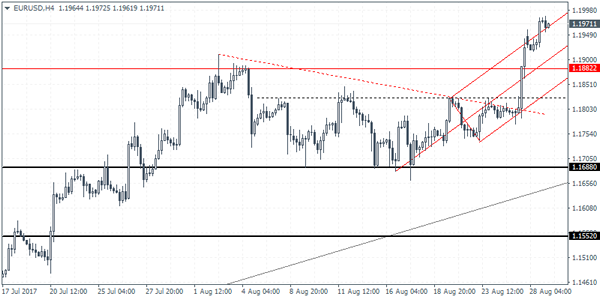
EURUSD (1.1971): The euro broke fresh highs yesterday as prices closed at 1.1977. The rebound came after a modest retracement, but price action turned bullish quite quickly. EURUSD looks to be all set to test the $1.2000 handle in the near term. However, the risk of a short term decline could see the common currency testing the support level at 1.1882 and 1.1824 levels. The bias in the EURUSD remains strongly supported to the upside until the gap around 1.2000 will be filled. This is likely to mark the end of the bullish rally in the euro before we can expect to see some kind of a pullback in prices.
British Pound Extends Losses As GDP Rises 1.7% On The Year
The UK's Office for National Statistics released the second revised estimate for the UK's GDP last week. According to the official data, the economic activity in the UK rose 0.3% in the quarter ending June.
This was broadly in line with the median estimates which expected to see an unchanged print from the first estimates. On a year over year basis, the UK's GDP was seen rising at an annual rate of 1.7% in the June quarter.
The ONS also said that the services sector managed to contribute to the GDP while the manufacturing and construction sectors posted a drag. Household spending was also seen weakening, rising just 0.1%. This was said to be the worst performance in consumer spending since the fourth quarter of 2014.
In the previous quarter, consumer spending was seen at 0.4%. Head of ONS GDP, Darren Morgan said that the weak exchange rate and inflation was hitting the household budgets.
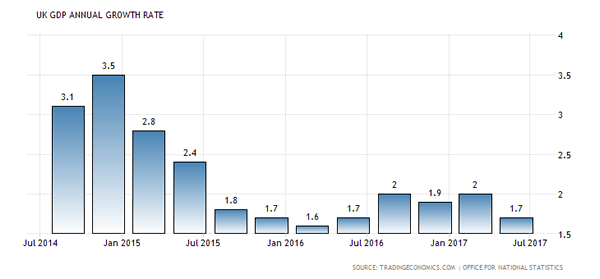
UK Annual GDP Growth Rate: 1.7%, Q2 2017. Source: Tradingeconomics.com
Government spending managed to offset some of the declines from the private consumption. Investments were however seen driven by largely on account of government spending and housing construction. Business investment remained flat for the month. Economists were expecting to see a 0.2% increase.
The UK's economy is expected to continue in this trend for the remainder of the year. Projections show that the UK's economy might average a 1.7% GDP annual growth rate this year. But they forecast that GDP could slow to as much as 1.5% in the next year.
The GDP growth rate also puts the UK as the slowest growing economy among the G7 economies. This was broadly attributed to the decision by the UK to leave the EU. The Brexit referendum was seen hitting business investment strongly and stalling any further plans.
Many financial institutions are also looking at ways to move into the European Union. The UK government is hopeful that it will complete the Brexit negotiations by March 2019.
Currently, preparations are underway by UK officials on how they wish to exit the EU. Key points of debate include retaining access to the single market and immigration.
UK retail sales posts fastest decline in a year
Last week, the Confederation of British Industry (CBI) released the retail sales report survey. According to the report, retail sales in the UK fell at the fastest pace in August. Data showed that 44% of retailers reported weaker sales volumes in August compared to the same month the year before. Anna Leach from CBI said that despite the warm weather, retail sales slowed. This was broadly attributed to the stronger inflation which has continued to put a squeeze on UK households.
Wages have remained broadly flat while inflation has overshot the BoE's 2% inflation target rate, rising to 2.6% last month. Some of the retailers in the survey remained optimistic however noting that they expect retail sales to pick up in September.
Data released a few weeks ago showed that retail sales in July managed to rise 0.3% on the month. This was slightly higher than the forecasts of a 0.2% increase. June’s retail sales figures were also revised down to show a 0.3% monthly increase.
On a year over year basis, retail sales in the UK rose just 1.7%. This was significantly lower from the revised 2.8% increase that was registered in the previous month. Excluding gasoline, retail sales rose 1.5% on the year, which managed to beat the forecasts but was still down from the previous month.
The British pound was seen weakening. The currency had briefly rallied to $1.325 levels in July. The gains came broadly on account of hawkish commentary from the Bank of England back then.
Yen Strengthens On North Korea Missile Launch
The US dollar was seen weakening once again on Monday. The dollar fell against the euro as investors bid up the common currency following Draghi's comments on Friday at the Jackson Hole symposium. Economic data was largely quiet yesterday.
Reports emerged earlier today that North Korea tested a missile which flew over Japan and landed in the sea. Investors rushed to the safe haven of the Japanese yen and gold which was seen strengthening as a result. Further reaction could be expected later in the day as the markets unfold.
Looking ahead on the economic front, the economic calendar today will include the French GDP numbers for the second quarter. No changes are expected as the second quarter GDP is expected to remain steady at 0.5%. In the US the conference board's consumer confidence data is also expected to come out.
EUR/CHF Daily Outlook
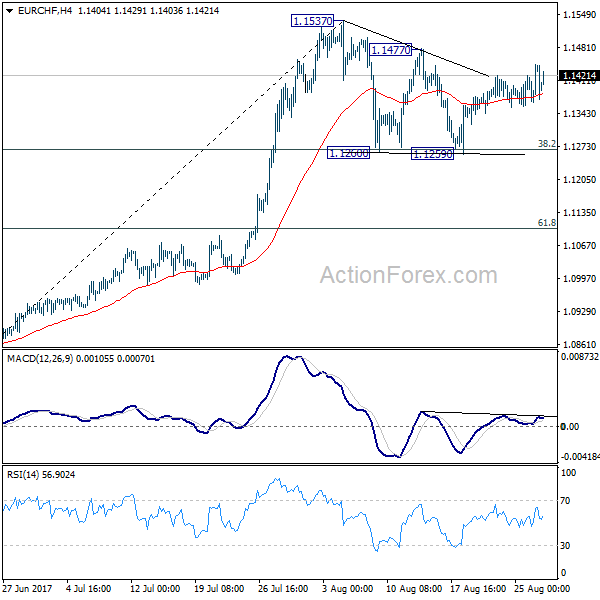
Daily Pivots: (S1) 1.1390; (P) 1.1418; (R1) 1.1469; More...
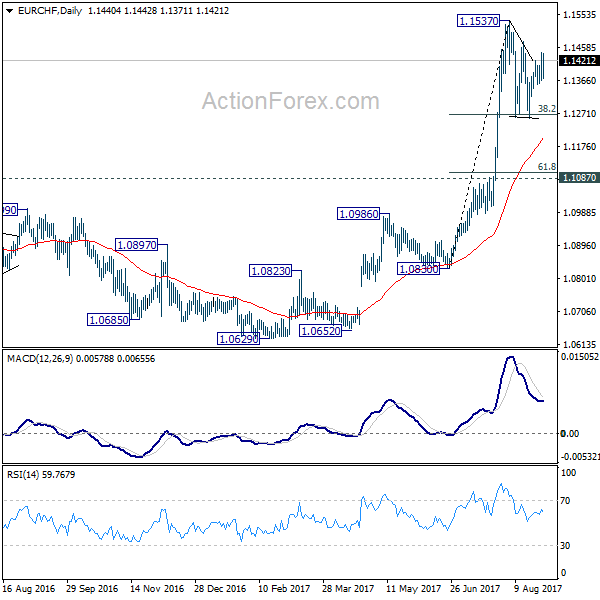
EUR/CHF is still staying in the consolidation pattern from 1.1537 and intraday bias remains neutral first. On the upside, break of 1.1477 resistance will argue that the consolidation from 1.1537 has completed and larger rise is resuming. Further break of 1.1537 will confirm and target 1.2 key resistance level next. On the downside, however, firm break of 38.2% retracement of 1.0830 to 1.1537 at 1.1267 will extend the correction to 61.8% retracement at 1.1100 before completion.
In the bigger picture, firm break of 1.1198 key resistance confirms resumption of the long term rise from SNB spike low back in 2015. In this case, EUR/CHF would eventually head back to prior SNB imposed floor at 1.2000. For now, this will be the favored case as long as 1.1087 resistance turned support holds.
Currencies: No Safe Haven Bid For The Dollar
Sunrise Market Commentary
- Rates: Geopolitical tensions boost US Treasuries, but for how long?
Risk aversion reigns cross markets overnight following the latest North Korean missile launch. The US Note future tests the contract high overnight. Geopolitical trading themes generally don't last very long. Some investors probably decide to hold a neutral view ahead of key US eco releases and a rumoured speech by US President Trump on his fiscal stimulus plans. - Currencies: no safe haven bid for the dollar
Yesterday, EUR/USD extented the post-Jackson hole gains and neared 1.20. Overnight, markets shifted in risk-off modus as a missile launch of North Korea triggers harsh verbal protest. This is a negative rather than a positive for the dollar. UK-EMU Brexit talks are still in a stalemate preventing a sterling rebound for now.
The Sunrise Headlines
- US equities ended nearly unchanged yesterday with Nasdaq slightly outperforming (+0.26%). Risk aversion reigns overnight following the latest North Korean rocket launch. Main Asian indices lose around 0.5%.
- North Korea has launched a ballistic missile that overflew Japan, undermining protracted US efforts to bring it to the negotiating table with an aggressive step it has not taken in almost 20 years.
- Saudi Arabia and Russia are pushing to extend their deal to limit crude oil production for another three months, which would leave the (non-)OPEC output deal in place through the end of June 2018, people familiar with the matter said.
- The EU's chief Brexit negotiator Barnier accused the UK of not "negotiating seriously" over its withdrawal and called on May's government to remove ambiguity about its stance.
- Romania, one of the fastest growing EU members, may join the euro zone in 2022, once the incomes of its poorest citizens rise, foreign minister Melescanu said.
- Greece must press ahead with implementing its reforms-for-aid programme and become more competitive, German FM Schaeuble was quoted as saying, adding that debt relief for Athens was "currently" not on the agenda.
- Today's eco calendar remains rather thin with only US consumer confidence and S&P housing prices.
Currencies: No Safe Haven Bid For The Dollar
EUR/USD nears 1.20 mark
On Monday, EUR/USD and USD/JPY initially held extremely tight ranges after Friday's ‘Jackson Hole decline of the dollar'. The lack of a correction on Friday's EUR/USD break higher convinced euro bulls of more upside. EUR/USD came within reach of the 1.20 barrier and closed the session at 1.1969. The decline of USD/JPY was more modest as equities performed rather well. The pair closed the session little changed at 109.25.
Overnight, markets shifted into risk-off modus as North Korea fired a missile that few over the north of Japan. The missile provoked a sharp verbal reaction from South Korea, Japan and the US. Japanese premier Abe and US president Trump extensively discussed the issue and agreed to raise the pressure on North Korea. South Korean stocks (-0.4%) and the won are underperforming. The yen plays its safe haven role with USD/JPY trading in the 108.80 area. The losses on Asian equity markets remain modest. The rise of tensions in Asia has little impact on EUR/USD. The pair trades in the 1.1975 area, holding within reach of the MT top.
The EMU calendar contains only French July consumer spending and the final Q2 GDP. No market impact is expected. US consumer confidence is expected to have declined slightly in August, (120.7 from 121.1). Other measures of consumer confidence (Michigan, Bloomberg) improved in August. The expected decline would be no reason of concern and we even don't exclude a rise in confidence instead of a decline. Strong consumer confidence might be lightly USD supportive. However, investors will give more weight to more important data later this week. The N-Korea inspired risk-off sentiment is a wildcard for FX trading. In the recent past, the impact of political event risk on global markets was limited and short-lived. The political rhetoric sounds a bit more harsh this time. That said, geopolitical tensions are currently not supportive for the dollar. Its safe haven appeal is rather low. The dollar needs in the first place data that are strong enough to raise rate hike expectations. This won't occur today. So some consolidation in USD/JPY is likely. A test of EUR/USD 1.20 is becoming ever more likely. Or will a risk-off topping out process in EUR/JPY help to stop the rise in EUR/USD?
Broader context and technical picture. Late June, EUR/USD started a new up-leg as investors anticipated a reduction of ECB bond buying. The Fed was expected to normalize policy only in a very gradual way as US inflation remains soft.
Uncertainty on the policy of the Trump administration was a secondary negative factor for the dollar. EUR/USD set a new correction top north of 1.19 before consolidating in a narrow 1.1662/1.1910 range. The top of this range was broken after Jackson hole. The day-to-day momentum remains euro positive. However, in MT perspective, we assume that the EUR/USD rebound has gone far enough if the recent improvement in US eco situation will be confirmed. A return of EUR/USD to the 1.15/16 area is possible. Pockets of US political risk are a (negative) wildcard for the dollar. We wait for a technical signal.
A downward correction in core (US and European) yields supported the yen in August. USD/JPY declined from mid-114 mid-July to 108.60. The April correction low (108.13) remains the line in the sand. For now, this level won't be easy to break as quite some USD bad news is discounted after the recent protracted setback. A cautious buy-on-dips approach (with stop-loss protection below 108) may be considered.
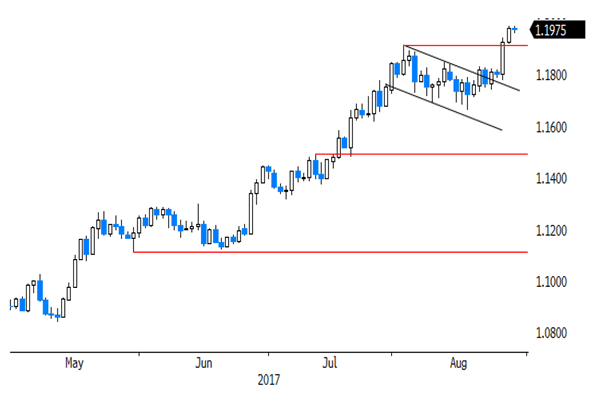
EUR/USD: ‘by default' euro buying persists. 1.20 within striking distance
EUR/GBP
EUR/GBP holding near the recent top
Yesterday, sterling trading volumes were low as UK markets were closed for the Summer Bank holiday. Cable and EUR/GBP basically maintained the moves after the Jackson hole speeches of Yellen and Draghi on Friday. EUR/GBP held in the mid-0.92 area. EUR/GBP closed the session at 0,9263 on a strong close of the euro. Cable finished the day at 1.2933.
Overnight, the reactions after the start of the third round of the Brexit talks shows that little progress has been made. EU negotiator Barnier repeated that the UK needs to bring clarity on the separation issues. For now, this stalemate in the negotiations has little negative impact on sterling, but UK sterling traders still have to return from a long weekend. The Halifax house prices were slightly softer than expected at -0.1% M/M and 2.1% Y/Y. There are no other UK data, but again plenty of Brexit headlines. For now, they are not sterling supportive. Even so, EUR/GBP already discounts plenty of UK negative news. We look for a signal that the rally slow.
From a technical point of view, EUR/GBP cleared the 0.8854/80 resistance (top end June), opening the way for further gains. The move was the result of euro strength. Simultaneously, UK price data were soft enough to keep the BoE sidelined. MT, we maintain a buy EUR/GBP on dips approach as we expect the combination of relative euro strength and sterling softness to persist. The 0.9415 ‘flash-crash spike' is the next target on the charts. However, we don't jump on the up-trend anymore after the recent rally and wait for a correction, e.g. to the technical support in the 0.88/89 area.
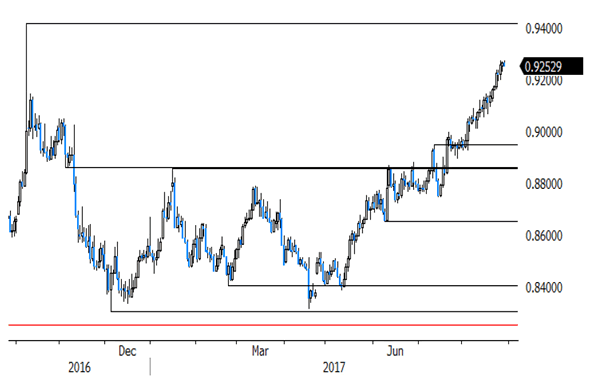
EUR/GBP: holding near recent top on euro strength
Another Wave of Escalation in North Korean Crisis
North Korea this morning fired what was likely an intermediate-range ballistic missile over Japan into the Pacific. After a short period of calm the North Korean crisis is again escalating.
How serious is this? The missile test is clearly a strengthening show of force from North Korea to show they are not bending to US demands. That the missile is flying over Japanese territory is a clear provocation, although not the first time it has happened. As late as 2016 North Korea fired a rocket over Okinawa. At the same time, North Korea did not go through with its' plans to send the missiles close to the waters of Guam as they had indicated on 9 August. Kim Jong Un had said he was reconsidering this and the missiles into the Pacific can to some extend be seen as a moderation compared to the initial plans. Japanese Foreign Minister Taro Kono said the launch to the east rather than to the south towards Guam was a sign Pyongyang 'flinched' in the face of US warnings.
North Korea had warned that the annual military exercises of US and South Korea taking place during these weeks would trigger a reaction. The so-called Ulchi-Freedom Guardian military exercises started earlier this month. It is not unusual that these exercises escalate tensions. Last year North Korea launched a missile from a submarine around the time of the exercises and put its military on high alert. China had asked US and South Korea to suspend the drills this year in order to ease the conflict and pave the way for diplomatic talks.
What's next? Following today's launch Japan has asked the United Nations Security Council to hold an emergency meeting. More sanctions may be imposed but we still see war as a very low probability as the risks involved on both sides are simply too big. Ultimately we believe that we will have talks between the involved parties. But before that both sides will need to illustrate a big show of force to strengthen the positon at the negotiating table. What the response might be from the US side this time is not clear. But a military strike does not seem likely.
A diplomatic solution is difficult as it will require on the one hand that North Korean demands for an end to the annual military exercises are difficult to obtain because US and South Korea sees a big threat from North Korea. Similarly the demand from the US for North Korea backing down from their nuclear ambition is also difficult as long as they see the US as a major threat. Eventually there is only a diplomatic solution to this as a military conflict would entail severe losses on both sides. But the road there will not be easy and we are likely to see continued waves of escalations before the parties are ultimately pushed to the negotiating table.
Market outlook: The markets reacted again with the usual safe haven flows sending equities and bond yields lower. Asian stocks took a hit again as after the recent escalation. But things will likely calm down again soon and markets recover. Overall, though, the crisis is keeping risk appetite dented as long as we see these continued waves of escalation. In combination with the looming US debt limit deadline coming closer risk markets will find it hard to gain real momentum despite overall positive growth numbers at the moment.
Below are an outline of recent events:
29 August:
North Korea fires missile over Japan into the Pacific
16 August:
Trump praises Kim Jong Un for 'wise' decision on Guam
15 August:
Kim Jong Un said he would watch the actions of the US for a while longer before making a decision to strike the area around Guam with missiles.
14 August:
South Korean President Moon Jae-In said Seoul would avoid a second Korean War at all costs and that "Military action on the Korean Peninsula can only be decided by the Republic of Korea and no one may decide to take military action without the consent of the Republic of Korea". US Defence secretary James Mattis said if North Korean missiles were considered to threaten Guam "then it's game on"
11 August:
Trump tweets that "Military solutions are now fully in place, locked and loaded, should North Korea act unwisely. Hopefully Kim Jong Un will find another path!"
9 August:
North Korea army says it plans to launch missiles to hit close to the American island Guam in mid-August. Rex Tillerson says he sees no "imminent threat" of North Korea attack. "Americans should sleep well at night".
8 August:
US intelligence officials concludes that North Korea has successfully produced a miniaturized nuclear warhead that can fit inside its missiles. If true it would mean that North Korea could already have reached their aim of having capability of reaching the US with a nuclear warhead as Intercontinental Ballistic Missiles (ICBM) tested twice in July would have been able to reach US if fired at a lower angle. Trump says that US would respond with "fire and fury like the world has never seen" if North Korea persisted threatening US. The statement was apparently improvised and said to surprise his aides.
5 August:
UN take unanimous decision to launch new sanctions on North Korea. Among other things it introduces a full ban on coal, iron and iron ore to banned commodities for import. Estimates say it may cost up to USD1bn per year for North Korea.
1 August:
US Secretary of State Rex Tillerson says US is willing to talk to North Korea saying North Korea is not the enemy of the US and that US does not seek regime change. The precondition for talks, though, is that North Korea backs down from their nuclear pursuit. North Korea denies to back down and demands that US and South Korea stops annual military exercises (expected to kick off later this month). The US reject this request. Tillerson has generally been the calm and responsible voice on the North Korean issue.
Market Update – Asian Session: Geopolitical Tensions Rise To New Highs As North Korea Launches A Missile Over Japan
Asia Summary
Asian equity markets opened mixed as early in the morning North Korea launched a mid-range ballistic missile that crossed over Japan’s air space (1st since 2009) before landing in the sea. S&P futures opened sharply lower, gold rose as geopolitical tensions rose to a new level. Crude is higher as hurricane Harvey continues to impact oil refineries and we may soon see impact on retail distribution as trucks are redirected to rescue and relief efforts. South Korea President Moon has ordered military to stage a show of force; 4 F-15K jet fighters conducted bomb-dropping drill. While Japan PM Abe and President Trump agreed to increase pressure on North Korea; want to call on China and Russia to play a role in North Korea. UN Security Council will hold a meeting later today. USD/KRW rose 0.8% to 1,126.70, while the Kospi fell over 1%. Many analysts are attributing the market reaction to risk off sentiment and the continued concern over US debt ceiling and possible government shutdown. Notably in China the PBOC made its first injection of CNY10B after several drains and the yuan strengthened to its highest against the dollar since June 2016.
Key economic data
(KR) South Korea Sept Business Manufacturing Survey: 83 v 78 prior; Non-Manufacturing Survey: 78 v 77 prior
(AU) Australia ANZ Roy Morgan Weekly Consumer Confidence Index: 113.5 v 109.2 prior
(JP) JAPAN JUL JOBLESS RATE: 2.8% V 2.8%E
(JP) JAPAN JUL OVERALL HOUSEHOLD SPENDING M/M: -1.9% V +1.5% PRIOR; Y/Y: -0.2% V +0.7%E
(AU) Australia Jul HIA New Home Sales m/m: -3.7% v -6.9% prior
Speakers and Press
China/Hong Kong
(CN) Deputy to the 12th National People’s Congress Lai Xiaomin: There are bubble characteristics in the distressed debt market as the growing market attracts many newcomers with little experience are driving up auction prices
(CN) China Economic Information Daily in a comment piece: Issuance of treasury bonds should be the main method for local governments to raise new funding to curb the need for illegal financing
(CN) PBOC Official Gongsheng: Aiming to offer more bondproducts - Chinese press
Korea
(KR) South Korea: Plans KRW429T budget for 2018 (record)
(KR) North Korea has launched a missile headed toward northern Japan, which landed in Sea of Japan, passing over the country - Japanese press
Other
(US) US Commerce Sec Ross: Postpones final determination related to Canada softwood lumber to Nov 14th
Asian Equity Indices/Futures (00:00ET)
Nikkei -0.6%, Hang Seng -0.4%; Shanghai Composite +0.1%, ASX200 -1.0%, Kospi -1.1%
Equity Futures: S&P500 -0.6%; Nasdaq100 -0.7%, Dax -0.6%, FTSE100 -0.5%
FX ranges/Commodities/Fixed Income (00:00ET)
EUR 1.1986-1.1956; JPY 108.95-108.34; AUD 0.7939-0.7906; NZD 0.7255-0.7221
Dec Gold +0.5% at $1,321/oz; Oct Crude Oil +-0.5% at $46.80/brl; Sept Copper +0.1% at $3.09/lb
GLD SPDR Gold Trust ETF daily holdings higher by 9.16 tonnes to 814.36 tonnes
USD/CNY *(CN) PBOC SETS YUAN REFERENCE RATE AT 6.6293 V 6.6353 PRIOR
(CN) China PBOC OMO injects CNY50B in 7 day v CNY100B prior in 7 and 14-day reverse repo prior; Net injection CNY10B v drain CNY100B prior
(KR) South Korea sells 30-yr treasury bonds at 2.365%
(TH) Thailand Central Bank sells combined THB60B in 3-month and 6-month bonds
Equities notable movers
Australia/New Zealand
SDL.AU Shut in ~75% of Eagle Ford operations due to Harvey; +20%
ALU.AU Reports FY17 (A$) Net 28.1M v 23.0M; EBIT 29.5M v 24.6M y/y; Rev 110.9M v 93.6M y/y; +10%
SFH.AU Reports FY17 (A$) Net loss 8.4M v loss 2.2Me; underlying EBITDA 26.7m v 25.0M y/y; Rev 808.9M v 826.2M y/y; -24%
Hong Kong/China
285.HK Reports H1 (CNY) Net 1.32B v 0.60B y/y, Rev 17.5B 15.5B y/y; -8%
3333.HK Reports H1 (CNY) Net 23.1B v 7.13B y/y, Rev 188.0B v 87.5B y/y; +4.6%
North Korea Fires Missile Over Japan
On Tuesday, North Korea fired a missile that flew over Japan and landed in the Pacific Ocean, approximately 1,180 kilometers (735 miles) off the northern region of Hokkaido, in a sharp escalation of tensions on the Korean peninsula. The implications of a missile flying over Japan are likely to be severe with condemnation expected from the UN and the US. With tensions rising again, USD was sold and the market sought safe havens.
On Monday, crude oil prices dropped as flooding from Tropical Storm Harvey inundated refining centers along the Texas coast, shutting more than 10% of US fuel-making capacity. The financial cost of Harvey is likely to be considerable, with analysts predicting costs in excess of $25 Billion, but the markets are aware it will take considerable time before the true impact is calculated. Regardless of the cost, the resulting rebuild is likely to have a positive impact on the US economy. WTI was down over 3.5% on Monday, trading as low as $46.27pb; levels not seen since July, as the markets are concerned that US refineries will not be able to operate at the high run rates they had in July and August, therefore reducing demand for crude oil.
The US Commerce Department released data on Monday showing that the goods trade gap increased 1.7% to $65.1 billion in July. Exports declined 1.3%, weighed down by an 8% drop in motor vehicles shipments. Data also showed decreases in exports of consumer goods, however, capital goods exports rose 1.5%. Whilst inventory data is weak, the markets are remaining optimistic that inventory investment will contribute to Q3 growth.
EURUSD traded to a 2 and a half year high on Monday at 1.1975. EUR benefitted from the lack of information from ECB President Draghi in regards to the ECB’s next steps in monetary policy. Overnight EURUSD strengthened to 1.1985 and is currently trading around 1.1975.
USDJPY was sold because of North Korea’s missile test, as the markets moved into the traditional safe haven Yen. USDJPY, down 0.5%, traded as low as 108.33 in early Tuesday trading. Currently, USDJPY is trading around 108.85.
GBPUSD traded higher on Monday, as the U.K. and European Union’s (EU) third round of Article 50 negotiations began with officials meeting in Brussels. The markets are expecting the UK to offer a softer stance with regards to immigration and future ties. Currently, GBPUSD is trading around 1.2945.
Gold increased over 1.2% on Monday, to trade as high as $1,307.61; levels not seen since November last year. Lower US Treasury yields and weaker equity markets have resulted in Gold bulls returning to the market. With the recent missile launch by North Korea, demand has increased for safe havens with Gold reaching a high of $1,324.33 in early Tuesday trading. Gold is currently trading around $1,317.
WTI fell over 3.5% on Monday to a low of $46.27pb, but has recovered in early Tuesday trading to currently trade around $46.95pb.
Tuesday is a relatively light day for impactful economic data releases.
At 13:00 BST, the S&P/Case Shiller Home Price Indices (YoY) for June will be released. Consensus suggests an unchanged reading of 5.7%. The US housing market appears to be relatively strong so markets will be expecting an unchanged or, potentially, stronger reading which may provide some respite for the currently poor performing USD.
Hurricane Harvey And North Korea Tension Triggered A New Wave Of The Hunt For Safety
Greenback Was Dragged Down By Hurricane Harvey. U.S. dollar weakened against its peers as traders worried that weak trade data and the impact of Hurricane Harvey would put a large dent on quarterly growth figures.
Canadian Dollar Lower Ahead of US Jobs Data. The oil-related Loonie was pushed lower, even after Canadian Prime Minister Justin Trudeau sought to reassure markets that Trump’s NAFTA remarks are nothing new. US employment data on Wednesday, August 30 is the highlight this week, with a special emphasis on wage growth data to look for signs of inflation.
Yen Benefits As Geopolitical Tensions Rise. The dollar tumbled to a four-month low against the yen early on Tuesday after North Korea fired a missile that flew over northern Japan and landed in the Pacific waters off the northern region of Hokkaido, South Korea. That was the latest act of provocation by Pyongyang that has escalated tensions in the region over the past month. The Japanese yen strengthened nearly 0.7% against the US dollar, to the 108.8 area this morning, its highest since April 18.
Gold Gaps to $1324 On Missile Provocation. Safe-haven demand has been in play. The gold price surged to its highest level since the November election and closed above the US$1,300 mark for the first time in nearly 10 months.
Crude Oil Down Nearly 3%. Crude oil prices are sinking as many refinery sites were closed due to Hurricane Harvey, delivering a negative impact to the economy. The damage brought by Harvey, which includes the cost of rebuilding, insurance, and loss of jobs, is devastating. According to the Bureau of Safety and Environmental Enforcement, approximately 331,370 barrels of oil per day has been shut in, leading to an excess of Black Crack supplies for the week. The U.S. National Hurricane Center predicts that the storm will move over to Louisiana, which churns out around 3.3 million barrels per day, within the week.
Watch Out Tomorrow For:
WED., 10:00 am GMT: GBP Inflation Report Hearings
WED., 13:30 pm GMT: USD Gross Domestic Product
Daily Technical Analysis: EUR/USD Approaches New Bounce Or Break Spot At 1.20 Target
Currency pair EUR/USD
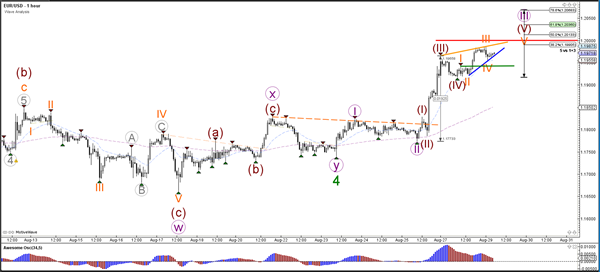
The EUR/USD bullish breakout reached the first target at the round level of 1.20 (red line). Price is at a decision zone now (bounce or break spot) and could make a larger correction at the 1.20 resistance zone such as a wave 4 (blue). A bullish break above 1.20 could signal a potential uptrend continuation.
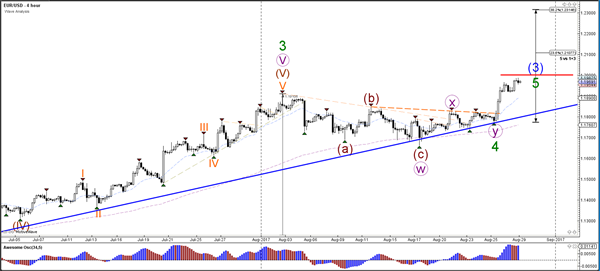
A bearish bounce at 1.20 could create a rising wedge chart pattern (orange/blue) within wave 5 (brown). The EUR/USD does not have to be as large as the wave 4 (blue) on the 4 hour chart because price could also complete a wave 3 of lower degree (purple) at the resistance (red). The size of the expected correction will depend on the chart patterns which unfold at 1.20.
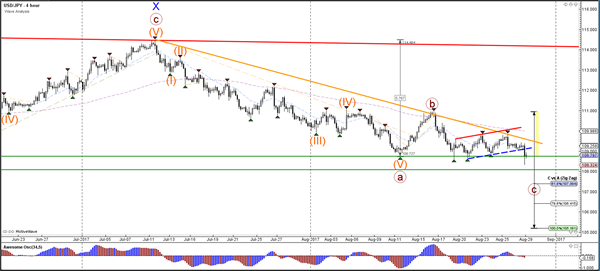
Currency pair USD/JPY
The USD/JPY is trying to break the larger support zone (green lines) and such a bearish break could indicate a downtrend continuation within wave C (brown).
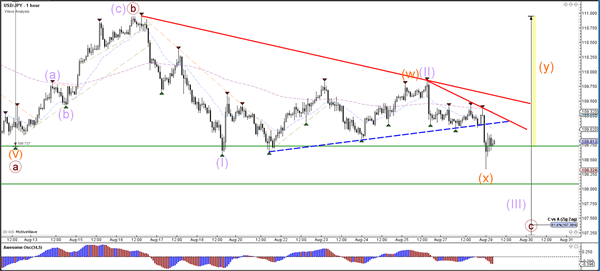
The USD/JPY is either building a bearish wave 3 (purple) or it's still expanding the correction via a WXY (orange). Price will need to break the support to confirm the bearish direction.
Currency pair GBP/USD
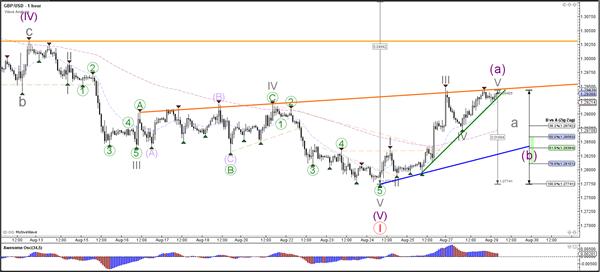
The GBP/USD bullish breakout seems to be part of wave A (purple) of a larger wave 2 (red) correction. The 38.2% Fibonacci retracement level could be a resistance point.
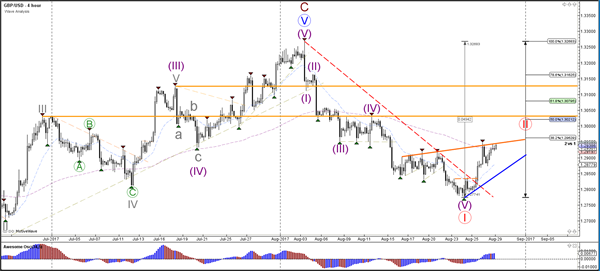
The GBP/USD seems to be building 5 bullish waves (grey) after breaking above multiple resistance trend lines (dotted orange). Price could bounce at the active resistance (orange) trend line and start an ABC (grey) correction within wave B (purple). The Fib levels of wave B vs A could act as support for a bullish bounce to complete wave C.