

Sample Category Title
Trade Idea Update: GBP/USD – Sell at 1.2920
GBP/USD - 1.2858
Original strategy :
Sell at 1.2920, Target: 1.2820, Stop: 1.2955
Position : -
Target : -
Stop : -
New strategy :
Sell at 1.2920, Target: 1.2820, Stop: 1.2955
Position : -
Target : -
Stop : -
As cable has remained under pressure after breaking below support at 1.2933-40, adding credence to our bearish view that the decline from 1.3269 top is still in progress for retracement of early upmove, hence downside bias remains for further weakness to 1.2825-30 (61.8% projection of 1.3269-1.2940 measuring from 1.3032), having said that, near term oversold condition should limit downside to 1.2800 and reckon 1.2770 would hold from here, bring rebound later.
In view of this, would not chase this fall here and would be prudent to sell sterling on recovery as said previous support at 1.2933 should turn into resistance and cap cable’s upside, bring another decline. Above 1.2950 would defer and risk a stronger rebound to 1.2990-00 before another decline.
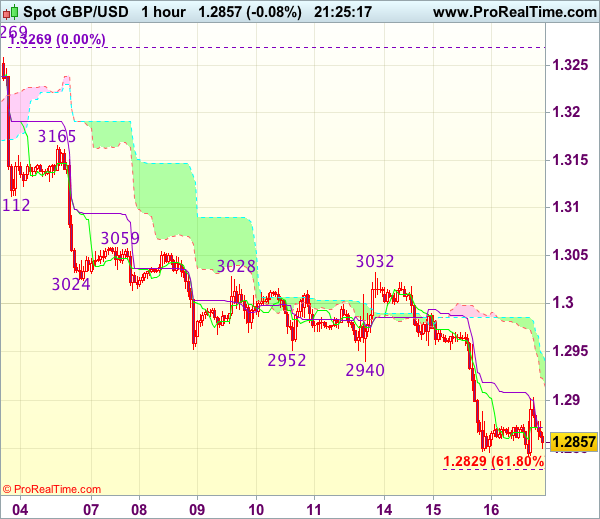
GBP/USD Mid-Day Outlook
Daily Pivots: (S1) 1.2819; (P) 1.2894; (R1) 1.2943; More...
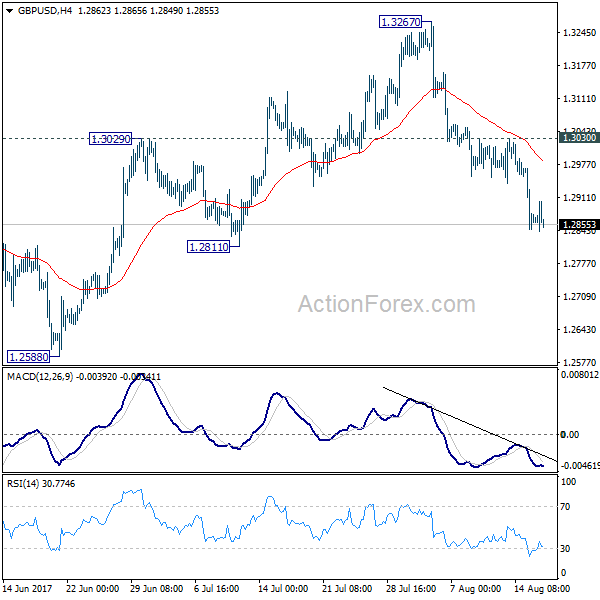
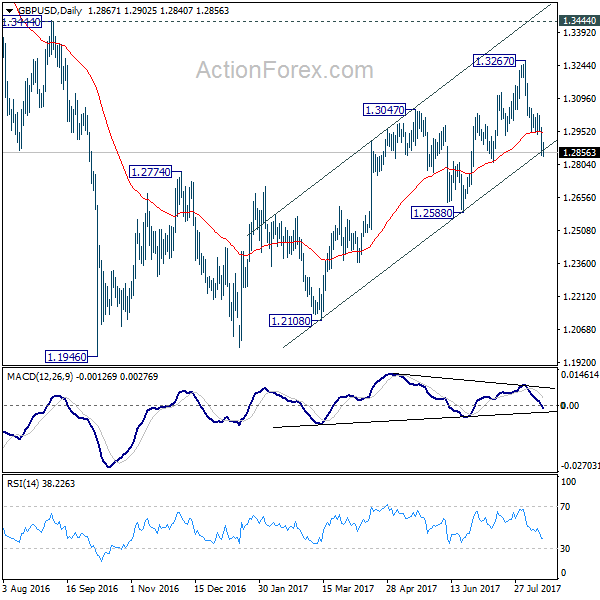
Intraday bias in GBP/USD remains on the downside as fall from 1.3267 is still in progress. Further fall should be seen to 1.2588 key near term support. As noted before, correction from 1.1946 is likely completed at 1.3267. Decisive break of 1.2588 will confirm our bearish view. On the upside, break of 1.3030 resistance is needed to indicate short term bottoming. Otherwise, outlook will stay cautiously bearish in case of recovery.
In the bigger picture, overall, price actions from 1.1946 medium term low are seen as a corrective pattern. While further rise cannot be ruled out, larger outlook remains bearish as long as 1.3444 key resistance holds. Down trend from 1.7190 (2014 high) is expected to resume later after the correction completes. And break of 1.2588 will indicate that such down trend is resuming.
Canadian Dollar Edges Higher as US Housing Reports Miss the Mark
The Canadian dollar has posted slight gains in the Wednesday session. In North American trade, USD/CAD is trading at 1.2726, down 0.25% on the day. On the release front, Canadian Foreign Securities Purchases shocked the markets, recording a decline of $C0.92 billion, compared to an estimate of a gain of $C 23.45 billion. This marked the first decline since December 2015. In the US, housing numbers were softer than expected. Building Permits dipped to 1.22 million shy of the forecast of 1.25 million. Housing Starts slowed to 1.16 million, missing the estimate of 1.22 million. Later in the day, the FOMC will release the minutes of its July policy meeting. On Thursday, there are two major events in the US – unemployment claims and the Philly Fed Manufacturing Index.
The Federal Reserve releases its July minutes on Wednesday, and the markets will be listening closely. Although we're unlikely to learn anything new about the likelihood of a rate hike before the end of the year, analysts will be looking for further details about the Fed's balance sheet, which has ballooned to $4.2 trillion. At the June policy meeting, the Fed outlined plans to begin reducing the balance sheet, but shied away from providing any details regarding the size of the reductions or a start time for the plan. Analysts expect September will be the start date, and the Fed could start the process by slowing its asset purchases by modest amount, such as $10 billion/mth. Once the reductions start, the US dollar stands to make gains for two reasons. First, the move would mark a vote of confidence in the US economy. Second, a reduction of $60 billion is expected to have the same effect as a quarter-point rate hike, which would make the dollar a more attractive asset for investors.
The Canadian dollar has lost ground in August, but has still looked hot this summer, jumping 5.7% since June 1. Some of these gains are linked to oil prices, which jumped sharply in July. At the same time, Canadian indicators have generally been strong, with a GDP gaining 0.6% in May, and the labor market showing improvement. In July, the Bank of Canada raised interest rates by 25 basis points to 0.75%. This was the first time the BoC raised rates since 2010, and the move has helped boost the currency. Despite the economic growth, Canada continues to grapple with weak inflation. CPI declined in June (the first decline in 2017), and the markets are braced for another soft reading on Friday, with an estimate of a flat 0.0%.
Dollar Index Ticked Lower after Downbeat US Housing Data
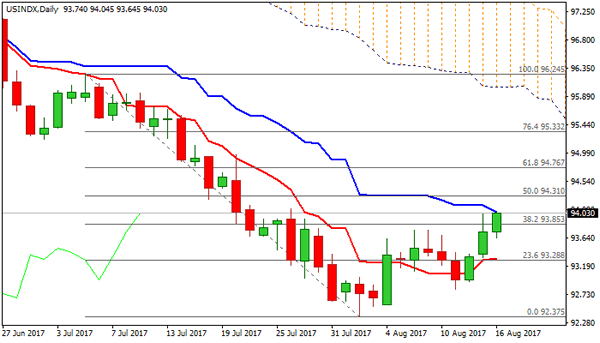
The dollar index ticked lower after downbeat US housing data (building permits unexpectedly dropped by 4.1% in July, undershooting the forecast for 2% fall and well below 9.2% increase in June, while Housing starts were down 4.8% in July against forecasted rise of 0.5% and increase of 7.4% in June). Weaker than expected data so far did not show stronger impact dollar's bulls which were boosted by strong retail sales on Tuesday, however, the dollar continues to struggle at psychological 94.00 barrier (reinforced by falling daily Kijun-sen). Today's repeated rejection at 94.00 and yesterday's failure to close above 93.85 (Fibo 38.2% of 96.24/92.37) suggests that strong recovery rally from Monday might be running out of steam but also awaiting FOMC minutes, due later today, for further signals. Traders are expecting Fed to provide more guidance about next steps and timing on massive balance sheet reduction as well as firmer signals about possible rate hike towards the end of the year. More hawkish tone from minutes would further boost the greenback and index price would rise above 94.00 barrier towards Fibo barriers at 94.31 and 94.75, with psychological 95.00 resistance expected to come in focus. Softer tone from Fed, on the other side, would allow for deeper pullback and expose solid support at 93.30 (daily Tenkan-sen).
Res: 94.00; 94.31; 94.75; 95.00
Sup: 93.64; 93.30; 93.00; 92.82
Trade Idea Update: EUR/USD – Hold short entered at 1.1755
EUR/USD - 1.1695
Original strategy :
Sold at 1.1755, Target: 1.1655, Stop: 1.1790
Position : - Short at 1.1755
Target : - 1.1655
Stop : - 1.1790
New strategy :
Hold short entered at 1.1755, Target: 1.1655, Stop: 1.1755
Position : - Short at 1.1755
Target : - 1.1655
Stop : - 1.1755
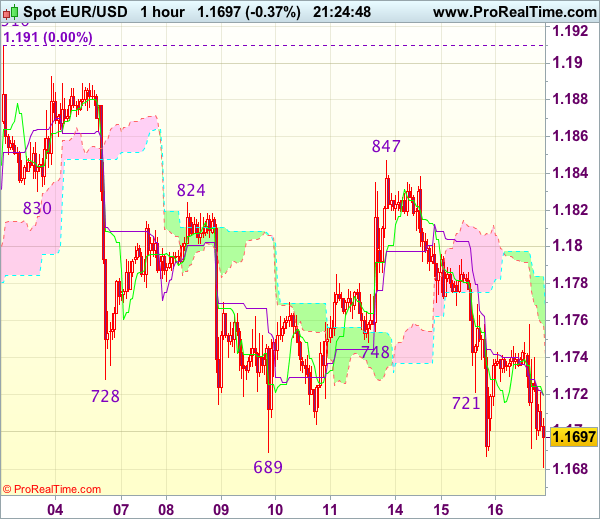
Euro’s selloff after meeting renewed selling interest at 1.1847 signals the erratic fall from 1.1910 top is still in progress and mild downside bias remains for further weakness to 1.1640-50 (50% Fibonacci retracement of 1.1370-1.1910 and previous support), below there would encourage for subsequent decline towards 1.1600-10 which is likely to hold from here due to near term oversold condition.
In view of this, we are holding on to our short position entered at 1.1755. Above 1.1755-60 would defer and risk a stronger rebound to 1.1790-95, break there would abort and signal a temporary low is possibly formed, bring subsequent gain to 1.1820 but price should falter below said resistance at 1.1847.
Trade Idea Update: USD/JPY – Buy at 110.20
USD/JPY - 110.85
Original strategy :
Buy at 110.20, Target: 111.20, Stop: 109.85
Position : -
Target : -
Stop : -
New strategy :
Buy at 110.20, Target: 111.20, Stop: 109.85
Position : -
Target : -
Stop : -
As the greenback has risen again after brief pullback, adding credence to our bullish view that the rebound from 108.73 low is still in progress, hence gain to previous resistance at 111.05 cannot be ruled out, however, break there is needed to retain bullishness and extend this rise for a stronger correction of early decline to 111.25-30, having said that, near term overbought condition should prevent sharp move beyond previous resistance at 111.71, risk from there is seen for a retreat later.
In view of this, would not chase this rise here and would be prudent to buy dollar on pullback as 110.15-20 should limit downside. Only below previous resistance at 109.80 would abort and signal top is formed instead, bring weakness towards support at 109.42.

NZD/USD Hit Another Downside Target
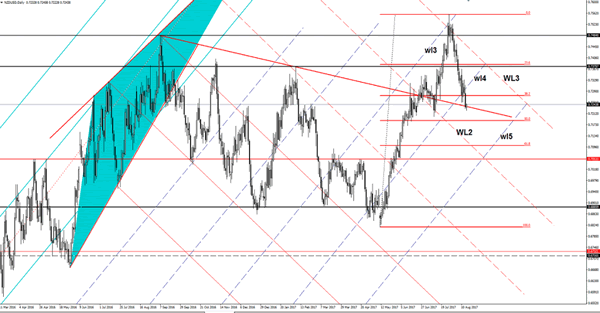
NZD/USD dropped as much as 0.7222 level, where has found support again. Price squeezed a little in the last hours, but this could be only temporary because remains under selling pressure. USD is expected to drive the rate much lower on the Daily chart as the dollar index is trading above the 94.00 psychological level. A valid breakout above the psychological level will confirm a larger rebound and a USD dominance.
The greenback needs more support from the United States data to be able to resume the upside movement. The US will publish the Building Permits later, which are expected to decrease from 1.28M to 1.25M in July, while the Housing Starts could remain steady at 1.22M for the second month in July. The main event will be the release of the FOMC Meeting Minutes, we may have a high volatility after this event.
NZD/USD tries to recover after the massive drop. You can see that has found strong support at the red downtrend line, a false breakdown below this obstacle will send it towards the 38.2% retracement level. Technically is expected drop further after the breakdown below the fourth warning line (wl4).
We may have a rebound only if the USDX will slide again. The next major downside targets remain at the fifth warning line (wl5) and at the WL2. A minor increase could signal a Head and Shoulders pattern on the Daily chart.
USD/JPY Still Sideways
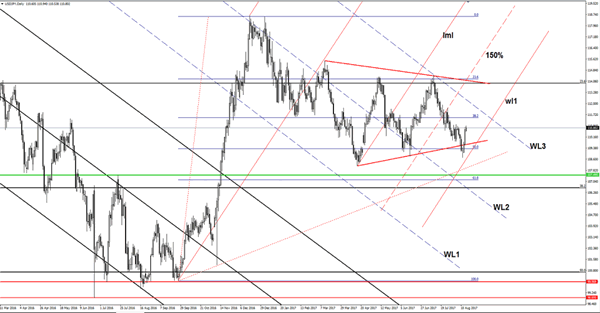
Price continues to move sideways on the Daily chart as the Nikkei failed to resume the corrective phase. The rebound invalidated the breakdown from the symmetrical triangle and now is expected to reach and retest the 38.2% retracement level and the third warning line (WL3). A valid breakout above the WL3 will confirm a further increase in the upcoming weeks, while only a valid breakdown below the wl1 will signal a major drop.
AUD/USD Throwback
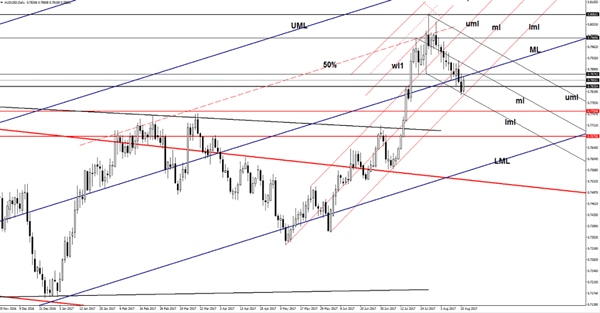
Price increased significantly today and now is retesting the median line (ML) of the major ascending pitchfork. It has erased the yesterday's losses, even if the USDX stays higher. Could drop again if the US data will come in better later and the FOMC Meeting Minutes will signal a rate hike in the upcoming period.
Has found support at the lower median line (lml) of the minor descending pitchfork and now could climb to retest the median line (ml) as well. Only a valid breakdown from the minor ascending pitchfork will confirm a major drop.
Pound Trying to Hold Steady after Steep Decline
The British Pound is trying to steady its stance at 1.28, after stronger than expected UK wage growth figures spared it from further losses, following a heavy decline noted in the latest inflation figures that were released yesterday.
Once the results of the UK jobs report are absorbed by the headlines, these are unlikely to remain a key driver behind British Pound price action. The UK inflation data has crumbled optimism over the Bank of England (BoE) raising interest rates any time soon. I think that even the most cautious optimist must be realizing that the case for the BoE to raise UK rates over the coming months is very slim. The Sterling is more sensitive to monetary policy speculation than anything else at present. This means that with interest rate rise talk fading into the background, this will result in many buyers losing interest in the Pound. I don't think there are any chances that the BoE will be raising UK interest rates over the upcoming months.
Let's also not forget that Governor Carney famously flirted with the prospects of higher UK interest rates just a few years ago, before backtracking. While the BoE has previously flirted with increasing interest rates, there is no reason for the Monetary Policy Committee (MPC) to vote for higher rates any time soon.
The only reason for the interest rate talk in the first place are UK inflationary pressures, but the British Pound, rebounding from its milestone 30+ year low below 1.20 in late 2016, should ease inflationary pressures later this year. This, coupled with the ongoing EU uncertainty and falling growth, will ultimately encourage the BoE to at least maintain rates at the current record low.
There is no real incentive for investors to be long on Pound as it stands. Unless there is another round of excessive USD weakness, traders are likely to jump on future opportunities to enter selling positions, when the Pound/Dollar is trading above 1.30.
EURUSD continues dipping lower
The Eurodollar is continuing to gradually ease away from its two-year high above 1.19, which was seen earlier this month, with the EURUSD at risk to dipping below 1.169 at time of writing. Reports that ECB President, Mario Draghi, will downplay any policy shift announcement at next week's Jackson Hole conference, seems to have been used as a catalyst to sell the Euro. I also wouldn't rule out the possibility that investors might be starting to price some German election premiums, into their portfolios.
With this in mind, the Euro has rallied significantly in recent months and it is possible that the EURUSD will remain under pressure in the near-term. My view is that Euro buyers will consider entering more buying positions on EURUSD, as it heads towards 1.15.
Investors need to remain alert ahead of FOMC minutes
I don't think US interest rate expectations are as dead in the water, as the markets have suggested in recent weeks. If the FOMC minutes release, due this evening, provides a hint to investors that the Federal Reserve could pull the trigger on another US interest rate rise late in 2017, the USD is in line to receive another bid.