

Sample Category Title
EUR/USD Mid-Day Outlook
Daily Pivots: (S1) 1.1753; (P) 1.1796 (R1) 1.1822; More...
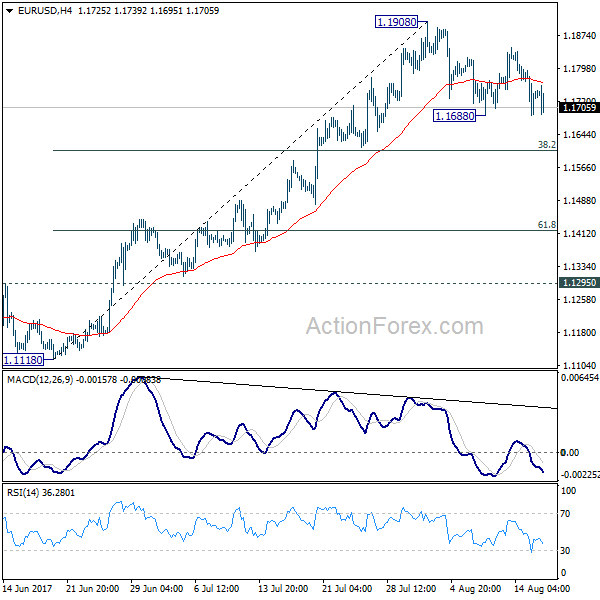
EUR/USD dips mildly today but it's staying above 1.1688 support and intraday bias stays neutral. Consolidation from 1.1908 is still in progress and deeper pull back might be seen. But downside should be contained by 38.2% retracement of 1.1119 to 1.1908 at 1.1606 to bring rebound. On the upside, break of 1.1908 will extend recent up trend to 1.2042 long term support turned resistance next.
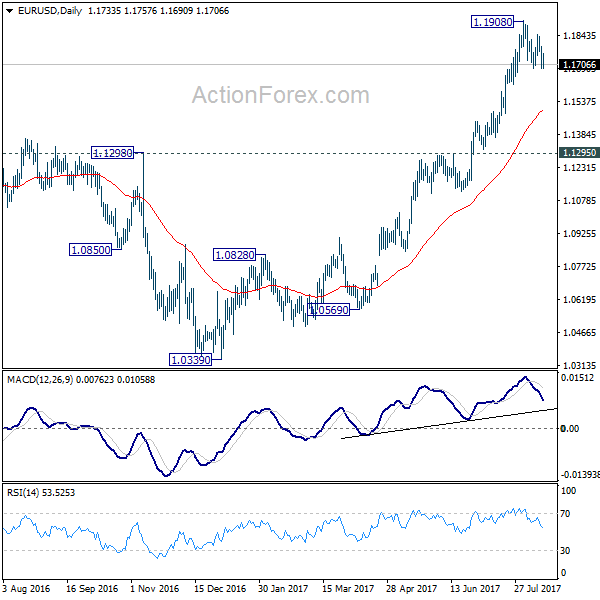
In the bigger picture, an important bottom was formed at 1.0339 on bullish convergence condition in weekly MACD. Sustained trading above 55 month EMA (now at 1.1768) will pave the way to key fibonacci level at 38.2% retracement of 1.6039 (2008 high) to 1.0339 (2017 low) at 1.2516. While rise from 1.0339 is strong, there is no confirmation that it's developing into a long term up trend yet. Hence, we'll be cautious on strong resistance from 1.2516 to limit upside. But for now, medium term outlook will remain bullish as long as 1.1295 support holds, in case of pull back.
Euro Mildly Lower as ECB Draghi Won’t Deliver Big Monetary Policy Speech at Jackson Hole
Commodity currencies are the strongest performers today as lifted by firm risk appetite. European indices are trading in black while US futures point to higher open. Sterling is staging a relief recovery after solid job data. Euro, on the other hand, trades softer on report that ECB President Mario Draghi will not sign policy changes in the upcoming Jackson Hole conference. Yen and Swiss are also weak in risk seeking markets. Nonetheless, the greenback remains the strongest one for the week as markets await FOMC minutes.
ECB Draghi won't deliver a big monetary policy speech at Jackson Hole
Euro trades generally lower today in response to a Reuters report that ECB president Mario Draghi will not deliver new messages regarding monetary policy in the Jackson Hole symposium in US on August 25. A spokesman of ECB said that Draghi will focus on the theme of symposium instead, that is, fostering a dynamic global economy. Reuters also quoted an unnamed source saying that "expectations that this will be a big monetary policy speech are wrong".
While the Euro trades softer, it's staying well above key near term support levels against Dollar, Yen and Sterling, and maintain bullishness against these currencies. It's understandable that the September ECB meeting is an important one regarding tapering the asset purchase program. And Draghi would like to keep his cards close to his chest.
Separately, ECB governing council member Ardo Hansson said that "as the exit from the asset buying program is in line with the recovery of economic activity, everything is calm." And, "after the completion of the purchase of bonds, the reinvestment of bonds already bought will continue for some time; that is, when the earlier purchased bonds expire, new ones will be bought instead."
Released from Eurozone, Q2 GDP grew 0.6% qoq, unchanged from Q1's figure and met expectations. Italian GDP rose 0.2% qoq in Q2, same as in Q1, and met expectations.
Sterling relief recovery as unemployment dropped to lowest since 1975
Sterling recovers against other major currencies, but not commodity currencies today, after solid job data. Claimant counts dropped -4.2k in July, much better than expectation of 3.7k rise. Unemployment rate dropped to 4.4% in the three months to June. Unemployment rate also hit the lowest level since 1975. Average weekly earnings rose by 2.1% 3moy in June, above expectation of 1.8% 3moy. However, some economists point out that real wage growth was at -0.5% yoy after adjustment for inflation.
The recovery is in the Pound is more of a relief rally as at least the set of job data is overall positive. But there is no change in the view that BoE is still distant from raising interest rate. Lower than expected inflation, which some talks that CPI won't hit 3% this year, would not prompt BoE for an early hike. And the central bank would at least wait for the result of Brexit negotiation before acting.
FOMC minutes watched for views on inflation
Regarding minutes of July FOMC meeting, the markets will be particularly interested in knowing policy-makers' views on inflation outlook. In the accompanying statement of the meeting, policymakers acknowledged that the overall inflation and the measure excluding food and energy prices (core inflation) have "declined" and are "running below 2%". The removal of the word "somewhat" signaled the weakness in inflation is more than the Fed had anticipated. We would look to see if the Fed maintained the view that weak inflation is "transitory".
So far, Fed officials have been rather cautious regarding the chance of another rate hike by the end of the year. The main exception is New York Fed President William Dudley while remained "favor of doing another rate hike later this year". After his comments earlier this week, market pricing of Fed rate path returned to normal. For now, Fed fund futures are pricing in 98.6% chance for Fed to stand pat in September. Chance of a rate hike in December is roughly 50%.
In US, housing starts dropped -4.8% mom to 1.15m annualized rate in July, below expectation of 1.22m. Building permits dropped -4.1% mom to 1.22m, below expectation of 1.25m. Canada International securities transactions dropped -0.92b in June.
EUR/USD Mid-Day Outlook
Daily Pivots: (S1) 1.1753; (P) 1.1796 (R1) 1.1822; More...
EUR/USD dips mildly today but it's staying above 1.1688 support and intraday bias stays neutral. Consolidation from 1.1908 is still in progress and deeper pull back might be seen. But downside should be contained by 38.2% retracement of 1.1119 to 1.1908 at 1.1606 to bring rebound. On the upside, break of 1.1908 will extend recent up trend to 1.2042 long term support turned resistance next.
In the bigger picture, an important bottom was formed at 1.0339 on bullish convergence condition in weekly MACD. Sustained trading above 55 month EMA (now at 1.1768) will pave the way to key fibonacci level at 38.2% retracement of 1.6039 (2008 high) to 1.0339 (2017 low) at 1.2516. While rise from 1.0339 is strong, there is no confirmation that it's developing into a long term up trend yet. Hence, we'll be cautious on strong resistance from 1.2516 to limit upside. But for now, medium term outlook will remain bullish as long as 1.1295 support holds, in case of pull back.
Economic Indicators Update
| GMT | Ccy | Events | Actual | Forecast | Previous | Revised |
|---|---|---|---|---|---|---|
| 00:30 | AUD | Westpac Leading Index M/M Jul | 0.10% | -0.10% | -0.20% | |
| 01:30 | AUD | Wage Cost Index Q/Q Q2 | 0.50% | 0.50% | 0.50% | 0.60% |
| 08:00 | EUR | Italian GDP Q/Q Q2 P | 0.40% | 0.40% | 0.40% | |
| 08:30 | GBP | Jobless Claims Change Jul | -4.2K | 3.7K | 6.0K | 3.5K |
| 08:30 | GBP | Claimant Count Rate Jul | 2.30% | 2.30% | ||
| 08:30 | GBP | Average Weekly Earnings 3M/Y Jun | 2.10% | 1.80% | 1.80% | 1.90% |
| 08:30 | GBP | ILO Unemployment Rate 3M Jun | 4.40% | 4.50% | 4.50% | |
| 09:00 | EUR | Eurozone GDP Q/Q Q2 P | 0.60% | 0.60% | 0.60% | |
| 12:30 | CAD | International Securities Transactions (CAD) Jun | -0.92B | 23.45B | 29.46B | |
| 12:30 | USD | Housing Starts Jul | 1.16M | 1.22M | 1.22M | |
| 12:30 | USD | Building Permits Jul | 1.22M | 1.25M | 1.25M | 1.28M |
| 14:30 | USD | Crude Oil Inventories | -3.0M | -6.5M | ||
| 18:00 | USD | FOMC Meeting Minutes Jul |
CAC Gains Ground as Eurozone GDP Improves
The CAC index has posted strong gains in the Wednesday session. Currently, the index is at 5,195.75, up 1.07% on the day. On the release front, euro zone Flash GDP edged up to 0.6% in the second quarter, matching the estimate. In the US, the Federal Reserve will release the minutes of its July policy meeting. On Thursday, the euro zone releases Final CPI and the ECB publishes the minutes of its July policy meeting.
The euro zone economy continues to improve in 2017, so there were no surprises as euro zone Flash GDP posted a strong gain of 0.6% in the second quarter, edging above the 0.5% gain in Q1. The euro zone economy has now picked up speed over three consecutive quarters. Much of the credit for improved growth in the euro zone goes to Germany, whose economy continues to fire on all four cylinders. Germany has been the locomotive of the euro zone. France, the second largest economy in the bloc, reported economic growth of 0.5% in the second quarter, with a strong export sector boosting economic growth. Despite the positive GDP numbers, inflation remains well below the ECB target of 2%. In July, French Final CPI declined 0.3%, after two readings of 0.0%. Euro zone Final CPI slowed to 1.3% in July, its weakest gain this year. Weak inflation levels have hampered ECB plans to wind down its asset purchases program, although the markets are prepared for a statement from the ECB concerning the scheme in September or October.
Global stock markets have been on a roller coaster, as tensions between the US and North Korea reached a fever pitch last week, only to recede this week. The CAC declined 2.9% last week, but has rebounded, recording gains of 2.0% so far this week. At the same time, although a military conflict remains unlikely in the Korean peninsula, tensions remain high, and if the war of words ratchets higher, investors could head for safer pastures and dump shares in favor of the Japanese yen and gold, which was the case last week.
The markets will be all ears as the Federal Reserve releases its July minutes. At that policy meeting, the Fed outlined plans to reduce its bloated balance sheet of $4.2 trillion. The Fed hasn't given any details about when it will commence trimming the balance sheet. Analysts expect September will be the start date, and the Fed could start the process by slowing its asset purchases by modest amount, such as $10 billion/mth.
Draghi Said to Wait Until Autumn Before Giving Clues on QE Exit Plans
Notes/Observations
- UK Jun Wage and unemployment data bucked tepid economic growth
- European Q2 GDP data continues to show broadening expansion in region
- Draghi said to wait until autumn before giving clues on QE exit plans; Jackson Hole event risk possibly diminished
Overnight
Asia:
- PBOC Adviser Sheng Songcheng: Cut of RRR is not in line with China's policy, more likely to use SLF, MLF and PSL. China unlikely to tighten monetary policy in H2
Europe:
- UK Govt paper said to reject the idea of a customs border in the Irish sea. UK wants to maintain a common travel area, which would allow UK and Irish citizens to move freely.
- Germany Fin Min Schaeuble believed ECB observes its mandate; did not agree with German constitutional court
Americas:
- Fed's Kaplan (moderate, voter) reiterates call to start balance sheet unwind soon. Appropriate to be patient on timing on next rate hike.
- Fed Vice Chair Fischer: Efforts to loosen bank rules are 'dangerous' and extremely short sighted
- Congressional Budget office (CBO): If Trump ends key Obamacare funds premiums estimated to increase 20% in 2018 for Silver plans; removing cost-sharing payments would increase federal deficit by $194B from 2017 to 2018
Energy:
- Weekly API Oil Inventories: Crude: -9.2M v -7.84M prior
Economic Calendar
- (RO) Romania Q2 Advance GDP Q/Q: 1.6% v 1.2%e; Y/Y: 5.9% v 5.1%e
- (HU) Hungary Q2 Preliminary GDP Q/Q: 0.9% v 1.1%e; Y/Y: 3.2% v 3.6%e
- (CZ) Czech Q2 Advance GDP Q/Q: 2.3% v 0.8%e; Y/Y: 4.5% v 3.0%e
- (TH) Thailand Central Bank (BoT) left its Benchmark Interest Rate unchanged at 1.50% (as expected) for its 17th straight pause in the current easing cycle
- (NL) Netherlands Q2 Preliminary GDP Q/Q: 1.5% v 0.6%e; Y/Y: 3.3% v 2.3%e
- (IT) Italy Q2 Preliminary GDP Q/Q: 0.4% v 0.4%e; Y/Y: 1.5% v 1.4%e
- (PL) Poland Q2 Preliminary GDP Q/Q: 1.1% v 0.8%e; Y/Y: 3.9% v 3.8%e
- (UK) July Jobless Claims Change: -4.2K v +3.5K prior; Claimant Count Rate: 2.3% v 2.3% prior
- (UK) Jun Average Weekly Earnings 3M/Y: 2.1% v 1.8%e; Weekly Earnings ex Bonus 3M/Y: 2.1% v 2.0%e
- (UK) Jun ILO Unemployment Rate: 4.4% v 4.5%e; Employment Change 3M/3M: _125K v +97Ke
- Sells € in 6-month Bills; Avg Yield: % v -0.410% prior; Bid-to-cover: x v 2.80x prior
- Sells € in 12-month Bills; Avg Yield: % v -0.374% prior; Bid-to-cover: x v 1.94x prior
- (EU) Euro Zone Q2 Preliminary GDP (2nd reading) Q/Q: 0.6% v 0.6%e; Y/Y: 2.2% v 2.1%e
**Fixed Income Issuance:
- (IN) India sold total INR160B vs. INR160B indicated indicated in 3-month and 12-month Bills
- (DK) Denmark sold DKK600M in 3-month Bills; Yield: -0.660% v -0.680% prior; bid-to-cover: 5.0x v x 1.0x prior
- (ES) Spain Debt Agency (Tesoro) sold total €4.47B vs. €4.0-5.0B indicated range in 6-month and 12-month bills
- (EU) ECB allotted $35M in 7-day USD Liquidity Tender at fixed 1.66% vs $35M prior
- (SE) Sweden sold SEK10B vs. SEK10B indicated in 3-month bills; Avg Yield: -0.7615% v -0.7525% prior; Bid-to-cover: 1.65x v 1.45x prior
SPEAKERS/FIXED INCOME/FX/COMMODITIES/ERRATUM
**Equities**
Indices [Stoxx600 +0.7% at 379, FTSE +0.6% at 7429, DAX +0.9% at 12280, CAC-40 +1.0% at 5193, IBEX-35 +0.7% at 10549, FTSE MIB +1.1% at 21962, SMI +0.5% at 9056, S&P 500 Futures +0.2%]
Market Focal Points/Key Themes:
European Indices continue the positive sentiment seen this week with further strong rises today, led by the CAC which trades higher by over 1%, as well as the Dax. Press reports that ECB's Draghi will make no new announcements at the Jackson hole meeting also helped boost Equities. In corporate news, Balfour Beatty outperforms after strong results, while Admiral trades lower after in line results. Evotec trades at 16 year highs after raising guidance following the completion of Aptuit acquisition, whilst Akza Nobel trades higher after reaching an agreement with Elliot after months of dispute.
Looking ahead notable earners out of the US include Target and Performance Food Group.
Equities
- Consumer discretionary [Lookers [LOOK.UK] -4.6% (Earnings)]
- - Consumer Staples [ ICA Gruppen [ICA.SE] -5% (Earnings)]
- Materials: [ Akza Nobel [AKZA.NL] +1% (Earnings), BHP [BLT.UK] +2.2% (Elliot announces 5% holding)]
- Industrials: [Maersk [MAERSKB.DK] +2% (Earnings) ]
- Financials: [Admiral [ADM.UK] -6.8% (Earnings), Swiss Life [SLHN.CH] -1.3% (Earnings)]
- Healthcare: [Evotec [EVT.DE] +3.3% (Completes acquisition of Aptuit, Raises outlook)]
- Real Estate: [Balfour Beatty [BBY.UK] +5.1% (Earnings)]
Speakers
- ECB's Draghi reportedly will not deliver a fresh policy message at Jackson Hole and hold off on policy discussion until the autumn. Would focus on the theme of the symposium, fostering a dynamic global economy
- - ECB's Hansson (Estonia): Wage pressures are beginning to emerge despite low inflation but are very uneven
- ECB'S Lautenschlaeger (Germany): Banks not as far advanced as we would like to see them in Brexit preparations
- Turkey Econ Min Zeybekci: Expected Q3 GDP growth over 7%
- Moody's: Political tensions in the ruling African National Congress will weigh on South Africa's growth
- Thailand Central Bank policy statement noted that today's decision to keep policy steady was unanimous and reiterated that monetary policy remained accommodative. Strong THB currency (Baht) was affecting business and would monitor currency closely; Baht rising on external position . Inflation seen returning to target band later than expected as headline inflation to slowly rise in H2. No need to cut rates further
- - Indonesia President Widodo: 2018 GDP growth seen at 5.4% and inflation at 3.5%
- China govt said to take measures to increase foreign investment
Currencies
- EUR/USD stayed within recent ranges but saw some whippy price action after reports circulated that ECB chief Draghi would not deliver any fresh policy message at the upcoming Jackson Hole symposium next week. There was some speculation that Draghi might provide some groundwork on how the ECB would exits its unconventional policy. Draghi has not been at the Jackson Hole conference for the past 3 years and his last appearance foreshadowed the launch of QE. EUR/USD hovering around 1.1730 area ahead of the NY morning.
- The GBP currency was firmer following better wage data out of the UK. The BOE noted that they were watching wage growth closely as it gauged whether the increase in inflation was creating longer-lasting pressure on prices. GBP/USD probing the 1.29 level after testing fresh 5-week lows earlier in the session below 1.2850.
- The easing of tension on the Korean Peninsula continued to help weaken the JPY currency. USD/JPY approaching the 111 neighborhood.
Fixed Income
- Bund futures trades at 163.80 up 3 ticks after ECB's Draghi is reportedly not planning on delivering a fresh policy message at Jackson Hole next week. Downside targets 163.50 followed by 162.56. To the upside the 164.50 to 165.20 remains key resistance.
- Gilt futures trades at 127.39 down 31 ticks as UK Unemployment Rate hits lowest level since 1975. A resumption to the upside could eye 128.25 then 128.75. A move back below 126.51 targets 125.97
- Wednesday's liquidity report showed Tuesday's excess liquidity in the Euro Zone rose to €1.742T from €1.741T and use of the marginal lending facility fell to €94M from €427M prior.
- Corporate issuance saw $19B come to market via 5 issuers headlined by Amazon's $16B (fourth-largest high grade deal of 2017 ) 7 part offering, and Etrade's $1B 2-part offering.
Looking Ahead
- (NG) Nigeria July CPI Y/Y: No est v 16.1% prior
- (CO) Colombia July Consumer Confidence Index: No est v -11.7 prior
- 05:30 (PT) Portugal Debt Agency (IGCP) to sell €0.75-1.0B in 3-month and 12-month bills
- 06:00 (IL) Israel Q2 Advance GDP Y/Y: 3.1%e v 1.4% prior
- 06:00 (RU) Russia to sell combined RUB40B in 2022 and 2027 OFZ bonds
- 06:45 (US) Daily Libor Fixing
- 07:00 (US) MBA Mortgage Applications w/e Aug 11th: No est v +3.0% prior
- 07:00 (ZA) South Africa Jun Retail Sales M/M: 0.1%e v 0.9% prior; Y/Y: 2.3%e v 1.7% prior
- 07:00 (BR) Brazil Aug FGV Inflation IGP-10 M/M: -0.1%e v -0.8% prior
- 08:00 (BR) Brazil IBGE Services Sector Volume Y/Y: -4.0%e v -1.9% prior
- 08:00 (UK) Baltic Dry Bulk Index
- 08:30 (US) July Housing Starts: 1.22Me v 1.215M prior; Building Permits: 1.25Me v 1.275M prior (revised from 1.254M)
- 08:30 (CA) Canada Jun Int'l Securities Transactions: No est v C$29.5B prior
- 10:30 (US) Weekly DOE Crude Oil Inventories
- 11:30 (BR) Brazil weekly Currency Flow data
- 12:00 (CA) Canada to sell 30-year bonds
- 14:00 (US) FOMC Minutes from July 26th decision
Daily Technical Analysis: GBP/USD Flat/Range Zone Has Been Broken
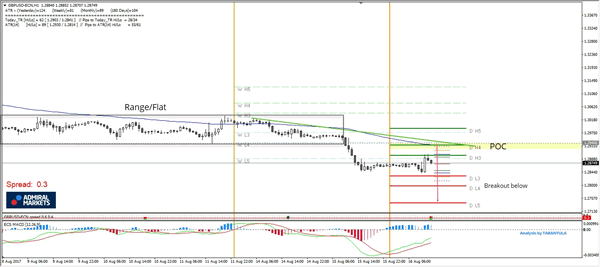
The GBP/USD has broken, the range/flat zone to the downside, going below W L5 camarilla pivot. At this point we see a retracement towards 1.2900 zone. The retracement happened after the good UK data namely wages and jobs. However the trend is still in place and the spike towards the POC (D H4, Trend line, ATR high, W L4, order block) 1.2930-40 could possibly be sold towards 1.2830 and 1.2815. Breakout below 1.2795 could further weaken the price to 1.2750.
Technical Outlook: EURGBP Pulls Back From Fresh High, Overall Bulls Remain Intact
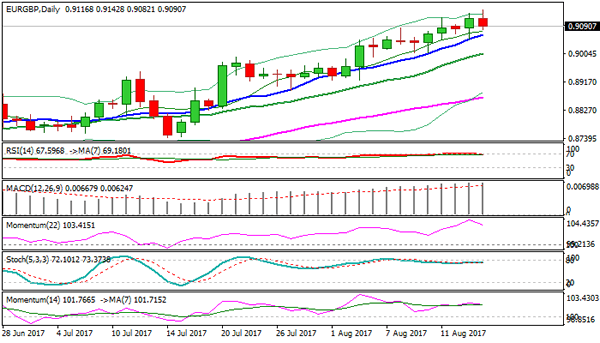
The pair hit fresh high at 0.9142 today (the highest since early Oct 2016) but was unable to hold gains and dipped below 0.9100 handle after upbeat UK jobs data boosted pound.
Overall bulls remain firmly in play for now, underpinned by rising 10SMA at 0.9063 (initial support) and ascending 4-hr cloud (spanned between 0.9041 and 0.9000, with lower boundary being reinforced by rising 20SMA) which is expected to contain dips before larger bulls from higher base at 0.8300 zone resume.
However, deeper pullback cannot be ruled out as daily RSI emerges from overbought territory and shows a plenty of space at the downside.
Violation of 0.9000 handle would risk extension towards 0.8942 (rising daily Kijun-sen) and 0.8890 (27 July trough).
Res: 0.9100, 0.9142, 0.9207, 0.9244
Sup: 0.9082, 0.9063, 0.9041, 0.9000
DAX Higher As Eurozone GDP Improves In Q2
The DAX index has posted considerable gains in the Wednesday session, continuing the upward movement seen on Monday. The DAX is trading at 12,280.75, up 0.82% on the day. On the release front, euro zone Flash GDP edged up to 0.6% in the second quarter, matching the forecast. In the US, the Federal Reserve will release the minutes of its July policy meeting. On Thursday, the euro zone releases Final CPI and the ECB publishes the minutes of its July policy meeting.
It was report card day for the euro zone economy, with the release of Flash GDP for the second quarter. The reading was positive, posting a gain of 0.6%, edging above the 0.5% gain in Q1. The euro zone economy has now picked up speed over three consecutive quarters. Much of the credit for improved growth in the euro zone goes to Germany, whose robust economy continues to impress. Germany’s GDP expanded 0.6% in the second quarter. Consumer spending, a key driver of economic growth, continues to propel economic growth, and the country has now posted 12 straight quarters of growth. Higher wages and increased government spending have also boosted the economy. The export sector remains strong, despite the stronger euro, as global demand for German products, especially automobiles, remains firm.
Geopolitical tensions in the Korean peninsula have abated, and this has helped boost global stock markets. The DAX has rebounded after sharp losses last week, following some saber-rattling between Washington and Pyongyang. The two countries engaged in an escalating war of words, with North Korea threatening to attack Guam, which hosts a major US military base. Although a military conflict remains unlikely, tensions remain high, and if tensions again rise, investors could head for safer pastures, and dump shares in favor of the Japanese yen and gold, which was the case last week.
Euro Unchanged As Eurozone Flash GDP Matches Estimate
EUR/USD is unchanged in the Wednesday session. Currently, the pair is trading at 1.1715, down 0.20% on the day. On the release front, euro zone Flash GDP edged up to 0.6% in the second quarter, matching the forecast. In the US, the focus will be on housing data, with the release of Building Permits and Housing Starts. Both indicators are expected to remain unchanged from their previous readings. As well, the FOMC will release the minutes of its July policy meeting. On Thursday, the euro zone releases Final CPI and the ECB publishes the minutes of its July meeting. In the US, the key events are unemployment claims and the Philly Fed Manufacturing Index.
The euro zone economy has now picked up speed over three straight quarters. In the second quarter, euro zone Flash GDP posted a gain of 0.6%, slightly stronger than the 0.5% reading in Q1. Much of the credit for improved growth in the euro zone must be given to Germany, the largest economy in the bloc and the star performer. Germany's GDP expanded 0.6% in the second quarter. Consumer spending, a key driver of economic growth, continues to propel economic growth, and Germany has now posted 12 straight quarters of growth. Higher wages and increased government spending have also boosted the economy. The export sector remains strong, despite the stronger euro, as global demand for German products, especially automobiles, remains firm. Positive economic conditions in Germany have translated into a stronger euro zone economy, which has experienced higher growth and lower unemployment.
The euro has taken a pause in August, but the currency has posted impressive gains in recent months, with EUR/USD jumping 3.5% in July. The euro has received a boost from a stronger euro zone economy, as well as growing political risk in the United States, as the Trump administration has lurched from crisis to crisis, and hasn't managed to pass a single major bill through Congress. The latest fiasco for Trump was the alt-right protest in Charlottesville, where one protester was killed by a suspected white supremacist. Trump initially refused to condemn white supremacists for the violence, and faced a strong backlash of criticism from both Democrat and Republican lawmakers. Trump finally came out with a statement on Monday which condemned hate groups, including white supremacists. However, the brash president followed up on Tuesday by again blaming both sides in Charlottesville, raising questions about Trump's reluctance to unequivocally condemn hate group such as white supremacists.
European Futures Higher | FOMC Minutes May Reveal New Details | Sterling Needs Help | Crude Inventory Data Under...
Sceptical About Dollar Rally
Hawkish FOMC Minutes Could Push Gold Lower
UK Earning Data Could Save Sterling
API Data Tumbled While Focus on Crude Inventory
European markets are keeping their attention on the upcoming FOMC minutes. The saggy inflation data could have an influence on the Fed minutes. The Fed see a valid reason to keep the interest rates at their current if the inflation does not create much rifts in the market. What the market would be looking at is the wind-up timing in relation to the Fed's balance sheet. The market is expecting the Fed to announce the winding down of the size of their balance sheet to begin in September
Sceptical About Dollar Rally
The king dollar is trading lower despite the fact that US retail sales data confirmed that the consumers are supporting the economy. The growth in the US wages is making consumers spend more. The US Empire State index also showed some solid reading and printed the highest level since September 2014. The index plays a fair share in the GDP growth and this confirms that we could be looking at a much better GDP growth for 2017.
The dollar rally picked up more fuel on the back of the hawkish comments by a top Federal Reserve official. Traders pay close attention to Bill Dudley, the New York Fed Chief, because of his influential position in the committee. He clearly wants the market to acknowledge that it would be a mistake to consider that the Fed cannot trigger the button for another interest rate hike this year.
However, we are sceptical about the current momentum in the dollar. The CFTC data is still showing that speculators are still piling into the second most crowded trade.
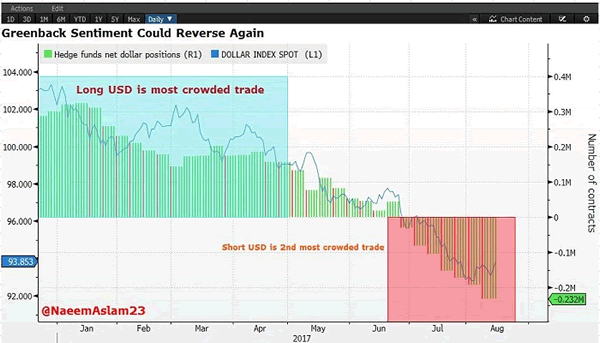
The retail sales number does provide a reasonable picture of the consumer health, however, the Fed considers inflation dearer. We do know that the inflation data was saggy and the fed could acknowledge this in their minutes. Therefore, we do think that the prospects of another rate hike are still remote for this year.
Hawkish FOMC Minutes Could Push Gold Lower
The bullish dollar is shifting the focus away from the safe havens. The yellow metal, the Japanese yen and the Swiss Franc, all are out of fuel. The Increasing odds of the US interest rate hike could push the gold price below the 1250 and this could happen if the upcoming FOMC minutes deliver some hawkish tone.
UK Earning Data Could Save Sterling
Sterling took the beating and the punishment could continue if the economic numbers do not provide support. The UK average earnings in the three months may rise to 2 percent. Even if this number is printed, there would not be a moment of celebration because inflation would still easily be outpacing it and creating more pressure for consumers. The inflation data was the only element which was supporting the argument that the Bank of England should tighten the monetary policy. However, the latest inflation number has eased off those concerns for the BOE. The unemployment rate is expected to remain at 4.5 percent, the lowest number since 1975 despite Brexit.
The Sterling drop against the euro is more prominent and a lot of this is just purely insane. This is because investors are hanging their hopes that the euro-Sterling rally could push the pair to parity. The UK is heading to leave the EU bloc and investors do not believe that the U.K. has any firm plan to save the economy from a catastrophe.
API Data Tumbled While Focus on Crude Inventory
Crude oil moved higher as the API inventory data tumbled. However, the data which matters the most is your crude inventory number and this is what investors will be looking at more closely. The forecast is that the downtrend would confirm a drop of 3.4 million barrels. Remember the oil curve is already in backwardation. It implies that the contracts approaching their expiration are trading at a higher price in comparison to the forward contract. In simple words, it shows that the supply concerns are fading fast and the market could be looking at a situation when demand would exceed supply.
FOMC Minutes Eyed As Fed Prepares First Balance Sheet Reduction
- FOMC minutes could offer interest rate and balance sheet clues;
- EIA expected to report seventh consecutive decline in inventories;
- GBP bounces on stronger labour market data;
- Eurozone growth momentum accelerates in July.
US futures are pointing to a higher open on Wall Street on Wednesday, as risk appetite continues its recovery ahead of the release of the FOMC minutes from the July meeting.
The Federal Reserve has become noticeably less hawkish in recent months as inflation has failed to pick up as much as policy makers had anticipated, causing some to question whether the current pace of tightening is appropriate. I expect the minutes will reflect this growing unease within the Fed which could once again weigh on interest rate expectations. Markets are currently pricing in only a 49% chance of another rate hike this year and even that has only been achieved in the last couple of days following some hawkish remarks from William Dudley.
The balance sheet is something else that traders will likely be looking for further clarity, with the central bank strongly hinting that it will start reducing it from September. The minutes may offer insight into how it plans to do so, although until now the market reaction to this has been very muted.
Other notable data points today including building permits and housing starts for the US, as well as crude inventory data from EIA. API reported a 9.2 million barrel draw down on Tuesday which didn’t provoke much of a reaction in the markets, despite the fact that a repeat of this today would represent the biggest drop since September last year and the seventh consecutive week of declines. Should EIA report a similar number then we may see a more significant reaction in Brent and WTI.
Sterling has rebounded slightly on Wednesday after the latest labour market data showed unemployment fell to 4.4% in the three months to June while average earnings rose by 2.1%. Both of these numbers exceeded market expectations offering some reprieve for the pound which suffered losses on Tuesday on the back of softer than expected inflation data.
While the numbers were generally good, the key takeaway from the release remains the fact that real wages are falling as wage growth lags behind inflation. While the gap between the two has narrowed and is likely to shorten again over the course of the next year or so, it is likely to continue to weigh on growth in the meantime. Even an apparently tight labour market isn’t easing the situation, with the Bank of England saying earlier this month that Brexit uncertainty is likely holding down wages.
There was also good news for the eurozone this morning, with GDP data for the second quarter exceeding expectations at 2.2% and indicating that the recovery is becoming more broad based. The eurozone may be a little late to the party but we’ve seen significant improvement in the region over the last year and the latest figures are extremely encouraging. There is obviously still a long way to go but there is certainly reason for optimism.