Sample Category Title
GBP/USD Mid-Day Outlook
Daily Pivots: (S1) 1.2939; (P) 1.2980; (R1) 1.3004; More...
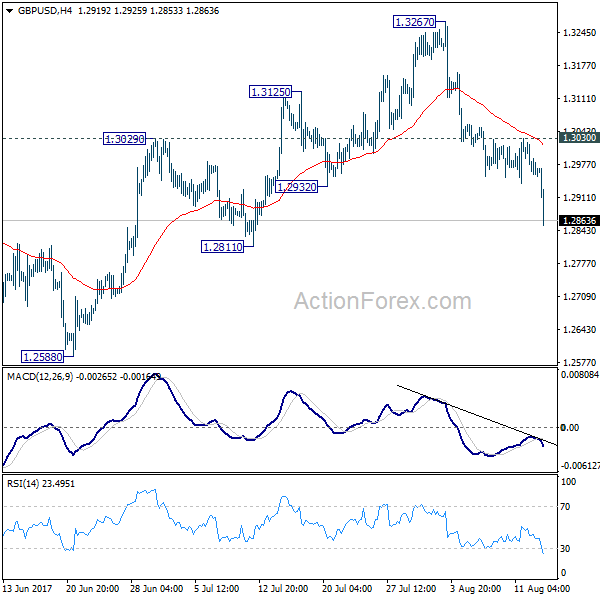
GBP/USD's fall from 1.3267 resumed by breaking 1.2932 support and reaches as low as 1.2853 so far. The development affirm our bearish view that correction from 1.1946 is completed at 1.3267. Intraday bias is back on the downside for 1.2588 key near term support for confirming our view. On the upside, break of 1.3030 resistance is needed to indicate short term bottoming. Otherwise, outlook will stay cautiously bearish in case of recovery.
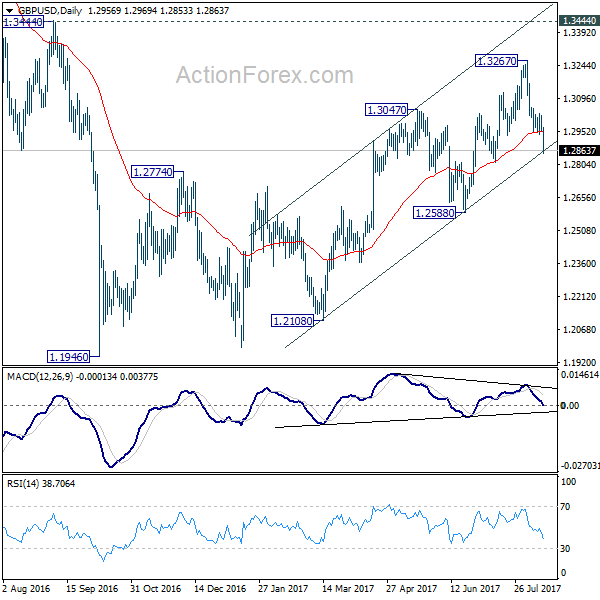
In the bigger picture, overall, price actions from 1.1946 medium term low are seen as a corrective pattern. While further rise cannot be ruled out, larger outlook remains bearish as long as 1.3444 key resistance holds. Down trend from 1.7190 (2014 high) is expected to resume later after the correction completes. And break of 1.2588 will indicate that such down trend is resuming.
Dollar Surges Further after Strong Retail Sales, UK Tumbles Again on CPI Miss
Dollar is extending this week's rebound in early US session after a string of solid economic data. Meanwhile, Sterling is trading as one of the weakest after another CPI miss. From US, headline retail sales rose 0.6% in July versus expectation of 0.4%. Ex-auto sales rose 0.5% versus expectation of 0.3%. Empire state manufacturing jumped to 25.2 in August and beat expectation of 10.3%. Import price index rose 0.1% mom in July. Technically, GBP/USD's break of 1.2932 is seen as a key near term bearish signal and the pair is now heading back to 1.2588 support. USD/JPY's break of 110.62 resistance also is also taken as a sign of near term reversal. But for the moment, EUR/USD is holding well above 1.1606 and maintains bullish outlook.
Rebound of the greenback started earlier this week as threat of imminent war between US and North Korea abated. New York Fed President William Dudley's comments yesterday gave Dollar another boost. Dudley, an influential member of FOMC, affirmed that he remained in "favor of doing another rate hike later this year". He prefers a rate hike despite soft inflation as "1) monetary policy is still accommodative, so the level of short-term rates is pretty low, and 2) and this is probably even more important, financial conditions have been easing rather than tightening". He indicated that "financial conditions are easier today than they were a year ago". Dudley added that it is not unreasonable to announce the balance sheet reduction plan in September. He forecast the portfolio would shrink to between USD 2.5-3.5T after five years.
Sterling dives on another CPI miss
Sterling tumbles broadly today, except versus Yen, as UK CPI missed expectations again. Headline CPI dropped -0.1% mom in July versus expectation of 0.0% mom. Annual rate of CPI was unchanged at 2.6% yoy, below expectation of 2.7% yoy. Core CPI was also unchanged at 2.4% yoy, below expectation of 2.5% yoy. RPI, on the other hand, rose to 3.6% yoy, up from 3.5% yoy and beat expectation of 3.5% yoy. Another downside surprise in CPI further reduced the chance of an early rate hike by BoE. And there are talks that UK CPI won't even hit 3% level later in the year as BoE projected. Also from UK, PPI input slowed to 6.5% yoy, PPI output slowed to 3.2% yoy while PPI output core slowed to 2.4% yoy. House price index rose 4.9% yoy in June.
German GDP solid but missed expectation
German GDP rose 0.6% qoq in Q2, below expectation of 0.7% qoq. Year on year growth was pushed up to 2.1%, highest in three years. While Euro dips mildly after the release, it's staying bullish against other currencies in general. Also from Germany, the constitutional court requested European court to make a ruling on ECB's EUR 2.3T monetary financing. The German constitutional court said that "significant reasons indicate that the ECB decisions governing the asset purchase programme violate the prohibition of monetary financing and exceed the monetary policy mandate of the European Central Bank, thus encroaching upon the competences of the Member States."
Staying in Germany, Finance Minister Wolfgang Schaeuble said the he hoped ECB's ultra-loose monetary policy would end in the foreseeable future. He noted that "no one seriously disputes that interest rates are rather too low for the strength of the German economy and the exchange rate of the euro, which is rising now." And in his view, most people expect ECB to take a further step at the upcoming meeting in September.
RBA minutes paint positive outlook
RBA's minutes for the August meeting revealed that policymakers were optimistic over the global and domestic economies. The central bank forecast that the economy would soon be growing at an annual rate of 3%, assuming that there's no major change in the Australian dollar. The central bank added that 'This assumption was one source of uncertainty'. Policymakers went to warn of the Aussie's strength, suggesting that 'a further appreciation of the Australian dollar would be expected to result in a slower pick-up in inflation and economic activity than currently forecast'. Meanwhile, RBA also signaled concerns over the housing market and household debt, while appeared more comfortable over the employment situation. More in RBA's Main Concerns Shifted to Housing Market From Employment
GBP/USD Mid-Day Outlook
Daily Pivots: (S1) 1.2939; (P) 1.2980; (R1) 1.3004; More...
GBP/USD's fall from 1.3267 resumed by breaking 1.2932 support and reaches as low as 1.2853 so far. The development affirm our bearish view that correction from 1.1946 is completed at 1.3267. Intraday bias is back on the downside for 1.2588 key near term support for confirming our view. On the upside, break of 1.3030 resistance is needed to indicate short term bottoming. Otherwise, outlook will stay cautiously bearish in case of recovery.
In the bigger picture, overall, price actions from 1.1946 medium term low are seen as a corrective pattern. While further rise cannot be ruled out, larger outlook remains bearish as long as 1.3444 key resistance holds. Down trend from 1.7190 (2014 high) is expected to resume later after the correction completes. And break of 1.2588 will indicate that such down trend is resuming.
Economic Indicators Update
| GMT | Ccy | Events | Actual | Forecast | Previous | Revised |
|---|---|---|---|---|---|---|
| 01:30 | AUD | RBA Minutes Aug | ||||
| 04:30 | JPY | Industrial Production M/M Jun F | 2.20% | 1.60% | 1.60% | |
| 06:00 | EUR | German GDP Q/Q Q2 P | 0.60% | 0.70% | 0.60% | 0.70% |
| 07:15 | CHF | Producer & Import Prices M/M Jul | 0.00% | 0.00% | -0.10% | |
| 07:15 | CHF | Producer & Import Prices Y/Y Jul | -0.10% | 0.00% | -0.10% | |
| 08:30 | GBP | CPI M/M Jul | -0.10% | 0.00% | 0.00% | |
| 08:30 | GBP | CPI Y/Y Jul | 2.60% | 2.70% | 2.60% | |
| 08:30 | GBP | Core CPI Y/Y Jul | 2.40% | 2.50% | 2.40% | |
| 08:30 | GBP | RPI M/M Jul | 0.20% | 0.10% | 0.20% | |
| 08:30 | GBP | RPI Y/Y Jul | 3.60% | 3.50% | 3.50% | |
| 08:30 | GBP | PPI Input M/M Jul | 0.00% | 0.40% | -0.40% | -0.30% |
| 08:30 | GBP | PPI Input Y/Y Jul | 6.50% | 6.90% | 9.90% | 10.00% |
| 08:30 | GBP | PPI Output M/M Jul | 0.10% | 0.00% | 0.00% | |
| 08:30 | GBP | PPI Output Y/Y Jul | 3.20% | 3.10% | 3.30% | |
| 08:30 | GBP | PPI Output Core M/M Jul | 0.10% | 0.10% | 0.20% | |
| 08:30 | GBP | PPI Output Core Y/Y Jul | 2.40% | 2.50% | 2.90% | |
| 08:30 | GBP | House Price Index Y/Y Jun | 4.90% | 4.30% | 4.70% | 5.00% |
| 12:30 | USD | Import Price Index M/M Jul | 0.10% | 0.10% | -0.20% | |
| 12:30 | USD | Empire State Manufacturing Index Aug | 25.2 | 10.3 | 9.8 | |
| 12:30 | USD | Advance Retail Sales Jul | 0.60% | 0.40% | -0.20% | |
| 12:30 | USD | Retail Sales Less Autos Jul | 0.50% | 0.30% | -0.20% | |
| 14:00 | USD | NAHB Housing Market Index Aug | 64 | 64 | ||
| 14:00 | USD | Business Inventories Jun | 0.40% | 0.30% | ||
| 20:00 | USD | Net Long-term TIC Flows Jun | 91.9B |
EUR/USD Looks Exhausted
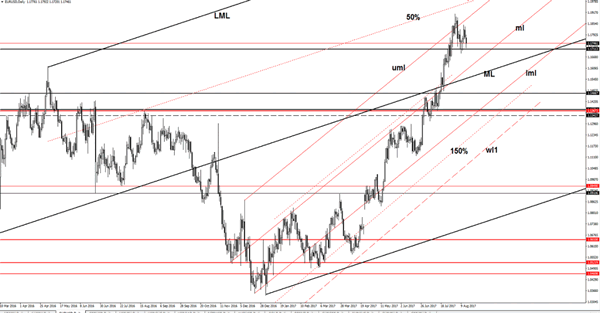
The EUR/USD is trading in the red and extends the yesterday's sell-off as the USDX looks determined to take out the 93.81 static resistance. The pair drops after the failure to retest a dynamic resistance, but we need a confirmation that will start another leg lower. The current drop could be only temporary if the US data will disappoint later.
Is trading above a critical support, only a valid breakdown will confirm a further drop in the upcoming period. Right now it is consolidating and waits for the US data to come out. You should be careful in the afternoon because we may have a high volatility.
The United States Retail Sales could increase by 0.3% in the previous month, the indicator could jump in the positive territory after 3-months, while the Core Retail Sales may increase by 0.3% in July versus the 0.2% drop in June.
The Import Prices could increase by 0.1% in June versus the 0.2% drop in the former reading period, while the Empire State Manufacturing Index could jump from 9.8 to 10.1 points.
Price is going down after failure to retest the upper median line (uml) of the minor ascending pitchfork, signaling that the bears are in control. Was almost to reach and retest the 1.1712 major support (resistance turned into support). Technically is expected now to approach and reach the median line (ml) of the minor ascending pitchfork. We have a major downside obstacle also at the median line (ML) of the major ascending pitchfork, the perspective is still bullish as long as the mentioned support levels are intact.
NZD/USD Breakdown Needs Confirmation
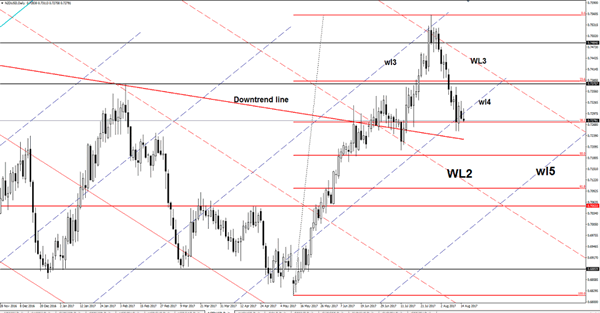
Price managed to drop below the fourth warning line (wl4) again and now is challenging the 38.2% retracement level, a valid drop below this obstacle if all what we need to know for sure that will drop further. Technically should drop further, having the next major target at the fifth warning line (wl5), will approach this level if will ignore the support from 50% and 61.8% retracement levels. Could be attracted by the confluence formed by the wl5 with the WL2.
EUR/GBP Breakout In Play
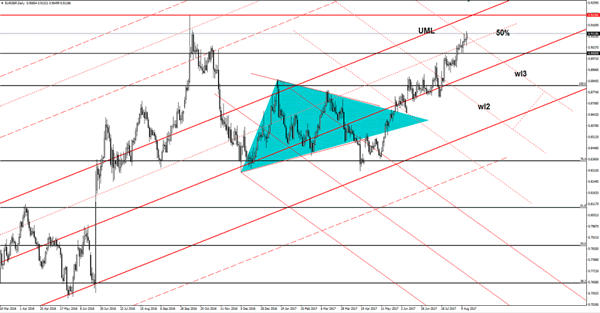
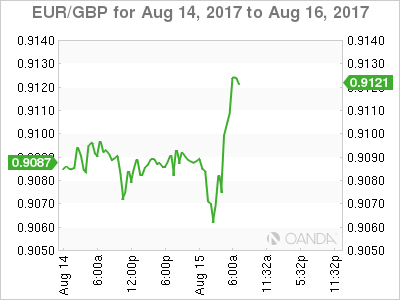
EUR/GBP is strongly bullish and has managed to jump above the third warning line (wl3). A valid breakout will attract more buyers, which will drive the rate towards the upper median line (UML) and towards the 0.9226 horizontal resistance. I've said in the previous analysis that price should take out the dynamic resistance because is attracted by the confluence area formed between the 0.9226 with the UML.
EURUSD – Follows Through Lower, Vulnerable
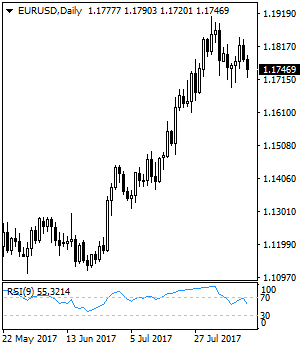
EURUSD - The pair followed through lower on Tuesday leaving risk of more weakness on the cards. Resistance comes in at 1.1800 level with a cut through here opening the door for more upside towards the 1.1850 level. Further up, resistance lies at the 1.1900 level where a break will expose the 1.1950 level. Conversely, support lies at the 1.1700 level where a violation will aim at the 1.1650 level. A break of here will aim at the 1.1600 level. All in all, EURUSD faces further downside pressure.
DAX Continues To Climb As North Korea Fears Abate
The DAX index has posted gains in the Tuesday session, continuing the upward movement seen on Monday. The DAX is trading at 12,200.80, up 0.29% on the day. On the release front, there is only one euro zone indicator on the schedule. German Preliminary GDP in the second quarter edged lower to 0.6%, missing the forecast of 0.7%. On Wednesday, the euro zone releases Flash GDP.
Tensions in the Korean peninsula last week weighed on global stock markets, and the DAX declined 2.4%. Washington and Pyongyang exchanged sharp warnings, with North Korea threatening to attack Guam, which hosts a major US military base. Tensions between North Korea and the US remain high, but the prevalent sentiment in the markets is that a diplomatic solution will be found to end the crisis. The stock markets are excellent barometers of geopolitical tensions, and the gains we are seeing this week are a direct result of the lowering of tensions. Still, Donald Trump and Kim Jon-un are unpredictable leaders, and a move by either side could easily ratchet up hostilities and send stock markets lower.
The robust German economy continues to perform well in 2017, as German GDP expanded 0.6% in the second quarter. Consumer spending, a key driver of economic growth, continues to propel economic growth, and Germany has now posted 12 straight quarters of growth. Higher wages and increased government spending has also boosted the economy. The export sector remains strong, despite the stronger euro, as global demand for German products, especially cars, remains firm. Positive economic conditions in Germany have translated into a stronger euro zone economy, which has experienced higher growth and lower unemployment.
The ECB has long insisted that it would not begin to wind up its quantitative easing (QE) before inflation moves higher, but at the July meeting, the bank appeared to change directions. In July, the ECB said it would hold discussions on the q scheme in “the autumn”, and analysts are split as to whether that means September or October. Either way, this means that the markets expect to hear an announcement regarding QE, and such a statement could have a significant impact on the euro. The ECB tapered QE earlier in 2017, from EUR 80 billion to 60 billion/mth, and there are calls to reduce this to 40 EUR billion/mth. The ECB is scheduled to terminate the asset purchases program in December, and could start tapering in early 2018. The bloc’s economy is forecast to expand a healthy 2.0% this year, and the eurozone outperformed both the US and the UK in the first half of 2017. The sore point remains inflation, which is stuck at low levels, despite the ECB’s ultra-accommodative monetary policy. Another factor which policymakers must deal with is the ECB’s bloated balance sheet, which stands at more than EUR 2 trillion.
Euro Lower As German Preliminary GDP Misses Estimate
EUR/USD has edged lower on in the Tuesday session. Currently, the pair is trading at 1.1756, down 0.31% on the day. On the release front, there is just one euro zone indicator. German Preliminary GDP in the second quarter edged lower to 0.6%, missing the forecast of 0.7%. In the US, the key releases are Core Retail Sales and Retail Sales, which are expected to come in at 0.3% and 0.4% respectively. US Empire State Manufacturing Index is expected to improve to 10.1 points. On Wednesday, the euro zone releases Flash GDP. In the US, we'll get a look at Building Permits and Housing Starts. As well, the FOMC releases its minutes from the July FOMC meeting.
It's been a quiet August for the euro, but the currency has pushed upwards in recent months, with EUR/USD jumping 3.5% in July. The euro has received a boost from a stronger euro zone economy, as well as growing political risk, with the Trump administration failing to pass a new healthcare bill through Congress. The latest fiasco for Trump is the alt-right protest in Charlottesville, where one protester was killed by a suspected white supremacist. Trump initially refused to condemn white supremacists for the violence, and faced a strong backlash of criticism from both Democrat and Republican lawmakers. Trump finally came out with a statement on Monday which condemned hate groups, including white supremacists. Meanwhile, far away in the Korean peninsula, tensions between North Korea and the US have abated, after some serious saber-rattling which pushed global stock markets lower last week. European markets have started the week with gains, as the markets are hopeful that a diplomatic solution to the crisis will be found.
Germany's economy has looked strong in 2017, and GDP expanded 0.6% in the second quarter. Consumer spending, a key driver of economic growth, continues to propel economic growth, and Germany has now posted 12 straight quarters of growth. Higher wages and increased government spending has also boosted the economy. The export sector remains strong, despite the stronger euro, as global demand for German products, especially cars, remains firm. Positive economic conditions in Germany have translated into a stronger euro zone economy, which has experienced higher growth and lower unemployment.
Risk Appetite Gradually Returning But Caution Remains
- Gold lower as traders gradually increase risk exposure;
- GBP tumbles as inflation falls short of expectations;
- EUR recovers after German GDP miss;
- US retail sales and manufacturing data eyed.
The risk rebound continues in financial markets on Tuesday, as tensions between the US and North Korea appear to ease and investors gradually unwind their safe haven trades from last week.
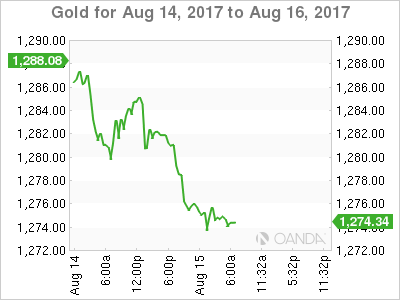
Gold – the ultimate traditional safe haven – is on course for a second day of losses and is currently trading around $1,273, finding some support around the level it ran into difficulty around a couple of weeks ago. A break below here could see $1,260 come into play and even $1,250, where it also found support this time last week. Assuming we don't see another flare up in the war of words between the two countries – or worse – then Gold could remain under pressure in the days ahead, although traders are understandably cautious still.
The British pound fell to a one month low against the dollar on Tuesday after CPI data for July showed inflation remained unchanged from a month earlier, despite expectations for a small increase. The data reduces the need for the Bank of England to tighten monetary policy in response to above target inflation, which peaked a couple of months ago just below 3%. With price pressures appearing to have cooled and the economy still facing a couple of years of uncertainty and slower growth, markets appear to once again be pricing out a rate hike this year and possibly next.
The euro has recovered to trade only slightly lower against the dollar on the day, having coming under some selling pressure earlier in the session in response to weaker than expected German GDP data. While the number fell short of expectations, it still represents a strong quarter of growth in the euro areas largest economy and came with an upward revision to the previous quarter.
The timing is also very good, with Angela Merkel out on the campaign trail ahead of the September election. While consumer spending was a big driver of growth in the second quarter, ramped up government spending also contributed to the stronger output which the sceptics among us may think is no coincidence given the proximity to the election. That said, strong growth has been a consistent feature in Germany for some years now and unemployment is very low which should continue to support the economy and help Merkel's case next month, not that she needs it if recent poll numbers are to be believed.
We still have more data to come today from the US, with the most notable being retail sales for July. Consumer spending is a critical component of the US economy and something that has remained adequate yet unremarkable for some time. We've actually seen a gradual slump in spending over the course of the year, something I'm sure the Fed would like to see a reversal of in the second half. The New York empire state manufacturing index will also be released today, among some other tier 2 data.
Dollar Rallies As North Korea Blinks
Tuesday August 15: Five things the markets are talking about
Global equities trade better bid while the 'mighty' U.S dollar finds much needed support ahead of the U.S open after North Korea's Kim Jong Un signalled that he would delay plans to fire a missile near Guam, easing tensions and prompting investors to move back into beaten-down riskier assets.
Aiding higher rates stateside, and the dollar, was New York Fed President Dudley comments Monday indicating that it was 'not unreasonable' to think the Fed would begin trimming its +$4.2T balance sheet next month and raise rates again this year.
This gave investors the green light to begin unwinding a portion of their 'bearish' bets made last week after Friday's disappointing U.S inflation data dampened market expectations that the Fed would raise interest rates again in 2017.
U.S data this morning will give some indication on how the U.S economy is doing in H2. July retail sales are expected to rise month-over-month (08:30 am EDT), while housing starts and industrial production (10:00 am EDT) is expected to be subdued.
Note: North Korea is celebrating its Liberation Day today to mark the end of Japanese rule.
1. Stocks reclaim lost territory
Global equity markets have happily retraced most of last Friday's pullback, as robust Asian corporate earnings and reduced fears of imminent military conflict between the U.S and North Korea supports buying interest.
In Japan, stocks have rebounded overnight, snapping a four-day losing streak and have moved away from their three-month low print hit on Monday. The Nikkei share average rallied +1.1%, after falling -1.0% in the previous session. The broader Topix index finished the day +1.1% higher.
Down-under, Australia's S&P/ASX 200 Index gained +0.5% at the close, while Hong Kong's Hang Seng index added +0.3% as the Shanghai Composite Index rose +0.4%.
Note: Markets in South Korea and India are closed Tuesday for holidays.
In China, stocks ended the day higher, but weak sentiment limited those gains. The blue-chip CSI300 index rose +0.3%, while the Shanghai Composite Index gained +0.4%.
In Europe, stocks opened higher and maintain a positive position on easing of geopolitical tensions around Korea. Macro data out of Germany (see below) is also helping support equities.
U.S stocks are set to open in the black (+0.2%).
Indices: Stoxx50 +0.1% at 3,460, FTSE +0.3% at 7,379, DAX +0.2% at 12,189, CAC-40 +0.3% at 5,139, IBEX-35 flat at 10,461, FTSE MIB +1.7% at 21,722, SMI -0.3% at 9,004, S&P 500 Futures +0.1%
2. Oil prices steady after dollar surge, gold lower
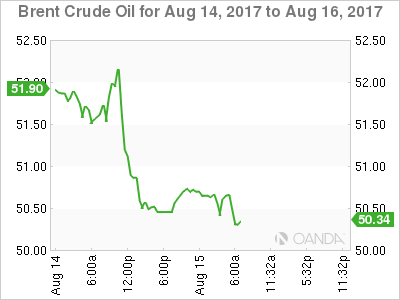
Crude oil prices have stabilized ahead of the U.S open after yesterday's heavy sell-off following a rally in the dollar. Signs of weaker demand in in China have also been pressuring the black stuff this week.
Benchmark Brent crude is little changed at +$50.73 a barrel, while U.S light crude (WTI) is -5c lower at +$47.54.
Data this week showed that Chinese oil refineries operated in July at their slowest daily rates since September. The drop was steeper than expected, raising concerns over the state of Chinese demand (the worlds second largest consumer) and level of domestic stocks.
Note: Brent and U.S crude both reached two-month highs in last week, but have fallen gradually in the last few days, as investors have been happy to book some well-deserved profits.
Investor focus remains on OPEC, U.S inventories (today's API and Wednesday's EIA report) and disappointing China demand, to shape the futures oil curve.
Gold prices are under pressure (down -0.6% at +$1,274.31 per ounce) on rising risk appetite as North Korea tensions eases. The 'yellow' metal continues to trade atop of its two-month highs touched last week as the market keeps an eye on developments in the peninsula.
3. Global yields back up
U.S Treasury prices have started this week's second session on the back foot as investors feel a tad better about the geopolitical situation and are willing to put their money to work in riskier assets.
U.S 10-year yields have backed up +2 bps to +2.24%. The move remains modest as global yields are expected to face strong headwinds if they're going to climb much higher.
Note: After another soft U.S inflation report last Friday, the market continues to remain highly skeptical that the Fed will raise rates again this year, and this despite NY Fed Dudley's 'hawkish' comments yesterday. Fed funds odds see a +42% chance of a rate hike at the Fed's December meeting, up from +36% late Friday.
In Europe, the eurozone's benchmark German 10-year bond yield is trading up +2 bps to +0.42%, adding to Monday's +3 bps rise and moving further off Friday's six-week low of +0.38%. U.K Gilts have backed up +3 bps to +1.101%.
4. U.S dollar up ahead of July retail sales
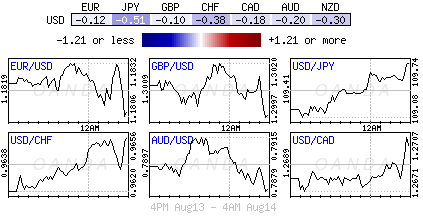
The U.S dollar is better bid ahead of this morning's July retail sales data release (08:30 am EDT). The EUR/USD is down -0.2% at €1.1757. The market consensus is for a rise of +0.4% compared with a fall in June, but with last weeks softer inflation numbers it would not be too much of a surprise to see the headline print come in below expectation. If it does, it could send USD/JPY to fresh intraday lows. USD/JPY is up +0.7% at ¥110.39.
In the U.K, July CPI missed expectations (see below), a second consecutive month, and has dented any 'hawks' bid for potential near-term hike by the Bank of England (BoE). Sterling is down -0.6% at £1.2890.
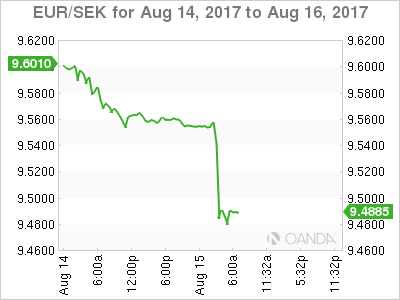
Elsewhere, the SEK has strengthened significantly outright (-0.46% to $8.0690) this morning after Sweden's higher-than-expected inflation figures. July CPI inflation rose +2.2% on the year compared to the Riksbank's +1.6% forecast, while CPIF inflation (calculated with a fixed interest rate) rose by +2.4%, against the Riksbank forecast of +1.8%. EUR/SEK has fallen -0.7% to €9.4874.
Down-under, there were brief gains for the AUD (A$0.7842) overnight following the release of this month's RBA minutes. The minutes judged 'steady' policy consistent with growth and inflation targets. The RBA expects growth is likely to pick up pace in Q2 and sees GDP around +3% for both 2018 and 2019. Policy makers are also confident in a pick-up in inflation and jobs.
5. Germany continues strong performance, U.K inflation steady
Data this morning showed that the German economy continues its strong performance with another 'above-trend growth rate' in Q2.
Germany's statistics body revealed that the German economy grew at a quarterly clip of +0.6% in Q2 and also lifted its Q1 growth estimate to +0.7% from a previous estimate of +0.6%.
In the U.K, annual inflation held steady in July as falling oil prices offset higher prices for clothing and food. Consumer prices rose +2.6% on the year, a smaller rise than the +2.7% increase the market had expected.
Separately, the annual increase in companies' raw material costs slowed in July to +6.5% from +10% in June, the biggest month-to-month slowdown in five years, as the effect of last summer's depreciation of the pound continues to fade.