

Sample Category Title
USDCAD in Consolidation Mode after Repeated Unsuccessful Probes Below 1.2500 Support
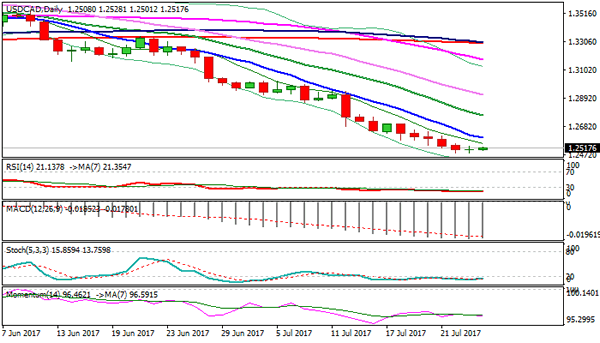
The USDCAD pair is in consolidation mode after repeated unsuccessful probes below 1.2500 support. Tuesday's close in tight Doji signaled hesitation at 1.2500 hurdle (that I anticipated in my previous report), following dips to 1.2483/80 lows on Mon/Tue, but close above 1.2500 on both days. Reaction was so far mild as daily technical studies remain firmly bearish and lacking firmer positive signals, despite strongly oversold conditions. Limited upside attempts stay so far under Tuesday's high at 1.2532, short of the initial pivot at 1.2545 (hourly cloud top) and more significant barriers at 1.2595 (falling 10SMA) and 1.2613 (daily Tenkan-sen) regain of which is needed to generate stronger reversal signal. Overall bearish structure suggests limited correction ahead of final push towards target at 1.2459 (03 May 2016 low). The pair may stay within narrow consolidation, awaiting FOMC statement for firmer signals.
Res: 1.2532; 1.2545; 1.2595; 1.2613
Sup: 1.2500; 1.2480; 1.2459; 1.2400
Fed to Decide on Next USD-Move?
- Gains in commodities from oil to copper lent momentum to European stocks as positive corporate results continued to feed into markets.
- GDP-growth in the UK edged up in Q2, in line with expectations. The ONS estimates the economy expanded by 0.3% Q/Q, up from 0.2% Q/Q in Q1. The year on year growth slowed to 1.7% from 2%.
- The INSEE office released figures showing French consumer confidence fell from 108 in June (a 2007 high) to 104 in July while a stabilisation was expected. The survey also revealed concerns over rising unemployment while inflation expectations also leapt among consumers.
- Copper prices have jumped to the highest level in two years following reports China could move to ban imports of scrap metal by the end of next year, a move that would likely boost demand for refined metals in China.
- The UK government says it will ban sales of fossil-fuelled vehicles by 2040, two weeks after France announced a similar plan.
- Poland, Hungary and the Czech Republic suffered a double blow as the EU mounted a legal fightback to force them to comply with EU refugee quotas. The EU forged ahead to enforce the law, as it prepared to sign-off legal suits against hold-out countries and separately won a favourable opinion at Europe's top court.
- The European Commission stands ready to trigger fresh legal action against the Polish government despite the country's president vetoing two out of four controversial reforms to the Polish judiciary. The EC vice president said the approval of the remaining measures still undermined the independence of the country's judges.
Rates
Core bonds move sideways ahead of FOMC decision
Global core bonds took a breather today following yesterday's sell-off and ahead of the FOMC decision later this evening. Equities traded with a positive bias, while oil moved sideways keeping yesterday's steep gains intact. No firm directional moves either on the main FX crosses. None of these other market had a noticeable impact on bond trading. The eco calendar was thin with UK Q2 GDP weak, but as expected at 0.3% Q/Q and French consumer confidence disappointing. The bond movements were also technically irrelevant. Needless to say that bond volumes traded were very light. Summarizing, dull trading across the board during the Summer holidays before the FOMC decision.
At the time of writing, US yields fell between 0.3 bps (30-yr) and 1.2 bps (5-10yr), the belly marginally outperforming the wings. Changes on the German yield curve were slightly bigger (-1.4 to -1.8 bps). On intra-EMU bond markets, 10-yr yield spread changes versus Germany varied between -2 bps (Italy) and +2 bps (Greece). Dull trading continued. The Italian small IL and zero coupon auctions went well.Later today, the Treasury holds its 5-year T-Note auction and the FOMC concludes its meeting. The FOMC has little incentive to inject volatility in these thin Summer markets and may wait for the September meeting to take some decisions. At that time, new eco and rate projections will be available and chair Yellen will hold a press conference to explain eventual new decisions. Two items nevertheless need to be watched in the FOMC statement this evening. First, will the FOMC announce the start of the tapering of its balance sheet? September is the more likely announcement date, but there is a small chance it will be announced today (to start in October?). It would underline that the Fed considers this tapering as a background event that will continue independent of temporary developments in the economy, for which its main tool, the FF rate, will be used. Second, will the Fed show more concerns about the low inflation readings of the past four month? Depending on the outcome of these questions, there might be some moves in the US Treasury market. Overall though, these should be subdued and temporary.
Currencies
Fed to decide on next USD-move?
Today, trading in the major USD cross rates was somewhat paralysed as investors kept side-lined ahead of this evening's Fed policy statement. The dollar tried to extend yesterday's rebound during European trading, but the bid faded later in the session. EUR/USD trades in the 1.1635 area. USD/JPY is changing hands in the 111.80/0 area. The Fed holds the key to unlock this stalemate.
Asian equities traded mixed to slightly lower. Japan and Australia outperformed on a decline of their currencies. USD/JPY maintained yesterday's gain and traded just below 112 going into European trading. The dollar also held its gains against the euro with EUR/USD trading in the 1.1635 area.
There were no important data in Europe. Trading in the major dollar cross rates was order-driven as investors awaited the Fed policy statement. The dollar initially kept a slightly positive bias. Especially EUR/USD lost a few more ticks and filled bids in the 1.1615 area mid-morning. USD/JPY didn't go anywhere. Changes in interest rate differentials were insignificant and no driver for USD trading. Sentiment on the dollar turned a bit softer going into the start of US dealings. EUR/USD returned to the mid 1.16 area. USD/JPY lost a few ticks to the 111.75 area. US investors didn't place big USD bets ahead of the Fed policy statement. EUR/USD trades in the 1.1640 area and USD/JPY is changing hands in the 111.80 area.
We expect the Fed to be more concerned on inflation but to keep the door open for a December rate hike. The market implied probability of a December rate hike is less than 50%. We don't expect the Fed to be so soft that markets reduce their expectations further. With US interest rates already at very low levels, one could assume that there is quite some negative news discounted for the dollar. US eco news has to be very good before it can trigger a sustained USD rebound. However, assuming that the Fed statement won't be overly soft, we expect no sustained break of the key 1.1714/35 resistance for now.
Sterling doesn't react to soft UK Q2 growth
Today's UK Q2 GDP estimate was one of the last important data series ahead of next week's BoE policy decision. UK Q2 GDP growth printed at 0.3% Q/Q and 1.7% Y/Y, exactly as expected. EUR/GBP was under slight pressure going into the GDP report, but this was euro softness rather than GBP strength. EUR/GBP temporarily dropped to the 0.8915 area, but rebounded slightly after the data. T The sterling correction didn't go far as global markets were in some kind of lethargy ahead of the Fed policy decision. The market implied probability of a BoE rate hike was and remains low (about 10 %). There probably is additional negative news (or spill-overs from other cross rates) needed to trigger additional sterling losses. EUR/GBP trades in the 0.8920 area. Cable trades near 1.3050.
USD/CHF Mid-Day Outlook
Daily Pivots: (S1) 0.9475; (P) 0.9500; (R1) 0.9549; More...
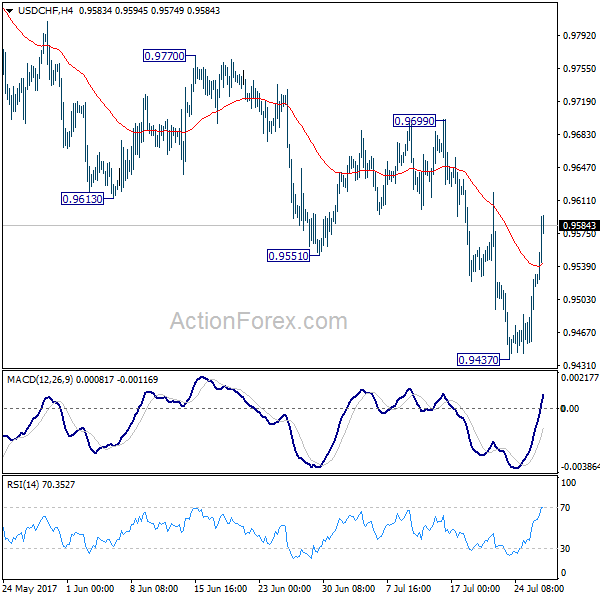
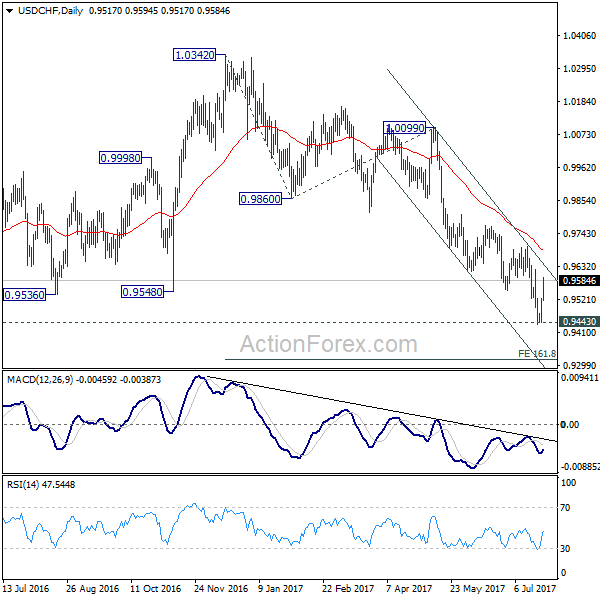
USD/CHF's rebound from 0.9437 extends higher today but it's staying below 0.9699 resistance. Intraday bias remains neutral first. As noted before, we remain cautious on strong support from 0.9443 key support to bring reversal. Decisive break of 0.9699 will confirm and turn outlook bullish. Meanwhile, sustained trading below 0.9443 will extend the down trend from 1.0342 to 161.8% projection of 1.0342 to 0.9860 from 1.0099 at 0.9319.
In the bigger picture, focus is now back 0.9443 key support level. Sustained break there indicate underlying bearish momentum and would target 0.9 handle and possibly below. Meanwhile, strong rebound from current level and break 0.9699 resistance will extend long term range trading between 0.9443/1.0342.
EUR/USD Mid-Day Outlook
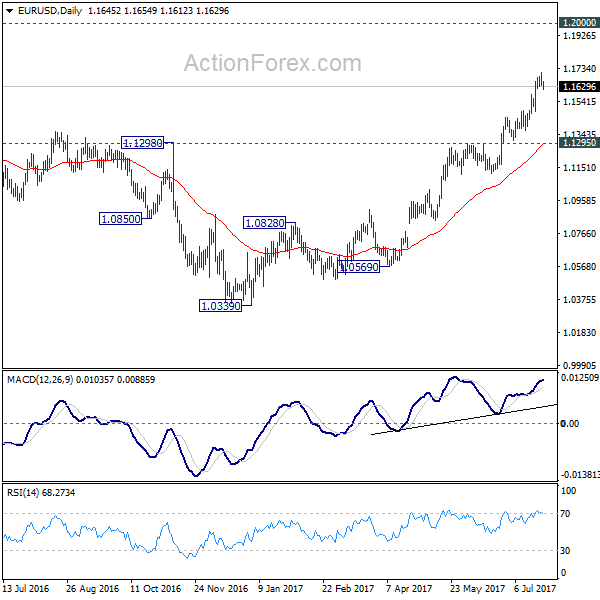
Daily Pivots: (S1) 1.1613; (P) 1.1662 (R1) 1.1696; More...
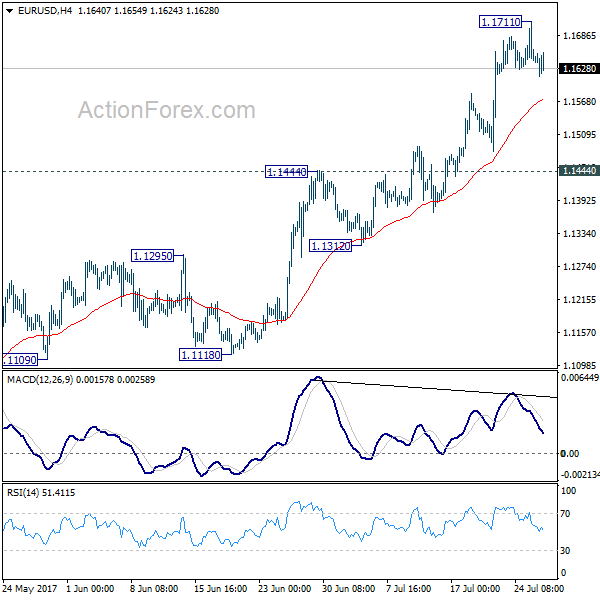
Intraday bias in EUR/USD remains neutral as consolidation from 1.1711 temporary top is still in progress. Downside of retreat should be contained above 1.1444 resistance turned support and bring rise resumption. Break of 1.1711 will extend the larger up trend to 1.2 handle next.
In the bigger picture, an important bottom was formed at 1.0339 on bullish convergence condition in weekly MACD. Sustained break of 55 month EMA (now at 1.1760) will pave the way to key fibonacci level at 38.2% retracement of 1.6039 (2008 high) to 1.0339 (2017 low) at 1.2516. While rise fro 1.0339 is strong, there is no confirmation that it's developing into a long term up trend yet. Hence, we'll be cautious on strong resistance from 1.2516 to limit upside. But for now, medium term outlook will remain bullish as long as 1.1295 support holds, in case of pull back.
GBP/USD Mid-Day Outlook
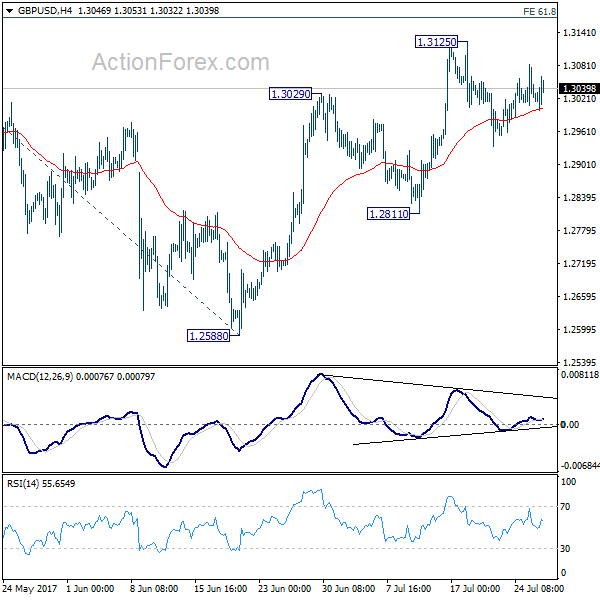
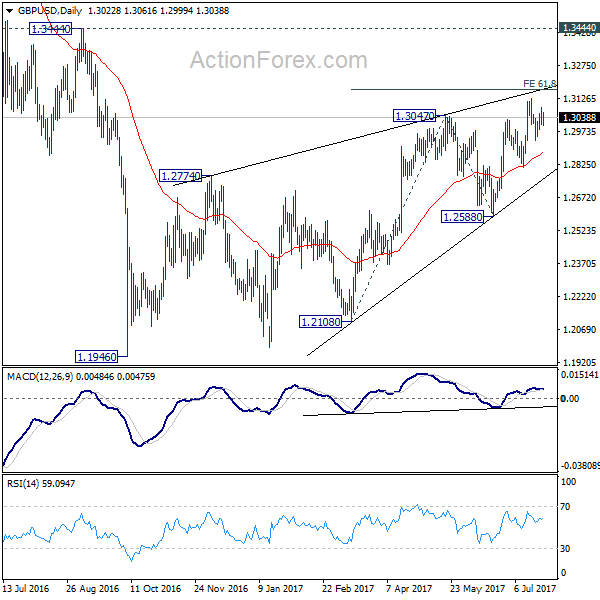
Daily Pivots: (S1) 1.2994; (P) 1.3038; (R1) 1.3070; More...
No change in GBP/USD's outlook as it's staying in range of 1.2811/3125. Intraday bias remains neutral and another rise is mildly in favor. Break of 1.3125 will target 61.8% projection of 1.2108 to 1.3047 from 1.2588 at 1.3168. Overall, choppy rebound from 1.1946 is seen as a corrective pattern, hence, we'd be cautious on strong resistance from 1.3168 to limit upside. But firm break of 1.3168 will bring further rise towards 1.3444 key resistance. Meanwhile, break of 1.2811 support will be the first sign of reversal and will turn bias to the downside to target 1.2588 key support next.
In the bigger picture, overall, price actions from 1.1946 medium term low are seen as a corrective pattern that is still in progress. While further upside is expected, overall outlook remains bearish as long as 1.3444 key resistance holds. Larger down trend from 1.7190 is expected to resume later after the correction completes. And break of 1.2588 will indicate that such down trend is resuming.
USD/JPY Mid-Day Outlook
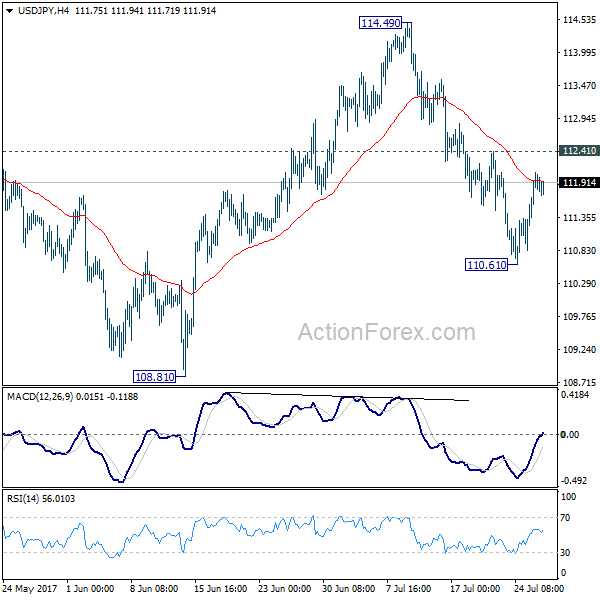
Daily Pivots: (S1) 111.15; (P) 111.55; (R1) 112.28; More...
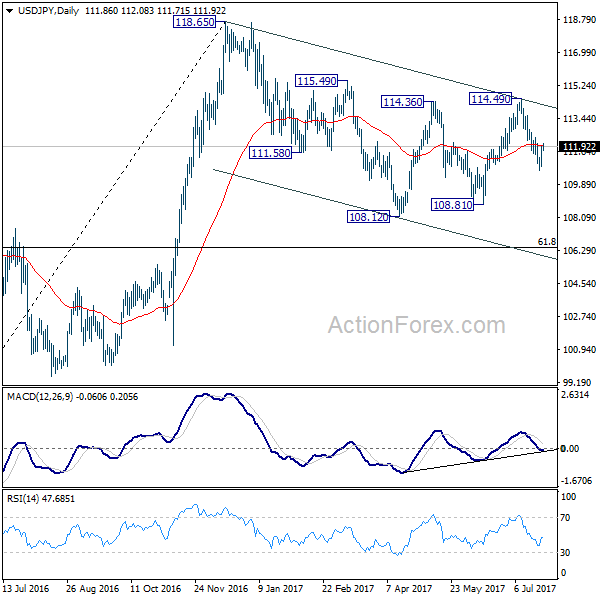
Despite today's recovery, USD/JPY is still staying below 112.41 minor resistance. Intraday bias remains neutral and another decline is still in favor. Below 110.61 will target 108.81. Break there will resume whole correction from 118.65 and target 61.8% retracement of 98.97 to 118.65 at 106.48. Nonetheless, break of 112.41 will dampen this bearish view and turn focus back to 114.49 resistance instead.
In the bigger picture, the corrective structure of the fall from 118.65 suggests that rise from 98.97 is not completed yet. Break of 118.65 will target a test on 125.85 high. At this point, it's uncertain whether rise from 98.97 is resuming the long term up trend from 75.56, or it's a leg in the consolidation from 125.85. Hence, we'll be cautious on topping as it approaches 125.85. If fall from 118.65 extends lower, down side should be contained by 61.8% retracement of 98.97 to 118.65 at 106.48 and bring rebound.
CAC Gains Continue Ahead of Fed Rate Statement
The CAC index has posted gains for a second straight day. In Wednesday's North American session, the index is trading at 5191.00, up 0.53% on the day. On the release front, there are no events out of the eurozone. In the US, the Federal Reserve releases its rate statement and is expected to maintain the benchmark at 1.25%.
The CAC is moving higher on Wednesday. Financial stocks continue to climb, led by bank stocks. BNP Aribas has gained 0.78%, while Credit Agricole is up 0.77%. BNP Aribas will be in the spotlight on Friday, as the bank releases its interim 2017 earnings report. The week started out on a strong note, as French Manufacturing PMI improved to 55.4, its highest level in three months. Although Eurozone Manufacturing PMI was softer in July, dropping from 57.3 to 56.8, it still pointed to solid expansion. The eurozone and French manufacturing sectors have received a boost from stronger exports as well as increased consumer demand. Improved economic conditions in the eurozone have boosted the euro, which has jumped 9.8% against the dollar since March 1. However, the high exchange rate has weighed on exporters' shares, such as automobile makers. The CAC has shown only marginal gains since April 1.
All eyes are on the Federal Reserve, which concludes its monthly policy meeting later on Wednesday. The Fed is not expected to alter its interest rate policy, but the rate statement could still be a market-mover. The rate statement will be under careful scrutiny, as analysts will be looking for any references to the "I" word. Inflation continues to hover around 1.4% (based on the Fed's calculations), well below the Fed target of 2%. In June, Janet Yellen described low inflation as "transitory", but recent comments from Yellen and other policymakers have shifted in tone, an apparent acknowledgment that inflation may remain stuck at low levels. This has raised doubts as to whether the Fed will indeed raise rates one more time this year. No move is expected before December, and the odds of a December hike have fallen to just 37%, according to the CME Group. If today's rate statement fails to reassure the markets that a December hike is planned, investors could respond by selling dollar-denominated assets in favor of other currencies or gold.
Aside from interest rates, Fed members will be discussing when to commence tapering the Fed's $4.2 trillion bond portfolio. The bloated balance sheet is a result of the aggressive quantitative easing program which was put in place after the financial crisis in 2008. In June, the Fed outlined plans to taper purchases, with experts circling September as the start date of the reduction. This would involve the Fed tapering the purchases of Treasury bonds and mortgage securities, with an initial taper likely of $10 billion/month. Analysts expect the taper to begin in September, so we could see the Fed make reference to this in the July statement.
UK Q2 GDP Growth Initial Estimate Pushes Sterling Down
On Wednesday, sterling edged down after initial UK GDP growth estimates showed that the expansion of the British economy continued its downtrend in the June quarter, recording the lowest yearly growth since 2013. This followed the IMF's downgrade of its UK GDP growth forecasts on Monday. With uncertainty around Brexit talks in the background, which have not made any significant progress so far, the BOE policymakers are expected to keep interest rates steady next week.
According to the Office for National Statistics, the British economy grew by 1.7% year-on-year as expected in the second quarter, dropping below the previous quarter's mark of 2% and posting the lowest growth since 2013. In contrast, on a quarterly basis, UK GDP growth improved marginally, rising in line with expectations by 0.3% and surpassing the figure of 0.2% in the March quarter. The main growth drivers were the service sector companies (including mainly distributive, and film production companies as well as hotels and restaurants) which expanded in total by 0.5% quarter-on- quarter and by 2.3% year-on- year. On the other hand, the output of the manufacturing and the construction sectors contracted by 0.5% and 0.9% respectively on a quarterly basis, while compared to the previous year, the sectors grew by only 0.3% (manufacturing) and 0.8% (construction).
Regarding GDP per capita, which is an important measure of standard of living, it increased by 0.1% quarter-on- quarter and by 1% year- on- year.

With inflation being above the target of 2%, unemployment falling to its lowest level in more than 40 years, wages posting weak growth and following today's numbers on GDP growth, the odds for a rate hike at next week's Bank of England meeting, are receding. In addition, following the release of the data, the finance minister Philip Hammond characterized the growth rate as "steady" and supported that a boost to the economy would arise only if consumers and businesses were more certain about Brexit which is heavily weighing on British economic performance. He also highlighted the importance of raising productivity saying that "We need to focus on restoring productivity growth to deliver higher wages and living standards for people across the country".
Looking at the forex markets, sterling despite showing relative resilience against the greenback in recent weeks, fell slightly from $1.3025 prior the data release to a low of $1.2998. However, it managed to jump above $1.30 afterward. Euro/pound and pound/yen remained flat around 0.89 and 145 respectively.
EUR/CHF Mid-Day Outlook
Daily Pivots: (S1) 1.1035; (P) 1.1064; (R1) 1.1119; More...
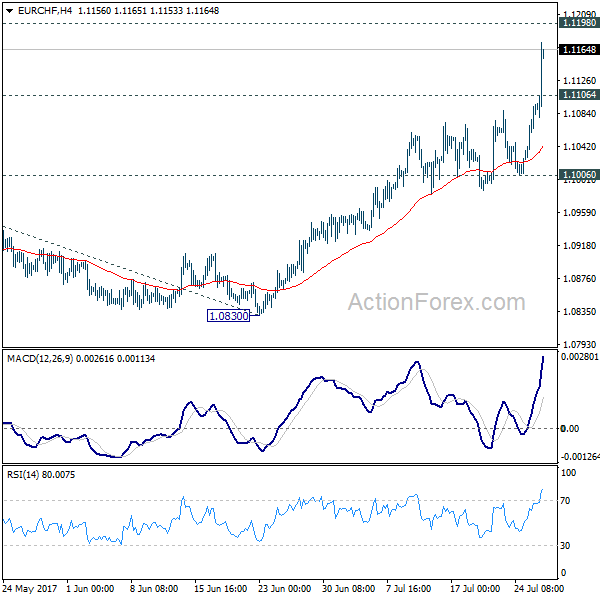
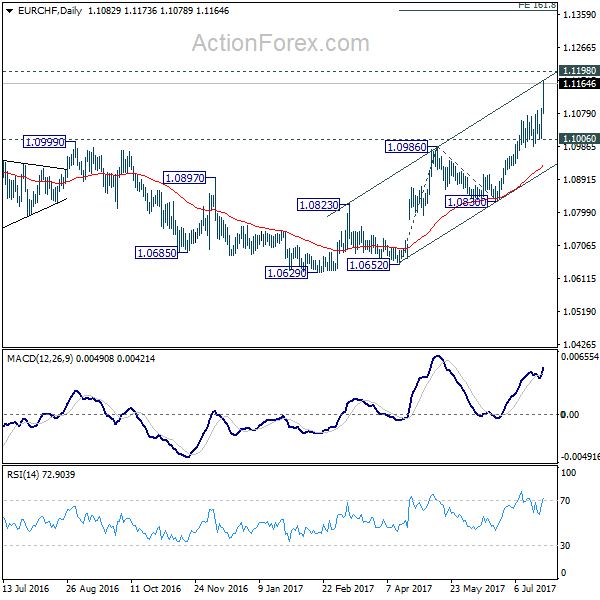
EUR/CHF's rally accelerates to as high as 1.1173 so far. Intraday bias remains on the upside for 1.1198 key resistance next. Sustained break there will carry larger bullish implication. In such case, next near term target will be 161.8% projection of 1.0652 to 1.0986 from 1.0830 at 1.1370. On the downside, below 1.1106 minor support will turn intraday bias neutral first. But retreat should be contained by 1.1006 to bring rise resumption.
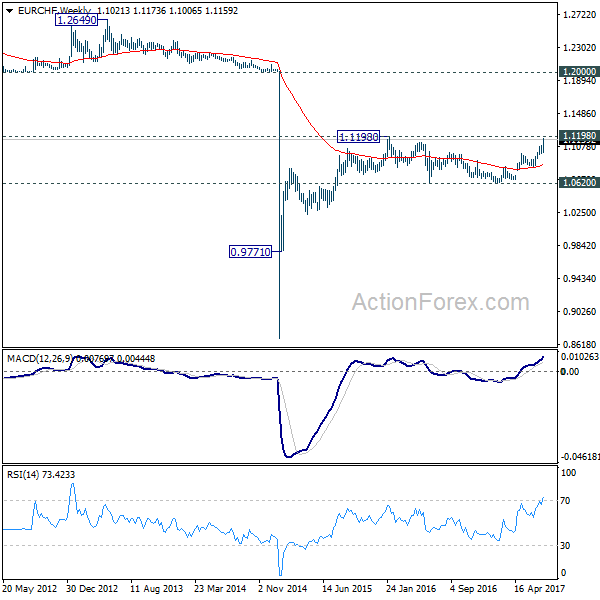
In the bigger picture, the price actions from 1.1198 are seen as a corrective move. Such correction could have completed after defending 38.2% retracement of 0.9771 to 1.1198 at 1.0653. Decisive break of 1.1198 will resume the long term rise from SNB spike low back in 2015. In such case, EUR/CHF could eventually head back to prior SNB imposed floor at 1.2000. We'll favor this bullish case as long as 1.0830 support holds. However, rejection from 1.1198 will extend the multi-year range trading with another fall.
Swiss Franc Steals the Show as Markets Await FOMC
Swiss Franc is stealing the show today as it tumbles broadly and sharply across the board. EUR/CHF is trading up 0.6% at the time of writing and is set to take on key resistance level around 1.12. The selloff in the Franc is believed to be a catch up to a combination of recent developments in the financial markets. Those include surge in risk markets including European stocks, oil and commodities. Market expectations are also firm that ECB is on course to exit stimulus down the road, or least, taper its asset purchase. Such expectation is reinforced by the rally in stocks, energy and commodities that would help lift inflation.
Also importantly, the jump in German yields since yesterday's Ifo release added more fuel to the selloff in the Franc. German 10 year bund yield has indeed doubled since ECB President Mario Draghi's hawkish speech. Meanwhile, Greece successfully held the first bond sales since 2014 yesterday. EUR 5b of its five-year bond was sold at yield at 4.625%, notably lower than 4.95% back in the auction in 2014. A government official was quoted saying that the sales was an "absolute success.
Talking about bonds, the Spanish/German yield spread dropped to the tightest level since 2015. Italian/German yield spread also dropped to the lowest level since December. Recent rally in Euro now encourages investors to borrow money in low-yielding assets and buy the high yield ones, such as European bonds. And that help narrowed the yield spreads with German bunds. Same picture could also be seen as investors borrow Swiss franc and sell them for Euro assets.
Technically, 1.1198 is the key to watch now and a firm break there could open up an medium term long term trend in EUR/CHF for SNB's prior EUR/CHF floor at 1.2. Released from Swiss, UBS consumption indicator dropped to 1.38 in June.
FOMC statement awaited
Still, FOMC rate decision and statement will be closely watched today. The Fed would leave the policy rate unchanged but the key is whether the Fed would turn more dovish on the inflation outlook which might affect the future normalization path. The market consensus remains that there would be one more rate hike in December, which was signalled in the June dot plot. However, more and more voices of doubt about the implementation due to recent disappointment on the data front. Another focus is whether the Fed would announce the kickoff period of the balance sheet reduction plan.
UK GDP showed "notable slowdown"
Released from UK, Q2 GDP grew 0.3% qoq, in line with consensus. Darren Morgan, head of national accounts at the Office for National Statistics, said that "the economy has experienced a notable slowdown in the first half of this year. While services such as retail, and film production and distribution showed some improvement in the second quarter, a weaker performance from construction and manufacturing pulled down overall growth."
Chancellor of Exchequer Philip Hammond tried to talk down the slowdown. He noted that "our economy has grown continuously for four-and-a-half years, delivering record levels of employment. We can be proud of that; but we are not complacent." Meanwhile, he emphasized the need to "focus on restoring productivity growth to deliver higher wages and living standards for people across the country. That is why we are committed to investing in infrastructure, technology and skills to deliver the best possible base for strong future growth."
Also from UK, BBA mortgage approvals dropped to 40.2k in June. Index of services rose 0.3% 3mo3m in May.
BoJ Nakaso: Improving output gap will lift prices
BoJ Deputy Governor Hiroshi Nakaso said that he's still confident that inflation will reach the 2% target around fiscal 2019. And, BoJ should stick with the current stimulus program. He noted that for now, companies have been trying to "absorb higher labour costs by revising their business processes". In such a way, higher labour costs are not being passed on to consumers. However, he emphasized that "the output gap is clearly improving, so companies will become more aggressive in setting wages and prices."
Aussie lower after CPI
Australian Dollar weakens mildly today after lower than expected inflation data. CPI rose 0.2% qoq in Q2, below consensus of 0.4% qoq. Annually, CPI slowed to 1.9% yoy, down from 2.1% yoy and missed expectation of 2.2% yoy. RBA trimmed mean CPI slowed to 1.8% yoy, down from 1.9% yoy. RBA weighted median CPI, however, rose to 1.8% yoy, up from 1.7% yoy. RBA Governor Philip Lowe said today that tightening in global central banks "has no automatic implications for monetary policy in Australia". And RBA "didn't" and "don't need to" move in "lockstep" with others.
Suggested reading on RBA: RBA's Neutral Rate Rhetoric Overstated, Real Rate Similar To Fed's
RBNZ McDermott stays dovish
RBNZ Assistant Governor John McDermott has spoken about the monetary policy outlook, with a dovish stance. He suggested that current estimates the neutral interest rate is around 3.5 % with potential output growth at 2.9% and core inflation at 1.4%. He added that the neutral rate has been slowly falling for some time, due to lower potential output growth. The impact on kiwi was rather muted. NZDUSD continued its sideways trading around a 10-month high. released from New Zealand, trade surplus widened to NZD 242m in June.
EUR/CHF Mid-Day Outlook
Daily Pivots: (S1) 1.1035; (P) 1.1064; (R1) 1.1119; More...
EUR/CHF's rally accelerates to as high as 1.1173 so far. Intraday bias remains on the upside for 1.1198 key resistance next. Sustained break there will carry larger bullish implication. In such case, next near term target will be 161.8% projection of 1.0652 to 1.0986 from 1.0830 at 1.1370. On the downside, below 1.1106 minor support will turn intraday bias neutral first. But retreat should be contained by 1.1006 to bring rise resumption.
In the bigger picture, the price actions from 1.1198 are seen as a corrective move. Such correction could have completed after defending 38.2% retracement of 0.9771 to 1.1198 at 1.0653. Decisive break of 1.1198 will resume the long term rise from SNB spike low back in 2015. In such case, EUR/CHF could eventually head back to prior SNB imposed floor at 1.2000. We'll favor this bullish case as long as 1.0830 support holds. However, rejection from 1.1198 will extend the multi-year range trading with another fall.
Economic Indicators Update
| GMT | Ccy | Events | Actual | Forecast | Previous | Revised |
|---|---|---|---|---|---|---|
| 22:45 | NZD | Trade Balance (NZD) Jun | 242M | 100M | 103M | 130M |
| 23:50 | JPY | Corporate Service Price Y/Y Jun | 0.80% | 0.80% | 0.70% | |
| 1:30 | AUD | CPI Q/Q Q2 | 0.20% | 0.40% | 0.50% | |
| 1:30 | AUD | CPI Y/Y Q2 | 1.90% | 2.20% | 2.10% | |
| 1:30 | AUD | CPI RBA Trimmed Mean Q/Q Q2 | 0.50% | 0.50% | 0.50% | |
| 1:30 | AUD | CPI RBA Trimmed Mean Y/Y Q2 | 1.80% | 1.80% | 1.90% | |
| 1:30 | AUD | CPI RBA Weighted Median Q/Q Q2 | 0.50% | 0.50% | 0.40% | |
| 1:30 | AUD | CPI RBA Weighted Median Y/Y Q2 | 1.80% | 1.70% | 1.70% | |
| 6:00 | CHF | UBS Consumption Indicator Jun | 1.38 | 1.39 | 1.32 | |
| 8:30 | GBP | BBA Mortgage Approvals Jun | 40.2K | 39.9K | 40.3K | |
| 8:30 | GBP | GDP Q/Q Q2 A | 0.30% | 0.30% | 0.20% | |
| 8:30 | GBP | Index of Services 3M/3M May | 0.40% | 0.40% | 0.20% | |
| 14:00 | USD | New Home Sales Jun | 615K | 610K | ||
| 14:30 | USD | Crude Oil Inventories | -4.7M | |||
| 18:00 | USD | FOMC Rate Decision | 1.25% | 1.25% |