

Sample Category Title
NZDUSD: Sells Off, Resumes Downside Pressure
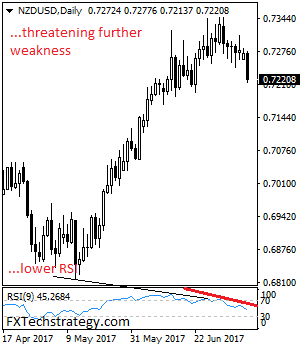
NZDUSD: The pair continues to face downside pressure selling on Tuesday and leaving risk lower in the days ahead. Support lies at the 0.7200 level. Further down, the 0.7150 level comes in as the next downside target. Its daily RSI is bearish and pointing lower suggesting more weakness. Conversely, resistance resides at the 0.7250 level where a break will aim at the 0.7300 level. A break of here will have to occur to create scope for a run at the 0.7350 level. Further out, resistance stands at the 0.7400 level. All in all, NZDUSD faces further downside pressure.
GBP/USD Slips Lower, EUR/CHF Strongly Bullish, EUR/GBP Still Sideways
GBP/USD slips lower
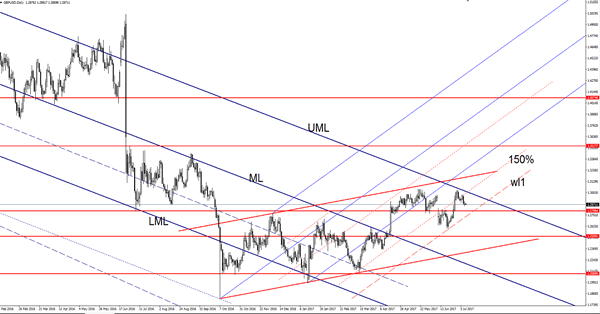
The currency pair is trading in the red right now and most likely will resume the minor retreat after the failure to climb above the 1.3047 previous high. Looks exhausted on the short term and could come down to test and retest some important support level. The greenback will drive the rate down if the USDX will have enough energy to stay above the 96.00 psychological level and to resume the minor rebound.
Price is driven by the technical factors right now, we have a poor economic calendar today, however, the United States figures could bring some action in the afternoon.
You can see that is trading within an ascending channel on the daily chart, but failed to reach the upside line of this pattern, signalling an overbought. Has also failed to approach and reach the upper median line (UML) of the major descending pitchfork (this represents a major dynamic resistance). Is expected to reach and retest the 1.2798 static support and also the first warning line (wl1) of the minor ascending pitchfork, a valid breakdown below these levels will confirm a larger drop.
The upside movement will resume only if the rate will take out the major resistance from the UML, this scenario will take shape only if the USDX will drop below the 95.45 previous low.
EUR/CHF strongly bullish
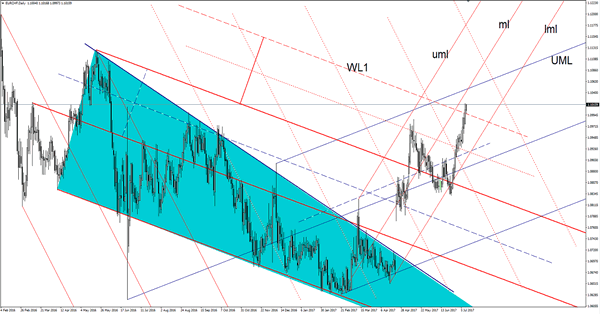
Price increased significantly in the last period and looks determined to hit fresh new highs, is attracted by an important confluence area on the short term. The Euro could receive a helping hand from the Italian Industrial Production, which is expected to increase by 0.5% in May, more after the 0.4% drop in the previous reading period.
Price extends the latest gains, has managed to break above the first warning line (WL1) of the major descending pitchfork, signalling a further increase. Maintains a bullish perspective as long as is trading within the minor ascending pitchfork's body. Is attracted by the confluence area formed at the intersection between the upper median line (UML) of the ascending pitchfork with the median line (ml) of the minor ascending pitchfork, where he could find strong resistance again. A breakout above the mentioned resistance levels will attract more buyers on the short term.
EUR/GBP still sideways
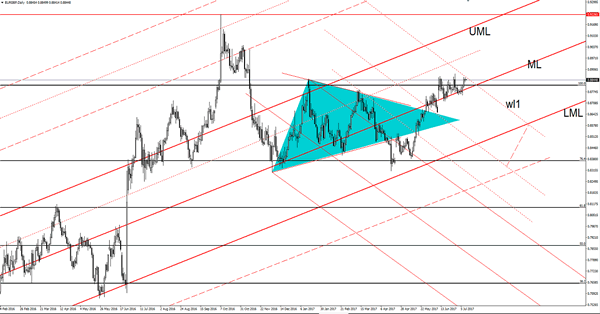
EUR/GBP continues to move sideways on the short term, is trapped below a strong dynamic resistance, but I hope that we'll have a clear direction very soon. Price needs a bullish spark to be able to breakout from the minor range, is trading near the 0.8850 psychological level, a further increase is favored on the Daily chart.
Is located right below the second warning line (wl2) of the former minor descending pitchfork and above above the 100% Fibonacci level, only a valid breakout above the wl2 will confirm a further increase. The next major upside target will be at the UML. Another leg down will appear if will breakdown below the ML again.
USD/CAD Increases ahead US and Canadian Data, NZD/USD Plunged Aggressively, GOLD Trading in the Red
USD/CAD increases ahead US and Canadian data
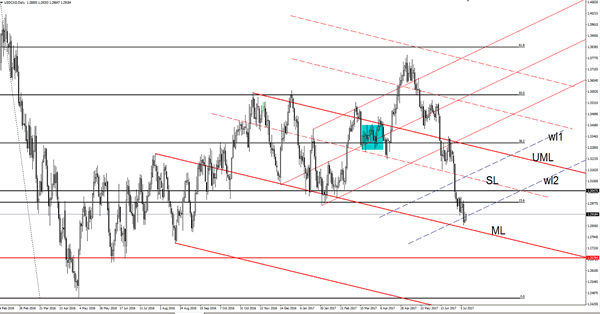
The currency pair edges higher and resumed the yesterday's minor bullish candle, remains to see how this bounce back will be because is still under massive selling pressure on the Daily chart. Price increases as the dollar index stays higher, near the 96.10 level, a USDX's further increase will force the greenback to appreciate versus all its rivals. The fundamental events could bring life on the currency market, the CMHC will publish the Canadian Housing Starts indicator, which is expected to increase from 195K to 200K in June. On the other hand, the US is to release the JOLTS Job Openings, which could decrease from 6.04M to 5.98M in May and the Final Wholesale Inventories, the economic indicator could increase by 0.3% in May.
We'll see how the USD will react later after the data will be released, a disappointment will send the USD/CAD lower again.
Price managed to bounce back on the Daily chart and now is pressuring the second warning line (wl2) of the ascending pitchfork. We'll have a larger rebound only if will stay above the median line (ML) of the major descending pitchfork and if will make an accumulation move.
NZD/USD plunged aggressively
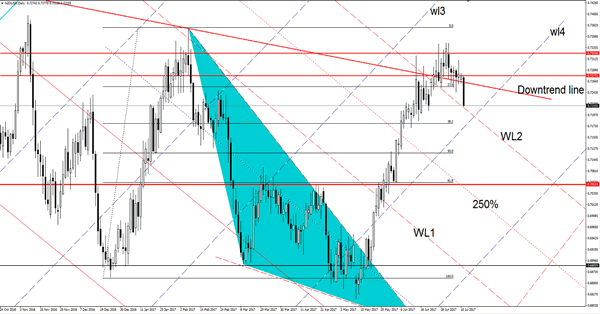
The Kiwi dropped sharply against the USD today and erased the last weeks gains, could drop much deeper if the dollar index will have enough energy to stay above the 96.00 psychological level and to resume the minor throwback. Has dropped more than 50 pips today and looks unstoppable on the short term.
You can see that has extended the minor corrective phase and is very close to hit the second warning line (WL2) of the former major descending pitchfork. The current retreat was somehow expected after the impressive rally, could find support at the WL2 and lower at the fourth warning line (wl4) of the former ascending pitchfork. Actually, could be attracted by the confluence area formed between the mentioned dynamic support levels.
We'll have a larger drop if the rate will breakdown through the mentioned confluence area, but a rejection from the confluence zone will bring us a good buying opportunity. The perspective remains bullish as long as the wl4 remains intact.
GOLD trading in the red
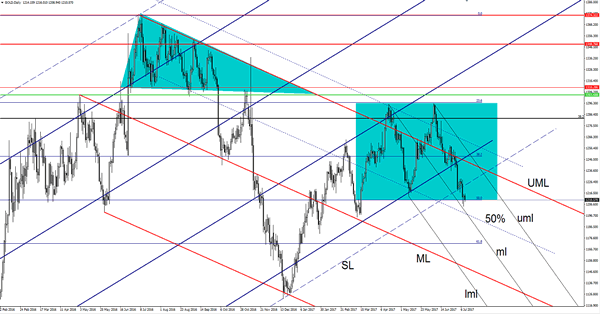
The yellow metal remains under massive selling pressure as the USD tries to rebound and to recover after the last week's drop. Will decreased further if the USDX will have enough energy to increase further.
Price is challenging the 50% retracement level, a valid breakdown below this level will open the door for more declines. The perspective is bearish on the short term as long as is trading within the descending pitchfork's body. Could drop much below the $1200 per ounce if the USD will receive support from the US economy. A minor bounce back will come only if the 50% support will hold for now.
EUR/USD Seems Exhausted, USD/JPY Trading in the Green, AUD/USD Still Bullish
EUR/USD - seems exhausted
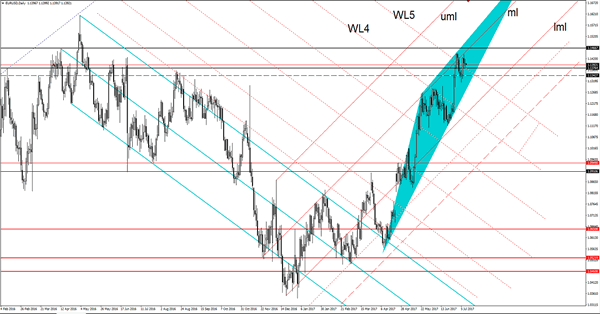
The EUR/USD changed little in the morning, looks undecided on the short term also because is located inside of a major resistance area (1.1376 - 1.1466). Price retreated again after the failure to reach the 1.1444 previous high, could come down to retest the 1.1466 static support before will increase further.
EUR/USD developed a Rising Wedge pattern on the Daily chart, but is far from being confirmed, we'll have another leg lower if will manage to breakdown from this pattern. Maintains a bullish perspective as long as is trading above the 1.1376 static support and above the downside line of the potential Rising Wedge. Only a drop below the lower median line (lml) of the minor ascending pitchfork will confirm a larger drop.
Technically a minor retreat is favored after the impressive rally, major resistance could be found at the 1.1466 level, we may have a minor consolidation above the 1.1376 because needs to recapture more directional energy to be able to increase further.
USD/JPY - trading in the green
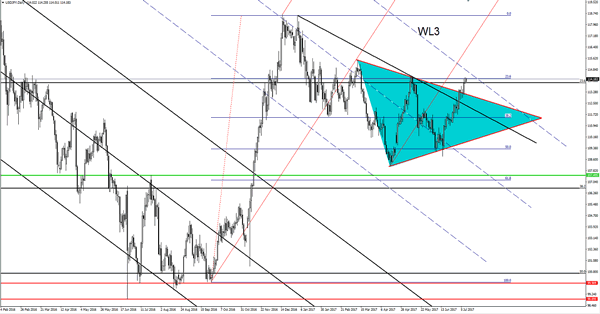
Price continues to increase on the Daily chart, but remains to see what will happen because has touched a resistance area. Continues to move somehow sideways, but looks determined to increase further because the behavior has changed when has started to make higher lows. Is trading near 114.20 level and could increase further as the Nikkei stock index has increased in the morning and stays above the 20058 broken static resistance. A further Nikkei's increase will force the Yen to depreciate versus all its rivals.
Price has managed to escape from a minor symmetrical triangle and now is challenging the 23.6% retracement level. We have a strong resistance at the third warning line (WL3) of the major descending pitchfork, a valid breakout above this line will attract more buyers, which will drive the rate towards fresh new highs.
AUD/USD - still bullish
The currency pair increased today and resumed the last day's rebound, technically is somehow expected to increase further despite the minor retreat. The Aussie is trading in the green, even if the Australian data have come in mixed, the Home Loans increased by 1.0% in May, less versus the 1.5% estimate, while the NAB Business Confidenceincresed from 8 to 9 points in June.
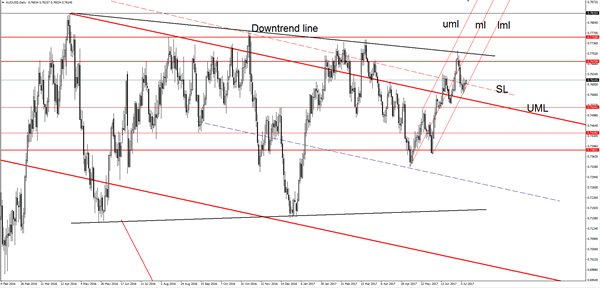
Price has found strong support much above the upper median line (UML) of the major descending pitchfork and now has jumped above the sliding line (SL) again. I've drawn a minor ascending pitchfork to catch a potential upside momentum, will climb much higher if will have enough energy to stabilize above the 0.7600 psychological level. The next major upside target will be at the black downtrend line, will reach this obstacle if will stay within the pitchfork's body.
Market Update – European Session: FTSE 100 Under Performs As M&
Notes/Observations
Bonds market selloff resumes yields approaching last weeks high
Emerging market currencies continues to sell off
M&S shares slide following its Q1 update, drags down retail names
PBoC resumes open market operation
Overnight
Asia:
PBoC resumed open market operations after 12 consecutive skips,this was speculated in the press ahead of the announcement given that the government and policy banks needed to sell at least CNY483B in bonds this week
Australian New home loans fell short of expectations, whilst Jun NAB Business confidence came in ahead of of the prior month.
A Magnitude 6.8 earthquake reported off southern coast of South Island New Zealand
Sunac China hlds acquired 76 hotels from Wanda Group for CNY33.6B, project stakes for CNY29.6B (total deal value CNY63.2B)
Europe:
European indices give back ground from earlier highs, as Bond Yields continue to advance
In latest German Poll Merkel's CDU/CSU takes 17 point lead over the Social Democrat Party
UK BRC LFL sales came in at 1.2% ahead of consensus
Americas
(US) Fed's Williams (moderate, non-voter) spoke overnight saying US fiscal policy is on an unsustainable path; reasonable view to expect one more rate hike this year
Economic Data
(IT) Italy May Industrial Production M/M: 0.7% V 0.5%E; Y/Y: 2.8% V -6.6% prior, Industrial Production WDA Y/Y: 2.8% V 2.0%e
Fixed Income Issuance:
(NL) NETHERLANDS DEBT AGENCY (DSTA) SELLS €985M VS. €0.75-1.25B INDICATED RANGE IN 2.75% 2047 DSL BONDS; AVG YIELD: 1.420% V 1.145% PRIOR
(ES) Spain Debt Agency (Tesoro) sells total €4.56B vs. €4.0-5.0B indicated range in 6-month and 12-month Bills
SPEAKERS/FIXED INCOME/FX/COMMODITIES/ERRATUM
Equities
Indices [Stoxx50 flat at 3,477, FTSE -0.6% at 7,324, DAX +0.2% at 12,472, CAC-40 flat at 5,168, IBEX-35 -0.2% at 10,491, FTSE MIB +0.4% at 21,268, SMI -0.5% at 8,894, S&P futures flat]
Market Focal Points/Key Themes: European stocks opened higher but turned around as the session progressed; trading moving on inertia due to little major news; crude prices drag down energy stocks and related; Total CEO says sees diminishing demand for oil due to Paris Accord; Hapag-Lloyd benefiting frin TUI divesting interest in accelerated bookbuilding deal after being buoyed by consolidation in the sea transport industry; Almirall continues to fall after ratings agencies downgrade; attention turning to Fed Chair Yellen's comments in Congress tomorrow; upcoming US earnings include Pepsico, Merus and AAR
Equities
Consumer discretionary [Marks & Spencer MKS.UK -3.3% (earnings), Pearson PSON.UK -6.4% (asset sale), Rational RAA.DE +1.6% (raises outlook), Grafton GFTU.UK +2.9% (earnings)]
Consumer staples [Refresco Gerber RFRG.NL -2.6% (does not get better offer)]
Financials [Banca Carige CRGI.IT +3.5% (potential takeover), Randstad RAND.NL -2.5% (analyst action)]
Healthcare [Almirall ALM.ES -6.2% (analyst action)]
Industrials [Hapag-Lloyd HLAG.DE +7.3% (third party placement)]
Technology [Wirecard WDI.DE +1.6% (outlook)]
Speakers
EU's Dombrovskis: Expects adoption of plan on non-performing loans to happen today
Currencies
GBPUSD trades higher this morning snapping the recent down trend and reclaiming 1.29 as EURGBP breaks below 0.8830. Dealers not 1.2940-50 the next area of resistance.
EURUSD trades below
Fixed Income
Bund futures trade at 160.58 down 38 ticks and back towards last week’s lows. Resistance lies near the 161.50 level followed by 162.10. A break of the 160.00 support level could see lows target 159.25 followed by 157.50.
Gilt futures trade at 125.13 lower by 21 ticks ahead of Thursday’s 2056 linker syndication Price finds key support at the 124.42 support level. An acceleration lower could test the 122.88 region. Resistance remains the noted 126.00 region, followed by 126.72.
Monday’s liquidity report showed Friday’s excess liquidity rose to €1.667T a gain of €2.4B from €1.6646T prior. Use of the marginal lending facility rose to €153M from €148M prior.
Corporate issuance saw $11.69B come to market via 8 issuers headlines by Intesa Sanpaolo $2.5B 2-part senior unsecured offering and Nissan Motor $1.75B 4-part senior unsecured medium-term notes
Looking Ahead
05.30 (UK) Weekly John Lewis LFL sales data
06:00 (US) Jun NFIB Small Business Optimism: 104.4e v 104.5 prior
06:00 (IE) Ireland May Property Prices M/M: No est v 1.1% prior; Y/Y: No est v 10.5% prior
07:00 (ZA) South Africa May Manufacturing Production M/M: 0.5%e v 2.3% prior; Y/Y: -3.3%e v -4.1% prior
07:00 (BR) Brazil July IGP-M Inflation (1st Preview): -0.7%e v -0.6% prior
07:30 (CL) Chile Central Bank Economist Survey
07:45 (US) Weekly Goldman Economist Chain Store Sales
08:00 (PL) Poland Jun Final CPI M/M: No est v -0.2% prelim; Y/Y: No est 1.5% prelim
08:00 (BR) Brazil CONAB report
08:15 (UK) Baltic Dry Bulk Index
08:15 (CA) Canada Jun Annualized Housing Starts: 200.0Ke v 194.6K prior
08:55 (US) Weekly Redbook Sales
09:00 (EU) Weekly ECB Forex Reserves: € v € prior
09:00 (RU) Russia Q2 Preliminary Current Account: $0.3Be v $23.3B prior
10:00 (US) May JOLTS Job Openings: No est v 6.044M prior
10:00 (US) May Wholesale Inventories M/M: 0.3%e v 0.3% prelim, Wholesale Trade Sales M/M: No est v -0.4% prior
12:00 (US) DOE Short-Term Crude Outlook
12:00 (IS) Iceland Jun International Reserves (ISK): No est v 643B prior
15:00 (AR) Argentina Jun National CPI M/M: No est v 1.3% prior
16:30 (US) Weekly API Oil Inventories
A Basic Introduction to the Different Order Types Used in the Forex Market
Have you ever found yourself unsure of what order to use, or where tocorrectly position it? If you have, then this article will help inproviding a good foundation. It's surprising how often we find tradersthat do not understand even the most basic entry order techniques, yetthey feel they're ready to tackle the live market. Make sure that youfully understand and are COMFORTABLE with your broker's order systembefore stepping into a live trading environment.
With that said, let's move on and have a look at some of the basic orders traders can use…
Market orders
This order type is often the first execution order that traders comeacross. Just as its name implies, this is an order that's executed atmarket and is immediate. This means that if you want to enter or exitthe market instantly, you can use a market order to trade at the nextbest available price. However, you might want to note that in afast-moving market where price can change in seconds, the price canalter substantially between the time the order is placed and the timethat it's completed/filled. This, fellow traders, is called slippage.
As an illustration, let's imagine that the EUR/USD is currently tradingat an asking price 1.2121 and has a bid of 1.2120. If you wantedinstant access to this market, then you'd have the choice of eitherbuying at 1.2121 or selling at 1.2120. To exit a position on the otherhand you would, assuming that you're long, sell the position back to themarket at the next best available price. To cover a short,nevertheless, you simply reverse and buy back the position at market.
The difference between the bid/ask price is known as the spread, which is essentially the broker's fee/commission.
Limit orders
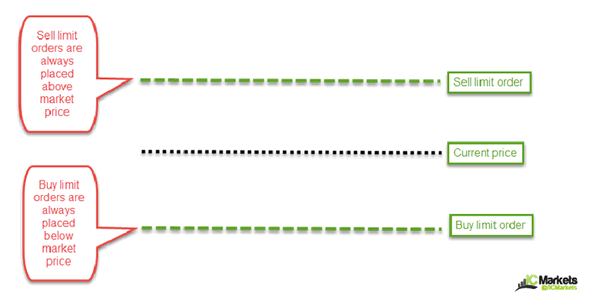
We're really fond of this type of order, as it can be positioned awayfrom current market price. A limit entry order is used to either buybelow or sell above market price. It's also very handy as a take-profitexecution order as well!
With regards to a buy order, let's say that the EUR/USD is trading at1.3150 and you believe that if price connects with 1.30, the pair willrally. If you're unable to monitor price, you could elect to set a buylimit entry order at your desired level. So, when/if price strikes thisnumber, a buy order will be executed with or without you being present.
For a sell order, it's the same but works in reverse. Let's imaginethat the EUR/USD just bounced from 1.2950 and is heading in thedirection of 1.30. You believe that this number has the potential tohold as resistance, but you're unable to monitor price. In this case,you could set a sell limit entry order at 1.30 and once price interactswith this number, the order will be filled.
When using limit orders, you'll only be filled at the price you designate or better.
Stop-entry orders
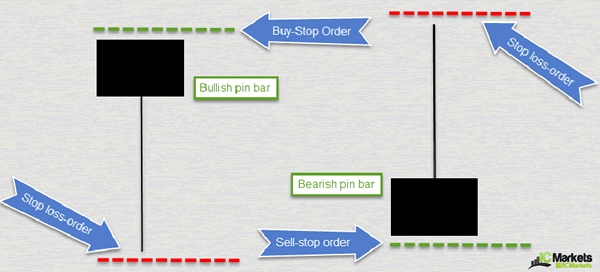
Instead of setting a buy order BELOW market price as you would do whenusing a limit order, a buy-stop order can be positioned to buy ABOVEcurrent price. It's just the inverse with sell orders. A sell limitorder would be placed ABOVE current price, whereas a sell-stop orderwould be sited BELOW price.You use stop-entry orders when you feel thatthe unit will move in one direction.
This is a common entry order used by pin-bar traders as per the diagram below:
Stop-loss orders
A stop-loss order, also known as a 'stop order' or 'stop market order',is an order whereby the trader/investor instructs the broker toautomatically liquidate a position if the instrument advances ordeclines past a certain point.
This is, in our humble opinion, probably the most important order tounderstand! To limit losses, market participants use a stop-loss orderto take them out of the market when they are wrong. And guys, you willbe wrong at times! If you do not have the time to monitor your position,a stop-loss order can really save your skin!
For example, if you're long at 1.3256 on the EUR/USD and your strategysays that if price crosses 1.3236 that you're wrong, this is where astop-loss order should be positioned. Once/if price crosses this line,the trading platform will automatically execute an order to sell at thenext best available price (assuming that you're using a stop marketorder).
In closing
Of course, there are plenty of different orders used by traders everyday. The above four, however, are what EVERY trader SHOULD know beforeconsidering a live trade.
What Snipers Can Teach You about Trading
A military sniper's edge is not only crucial, it's also extremely extensive! Determining distance, selecting camouflage, preparing a suitable location, making sure that the rifle is well-sighted, having the correct mindset and showing patience are just some of the components that help form a sniper's edge in the field. Without it, there could potentially be fatal consequences. Fortunately, for us civilians we don't have to deal with the stresses of conflict. What we can do from here, however, is apply some of these elements a sniper uses to form a complete trading edge. What we mean by 'complete' is simply an edge which has all the necessary components to achieve consistency in the market.
Factors that we deem necessary to fulfil a complete trading edge are the following:
- Know thyself. Understand what makes you tick. Are you impatient, greedy or fearful when money is on the line? This is something that needs to be addressed.
- Develop a trading method. Whether this be technical or fundamental, or even a combination of the two, this will have to be back tested and forward tested before an edge is considered present.
- Money management and risk. What risk/reward will you target, how much equity risk is allocated per trade etc.?
Preparation
Without preparation, life for both a trader and the sniper would be extremely hazardous.
While the sniper prepares location, selects appropriate camouflage and makes sure the equipment is well maintained, the trader, assuming that a technical formation is used to trade, will typically prepare using the charts. Also of note, we believe it prudent to always be prepared for what economic data may throw your way. A high-impacting news event can, and usually does, run through most technical levels.
Remaining vigilant of the entire picture in the markets is a crucial segment within a trading edge.
Mastery
This is critical. For a sniper, mastering the operation of his/her rifle is imperative. Without having absolute confidence in the equipment, the operator would likely hesitate when it matters most. The same goes for us traders in regards to our trading setup! The trouble here, however, comes from there being a myriad of different trading systems one can adopt, which often leaves newer traders overwhelmed. This is why we promote learning/mastering just ONE setup, especially in your initial years of study.
Mastering (and trading) a single setup may seem boring when there is a plethora of trading setups to choose from. While this may be true, once you've proved you have a trading method with an edge in the market over a series of trades using one setup, you can then think about adding additional systems to your toolbox.
As traders, we are attempting to pull money out of a very competitive market over a series of trades, using a collective edge. Unless you have mastered your setup, you'll find it difficult to profit as your edge would be incomplete.
Less is more:
Do you think a sniper fires continuously when in the field? Highly unlikely. This is all done in practice. Similarly, this is why we believe back testing a trading method is so important. Think about it like this… how can one be confident enough to move on to mastery without first having the confidence in the method to pull the trigger in a live environment?
Once settled into live trading, one should only be trading when the setup is present and correct. With no visible edge, you're playing a VERY dangerous game! Trading one setup, of course, means you may not trade every day, but when the setup does eventually come into range, you'll be prepared and ready, similar to a sniper, to pull the trigger – discipline at its finest!
Sometimes snipers have to wait days for a target to come into range, as we swing traders often do! Over the long haul though this will help achieve consistency as you're not attempting to machine gun the market, hence why we believe the less-is-more approach adds weight and complements a trading edge.
Patience
And this leads us nicely on to our next point: patience. The dictionary definition states that patience is: the capacity to accept or tolerate delay, trouble, or suffering without getting angry or upset. A sniper, in our opinion, is the epitome of patience! And this is something a trader should try to emulate. Having the ability to sit and wait for the market to move into your strike zone takes a truckload of patience. But in order to become a consistently successful trader, this is a crucial ingredient needed to form a complete trading edge.
In closing…
Successful traders who have accomplished consistency have typically learnt to select trades in a calculated manner. Losing traders on the other hand attempt to machine gun their way through the markets, and only end up quitting once their ammunition has been exhausted. This is usually the point in one's trading career where they either learn how to trade properly or leave the business altogether. Developing a collective edge similar to that of a sniper is a MUST if you wish to operate successfully in this business.
Quite simply, an edge to a forex trader gives a higher probability of one outcome over another with positive expectancy. Without a COMPLETE edge it's highly unlikely that you'll succeed.
A trading edge is a combination of the things we've discussed in this article and is, as you can see, NOT solely just the trading method.
A trader with a mediocre setup, buckets of discipline and a well-formed trading plan which CLEARLY details money management and risk, will generally overtake a trader who has an awesome setup but lacks the remaining sections to fulfil a complete trading edge.
How to Trade Forex for Beginners
With the improvement of technology in the late 20th century, the world of forex trading opened up to the internet. By 2004, forex had developed into a $1.9 trillion a day market. As of 2016, the daily volume surpassed $5 trillion a day! Gaining access to the markets is relatively easy. The creation of the Internet made it possible to trade currencies anywhere in the world with internet access, 24 hours a day five days a week.
When beginning one's forex journey, you'll likely come across two methods of trading: technical analysis and fundamental analysis. Technical analysis, the more popular of the two approaches, is effectively the study of price movement on a chart. Fundamental analysis, however, looks at the underlying economic conditions of an economy, focusing on statistical reports and macroeconomic indicators.
- Fundamental analysis helps answer the question WHY a market is moving in a particular direction. For example: is the currency pair rallying due to the Federal Reserve (more commonly known as 'the Fed') expected to hike rates in the near future, or is the move fuelled by a country's political stance? Knowing what causes markets to move helps one pin down market direction in the future.
- Technical analysis typically helps define WHEN to trade. For example, assuming that we know the underlying fundamentals are pointing to a rally in the dollar, but technical price action remains trading at the underside of a strong resistance (which essentially means a level in the market that price has trouble breaking beyond), this may not be the best time to buy the currency. However, once the resistance is broken, a buy trade could be taken as we now have both technical and fundamental cues signalling that the dollar is likely to strengthen. Learning both methods is highly recommended!
Terminology:
Doctors, lawyers and engineers all use specialized language related to the profession. Why should trading be any different? Knowing how to communicate is essential! Fortunately, the forex market's terminology is not all that complex. For those completely new to forex, please check out our 'what is forex trading' article before continuing as we touched on some very significant market jargon like what a pip is and how to recognize this in a currency quotation, what spread means and how it affects us traders and also what leverage is.
While gaining access to this huge marketplace takes less than a few clicks, trading has proven especially tough for beginner traders. They often come to the markets with unrealistic expectations. This business, despite what some gurus claim, is not a get-rich-quick-scheme. And, unless treated like a business, your trading career will likely be a short-lived one.
Helpful Tips:
Here are a few tips to keep you on the right track in the earlier stages of your journey:
- Rather than thinking short term, try and think long term. Don't fall victim to the 'I want to be a millionaire next month' camp.
- Don't rush! How long does it take the average doctor to become medically qualified? Several years! Why would trading be any different? How many businessmen/women do you know that started a business with little to no knowledge and have stayed in the game? Not many, that's for sure!
- Journal your progress. Learn from your mistakes. This is crucial. Without a journal, the learning curve will likely be a long process that may end up with you throwing in the towel.
- Despite hearing of traders winning 80% of the time, and there are some that do, don't get us wrong, you don't have to win 80% of your trades to profit. You don't even need to win 50% of the time. If we were to present a trading method to you that won only 4 trades out of ten, you may respond with a rather confused look upon your face. However, what if we then said that on those winning trades, the average gain was two times your risk, now would you be interested? Think about it like this, we risk $200 each trade. So, on each winning trade we net $400. Multiply this by 4 and we have $1600. Taking out the the 6 losses ($200 * 6) which equates to $1200, we're left with a profit of $400 from these ten trades.
- While this is an article for beginners, we feel it is necessary to touch on how a trader sizes (calculates) their position. This is EXTREMELY important. As traders, before anything else we are effectively risk managers. Get this part wrong, and it could have dire consequences for your account and effectively leverage your position to reckless levels.
Correct position sizing allows the trader to select how much risk is placed on each trade. To calculate a position's risk one needs the following data: account equity, the pip value for the pair you're intending to trade, the stop-loss pip distance and the percentage of your account equity that you're willing to risk. Furthermore, Standard lots, Mini lots and micro lots are what we generally use to calculate a trading position. 1 standard lot equates to 100,000 units, whereas a mini lot represents 10,000 units and a micro lot comes in at 1,000 units.
By way of example, let's say trader A has an account balance of $10,000. On average that trader risks about 25 pips each trade on the EUR/USD pair. So, in this case, the account denomination is the same as the quote, or counter currency. Trader A has chosen to risk 2% of his account equity per trade. Firstly, we'll need to calculate the dollar amount: $10,000/100 = 100 * 2 = $200. Following this, we divide the amount of equity risked by the stop-loss distance in pips: $200/25 = $8 per pip. Once we've completed this, the trader must locate the pip value of the EUR/USD. 1 standard lot equals $10 per pip, a mini lot equates to $1 per pip and a micro lot represents $0.10 per pip. As such, using 1 standard lot here would put the trader in at a higher risk bracket of $250 ($10 per pip * 25 pip stop loss = $250). Given this, we could simply size the position using 8 micro lots since they equate to a $1 pip movement ($1 per pip [1 micro lot] * 8 = $8 per pip * 25 pips = $200). There are additional steps involved when your account currency is different from the counter currency. However, for ease, one can simply use a position sizing calculator. It's time efficient, easy to use and less taxing on the brain!
- Keep risk parameters to within a 1-2% risk bracket. We know that it may be tempting to risk more but this is a dangerous play, in our humble opinion.
- Don't overtrade. Focus on only a few pairs to begin with.
- Trade using a demo account first. This will allow one to become familiar with the platform features. Why not consider opening a demo account and get a feel for the market without risking capital. The next question that usually arises is, how long should one stay on demo? Well, there is no one right answer here, we're afraid. While a demo account is beneficial for the learning process, to trade the markets successfully one needs to fully appreciate the psychology behind trading. Therefore, once fully comfortable with the trading platform features, trading a small live account could be the next step forward, assuming you have a back-tested method with a clear-cut trading plan that is! With IC markets, you can open an account with as little as $200. That way, making your very first need not break the bank should you make a mistake.
Gold Trade Specifications Every Trader Must Know
While traders tend to focus more on trading strategies for gold, the trade specifications which are actually very important are often given least priority. In this article, learn about the trade specification requirements and details for trading gold at Orbex.com
Trading Gold CFD's requires a completely different approach than trading currencies. This is simply due to the nature of the way gold prices behave compared to other markets. For most traders, gold and fx are often used inter-mixed especially when it comes to trading strategies. Without understanding the basics of what is going on in your gold trades, it can be difficult to make consistent profits. The following three points are quite important when it comes to trading gold and something a trader must know at any point in time. This article is specifically focused on the Gold CFD contracts that are available to trade from Orbex.com
Gold - Specifications
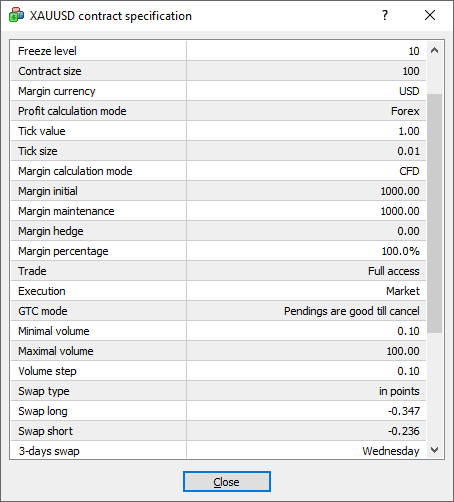
Initial Margin: The initial margin is the amount of collateral required to hold a position in Gold. At Orbex, the initial margin for gold is $1000 for a trade size of 1 lot (100,000). So if you are trading 0.50 lots, your initial margin would be $500, or $100 margin requirement to trade 0.10 lots of Gold.
Why is margin important?
Understanding the initial margin can be beneficial for you to plan your trade size. For example, if you had a trading equity of $1000, then it makes sense to trade with 0.10 lots in Gold, where the requirement margin of $100 is locked in. This leaves you with a free margin of $900.
Minimum contract size: The minimum contract size to trade Gold is 0.10 lots. A 1 standard lot in gold is equal to 100 ounces. Therefore, when you trade, 0.10 lots is trading 10 ounces of Gold.
Understanding the minimum contract size can help you in your position management. Because the contract size or lots are directly related to the required margin, by knowing these details, you would be able to position your trade sizes better based on the trading capital that you have.
Tick Size and value: The minimum tick size is 0.01. At Orbex, gold is priced in two decimals, such as 1200.12 and so on. Each tick or 0.01 is $1 for a standard lot or $0.10 if you are trading the minimum trading size of 0.10 lots.
The value of the tick size in gold is perhaps the most important. Because each tick is equal to $10 for a standard lot size, you can quickly do the math in terms of knowing how much loss or profit you can make off your trades.
Swaps: When you keep your positions in gold open overnight, then your trades attract overnight rollover swaps. For long positions, the swap on your gold trade is a -0.347 points and for short positions that are kept open overnight, the swaps are -0.236. So when you are trading 1 lot position in Gold, long positions held overnight have -$0.347 (rounded to -$0.35) swap and short positions have -$0.236 (rounded to -$0.24) swap.
Gold - Trade Example:
We purchased 1 lot in Gold at $1250.98. Therefore, the required margin was $1000 and each tick (0.01) is worth $10. So if gold had risen from 1250.98 to 2151, a 0.02 tick move, which would give a profit of $2. Likewise, if gold prices fell from 1250.98 to 1250.68, that is a 0.30 tick move, which is $30 (0.30 x $100).
Why is it important to understand gold specification?
Understanding the margin requirements, swaps and tick size can help traders to remove any ambiguity from their trades. By knowing exactly how much you can make or lose on a trade that you hold, including the additional swaps that are applied, traders will be able to use this information to better manage their gold trading positions.
Top Ten: Trading Risk & Psychology Reads
In this weekly segment I am going to bring to you my Top Ten of everything trading related; from trading myths, trading mistakes, trading books, trading websites, trading hacks - I am sure you get the picture.
I want to kick this segment off with an introduction to what I consider my top ten Trading Books that aren't related to trading strategies or set ups, but focused specifically on risk and psychology, as the defining moment in my trading career was moving from part time gambler to full time student of risk and psychology.
1. Market Mind Games: A Radical Psychology of Investing, trading and Risk - Schull
This work provides a pragmatic strategy to unify your mental tactics with your trading strategy, enabling the trader to make better decisions by navigating the complicated relationships between reason, analysis, emotion, and intuition.
2. Manias, Panic and Crashes - Kindleberger and Aliber
An excellent and insightful read on the way that the mismanagement of finances and credit has been the catalyst for financial collapses throughout history. The book covers the full spectrum and anatomy of crises, speculative manias and the lender of last resort scenarios. This work does a first class job of capturing the turbulence of the financial markets.
3. Mistakes Were Made (But Not by Me): Why We Justify Foolish Beliefs, Bad Decisions and Hurtful Acts - Tarvis and Aronson
An in depth investigation into how the brain is hardwired for self-justification. When we make mistakes, we must endeavor to calm the cognitive dissonance that impacts are feelings of self worth, hence we create fictions that absolve of us of personal responsibility, restoring are feelings of self belief, a belief that often keeps us on the wrong rinse and repeat the course.
4. Thinking, Fast and Slow - Kahneman
This masterpiece defines the two mental systems that drive our thought patterns. The first system, fast and intuitive and the Second system slower and more logical. Kaheman exposes the extraordinary capabilities and drawbacks of both systems, demonstrating the impacts of loss aversion and over confidence, the challenge of properly framing risk and the profound effects of cognitive bias.
5. The Psychology of The Foreign Exchange Market - Oberlechner
A must read an overview of the complexities of the international Foreign Exchange Markets. Investigating the markets dynamics and drivers behind the diverse participants and the variety of psychological perspectives ranging from the impacts of social market dynamics, the role of affects and intuition in trading decisions, cognitive biases of traders and subjective attitudes in market expectations.
6. The Hour Between the Dog and Wolf - Coates
Explains how we think with our bodies as well as our brains when we take risks at work, in sport, on the battlefield, and the financial markets. Shows that under the pressure of risk, we biologically transform, a metamorphosis Coates refers to as the hour between dog and wolf. A fascinating read for anyone who has worked on a trading floor
7. The Misbehavior of Markets - Maderblot
Markets, we learn, are far riskier than we have wanted to believe. From the gyrations of IBM's stock price to cotton trading, and the dollar-Euro exchange rate - Mandelbrot shows that the world of finance can be understood in more accurate, and volatile, terms than the tired theories of yesteryear.
8. The Bounds of Reason: Game Theory and the Unification of the Behavioral Sciences - Gintis
Game theory alone cannot fully explain human behavior and should instead complement other key concepts championed by the behavioral disciplines. Shows that just as game theory without broader social theory is merely technical bravado, so social theory without game theory is a handicapped enterprise.
9. The Black Swan: The Impact of The Highly Improbable - Taleb
Focuses on the extreme impact of certain kinds of rare and unpredictable events (outliers) and humans' tendency to find simplistic explanations for these events retrospectively. This theory has since become known as the Black Swan theory
10. Freakonomics - Levit and Dunber
A collection of articles written by Levitt, an expert who has already gained a reputation for applying economic theory to diverse subjects not usually covered by "traditional" economists. He does, however, accept the standard neoclassical microeconomic model of rational utility-maximization. In Freakonomics, Levitt and Dubner argue that economics is, at root, the study of incentives.