Sample Category Title
How to Improve Your Trading Results with Daily & Weekly Routine
As humans, we tend to perform our best when we have a well laid out routine. Chaos is something that most of us by human nature tend to avoid at best. With trading, having a routine brings with it a certain level of discipline which helps you to improve your performance as a trader. Having a trading routine helps you follow a trading process and at the same time will help you to avoid taking impulsive trading decisions, be it entering or exiting a trade prematurely. Professional traders, whether they trade currencies or bonds, or stocks follow a routine.
So what kind of routine works best? These following steps should help act as a guideline to build your own trading routine.
No matter what kind of routine you follow, they will most likely fall into these three categories:
- Psychological: The psychological aspect of a trading routine can be personal and subjective. For some, starting the day with brief exercise works, while for some meditation also works. Finding that little routine to prepare your mind for the day ahead and also to clear up any distractions can have direct results in how you deal with emotions while trading.
- Information: The informational aspect of trading deals with keeping an ear to the markets. A quick round up of the previous day's events and reading up on what to look forward to, for the day or the week can help you to focus on selective instruments rather than pick an instrument to trade randomly.
- Analysis: The analysis part of the trading routine if of course spending time with your analysis on the charts. Making notes and doing initial ground work such as risk management and so on.
- Execution & Management: The execution part of the routine is where all your hard work is put to test. Executing a trade could be simple but managing your trade so that a winning trade doesn't turn out to be a loser or failing to cut your losses plays into the bigger picture.
Plan your trades and trade your plans
This is a common saying among the trading circles. But does planning a trade simply means, analyzing a chart and then trading or is there more to this?
For traders who actively trade the forex markets, the only 'quiet time' we get is during the weekends when the markets are closed. Planning your trades over the weekend can help you to pick out the currency pairs to focus on and will also give you an edge when you combine both technical and the prevailing fundamentals that are driving the markets.
Establishing a procedure
Establishing a routine or procedure can help you to follow a certain path. For example, if you are really serious about trading, start by analyzing your charts over the weekend. Free from noise and with the currency markets closed, you can take your own time to draw up your analysis and conclusions.
Once you have your plans were drawn up over the weekend, which should typically combine both fundamentals and technicals, also focus on the trade or risk management aspect of it. Little things such as how much to risk on a trade or finding correlated pairs to trade can help improve your strategy.
Some traders tend to follow both a weekly and daily routine.
Steps to build a 'weekly' routine
- Read up on the fundamental events that occurred over the week and also read up on any news and opinion pieces which reflect on the week ahead
- Glance through the weekly economic calendar and make a note of any upcoming fundamentals that will likely be a catalyst for prices
- Analyze your charts over the weekend. Start with the weekly (or monthly) and build a context of the markets
- Once you spot a potential trading opportunity, you can then look into the smaller time frames to time your trades accordingly
- Divide your analysis into "Watchlist" and "Opportunities". Watchlist will be the currency pairs that you are interested in, but either not sure how prices will move or you are waiting on the sidelines for a good trading opportunity to come up. On the other hand, Opportunities section should contain trades that you are most likely to trade, given that you have done your top-down analysis including technical and fundamental analysis
- On the potential set of trades that you have now have, run through your risk management to see the potential profits and losses that you can make.
- From the set of "Opportunities" try to filter out any trades that you are not entirely sure about and focus only on the trades where you have a strong conviction and one which is supported by your analysis
- As a final run down, re-check on the fundamentals by searching for related news or commentary on the currencies that you are trading. Re-evaluate your opportunities
- When the week starts, only keep the charts for the currencies that you are trading, to help you avoid the temptation of looking at other charts and potentially ending up trading them, which falls outside of your trading plans
Steps to build a 'daily' routine
- You can make a habit by first reading up on any news events from the day depending on your location. If you are based in Asia, then scan the news for any financial news from the previous day's US trading session and the current Asian session. If you are based in Europe, read up on what has happened in the Asian session and any news that has occurred prior to the start of your trading. Or, if you are based in the US, watch how Asia closed for the day and how European markets are evolving
- Spend a few minutes on the charts that you already analyzed over the weekend to determine the general sentiment and any fundamentals that could shift the markets around
- Before you start trading always, take a look at the potential losses you might incur if the markets moved against your analysis. Focusing on the losses will help you to at the very least remove the regret aspect from the equation which could otherwise snowball into taking impulsive trades or trading on gut rather than trading based on your analysis
Using Expert Advisors to Improve Your Trading
Traders may or may not agree that using an automated trading strategy will improve your trading results. But one cannot ignore the fact that an EA can be beneficial in the early stages of developing your trading strategy. In this article, we look at how using automation can help you to cut down on time while providing an objective analysis of your trading system.
When it comes to Expert Advisors, traders can be broadly distinguished into two groups. The first group which believes that the markets can be traded consistently by automation, where it is possible to take advantage of some recurring patterns and thus be able to build a mechanical system. And then, there are traders who believe that discretion based trading offers more consistency in making profitable trades.
An expert advisor or a bot can be used to either inform the trader of a potential trade or it can also execute the trade automatically without any human intervention. The biggest argument for using an expert advisor is that it removes the emotional factor from the equation. It is said that an EA can perform better than a discretionary based trading approach for the fact that the automated trading strategy is based on logic and not emotions. Secondly, an EA is also said to be less time consuming and can identify more opportunities. With an EA, a trader doesn't have to be stuck to their trading screens.
No matter which camp you belong to, the fact remains that automation or expert advisors form a big group in the trading environment.
There are different ways to use an EA, even for those who base their trading decisions based on discretion. In fact, a semi-automated trading strategy can offer the advantage of both using discretion to execute the trades while also pointing to potential trading opportunities.
Here's how you can use Expert Advisors to improve or evaluate your trading strategies.
Using EA's or Indicators in your trading strategy
Firstly, the word 'Indicator' is not to be confused with a moving average or an MACD indicator. By indicator, in the context of EA's is a tool or a piece of code that indicates you to potential trading opportunities based on the conditions of your trading system.
An example of such indicator could be one which alerts you when there is a bullish or a bearish moving average crossover. This can be greatly beneficial when you want to visually backtest your trading strategy, set up a stage that comes in quite early in the development of your trading system.
By starting out with this simple indicator, you can visually check on how your trades would have performed if you simply bought and sold at every bullish or bearish crossover.
Using such indicators can be greatly beneficial especially if you are trading with price bars or candlesticks. For example, it can be exhausting to visually plot inside bars. However, by using an indicator that automatically plots inside bars can help you to save not only time but also removes any bias.
The following chart illustrates this. On the left is the inside bar indicator which colors the bar 'Magenta' when an inside bar is formed. On the right is a plain bar chart. It is easy to see how using the custom indicator can help you automatically focus on the next steps in your trading strategy, as compared to visually plotting the inside bar formations without using an indicator.
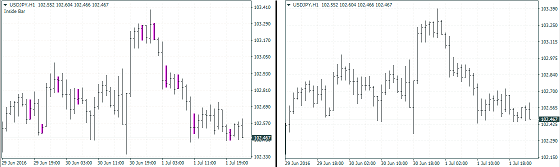
Using a custom indicator to plot inside bars
With the major part of the strategy done with, which is identifying the set ups, traders can now simply focus on testing how they can execute the trades.
Notice that despite using the custom indicator; traders can still retain their discretionary models in their trading strategy.
Another way to use an expert advisor is to actually code up your entire trading strategy. Having the EA to run a backtest can help you to initially identify the potential in the trading strategy. A trader can then go into the details of evaluating individual trades and thus be able to fine tune their strategy by adding new filters to improve the trading performance or even employ position management into your trading strategy.
Some might call this as curve fitting, but as long as you do not fall into the trap of over-optimizing your trading strategy, it can be beneficial in removing the weak links in your trading system rules or logic.
Using automation to build screeners
Automation can also help traders in building their own instrument screeners. For example, it makes more sense to have a dashboard indicator that alerts you to a trading setup or a signal than having to manually check the charts every day or after every intraday session. It can also help you to screen different times frames as shown in the chart below.
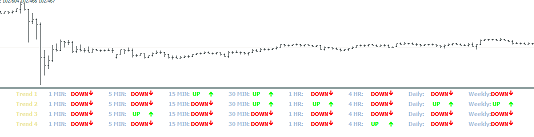
Trend Screener – Automation
The trend automation screener, for example, combines various indicators to show the overall trend. As obvious from the above screenshot, the automated script can help traders to spend more time in looking at potential trading opportunities than having to look at each of the instruments or move across different time frames.
To conclude, while you may or may not agree with using an automated approach to trading, the fact remains that making use of automated indicators or scripts can help you at the very least to cut down on the more recurring or mundane tasks while developing your trading system.
Euro Remains Subdued, Markets Eye Yellen Testimony
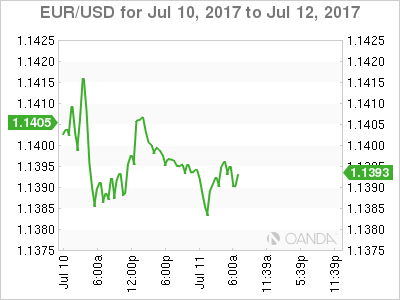
The euro is having a quiet week, as the pair continues to stay close to the 1.14 line. On the release front, there are no major events out of the eurozone. With a lack of data so far this week, investors have been consolidating positions, contributing to the lack of movement from EUR/USD. In the US, today’s key event is JOLTS Job Openings, which is expected to come in at 5.98 million, lower than the previous reading of 6.04 million. On Wednesday, Federal Reserve Chair Janet Yellen will testify before the House Financial Services Committee.
The US wrapped up last week with key employment numbers, and the results were mixed. Nonfarm Payrolls rebounded in June, climbing to 222 thousand. This easily beat the estimate of 175 thousand and marked a 4-month high. However, wage growth remained stuck at 0.2%, shy of the forecast of 0.3%. Weak wage growth has remained soft throughout the first half of 2017, which is somewhat puzzling, as the labor market remains extremely tight, with an unemployment rate of 4.4%. As well, there are widespread reports of a lack of qualified workers, but this hasn’t translated into higher wages.
The markets reacted positively to the solid Nonfarm Payrolls report, but there expectations of a third rate hike in 2017 remain lukewarm. A rate increase in September is very unlikely, with the odds pegged at just 13%, according to the CME Group. As for December, the likelihood of a rate hike is 50%, so the markets will need plenty of convincing that the Fed plans to make a move. What factors will raise the odds of a rate increase? First, second quarter growth will have to improve, after a weak performance in the first quarter, in which GDP rose just 1.4%. Second, stronger inflation levels would boost speculation of a rate hike. Currently, inflation is well below the Fed’s target of 2%, and although Janet Yellen recently stated that the factors weighing on inflation were temporary, investors aren’t convinced. Third, the Fed has outlined plans to reduce its bloated balance sheet, but has avoided providing any specifics. If the Fed started to lower the balance sheet in September, such a move would mark a vote of confidence in the economy and raise speculation of a rate hike to follow in December.
What is Price Action in Forex Trading?
Looking at a candlestick, bar or a line chart for the very first time is both captivating yet confusing. The typical response we hear from newer traders is that it reminds them of a hospital's heart monitor. While this medical appliance is designed to monitor the fluctuations of a heart, the chart is there to record a security's price.
Price action, or 'P.A' for short, is a term used to note the movement of price. To understand the basics of a price chart, however, knowing the anatomy of a candlestick is essential. Candlesticks are used extensively throughout the trading community and are, in our humble opinion, the more visually striking when compared to a bar or line chart.
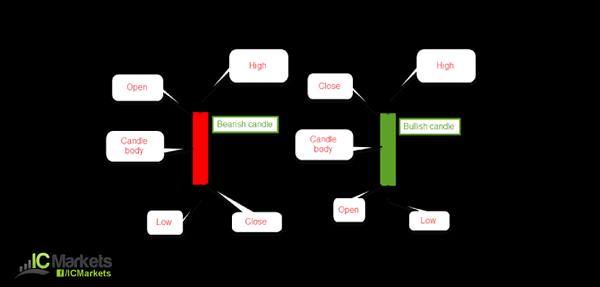
The picture above shows how a candlestick formation is read. Each candle typically contains both a high (also known as a 'wick'), a low (also known as a 'tail'), an open, close and a body, with each closed candle telling a different story. The wick, assuming that the candle being studied is from the daily timeframe, displays how high the instrument traded throughout the day. By the same token, the tail demonstrates how low price managed to trade on the day. In the event that the newly-painted candle closes above the prior day's close, then a bullish/positive candle would be seen (green). Likewise, if the day's trading concludes with price action closing lower than the previous day's closing point, the candle will then be considered bearish/negative (red). Despite this, one must also take into account that during the trading day, even if the day's candle closes bullishly, bearish candles will still usually be seen if one examines the lower timeframes. Take the daily bullish candle seen below, for example. While the candle body closed positively, the H1 timeframe/chart shows a number of H1 bearish candles that played out over the course of the day.
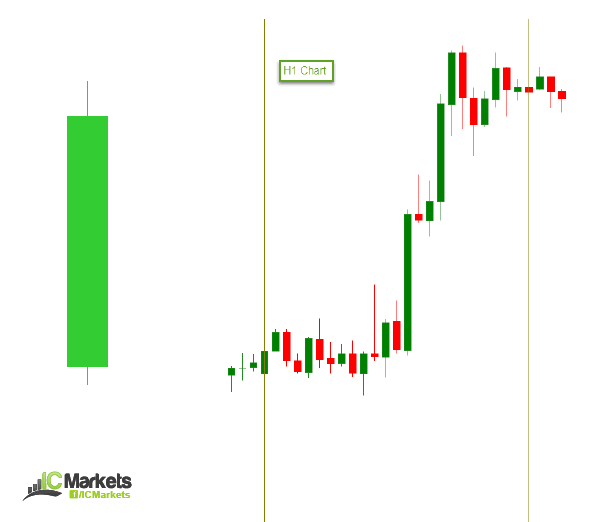
For those of you completely new to the world of trading, a timeframe simply refers to the period that a trader selects to conduct his/her trading on. IC Markets provides the following timeframes on their MT4 platform to view price action:

The 'M1', or 1 minute timeframe, is the smallest timeframe a trader can view price action here, where candlesticks come in thick and fast, printing a fresh candlestick every minute. The 'MN', or monthly timeframe, is the largest scale one can view candle action here, which provides one with a freshly-painted candle each month. Of course, as demonstrated in our very own daily technical reports, one does not need to solely rely on one timeframe. A trader has the option of adopting a multi-timeframe style, which, in our belief, helps one establish more of a concrete picture of the market as a whole.
Next, we're going to touch on a fairly simple yet very significant aspect of price action. Below is a H4 chart, meaning that each candle close on this timeframe represents 4 hours of price action.
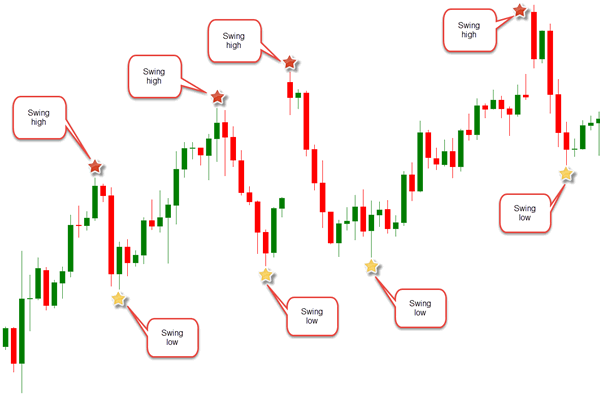
The gold stars are used to denote 'swing lows' and the red stars are there to signify 'swing highs'. You'll often here these terms thrown around forums when discussing technical analysis. Put simply, they are the extreme points that are visible on a particular timeframe. As can be seen from the above chart, it's relatively simple to recognize them visually. However, they are, without a doubt, essential concepts one needs to grasp in order to read the charts correctly. Do yourself an enormous favour and practice observing these extreme points, as it will certainly benefit you later in your trading career.
Being able to identify swing highs and lows helps traders/investors pin down market direction. In the example above, after noting the extreme points, where would be the more likely direction price may travel to next? Our expectation would, assuming the latest swing low holds steady, be for a new swing high to form essentially setting the stage for a trend continuation.
Knowing what a timeframe is and how to read a candlestick chart, nevertheless, is not enough. There is a plethora of price action patterns that traders use to analyse the markets. In order not to overwhelm our newer traders, we've kept this article relatively simple. In part 2, we'll look to dive into more juicy aspects of price action and touch on how one could potentially use this in their trading.
How To Trade Pullbacks With 5 Key Technical Tools
Trading forex can be both interesting and rewarding if one can spend the time learning how it really works. First you have to build a base or foundation. That includes developing a strategy that works for you, finding good money management techniques and training your mind to be disciplined in all facets of trading. Remember, at the end of the day you must muster up enough courage to pull the trigger for any strategies developed to work.
What you will learn in this article is a pullback trading strategy that utilizes stochastics, simple support and resistance as well as Fibonacci retracement ratios to time trades in the direction of the primary trend. In my opinion, simple strategies work best in trading. And as simple as this strategy appears, keep in mind that no system is a bad system as long as it works and produces results for the owner. My honest advice is that you should stick to what works for you. If your strategy produces more winners (profits) than losers (losses) stick with it but re-evaluate it from time to time because market conditions might change so re-evaluations allow you to incorporate new changes in the market you trade into your strategy.
Terminology Used In This Article
Before we go into the discussion of this strategy, it is important for us to understand the key technical analysis tools we will utilize in this strategy. Don't worry if you don't fully grasp the definitions below. They will become clearer when I walk you through my strategy.
Stochastics: It is based on the rule that, within a period of strong market action, a market will tend to close towards the upper end of the range, while in downtrends, the price will close near the bottom of the range. Stochastics is made up of two lines; %K and %D that oscillate between 0 and 100. Overbought and oversold conditions are functions of this indicator, which could range between 80 on the upside and 20 on the downside. In addition, stochastics sometimes generates a divergence condition, which occurs when the indicator fails to confirm a move to a new price high or low in the price action.
Support and Resistance: Resistance is a price level above the market where supply is strong enough to overcome demand while support is a price level below the market where demand is strong enough to overcome supply. Price highs and lows as well trading ranges can exemplify support and resistance. Rectangle pattern tops and bottoms can serve as good examples of support and resistance levels.
Fibonacci Ratios: Are a sequence of numbers in which each successive number is the sum of the two previous numbers: 1, 1, 2, 3, 5, 8, 13, 21, 34, 55, 89, 144, 610, etc. Leonardo Fibonacci, an Italian born mathematician around 1170 discovered the relationship of what is now referred to as Fibonacci ratios while he was studying the Pyramid in Egypt. These numbers possess interrelationships, such as any given number is approximately 1.618 times the preceding number and any given number is approximately 0.618 times the following number. Fibonacci levels are relevant to traders because markets often bounce off key Fibonacci price levels. These levels can also act as support and resistance and can be used as projected profit targets.
Candlesticks: Are a way of displaying the relationship between opening and closing prices during a time interval.
If the close is higher than the open - the candle is white.
If the open is higher than the close - the candle is black.
Now that the meanings of our technical tools are understood, we will now move on to the fundamentals of this strategy. The parameters are set below:
1. The strategy takes a top-down approach to analyze allowing it to start from the higher time frames(weekly charts) and drill down to lower time frames(240mins charts)
2. We look for overbought and oversold readings on the stochastics indicator after a pullback in an uptrend and a rally in a downtrend.
3. We then watch price actions at our defined support and resistance levels to see if it would hold or violate these levels.
4. After establishing support & resistance, we will now plot our Fibonacci ratios to determine which Fib levels coincide with support and resistance zones, keeping an eye on the stochastic extreme readings.
5. Our focus is on signals that are going in the direction of the primary trend. We do not take trades or open positions against the primary trends, whether downtrends or up trends.
6. Lastly, we use reversal candle patterns as our entry triggers. These reversal candle patterns include hammers, bullish engulfing patterns and dojis etc.
7. Putting it all together: A close above the high of the previous days low when the stochastic indicator crosses over from the oversold zone and is above 20 (reading) coinciding with our established support & resistance/Fibonacci retracement and a reversal candlestick pattern gives us an entry.
Step One
Establishing A Trend: Establish an uptrend (downtrend) on the weekly time frame. In this case, EMAs (50,100 & 200) and trendlines are used to determine the direction of the main trend. Below is a weekly chart of EURNZD cross, which has been in an uptrend since July 2007.
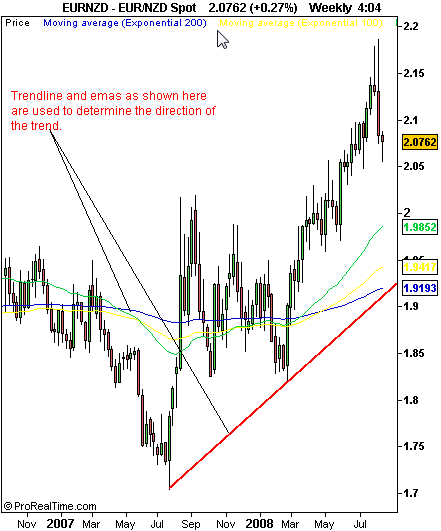
Figure 1
Step Two
Monitoring Pullbacks: After determining the direction of the trend on the weekly time frame, we will drill down to the daily chart in order to establish the trend (in the direction of the weekly trend) and also monitor pullbacks to know if it meets our strategy as defined above.
As you can see below, a pullback is already in place and price has moved into our defined support zone, but we still need to drill down further to 240-minute chart to see what price action and the stochastic indicator are doing. If price is hesitating or consolidating while stochastic is oversold, we then look for a reversal candle and a bullish stochastic crossover above oversold zone (reading above 20).
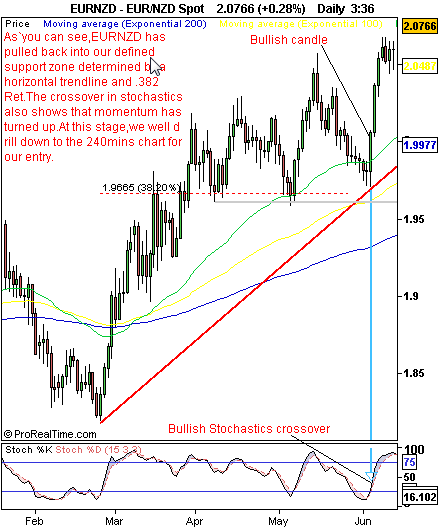
Figure 2
Step Three
On the 240-minute chart, price actually stalled ahead of our defined support/fib levels from the daily chart and a few ours later closed above the previous bearish candle to form a bullish candle pattern(bullish harami pattern). Furthermore, our stochastic indicator has already turned bullish above the oversold zone on the formation of the bullish engulfing pattern giving us an entry on the formation of the next candle. Stop losses are set 10 pips below the reversal candle.
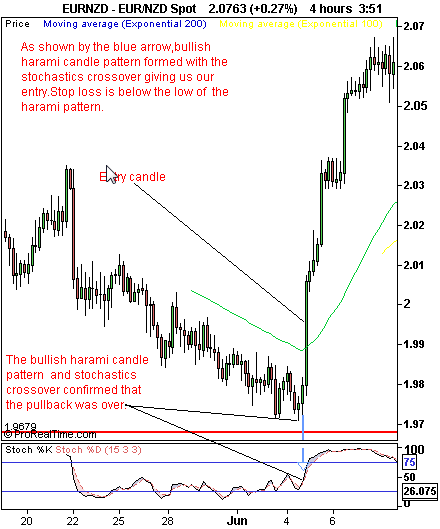
Figure 3
Conclusion
This strategy works on both downtrends and uptrends provided its defined parameters are followed. I use it as a swing trading strategy but for those interested in using it for day trading a little adjustment might be needed. Furthermore, refining your entries for low risk trades may take you below the 240mins chart, it is still all right as long as you are trading in the direction of the main trend. Depending on how you want to utilize the strategy, either as day trading or swing trading you can set your exit points based on your preferences but for me, I like using trailing stops. As stated in the beginning, simplify, simplify, simplify are the words I read every day as I begin my trading day. I love simple strategies because they work.
Will Central Bankers Follow Through On Hawkish Warnings?
- BoC and Yellen remains this week's headline events;
- Will BoE's Broadbent echo his colleagues hawkish rhetoric?
- Oil inventory data released as prices near 11-month lows.
As is likely to be the case for much of this week, central banks will be in focus again on Tuesday with two policy makers from the Bank of England and one Federal Reserve official scheduled to appear.
Wednesday remains the most notable session of the week, with Fed Chair Janet Yellen testifying before the House Financial Services Committee and the Bank of Canada potentially raising interest rates for the first time in almost seven years. A rate hike from the BoC would come as a number of the G7 central banks adopt a more hawkish stance, despite the economic data not necessarily supporting such a move.
It would appear there is a sudden coordinated desire to start moving away from the ultra-accommodative monetary policies that have been necessary over the past decade, even if the economic data doesn't necessarily warrant higher rates. The ECB is widely expected to lay out plans for ending its asset purchase program later this year, while the Fed is likely to announce plans to reduce its balance sheet in September and the BoE and BoC have, somewhat out of the blue, deciding the time to raise interest rates has arrived.
We'll have to wait 24 hours to find out what the BoC is going to do and whether more hikes are planned for the months ahead, and to hear what Yellen has to say about the path of interest rates and the balance sheet. Today though, we could get more insight from two prominent BoE policy makers and two FOMC voters, which should be of interest to traders.
The BoE's Chief Economist Andy Haldane has already recently made his feelings known, suggesting that while he never backed a hike at the last meeting, he could be persuaded to do so if the data performs as expected. Deputy Governor Ben Broadbent has been relatively quiet until now though and should he echo the views of Haldane in recent weeks, it could send a strong signal to the markets that the BoE won't be far behind the BoC, if it does in fact raise interest rates tomorrow.
The data will be less of a focal point today, although we will get JOLTS job openings for the US and oil inventory data later on in the session from API. Brent and WTI remain under pressure despite inventories having fallen consistently in recent months, with traders instead focusing on rising oil rigs in the US and higher output from Nigeria and Libya. Another large drawdown last week may provide some reprieve for oil, with it not trading far from its 11-month lows.
Rate Differentials Hinders Yen
Tuesday July 11: Five things the markets are talking about
Capital markets continue to watch for cues on monetary policy.
Questions on the U.S inflation outlook are certain to be front and center for Fed head Janet Yellen tomorrow – she is due to testify on the semi-annual Monetary Policy Report before the House Financial Services Committee.
Inflation data will in fact cap this week with Friday's consumer price report where minimal pressure is the market consensus. Also on Friday, U.S retail sales is expected to show a minimal gain once again, held down by weak auto sales.
Currently, global equities are little changed, unlike bonds, which are extending their slump triggered by more ‘hawkish' rhetoric from central banks.
Normalization of monetary policy is holding the ‘big' dollar firm and limiting its downside.
1. Stocks mixed results
Asian markets mostly climbed overnight supported by technology companies who mirrored gains in their U.S counterparts.
In Japan, the Nikkei stock index ended up +0.6%, buoyed by the weaker yen (¥114.32), while Australian shares erased losses and ended slightly higher.
In Hong Kong, stocks extended this week's rally, posting their best day in four months overnight, bolstered by strong gains among financial sector stocks. The Hang Seng Index rose +1.5%, while the China Enterprises Index gained +2.0%.
In China, stocks diverged, with the blue-chip index hitting a fresh 18-month high as investors favoured solid fundamentals, while small-caps extended a fall on expectations more equity issuance would soften valuations. The blue-chip CSI300 index rose +0.5%, while the Shanghai Composite Index lost -0.3%.
In Europe, stocks opened higher, but have since turned due to little major news. Crude prices are again dragging down energy stocks in the FTSE 100 as investors turn their attention to Fed Chair Yellen's comments in Congress tomorrow and upcoming U.S reported earnings.
U.S stocks are set to open little changed.
Indices: Stoxx50 flat at 3,477, FTSE -0.6% at 7,324, DAX +0.2% at 12,472, CAC-40 flat at 5,168, IBEX-35 -0.2% at 10,491, FTSE MIB +0.4% at 21,268, SMI -0.5% at 8,894, S&P futures flat
2. Oil steadies but outlook remains weak, gold lower
Oil prices have steadied overnight after almost a week of sharp falls, but the outlook remains weak amid oversupply issues.
Benchmark Brent crude is down -10c at +$46.78 a barrel, while U.S light crude is -5c lower at +$44.35.
Signs of strong short-term demand are capping losses for now – gas demand tends to increase in the northern hemisphere in the summer as U.S drivers take to the road.
Fundamental and technical dynamics for crude have not changed; the world is awash with crude supply.
Note: Brent prices are -17% below their 2017 opening despite a deal OPEC to cut production from January.
On Friday Baker Hughes data showed that U.S energy firms added +7 oil drilling rigs last week, marking a 24th week of increases out of the last 25 and bringing the total count up to +763, the most since April 2015.
Note: U.S oil production has risen over +10% since mid-2016 to +9.34m bpd.
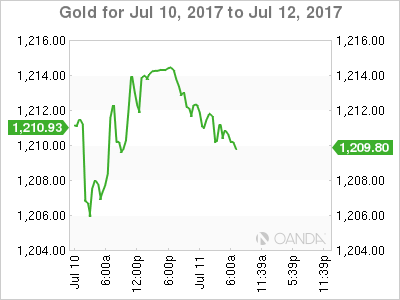
Gold prices (-0.3% to +$1,210.88 an ounce) have edged lower on a firmer dollar after touching near four-month lows in the previous session as the market waits for cues from the central bank on the path of U.S. interest rate hikes.
3. Bonds market selloff resumes, yields approaching last weeks high
San Francisco Federal Reserve President John Williams said overnight in Sydney that “it was a reasonable view to expect one more rate hike this year, and his own view was to start adjusting the central bank's balance sheet in the next few months.”
Yields on 10-year Treasury's have backed up +2 bps to +2.392%, while German bund yields climbed to +0.559% from +0.539%.
Investors should expect further pressure on yields as the U.S Treasury this week will auction a combined +$56B in notes and bonds.
Note: +$24B in three-year notes will be auctioned today, while +$20B in reopened 10-year notes on Wednesday, and +$12B in opened 30-year bonds on Thursday.
Elsewhere, Japan's Ministry of Finance confirmed that Japanese investors have returned to owning French government bonds (OAT's) after Macron's election win.
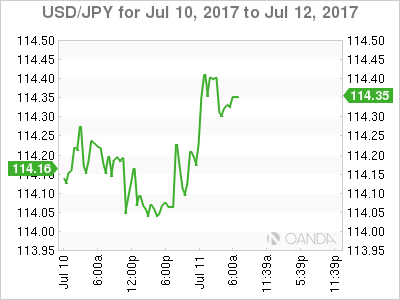
4. Dollar makes new highs against yen
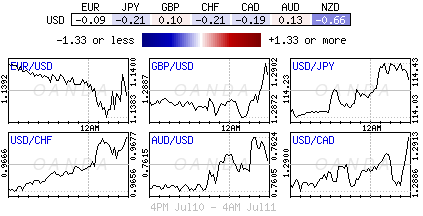
Rate differentials are hurting JPY (¥114.27). The yen remains under pressure as Japanese monetary policy looks set to remain ultra loose, while the Fed is raising interest rates and other central banks, including in the eurozone, U.K, Canada and Scandinavia, switch their bias toward tightening policy.
The market believes that the Bank of Japan (BoJ) would be the only G-10 central bank not starting a rate normalization process at the latest by next year.
Elsewhere, sterling (£1.2916) is rallying before a speech by Bank of England policymaker Ben Broadbent (07:00 am EST) – anymore rate rise hints is expected to lift the pound further. GBP/USD is up +0.2%, while EUR/GBP is down -0.2% at €0.8833.
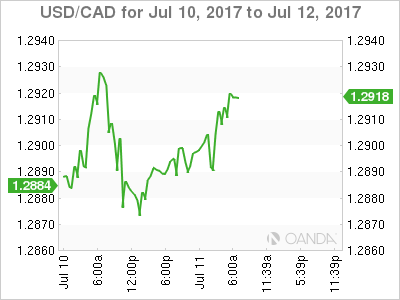
For the loonie (C$1.2909), the market seems somewhat divided on whether the Bank of Canada (BoC) will raise rates tomorrow (10:00 am EST), but data from the overnight index swaps market shows that money markets are almost fully priced for a +25 bps increase, while an +80% chance of a second hike has been implied by December.
5. U.S small-business confidence dragged by senate gridlock
Data this morning stateside showed that small-business owners' confidence about their economic situation declined last month as the U.S Senate remains in gridlock over the health-care reform bill.
The National Federation of Independent Business's (NFIB) small-business optimism index fell to 103.6 from May's reading of 104.5.
Note: The index rose sharply after the 2016 presidential election and reached a peak of 105.9 in January.
The result sunk well below market expectations of 104.5.
GOLD Targeting Support At 1195, SILVER Strong Bearish Momentum, CRUDE OIL Short-Term Selling Pressures Are Fading.
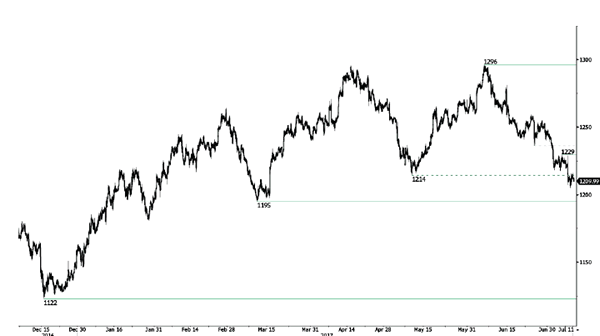
GOLD Targeting support at 1195.
Gold's is trading lower towards strong support given at 1214 (09/05/2017 low). Hourly resistance can be found at 1258 (23/06/2017 high). Expected to show continued weakness.
In the long-term, the technical structure suggests that there is a growing upside momentum. A break of 1392 (17/03/2014) is necessary ton confirm it, A major support can be found at 1045 (05/02/2010 low).
SILVER Strong bearish momentum.
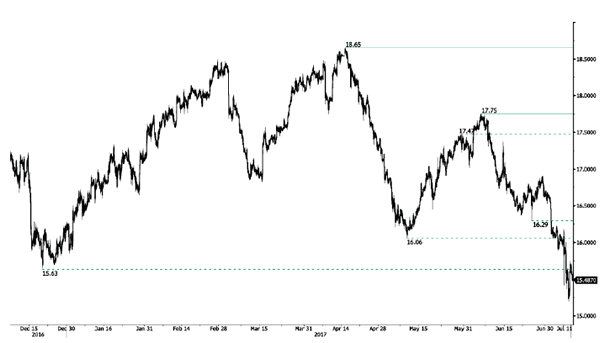
Silver has broken support at 15.63 (27/12/2016 low). Key resistance is given at a distance at 17.75 (06/06/2017 high). The road seems wide open for further decline.
In the long-term, the death cross indicates that further downsides are very likely. Resistance is located at 25.11 (28/08/2013 high). Strong support can be found at 11.75 (20/04/2009).
CRUDE OIL Short-term selling pressures are fading.
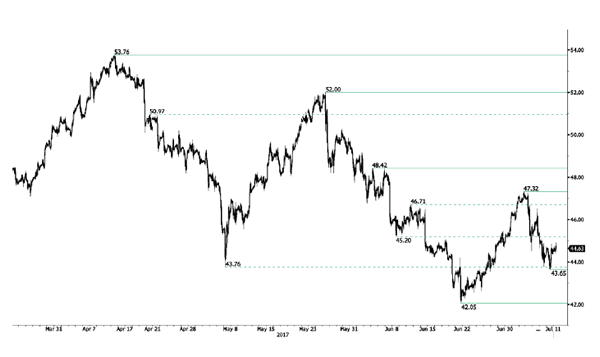
Crude oil is consolidating above $44. Support is given at 42.05 (21/06/2017 low). Expected to show short-term bullish improvement.
In the long-term, crude oil has recovered after its sharp decline last year. However, we consider that further weakness are very likely. Strong support lies at 35.24 (05/04/2016) while resistance can now be found at 55.24 (03/01/2017 high).
EUR/JPY Continued Increase, EUR/GBP Failed To Break Resistance Area Around 0.8900, EUR/CHF Breaking 1.10 For The First Time In...
EUR/JPY Continued increase.
EUR/JPY is back above 130 for the first time in a year and half. Hourly support can be found at 127.10 (30/06/2017). Next support is given at 122.56 (18/05/2017 low). Further upside is favored.
In the longer term, the technical structure validates a medium-term succession of lower highs and lower lows. As a result, the resistance at 149.78 (08/12/2014 high) has likely marked the end of the rise that started in July 2012. Strong support at 94.12 (24/07/2012 low) looks nonetheless far away.

EUR/GBP Failed to break resistance area around 0.8900.
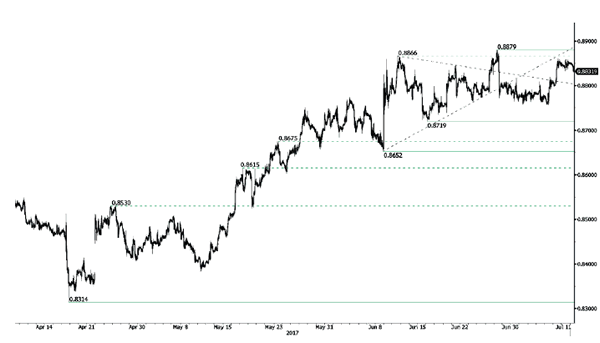
EUR/GBP is testing for the third time in two months resistance area around 0.8900. Hourly support is given at 0.8719 (16/06/2017 low). Expected to show further buying pressures.
In the long-term, the pair has largely recovered from recent lows in 2015. The technical structure suggests a growing upside momentum. The pair is trading above from its 200 DMA. Strong resistance can be found at 0.9500 psychological level.
EUR/CHF Breaking 1.10 for the first time in a year.
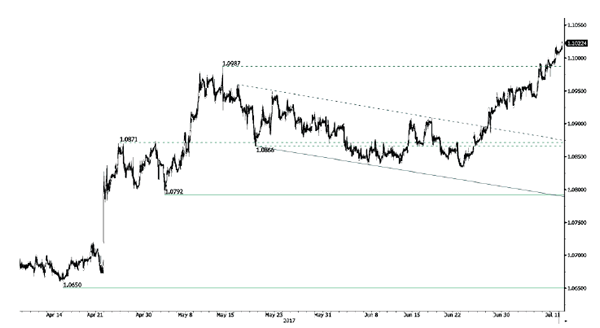
EUR/CHF has broken psychological level at 1.1000. Selling pressures will definitely be important at this point. Hourly support is located at a distance at 1.0922 (30/06/2017 low). Expected to inch higher.
In the longer term, the technical structure is mixed. Resistance can be found at 1.1200 (04/02/2015 high). Yet,the ECB's QE programme is likely to cause persistent selling pressures on the euro, which should weigh on EUR/CHF. Supports can be found at 1.0184 (28/01/2015 low) and 1.0082 (27/01/2015 low).
USD/CHF Short-Term Bullish, USD/CAD Consolidating Above 1.2900, AUD/USD Strengthening.
USD/CHF Short-term bullish.
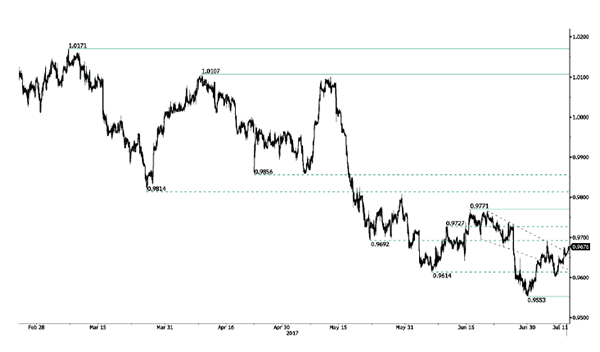
USD/CHF is pushing higher. Hourly resistance can be found at 0.9771 (09/06/2017 high). Strong resistance is given at 1.0107 (10/04/2017 high). Hourly support is given at 0.9553 (30/06/2017 low).
In the long-term, the pair is still trading in range since 2011 despite some turmoil when the SNB unpegged the CHF. Key support can be found 0.8986 (30/01/2015 low). The technical structure favours nonetheless a long term bullish bias since the unpeg in January 2015.
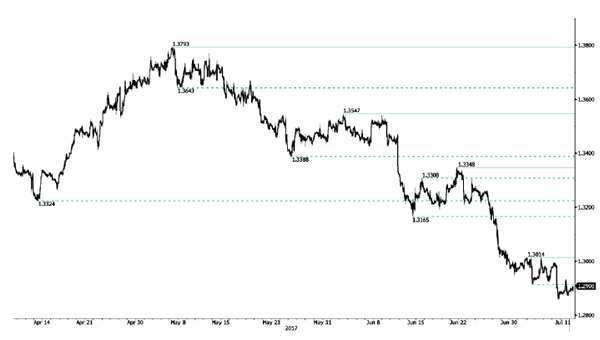
USD/CAD Consolidating above 1.2900.
USD/CAD's bearish momentum continues. Support given at 1.2913 (04/07/2017 low) has been broken. Resistance is located at 1.3014 (02/15/2017). Expected to show renewed bearish pressures.
In the longer term, the pair lies in a bullish channel since a year. Strong resistance is given at 1.4690 (22/01/2016 high). Long-term support can be found at 1.2461 (16/03/2015 low).
AUD/USD Strengthening.
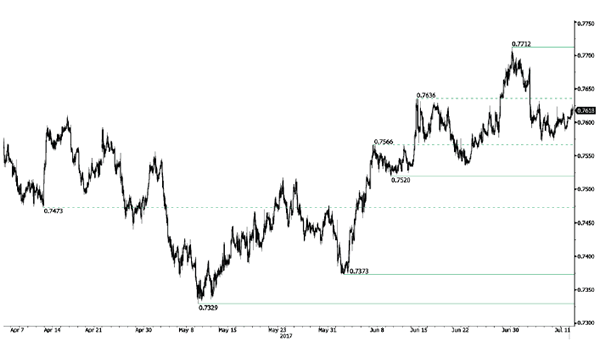
AUD/USD's technical structure is bullish since early May despite some consolidation move. The pair should further head back towards resistance at 0.7712 (30/06/2017 high). However, a break of support at 0.7520 (09/06/2017 low) would nonetheless indicate a renewed bearish trend.
In the long-term, we are waiting for further signs that the current downtrend is ending. Key supports stand at 0.6009 (31/10/2008 low) . A break of the key resistance at 0.8295 (15/01/2015 high) is needed to invalidate our long-term bearish view.