

Sample Category Title
Central Bank Speeches In Focus, Euro Eases On Draghi, Dollar Awaits Yellen, Gold Recovers
As the Asian markets were closing for the day, major currencies were mostly range-bound in a relatively quiet session due to few data releases and ahead some of the key events scheduled for later in the day.
European Central Bank President Mario Draghi will speak shortly at the ECB Forum on Central Banking in Portugal. Bank of England Governor Mark Carney is scheduled to speak following the release of the BoE's Financial Stability Report, while Federal Reserve Chair Janet Yellen will be speaking later today from London. Forex market participants are keen on getting more insight into the latest thinking of these monetary policy makers.
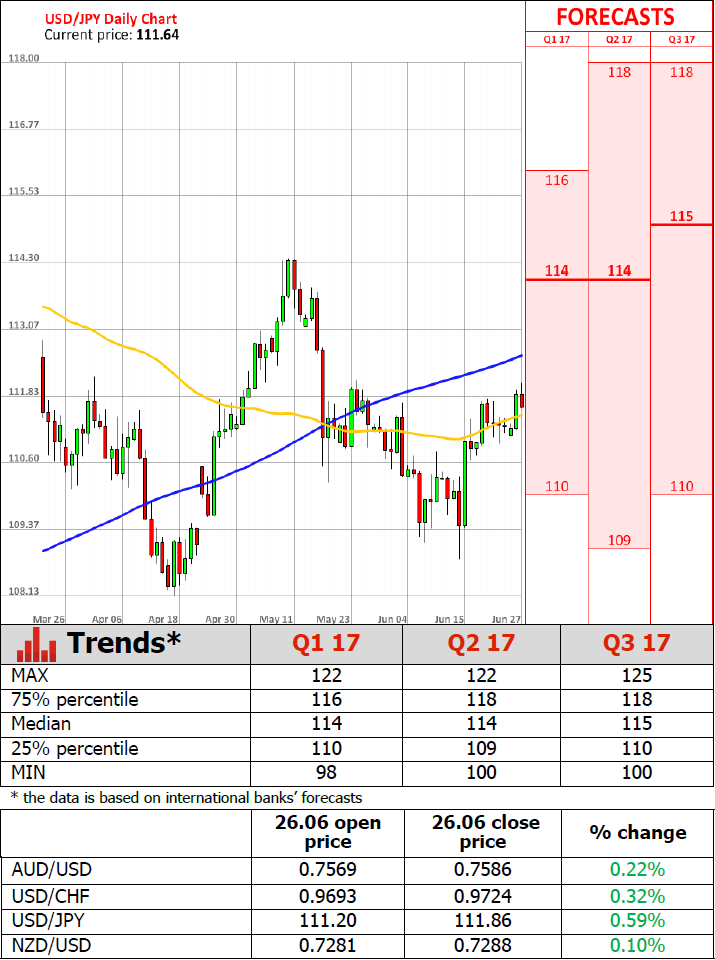
The dollar has been under slight pressure against the yen as Asian markets were coming to the end of the trading day. At 111.71, the greenback fell 0.16% versus the yen during the session. Market participants are eyeing Janet Yellen's speech, as they are hoping for more clarity into the latest inflation outlook and the potential for another rate hike this year.
Euro/dollar traded in the narrow range of 1.1180-1.1203 during the Asian session. The euro managed to recoup some of the losses against the dollar, after weakening in yesterday's US trading session on Mario Draghi's opening remarks at the ECB Forum. The ECB President defended the Bank's loose monetary policy.
In the meantime, the Bank of England is expected to publish the Financial Stability Report that will be followed by Mark Carney's speech. His remarks will be closely watched. Pound/dollar traded in the range between 1.2722 and 1.2724.
Both the Australian and the New Zealand dollar got a boost during the Asian session amid yesterday's soft US durable goods data. The China-linked aussie might have also been helped by Chinese industrials strong profit growth, as well as positive comments by Chinese Premier on the growth outlook for the Mainland. The Australian dollar posted gains for the third consecutive day against the greenback. It was last trading at $0.7606, up 0.3% on the day.
New Zealand's trade surplus in May stood at NZ$103 million (US$75 million), well under the NZ$420m expected and the prior month's NZ$536m. A strong rise in imports of both petroleum products and motor vehicles caused total imports to top forecasts and weighed on the overall balance. By contrast, exports were close to the expected level at NZ$4.95 billion, with the key dairy sector leading the gain. The New Zealand dollar edged lower against its US counterpart as the data were released, but firmed up later during the Asian session.
Taking a look at gold, the precious metal managed to recover some of yesterday's losses, following a large sell order that hit the market. The commodity last traded at $1250.33 an ounce. This compares to yesterday's one-month low of $1235.84 an ounce.
WTI oil futures (August 2017 contract) continued to gain for the fourth consecutive day, trading at $43.65 a barrel.
Conservatives Reach A Deal With The DUP
Yesterday, the UK Conservative Party finally reached a deal with Northern Ireland's Democratic Unionist Party (DUP) to back Theresa May's minority government. The deal suggests that the 10 DUP MPs will vote for the Queen's Speech, which will allow May to keep her job as Prime Minister. The Irish Party also committed to back the Tories in other key votes in the House of Commons.
Sterling reacted little to the announcement, as this deal had been widely anticipated and probably came as a surprise to nobody. Moving forward, the next risk event for the pound is the actual vote on the Queen's Speech, expected to take place on Thursday. If all goes as planned and the Speech is passed, political uncertainty in the UK could dissipate further, and market focus is likely to turn to headlines surrounding the negotiating process. Monetary policy may also keep investors sitting on their hands, especially considering the divided views within the BoE Committee.
GBP/USD traded slightly lower on Monday after it hit resistance at 1.2755 (R1). During the Asian morning Tuesday, it hit support near 1.2700 (S1) and then recovered somewhat. Bearing in mind that the rate is still trading below the key resistance territory of 1.2850 (R3), but above the longer-term upside support line drawn from the low of the 7th of October, we consider the short-term outlook to be neutral. That said, we see the likelihood for the rate to trade higher heading into the Queen's Speech vote on Thursday and get closer to 1.2850 (R3), given that the Tory-DUP accord lifts some political uncertainty.
If Cable manages to break above the 1.2755 (R1) resistance soon, then we may see it targeting our next resistance of 1.2815 (R2).
Draghi says rates have to be low for growth to recover
Speaking in Portugal yesterday, ECB President Mario Draghi maintained a somewhat dovish tone. The ECB chief defended the Bank's massive stimulus program, indicating that interest rates have to be very low for economic growth to recover. This is no change in ECB rhetoric, which although it shifted to a less dovish bias at the latest policy meeting, it remained committed to keeping rates at current low levels. Thus, we keep our view untouched that the ECB is likely to continue to shift towards a more sanguine bias at its upcoming meetings, provided that incoming Eurozone data remain solid. Draghi will speak again today and tomorrow, but given that he already expressed his view, we don't expect any major reaction from the euro, unless he provides fresh signals on policy. Besides the ECB President, focus is likely to remain on Eurozone's preliminary CPI data for June, due out on Friday, which could prove critical to market expectations regarding the Bank's next move.
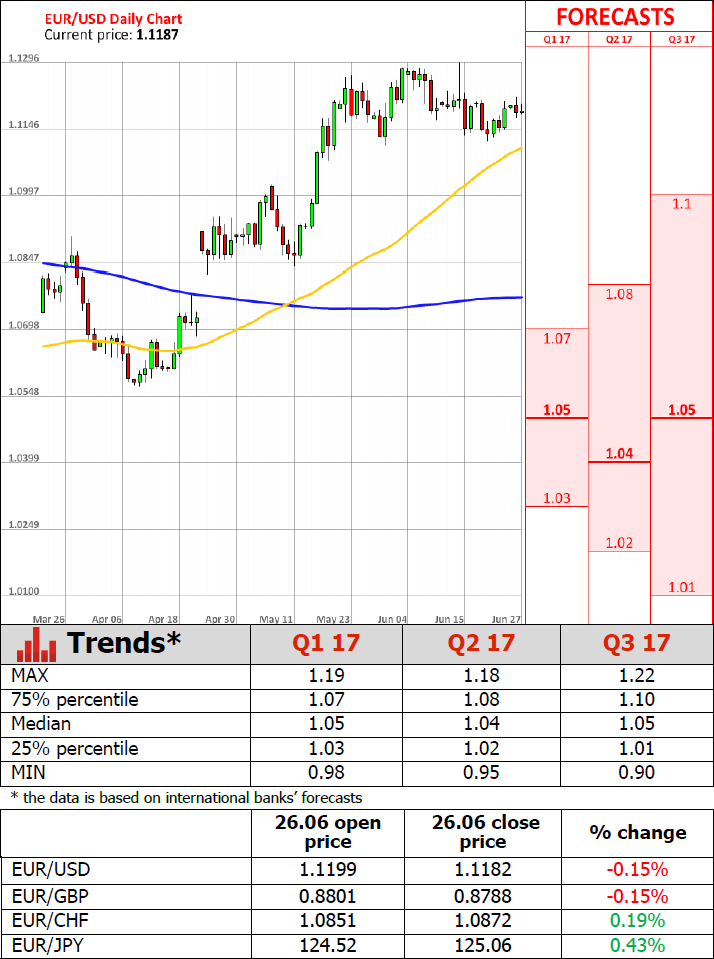
EUR/USD slid somewhat yesterday after it hit resistance at 1.1220 (R1), to hit support at 1.1170 (S1). The pair has been trading in a sideways mode since the 19th of May, between the support of 1.1120 (S2) and the resistance territory of 1.1300 (R2). Thus, we believe that the near-term path remains sideways. However, given that on the 20th of June the rate started to recover after it hit the lower bound of the aforementioned range, we believe that there is scope for some further recovery, perhaps towards the upper end of the range at 1.1300 (R2).
Today's highlights:
During the European day, we only get second-tier economic indicators. In Sweden, PPI data for May are due out while from the US, we get the S&P/Case-Shiller house price index for April, as well as the CB consumer confidence index for June.
Besides ECB's Draghi, today we will also hear from Fed Chair Janet Yellen, San Francisco Fed President John Williams, and Philadelphia Fed President Patrick Harker. Market participants may focus primarily on Chair Yellen, and specifically, on whether she will support another rate hike this year, amid slowing inflation.
GBP/USD
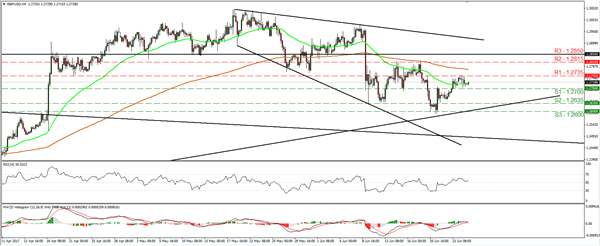
Support: 1.2700 (S1), 1.2635 (S2), 1.2600 (S3)
Resistance: 1.2755 (R1), 1.2815 (R2), 1.2850 (R3)
EUR/USD
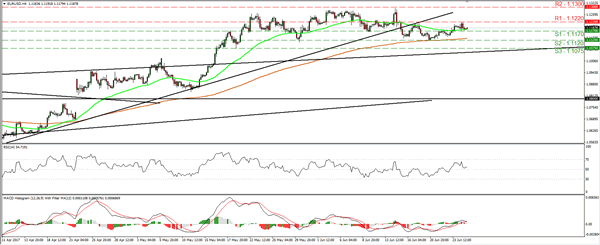
Support: 1.1170 (S1), 1.1120 (S2), 1.1075 (S3)
Resistance: 1.1220 (R1), 1.1300 (R2), 1.1380 (R3)
Technical Outlook: EURUSD Rallies Above 20SMA On Draghi’s Comments
The Euro jumped from tight overnight range on comments from ECB's President Mario Draghi, who pointed at strengthening and broadening recovery in the Eurozone. Draghi also said that the EU economy still needs considerable monetary support from the central bank even as the economy recovers steadily and inflation picks up.
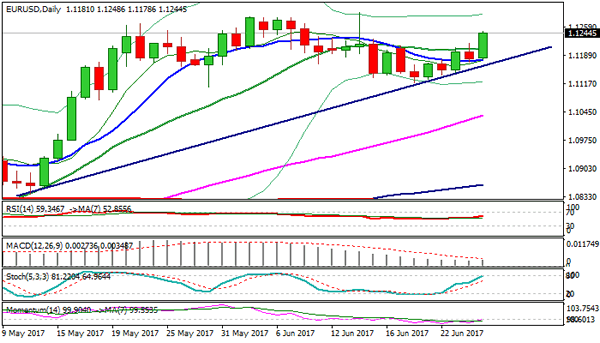
Fresh bullish acceleration eventually broke above 20SMA which caped upside attempts in past two days.
Today's close above 20SMA would be bullish signal and may re-attract 1.1300 target zone, below which repeated upside rejections occurred in early June.
Broken 20SMA now acts as initial support at 1.1203, followed by lower pivot at 1.1177 (10SMA), loss of which would generate stronger bearish signal.
Res: 1.1254, 1.1285, 1.1295, 1.1314
Sup: 1.1219, 1.1203, 1.1177, 1.1145
Loonie Loses Steam, Fed Speakers In Focus
USD/CAD sell-off stabilises despite lacklustre US data
After falling more than 4% over the last seven weeks, USD/CAD has been stabilising at around 1.3250. This sharp appreciation of the loonie was quite surprising, especially against the backdrop of falling oil prices. Indeed, WTI futures for delivering in August slid to $43.60 over the same period, down more than 16%. It would have been obvious that the Canadian dollar, which has been historically strongly correlated with crude oil, followed its footsteps.
From our standpoint, this positive reaction of the loonie is due to the concurrence of two separate actions. First, the Canadian economy was able to surmount the massive oil correction that started in 2014 as oil producers improved efficiency, especially in the shale industry. Furthermore, the economy is back on track again and is close to its long-term average yearly growth rate of between 3% and 4%.
Secondly, speculators were already short CAD before the recent oil clump. Indeed, they started to build their short positions in the wake of Trump’s accession to power, in anticipation of a tougher trade relationship between the US and Canada. By April 25th, net short non-commercial positions reached 25% of total open interest - as reported by the CFTC - and finally it hit 49% in the last week of May. When it reaches such extreme levels, a correction is highly likely. This is actually what prevented the loonie to slide further. Overall, we believe that USD/CAD has reached a temporary low and that further gains for the loonie are unlikely in the short-term.
EUR/USD may bounce higher in short-term
Today, no less than four Fed members will provide their views on monetary policy including Janet Yellen whose speech is tonight in London is expected to be on global economic issues. Financial markets will try and grab some hints regarding the Fed's path towards normalisation of monetary policy. Markets estimate the likelihood of a third rate hike this year below 50%. We believe the Fed will be very focused on economic data rather than geopolitical development and we consider that recent economic data is not fully supporting a continued normalisation of the economy.
Yesterday, non-defense capital goods recorded their highest decline since last December at -0.2% m/m below consensus 0.1 m/m. Earlier last week, the US Manufacturing PMI came in below expectations at 52.1 vs 52.7 expected. We recall that a level above 50 indicates expansion and we are slowly approaching towards this threshold.
On Thursday, the US GDP will be released and for the time being, data for the second quarter is significantly weaker than what has been released during the first quarter. We believe there are clear downside risks on the US GDP at the moment. Therefore, the EURUSD pair may bounce higher towards 1.1300 in the short-term.
Gold Analysis: Recovers After Crashing
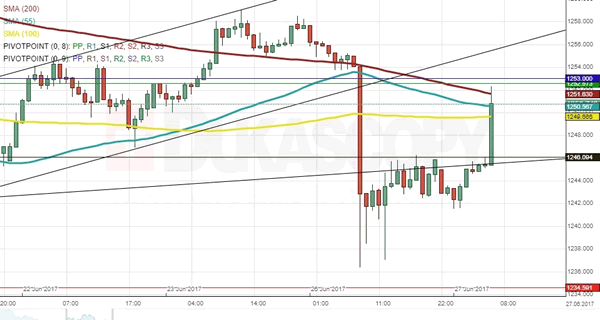
After the sudden crash of the yellow metal, which occurred on Monday, the bullions price was recovering on Tuesday. The yellow metal traded rather flat, as it faced the resistance of the first weekly support level a the 1,246 mark. However, that resistance was broken and the bullion jumped to trade above the 1,250 mark. By looking at the technical aspects of the commodity price on the hourly chart, a prolonged recovery of the metal now seems unlikely. Every ascending chart of the bullion has been broken. Moreover, the metal faces the resistance of the various simple moving averages, the monthly pivot point at 1,253 and the weekly pivot point at 1,252.57. However, if these levels of resistance are broken, the pair might resume the surge.
Technical Outlook: GBPUSD – Near-Term Focus Shifted Higher While Daily Tenkan-Sen Holds
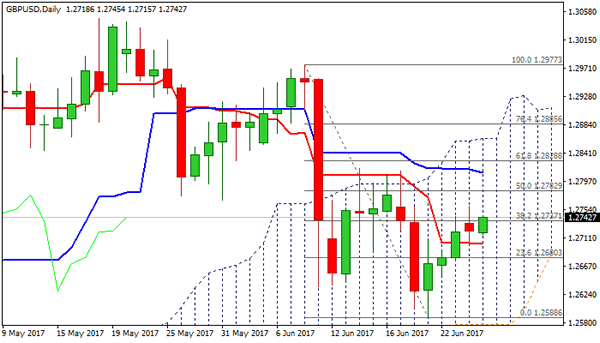
The pair rallied around 60 pips on Monday, bringing bulls back to play after four consecutive descending long-legged daily candles last week, which signaled hesitation of broader bulls ahead of daily cloud barrier. Thin daily cloud which twists on Tuesday continued to attract for fresh attacks and today's rally came just ticks ahead of it. Plethora of strong supports provided by daily MA's (which also made a multiple bull-crosses and contained last week's easing) continues to underpin the action for final break above daily cloud / 100 SMA pivots at 111.80 zone and further retracement of 114.36/108.80 descend. Corrective easing from today's high at 111.71 should ideally find support at 111.48 (Fibo 38.2% of today's 111.11/71 rally) with extended dips to be contained at 111.34 (hourly cloud top) to keep fresh near-term bulls in play.
Res: 111.71, 111.80, 112.00, 112.25
Sup: 111.57, 111.48, 111.34, 111.24
ECB President Mario Draghi Points To High Income Inequality, Defends Ultra Low Interest Rates
'Draghi pouring water on expectations of reducing monetary stimulus, that saw the euro then start to weaken.' - Douglas Borthwick, Chapdelaine Foreign Exchange
The European Central Bank President Mario Draghi reported on Tuesday that in order to overcome Europe's income inequality authorities should focus more on education, innovation and investment in human capital. According to the ECB President inequality in the Euro zone grew markedly since the last global financial crisis. Thus, governments should consider adopting policies aimed at redistributing wealth. According to data from Eurostat, the inequality level has increased sharply since the crisis in countries like France and Spain. The highest level of income inequality has been registered in Greece, Spain and Portugal. Apart from that, Mario Draghi said that ultra low interest rates helped to boost job creation, economic growth and benefit borrowers. Moreover, the ECB President said that a faster pace of monetary policy tightening would likely lead to a new wave of recession and boost income inequality in the region. Following these dovish comments, the US Dollar hit its one-month high against the Japanese Yen and rebounded sharply against the Euro, as the probability of a monetary policy stimulus reduction diminished.
Orders For US-Manufactured Durable Goods Drop 1.1% Last Month
'We see the core data as consistent with soft business investment in the second quarter.' - Blerina Uruci, Barclays
Orders for US-made durable goods dropped more than expected last month, pointing to a slowdown in the manufacturing sector. The Commerce Department reported on Monday that durable goods orders fell 1.1% in May, following the preceding month's downwardly revised drop of 0.8% and falling behind expectations for a 0.5% decline. In the meantime, core durable goods orders rose just 0.1% last month after dropping 0.5% in April, whereas analysts anticipated an increase of 0.4% during the reported month. Monday's data combined with the prior week's retail sales and inflation figures suggested that the economy failed to regain positive momentum in the June quarter despite the recent sharp drop in the jobless rate. Back in the Q1, the US economy expanded at an annualised 1.2% pace. Yesterday's data also showed that orders for machinery climbed 0.6%, while shipments dropped 0.3%. Orders for civilian aircraft dropped 11.7%, whereas orders for defence aircraft and parts plunged 30.8%. Orders for motor vehicles and parts advanced 1.2% last month.
Trade Idea : USD/CHF – Stand aside
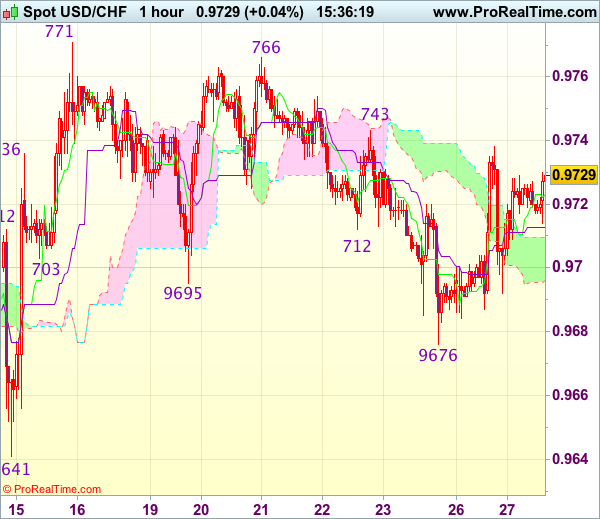
USD/CHF - 0.9726
Most recent candlesticks pattern : N/A
Trend : Near term up
Tenkan-Sen level : 0.9724
Kijun-Sen level : 0.9713
Ichimoku cloud top : 0.9710
Ichimoku cloud bottom : 0.9696
New strategy :
Stand aside
Position : -
Target : -
Stop : -
Despite yesterday’s retreat from 0.9738 to 0.9692, lack of follow through selling and the subsequent rebound suggest further choppy trading would be seen and another bounce to 0.9738-43 cannot be ruled out, however, only a firm break above there would revive bullishness and signal low is formed, bring test of 0.9766-71 resistance first. Once this resistance is penetrated, this would confirm recent rise from 0.9613 low has resumed for test of resistance at 0.9808, then towards another previous resistance at 0.9825.
On the downside, below said support at 0.9692 would suggest the rebound from 0.9676 (Friday’s low) has ended, bring another test of this level, break there would signal the erratic fall from 0.9771 top is still in progress for retracement of recent rise to 0.9660, however, as broad outlook remains consolidative, still reckon downside would be limited to 0.9641 support, risk from there is seen for another rise to take place later.
Nikkei Carves Out Swing Low | AUDJPY Pauses Below Key Resistance
The weaker Yen has benefitted the Nikkei which now appears on track for another leg higher towards the 20,400 targets. AUDJPY has since paused below a critical juncture yet we suspect the odds favour an eventual upside break.
The Nikkei printed a solid bull candle on Friday to suggest the low is in place, which leaves potential for the final leg up to our 20,400 targets. It has been helped higher by a weaker Yen and, if USDJPY goes on to hit the 114.38 target then the Nikkei could exceed the bullish target above 20,400. However, we are also slightly concerned that the bond market is not backing up the higher Nikkei, which is why we are conservatively bullish for another swing higher whilst also monitoring the development on a potential bearish wedge.

Friday's low also coincides with MR1 and the low of 3x Dojis. Therefore, we can use this area to aid with stop placement but to increase the potential reward/risk ratio we can consider a buy-limit within Friday's range.
We have included a potential bearish wedge but this is for illustrative purposes only; price need to remain contained perfectly within the red lines for the pattern to be valid, so we focus on the relationship between the swings instead. If this is a true bearish wedge, then each leg higher should be of less magnitude, so direct gain from here lowers the probability of the bearish wedge being confirmed. Moreover, to confirm the pattern we need to see a break of a prior swing combined with a higher low and, yet, we see neither. Therefor the near-term bias remains bullish and we will continue to monitor the potential wedge.
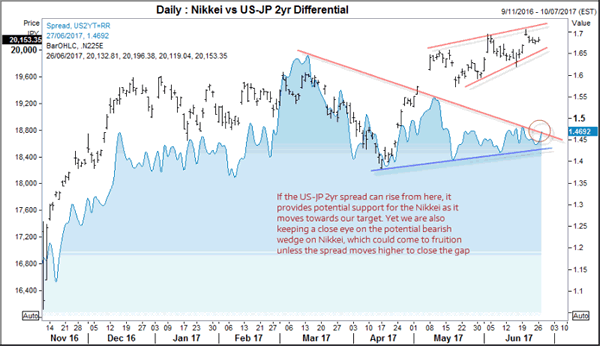
The 2yrs spread is testing the bearish trendline, so a bullish signal can be taken if it breaks to the upside over the coming sessions. We would feel more confident with Nikkei being near current highs if the spread it to move higher because presently, its failure to close the gap and support Nikkei undermines recent gains on the Stock index. Alternatively, if we are to see the spread move lower (and break the blue line) then this improves the odds of a bearish wedge of playing out.
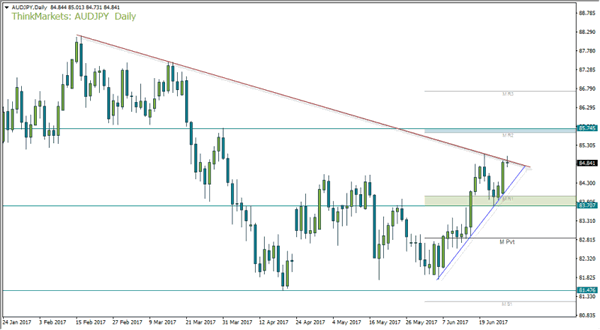
The Australian Dollar is one of many currencies taking advantage of the weaker Yen. AUDJPY is fliting with a bearish resistance level and we suspect it odds of it breaking higher form here are strong. As Friday's candle particularly bullish, its likely we'll only see a minor pullback before it breaks higher. Therefor this is one of the rare occasions we'd consider entering before the break and using the 50% retracement of the bullish candle to aid with potentials entry or stop placement.
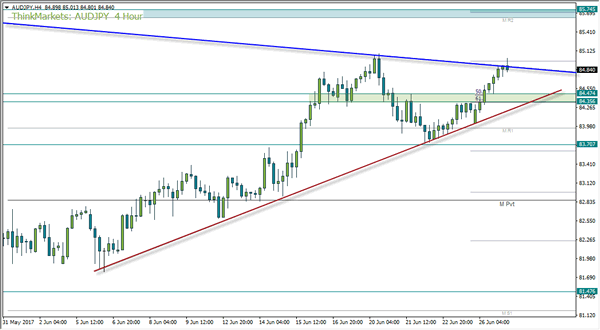
The zone between the 50% and 61.8% retracement of Friday's range also coincides with a swing low and swing high, making it an important level going forward. As prices have also stalled beneath the MR2 pivot as well as the bearish trendline, we think the odds of a move lower form here are relatively high, so we'll seek support to be found above the Fibonacci zone.