Sample Category Title
USD Bounces Back Amid Hawkish Fed, SNB Holds Steady
Fed remains on track despite faltering inflationary pressures
As broadly expected the Federal Reserve lifted borrowing costs by 25bps following a two-day meeting. The decision was already priced in by market participants. However, the Committee created a stir with a surprisingly hawkish statement and press conference from Janet Yellen despite the recent publication of lacklustre economic data.
Indeed, the last CPI and retail sales reports came on the soft side and triggered a USD sell-off, just a couple of hours before the announcement of FOMC's decision. The consumer price index extended only 1.9%y/y in May versus 2.0% expected and down from 2.2% in the previous month amid sustainable downside pressure on crude oil prices. In addition, the core measure, which excludes the most volatiles components such as food and energy prices, slid to 1.7%y/y, down from a previous reading and median forecast of 1.9%. Finally, retail sales printed in negative territory and contracted 0.3%m/m in May, well below market's expectations of a flat reading, signalling that US consumers preferred to remain cautious against the backdrop of political jitters in the US and an uncertain economic outlook.
Committee's members seemed committed to hold the line and keep steady the tightening pace as announced at the preceding meetings. Moreover the Fed remains highly confident the recent set-back in inflation developments is only temporary and expects to increase by another notch the federal funds target before the end of the year.
In our opinion, the fact that the Fed is not really concerned about the disappointing inflation readings suggests that the institution may have started to reconsider the ground for reaching at all cost the 2% inflation target. Indeed, overall the US economy is not in such a bad state as it is not in recession anymore and the economic growth is the envy of many countries.
Finally, the Committee discussed further about balance sheet unwinding as it drafted carefully a plan for policy normalisation; and it is expected to be implement before the end of the year. However, the Fed remained extremely cautious by stating that “the Committee would be prepared to resume reinvestment of principal payments received on securities held by the Federal Reserve if a material deterioration in the economic outlook were to warrant a sizable reduction in the Committee's target for the federal funds rate”.
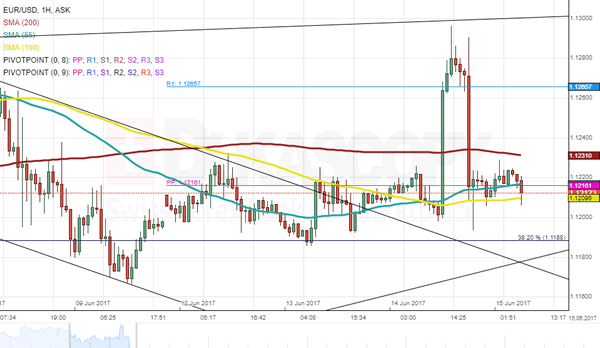
The USD was broadly higher this morning and erased partially the losses triggered by the release of the CPI and retail sales report. EUR/USD is back below 1.12 and currently trading with a negative bias.
Switzerland: SNB holds rates unchanged
Loose monetary policy is to continue for some more time. The EURCHF pair is back above 1.0900. This morning Swiss policymakers have decide to hold rates unchanged at -0.75% repeating that the Swiss franc is largely overvalued and that this is a threat for the Swiss economy. The Swiss franc is trading at a level around 30 times higher than levels before the financial crisis. Such high levels are definitely boosting deflationary pressures.
The plan is definitely staying the same for the central bank. Defending the Swiss Franc at all costs. The FX reserves keep on growing towards very massive levels. It now represents CHF 700 billion. As long as the Swiss central bank considers the currency is overvalued, the FX reserves are going to keep climbing.
In Swiss political news, Didier Burkhalter, head of the Federal Department of Home Affairs, will leave the Federal Council on October 31st. He was mostly criticised for his pro-Europe views. Monitoring relations with the EU is very important, as one key driver for the CHF depends on its giant neighbour.
For the time being, we can see that political uncertainties have reduced since the French elections. Nonetheless, other political uncertainties seem to arise with Hungary, Czech Republic or Poland seeming to refuse to welcome any more migrants and they will likely be sanctioned by the European Commission.
Trade Idea: EUR/JPY – Stand aside
EUR/JPY - 122.50
Recent wave: wave v of (C) ended at 94.12 and major correction in wave A has ended at 149.79
Trend: Near term up
New strategy :
Stand aside
Position: -
Target: -
Stop:-
Although the single currency has fallen again and near term downside risk remains for recent decline from 125.82 top to extend weakness to 122.00, near term oversold condition should prevent sharp fall below 121.50-60 and reckon 121.25-30 would hold from here, risk from there has increased for a rebound to take place later.
In view of this, would not chase this move here and would be prudent to stand aside in the meantime. Above 123.15-20 would suggest low is possibly formed but break of resistance at 123.65-75 is needed to add credence to this view, bring a stronger rebound towards 124.10-20 which is likely to cap upside.
Our latest preferred count is that wave (ii) is ABC-X-ABC which ended at 123.33 and wave (iii) is unfolding with wave iii ended at 100.77, followed by wave iv at 111.57 and wave v as well as the wave (iii) has ended at 97.04, followed by wave (iv) at 111.43 and wave (v) has ended at 94.12 which is also the end of the larger degree v, this also implied the major wave (C) has also ended there, hence major correction has commenced from there with (A) leg unfolding in its lower degree wave c which has possibly ended at 145.69. Under this count, A-B-C wave (B) has commenced with A leg ended at 136.23, wave B at 143.79 and wave C has possibly ended at 149.79.
Our larger degree count is that the decline from 139.26 is wave (C) and is sub-divided into a diagonal triangle i-ii-iii-iv-v with wave i - 105.44, wave ii- 123.33, wave iii - 97.03, wave iv - 111.43, followed by the final wave v as well as the end of wave (C) at 94.12, this also mark the bottom of larger degree wave B. Under this count, major rise in wave C has commenced as an impulsive wave with minor wave III ended at 145.69, wave V is still in progress for further gain to 150.00. Having said that, this so-called wave V could well be the first leg of larger degree 5-waver wave C and this wave C should bring at least a retest of wave A top at 169.97 (July 2008).

Gold Analysis: Reaches Above 1,280 Before Falling
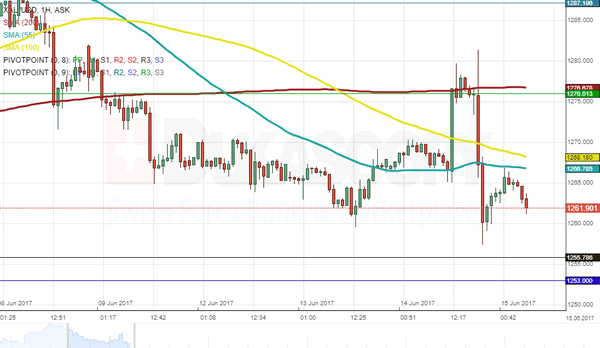
The yellow metal is continuing its decline, as the metal traded near the 1,260 mark on Thursday morning. However, there are bad news for the bears, as during the data releases of Wednesday the commodity price managed to surge and reach above the 1,280 mark, which most likely triggered a lot of stop losses. The bullion retreated once more to trade near the 1,260 after the Federal Reserve made their announcements at 18:00 GMT during yesterday’s trading session. It can still be expected that the gold price will decline down to the 1,255.79 mark where the first weekly support was located at on Thursday. The support is also strengthened by the close by located monthly pivot point at the 1,253 mark.
Trade Idea: AUD/USD – Buy at 0.7525
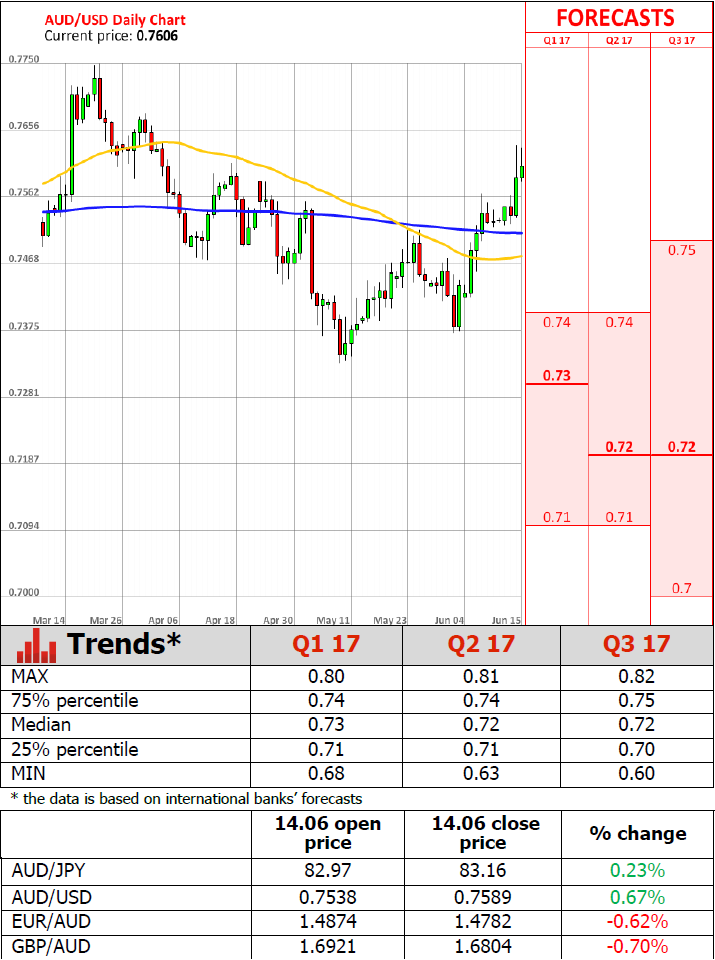
AUD/USD – 0.7597
Recent wave: Wave 5 ended at 1.1081 and major correction has commenced for fall to 0.7000 and then towards 0.6500-10
Trend: Near term down
Original strategy :
Buy at 0.7500, Target: 0.7650, Stop: 0.7440
Position: -
Target: -
Stop: -
New strategy :
Buy at 0.7525, Target: 0.7670, Stop: 0.7465
Position: -
Target: -
Stop:-
As the Australian dollar has eased after meeting resistance at 0.7636, suggesting consolidation below this level would be seen and pullback t0 0.7550-60 cannot be ruled out, however, reckon support at 0.7524 would limit downside and bring another rise later, above said resistance at 0.7636 would extend recent upmove from 0.7329 towards resistance at 0.7680 but loss of momentum should limit upside and price should falter below chart point at 0.7750.
In view of this, we are looking to buy aussie on dips as 0.7520-25 should limit downside and bring another rise. Only below support at 0.7457 would abort and suggest top is possibly formed, bring weakness to 0.7415-20 but price should stay well above key support at 0.7372, bring another rebound later.
On the 4-hour chart, the move from 0.8066 is the wave 5 with i: 0.8860, ii: 0.8315, wave iii is an extended move ended at 1.0183, iv: 0.9706 and wave v has ended at 1.1081 (also the top of entire wave 5). The subsequent selloff is the major correction which is unfolding as ABC-X-ABC and 2nd A leg has ended at 0.8848, followed by a-b-c wave B which ended at 0.9758, hence, 2nd C wave is now in progress and indicated downside target at 0.7000 and 0.6950 had been met, so further fall to 0.6710-20 cannot be ruled out.

USD/JPY Analysis: Subject To More Weakness
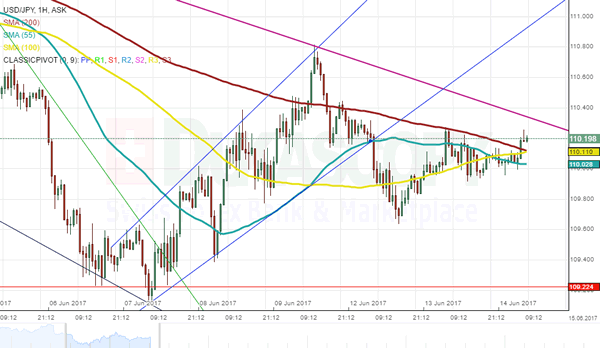
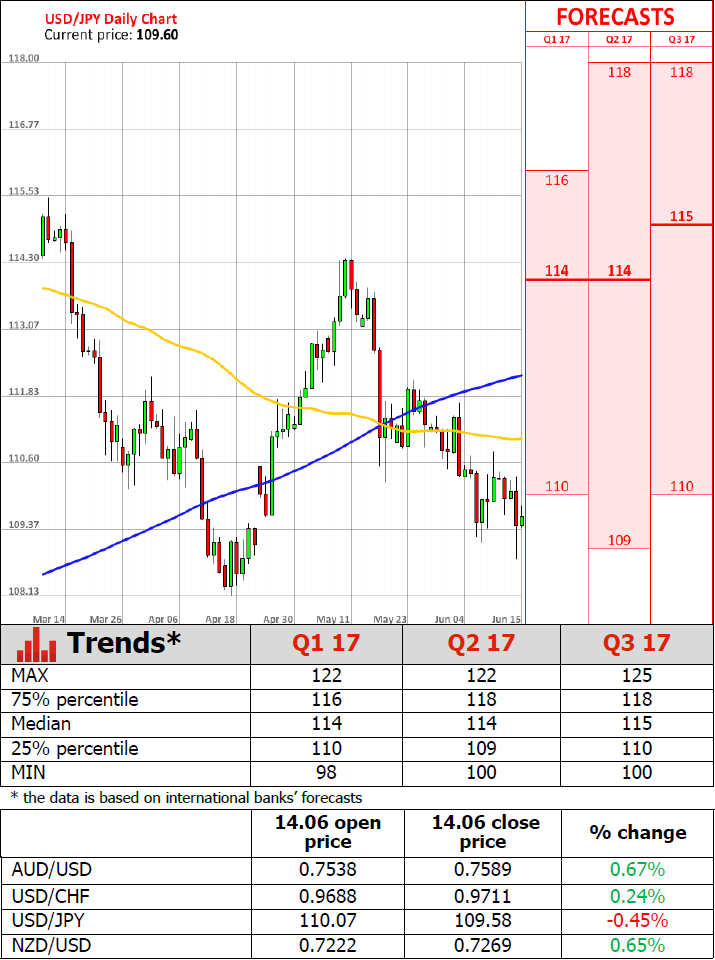
As was anticipated, the retest of the six-week down-trend caused the Buck to decline against the Yen yesterday, as poor US fundamentals and political ‘issues’ overshadowed the Fed’s hawkish tone. As a result, the key support, namely the monthly S1 at 109.22, was briefly pierced, but the exchange rate quickly recovered back towards 109.50. The USD/JPY pair still has a number of strong resistances in close proximity, which are all likely to contribute to another leg down. Moreover, technical indicators keep suggesting the bearish momentum is to prevail today, bolstering the possibility of the negative outcome. Furthermore, with the breach of the key support, the given pair is now exposed to falling under the 109.00 mark, with the next solid support being only the 108.00 psychological level.
GBP/USD Analysis: Orbits Monthly S1
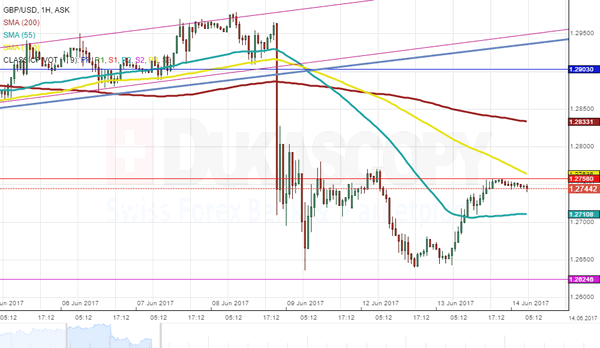
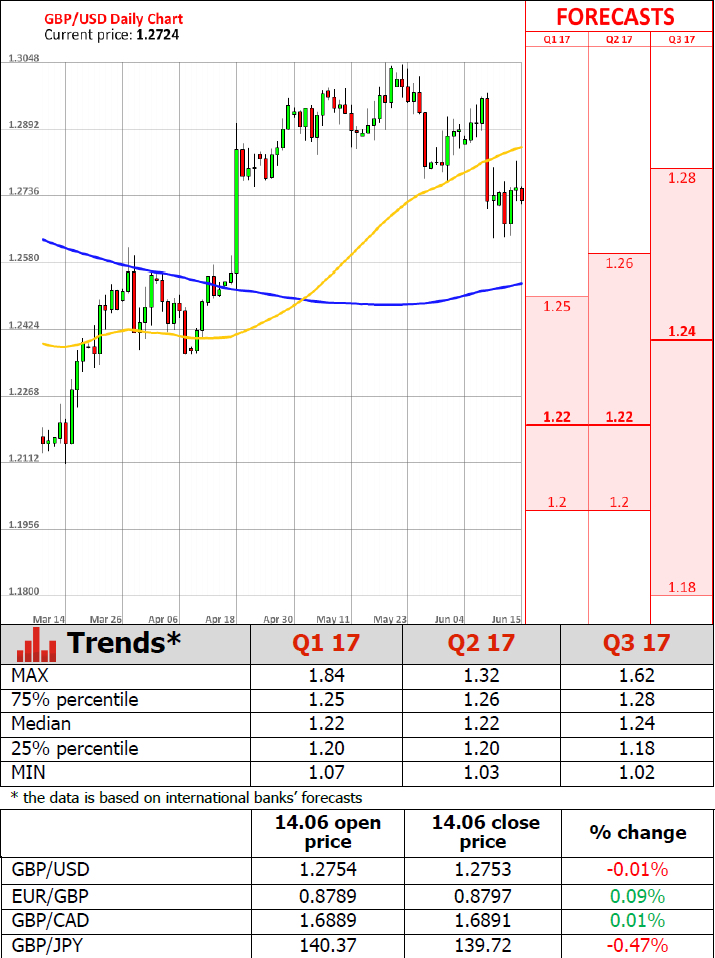
Even though the GBP/USD currency pair experienced some volatility on Wednesday, trade still closed with the Cable remaining relatively unchanged. The pair was also unable to stabilise above the monthly S1, which suggests that more downside movement is possible. However, technical studies are unable to fully confirm this scenario. The 1.2624 level, namely the monthly S2, is still likely to be the bottom floor, where demand is expected to be sufficient to either limit the losses or even trigger a rebound. In case the Sterling manages to outperform the Buck, thus, climb above the monthly S1, a potential resistance area would be just above the 1.28 handle, represented by the 200hour SMA and the upper Bollinger band.
EUR/USD Analysis: Highly Volatile On Fundamentals
The common European currency remains near previous session opening levels against the US Dollar. However, there is a huge arch observable on the hourly chart. The jump of the currency exchange rate was caused by the US CPI and Retails Sales data set release, which turned out to be a lot less than the average market forecast. That caused the EUR/USD pair to jump and almost reach the 1.13 mark. However, at 18:00 GMT the Federal Reserve made their announcements, which strengthened the US Dollar all across the markets. As a result the pair trades in limbo around the cluster of levels of significance at just above the 1.12 mark. The rate can either retreat to the 38.20% Fibonacci retracement level at the 1.1188 level or begin a surge up to the 200-hour SMA at 1.1231 by the end of the day.
Weak UK Pay Growth Raises Concerns Over Economy Growth
'The wage figures are astonishingly weak.' - Samuel Tombs, Pantheon Macroeconomics
The number of Britons applying for unemployment benefits dropped more than expected, whereas wage growth slowed unexpectedly in the three-month period to April. The Office for National Statistics reported on Wednesday that the unemployment rate came in at 4.6% for the period between February and April, unchanged from the prior month and in line with forecasts. Meanwhile, the number of claimants fell to 7.3K, following the preceding month's upwardly revised figure of 22.0K and surpassing expectations for a decrease to 12.5K. Meanwhile, the number of people in work rose 109K in the three-month period to April. Thus, the employment rate climbed to a record high of 74.8%. Apart from that, average hourly earnings grew just 2.1% between February and April, the weakest since February 2016 and following the March quarter's downwardly revised increase of 2.3%, whereas analysts anticipated a rise of 2.4%. A combination of weak wage growth and strong inflation raised concerns over the ability of consumer spending to contribute to economic growth.
Federal Reserve Raises Rates As Expected, Expressing Confidence In Economy
'What I can tell you is that we anticipate reducing reserve balances and our overall balance sheet to levels appreciably below those seen in recent years but larger than before the financial crisis.' - Janet Yellen, Federal Reserve
As markets expected, the Federal Reserve raised its interest rates at the end of its meeting on Wednesday, adding that it would start cutting its Treasury bonds and other securities this year amid solid economic growth and strong employment trends. Despite the release of weak retail sales and inflation figures earlier in the day, policymakers voted to lift its benchmark lending rate to a target range of 1.00-1.25% and predicted one more rate hike this year. The Bank said the economy remained on a steady growth path and continued generating new jobs. Moreover, policymakers noted that the most recent slowdown in inflation was driven by transitory factors. The Fed also said that it would soon start reducing its $4.2T portfolio of Treasury bonds and other securities. The Fed Chair said that the Bank would start cutting its Treasury holdings by $6B per month and increase the size of cuts by $6B every three months until they hit $30B per month. The Bank's mortgage-backed securities would be a subject to a $4B monthly cap that would continue rising by $4B on a three-month basis until it reaches $20B per month.
Australian Employment Data Beat Forecasts
'The much-stronger-than-anticipated rise in employment in May and the larger-than-expected fall in the unemployment rate will go some way to quashing growing talk of the chance of another interest rate cut by the RBA later this year.' - Paul Dales, Capital Economics
The Australian economy created more than expected jobs last month, while the jobless rate fell unexpectedly. The Australian Bureau of Statistics reported on Thursday that the economy generated 42.0K jobs on a seasonally adjusted basis in May, following the preceding month's upwardly revised gain of 46.1K jobs, whereas analysts expected the economy to create just 9.7K new positions. That marked the eight-straight month of job gains, with 124K full-time positions created since September 2016. However, the participation rate rose just 0.1% to 64.9% during the reported period. Thursday's data also showed that the unemployment rate dropped to 5.5% last month, whereas economists expected the rate to remain unchanged at 5.7%. The strong employment data is expected to please the Reserve Bank of Australia and remove a possible rate hike from the table. Nevertheless, due to weak pay growth, the Bank is set to remain on hold until 2019. After the release, the Australian Dollar hit its multi-week highs against the Euro and the British Pound and hit 0.7636 against its US counterpart.