Sample Category Title
Commodities In Need Of A Vix Fix
Global lethargy or naivety, you chose. The VIX's fall puts the skids under oil and gold.
Oil continued its rebound overnight but could not hold onto the gains with both Brent and WTI spot finishing roughly unchanged from the previous day. Soothing words from Saudi Arabia about extending the production cut deal, possibly into 2018 supported prices for most of the day until a resurgent U.S. Dollar took the heat out of the rally.
Oil will continue to be headline driven as we head into tomorrow's crude inventory figures. However, one suspects that OPEC's comments to talk up crude are already generating diminishing returns with both contracts still trading at the bottom end of their long term ranges
Brent
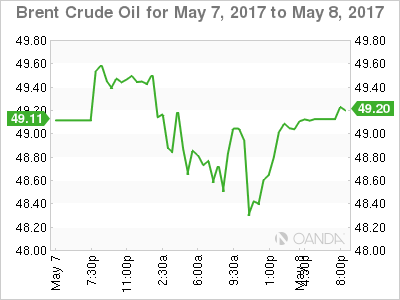
Brent spot trades at 49.10 this morning in Asia with resistance at 50.00 and support near the overnight low around 48.15.
WTI
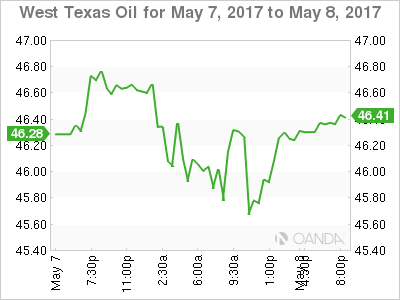
WTI spot trades 46.35 with resistance at 47.00 and support initially at 45.50. A break of the latter may see newly minted longs at these levels heading for the exit door.
Gold
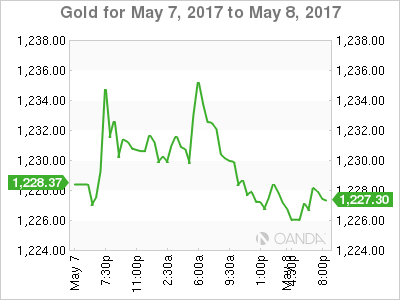
Gold's nascent rally petered out overnight, and gold fell to open in Asian trading around 1227.50. Yesterday's post Macron victory commodity and risk rally ran into a brick wall in European trading as traders booked profits across most asset classes. A resurgent dollar saw the CBOE Volatility Index (VIX) fall to 9.77%, its lowest since 1993, suggesting the market thinks the world is a safer place than at any time in the last 25 years.
Whether you consider this a gross mispricing of risk or not, the fall of the VIX further hollows out the safe haven bid that has underpinned gold for most of 2017. Should volatility remain becalmed, gold may find itself on the losing end of a deeper correction to the downside.
Gold this morning has initial resistance at yesterday's high of 1236.50, followed by 1241.60. It is hovering rather nervously above the 100-day moving average at 1223.00 and then 1221.50, yesterday's low. A close below these levels signalling the next possible down leg could be near.
Back To The Grind
Back to the Grind
Now that the French election risk is little more than an afterthought; the market is quickly pivoting to the Federal Reserve Board's expectations while focusing on this week's key economic data releases. Friday's retail sales and CPI data will be very critical. While we think the Fed will be resolute on its course towards at least two rate hikes, the market is underpricing the risk that the US Fed will tighten rates more quickly than expected, so a robust Retail Sales print and a stronger-than-expected CPI print will be a call to action for dollar bulls.
Overnight, the equity markets were quiet, with stock traders desperately seeking volatility as “Vol's” fell off the cliff, as the event risk lapsed. The main topic was Friday's strong payroll headline, which, after a weekend of reflection, has traders questioning their cynical view on the state of the US economy.
One final thought on the French election: despite yesterday's unassuming market reaction to the runaway victory by Emmanuel Macron, the well-behaviour of the markets suggests that despite a major pop to the upside, the result cannot be viewed in any other light than positive for market sentiment.
Australian Dollar
It's been a rough start for metals this week, with continued fragility in iron ore and copper likely translating into AUD weakness. The commodities lower narrative still looks to have more to run, which will keep the Aussie on the defensive. Also, we've yet to see a relevant retracement during this recent downtrend, suggesting that dealers still favour the AUDUSD to trade lower.
Euro
The market-positive election outcome should be a boost to both euro and risk appetite, but short term market noise and position (i.e. the crowded EUR and EURJPY trade) is dictating near-term price action. And with the close below 1.0930 in New York, it certainly points to a bearish outside day. Despite the profit-taking and stops getting a trigger on the move below 1.0950, there was a lack of new catalysts to buy euro once the election narrative had played out. Dealers are now in a state of flux awaiting some central bank direction, whether it be Fed or ECB.
USD/CAD Canadian Dollar After Dollar Surge Post Macron Election
The Canadian dollar is lower against its US counterpart on Monday. The USD got a boost of investors taking profit on EUR positions on the aftermath of the Macron presidential win in France. The candidate was favoured by polls to win it, and he did even better than expected which again puts into question the accuracy of polls. The EUR advanced since the first round of elections that put Macron head to head with Marine Le Pen. The loonie was able to capitalize on USD weakness ahead of the weekend etching gains on Friday, but was again on the back foot on Monday as oil prices fell despite the efforts of the Organization of the Petroleum Exporting Countries (OPEC).
Canadian indicators have been mixed after a strong first quarter there are signs that the economy is slowing down. Real estate has proven to be one of the biggest contributors to the economy but the Canadian market has raised red flags for global think tanks and the Bank of Canada (BoC). The Home Trust Capital debacle has put housing prices under the microscope and investors are growing anxious with BoC Governor Poloz fielding a question about the trouble mortgage company while delivering a speech in Mexico city focused on trade.
The US delivered a surprise blow for Canada-US relations with a tariff on soft lumber wood companies and criticism of the Canadian dairy industry. Canadian Prime Minister Justin Trudeau has defended both industries looking ahead to what is turning into a less than congenial atmosphere ahead of a renegotiation of NAFTA.
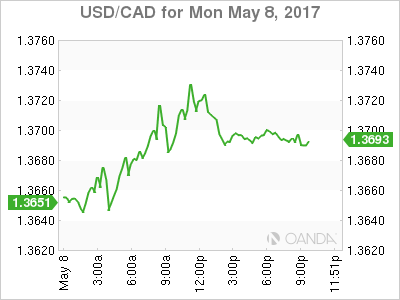
The USD/CAD gained 0.359 percent in the last 24 hours. The currency pair is trading at 1.3698 near 14 month lows. The Canadian currency has been sensitive to the usual factors like the pace of growth and oil prices (a large export) but the rise of combative rhetoric from the Trump administration (3/4 of exports are headed south) and an sensitivity to housing anxiety has put downward pressure on the loonie.
The economic calendar will offer little support to the CAD. The biggest event his week will be the US retail sales and inflation data to be released on Friday. A mild improvement is expected which could validate the market pricing in a rate hike in June from the U.S. Federal Reserve. Fed member added to the optimism with her comments about waiting too long before raising interest rates.
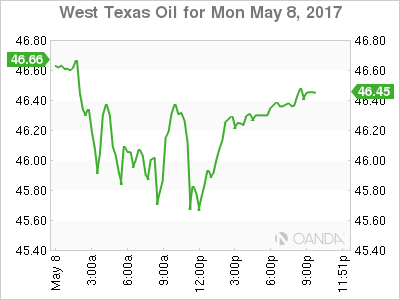
The price of energy lost 0.115 percent on Monday. West Texas is trading at $46.23 in a rollercoaster day for energy traders. The Organization of the Petroleum Exporting Countries (OPEC) said on Monday that they would do whatever it took to rebalance the market. The organization is expected to reach an agreement with non-members to extend the current production cut deal by 9 months. Two factors are keeping prices low. US shale producers have ramped up production to benefit from stable prices and the second and most important reason is that demand for energy continues to stagnate. One of the best indicators of consumer demand is the gasoline inventories. They have shown unexpected large buildups ahead of a traditional high usage driving season.
Market events to watch this week:
Tuesday, May 9
5:30am AUD Annual Budget Release
Wednesday, May 10
10:30am USD Crude Oil Inventories
5:00pm NZD Official Cash Rate
5:00pm NZD RBNZ Rate Statement
6:00pm NZD RBNZ Press Conference
9:10pm NZD RBNZ Gov Wheeler Speaks
Thursday, May 11
4:30am GBP Manufacturing Production m/m
7:00am GBP BOE Inflation Report
7:00am GBP MPC Official Bank Rate Votes
7:00am GBP Monetary Policy Summary
7:00am GBP Official Bank Rate
8:30am USD PPI m/m
8:30am USD Unemployment Claims
Friday, May 12
All day G7 Meetings
8:30am USD CPI m/m
8:30am USD Core Retail Sales m/m
8:30am USD Retail Sales m/m
10:00am USD Prelim UoM Consumer Sentiment
Saturday, May 13
All day G7 Meetings
USDJPY Marches On, Aussie Data Next
Disappointment at the nonfarm payrolls report was a distant memory on Monday as USD/JPY rose to a fresh six-week high. On the day, USD was the top performer while the Swiss franc lagged. Australian retail sales and the budget are due up next.
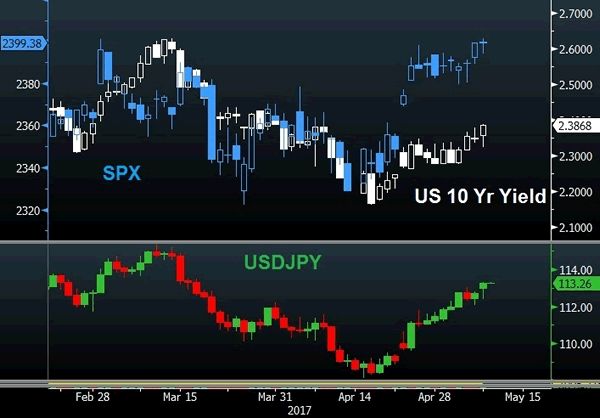
USD/JPY broke 113.20 in a rise to the highest since March 16. It's been a steady 500 pip climb since April 16 as the S&P 500 continues to hit fresh highs. The Federal Reserve is one reason why. Mester spoke Monday and brushed aside week economic data while touting sentiment indicators and jobs data.
The euro was a classic 'sell the fact' trade as the opening gap above 1.10 in EUR/USD quickly closed and the pair fell to 1.0920. The March26 high of 1.0906 and psychological support at 1.0900 are the next levels to watch.
With the French election ending and Trump leaving his first 100 days, expect the markets to shift gears. Political risk has been at generational highs but it's likely to ebb over the Summer months. In that time, the focus will shift back to economic data and central banks.
A third focus will be China. Officials have been tightening credit in an attempt to cool the economy. The fallout has been felt through the commodities market and we will be looking for signs it's hitting more broadly.
In terms of economic data, next we look to Australian retail sales at 0130 GMT. The consensus is for a 0.3% m/m rise. AUD/USD finished near the lowest levels since January on Monday and it has struggled to hold gains on good news.
What will eventually prove to be a bigger driver of AUD is the government's budget, which will also be released Monday. One accounting proposal is to separate regular government debt from infrastructure debt. It's an interesting development and more of a PR move that would make road and bridge building an easier sell but it could also mean more debt issuance, for better or worse.
Pound Steady as Markets Relieved Over Macron Win
GBP/USD has edged lower in the Monday session. In North American trade, GBP/USD is trading at 1.2940. It's a very quiet start to the week, with no major releases out of the UK or the US. On Sunday, Emmanuel Macron easily defeated Marie Le Pen to win the French presidential election.
It was a clean sweep for PMI reports last week, as the Manufacturing, Construction and Services PMIs all beat their estimates. These releases underscore a solid British economy, despite continuing jitters over Britain's departure from the European Union. Market concerns have increased ahead of the first phase of negotiations between Britain and the European Union. The war of words between London and Brussels continued to heat up last week. British Prime Minister Theresa May attacked the EU on Thursday, saying that politicians in Brussels were deliberately meddling in the British election, which will be held in June. May reiterated that she wants a "deep and special partnership" with the EU, while at the same time warning that no deal was preferable to a bad deal. May's combative tone may serve her well in the election campaign, but if negotiations reach an impasse and Britain leaves the EU without a comprehensive deal in place, the toll on the British economy would be significant and the pound could drop sharply.
Emmanuel Macron has become France's youngest president at age 39, and he rode to victory in convincing style. Macron won 64% of the popular vote, with Marie Le Pen taking 36%. Macron's margin of victory was larger than the polls predicted, but the markets had priced in a decisive win, so the euro has showed little response to the election results. Although Macron certainly "won big", it should be noted that fully one third of French voters either abstained or voted a blank ballot as a protest vote. This means that Macron was viewed by many voters as a default choice, given that his opponent was the leader of the far-right and has been accused of being racist and xenophobic. The French elections now enter a new phase, with parliamentary elections slated for mid-June. Macron's En Marche! party is barely a year old and is unlikely to win a majority, which would mean a power-sharing setup in parliament, likely between Macron's party and the center-right. Similar to the presidential election, the parliamentary election is full of uncertainty, and opinion polls during the election campaign will be important as fundamental releases and should be treated as market-movers.
Yen Remains Subdued as Markets Search for Cues
USD/JPY is showing little movement in the Monday session, continuing the trend which as marked the pair since last week. In the North American session, the pair is trading at 112.80. There are no major releases to start off the week. Japanese Consumer Confidence dipped to 43.2, shy of the estimate of 44.3 points.
The yen continued to lose ground last week, as the dollar touched a high of 113.05, its highest level in seven weeks. A weaker yen should result in a boost to the export sector, but on Saturday, BoJ Governor Haruhiko Kuroda said that this was not the case for Japan, since many Japanese companies were producing goods overseas. This argument may ring hollow with US president Trump and US exporters, who will likely cry foul if the the yen continues to lose ground. Early in his presidency, Trump accused Japan of manipulating the yen in order to gain a trade advantage over the US. The two sides have since agreed to let their foreign ministers handles issues related to currency matters.
US employment numbers were generally strong on Friday. Nonfarm Payrolls improved to 211 thousand, easily beating the forecast of 194 thousand. The unemployment rate fell to an impressive 4.4%, compared to the estimate of 4.6%. This was the lowest rate since May 2007. The news was not as positive from wage growth remained weak at 0.3%, matching the forecast. Still, with such little slack in the labor markets, we should see wage growth start to move higher. If that happens sooner rather than later, the Fed will have to reconsider a third rate hike in 2017. As things stand now, two more moves is the likely scenario. The positive job numbers have cemented a rate hike in June, as the odds of hike are up to 83%, according to the CME Group.
USDJPY: Eyes Further Upside Pressure In The Short Term
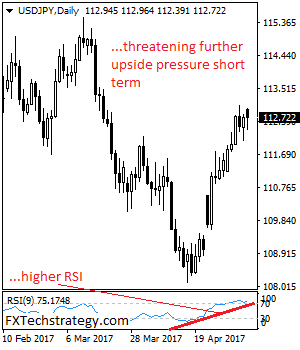
USDJPY: The pair remains on the offensive leaving further upside pressure on the cards. Despite its current price hesitation this view remains valid. On the downside, support comes in at the 112.00 level where a break if seen will aim at the 111.50 level. A cut through here will turn focus to the 111.00 level and possibly lower towards the 110.50 level. On the upside, resistance resides at the 113.00 level. Further out, we envisage a possible move towards the 113.30 level. Further out, resistance resides at the 114.00 level with a turn above here aiming at the 114.50 level. On the whole, USDJPY looks to recover further higher.
Elliott Wave Trade Ideas Performance Update
No position was entered last week.
| AUD EUR/JPY EUR/GBP CAD GBP GBPJPY
Jan - 15 -275 - 35 -120
Feb + 140 -17 - 40 +11
Mar - 20 +115 +132 - 19
Apr + 30 - 40 +120 + 45
May
Jun
Jul
Aug
Sep
Oct
Nov
Dec
Y-T-D + 135 - 177 + 17 + 158 + 45
Candlesticks and Ichimoku Trade Ideas Performance Update
We bought dollar against yen last week at 112.20, however, in view of the retreat from 113.05, we exited the position around break-even but the greenback found support at 112.09 and has rebounded again.
No position was entered among other currency pairs.
In short, only 1 position was entered among all 4 currency pairs with total profit of 3 points and the position is listed below:
5 May : USD/JPY - Long at 122.20, exited at 122.25 (+ 5 points)
| JPY EUR CHF GBP
Jan + 167 - 85 - 10 + 50
Feb + 200 +150 +93 - 59
Mar -23 -70 -23 - 35
Apr + 65 + 93 + 50 - 40
May + 5
Jun
Jul
Aug
Sep
Oct
Nov
Dec
Y-T-D + 413 + 83 +110 -84
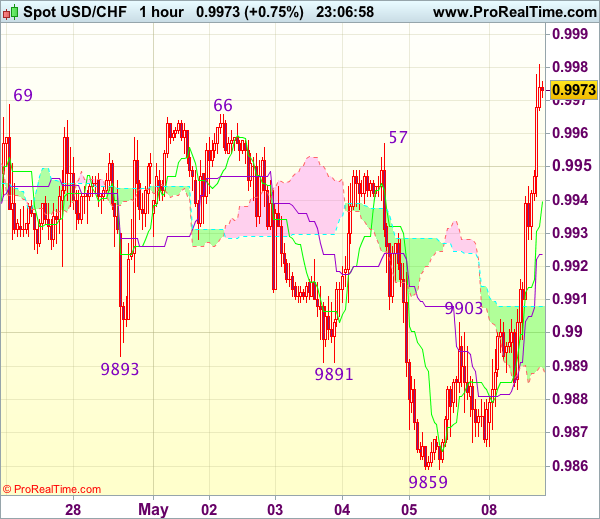
Trade Idea Wrap-up: USD/CHF – Buy at 0.9930
USD/CHF - 0.9976
Most recent candlesticks pattern : N/A
Trend : Near term down
Tenkan-Sen level : 0.9940
Kijun-Sen level : 0.9924
Ichimoku cloud top : 0.9908
Ichimoku cloud bottom : 0.9890
Original strategy :
Buy at 0.9910, Target: 1.0005, Stop: 0.9875
Position : -
Target : -
Stop : -
New strategy :
Buy at 0.9930, Target: 1.0030, Stop: 0.9895
Position : -
Target : -
Stop : -
As dollar’s intra-day rise has gathered momentum and broke above resistance at 0.9966-69, adding credence to our view that low has been formed at 0.9859, hence consolidation with mild upside bias is seen further gain to indicated previous resistance at 1.0000-08 but only break there would signal recent decline from 1.0108 top has ended, then headway to 1.0025-30 and possibly 1.0050 would follow.
In view of this, we are looking to buy dollar on dips as 0.9920-25 should limit downside. Only below 0.9880 would risk test of 0.9859, however, break there is needed to signal recent decline has resumed and extend weakness to support at 0.9831 and possibly towards 0.9800.