

Sample Category Title
EUR/AUD Weekly Outlook
EUR/AUD surged to as high as 1.4334 last week and the break of 1.4309 resistance indicates resumption of whole rebound from 1.3624. The development also affirm the case of trend reversal after defending 1.3671 key support. While some consolidations would be seen in near term below 1.4334 first. Further upside is expected in EUR/AUD ahead.
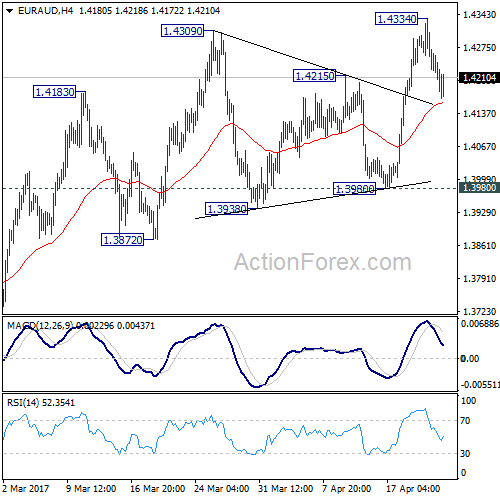
Initial bias in EUR/AUD remains neutral this week for consolidation below 1.4334 temporary top. Downside of retreat should be contained well above 1.3980 support and bring another rally. Above 1.4334 will turn bias to the upside for 1.4721 key resistance level next. Decisive break there will confirm our bullish view of trend reversal.
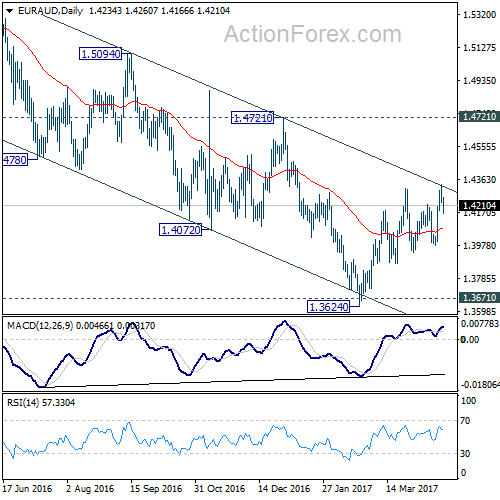
In the bigger picture, price actions from 1.6587 medium term top are viewed as a corrective pattern. Such correction could be completed after defending 1.3671 key support. Break of 1.4721 cluster resistance (38.2% retracement of 1.6587 to 1.3624 at 1.4756) should confirm this case and target 61.8% retracement at 1.5455 and above. Overall, we'd expect the up trend from 1.1602 to resume later. However, sustained break of 1.3671 will invalidate our bullish view and would turn extend the fall from 1.6587 towards 1.1602 long term bottom.
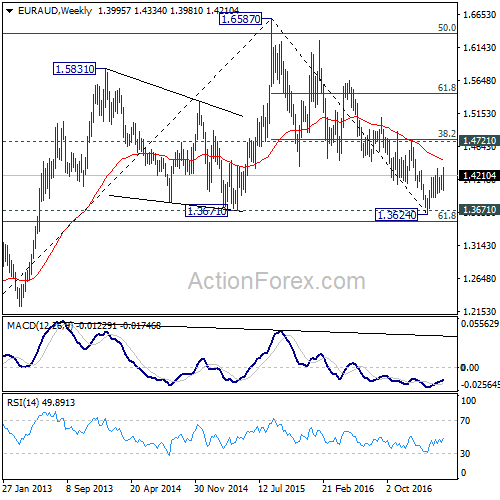
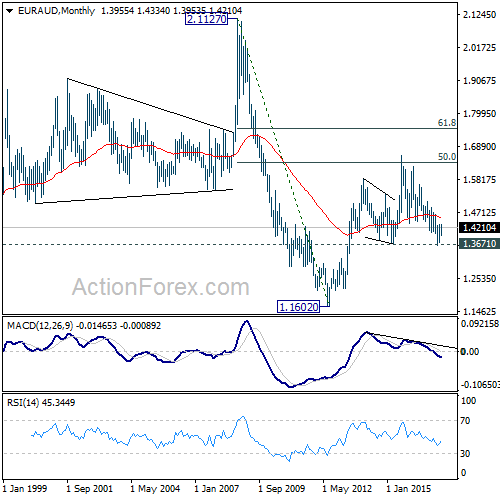
In the longer term picture, the rise from 1.1602 long term bottom isn't over yet. We'll keep monitoring the development but there is prospect of extending the rise to 61.8% retracement of 2.1127 to 1.1602 at 1.7488 and above. However, sustained trading below 1.3671 should confirm trend reversal and target 1.1602 long term bottom again.
EUR/CHF Weekly Outlook
EUR/CHF recovered to 1.0718 last week but reversed ahead of 1.0725 resistance and weakened. The development dampened the bullish reversal case and argue that more consolidations would be seen in near term.
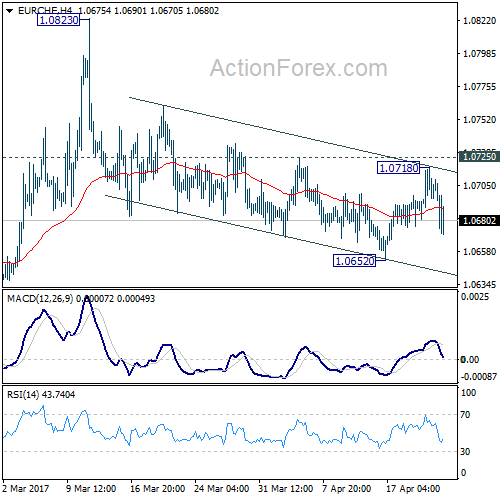
Initial bias in EUR/CHF is neutral this week first. Below 1.0652 will extend the choppy fall from 1.0823 to 1.0620/1.0629 support zone. Without downside acceleration, the structure of the fall from 1.0823 is corrective in nature. And hence, we'd be cautious on bottoming at this 1.0620/29 support zone. On the upside, break of 1.0725 will suggest near term reversal and turn bias back to the upside for 1.0823 resistance.
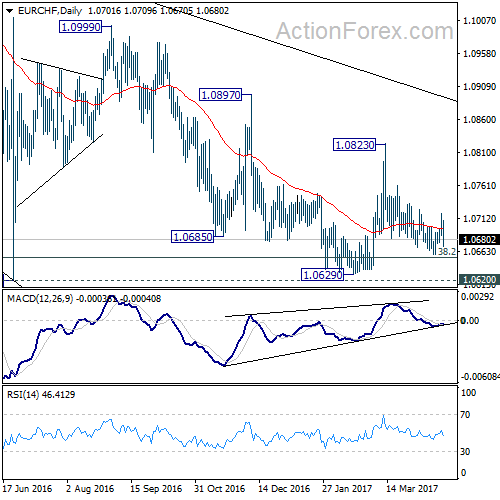
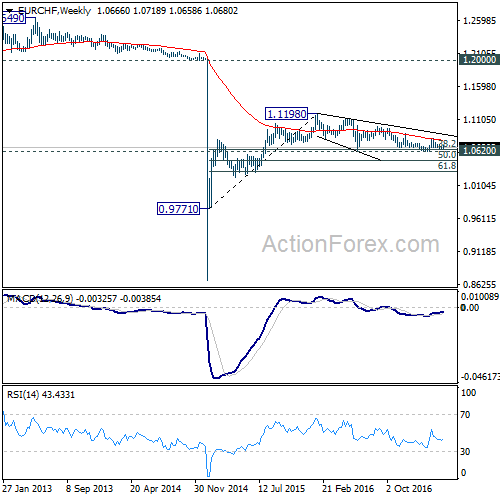
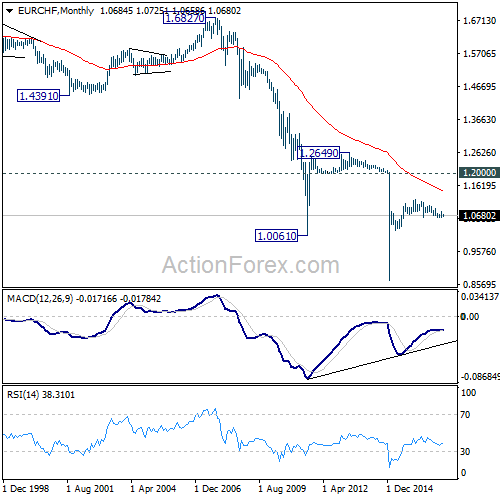
In the bigger picture, the decline from 1.1198 is seen as a corrective move. Such correction might not be completed yet. And, sustained trading below 38.2% retracement of 0.9771 to 1.1198 at 1.0653 will target 50% retracement at 1.0485. In any case, break of 1.0823 resistance is needed to be the first indication of reversal. Otherwise, deeper fall is still expected even in case of recovery.
Summary 4/24 – 4/28
Monday, Apr 24, 2017
[php_everywhere] [/php_everywhere]
Tuesday, Apr 25, 2017
[php_everywhere] [/php_everywhere]
Wednesday, Apr 26, 2017
[php_everywhere] [/php_everywhere]
Thursday, Apr 27, 2017
[php_everywhere] [/php_everywhere]
Friday, Apr 28, 2017
[php_everywhere] [/php_everywhere].
The Weekly Bottom Line
HIGHLIGHTS OF THE WEEK
United States
- Investor sentiment remained relatively upbeat this week on constructive economic data, positive earnings reports, and hopes for near-term pro-growth policies.
- Still, safe-haven assets remained in demand, supported by rising geopolitical tensions and anxiety over the first round of the French presidential election this Sunday.
- Overall, economic data has been coming in relatively healthy, both in the U.S. and other advanced economies, but the dichotomy between soft and hard data is hard to miss. This is particularly the case for the U.S. where survey data surged while hard data suggest that economic growth largely fizzled out in the first quarter. Having said that, some convergence appears to be in the offing.
Canada
- The Canadian housing market made headlines yet again this week with another strong gain in both home prices and sales in March, mostly driven by hot conditions in the Greater Golden Horseshoe Area.
- Interest rates are not going to be the instrument to cool housing activity. The consumer price report this week showed a dip in inflation in March, supporting the view that the central bank will be on hold at least until next year, despite a pick-up in economic activity in recent months.
- Rather, the Ontario government has stepped in with a pack of 16 policy measures aimed at cooling demand, tackling the supply shortage and promoting affordability. The biggest of the measures include a 15% nonresident tax and the expansion of rent control to all rental units. Combined, these two measures are likely to take some steam out of sales and prices in the near-term.
UNITED STATES - HARD AND SOFT DATA BEGINNING TO CONVERGE
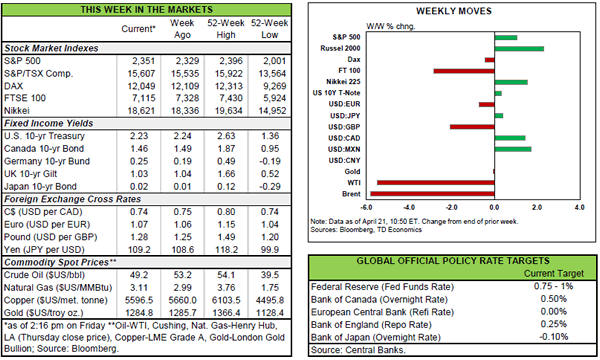
Market sentiment remained relatively sanguine this week. Equities in the U.S. were supported by a string of positive earnings reports and hopes for near-term pro-growth policies. Treasury Secretary Steven Mnuchin indicated that tax reform is "pretty close," helping lift spirits of investors who in recent weeks began to question the Trump reflation trade. Sentiment was also supported by robust growth in China at the start of 2017, with the economy growing by 6.9% (y/y) during the first quarter. Oil prices tanked this week on a large build in gasoline inventories in the U.S. while the dollar remained range bound - neither helped nor hurt by this week's FOMC speeches from across the hawk-to-dove spectrum, with George, Rosengren, Kaplan, and Kashkari expressing their views prior to the blackout period which begins on Saturday. Generally, safe-haven bonds remained in good demand, with long-term Treasury yields hovering around 2.2% or nearly 40 basis points lower than their mid-March nadir.
The bid for safe assets is at least partly related to rising geopolitical tensions on the Korean Peninsula and in the Middle East. There is also plenty of anxiety over the French election, which has been further heightened after yesterday's terrorist attack on French police. Polls suggest that a populist candidate, whether Le Pen or Mélenchon, is in good position to make it through to the second round but unlikely to clinch the runoff election. And even if so, there is still a long-road ahead before any referendum on the EU is even considered (see our French election preview).
Populist candidates have been boosted by weak economic growth and high unemployment in Europe. But, the economic data has been coming in better as of late. Reports this week confirmed the constructive data flow. Inflation advanced by a decent 1.5% (y/y) in March, while both consumer confidence and Eurozone PMIs surprised to the upside. At 56.7, the preliminary April composite PMI suggests growth carried into the second quarter after a good start to the year. Having said that, any survey data should be taken with a grain of salt, given the increasingly diverging performance of hard and soft indicators recently.
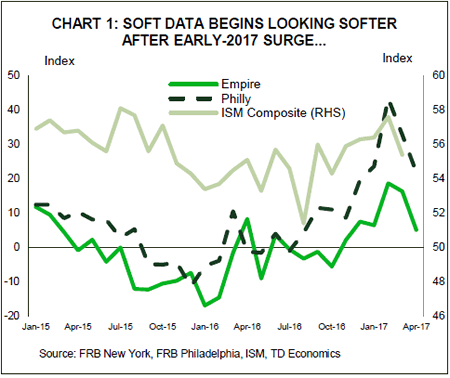
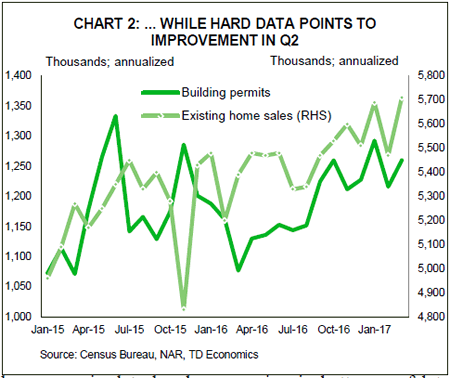
The hard-soft split is perhaps nowhere as apparent as in the U.S. where measures of consumer and business confidence surged while economic growth appears missing, with first-quarter tracking a meagre 0.5%. However, data released this week suggests that some convergence may be in the offing. Both the Philly and Empire indexes, which track activity across the Mid-Atlantic region, pulled back from their lofty levels recently (see Chart 1), while initial claims and housing activity remain very healthy – home sales reached a decade high in March as permits and starts continued to grind higher.
How exactly the convergence will manifest will be of utmost importance both for Fed policymakers and investors alike. Many among the FOMC expect to raise rates twice more this year. But, should the soft data weaken and converge closer to what the hard indicators are suggesting, two more hikes may not be an achievable target. On the other hand, should hard data trend higher, the Fed may be more anxious to raise rates, and may even begin the process of reducing their large balance sheet.
CANADA - HOPEFUL FOR FOOLER HOUSING MARKET CONDITIONS
The Canadian housing market made headlines again this week with another strong gain in both home prices and sales in March, mostly driven by hot conditions in the Greater Golden Horseshoe Area (it's not just the GTA anymore!). Home prices were up by 32% year-over-year in the Greater Toronto Area and by almost 40% in some surrounding areas such as Durham, Barrie, Welland and St. Catherines.
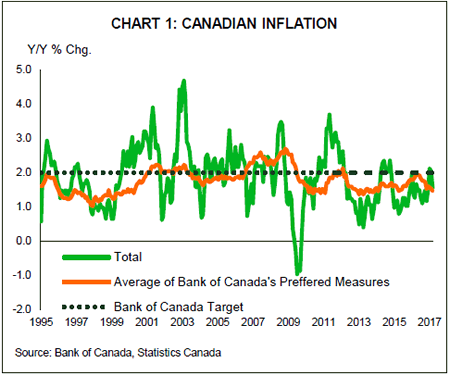
While these gains are a sweet deal for current homeowners, it is becoming increasingly more difficult for would-be first-time homebuyers to jump into the market. Moreover, every month of double-digit home price growth brings with it a risk of a deeper correction down the road. In the absence of policy intervention, there was nothing on the economic docket in 2017 to slow this train. In particular, five-year mortgage rates fell 10 basis points during the first two weeks of April, giving back a third of the increase experienced since Trump's election in November. Meanwhile, despite a pick-up in Canadian economic growth over the first quarter of 2017, this week's Canadian inflation report supported the view that the Bank of Canada will remain on hold at least until 2018. Overall consumer price inflation dipped to 1.6% (year-on-year) in March, from 2.0% in the prior month and all of the central bank's preferred measures of inflation fell short of the Bank's 2% target (Chart 1).
So, the Ontario government decided to step in this week, with a package of 16 new policy measures aimed at cooling demand in the Golden Horseshoe, addressing Ontario's housing shortage and promoting affordability. Some of the measures were tied to improved oversight of real estate agents, rental agreements, tax evasion, speculation and the municipal building permitting process. But, there were some big-ticket items in the package, including a 15% non-resident buyer's tax (with exceptions for students, those seeking permanent residency and refugees), the extension of rent control to all rental units, lowering of taxes on purpose built rentals and some monetary incentives to encourage building, the opening up of provincial vacant land for new home development and giving municipalities the right to tax vacant homes and land (of which Toronto is likely to implement).
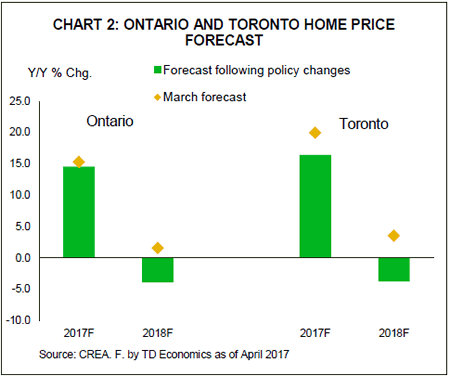
These policies are likely to dampen housing activity in the short-term. Using Vancouver as a guide, the non-resident buyer's tax may push both non-resident and domestic speculators out of the market, bringing home sales across Ontario more in line with historical averages. Meanwhile, rent controls will put pressure on already depressed rates of return on rental properties, and prices will likely have to adjust lower to encourage further investment. As such, we have revised our housing forecast for Ontario and the GTA lower over 2017 and 2018 (Chart 2) to reflect these changes, and are now expecting a moderate correction in the average home price next year. Over the long-term, the mix of policy offers some incentives for increased housing supply. But, our view is that the overriding impact of rent control will be to restrict future investment in both condo and purpose-built rental development.
Overall, Ontario's move will help buy some time in the near-term while the Bank of Canada remains on hold for a while longer. But the longer-term challenge of housing supply will remain even in light of this week's efforts.
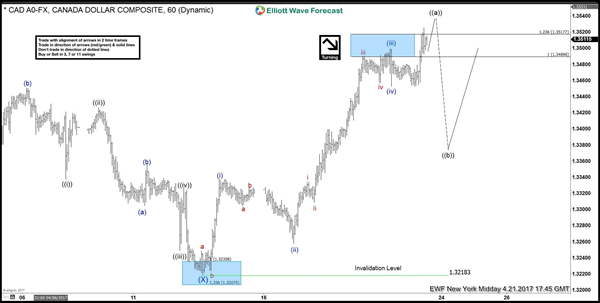
USDCAD Elliott Wave View: Ending 5 Wave Impulse
Short term Elliott wave view in USDCAD suggest that the cycle from 4/13 low (1.3218) is unfolding as an impulsive Elliott wave structure . This 5 wave move could be wave ((a )) of an Elliott wave zigzag structure structure or wave ((c )) of FLAT correction. In either case, after 5 wave move ends, pair should pull back in 3 waves at least as the Elliott Wave Theory suggests. Minutte wave (i) ended at 1.3337 peak, Minutte wave (ii) ended at 1.3261, Minutte wave (iii) ended at 1.3498, Minutte wave (iv) pullback ended at 1.3455 low and above from there Minutte wave (v) of ((a)) already reached the minimum extension area between 1.3509-1.3527 which is the inverse 1.236-1.618% Fibonacci extension area of proposed wave (iv) dip. This means cycle is now mature and can end at any moment resulting in a 3 wave pull back at minimum. The pull back is shown to be wave ((b)) and should correct the cycle from 4/13 low in 3, 7 or 11 swings. If the decline turns out to be stronger than expected and breaks the pivot at 1.3218 low, that would suggest 5 wave move up from 1.3218 low was a B wave FLAT from 3/21 (1.3261) low and pair could then see 1.3252 - 1.3187 area before bouncing again. Although Minutte wave (v) of ((a)) has reached the minimum extension area, another high towards (v) = (i) target @ 1.3571 can't be ruled out to end wave ((a)) cycle from 4/13 low. In either case, cycle from 4/13 (1.3218) low is mature and should result in a pull back soon.
USDCAD 1 Hour Elliott Wave Chart
Week Ahead Geopolitics to Cloud Central Bank Outlook
European and Japanese Policy Makers Announce Policy Decisions
Higher political risk in 2017 was forecasted and so far it hasn't disappointed. The calendar of democratic events expanded last week as the United Kingdom announced a snap election that will be held in June. The pound has appreciated above 2 percent since the announcement in the hope it will strengthen the Conservative party's position in parliament and give more latitude for negotiating the British exit from the European Union. The first leg of the French presidential elections will kick off with the second round to take place on May 7.
The Japanese yen is a preferred destination during risk aversion periods which boosted the currency two weeks ago. As risk appetite returned the yen gave back gains and US dollar could continue to advance ahead of the Bank of Japan (BOJ) Outlook Report and monetary policy decisions on early Thursday, April 27. The BOJ will host a press conference at 2:30 am EDT (6:30 am GMT). BOJ Governor Haruhiko Kuroda spoke on Thursday signalling it will continue to keep its monetary policy accommodative with the current pace of asset purchases to remain for some time. Despite growth in the economy the appreciation of the currency could delay inflation reaching the 2 percent goal set by the central bank who could publish a lower target on Thursday.
European Central Bank (ECB) will announce its monetary policy later on the same day. ECB President Mario Draghi is expected to hold the benchmark rate and stimulus programs without any changes. Draghi said on Friday that very substantial accommodation is still necessary in the Euro zone despite the risk of deflation not a going concern. Growth will be on display on Friday, April 28 at 8:30 am EDT when the US releases the first estimate of GDP for the first quarter of 2017, the forecast shows a gain of 1.3 percent that is below the last quarter gain of 2.1 percent. The slowdown of the economy will surely raise questions on what the rate hike path of the Fed when the economy is not gaining momentum and pro-growth policies by the Trump administration are yet to appear.
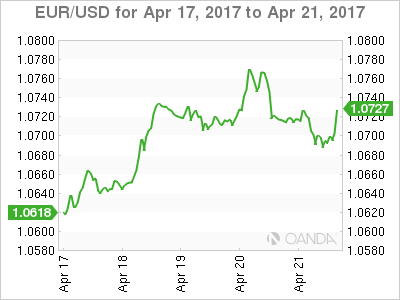
The EUR/USD gained 0.609 percent in the last five trading days. The single pair is trading at 1.0689 after touching weekly highs of 1.0777 but the US dollar has bounced as French election jitters took its toll on the euro. US President Trump said he would unveil a tax plan next week which got some wind under the greenback sails after his dollar strength comments had sunk the currency.
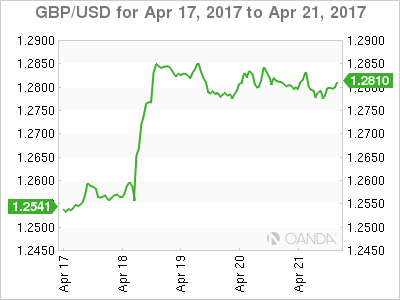
The GBP/USD gained 2.11 percent in the last week. The pair is trading at 1.2796 in a week where British Prime Minister Theresa May announced the decision to call for a snap election in June. The move was ratified by parliament the next day. The market is taking this as a political move to consolidate power in parliament ahead of Brexit negotiations with the European Union.
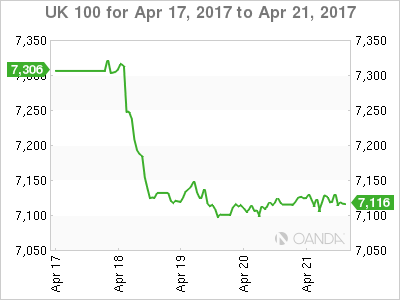
The UK stock market lost 2.56 percent in the last five trading days. The UK100 is trading at 7,119 after UK PM May's shocking decision to call for an early election in June. The rise of the pound as a result of a softer Brexit deal took its toll on the stock market as results were below expectations and the weak UK retail sales data released on Friday. The UK stock market had its worst performance since November.
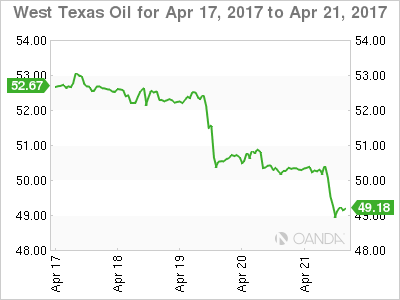
The price of West Texas dropped 7.18 percent in the last week. The energy benchmark is trading at $48.97 as downward pressure from US production has driven the price below $50. The Organization of the Petroleum Exporting Countries (OPEC) production cut deal was able to stabilize prices last year before kicking into effect in 2017, but as it nears the end of its six month term there are doubts on how effective it has really been as there is still ample supply. US oil rig counts rose again for the 14th straight week to a total of 688.
The group will meet in Vienna this weekend with an extension to the production cut deal in the works. Russia has already said that it will meet with OPEC members on late May. Global inflation expectations were based on a higher oil price and if those fail to materialize the reflation trade will have very little to stand on.
Market events to watch this week:
Monday, April 24
- 4:00am EUR German Ifo Business Climate
Tuesday, April 25
- 10:00am USD CB Consumer Confidence
- 9:30pm AUD CPI q/q
Wednesday, April 26
- 8:30am CAD Core Retail Sales m/m
- 10:30am USD Crude Oil Inventories
- 11:50pm JPY Monetary Policy Statement
Thursday, April 27
- Tentative JPY BOJ Outlook Report
- Tentative JPY BOJ Policy Rate
- 2:30am JPY BOJ Press Conference
- 7:45am EUR Minimum Bid Rate
- 8:30am EUR ECB Press Conference
- 8:30am USD Core Durable Goods Orders m/m
- 8:30am USD Unemployment Claims
Friday, April 28
- 4:30am GBP Prelim GDP q/q
- 8:30am CAD GDP m/m
- 8:30am USD Advance GDP q/q
*All times EDT