Sample Category Title
Weekly Focus: Elections Set the Agenda in Europe
Market movers ahead
- There are no clear favourites in the first round of the French presidential elections, in which several candidates are EU sceptics.
- The ECB meets during the week and will probably take the opportunity to dampen the expectations of higher rates that came in the wake of the March meeting.
- Euro-area inflation will probably rise slightly in April, but nowhere near enough for the ECB to start tightening monetary policy.
- Confidence indicators have been pointing to strong growth in the US in 2017, but hard data have been more subdued, so there is strong interest in the GDP numbers for Q1.
- In Sweden, the Riksbank is expected to announce that it will not be extending its asset purchase programme even though inflation remains low.
Global macro and market themes
- Elections in Europe come against the backdrop of the global business cycle looking to lose momentum.
- First round of French presidential elections too close to call.
- Relief rally expected if mainstream candidates go to second round.
- A run-off between Marine Le Pen and Jean-Luc Mélenchon cannot be precluded and could set off a major market correction.
- The UK election is likely to strengthen Theresa May's hand in the upcoming Brexit negotiations.
Currencies: No Further Euro Gains ahead of French Election
Headlines
European equities initially slid lower, but the losses were easily recouped after which sideways trading followed. US stock markets opened little changed.
The euro zone defied expectations of slowing growth in April, expanding for another month, according to Markit PMI business sentiment. Its closely-watched measure of economic activity climbed to a fresh post-euro zone crisis high of 56.7 in April from 56.4, beating forecasts, to hit its highest level since April 2011.
UK retail sales fell back more than predicted in March to cap off the first quarterly decline since 2013 in the latest sign that rising inflation is beginning to weigh on economic growth. Retail sales excluding auto fuel fell by 1.5% compared to February, bringing the year on year growth rate down to 2.6%, from 4.1% the previous month.
BOE policy maker Michael Saunders sees risks that the weaker pound will boost near-term inflation more than officials projected in February. "I would not be surprised if CPI inflation reaches 3% later this year or early next".
Federal Reserve staff, widening their outreach to investors in anticipation of a critical turning point in monetary policy, are seeking bond fund manager feedback on how the central bank should tailor and communicate its exit from record holdings of Treasuries and mortgage-backed securities.
Belgium's 2016 budget deficit widens to EU11.1b, or 2.6% of GDP, from EU10.3b, or 2.5% of GDP in 2015. Gross public debt rises to EU446.8b, or 105.9% of GDP, from EU434.8b, or 106.0% of GDP in 2015. EU Commission anticipated a 2016 deficit of 2.9% of GDP, debt-to-GDP ratio of 106.8% at year-end for Belgium
Rates
Core bonds take day off ahead of French election
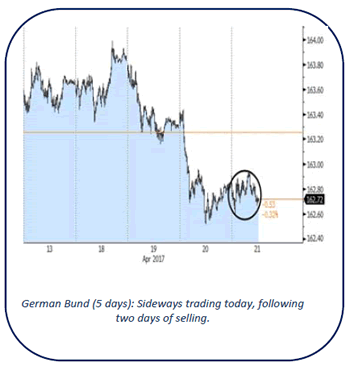
Core bonds showed no appetite to choose direction today and stayed near yesterday's closing levels. The April EMU PMI rose unexpectedly for the sixth consecutive month to a 6 year high, suggesting that the strong economic momentum isn't hindered by political uncertainty. Even the Italian economy is gaining momentum, as evidenced by iron-strong industrial sales and orders figures. For the bond markets, it was worth one long yawn. Some punters anticipated a continuation of the past two days selling spree at the start of the Bund trading. They tried to push the Bund lower, but once equities opened, the losses were recouped. Traders understood that it would be a wait-and-see session ahead of the French election. The Bund sleep-walked around in a 20 ticks range. US traders had even less appetite than their European peers and Treasuries remained range-bound too as the US market calendar was unenticing.
At the time of writing, the German yield curve bull steepens marginally with yields 0.7 bps (2-yr) to 0.1 bp (30-yr) lower. Changes on the US yield curve ranged between -0.4 bps (2-yr) and +0.4 bps (30-yr). On intra-EMU bond markets, 10-yr yield spread changes versus Germany narrowed up to 4 bps for France. Core spreads widened 1 bp.
Currencies
No further euro gains ahead of French election
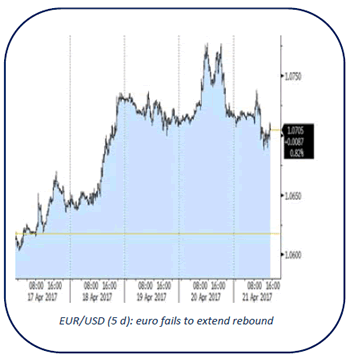
Yesterday's pro-Europe/France repositioning didn't continue. EUR/USD and USD/JPY held tight ranges respectively in the 1.07 and the 109 area. Investors kept a wait-and-see modus going into the first round of the French presidential election. The EMU PMI was strong, but had also no impact on the euro.
This morning, Asian markets to some extent joined the risk rally from the US yesterday evening. However, contrary to what happened yesterday, the move had no big impact on the dollar. EUR/USD stabilised in the low 1.07 area. USD/JPY traded near the 109.25 level.
At the start in Europe, investors retried yesterday's tactics. Both EUR/USD and USD/JPY gained a few ticks. The move had no strong legs and all the gains evaporated very soon. The EMU PMI's (in particular the French ones) were strong, indicating ongoing good growth in EMU at the start of the second quarter. However, it didn't help a resumption of yesterday's risk-on trade. On the contrary, the topside of European equities was blocked and core bond yields stabilized. Both EUR/USD and USD/JPY lost a few ticks, returning to the 1.07 and 109 big figures. Yesterday's terrorist attack in Paris maybe made investors a bit reluctant to adopt positions further to a market-friendly outcome of Sunday's vote in the first round. The was no additional news this afternoon in the US to spice USD trading., leaving EUR/USD and USD/JPY in directionless trading.
Poor UK retail sales have limited impact on sterling
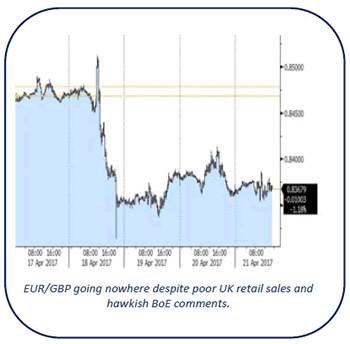
UK investors focused on the retail sales today. Of late, there were tentative signs that price rises were eroding consumers' purchasing power and that this would affect spending. UK March retail sales declined more than expected -1.8% M/M). A more modest decline of -0.5M/M after a strong February report was expected. The damage for sterling was limited. Cable was well bid going into the publication of the report (intraday top of 1.2835) but returned to the big figure after the report. EUR/GBP jumped up and down in the 0.8375 area as sterling's 'decline' was counterbalanced by a decline of EUR/USD more or less at the same time. So, for now, soft UK data still have only a modest impact on sterling. Later in the session, there were some hawkish comments from BoE 's Saunders as he indicated that the BoE doesn't need to delay a rate hike because of Brexit if growth and inflation are stronger than expected. The reaction of sterling was again close to non-existent. EUR/GBP trades currently in the 0.8365/70 area. Cable hovers around 1.28.
Elliott Wave Analysis: GBPJPY Trading In A Temporary Correction
GBPJPY may be trading at the beginning of a three wave correction, now in wave a. As such after wave a finds bottom a new bounce into wave b may follow. Later the mentioned wave b may see limited upside around the 139.90 level, from where a new drop into the following wave c may follow. Support for the whole corrective retracement may later be around the 138.29 level.
GBPJPY, 1H

Canadian CPI Growth Moderated Further in March
Highlights:
- The year-over-year rate of headline CPI inflation edged down to 1.6% (below expectations for a 1.8% reading) from 2.0% in February 2.1% in January.
- The rate of energy price inflation eased to 8.5% (on a year-over-year basis) from 12.3% in February but food price weakness eased to –1.9% from the 46-year low –2.3% in the earlier month.
- Excluding food and energy, price growth dropped to 1.7% from 2.0% in February and 2.2% in January.
- Of the Bank of Canada's three preferred 'core' measures, the 'CPI-Median' and 'CPI-Trim' measures both moderated, to 1.7% from 1.8% and 1.4% to 1.5%, respectively, while the 'CPI-Common' held at historically low levels (1.3%).
Our Take:
The dip in the headline CPI year-over-year rate of growth to 1.6% from 2.0% in February provides little evidence that stronger recent economic growth is generating greater underlying inflation pressures. The latest monthly dip in part reflected a moderation in energy price growth (which moderated to 8.5% on a year-over-year basis from 12.3% in February); however, the larger factor was a moderation in the pace of growth excluding the energy and food components to a 1.7% year-over-year pace from 2.0% in February and 2.2% in January. Of the Bank of Canada's three preferred 'core' measures, the 'trim' (1.4% in March) and 'median' (1.7%) both edged lower from modestly downwardly revised levels in earlier months while 'CPI-Common' held at 1.3%, matching its lowest level since the mid-1990s. The monthly price data can be volatile and we continue to expect the underlying trend rate of price growth is just under a 2% rate; however, alongside continued modest wage growth to-date in 2017, today's report will provide further ammunition to the Bank of Canada's argument that the economy continues to run materially below its long-run production capacity.
Canada: Inflation Mellows in March
Consumer price inflation decelerated to 1.6% (year-on-year) in March from 2.0% in February. Most categories experienced a slower rate of price growth in March, with decelerating energy prices leading the way. The broader, transportation price growth slowed to 4.6% from 6.6% in February.
Declining food prices (-1.9% y/y) and clothing and footwear prices (-0.9% y/y) weighed on the headline.
The Bank of Canada's core measures softened, with CPI-median edging down to 1.7% (from 1.8%), and CPI-trim to 1.4% (from 1.5%), and CPI-common unchanged at a feeble 1.3%.
Key Implications
Economic data has turned up in Canada in recent months, but softening inflation gives the Bank of Canada scope to fade some of that strength and await confirmation that it will be sustained. The deceleration in the core measures in particular means the Bank of Canada will be in no rush to remove accommodation.
Soft inflation and wage growth is the best evidence that the Canadian economy continues to operate under its potential. With faster economic growth, the output gap will eventually close and begin to exert upward pressure on inflation. However, this is likely to be more of a 2018 story than a 2017 one.
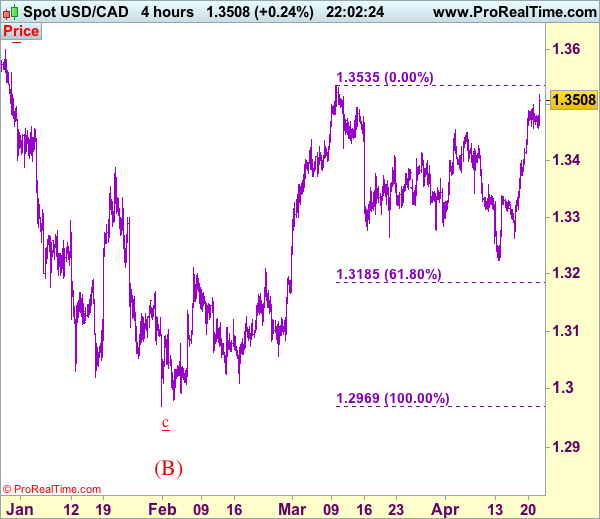
Trade Idea: USD/CAD – Buy at 1.3430
USD/CAD - 1.3510
Recent wave: Only wave v of c has ended at 0.9407 and wave C of major A-B-C correction is underway for headway to 1.4700
Trend: Near term up
Original strategy :
Buy at 1.3400, Target: 1.3580, Stop: 1.3340
Position: -
Target: -
Stop: -
New strategy :
Buy at 1.3430, Target: 1.3590, Stop: 1.3370
Position: -
Target: -
Stop:-
As the greenback has risen again after brief pullback, adding credence to our view that the correction from 1.3535 has ended and upside bias remains for the rise from 1.3223 to extend gain to previous resistance at 1.3535, once this level is penetrated, this would confirm early upmove has resumed and extend headway towards previous chart resistance at 1.3599 later which is likely to hold from here.
In view of this, would not chase this rise here and would be prudent to buy on subsequent pullback as 1.3430 should limit downside. Only below previous resistance at 1.3337 would abort and suggest top is possibly formed, risk weakness to 1.3300-10 but indicated support at 1.3262 should remain intact.
To recap, wave B from 1.3066 is unfolding as an a-b-c and is sub-divided as a: 1.2192, b: 1.2716 and wave c is a 5-waver with i: 1.1983, ii: 1.2506, extended wave iii with minor iii at 1.0206, wave iv ended at 1.0781 and wave v as well as wave iii has ended at 0.9931, hence the subsequent choppy trading is the wave iv which is unfolding as (a)-(b)-(c) with (a) leg of iv ended at 1.0854, followed by (b) leg at 1.0108 and (c) leg as well as the wave iv ended at 1.0674. The wave v is sub-divided by minor wave (i): 0.9980, (ii): 1.0374, (iii): 0.9446, (iv): 0.9913 and (v) as well as v has possibly ended at 0.9407, therefore, consolidation with upside bias is seen for major correction, indicated target at 1.3700 and 1.4000 had been met and further gain to 1.4700 would be seen later.
USD/JPY Mid-Day Outlook
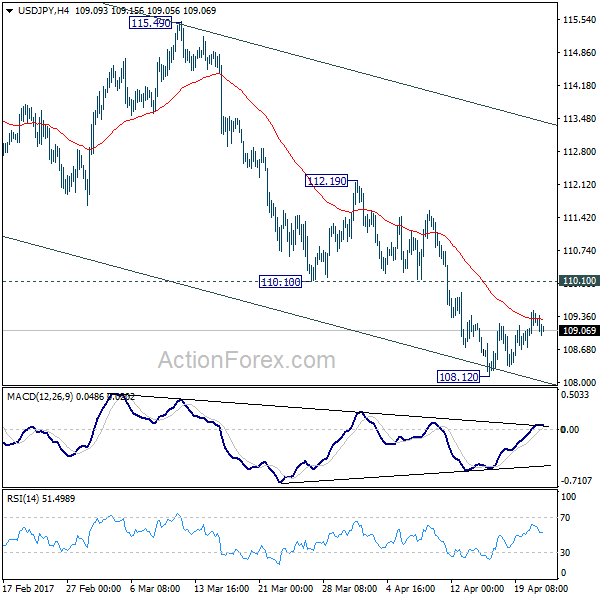
Daily Pivots: (S1) 108.85; (P) 109.17; (R1) 109.63; More....
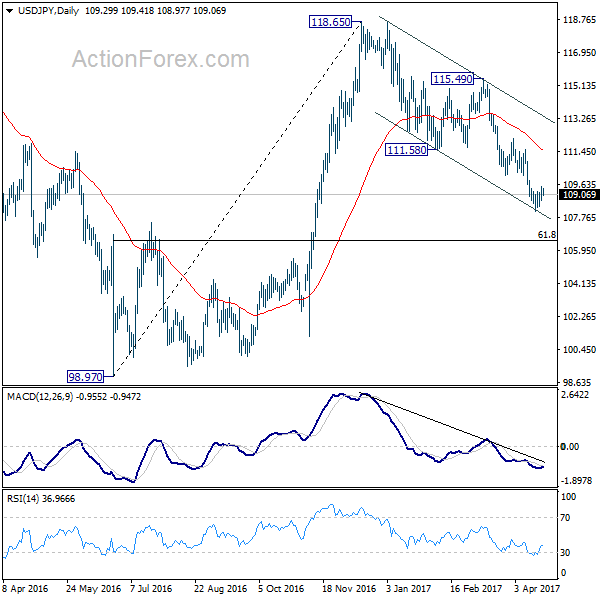
Intraday bias in USD/JPY remains neutral for consolidation above 108.12. With 110.10 resistance intact, near term outlook remains bearish. Rise from 98.97 is finished at 118.65 and fall from there would extend. On the downside, break of 108.12 will target 61.8% retracement of 98.97 to 118.65 at 106.48. Sustained break there will pave the way back to 98.97 low. Nonetheless, break of 110.10 will be the first sign of near term bottoming and turn bias back to the upside for 112.19 resistance instead.
In the bigger picture, price actions from 125.85 high are seen as a corrective pattern. Current development suggests that it's not completed yet and is extending. In case of deeper decline, downside should be contained by 61.8% retracement of 75.56 to 125.85 at 94.77 to bring rebound. Rise from 75.56 is still expected to resume later after the correction from 125.85 completes.
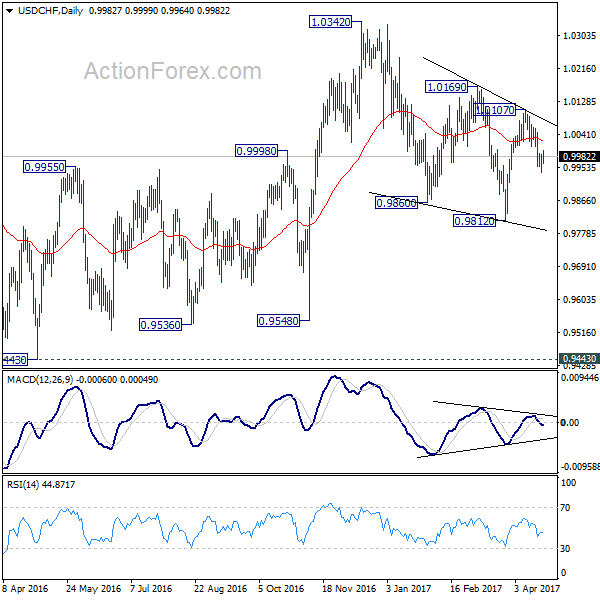
USD/CHF Mid-Day Outlook
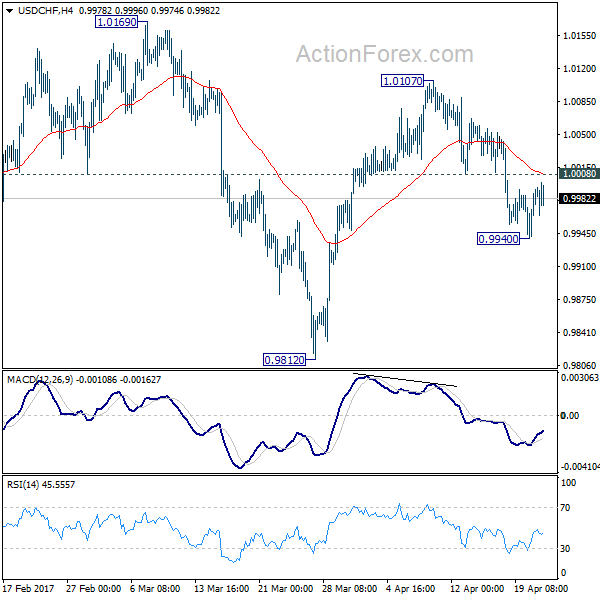
Daily Pivots: (S1) 0.9954; (P) 0.9971; (R1) 1.0001; More.....
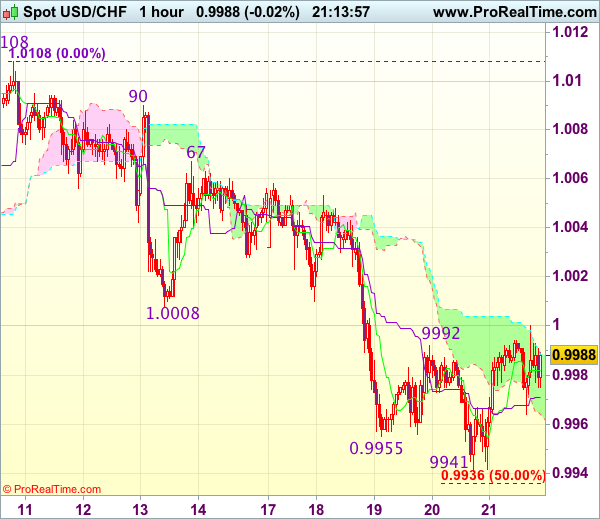
Intraday bias in USD/CHF remains neutral for consolidation above 0.9940 temporary low. Another decline is in favor as long as 1.0008 minor resistance holds. Below 0.9940 will target 0.9812 and below. Fall from 1.0342 is seen as a correction. Hence, we'll look for bottoming signal below 0.9812. Meanwhile, on the upside, above 1.0008 minor resistance will turn bias back to the upside for 1.0107 resistance instead.
In the bigger picture, we're still maintaining that firm break of 1.0342 key resistance is needed to confirm underlying bullish momentum in the cross. However, the corrective nature of the fall from 1.0342 is starting to give the medium term outlook a bullish favor. Hence, in stead of looking for topping signal around 1.0342, we'd now pay closer attention to upside acceleration as USD/CHF approaches this level again.
GBP/USD Mid-Day Outlook
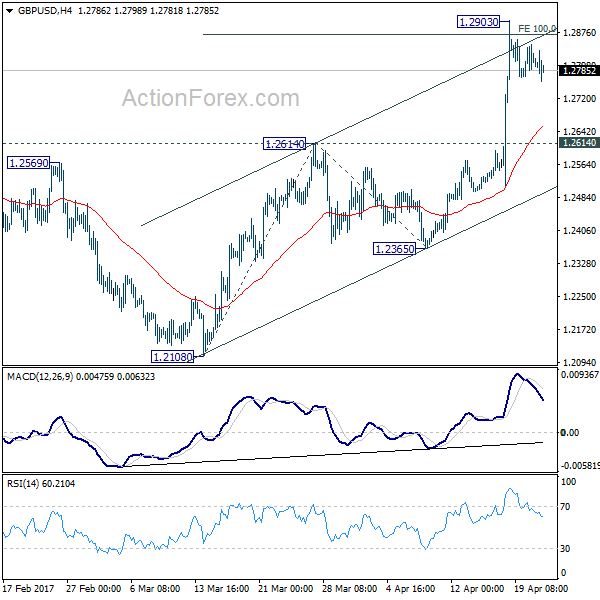
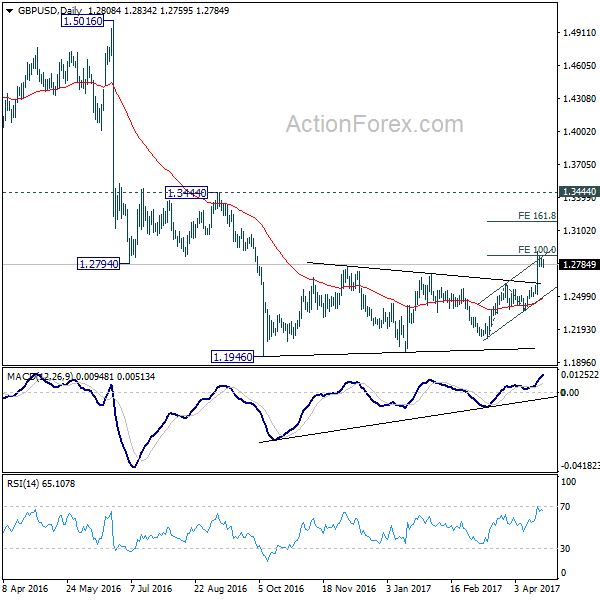
Daily Pivots: (S1) 1.2772; (P) 1.2809; (R1) 1.2847; More...
Intraday bias in GBP/USD remains neutral for the moment. With 1.2614 resistance turned support holds, near term outlook remains bullish for further rise. Firm break of 100% projection of 1.2108 to 1.2614 from 1.2365 at 1.2871 will target 161.8% retracement at 1.3184. Still, price actions from 1.1946 are seen as a correction. Hence we'd expect strong resistance below 1.3444 to bring larger down trend resumption. On the downside, break of 1.2614 resistance turned support will turn bias back to the downside for 1.2365 support first.
In the bigger picture, fall from 1.7190 is seen as part of the down trend from 2.1161. There is no sign of medium term reversal yet. Sustained trading below 61.8% projection of 2.1161 to 1.3503 from 1.7190 at 1.2457 will target 100% projection at 0.9532. Overall, break of 1.3444 resistance is needed to confirm medium term bottoming. Otherwise, outlook will remain bearish.
Trade Idea Update: USD/CHF – Stand aside
USD/CHF - 0.9990
New strategy :
Stand aside
Position : -
Target : -
Stop : -
The greenback rebounded after holding above yesterday’s low at 0.9941, suggesting consolidation above this level would be seen and test of previous support at 1.0008 (now resistance) cannot be ruled out, however, break there is needed to signal low is formed and bring retracement of recent decline from 1.0108 to 10030 but resistance at 1.0067 should remain intact.
On the downside, below said support at 0.9941 would extend recent decline to 0.9935-38 (50% projection of 1.0067-0.9955 measuring from 0.9992) and then 0.9926 (61.8% Fibonacci retracement of 0.9813-1.0108) but reckon 0.9900-05 (1.618 times projection of 1.0108-1.0008 measuring from 1.0067) would hold, bring rebound later. As near term outlook is mixed, would be prudent to stand aside for now.