Sample Category Title
Trade Idea Update: USD/JPY – Sell at 111.55
USD/JPY - 110.93
Original strategy :
Sell at 111.10, Target: 110.00, Stop: 111.45
Position : -
Target : -
Stop : -
New strategy :
Sell at 111.55, Target: 110.35, Stop: 111.90
Position : -
Target : -
Stop : -
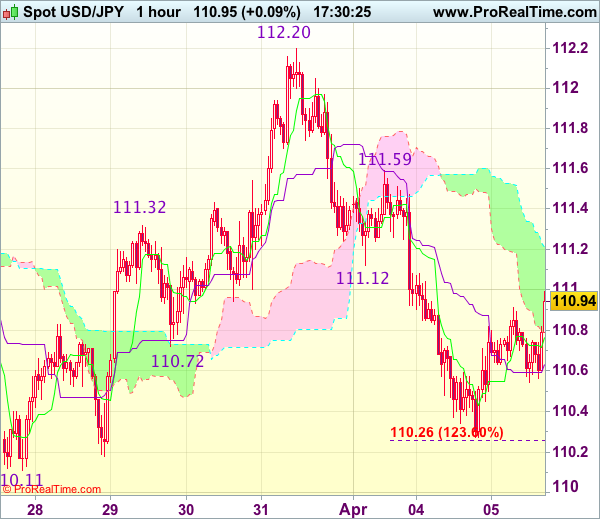
As the greenback has rebounded again in European morning, suggesting near term upside risk remains for the rebound from 110.27 (yesterday’s low) to bring retracement of the decline from 112.20, hence further gain to previous support at 111.12 cannot be ruled out, however, resistance at 111.59 would cap upside and bring another decline later, below 110.50-55 would suggest the rebound from 110.27 has ended, bring retest of this level, break there would extend the fall from 112.20 to last week’s low at 110.11. Looking ahead, break there is needed to retain downside bias and confirm medium term decline has resumed for further subsequent fall to 109.80-85 (1.618 times projection of 112.20-111.12 measuring from 111.59) which is likely to hold on first testing.
In view of this, would not chase this fall here and would be prudent to sell dollar on further subsequent recovery as 111.59 resistance should limit upside. Above 111.80 would shift risk to upside and signal the fall from 112.20 has ended, bring subsequent rise to 112.00-05 first.
French Election Monitor No.1: Emmanuel Macron Remains Favourite After 2nd TV Debate
Yesterday, the second TV debate of all 11 presidential candidates took place, which again saw Emmanuel Macron as one of the candidates with the most convincing performance (21% of viewers) after Jean-Luc Mélenchon (25%). On the other hand, Marine Le Pen was rated only the fourth most convincing candidate (11%), according to a snap poll by Elabe conducted right after the debate. In the same poll, Macron was also seen as the candidate with the best programme by 23% of viewers. A third and final debate is scheduled for 20 April but it is currently unclear if it will take place, as some candidates have complained that it is being held too close to the first round on 23 April.
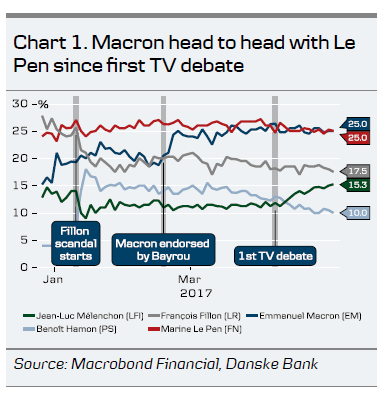
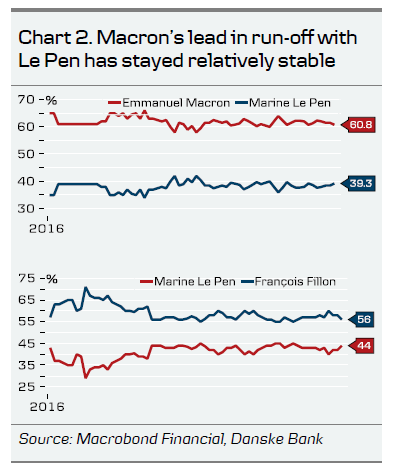
The impact of these debates should not be underestimated, and we are likely to see polling for Macron and Mélenchon move up after their convincing performance yesterday. Macron's support surged after the first TV debate, when he was seen as the most convincing candidate and similarly for Melénchon, who due to his performance has now overtaken the Socialist candidate Benoît Hamon in the polls (see Chart 1). For now, it still seems to come down to a second round run-off on 7 May between Le Pen and Macron, where the latter is projected to win at around 61% and the margin of winning for Macron has also stayed relatively stable since the beginning of the year (see Chart 2).
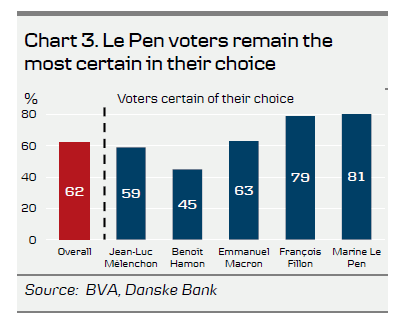
However, the overall electorate is still not too determined in their voting intentions, as only 62% express certainty in their choice of candidate. Hence, the election outcome remains unpredictable and will to a large extent also depend on the participation rate. Traditionally, participation for presidential elections has been relatively high at around 80%. However, recent polls have suggested that voter turnout might be lower this time, only around 66-76%, due to widespread dissatisfaction with the political class. Should this be the case, it would be likely to boost Le Pen's chances of winning, as her supporters remain the most certain of their vote at 81%, compared to only 63% for Macron supporters (see Chart 3). For the short-term market implications of a Le Pen win, see Le Pen – What If? Implications for Euro and Nordic markets, 13 February 2017

UK Construction Growth Slows Slightly In March
'UK construction firms experienced a growth slowdown in March, with the loss of momentum centred on housebuilding.' - Tim Moore, IHS Markit
The Purchasing Manager's Index for the British construction sector slipped slightly last month, falling behind analysts' expectations. IHS Markit reported on Tuesday its UK Construction PMI came in at 52.2, while analysts held expectations for an unchanged reading of 52.5. According to IHS Markit's report, this drop reflected a slowdown in residential building activity, which offset a revival in both commercial and civil engineering sectors. The data showed a minor change in new business growth, due to consumers' budget constraints that also slowed hiring and created less demand for raw materials. In addition, companies reported weaker demand for subcontractors' services and noted that inflationary pressures continued to build in because of expensive imports and rising commodity prices. Nevertheless, construction companies maintained a positive outlook for short-term growth prospects, referring to lower anxiety associated with Brexit and satisfactory macroeconomic data. Stronger consumer confidence also contributed to firms' optimism, which reached a fifteen-month high. In particular, almost half of the respondents claimed their business activity would likely improve, while 9% of the surveyed expressed strong pessimism on growth .
Canada Posts Trade Deficit For First Time Since October In February
'The Bank of Canada has highlighted we've been here before, where things have looked good at the start of the year if only to melt away in the second half. They've noted they're not going to make policy decisions on a short stretch of data.' - Nick Exarhos, CIBC Capital Markets
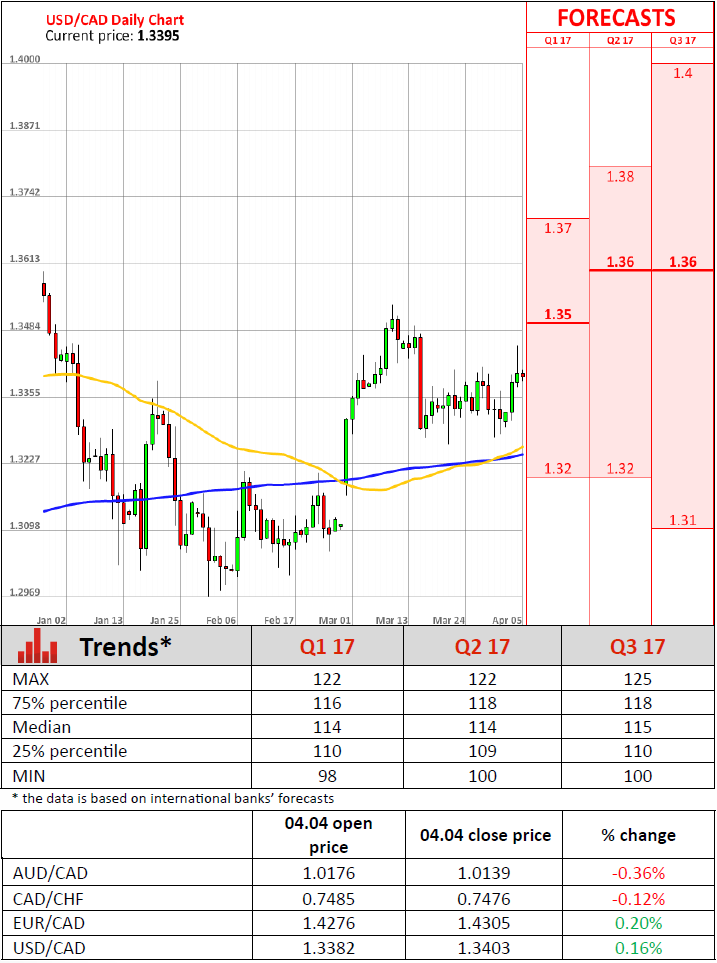
Canada's balance of trade turned negative for the first time since October 2016 in February, surprising markets and raising concerns about the overall health of the economy. Canada posted a trade deficit of C$972 million ($724) in February, following the preceding month's downwardly revised surplus of C$421, Statistics Canada reported on Tuesday. Total exports' value dropped 2.4%, the largest decline since March 2016. Yesterday's data called to question Canada's stronger than expected economic figures released in March. Thus, analysts started to doubt whether the Canadian economy managed to hit 2.5% growth in the Q1 of 2017 as predicted by the Bank of Canada. Moreover, following the release, analysts suggested that the Central bank would leave its monetary policy on hold at its April meeting next week, keeping the key interest rate at a record low of 0.50%. The data showed exports in the farm, fishing and food products sector fell 10.6%, whereas shipments of aircraft and transportation equipment dropped 15.2%. The largest declines were registered in shipments of aircrafts and canola, which contributes $26.7B to the Canadian economy each year. Exports to Canada's southern neighbour, the United States, decreased 1.2%, while shipments to other countries plunged 5.9%.
New Zealand Dairy Product Prices Rise 1.6% At Latest Global Dairy Trade Auction
'Buyers will be aware that New Zealand dairy farmers are having a strong finish to the production season which means there is extra milk powder coming on line, so in this environment it is very positive to see whole milk powder prices creeping back up.' - Susan Kilsby, AgriHQ
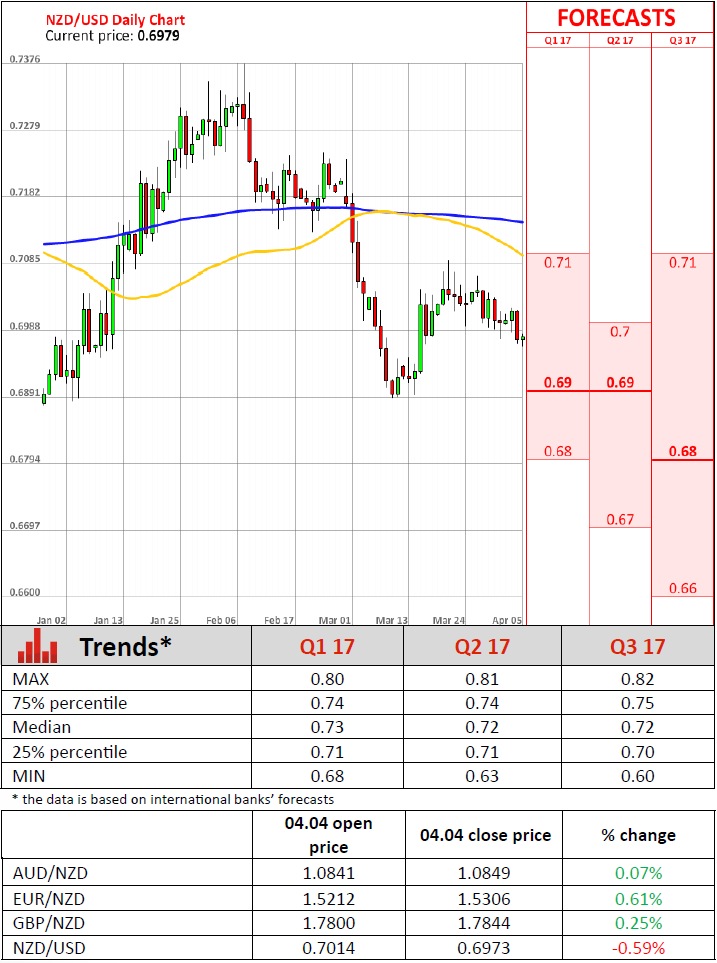
Dairy product prices rose for the second time in a row at the Global Dairy Trade auction on Tuesday amid growing market optimism. The GDT Price Index climbed 1.6% to $3,005 after advancing 1.7% at the preceding auction. Some 22,642 tonnes of dairy products was sold, compared to 22,498 tonnes sold at the previous auction. The whole milk powder price rose 2.4% to $2,924 per tonne, while the rennet casein price surged 6.9% to $6,260 per tonne. Prices for anhydrous milk fat advanced 2.5% to $5,936 per tonne, whereas the lactose price climbed 2.2% to $927 per tonne. In the meantime, prices for butter milk powder plunged 12.2% to $1,588 per tonne, while prices for cheddar fell 4.4% to $3,288 per tonne. The butter price decreased 1.6% to $4,751 per tonne, whereas the skim milk powder price declined 0.8% to $1,913 per tonne. According to analysts, the second straight increase in the GDT Price Index is encouraging, as it is common for prices to dip during the spring season. However, the latest auction results suggest that skim milk powder markets are under pressure due to large inventories in Europe, but analysts expect to see further demand growth in China and other Asian countries. The NZD/USD pair surged shortly after the release, rising above the 70.00 level.
XAUUSD: Fluctuates Above 1,250 Mark
'The markets are waiting for the conference between the most important leaders in the world.' – Jiang Shu, Shandong Gold Group (based on Reuters)
Pair's Outlook
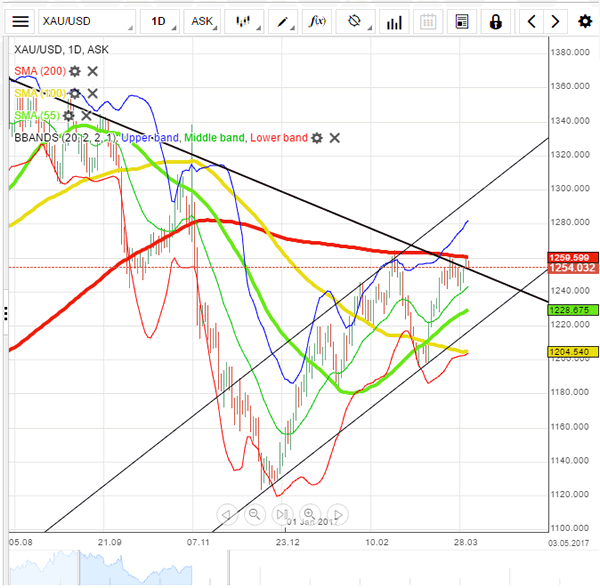
On Wednesday morning the yellow metal's price remained almost unchanged at the 1,255 mark. However, various clues were indicating that the bullion's price was about to decline down to the 1,250 mark, where a cluster of support was located at. The main reason for that hypothesis was the fact that the 200-day SMA was providing resistance at the 1,256.45 level, and gold clearly could not pass it. It is highly possible that the bullion's price will decline down to the combined support of the weekly PP and the 50.00% Fibonacci retracement level, respectively, at 1,249.67 and 1,248.96 during the day's trading session.
Traders' Sentiment
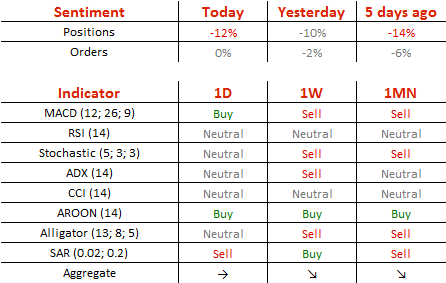
Traders have become slightly bearish on the metal, as 52% of open positions are short on Wednesday. Meanwhile, 63% of trader set up orders are to buy.
USDJPY: Set Eye On 110.00
'The foreign exchange market's main focus remains whether or not Trump can carry out his policies, and whether the U.S. economy will stay strong enough for the Fed to stick to the path of rate hikes.' – Sony Financial Holdings (based on Business Recorder)
Pair's Outlook
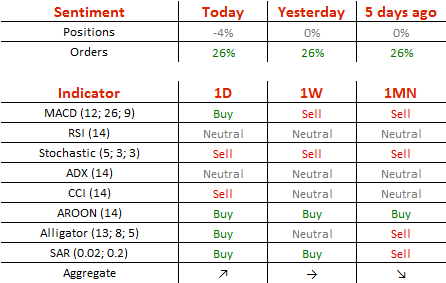
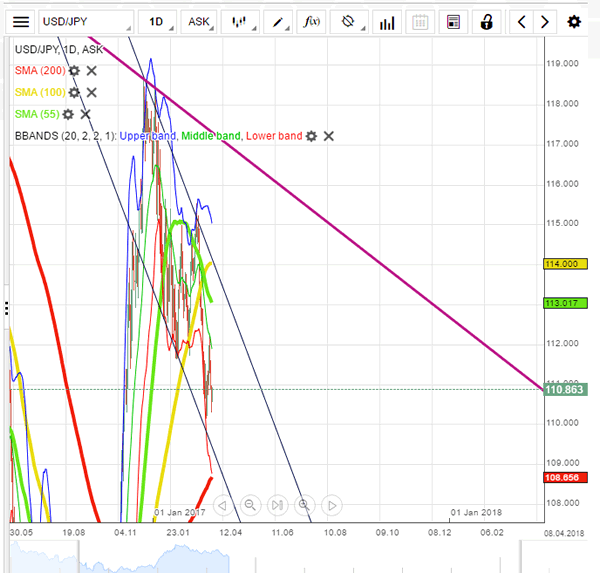
The US Dollar weakened against the Yen on Tuesday, marking a third consecutive decline. The pair is set for another leg down today, with the weekly S1 still acting as the nearest support at 110.27. This support, however, is unlikely to limit the losses should the US ADP Employment Change reading disappoint, with the 110.00 level open to exposure. Further below lies the descending channel's support line, bolstered by the weekly S2, the monthly S1 and the lower Bollinger band, all marking the expected intraday low. Meanwhile, technical indicators keep giving bearish signals, bolstering the possibility of the bearish scenario.
Traders' Sentiment
Today 68% of traders are long the Greenback (previously 70%), while 63% of all pending orders are to acquire the American Dollar.
GBPUSD: Set To Retest The Down-Trend
'We do not believe the USD will weaken through key technical and psychological levels in the coming month.' – HSBC (based on PoundSterlingLive)
Pair's Outlook
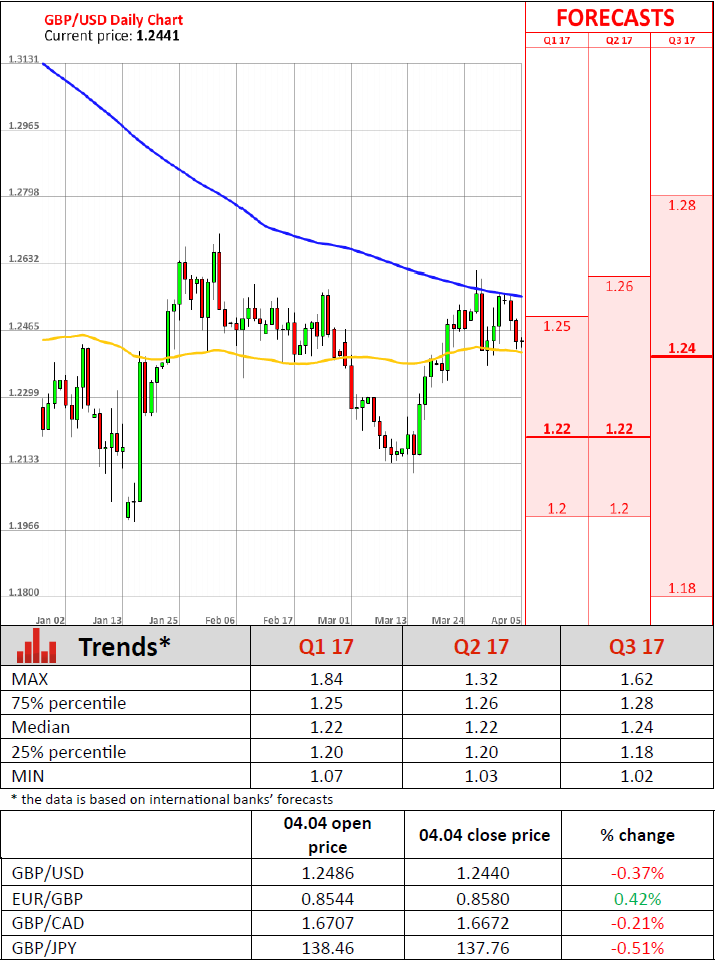
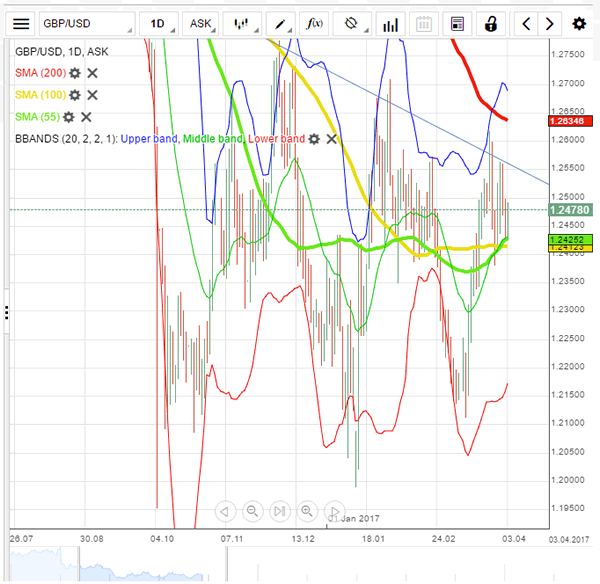
The Cable weakened for the second day in a row yesterday, finding support in front of the tough demand area, represented by the weekly S1, the monthly PP, the 55 and the 100-day SMAs. The same cluster is now also reinforced by the 20-day SMA, bolstering the chance the Sterling is to rebound today. Technical indicators are also in favour of the positive outcome. The GBP/USD pair could even surge back above 1.25 and put the six-month down-trend to the test again. However, downside risks also persist, a driver for which would be the ADP data later today.
Traders' Sentiment
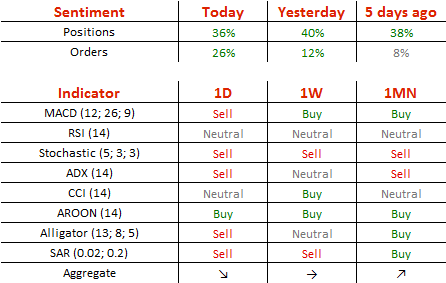
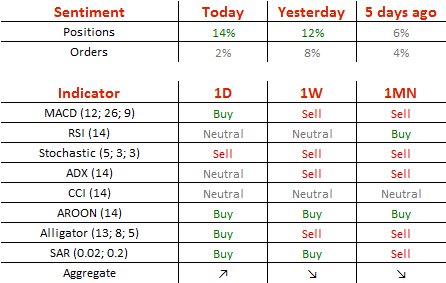
Bullish traders' sentiment returned to its last Wednesday's level of 57%, whereas the share of purchase orders declined from 54 to 51% in the last 24 hours.
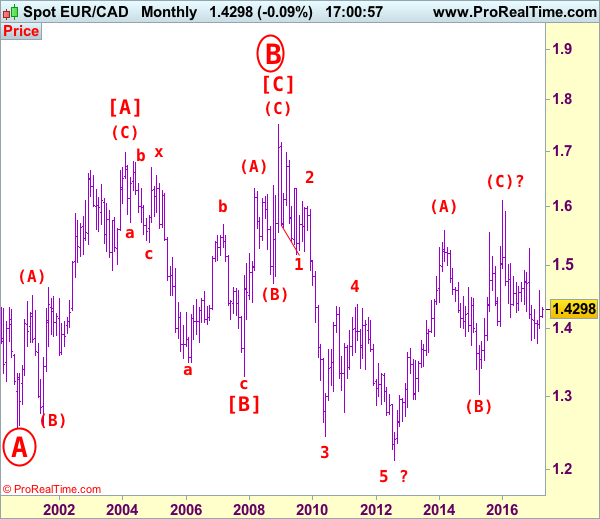
EUR/CAD Elliott Wave Analysis
EUR/CAD – 1.4451
EUR/CAD: Wave 4 ended at 1.4380 and wave 5 as well as circle wave C has possibly ended at 1.2129, major (A)-(B)-(C) correction has commenced and indicated target at 1.6000 had been met.
Despite last week’s initial rise to 1.4600, the subsequent deeper-than-expected retreat suggests top has been formed there and consolidation below this level would be seen with mild downside bias for another test of last week’s low at 1.4176, break there would extend weakness to 1.4100, however, as broad outlook remains consolidative, reckon downside would be limited to 1.4000 and bring another rebound later.
Our latest preferred count is that larger degree wave [C] from 1.3289 as well as circle wave B ended at 1.7509 in Dec 2008 with (A): 1.6325, (B): 1.4719 followed by wave (C) at 1.7509, hence circle wave C is unfolding with wave 1 ended at 1.5186 (diagonal wave 1), wave 2 at 1.6096, impulsive wave 3 has ended at 1.2451, followed by wave 4 at 1.4380, in view of recent strong rebound, we are now treating the wave 5 as well as larger degree circle wave C has ended at 1.2129, hence (A)-(B)-(C) correction has commenced from there with impulsive wave (C) now unfolding and indicated initial upside target at 1.6000 had been met and reckon 1.6500 would hold.
On the upside, whilst initial recovery to 1.4350 and 1.4400 cannot be rule out, reckon upside would be limited and 1.4500-10 would hold from here, bring another retreat later. Above 1.4550-60 would bring test of said resistance at 1.4600 would revive bullishness and extend the rise from 1.3784 low for further gain to 1.4710 (61.8% Fibonacci retracement of 1.5282-1.3784) and later towards 1.4800.
Recommendation: Stand aside for this week.
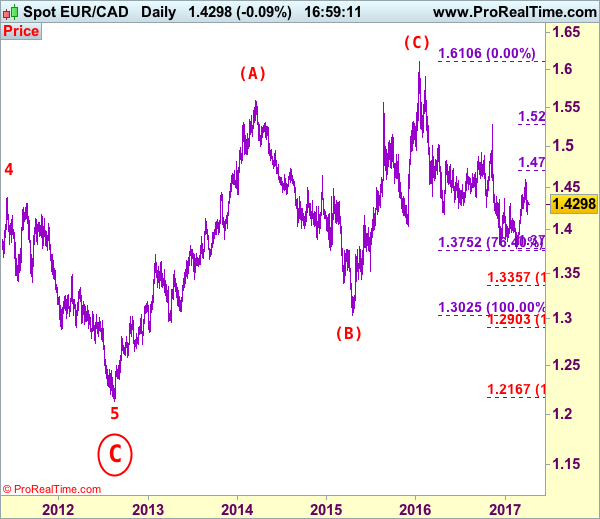
On the bigger picture, our long-term count on the monthly chart is that a big sideways consolidation from 2000 low of 1.2557 has possibly ended at 1.7509 as circle wave B with [A]: 1.6976 ( (A): 1.4513, (B): 1.2612, (C): 1.6976), wave [B]: 1.3289 is a double three with 1st a-b-c: 1.5384, x: 1.6709 and 2nd a-b-c: 1.3289. As indicated above, the wave [C] has ended at 1.7509. The selloff from there is now unfolding which itself should be labeled as an impulsive wave with wave 1: 1.5186 (diagonal wave 1), followed by wave 2: 1.6096 and wave 3: 1.2451, wave 4: 1.4380, wave 5 as well as larger degree circle wave C has possibly ended at 1.2129 and major correction has possibly commenced for retracement of recent decline towards 1.4000, then 1.4180-90 (38.2% Fibonacci retracement of 1.7509-1.2129). Below said support at 1.2129 would risk weakness to psychological support at 1.2000 and then 1.1851 (50% projection of 1.7509-1.2451 measuring from 1.4380) but reckon 1.1500 would remain intact, bring reversal later.
EURUSD: Attempts To Break Resistance
'In reality Madame Le Pen has no economic policy.' – Francois Fillon (based on Bloomberg)
Pair's Outlook
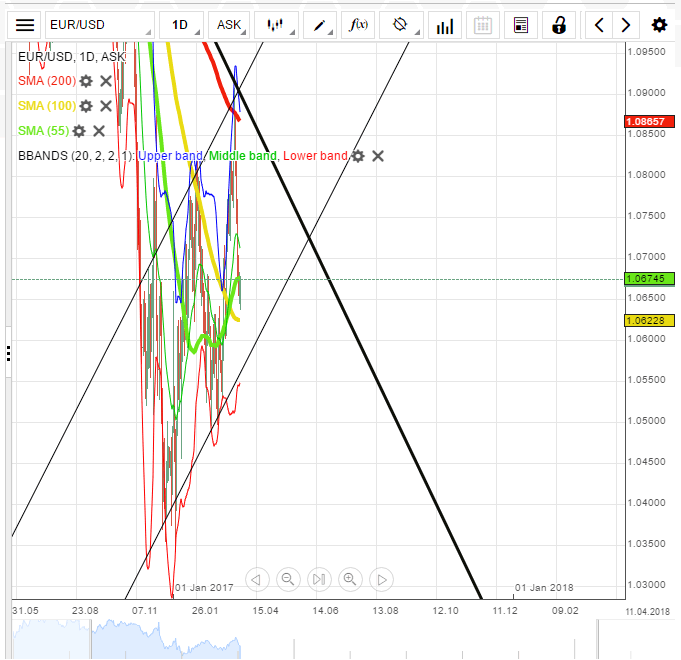
During the early hours of Wednesday's trading session the common European currency attempted to break the resistance against the US Dollar put up by the monthly pivot point at the 1.0685 level. The attempt failed and the currency exchange rate retreated to trade below the 55-day SMA, which was located at the 1.0674 mark. Due to the facts that the pair now faces a strong resistance, and the range of almost 50 base points is almost free below it, a decline of the currency pair is expected. The pair is likely set to decline once more to the 23.60% Fibonacci retracement level, which is located at the 1.0639 level.
Traders' Sentiment
SWFX traders remain bearish on the pair, as 56% of open positions are short. Meanwhile, trader set up orders are neutral.