Sample Category Title
GBP/USD Elliott Wave Analysis
GBP/USD – 1.2460
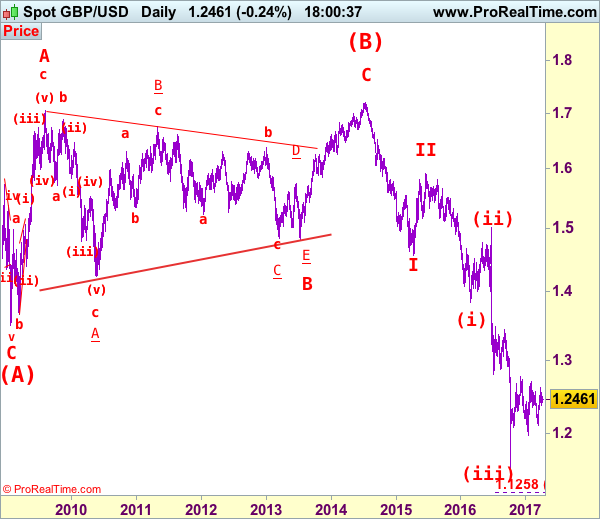
GBP/USD – Wave 4 is unfolding as an (A)-(B)-(C) and could have ended at 1.7192
As cable met resistance at 1.2559 and has slipped again, retaining our view that further consolidation below last month’s high of 1.2616 would be seen and initial downside risk remains for test of 1.2377 support, however, reckon downside would be limited to previous support at 1.2335 and bring another rise later. A daily close above resistance at 1.2559 would signal the retreat from 1.2616 has ended, bring retest of this level, break there would extend the rebound from 1.2109 to previous resistance at 1.2706 but break there is needed to signal another leg of corrective upmove from 1.1986 low is underway for further gain to 1.2800 and then 1.2900, having said that, psychological resistance at 1.3000 would remain intact.
Our preferred count on the daily chart is that cable's rebound from 1.3500 (wave (A) trough) is unfolding as a wave (B) with A ended at 1.7043, followed by triangle wave B and wave C as well as wave (B) has possibly ended at 1.7192, below support at 1.4232 would add credence to this count, then further fall to 1.4000 level would follow but reckon downside would be limited to 1.3655 support and price should stay above previous support at 1.3500.
On the downside, whilst initial pullback to 1.2400-05 cannot be ruled out, reckon downside would be limited to 1.2335 support and bring another rise later. A daily close below support at 1.2335 would dampen this bullish view and bring weakness to 1.2290-00 but reckon 1.2240-50 would hold, bring another rebound. A drop below 1.2240-50 would suggest the rebound from 1.2109 has ended instead, bring further fall to 1.2200 and then 1.2150-60 but said support at 1.2109 should remain intact.
Recommendation: Buy at 1.2340 for 1.2600 with stop above 1.2240.
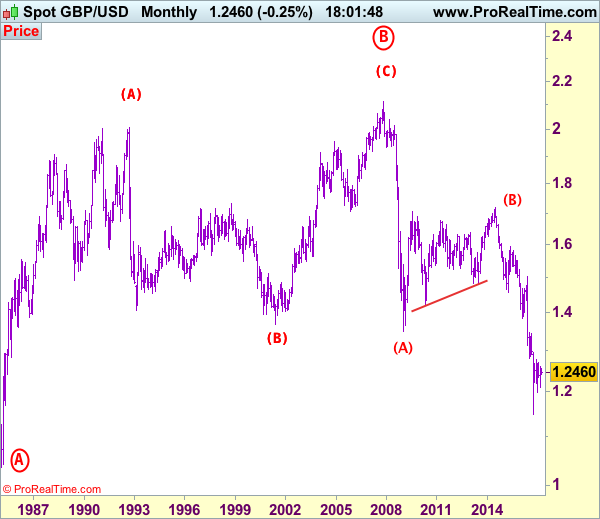
Longer term - Cable's rise from 1.0520 (Feb 1985) to 2.0100 (September 1992) is seen as [A], the decline to 1.3682 is labeled as (B) and (C) wave rally has ended at 2.1162 (9 Nov, 2007) which is also the top of larger degree wave B with circle. The selloff from there is a 5-waver with wave (A) ended at 1.3500 (23 Jan 2009), wave (B) itself is labeled as A: 1.6733, triangle wave B: 1.4813 and wave C as well as top of wave (B) ended at 1.7192 (2014), hence the selloff from there is an impulsive wave (C) with wave I : 1.4566, wave II 1.5930, an extended wave III is unfolding and already exceeded our downside target at 1.3500 and 1.3000, hence weakness to 1.2500 and possibly 1.2000 cannot be ruled out, however, price should stay well above psychological level at 1.0000.
Reserve Bank Of Australia On Hold, USD Gains As Market Switch In Risk-Off Mode
News and Events:
USD extends gain versus G10, JPY resists
After a quiet start into the week, the USD was back in full force on Tuesday as it extended gains against most of its pairs. The Japanese Yen was the only G10 currency able to offer resistance as it rose 0.36% with USD/JPY sliding to 110.40. The market is currently switching slowly into risk-averse mode, with the Yen and Gold seeing good inflow, amid rising global uncertainty.
Investors will soon however ever get some fresh data to get their teeth into. In the US, February factory orders (+1% m/m exp.,1.2% prev.) and durable goods orders (first est. 1.7% m/m) are due this afternoon.
Tomorrow, the publication of the FOMC will get special attention from investors who will try to read between the lines, looking for hidden hints about the pace of the rate normalisation process.
Finally, March’s job report will be Friday’s major event. The US economy is expected to have created 175k private jobs last month, compared to 235k in February. As explained a month ago, we believe that the market is less and less focused on job gains but instead monitoring wage development closely. Looking at the headline figures, the momentum seems solid as average hourly earnings were up 2.8% y/y. Nevertheless, the sustained rise in consumer prices, which has been mostly driven by rising commodity prices, has eroded the purchasing power of the average American as real average weekly earnings dipped in negative territory during the first two months of the year.
Emerging market and commodity currencies took the bigger hit this morning as market participants shied away from risky positions. We do not think this is the time for further Dollar debasement as the global uncertainty favours long USD position, especially ahead of the French and German election. Similarly, the setback of commodity currencies will also prove temporary in our opinion as high returns are still a rare breed.
French Elections: Candidates return to debate
Today 11 candidates will debate for the French Presidency. At the last debate, contrary to what is said now about him being a frontrunner, Emmanuel Macron had not been successful. So this debate may see a turnaround in this presidential election, as Francois Fillon has improved lately in the polls despite the accusations that engulfed him.
Tonight’s debate will mostly be on jobs, security, and the candidates' vision for the future of France. It is clear that the European Union will be at the centre of the debate and we should see “small” candidates trying to make a difference with their views on this.
It is expected that François Asselineau, the Frexit candidate, will largely attack Macron and Fillon on this specific topic, as will Marine Le Pen. But a possible referendum if she gets elected remains somewhat unclear.
For now, markets are still not pricing a Le Pen victory. In terms of currency, the Euro is consolidating against the USD between 1.06 and 1.07 and we believe that there is more room for further downside in the short-term.
Bullish on AUD after RBA kept rates unchanged
As expected the RBA held its cash rate at 1.50%. Despite this, the AUDUSD quickly fell to 0.7557 on market disappointment that rate expectation should be paired back and also due to lower risk appetite and lower iron ore prices.
The accompanying statement was marginally more optimistic regarding the domestic and global economic outlook. They mentioned the improvement in trade and higher commodity prices (on-going large trade surplus) would support domestic conditions. The RBA indicated that “on-going moderate growth” will support forward indicators and backstop softening labor markets.
The RBA also highlighted risks in the housing market. They took particular care in discussing retail credit growth and risk of rising mortgage rates on outstanding loans, adding that lenders must watch serviceability analytics. Additionally, the RBA introduced a new paragraph on macro-prudent measures stating “a reduced reliance on interest-only housing loans in the Australian market would also be a positive development”.
On inflation the statement was unchanged with headline CPI expected to break 2% in 2017, with a limited upside as wage growth is subdued.
All in, it is unlikely the RBA will rise rates unless the housing market continues to accelerate and even then it is likely to use micro-adjustment tools prior to monetary policy hikes. However, we can expect the RBA to shift from dovish to neutral as growth gradually breaches the bank’s forecasted range.
Given the positive global conditions of risk taking (despite the current bout of uncertainty) we are constructive on AUDUSD, as 0.7563 should provide support for a recovery rally to 0.7633 resistance.
Today's Key Issues (time in GMT):
- Mar Unemployment MoM Net ('000s), exp -40,9, last -9,4 EUR / 07:00
- 4Q Deficit to GDP YTD, last 2,30%, rev 2,50% EUR / 08:00
- Mar FIPE CPI - Monthly, exp 0,12%, last -0,08% BRL / 08:00
- Mar Markit/CIPS UK Construction PMI, exp 52,5, last 52,5 GBP / 08:30
- Feb Retail Sales MoM, exp 0,50%, last -0,10%, rev 0,10% EUR / 09:00
- Feb Retail Sales YoY, exp 1,00%, last 1,20%, rev 1,50% EUR / 09:00
- Lowe Gives Remarks at RBA Board Dinner, Melbourne AUD / 09:15
- Mar Effective Exchange Rate, last 88,83 TRY / 11:30
- Feb Industrial Production MoM, exp 0,70%, last -0,10% BRL / 12:00
- Feb Industrial Production YoY, exp 0,30%, last 1,40% BRL / 12:00
- Feb Trade Balance, exp -$44.6b, last -$48.5b USD / 12:30
- Feb Int'l Merchandise Trade, exp 0.60b, last 0.81b CAD / 12:30
- ECB President Draghi speaks in Frankfurt EUR / 13:30
- Mar Foreign Reserves, exp 470,8, last 466,6 DKK / 14:00
- Mar Change in Currency Reserves, last 8.8b DKK / 14:00
- Feb Factory Orders, exp 1,00%, last 1,20% USD / 14:00
- Feb Factory Orders Ex Trans, last 0,30% USD / 14:00
- Feb F Durable Goods Orders, exp 1,70%, last 1,70% USD / 14:00
- Feb F Durables Ex Transportation, last 0,40% USD / 14:00
- Feb F Cap Goods Orders Nondef Ex Air, last -0,10% USD / 14:00
- Feb F Cap Goods Ship Nondef Ex Air, last 1,00% USD / 14:00
- Mar QV House Prices YoY, last 13,50% NZD / 17:00
- Fed's Tarullo speaks at Princeton University USD / 20:30
- Mar Foreign Reserves, last $373.91b KRW / 21:00
The Risk Today:
EUR/USD is getting lower despite ongoing consolidation. The pair is heading lower since the pair failed to hold above former resistance given at 1.0874 (08/12/2017 high). Hourly support can be found at 1.0643 (03/04/2017 low). Stronger support can be found at 1.0493 (22/02/2017 low). The short-term technical structure indicates further weakness.. In the longer term, the death cross late October indicated a further bearish bias. The pair has broken key support given at 1.0458 (16/03/2015 low). Key resistance holds at 1.1714 (24/08/2015 high). Expected to head towards parity.
GBP/USD's bullish pressures have faded abruptly. Hourly resistance is located at 1.2615 (27/03/2017 high) while hourly support can be found at 1.2324 (03/17/2017 low). Expected to show continued strengthening towards resistance at 1.2775 (06/12/2016 high) if support area around 1.24 stands. The long-term technical pattern is even more negative since the Brexit vote has paved the way for further decline. Long-term support given at 1.0520 (01/03/85) represents a decent target. Long-term resistance is given at 1.5018 (24/06/2015) and would indicate a long-term reversal in the negative trend. Yet, it is very unlikely at the moment.
USD/JPY's bearish pressures are fading. Hourly resistance is given at 112.20 (31/03/2017 high). Stronger resistance can be located at 113.57 (16/03/2017 high) while support is given at 110.11 (27/03/2017 low). We favor a long-term bearish bias. Support is now given at 96.57 (10/08/2013 low). A gradual rise towards the major resistance at 135.15 (01/02/2002 high) seems absolutely unlikely. Expected to decline further support at 93.79 (13/06/2013 low).
USD/CHF is strengthening. Hourly support is given at 0.9814 (27/03/2017 low). Key resistance can be found at a distance at 1.0344 (15/12/2016 high). Expected to show further consolidating. In the long-term, the pair is still trading in range since 2011 despite some turmoil when the SNB unpegged the CHF. Key support can be found 0.8986 (30/01/2015 low). The technical structure favours nonetheless a long term bullish bias since the unpeg in January 2015.
| EURUSD | GBPUSD | USDCHF | USDJPY |
| 1.1300 | 1.3445 | 1.0652 | 121.69 |
| 1.0954 | 1.3121 | 1.0344 | 118.66 |
| 1.0906 | 1.2771 | 1.0171 | 115.62 |
| 1.0669 | 1.2504 | 1.0018 | 111.32 |
| 1.0494 | 1.1986 | 0.9550 | 106.57 |
| 1.0341 | 1.1841 | 0.9444 | 106.04 |
| 1.0000 | 1.0520 | 0.9259 | 101.20 |
GBP/JPY Elliott Wave Analysis
GBP/JPY – 137.65
GBP/JPY – Wave 5 as well as wave (III) has possibly ended at 116.85
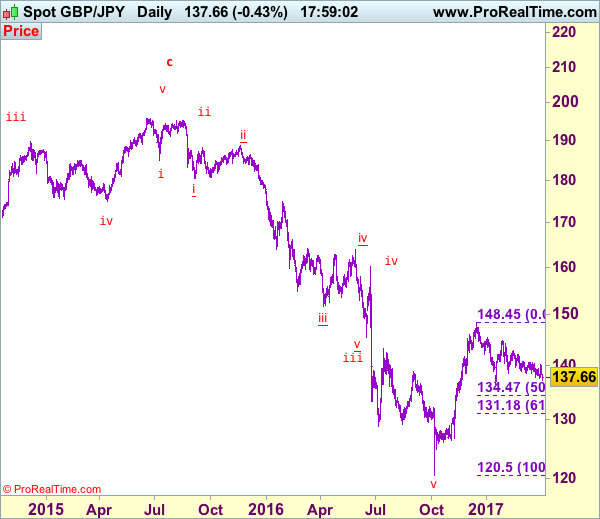
As sterling has fallen again after faltering below resistance at 140.60, dampening our near term bullishness and near term downside risk remains for the fall from 144.75 to bring a stronger retracement of early upmove from 120.50 to 136.45-50, break there would add credence to this view and extend fall to 135.90-00, then towards 134.45-50 (50% Fibonacci retracement of 120.50-148.45) which is likely to hold on first testing, risk from there is seen for a rebound to take place later.
Our preferred count is that larger degree wave V with circle is unfolding from 251.12 with wave (I) 219.34, (II): 241.38 and wave (III) is subdivided into 1: 192.60, 2: 215.89 (23 Jul 2008) and wave 3 ended at 118.87 earlier in 2009. The correction from there to 162.60 is wave 4 which itself is a double three and is labeled as first a-b-c ended at 151.53, followed by wave x at 139.03, 2nd a ended at 162.60, 2nd b at 146.75 and 2nd c leg of wave 4 ended at 163.00. Therefore, the decline from 163.00 to 116.85 is now treated as wave 5 which also marked the end of larger degree wave (III), hence wave (IV) major correction has commenced for retracement of the wave (III) from 241.38 and upside target at 183.95-00 (50% Fibonacci retracement of the wave (II) from 241.38) had been met, a drop below 160.00 would suggest wave (IV) has ended at 195.85, bring decline in wave (V) for initial weakness to 130 (already met) and 120.
On the upside, whilst recovery to 138.35-40 cannot be ruled out, reckon upside would be limited to 139.00-10 and resistance at 140.10 (last week’s high) should hold, bring another decline later. Only break of indicated resistance at 140.60 would revive bullishness and suggest low is formed, bring a stronger rebound to 142.00-05 but only break of resistance at 142.80 would signal the fall from 144.75 has ended, bring further gain to 143.40-50 first.
Recommendation: Stand aside for this week.
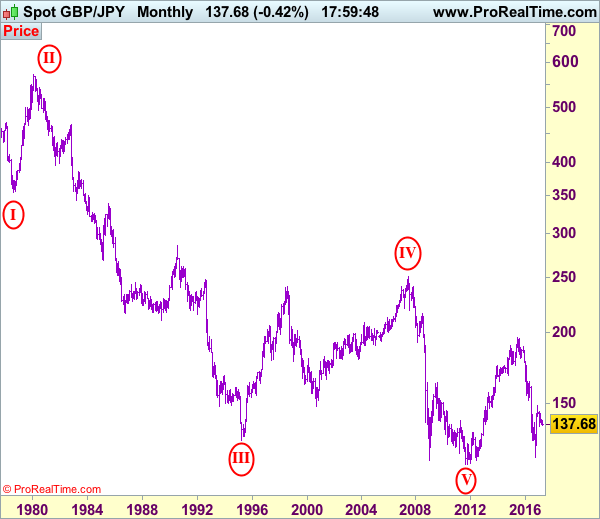
The long-term downtrend from 570.99 (29 Feb 1980) is labeled as an impulsive wave with III with circle ended at 129.77 (20 Apr 1995) and the corrective rebound to 251.12 (20 Jul 2007) is treated as wave IV with circle and the wave V with circle selloff from 251.12 has possibly ended at 116.80 (almost reached our indicated target at 116.00) and major correction has commenced from there and indicated upside target at 183.90-00 (50% Fibonacci retracement of 251.10-116.85) had been met, reckon upside would be limited to 199.80-90 (61.8% Fibonacci retracement) and bring wave (V) decline in later part of 2017.
Euro Under Pressure, Retail Sales Next
EUR/USD has edged lower in the Tuesday session. Currently, the pair is trading at 1.0660. On the release front, the eurozone will release retail sales, which is forecast to post a gain of 0.5%, after three straight declines. ECB President Mario Draghi will speak in Frankfurt, as the ECB launches its new EUR 50 banknote. In the US, today’s highlight is trade balance, which the trade deficit expected to narrow to $46.0 billion. On Wednesday, all eyes will be on the Federal Reserve, which will publish the minutes of its March policy meeting. As well, the US will release ADP Employment Change and ISM Non-Manufacturing PMI.
The euro remains under pressure, as the currency hovers close to 3-week lows. EUR/USD dropped 1.9 percent last week, marking its worst weekly decline since November 2016. Soft inflation numbers late in the week disappointed the markets and soured sentiment on the continental currency. German Preliminary CPI posted a weak gain of 0.2%, short of the forecast of 0.4%. This was followed by Eurozone Flash CPI Estimate, which slipped to 1.5%, missing the forecast of 1.8%. At the same time, Germany, the largest economy in Europe, continues to post solid numbers. Employment and retail sales data in February beat expectations, as the German economy continues to expand at a healthy clip in 2017.
The US economy hasn’t missed a beat in 2017, and the markets are expecting strong data for the first quarter. The CB consumer confidence report soared to 125.6 in March, and strong consumer confidence levels should translate into increased consumer spending, a key component of economic growth. GDP for the fourth quarter was revised to 2.1%, up from 1.9% in the previous GDP report. With the economy headed in the right direction, the discussions around the monetary policy tables are not whether the Fed will raise rates, but will it press the rate trigger two or three more times in 2017. The markets will be paying close attention to the minutes of the March meeting, when the Fed raised rates by a quarter-point, to a range of 0.75-1.00%. Any hints about the timing of the next hike, as well as the tone of the minutes are factors which could move the currency markets on Wednesday. The markets considered the rate statement overly cautious, and this sentiment sent the US dollar broadly lower. If the reaction to the minutes is one of disappointment, the dollar could again head downwards.
Asia Session – Holiday Thinned Trading
Holidays in China, Hong Kong, Taiwan and India saw muted trading in much of Asia with the USD holding firm, except against the JPY.
With so much of the region on holiday today, the focus rested mostly on the USD/JPY and AUD/USD. This follows the tumble in US yields yesterday and the RBA rate decision this afternoon. The dovish tone of the RBA staying unchanged overrode any positive sentiment from this morning’s near record trade surplus. In Japan, the Yen continued to strengthen against the USD and Euro as the yield spread narrowed and risk aversion from Japanese investors continued.
Today in Europe we have ECB President Mario Draghi talking this evening, as well as Euro-zone Retail Sales. The U.S. announces the Trade Balance, Durable Goods and Factory Orders. Tonight will also be notable as the White House announces its mark 2 version of the Obamacare Repeal.
Equities
The Nikkei fell over 1% today as a strengthening Yen weighed on sentiment and pushed automaker stocks in particular, lower. Mainland China and Hong Kong markets were closed. The Nikkei will likely continue to remain heavy as USD/JPY approaches the 110.00 level and JGB’s continue to rally on safe-haven flows. The next important level is 18,850 just below.
FX
AUD struggled today as a dovish RBA (particularly on jobs) and falling imports data tipped it through key support at 7590. Aud has continued to fall into the afternoon session with nearby support at 7550 with a break possibly setting up a test of key long-term support in the 7490/7500 area.
AUD/JPY is also suffering as a high beta pair to the risk -on, risk-off complex.The cross is finishing on its lows at 83.45, having broken support at 83.75. A daily close would be quite bearish technically, setting up further possible losses to the 82.50 area.
USD/JPY has had another bad day as U.S. yields tanking added to the already bearish technical picture. We finish in Asia at the lows of 110.40 having fallen from 111.00 this morning. The bounces in USD/JPY from a technical perspective, have been tepid, to say the least. 110 is the key support level now with stop-loss selling anticipated on a break. Until then, we remain becalmed within the recent 110/112 trading range.
EUR/JPY has broken support at 118.25 and is testing its 200-day moving average at 117.65 as I write. Although a daily close below would be bearish, we do note that the daily RSI is in oversold territory. This may make the technical picture less clear and leave the cross vulnerable to a possible squeeze higher in the short term before the bigger technical picture re-establishes itself.
EUR/USD. The highlight will undoubtedly be Mario Draghi speaking at 2130 Singapore time. The street seems to have taken the ECB’s guidance to heart and scaled back on their tapering ambitions. With Greece coming back into the headlines for all the wrong reasons, peripheral spreads of Bunds, in particular, have widened. This has seen the Euro fall from grace quite quickly from the taper-tantrum heights of last week. The single currency, however, does have technical support down here at 1.0640, yesterday’s low, and more importantly at the 100-day moving average at 1.0630.
In the bigger picture, the key level for Euro is 1.0500. Momentum appears to be waning down here for now from a chart perspective, meaning Euro could be vulnerable to a squeeze higher.
Precious Metals
Gold is benefitting from the risk aversion in other markets, finishing up five dollars in Asia at 1258.50. Dips have been shallow of late, with 1240 now very strong support on the daily charts. This seems to be setting up gold for a test of its 200-day moving average just above at 1259.50. The 200-day has capped all successive rallies this year. A close above 1260.50 now would be a strong technical signal that we are going to higher levels.
Silver has already broken through its 200-day moving average at 18.0900, and this has held all pullbacks in the last week, making it strong support on the technicals. Silver has moved directly higher today from its New York close. Up some 10 cents from 10.2500 t0 10.3500 and putting it in sight of key resistance at 18.5000. The price action suggests a test of the latter is almost inevitable, with a daily close above, possibly setting up a technical move to the 19.0000 area.
Technical Outlook: Spot Gold Is Pressuring Key Barriers For Continuation Of Larger Uptrend
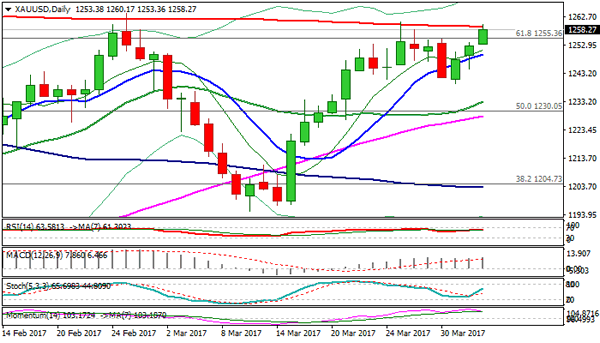
Spot Gold extended recovery rally from $1139 trough on strong risk-off buying and cracked initial target at $1259 (200SMA), pressuring next targets at $1261/63(peaks of 27 Mar and 27 Feb).
The price is looking for daily close above $1255 (Fibo 61.8% of $1337/$1122 descend, which so far resisted several attacks), to generate bullish signal.
Firm break above 200SMA and $1261/63 peaks is needed to signal resumption of larger uptrend from $1122 (15 Dec low) towards Fibonacci projections at $1269/74 and $1286 (Fibo 76.4% of $1337/$1122 descend) in extension.
Meantime, the price may spend some time in consolidation before final break above key barriers, with daily Tenkan-sen (currently at $1250) required to contain extended dips.
Res: 1261, 1263, 1269, 1274
Sup: 1253, 1250, 1244, 1239
Forex Technical Analysis: EUR/USD, USD/JPY, GBP/USD
EUR/USD
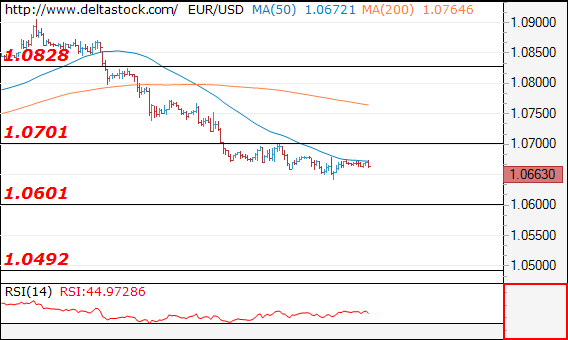
Current level - 10663
The bias is bearish, for a test of 1.0600 static support. A break through the latter will challenge 1.0490 area. Crucial on the upside is 1.0700.
| Resistance | Support | ||
| intraday | intraweek | intraday | intraweek |
| 1.0700 | 1.0904 | 1.0600 | 1.0600 |
| 1.0828 | 1.1010 | 1.0490 | 1.0490 |
USD/JPY
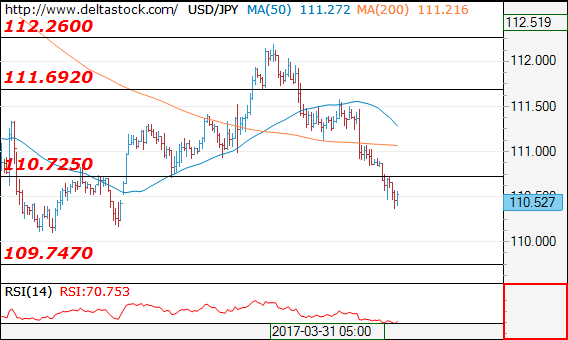
Current level - 110.52
The recent slide from 112.20 is still intact, with an initial resistance at 110.70 and target projection at 110.10 low.
| Resistance | Support | ||
| intraday | intraweek | intraday | intraweek |
| 110.70 | 113.50 | 110.10 | 109.75 |
| 111.55 | 115.65 | 109.75 | 107.80 |
GBP/USD
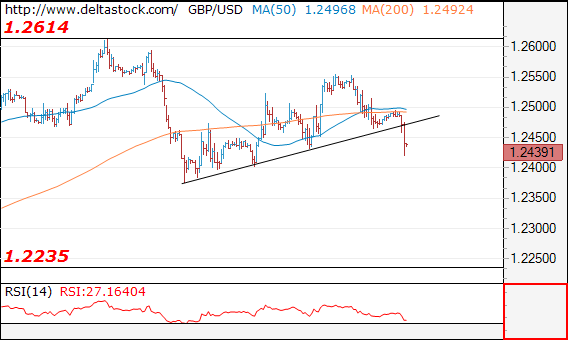
Current level - 1.2439
The break through the dynamic support at 1.2465 signals a bearish outlook, for a slide towards 1.2375, en route to 1.2230 area.
| Resistance | Support | ||
| intraday | intraweek | intraday | intraweek |
| 1.2465 | 1.2620 | 1.2375 | 1.2230 |
| 1.2555 | 1.2705 | 1.2235 | 1.2107 |
EURUSD: Risks Lie To The Downside
'The recent good signals coming from the euro-area economy shouldn't hide the fact that it remains an incomplete -- and therefore dysfunctional -- monetary union.' – Maxime Sbaihi (Based on Bloomberg)
Pair's Outlook
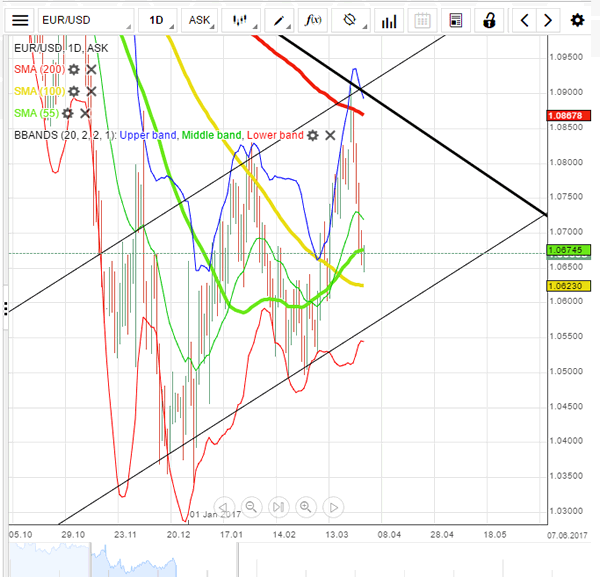
The daily chart displays that the pair has showed almost no movement whatsoever, shifting from a green to a red doji candle. It appears that EUR/USD has now initiated a downward motion as the redness of the small candle has become more consistent, meaning that 1.0639, representing the 23.6% Fibo retracement of the May-January downfall, might be the ultimate target for today. The scenario is in line with the strong resistance cluster above at 1.0673/85 which the rate has not been able to overstep, leading with the 55-day SMA.
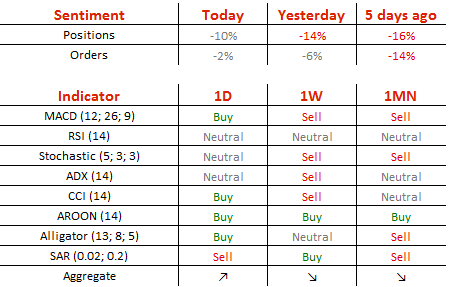
Traders' Sentiment
SWFX traders remain bearish on the pair, as 55% of open positions are short on Tuesday. Similarly 51% of trader set up orders are to sell the Euro.
GBPUSD: Rebound Anticipated
'The dollar got some support last week from month-end buying and came off its lows, but overall its heaviness remains unchanged.' – Daiwa Securities (based on Reuters)
Pair's Outlook
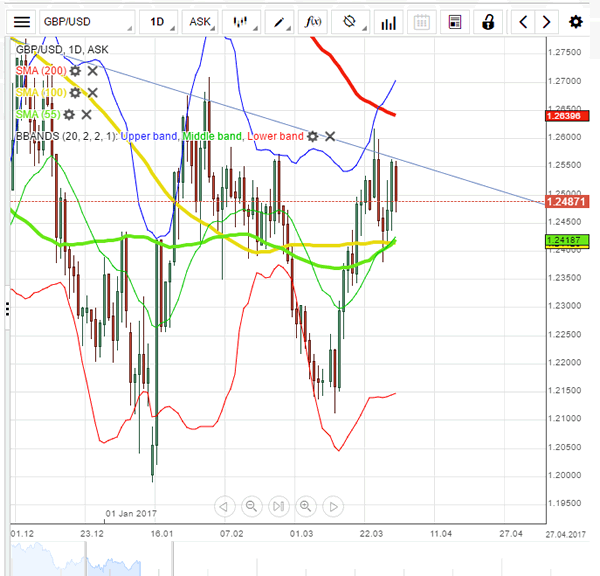
The British currency's performance yesterday fell in line with expectations, being that the Pound reconfirmed the down-trend and closed trade between 1.2490 and 1.2480. Another bearish development today is expected, this time with the tough demand cluster around 1.2420 limiting the losses. However, daily technical indicators keep suggesting the Cable is to edge higher, but another retest of the bearish trend-line is anticipated not earlier than on Wednesday, when the upcoming ADP data could weaken the US Dollar in order for the Sterling to climb back above 1.25. Tuesday's trade is expected to remain in the red zone.
Traders' Sentiment
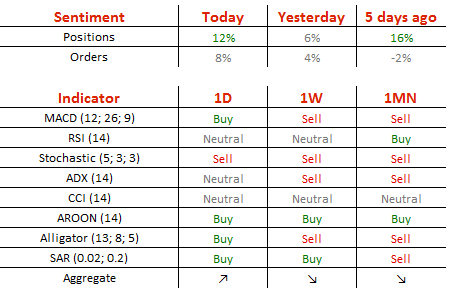
There are 56% of traders holding long positions today (previously 53%), whereas 54% of all pending orders are to purchase the Sterling.
USDJPY Keeps Sliding Down
'Before resuming its uptrend in the medium term, we think USD/JPY will likely be capped in the near term.' – Deutsche Bank (based on FXStreet)
Pair's Outlook
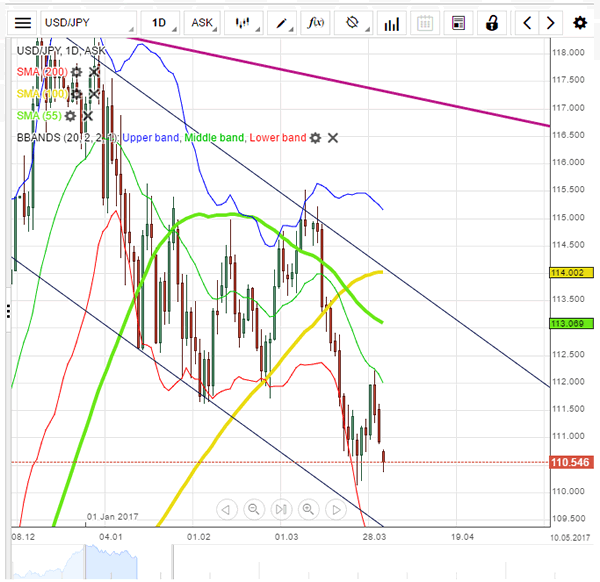
Monday ended with the US Dollar edging lower against the Japanese Yen, paving its way towards the descending channel's lower border, rather than the upper. Technical studies keep giving bearish signals, implying the Buck is to keep weakening. The weekly S1 is the nearest support, but in case bears continue pushing the pair lower, a drop beyond this area is likely. Nevertheless, a tough support cluster rests circa 109.30, which is also reinforced by the channel's support line, thus, that is where the Greenback should definitely rebound, given that no other factor sparks more USD-selling.
Traders' Sentiment
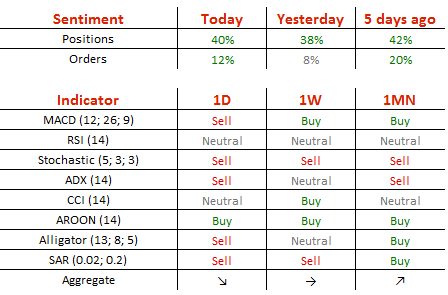
Market sentiment remains bullish, as 70% of traders hold long positions today, compared to 69% yesterday. At the same time, the share of buy orders added two percentage points, having risen up to 56%.