

Sample Category Title
British Pound Buoyed By Solid Services PMI, ADP And FOMC Minutes In Focus
Sterling received a lifeline on Wednesday following March's solid Service PMI figure of 55.00 which boosted some confidence towards the health of the British economy. UK services activity in March has logged its strongest increase this year and such may mitigate the Brexit jitters as concerns momentarily ease over a slowdown in economic momentum. While the sharp jump in UK services is undeniably impressive given the Brexit uncertainty, some fears may linger over the decline seen in manufacturing and construction PMI this week. Although economic data from the UK continues to display post-Brexit resilience occasionally, the possibility of growth decelerating in the first quarter of 2017 may weigh heavily on sentiment. Despite today's upsurge in prices, Sterling could still be destined to sink lower as the Brexit fueled uncertainties haunt attraction towards the currency.
Speaking of uncertainty, the battle of words between politicians on the Brexit topic has started with a bang as debates take place in Strasbourg. With the European Union setting out its “red lines” for the Brexit negotiations and emphasizing how the divorce terms must be agreed before striking any new trade deals, a rocky road may lie ahead. The worrying fact that the EU continues to demand a £50 billion Brexit divorce bill before any proper talks are in place may heighten concerns over the bloc playing hardball in the negotiation. With Manfred Weber who is a member of the European Parliament already demanding that Britain must give up the right to clear euros once it leaves the European Union adding to the messy mix, Sterling bears remain in close proximity to attack.
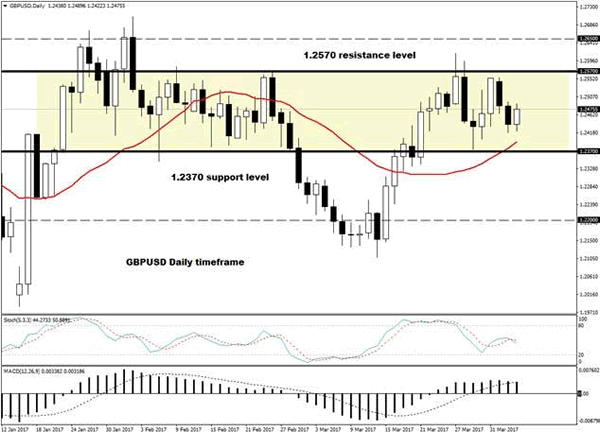
Focusing on the foreign exchange outlook, Sterling/Dollar trades within a sticky range with 1.2370 acting as a support and a resistance at1.2570. Although Dollar weakness has the ability to elevate prices higher, the uncertainty and tepid buying sentiment towards Sterling could inspire sellers to attack prices lower in the medium to longer term. On the daily charts, bears must conquer the 1.2370 support level for a further decline towards 1.2200.
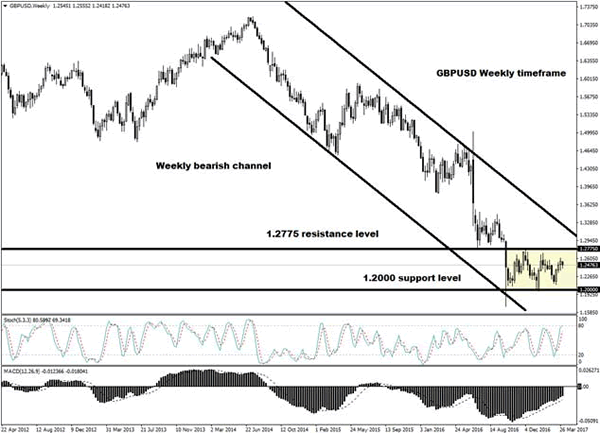
In an alternative scenario, a breakout above 1.2570 may signal a defeat to the bears in the short term with the next target at 1.2650. Investors should keep in mind that the Brexit developments and concerns of a hard Brexit may ensure Sterling remains depressed for prolonged periods. Based on this hypothesis, when zooming out onto the weekly timeframe, the long-term bears remain in control below the major 1.2775 resistance level.
ADP and FOMC minutes in focus
The Greenback was on standby on Wednesday with the Dollar Index hovering around 100.50 ahead of the ADP report and FOMC minutes this evening. It is becoming quite clear that Dollar bullish investors are in need of inspiration to elevate the Greenback higher with the pending ADP report acting as a catalyst. A positive ADP that exceeds expectations and heightens speculation of further rate hikes this year could pump some life back into the Dollar.
Investors will be paying very close attention to the Fed minutes this evening which could offer some insights on how the Federal Reserve's plan to unwind its $4.5 trillion balance sheet. Although the “dovish hike” in March exposed the Dollar to downside shocks, any signs of hawks in the pending minutes could offer the Greenback a boost.
Technical Outlook: FTSE 100 – Daily Cloud Top Needs To Contain Dips To Maintain Bullish Signals From Diamond Bottom...
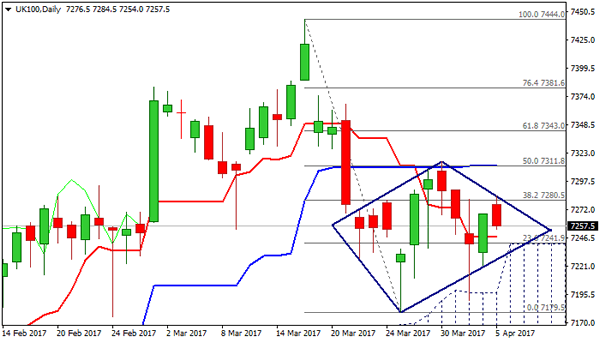
FTSE eased on fresh strength of pound on Wednesday, pulling back from cracked 7280 barrier (Fibo 38.2% of 7444/7179 correction).
Mixed technical studies are lacking clear direction signal for now, however, near-term action off 7179 (27 Mar low) remains supported by rising daily cloud that keeps alive hopes of fresh upside attempts.
Such scenario requires daily Tenkan-sen (7247) and daily cloud top (7241) to hold current easing, as near-term action has formed Diamond bottom pattern which is seen as reversal signal.
Recovery attempts then need to clear initial barrier at 7280 to trigger fresh upside, with break above daily Kijun-sen (7311) that previously capped recovery, needed to confirm reversal.
Conversely, violation of daily cloud top and diamond’s lower boundary (bull-trendline) would generate negative signal and risk further weakness
Res: 7280, 7311, 7343, 7367
Sup: 7247, 7241, 7222, 7190
EURUSD – Halts Weakness, Eyes Recovery Higher
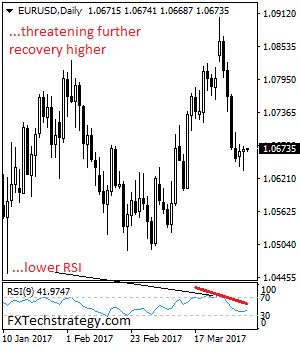
EURUSD - With the pair closing marginally higher on Tuesday, more strength is expected as long as it trades above the 1.0635 level. Resistance comes in at 1.0700 level with a cut through here opening the door for more upside towards the 1.0750 level. Further up, resistance lies at the 1.0800 level where a break will expose the 1.0850 level. Conversely, support lies at the 1.0600 level where a violation will aim at the 1.0550 level. A break of here will aim at the 1.0500 level. All in all, EURUSD faces more bear threats.
French Presidential Debate Brings Forth Slings and Arrows
- US manufacturing slowing
- British Retail Consortium (BRC) Shop Price Index slips
- French Presidential debate brings forth slings and arrows
The latest French Presidential debate delivered fireworks between front-runner Emmanuel Macron and his main rival, Marine Le Pen. Macron was scathing of Le Pen's nationalist agenda, while Le Pen accused Macron of "speaking like old fossils." It is generally considered that Macron performed better than Le Pen and remains ahead in the polls. The EU will be watching with keen interest as Le Pen is still staunchly anti-Euro and anti-EU. The Euro was unmoved by the events, but this morning's EU Service Sector Purchasing Managers' Index (PMI) has the capacity to shift the Euro.
The US Dollar was similarly unmoved by data showing a slowdown in the US manufacturing sector, to its slowest level of growth for six months. The data was still in positive territory, but the US economy is certainly not romping away at the moment. This afternoon's Service Sector Index is expected to be stronger than March's and that will boost the USD - if the forecasts are right - but the minutes from the Federal Reserve meeting being released later in the day will be more influential. When US interest rates will next rise, how many rises will come after it; and how much will the US base rate rise over the next year? This is all the markets really want to know. They won't get all their answers today, but hints will be enough to shift the USD. Dollar buyers may wish to move ahead of that release.
Sterling should probably have fallen this morning after the BRC's Shop Price Index fell by 0.8% after a 0.1% fall in February 2017, but the Service Sector PMI Index is likely to be a little more upbeat; and that will stabilise the Pound.
Other than these snippets, the day is a quiet one... a sunny one in London... and probably a thinly traded one ahead of the US data and Federal Reserve minutes.
Have a terrific Wednesday.
Blind flight crew
The passengers have all been seated on a commercial airliner when the pilot and co-pilot finally appear in the rear of the plane and begin walking up to the cockpit through the centre aisle. Both have dark glasses on; the pilot is using a white cane, bumping into passengers right and left as he stumbles down the aisle. The co-pilot is using a guide dog. At first, the passengers do not react, thinking that it must be some sort of practical joke. After a few minutes, though, the engines start revving, and the plane is shifted into the taxi area before starting to move down the runway. The passengers look at each other with some uneasiness. They start whispering among themselves and look desperately to the stewardesses for reassurance. The plane continues to accelerate and people begin panicking. Some passengers are praying and, as the plane gets closer and closer to the end of the runway, the voices are becoming more and more hysterical with screams and loud prayers being offered up to a number of different deities. When the plane has fewer than 50 yards of runway left, there is a noticeable change in the pitch of the shouts as everyone screams at once. At that very moment, the plane rotates on its axis, lifts off and is airborne. Up in the cockpit, the co-pilot breathes a sigh of relief and turns to the pilot: "You know, one of these days the passengers aren't going to scream, and we won't know when to lift the nose. "
DAX Steady On Higher German, Eurozone Services PMI
The DAX Index has edged lower on Wednesday, after an uneventful Tuesday session. Currently, the DAX is trading at 12,242.25. On the release front, services reports are in focus. German Final Services PMI improved to 55.6, matching the forecast. Eurozone Final Services PMI climbed to 56.5, short of the forecast of 56.0 points. In the US, the Federal Reserve releases its minutes from the March policy meeting. On Thursday, Germany releases Factory Orders, and ECB President Mario Draghi speaks at a conference in Frankfurt.
Eurozone indicators continue to point upwards, indicative of an improving eurozone economy. In March, German and Eurozone Services PMIs pointed to expansion. The German release hit a 15-month high, while the Eurozone indicator jumped to a 71-month high, although it missed expectations. The euro shrugged off these strong numbers, as it continues to have an uneventful week. EUR/USD dropped 1.9 percent last week, marking its worst weekly decline since November 2016. Soft inflation numbers late in the week disappointed the markets and soured sentiment on the continental currency. German Preliminary CPI posted a weak gain of 0.2%, short of the forecast of 0.4%. This was followed by Eurozone Flash CPI Estimate, which slipped to 1.5%, missing the forecast of 1.8%. Although inflation levels have improved to their highest levels in years, they remain below the ECB target of 2.0%, so the central bank still has some breathing room and isn’t under immediate pressure to tighten monetary policy. The ECB’s asset purchase program of EUR 60 billion/mth is scheduled to expire in December.
What’s next for the Federal Reserve? With the US economy continuing to perform well, the discussions around the monetary policy tables are not whether the Fed will raise rates, but how many hikes we will see in 2017. The markets will be paying close attention to the minutes of the March meeting, when the Fed raised rates by a quarter-point, to a range of 0.75%-1.00%. Any hints about the timing of the next hike, as well as the tone of the minutes are factors which could move the currency markets on Wednesday. The markets considered the rate statement overly cautious, and this sentiment sent the US dollar broadly lower in March. If the reaction to the minutes is one of disappointment, the dollar could again experience broad losses.
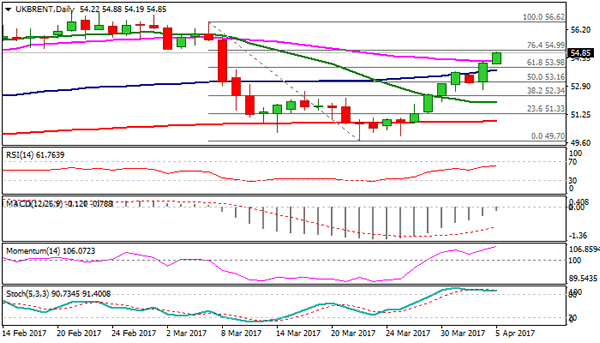
Technical Outlook: BRENT Pressures $54.99 Barrier On Extension Of Strong Bullish Acceleration
Brent oil extends strong bullish acceleration from Tuesday (the biggest one-day gains since 20 Jan), gaining slightly over 1% in early Wednesday's trading.
Tuesday's strong rally closed well above $53.98 (Fibo 61.8% of larger $56.62/$49.70 fall), generating strong bullish signal that resulted in fresh bullish extension that is approaching next barrier at $54.99 (Fibo 76.4% retracement).
Daily technical studies are now in full bullish setup and supportive for further upside action. Break above $54.99 would open way towards key short-term barrier at $56.62 (07 Mar high).
Minor resistance en-route is thin daily cloud that twists next week and would also support bulls.
Broken 55SMA offers immediate support at $54.37, followed by session low at $54.19 and strong supports at $53.98/87 (broken Fibo 61.8% / broken 100SMA) which should contain extended dips, as strongly overbought daily chart slow stochastic suggests a pause in strong rally, but no firmer bearish signal being generated so far.
Res: 54.99, 55.75, 56.06, 56.62
Sup: 54.37, 53.98, 53.87, 53.37
Market Update – European Session: South Africa President Zuma Survives Ruling Party Meeting; UK Services PMI Beats Expectations
Notes/Observations
FOMC Minutes in Focus; looking for indications on how much the Fed has discussed balance sheet reduction
Major European PMI Services numbers remain in expansion but most succumbing to a slower pace; France and Euro Zone revised lower in their final readings; UK handily beats
Overnight:
Asia:
North Korea launches missile into waters off Korean peninsula's east coast (towards Japan) ahead of China-US leader meeting
PBoC skipped open market operations for 8th straight session; drained CNY90B
Europe:
Eurogroup Chief Dijsselbloem: Good progress being made in talks with Greece
Elabe Presidential survey, Melenchon seen as most convincing candidate in Tuesday's election debate, Macron second
Americas:
Richmond Fed President Lacker resigned effective Apr 4th over improper disclosure of confidential FOMC information, earlier than planned
Energy:
Weekly API Oil Inventories: Crude: -1.8M v +1.9M prior; first draw in 3 weeks
Economic Data
(IE) Ireland Mar Services PMI: 56.9 v 60.6 prior (56th month of expansion), Composite PMI: 59.1 v 57.8 prior
(RU) Russia Mar PMI Services: 56.6 v 55.0e (14th month of expansion), PMI Composite: 56.3 v 55.4 prior
(SE) Sweden Mar PMI Services: 61.3 v 59.5e
(ZA) South Africa Mar PMI (Whole Economy): 50.7 v 50.5 prior
(ES) Spain Mar Services PMI: 57.4 v 57.4e (41st month of expansion), Composite PMI: 56.8 v 57.0e
(SE) Sweden Feb Industrial Production M/M: 0.2% v 0.1%e; Y/Y: 4.1% v 1.8%e
(IT) Italy Mar Services PMI: 52.9 v 54.3e (10th month of expansion), Composite PMI: 54.2 v 54.9e
(FR) France Mar Final Services PMI: 57.5 v 58.5e (9th month of expansion and highest since May 2011), Composite PMI: 56.8 v 57.6e
(DE) Germany Mar Final Services PMI: 55.6 v 55.6e (confirms 45th month of expansion and highest reading since Dec. 2015), Composite PMI: 57.1 v 57.0e
(EU) Euro Zone Mar Final Services PMI: 56.0 v 56.2e (confirms 45th month of expansion); Composite PMI: 56.4 v 56.7e
(UK) Mar Services PMI: 55.0 v 53.4e (8th month of expansion), Composite PMI: 54.9 v 53.8e v 53.8 prior
Fixed Income Issuance:
(DK) Denmark sold total DKK2.02B in 2021 and 2027 Bonds
(IN) India sold total INR140B vs. INR140B indicated in 3-month and 6-month Bills
(SE) Sweden sold SEK2.5B vs. SEK2.5B indicated in 0.75% 2028 bonds; Avg Yield: 0.8090% v 0.9444% prior; Bid-to-cover: 2.58x v 1.86x prior
SPEAKERS/FIXED INCOME/FX/COMMODITIES/ERRATUM
Index snapshot (as of 10:00 GMT)
Indices [Stoxx50 flat at 3,479, FTSE +0.2% at 7,335, DAX -0.3% at 12,245, CAC-40 flat at 5,102, IBEX-35 +0.4% at 10,401, FTSE MIB +0.1% at 20,276, SMI -0.1% at 8,640, S&P 500 Futures -0.1%]
Market Focal Points/Key Themes: European equity indices are trading mixed despite an overall positive end to the Asian session overnight; Dax underperforming weighed by shares of car manufacturers Volkswagen, Daimler and BMW; energy stocks across Europe trading notably higher as oil trades sharply higher intraday; homebuilder stocks trading notably lower in the FTSE 100; banking stocks trading mostly higher providing some support across some of the major indices.
Upcoming scheduled US earnings (pre-market) include Greenbrier Companies, Monsanto, and Walgreens Boots Alliance.
Equities (as of 09:50 GMT)
Consumer Discretionary: [Bovis Homes BVS.UK +2.1% (operational update, new CEO, Galliford Try confirms no longer interested in combination), DCC Plc DCC.UK +1.7% (to acquire Shell's LPG business, CEO transition), Galliford Try GFRD.UK +0.6% (confirms no longer interested in Bovis combination), Hollywood Bowl Group BOWL.UK +2.9% (H1 sales)]
Energy: [Premier Oil PMO.UK +4.1% (sales of Pakistan business for $65.6M)]
Industrials: [John Wood Group WG.UK +3.3% (Increased cost synergies as a result of offer for Amec Foster Wheeler), Obrascon Huarte Lain OHL.ES +1.4% (FY17 and FY18 outlook), Telford Homes TEF.UK +2.5% (trading update)]
Speakers
South Africa President Zuma retained support of ANC following key meeting (Zuma survived calls to resign as President)
ECB's Likanen (Finland): Reiterates General Council view that interest rates would remain low beyond end of asset purchases. Improvements not seen big enough to fundamentally change guidance, strong monetary support was still required
European Parliament members debated on a resolution setting out its position in the negotiations
EU's Weber: EU was ready for negotiations; must prepare for hard stance
EU's Verhofstadt: EU-UK relationship had never been easy
EU's Barnier: No deal scenario was NOT the one the EU was looking for
German Economy Ministry report on ECB monetary policy: Zero interest rates damaged the financial system
Italy Stats Agency (ISTAT) Monthly Economic Note: Q2 GDP growth seen slower but likely to continue at same pace going forward
Russia Central Bank (CBR) Gov Nabiullina: Regardless of oil price, GDP growth to stabilize around 1.5-2.0% without structural reformseasy
Russia Econ Min Oreshkin: Domestic economy is actively growing
Currencies
FX markets retained a cautious tone after North Korea fired a ballistic missile into the sea ahead of a summit between US and Chinese leaders. The USD/JPY was little changed at 110.65 area despite the traditional safe-haven status of the Japanese currency under such siotuations.
The GBP/USD found some traction after UK Mar PMI Services beat expectations. Pair higher by 0.3% just ahead of the NY morning as it approached the 1.25 handle. The FX market was watching the European Parliament members debate its position in the Brexit negotiations
The USD/ZAR pair was higher after reports that South African President Jacob Zuma again survived calls to resign by members of the ruling African National Congress
Fixed Income:
Bund futures trade at 162.38 down 15 ticks reversing earlier gains after mixed European PMI data. Support moves to 162.07 initially followed by 161.52 then 161.02. A move back higher targets 162.72 followed by 162.98 then Feb contract high at 163.12.
Gilt futures trade at 128.06 down 31 ticks pressured by stronger UK Services PMI data which came ahead of consensus and marked an 8th month of expansion. Support remains at 127.75 then 127.34 followed by 127.05. Resistance remains at 128.96 followed by 129.24. Short Sterling futures have steepened following the stronger data with Jun17Jun18 coming of day lows to trade at 13.5/14bp
Wednesday's liquidity report showed Tuesday's excess liquidity rose sharply to €1.575T a rise of €131B from €1.444T prior. Use of the marginal lending facility fell to €114M from €212M prior.
Corporate issuance saw $8.4B come to market via 5 issuers headlined by European Banking name Banco Santander 3 part $2.5B offering and ABN Amro 2 part $1.25B offering alongside Cenovus Energy $2.9B 3 part offering. This puts weekly issuance at $11.2B.
Looking Ahead
(RO) Romania Central Bank (NBR) Interest Rate Decision: Expected to leave Interest Rates unchanged at 1.75%
05:30 (ZA) South Africa Mar Sacci Business Confidence: No est v 95.5 prior
05:30 (DE) Germany to sell €4.0B in 0% Apr 2022 BOBL
06:00 (PL) Poland Central Bank (NBP) Interest Rate Decision: Expected to leave Base Rate unchanged at 1.50%
06:00 (IE) Ireland Feb Industrial Production M/M: No est v 3.4% prior; Y/Y: No est v -9.4% prior
07:00 (US) MBA Mortgage Applications w/e Mar 31st: No est v -0.8% prior
07:00 (RU) Russia to sell combined RUB43B in OFZ bonds
07:30 (CL) Chile Feb Economic Activity Index (Monthly GDP) M/M: -1.0%e v +0.4% prior; Y/Y: -1.4%e v +1.4% prior (revised from 1.7%)
08:00 (BR) Brazil Mar PMI Services: No est v 46.4 prior; PMI Composite: No est v 46.6 prior
08:00 (UK) EU Commissioner Oettinger (Germany) speaks on Brexit
08:00 (RO) Romania Central Bank Gov Isarescu post rate decision press conference
08:15 (US) Mar ADP Employment Change: +185Ke v +298K prior
08:15 (UK) Baltic Dry Bulk Index
08:30 (UK) BOE Vlieghe speaks in London
09:00 (MX) Mexico Mar Consumer Confidence: 79.0e v 75.7 prior
09:00 (MX) Mexico Jan Gross Fixed Investment: 0.8%e v 0.9% prior
09:45 (US) Mar Final Markit Services PMI: 53.1e v 52.9 prelim, Composite PMI: No est v 53.2 prelim
10:00 (US) Mar ISM Non-Manufacturing Composite: 57.0e v 57.6 prior
10:00 (PL) Poland Central Bank Gov Glapinski post rate decision press conference
10:30 (US) Weekly DOE Crude Oil Inventories
13:00 (EU) Germany Fin Min Schaeuble speaks on EU crisis as an opportunity
14:00 (US) FOMC Minutes from Mar 15th Meeting
15:00 (MX) Mexico Citibanamex Survey of Economists
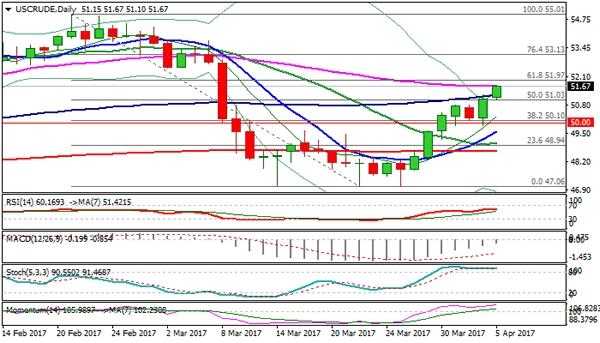
Technical Outlook: US OIL – Strong Bullish Sentiment On Supply Tightening Drives Oil Price To Nearly One–Month High
US oil is maintaining strong bullish sentiment and extends gains on Wednesday. Strong rally of the previous day started after brief probe below psychological $50.00 support proved to be short-lived and stronger bullish acceleration was triggered by stronger than expected draw in US crude stocks.
American Petroleum Institute data, released on Tuesday, showed surprise fall of 1.8 million barrels in crude stocks vs forecasted draw of 0.5 million barrels and 1.9 million barrels build previous week.
Initial signs of gradual tightening in global /rates-charts/dbwti/trading-positions inventories and concerns about a supply outage from North Sea oil fields, gave strong boost to the oil prices.
Resumption of broader recovery rally from $47.06 base on Tuesday’s 1.7% gains and close above $51.00 handle, was seen as strong bullish signal for today’s fresh extension higher.
WTI contract for May delivery hit the highest level in nearly one month and pressuring next barrier at $51.68 (55SMA), break of which would open next pivot at $51.97 (Fibo 61.8% of $55.01/$47.06 descend).
However, strongly overbought slow stochastic on daily chart warns of possible hesitation ahead of key barriers, but no firmer bearish signal being generated so far.
Broken 100SMA marks initial support at $51.29, ahead of session low at $51.10 and broken daily Kijun-sen at $50.73, which should contain extended dips.
Res: 51.68, 51.97, 52.53, 52.90
Sup: 51.29, 51.10, 50.73, 50.10
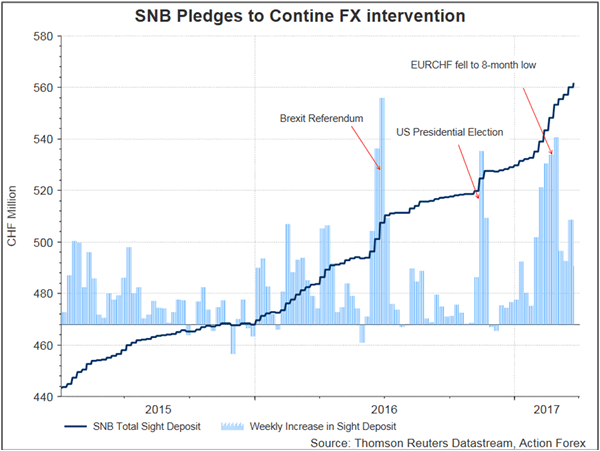
SNB Continues Intervention, But With Greater Tolerance Over Swiss Franc’s Strength
EURCHF recovered after declining over the past three weeks. Political uncertainty and diminished expectations of ECB's QE tapering has pressured the single currency and raised demand for safe-haven assets. Despite the selloff to as low as 1.0629 in February, EURCHF had then rebounded to a 3-month high of 1.0825 in mid-March, before settling at 1.068 at end-1Q17. This came in line with over forecast of 1.07 for the first quarter. Movement of USDCHF was, however, more volatile than we had anticipated. The currency pair indeed broke below 1, plunging to a 4.5-month low of 0.9812 on March 27 before returning to parity on March 31.
We attribute the sharper-than-expected weakness in US dollar over the past quarter to the inability of US President Donald Trump's administration. Indeed, the market has turned less optimistic over the president's pro-growth policy, after the withdrawal of the healthcare bill. However, the price movements in the first quarter do not alter our view that SNB has turned more tolerable to franc's appreciation, although FX intervention would continue should euro's selloff accelerate.
SNB new exchange rate index
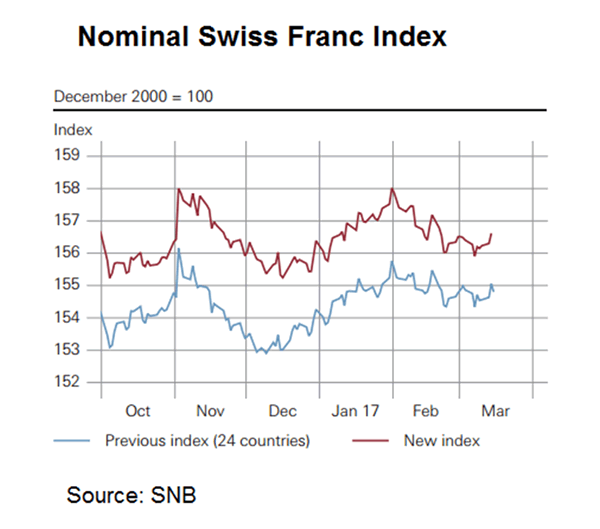
SNB unveiled in its latest quarterly bulletin a new method to calculate Swiss franc's exchange rate index. The central bank indicated that the new method "allows the Swiss economy's competitive and trading relationships to be replicated in a more comprehensive and up-to-date way". It laid down three key differences between the new and old methods.
- First, the weighting of a specific country in the new method is based both on exports to and imports from this country as well as on so-called third-market effects. As such, the new method gives greater consideration to competitive relationships between Switzerland and its trading partners than the previous one.
- Second, the calculation of the country weightings includes global trade in both goods and services, compared with only goods in the old one.
- Finally, the new index is chained, in contrast to the fixed base period of the previous index. SNB suggested that this allows the group of countries taken into consideration in the index to be reviewed every year.
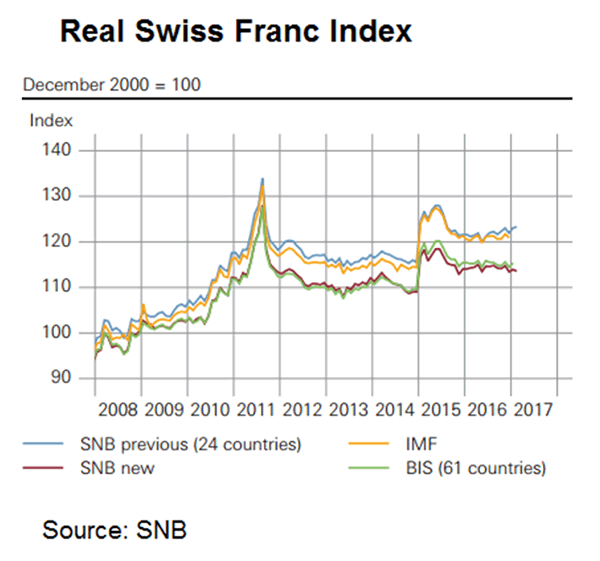
With the December 2000 reading set at 100, the nominal effective exchange rate index using the new method was 156.5 in early March, compared with 155 under the old method. Meanwhile the real exchange rate index was revised to around 114, compared with the previous reading around 120.
The real index at December 2000 was set at zero. According to SNB, the new indices continue to show that the Swiss franc is "significantly overvalued". In our opinion, the downward revision of the real index signals that the degree of overvaluation is less extreme, offering SNB more rooms to avoid aggressive intervention.
SNB bought CHF 67.1b of foreign currencies in 2016
Indeed, SNB was more constrained in FX intervention last year, when compared with the prior year. The latest statistics show that the central bank bought CHF 67.1B worth of foreign currencies in 2016, compared with CHF 86.1B in 2015 when it intervened aggressively soon after removing the EURCHF floor of 1.2.
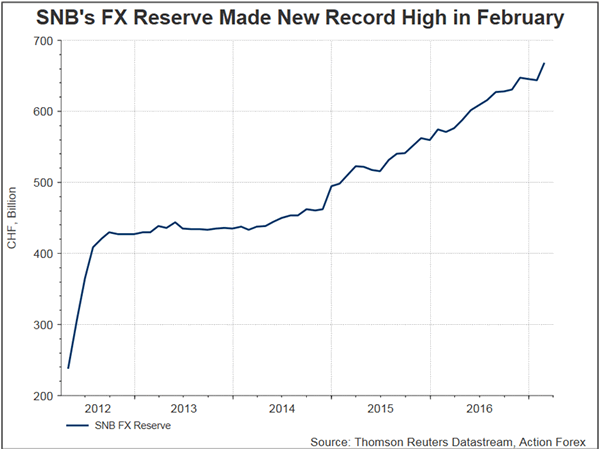
According to SNB, FX intervention "occurred mainly at times of heightened uncertainty, when the Swiss franc was particularly sought after as a safe investment". The March FX reserve data, due Friday, is closely watched. The market currently expects a widening of +CHF 5.8B to CHF 674B for the month.
Euro Subdued As German, Eurozone Service PMIs Improve
EUR/USD is unchanged in the Wednesday session, as the euro continues to have a quiet week. Currently, the pair is trading at 1.0680. On the release front, services reports are in focus. German Final Services PMI improved to 55.6, matching the forecast. Eurozone Final Services PMI climbed to 56.5, short of the forecast of 56.0 points. The US will release ADP Nonfarm Payrolls as well as the ISM Non-Manufacturing PMI. As well, the Federal Reserve releases its minutes from the March policy meeting.
Eurozone indicators continue to point upwards, and German and Eurozone Services PMIs pointed to expansion in March. The German release hit a 15-month high, while the Eurozone indicator jumped to a 71-month high, although it missed expectations. The euro shrugged off these strong numbers, as it continues to have an uneventful week. EUR/USD dropped 1.9 percent last week, marking its worst weekly decline since November 2016. Soft inflation numbers late in the week disappointed the markets and soured sentiment on the continental currency. German Preliminary CPI posted a weak gain of 0.2%, short of the forecast of 0.4%. This was followed by Eurozone Flash CPI Estimate, which slipped to 1.5%, missing the forecast of 1.8%. Although inflation levels have improved to their highest levels in years, they remain below the ECB target of 2.0%, so the central bank still has some breathing room and isn’t under immediate pressure to tighten monetary policy. The ECB’s asset purchase program of EUR 60 billion/mth is scheduled to expire in December.
What’s next for the Federal Reserve? With the US economy continuing to perform well, the discussions around the monetary policy tables are not whether the Fed will raise rates, but how many hikes we will see in 2017. The markets will be paying close attention to the minutes of the March meeting, when the Fed raised rates by a quarter-point, to a range of 0.75%-1.00%. Any hints about the timing of the next hike, as well as the tone of the minutes are factors which could move the currency markets on Wednesday. The markets considered the rate statement overly cautious, and this sentiment sent the US dollar broadly lower in March. If the reaction to the minutes is one of disappointment, the dollar could again experience broad losses.