Sample Category Title
Solid Gain in February Personal Income, But Inflation Rising
Unseasonably warm weather in February held down spending in February, but income gains suggest the weakness should be temporary. Inflation continues to firm and has returned to the Fed's target.
Income Solid, While Spending Held Down by Utilities
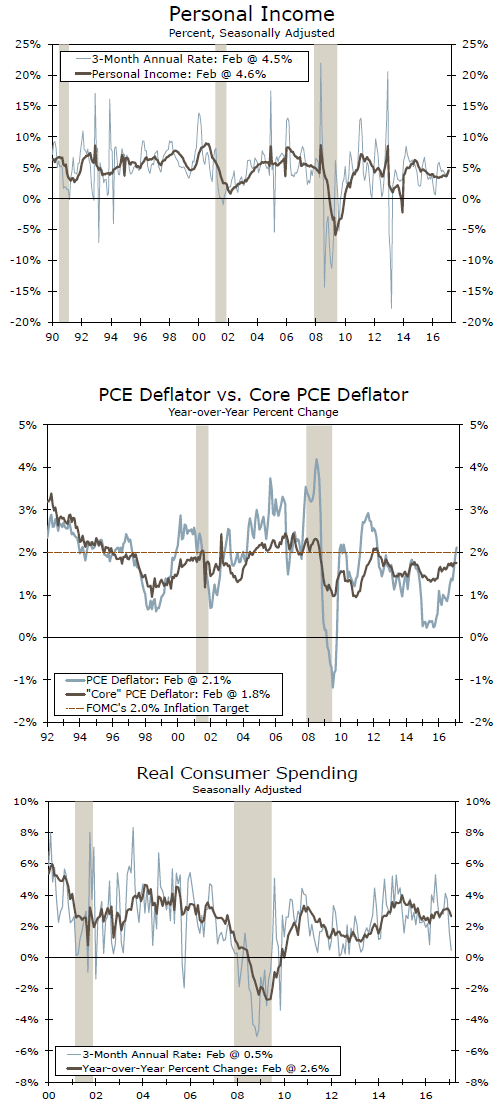
As expected, income among U.S. households posted another solid gain in February. Personal income rose 0.4 percent, while income growth for January was revised up a tick to 0.5 percent. With strong payroll gains and an uptick in average hourly earnings last month, income from wages & salaries rose a touch ahead of the headline in February.
Spending, on the other hand, came in a bit below expectations, increasing just 0.1 percent. Weakness in utilities consumption once again depressed the headline; this year was the second warmest February in the contiguous U.S. since records began back in 1895. In addition, a near 3 percent drop in gasoline & energy prices depressed nominal consumption on energy goods over the month. The upshot of the weakness in spending is that the saving rate rose to a four-month high of 5.6 percent.
At Last, Inflation Reaches the Fed's Target
Inflation showed further signs of firming in February. Headline inflation is now above the Fed's 2.0 percent target for the first time since 2012. The PCE deflator ticked up just 0.1 percent on a drop back in energy prices over the month, but the year-over-year rate rose to 2.1 percent as energy prices have rebounded more than 30 percent over the past year.
Core inflation posted another solid monthly gain, up 0.2 percent. Revisions to previous months' data pushed the year-ago rate up to 1.8 percent, while over the past three months core inflation is rising within a hair of the Fed's target at 1.9 percent. Although still below the Fed's goal, the upward momentum should be enough for the Fed to hike again in June.
While inflation is now back to levels more palatable to the Fed, the upturn has taken a bite out of real consumer spending. After adjusting for inflation, personal spending fell for a second straight month in February and has slowed to a 1.9 percent pace over the past three months.
Currently, it looks like real personal consumption is on track to expand around 2 percent in the first quarter. This would mark a slowdown from Q4 after yesterday's GDP revision showed consumer spending expanded at a 3.5 percent clip - noticeably stronger than the 3.0 percent pace previously estimated.
Spending Should Strengthen from Here
The soft spending numbers look at odds with the recent surge in consumer confidence measures. However, given the weather-related weakness in utilities spending as well as some delays in tax refunds for low- and middleincome earners in February, we expect real consumer spending to strengthen in the quarters ahead. In addition to the elevated readings of consumer confidence, hiring remains solid while average hourly earnings are picking up, which will support income and spending.
RBA Policy Meeting, US Jobs Report, FOMC Minutes, Other Key Data in Focus
Next week's market movers
- In Australia, we expect the RBA to remain on hold and maintain its neutral bias. However, we see the risks as skewed towards a more dovish narrative.
- In the US, the employment report for March could prove critical to market expectations regarding the timing of the next Fed hike. The minutes from the latest FOMC meeting will also be in focus.
- In Japan, we expect the Tankan survey for Q1 to reveal rising business optimism.
- We also get key economic data from the UK, the US, and Canada.
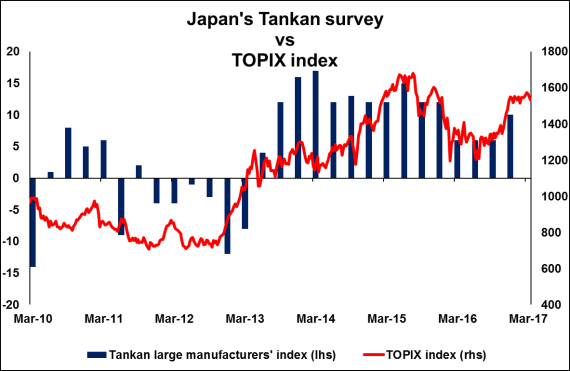
On Monday, during the Asian morning, the Bank of Japan will release its Tankan business confidence survey for Q1. This is perhaps the most important indicator that comes out from Japan and thus, it will be closely watched. No forecast is available, but bearing in mind that the Reuters Tankan Diffusion Index rose notably in all three months of the quarter, we expect the official indices to move in a similar fashion. This could signal that Japanese firms are feeling more optimistic, something that we believe may be related to the notable depreciation of the yen following the US election late last year. We expect Japanese equity markets to benefit from such a strong report, as it may be a signal that GDP growth is set to pick up steam moving forward. Something like that could also generate some speculation that the BoJ may gradually begin thinking about a slight reduction in its massive stimulus program at its upcoming meetings. However, as long as Japan's headline and core inflation rates remain stuck near zero, we do not expect anything like that to happen, as the Bank would not want to undermine the effectiveness of its previous easing measures by triggering a tightening in financial conditions.
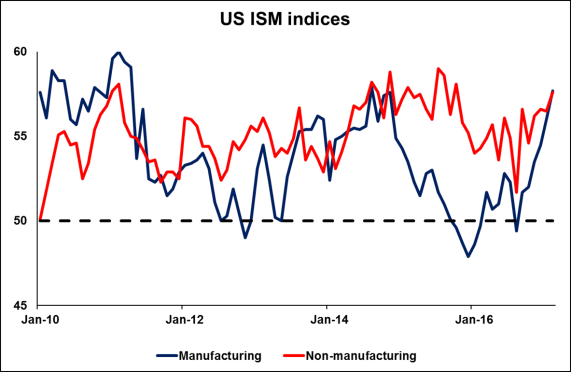
From the US, we get the ISM manufacturing PMI and thereafter on Wednesday, we get the non-manufacturing index, both for March. Both figures are forecast to decline somewhat, but to still remain well above the key 50 barrier that separates expansion from contraction. Despite the potential declines, given that these indices are expected to remain at very healthy levels, we doubt that they will have a material effect on market pricing regarding the timing of the next FOMC rate hike.
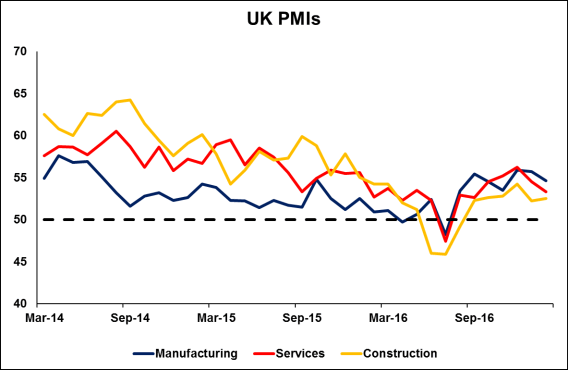
From the UK, we will get the manufacturing PMI for March. Then on Tuesday, we will get the construction index for the month and subsequently on Wednesday, the services figure. No forecast is available for any of these indices. The manufacturing and services indices declined somewhat in February, though they still remained safely above the critical 50 level. The most interesting part of these reports was related to inflation. The service-sector survey, which accounts for the vast majority of the UK economy, showed that prices charged rose at the fastest pace since 2008. It would be interesting to see whether this continued in March, as it could increase speculation for further acceleration in inflation. The latest commentary from BoE policymakers suggests that the Bank is in no hurry to raise rates, despite signs that inflationary pressures are picking up rapidly. As such, we do not expect the BoE to actually hike in coming months, at least not until the Brexit negotiating landscape becomes clearer. We do however believe that further acceleration in inflation could lead to some more hawkish dissents among the Committee, perhaps as early as at the summer meetings.
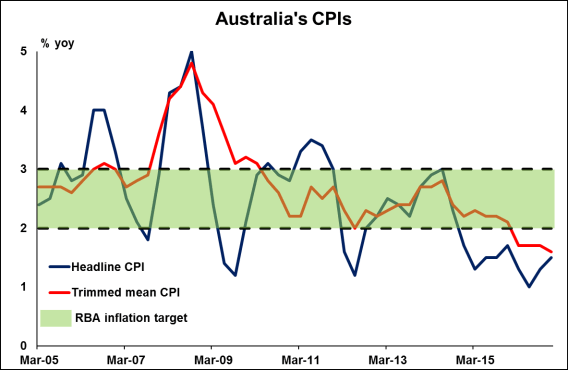
On Tuesday, during the Asian session, the Reserve Bank of Australia will announce its rate decision. The forecast is for the RBA to remain on hold once again, a view that we share considering the neutral tone the Bank has maintained in all of its recent communications. At the latest meeting, the RBA reiterated that underlying inflation is expected to stay low for some time, while in the minutes of that gathering, we saw that the Bank is also worried that the labor market may not be as strong as the headline employment figures indicate. Even though these signals were relatively dovish, they were balanced by a repetition that high housing prices continue to pose risks to financial stability and that any more rate cuts could amplify such risks further. Since that gathering, the only major piece of economic data we got was the unemployment rate for February, which rose. However, considering that employment indicators tend to be volatile on a monthly basis, we don't expect a single data point to alter the Bank's overall bias. Having said that, we think that the risks are tilted towards a more dovish narrative from the RBA. If employment indicators continue to deteriorate, the Bank could lean more towards actually cutting rates, and simultaneously introduce macro-prudential measures in the housing market to limit financial stability risks.
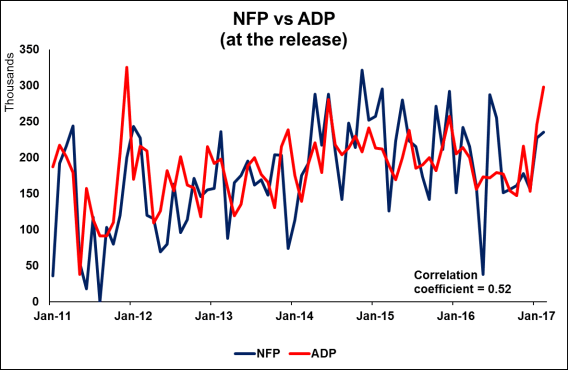
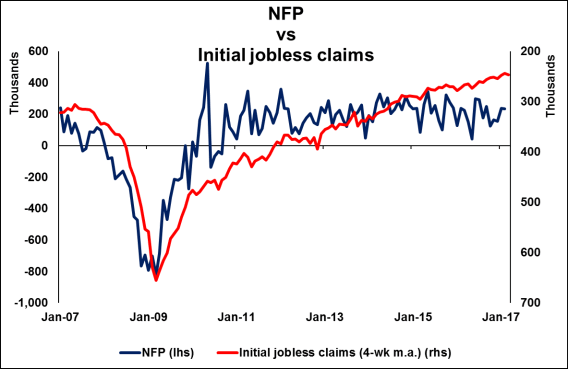
On Wednesday, we get the US ADP employment report for March. The private sector is expected to have added 194k jobs, less than the 298k in February, though still a strong number that is likely to raise speculation for the NFP figure to meet its forecast of 185k. We see the case for the ADP number to be higher than the NFP print as reasonable, considering that Trump's federal hiring freeze is very possible to have led to diminishing hiring in the public sector.
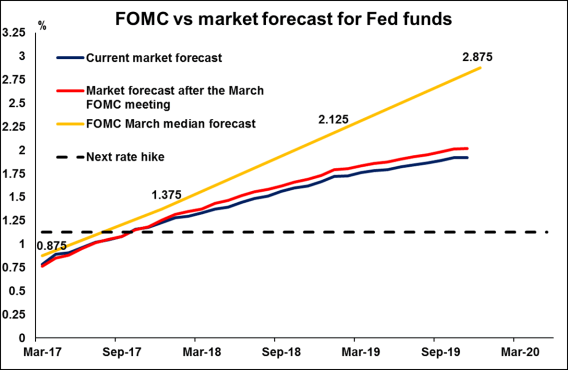
Later during the day, the Fed will release the minutes of the March FOMC meeting, where the Committee raised interest rates by 25bps, as was very widely expected. However, the signals we received were not as hawkish as one would have expected given how quick this hike was compared to the time elapsed between the first two of this hiking cycle. Firstly, Minneapolis Fed President Neel Kashkari added a dovish touch by dissenting the decision. What's more, even though the Fed upgraded its forecasts for the US economy, the "dot plot" was left largely unchanged, and Chair Yellen shifted to a much more cautious tone in her press conference compared to her latest appearances. The key message we got was that this hike does not reflect heightened optimism on the economic outlook, and does not imply that future rate hikes will be faster than previously anticipated. It would be interesting to see whether the tone of the minutes is equally cautious, as something like that could push somewhat back market expectations regarding the timing of the next rate hike. However, we believe that Friday's employment data will probably be a much bigger determinant of when investors will anticipate the Fed's next move (see below).
We also get the US ISM non-manufacturing PMI for March, as well as the UK services PMI for the same month, as we noted above.
On Thursday, we have a relatively light day, no major events or indicators due to be released.
On Friday, the US employment report for March will take center stage. The forecast is for nonfarm payrolls to have risen by 185k, less than the robust 235k in February, but still a solid number consistent with further tightening in the jobs market. The unemployment rate is forecast to have held steady at 4.7%, while average hourly earnings are expected to have risen at the same pace as previously in monthly terms. This would likely be one more set of data entering the basket of those supporting another near-term Fed rate hike. According to the Fed funds futures, the market is currently pricing in the next hike to come in September. So, a solid employment report could bring those expectations forward, perhaps to anticipate such action in summer months.
We also get employment data for March from Canada.
Weekly Focus: US Labour Market Report in Focus
Market movers ahead
- In the US, the key event of next week is Friday's labour market report. We forecast it will show a total of 160,000 new jobs, an unchanged unemployment rate of 4.7% and monthly wage growth of 0.2% m/m. The week also brings ISM manufacturing for March and a number of speeches by FOMC members.
- In the euro area, ECB minutes will be scrutinised by markets for clues on whether a rate hike before QE termination is on the cards. We do not think so. The week also brings the monthly labour markets report, retails sales and German factory orders.
- In the UK, PM Theresa May triggered Article 50 this week, meaning Brexit negotiations have officially started and we are likely to begin to get more headlines about what to expect of the negotiations in coming weeks and months. For more information on what happens next, see Brexit Monitor No. 27: Brexit negotiations set to start today - what now? 29 March. The week also brings PMIs and the NIESR GDP estimate.
- In China, focus is on Caixin manufacturing PMI on Monday. The official PMI manufacturing on Friday surprised a bit on the upside and pointed to continued strong growth in March. We look for a rise to 52.0, from 51.7 in February.
- In the Scandi area, the key releases are currency reserve data from Danmarks Nationalbank and industrial production releases for Norway, Sweden and Denmark.
Global macro and market themes
- The EU favours a multi-speed Europe - progress will depend on upcoming elections.
- Italy is the big worry - expect the EU to get tougher on its debt and banking problems.
- Greece has become a political issue between the EU and the IMF but do not expect a summer-2015 scenario.
- In our view, the ECB is unlikely to raise rates before late 2018 at the earliest.
EUR/USD Stabilizes Near Week Low
Headlines
European stock markets opened lower, but traded with a minor upward bias, erasing those opening losses. US equities opened abound 0.25 % lower, but show no clear trend after the open.
The PCE deflator moved above the Fed's 2% inflation target for the first time since Q1 2012. The measure rose from 1.9% Y/Y to 2.1% Y/Y, while the core PCE stabilised at an upwardly revised 1.8% Y/Y. Both figures were in line with expectations.
US consumer spending rose less than forecast in February (0.1% M/M) even as wage growth improved (0.4% M/M). The Chicago PMI increased from 57.4 to 57.7 in March, while a small decline to 56.9 was expected.
NY Fed Dudley repeated that a couple more rate hikes this year seems reasonable. He puts risks for growth and inflation on the upside because of the expected fiscal stimulus boost. Additionally, he said that balance sheet rolloffs could start late 2017.
Eurozone inflation readings disappointed in March. Both headline and core CPI rose at a much slower pace than in February and than expected. Headline CPI printed at 1.5% Y/Y (from 2% Y/Y) and core CPI at 0.7% Y/Y (from 0.9% Y/Y). The slowdown was partly related due to the timing of the Easter holiday.
German unemployment dropped by another 30,000 this month - three times better than expected and driving the country's jobless rate to 5.8%. That's the lowest since it became a reunified country in 1991 and down from 5.9%.
The ECB's policy guidance, including the expected order of its next steps, remains valid for now but could change if inflation fundamentals warrant, ECB Executive Board member Coeure said.
EU leaders are preparing a tough opening stance in Brexit talks, explicitly stating that Britain must accept the bloc's existing laws, court, and budget fees if it seeks a gradual transition out of the single market. The EU won't agree to any future trade pact with the UK until after Britain leaves the bloc.
Spain's minority government is expected to offer public sector pay rises and more social spending in its muchdelayed draft budget for 2017, steering further away from years of austerity as it tries to get the opposition to back the bill.
Rates
Dispersion between EMU and US inflation ignored
Global core bonds had every right to react to EMU and US inflation data, but they didn't. EMU inflation increased at a much slower pace (1.5% Y/Y) than forecast (1.8% Y/Y) and than in February (2% Y/Y) while also core inflation slowed down (0.7% Y/Y from 0.9% Y/Y). The data were partly influenced by the timing of Easter holidays, but nevertheless fend off speculation on an early ECB exit. ECB's Coeuré was the first board member to question the sequence of the normalisation process (tapering vs hiking), but his comments were ignored. US inflation today printed in line with expectations with the PCE deflator rising above the Fed's 2% inflation goal for the first time since Q1 2012. It turned out to be a dull pre-weekend session until NY Fed Dudley hit the wires for a second day running. He echoed comments by Cleveland Fed Mester yesterday, saying that the Fed could start letting its balance sheet run-off late 2017. One could expect a bear steepening on such quotes, but instead the US curve bull steepened (5yr to 30yr) as Dudley added that normalizing the balance sheet is a substitute for rate hikes. US Treasuries ticked slightly higher after his comments.
At the time of writing, changes on the German yield curve range between +0.2 bps (2-yr) and -1.4 bps (5-yr). Changes on the US yield curve vary between +0.3 bps (30-yr) and -3 bps (5-yr). On intra-EMU bond markets, 10-yr yield spread changes versus Germany range between -1 bp and +3 bps. The 16 bps Italian spread widening is due to a BB benchmark change.

Currencies
EUR/USD stabilizes near week low
EUR/USD entered calmer waters today even as the EMU inflation slowed much more than expected. The news was apparently discounted. EUR/USD hovered in a tight range in in the high1.06 area. USD/JPY failed to sustain yesterday's rebound and the rise in core yields and the equity rally did ran into resistance.
Overnight, Asian equities traded mixed with Japan and China initially outperforming. However, the daily momentum faltered as the session proceeded. Japanese eco data were mixed with the headline February CPI slightly higher than expected at 0.3% Y/Y. USD/JPY tried to regain the 112 barrier, but the pair already traded back below the big figure at the start of the European session. So, the impact of yesterday's hawkish comments from Fed Dudley on USD/JPY was far from spectacular. EUR/USD hovered near yesterday's lows (1.0675 area).
The EMU eco data were interesting with the German unemployment rate declining to a record low of 5.8%. This good news was balanced by EMU inflation slowing sharply from 2.0% Y/Y in February to 1.5% Y/Y in March. Core inflation also eased to a low 0.7% Y/Y. The reaction of European interest rate markets and of the euro was very limited. The news was already discounted after yesterday's German data. EUR/USD hovered in a tight range near the 1.0675 pivot.
US data also didn't help to inspire any end-of-week/quarter activity. The personal income and spending data were almost exactly in line with expectations (including the close watched PCE deflators). USD/JPY trades currently is the 111.70 area. EUR/USD is holding in the 1.0675 area.

Sterling taking a breather
Today's UK eco data were interesting but hardly impacted sterling trading. The final UK Q4 GDP printed at 0.7% Q/Q and 1.9% Y/Y. However, details suggested a softening in consumer spending even as the savings ratio declined. On the other hand, net exports made a substantial positive contribution to growth. This was illustrated by a bigger than expected decline in the UK current account deficit. Looking forward, the questions is whether exports (supported by a weaker sterling) will continue to compensate for a slowdown in domestic spending as the Brexitprocedure continues. In a guideline for the Brexit-negotiations, EU Tusk indicated that enough progress has to be made on issues regarding the separation process before talks on future trade relations can start. The eco data were mixed for markets/sterling. The EU-approach is not the start the UK wants, but is no surprise. At least for now, sterling holds strong. EUR/GBP hovers near the recent lows (currently 0.8560 area), but this also still partially euro softness. Cable hovered mostly in the higher half of the 1.24/lower 1.25 big figure. Tentative signs of GBP consolidation?

Personal Income Up Nicely, But Spending Pulled Back in February
Personal income rose 0.4% (month-on-month) in February. Removing taxes and inflation real disposable personal income was up just half that pace at 0.2%.
Personal spending was up a modest 0.1% in nominal terms, and actually fell 0.1% after removing price effects. This poor showing follows a 0.2% decline in real spending in January.
By component, spending on services fell for a second straight month (-0.14%), durables sales were flat (-0.05%), and non-durables inched up 0.1%.
Consumer prices rose 0.2%, pushing headline inflation (year-on-year) up to 2.1% (from 1.9% in January). Core prices (excluding food and energy) also rose 0.1% (m/m), and accelerated to 1.8% in February (from 1.7%).
The personal saving rate rose to 5.6% from a downwardly revised 5.4% in January
Key Implications
After a knock-out quarter end to last year, consumers tightened their purse strings at the start of this one. Real consumer spending looks to advance by less than 1% (annualized) in the first quarter after a 3.5% gain in the fourth quarter of 2016. So, just like last year, 2017 year is likely to start with a thud in terms of real GDP growth.
And just like last year, it is likely to be a temporary setback. Weather and delayed tax rebates likely played a part and with strong consumer confidence and strengthening income growth, we fully expect spending to bounce back in the second quarter, restoring economic growth to an above trend rate.
Notably, inflation continues to push higher with the core rate moving to 1.8%, in striking distance of 2%. With this inflationary backdrop in place, the Federal Reserve is likely to look past the temporary setback in economic growth and continue to normalize monetary policy.
A Great Start to 2017 for the Canadian Economy
The Canadian economy recorded a third straight monthly expansion with output rising 0.6% month-on-month in January. Growth was fairly widespread, with 15 of the 20 major industries reporting gains.
The goods producing sectors performed well, up 1.1% as a whole. Output was supported by the manufacturing sector (+1.9%), with a particularly strong performance recorded among durables manufacturers (+2.0%). Mining, quarrying, and oil and gas extraction came back from December's 0.5% contraction, with output growing 1.9% in January.
Services-producing industries were up by 0.4% month-on-month in aggregate - a 17th straight monthly gain. Particularly strong performances were recorded among wholesalers (+2.4%), and retailers (+1.5%), as the latter more than offset December's pullback. Accommodation and food services also performed well, rising 0.9% to end three months of prior contractions.
Key Implications
The hits just keep on coming. Although it is still early days and risks abound, signs are pointing to an economy that looks increasingly poised to shake off the setbacks of recent years.
Indeed, while our initial expectations of first quarter growth were for a repeat of the prior quarter's 2.6% expansion (q/q, annualized), data to date suggest an even healthier start to the year. Incorporating today's data moves our tracking for first quarter GDP growth to 3.4%, putting Canada on track for the strongest yearly start since 2013.
The recent spate of positive Canadian economic data will likely feed through to the Bank of Canada's forecasts as well. We expect their growth outlook to be revised higher in the next Monetary Policy Report (on April 12th). The upgraded outlook is not expected to be matched by a change in the tone of the accompanying statements however. Rather, the dovish bent that has typified recent communication should remain intact, consistent with Governor Poloz's comments in a Q&A session earlier this week. During a public appearance, the Governor continued to point to sizeable economic slack in the Canadian economy, and also noted that Canada has seen a few 'false starts' in recent years. All told, we remain of the view that the monetary policy interest rate is not likely to be raised from its current 0.50% level until late next year.
US Consumer Spending Disappointed in February
Highlights:
- US personal consumption expenditures (PCE) edged up 0.1% in February, but excluding price effects, the volume of spending (real PCE) fell for a second consecutive month.
- Market expectations were for a slightly stronger increase in both nominal and real spending.
- Upward revisions to real PCE in three of the prior four months take some of the sting out of the disappointing February number.
- Personal incomes rose 0.4% thanks to solid job and wage growth in February.
- PCE inflation rose to 2.1% year-over-year, the fastest pace since 2012. Prices excluding food and energy were 1.8% higher than a year ago, again matching the highest rate since 2012
Our Take:
The disappointing decline in real PCE in February is offset somewhat by upward revisions to previous months, although there is no hiding the fact that spending has slowed early this year relative to the impressive pace recorded through much of 2016. We are now monitoring consumer spending growth of around 1% in Q1, which would trim our GDP forecast for the quarter to 1.7% from 2.0% previously. Some of this slowdown reflects temporary factors, particularly a decline in utilities spending amid mild winter weather, while payback for strong gains in earlier months may also have been at play. It isn't hard to come up with factors supporting US households -strong job growth and rising wages, rising home prices and equity markets, and the prospect of lower income taxes have all contributed to a pickup in consumer confidence in recent months -so soft consumer spending isn't expected to last. We look for quarterly gains in the 2½% range going forward, supporting above-trend growth in GDP this year.
For the Fed, today's PCE report will be a disappointment but we think they too will maintain a constructive view on household spending in the face of Q1's slowdown. The bigger takeaway from today's data was arguably firmer PCE inflation, both in the headline and core measures. Progress toward their 2% inflation objective will keep the Fed on their plotted course for gradual rate hikes - we expect another two this year following March's 25 basis point increase.
Canadian GDP Jumps 0.6% in January
Highlights:
- Canadian January GDP jumped 0.6% in the month which was double the 0.3% expected going into the report. This represented the third consecutive month of stronger-than-expected monthly gains with GDP rising 0.3% in December and 0.5% in November.
- Goods-producing industries jumped 1.1% with manufacturing output soaring 1.9% and mining up a similar 1.9%. Rising energy and non-energy commodity prices were a factor in the strength in both sectors. These increases were tempered by mild winter temperatures sending utilities down 1.3%.
- Growth in service-producing industries rose a stronger-than-expected 0.4%, led by wholesale trade jumping 2.4% with the retail trade sector up 1.5%.
Our Take:
The increase in January GDP represents the third consecutive month of robust gains. It contributed to the year-over-year rate jumping to 3.1% in January relative to 2.0% in Q4 and an average of 1.1% over the first three quarters of 2016. The upward trend in this rate in part reflects oil and gas sector activity starting to contribute to growth though it also reflects an improving trend non-oil and gas commodities and continued steady gains in non-commodity-related sectors. This broadening in economic strength is expected to contribute to GDP growth continuing at an above-average pace soaring to likely 4.0% in the first quarter following stronger-than-expected gain of 2.6% in the fourth quarter. The expected increase in Q1 would be well above the 2.5% projected by the Bank of Canada in its January forecast with Q4 growth also well above the Bank's 1.5% forecast. Thus domestic conditions are seemingly pointing to the reduced need for stimulus. However, recent comments by Governor Poloz are not indicative of policy poised to change with some doubt expressed as to the sustainability of the recent stronger-than-expected data. As well, uncertainty about the potential increase in trade protectionism by the Trump Administration presents a downside risk to growth going forward and reason to keep policy very accommodative. Our forecast does assume an eventual hike in the overnight rate from the current 0.50% though not until the second quarter of 2018 with uncertainty about external trade weighing on growth through the remainder of this year.
USD/JPY Mid-Day Outlook
Daily Pivots: (S1) 111.26; (P) 111.60; (R1) 112.27; More....
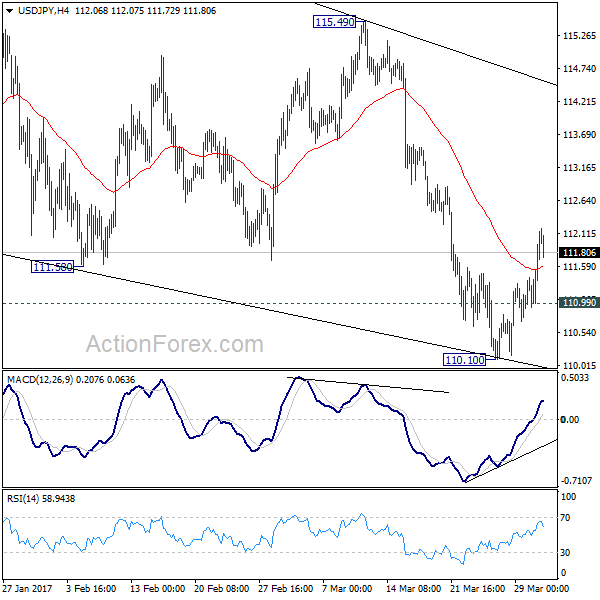
Intraday bias in USD/JPY remains on the upside as rebound 110.10 short term bottom should extend higher to 55 day EMA (now at 112.91). Sustained break there will raise the chance of near term reversal and target 115.49 resistance for confirmation. On the downside, though, below 110.99 minor support will turn bias back to the downside for 110.10 and break will extend the corrective fall from 118.65.
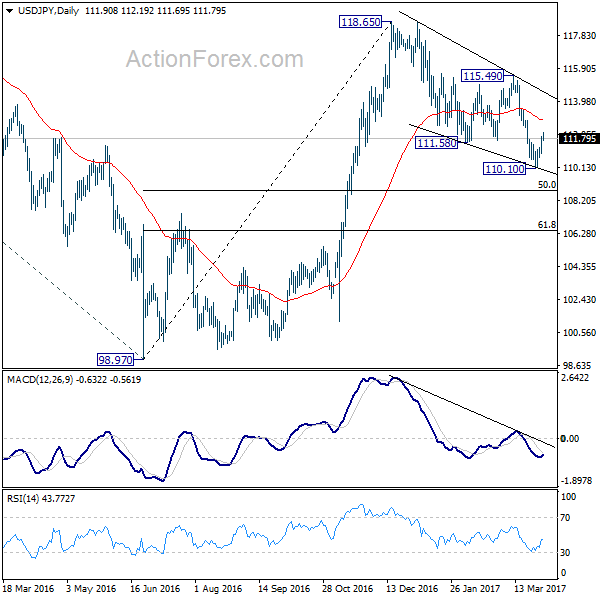
In the bigger picture, price actions from 125.85 high are seen as a corrective pattern. sustained trading below 55 week EMA (now at 111.11) will indicates that such consolidation is not completed. And another fall would be seen back to 98.97 as the third leg. In that case, downside would be contained by 61.8% retracement of 75.56 to 125.95 at 94.77 to complete the correction. On the upside, above 115.49 will extend the rise from 98.97 to retest 125.85 first. Overall, up trend from 75.56 is expected to resume after the consolidation from 125.85 completes.
USD/CHF Mid-Day Outlook
Daily Pivots: (S1) 0.9969; (P) 0.9990; (R1) 1.0033; More.....
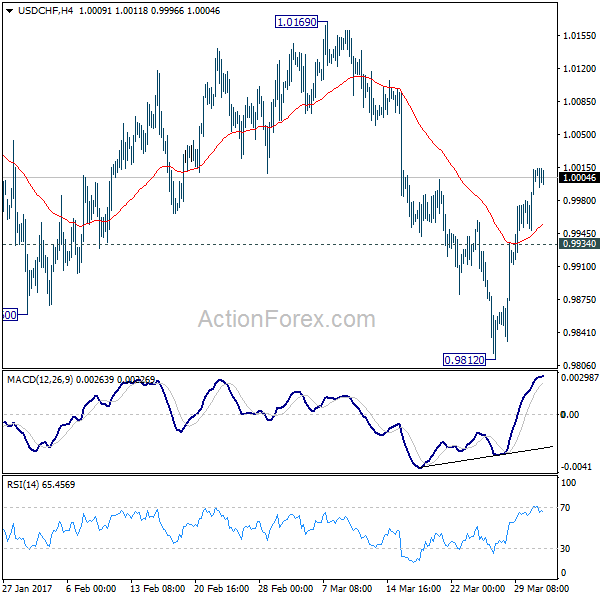
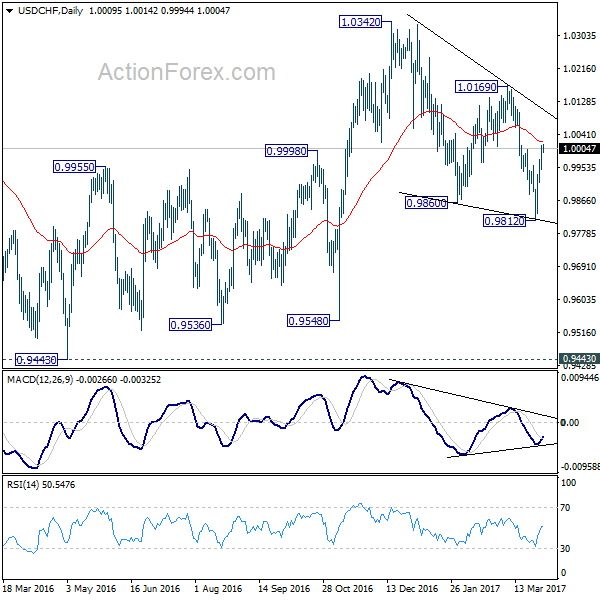
Intraday bias in USD/CHF remains on the upside as rebound from 0.9812 short term bottom continues. Sustained trading above 55 day EMA (now at 1.0021) will argue that whole decline from 1.0342 has completed. Further rise should then be seen to 1.0169 resistance for confirmation. On the downside, below 0.9934 minor support will turn bias back to the downside for 0.9812 instead.
In the bigger picture, USD/CHF is staying in medium term sideway pattern between 0.9443/1.0342. In any case, decisive break of 1.0342 resistance is needed to confirm underlying strength. Otherwise, we'll stay neutral in the pair first. In case of deeper fall, we'd expect strong support from 0.9443/9548 support zone.