

Sample Category Title
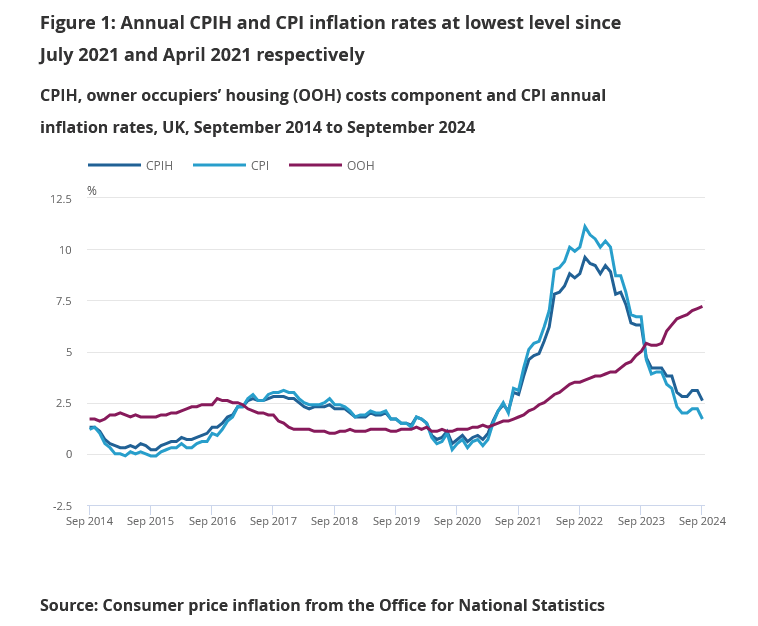
UK CPI falls to 1.7% in Sep, core CPI down to 3.2%
UK CPI slowed more than expected from 2.2% yoy to 1.7% yoy in September, below expectation of 1.9% yoy.
Core CPI (excluding energy, food, alcohol and tobacco) slowed from 3.6% yoy to 3.2% yoy, below expectation of 3.4% yoy.
CPI goods fell from -0.9% yoy to -1.4% yoy. CPI services also slowed from 5.6% yoy to 4.9% yoy.
ONS Chief Economist Grant Fitzner says:
“Inflation eased in September to its lowest annual rate in over three years. Lower airfares and petrol prices were the biggest driver for this month’s fall.
“These were partially offset by increases for food and non-alcoholic drinks, the first time that food price inflation has strengthened since early last year.
“Meanwhile the cost of raw materials for businesses fell again, driven by lower crude oil prices.”
BoJ’s Adachi warns against premature rate hikes, urges most conservative approach
In a speech today, BoJ Board Member Seiji Adachi suggested that Japan's economy has met the conditions for beginning to normalize its ultra-loose monetary policy. He pointed to the firm economic outlook and broadening price increases as positive signs.
However, Adachi emphasized the need for caution, stating that until underlying inflation sustainably reaches the 2% target, Japan must maintain an "accommodative" financial environment. He added that any interest rate increases should be at a "very moderate pace."
Adachi also stressed the importance to "avoid raising rates prematurely", suggesting that BoJ should use the "most conservative estimate" when considering policy adjustments.
"Given high uncertainty surrounding global developments, there is significant uncertainty over next year's wage developments in Japan. We must carefully monitor the situation," Adachi added.
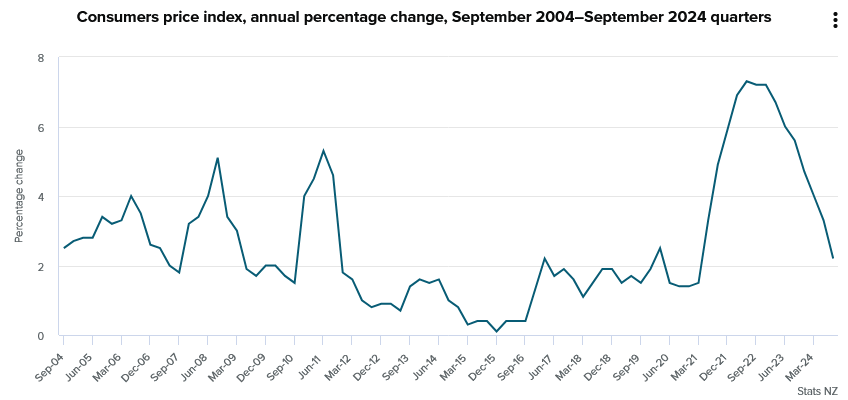
NZ CPI falls to 2.2% in Q3, back in RBNZ’s target band
New Zealand's CPI rose 0.6% qoq in Q3, slightly below market expectations of 0.7% qoq. Annually, inflation slowed sharply from 3.3% yoy to 2.2% yoy, in line with forecasts.
This marks the first time since March 2021 that annual inflation has returned within RBNZ’s target range of 1 to 3%. The result was also softer than RBNZ’s own forecast of 0.8% quarterly and 2.3% annual inflation.
Rent prices were the largest contributor to the annual inflation figure, rising by 4.5%. Nearly 20% of the overall inflation increase came from rent.
On the other hand, lower fuel costs, with petrol prices dropping -8.0%, helped balance rising costs, alongside a notable -17.9% drop in vegetable prices following last year’s spike in potato, kūmara, and onion prices.
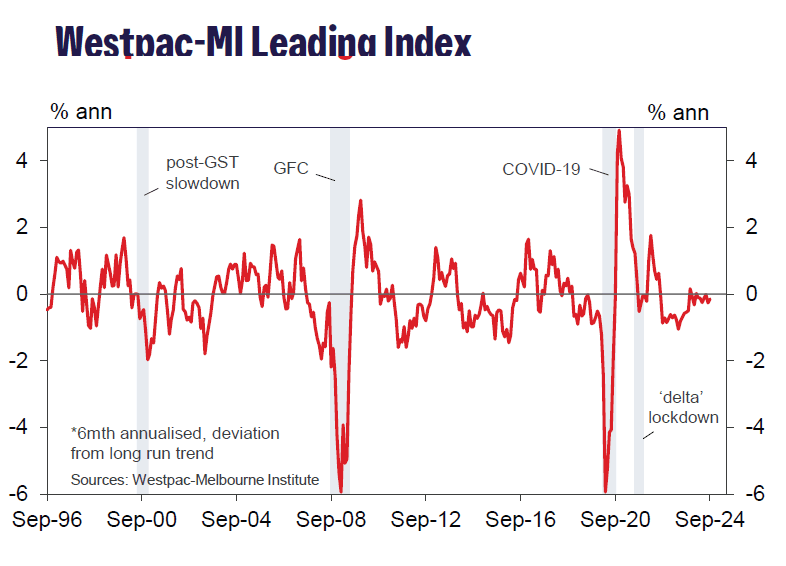
Australia’s Westpac leading index ticks up to -0.15%, growth outlook remains subdued
Australia’s Westpac Leading Index showed a slight improvement, rising from -0.26% to -0.15% in September. However, the index remains in negative territory, indicating "below-trend momentum" that is expected to carry into 2025.
Westpac maintains that while growth will improve next year, it will remain "relatively subdued," with GDP growth forecasted to gradually rise from annualized 1% currently to 1.5% by the end of 2024, reaching 2.4% by the end of 2025—still below the long-term trend of slightly above 2.5%.
As for monetary policy, RBA is not expected to change its cash rate target at the upcoming meetings in November and December.
However, Westpac anticipates a shift in RBA's messages, moving away from its 2024 focus on "inflation vigilance."
Key data releases, including Q3 CPI on October 30 and national accounts on December 4, are likely to confirm a subdued growth environment and provide RBA with enough confidence to start considering less restrictive policies in 2025.
WTI Crude Oil Cut Back Gains: Will the Slide Continue?
Key Highlights
- WTI Crude Oil price started a fresh decline from the $78.80 resistance.
- A connecting bearish trend line is forming with resistance at $72.80 on the 4-hour chart.
- Gold could aim for more gains above the $2,670 level.
- Bitcoin could accelerate higher if it settles above $66,500 and $67,000.
WTI Crude Oil Price Technical Analysis
WTI Crude Oil price rally stalled near the $78.80 resistance zone. The price started a fresh decline and traded below the $75.00 level.
Looking at the 4-hour chart of XTI/USD, the price settled below the $73.20 level, the 100 simple moving average (red, 4-hour), and the 200 simple moving average (green, 4-hour). The bears were able to push the price below the 61.8% Fib retracement level of the upward move from the $66.94 swing low to the $78.78 high.
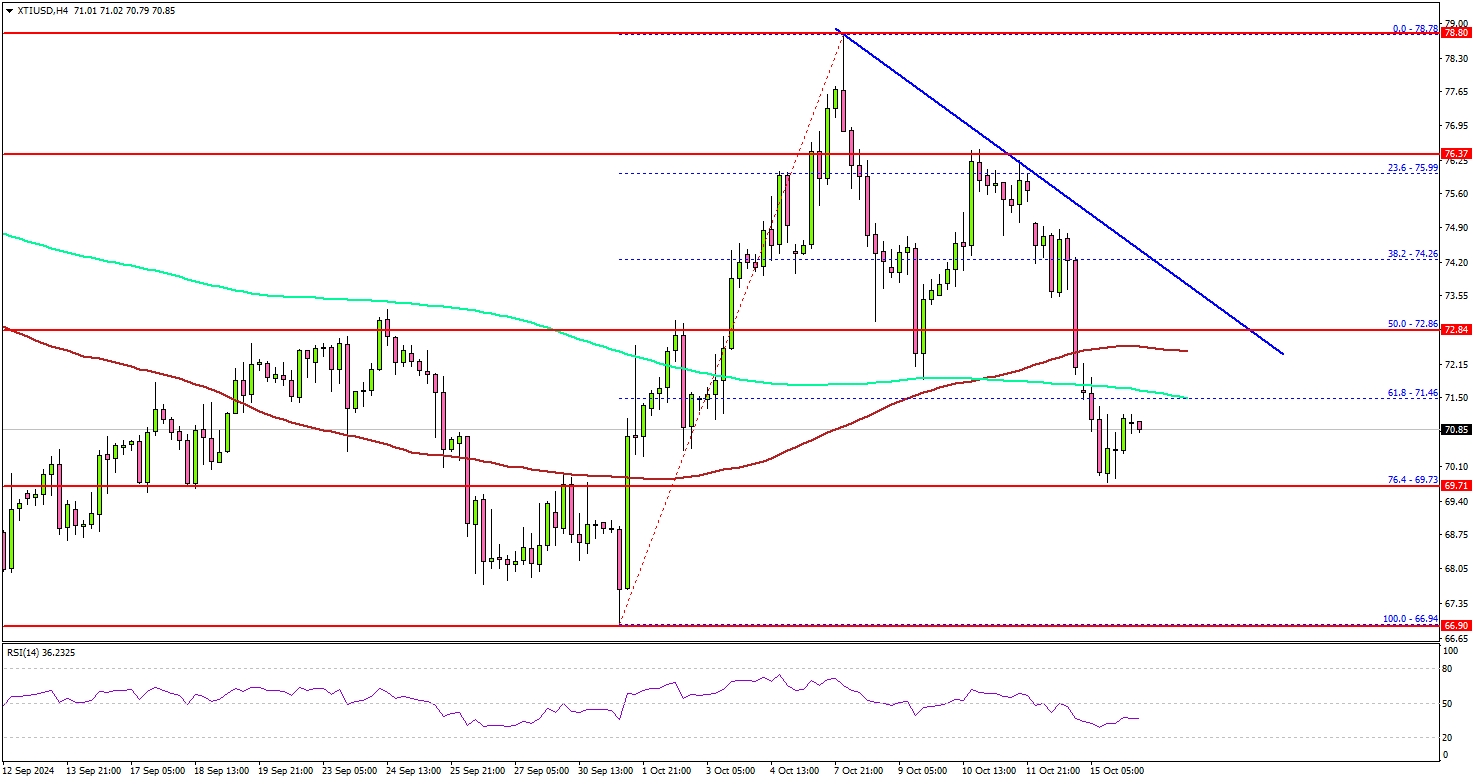
The bulls are now trying to protect the $69.75 support. It is close to the 76.4% Fib retracement level of the upward move from the $66.94 swing low to the $78.78 high.
On the downside, the first major support sits near the $68.50 zone. A daily close below $68.50 could open the doors for a larger decline. The next major support is $65.50. Any more losses might send oil prices toward $60.00 in the coming days.
On the upside, the price might face resistance near the $72.2 level. The next major resistance is near the $72.80 zone. There is also a connecting bearish trend line forming with resistance at $72.80 on the same chart, above which the price may perhaps accelerate higher.
In the stated case, it could even visit the $76.00 resistance. Any more gains might call for a test of the $78.80 resistance zone in the near term.
Looking at Gold, the price is still showing a lot of positive signs and might aim for more upsides above the $2,670 level.
Economic Releases to Watch Today
- US Import Price Index for Sep 2024 (MoM) – Forecast -0.3%, versus -0.3% previous.
- US Export Price Index for Sep 2024 (MoM) – Forecast -0.4%, versus -0.7% previous.
RBA’s Hunter: Monitoring China’s stimulus and inflation expectations closely
RBA Assistant Governor Sarah Hunter emphasized today the importance of China’s economic stimulus measures for Australia, noting that the central bank is actively assessing their local implications.
In a Bloomberg interview, Hunter explained, “We are factoring it into our forecasts going into November," as China remains a key player in Australia’s economy. "China’s still very important, and we put a lot of our time and attention into thinking through what’s happening there and what it means for the economy here."
In a separate speech, Hunter also addressed the importance of keeping inflation expectations anchored within RBA’s 2-3% target range.
She noted that “the fact that expectations feed into actual inflation outcomes means de-anchored expectations typically lead to greater inflation volatility.”
RBA remains vigilant to ensure inflation expectations remain steady, as de-anchoring could cause significant economic disruption. Hunter stressed the need to constantly track and understand how inflation expectations are evolving to mitigate any risks to the broader economy.
Fed’s Bostic sees one more 25bps rate cut in 2024
In a moderated discussion, Atlanta Fed President Raphael Bostic addressed the key question on investors' minds: "how fast" will the Fed proceed with further rate cuts?
According to Bostic, Fed's median projection suggests an additional 50bps of rate cuts this year, following 50bps cut in September. However, for Bostic, "My dot was 25 basis points more".
Nevertheless, he emphasized that his stance is not set in stone. "I'm keeping my options open," Bostic said, indicating that he would reassess based on incoming data on inflation and the labor market.
He also projected GDP growth of around 2.6% for 2024 and expects it to moderate to 2% in 2025 as household savings dwindle.
Fed’s Daly: One or two more rate cuts reasonable this year
San Francisco Fed President Mary Daly signaled in a speech overnight that additional rate cuts are in the pipeline for this year, suggesting that "one or two" further reductions would be a "reasonable thing to do."
Daly emphasized that the primary focus now is on determining "how quickly to adjust," rather than where the ultimate destination of the easing cycle will be.
She also acknowledged that “the economy is clearly in a better place,” pointing to significant progress in reducing inflation pressures. She also highlighted that the labor market is now on a more sustainable path, which was a key concern earlier this year. With both inflation and employment showing healthier trends, Daly noted, “the risks to our goals are now balanced.”
An Easier Path For Bank of Canada Monetary Policy
Summary
- Today's release of Canada's September CPI offers a decisive data point, in our view, that should see the Bank of Canada (BoC) step up the pace of monetary easing next week.
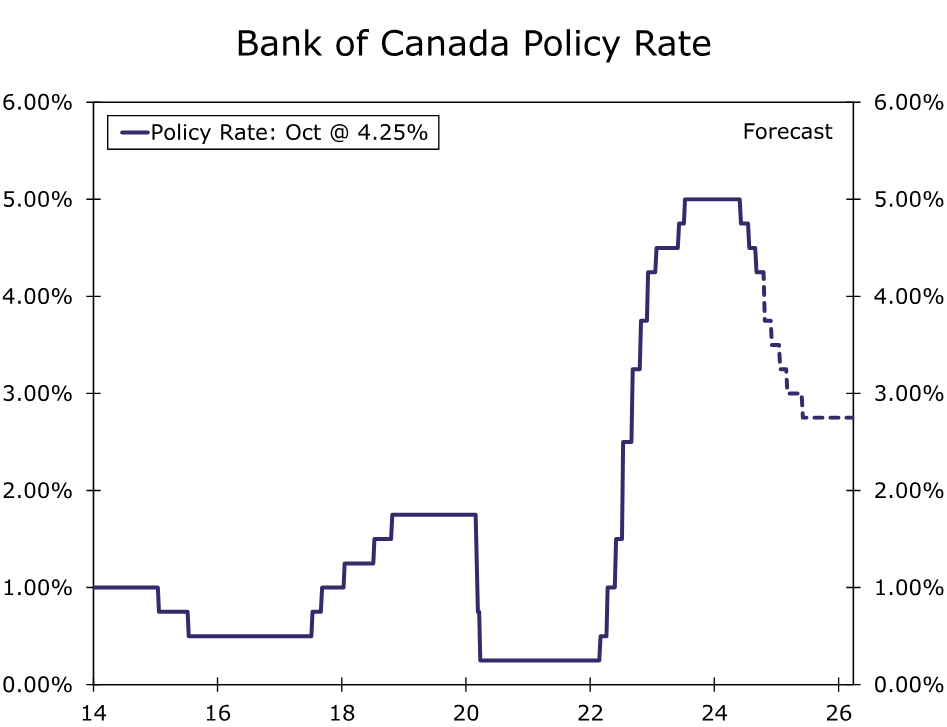
- In addition to headline inflation surprising to the downside, broader underlying inflation pressures also remained contained. With activity data subdued overall, and with policy interest rates still some way above neutral and next week's announcement accompanied by fully updated economic projections, we now forecast the BoC to cut its policy rate by 50 bps to 3.75% at its October 23 meeting.
- We expect the BoC to revert to 25 bps rate cuts at its December, January, March and June meetings, for a terminal policy rate of 2.75% by the middle of next year. Relative to our prior forecast, we see the central bank lowering interest rates more quickly and, moreover, view the risks as tilted to even faster monetary easing if growth in economic activity disappoints.
Ongoing Disinflation Points to Faster Bank of Canada Rate Cuts
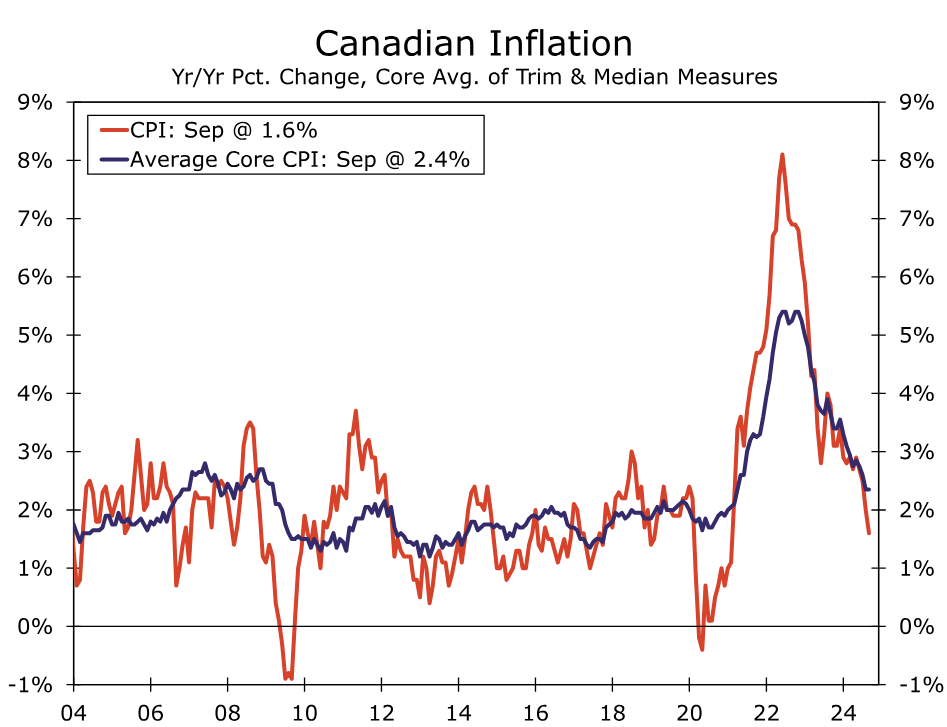
Today's release of Canada's September CPI offers a decisive data point, in our view, that should see the Bank of Canada (BoC) step up the pace of easing, and lower its policy interest rate by 50 bps at next week's monetary policy announcement. September headline inflation slowed more than consensus economists expected to 1.6% year-over-year, and while that deceleration was driven by an 8.3% decline in energy prices, there were also indications that underlying price pressures are contained. Services inflation slowed to 4.0%, the smallest increase in services prices since September of last year. Meanwhile, the average core CPI remains close to the central bank's 2% inflation target, rising 2.4% over the past 12 months, by a 2.4% annualized pace over the past six months, and by 2.1% annualized over the past three months.
Meanwhile, while Canadian activity data is a bit more mixed, we also believe it is consistent with a 50 bps rate cut next week. July GDP rose 0.2% month-over-month, although the advance estimate is for a flat outcome in August, which, if realized, would leave the level of July-August GDP just 0.25% above its April-June average—tracking well below the Bank of Canada's Q3 growth forecast of around a 0.7% quarter-over-quarter (not annualized) gain. More recent activity and survey data are not quite as soft. September employment rose by 46,700, driven by full-time jobs, and the unemployment rate fell to 6.5%. Offsetting that strength to some extent, the labor report also showed that wage growth eased by more than expected, to 4.5% year-over-year. Finally, the BoC's Q3 business outlook survey showed a modest improvement in expectations for future sales, and the headline business outlook indicator improved to -2.3, although that reading for the business outlook indicator is still reflective of overall net pessimism rather than net optimism.
A couple of other factors are also supportive of a larger rate cut at next week's announcement. First, the policy interest rate remains some way above neutral, which the BoC estimates to be in a range of 2.25% to 3.25%. In addition, next week's announcement will also be accompanied by fully updated economic projections. Both of these factors argue for a larger rate cut, considering the subdued economic backdrop. Accordingly, we now forecast the BoC will lower its policy rate by 50 bps to 3.75% at its October 23 announcement, and by a further 25 bps to 3.50% in December. In 2025, we expect 25 bps rate cuts in January, March and June, which would bring the policy rate to 2.75% by middle of next year. Among the factors we think will see the Bank of Canada revert back to smaller 25 bps increments following the October move are policy interest rates that are moving somewhat closer to neutral, hints of improvement in some of the more recent activity data, and the potential for (and desire to avoid) excessive Canadian currency weakness. That said, relative to our prior forecast we see the Bank of Canada lowering interest rates more quickly to the same 2.75% terminal rate we had previously anticipated. Moreover, we view the risks as still tilted toward even faster monetary easing should inflation remain contained, and if growth in economic activity disappoints.
This Time Is Not Different For China
Summary
High profile policy announcements from China have captured financial markets' attention over the past few weeks. China's central bank eased monetary policy, while the Ministry of Finance deployed fiscal resources to aid the property sector and local banks. However, with few fiscal resources deployed toward supporting broader domestic demand, we don't think the growth impact of the latest stimulus announcements will be any different for China. We believe that utilizing the policy support playbook from the last fifteen years will not be enough to change China's short or long-term economic trajectory, and that policy measures that are not aimed at generating consumer spending will ultimately fall short of authorities' intentions. China's economy, in our view, is still staring down at annual GDP growth in the 4.5% range for the next few years. We also expect the recent burst of market optimism around China to fade, and a range of systemically important emerging market nations could be at risk of sentiment swings. With China's policy support announcements missing the mark, combined with a Federal Reserve taking a more gradual approach to easing, 2025 could be a year defined by significant emerging market currency depreciation.
The Time Has Come For China to Change
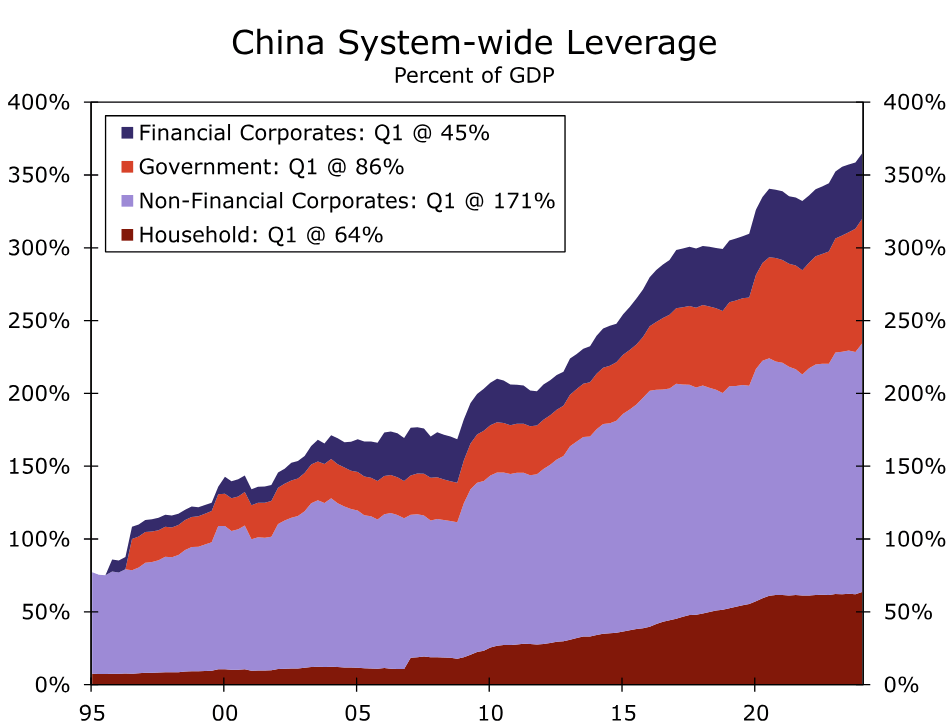
Chinese authorities have now hosted two highly publicized stimulus announcements over the past few weeks. The announcement in September was particularly focused on easing monetary policy, but also other actions designed to help China's economy achieve the government's 5% growth target. This past weekend, China's Ministry of Finance (MoF) followed up September's announcement with a stronger effort toward economic support. The latest policy support is more centered around fiscal stimulus. China's Finance Minister communicated a willingness to take on more debt and expand government fiscal deficits (general and local), allowed for greater usage of local government bond issuance proceeds, dedicated support to China's local real estate sector and offered additional support to local governments to recapitalize bank balance sheets. While details of MoF stimulus are still somewhat vague, Chinese authorities are once again adjusting policy settings in a more accommodative direction in an effort to support China's economy. The shift to policy accommodation is notable. Essentially since the Global Financial Crisis in 2008-2009, Chinese authorities have attempted to balance supporting economic growth with reducing financial stability risks. This balance has been a challenge that has seen authorities at times dip into stimulus by allowing increased leverage, and at other times aim to deleverage by sacrificing economic growth. For the most part, authorities have leaned in favor of supporting activity, which has seen system-wide debt rise significantly over the past fifteen years (Figure 1). Following a brief period of striving for deleveraging post-pandemic, authorities are now clearly more committed to sparking growth than deleveraging China's economy, again opening the tap to policy support, both monetary and fiscal. Historically, Chinese authorities flipping to stimulus has supported growth and led to China's economy being one of the largest single contributors to global GDP growth.
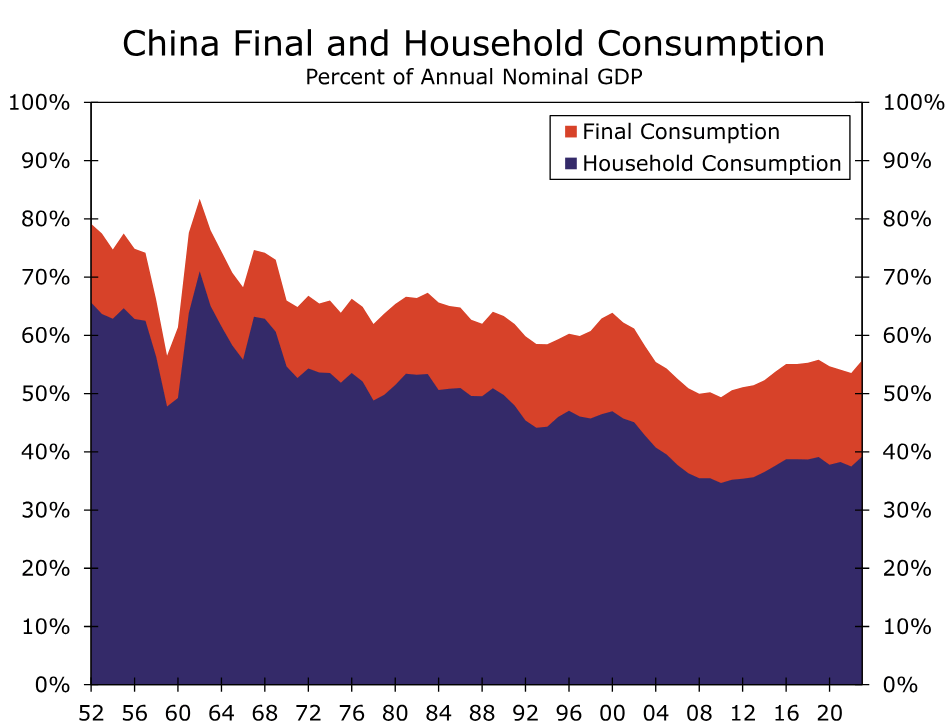
However—and this is where our “This Time is Not Different” title comes into play—all the above mentioned policy support draws from a playbook that is outdated and no longer able to provide material long-lasting momentum to China's economy. In our latest International Economic Outlook we dedicated specific commentary to China's September policy actions with the takeaway being that we were underwhelmed. Gradual monetary easing combined with vague commitments to limited future fiscal stimulus was a policy communication that we believe missed the mark. We have similar takeaways from the latest MoF announcement. Fiscal stimulus, so far, is primarily aimed at China's real estate sector and improving local bank balance sheets. While we acknowledge the local property sector and bank balance sheets need support, targeting fiscal resources solely toward these issues is merely a band-aid for China's economy. In our view, consumer confidence is too weak to make this kind of fiscal support, by itself, impactful. Meaning, fiscal stimulus needs to be primarily deployed toward generating domestic demand and improving consumer sentiment (Figure 2). Any policy adjustments that do not include specific stimulus to spark domestic consumption in our view miss the mark and will ultimately not match authorities' intentions. As of now, MoF fiscal stimulus has little dedicated toward reviving domestic demand. Cash handouts are slim, subsides slimmer, the social safety net shallow, and authorities have provided little to reverse deflationary pressures and create justification for households to deploy cash savings. President Xi and his closet advisors continue to push back on these types of support policies, consistently saying “welfarism policies” are not an appropriate policy response to subdued consumer activity. But with the old blueprint for economic success expired, China's policy response to deteriorating conditions this time needs to be different to have a meaningful growth impact.
With our view that recent policy actions are insufficient, we are not adjusting our 2024 nor 2025 China GDP growth forecasts. We continue to believe China's economy will grow just 4.6% this year and 4.3% next year, and will continue to decelerate over the medium term as imbalances persist. We also believe that the current rally in China's local financial markets is overdone and a correction is likely to occur in the near future. Local equity indices have already started to unwind the latest gains, but going forward, unless policies aimed at domestic demand are announced and implemented in the coming weeks, we would expect benchmark indices to slip further and for sentiment toward the Chinese renminbi to soften. China plays an important role in the global economy as well as global financial markets, and if sentiment toward the second largest economy in the world turns more negative, we would expect spillovers to reach other parts of the world, particularly the emerging markets. In that sense, we updated and refreshed our “China Sensitivity” framework to get a sense of which developing nations could be most at risk of a reversal in sentiment toward China. To identify at-risk nations, our framework incorporates trade linkages between China and peer emerging market nations—both from an export and import perspective. Countries with an elevated dependency on demand from China, such as South Korea, Thailand and South Africa, can see their respective economies come under pressure, while nations still overly dependent on China from a supply chain perspective, such as South Korea, Thailand and Singapore, could be impacted if manufacturing and production out of China softens. Our framework also includes financial markets indicators, more specifically “betas”, to measure how sensitive peer nation benchmark equity indices and currencies are to moves in China's local equity market and the renminbi. For example, if China's Shanghai Composite equity index sells off 1%, equity indices of countries our framework identify as “highly sensitive” can experience a selloff greater than 1%. Same idea for a depreciation of the renminbi. A 1% depreciation in the renminbi could lead to a greater selloff for highly sensitive currencies, including but not limited to the South African rand, Chilean peso and Brazilian real.

Taking trade and financial market linkages in aggregate, our framework suggests South Korea, Thailand, South Africa, Chile and Peru are most sensitive, and in turn most at risk, to the reversal in sentiment that we believe will unfold. On the other hand, economies and financial markets in countries such as India and the Philippines may not be impacted as significantly by a selloff in China's equity indices or depreciation pressures building on China's currency that we expect. In these latter cases, trade linkages are modest, and while Indian equities may be overly sensitive to Chinese equities, other measures of sensitivity suggest India's economy and the rupee may be relatively insulated from developments in China. As far as how we utilize this sensitivity analysis, in our October International Economic Outlook we will incorporate a softening in China sentiment into our emerging markets, and possibly broader currency forecasts. In that sense, while we already forecast most emerging market currencies to weaken in 2025, countries associated with elevated degrees of sensitivity toward the renminbi could see their respective currencies come under more pressure than we initially expected. Unless additional Chinese stimulus is offered, and that stimulus is more geared toward domestic demand, we plan on baking a China-induced depreciation into many of the highly and moderately sensitive currencies on top of what we already forecast. 2025 could be a year of significant stress in the emerging markets. We have already scaled back the amount of easing we expect from the Federal Reserve, which should lead to broad U.S. dollar strength and emerging market FX weakness. Tack on trouble in China, and emerging market currencies may be in for a rough ride next year.