Sample Category Title
USDJPY Holds Within Key Lines
- USDJPY rebounds off 140.90
- Momentum indicators suggest more gains in the near term
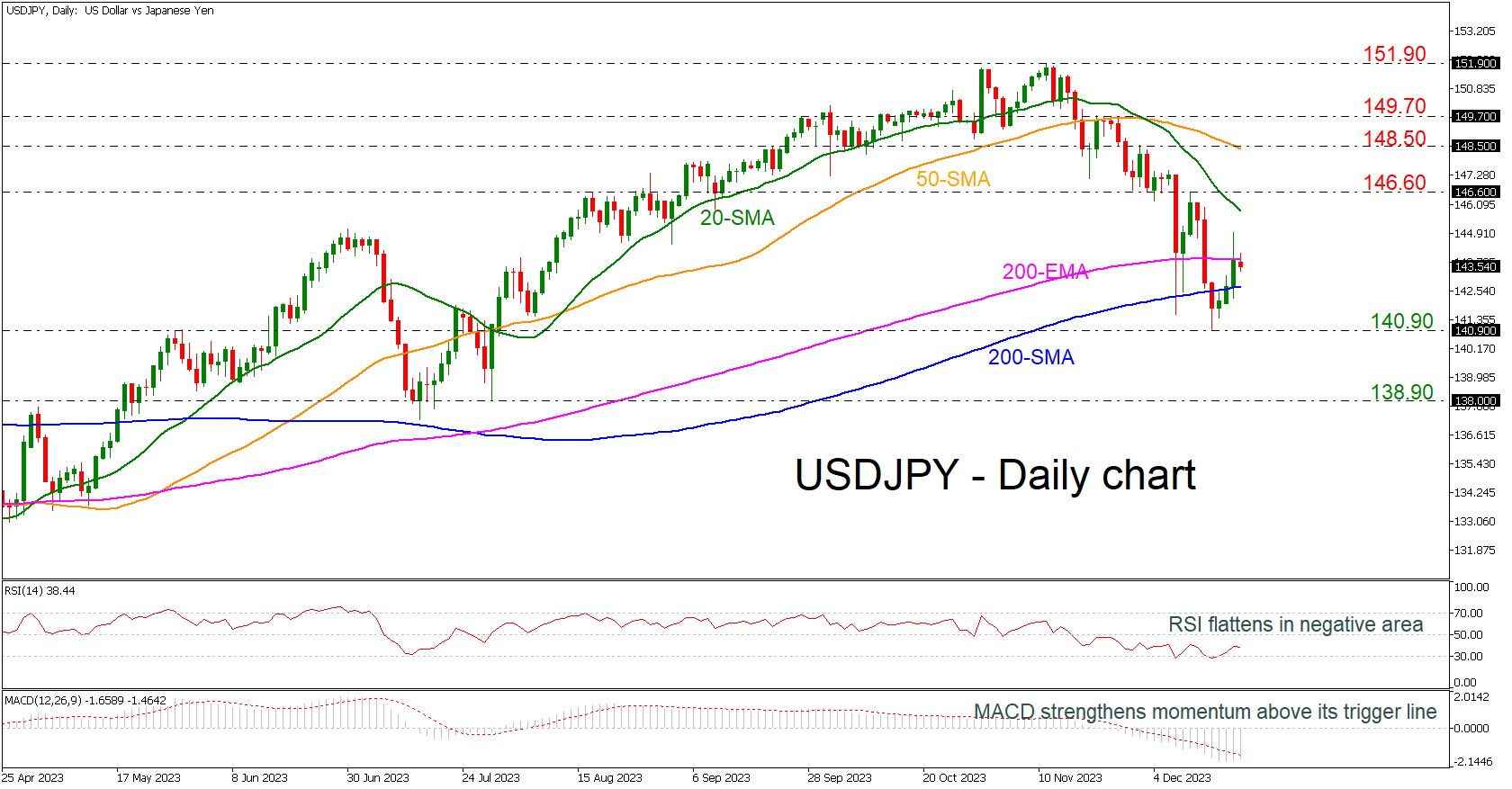
USDJPY stormed higher after penetrating the 200-day simple moving average (SMA) but found strong resistance at the 200-day exponential moving average (EMA), recouping some of last week’s losses. The RSI indicator bounced off the 30 level but is flattening, while the MACD is moving higher after the slip beneath its trigger line.
If the bullish pressures persist, the price could revisit the 20-day SMA at 146.15 and the 146.60 barricade. Breaking above this area, the pair may face the 148.50 resistance, which overlaps with the 50-day SMA. A jump above that region could pave the way for 149.70.
Alternatively, should the bears attempt to push the price lower, initial declines could cease at the recent support lines of 200-day EMA at 143.80 ahead of the 200-day SMA at 142.60. Diving below these levels, the price may descend towards the 140.90 bottom.
In brief, USDJPY is in negative mode in the near-term after the pullback from 151.90 but in the very short-term timeframe is gaining some momentum. However, the odds are in favour of a bullish breakout as the MACD is strengthening in their negative territories.
UK Inflation Falls Faster Than expected
Isn’t it amazing how investors ignore the hawkish Federal Reserve (Fed) comments but fully embrace the dovish commentaries.
Fed’s Thomas Barkin’s words that suggested that the Fed could cut rates if recent progress inflation continues sent the Nasdaq 100 to a fresh record for the 3rd consecutive day and the S&P500 to a fresh ytd high and near an ATH record as well. Yet all the other central bankers’ warnings that it could be too early to cut rates didn’t see the same enthusiastic reaction. But the trend is your friend, the doves are your friends, the hawks are not your friends and that’s – I guess - the magic ingredient to ensure a Santa rally.
Yet, there is no rational explanation to this asymmetric market reaction given that the latest USeconomic data points at ongoing strength, and the latter should be, in theory, supportive of the Fed hawks.
Investors are dreaming of aggressive rate cuts in an environment of strong economic growth, and that is not the right recipe for easing inflation and keeping it sufficiently low. The robust economic data and high earnings expectations are not compatible with a dovish Fed.
FedEx rings the alarm bell
The latest FedEx results didn’t enchant investors yesterday. The company, which serves as a gauge of economic activity, missed expectations due to declining airfreight and trucking volumes. The stock price fell 7% after the closing bell. The selloff will likely send FedEx below its uptrending channel building since October – on the back of falling yields, but that negative correlation between the FedEx and the US 10-year yield is about to break, as FedEx, like most stocks, can’t continue to rise on the back of the falling yields: a further fall in yields implies a decent economic slowdown and that isn’t good for earnings, earnings expectations and hence the valuations.
Zooming out, the S&P stocks are now trading at nearly 20 times the 12-month earnings estimates, and the trailing 12-month EPS estimate is at a record. This is a valuable insight into the expectations regarding the overall earnings performance of the companies in the S&P500, and the numbers don’t look like an economy that needs looser financial conditions.
Dollar weakness
Released yesterday, the latest housing data in the US showed that housing starts jumped nearly 15% in November as the mortgage rates dipped from above 8% to below 7% thanks to a swift fall in US yields. That’s a good sign for economic health, but not necessarily for the future path of inflation. But the dollar didn’t react.
Another interesting place to see is the US deposits. The US deposits were around 80% at the peak of the pandemic and are now reverting toward pre-pandemic norm of around 60%. The melting excess savings could slow down the US consumer spending, hence temper the economic growth and tame inflation, but Atlanta Fed’s GDPNow points at a 2.7% growth in the US GDP in Q4. Thursday’s official data will remind that the US economy grew more than 5% in Q3, a number that should raise questions regarding the dovish Fed optimism.
The Fed doves’ optimism is overdone given the strength of the underlying economic data, and the upside pressure on energy and shipping costs as the world’s leading energy and shipping companies have started avoiding Suez Canal due to Houthi attacks. The recent developments will start showing in the economic data in a few weeks and help investors assess the extent of global implications.
Inflation falls
As worries regarding the implications of developments in the Red Sea mount, latest inflation numbers from Europe and Britain give some respite.
Inflation in the Eurozone slowed to 2.4% in November and core inflation fell to 3.6% as expected.
In the UK, both headline and core inflation fell faster than expected in November. Headline CPI slipped below the 4% mark, as core inflation eased to 5.1%. Cable slipped below 1.27 as a kneejerk reaction to the softer-than-expected inflation figures.
Yet in absolute terms, core inflation in Britain is still more than twice the BoE’s 2% inflation target. And even though the pace of easing is more than welcome, the Bank of England (BoE) is still last in line to join the pivot party. Therefore, hawkish BoE expectations should limit the pond selloff if, of course, investors continue to divest from the US dollar on the back of softening Fed expectations.
EUR/GBP Daily Outlook
Daily Pivots: (S1) 0.8602; (P) 0.8621; (R1) 0.8644; More....
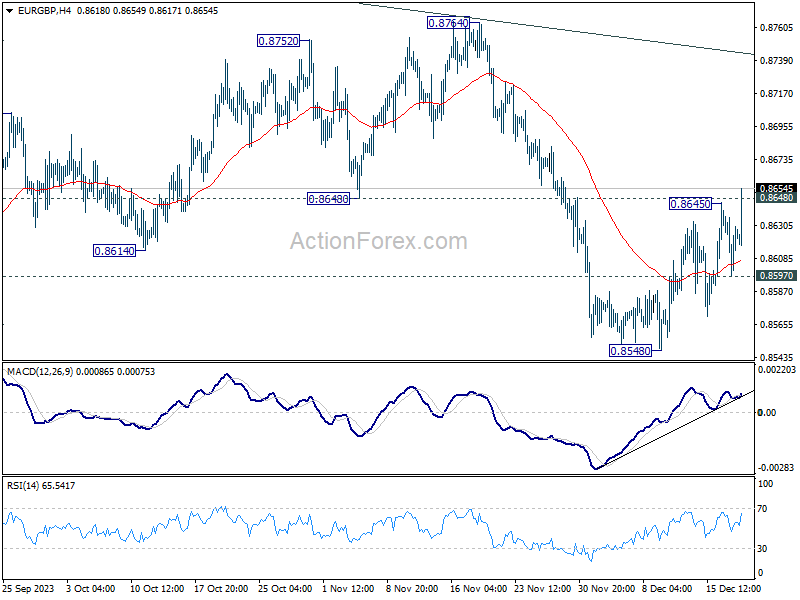
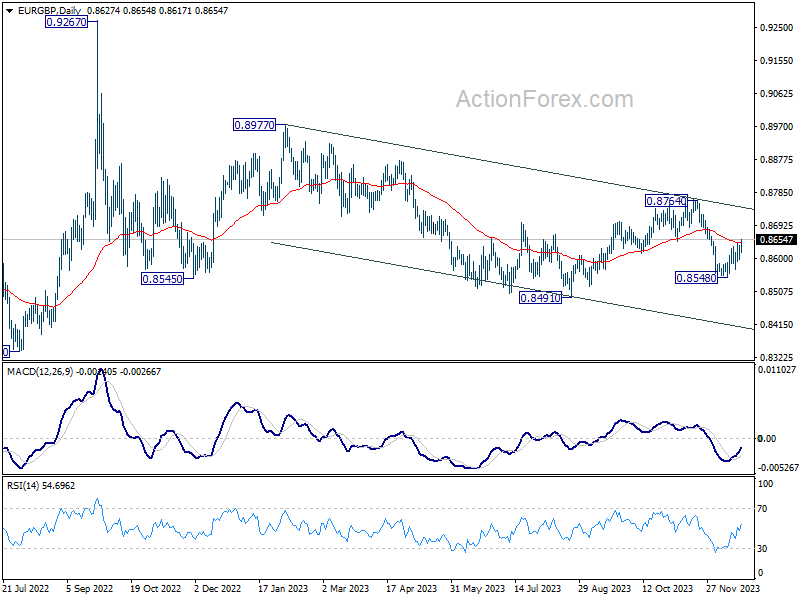
EUR/GBP's rise from 0.8548 resumes today and the break of 0.8648 support turned resistance argues that fall from 0.8764 might have completed already. Intraday bias is now on the upside for stronger rebound towards 0.8764 resistance. On the downside, though, break of 0.8597 minor support will bring retest of 0.8548 instead.
In the bigger picture, current development suggests that down trend from 0.9267 (2022 high) is still in progress. This decline is seen as the third leg of the pattern from 0.9499 (2020 high). Break of 0.8201 will target 100% projection of 0.9499 to 0.8201 from 0.9267 at 0.7969. In any case, outlook will stay bearish as long as 0.8764 resistance holds.
GBP/JPY Daily Outlook
Daily Pivots: (S1) 180.73; (P) 182.46; (R1) 184.86; More...
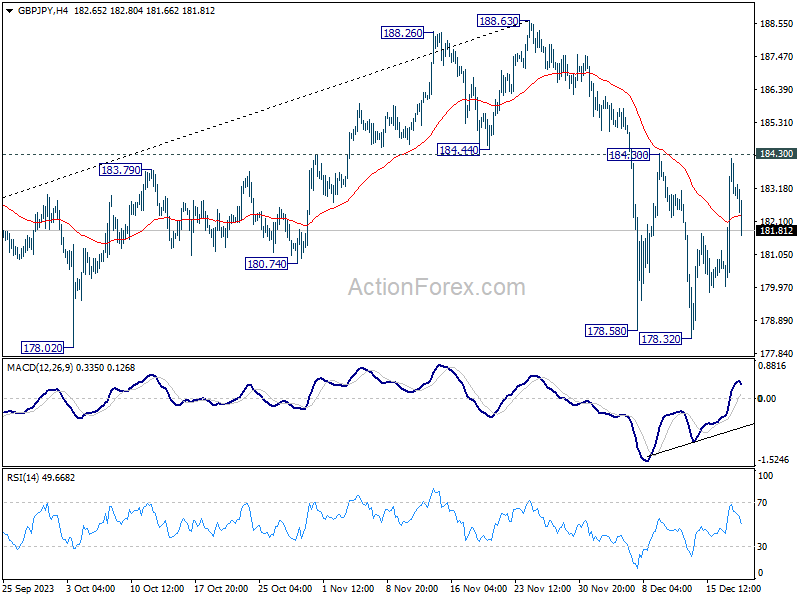
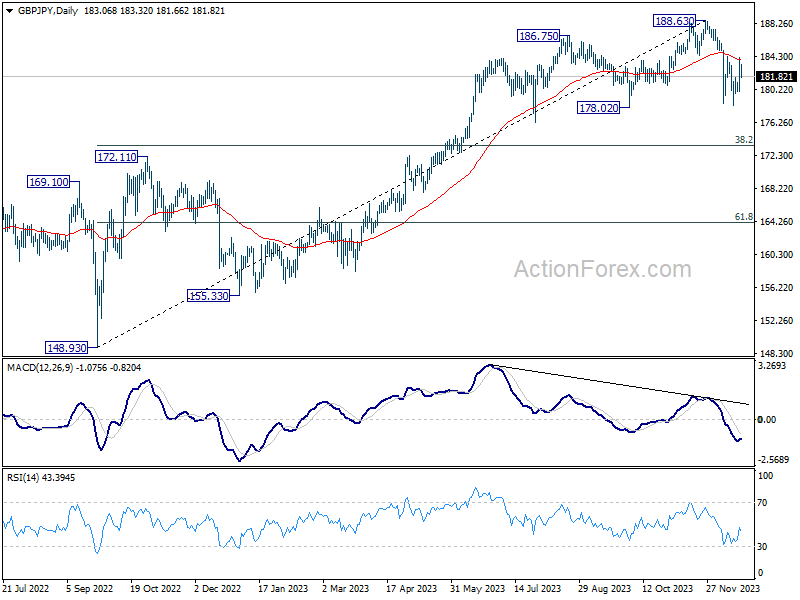
GBP/JPY retreats sharply ahead of 184.30 resistance and intraday bias remains neutral first. Fall from 188.63 is still in favor to continue. Break of 178.32 will resume the decline and target 38.2% retracement of 148.93 to 188.63 at 173.46. However, decisive break of 184.30 will argue that pull back from 188.63 has completed and bring retest of this high.
In the bigger picture, price actions from 188.63 medium term top are currently seen as a correction to the up trend from 148.93 (2022 low) only. As long as 172.11 resistance turned support holds, larger up trend from 123.94 (2020 low) is still in favor to resume through 188.63 at a later stage.
GBP/USD Daily Outlook
Daily Pivots: (S1) 1.2661; (P) 1.2711; (R1) 1.2782; More...
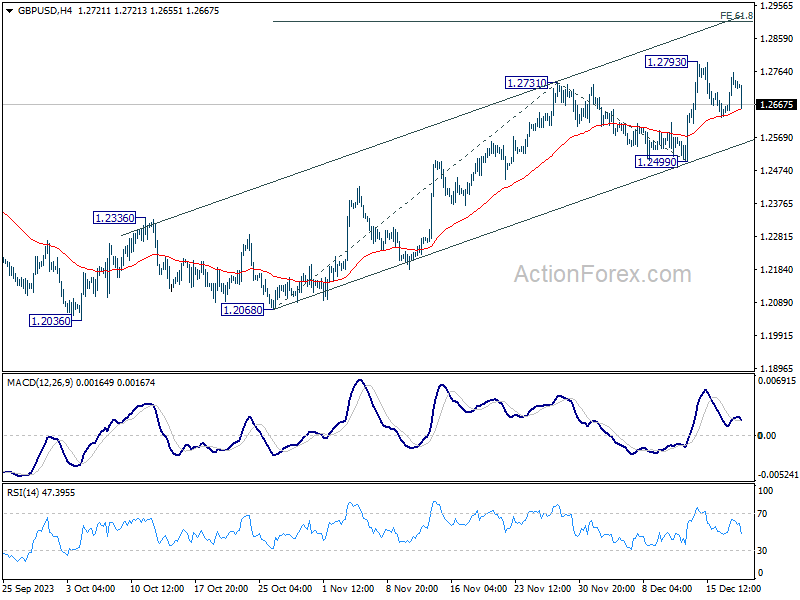
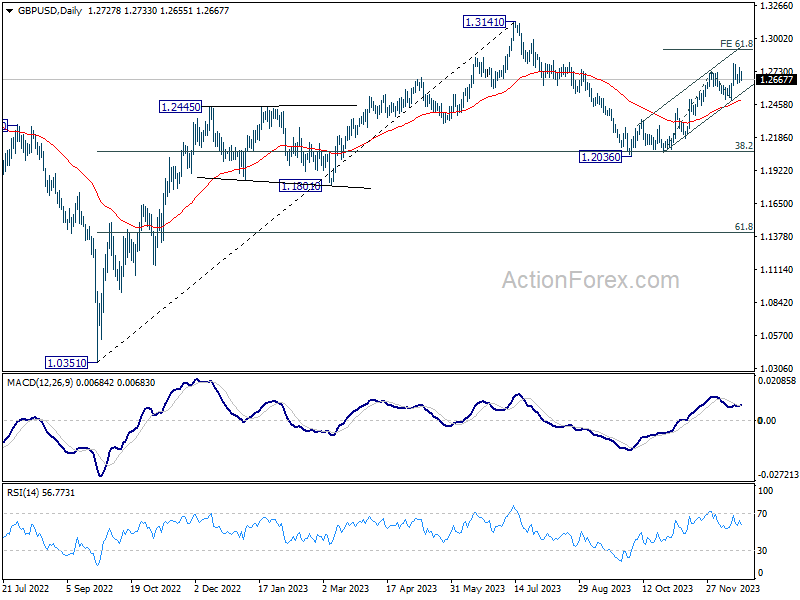
Intraday bias in GBP/USD remains neutral as consolidation from 1.2793 is still extend. Overall, further rally is expected as long as 1.2499 support holds. On the upside, firm break of 1.2793 will resume the rally from 1.2036. Next target is 61.8% projection of 1.2068 to 1.2731 from 1.2499 at 1.2909.
In the bigger picture, price actions from 1.3141 medium term top are seen as a corrective pattern to rise from 1.0351 (2022 low). Rise from 1.2036 is seen as the second leg that's in progress. Upside should be limited by 1.3141 to bring the third leg of the pattern. Meanwhile, break of 1.2499 support will argue that the third leg has already started for 38.2% retracement of 1.0351 (2022 low) to 1.3141 at 1.2075 again.
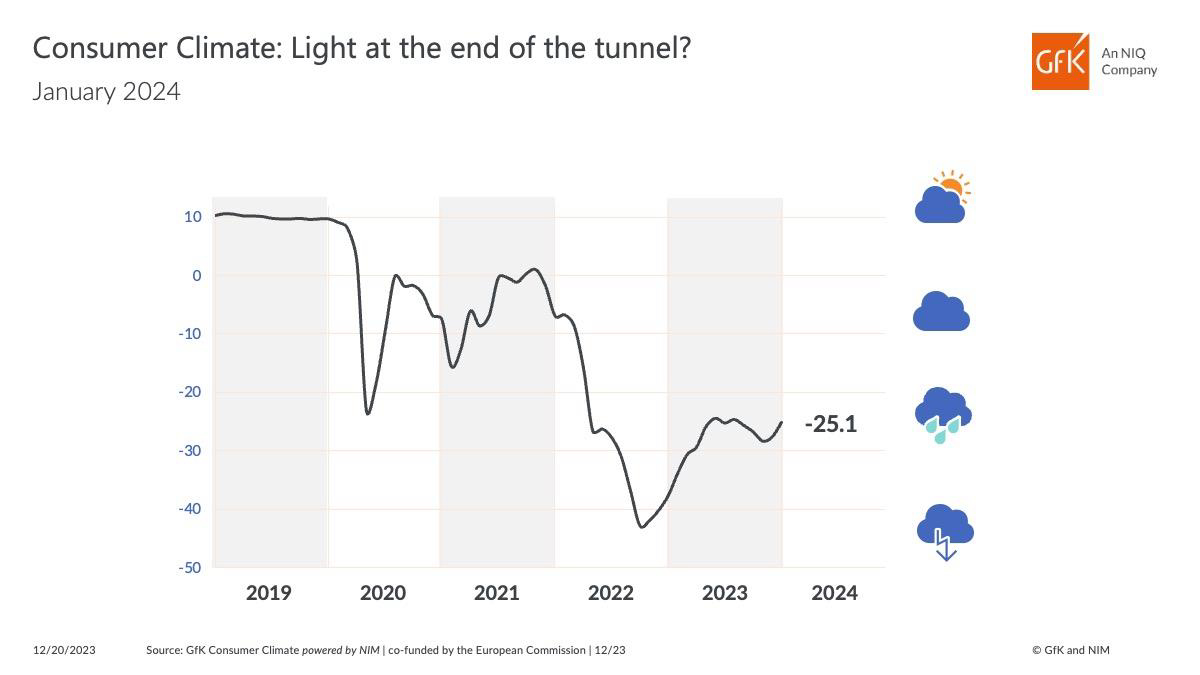
Germany’s Gfk consumer climate rises to -25.1, consumers still have major worries
Germany's Gfk Consumer Climate for January rose from -27.6 to -25.1. In December, income expectations rose from -16.7 to -6.9. Willingness to buy rose from -15.0 to -8.8. Willingness to save rose from 5.3 to 7.3.
"It remains to be seen whether the current increase represents the start of a sustained recovery in consumer sentiment," explains Rolf Bürkl, consumer expert at NIM.
"Consumers still have major worries. Geopolitical crises and wars, sharply rising food prices and discussions around national budget for 2024 continue to cause uncertainty. As a result, the level of consumer sentiment is currently still very low."
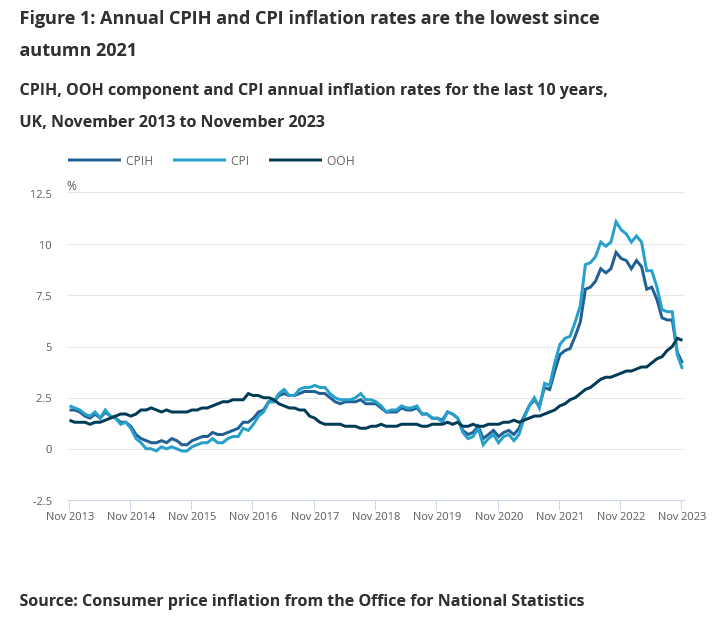
UK CPI slows to 3.9% yoy in Nov, core CPI down to 5.1% yoy
UK CPI slowed from 4.6% yoy to 3.9% yoy in November, below expectation of 4.3% yoy. Core CPI (excluding energy, food, alcohol and tobacco) slowed from 5.7% yoy to 5.1% yoy, below expectation of 5.5% yoy. CPI goods fell from 2.9% yoy to 2.0% yoy. CPI services also fell from 6.6% yoy to 6.2% yoy.
ONS noted, "The easing in the annual inflation rates reflected downward contributions from eight divisions, most notably transport, recreation and culture, and food and non-alcoholic beverages. There were no divisions with large offsetting upward effects."
On a monthly basis, CPI was down -0.2% mom, below expectation of 0.2% mom rise.
Rate Cut Optimism Continues to Lift Risk Sentiment
In focus today
This morning, the Danish statistics office will release the consumer confidence indicator for December. In November, consumer confidence improved, although sentiment was still overall negative at -10.3. The labour market is still going strong, and inflation was low in November. Given the high expected wage growth, consumers' purchasing power is increasing. This is positive for consumer confidence, and we think it will improve again in December.
Today, we closely follow the EU meeting regarding a new set of fiscal policy rules in the EU. The EU economy and finance ministers will hold an informal videoconference to discuss the fiscal rules. This is likely the last chance to get a deal on a new set of rules before the self-imposed year-end deadline. Read more about the negotiations on fiscal rules in Euro Area Research - New fiscal rules in the EU - aligning theory and practice?, 29 November.
In the US, existing home sales for November and Conference Board consumer survey for December will be released.
Looking at the central bank calendar, ECB's Lane and Riksbank's Thedeen are scheduled to speak.
The 60 second overview
Fed speak: The Fed's Goolsbee and Bostic continued to push back on the notion of imminent rate cut talks yesterday even if both underscored the recent positive developments on inflation. Goolsbee noted that 'market has gotten ahead of themselves' while Bostic reminded that there 'is not going to be urgency' in easing the current restrictive policy stance. Barkin was more optimistic, as he described the retreat in inflation as 'remarkable', which contrasts his more cautious comments heard in late November. We still think that the Fed is going to cut rates for the first time in March, but given the recent easing in financial conditions and that there are few signs of a clear cooling in economic momentum, we think the Fed will opt for a relatively gradual rate cutting pace of 4x25bp in 2024 (market prices in a total of 145bp of cuts).
PBoC: The People's Bank of China left the 1 and 5 year Loan Prime Rates (LPR) unchanged overnight, which was widely anticipated after it made no changes to the Medium-term Lending Facility (MLF) rate last Friday. Loan Prime Rates are the key reference rates for business loans and mortgages. As both economic data and the outlook for new stimulus remain mixed, we stick to our 'muddling through' scenario for China, with no boom but also no signs of an imminent bust. We expect Chinese GDP to grow by 4.5% in both 2024 and 2025.
Equities: Global equities were higher (again) yesterday. Fed officials are trying to push back against rate cut expectations for next year, but investors are not listening. They have decided that rate cuts are coming and that means less monetary headwinds and cheaper financing. Russell 2000 was up by almost 2% yesterday, which was not surprising with the soft-landing and lower yields dominating. Energy doing well as oil prices are higher, not due to lower yields but rather as the Red Sea conflict is escalating. Materials also outperforming as industrial metals have grinded higher lately. Major indices in US yesterday, Dow +0.7%, S&P 500 +0.6%, Nasdaq +0.7% and Russell 2000 +1.9%. The positive sentiment is continuing in Asia this morning with both Kospi and Nikkei 225 up more than 1.5% despite lacklustre trade data out of Japan. US and European futures both in green this morning as well.
FI: The markets keep ignoring comments from the Federal Reserve officials that rate cuts will be gradual and limited and inflation needs to decline further such that the "battle against inflation" can be declared to be "won". Hence, the 10Y US Treasury yield is testing the 4%-level and the US curve flattened from the long end, which is not what we see during the start of a rate cutting cycle.
FX: In Scandies, NOK/SEK closed higher for the fifth consecutive session, hand in hand with relative yields on the back of Norges Bank's surprise hike. On Tuesday, the cross traded above 0.99 for the first time since early November. In majors, GBP and AUD were among the outperformers both in response to hawkish central bank comments. Meanwhile, the USD continues to trade on the back foot after Fed/Powell refrained from pushing back on rates pricing last week and as such fuelled further risk on. EUR/USD took another step higher and is seemingly having its eyes on the 1.10 handle.
EUR/JPY Daily Outlook
Daily Pivots: (S1) 156.04; (P) 157.30; (R1) 159.22; More..
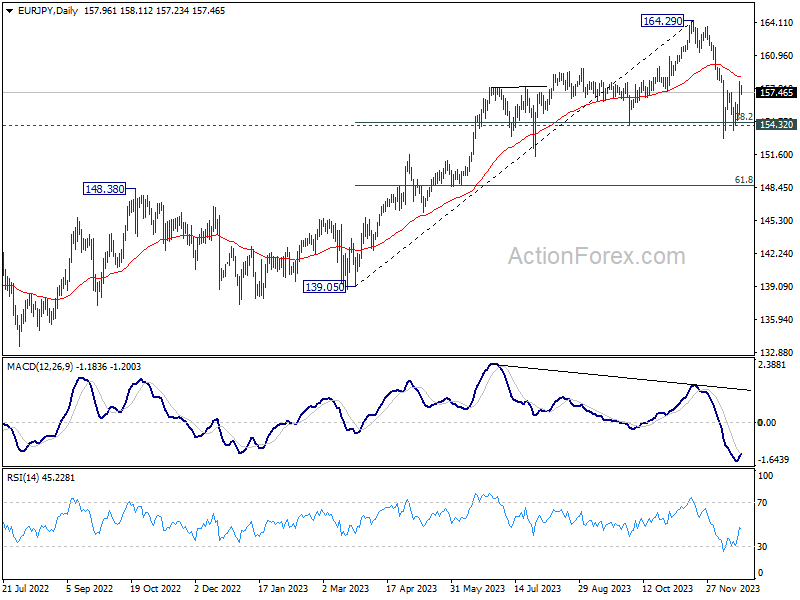
Intraday bias in EUR/JPY stays on the upside for the moment. Rebound from 153.15 should target 55 D EMA (now at 158.97). On the downside, break of 153.15 will resume whole fall from 164.39 to 61.8% retracement of 139.05 to 164.29 at 148.69.
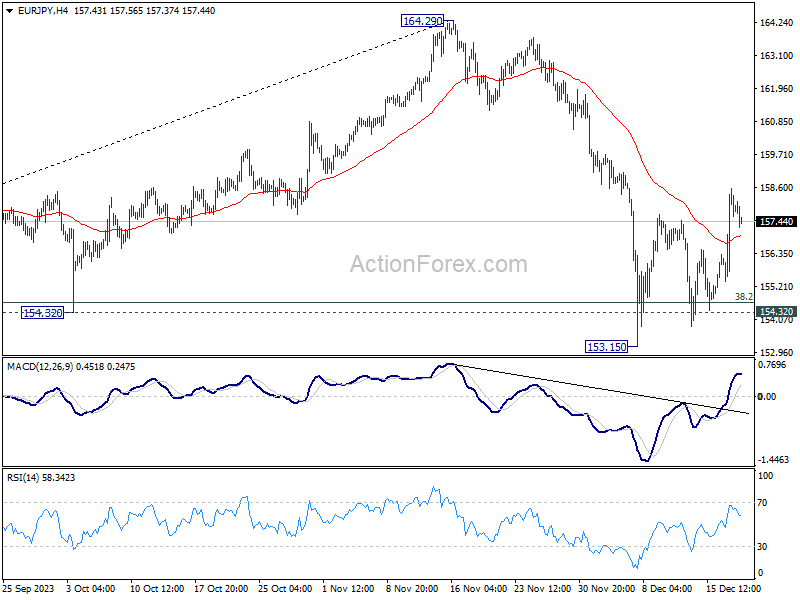
In the bigger picture, price actions from 164.29 medium term top are tentatively seen as a correction to rise from 139.05 for now. As long as 148.48 resistance turned support holds (2022 high), larger up trend from 114.42 (2020 low) could still resume through 164.29 at a later stage.
EUR/AUD Daily Outlook
Daily Pivots: (S1) 1.6197; (P) 1.6248; (R1) 1.6289; More...
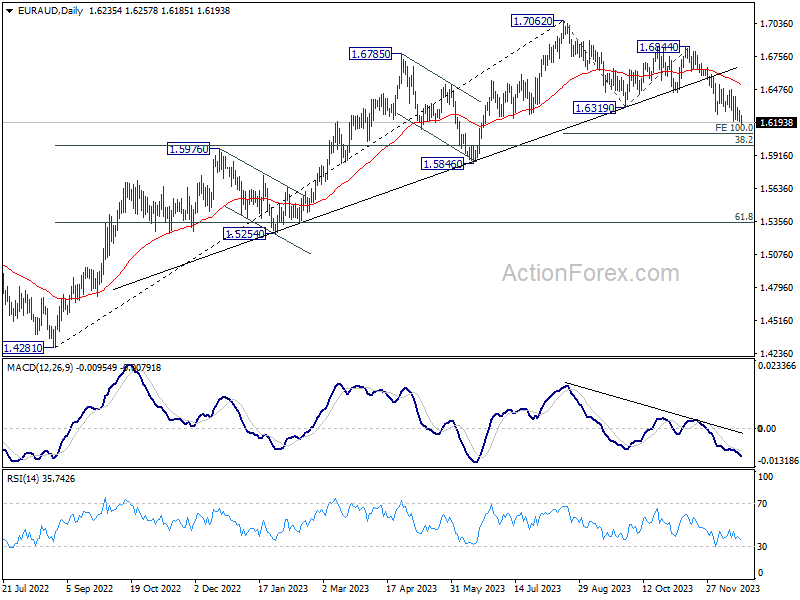
EUR/AUD's decline resumed by breaking 1.6206 and intraday bias is back on the downside. Current fall from 1.7062 should now target 100% projection of 1.7062 to 1.6319 from 1.6844 at 1.6106. On the upside, above 1.6319 minor resistance will turn intraday bias neutral first. But risk will stay on the downside as long as 1.6478 resistance holds.
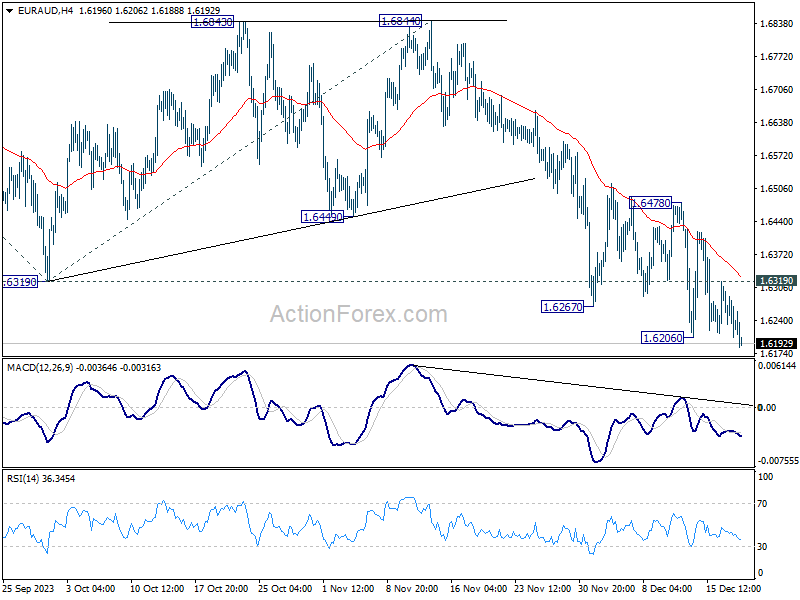
In the bigger picture, fall from 1.7062 medium term top is seen as correcting the whole up trend from 1.4281 (2022 low). Deeper decline would be seen to 38.2% retracement of 1.4281 to 1.7062 at 1.6000. Strong support could be seen there to bring rebound on first attempt. But risk will stay on the downside as long as 1.6844 resistance holds. Sustained break of 1.6000 would bring further fall to 61.8% retracement at 1.5343.