

Sample Category Title
ECB’s Influential Hawk Takes Further Rate Hikes Off the Table
Markets
Markets started off choppy yesterday, suggesting the bond-inspired everything-rally is losing steam. A backloaded eco calendar is keeping investors at bay as well. US yields recouped 2.1-9.6 bps from the huge losses incurred last month. The front end underperformed. German yields lagged behind but finished off intraday lows nevertheless. Changes varied between -0.8 bps (10-y) and +1.3 bps (2-y) with a noticeable outperformance of the very long end (30-y -4.4 bps). Stocks ended virtually flat in Europe while losing some ground in the US (Nasdaq -0.84%). The trade-weighted dollar index extended its recent bottoming out by rising above 103.62 (23.6% recovery on the Oct-Nov decline). EUR/USD lost mirror support at 1.0883. The pair neared the next reference at 1.08 (38.2% retracement) fast but it never came to an actual test. EUR/USD closed at 1.0836. Sterling’s stellar run grinded to a halt at the EUR/GBP 0.8558 resistance. Technical trading lifted the pair to 0.8578 at the close. Asian markets copy Wall Street’s meagre performance yesterday by losing ground. South Korea underperforms (-1.8%). News flow concentrates around inflation in the country as well as the Tokyo reading in Japan (see below). The Reserve Bank of Australia kept rates steady with further hikes, if any, contingent on the data. The Aussie dollar underperforms global peers this morning. For Europe, we retain ECB’s Schnabel interview by Reuters published this morning. The influential hawk took further rate hikes off the table in a dovish shift compared to just one month ago. Three unexpectedly benign inflation readings in a row changed Schnabel’s mind. She noted last month’s “remarkable” drop in the core gauge. Schnabel also warned against guiding markets to far ahead given how inflation is surprising. Dropping forward guidance was fitting when prices surged well beyond expectations but that works both ways, she reasons. On finishing PEPP reinvestments earlier than currently communicated (2025), Schnabel called it not a big deal as purchasing volumes are low and markets anticipate it already. The euro erased tiny gains after headlines hit the wires while Bund future price action suggests a lower open for cash yields. Attention later today shifts to the US with the JOLTS report as well as the services ISM for November. Market’s mindset suggests there’s still a risk for an asymmetric response to a negative surprise. That said, there’s only little room left to add to current market pricing which already assumes a 66% chance for a March cut. US bond spillovers, if any, to Europe should limite the damage for the dollar against the euro, especially after Schnabel’s comments. EUR/USD 1.08 is the first reference, followed by 1.0733/56.
News & Views
The Reserve bank of Australia kept its policy rate unchanged at 4.35%. The RBA raised the policy rate by 25 bps last month after 4 month pause as progress in bringing inflation to target was developing slower than forecast. The RBA now indicated that the new information it received since has been broadly in line with expectations. Monthly data suggested a further decline in goods inflation. The development of services inflation remains uncertain. Wage growth picked up in September, but the RBA doesn’t expect it to increase much further. Higher interest rate are working to establish a more sustainable balance between aggregate supply and demand as previous rate hikes continue to flow through the economy. This gives RBA the time to assess the impact of precious tightening in a data-dependent approach. RBA concludes that ‘whether further tightening of monetary policy is required to ensure that inflation returns to target in a reasonable timeframe will depend upon the data and the evolving assessment of risks’. The tone of the RBA assessment maybe was a bit less hawkish than the market expected. The 2-y yield (4.08%) dropped 5 bps. AUD/USD fell from the 0.6610 area to currently 0.6585.
November inflation in South Korea and Japan this morning were softer than expected. CPI in SK declined 0.6% M/M slowing the Y/Y measure from 3.8% to 3.3% (3.5% was expected). Core inflation cooled from 3.0%. The BoK last week raised its inflation forecast for this year (3.6%) and next year (2.6%), but today indicated that it expects inflation to continue to decelerate at a moderate pace, assuming oil prices won’t significantly rise. November CPI excluding fresh food (monitored by the BoJ) in the Tokyo region dropped from 2.7% to 2.3%. The measure ex. fresh food and energy slowed to 3.6% from 3.8. The Tokyo data are seen as a good pointer for the national data that will be published on December 22. The BoJ holds its final meeting of the year on December 19. Softer inflation probably will reinforce the BoJ’s assessment that in can proceed very gradually when considering policy normalization.
EUR/USD Daily Outlook
Daily Pivots: (S1) 1.0795; (P) 1.0845; (R1) 1.0886; More...
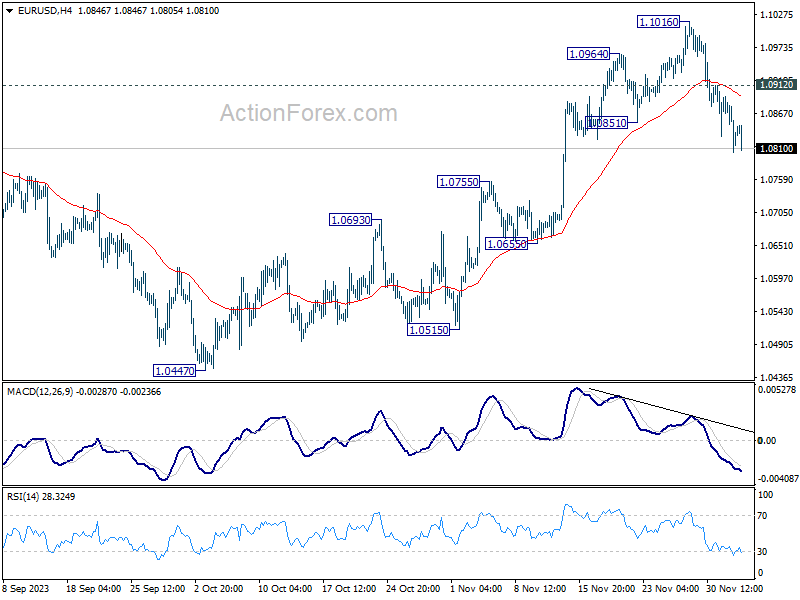
Intraday bias in EUR/USD remains on the downside for the moment. Current fall from 1.1016 short term to is in progress for 55 D EMA (now at 1.0770). On the upside, above 1.0912 minor resistance will turn intraday bias neutral again first. Further break of 1.1016 will resume the rise from 1.0447 to retest 1.1274 high instead.
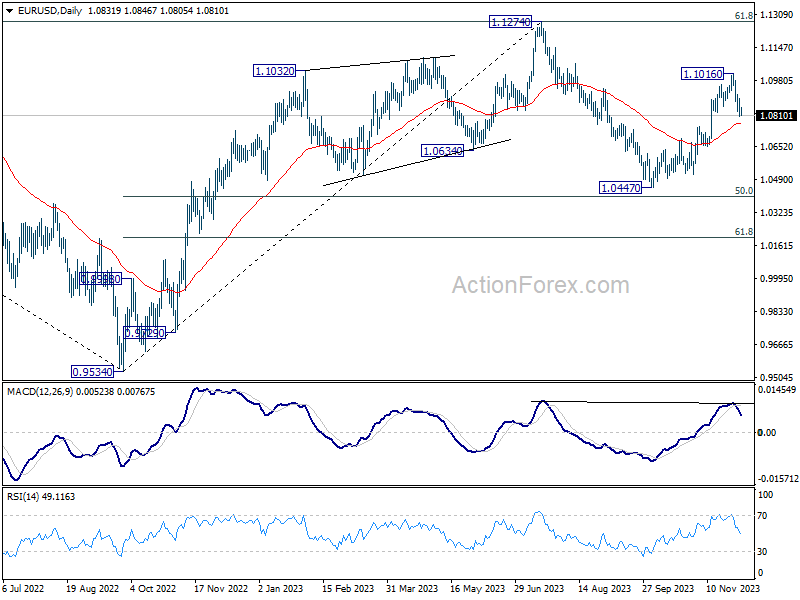
In the bigger picture, price actions from 1.1274 are viewed as a corrective pattern to rise from 0.9534 (2022 low). Rise from 1.0447 is tentatively seen as the second leg. Hence while further rally could be seen, upside should be limited by 1.1274 to bring the third leg of the pattern. Meanwhile, sustained break of 55 D EMA will argue that the third leg has already started for 1.0447 and below.
GBP/USD Daily Outlook
Daily Pivots: (S1) 1.2582; (P) 1.2654; (R1) 1.2703; More...
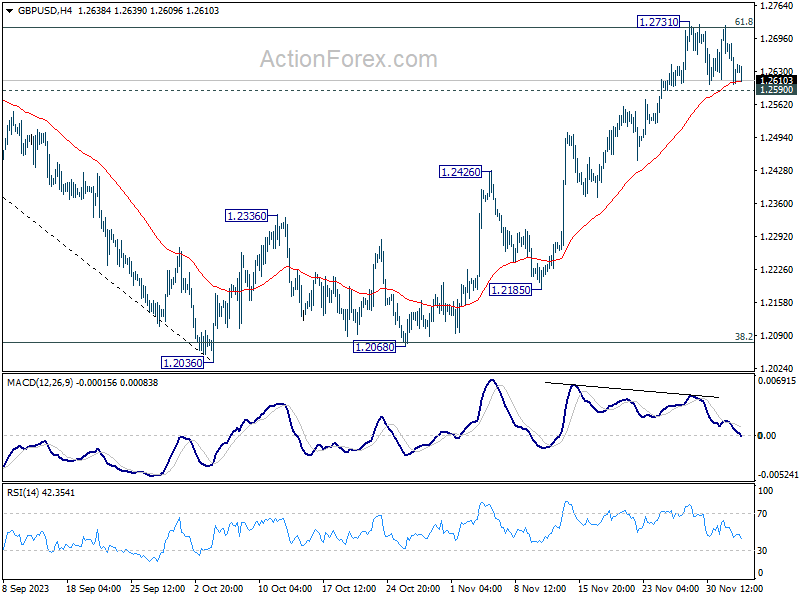
Range trading continues in GBP/USD and intraday bias remains neutral at this point. Further rally is expected as long as 1.2590 minor support holds. On the upside, decisive break of 1.2731 will resume the rally from 1.2036 for retesting 1.3141 high next. However, firm break of 1.2590 will confirm short term topping, and turn bias back to the downside for deeper pullback.
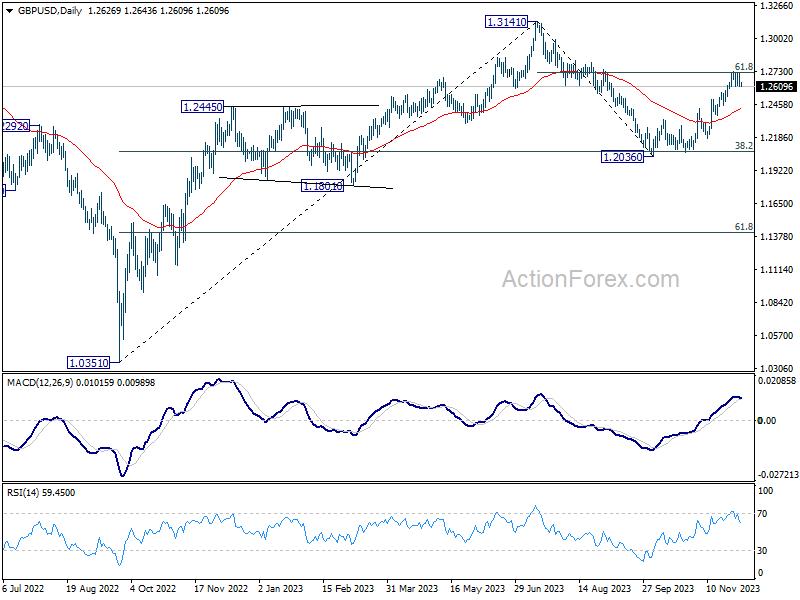
In the bigger picture, price actions from 1.3141 are seen as a corrective pattern to rise from 1.0351 (2022 low). Strong rebound from 38.2% retracement of 1.0351 (2022 low) to 1.3141 at 1.2075 suggests that current rise from 1.2036 is already the second leg. However, while further rally could be seen, upside should be limited by 1.3141 to bring the third leg of the pattern.
USD/CHF Daily Outlook
Daily Pivots: (S1) 0.8678; (P) 0.8717; (R1) 0.8766; More....
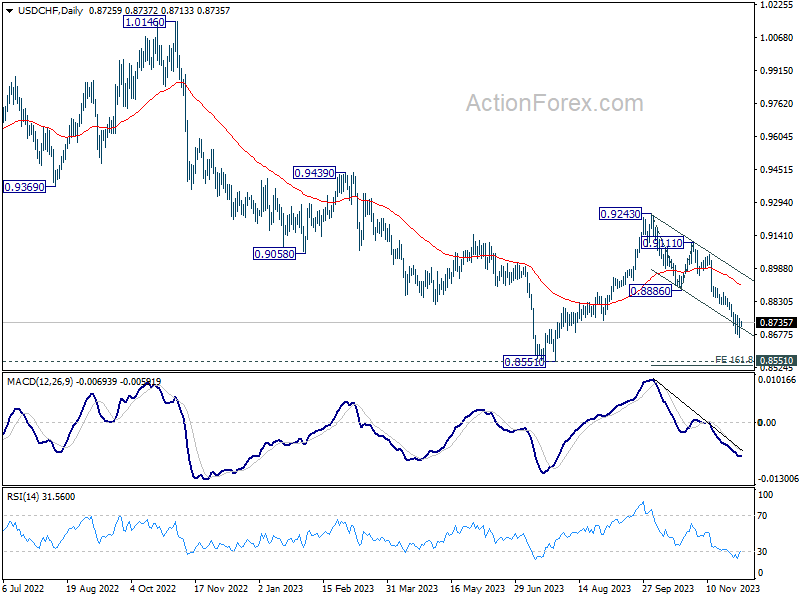
USD/CHF is staying in consolidation from 0.8665 and intraday bias stays neutral. Another fall is in favor as long as 0.8769 minor resistance holds. Below 0.8665 will resume the decline from 0.9243 to 161.8% projection of 0.9243 to 0.8886 from 0.9111 at 0.8533, which is close to 0.8551 low. However, break of 0.8769 minor resistance should indicate short term bottoming, and turn bias back to the upside for stronger recovery.
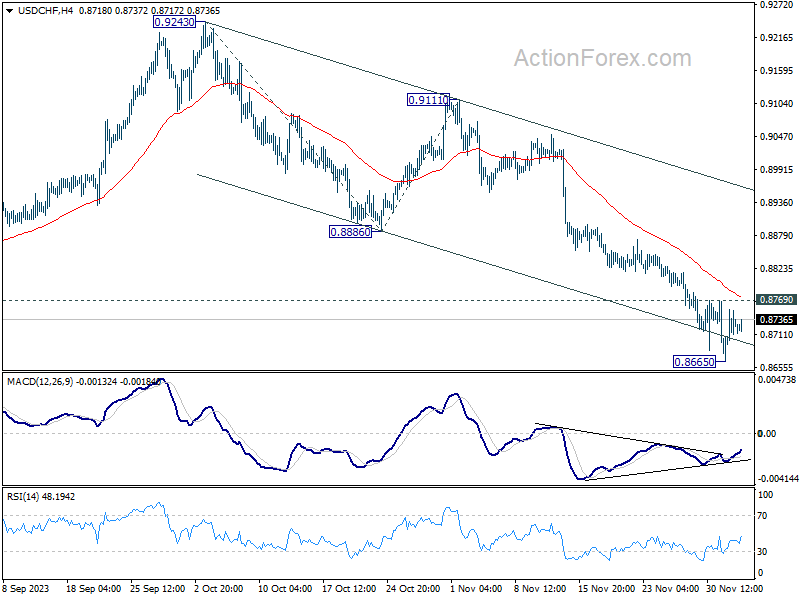
In the bigger picture, price actions from 0.8551 are currently seen as part of a corrective pattern to the decline from 1.0146 (2022 high). Fall from 0.9243 is seen as the second leg for now. Deeper decline could be seen to 0.8551 low but strong support should be seen there to bring rebound. For now, this will remain the favored case as long as 0.8886 support turned resistance holds.
USD/JPY Daily Outlook
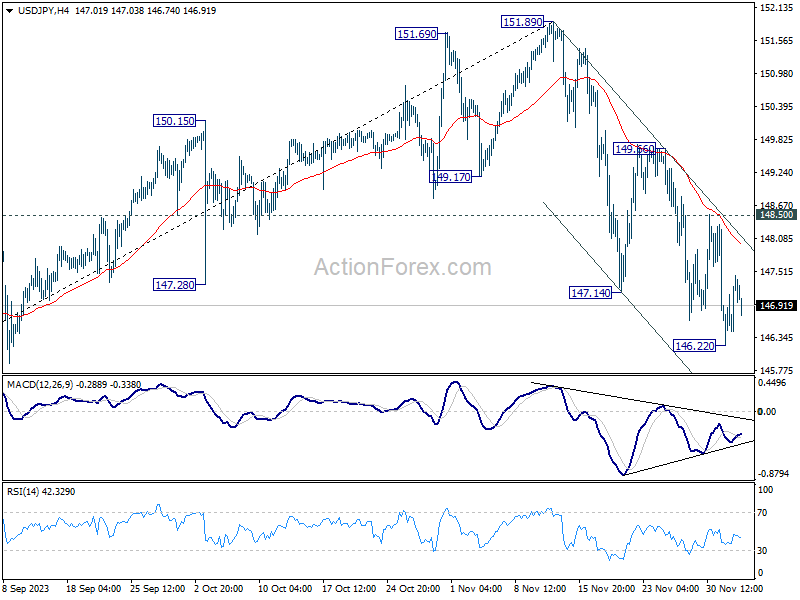
Daily Pivots: (S1) 146.48; (P) 146.97; (R1) 147.70; More...
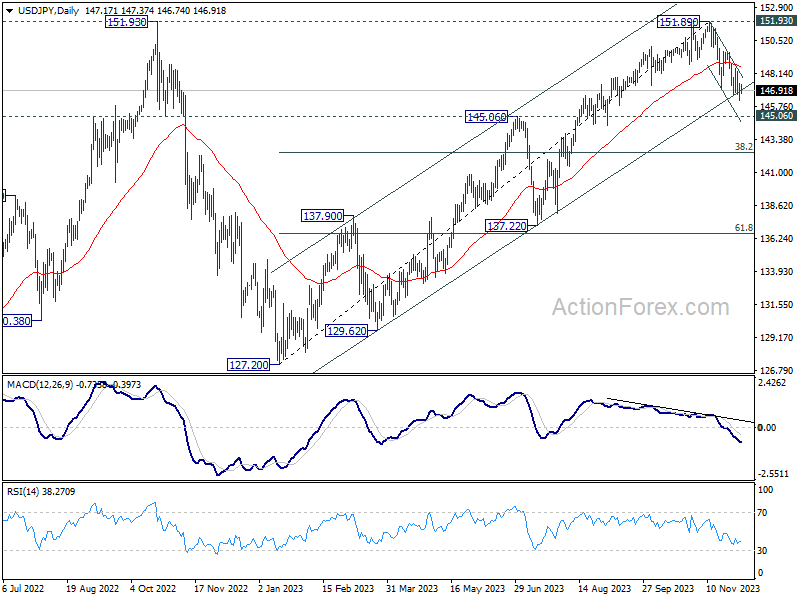
Intraday bias in USD/JPY is turned neutral with current recovery, but further decline is expected with 148.50 resistance intact. Break of 146.22 will resume the fall from 151.89 to 145.06 key support level.
In the bigger picture, rise from 127.20 (2023 low) is seen as the second leg of the pattern from 151.93 (2022 high). Decisive break of 145.06 resistance turned support will confirm that this second leg has completed, after rejection by 151.93. Deeper fall would be seen through 38.2% retracement of 127.20 to 151.89 at 142.45 to 61.8% retracement at 136.63. Nevertheless strong bounce from 145.06 will retain medium term bullishness for another test on 151.93 at a later stage.
USD/CAD Daily Outlook
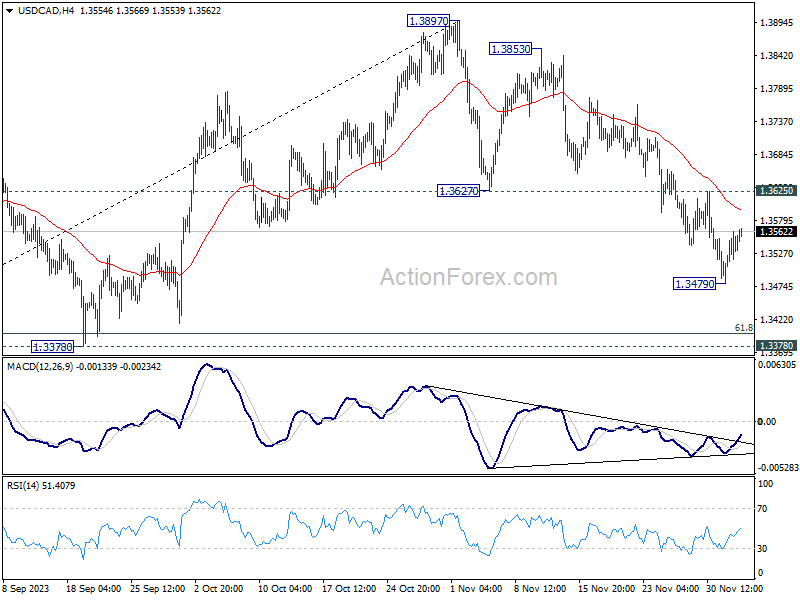
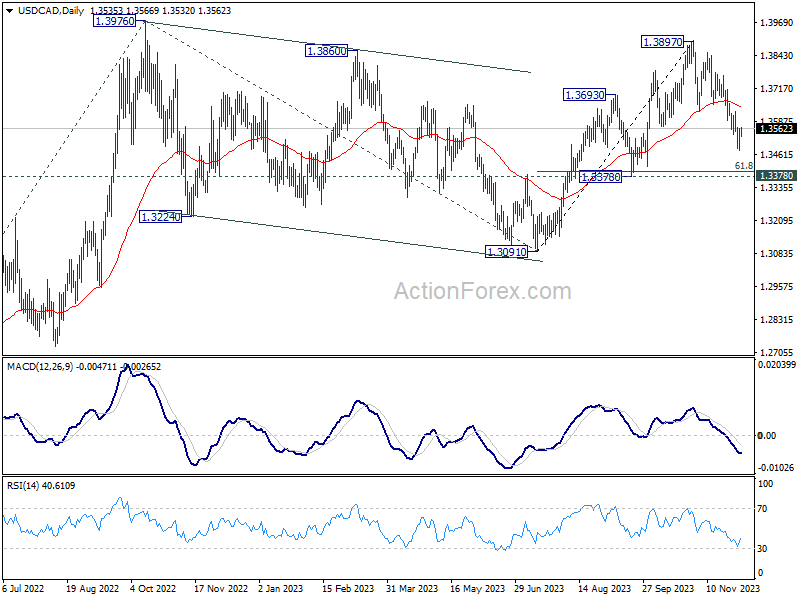
Daily Pivots: (S1) 1.3491; (P) 1.3526; (R1) 1.3573; More...
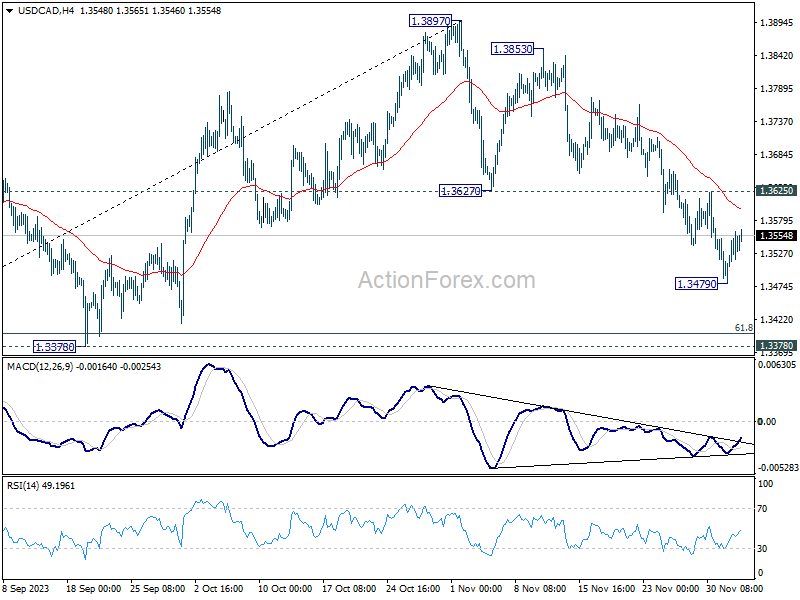
Intraday bias in USD/CAD remains neutral for the moment. Below 1.3479 will resume the corrective fall from 1.3897. But downside should be seen from 1.3378 support, which is close to 61.8% retracement of 1.3091 to 1.3897 at 1.3399, to bring rebound. On the upside, break of 1.3625 resistance will indicate short term bottoming, and turn bias back to the upside for stronger rise.
In the bigger picture, rise from 1.3091 is seen as the fifth leg of the whole rise from 1.2005 (2021 low). Further rally is expected as long as 1.3378 support holds, to 61.8% projection of 1.2401 to 1.3976 from 1.3091 at 1.4064. However, decisive break of 1.3378 will dampen this view and bring deeper fall back to 1.3091 instead.
EUR/USD: Bears Tighten Grip and Crack Pivotal Supports
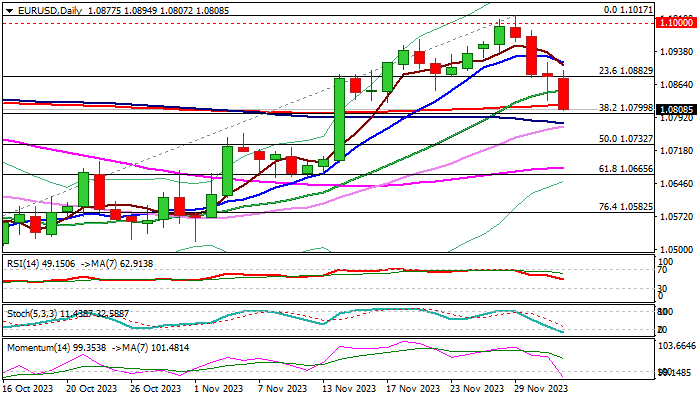
Bears returned fully to game on Monday after Friday’s brief pause on Fed Powell’s remarks, pushing the Euro to the lowest in three weeks.
The pair slid over 0.5% until mid-US session and cracked pivotal support at 1.0818 (200DMA), looking for a bearish signal on firm break, which will be confirmed on extension and close below nearby Fibo support at 1.0799 (38.2% of 1.0448/1.1017).
Loss of these supports will add to signals of reversal pattern which is forming on daily chart and open way for deeper drop through 100DMA (1.0778) towards 1.0737 (50% retracement and 1.0700 (round-figure).
Negative momentum is strengthening on daily chart and supports the action, however, MA’s are in mixed setup and oversold stochastic warns that bears may take a breather soon.
Limited upticks should provide better levels to re-enter bearish market, with 20DMA (1.0846) offering initial resistance and broken Fibo 23.6% (1.0882) to cap and keep bears in play.
Res: 1.0818; 1.0846; 1.0882; 1.0912
Sup: 1.0799; 1.0778; 1.0737; 1.0700
Financial Markets Were Feeling Hangover From November Rally
US yields rebounded and major indices sold off yesterday as markets have priced in a beyond-reasonable amount of rate cuts from the Federal Reserve (Fed) for next year based on a soft-landing scenario. All eyes are on the US jobs data for some comfort… that may or may not come.
Hangover
Financial markets were feeling the hangover from the November rally yesterday. The week kicked off with a downside correction in many stock and bond markets, whereas the bigger than expected slump in US factory orders, soft growth in British retail sales amid the Black Friday discounts failed to boost sales, and an unexpected fall in Australian company profits last quarter could’ve further boosted the central bank doves and the rate cut bets around the globe. But they didn’t’. The US 2-year yield jumped to 4.66% level as the 10-year yield rebounded to 4.30% on awakening that the Fed rate cut bets may have gone a bit too far, and that it was – maybe time for a correction. As such, the S&P500 gave back some field close to a ytd high level and we saw a bigger selloff in rate-sensitive Nasdaq – which lost 1% yesterday. Stocks in Europe retreated as well, but they first advanced to a fresh high since summer before Americans came to hammer sentiment.
In the FX, the US dollar jumped past its 200-DMA, and in metals, the ounce of gold saw a more than $100 selloff after hitting an ATH on Monday’s open. The kneejerk reaction of the market to yesterday’s gold rally was so violent that it made me think twice about the potential of a significant rise in gold prices in the short run above the $2000 level. Gold’s value is negatively correlated to the US yields as gold doesn’t pay interest. Therefore, if the US yields continue to fall, there will be a natural appetite for holding gold. But if yields go up – which is my base case scenario after such a rapid and significant fall in November, then the cost of holding the non-interest-bearing gold will increase, and its value should decrease.
Data watch
Investors don’t have much time to think of the past and make digestive trades. We will have a flow of new and important economic data – including the US jobs data - which will help the market find fresh direction. Either soft data will cement the Fed rate cut bets or robust data will inject uncertainty and volatility to the market. In this context, the JOLTS data is expected to show lesser job additions in the US in October. But note that the US jobs market was impacted by strikes last month, last month’s negative impact could turn out to be positive for this month, and the latter could eventually blur the visibility of the health of the US jobs market.
Presently, the markets price in around 125bp cut from the Fed next year, that’s obviously significantly lower than where the Fed sees its rate by the end of next year. The Fed optimism looks overstretched, the risk assets were in the overbought territory until yesterday, and we need sufficiently soft US data to keep the bears asleep, otherwise a gust of hot wind could easily rouse the bear from its slumber.
Elsewhere
The Reserve Bank of Australia (RBA) kept its policy rate unchanged at today’s meeting and warned that more tightening could be needed depending on the data. Governor Michelle Bullock says that Australian inflation becomes more ‘home-grown’ than supply chain related, and if inflation remains sticky, more rate hikes could be in the pipeline for Australians. Yes, but we already knew that the RBA would sound reasonably hawkish, so the AUDUSD couldn’t benefit from the RBA’s hawkish accompanying statement, the pair fell on a broad-based rebound in the US dollar, instead. The USDJPY remained offered at the 100-DMA despite a softer than expected inflation read in Tokyo and a disappointing sales of the 10-year JGBs. The EURUSD on the other hand tipped a toe below its 200-DMA and tested the 1.08 support to the downside yesterday. The easing Eurozone inflation, along with slowing European economies boost the dovish European Central Bank (ECB) expectations. Today, Eurozone’s October PPI and final services PMI data should print a further decline in producer price inflation and a continued contraction in activity in the zone, as the Eurozone GDP read – due Thursday – will likely confirm a 0.1% contraction last quarter. The EURUSD sees support near 1.0800/1.0820, which includes the 200-DMA and the major 38.2% Fibonacci retracement on October – November rebound. But clearing this support – which shouldn’t be a big deal if the US dollar further corrects - should pave the way for an extended selloff toward 1.0730.
Whatever
The selloff in crude oil continues. The barrel of US crude just slipped below the $73pb level this morning, as oil bears totally ignored the Saudi Energy Minister Abdulaziz bin Salman’s warning that production cuts can ‘absolutely’ continue past Q1 if needed. At this point, OPEC had better wait for the dust to settle. Not seeing reaction to threats is worse than watching prices go down. Prospects of slower global economy will likely help the oil bears hit their $70pb target in the continuation of a solidly building negative trend.
AUD/USD Daily Report
Daily Pivots: (S1) 0.6586; (P) 0.6639; (R1) 0.6672; More...
AUD/USD dips notably today but stays above 0.6570 support so far. Intraday bias remains neutral first. On the upside, sustained break of channel resistance (now at 0.6651) will argue that whole decline from 0.7156 has completed with three waves down to 0.6269. Further rally should then be seen to 0.6894 resistance for confirmation. However, break of 0.6570 support will indicate rejection by the channel and turn bias back to the downside for 55 D EMA (now at 0.6482) instead.
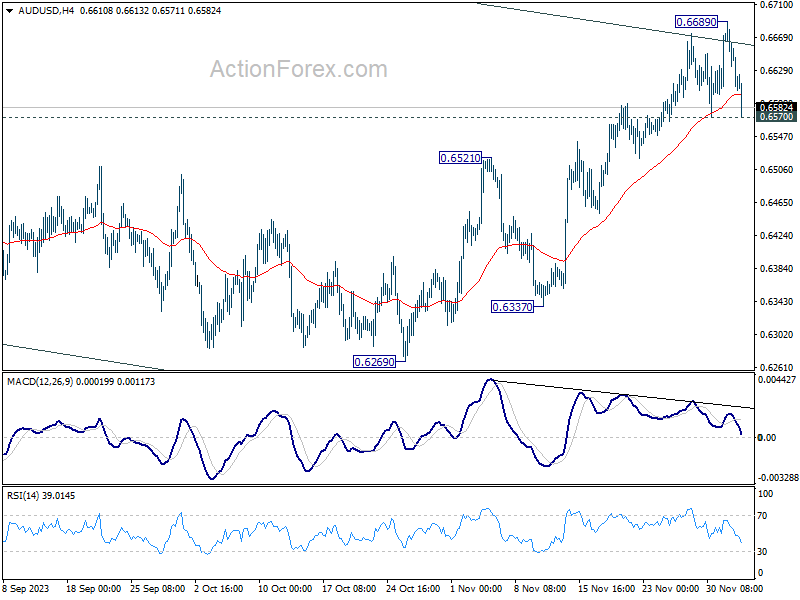
In the bigger picture, there is no confirmation that down trend from 0.8006 (2021 high) has completed. price actions from 0.6169 (2022 low) could be just a medium term corrective pattern, with rise from 0.6269 as the third leg. For now, range trading should be seen between 0.6169 and 0.7156 (2023 high), until further developments.
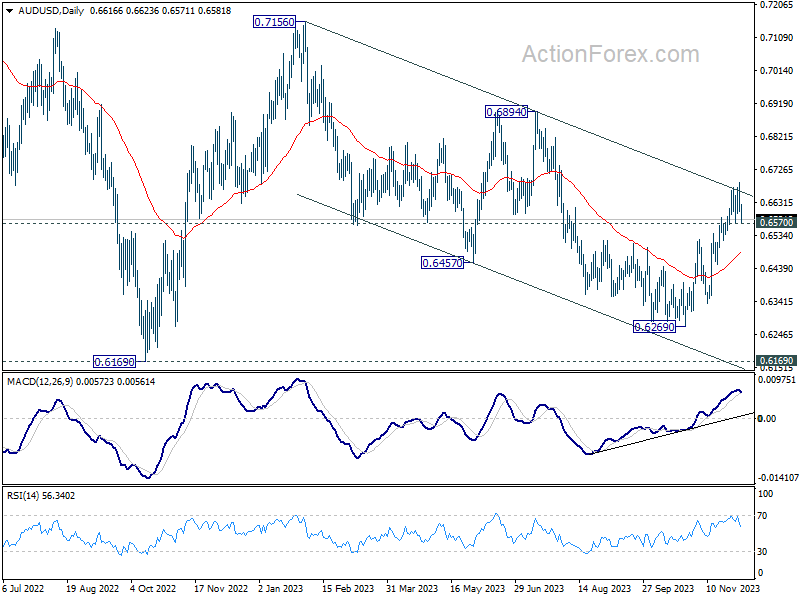
Aussie Dips Following RBA, With Loonie and Kiwi Also Impacted by Risk Aversion
Today's Asian session saw broad decline in Australian Dollar, along with New Zealand and Canadian Dollars. This pattern suggests a shift towards risk aversion among investors, a sentiment echoed by the performance of major Asian stock indexes. Hong Kong stocks, in particular, continued their recent down trend, reaching new lows due to disappointing earnings results from some large Chinese companies. Japan's Nikkei index also hit a three-week low, largely impacted by falling chipmaker stocks.
RBA's decision to maintain its interest rate unchanged was in line with market expectations. Despite this, the statement was interpreted as less hawkish than some market analysts anticipated. However, prior to the meeting, it was largely understood that RBA would await Q4 inflation data, scheduled for release in January, before contemplating its next move in February. Thus, RBA's stance of data-dependency and openness to future rate hikes was not an entirely new revelation. Nonetheless, the Australian Dollar is currently underperforming even compared to other commodity-linked currencies.
In other areas of the currency markets, Dollar, Euro, and Japanese Yen are showing relative strength. But Yen's progress is somewhat tempered by lower-than-expected inflation figure from Tokyo. Dollar is also facing challenges in sustaining its near-term rebound. Market focus is now shifting towards the upcoming US ISM Services PMI, which is expected to introduce some volatility. However, traders may hold off on larger bets until Friday's non-farm payroll report.
Technically, USD/CAD is recovering mildly after edging lower to 1.3479 yesterday. Fall from 1.3897 is seen as a corrective move only. While another fall cannot be ruled out yet, bullish convergence condition in 4H MACD suggest that downside should be contained by 1.3378 support, at least on first attempt. Meanwhile, break of 1.3625 resistance will argue that the correction has completed and bring stronger rebound. With key economic events like ISM services data, BoC's rate decision, and US non-farm payroll report on the horizon, the direction of USD/CAD is likely to become clearer very soon.
In Asia, at the time of writing, Nikkei is down -1.20%. Hong Kong HSI is down -1.44%. China Shanghai SSE is down -0.67%. Singapore Strait Times is down -0.28%. Japan 10-year JGB yield is down -0.0040 at 0.687. Overnight, DOW fell -0.11%. S&P 500 fell -0.54%. NASDAQ fell -0.85%. 10-year yield rose 0.062 to 4.288.
RBA holds rates following sparse information since last meeting
RBA kept its cash rate target unchanged at 4.35%, aligning with market expectations. The central bank's latest statement indicates continued openness to further rate hikes, but emphasizes that any such decision "will depend upon the data and the evolving assessment of risks." This stance reflects a careful approach, as RBA awaits more comprehensive data, particularly the Q4 inflation figures due in January, before its next meeting in early February.
In its review of the "limited information" available since November meeting, RBA acknowledged that the data were "broadly in line with expectations." The October monthly CPI update suggested continued moderation in inflation, but did not provide substantial insights into services inflation. While wage growth accelerated in Q3, it is "not expected to increase much further". The labor market conditions are seen as "continuing to ease gradually," though they remain tight.
RBA also highlighted "still significant uncertainties" regarding the economic outlook. It pointed out the potential for persistent services inflation in Australia. Domestically, the uncertainties include the lag effects of monetary policy and household consumption patterns. On a global scale, the ongoing uncertainty around Chinese economy's trajectory and the broader implications of international conflicts were noted as significant factors influencing Australia's economic environment.
Japan's Tokyo CPI core slows to 2.3% yoy in Nov, core-core still stick at 3.6% yoy
November's inflation data in Japan's capital Tokyo shows a notable slowdown. CPI core, which excludes fresh food, dropped from 2.7% yoy to 2.3% yoy, falling slightly below the expected 2.4%. This decline brings the reading further towards BoJ target of 2%.
Headline CPI also experienced a decrease, falling back to 2.6% yoy. This reduction comes after an unexpected rise from 2.8% yoy in September to 3.2% yoy in October.
Furthermore, CPI core-core, which excludes both food and energy, showed some progress. It declined from 3.8% yoy to 3.6% yoy, a reduction from its peak of 4.0% seen in July and August. However, the still relatively high CPI core-core reading indicates that underlying inflationary pressures remain persistent within the economy, despite the overall slowdown.
Japan's PMI services finalized at 50.8, weakening in a year of strong growth
Japan's PMI Services for November was finalized at 50.8, down from October's 51.6, marking the weakest reading since November 2022. PMI Composite also fell to 49.6, down from 50.5 in the previous month, indicating the first contraction since December 2022.
Trevor Balchin, Economics Director at S&P Global Market Intelligence, contextualized these numbers, stating, "November data signalled a further loss of momentum in the services sector, but this should be viewed in the context of a year of strong growth." He highlighted that Business Activity Index for 2023 is trending at 53.7, the highest annual reading since the survey's inception in 2007.
Balchin also pointed out several positive aspects in the latest survey. The rise in new business, sustained employment growth, and the increase in outstanding work indicate ongoing economic activity. Furthermore, the 12-month outlook for activity improved and was "among the strongest on record". Despite these optimistic signs, price pressures in November eased but remained above long-term trends.
China's PMI services rose to 51.5 in Nov, composite rose to 51.6
China's Caixin PMI Services rose from 50.4 to 51.5 in November, above expectation of 50.8. PMI Composite rose from 50.0 to 51.6.
Wang Zhe, Senior Economist at Caixin Insight Group said: "Overall, the macroeconomy showed signs of a positive recovery, with steady growth in consumer spending, solid progress in industrial production and improved market expectations.
"However, due to various unfavorable factors, both domestic and external demand still face challenges and employment pressures remain relatively high. The foundation for economic recovery needs to be further consolidated."
Looking ahead
France industrial production, Eurozone PMI services final and PPI, UK PMI services final will be released in European session. Later in the day, US ISM services is the main focus.
AUD/USD Daily Report
Daily Pivots: (S1) 0.6586; (P) 0.6639; (R1) 0.6672; More...
AUD/USD dips notably today but stays above 0.6570 support so far. Intraday bias remains neutral first. On the upside, sustained break of channel resistance (now at 0.6651) will argue that whole decline from 0.7156 has completed with three waves down to 0.6269. Further rally should then be seen to 0.6894 resistance for confirmation. However, break of 0.6570 support will indicate rejection by the channel and turn bias back to the downside for 55 D EMA (now at 0.6482) instead.
In the bigger picture, there is no confirmation that down trend from 0.8006 (2021 high) has completed. price actions from 0.6169 (2022 low) could be just a medium term corrective pattern, with rise from 0.6269 as the third leg. For now, range trading should be seen between 0.6169 and 0.7156 (2023 high), until further developments.
Economic Indicators Update
| GMT | Ccy | Events | Actual | Forecast | Previous | Revised |
|---|---|---|---|---|---|---|
| 23:30 | JPY | Tokyo CPI Y/Y Nov | 2.60% | 3.30% | 3.20% | |
| 23:30 | JPY | Tokyo CPI ex Fresh Food Y/Y Nov | 2.30% | 2.40% | 2.70% | |
| 23:30 | JPY | Tokyo CPI ex Food Energy Y/Y Nov | 3.60% | 3.80% | ||
| 00:30 | AUD | Current Account (AUD) Q3 | -0.2B | 3.5B | 7.7B | 7.8B |
| 01:45 | CNY | Caixin Services PMI Nov | 51.5 | 50.8 | 50.4 | |
| 03:30 | AUD | RBA Interest Rate Decision | 4.35% | 4.35% | 4.35% | |
| 07:45 | EUR | France Industrial Output M/M Oct | -0.20% | -0.50% | ||
| 08:45 | EUR | Italy Services PMI Nov | 48.2 | 47.7 | ||
| 08:50 | EUR | France Services PMI Nov F | 45.3 | 45.3 | ||
| 08:55 | EUR | Germany Services PMI Nov F | 48.7 | 48.7 | ||
| 09:00 | EUR | Eurozone Services PMI Nov F | 48.2 | 48.2 | ||
| 09:30 | GBP | Services PMI Nov F | 50.5 | 50.5 | ||
| 10:00 | EUR | Eurozone PPI M/M Oct | 0.20% | 0.50% | ||
| 10:00 | EUR | Eurozone PPI Y/Y Oct | -9.40% | -12.40% | ||
| 14:45 | USD | Services PMI Nov F | 50.8 | 50.8 | ||
| 15:00 | USD | ISM Services PMI Nov | 52.6 | 51.8 |