Sample Category Title
USD/CHF Mid-Day Outlook
Daily Pivots: (S1) 0.8678; (P) 0.8717; (R1) 0.8766; More....
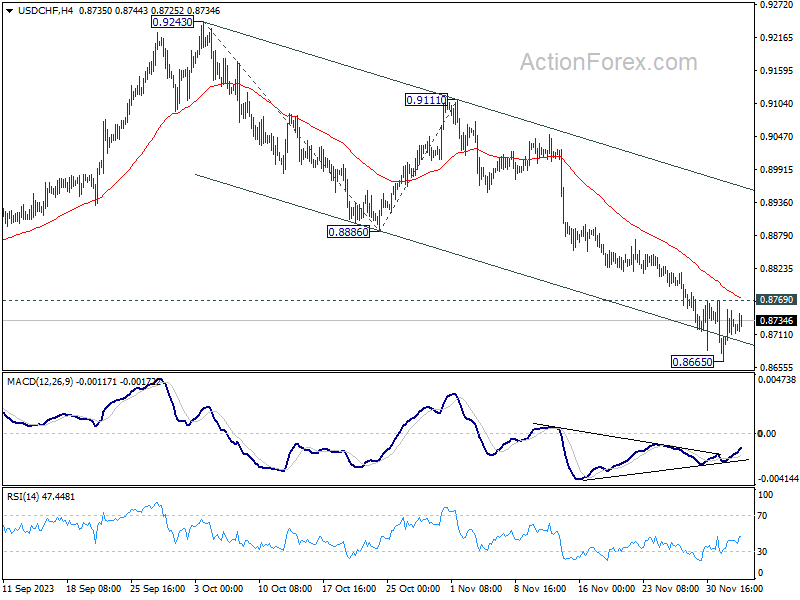
Intraday bias in USD/CHF stays neutral and outlook is unchanged. Another fall is in favor as long as 0.8769 minor resistance holds. Below 0.8665 will resume the decline from 0.9243 to 161.8% projection of 0.9243 to 0.8886 from 0.9111 at 0.8533, which is close to 0.8551 low. However, break of 0.8769 minor resistance should indicate short term bottoming, and turn bias back to the upside for stronger recovery to 0.8886 support turned resistance.
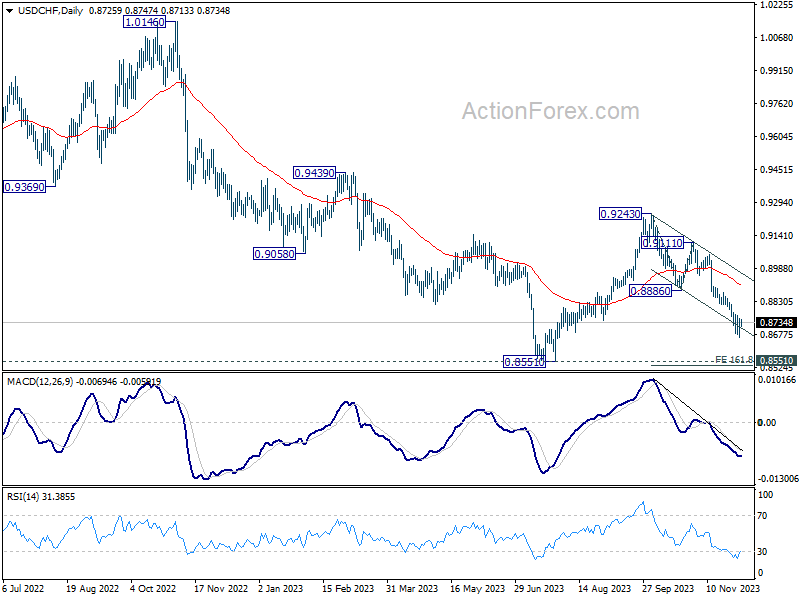
In the bigger picture, price actions from 0.8551 are currently seen as part of a corrective pattern to the decline from 1.0146 (2022 high). Fall from 0.9243 is seen as the second leg for now. Deeper decline could be seen to 0.8551 low but strong support should be seen there to bring rebound. For now, this will remain the favored case as long as 0.8886 support turned resistance holds.
GBP/USD Mid-Day Outlook
Daily Pivots: (S1) 1.2582; (P) 1.2654; (R1) 1.2703; More...
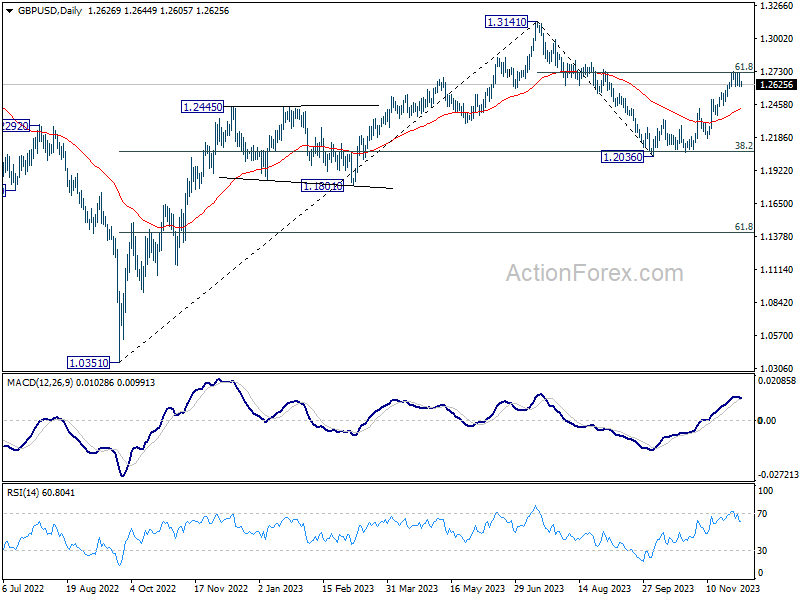
GBP/USD is still bounded in range of 1.2590/2731 and intraday bias remains neutral. On the upside, decisive break of 1.2731 will resume the rally from 1.2036 for retesting 1.3141 high next. However, firm break of 1.2590 will confirm short term topping, and turn bias back to the downside for deeper pullback to 55 D EMA (now at 1.24328).
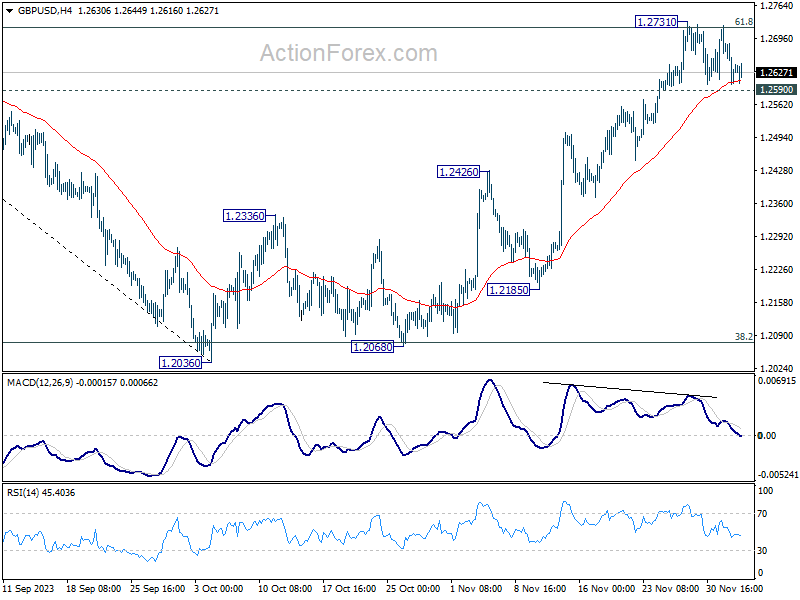
In the bigger picture, price actions from 1.3141 are seen as a corrective pattern to rise from 1.0351 (2022 low). Strong rebound from 38.2% retracement of 1.0351 (2022 low) to 1.3141 at 1.2075 suggests that current rise from 1.2036 is already the second leg. However, while further rally could be seen, upside should be limited by 1.3141 to bring the third leg of the pattern.
EUR/USD Mid-Day Outlook
Daily Pivots: (S1) 1.0795; (P) 1.0845; (R1) 1.0886; More...
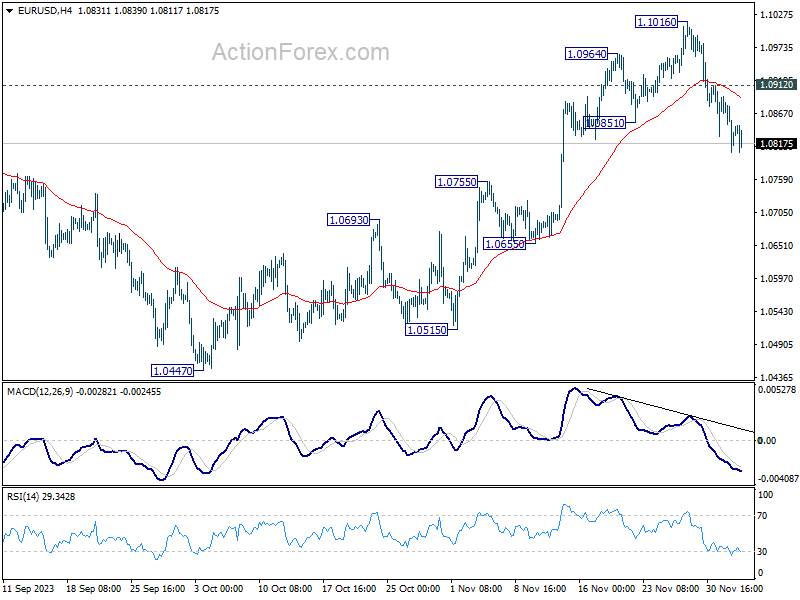
EUR/USD's fall from 1.1016 is still in progress and intraday bias remains on the downside. Next target is 55 D EMA (now at 1.0770. Sustained break there will target 1.0447 support next. On the upside, above 1.0912 minor resistance will turn intraday bias neutral again first. Further break of 1.1016 will resume the rise from 1.0447 to retest 1.1274 high instead.
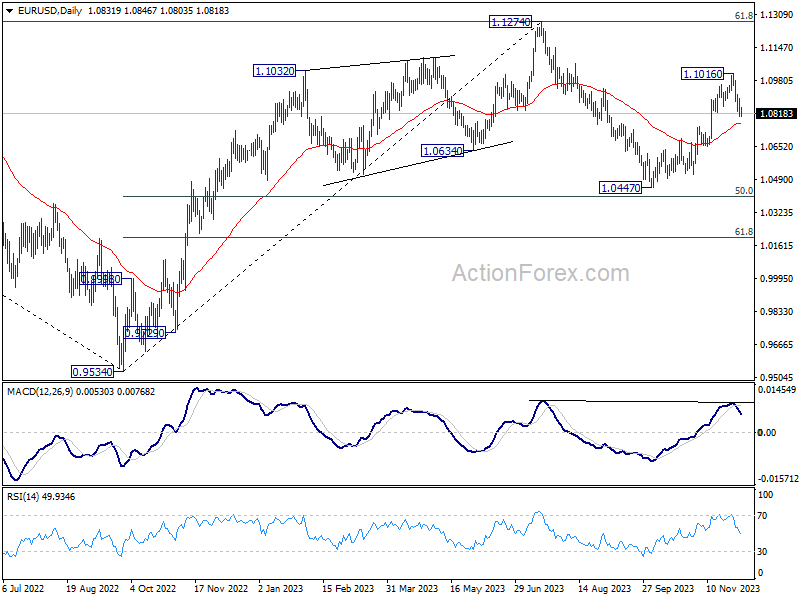
In the bigger picture, price actions from 1.1274 are viewed as a corrective pattern to rise from 0.9534 (2022 low). Rise from 1.0447 is tentatively seen as the second leg. Hence while further rally could be seen, upside should be limited by 1.1274 to bring the third leg of the pattern. Meanwhile, sustained break of 55 D EMA will argue that the third leg has already started for 1.0447 and below.
Moody’s Downgrade on China Weighs on Commodity Currencies, AUD Leads Decline
Commodity currencies, particularly Australian Dollar, are experiencing notable selling pressure today. However, it should be noted that European investor sentiment, while not explicitly full-blown risk-on, clearly lacks the typical features of risk aversion. In the US, futures markets are just slightly down, indicating a cautious rather than outright negative sentiment among traders. This subdued response across markets suggests that investors are not engaging in widespread risk aversion but are instead selectively cautious.
A key factor influencing market sentiment is the today's decision by Moody's to downgrade its outlook on China's government credit ratings from stable to negative. This adjustment reflects increasing expectations that the Chinese government will be compelled to provide additional financial support to heavily indebted local governments and state-owned enterprises. According to Moody's, this necessity poses significant risks to China's overall fiscal, economic, and institutional integrity. The statement from Moody's emphasizes concerns about "structurally and persistently lower medium-term economic growth" and challenges within China's property sector, indicating broader economic issues that could impact global markets.
In other currency markets, Yen and Dollar are emerging as stronger contenders, followed by Sterling and Swiss Franc. Euro is trailing behind its European counterparts, especially after dovish remarks fro a know hawk ECB Executive Board member Isabel Schnabel.
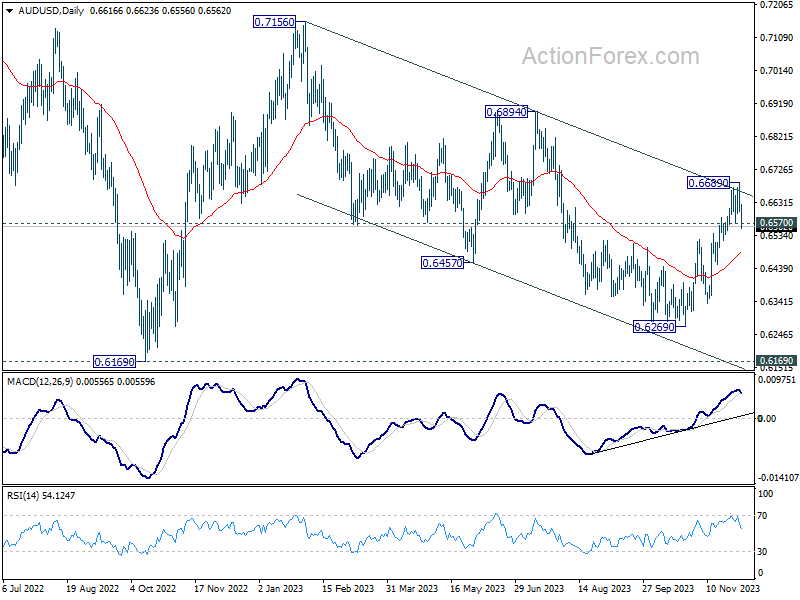
Technically, AUD/USD's break of 0.6570 support today indicates first rejection by medium term channel resistance from 0.7156. It's still early to conclude if the rise from 0.6269 has completed. But deeper fall is now in favor back to 55 D EMA (now at 0.6482). Sustained break there will argue that the whole fall from 0.7156 is still in progress for another low. Nevertheless, strong bounce from the EMA will keep the bullish scenario alive, that is, fall from 0.7156 has completed as a correction with three waves down to 0.6269.
In Europe, at the time of writing, FTSE is down -0.50%. DAX is up 0.26%. CAC is up 0.33%. Germany 10-year yield is down -0.0070 at 2.289. Earlier in Asia, Nikkei fell -1.37%. Hong Kong HSI fell -1.91%. China Shanghai SSE fell -1.67%. Singapore Strait Times fell -0.22%. Japan 10-year JGB yield fell -0.0179 to 0.673.
ECB's Schnabel: Another rate hike now rather unlikely
In an interview with Reuters, ECB Executive Board member Isabel Schnabel remarked that the slowdown to 2.4% in Eurozone's November flash CPI a "very pleasant surprise." More importantly, that made "further rate increase rather unlikely".
Schnabel emphasized the significance of the decline in "underlying inflation", which has proven "more stubborn", is now also "falling more quickly than we had expected". Such trends have bolstered her confidence in achieving ECB's 2% inflation target no later than 2025.
However, she cautioned against premature victory declarations over inflation, expecting some upticks in the coming months due to fiscal changes and base effects, and not ruling out potential new spikes in energy or food prices.
On the growth front, Schnabel acknowledged mixed signals. While some hard data points are concerning, softer indicators, like PMI, are showing signs of stabilization and are "giving us hope."
She forecasts a gradual uptick in growth next year, driven by rising real incomes, which should boost confidence and consumption. Regarding the labor market, she noted some softening but does not anticipate a significant deterioration or a deep, prolonged recession.
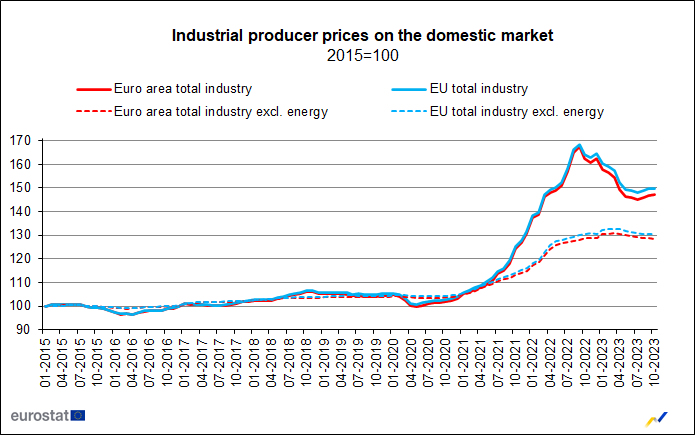
Eurozone PPI at 0.2% mom, -9.4% yoy in Nov, matches expectations
Eurozone PPI came in at 0.2% mom, -9.4% yoy in November, matched expectations. For the month, industrial producer prices increased by 1.0% mom in the energy sector and by 0.1% mom for durable consumer goods, while prices remained stable for capital goods, and prices decreased by -0.1% mom for non-durable consumer goods and by -0.3% mom for intermediate goods. Prices in total industry excluding energy decreased by -0.2% mom.
EU PPI was at 0.2% mom, -8.7% yoy. The biggest monthly increases in industrial producer prices were observed in Ireland (+4.9%), Italy (+2.2%) and the Netherlands (+0.7%), while the largest decreases were recorded in Luxembourg (-3.7%), Latvia (-2.7%) and Greece (-1.9%).
Eurozone PMI composite finalized at 47.5, on the brink of recession
Eurozone's PMI Services for November showed a slight improvement, finalizing at 48.7, up from 47.8 in October. PMI Composite also experienced an uptick, reaching 47.5 from the previous month's 46.5.
Looking at individual member states, PMI composite revealed mixed results. Ireland registered a three-month high at 52.3, while Spain hit a three-month low at 49.8. Italy reported a two-month high at 48.1, and Germany saw a four-month high at 47.8. France remained unchanged, with its PMI holding steady at 44.6.
Cyrus de la Rubia, Chief Economist at Hamburg Commercial Bank, stated, "The service sector maintained its downward slide in November." He noted that the modest improvement in the activity index offers little optimism for a swift recovery in the immediate future. De la Rubia also highlighted concerning trends, such as the fifth consecutive monthly decline in new business and subdued business expectations, which remain "well below the long-term average."
Outlook for Eurozone's economy, as inferred from these PMI indicators, is not encouraging. De la Rubia mentioned, "As per our GDP nowcast, factoring in the latest PMI indicators, a fall in GDP is on the cards for the fourth quarter." He warned that if two consecutive quarters of negative growth define a recession, the Eurozone is currently "on the brink" of one.
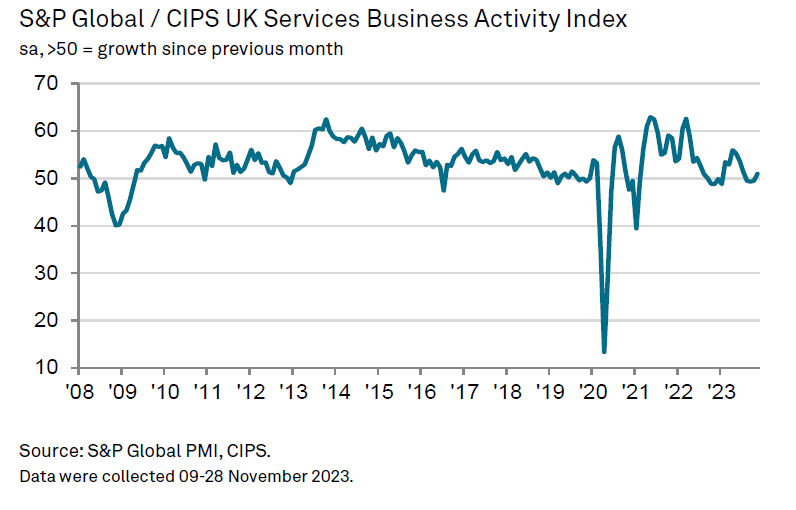
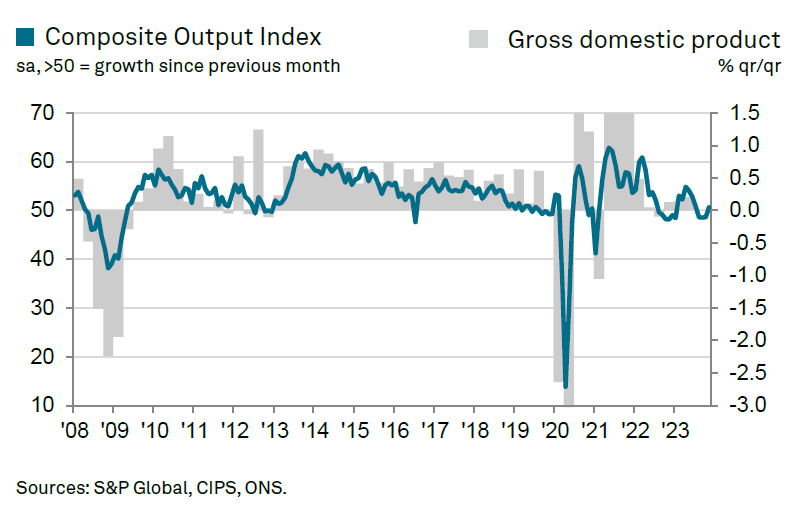
UK PMI services finalized at 50.9, composite at 50.7
UK's PMI Services for November improved to 50.9 from October's 49.5, indicating expansion for the first time in four months. PMI Composite also rose to 50.7, crossing the critical 50 mark for the first time since July.
Tim Moore of S&P Global Market Intelligence remarked on the positive shift: "UK service providers moved back into expansion mode" However, he cautioned about inflation, noting "another round of strong input cost pressures" mainly due to rising staff wages. This improvement in the service sector, although positive, is shadowed by ongoing inflationary challenges.
RBA holds rates following sparse information since last meeting
RBA kept its cash rate target unchanged at 4.35%, aligning with market expectations. The central bank's latest statement indicates continued openness to further rate hikes, but emphasizes that any such decision "will depend upon the data and the evolving assessment of risks." This stance reflects a careful approach, as RBA awaits more comprehensive data, particularly the Q4 inflation figures due in January, before its next meeting in early February.
In its review of the "limited information" available since November meeting, RBA acknowledged that the data were "broadly in line with expectations." The October monthly CPI update suggested continued moderation in inflation, but did not provide substantial insights into services inflation. While wage growth accelerated in Q3, it is "not expected to increase much further". The labor market conditions are seen as "continuing to ease gradually," though they remain tight.
RBA also highlighted "still significant uncertainties" regarding the economic outlook. It pointed out the potential for persistent services inflation in Australia. Domestically, the uncertainties include the lag effects of monetary policy and household consumption patterns. On a global scale, the ongoing uncertainty around Chinese economy's trajectory and the broader implications of international conflicts were noted as significant factors influencing Australia's economic environment.
Japan's Tokyo CPI core slows to 2.3% yoy in Nov, core-core still stick at 3.6% yoy
November's inflation data in Japan's capital Tokyo shows a notable slowdown. CPI core, which excludes fresh food, dropped from 2.7% yoy to 2.3% yoy, falling slightly below the expected 2.4%. This decline brings the reading further towards BoJ target of 2%.
Headline CPI also experienced a decrease, falling back to 2.6% yoy. This reduction comes after an unexpected rise from 2.8% yoy in September to 3.2% yoy in October.
Furthermore, CPI core-core, which excludes both food and energy, showed some progress. It declined from 3.8% yoy to 3.6% yoy, a reduction from its peak of 4.0% seen in July and August. However, the still relatively high CPI core-core reading indicates that underlying inflationary pressures remain persistent within the economy, despite the overall slowdown.
Japan's PMI services finalized at 50.8, weakening in a year of strong growth
Japan's PMI Services for November was finalized at 50.8, down from October's 51.6, marking the weakest reading since November 2022. PMI Composite also fell to 49.6, down from 50.5 in the previous month, indicating the first contraction since December 2022.
Trevor Balchin, Economics Director at S&P Global Market Intelligence, contextualized these numbers, stating, "November data signalled a further loss of momentum in the services sector, but this should be viewed in the context of a year of strong growth." He highlighted that Business Activity Index for 2023 is trending at 53.7, the highest annual reading since the survey's inception in 2007.
Balchin also pointed out several positive aspects in the latest survey. The rise in new business, sustained employment growth, and the increase in outstanding work indicate ongoing economic activity. Furthermore, the 12-month outlook for activity improved and was "among the strongest on record". Despite these optimistic signs, price pressures in November eased but remained above long-term trends.
China's PMI services rose to 51.5 in Nov, composite rose to 51.6
China's Caixin PMI Services rose from 50.4 to 51.5 in November, above expectation of 50.8. PMI Composite rose from 50.0 to 51.6.
Wang Zhe, Senior Economist at Caixin Insight Group said: "Overall, the macroeconomy showed signs of a positive recovery, with steady growth in consumer spending, solid progress in industrial production and improved market expectations.
"However, due to various unfavorable factors, both domestic and external demand still face challenges and employment pressures remain relatively high. The foundation for economic recovery needs to be further consolidated."
EUR/USD Mid-Day Outlook
Daily Pivots: (S1) 1.0795; (P) 1.0845; (R1) 1.0886; More...
EUR/USD's fall from 1.1016 is still in progress and intraday bias remains on the downside. Next target is 55 D EMA (now at 1.0770. Sustained break there will target 1.0447 support next. On the upside, above 1.0912 minor resistance will turn intraday bias neutral again first. Further break of 1.1016 will resume the rise from 1.0447 to retest 1.1274 high instead.
In the bigger picture, price actions from 1.1274 are viewed as a corrective pattern to rise from 0.9534 (2022 low). Rise from 1.0447 is tentatively seen as the second leg. Hence while further rally could be seen, upside should be limited by 1.1274 to bring the third leg of the pattern. Meanwhile, sustained break of 55 D EMA will argue that the third leg has already started for 1.0447 and below.
Economic Indicators Update
| GMT | Ccy | Events | Actual | Forecast | Previous | Revised |
|---|---|---|---|---|---|---|
| 23:30 | JPY | Tokyo CPI Y/Y Nov | 2.60% | 3.30% | 3.20% | |
| 23:30 | JPY | Tokyo CPI ex Fresh Food Y/Y Nov | 2.30% | 2.40% | 2.70% | |
| 23:30 | JPY | Tokyo CPI ex Food Energy Y/Y Nov | 3.60% | 3.80% | ||
| 00:30 | AUD | Current Account (AUD) Q3 | -0.2B | 3.5B | 7.7B | 7.8B |
| 01:45 | CNY | Caixin Services PMI Nov | 51.5 | 50.8 | 50.4 | |
| 03:30 | AUD | RBA Interest Rate Decision | 4.35% | 4.35% | 4.35% | |
| 07:45 | EUR | France Industrial Output M/M Oct | -0.30% | -0.20% | -0.50% | -0.60% |
| 08:45 | EUR | Italy Services PMI Nov | 49.5 | 48.2 | 47.7 | |
| 08:50 | EUR | France Services PMI Nov F | 45.4 | 45.3 | 45.3 | |
| 08:55 | EUR | Germany Services PMI Nov F | 49.6 | 48.7 | 48.7 | |
| 09:00 | EUR | Eurozone Services PMI Nov F | 48.7 | 48.2 | 48.2 | |
| 09:30 | GBP | Services PMI Nov F | 50.9 | 50.5 | 50.5 | |
| 10:00 | EUR | Eurozone PPI M/M Oct | 0.20% | 0.20% | 0.50% | |
| 10:00 | EUR | Eurozone PPI Y/Y Oct | -9.40% | -9.40% | -12.40% | |
| 14:45 | USD | Services PMI Nov F | 50.8 | 50.8 | ||
| 15:00 | USD | ISM Services PMI Nov | 52.6 | 51.8 |
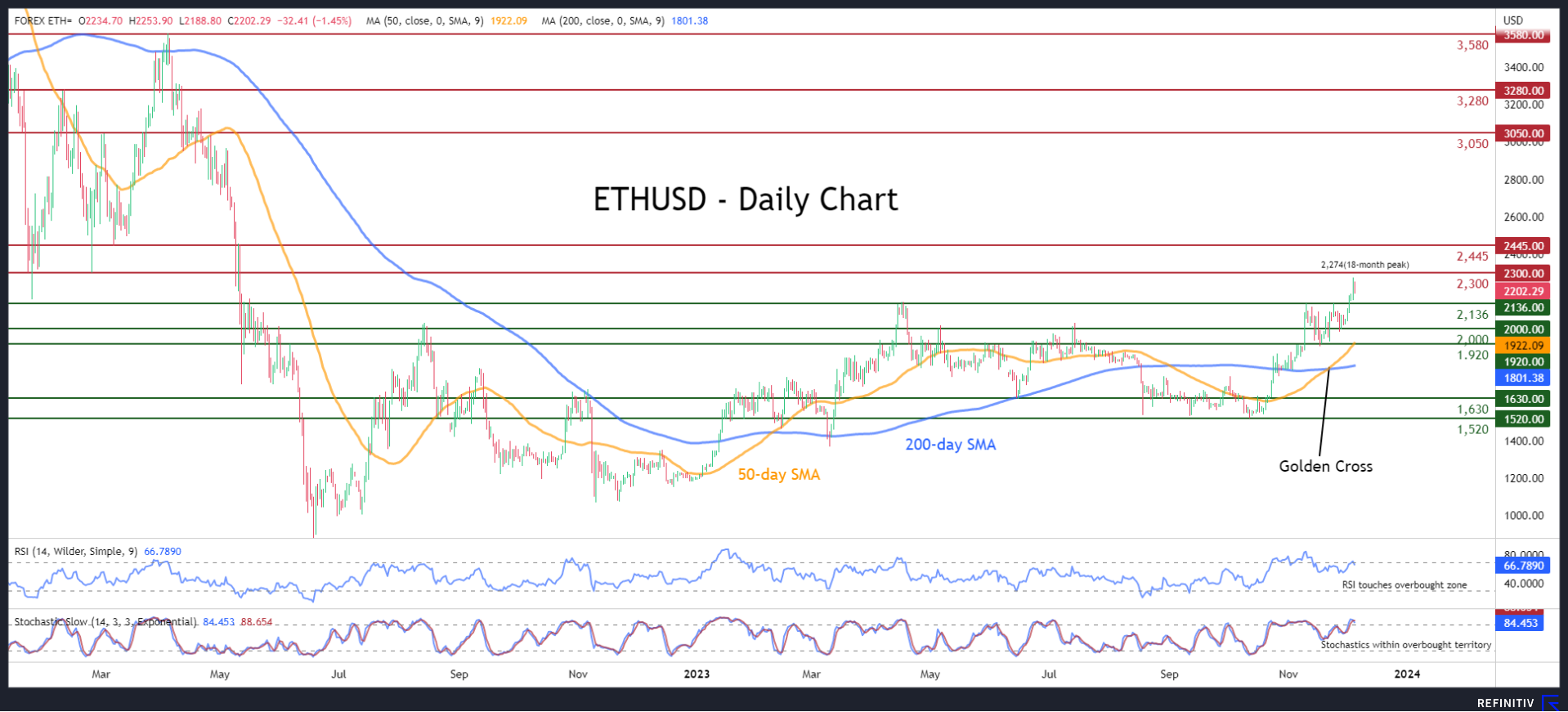
ETHUSD Posts a Fresh 18-month High
- Ethereum jumps to its highest since May 2022
- Advance eases as oscillators point at overbought conditions
ETHUSD (Ethereum) has experienced a strong rally since late October, which propelled the price to a fresh 18-month peak of 2,274 on Monday. However, the uptrend seems to be losing some steam, with both the RSI and stochastics touching their overbought territories.
Should the rally extend, the price could initially test the February 2022 support of 2,300, which could now serve as resistance. Conquering this barricade, the bulls could attack the March 2022 bottom of 2,445. If that barricade also fails, there is no prominent resistance until the March 2022 hurdle of 3,050.
On the flipside, bearish actions could send the price to challenge the November resistance of 2,136, which also held strong in April. Sliding beneath that floor, the leading altcoin could descend towards the 2,000 psychological mark. A break below the latter may pave the way for the November support of 1,920, which overlaps with the 50-day simple moving average (SMA).
Overall, ETHUSD has been constantly gaining ground in the short-term, posting consecutive 2023 highs. Nevertheless, traders should not rule out a pullback as there are emerging signs that the advance has been overstretched.
Eurozone PPI at 0.2% mom, -9.4% yoy in Nov, matches expectations
Eurozone PPI came in at 0.2% mom, -9.4% yoy in November, matched expectations. For the month, industrial producer prices increased by 1.0% mom in the energy sector and by 0.1% mom for durable consumer goods, while prices remained stable for capital goods, and prices decreased by -0.1% mom for non-durable consumer goods and by -0.3% mom for intermediate goods. Prices in total industry excluding energy decreased by -0.2% mom.
EU PPI was at 0.2% mom, -8.7% yoy. The biggest monthly increases in industrial producer prices were observed in Ireland (+4.9%), Italy (+2.2%) and the Netherlands (+0.7%), while the largest decreases were recorded in Luxembourg (-3.7%), Latvia (-2.7%) and Greece (-1.9%).
UK PMI services finalized at 50.9, composite at 50.7
UK's PMI Services for November improved to 50.9 from October's 49.5, indicating expansion for the first time in four months. PMI Composite also rose to 50.7, crossing the critical 50 mark for the first time since July.
Tim Moore of S&P Global Market Intelligence remarked on the positive shift: "UK service providers moved back into expansion mode" However, he cautioned about inflation, noting "another round of strong input cost pressures" mainly due to rising staff wages. This improvement in the service sector, although positive, is shadowed by ongoing inflationary challenges.
Gold Falls from Record High by $100 in 1 Day
The record high of about USD 2,130 an ounce was set just after the weekend in low-liquid Asian markets. By the nature of the movement, it looked more like a cascading triggering of sellers’ stop losses, rather than finding a stable balance between supply and demand, since after the candle with a long upper tail, the quote began to fall. During the European session it fell to 2,060, and during the American session it fell to 2,030. So in less than a day, the price of gold fell about USD 100, making Monday's close further from the record top than Friday's close — essentially similar to a change in market sentiment, in which a bearish engulfing pattern is formed.
From a fundamental point of view, the gold market is influenced by:
→ Jerome Powell's words that expectations of a rate cut may be “premature”;
→ positioning traders at the beginning of the working week. Important news on the US labor market is expected on Friday.
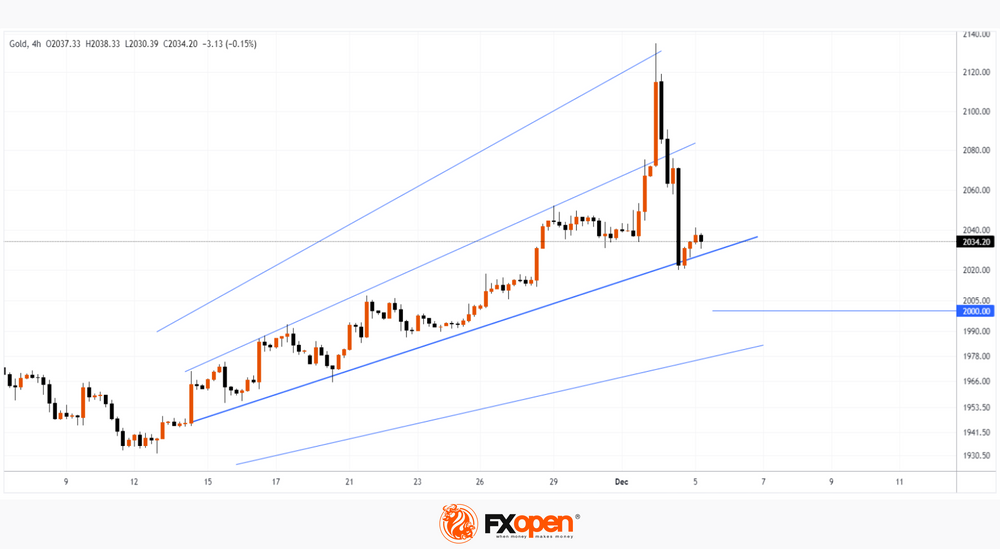
From a technical point of view, the gold price chart has a structure of trend lines that resemble a Gann fan. The price found support near one of them (shown in double thickness), thereby stopping Monday's fall. It is possible that if the bounces from this line are weak, the downward momentum may resume. In this case, the bears may try to break through the psychological level of USD 2,000 to test the next line from the mentioned structure.
This article represents the opinion of the Companies operating under the FXOpen brand only. It is not to be construed as an offer, solicitation, or recommendation with respect to products and services provided by the Companies operating under the FXOpen brand, nor is it to be considered financial advice.
AUDUSD Plummets Below Uptrend Line
- AUDUSD posts several red candles
- Holds below the SMAs
- Technical oscillators hold in negative areas
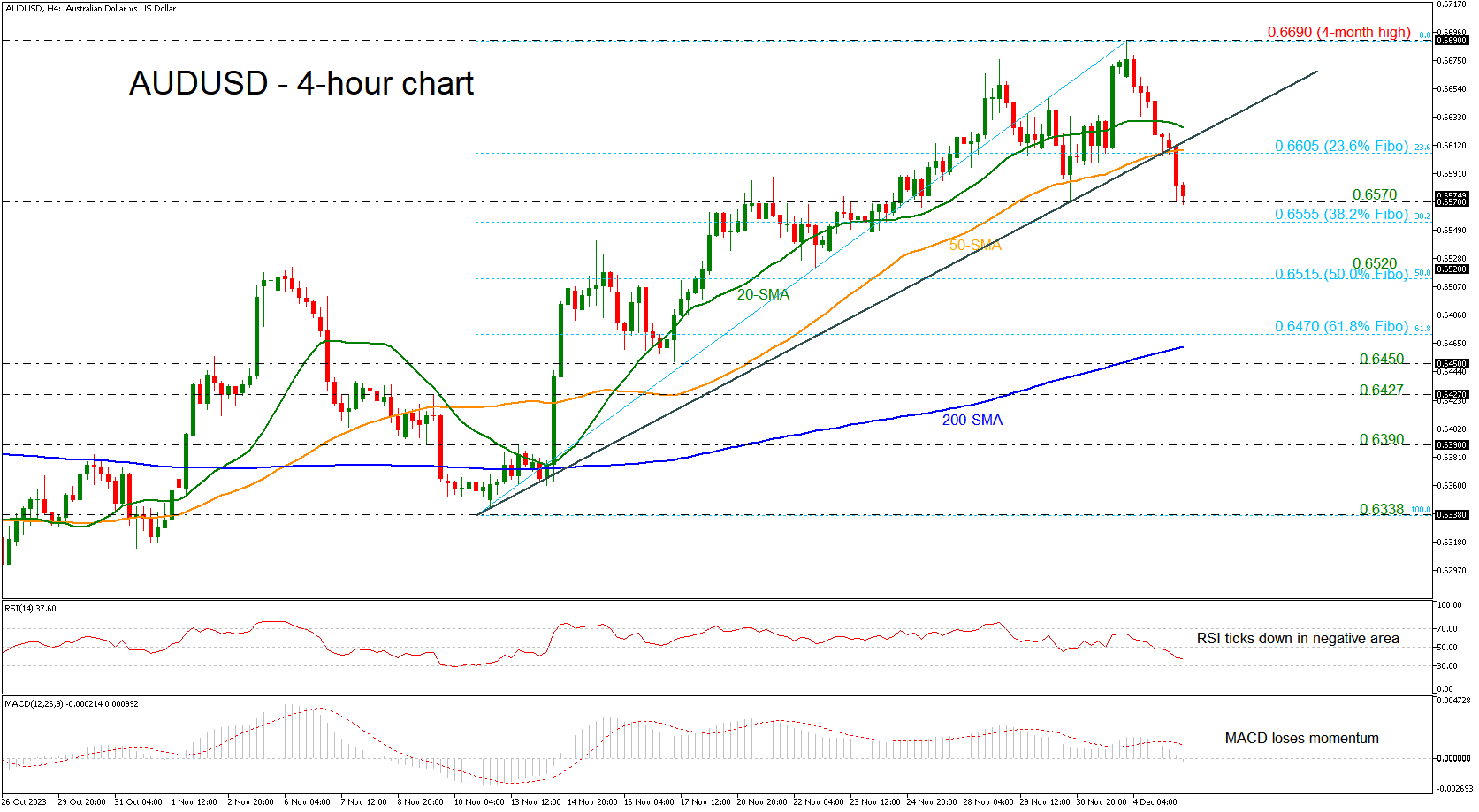
AUDUSD has been in a bearish corrective mode during the week, penetrating the short-term uptrend line to the downside with strong momentum.
Entering the 0.6570 area has been a struggle over the past three days, and there might be another tough obstacle within the 38.2% Fibonacci retracement level of the up leg from 0.6338 to 0.6690 at 0.6555, but the bears may not give the battle yet according to the technical indicators. Specifically, the RSI is plunging below the 50 neutral mark and the MACD oscillator is diving beneath the zero level.
In the event the pair re-activates its uptrend above the 23.6% Fibonacci of 0.6605, which overlaps with the 50-period simple moving average (SMA) in the 4-hour chart, ahead of the 20-period SMA at 0.6625, which would shift the bias back to positive. Even higher, the bulls might head for the four-month high of 0.6690.
On the downside, the 38.2% Fibonacci of 0.6555 could come in focus before the market continues the selling interest towards the 0.6515-0.6520 support region, which encapsulates the 50.0% Fibonacci.
Overall, AUDUSD is changing the bullish bias to bearish in the near-term and only a climb back above the ascending trend line could resume the positive outlook.
GBPUSD Bulls Hit a Wall; Support Nearby
- GBPUSD reaches overbought area near key resistance
- Sellers could take control of the market below 1.2588
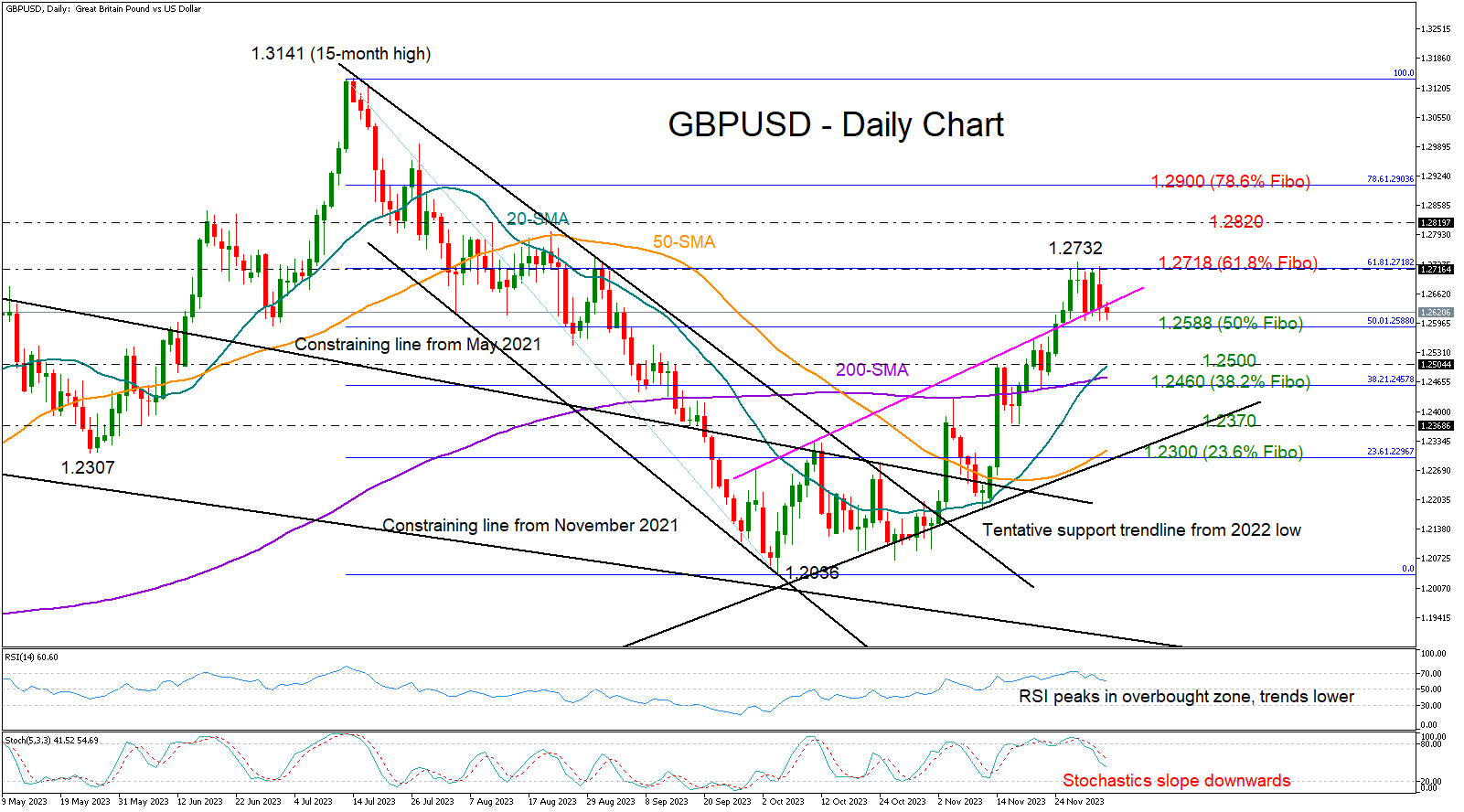
GBPUSD flatlined around the familiar 1.2720 resistance region, which was last tested at the end of August, after three constructive bullish weeks. The area also overlaps with the 61.8% Fibonacci retracement of the July-October downleg.
The ongoing consolidation phase could develop into a bearish wave according to the technical indicators. Both the RSI and the stochastic oscillators have peaked near their overbought levels and are trending southwards at the moment.
Nevertheless, sellers might stay patient until the price drops below the 23.6% Fibonacci level of 1.2588. If that floor collapses, the decline could pick up pace towards the 20-day simple moving averages (SMA) at 1.2500. The 38.2% Fibonacci mark of 1.2457 could also be on guard, protecting the market from a deep downfall to 1.2370. Should the bearish sentiment hold up, the price could next stall somewhere between the 50-day SMA and the support trendline from the 2022 low at 1.2300.
In the event upside forces resume above the nearby resistance of 1.2640, buyers will eagerly look for a sustainable move above the 1.2720 ceiling. A victory there could prompt an advance towards the 1.2820 barrier, while a steeper increase could battle the 23.6% Fibonacci of 1.2900.
Overall, GBPUSD is expected to switch into a corrective mode, with selling pressures likely intensifying below 1.2588. Otherwise, the pair might push for an uptrend resumption above the 1.2720 bar.