

Sample Category Title
EUR/GBP Daily Outlook
Daily Pivots: (S1) 0.8685; (P) 0.8709; (R1) 0.8731; More…
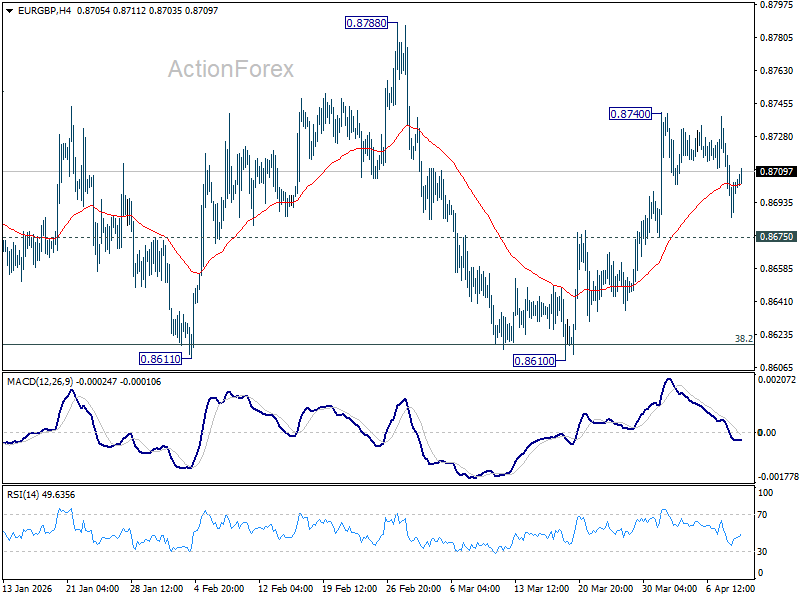
Intraday bias in EUR/GBP remains neutral as consolidations continues below 0.8740. On the upside, above 0.8740 will resume the rebound from 0.8610 short term bottom to 0.8788 resistance next. However, break of 0.8675 will bring retest of 0.8610 low instead.
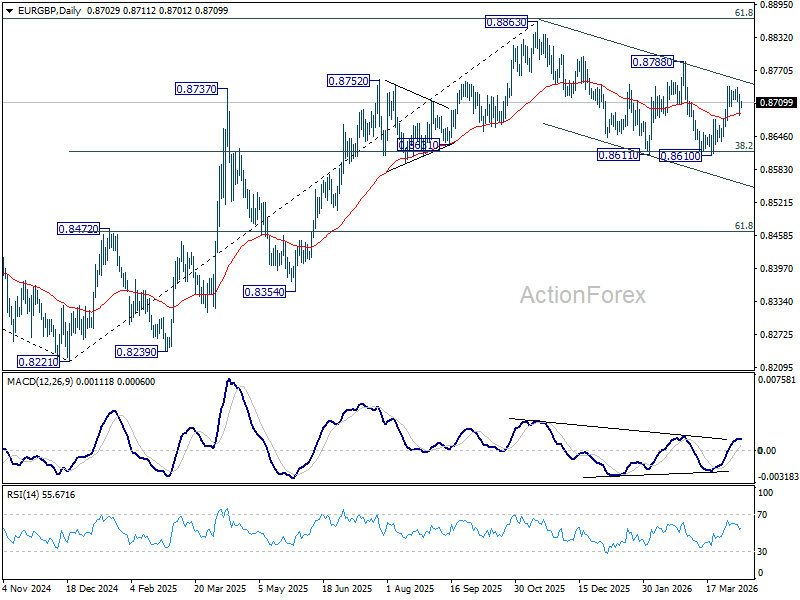
In the bigger picture, strong support was seen again from 38.2% retracement of 0.8821 to 0.8863 at 0.8618. Break of 0.8788 resistance will argue that larger rise from 0.8221 might be resume to resume through 0.8863. Nevertheless, sustained trading below 0.8618 should confirm reversal, and bring deeper fall to 61.8% retracement at 0.8466 at least.
EUR/AUD Daily Outlook
Daily Pivots: (S1) 1.6489; (P) 1.6568; (R1) 1.6635; More...
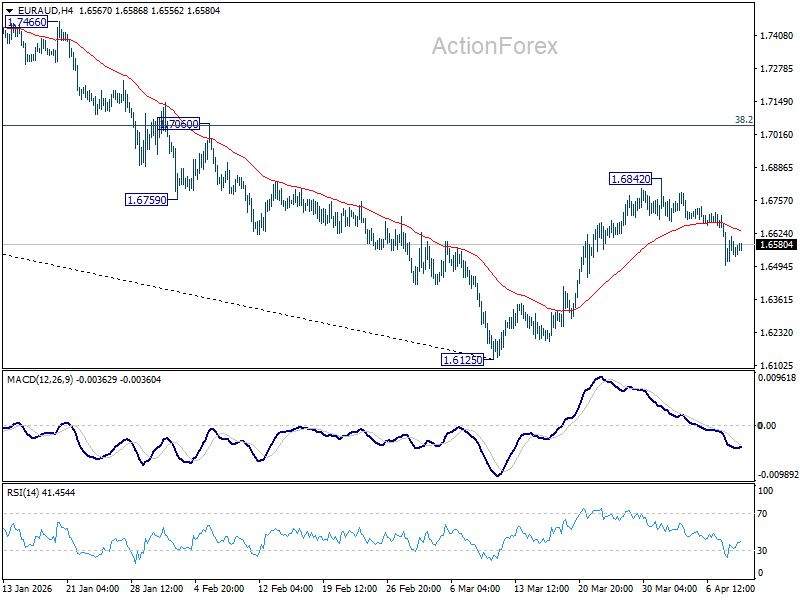
Intraday bias in EUR/AUD remains mildly on the downside for the moment. Corrective rebound from 1.6125 could have completed at 1.6842 after rejection by 55 D EMA (now at 1.6733). Deeper fall should be seen to retest 1.6125. Firm break there will resume larger down trend. On the upside, though, break of 1.6842 will resume the rebound to 38.2% retracement of 1.8554 to 1.6125 at 1.7053.
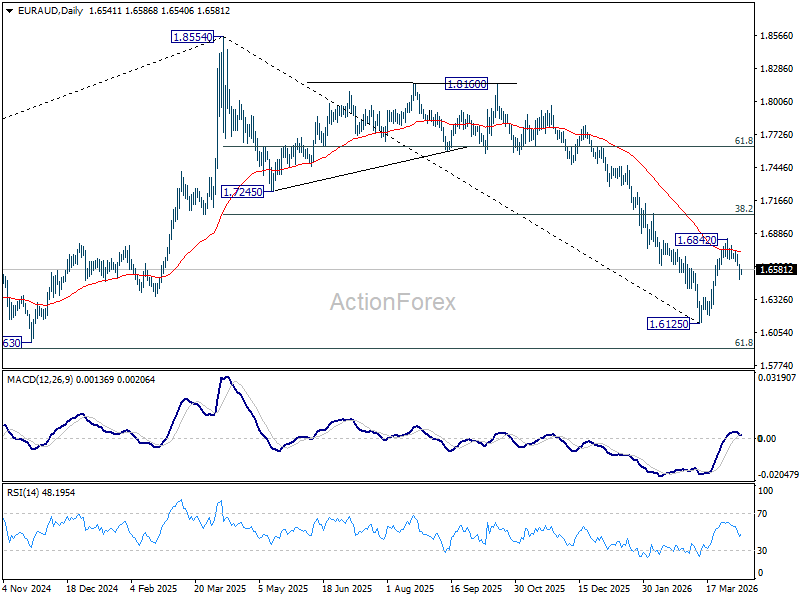
In the bigger picture, fall from 1.8554 medium term top is seen as reversing the whole up trend from 1.4281 (2022 low). Deeper decline should be seen to 61.8% retracement of 1.4281 to 1.8554 at 1.5913, which is slightly below 1.5963 structural support. Decisive break there will pave the way back to 1.4281. For now, risk will stay on the downside as long as 55 W EMA (now at 1.7207) holds, even in case of strong rebound.
EUR/CHF Daily Outlook
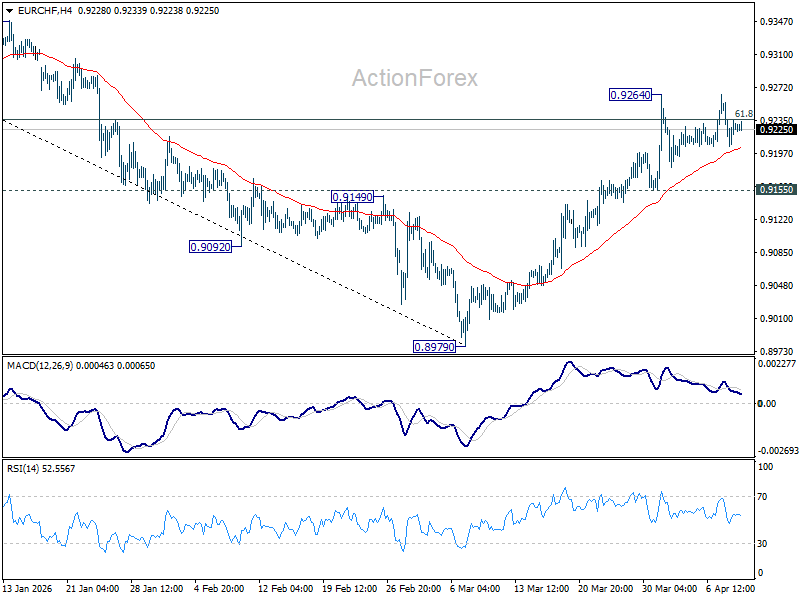
Daily Pivots: (S1) 0.9198; (P) 0.9237; (R1) 0.9267; More....
Intraday bias in EUR/CHF remains neutral at this point, and more consolidations would be seen first. On the upside, sustained trading above 61.8% retracement of 0.9394 to 0.8979 at 0.9235 will pave the way to 0.9394 key resistance next. However, break of 0.9155 support will turn bias back to the downside for 0.8979 low.
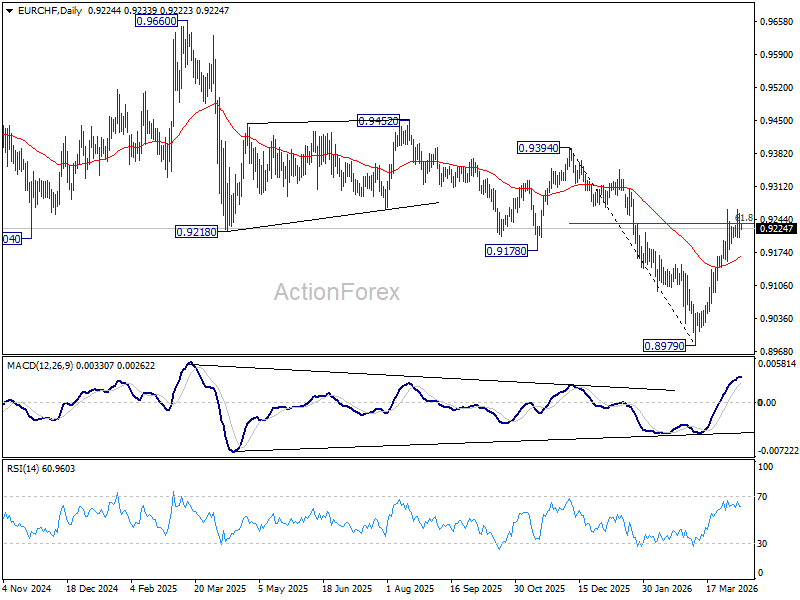
In the bigger picture, as long as 55 W EMA (now at 0.9281) holds, the larger down trend from 0.9928 (2024 high) is still expected to continue through 0.8979 at a later stage. However, sustained break of 55 W EMA should confirm medium term bottoming, and bring stronger rise through 0.9394 resistance, even as a corrective move.
Dollar Might Enter a More Neutral Pattern
Markets
Markets experienced an impressive ‘relieve squeeze’ after the US and Iran agreed to a two-week ceasefire that should allow for a more in-depth solution to the conflict. Visibility on how this process will develop and what it eventually might yield in the end remains low with US and Iranian starting points miles apart. Despite the multiple ‘likely’ roadblocks, markets cheered the announcement as if they expected it to be a real game-changer. European equities rebounded up to 5% (EuroStoxx 50). US indices which already anticipated something to happen on Tuesday still gained another 2.5-3%. The force of the moves suggests investors had built up quite some ‘defensive protection’ in the run-up to Tuesday’s deadline that now had to be unwound. Oil evidently was one of the key barometers on the perceived level of stress. Brent oil at some point dropped from $110+ levels on Tuesday to almost $90 p/b intraday (close near $94.75). It also triggered a similar impressive squeeze in the inflation trade that had been set up over the previous weeks. German yields declined between 22.9 bps (2-y) and 7.4 bps (30-y). Euro are money markets reduced their expected probability on a April 30 ECB rate hike to 30% from 70% and now see two rather than three hikes EoY. The ‘pricing out’ in the UK (yield declines up to 23.7 bps in the 2-y) was even more impressive. US yields initially joined the easing trend but gradually reversed gains and eventually closed the session little changed between -0.5 bps 5-y & +1.2 bps 30-y. The Fed assessment as revealed in the Minutes of the March 18 meeting in the current context evidently is subject to a quickly developing economic and inflation environment. The conflict in the Middle East probably raises the risk both to the labour market and at the same time of higher inflation. While views in the Fed are divided on the weight of those factors for policy, a growing number of governors is rather focusing on the inflation risks. On FX markets the dollar, which of late profited only modestly for safe haven flows, was one of the victims of the ‘relieve squeeze’. DXY closed at 99.13 (from 99.86 on Tuesday). However, ‘in line’ with the reversal on the US yields markets, the dollar closed well off intraday lows. EUR/USD filled offers north of 1.17, but closed at 1.166 (from 1.1595). In a similar move, EUR/GBP briefly dipped below 0.87 to close just north of the big figure.
The evident question now evidently is ‘what’s next’? This uncertainty applies to the status of the ceasefire (violated?), the kick-off of the negotiations (expected this weekend in Islamabad) & the status of the ‘opening’ of the Strait of Hormuz. For (interest rate) markets, the key is to assess the inflationary fall-out of the conflict even with this (fragile) ceasefire in place. The multiple political and logistic issues that still have to be solved suggest that quite some costs in the end still might filter through to end demand. In this respect, the relief rally on interest rate markets yesterday probably doesn’t have to go much further as long as there is no indication of a genuine improvement in fixing distorted supply chains. The dollar might enter a more neutral pattern. Recent performance at least doesn’t suggest a really strong rush to the US currency in a context of current low geopolitical visibility. Some EUR/USD consolidation in the 1.15/1.18 corridor might be on the cards with the downside better protected.
News & Views
Geopolitically driven macro pressures weigh on UK housing market activity and the near term outlook according to the March 2026 RICS UK Residential Market Survey. With intensifying inflationary pressures pushing borrowing costs higher, buyer demand has weakened. At the headline level, the new buyer enquiries net balance slipped to -39% (-29% in Febr, weakest since August 2023). Volume of agreed sales has also been adversely affected, with the aggregate net balance falling from -13% to -34%, also the weakest since the summer of 2023. Respondents anticipate a further contraction of sales in coming months and see broadly stabilization for year-ahead sales (vs moderately positive view last month). On the supply side, there was marginally softer flow of listings coming to the market. The level of unsold stock on agents’ books has risen. The aggregate net balance of -23% for house prices points to some renewed downward pressure on prices coming through. It is still relatively moderate at the moment and is expected to build over the coming three months. A broad flat trend is seen for the year ahead, significantly down from +43% and +33% levels at the start of the year.
Czech National Bank board member Seidler said in an interview with Hospodarske Noviny that the central bank was in a relatively good position when the war in the Middle East started. Its slightly restrictive monetary policy allows it to look through the primary impact on inflation from the energy-related supply shock. The CNB must nevertheless be attentive to second-round effects to assess potential steps and their timing.
USD/CAD Daily Outlook
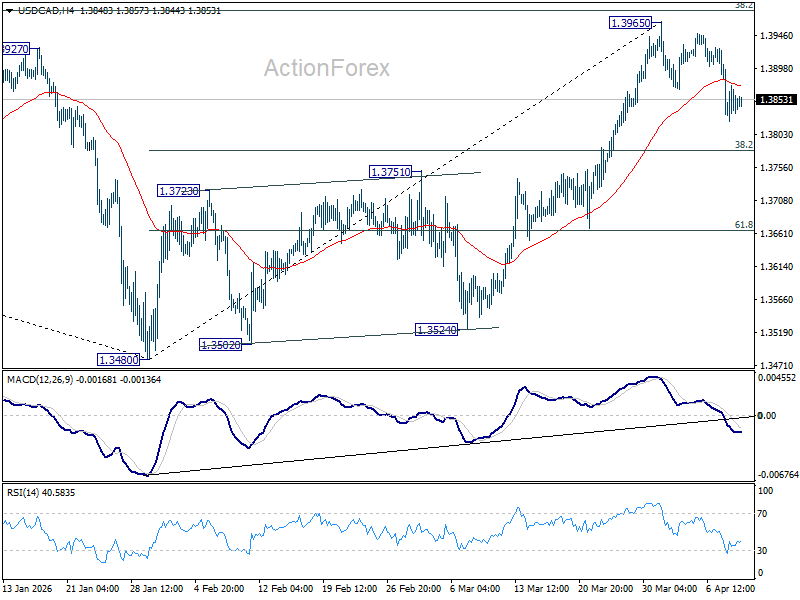
Daily Pivots: (S1) 1.3813; (P) 1.3857; (R1) 1.3889; More...
Intraday bias in USD/CAD remains neutral and more consolidations could be seen below 1.3965. As long as 38.2% retracement of 1.3840 to 1.3965 at 1.3780 holds, further rally is in favor. Break of 1.3965 will resume whole rise from 1.3480. However, sustained break of 1.3780 will argue that the rebound from 1.3840 has completed, and bring deeper decline to 61.8% retracement at 1.3665 and below.
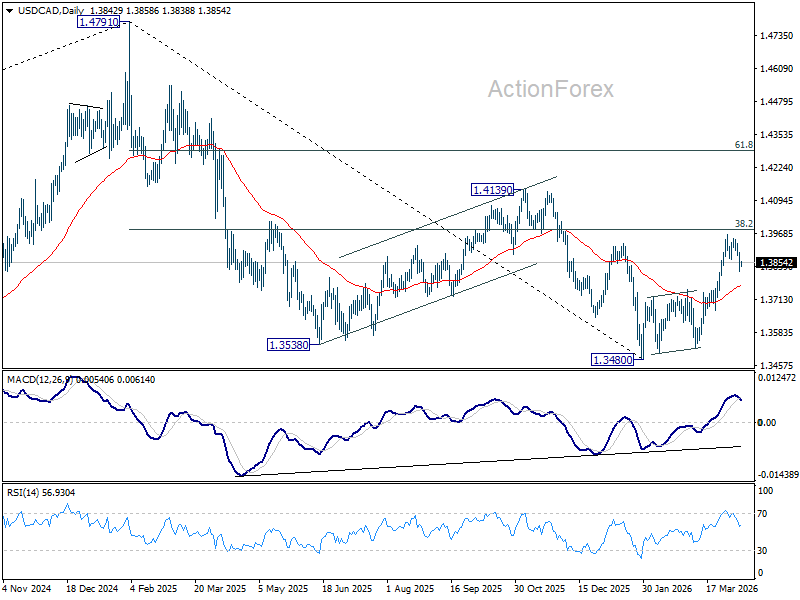
In the bigger picture, price actions from 1.4791 are seen as a corrective pattern to the whole up trend from 1.2005 (2021 low). Deeper fall could be seen, as the pattern extends, to 61.8% retracement of 1.2005 to 1.4791 at 1.3069. However, decisive break of 38.2% retracement of 1.4791 to 1.3480 at 1.3981 will argue that the correction has completed with three waves down to 1.3480 already. Further break of 1.4139 will confirm and bring retest of 1.4791 high.
AUD/USD Daily Report
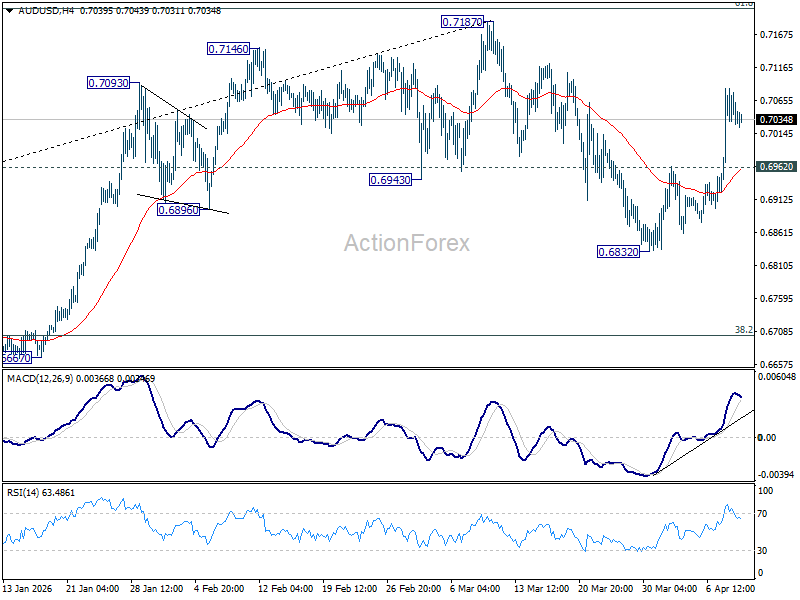
Daily Pivots: (S1) 0.6979; (P) 0.7032; (R1) 0.7097; More...
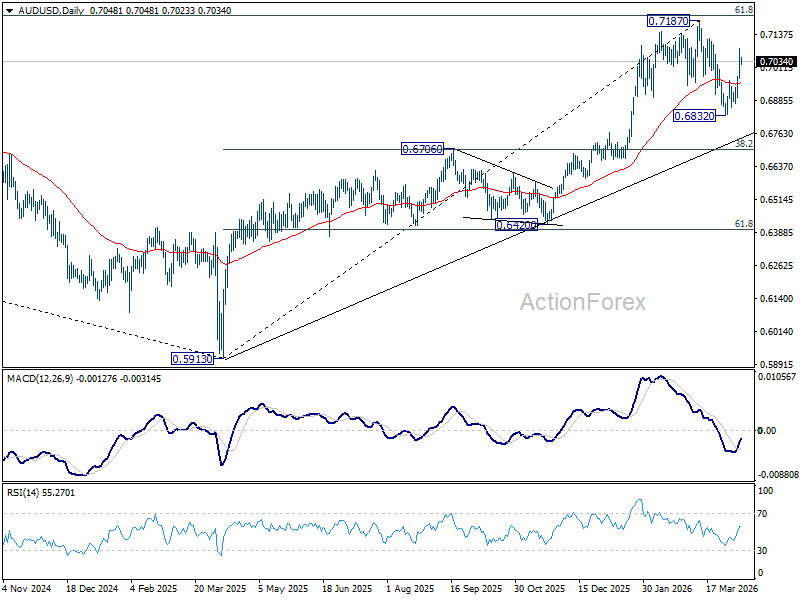
Intraday bias in AUD/USD stays mildly on the upside at this point. Corrective fall from 0.7187 should have completed at 0.6832. Further rise should be seen to retest 0.7187. Strong resistance could be seen there to bring another fall the extend the corrective pattern. On the downside, below 0.6962 resistance turned support will turn intraday bias neutral again first.
In the bigger picture, as long as 0.6706 cluster support holds, rise from 0.5913 (2024 low) should still be in progress. Decisive break of 61.8% retracement of 0.8006 to 0.5913 at 0.7206 will solidify the case that it's already reversing the down trend from 0.8006 (2021 high). However, firm break of 0.6706 will dampen this bullish case, and bring deeper fall back to 0.6420 support, and possibly below.
EUR/USD Daily Outlook
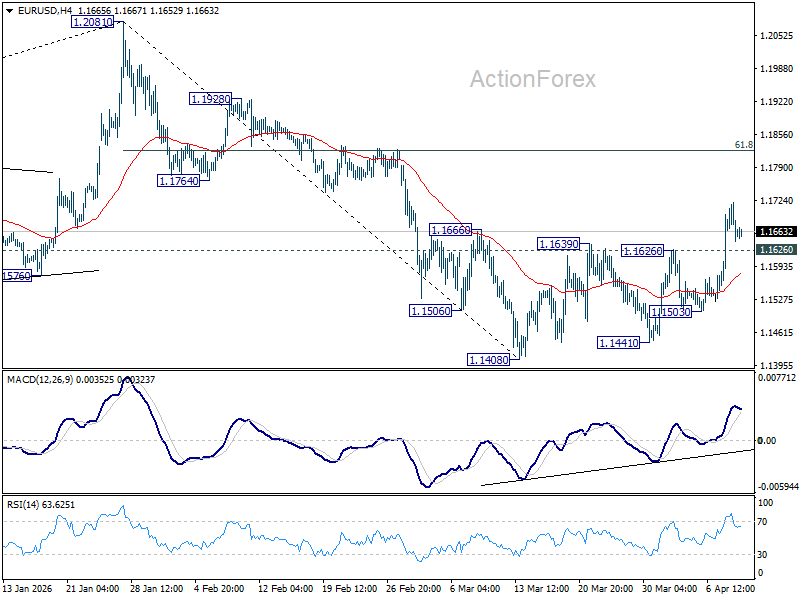
Daily Pivots: (S1) 1.1593; (P) 1.1658; (R1) 1.1727; More….
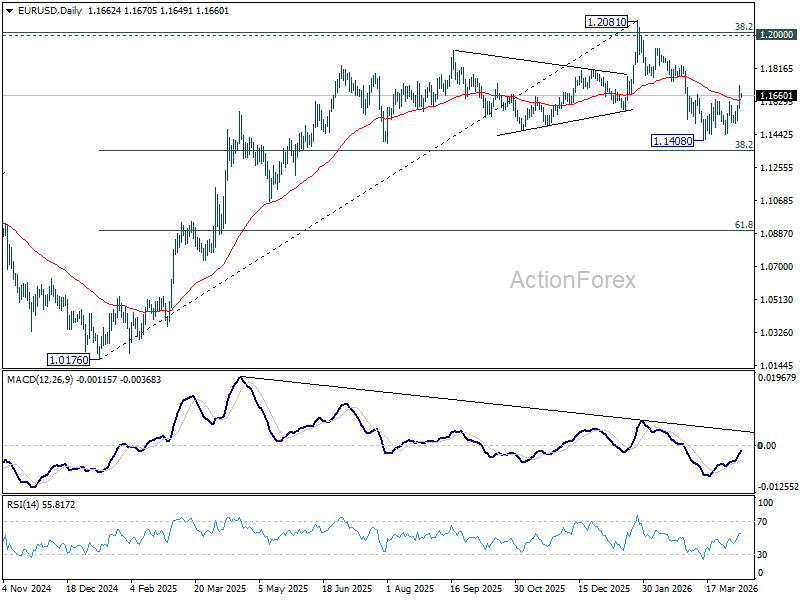
Intraday bias in EUR/USD stays mildly on the upside at this point. Fall from 1.2081 could have completed as a correction at 1.1408. Further rise should be seen to 61.8% retracement of 1.2081 to 1.1408 at 1.1824. Firm break there will pave the way to retest 1.2081 high. On the downside, below 1.1626 minor support will turn intraday bias neutral and bring consolidations first.
In the bigger picture, the strong support from 38.2% retracement of 1.0176 to 1.2081 at 1.1353 suggests that the pullback from 1.2081 is more likely a corrective move. Strong support was also found in 55 W EMA (now at 1.1505). Focus is back on 1.2 key cluster resistance level. Decisive break there will carry long term bullish implications. Nevertheless, break of 1.1408 support will revive the case of medium term bearish trend reversal.
GBP/USD Daily Outlook
Daily Pivots: (S1) 1.3293; (P) 1.3389; (R1) 1.3492; More...
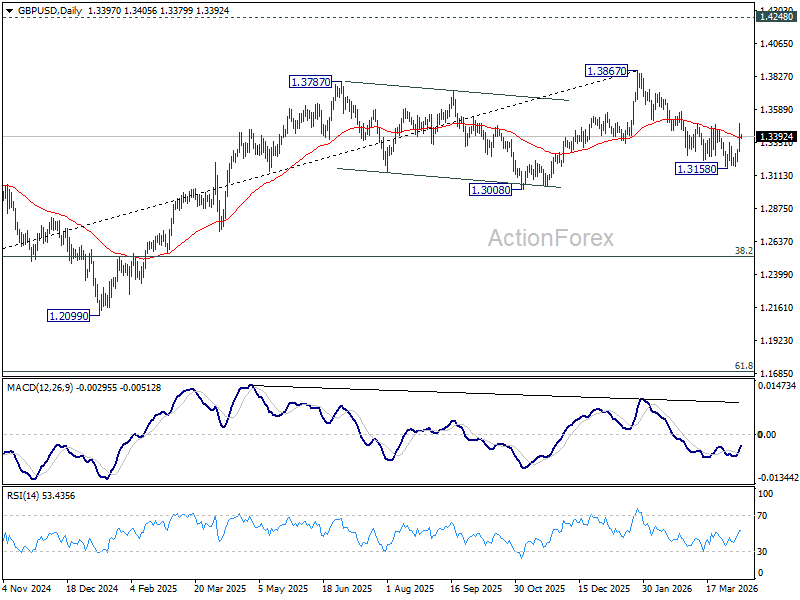
Intraday bias in GBP/USD is turned neutral first with current retreat. Fall from 1.3867 could have completed as a correction at 1.3158 already. Above 1.3483 will target 61.8% retracement of 1.3867 to 1.3158 at 1.3596. Firm break there will bring retest of 1.3867 high. Nevertheless, sustained break of 55 4H EMA (now at 1.3304) will dampen this bullish view and bring retest of 1.3158 instead.
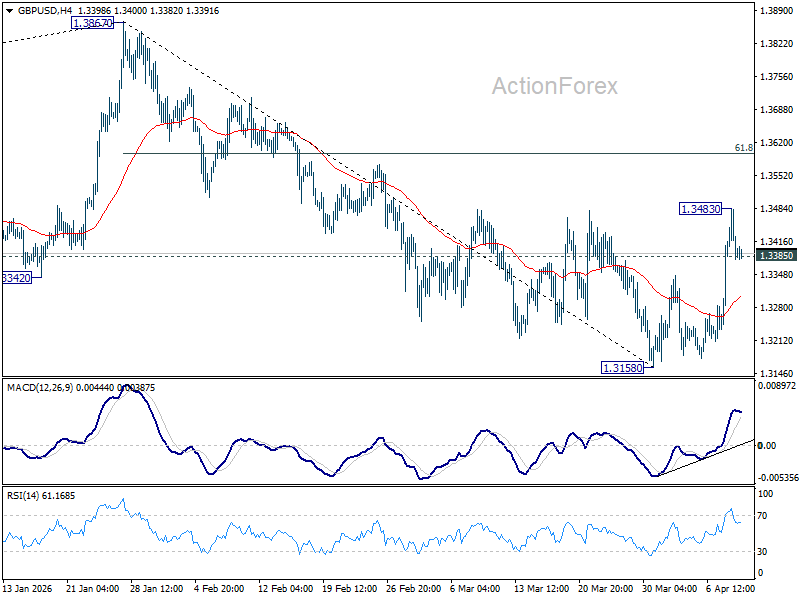
In the bigger picture, current development suggests that price actions from 1.3867 are merely a corrective pattern within the broader up trend from 1.0351 (2022 low). With 1.3008 support intact, medium term bullishness is maintained and break of 1.3867 is back in favor for a later stage, towards 1.4248 key resistance (2021 high).
USD/JPY Daily Outlook
Daily Pivots: (S1) 157.72; (P) 158.73; (R1) 159.59; More...
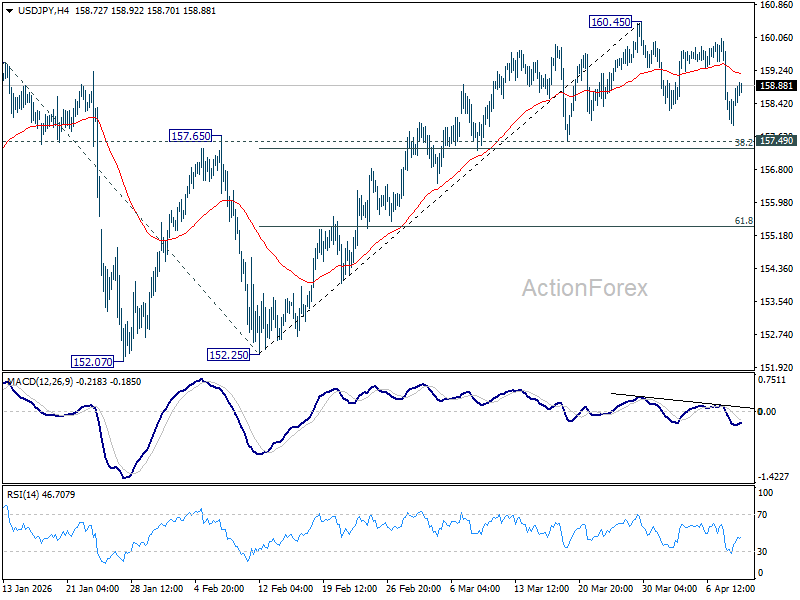
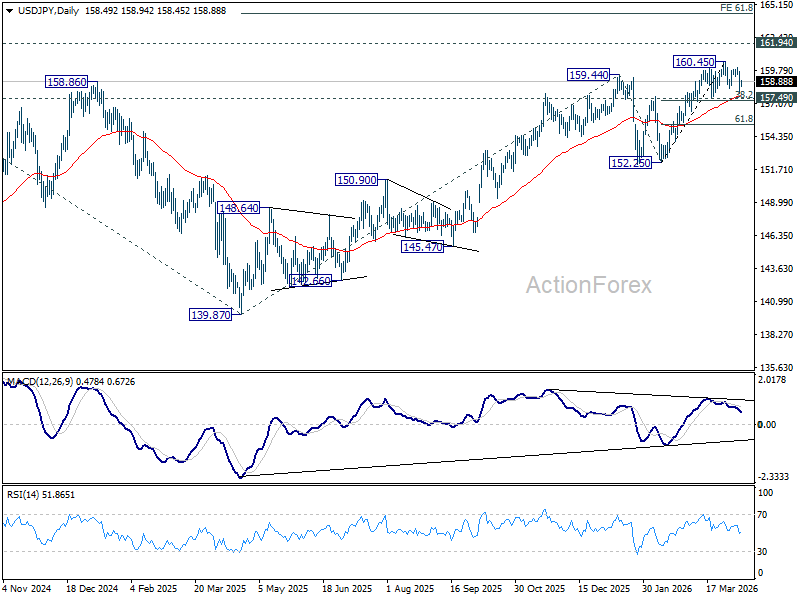
USD/JPY is still extending the consolidation pattern from 160.45 and intraday bias remains neutral. Further rise is expected as long as 157.49 cluster support (38.2% retracement of 152.25 to 160.45 at 157.31) holds. Firm break of 160.45 will resume the rise from 152.25 to retest 161.94 high. However, firm break of 157.31/49 will bring deeper fall back to 61.8% retracement at 155.38 next.
In the bigger picture, outlook is unchanged that corrective pattern from 161.94 (2024 high) should have completed with three waves at 139.87. Larger up trend from 102.58 (2021 low) could be ready to resume through 161.94. This will remain the favored case as long as 55 W EMA (now at 152.97) holds. Firm break of 161.94 will pave the way to 61.8% projection of 102.58 to 161.94 from 139.87 at 176.75.
Middle East Truce Lifts Markets, But Tensions Persist
In focus today
Focus remains on energy markets, as tensions in the Middle East continue to weigh on oil supply disruptions and market sentiment.
From the US, February PCE data and final Q4 GDP are due for release in the afternoon. While the PCE is the Fed's preferred measure of inflation, the pre-war data will likely gather less attention than usual.
The Bank of Poland (NBP) is widely expected to keep the key rate unchanged at 3.75% at today's meeting. Although Governor Glapinski has previously hinted that there might be the odd cut left in store for NBP, the Board has been unanimous over the last month in communicating that for the time being, a wait-and-see approach is to be preferred. And the recent ceasefire deal between the US and Iran is unlikely to have changed that, given the remaining uncertainties and its likely brittle status.
Economic and market news
What happened yesterday
Global markets breathed a sigh of relief as Brent crude fell 14% to USD 95/bbl and equities surged to one-month highs following President Trump's announcement of a two-week ceasefire late Tuesday. However, the truce has failed to completely halt fighting across the region. Israel launched heavy strikes on Lebanon, while Hezbollah retaliated with rocket fire into northern Israel. Iran targeted Gulf neighbours' critical oil and power infrastructure, adding to the volatility. Confusion over the terms of the ceasefire has emerged, with Iran believing it included Lebanon, while the US and Israel maintain it does not. The oil market has reacted with relative calm, suggesting that reported damages may be manageable for now. That said, Asian markets turned more cautious on Thursday, with Japan's Nikkei flat and South Korea's Kospi down 0.4% after sharp gains the previous day. Brent futures also edged up slightly to USD 97/bbl. The Strait of Hormuz remains blocked, though Iran has indicated it could reopen later this week subject to further agreements. Markets are closely watching for signs of increased traffic through the strait in the coming days.
In the US, FOMC minutes from the March meeting revealed a growing openness among policymakers to potential rate hikes, as concerns about persistently high inflation, driven by the war-related oil shock, outweighed earlier expectations. While the Fed held rates steady at 3.50-3.75%, several officials cited the risk of prolonged above-target inflation and its impact on core price trends. Despite this, most participants still viewed rate cuts as the baseline scenario, anticipating that the economic fallout from the Middle East conflict could weaken growth and labour markets.
Equities: Global equities rallied sharply yesterday in the wake of the Iran ceasefire headlines, leaving global benchmarks just ~2% below all-time highs and back in positive territory year-to-date. Unsurprisingly, the move was characterized by a strong cyclical rotation, while energy stood out as the clear underperformer. At the same time, minimum volatility significantly lagged; in fact, min vol is now the worst-performing factor since our latest strategy report in early March, standing in stark contrast to the heavy flow of geopolitical risk over the past month.
Notably, the rebound dynamics show a clear reversal pattern: the strongest moves were seen in Asia and Europe, and at industry level, semiconductors outperformed energy by ~15% yesterday alone. While US moves were more muted, it is worth noting that yesterday marked the sixth consecutive positive session for the S&P 500.
This morning, with uncertainties around how the ceasefire will evolve, Asian equities are giving back some of the gains. European and US futures are also modestly lower.
FI and FX: EUR/USD initially rallied on the ceasefire, but with stirring doubts regarding the longevity of the deal we saw the greenback slowly crawl back, as well as equities softening a tad and risky assets in general retrace some of the earlier moves. The SEK had a stellar first half of the session, with EUR/SEK briefly printing 10.75, before turning 10 figures higher in the latter half, currently sitting close to 10.90. Also, US treasuries saw partial reversals of the initial ceasefire rally, with a modest bear-flattening of the curve, supported a slight hawkish lean to the March FOMC minutes. The NOK failed to capitalize on the rallying risk sentiment, weighed down by the decline in energy prices, highlighting the tug-of-war that is likely to dominate the NOK over the coming weeks.