

Sample Category Title
Markets Overnight Again Had to Cope With a TACO-Like U-Turn
Markets
Markets overnight again had to cope with a TACO-like U-turn regarding the conflict with Iran and the impact on the on energy supply affecting the global economy. Pakistan (PM Shehbaz Sarif) proposing a 10-point plan from Iran to the US apparently ‘convinced’ the US not to start a devastating attack on Iranian infrastructure and to agree to a 2-week ceasefire. Demands from both sides as put down in an earlier US-15 point plan and a new Iranian plan suggest that high hurdles have to be overcome. Even so, president Trump accepted the proposal as a workable basis to start negotiations. One of many key points that still have to be resolved/clarified is the framework on the reopening of the Strait of Hormuz. The US sees a complete, immediate and safe opening of the Strait as part of the ceasefire agreement. Iran from his side mentions that ‘for a period of two weeks, safe passage through the Strait of Hormuz will be possible via coordination with Iran’s Armed forces’. How this (and multiple other unresolved topics) will turn out both political and logistically still has to become clear. Even so, for markets the ceasefire trigged a logical Pavlov decompression move. After a modest rise early in US dealings, US yields already drifted gradually lower on rumours that Pakistan was actively working on a proposal. US yields already closed the session lower between 6 bps (2-y) and 1.6 bps (30-y). This morning the easing continues in an extended bull steepening move (2-y minus additionally 6.5 bps, 30-y minus 2.6 bps). At the close of the European markets, tension/fears of an escalation still were riding high with Bund yields closing between 10.8 (5-y) and 6.7 bps (30-y) higher. US equities yesterday closed the session little changed. The EuroStoxx 50 lost 1.05%. Already yesterday in the pre-ceasefire era, the dollar hardly profited with DXY closing well below the 110 barrier (99.86). Idem for EUR/USD (close 1.1595).
This morning’s relief after the ceasefire lifts all/multiple boats in a broad risk-on move. Asian equities jump sharply higher (Nikkei +5.45%, Kospi +7%). Brent oil tumbles form $110+ p/b levels yesterday to currently hovering near $94 p/b. The dollar eases further (DXY 98.75, EUR/USD 1.1685). We also keep a close at the re-evaluation on European interest rate markets. Yesterday, rising inflationary risks pushed expectations for a an April ECB rate hike close to 70% with cumulative 75 bps tightening discounted from the end of the year. To what end will the ceasefire make markets question that the impact of the recent developments already pushed price developments in line with the adverse scenario which they saw creating (pre-emptive) ECB action? In a scenario of oil holding in the $90-$100 range and plenty of political and logistical issues still to be solved, interest rate markets might still keep a scenario of at least two ‘pre-emptive’ ECB rate hikes in a not-that distant future. Given recent modest USD gains considering the level of tension, there is room for EUR/USD to move higher in the 1.14/1.18 ST trading range.
News & Views
The Reserve Bank of New Zealand (RBNZ) held its policy rate unchanged at 2.25% this morning. Since its February meeting, events in the Middle East materially altered the outlook and balance of risks. The RBNZ didn’t completely update February forecasts for inflation but gave an indication for the short term by raising the prognosis for Q1 2026 and Q2 2026 respectively to 3% (from 2.8%) and 4.2% (from 2.7%). Today’s decision balances the potential benefits of responding pre-emptively to the risk of higher medium-term inflation against the cost of unnecessarily stifling the economic recovery. The Monetary Policy Committee is nevertheless vigilant to any generalized inflationary pressure and stands ready to act to return inflation to its medium-term target. Any signs of significant second-round inflationary effects or increases in medium-term inflation expectations would require decisive and timely increases in the policy rate to re-anchor inflation expectations. For now, the central bank believes that weak demand and spare productive capacity should constrain the degree to which higher costs can be passed on. It eyes the magnitude and duration to the disruption to global supply chains and energy markets and the way they influence price- and wage-setting behavior. The kiwi dollar extends cease-fire gains against USD after the hawkish hold with NZD/USD rising from 0.5730 to 0.5830.
The Reserve Bank of India left its policy change unaltered at 5.25% and kept a neutral stance, retaining flexibility to respond judiciously to incoming information. It is vigilant to upside inflation risks linked to the intensity and duration of the conflict in the Middle East and the resulting damage to energy and other infrastructure. CPI inflation for 2026-27 is projected to be at 4.6% with Q1 at 4%; Q2 at 4.4%; Q3 at 5.2%; and Q4 at 4.7%. The RBI has a 4% inflation target with a 2%-6% tolerance band.
EUR/AUD Daily Outlook
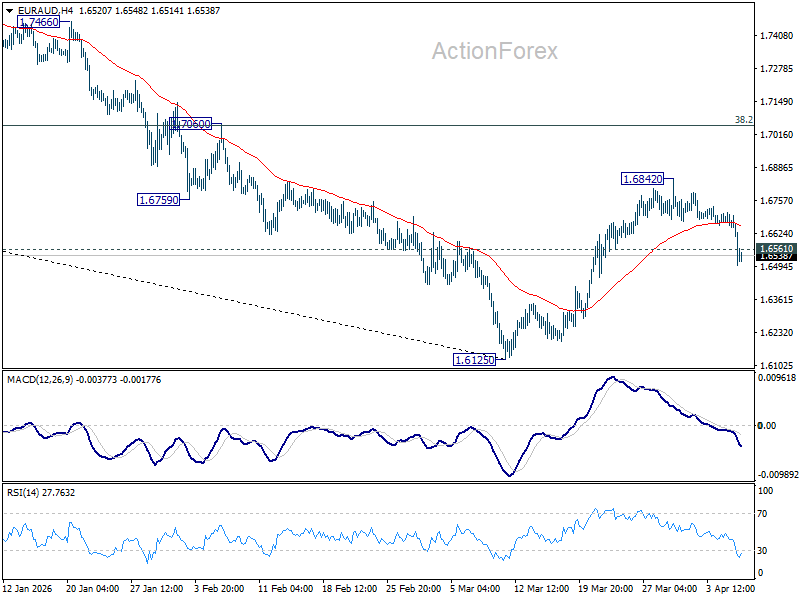
Daily Pivots: (S1) 1.6592; (P) 1.6653; (R1) 1.6686; More...
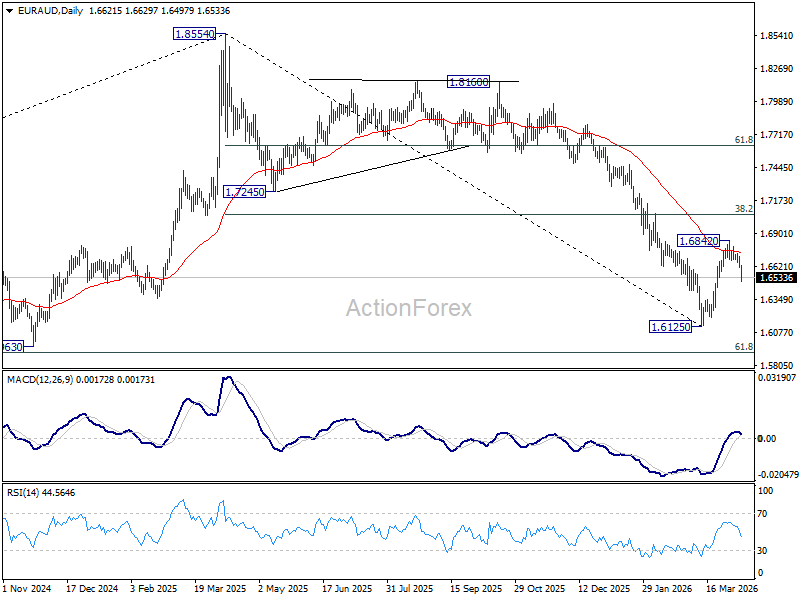
EUR/AUD's break of 1.6561 minor support suggests that corrective rebound from 1.6125 has already completed at 1.6842, after rejection by 55 D EMA (now at 1.6733)/ Intraday bias is back on the downside for retesting 1.6125. Firm break there will resume larger down trend. On the upside, though, break of 1.6842 will resume the rebound to 38.2% retracement of 1.8554 to 1.6125 at 1.7053.
In the bigger picture, fall from 1.8554 medium term top is seen as reversing the whole up trend from 1.4281 (2022 low). Deeper decline should be seen to 61.8% retracement of 1.4281 to 1.8554 at 1.5913, which is slightly below 1.5963 structural support. Decisive break there will pave the way back to 1.4281. For now, risk will stay on the downside as long as 55 W EMA (now at 1.7207) holds, even in case of strong rebound.
EUR/GBP Daily Outlook
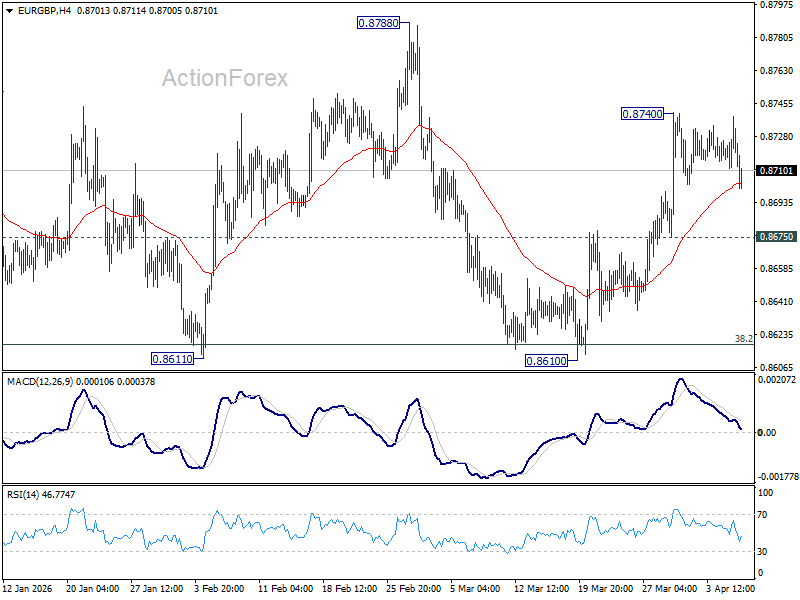
Daily Pivots: (S1) 0.8708; (P) 0.8725; (R1) 0.8739; More…
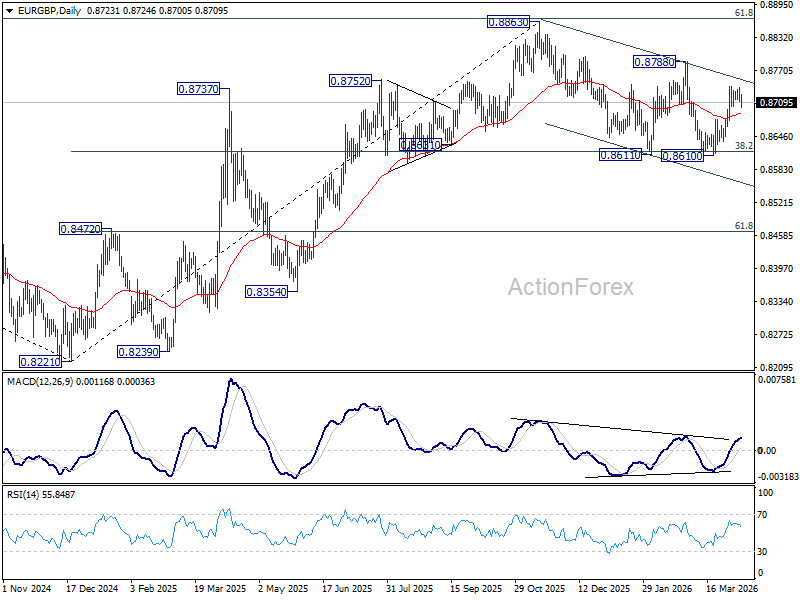
EUR/GBP is still bounded in consolidations below 0.8740 and intraday bias remains neutral. On the upside, above 0.8740 will resume the rebound from 0.8610 short term bottom to 0.8788 resistance next. However, break of 0.8675 will bring retest of 0.8610 low instead.
In the bigger picture, strong support was seen again from 38.2% retracement of 0.8821 to 0.8863 at 0.8618. Break of 0.8788 resistance will argue that larger rise from 0.8221 might be resume to resume through 0.8863. Nevertheless, sustained trading below 0.8618 should confirm reversal, and bring deeper fall to 61.8% retracement at 0.8466 at least.
EUR/JPY Daily Outlook
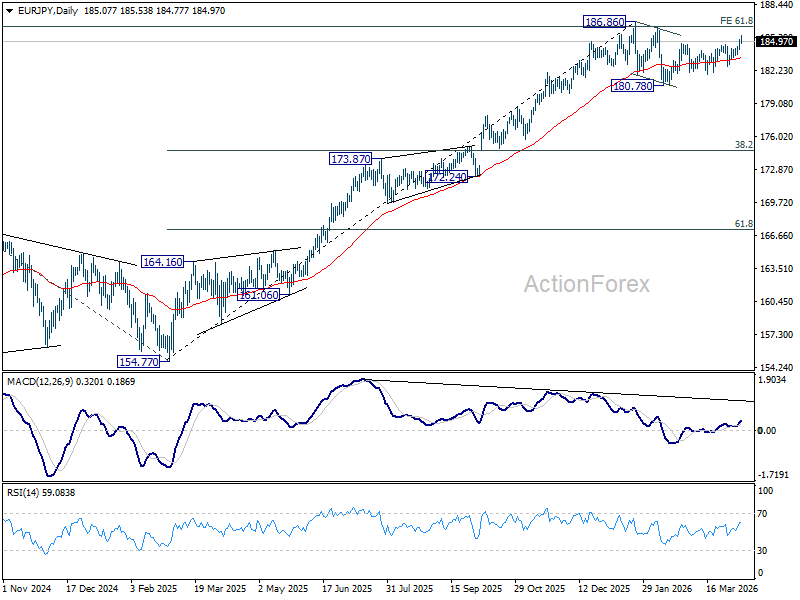
Daily Pivots: (S1) 184.48; (P) 184.83; (R1) 185.44; More...
EUR/JPY's rise from 180.78 resumed by breaking through 184.75 resistance and intraday bias is back on the upside. Further rally should be seen to retest 186.86 high. On the downside, below 184.21 minor support will turn intraday bias neutral first. Further break of 182.56 will extend the corrective pattern from 186.86 with another falling leg.
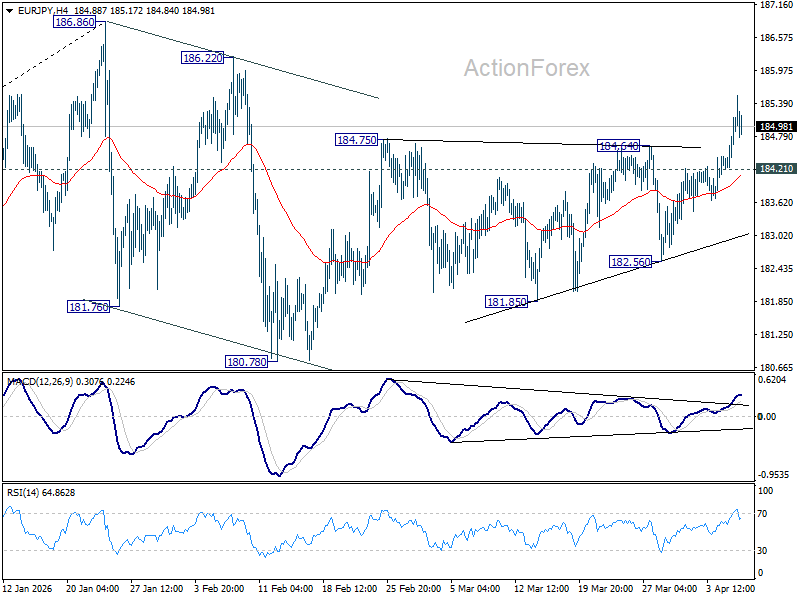
In the bigger picture, a medium term top could be in place at 186.86 and some more consolidations would be seen. Nevertheless, as long as 55 W EMA (now at 176.21) holds, the larger up trend from 114.42 (2020 low) remains intact. Firm break of 186.86 will pave the way to 78.6% projection of 124.37 (2022 low) to 175.41 (2025 high) from 154.77 at 194.88 next.
GBP/JPY Daily Outlook
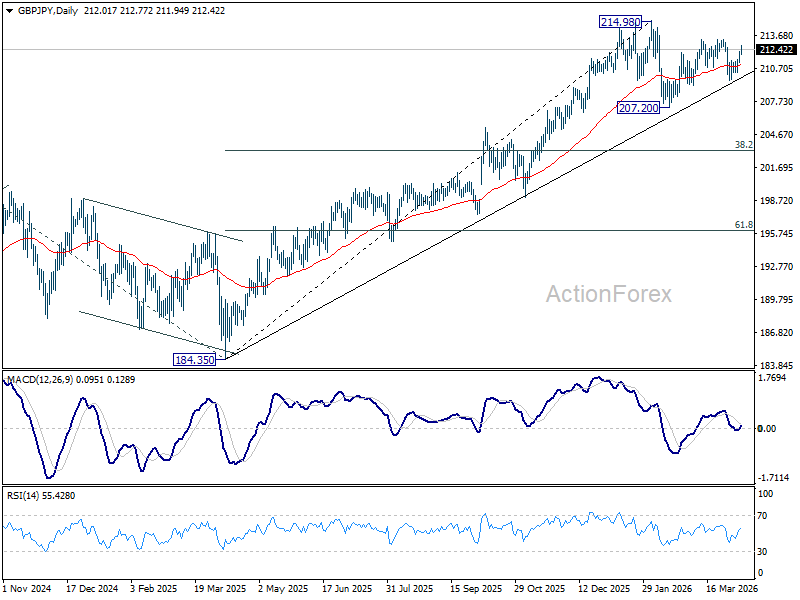
Daily Pivots: (S1) 211.52; (P) 211.92; (R1) 212.60; More...
GBP/JPY is staying below 213.29 resistance despite current strong rebound. Intraday bias remains neutral first. On the upside, firm break of 213.29 will resume the rise from 207.20 and target a retest on 214.98 high. On the downside, below 209.58 will bring deeper fall to 207.20 to extend the corrective pattern from 214.98.
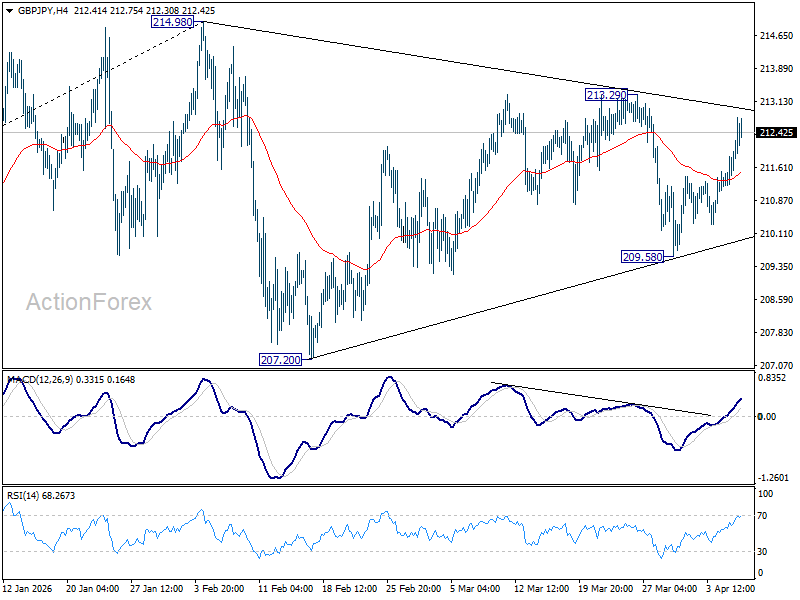
In the bigger picture, up trend from 123.94 (2020 low) is still in progress. Firm break of 214.98 will target 61.8% projection of 148.93 (2022 low) to 208.09 (2024 high) from 184.35 at 220.90. This will remain the favored case as long as 55 W EMA (now at 203.13) holds, even in case of another deep pullback.
EUR/CHF Daily Outlook
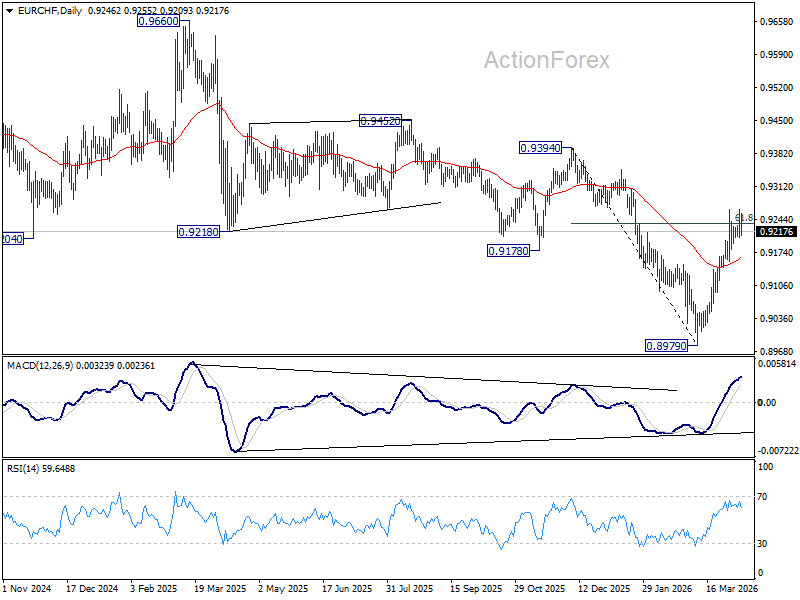
Daily Pivots: (S1) 0.9216; (P) 0.9241; (R1) 0.9277; More....
EUR/CHF is staying in range trading and intraday bias remains neutral. On the upside, sustained trading above 61.8% retracement of 0.9394 to 0.8979 at 0.9235 will pave the way to 0.9394 key resistance next. However, break of 0.9155 support will turn bias back to the downside for 0.8979 low.
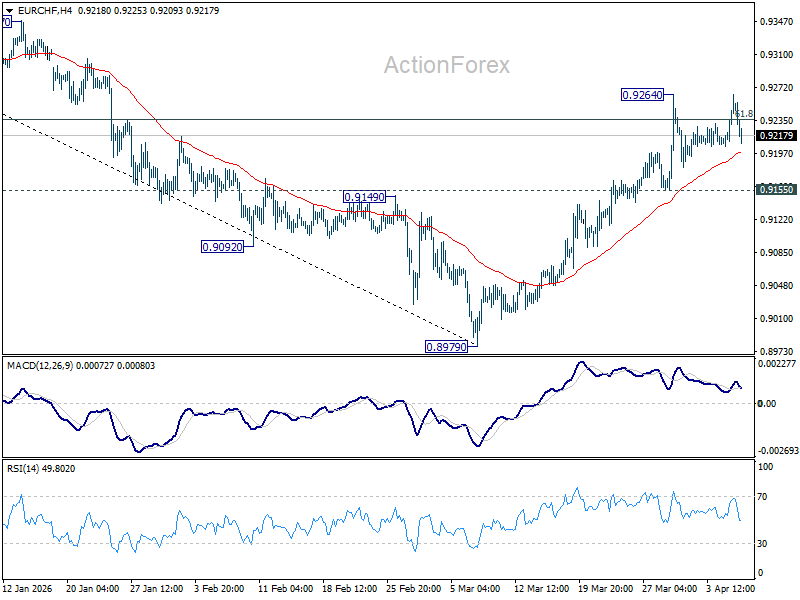
In the bigger picture, as long as 55 W EMA (now at 0.9281) holds, the larger down trend from 0.9928 (2024 high) is still expected to continue through 0.8979 at a later stage. However, sustained break of 55 W EMA should confirm medium term bottoming, and bring stronger rise through 0.9394 resistance, even as a corrective move.
USD/CAD Daily Outlook
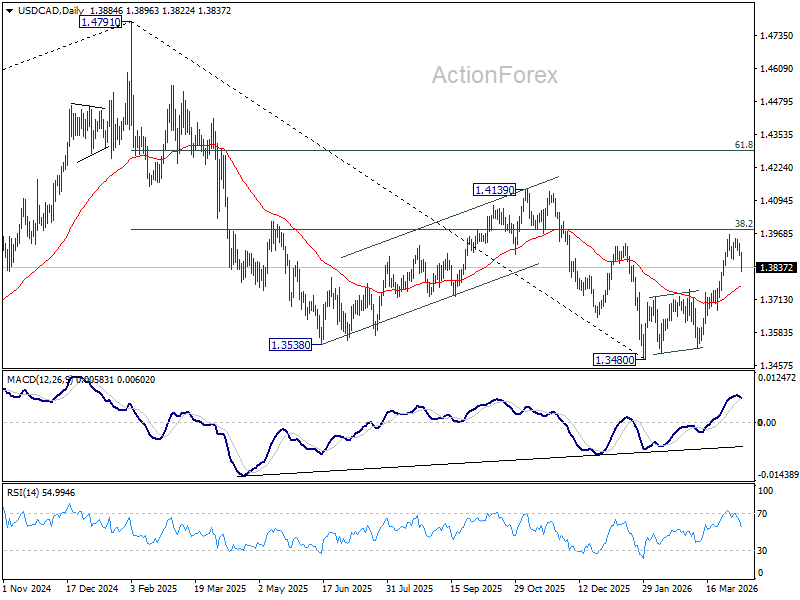
Daily Pivots: (S1) 1.3869; (P) 1.3900; (R1) 1.3917; More...
USD/CAD's fall from 1.3965 extended lower last week and focus is now on 38.2% retracement of 1.3840 to 1.3965 at 1.3780. Decisive break there will argue that whole rebound from 1.3840 has completed, and bring deeper decline to 61.8% retracement at 1.3665 and below. Nevertheless, strong rebound from 1.3780 will retain near term bullishness for another rise through 1.3965 at a later stage.
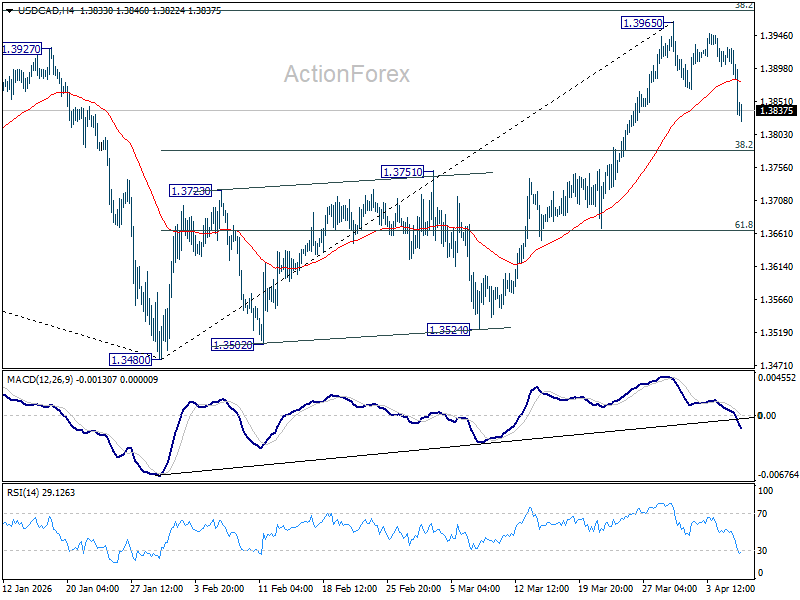
In the bigger picture, price actions from 1.4791 are seen as a corrective pattern to the whole up trend from 1.2005 (2021 low). Deeper fall could be seen, as the pattern extends, to 61.8% retracement of 1.2005 to 1.4791 at 1.3069. However, decisive break of 38.2% retracement of 1.4791 to 1.3480 at 1.3981 will argue that the correction has completed with three waves down to 1.3480 already. Further break of 1.4139 will confirm and bring retest of 1.4791 high.
AUD/USD Daily Report
Daily Pivots: (S1) 0.6923; (P) 0.6951; (R1) 0.7004; More...
AUD/USD's strong rally today indicates that corrective fall from 0.7187 has already completed at 0.6832. Intraday bias is back on the upside for retesting 0.7187 high. Strong resistance could be seen there to bring another fall the extend the corrective pattern. On the downside, below 0.6962 resistance turned support will turn intraday bias neutral again first.
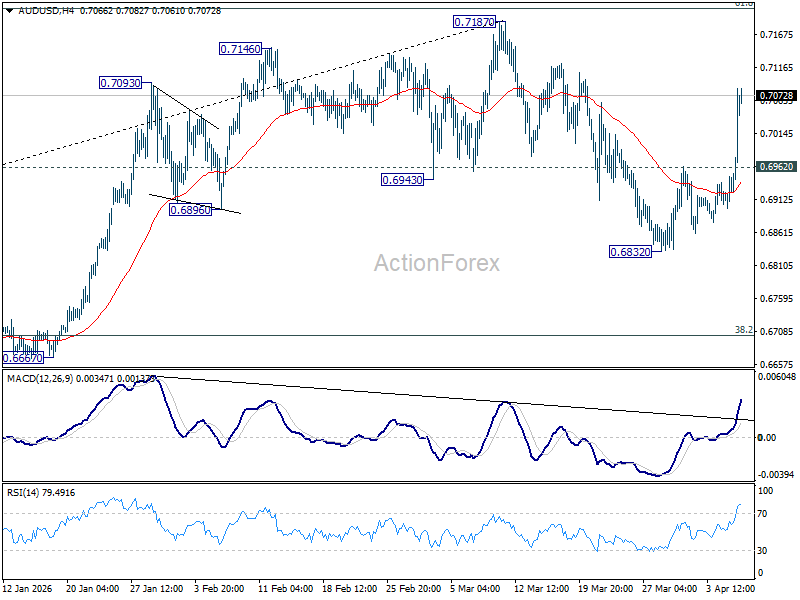
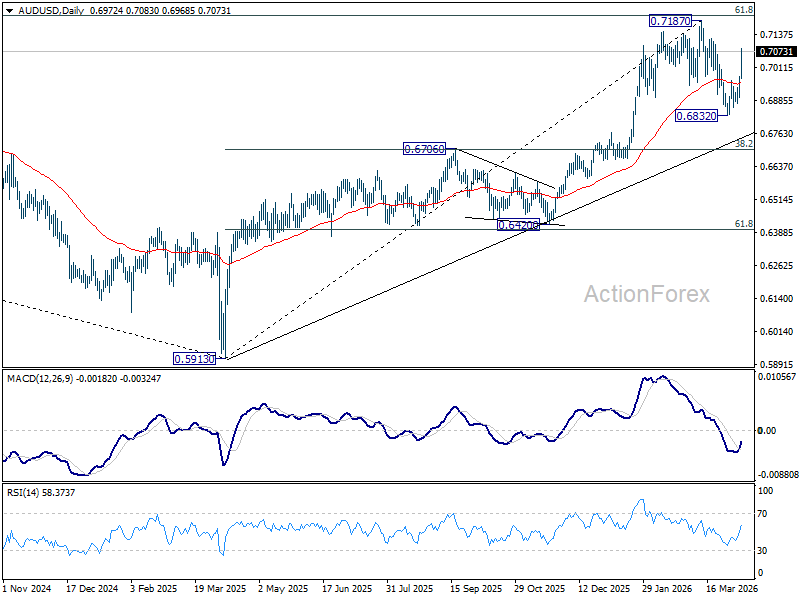
In the bigger picture, as long as 0.6706 cluster support holds, rise from 0.5913 (2024 low) should still be in progress. Decisive break of 61.8% retracement of 0.8006 to 0.5913 at 0.7206 will solidify the case that it's already reversing the down trend from 0.8006 (2021 high). However, firm break of 0.6706 will dampen this bullish case, and bring deeper fall back to 0.6420 support, and possibly below.
RBNZ to Tighten in September
- As widely expected, the RBNZ retained the OCR at 2.25%. There was no vote, with the decision reached by consensus.
- The commentary was hawkish as concerns of rising second-round inflation pressures were quite prominent.
- The MPC debated the options of an earlier vs later beginning to interest rate normalisation. Interest rate cuts were not discussed.
- An earlier start was described as May or July. A hike was discussed as an option today, but the Governor said that the MPC was not close to hiking at this meeting.
- The RBNZ’s short-term inflation forecast is now 4.2%y/y in June 2026 – higher than before, but close to our 4.1% forecast.
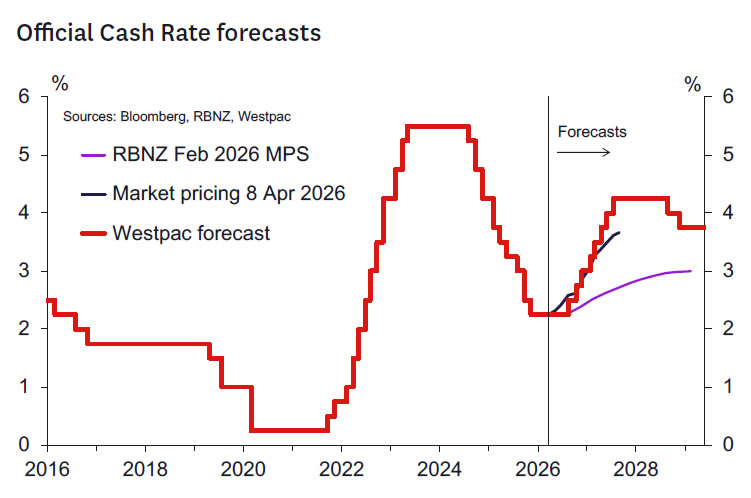
- We have pulled forward our forecast for the first OCR hike from the RBNZ to September (previously December).
- The balance of risks is towards an earlier start to hikes than September, should evidence of second-round inflation impacts accumulate.
OCR retained at 2.25% but coupled with a hawkish outlook.
The RBNZ kept the OCR unchanged at 2.25% as expected. There was no vote, with the decision reached by consensus. However, the Bank’s commentary adopted a more hawkish tone than expected. There was no discussion of needing to cut the OCR despite acknowledging that, at least in the short term, there would be greater excess capacity than previously thought. Rather, the debate was between:
- a “a pre-emptive response to medium-term inflation pressures could guard against the risk of inflation expectations becoming unanchored”; or
- a gradual increase in the OCR towards “more neutral levels” to reduce the risk of “reacting to higher nearterm inflation and accentuating weakness in the real economy and labour market”.
In the press conference the Governor noted that the MPC discussed the possibility of raising the OCR at this meeting, but there had been “no strong advocate” for doing so.
We interpret the more gradual path as being something akin to the late 2026 lift-off date that we have been forecasting, and that the RBNZ largely had in mind at the February meeting. A pre-emptive response likely implies something faster that begins by September but could come sooner than that, should evidence of secondround inflation impacts begin to accumulate. Indeed, the Governor indicated that the pre-emptive approach could have been a tightening in May or July. More dovish members were uncomfortable with the risks of that.
Key evidence that the RBNZ seeks seems to be in the form of anecdotal evidence on pricing and wage setting behaviour combined with higher frequency evidence on price setting, costs and inflation expectations coming from monthly surveys. We think it likely that at least some evidence along these lines will accumulate given the broad-based cost shock that the economy is facing. As a result, an earlier than December beginning to the tightening cycle looks much more likely now.
Hence, we are bringing forward our existing 25bp per meeting tightening profile to begin in September. The OCR will thus end 2026 at 3% and reach the previously expected 4.25% peak earlier, in September 2027. Easing is forecast to begin a year later in September 2028 with the neutral OCR reestablished in December 2028.
An earlier start than September should not be ruled out. And given it’s likely easier to explain the tightening profile in a Monetary Policy Statement meeting then the bias is likely for an earlier move to come in May versus July. The key question is: will sufficient evidence of second-round inflation impacts have accumulated by then? We think that’s still an open question at this point.
Key quotes from the press release and Record of Meeting were:
- “The Monetary Policy Committee is focused on ensuring that inflation returns to the 2-percent target midpoint over the medium term. This requires core inflation and wage growth to remain contained and medium- and long-term inflation expectations to remain around 2 percent. If these conditions are not met, decisive and timely increases in the OCR would be required.”
- “The outlook for medium-term inflation pressures depends on the size and persistence of the inflationary impulse stemming from higher oil prices and the extent to which it is offset by weaker demand in the economy.”
- “If the increase in near-term inflation is largely temporary, the Committee envisages gradually moving the OCR to more neutral levels as activity recovers and near-term inflationary pressures dissipate. However, any signs of significant secondround inflationary effects or increases in medium-term inflation expectations would require decisive and timely increases in the OCR to re-anchor inflation expectations.”
- “On the timing of any increase in the OCR, members discussed that a pre-emptive response to mediumterm inflation pressures could guard against the risk of inflation expectations becoming unanchored and reduce the extent of second round price increases.”
- “Conversely, the Committee noted the risk of reacting to higher near-term inflation and accentuating weakness in the real economy and labour market. Members noted that this could cause unnecessary volatility in output and employment if the conflict was resolved in the near term or if the economic outlook weakens by more than currently expected.”
The RBNZ’s initial thoughts on the near-term outlook.
The RBNZ provided updated inflation forecasts for the next two quarters. This is a change from their usual practice of not releasing updates to their forecasts at interim reviews and reflects that recent geopolitical developments have in the RBNZ’s words “materially altered the outlook and the balance of risks for inflation and economic growth”.
The RBNZ now expects inflation of 3% in the March quarter (previously 2.8%), rising to 4.2% in the June quarter (previously 2.7%). Those updated figures are close to our own forecasts. The RBNZ did not provide forecasts further ahead.
The RBNZ has noted that higher energy costs will push up other prices in the economy. However, longer term impacts on wage and price setting (aka. ‘second round impacts’) are expected to be constrained by weak demand at this stage. This is a key area of uncertainty and one where the RBNZ will be watching closely for signs that longer-term inflation pressures are increasing. Indeed, the RBNZ went on to note that “any signs of significant second-round inflationary effects or increases in medium-term inflation expectations would require decisive and timely increases in the OCR to re-anchor inflation expectations. The Committee is vigilant to these risks.”
While the RBNZ did not provide forecasts for other variables, they noted that the conflict and related increases in both operating costs and economic uncertainty will result in weaker activity in the near term. That’s very much in line with our own thoughts.
Things to watch ahead of the next meeting.
The RBNZ’s next policy review is on 27 May, when it will also publish a full Monetary Policy Statement (MPS) with refreshed forecasts (and probably some alternative scenarios too considering the current level of uncertainty). How the RBNZ’s stance evolves between now and then will depend on the path the Middle East conflict takes; what early indicators and anecdote suggest about the impact of the conflict on activity and inflation, both in New Zealand and abroad; and any developments in financial markets as a result of the conflict or other vulnerabilities triggered by the conflict.
As far as domestic economic indicators are concerned, we think the following are key ones to watch.
- Q1 CPI (21 April) and April Selected Prices (15 May): These pricing indicators will reveal the initial firstround direct and indirect impacts of the recent surge in fuel prices. They will provide some insight as to how high headline inflation might peak, but not about how long it will remain at elevated levels.
- Q1 QSBO (21 April) and April/May ANZ Business Outlook (30 April/27 May): Unfortunately, the data-rich QSBO survey was initially in the field very early in the conflict (it is unclear whether a breakdown of early and late responses will be released). Therefore, the ANZ surveys may provide a more up-to-date account of how businesses are responding to the conflict.
- March/April PMI and PSI surveys (mid-April/mid- May): These may provide some early insight regarding the likelihood of a contraction in GDP in Q2.
- Q1 labour market surveys (6 May): Employment and hours worked data from the HLFS and QES surveys will cast light on what momentum the economy had going into the conflict, while the LCI will cast light on underlying inflation pressures.
- Budget 2026 (28 May): While the formal unveiling of the Budget comes the day after the release of the MPS, ahead of the Budget the RBNZ’s MPC will receive a high-level briefing from the Treasury on what to expect at the macro level. Pre-Budget speeches and policy announcements may reveal more in the public sphere.
In addition to the above, we will be monitoring a range of other high-frequency indicators, such as monthly data on filled jobs, consumer spending, building consents, housing market activity and prices, job ads and consumer confidence. We will also be paying close attention to developments in prices for New Zealand’s key export commodities. The RBNZ looks to also be focused on anecdotal evidence of business pricing and wage setting behaviour – although that will be harder to track.
Elliott Wave: Gold (XAUUSD) Builds 5 Swings Higher, Favoring Upside
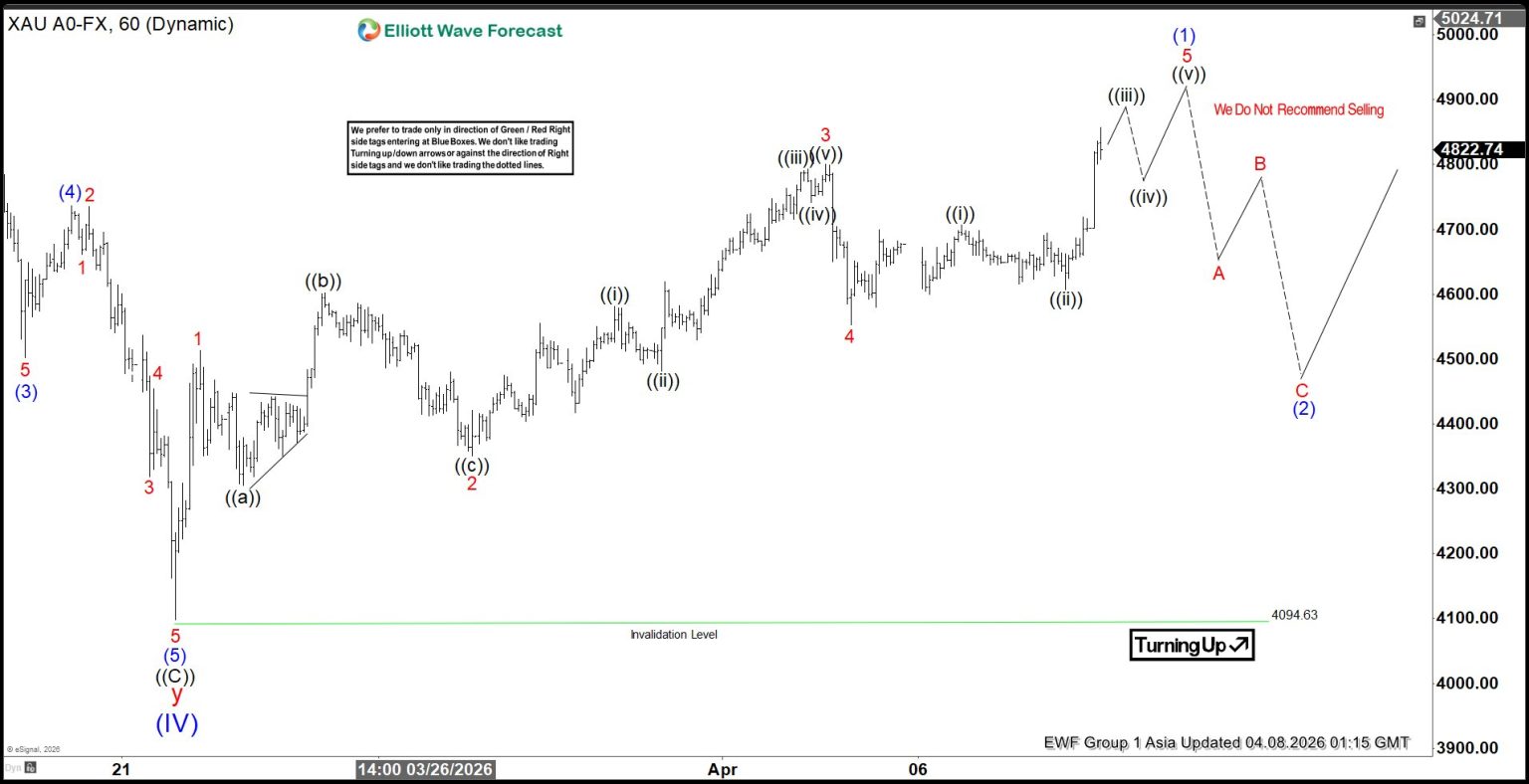
Gold (XAUUSD) reached an all-time high of $5598.75 on January 29 before undergoing a notable correction. This decline unfolded in a 3 Elliott waves zigzag structure, ultimately finding support at $4094.63. We have identified this corrective phase as wave (IV). Since then, the metal has resumed its upward trajectory, entering wave (V). To fully confirm the bullish outlook, however, gold must decisively break above the prior peak of $5598.75. Without such a move, the risk of a double correction remains present.
The short-term rally from the wave (IV) low has already displayed a five-swing structure. This pattern is characteristic of a motive sequence, which generally signals continuation rather than exhaustion. Consequently, the technical picture favors further upside momentum. From the wave (IV) base, wave 1 concluded at $4512.85, followed by wave 2 at $4350.52. Wave 3 extended higher to $4800.46, while the subsequent pullback in wave 4 ended at $4553.16. Current price action suggests that wave 5 is nearing completion. Once finalized, this will mark the end of wave (1) at a higher degree.
Afterward, gold is expected to retrace in wave (2). This corrective phase should address the cycle that began from the March 23 low. Such a pullback would be a natural development within the broader bullish structure, setting the stage for renewed strength. If the outlined progression holds, the metal could establish a sustainable advance beyond its previous record high.
Gold (XAUUSD) 60-Minute Elliott Wave Chart
XAUUSD Elliott Wave Video:
https://www.youtube.com/watch?v=PKRrBd3WawQ