Sample Category Title
US: Economic Growth Clocked in at Robust 4.9% in Q3, More Than Double Q2’s Rate of Expansion
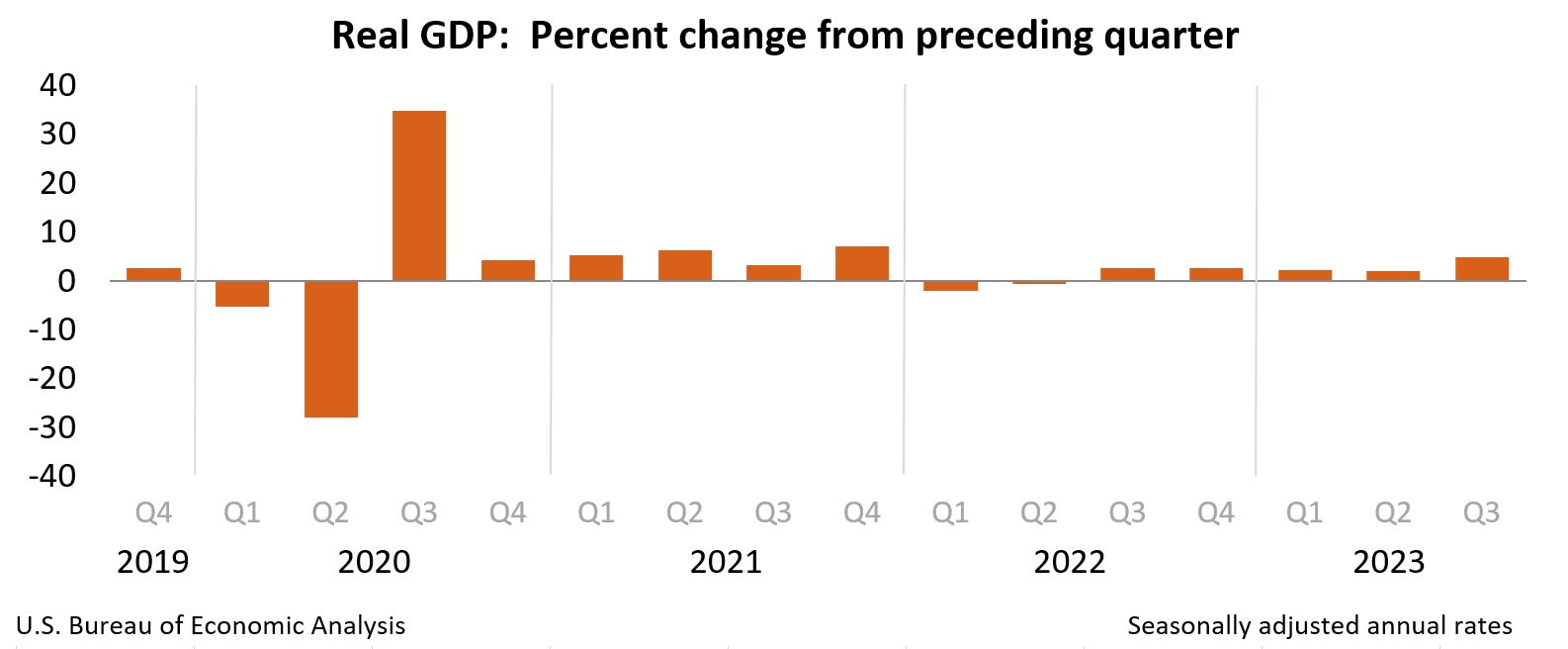
Real GDP expanded by 4.9% quarter-over-quarter (q/q, annualized) in the third quarter of 2023 – more than double the rate of expansion seen in the second quarter. The reading came in slightly ahead of the consensus forecast, which called for a still healthy gain of 4.5%.
Consumer spending grew by 4.0% – a sharp acceleration from the 0.8% recorded in the second quarter. Gains were spread across both goods (+4.8%) and service (+3.6%) expenditures.
Non-residential business fixed investment was flat last quarter, as modest gains in structures (+1.6%) and intellectual property products (+2.6%), where offset by weaker equipment spending (-3.8%).
Residential investment (+3.9%) posted a small gain, snapping what had been nine consecutive quarters of declines.
Government spending increased 4.6%, as spending at both the federal (+6.2%) and state & local (+3.7%) level moved higher. Federal outlays were seen across both defense (+8.0%) and non-defense spending (+3.9%).
Inventory investment added a meaningful 1.3 percentage points to headline growth – the strongest pace of inventory accumulation in three quarters.
Net exports shaved just a tenth of a percentage point from GDP, as strong growth in exports (+6.2%) was more than offset by a healthy gain in imports (+5.7%).
The core PCE deflator rose 2.4% on a q/q (annualized) basis – a deceleration from 3.7% in Q2.
Key Implications
An absolute blockbuster reading for third quarter real GDP, with solid gains seen across nearly all components of spending. At this rate, even if the economy were to completely stall in the fourth quarter, economic growth would still expand by 2.3% this year – slightly stronger than last year's 1.9% and an equivalent rate of expansion to 2019 when interest rates were far lower.
Despite the recent strength, it's important to not become complacent with the economy's recent resilience. Several headwinds including the ongoing United Auto Workers strike, the resumption of student loan repayments, and the potential for a government shutdown come mid-November could lead to a considerable drag on near-term activity. This is happening at time when financial conditions have tightened significantly over the past few months and the real effective policy rate has become increasingly more restrictive alongside some easing in inflationary pressures. We expect growth to decelerate somewhere close to 1% in Q4, before slipping to a near stall speed through the first half of next year.
EUR/USD Mid-Day Outlook
Daily Pivots: (S1) 1.0552; (P) 1.0580; (R1) 1.0593; More...
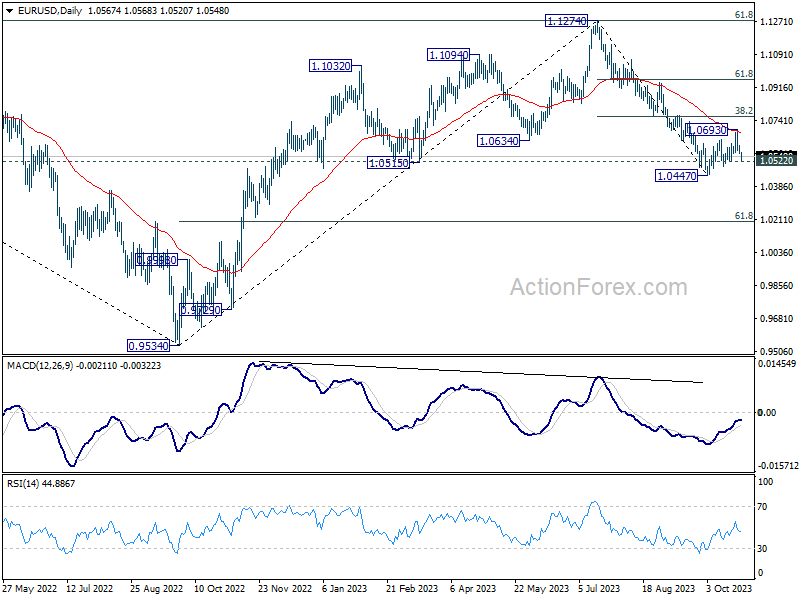
Intraday bias in EUR/USD remains neutral for the moment. On the downside, break of 1.0522 support will confirm rejection by 55 D EMA, and retain near term bearishness. Intraday bias will be back on the downside for 1.0447. Break there will resume larger fall from 1.1274. On the other, strong bounce from current level, followed by break above 1.0693, rebound from 1.0447 to 1.0764 cluster resistance (38.2% retracement of 1.1274 to 1.0447 at 1.0763).
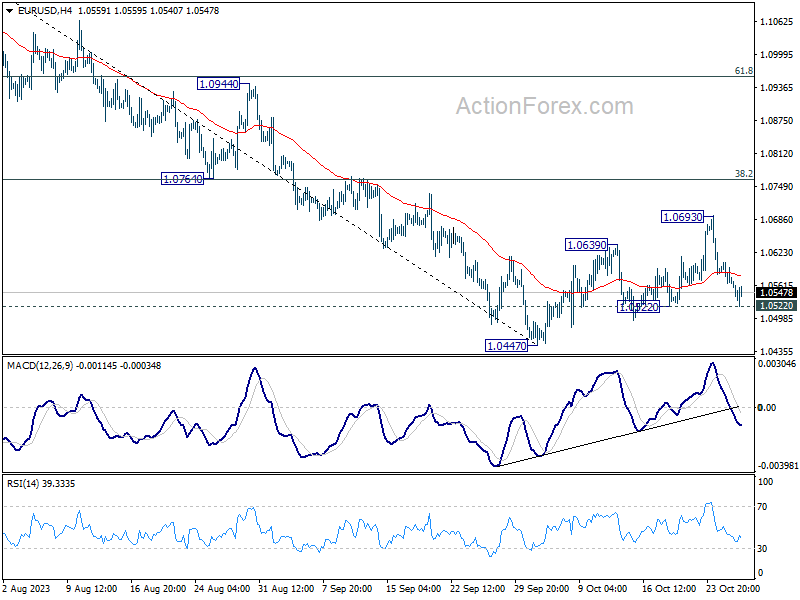
In the bigger picture, fall from 1.1274 medium term top could still be a correction to rise from 0.9534 (2022 low). But chance of a complete trend reversal is rising. In either case, current fall should target 61.8% retracement of 0.9534 to 1.1274 at 1.0199 next. For now, risk will stay on the downside as long as 55 D EMA (now at 1.0684) holds, in case of rebound.
Euro’s Soft Stance Continues Post-ECB; Strong US GDP Fails to Rouse Dollar
Euro is trading as the worst performer for the today so far, but there is no extended selloff after ECB's decision to hold interest rates unchanged. President Christine Lagarde's press conference reiterated that current rates should be bring inflation down to target in a timely manner if maintained for sufficiently long time, which is data dependent. Geopolitical tensions posts downside risks to growth and upside risks to inflation.
Following Euro, Canadian Dollar is the second worst, and then Swiss Franc. Dollar is also softer as it's paring yesterday's gains. There is a brief dip in USD/JPY but the scale doesn't look like Japan's intervention. Meanwhile, the greenback showed no special reaction to stronger than expected US Q3 GDP data. Aussie and Kiwi are mildly higher with Sterling.
As for the week, Aussie is currently the strongest one, after volatility from yesterday's CPI data and today's comments by RBA governor. Dollar is the second strongest, and has the potential to overpower if rise in treasury yields and selloff in stocks extend. Canadian Dollar is the worst performer, followed by Swiss Franc and Sterling. Euro and Yen are mixed.
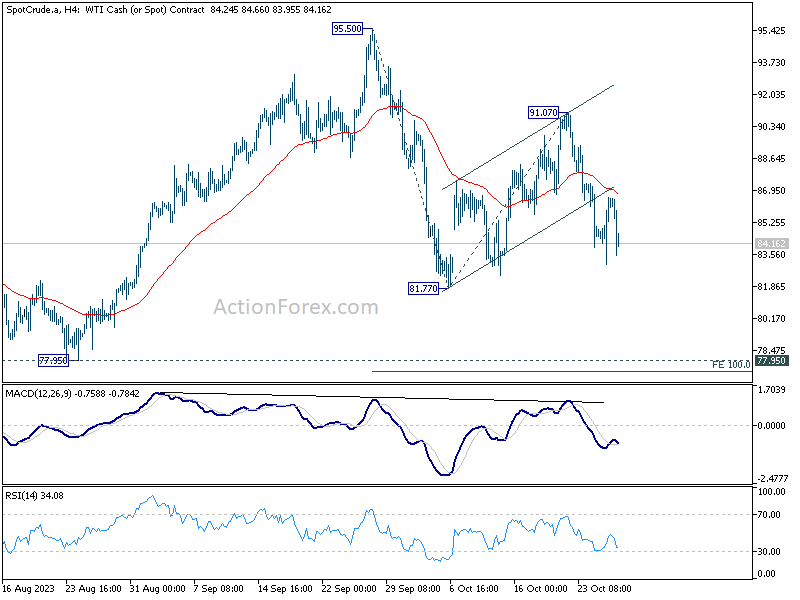
Technically, WTI crude oil's recovery from yesterday's low of 83.05. Rejection by near term channel resistance as well as 55 4H EMA affirms the near term bearish case. That is, corrective recovery from 81.77 has completed at 91.07, fall from 95.50 is probably ready to resume. break of 81.77 will bring deeper fall to 100% projection of 95.50 to 81.77 from 91.07 at 77.34, which is close to 77.95 structural support.
In Europe, at the time of writing, FTSE is down -0.49%. DAX is down -0.85%. CAC is down -0.22%. Germany 10-year yield is down -0.035 at 2.849. Earlier in Asia, Nikkei dropped -2.14%. Hong Kong HSI dropped -0.24%. China Shanghai SSE rose 0.48%. Singapore Strait Times dropped -0.24%. Japan 10-year JGB yield rose 0.0246 to 0.885.
ECB keeps interest rates unchanged as widely expected
ECB keeps interest rates unchanged as widely expected. The main refinancing, marginal lending and deposit rates are held at 4.50%, 4.75%, and 4.00% respectively.
The central bank maintains that key interest are "at levels that, maintained for a sufficiently long duration, will make a substantial contribution to this goal." Future decisions will ensure the policy rates are set at sufficiently restrictive levels for "as long as necessary". Nevertheless, ECB still "stands ready" to adjust all of its instruments.
ECB's Lagarde: Geopolitical tensions posts downside risk to growth, upside to inflation
At the post-meeting press conference, ECB President Christine Lagarde noted that risk to growth are "tilted to the downside", with geopolitical tensions potentially shaking confidence among businesses and households.
On the other hand, growth could be higher if resilient labour market continue its course and real incomes rise. The world economy could grow "more strongly" than expected.
Lagarde also flagged potential upward risks on inflation from sources like escalating energy and food prices. She underscored the role geopolitical tensions might play in boosting short-term energy prices, while also drawing attention to the repercussions of the climate crisis, which could lead to unexpected hikes in food prices.
However, she also acknowledged scenarios where inflationary pressures could diminish, particularly if there's a decline in demand. This could be due to factors such as a more pronounced impact of monetary policy or external economic challenges fueled by heightened geopolitical risks.
US GDP exceeds expectations with 4.9% growth in Q3
US economy delivered a strong performance in Q3, with GDP growth registering at an annualized rate of 4.9%, surpassing the anticipated 4.3% and showing a marked improvement from the 2.1% seen in Q2.
This robust growth in real GDP was driven by a series of factors. Notably, there were marked increases in areas such as consumer spending, private inventory investment, exports, both state and local government spending, federal government spending, and residential fixed investment.
However, these gains were somewhat tempered by a decline in nonresidential fixed investment. Additionally, it's essential to note that imports, which act as a deduction in GDP calculation, saw an increase during this period.
US initial jobless claims rose to 210k, vs expectation 202k
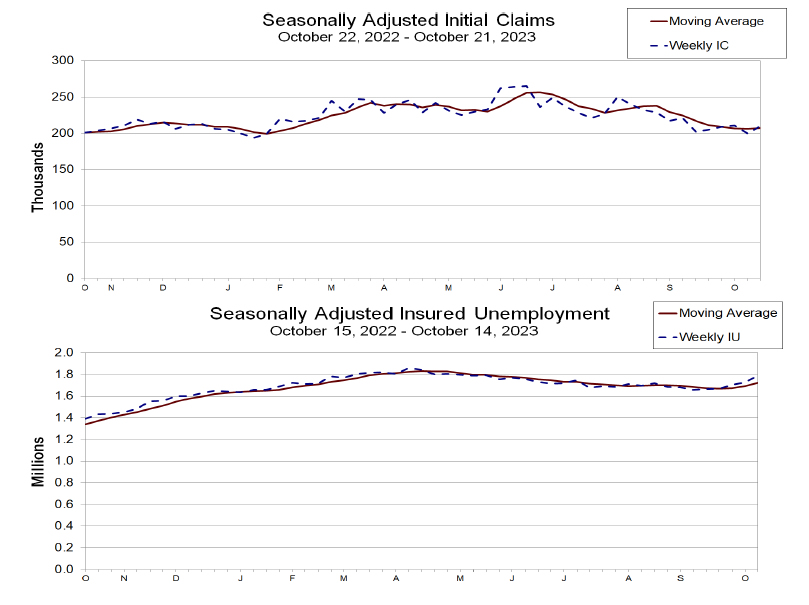
US initial jobless claims rose 10k to 210k in the week ending October 21, above expectation of 202k. Four-week moving average of initial claims rose 1.25k to 207.5k.
Continuing claims rose 63k to 1790k in the week ending October 14. Four-week moving average of continuing claims rose 31k to 1724k.
RBA's Bullock undecided on rate hike following CPI surprise
In the Senate Economics Committee session today, RBA Governor Michele Bullock indicated that the bank was not entirely caught off guard by the stronger than expected CPI data released yesterday. She refrained from offering a definitive direction for the bank's next steps
The Q3 and September CPI data, which Bullock admitted "came out a little higher" than the projections in the August Statement on Monetary Policy, still aligned with the bank's expectations. She clarified, "The numbers were pretty much where we thought it would come out".
When queried on the prospect of another rate hike in the forthcoming meeting, Bullock responded, "We're still analyzing the numbers at the moment. I wouldn't like to say more or less likely, we're still looking at it."
Bullock reiterated the bank's position, stating, "We've always said we have a low tolerance" on inflation surprises. She added, "We are wary and we don't know if the job has been done yet."
Looking forward, Bullock hinted at imminent changes to their economic projections, announcing, "We will be releasing a new set of forecasts after the board meeting." Moreover, she alluded to the significance of these revisions by stating, "There is going to be a change to our forecasts. We have to look at whether or not it's material enough to change our views on monetary policy."
EUR/USD Mid-Day Outlook
Daily Pivots: (S1) 1.0552; (P) 1.0580; (R1) 1.0593; More...
Intraday bias in EUR/USD remains neutral for the moment. On the downside, break of 1.0522 support will confirm rejection by 55 D EMA, and retain near term bearishness. Intraday bias will be back on the downside for 1.0447. Break there will resume larger fall from 1.1274. On the other, strong bounce from current level, followed by break above 1.0693, rebound from 1.0447 to 1.0764 cluster resistance (38.2% retracement of 1.1274 to 1.0447 at 1.0763).
In the bigger picture, fall from 1.1274 medium term top could still be a correction to rise from 0.9534 (2022 low). But chance of a complete trend reversal is rising. In either case, current fall should target 61.8% retracement of 0.9534 to 1.1274 at 1.0199 next. For now, risk will stay on the downside as long as 55 D EMA (now at 1.0684) holds, in case of rebound.
Economic Indicators Update
| GMT | Ccy | Events | Actual | Forecast | Previous | Revised |
|---|---|---|---|---|---|---|
| 23:50 | JPY | Corporate Service Price Index Y/Y Sep | 2.10% | 2.00% | 2.10% | |
| 00:30 | AUD | Import Price Index Q/Q Q3 | 0.80% | 0.20% | -0.80% | |
| 12:15 | EUR | ECB Main Refinancing Rate | 4.50% | 4.50% | 4.50% | |
| 12:30 | USD | Initial Jobless Claims (Oct 20) | 210K | 202K | 198K | 200K |
| 12:30 | USD | GDP Annualized Q3 P | 4.90% | 4.30% | 2.10% | |
| 12:30 | USD | GDP Price Index Q3 P | 3.50% | 2.50% | 1.70% | |
| 12:30 | USD | Goods Trade Balance (USD) Sep P | -85.8B | -85.5B | -84.6B | |
| 12:30 | USD | Wholesale Inventories Sep P | 0.00% | 0.10% | -0.10% | |
| 12:30 | USD | Durable Goods Orders Sep | 4.70% | 1.00% | 0.10% | |
| 12:30 | USD | Durable Goods Orders ex Transport Sep | 0.50% | 0.20% | 0.40% | |
| 14:00 | USD | Pending Home Sales M/M Sep | 1.10% | -7.10% | ||
| 14:30 | USD | Natural Gas Storage | 82B | 97B |
GBP/USD Mid-Day Outlook
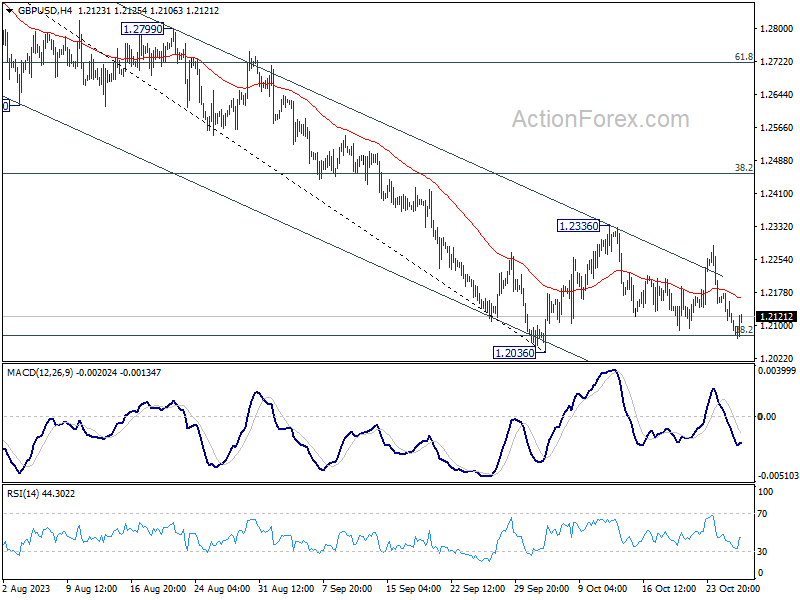
Daily Pivots: (S1) 1.2085; (P) 1.2131; (R1) 1.2156; More
Intraday bias in GBP/USD remains neutral as it's still bounded in range of 1.2036/2336. Downside breakout is in favor with 1.2336 resistance intact. On the downside, decisive break of 1.2036 will resume whole decline from 1.3141 for 1.1801 support next. However, break of 1.2336 will turn bias back to the upside for 38.2% retracement of 1.3141 to 1.2036 at 1.2458.
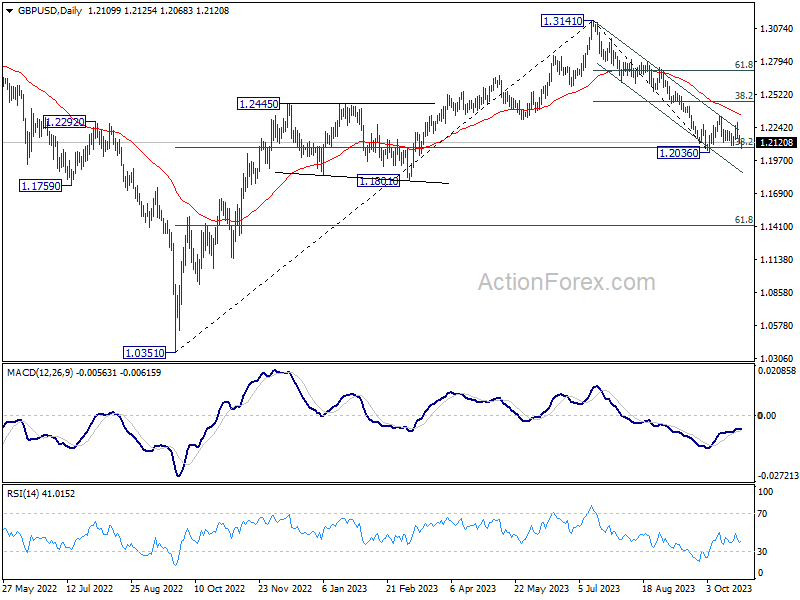
In the bigger picture, fall from 1.3141 medium term top could still be a correction to up trend from 1.0351 (2022 low) only. But risk of complete trend reversal is rising. Sustained break of 38.2% retracement of 1.0351 to 1.3141 at 1.2075 will pave the way to 61.8% retracement at 1.1417. For now, risk will stay on the downside as long as 55 D EMA (now at 1.2346) holds, in case of rebound.
USD/CHF Mid-Day Outlook
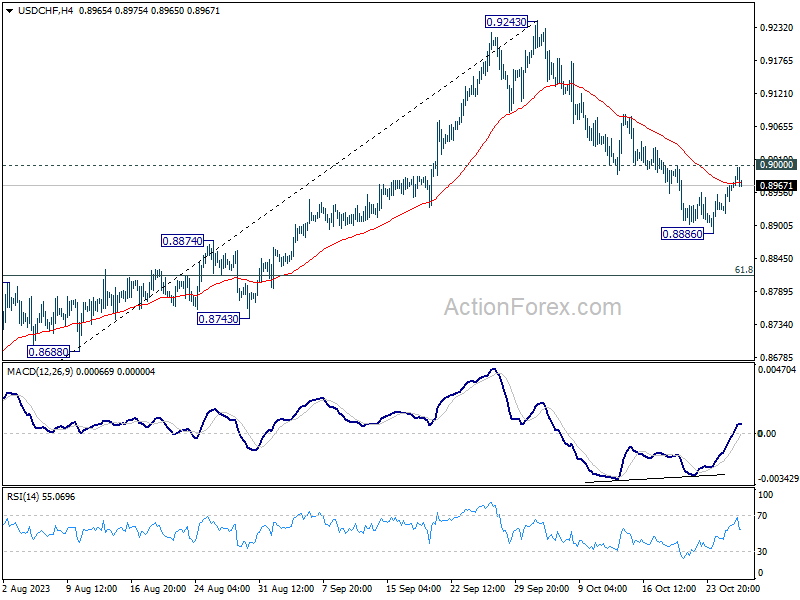
Daily Pivots: (S1) 0.8936; (P) 0.8954; (R1) 0.8986; More....
Intraday bias in USD/CHF remains neutral for the moment. On the downside, break of 0.8886 will resume the fall from 0.9243 to 61.8% retracement of 0.8551 to 0.9243 at 0.8815 next. However, firm break of 0.9000 resistance will indicate short term bottoming, and turn bias back to the upside for stronger rebound.
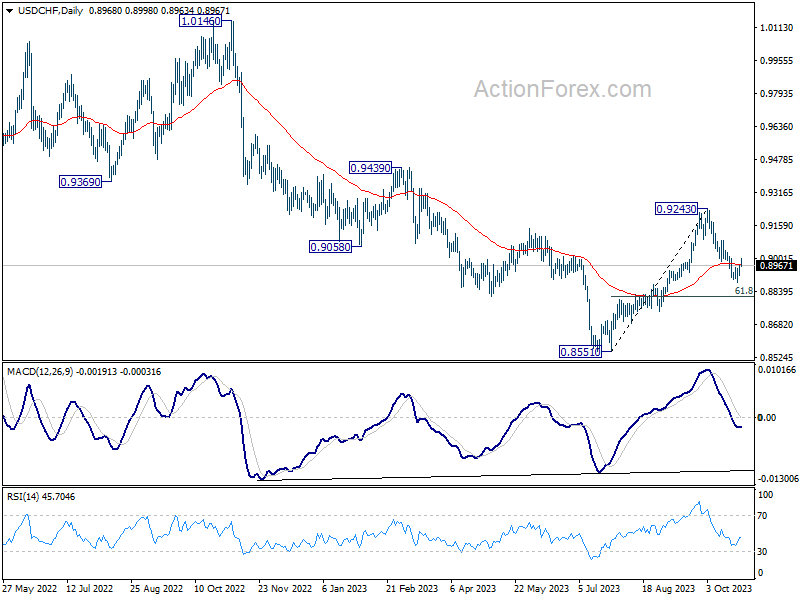
In the bigger picture, rebound from 0.8551 might be completed as a correction at 0.9243. In other words, larger fall from 1.0146 (2022 high) is possibly not over yet. Risk will now stay on the downside as long as 0.9243 resistance holds. Firm break of 0.8551 will confirm down trend resumption.
USD/JPY Mid-Day Outlook
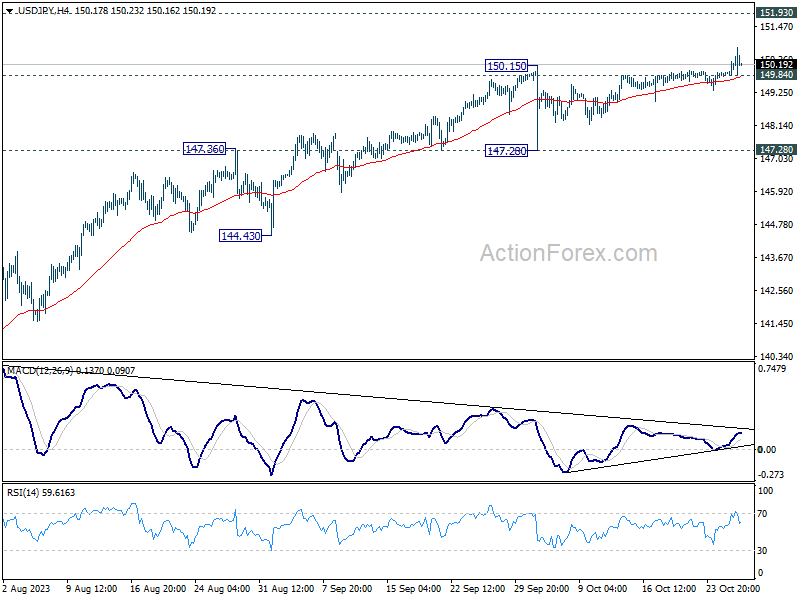
Daily Pivots: (S1) 149.91; (P) 150.12; (R1) 150.43; More...
Intraday bias in USD/JPY stays on the upside with 149.84 minors support. Current rally, as part of the whole rise from 127.20, should target 151.93 medium term resistance next. On the downside, below 149.84 minor support will turn intraday bias neutral first, and bring consolidations. But near term outlook will now stay bullish as long as 147.28 support holds, even in case of deep retreat.
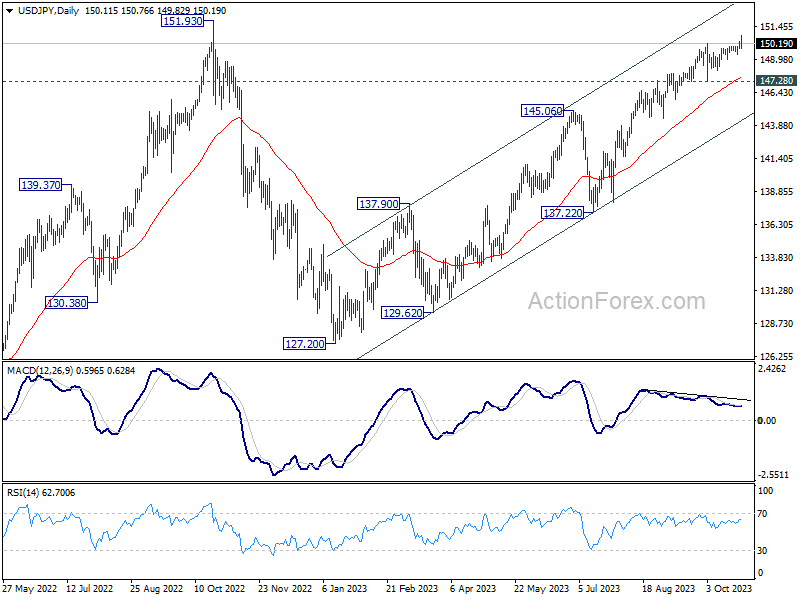
In the bigger picture, while rise from 127.20 is strong, it could still be seen as the second leg of the corrective pattern from 151.93 (2022 high). Rejection by 151.93, followed by sustained break of 145.06 resistance turned support will be the first sign that the third leg of the pattern has started. However, sustained break of 151.93 will confirm resumption of long term up trend.
ECB’s Lagarde: Geopolitical tensions posts downside risk to growth, upside to inflation
At the post-meeting press conference, ECB President Christine Lagarde noted that risk to growth are "tilted to the downside", with geopolitical tensions potentially shaking confidence among businesses and households.
On the other hand, growth could be higher if resilient labour market continue its course and real incomes rise. The world economy could grow "more strongerly than expected.
Lagarde also flagged potential upward risks on inflation from sources like escalating energy and food prices. She underscored the role geopolitical tensions might play in boosting short-term energy prices, while also drawing attention to the repercussions of the climate crisis, which could lead to unexpected hikes in food prices.
However, she also acknowledged scenarios where inflationary pressures could diminish, particularly if there's a decline in demand. This could be due to factors such as a more pronounced impact of monetary policy or external economic challenges fueled by heightened geopolitical risks.
US initial jobless claims rose to 210k, vs expectation 202k
US initial jobless claims rose 10k to 210k in the week ending October 21, above expectation of 202k. Four-week moving average of initial claims rose 1.25k to 207.5k.
Continuing claims rose 63k to 1790k in the week ending October 14. Four-week moving average of continuing claims rose 31k to 1724k.
US GDP exceeds expectations with 4.9% growth in Q3
US economy delivered a strong performance in Q3, with GDP growth registering at an annualized rate of 4.9%, surpassing the anticipated 4.3% and showing a marked improvement from the 2.1% seen in Q2.
This robust growth in real GDP was driven by a series of factors. Notably, there were marked increases in areas such as consumer spending, private inventory investment, exports, both state and local government spending, federal government spending, and residential fixed investment.
However, these gains were somewhat tempered by a decline in nonresidential fixed investment. Additionally, it's essential to note that imports, which act as a deduction in GDP calculation, saw an increase during this period.