

Sample Category Title
Crude Oil Price Could See Swing Moves Due To Israel-Hamas War
Key Highlights
- Crude oil prices opened with a gap higher after the Israel-Hamas war escalated.
- It is struggling to clear the $87.00 resistance on the 4-hour chart.
- Gold prices climbed further higher toward the $1,880 resistance.
- The US Consumer Price Index could decline from 3.7% to 3.6% in Sep 2023 (YoY).
Crude Oil Price Technical Analysis
Yesterday, we discussed how Gold and Crude oil prices opened with a gap higher this week due to the Israel-Hamas war. Oil prices climbed above the $85.00 resistance zone before the bears appeared. The death toll is still rising in Israel and the Gaza Strip, as missile attacks continue, and conflicts explode for a sixth day on Thursday.
Looking at the 4-hour chart of XTI/USD, the price spiked toward the $87.00 resistance zone and the 200 simple moving average (green, 4-hour). It struggled to continue higher and formed a short-term high at $87.36.
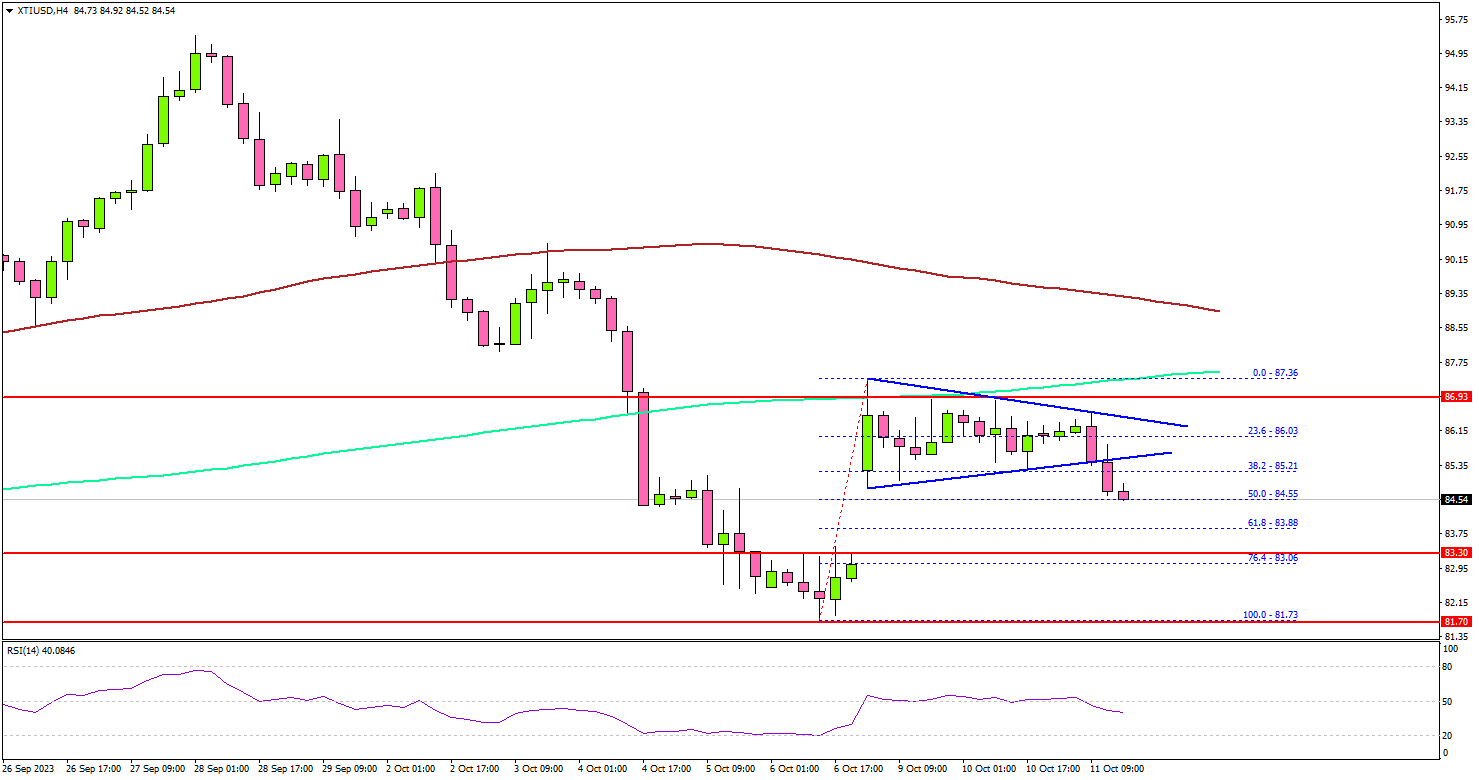
Recently, there was a downside correction below the $86.20 support. The price is now trading well below the $87.00 zone, the 100 simple moving average (red, 4-hour), and the 200 simple moving average (green, 4-hour).
If it continues to move down, the bulls might appear near the gap-close region at $83.30. The next major support sits near the $81.80 zone. Any more losses might call for a test of the $80.50 support zone or a trend change and drop toward the $80.00 support zone.
On the upside, the price might face resistance near the $86.20 level. The next major resistance is near the $87.00 zone, above which the price may perhaps accelerate higher. In the stated case, it could even visit the $90 resistance.
Looking at gold prices, there was a steady increase above the $1,850 level and the bulls could aim a spike above the $1,880 resistance.
Economic Releases to Watch Today
- US Consumer Price Index for Sep 2023 (MoM) – Forecast 0.3%, versus +0.6% previous.
- US Consumer Price Index for Sep 2023 (YoY) – Forecast +3.6%, versus +3.7% previous.
- US Consumer Price Index Ex Food & Energy for Sep 2023 (YoY) – Forecast +4.1%, versus +4.3% previous.
Japan’s PPI slows to 2% yoy in Sep, trailing CPI core for the first time since 2021
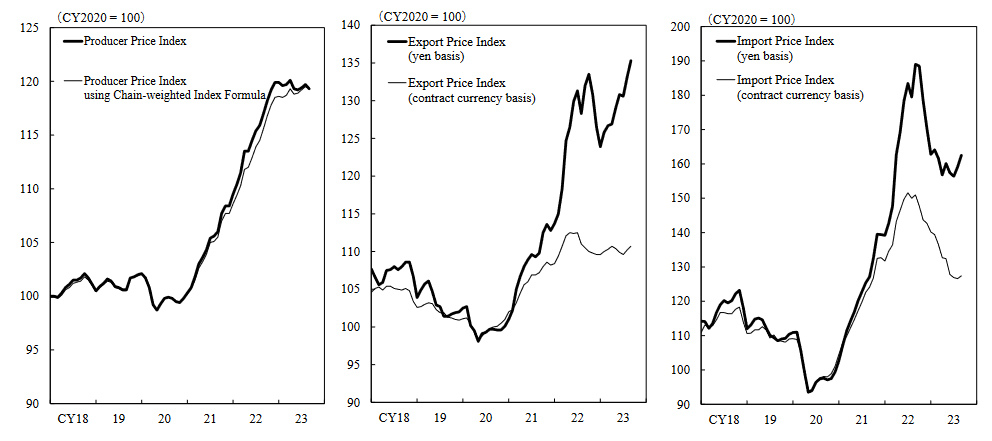
Japan PPI slowed from 3.3% yoy to 2.0% yoy in September, below expectations of 2.3%. That's the lowest level since March 2021. Also, PPI is now below CPI core (at 3.1% yoy) for the first time since early 2021.
Import price index was unchanged at -15.6% yoy, the sixth month of decline. Export price index rose for the first time in seven months, up 0.2% yoy, comparing to prior month's -0.7% yoy.
For the month, PPI fell -0.3% mom. Import price index rose 0.6% mom. Export price index rose 0.5% mom.
Fed’s Collins eyes prolonged restrictive rates
Boston Fed President Susan Collins noted overnight her expectation that the central bank may need to maintain interest rates at restrictive levels "for some time" until there's tangible evidence of inflation moving back to 2% target.
While acknowledging that the policy rates might currently be near their peak, Collins did not rule out the possibility of additional rate hikes.
She stated, "And while we are likely near, and could be at, the peak for policy rates, further tightening could be warranted depending on incoming information."
Amidst the pervasive economic uncertainties and risks characterizing the current financial climate, Collins remains cautiously optimistic. She believes that the restoration of price stability is achievable, anticipating an "orderly slowdown in activity and only a modest increase in the unemployment rate."
Fed minutes show majority leaning towards further rate hike
In the minutes from Fed's September 19-20 meeting, while "a majority of participants" believed another rate increase might be in order, a contrasting view was held by "some" who deemed no further hikes necessary.
A unanimous consensus was evident among all attendees that the existing policy stance needs to "remain restrictive for some time". The chief rationale behind this unified sentiment is to ensure that inflation trends downwards in a sustained manner to Fed's target.
An interesting shift in communication strategy was proposed by "several participants". They emphasized that discussions and subsequent messaging should transition from deliberating the potential height of rate hikes to determining the duration for which rates should be maintained at these elevated, restrictive levels.
In terms of gauging risks, participants "generally judged" that challenges to fulfilling the Fed's mandates had become "more two sided". However, a lingering concern persists. Despite this balanced view of risks, "most participants" continued to see upside risks to inflation.
EURNZD Wave Analysis
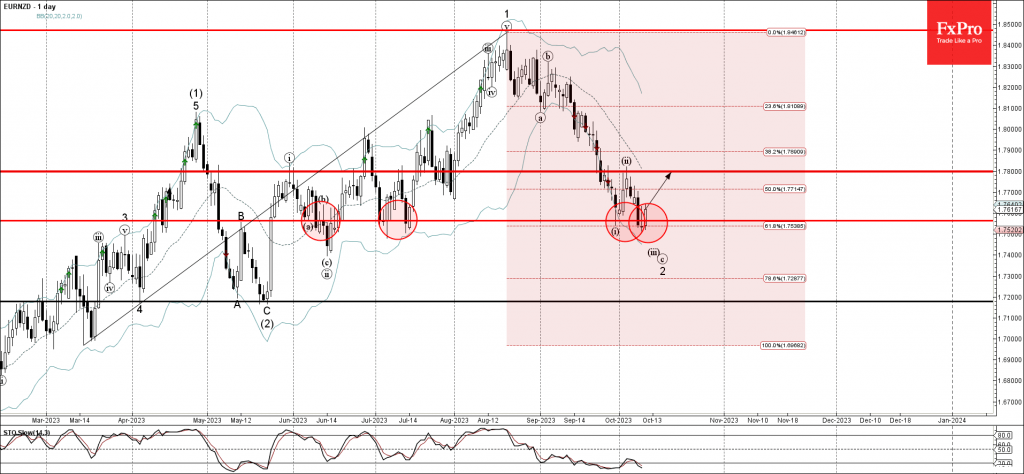
- EURNZD reversed from support level 1.7565
- Likely to rise to resistance level 1.7800
EURNZD currency pair recently reversed up from the key support level 1.7565 (which has been reversing the price from June), intersecting with the lower daily Bollinger Band and the 61.8% Fibonacci correction of the previous upward impulse from March.
The upward reversal from the support level 1.7565 stopped the c-wave of the previous ABC correction 2 from the middle of August.
Given the oversold daily Stochastic, EURNZD currency pair can be expected to rise further toward the next resistance level 1.7800.
CADJPY Wave Analysis
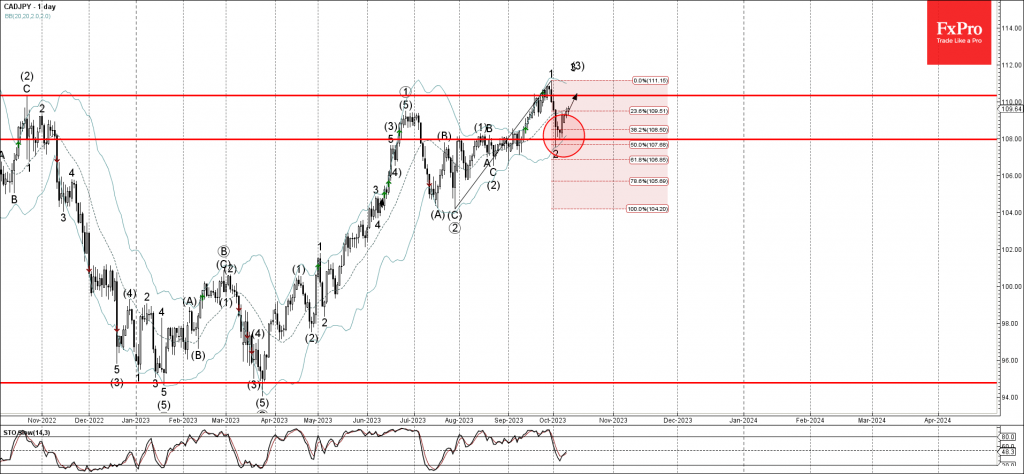
- CADJPY reversed from support level 108.00
- Likely to rise to resistance level 110.35
CADJPY currency pair recently reversed up from the pivotal support level 108.00 (former key resistance from July and August), intersecting with the lower daily Bollinger Band.
The upward reversal from the support level 108.00 started the active short-term impulse wave 3 of the intermediate impulse wave (3) from the middle of August.
Given the clear daily uptrend and the continued yen sales, CADJPY can be expected to rise further toward the next resistance level 110.35.
Dollar Mostly Unfazed Post FOMC Minutes
- Minutes: Fed sees ‘restrictive’ policy staying in place until inflation eases
- 10-year Treasury yield resumes slide post minutes, down 5.4bps to 4.599%
- Inflation expected to moderate given energy price trends in September; while core proves to be sticky
These Fed Minutes seem to be particularly old given everything we’ve seen with rates, a new war, and a gloomier outlook for the economy. The Minutes noted that policy should remain restrictive for some time until the Committee is confident that inflation is moving down sustainably toward its objective. The Fed acknowledged given how restrictive monetary policy has become that the risks to the achievement of the Committee’s goals had become more two sided. Many noted data volatility and potential data revisions, or the difficulty of estimating the neutral policy rate, as supporting the case for proceeding carefully in determining the extent of additional policy firming that may be appropriate.
Wall Street seems confident the Fed is done raising rates this year. A lot has happened since the September 19-20th FOMC policy decision and it seems the Fed can park rates here and wait to see how quickly inflation falls to their target. If the consumer finally shows major signs of weakness this earnings season, Fed rate cut bets will become bolstered for the spring time.
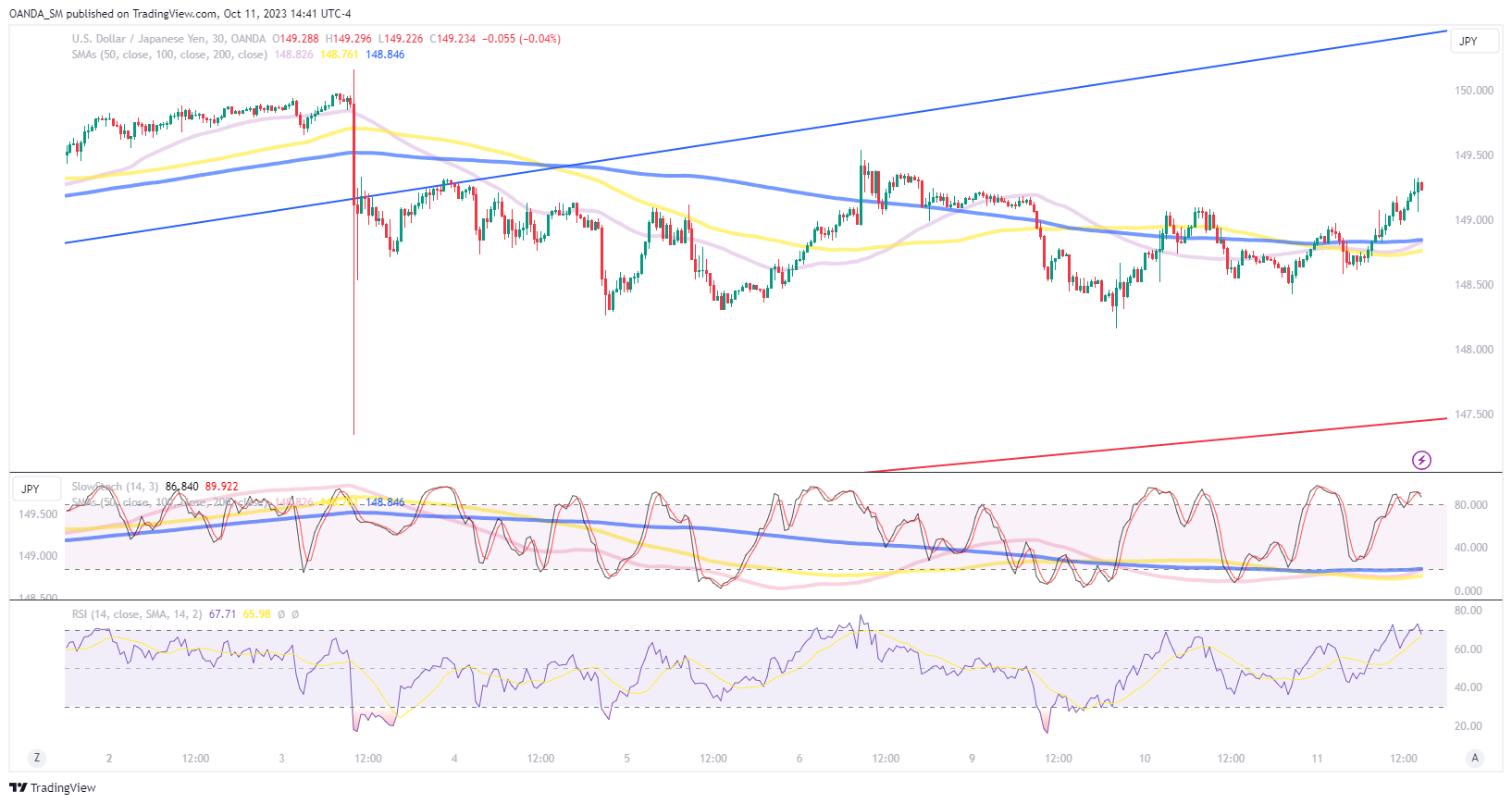
The dollar initially pared losses against its major trading partners following the release of the Fed minutes, with the dollar-yen erasing the majority of losses that stemmed from the start of the trading week. The safe-haven flows that went into the Japanese yen from the Israel-Hamas war have mostly been unwound. Currency traders will pay close attention to the upcoming inflation report which could suggest restrictive policy might have to stay in place even longer.
USD/JPY 30-minute chart
Fed Minutes Signal One More Rate Hike Could Be On Tap
The minutes from the September 19-20, 2023 Federal Open Market Committee (FOMC) meeting underscored the Fed's commitment to curtailing price pressures.
On the economic outlook, Committee members noted that "that real GDP had been expanding at a solid pace and had been more resilient than expected. Nevertheless, participants also noted that they expected that real GDP growth would slow in the near term. Participants judged that the current stance of monetary policy was restrictive and that it broadly appeared to be restraining the economy as intended." Additionally, participants continued to anticipate that a period of below trend growth would be needed to return inflation to its 2% target.
On debating the appropriate policy actions, "almost all participants judged it appropriate to maintain the target range for the federal funds rate." A more cautious approach would better allow the Committee the cumulative effects of previous tightening on economic activity.
When discussing future interest rate hikes, the "majority of participants judged that one more increase in the target federal funds rate at a future meeting would likely be appropriate, while some judged it likely that no further increases would be warranted." Moreover, all participants stressed the importance of maintaining a restrictive policy stance until there is strong evidence that inflation is moving back to target.
Concerning the risks of additional rate hikes, committee members noted that "risks to the achievement of the Committee’s goals had become more two sided." The Committee noted the potential for a larger-than-anticipated lagged impact on economic activity from tightening financial conditions.
Key Implications
Today's minutes confirmed that the Fed has kept another rate hike in play as economic activity continues to be buoyant underscored by strength in the labor market. This has been reflected in an expected shallower path of rate cuts. While inflation has been trending in a favorable direction, near-term inflation expectations have inched higher in recent months and will have the Fed attentively monitoring upside risks to inflation when calibrating policy to a restrictive level that balances the risks of doing too much versus doing too little.
With economic activity remaining strong, the Fed is likely to move forward with an additional rate hike and maintain rates at a restrictive level until there is clear evidence that inflation is on a sustainable path to its 2% target. The one risk to this view is the sharp tightening in financial conditions experienced over the past several weeks, highlighted by a rise in long-term treasury yields. Should this continue, it may give the Fed reason to pause.
(FED) Minutes of the Federal Open Market Committee
September 19-20, 2023
A joint meeting of the Federal Open Market Committee and the Board of Governors of the Federal Reserve System was held in the offices of the Board of Governors on Tuesday, September 19, 2023, at 10:30 a.m. and continued on Wednesday, September 20, 2023, at 9:00 a.m.1
Attendance
Jerome H. Powell, Chair
John C. Williams, Vice Chair
Michael S. Barr
Michelle W. Bowman
Lisa D. Cook
Austan D. Goolsbee
Patrick Harker
Philip N. Jefferson
Neel Kashkari
Adriana D. Kugler
Lorie K. Logan
Christopher J. Waller
Thomas I. Barkin, Raphael W. Bostic, Mary C. Daly, and Loretta J. Mester, Alternate Members of the Committee
Susan M. Collins and Jeffrey R. Schmid, Presidents of the Federal Reserve Banks of Boston and Kansas City, respectively
Kathleen O'Neill Paese, Interim President of the Federal Reserve Bank of St. Louis
Joshua Gallin, Secretary
Matthew M. Luecke, Deputy Secretary
Brian J. Bonis, Assistant Secretary
Michelle A. Smith, Assistant Secretary
Mark E. Van Der Weide, General Counsel
Richard Ostrander, Deputy General Counsel
Trevor A. Reeve, Economist
Stacey Tevlin, Economist
Beth Anne Wilson, Economist
Shaghil Ahmed,2 Roc Armenter, James A. Clouse, Brian M. Doyle, Eric M. Engen,3 Andrea Raffo, Chiara Scotti, and William Wascher, Associate Economists
Roberto Perli, Manager, System Open Market Account
Julie Ann Remache, Deputy Manager, System Open Market Account
Stephanie R. Aaronson, Senior Associate Director, Division of Research and Statistics, Board
Jose Acosta, Senior System Administrator II, Division of Information Technology, Board
Andrea Ajello, Section Chief, Division of Monetary Affairs, Board
Penelope A. Beattie,4 Section Chief, Office of the Secretary, Board
Ellen J. Bromagen, First Vice President, Federal Reserve Bank of Chicago
Mark A. Carlson, Adviser, Division of Monetary Affairs, Board
Daniel Cooper, Vice President, Federal Reserve Bank of Boston
Daniel M. Covitz, Deputy Director, Division of Research and Statistics, Board
Stephanie E. Curcuru, Deputy Director, Division of International Finance, Board
Rochelle M. Edge, Deputy Director, Division of Monetary Affairs, Board
Matthew J. Eichner,5 Director, Division of Reserve Bank Operations and Payment Systems, Board
Eric C. Engstrom, Associate Director, Division of Monetary Affairs, Board
Jon Faust, Senior Special Adviser to the Chair, Division of Board Members, Board
Charles A. Fleischman, Adviser, Division of Research and Statistics, Board
Glenn Follette, Associate Director, Division of Research and Statistics, Board
Jennifer Gallagher, Assistant to the Board, Division of Board Members, Board
Carlos Garriga, Senior Vice President, Federal Reserve Bank of St. Louis
Michael S. Gibson, Director, Division of Supervision and Regulation, Board
Joseph W. Gruber, Executive Vice President, Federal Reserve Bank of Kansas City
Valerie S. Hinojosa, Section Chief, Division of Monetary Affairs, Board
Matteo Iacoviello,3 Senior Associate Director, Division of International Finance, Board
Jane E. Ihrig, Special Adviser to the Board, Division of Board Members, Board
Michael T. Kiley, Deputy Director, Division of Financial Stability, Board
Don H. Kim,5 Senior Adviser, Division of Monetary Affairs, Board
Edward S. Knotek II, Senior Vice President, Federal Reserve Bank of Cleveland
Spencer Krane, Senior Vice President, Federal Reserve Bank of Chicago
Andreas Lehnert, Director, Division of Financial Stability, Board
Paul Lengermann, Assistant Director, Division of Research and Statistics, Board
Kurt F. Lewis, Special Adviser to the Board, Division of Board Members, Board
Dan Li, Assistant Director, Division of Monetary Affairs, Board
Laura Lipscomb, Special Adviser to the Board, Division of Board Members, Board
Zheng Liu, Vice President, Federal Reserve Bank of San Francisco
David López-Salido, Senior Associate Director, Division of Monetary Affairs, Board
Jonathan P. McCarthy, Economic Research Advisor, Federal Reserve Bank of New York
Ann E. Misback, Secretary, Office of the Secretary, Board
Raven Molloy, Deputy Associate Director, Division of Research and Statistics, Board
Michelle M. Neal, Head of Markets, Federal Reserve Bank of New York
Anna Orlik, Principal Economist, Division of Monetary Affairs, Board
Damjan Pfajfar, Group Manager, Division of Monetary Affairs, Board
Pierre-Daniel G. Sarte, Senior Advisor, Federal Reserve Bank of Richmond
Nitish Ranjan Sinha, Special Adviser to the Board, Division of Board Members, Board
Dafina Stewart, Special Adviser to the Board, Division of Board Members, Board
Clara Vega, Special Adviser to the Board, Division of Board Members, Board
Jeffrey D. Walker,5 Associate Director, Division of Reserve Bank Operations and Payment Systems, Board
Min Wei, Special Adviser to the Board, Division of Board Members, Board
Jonathan Willis, Vice President, Federal Reserve Bank of Atlanta
Donielle A. Winford, Information Manager, Division of Monetary Affairs, Board
Paul R. Wood, Special Adviser to the Board, Division of Board Members, Board
Rebecca Zarutskie, Special Adviser to the Board, Division of Board Members, Board
Andrei Zlate, Group Manager, Division of Monetary Affairs, Board
Developments in Financial Markets and Open Market Operations
The manager turned first to a review of developments in financial markets over the intermeeting period. U.S. data releases generally pointed to greater economic resilience than previously thought, and the reaction in market pricing implied both a higher expected trajectory for the policy rate at longer horizons and higher term premiums. Policy-sensitive rates rose moderately, and longer-dated forward rates displayed larger increases. Ten-year Treasury yields ended the period more than 40 basis points higher, and broad measures of equity prices fell. Bank equity prices underperformed over the period, but taking a somewhat longer view, investor sentiment toward the banking sector appeared to have largely stabilized, with less differentiation of equity price movements across bank types. The dollar broadly appreciated against advanced-economy currencies over the period, as stronger U.S. data supported moderately increased yield differentials against these economies amid perceptions that policy rates were at or near their peaks. In China, signs of strain in the property sector increased, and optimism about growth diminished further, on net, although broader markets, including global commodity markets, did not appear to show elevated concern about China-related risks. U.S. financial conditions tightened, with higher longer-term rates, lower equity prices, and a stronger dollar contributing roughly equally to the increase in various financial conditions indexes.
In addressing the increase in nominal yields on longer-run Treasury securities over the intermeeting period, the manager noted that the rise in real yields exceeded that of nominal yields over the period, implying a small decline in inflation compensation. Inflation expectations appeared to remain very well anchored. Market participants cited various factors for the rise in longer-term nominal yields, including stronger-than-expected economic data, a possible increase in the neutral policy rate, greater economic and policy uncertainty, and larger-than-expected borrowing by the Treasury.
Household and corporate borrowing rates increased over the period, generally rising in line with Treasury yields. Still, market participants noted that, with household and corporate borrowers having a limited need to refinance debt in the near term, it could take more time for past monetary policy actions to fully pass through to these sectors.
Regarding expectations for the September FOMC meeting, the manager noted that responses to the Open Market Desk's Survey of Primary Dealers and Survey of Market Participants and market pricing all pointed to a virtual certainty of no change in the policy rate. In addition, modal expectations for the policy rate from the surveys were that the current target range would be maintained until the May 2024 FOMC meeting, compared with March in the previous survey, with a roughly one-in-three chance of a 25 basis point increase by the November FOMC meeting. For horizons beyond the middle of next year, the modal path from the surveys was notably lower than the market-implied path.
The manager turned next to developments in money markets and Desk operations. Usage of the overnight reverse repurchase agreement (ON RRP) facility continued to decline over the intermeeting period, largely reflecting reduced participation by government and prime money market funds even as these funds continued to see inflows. Increased supply of money market instruments, especially Treasury bills, contributed to a slight increase in money market rates, which appeared to induce money funds to shift away from ON RRP toward other instruments. However, the ON RRP facility continued to provide an effective floor for the federal funds rate. With ON RRP balances falling more than Federal Reserve assets, reserve balances grew over the period. At more than $3.3 trillion, reserves remained abundant. In the September Survey of Primary Dealers, respondents generally saw a lower path for ON RRP participation and a higher path for reserves, compared with the July survey.
By unanimous vote, the Committee ratified the Desk's domestic transactions over the intermeeting period. There were no intervention operations in foreign currencies for the System's account during the intermeeting period.
Staff Review of the Economic Situation
The data available at the time of the September 19-20 meeting suggested that real gross domestic product (GDP) was rising at a solid pace in the third quarter. The labor market continued to be tight, with the unemployment rate low and job gains slowing but remaining strong. Consumer price inflation was still elevated.
The imbalance between labor demand and supply appeared to be easing. Total nonfarm payroll employment increased at a slower pace over July and August than in the second quarter. The private-sector job openings rate and the quits rate, both measured by the Job Openings and Labor Turnover Survey, moved down further through July. Over July and August, the unemployment rate edged up, on net, and stood at 3.8 percent in August, and both the labor force participation rate (LFPR) and the employment-to-population ratio rose slightly. The unemployment rate for African Americans declined, while the jobless rate for Hispanics rose, and both rates were still above the national average. The easing of labor market imbalances was also evident in the recent wage data, with the 12-month changes in average hourly earnings and the employment cost index, and the four-quarter change in business-sector compensation per hour all lower than their year-earlier levels.
Consumer price inflation remained elevated but continued to show signs of slowing. The total price index for personal consumption expenditures (PCE) increased 3.3 percent over the 12 months ending in July, and core PCE price inflation, which excludes changes in energy prices and many consumer food prices, was 4.2 percent over the same period; both total and core PCE price inflation were lower than a year earlier. The trimmed mean measure of 12-month PCE price inflation constructed by the Federal Reserve Bank of Dallas was 4.1 percent in July, down from its level earlier in the year. In August, the 12‑month change in the consumer price index (CPI) was 3.7 percent, while core CPI inflation was 4.3 percent over the same period, and both total and core CPI inflation were well below their year-earlier levels. Survey measures of consumers' short-term inflation expectations had moved down alongside actual inflation but remained above pre-pandemic levels. In contrast, survey measures of medium- to longer-term inflation expectations remained in the range seen in the decade before the pandemic.
Available indicators suggested that real GDP was expanding at a solid pace in the third quarter. Private domestic final purchases—which includes PCE, residential investment, and business fixed investment (BFI) and often provides a better signal of underlying economic momentum than does GDP—also looked to be rising solidly, led by gains in both PCE and BFI.
After falling in the second quarter, real goods exports increased in July, supported by higher exports of automotive products. Real goods imports also rose, as imports of consumer goods and capital goods partially recovered from their declines in recent months. The nominal U.S. international trade deficit widened, as growth in imports of goods and services outpaced that of exports.
Foreign economic growth slowed in the second quarter, as troubles in the property sector weighed on economic activity in China and monetary policy restraint contributed to the slowing in economic growth in Europe. Available data for the third quarter, such as purchasing managers indexes and measures of business confidence, pointed to a continued subdued pace of economic activity abroad.
Foreign headline inflation continued to fall but remained elevated. In several economies, though, energy prices turned up again. In the context of still-high core inflation, some central banks in advanced foreign economies (AFEs) raised their policy rates, despite a slowdown in economic activity, and indicated their intention to hold these rates at sufficiently restrictive levels to bring inflation back to target rates. In contrast, central banks of emerging market economies largely remained on hold, and some even began to cut rates amid easing inflationary pressures.
Staff Review of the Financial Situation
Over the intermeeting period, generally robust economic data led to moderate increases in the market-
implied path of the federal funds rate and yields on shorter-term Treasury securities. Yields on medium- and longer-term nominal Treasury securities rose more substantially, mainly reflecting higher term premiums and higher real yields. Stock prices declined somewhat, but spreads on investment- and speculative-grade corporate bonds were little changed. Financing conditions tightened somewhat, and borrowing costs increased moderately.
Market participants pointed to a range of factors that may have contributed to the increase in longer-term forward rates, including higher term premiums and upward revisions to market views of the likely path of Treasury debt over time. Real yields increased almost as much as or a little more than nominal yields, leaving implied measures of inflation compensation modestly changed. The market-implied path for the federal funds rate in the near term was up slightly since the July FOMC meeting, and the expected path further out, implied by overnight index swap contracts, rose moderately.
Broad equity price indexes declined somewhat, and the one-month option-implied volatility on the S&P 500 index edged up slightly, on net, and stood near the 25th percentile of its historical distribution.
Conditions in domestic short-term funding markets remained stable over the intermeeting period. Both prime and government money market funds experienced moderate inflows since the July FOMC meeting. Against a backdrop of heavy issuance of Treasury bills and the modest associated upward pressure on Treasury bill yields, take-up in the ON RRP facility continued to decline over the period and fell below $1.5 trillion late in the period.
Over the intermeeting period, the dollar appreciated, as U.S. economic data came in stronger than expected, while foreign data suggested slowing economic growth abroad. Long-term yields in AFEs ended the period higher, reflecting spillovers from higher U.S. yields and, to a lesser extent, the increase in Japanese yields following the decision by the Bank of Japan to effectively widen its target range for the 10-year Japanese yield. Global equity prices declined moderately, reflecting higher long-term yields and increased concerns about the foreign economic outlook. Bond and equity funds focused on emerging markets saw moderate outflows.
In domestic credit markets, borrowing rates for businesses, households, and municipalities increased moderately over the intermeeting period, mostly reflecting a pass-through of higher yields on longer-maturity Treasury securities to those borrowing rates. Interest rates on newly originated bank loans to businesses and households increased over the second quarter, interest rates on credit card offers increased in July, and interest rates on auto loans increased in July and August.
Bank credit conditions appeared to tighten somewhat over the intermeeting period, but credit to businesses and households remained generally accessible. Commercial and industrial loan balances contracted, but outstanding commercial real estate (CRE) loans increased from July through late August, though at a slower pace than earlier in the year. Within the category of CRE loans, nonfarm nonresidential loans contracted over the summer for the first time since March 2022. Bank funding conditions were generally stable. Core deposits declined but were offset by inflows of large time deposits.
Credit was available for most consumers. Credit card balances grew in the second quarter through late August. For residential real estate borrowers, credit availability was little changed. Credit conditions for small businesses were also fairly stable. The PayNet Small Business Lending Index indicated that loan originations edged up in July and stood above the median of its pre-pandemic level. Credit was generally accessible through capital markets, although issuance was subdued. Issuance of nonfinancial investment- and speculative-grade bonds was muted in July but picked up modestly in August, and issuance of municipal bonds was weak in July. New issuance of leveraged loans was subdued in July, and issuance of agency and non-agency commercial mortgage-backed securities (CMBS) was soft in July and August.
Credit quality deteriorated a little further across many sectors in recent months but remained broadly solid. In the CRE sector, delinquency rates on nonfarm nonresidential CRE bank loans rose over the second quarter, while delinquency rates on construction, land development, and multifamily loans were roughly unchanged. Delinquency rates of loans in CMBS pools increased, driven by the office and retail sectors. The office delinquency rate rose more than 2 percentage points since January but remained below its pre-pandemic average. The delinquency rate for small business loans ticked up in June and July. Delinquency rates for credit cards and auto loans increased further in the second quarter and stood a bit above their average levels in the years leading up to the pandemic. The fraction of potential borrowers with a prime credit score expanded through the second quarter, moving further above its pre-pandemic level. The trailing default rates for investment- and speculative-grade corporate bonds increased in July but remained at historically low levels. The trailing default rate for leveraged loans was little changed, on net, but downgrades of leveraged loans surpassed upgrades in July and August.
In contrast to many other types of loans, the payment performance of home mortgages improved. Delinquency rates of Federal Housing Administration and Department of Veterans Affairs loans in July were lower than levels seen earlier this year, and delinquency rates of conventional loans remained at historical lows. Credit quality was also strong for municipal borrowers.
Staff Economic Outlook
The economic forecast prepared by the staff for the September FOMC meeting was stronger than the July projection, as consumer and business spending appeared to be more resilient to tight financial conditions than previously expected. The staff assumed that GDP growth for the rest of this year would be damped a bit by the autoworkers' strike, with these effects unwound by a small boost to GDP growth next year. The size and timing of these effects were highly uncertain. In all, the staff projected that real GDP growth in 2024 through 2026 would be slower, on average, than this year and would run below the staff's estimate of potential output growth, restrained over the next couple of years by the lagged effects of monetary policy actions. The unemployment rate was projected to remain roughly flat through 2026, as upward pressure from below-potential output growth was offset by downward pressure from further improvements in labor market functioning.
Total and core PCE price inflation were forecast to be around 3.5 percent at the end of this year, and inflation was projected to move lower in coming years, as demand and supply in product and labor markets continued to move into better alignment. Total and core PCE price inflation were expected to be close to 2 percent in 2026.
The staff continued to view the uncertainty around the baseline projection as considerable. Risks around the inflation forecast were seen as skewed to the upside, given the possibility that inflation could prove to be more persistent than expected or that further adverse shocks to supply conditions might occur. Should these upside inflation risks materialize, the response of monetary policy could, if coupled with an adverse reaction in financial markets, tilt the risks around the forecast for economic activity to the downside.
Participants' Views on Current Conditions and the Economic Outlook
In conjunction with this FOMC meeting, participants submitted their projections of the most likely outcomes for real GDP growth, the unemployment rate, and inflation for each year from 2023 through 2026 and over the longer run. The projections were based on their individual assessments of appropriate monetary policy, including the path of the federal funds rate. The longer-run projections represented each participant's assessment of the rate to which each variable would be expected to converge, over time, under appropriate monetary policy and in the absence of further shocks to the economy. A Summary of Economic Projections (SEP) was released to the public following the conclusion of the meeting.
Regarding the economic outlook, participants assessed that real GDP had been expanding at a solid pace and had been more resilient than expected. Nevertheless, participants also noted that they expected that real GDP growth would slow in the near term. Participants judged that the current stance of monetary policy was restrictive and that it broadly appeared to be restraining the economy as intended. Participants stressed that current inflation remained unacceptably high while acknowledging that it had moderated somewhat over the past year. They also noted that further evidence would be required for them to be confident that inflation was clearly on a path to the Committee's 2 percent objective. Participants continued to view a period of below-trend growth in real GDP and some softening in labor market conditions as likely to be needed to bring aggregate demand and aggregate supply into better balance and reduce inflation pressures sufficiently to return inflation to 2 percent over time.
In their discussion of the household sector, participants observed that aggregate consumer spending had continued to exhibit considerable strength, supported by the strong labor market and by generally strong household balance sheets. However, many participants remarked that the finances of some households were coming under pressure amid high inflation and declining savings and that there had been an increasing reliance on credit to finance expenditures. In addition, tighter credit conditions, waning fiscal support for families, and a resumption of student loan payments were viewed by several participants as having the potential to weigh on the growth of consumption. While household credit quality was seen as generally strong, a few participants noted rising delinquency rates on some types of consumer credit. A couple of participants also remarked that households were becoming increasingly price sensitive. Some participants noted that housing demand was resilient despite higher interest rates; new home construction was solid, in part reflecting the limited inventory of homes available for sale.
Regarding the business sector, participants noted that activity continued to be solid, though several pointed to signs of softening conditions. Many participants noted improved business conditions from an increased ability to hire and retain workers, better-functioning supply chains, or reduced input cost pressures. A few participants commented that their business contacts had reported difficulties passing on cost increases to customers. Several participants judged that, over coming quarters, business activity would be restrained by tighter financial conditions, such as higher interest rates and more constrained access to bank credit. Several participants noted, however, that the tightening of credit conditions resulting from the banking stresses earlier in the year was likely to be less severe than they previously expected. A number of participants expressed concerns about vulnerabilities in the CRE sector. Many participants commented that they expected that the autoworkers' strike would, in the near term, result in a slowdown in production of motor vehicles and parts and possibly put upward pressure on automobile prices, but that these effects would be temporary. With respect to the agricultural sector, a few participants noted that conditions were mixed, as crop prices had declined amid higher production estimates and as supply and demand imbalances pushed up the prices of some types of livestock and held down the prices of others.
Participants observed that the labor market was tight but that supply and demand conditions were continuing to come into better balance. Most participants remarked that a range of indicators of labor demand were easing—as could be seen by declines in job openings, a narrowing of the jobs-to-workers gap, lower quits rates, and a reduction in average weekly hours worked to levels at or below those seen before the pandemic. However, several participants noted that labor markets remained very tight in some sectors of the economy, such as health-care services and education. Many participants also observed that measures of labor supply, especially the LFPR, had moved up. Some participants commented that the increase in the LFPR for women had been particularly notable, although they expressed concern that challenges regarding the availability of childcare could affect the sustainability of this increase in participation. Several participants noted that immigration had also been boosting labor supply. Some participants observed that payroll growth remained strong but had slowed in recent months to a pace closer to that consistent with maintaining a constant unemployment rate over time. Most participants commented that the pace of nominal wage increases had moderated, and a few also mentioned that the wage premium for job switchers had come down. They noted, however, that nominal wages were still rising at rates above levels generally assessed to be consistent with the sustained achievement of the Committee's 2 percent inflation objective, given current estimates of trend productivity growth.
Participants noted that the data received over the past several months generally suggested that inflation was slowing. Even with these favorable developments, they emphasized that further progress was needed to get inflation sustainably to 2 percent. Participants pointed to the softening of price inflation for goods amid improving supply conditions and to declining housing services inflation. Several participants remarked that, despite the recent rise in energy prices, food and energy prices over the past year had contributed to a decline in overall inflation. However, participants also noted that significant progress in reducing inflation had yet to become apparent in the prices of core services excluding housing. Participants noted that longer-term inflation expectations remained well anchored and that shorter-term inflation expectations had been moving down from elevated levels. Participants observed that, notwithstanding recent favorable developments, inflation remained well above the Committee's 2 percent longer-run objective and that elevated inflation was continuing to harm businesses and households—particularly low-income households. Participants stressed that they would need to see more data indicating that inflation pressures were abating to be more confident that inflation was on course to return to 2 percent over time.
Participants generally noted there was still a high degree of uncertainty surrounding the economic outlook. One new source of uncertainty was that associated with the autoworkers' strike, and many participants observed that an intensification of the strike posed both an upside risk to inflation and a downside risk to activity. A majority of participants pointed to upside risks to inflation from rising energy prices that could undo some of the recent disinflation or to the risk that inflation would prove more persistent than expected. Various participants noted downside risks to economic activity, including that credit conditions might tighten more than expected if the domestic banking sector experienced further strains; the possibility that the economic slowdown in China could result in a drag on global economic growth; or that an extended U.S. government shutdown could have negative, albeit temporary, consequences for growth. Some participants remarked that an upside risk to their projections for economic activity was that the unexpected resilience that the economy had demonstrated so far could persist. Several participants commented that a government shutdown might result in the delayed release of some economic data and that this outcome would make it more difficult to assess economic conditions. A few participants observed that there were challenges in assessing the state of the economy because some data continued to be volatile and subject to large revisions.
In their consideration of appropriate monetary policy actions at this meeting, participants concurred that economic activity had been expanding at a solid pace and had been resilient. While the labor market remained tight, job gains had slowed, and there were continuing signs that supply and demand in the labor market were coming into better balance. Participants also noted that tighter credit conditions facing households and businesses were a source of headwinds for the economy and would likely weigh on economic activity, hiring, and inflation. However, the extent of these effects remained uncertain. Although inflation had moderated since the middle of last year, it remained well above the Committee's longer-run goal of 2 percent, and participants remained resolute in their commitment to bring inflation down to the Committee's 2 percent objective. Amid these economic conditions, and in consideration of the significant cumulative tightening in the stance of monetary policy and the lags with which policy affects economic activity and inflation, almost all participants judged it appropriate to maintain the target range for the federal funds rate at 5-1/4 to 5-1/2 percent at this meeting. Participants judged that maintaining this restrictive stance of policy would support further progress toward the Committee's goals while allowing the Committee time to gather additional data to evaluate this progress. All participants agreed that it was appropriate to continue the process of reducing the Federal Reserve's securities holdings, as described in its previously announced Plans for Reducing the Size of the Federal Reserve's Balance Sheet.
In discussing the policy outlook, participants continued to judge that it was critical that the stance of monetary policy be kept sufficiently restrictive to return inflation to the Committee's 2 percent objective over time. A majority of participants judged that one more increase in the target federal funds rate at a future meeting would likely be appropriate, while some judged it likely that no further increases would be warranted. All participants agreed that the Committee was in a position to proceed carefully and that policy decisions at every meeting would continue to be based on the totality of incoming information and its implications for the economic outlook as well as the balance of risks. Participants expected that the data arriving in coming months would help clarify the extent to which the disinflation process was continuing and labor markets were reaching a better balance between demand and supply. This information would be valuable in determining the extent of additional policy firming that may be appropriate to return inflation to 2 percent over time. Some participants also emphasized the importance of continuing to communicate clearly to the public about the Committee's data-dependent approach to policy and its firm commitment to bring inflation down to 2 percent.
All participants agreed that policy should remain restrictive for some time until the Committee is confident that inflation is moving down sustainably toward its objective. A few participants noted that the pace at which inflation was returning to the Committee's 2 percent goal would influence their views of the sufficiently restrictive level of the policy rate and how long to keep policy restrictive. Several participants commented that, with the policy rate likely at or near its peak, the focus of monetary policy decisions and communications should shift from how high to raise the policy rate to how long to hold the policy rate at restrictive levels. A few participants noted that it would be important to monitor the real federal funds rate in gauging the stance of monetary policy over time. Most participants observed that postmeeting communications, including the SEP, would help clarify to the public how participants assessed the likely evolution of the stance of monetary policy. Participants observed that the continuing process of reducing the size of the Federal Reserve's balance sheet was an important part of the overall approach to achieving their macroeconomic objectives. Several participants noted that the process of balance sheet runoff could continue for some time, even after the Committee begins to reduce the target range for the federal funds rate.
A vast majority of participants continued to judge the future path of the economy as highly uncertain. Many noted data volatility and potential data revisions, or the difficulty of estimating the neutral policy rate, as supporting the case for proceeding carefully in determining the extent of additional policy firming that may be appropriate.
Participants discussed several risk-management considerations that could bear on future policy decisions. Participants generally judged that, with the stance of monetary policy in restrictive territory, risks to the achievement of the Committee's goals had become more two sided. But with inflation still well above the Committee's longer-run goal and the labor market remaining tight, most participants continued to see upside risks to inflation. These risks included the imbalance of aggregate demand and supply persisting longer than expected, as well as risks emanating from global oil markets, the potential for upside shocks to food prices, the effects of a strong housing market on shelter inflation, and the potential for more limited declines in goods prices. Many participants commented that even though economic activity had been resilient and the labor market had remained strong, there continued to be downside risks to economic activity and upside risks to the unemployment rate. Such risks included larger-than-anticipated lagged macroeconomic effects from the tightening in financial conditions, the effect of labor union strikes, slowing global growth, and continued weakness in the CRE sector. Participants generally noted that it was important to balance the risk of overtightening against the risk of insufficient tightening.
Committee Policy Actions
In their discussion of monetary policy for this meeting, members agreed that economic activity had been expanding at a solid pace, and, accordingly, that the corresponding language in the postmeeting statement should be changed from "moderate" to "solid." They also concurred that job gains had slowed in recent months but remained strong, and the unemployment rate had remained low. Inflation had remained elevated.
Members concurred that the U.S. banking system was sound and resilient. They also agreed that tighter credit conditions for households and businesses were likely to weigh on economic activity, hiring, and inflation but that the extent of these effects was uncertain. Members also concurred that they remained highly attentive to inflation risks.
In support of the Committee's objectives to achieve maximum employment and inflation at the rate of 2 percent over the longer run, members agreed to maintain the target range for the federal funds rate at 5-1/4 to 5-1/2 percent. They also agreed that they would continue to assess additional information and its implications for monetary policy. In determining the extent of additional policy firming that may be appropriate to return inflation to 2 percent over time, members concurred that they would take into account the cumulative tightening of monetary policy, the lags with which monetary policy affects economic activity and inflation, and economic and financial developments. In addition, members agreed to continue to reduce the Federal Reserve's holdings of Treasury securities and agency debt and mortgage-backed securities, as described in its previously announced plans. All members affirmed that they are strongly committed to returning inflation to their 2 percent objective.
Members agreed that, in assessing the appropriate stance of monetary policy, they would continue to monitor the implications of incoming information for the economic outlook. They would be prepared to adjust the stance of monetary policy as appropriate if risks emerge that could impede the attainment of the Committee's goals. Members also agreed that their assessments will take into account a wide range of information, including readings on labor market conditions, inflation pressures and inflation expectations, and financial and international developments.
At the conclusion of the discussion, the Committee voted to direct the Federal Reserve Bank of New York, until instructed otherwise, to execute transactions in the System Open Market Account in accordance with the following domestic policy directive, for release at 2:00 p.m.:
"Effective September 21, 2023, the Federal Open Market Committee directs the Desk to:
- Undertake open market operations as necessary to maintain the federal funds rate in a target range of 5-1/4 to 5-1/2 percent.
- Conduct standing overnight repurchase agreement operations with a minimum bid rate of 5.5 percent and with an aggregate operation limit of $500 billion.
- Conduct standing overnight reverse repurchase agreement operations at an offering rate of 5.3 percent and with a per-counterparty limit of $160 billion per day.
- Roll over at auction the amount of principal payments from the Federal Reserve's holdings of Treasury securities maturing in each calendar month that exceeds a cap of $60 billion per month. Redeem Treasury coupon securities up to this monthly cap and Treasury bills to the extent that coupon principal payments are less than the monthly cap.
- Reinvest into agency mortgage-backed securities (MBS) the amount of principal payments from the Federal Reserve's holdings of agency debt and agency MBS received in each calendar month that exceeds a cap of $35 billion per month.
- Allow modest deviations from stated amounts for reinvestments, if needed for operational reasons.
- Engage in dollar roll and coupon swap transactions as necessary to facilitate settlement of the Federal Reserve's agency MBS transactions."
The vote also encompassed approval of the statement below for release at 2:00 p.m.:
"Recent indicators suggest that economic activity has been expanding at a solid pace. Job gains have slowed in recent months but remain strong, and the unemployment rate has remained low. Inflation remains elevated.
The U.S. banking system is sound and resilient. Tighter credit conditions for households and businesses are likely to weigh on economic activity, hiring, and inflation. The extent of these effects remains uncertain. The Committee remains highly attentive to inflation risks.
The Committee seeks to achieve maximum employment and inflation at the rate of 2 percent over the longer run. In support of these goals, the Committee decided to maintain the target range for the federal funds rate at 5-1/4 to 5-1/2 percent. The Committee will continue to assess additional information and its implications for monetary policy. In determining the extent of additional policy firming that may be appropriate to return inflation to 2 percent over time, the Committee will take into account the cumulative tightening of monetary policy, the lags with which monetary policy affects economic activity and inflation, and economic and financial developments. In addition, the Committee will continue reducing its holdings of Treasury securities and agency debt and agency mortgage-backed securities, as described in its previously announced plans. The Committee is strongly committed to returning inflation to its 2 percent objective.
In assessing the appropriate stance of monetary policy, the Committee will continue to monitor the implications of incoming information for the economic outlook. The Committee would be prepared to adjust the stance of monetary policy as appropriate if risks emerge that could impede the attainment of the Committee's goals. The Committee's assessments will take into account a wide range of information, including readings on labor market conditions, inflation pressures and inflation expectations, and financial and international developments."
Voting for this action: Jerome H. Powell, John C. Williams, Michael S. Barr, Michelle W. Bowman, Lisa D. Cook, Austan D. Goolsbee, Patrick Harker, Philip N. Jefferson, Neel Kashkari, Adriana D. Kugler, Lorie K. Logan, and Christopher J. Waller.
Voting against this action: None.
Consistent with the Committee's decision to leave the target range for the federal funds rate unchanged, the Board of Governors of the Federal Reserve System voted unanimously to maintain the interest rate paid on reserve balances at 5.4 percent, effective September 21, 2023. The Board of Governors of the Federal Reserve System voted unanimously to approve the establishment of the primary credit rate at the existing level of 5.5 percent, effective September 21, 2023.
It was agreed that the next meeting of the Committee would be held on Tuesday-Wednesday, October 31-November 1, 2023. The meeting adjourned at 10:10 a.m. on September 20, 2023.
Notation Vote
By notation vote completed on August 15, 2023, the Committee unanimously approved the minutes of the Committee meeting held on July 25-26, 2023.