Sample Category Title
USD/JPY Mid-Day Outlook
Daily Pivots: (S1) 144.92; (P) 145.40; (R1) 145.87; More...
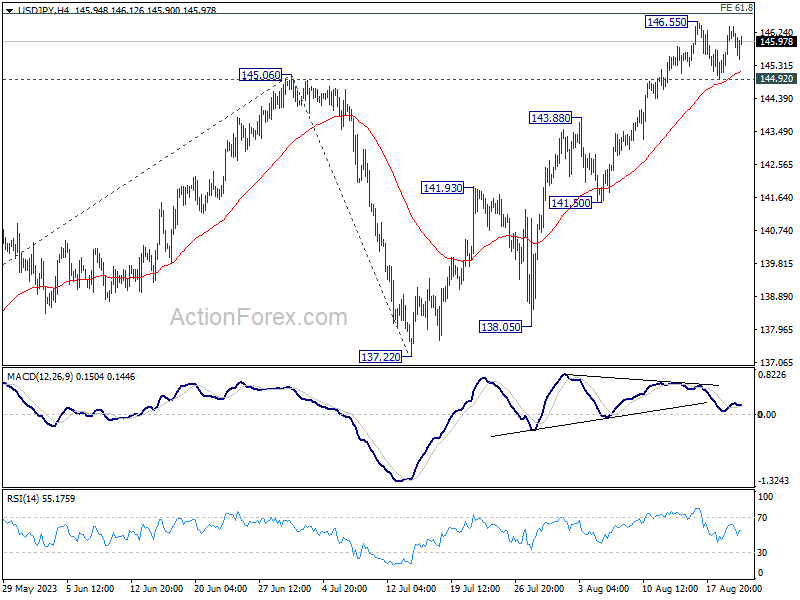
Intraday bias in USD/JPY stays neutral for the moment. On the upside, sustained break of 61.8% projection of 129.62 to 145.06 from 137.22 at 146.76 will pave the way to retest 151.93 high. However, considering bearish divergence condition in 4H MACD, firm break of 44.92 support will be a sign of reversal, and turn bias back to the downside for 55 D EMA (now at 141.95).
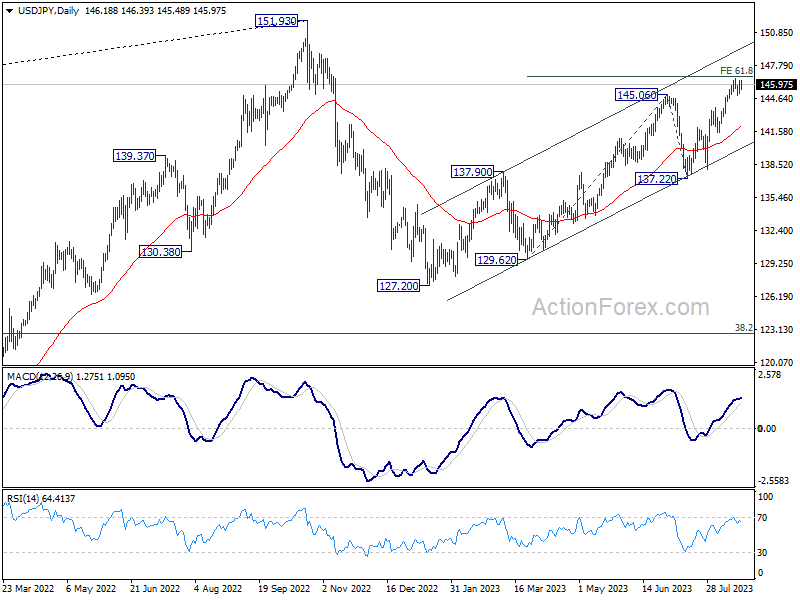
In the bigger picture, overall price actions from 151.93 (2022 high) are views as a corrective pattern. Rise from 127.20 is seen as the second leg of the pattern and could still be in progress. But even in case of extended rise, strong resistance should be seen from 151.93 to limit upside. Meanwhile, break of 137.22 support should confirm the start of the third leg to 127.20 (2023 low) and below.
USD/CHF Mid-Day Outlook
Daily Pivots: (S1) 0.8767; (P) 0.8797; (R1) 0.8815; More....
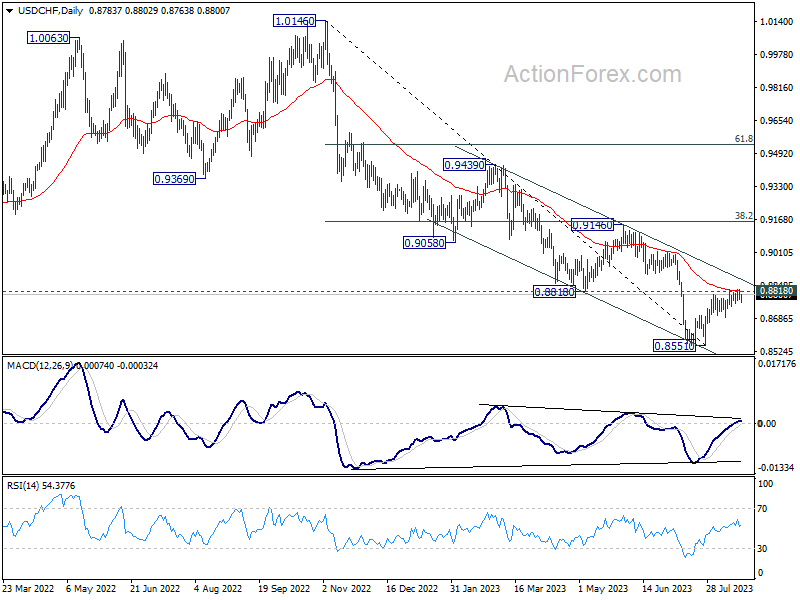
Intraday bias in USD/CHF stays neutral at this point. On the upside, decisive break of 0.8818 will carry larger bullish implication, and target 0.9146 cluster resistance next. However, break of 0.8688 support will indicate rejection by 0.8818, and turn bias back to the downside for retesting 0.8551 low.
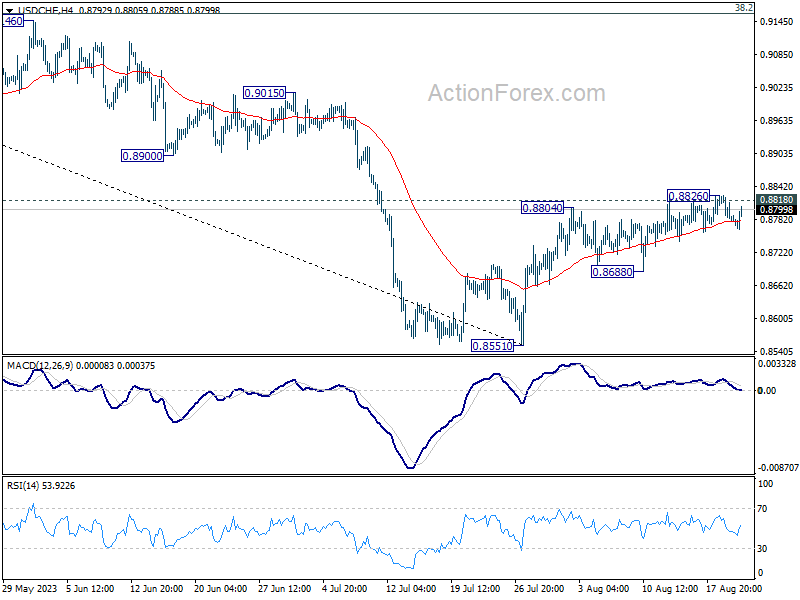
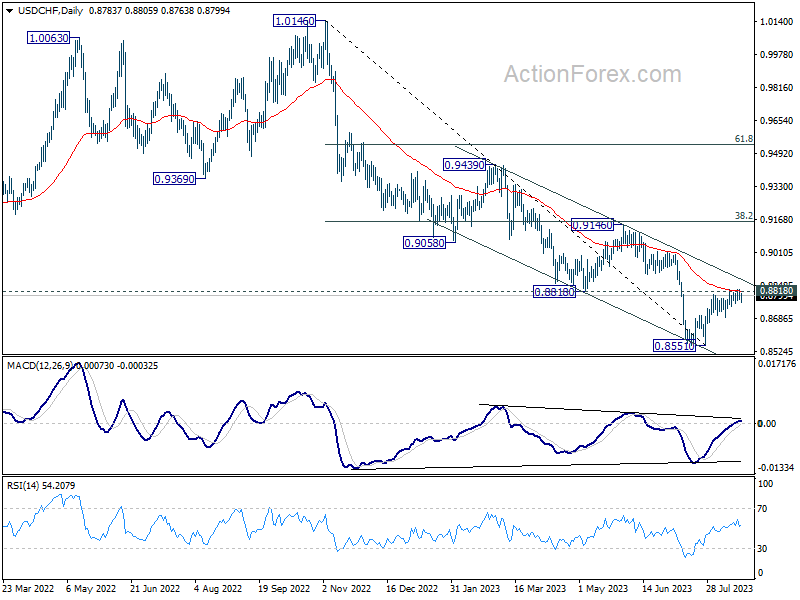
In the bigger picture, a medium term bottom could be in place at 0.8551 already, on bullish convergence condition in D MACD. Sustained trading above 0.8818 support turned resistance will bring further rise to 0.9146 cluster resistance (38.2% retracement of 1.0146 to 0.8551 at 0.9160), even as a correction. Nevertheless, break of 0.8851 will resume the down trend from 1.0146 instead.
GBP/USD Mid-Day Outlook
Daily Pivots: (S1) 1.2723; (P) 1.2745; (R1) 1.2779; More...
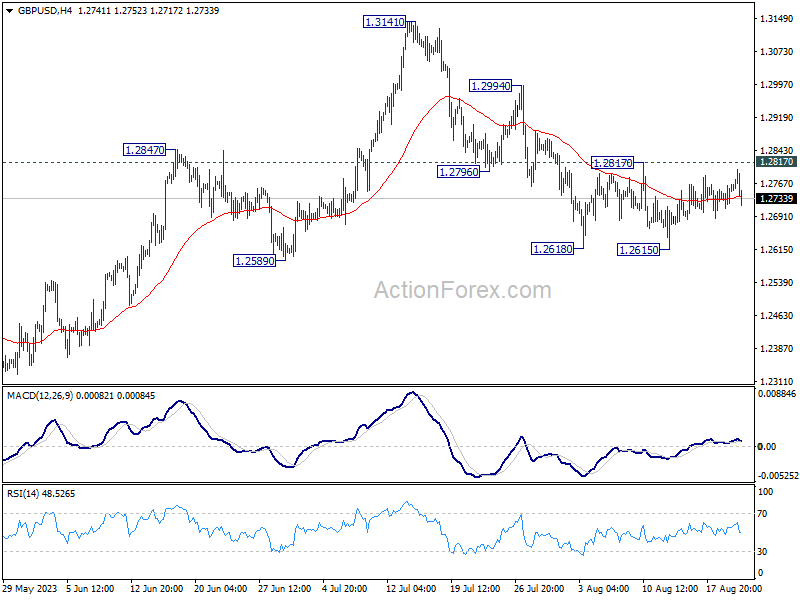
Outlook in GBP/USD is unchanged as sideway trading is in progress. Intraday bias stays neutral at this point. On the downside, firm break of 1.2615, and sustained trading below 1.2678 resistance turned support will argue that it's already in a larger correction. Deeper decline would then be seen to 1.2306 support next. Nevertheless, break of 1.2817 minor resistance will indicate that the pull back from 1.3141 has completed, and turn bias back to the upside for stronger rebound.
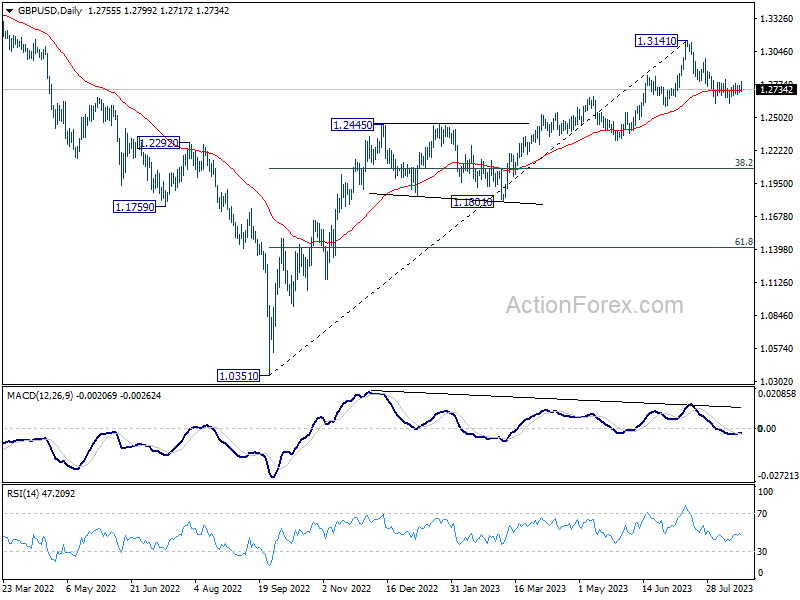
In the bigger picture, a medium term top could be in place at 1.3141 already, on bearish divergence condition in D MACD. Sustained trading below 55 D EMA (now at 1.2723) should confirm this case, and bring deeper fall to 38.2% retracement of 1.0351 to 1.3141 at 1.2075, as a correction to up trend from 1.0351 (2022 low). For now, rise will stay mildly on the downside as long as 1.3141 resistance holds, in case of strong rebound.
EUR/USD Mid-Day Outlook
Daily Pivots: (S1) 1.0873; (P) 1.0893; (R1) 1.0917; More...
EUR/USD dips notably after rejection by 55 4H EMA, but stays above 1.0832 support. Intraday bias remains neutral first. On the downside, decisive break of 1.0832 support will resume the fall from 1.1274 and target 1.0609/34 cluster support next. On the upside, above 1.0951 minor resistance will turn intraday bias to the upside for stronger recovery.
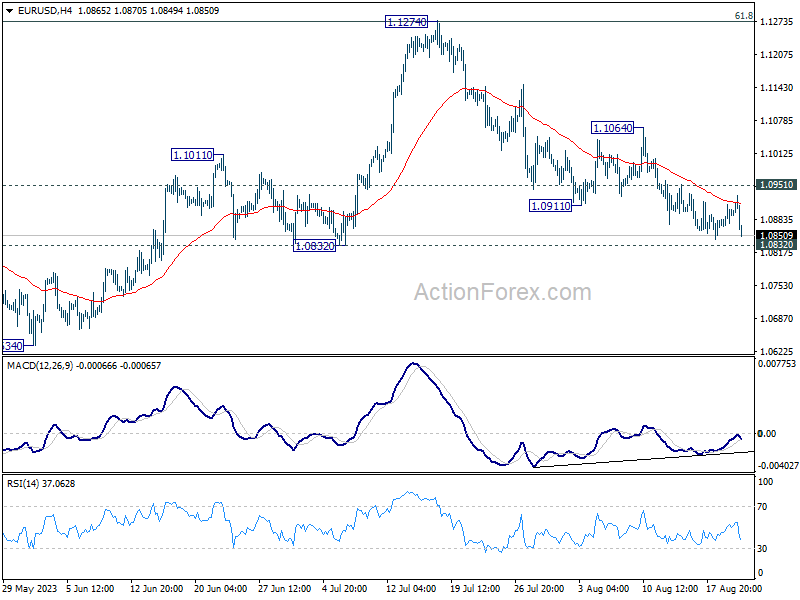
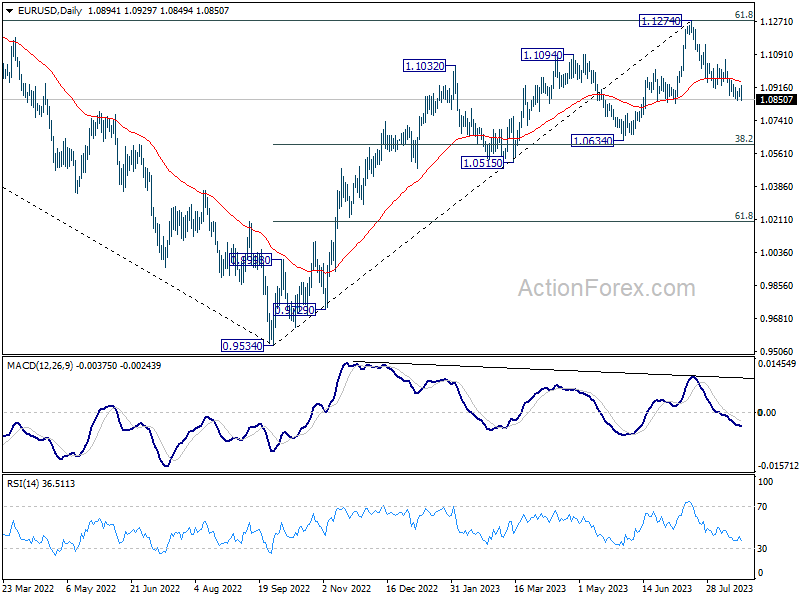
In the bigger picture, a medium term top should be formed at 1.1274, after failing to break through 61.8% retracement of 1.2348 (2021 high) to 0.9534 at 1.1273 decisively, on bearish divergence condition in D MACD. Fall from there is seen as a correction to the uptrend from 0.9534 (2022 low). Deeper decline would be seen to 1.0634 cluster support (38.2% retracement of 0.9534 to 1.1274 at 1.0609). Strong support could be seen there, at least on first attempt, to set the range for consolidation. Yet, medium term outlook will be neutral for now, as long as 1.1274 resistance holds.
Euro Lags in Muted Markets; Eyes on Upcoming PMI Data
Euro is currently the weakest major currency in very quiet markets today, with little of note from the economic calendar. Meanwhile, other European majors are soft too, with Sterling just performing slightly better than Swiss Franc. Meanwhile, the rebound in metal prices is helping Aussie recover, while Kiwi is following. Yen is reversing earlier selloff but there is no sign of a sustainable rebound yet. The markets might just wait for tomorrow's PMI data from major economies to come back to life.
Technically, Dollar is mixed for now without a clear near term direction. USD/CHF continues to press 0.8818 support turned resistance, which now coincides with 55 D EMA (now at 0.8818). Sustained break there will be a strong signal that it's at least correcting the down trend from 1.0146. Stronger rally should be seen to 0.9146 cluster resistance (38.2% retracement of 1.0146 to 0.8551 at 0.9160). However, rejection by 0.8818 and 55 D EMA will maintain near term bearishness for another fall through 0.8551 low. Clarity on the direction should emerge in the next few days.
In Europe, at the time of writing, FTSE is up 0.51%. DAX is up 0.99%. CAC is up 0.97%. Germany 10-year yield is down -0.0246 at 2.677. Earlier in Asia, Nikkei rose 0.92%. Hong Kong HSI rose 0.95%. China Shanghai SSE rose 0.88%. Singapore Strait Times rose 0.19%. Japan 10-year JGB yield rose 0.0163 to 0.672.
Fed Barkin emphasizes need to uphold 2% inflation target for credibility
Richmond Fed President Thomas Barkin voiced his perspective on the importance of adhering to its 2% inflation target today. He emphasized the paramountcy of maintaining the institution's credibility with the public, noting, "We have one big weapon and that is credibility."
Elucidating on the choice of the 2% benchmark, Barkin said, "There is nothing magic about 2 except that when you set that as a target you probably want to achieve it."
In the broader discussion on the economy, Barkin offered a tempered view. Should the US head into a recession, he anticipates it to be on the "less-severe" side of the spectrum. Moreover, he indicated that while the Fed remains vigilant, it aims to not get overly swayed by transient market fluctuations.
BoJ Ueda meets PM Kishida: Exchange-rate volatility not discussed
In a meeting today, BoJ Governor Kazuo Ueda and Prime Minister Fumio Kishida discussed a range of financial topics. However, in a post-meeting address to the media, Ueda clarified that the recent volatility of exchange rates was not a focal point of their conversation. He stated, "There wasn't anything in particular discussed today," in response to inquiries regarding the topic.
The backdrop to this meeting was Dollar's significant surge over 145 Yen mark. To provide some historical context, when the currency reached this level in September 2022, it prompted Japan's inaugural Yen-buying intervention operation in nearly a quarter of a century, since 1998.
During their dialogue, Ueda shed light on BoJ's recent decision to ease its hold on long-term interest rates, lifting the cap on 10-year JGB yield from 0.50% to 1.00%. Prime Minister Kishida expressed understanding and agreement with the central bank's decision, Ueda remarked.
Highlighting the periodic nature of such high-level meetings, Ueda noted that the recent gathering was in line with the tradition maintained by his predecessor, Haruhiko Kuroda. Such consultations, held once every few months, aim to facilitate discussions on prevailing economic and financial landscapes.
EUR/USD Mid-Day Outlook
Daily Pivots: (S1) 1.0873; (P) 1.0893; (R1) 1.0917; More...
EUR/USD dips notably after rejection by 55 4H EMA, but stays above 1.0832 support. Intraday bias remains neutral first. On the downside, decisive break of 1.0832 support will resume the fall from 1.1274 and target 1.0609/34 cluster support next. On the upside, above 1.0951 minor resistance will turn intraday bias to the upside for stronger recovery.
In the bigger picture, a medium term top should be formed at 1.1274, after failing to break through 61.8% retracement of 1.2348 (2021 high) to 0.9534 at 1.1273 decisively, on bearish divergence condition in D MACD. Fall from there is seen as a correction to the uptrend from 0.9534 (2022 low). Deeper decline would be seen to 1.0634 cluster support (38.2% retracement of 0.9534 to 1.1274 at 1.0609). Strong support could be seen there, at least on first attempt, to set the range for consolidation. Yet, medium term outlook will be neutral for now, as long as 1.1274 resistance holds.
Economic Indicators Update
| GMT | Ccy | Events | Actual | Forecast | Previous | Revised |
|---|---|---|---|---|---|---|
| 06:00 | CHF | Trade Balance (CHF) Jul | 3.13B | 4.50B | 4.82B | |
| 06:00 | GBP | Public Sector Net Borrowing (GBP) Jul | 3.5B | 3.4B | 17.7B | 17.1B |
| 08:00 | EUR | Eurozone Current Account (EUR) Jun | 35.8B | 10.2B | 9.1B | 7.9B |
| 14:00 | USD | Existing Home Sales Jul | 4.15M | 4.16M |
Fed Barkin emphasizes need to uphold 2% inflation target for credibility
Richmond Fed President Thomas Barkin voiced his perspective on the importance of adhering to its 2% inflation target today. He emphasized the paramountcy of maintaining the institution's credibility with the public, noting, "We have one big weapon and that is credibility."
Elucidating on the choice of the 2% benchmark, Barkin said, "There is nothing magic about 2 except that when you set that as a target you probably want to achieve it."
In the broader discussion on the economy, Barkin offered a tempered view. Should the US head into a recession, he anticipates it to be on the "less-severe" side of the spectrum. Moreover, he indicated that while the Fed remains vigilant, it aims to not get overly swayed by transient market fluctuations.
NZD/USD Climbs Ahead of Retail Sales
- NZD/USD posts strong gains on Tuesday
- New Zealand retail sales are expected to decline by 2.6%
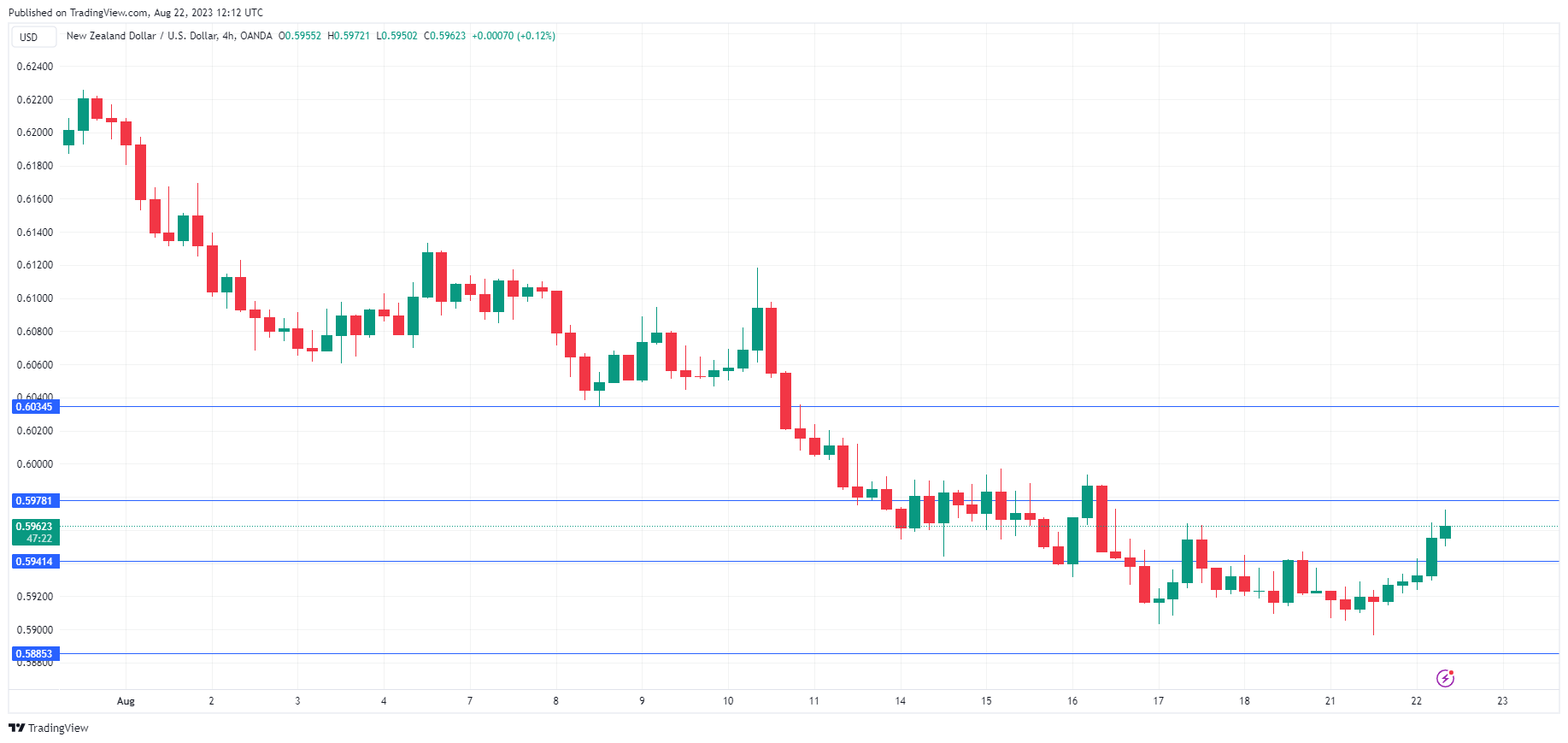
The New Zealand dollar has posted strong gains on Tuesday. In the European session, NZD/USD is trading at 0.5959, up 0.55%. On the data calendar, New Zealand retail sales are expected to decline by 2.6% q/q in the second quarter, compared to -1.4% in Q1.
The New Zealand dollar has gone on a dreadful slide since mid-July, falling as much as 500 basis points during that spell. The current downswing has been driven by weak global demand and jitters over China’s economy, which is showing alarming signs of deterioration.
Chinese releases have been pointing downward recently. Exports and imports have fallen, manufacturing activity is weak and the world’s second-largest economy is experiencing deflation. Last week, Evergrande, a huge Chinese property developer, filed for bankruptcy in the United States, raising fears of contagion to other parts of the economy.
It wasn’t long ago that the Chinese ‘miracle’ was being touted as an economic powerhouse on the global stage, but now the world’s second-largest economy is in deep trouble and is dragging down global growth. An interesting silver lining is that deflation in China could help lower inflation worldwide, which would be good news for the Fed, ECB and other central banks that are battling to push inflation lower.
The People’s Bank of China (PBOC) has responded in recent days to the economic slowdown with some cuts to lending rates, but surprisingly, has not trimmed the five-year loan prime rate, which has a major impact on mortgages. The PBOC’s lukewarm move to the economic crisis could mean China’s economy will continue to sputter, and that is bad news for the New Zealand dollar, as China is by far New Zealand’s largest trading partner. If Chinese releases continue to head lower, we can expect the New Zealand dollar to continue losing ground.
NZD/USD Technical
- NZD/USD has pushed above resistance at 0.5941 and is putting pressure on resistance at 0.5978. There is support at 0.5885 and close by at 0.5848
GBP/USD – Consolidation Continues Amid Promising Inflation Numbers for UK
- New inflation methodology offers hope for BoE
- 1.28 could be major resistance point for GBPUSD
- A break of 1.26 could be bearish signal
Recent UK economic data has been a mixed bag, with wages rising at a much-accelerated rate but inflation decelerating as expected.
While the Bank of England will be relieved at the latter, the former will remain a concern as wage growth even near those levels is not consistent with inflation returning sustainably to target over the medium term.
The ONS released new figures overnight that appeared to suggest core inflation is not rising as fast as the CPI data suggests. The reportedly more sophisticated methodology concluded that core prices rose 6.8% last month, down from 7% the previous month and 7.3% the month before.
The official reading for July was slightly higher at 6.9% but down from only 7.1% in May. So not only is the new methodology showing core inflation lower last month but the pace of decline is much faster. That will give the BoE hope that price pressures are easing and they’re expected to do so much more over the rest of the year.
Will cable break key support or resistance?
The pound has continued to trend higher against the dollar over the last week or so having corrected quite considerably since the middle of last month.
GBPUSD Daily
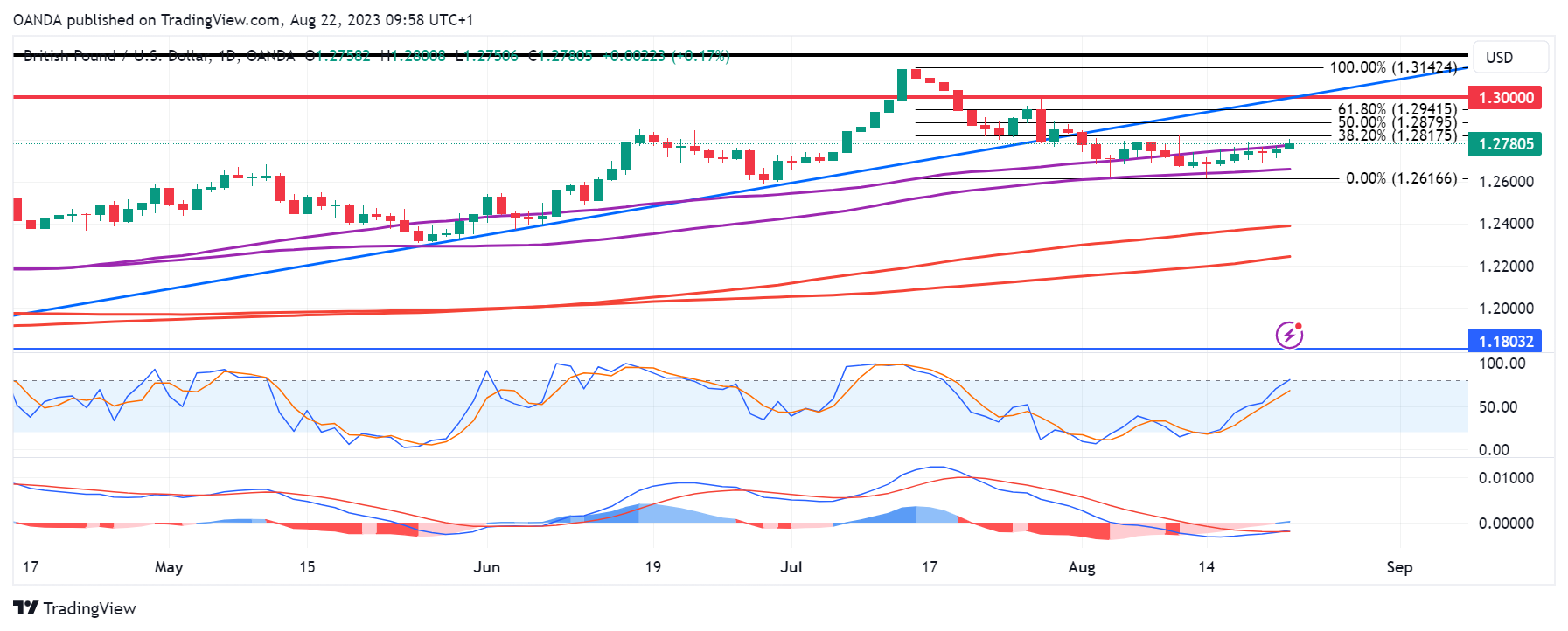
Source – OANDA on Trading View
It’s not clear whether this will prove to be a resumption of the uptrend or merely a bearish consolidation. It is currently nearing 1.28, the area around which it has previously run into resistance this month and around the 38.2% Fibonacci retracement level.
Another rebound off here could be viewed as another bearish signal, which may suggest we’re currently seeing a bearish consolidation, while a move above could be more promising for the pound.
If the pair does rebound lower then the area just above 1.26 will be key, given this is where it has recently seen strong support. It is also where the 55/89-day simple moving average band has continued to support the price in recent months.
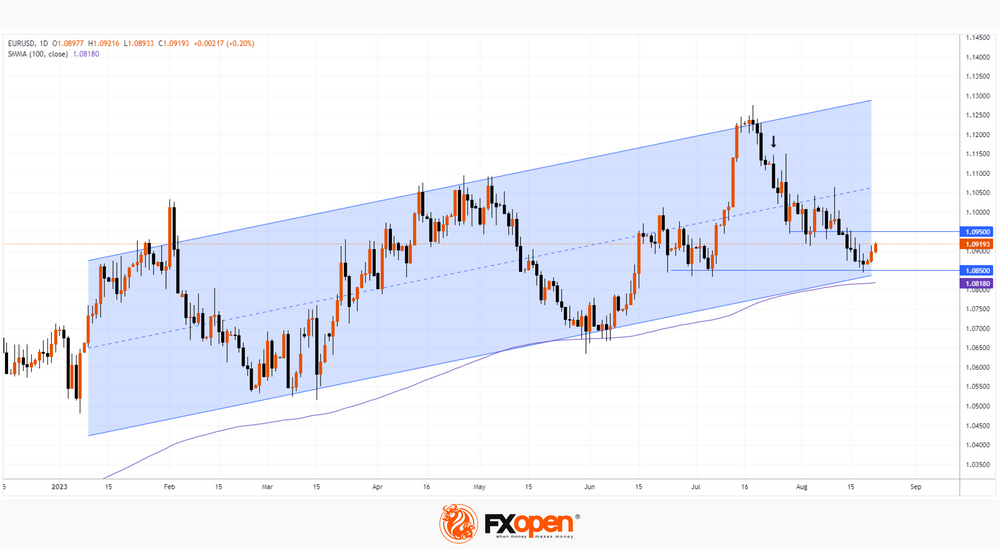
EURUSD Analysis: Price is Forming a Rebound from Support of 1.085
From the high of the year, set on July 18 near the level of 1.125, the price of EUR/USD fell in 1 month to the support of 1.085 (-3.4%). Today, the EUR/USD chart shows that the market is forming a rebound from this support, which has been in place since mid-June. What will be the further development?
Bullish arguments:
→ The market is in an uptrend (indicated by the blue channel) in 2023 and its lower boundary, which forms a powerful block of support at the level of 1.085, can help the bounce develop into a meaningful swing.
→ Support may come from SMA (100).
Bearish arguments:
→ The higher the price of EUR/USD rises, the closer the level of 1.095 becomes, which acted as support; but after the pin bar on August 10, the level was broken, and now resistance can be expected from it. If this is indeed the case, the market will form a weak bounce from the block of supports in the 1.085 area — a threatening sign for the current ascending channel.
Fundamental background:
→ Tomorrow morning (between 10:15 am and 11:00 am GMT+3) economic data from the Eurozone will be published, including the Purchasing Managers' Index (PMI), which is considered a leading indicator of the state of the economy. Last month, PMI values set multi-month lows, showing a slowdown in the economy in Europe, which led to a fall in the EUR/USD rate (shown by the arrow). It is possible that the market will get a new reason for a bearish momentum.
→ The media are writing about the weakening of the dollar on the eve of the symposium in Jackson Hole, where Powell is scheduled to speak on August 25. If the head of the Fed is clearly leaving the doors open for new rate hikes, this will allow the dollar to strengthen and put pressure on the EUR/USD rate.
This article represents the opinion of the Companies operating under the FXOpen brand only. It is not to be construed as an offer, solicitation, or recommendation with respect to products and services provided by the Companies operating under the FXOpen brand, nor is it to be considered financial advice.
Crude Oil Looking for Deeper Supports Within Uptrend (Elliott Wave Forecast)
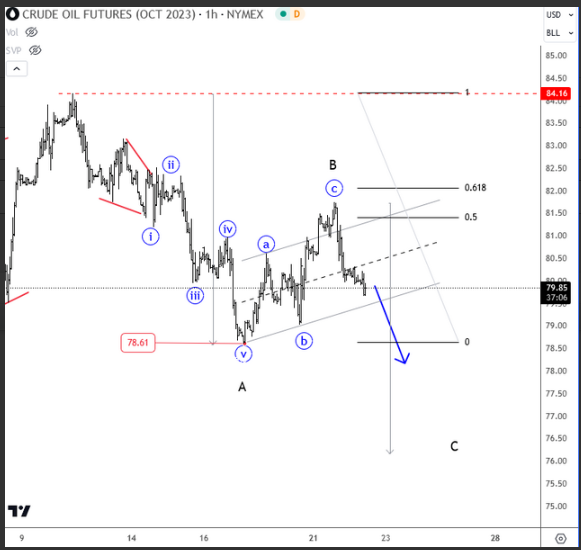
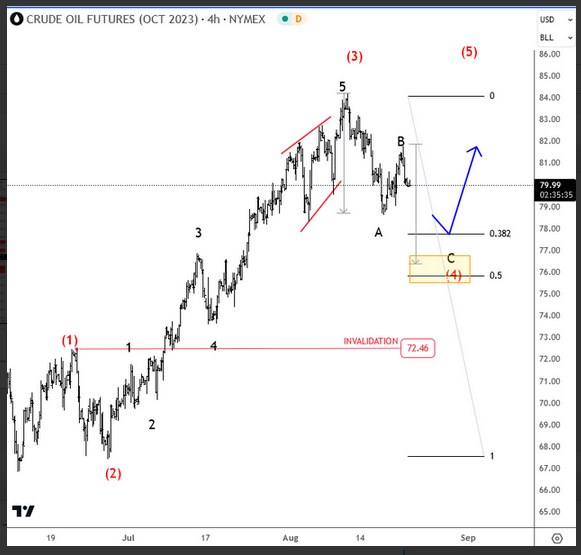
Crude rallied only in three waves and stops between 50-61.8% Fib, so it appears that corrective pullback is still in play from 84.16 and that deeper supports can be retested. There is even a chance for a drop to 77 area where wave C may look for stabilization, possibly later this week.