

Sample Category Title
Eurozone PMIs Important for Euro Next Week
Economists see another rate hike in the euro area, but some skepticism remains about whether the rise will happen in September or at a later time. Preliminary business PMI figures for August could provide fresh insight on Wednesday at 08:00 GMT. Even if there's another bad report, a September rate hike might still happen, but it could also be the last. The euro could extend its downleg in this case, unless the Fed chief sends strong dovish signals during the Jackson Hole Symposium.
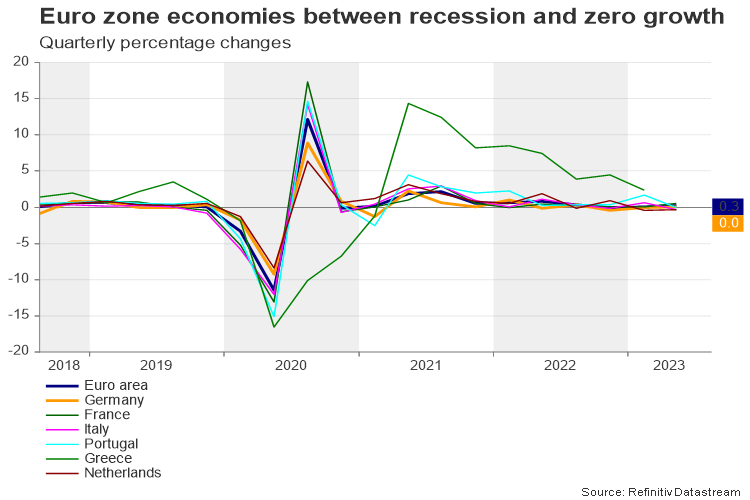
Eurozone economy between recession and stagnation
ECB president Lagarde could not clarify if interest rates will rise by another quarter percentage point in September at her latest press conference in July. Instead, she messaged investors that the rate decision will be based on data as inflation is abating, but it’s not at the 2.0% target, while growth risks are pointing downwards.
The truth is that the eurozone economy is not in a great shape. Some member states such as the Netherlands and Poland have already confirmed two negative consecutive quarters despite the bloc barely avoiding a technical recession in Q2.
Germany, Eurozone’s growth engine and the fourth largest economy in the world, is also at the edge of a cliff even before rate increases start to have a real impact on the economy. The ongoing war in Ukraine that restricted access to cheap gas prices, worker shortages that weigh on the manufacturing sector, and economic woes in China, are dampening hopes for a quick recovery, with IMF analysts foreseeing a 0.3% German contraction in 2023.
August flash business PMIs to ease further
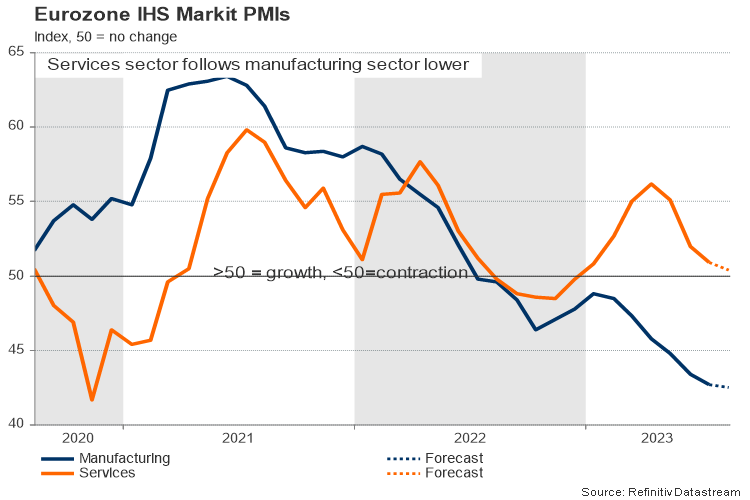
On Wednesday, the preliminary S&P Global PMI survey for August could be more evidence that the euro area is still treading water. The manufacturing index is expected to slip to 42.5 in August from 42.7 in July. Likewise, the services gauge could retreat from 50.9 to 50.4, driving the composite index marginally lower to 48.5 in the contraction area. German and French PMI indices could send the first warning over a struggling eurozone business sector half an hour earlier.
September rate hike loses popularity
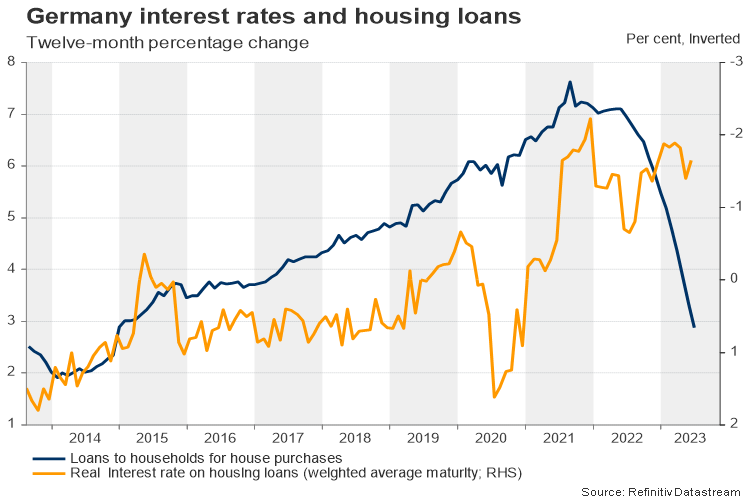
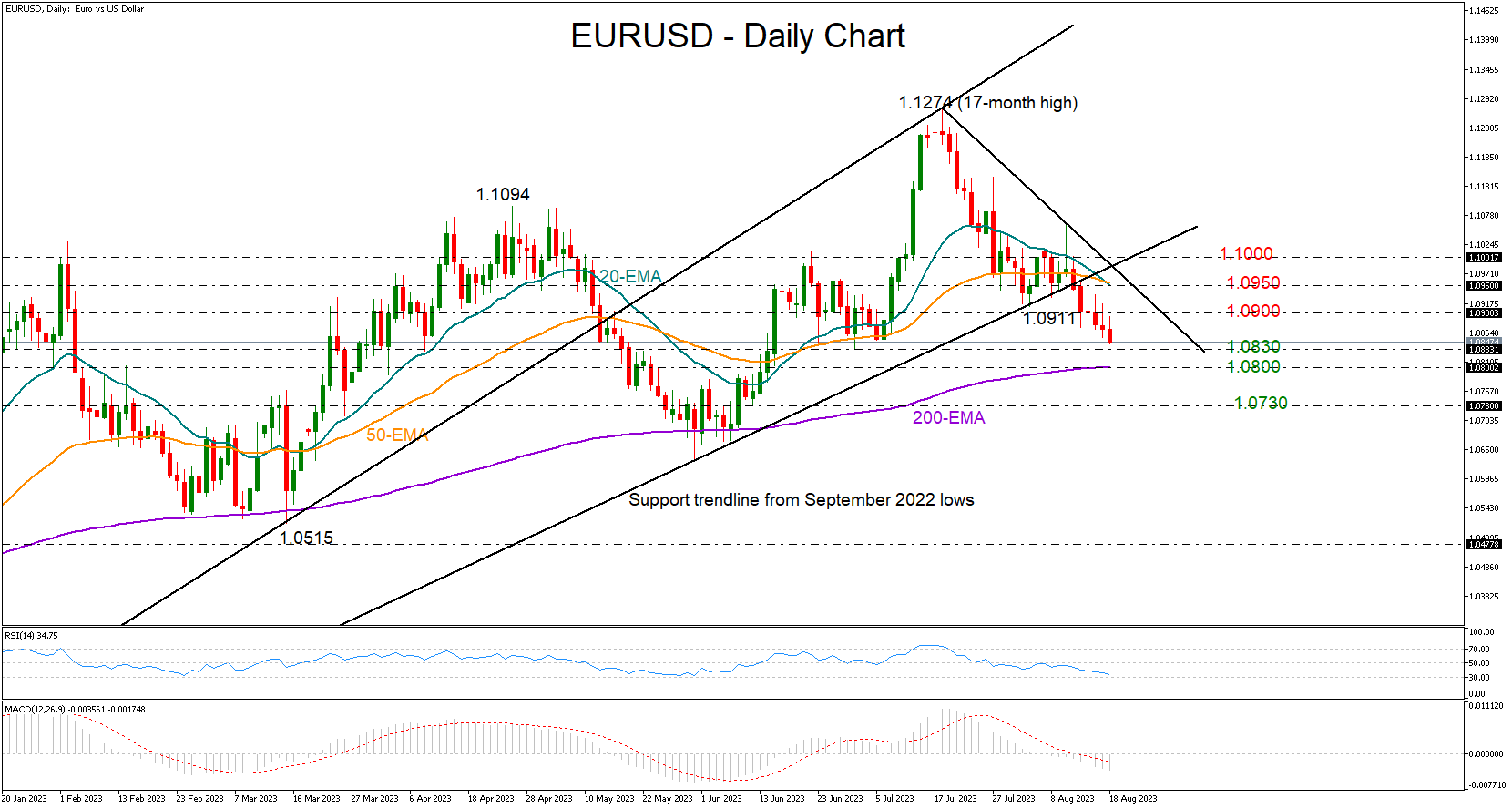
The probability of a 25bps rate hike had fallen to 63.8% in futures markets on Friday from above 70% previously. A bleaker-than-expected business PMI survey could change the odds to a flip coin, likely sinking the battered euro/dollar into the 1.0800-1.0830 support zone. The pair has suffered an ugly 4.0% downfall over the past month on the back of signs the US economy is relatively more resilient, whereas eurozone’s economic conditions are fragile enough to question whether there is a need for another rate hike by the end of the year.
Investors forecast a terminal interest rate slightly higher at 4.0% in the eurozone while pricing a small chance for two rate cuts in the second and third quarters of 2024. It may take some time until core inflation eases towards the central bank’s 2.0% symmetrical target, especially if inflation expectations stay above that level over the next couple of years. Therefore, the central bank could stay open to additional tightening, though given that the biggest part of the tightening phase is behind us, policymakers could debate only moderate rate increases in the months ahead.
It’s worthy to mention that household savings have fallen back to pre-pandemic levels in Germany and households’ demand for loans has plummeted to the lowest in nine years. Hence, a more cautious approach on the monetary front would not be very surprising.
In the event the eurozone’s business PMI figures show some improvement, setting the stage for a September rate increase, euro/dollar could return to 1.0900. The 20- and 50-day exponential moving averages (EMAs) could attract attention as well around 1.0950, though for an impressive recovery above the constraining trendlines and the 1.1000 round-level, Fed chief Jerome Powell will need to sound surprisingly dovish at his Jackson Hole speech next Friday.
Week Ahead – All Eyes on the Jackson Hole Symposium
It’s a light week in terms of economic data, with the most important releases being the business surveys from the major economies. But the true highlight will be the Fed’s annual economic symposium. With US yields on the verge of a breakout, Chairman Powell’s signals about the path of interest rates will be absolutely crucial for the dollar.
Will Powell tread lightly?
Once per year, FOMC officials gather at their summer retreat in Jackson Hole, Wyoming for a symposium to exchange views on monetary policy and economic trends. Although this is mostly an academic event, it has been used by Fed leaders over the years to signal major strategy shifts.
Last year, Chairman Powell used this venue to declare that his Fed will continue raising interest rates with urgency to fight rampant inflation. He was trying to send the message that the tightening cycle was just beginning. What followed was a powerful rally in US yields, which turbocharged the dollar and slammed stocks.
The landscape is very different today. Inflation has moderated, although much of this improvement is because of declines in energy prices. Core inflation is still burning hot and since the labor market remains extremely tight, there are concerns inflation might not return to its 2% target anytime soon.
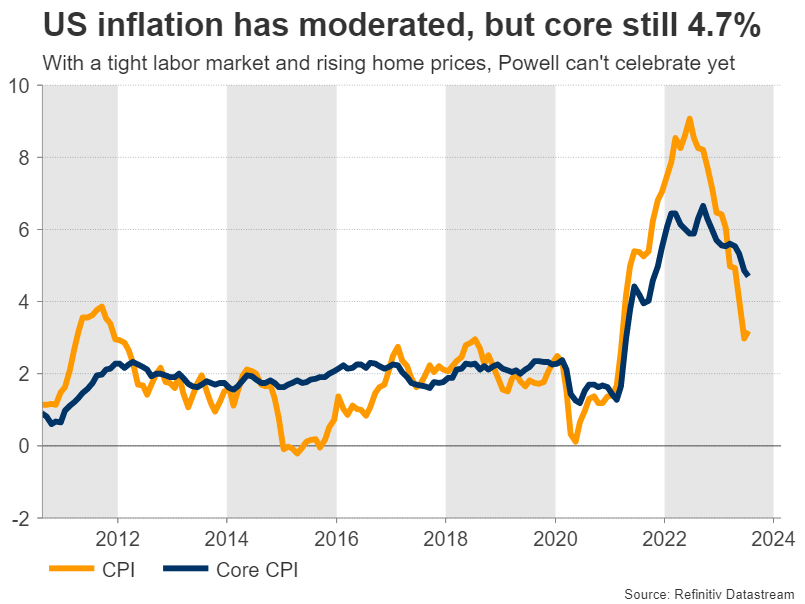
Adding fuel to such concerns is the recent streak of economic data. The Atlanta Fed GDP tracker currently estimates growth for this quarter at an annualized 5.8%, thanks to a resilient consumer and a booming housing market. With home prices hitting new record highs in much of the country, the cooldown in rents that the Fed has long anticipated might prove elusive.
All this goes to show that while there has been serious progress on the inflation front, it is probably too early for the Fed chief to take a victory lap and declare ‘mission accomplished’. Most likely, his message will be flexible, keeping the door open for maintaining rates at current levels and for raising them again if inflation proves persistent.
That’s essentially what he said at the Fed’s July meeting three weeks ago. However, considering that the data flow has been stronger than expected since then, the risk is that he strikes a slightly more hawkish tone this time, putting greater emphasis on the prospect of keeping rates elevated for a longer period or another rate hike.
The event will begin on Thursday, although the Fed chief usually speaks on Friday. As for economic data, the latest S&P Global business surveys will be released on Wednesday ahead of durable goods orders on Thursday.
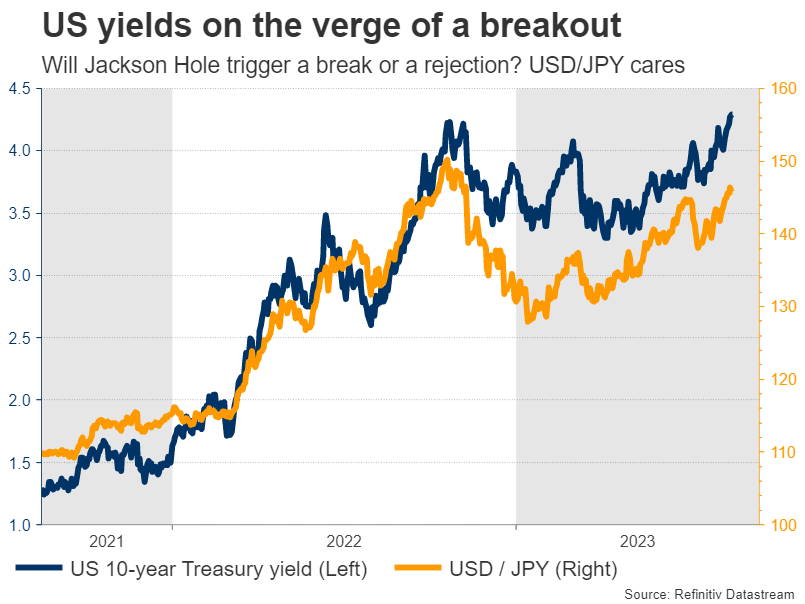
Now in the markets, Powell’s comments could have a disproportionate impact given that US yields are trading near their highest levels for this cycle. Jackson Hole can be the catalyst for a break higher or a rejection, driving the US dollar accordingly.
Overall, the fundamental outlook for the dollar seems bright amid a US economy that is superior to Europe and China from a growth perspective. The technicals are lining up too after euro/dollar sliced below the crucial 1.0940 zone this week, violating an uptrend line drawn from the September lows and some key moving averages.
Flash PMIs from Europe
In the Eurozone, the spotlight will fall on the preliminary PMI business surveys for August, out on Wednesday. Forecasts suggest the slump in manufacturing continues to deepen and has started to infect the much larger services sector, putting the brakes on the economy.
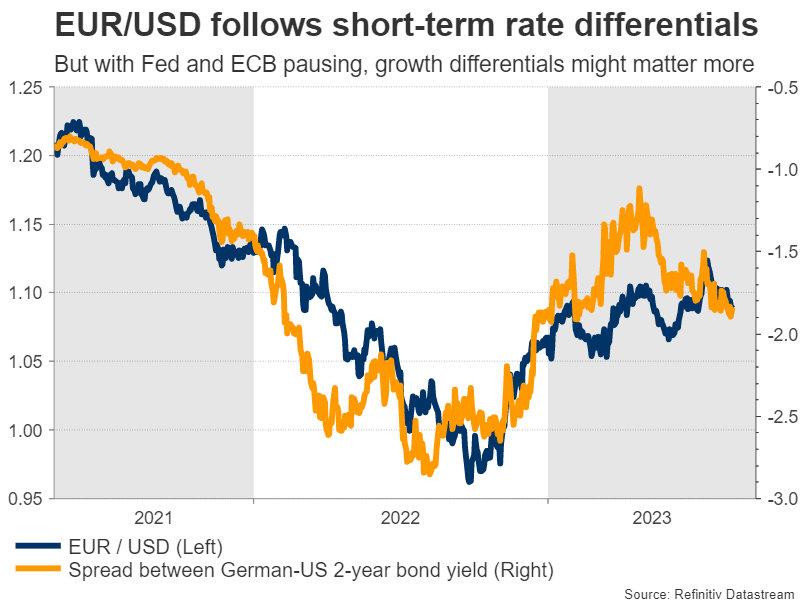
The euro has shrugged off negative economic news for some months now and has instead focused on the ECB’s rate increases that have narrowed rate differentials in its favor. That said, the ECB can only ignore the weaker growth profile for so long. If the data pulse continues to slow, the central bank might ‘pause’ its tightening cycle in September, giving the euro a rude awakening.
It’s a slightly brighter picture in the United Kingdom, which will also receive its business surveys on Wednesday. The latest services PMI pointed to an economy that was “set to flatline at best in the coming months”. But since the UK has a bigger inflation problem than other countries, markets still expect another 75bps worth of rate increases from the Bank of England.
This is a double-edged sword. These rate bets have helped boost the pound this year, but the higher rates go, the greater the risk of a recession that comes back to bite the currency. Stock market performance will also be critical, as Cable is strongly correlated with global risk sentiment, thanks to the nation’s twin deficits that require funding from abroad.
Finally, there are some key releases from Japan and Canada. The latest Tokyo inflation data on Friday could influence the Bank of Japan’s decision-making process. In Canada, retail sales for June will be released Wednesday, but might be seen as outdated by investors.
Weekly Focus – PMIs Next Week Could Be Decisive for ECB and Fed
Over the last week, we have seen bond yields trend upwards, probably driven by a range of factors including government bond supply and better than expected economic data. US retail sales excluding cars and gasoline increased 1% m/m in July, to some extent likely driven by the "Amazon Prime Day" sale event, but nevertheless a robust number that markets reacted to, even if retail sales are not always a good indicator for total consumer spending. Minutes from the July FOMC meeting showed that "a couple of participants" wanted to leave rates unchanged and stated that risks have become more two sided which underlines that it will be up to the data if there is another hike in September or not. Since the meeting, hard data for July like retail sales and industrial production have generally been strong. Early soft data for August is so far sending mixed signals and it will be very interesting to see the PMI data in the coming week. Overall, we still see unchanged rates at the September meeting as the most likely outcome.
In the Euro Area, employment increased by 0.2% q/q in Q2 so more moderate than the 1.6% jump in Q1 but still remarkable given the relatively stagnant underlying economic picture. Strong labour markets remain a significant factor in why the ECB, in our view, is likely to hike interest rates again at the September meeting even though there are concerns about the state of the economy more broadly. However, it is not a done deal, and one key data point to watch will be the August PMI release on Wednesday, after July showed very weak manufacturing numbers and declining strength in the service sector.
Sentiment on the Chinese economy has taken a negative turn. Industrial production was 3.7% y/y in July and retail sales 2.5% y/y, both significantly below expectations and below the June outcome. More importantly, there are increasing signs of financial stress. There are reports that China's biggest private property developer Country Garden is seeking to delay bond payments as home sales remain weak. There is risk of a negative spiral where eroding confidence causes sales to weaken further and further weaken developers and confidence in them. In addition, if developers miss bond payments, that can again hit investment products linked to them, further undermining household confidence and cause outflows from the 'shadow banking system' that is an important source of financing. Authorities responded this week with a 15bp rate cut - unusually large by Chinese standards - and by restating their commitment to the 5% growth target, but in our view, more forceful measures are likely to be needed to restore confidence and reduce the risk of financial crisis. We are less concerned about the deflation, as that is driven by temporary factors.
GDP growth in Japan hit 1.5% q/q in Q2, much stronger than expected. However, it was very much driven by foreign demand, whereas private consumption in Japan decreased 0.5%, and the GDP number in itself does not really change the rate outlook, in our view.
The Fed's Jackson Hole symposium is next week. Last year Powell's hawkish comments sparked an uptick in yields, and this year it will be interesting to hear how they assess the latest more promising inflation data.
Gold Looks Heading Towards $1800
Gold has gained 0.3% since the start of the day on Friday, marking only its third session of gains since the beginning of August. Despite signs of local oversold conditions suggesting a bounce, the ultimate downside target looks to be the $1800 area.
Gold’s sharp decline began a month ago when the bears once again prevented the metal from consolidating above $1980, a critical resistance level since May.

On the way down in August, gold first broke below the 50-day MA and then two days ago below the 200-day MA. Both curves act as medium and long-term trend indicators. Gold failed to rally higher after a drop below the 50-day MA, but the failure only intensified the sell-off.
Tuesday and Wednesday saw a battle for the 200-day, which the Bears also won. Since the beginning of 2021, at least a month of sustained pressure on prices has followed such a signal.
This week, gold also broke below previous local lows – another signal of a downtrend formation in addition to lower local highs: $1985 in July vs. $2080 in May.
A crucial fundamental factor putting pressure on gold is the rise in government bond yields in developed countries with falling inflation. It is becoming increasingly difficult for gold to compete on yield.
We also expect China’s attempts to protect its currency from depreciation to lead to US government bonds and gold sales.
And we must consider the possibility that other major emerging market reserve holders will do the same as they face diminishing returns from the economic slowdown.
If there is no strong rally above $1905 today or Monday, confidence will grow that gold’s downtrend is already established. The $1800-1810 area is a potential technical target in this case. This is where gold has been supported or surrendered many times over the past three years.
The 200-week MA, which has attracted buyers for the past six years, passes through these levels, and we expect the battle to be much more intense at these levels.

Dollar Index Hits New Two-Month High
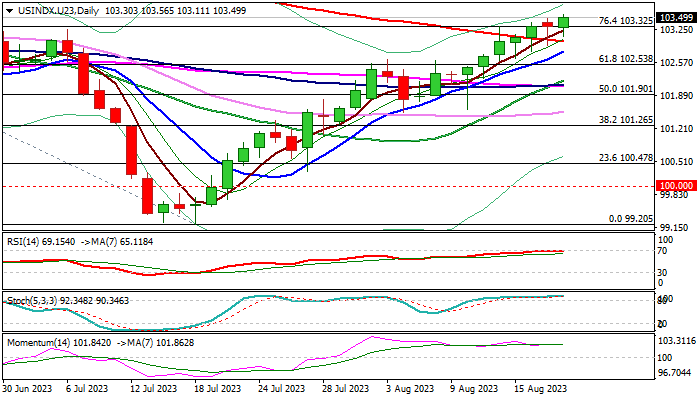
The Dollar Index hit new near two-month high on Friday, after price action slightly reduced speed on Thursday.
Break of Fibo resistance at 103.32 (76.4% of 104.59/99.20) marks fresh bullish signal, which looks for confirmation on weekly close above this level.
Long tails of recent daily candles point to strong demand, which contribute to firmly bullish daily studies and continue to underpin the price, offsetting warnings from overbought conditions.
The index is on track for the fifth consecutive week of gains, the largest uninterrupted advance since Apr/May 2022, which adds to positive outlook.
The downside should remain protected by broken 200DMA (103.01) to keep bulls intact for extension towards 104.59 (May 31 peak), with this week’s twist of weekly cloud also expected to attract bulls.
The dollar remains underpinned by increasing concerns over China’s economic growth and signals that US interest rates my stay high for some time, as recent economic data showed that US economy is resilient despite high interest rates.
Res: 103.72; 104.00; 104.33; 104.59.
Sup: 103.32; 103.01; 102.80; 102.53.
EUR/USD Mid-Day Outlook
Daily Pivots: (S1) 1.0847; (P) 1.0883; (R1) 1.0908; More...
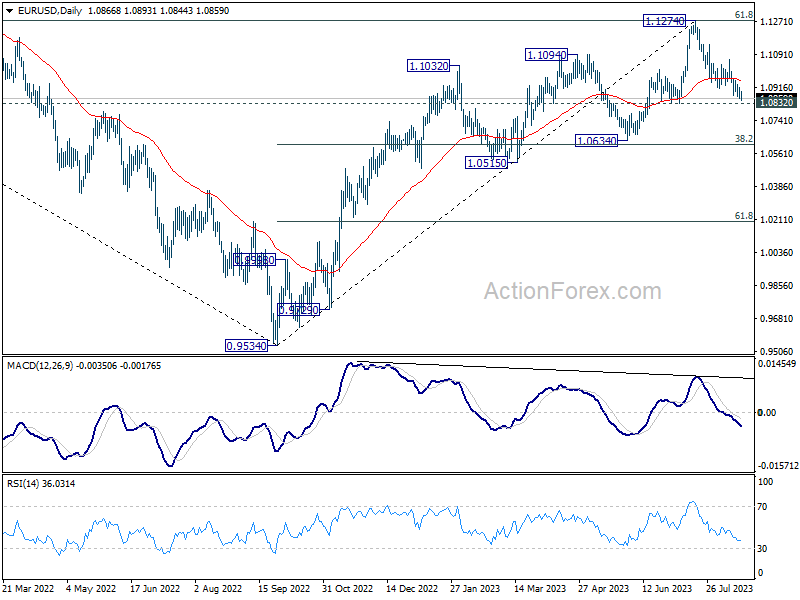
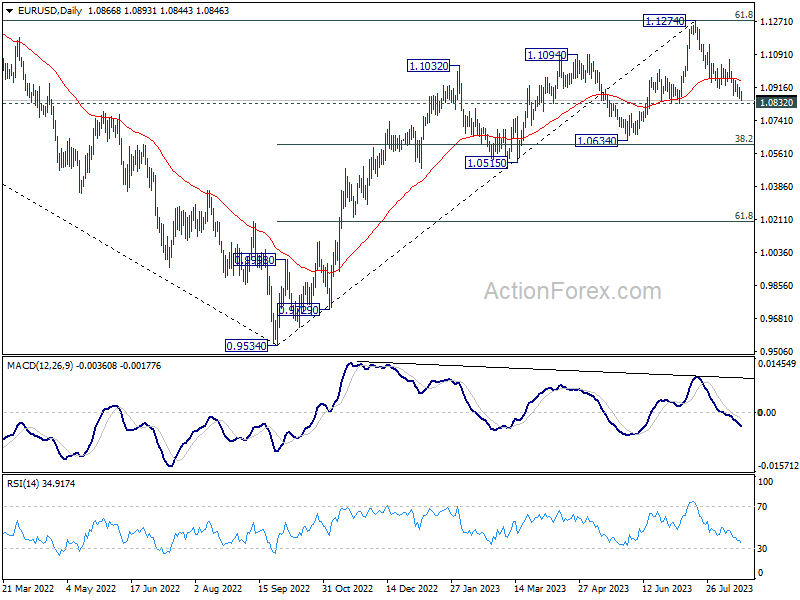
Intraday bias in EUR/USD remains on the downside at this point. Firm break of 1.0832 support will extend the fall from 1.1274 to 1.0609/34 cluster support. On the upside, above 1.0951 minor resistance will turn intraday bias neutral first. But risk will stay on the downside as long as 1.1064 resistance holds, in case of rebound.
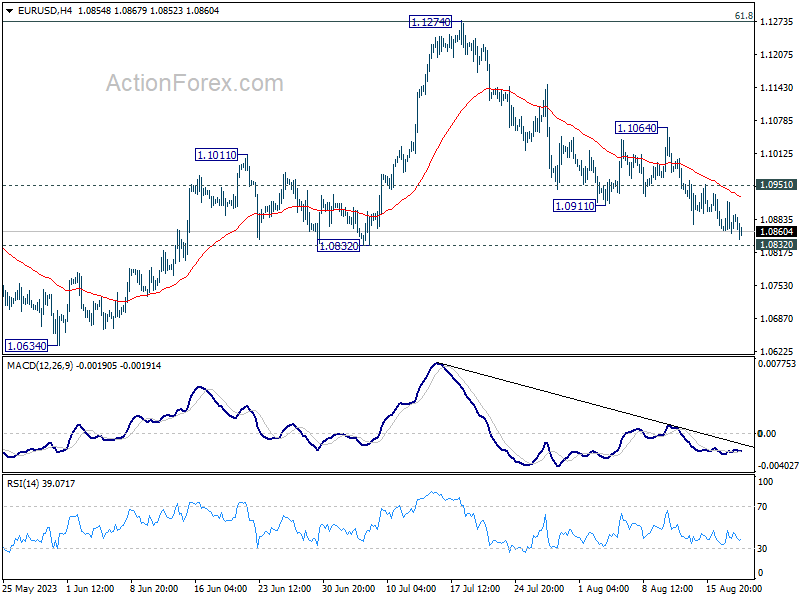
In the bigger picture, a medium term top should be formed at 1.1274, after failing to break through 61.8% retracement of 1.2348 (2021 high) to 0.9534 at 1.1273 decisively, on bearish divergence condition in D MACD. Fall from there is seen as a correction to the uptrend from 0.9534 (2022 low). Deeper decline would be seen to 1.0634 cluster support (38.2% retracement of 0.9534 to 1.1274 at 1.0609). Strong support could be seen there, at least on first attempt, to set the range for consolidation. Yet, medium term outlook will be neutral for now, as long as 1.1274 resistance holds.
GBP/USD Mid-Day Outlook
Daily Pivots: (S1) 1.2704; (P) 1.2746; (R1) 1.2789; More...
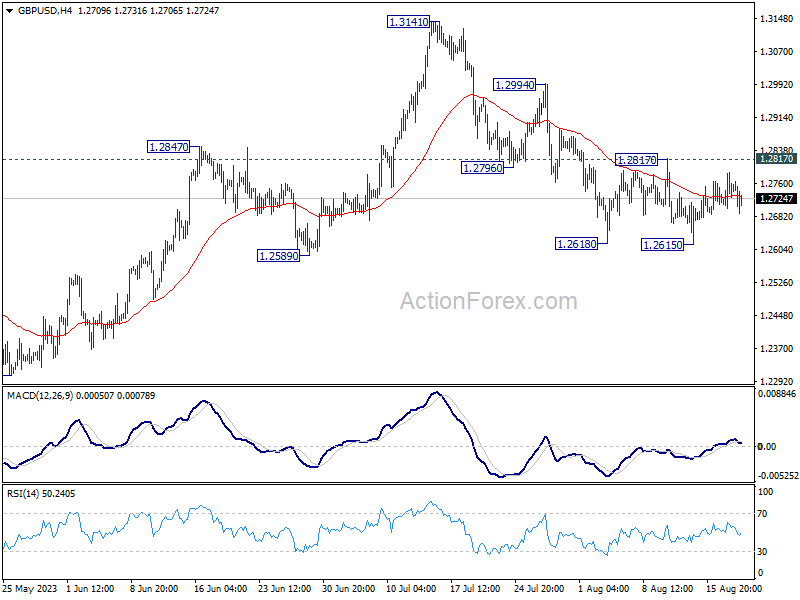
Range trading continues in GBP/USD and intraday bias remains neutral. On the downside, firm break of 1.2615, and sustained trading below 1.2678 resistance turned support will argue that it's already in a larger correction. Deeper decline would then be seen to 1.2306 support next. Nevertheless, break of 1.2817 minor resistance will indicate that the pull back from 1.3141 has completed, and turn bias back to the upside for stronger rebound.
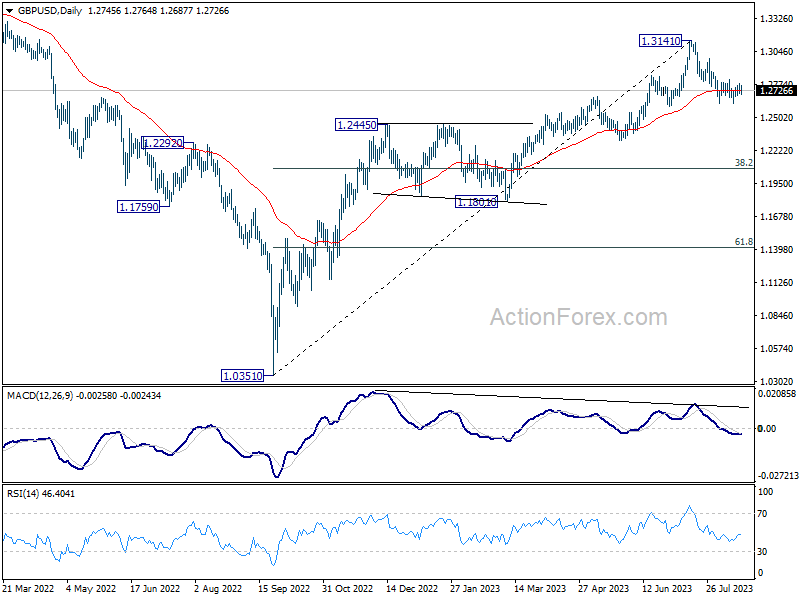
In the bigger picture, a medium term top could be in place at 1.3141 already, on bearish divergence condition in D MACD. Sustained trading below 55 D EMA (now at 1.2723) should confirm this case, and bring deeper fall to 38.2% retracement of 1.0351 to 1.3141 at 1.2075, as a correction to up trend from 1.0351 (2022 low). For now, rise will stay mildly on the downside as long as 1.3141 resistance holds, in case of strong rebound.
USD/JPY Mid-Day Outlook
Daily Pivots: (S1) 145.46; (P) 146.01; (R1) 146.40; More...
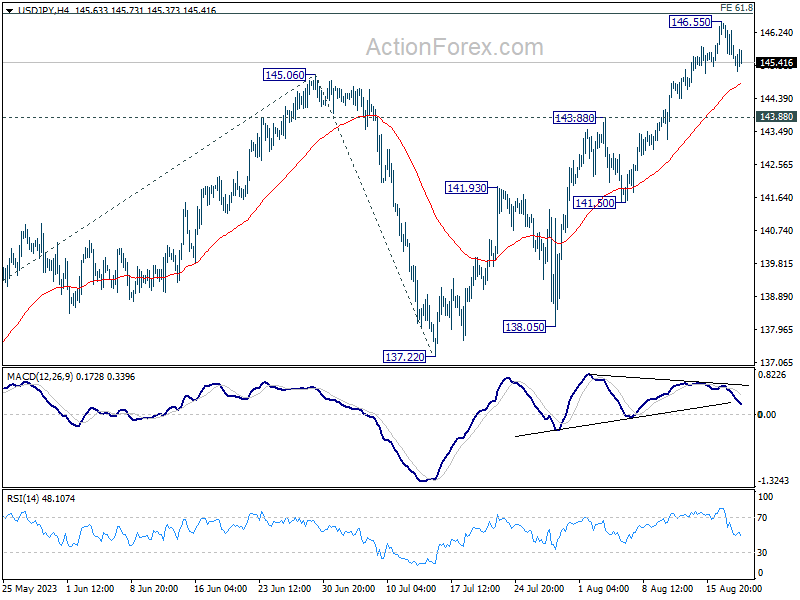
USD/JPY is extending the consolidation from 146.55 and intraday bias stays neutral. On the upside, sustained break of 61.8% projection of 129.62 to 145.06 from 137.22 at 146.76 will pave the way to retest 151.93 high. However, considering bearish divergence condition in 4H MACD, firm break or 143.88 resistance turned support will be a sign of reversal, and turn bias back to the downside for 55 D EMA (now at 141.79).
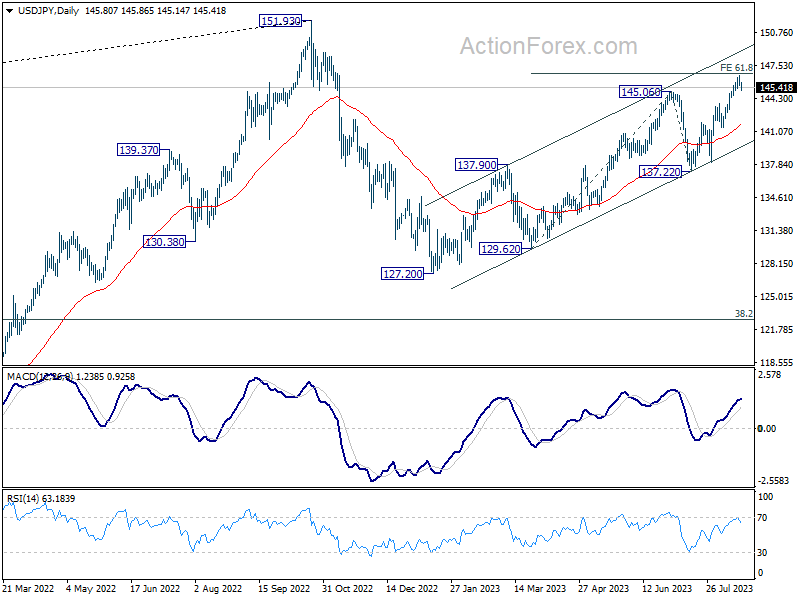
In the bigger picture, overall price actions from 151.93 (2022 high) are views as a corrective pattern. Rise from 127.20 is seen as the second leg of the pattern and could still be in progress. But even in case of extended rise, strong resistance should be seen from 151.93 to limit upside. Meanwhile, break of 137.22 support should confirm the start of the third leg to 127.20 (2023 low) and below.
USD/CHF Mid-Day Outlook
Daily Pivots: (S1) 0.8761; (P) 0.8785; (R1) 0.8810; More....
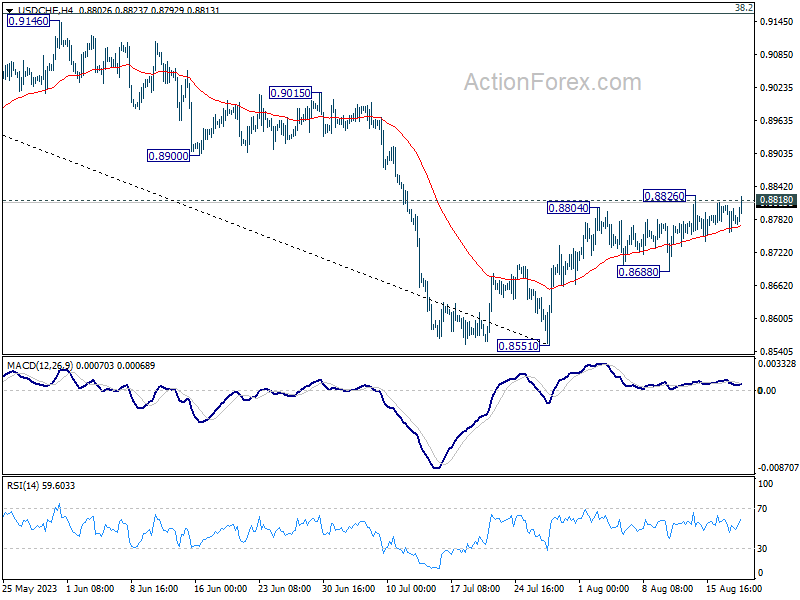
USD/CHF rises slightly again after drawing support from 55 4H EMA (now at 0.8770). Immediate focus is back on 0.8818 support turned resistance and 0.8826 temporary top. Decisive break there will carry larger bullish implication. Further rally should then be seen to 0.9146 cluster resistance next. However, break of 0.8688 support will indicate rejection by 0.8818, and turn bias back to the downside for retesting 0.8551 low.
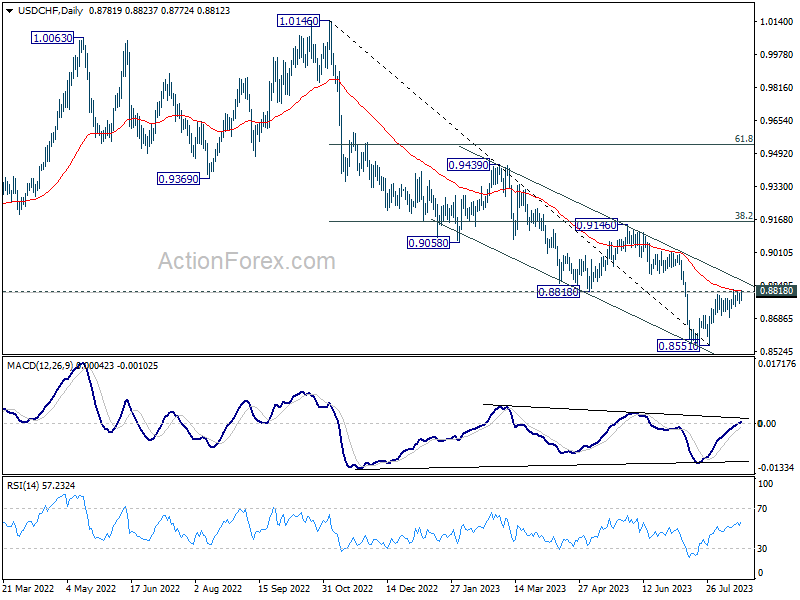
In the bigger picture, a medium term bottom could be in place at 0.8551 already, on bullish convergence condition in D MACD. Sustained trading above 0.8818 will bring further rise to 0.9146 cluster resistance (38.2% retracement of 1.0146 to 0.8551 at 0.9160), even as a correction. Nevertheless, break of 0.8851 will resume the down trend from 1.0146 instead.
Dollar Finally Capitalizes on Intensifying Risk Aversion?
As the trading week draws to a close, Dollar appears to be finally capitalizing on heightened risk aversion, extending its recent surge. Major European stock indexes are painting a gloomy picture, while US futures points to negative opens. British Pound, once the darling of the markets, has started to wane after an unexpectedly dismal retail sales report from the UK. Simultaneously, the Japanese Yen attempting a stronger rebound, especially against European and commodity currencies.
Technically, EUR/USD is now inching closer to 1.0832 support. Decisive break there will further solidify the case that it's at least in correction to whole up trend from 0.9543. Deeper fall would be then seen to 1.0634 support next, which is close to 38.2.% retracement of the up trend from 0.9543 to 1.1274. If materializes, that would likely be accompanied by equally strong rally in the greenback elsewhere.
In Europe, at the time of writing, FTSE is down -0.99%. DAX is down -1.01%. CAC is down -1.06%. Germany 10-year yield is down -0.0827 at 2.627. Earlier in Asian Nikkei dropped -0.55%. Hong Kong HSI dropped -2.05%. China Shanghai SSE dropped -1.00%. Singapore Strait Times dropped -0.71%. Japan 10-year JGB yield dropped -0.0238 to 0.631.
Eurozone CPI finalized at 5.3% in Jul, core CPI at 5.5%
Eurozone CPI was finalized at 5.3% yoy in July, down from June's 5.5% yoy. Core CPI (ex energy, food, alcohol & tobacco) was finalized at 5.5%, unchanged from June's reading. The highest contribution came from services (+2.47%), followed by food, alcohol & tobacco (+2.20%),), non-energy industrial goods (+1.26%),) and energy (-0.62%),).
EU CPI was finalized at 6.1% yoy, down from prior month's 6.4% yoy. The lowest annual rates were registered in Belgium (1.7%), Luxembourg (2.0%) and Spain (2.1%). The highest annual rates were recorded in Hungary (17.5%), Slovakia and Poland (both 10.3%). Compared with June, annual inflation fell in nineteen Member States, remained stable in one and rose in seven.
UK retail sales volumes down -1.2% in Jul, sales value down -1.0% mom
UK retail sales volumes dropped -1.2% mom in July, much worse than expectation of -0.4% mom. Ex-automotive fuel sales volume dropped -1.4% mom. In value term, sales dropped -1.0% mom while ex-fuel sales contracted -1.4% mom.
Food stores sales volumes fell by -2.6% mom. Non-food stores sales volumes fell by -1.7% mom. Automotive fuel stores sales volumes rose by 0.7% mom. Non-store retailing sales volumes rose by 2.8% mom.
ONS also noted, shoppers switching to online shopping because of poor weather and increased promotions led to 27.4% of retail sales taking place online in July 2023, up from 26.0% in June 2023; this is the highest proportion since February 2022 (28.0%).
Japan CPI core eased to 3.1% in Jul, but core-core back at four decade high
Japan's core CPI, which excludes fresh food, eased slightly from 3.3% yoy in June to 3.1% yoy in July, aligning with market expectations. Notably, this metric continued its streak above BoJ's 2% inflation target for a commendable 16 consecutive months.
Diving deeper, core-core CPI, which subtracts both fresh food and energy, inched higher to 4.3% yoy, equalling the peak seen in May. This current rate hasn't been witnessed since 1981, underscoring the latent inflationary pressures within the Japanese economy.
Processed food costs are a particular hotspot, skyrocketing by 9.2% yoy – a surge not seen in nearly half a century. Adding to this, durable goods saw a robust rise of 6.0% yoy. Furthermore, possibly driven by travel and vacationing demand, accommodation fees witnessed a significant 15.1% yoy hike during the prime summer holiday period.
Conversely, energy prices painted a contrasting picture, plummeting by -8.7% yoy. This decline can largely be attributed to government interventions, with subsidies introduced to mitigate household utility expenses. These subsidies, in turn, have played a pivotal role, dragging the core CPI lower by approximately one percentage point.
Service prices also shifted gears, moving up to 2% yoy from 1.6% yoy – the most substantial leap since 1993 if we set aside the aftermath of the 1997 sales tax hike.
Despite these intricate dynamics, headline CPI remained steadfast at 3.3% yoy.
RBNZ Silk: Housing the biggest upside risks to inflation
RBNZ Assistant Governor Karen Silk said today, "Near term, there are still some risks on the upside to inflation." She further identified the housing market as a significant factor, mentioning, "The OCR track is slightly higher and we're saying potentially retaining rates at a higher level for longer. Probably the biggest driver of that is really housing."
The bank's recent projections indicate that OCR could reach its peak at 5.59% by mid-2024, and then slightly pull back to 5.36% by early 2025. This revised forecast surpasses earlier predictions laid out in the previous Monetary Policy Statement.
Silk expressed uncertainty regarding how the stability observed in the housing market, combined with a potential recovery next year, might impact inflation.
"We are looking at it as a gradual resumption in house price trend," Silk elaborated, "but in an environment where labor market pressures continue to ease and at the same time you've got a higher interest rate environment."
Additionally, Silk pointed out broader concerns beyond the local scenario. "One of the medium-term risks for us is global growth," she said. Expressing a keen interest in international trajectories, she added, "We're really focused on global growth and in particular how weak is China. Is China really going to be able to deliver the growth that they're suggesting?"
USD/CHF Mid-Day Outlook
Daily Pivots: (S1) 0.8761; (P) 0.8785; (R1) 0.8810; More....
USD/CHF rises slightly again after drawing support from 55 4H EMA (now at 0.8770). Immediate focus is back on 0.8818 support turned resistance and 0.8826 temporary top. Decisive break there will carry larger bullish implication. Further rally should then be seen to 0.9146 cluster resistance next. However, break of 0.8688 support will indicate rejection by 0.8818, and turn bias back to the downside for retesting 0.8551 low.
In the bigger picture, a medium term bottom could be in place at 0.8551 already, on bullish convergence condition in D MACD. Sustained trading above 0.8818 will bring further rise to 0.9146 cluster resistance (38.2% retracement of 1.0146 to 0.8551 at 0.9160), even as a correction. Nevertheless, break of 0.8851 will resume the down trend from 1.0146 instead.
Economic Indicators Update
| GMT | Ccy | Events | Actual | Forecast | Previous | Revised |
|---|---|---|---|---|---|---|
| 23:30 | JPY | National CPI Y/Y Jul | 3.30% | 3.30% | ||
| 23:30 | JPY | National CPI ex-Fresh Food Y/Y Jul | 3.10% | 3.10% | 3.30% | |
| 23:30 | JPY | National CPI ex Food Energy Y/Y Jul | 4.30% | 4.20% | ||
| 06:00 | GBP | Retail Sales M/M Jul | -1.20% | -0.40% | 0.70% | 0.60% |
| 09:00 | EUR | Eurozone CPI Y/Y Jul F | 5.30% | 5.30% | 5.30% | |
| 09:00 | EUR | Eurozone Core CPI Y/Y Jul F | 5.50% | 5.50% | 5.50% | |
| 12:30 | CAD | Industrial Product Price M/M Jul | 0.40% | 0.20% | -0.60% | |
| 12:30 | CAD | Raw Material Price Index Jul | 3.50% | 2.10% | -1.50% |