Sample Category Title
GBP/AUD: Bullish Run Extends as England Ends Matildas Mania
- UK core inflation remains elevated at 6.9% and above the consensus estimate of 6.8%
- BOE expected to raise rates another by almost 75 bps more in this tightening cycle
- Aussie downside extends over China’s economic struggles
World Cup Final Match Set
England has advanced to its first Women’s World Cup final with a 3-1 victory over co-host Australia. Soccer mania was embraced in Australia as the women’s soccer team’s put up an impressive run that fell two wins short of becoming champions. The Matildas dream run might be over, but the pain for the Australian dollar seems like it might be poised to continue. England will play Spain in the Women’s World Cup Final on Sunday.
UK CPI refuses to cool
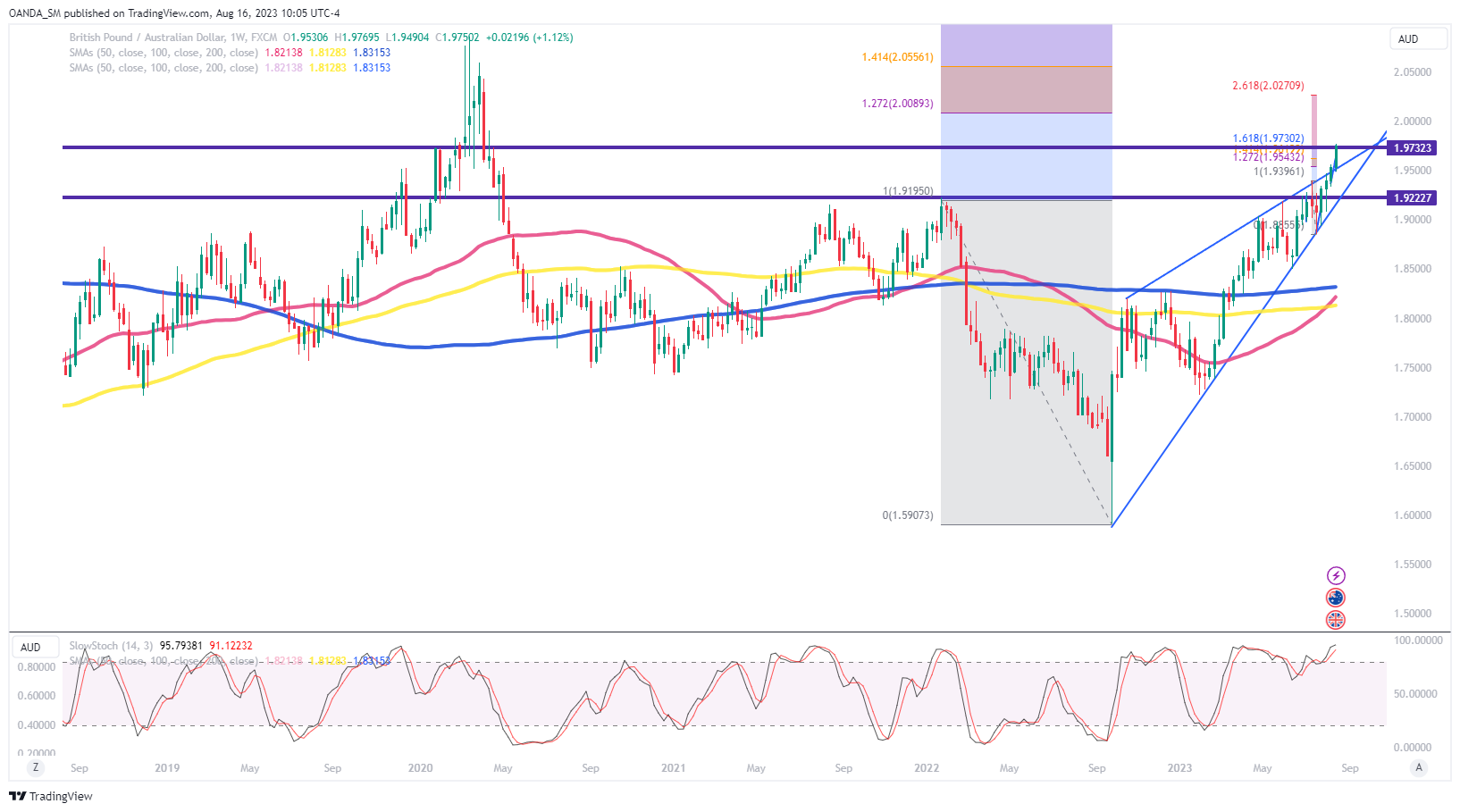
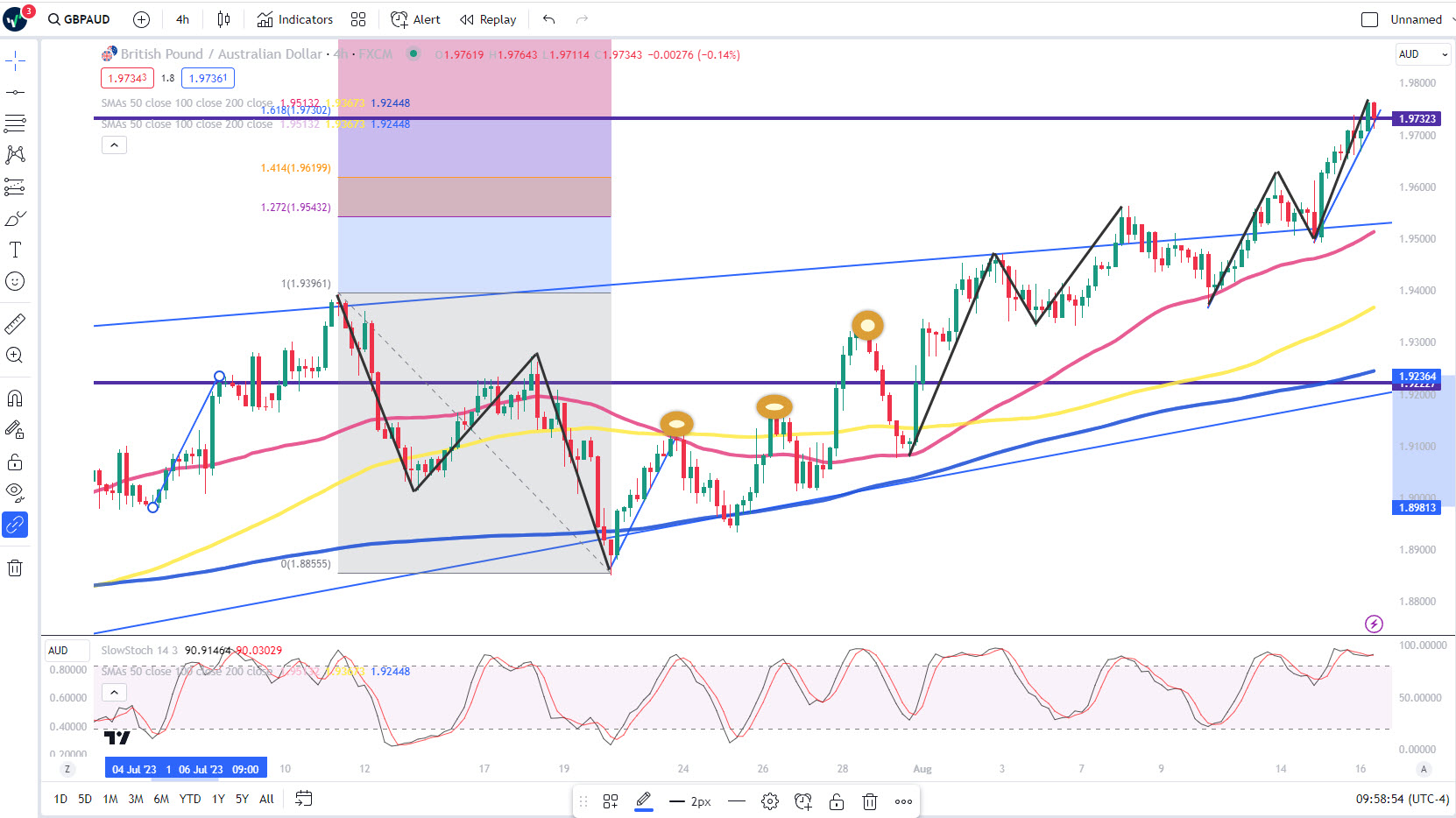
The British pound rallied earlier in London after the July inflation report showed core and services pricing pressures are proving to be sticky. Inflation is slowly coming down and this will not let the BOE ease up on tightening. With the risk of a few more rate hikes on the table, the pound could still remain in overbought territory a while longer against the Australian dollar. The macro backdrop supports further GBP strength, but most traders might have a tight leash on that trade.
GBP/AUD Weekly Chart
Source: Trading View
GBP/AUD 4-four Chart
Source: Trading View
We haven’t seen a substantial correction since May, so some technical traders might be concerned with how overbought GBP/AUD has become across multiple time frames. If exhaustion starts to settle for the bullish rally, initial support lies at the 1.9620 level. If bearish momentum begins, long-term downside targets include the 1.9220 level, followed by the 1.9105 level. Eventually, Chinese officials will be more aggressive with stimulus, with the timing likely happening before the end of September. If China can ease global growth concerns that should be Aussie dollar positive.
Kiwi Dollar Tries to Fly Despite RBNZ’s ‘Wait-and-See Approach
The Reserve Bank of New Zealand left its key rate unchanged for the second time at 5.5%. Most analysts predicted this decision, but it created positive momentum in the NZDUSD, which at one point added about 1% to the day’s lows set before publication.
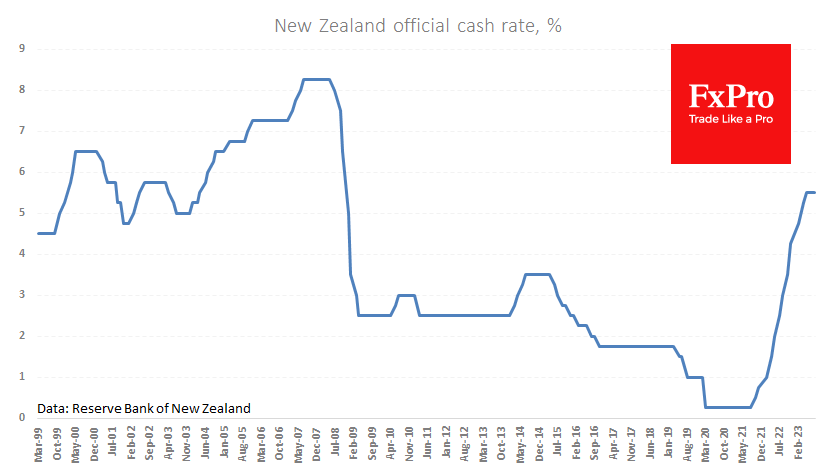
The RBNZ’s mood has clearly shifted from raising the rate to keeping it at the current restrictive level for an extended period of time. The Central Bank notes a decline in activity in the sectors most sensitive to interest rates. In addition, they emphasise the reduction of labour shortage due to migrants and softening demand.
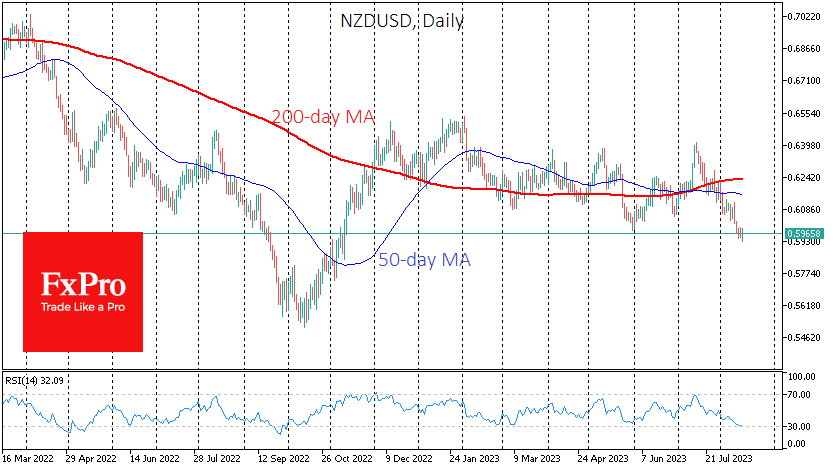
The positive reaction of the currency market to the Central Bank’s comments has a chance to be the starting point for a corrective recovery or even the beginning of the growth of NZD, which by mid-August was at historic lows against CHF and multi-year lows against EUR & GBP.
NZDUSD lost about 7.4% in about a month, and the intraday dip was at its lowest since last November at 0.5930. On the daily timeframes, the RSI flirted with oversold territory the day before, which hasn’t been seen since October 2022. A rise out of this area is a bullish signal, which was also well worked out by NZDUSD, adding over 15% in the last two months.
Sunset Market Commentary
Markets:
UK July inflation numbers grabbed most attention this morning. Headline CPI fell slightly less than expected (-0.4% M/M vs -0.5%) with the Y/Y-figure dropping from 7.9% to 6.8%, the lowest level since February of last year. The biggest contributor were gas and electricity prices following the UK regulator’s announcement that the average annual bill would drop from £2500 to slightly over £2000. Core CPI accelerated again on a monthly basis, from 0.2% M/M in June to 0.3% with the Y/Y-number stable at 6.9%. Services inflation even accelerated from 7.2% Y/Y to 7.4% suggesting that the Bank of England’s work is far from done, even if the UK central bank slowed down its tightening pace from 50 bps rate hikes to 25 bps at the early August meeting. UK gilts underperform today with UK yields rising by 2.4 bps to 3.7 bps across the curve. Sterling holds a small advantage over the euro, with EUR/GBP down at 0.8565 from an open at 0.8585. US eco data were decent today with housing starts up by 3.9% M/M in July (vs 1.1% expected), building permits rising a gently 0.1% M/M (vs 1.5%) and industrial production increasing by 1% M/M (vs 0.3%). They help explain the underperformance of US Treasuries vs German Bunds. The long end of the US curve underperforms again, rising by up to 2.7 bps for the 30-yr tenor. Yesterday, a first attempt to push through the YTD high (10y 4.2%) on stronger retail sales failed. Real yields are driving the move with the US 10y real yield approaching 1.9% for the first time since June 2009! FOMC Minutes can tonight give more ammunition given the divergence between June FOMC dots (5.5%-5.75% EoY policy rate) and market expectations of a 5.25%-5.5% policy rate peak. EUR/USD holds steady again between 1.09 and 1.0950. The Japanese yen remains on the weak side (USD/JPY 146) following last week’s rise in core yields. The market is also stepping up pressure on the BoJ to really start normalizing its policy instead of just widening the band around the 0% target around the 10y yield (from 50 bps to 100 bps end of July). Back in September, the Japanese Ministry of Finance did its first FX interventions since 1998 at the current spot rate. They later stepped it up as USD/JPY briefly passed 150 in October. (More) verbal intervention threats will follow.
News & Views:
The Reserve Bank of New Zealand (RBNZ) kept its policy rate (OCR) unchanged at 5.5% this morning. The Committee agreed that the OCR needs to stay at restrictive levels for the foreseeable future to ensure annual consumer price inflation returns to the 1 to 3% target range, while supporting maximum sustainable employment. A prolonged period of subdued spending growth is still required to better match the supply capacity of the economy and reduce inflation pressure. In the near term, there is a risk that activity and inflation measures do not slow as much as expected. This is reflected in the updated projection path for the policy rate which slightly raised the odds of a final rate hike and pushes forward the potential start of the rate cut cycle. The expected policy rate peak was raised from 5.5% to 5.59% mid next year with end of 2024 and end of 2025 projections increased from 5.3% to 5.5% and from 4.09% to 4.51% respectively. Headline inflation isn’t expected to fall in the 1%-3% range before Q3 2024. The RBNZ also increased its neutral rate prognosis from 2% to 2.25%. NZD swap rates rose slightly at the front end of the curve (+2 bps) with NZD/USD temporary halting a month-long decline, hopelessly trying to regain lost support at NZD/USD 0.60 (previous YTD low).
Hungarian GDP shrank by 0.3% Q/Q in Q3 with YoY growth 2.4% lower. YTD, YoY GDP fell by 1.7%. The largest contributors to the decrease in the economic performance were industry and market services, within which mainly transportation and storage as well as wholesale and retail trade. The good performance of agriculture lowered the reduction. The decrease in the value added of services was partly offset by a significant growth in human health and social work activities, the performance of which approximated the level before the Covid-19 pandemic. The Hungarian forint is better bid today, ignoring the outdated numbers and core bonds yields finally relax after a week of significant increases. EUR/HUF drop back from 388 to 385. Polish GDP decreased by 3.7% Q/Q in Q2 (-0.5% Y/Y). The outcome was weaker than forecast (-2.3% Q/Q) with details being provided on August 31. Today’s Polish zloty rebound is similar to the HUF move with EUR/PLN currently trading at 4.45 from 4.48.
EUR/USD Mid-Day Outlook
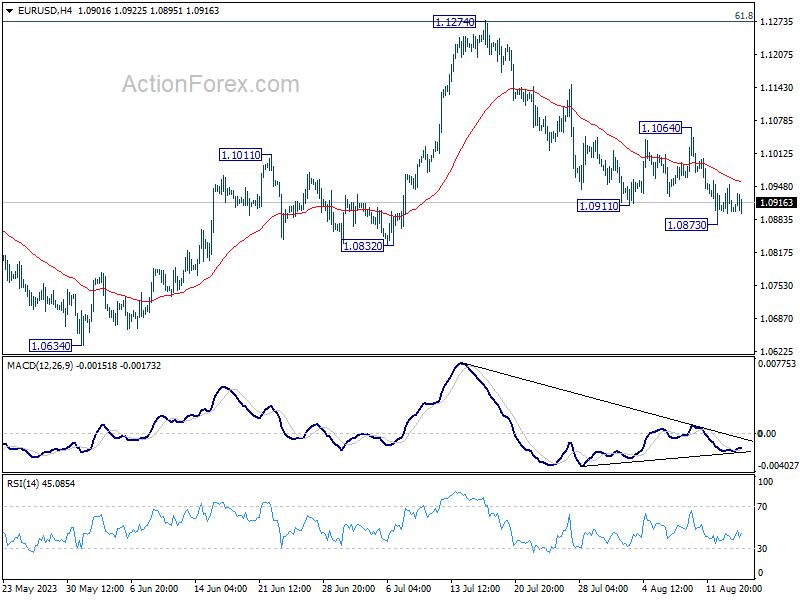
Daily Pivots: (S1) 1.0884; (P) 1.0919; (R1) 1.0939; More...
A temporary low is formed at 1.0873 in EUR/USD and intraday bias is turned neutral first. But outlook stays bearish with 1.1064 resistance intact. On the downside, below 1.0873 will target 1.0832 support first. Decisive break there will extend the decline from 1.1274 to 1.0609/34 cluster support.
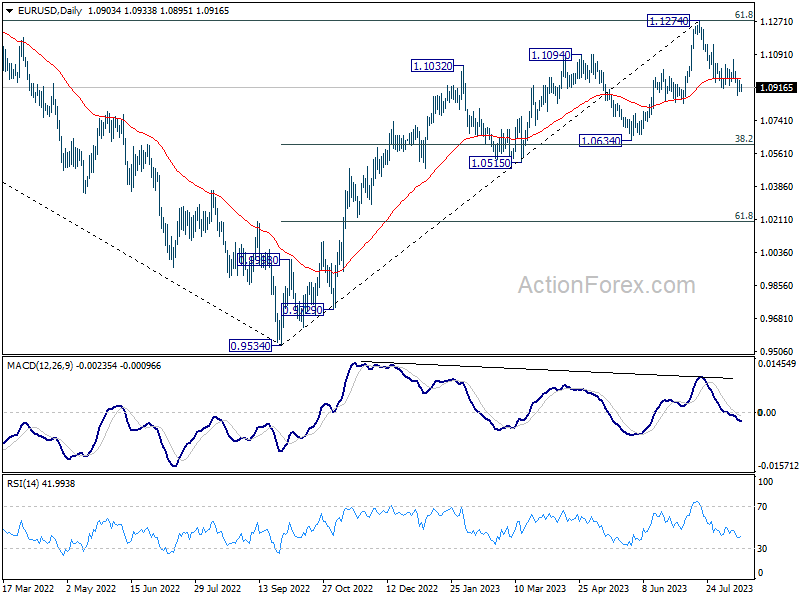
In the bigger picture, a medium term top could be formed at 1.1274, after failing to break through 61.8% retracement of 1.2348 (2021 high) to 0.9534 at 1.1273 decisively, on bearish divergence condition in D MACD. Sustained trading below 55 D EMA (now at 1.0966) will bring deeper correction to 1.0634 cluster support (38.2% retracement of 0.9534 to 1.1274 at 1.0609). Strong support could be seen there, at least on first attempt, to set the range for consolidation.
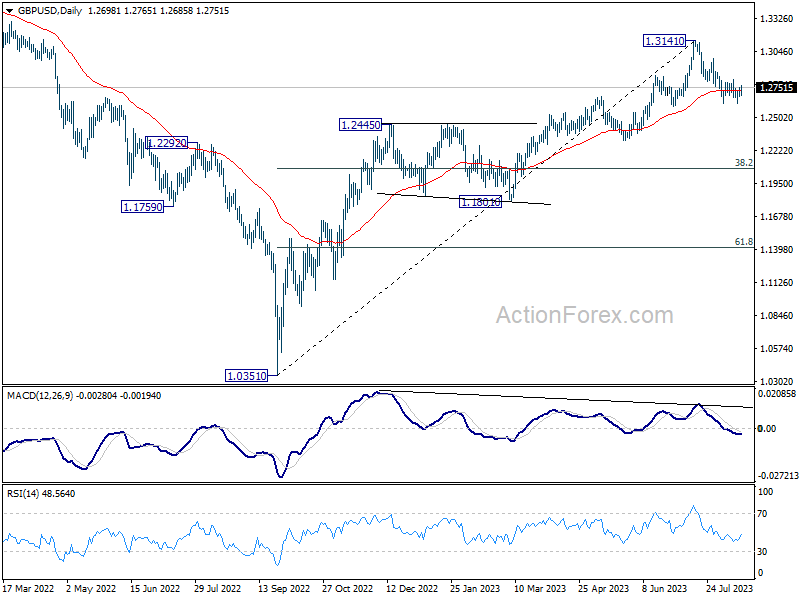
GBP/USD Mid-Day Outlook
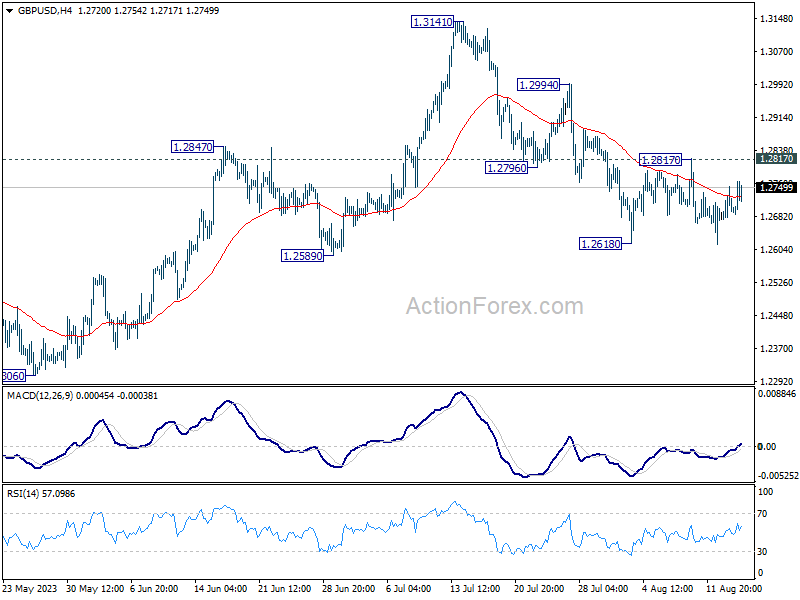
Daily Pivots: (S1) 1.2668; (P) 1.2711; (R1) 1.2746; More...
Range trading continues in GBP/USD and intraday bias remains neutral. On the downside, firm break of 1.2618, and sustained trading below 1.2678 resistance turned support will argue that it's already in a larger correction. Deeper decline would then be seen to 1.2306 support next. Nevertheless, break of 1.2817 minor resistance will indicate that the pull back has completed, and turn bias back to the upside for stronger rebound.
In the bigger picture, a medium term top could be in place at 1.3141 already, on bearish divergence condition in D MACD. Sustained trading below 55 D EMA (now at 1.2723) should confirm this case, and bring deeper fall to 38.2% retracement of 1.0351 to 1.3141 at 1.2075, as a correction to up trend from 1.0351 (2022 low). For now, rise will stay mildly on the downside as long as 1.3141 resistance holds, in case of strong rebound.
USD/CHF Mid-Day Outlook
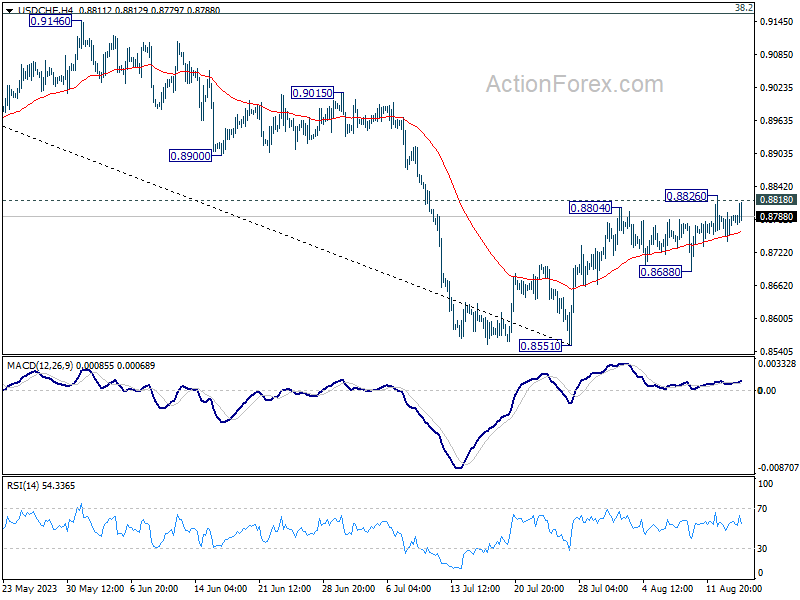
Daily Pivots: (S1) 0.8754; (P) 0.8775; (R1) 0.8807; More....
Range trading in USD/CHF continues today and intraday bias remains neutral. On the upside, sustained trading above 0.8818 support turned resistance will carry larger bullish implication. Further rally should then be seen to 0.9146 cluster resistance next. However, break of 0.8688 support will indicate rejection by 0.8818, and turn bias back to the downside for retesting 0.8551 low.
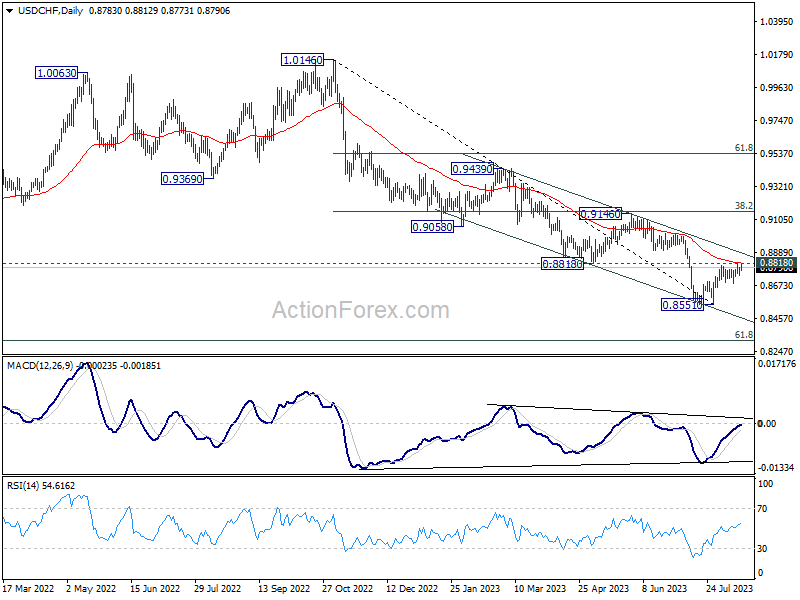
In the bigger picture, a medium term bottom could be in place at 0.8551 already, on bullish convergence condition in D MACD. Sustained trading above 0.8818 will bring further rise to 0.9146 cluster resistance (38.2% retracement of 1.0146 to 0.8551 at 0.9160), even as a correction. Nevertheless, break of 0.8851 will resume the down trend from 1.0146 instead.
USD/JPY Mid-Day Outlook
Daily Pivots: (S1) 145.17; (P) 145.52; (R1) 145.93; More...
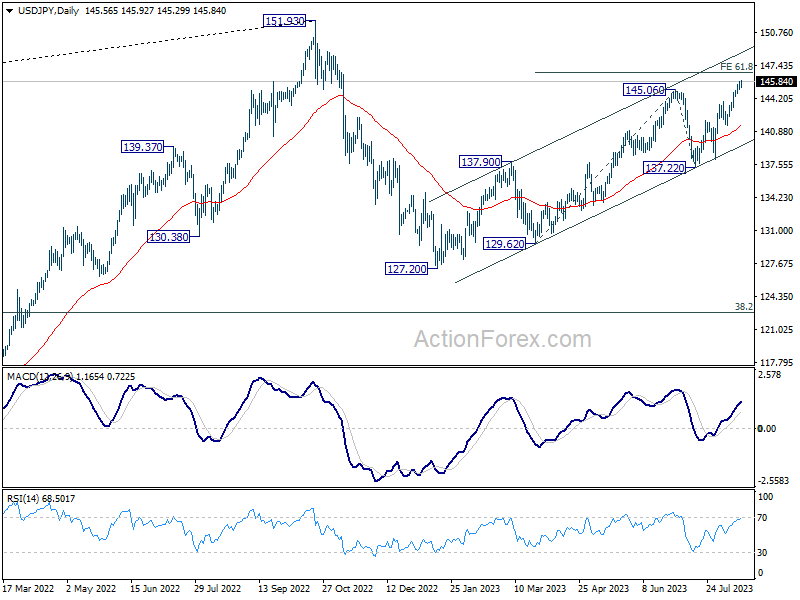
Intraday bias in USD/JPY remains on the upside at this point, despite some loss of momentum. Current rally from 127.20 is in progress for 61.8% projection of 129.62 to 145.06 from 137.22 at 146.76. On the downside, below 144.62 minor support will turn intraday bias neutral and bring consolidations first, before staging another rally.
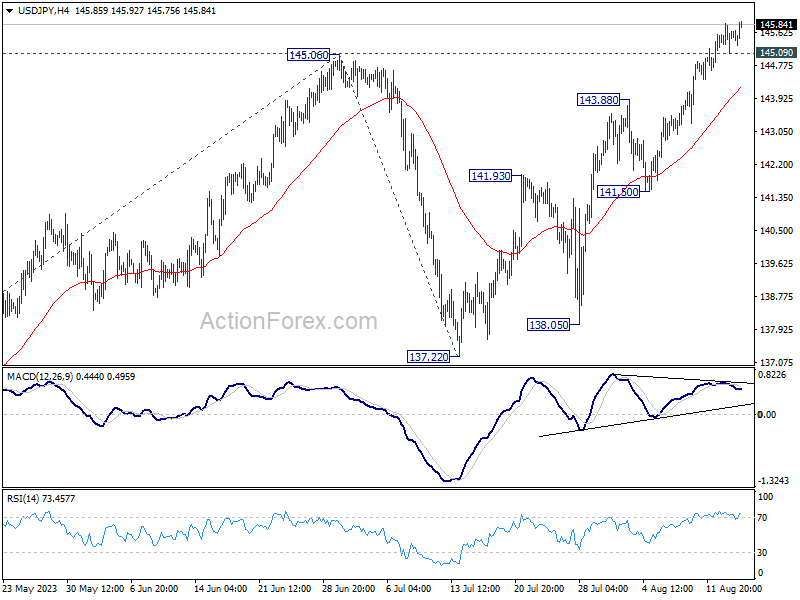
In the bigger picture, overall price actions from 151.93 (2022 high) are views as a corrective pattern. Rise from 127.20 is seen as the second leg of the pattern and could still be in progress. But even in case of extended rise, strong resistance should be seen from 151.93 to limit upside. Meanwhile, break of 137.22 support should confirm the start of the third leg to 127.20 (2023 low) and below.
Dollar Gears Up as Eyes Turn to FOMC Minutes; Sterling Staying Firm
In early US trading sessions, Dollar is showing signs of regaining momentum as market participants eagerly anticipate the release of FOMC minutes from July 25-26 meeting, where a 25bps hike was delivered. Recent comments from Fed officials suggest an increasing divergence in views regarding the need for additional monetary tightening.
Presently, fed funds futures reflect an approximately 90% likelihood of rates remaining unchanged in September, with the odds for another rate hike by year-end staying well below 40%. Although the minutes might not paint a clear roadmap for future rate adjustments, the deliberations between the more aggressive 'hawks' and the cautious 'doves' are set to garner significant attention.
In the broader currency landscape, Sterling has emerged as today's frontrunner, buoyed by UK's CPI data. However, its climb lacks substantial vigor. Hot on its heels is New Zealand Dollar, followed by Euro. Swiss Franc, meanwhile, finds itself at the opposite end of the spectrum as today's weakest performer, shadowed closely by the Australian Dollar and the Yen.
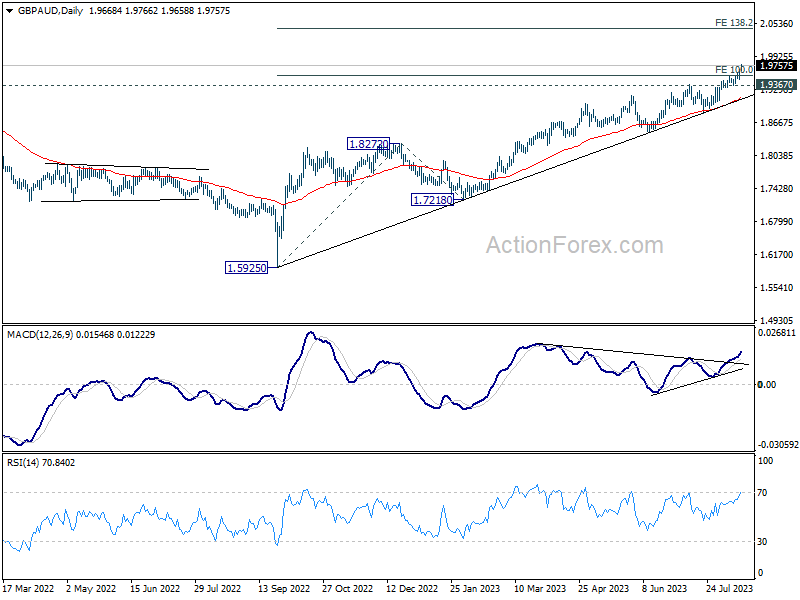
Technically, GBP/AUD up trend continues this week, and D MACD clearly indicates upside reacceleration. Further rise is expected as long as 1.9367 support holds. With 100% projection of 1.5925 to 1.8272 from 1.7218 at 1.9565 taken out, next target is 138.2% projection at 2.0462. While both currencies are risk-sensitive, the development in GBP/AUD suggests that Aussie is the one to go against in case of intensifying risk aversion, not the Pound.
In Europe, at the time of writing, FTSE is down -0.59%. DAX is up 0.02%. CAC is down -0.11%. Germany 10-year yield is down -0.006 at 2.670. Earlier in Asia, Nikkei dropped -1.46%. Hong Kong HSI dropped -1.36%. China Shanghai SSE dropped -0.82%. Singapore Strait Times dropped -0.59%. Japan 10-year JGB yield rose 0.0002 to 0.632.
Eurozone industrial production up 0.5% mom on energy
Eurozone industrial production rose 0.5% mom in June, well above expectation of 0.1% mom. Production of energy grew by 0.5%, while production of durable consumer goods fell by -0.1%, capital goods by -0.7%, intermediate goods by -0.9% and non-durable consumer goods by -1.1%.
EU industrial production rose 0.4% mom. Among Member States for which data are available, the highest monthly increases were registered in Ireland (+13.1%), Denmark (+6.3%) and Lithuania (+3.2%). The largest decreases were observed in Sweden (-5.3%), Finland and Malta (both -3.3%) and Belgium (-3.0%).
UK CPI slowed to 6.8% in Jul, services inflation hit highest since 1992
July saw a marked deceleration in UK's CPI, falling from 7.9% yoy to 6.8% yoy , precisely in line with market expectations. Core CPI, which strips out variables like energy, food, alcohol, and tobacco, stood unchanged at 6.9% yoy, above the expected 6.8%.
CPI figures pertaining to goods showed a noticeable slowdown, dropping from 8.5% yoy to 6.1% yoy. On the flip side, CPI services ramped up from 7.2% yoy to 7.4% yoy , registering its peak since the staggering 9.5% yoy rate observed in March 1992.
On a month-to-month analysis for July, CPI receded by -0.4%, a figure slightly above than forecasted decline of -0.5%. Core CPI saw a monthly rise of 0.3% mom. While the CPI for goods plunged by -1.7% mom. , services CPI exhibited an increase, registering growth of 1.0% mom. .
Office for National Statistics remarked, "The slowdown in the annual CPI rate into July 2023 was driven by downward contributions to change from 8 of the 12 divisions."
Notably, housing and household services emerged as the primary sectors applying downward pressure. Expanding on this, ONS stated, "Within this division, the downward effect came mainly from gas and electricity."
RBNZ on hold, OCR to stay high for longer
RBNZ has decided to maintain OCR unchanged at 5.50% again, aligning with broad market expectations. Making its stance clear, the bank asserted that the "OCR needs to stay at restrictive levels for the foreseeable future."
Reflecting a neutral stance, the central bank emphasized its confidence in the current monetary policy, "that with interest rates remaining at a restrictive level for some time, consumer price inflation will return to within its target range of 1 to 3% per annum, while supporting maximum sustainable employment."
Adding depth to its economic perspective, "The nominal neutral OCR has increased by 25 basis points to 2.25% within the projections," the Committee noted. They were in consensus that the existing OCR level was contractionary, asserting that it's effectively curbing domestic spending as intended.
Shifting the lens to future projections, the forecasts in the Monetary Policy Statement hint at the OCR potentially reaching a peak of 5.6% in the first quarter of 2024. This marks a slight shift from the earlier prediction of 5.5% in Q3 2023, hinting at the possibility of an additional rate hike. As for subsequent rate cut expectations are now set for the second quarter of 2025, a slight delay from the previously anticipated period between Q4 2024 and Q1 2025.
Australia's Westpac leading index ticks up, but below-par growth set to persist
Australia's Westpac Leading Index figures reveals that growth rate has shown a marginal uptick, moving from -0.67% to -0.60% in July. But alarmingly, this marks the twelfth consecutive month in red, representing the longest stretch of such negative prints in a span of seven years, barring the COVID-affected period.
The subdued, below-par growth momentum witnessed throughout 2023 seems set to persist into the subsequent year. Westpac predicts deceleration in GDP growth to a mere 1% for the current year. Any potential rebound is anticipated to be minimal, with projections indicating a slight rise to 1.4% annually in 2024 – with the bulk of this growth concentrated towards the year-end.
Regarding RBA meeting on September 5, Westpac sets its expectations clear. The institution foresees cash rate remaining stable at 4.10%, denoting the zenith of this current tightening phase.
Referring the recent remarks of RBA Governor before the House of Representatives Standing Committee on Economics, the note emphasized, "Policy is now in a 'calibration' phase with small adjustments still possible if the data starts to show clear risks of a slower return to low inflation."
Nevertheless, given the evident frailty in growth momentum – as underscored by the most recent Leading Index update – coupled with the broader dynamics of price and wage inflation aligning with RBA's forecasts, "the threshold for additional tightening is high and unlikely to be met."
USD/JPY Mid-Day Outlook
Daily Pivots: (S1) 145.17; (P) 145.52; (R1) 145.93; More...
Intraday bias in USD/JPY remains on the upside at this point, despite some loss of momentum. Current rally from 127.20 is in progress for 61.8% projection of 129.62 to 145.06 from 137.22 at 146.76. On the downside, below 144.62 minor support will turn intraday bias neutral and bring consolidations first, before staging another rally.
In the bigger picture, overall price actions from 151.93 (2022 high) are views as a corrective pattern. Rise from 127.20 is seen as the second leg of the pattern and could still be in progress. But even in case of extended rise, strong resistance should be seen from 151.93 to limit upside. Meanwhile, break of 137.22 support should confirm the start of the third leg to 127.20 (2023 low) and below.
Economic Indicators Update
| GMT | Ccy | Events | Actual | Forecast | Previous | Revised |
|---|---|---|---|---|---|---|
| 00:30 | AUD | Westpac Leading Index M/M Jul | 0.00% | 0.12% | ||
| 02:00 | NZD | RBNZ Interest Rate Decision | 5.50% | 5.50% | 5.50% | |
| 03:00 | NZD | RBNZ Press Conference | ||||
| 06:00 | GBP | CPI M/M Jul | -0.40% | -0.50% | 0.10% | |
| 06:00 | GBP | CPI Y/Y Jul | 6.80% | 6.80% | 7.90% | |
| 06:00 | GBP | Core CPI Y/Y Jul | 6.90% | 6.80% | 6.90% | |
| 06:00 | GBP | RPI M/M Jul | -0.60% | -0.70% | 0.30% | |
| 06:00 | GBP | RPI Y/Y Jul | 9.00% | 9.00% | 10.70% | |
| 06:00 | GBP | PPI Input M/M Jul | -0.40% | 0.00% | -1.30% | |
| 06:00 | GBP | PPI Input Y/Y Jul | -3.30% | -5.10% | -2.70% | -2.90% |
| 06:00 | GBP | PPI Output M/M Jul | 0.10% | -0.40% | -0.30% | -0.20% |
| 06:00 | GBP | PPI Output Y/Y Jul | -0.80% | -1.20% | 0.10% | 0.30% |
| 06:00 | GBP | PPI Core Output M/M Jul | 0.10% | -0.30% | -0.20% | |
| 06:00 | GBP | PPI Core Output Y/Y Jul | 2.30% | 1.60% | 3.00% | 3.10% |
| 09:00 | EUR | Eurozone GDP Q/Q Q2 P | 0.30% | 0.30% | 0.30% | |
| 09:00 | EUR | Employment Change Q/Q Q2 P | 0.20% | 0.40% | 0.60% | |
| 09:00 | EUR | Eurozone Industrial Production M/M Jun | 0.50% | 0.10% | 0.20% | |
| 12:15 | CAD | Housing Starts Y/Y Jul | 255K | 260K | 281.4K | |
| 12:30 | CAD | Wholesale Sales M/M Jun | -2.80% | -4.40% | 3.50% | 2.90% |
| 12:30 | USD | Housing Starts Jul | 1.45M | 1.45M | 1.43M | 1.40M |
| 12:30 | USD | Building Permits Jul | 1.44M | 1.47M | 1.44M | |
| 13:15 | USD | Industrial Production M/M Jul | 1.00% | 0.30% | -0.50% | -0.80% |
| 13:15 | USD | Capacity Utilization Jul | 79.30% | 79.00% | 78.90% | 78.60% |
| 14:30 | USD | Crude Oil Inventories | -2.4M | 5.9M | ||
| 18:00 | USD | FOMC Minutes |
New Zealand Dollar Rises after RBNZ Maintains Cash Rate
- RBNZ holds cash rate at 5.5%, as expected
- New Zealand dollar stems slide
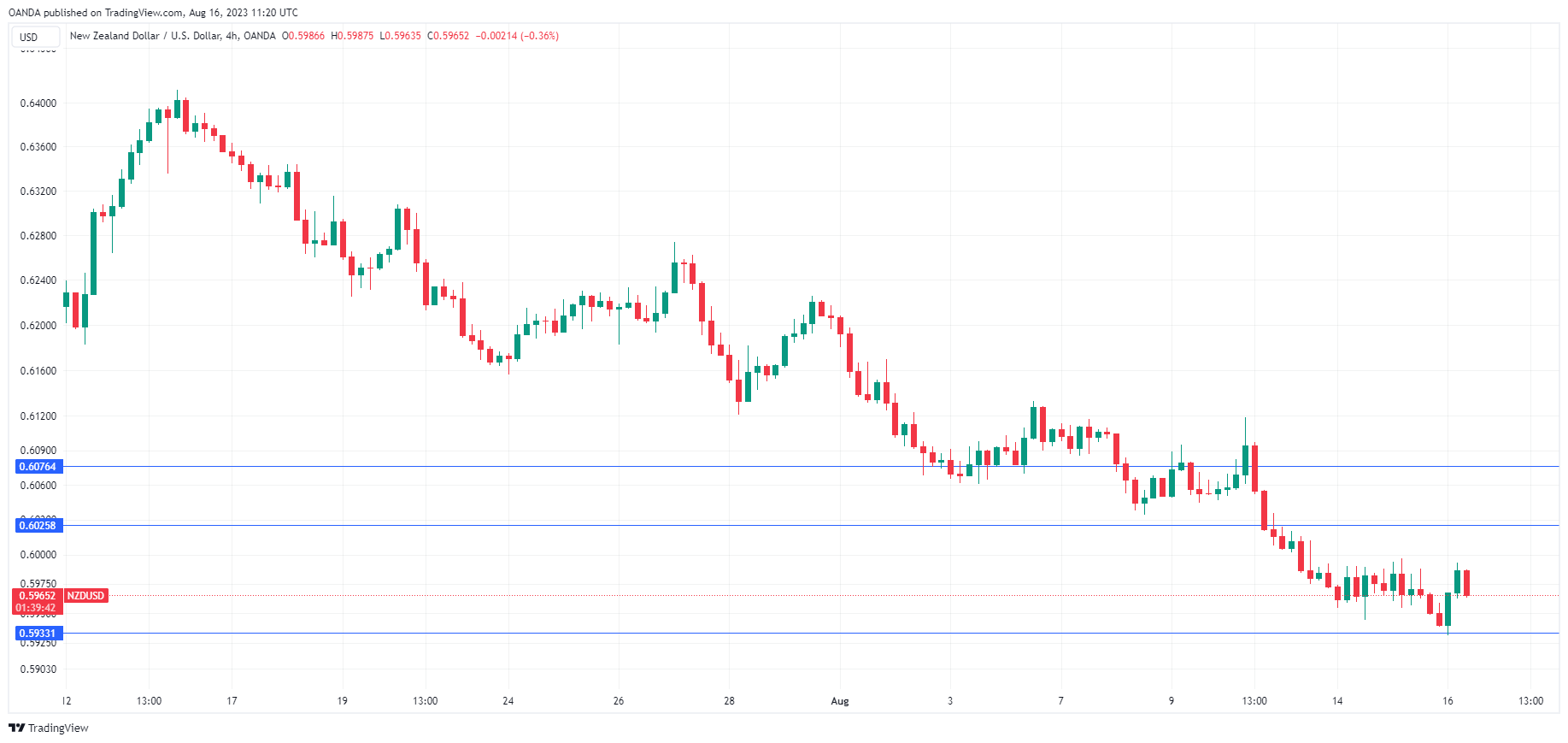
The New Zealand dollar is in positive territory on Wednesday in the aftermath of the Reserve Bank of New Zealand’s decision to maintain interest rate levels. In the European session, NZD/USD is trading at 0.5965, up 0.25%. NZD/USD rose as high as 0.5993 but has pared most of these gains.
It has been a bumpy road for the New Zealand dollar, which is coming off a six-day slide in which it declined 150 basis points. The Kiwi has the dubious honour of the worst-performing currency among the majors over the past month, sliding about 7.1%. The current downswing has been driven by weak global demand and concerns over China’s economy, which is experiencing deflation.
RBNZ holds rates but says further rate hikes remain an option
The RBNZ opted to pause for a second straight time, leaving the cash rate at 5.5%. This decision was expected, but the New Zealand dollar managed to rise about 0.66% after the decision, before surrendering much of those gains.
The RBNZ noted that inflation, currently at 6%, is expected to fall below the upper band of the 1%-3% target by the third quarter of 2025, but that will require rates to remain restrictive “for some time”. The central bank warned that “in the near term there is a risk that activity and inflation measures do not slow as much as expected.” The Bank also said that headline inflation and inflation expectations have been in decline, but core CPI remains too high.
Is the RBNZ done raising rates? A second-straight pause is a promising sign and many economists believe that rates have peaked, with rate cuts coming sometime next year. The RBNZ continues to forecast a peak at the current rate of 5.5% but said that there is an upside risk of one more hike, before cutting rates in 2025.
NZD/USD Technical
- NZD/USD tested support at 0.5933 earlier today. Below, there is support at 0.5833
- 0.6026 and 0.6076 are the next resistance lines
BoE Unlikely to Stop Hiking as UK Inflation Remains High
Inflationary pressures in the UK are easing, although they remain the highest among the G7 countries, as sellers are in no hurry to cut prices.
UK CPI fell 0.4% in July (-0.5% expected), the first decline since January. The year-over-year price growth rate fell to 6.8%, the lowest since February 2022. The Retail Price Index last month was 9.0% higher than a year before, slowing to single digits for the first time since March 2022.
Core inflation remained at 6.9% y/y, just 0.2 percentage points below the peak two months earlier.
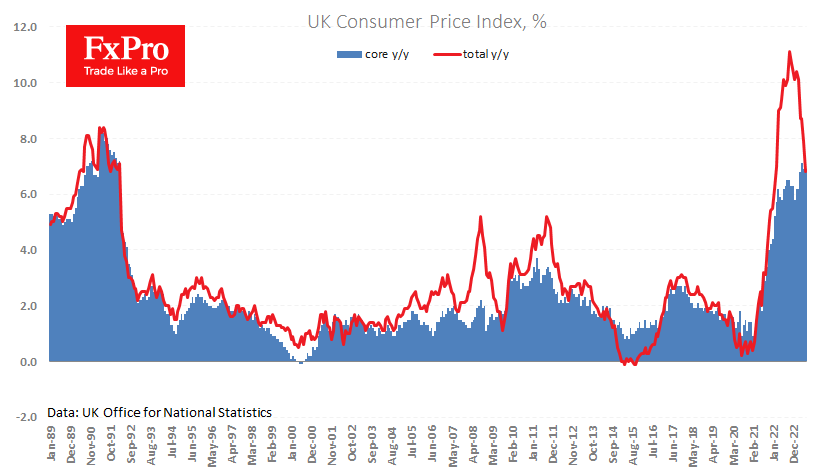
These latest price data are above market expectations and higher than those of the other G7 countries, which puts the most significant pressure on the Pound’s purchasing power. Such figures will unlikely stop the Bank of England from raising interest rates.
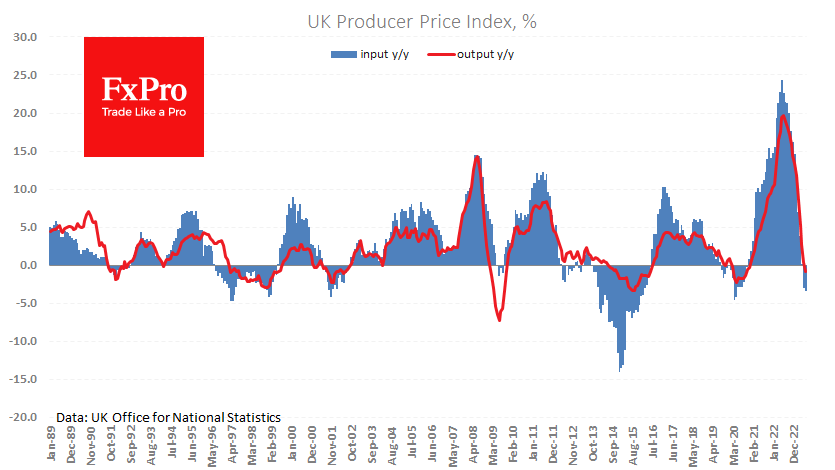
Meanwhile, producer prices are falling at an accelerating rate. Input Producer Price Index fell 0.4% in July and is now at -3.3% y/y, the lowest since May 2020. Output PPI was 0.8% lower than 12 months ago.
Producer prices are under pressure after commodities. However, a tight labour market and elevated inflationary pressures in the services sector keep inflation higher than the central bank would like.
Cooling the economy through recession and rising unemployment is a desirable quick fix in this environment. But it is politically unpalatable and can quickly have a knock-on effect on the economy.
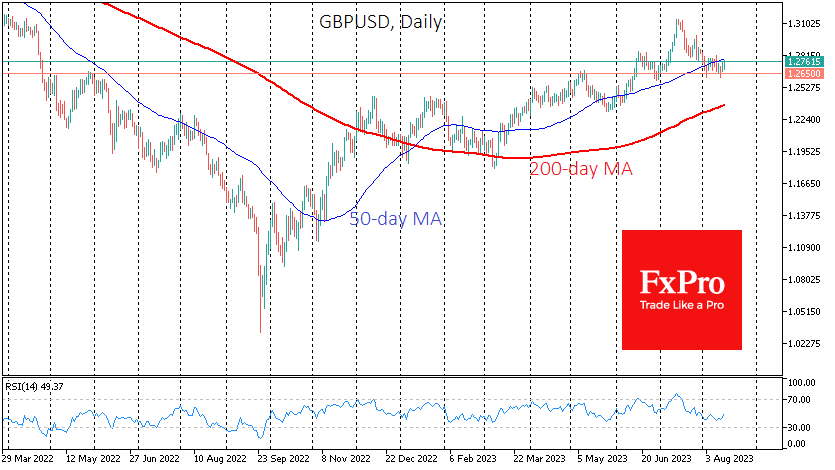
The Bank of England has not yet reached the peak of interest rates, which we estimate to be around 6%. Given the entrenched inflationary processes, it will also have to keep rates at their peak for longer. This is good news for the Pound, which has had a chance to lick its wounds after a month of decline against the USD.
The technical picture for the GBPUSD is also interesting. The recent reversal in the pair’s growth from 1.2650 based on pro-inflationary data from the labour market and consumer prices could be both a temporary respite and a turning point. The bulls’ ability to push the pair above 1.2800 could attract more buyers to the GBP. A return below 1.2650 this week would signal a new round of weakness.