Sample Category Title
Sunset Market Commentary
Markets
The first ECB governors came to speech in the wake of yesterday’s policy meeting. Muller kicked off by saying that previous rate increases are having an impact and that next decisions are no longer obvious. Vasle and Simkus joined by adding that September could either be a hike or a pause, depending on the data. Kazimir struck the most hawkish cord. Core inflation remains too high and risks are still clearly tilted to the upside, he said. He does acknowledge that the latest hike to 3.75% brought the ECB close to the peak. Germany’s Nagel also referred to stubborn core inflation but kept an open mind on whether to hike or pause in September. France’s Villeroy repeated the “data dependence” code the ECB now lives by. Both him and Nagel stressed the need for keeping rates high for long enough. Acting on the quotes proved tricky with a slew of European data scheduled for release though. Several euro area member states published July inflation numbers, including Spain (2.1%, up from 1.6% with core rising too), Germany (6.5% from 6.8%), France (5% from 5.3%) and Belgium (4.14% from 4.15%). Data from the first printed higher than expected while our neighbours in the south and east missed the bar by the tiniest margin. The latter two also published a first Q2 growth estimate. France crushed the bar by growing a nice 0.5% q/q (0.9% y/y). Germany stagnated but saw its Q1 figure revised upwards from -0.3% to -0.1%. Belgium’s economy grew a meagre 0.2%. Services single-handedly support growth with the industry still teetering. As if a clean markets response wasn’t already difficult enough, US data came interfering too. The all-important Employment Cost Index (+1% q/q in Q2) rose less than the 1.1% consensus. June income and spending data were about in line with expectations, considering the upward revisions to the previous month. PCE deflators were spot on (0.2% m/m, 3% y/y) with the core gauge slightly less than anticipated in the yearly print (0.2% m/m, 4.1% y/y).
The data in general confirm markets’ current belief that tightening is close to an end and a soft landing is actually on the table. Core bonds in general gain with USTs outperforming Bunds. The latter gapped significantly lower at the open, catching up with a BoJ-inspired move in the US late-yesterday. From there on, however, yield gains quickly evaporated. Changes vary between -6 bps at the front and +2.7 bps at the longest tenor. US yields move from -3.9 bps to +0.8 bps in similar steepening/less inversion of the curve. EUR/USD is struggling for the 1.10 big figure going into the weekend. Sterling is well bid. EUR/GBP is easing towards 0.855. Unlike the euro and USD, the pound is the only one having clear(est) sight on further tightening, even if already accounting for next week’s BoE (25 or 50 bps?) rate hike. European equities wiped out earlier minor losses to trade flat and WS opens >1% higher (Nasdaq).
News & Views
Swedish growth contracted by 1.5% in Q2 putting the level of activity 2.4% lower y/y. It follows a 0.6 % Q/Q rise in Q1. Monthly retail sales in June also declined 0.3% M/M to be 4.4% y/y. June labour market data showed a sizeable increase in the labour force participation. The number of people in the labour force rose 103k compared to the same month last year to 5.940 mln. The relative labour force participation rate amounted to 78.5%, an increase by 1.1 ppts. The unemployment rate rose to 7.9% from 7.2%. However, due the rise in the labour force the higher unemployment rate mirrored both a higher number of unemployed and employed people. Soft activity data won’t make it easier for the Riksbank to convincingly execute further tightening as it still has to cope with high inflation (CPIF 6.4% Y/Y in June). The Riksbank end June raised its policy rate by 25 bps points to 3.75%. The krone early this month rebounded from an all-time low against the euro at EUR/SEK 11.95. The pair currently hovers near 11.55.
The Swiss KOF Economic Barometer improved slightly in July from 90.7 to 92.2 after three consecutive monthly declines. However the economic environment in the Swiss economy is still labeled as difficult. All indicator bundles except those for consumption continue to point to a rather below-average development, but they moved in different directions in July. The outlook for services, financial and insurance services as well as for foreign demand and domestic consumption has brightened somewhat. On the other hand, the outlook for construction activity and for manufacturing, whose outlook is particularly gloomy, have clouded over. The Swiss franc was well bid in July, but today some modest correction kicked in. At EUR/CHF 0.956, the franc still trades strong compared to levels near 0.98 a month ago.
Canada’s Economy Grew in May, with Slowdown Projected in June
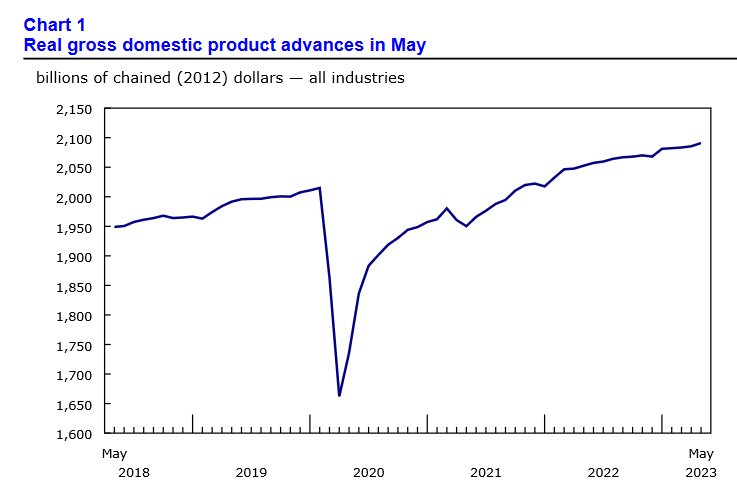
The Canadian economy advanced 0.3% month-on-month (m/m) in May, coming in a tick below Statistics Canada's advanced estimate of 0.4% m/m. However, April's flat reading was revised upward by one-tenth providing an offset to this month's figure. The flash estimate for June growth points toward a -0.2% m/m contraction.
April's reading was balanced, with output expanding in 12 of 20 industries. Services-producing industries led the gain, rising by 0.5% m/m. Goods-producing industries contracted by 0.3% m/m, after expanding in the four months prior.
As expected, goods-producing sectors were dragged down by the adverse effects of the wildfires in May. Oil and gas extraction fell 3.6% m/m, and excluding oil sands, dropped 6.6% m/m. All said, mining, quarrying, and natural gas shaved two-tenths off of the headline reading. Manufacturing (+1.6% m/m) partially offset the decline in goods, as supply chains issues continued to ease. The construction sector contracted 0.8% m/m in May, led by residential building construction (-1.8% m/m).
Also as anticipated, the public administration sector rebounded as workers came back to the job after striking until the end of April. The sector rebounded 1.3% m/m and contributed one-tenth to headline GDP. Wholesale trade also provided a lift to services, rebounding by a healthy 2.9% m/m after contracting for three straight months. The real estate sector provided an assist with a gain of 0.5% m/m.
This month's 0.3% m/m for May mark's the largest gain since January 2023. If advanced estimates are correct, June's decrease will mark the first contraction since December 2022.
Key Implications
Canadian GDP came in roughly in line with expectations. With today's print, last month's upward revision and the flash estimate for June, second quarter GDP growth is tracking around 1.0%. This would undershoot the Bank of Canada's (BoC) most recent 1.5% annualized estimate for Q2 growth and put it in line with our current forecast. Still, the BoC reiterated in their July policy statement that they are still concerned with excess demand.
Today's reading points to some slowing momentum heading into the summer months. Since April, GDP data has been impacted by a series of transitory shock whose net effects make the data more difficult to interpret. Looking ahead, headline GDP figures may continue to be skewed by the government's grocery rebate and the effects of the B.C. port strike in July. All said, slowing growth appears to be in the cards for the Canadian economy, and we believe this will be enough for the BoC to remain on hold at its next meeting.
EUR/USD Rebounds after Sharp Losses
- EUR/USD rebounds after 1% fall on Thursday
- US GDP for Q1 beats expectations
The euro has bounced back on Friday after sliding 0.99% a day earlier. In the European session, EUR/USD is trading at 1.1018, up 0.38%. On the economic calendar, the US PCE Price Index, the Fed’s preferred inflation gauge, fell to 3.0% in June, down from 3.8% in May.
ECB, US GDP send euro sharply lower
The European Central Bank raised interest rates by 0.25% on Thursday, bringing the main rate to 3.75%. The ECB statement warned that inflation, although on the decline, “is expected to remain too high for too long”. The ECB did not provide any forward guidance, as the statement said the Governing Council would base its decisions on the data. ECB President Lagarde didn’t add much to this stance, saying that ECB members were “open-minded” about rate decisions at upcoming meetings and wouldn’t commit to whether the ECB would raise or pause in September.
The rate increase can be described as a ‘hawkish hike’, as the statement kept the door open for further hikes. Nevertheless, the euro lost ground following the decision, which could reflect expectations that the ECB is close to its peak rate, despite the hawkish rhetoric.
The eurozone economy is struggling, and this week’s Services PMIs pointed to weakness in Germany and France, the biggest economies in the bloc. The eurozone could slip into recession this year, which means that the ECB will have to think carefully before its raises rates. On the other side of the coin, inflation, which is the ECB’s number one priority, is at 5.5%, well above the target of 2%. The eurozone releases the July inflation report on Monday and the reading could be a key factor in the ECB’s rate decision at the September meeting.
The euro lost further ground on Thursday after better-than-expected US data. In the second quarter, GDP rose 2.4% q/q, above the Q1 reading of 2.0% and the consensus estimate of 1.8%. US Durable Goods Orders and unemployment claims were better than expected, a further indication that the Fed may be able to guide the economy to a soft landing even with interest rates at their highest levels in 22 years.
EUR/USD Technical
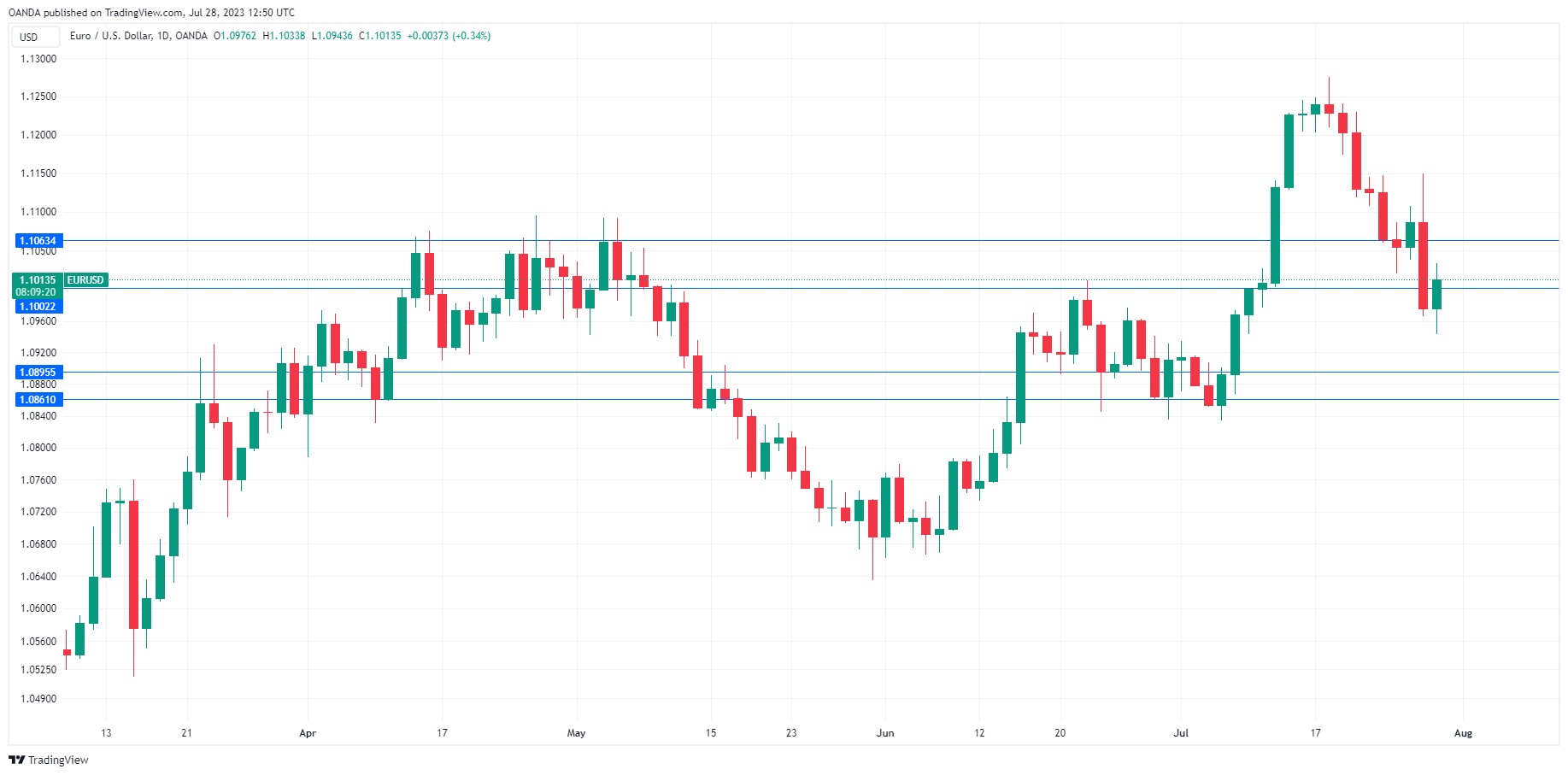
- EUR/USD is testing resistance at 1.1002. The next resistance line is 1.1063
- There is support at 1.0895 and close by at 1.0861
USD/JPY Mid-Day Outlook
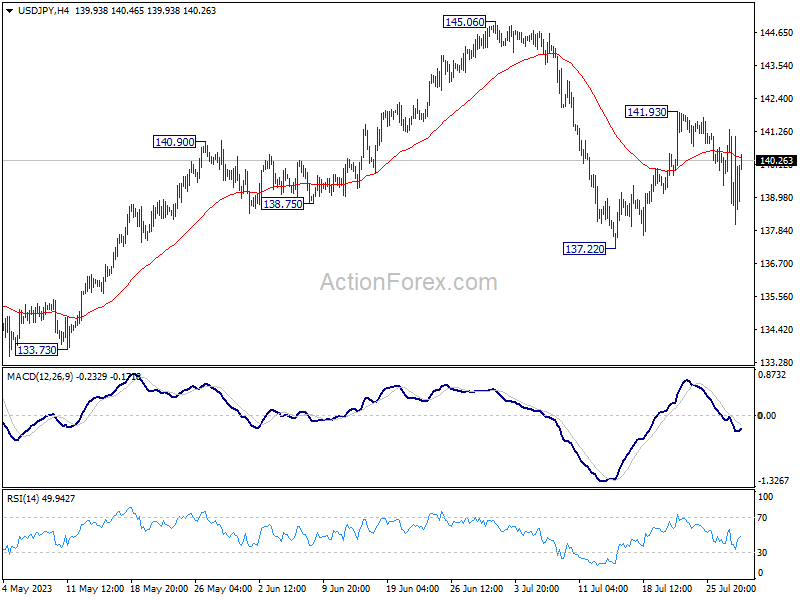
Daily Pivots: (S1) 138.40; (P) 139.86; (R1) 140.95; More...
Intraday bias in USD/JPY is turned neutral again as it recovery after failing to break through 137.22 support. On the downside, break of 137.22 will resume the whole decline from 145.06, and carries larger bearish implications. On the upside, though, break of 141.93 will resume the rebound from 137.22 and target a test on 145.06 high.
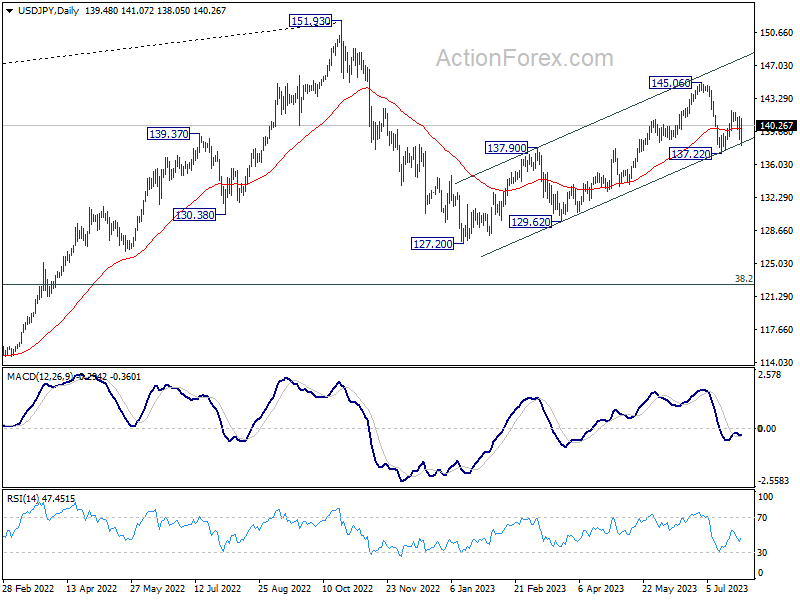
In the bigger picture, overall price actions from 151.93 (2022 high) are views as a corrective pattern. Current development suggests that the second leg (the rise from 127.20) might not be over yet. But even in case of extended rise, strong resistance should be seen from 151.93 to limit upside. Meanwhile, break of 137.22 support should confirm the start of the third leg to 127.20 (2023 low) and below.
USD/CHF Mid-Day Outlook
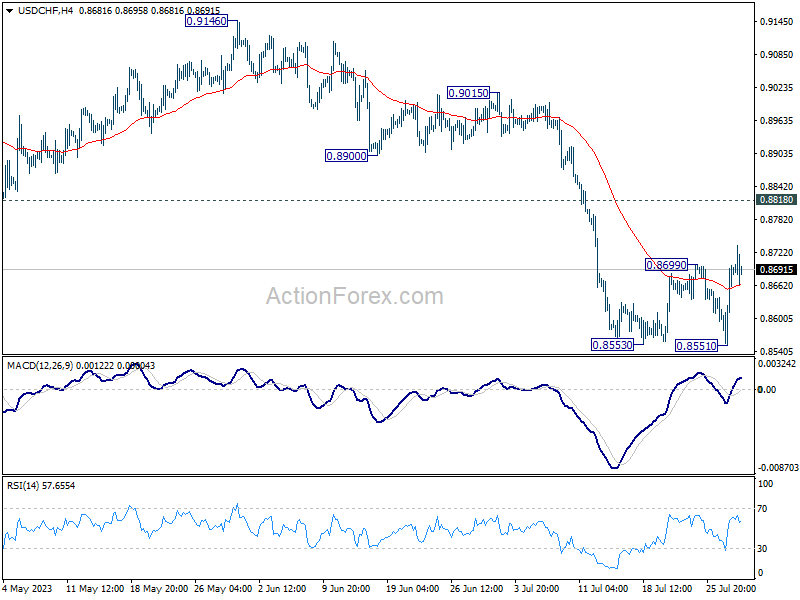
Daily Pivots: (S1) 0.8598; (P) 0.8648; (R1) 0.8744; More....
Intraday bias in USD/CHF is back on the upside with break of 0.8699 resistance. Further rise would be seen towards 0.8818 support turned resistance. On the downside, firm break of 0.8551 will resume larger down trend from 1.0146, targeting 0.8317 fibonacci level.
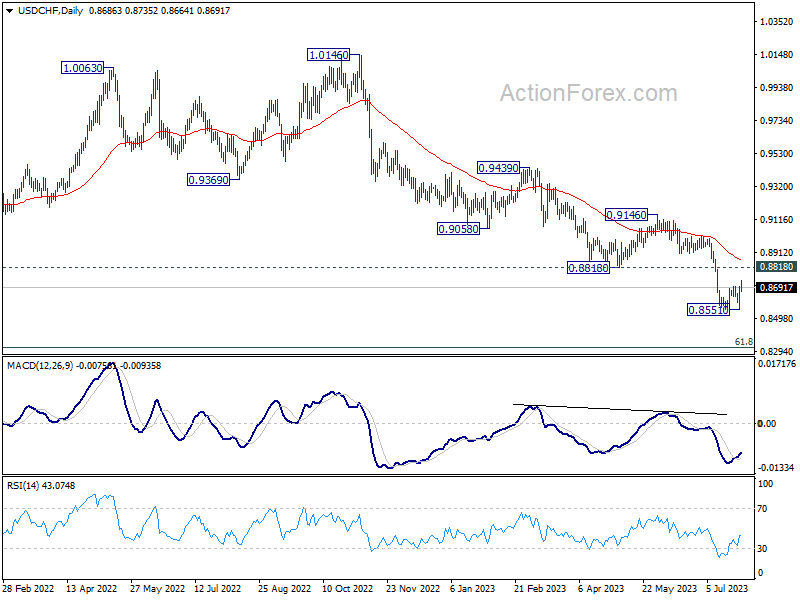
In the bigger picture, the break of 0.8756 (2021 low) indicates break out from the long term range pattern. For now, medium term outlook will stay bearish as long as 0.9146 resistance holds. Further fall would be seen to 61.8% retracement of 0.7065 (2011 low) to 1.0342 (2016 high) at 0.8317 next.
EUR/USD Mid-Day Outlook
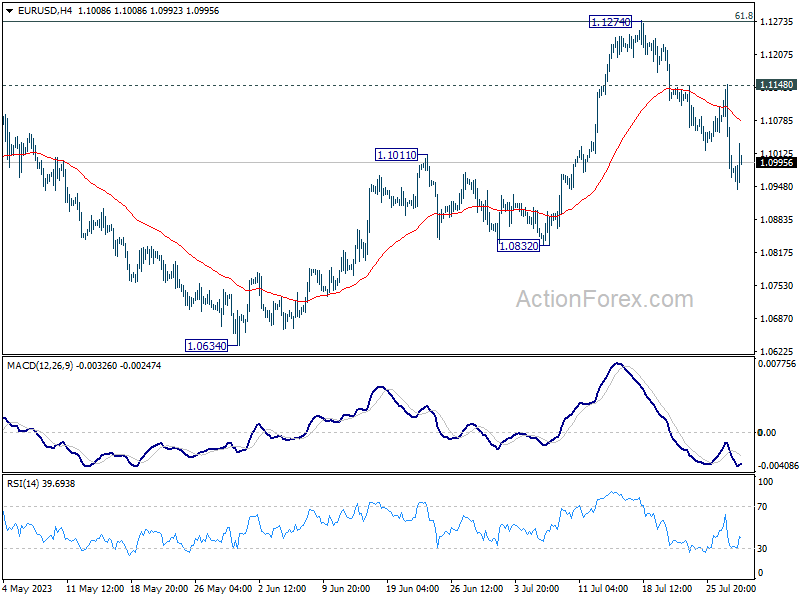
Daily Pivots: (S1) 1.0912; (P) 1.1031; (R1) 1.1096; More...
EUR/USD recovered after dipping to 1.0942 but further decline is still in favor as long as 1.1148 resistance holds. Sustained trading below 1.1011 resistance turned support will argue that larger correction is underway. Deeper fall would then be seen to 1.0832 support and below. For now, risk will stay mildly on the downside as long as 1.1148 resistance holds, in case of recovery.
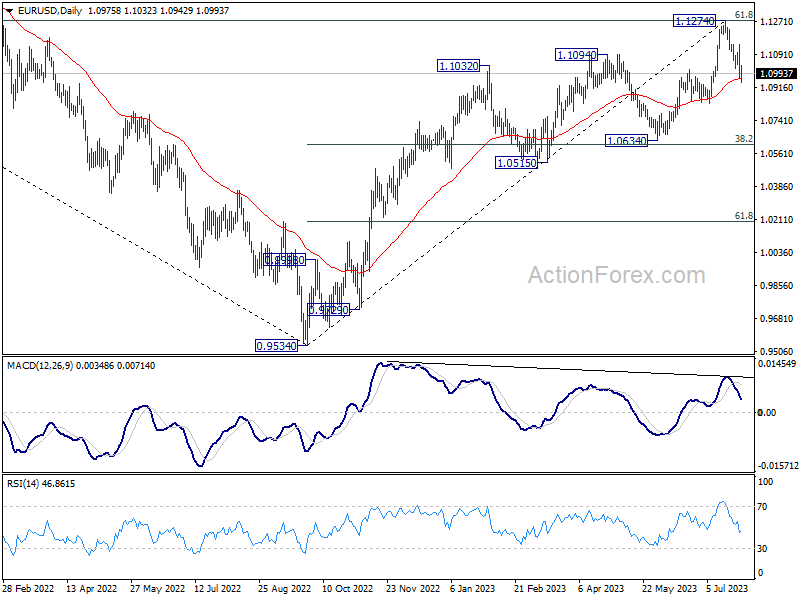
In the bigger picture, a medium term top could be formed at 1.1274, after failing to break through 61.8% retracement of 1.2348 (2021 high) to 0.9534 at 1.1273 decisively, on bearish divergence condition in D MACD. Sustained trading below 55 D EMA (now at 1.0962) will bring deeper correction to 1.0634 cluster support (38.2% retracement of 0.9534 to 1.1274 at 1.0609). Strong support could be seen there, at least on first attempt, to set the range for consolidation.
GBP/USD Mid-Day Outlook
Daily Pivots: (S1) 1.2720; (P) 1.2858; (R1) 1.2934; More...
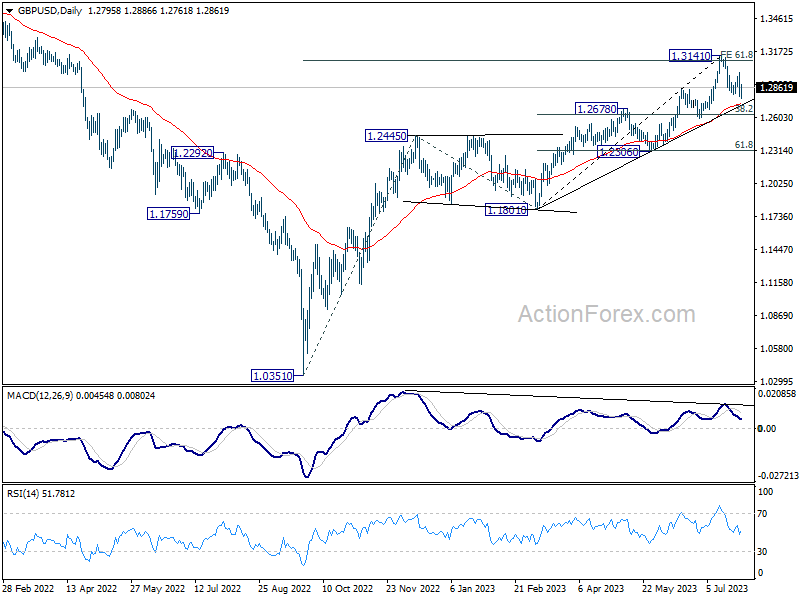
GBP/USD recovers notably after dipping to 1.2761 earlier today. But for now, further decline is in favor as long as 1.2994 resistance holds. Fall from 1.3141 would target 55 D EMA (now at 1.2718) and possibly below. On the upside, break of 1.2994 resistance will argue that the pull back has completed, and bring retest of 1.3141 high.
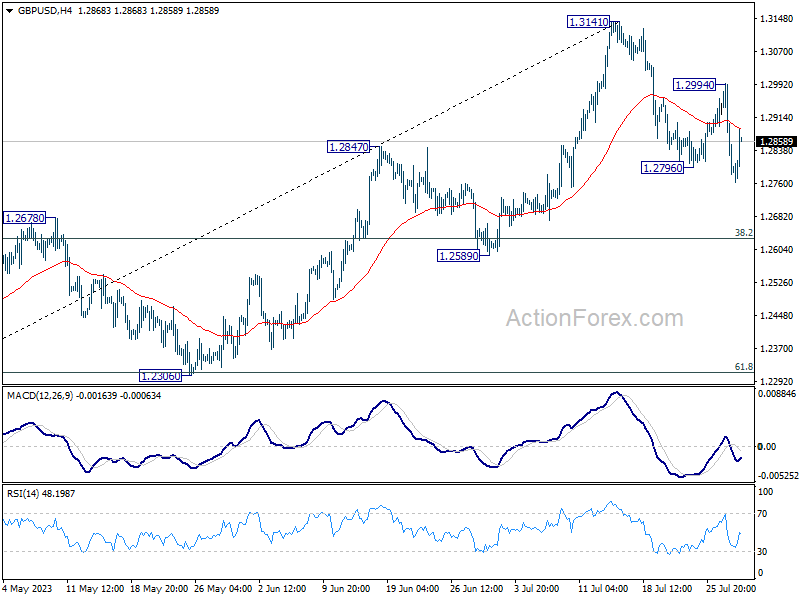
In the bigger picture, as long as 1.2678 resistance turned support holds, rise from 1.0351 (2022 low) is expected to continue. Next target is 100% projection of 1.0351 to 1.2445 from 1.1801 at 1.3895. However, sustained break of 1.2678 will argue that it's at least correcting this rally, with risk of bearish reversal.
Dollar Down Again on PCE Inflation, Yen Reverses Too
Dollar is reversing much of yesterday's gain as both headline and core PCE price indexes showed more than expected moderation. Meanwhile, Yen is also reversing earlier gains around BoJ policy decisions. On the other hand, European majors are making a notable comeback, with Sterling outperforming Euro and Swiss Franc. Commodity currencies however, are staying as the worst performers, except that Loonie is just mixed.
In Europe, at the time of writing, FTSE is up 0.14%. DAX is up 0.22%. CAC is up 0.01%. Germany 10-year yield is flat at 2.473. Earlier in Asia, Nikkei dropped -0.40%. Hong Kong HSI rose 1.41%. China Shanghai SSE rose 1.84%. Singapore Strait Times rose 1.01%. Japan 10-year JGB yield rose 0.1094 to 0.550.
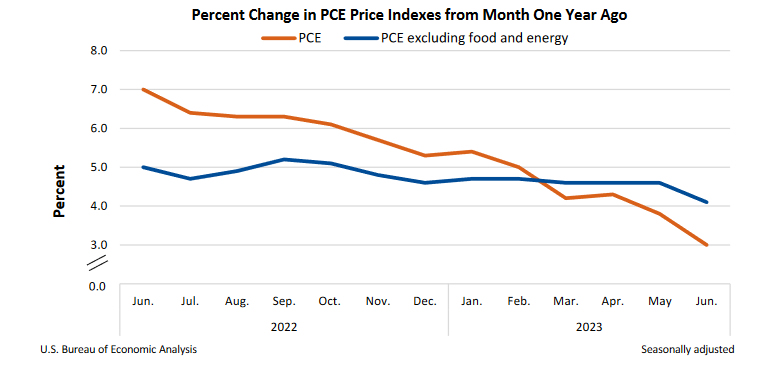
US PCE slows to 3.0% yoy, core PCE down to 4.1% yoy, below expectations
US personal income rose 0.3% mom or USD 69.5B in June, below expectation of 0.5% mom. Spending rose 0.5% mom or USD 100.4B, above expectation of 0.4% mom.
PCE price index rose 0.2% mom, above expectation of -0.1% mom. Core PCE price index (excluding food and energy) also rose 0.2% mom, matched expectations. Prices for goods decreased -0.1% mom and prices for services increased 0.3% mom. Food prices decreased -0.1% mom and energy prices increased 0.6% mom.
From the same month one year ago, PCE price index slowed from 3.8% yoy to 3.0% yoy, below expectation of 3.1% yoy. Core PCE price index slowed from 4.6% yoy to 4.1% yoy, below expectation of 4.2% yoy. Goods prices were down -0.6% yoy while services prices were up 4.9% yoy. Food prices increased 4.6% yoy and energy prices decreased -18.9% yoy.
Canada GDP grew 0.3% mom in May, but down -0.2% mom in Jun
Canada GDP grew 0.3% mom in May, matched expectations. Services-producing industries were up 0.5%, while goods-producing industries partially offset the increase with -0.3% decline. Overall, 12 of 20 industrial sectors posted increases.
Advance information indicates that GDP decreased -0.2% mom in June. The decrease was driven by the wholesale trade and manufacturing sectors. These decreases were partially offset by increases in oil and gas extraction as well as in the real estate and rental and leasing sector.
ECB policymakers weigh in on rates
Several top ECB policymakers have today voiced their thoughts on the future of the bank's interest rate hikes, highlighting a variety of perspectives.
Yannis Stournaras, Chief of Greek Central Bank, hinted towards the nearing end of interest rate increases, stating, "It looks like we are very close to the end of interest rate rises." While he doesn't completely rule out another possible hike in September, he noted, "if there is one further - I see it difficult - in September, I believe we will stop there."
However, Slovakia's Central Bank Head Peter Kazimir suggested a less definitive stance, indicating a pause rather than an outright end to the cycle of rate increases. "Even if we were to take a break in September, it would be premature to consider it automatically...the end of the cycle," Kazimir opined, further adding, "We are looking for the right place to stay for a large part of next year...And you will recognize that it has to be a place where we all must like it a little."
Adding a nuanced perspective to the discourse, Francois Villeroy de Galhau, head of French Central Bank, expressed the ECB's growing confidence that it will achieve its 2% inflation target by 2025, attributing this confidence to the effective transmission of rate hikes to the broader economy.
Villeroy emphasized the need for continued perseverance and pragmatism, stating, "Given the time needed for this full transmission, perseverance is now the prime key virtue. Pragmatism is second - decisions at our next meetings will be open and entirely data driven."
French GDP grew strongly by 0.5% qoq, bolstered by foreign trade
France's GDP surpassed expectations in Q2, growing by 0.5% qoq, significantly better than anticipated 0.1% qoq growth. French economy managed to outperform due to robust rebound in foreign trade activities.
According to the data, the main driver of this better-than-expected performance was the positive contribution from foreign trade, which added 0.7 points to GDP growth. Exports in particular saw a rebound this quarter, rising 2.6% after -0.8% contraction in the previous period. Meanwhile, imports also saw an increase, though less pronounced, rising by 0.4% after falling -2.0% in the prior period.
On the other hand, final domestic demand, excluding inventories, weighed on GDP growth once again, contributing a negative -0.1%, consistent with the previous quarter. This is largely attributed to a decrease in household consumption, which dropped by -0.4%. However, Gross Fixed Capital Formation (GFCF) noted a slight increase of 0.1%.
Contribution of inventory changes to GDP growth was minimally negative in Q2, at -0.1%.
Swiss KOF rose slightly to 92.2, economic environment remains difficult
Swiss KOF Economic Barometer rose from 90.7 to 92.2 in July, above expectation of 90.0. KOF said: "The economic environment remains difficult for the Swiss economy."
It added: "All indicator bundles except those for consumption continue to point to a rather below-average development, but they moved in different directions in July.
"The outlook for services, financial and insurance services as well as for foreign demand and domestic consumption has brightened somewhat. On the other hand, the outlook for construction activity and for manufacturing, whose outlook is particularly gloomy, have clouded over."
BoJ imposes minor tweak in YCC
On the surface, BoJ kept monetary policy unchanged today. Short term policy rate is held at -0.10% and 10-year JGB yield target is kept at around 0%, by unanimous vote. The band for 10-year JGB yield fluctuation is also kept at plus and minus 0.50% from the target level, by 8-1 majority vote.
However, there were key alterations including decision to buy 10-year JGB yields at 1% in fixed-rate operations, up from previous rate of 0.5%, caught investors' attention. Additionally, BoJ's pledge to conduct yield curve control with "greater flexibility" and to "nimbly respond" to both upside and downside risks was noted.
At the post-meeting press conference, BoJ Governor Kazuo Ueda explained the details of the changes. "We will not tolerate an increase in the 10-year bond yield above 1% and will step in if it does," Ueda emphasized.
While yield moves between 0.5% and 1%, BoJ will monitor the yield level, pace of change, and speed, and conduct various market operations to counter any excessive upward pressure on long-term interest rates. He added, "We don't expect the yield to move up to 1%, but have set this cap as a pre-emptive measure."
In the new economic forecasts, BoJ upgraded CPI core and CPI core-core forecasts for fiscal 2023, but other projections are kept largely unchanged.
- Real GDP growth at 1.3% in fiscal 2023, downgraded from 1.4% as made in April.
- Real GDP growth at 1.2% in fiscal 2024, unchanged.
- Real GDP growth at 1.0% in fiscal 2025, unchanged.
- CPI core at 2.5% in fiscal 2023, upgraded from 1.8%.
- CPI core at 1.9% in fiscal 2024, downgraded from 2.0%.
- CPI core at 1.6% in fiscal 2025, unchanged.
- CPI core-core at 3.2% in fiscal 2023, upgrade from 2.5%.
- CPI core-core at 1.7% in fiscal 2024, unchanged.
- CPI core-core at 1.8% in fiscal 2025, unchanged.
Australia retail sales down -0.8% mom in Jun, cost-of-living pressures weigh
Australia retail sales turnover fell -0.8% mom in June, much worse than expectation of 0% mom. Sales turnover rose 2.3% yoy compared with June 2022.
Ben Dorber, ABS head of retail statistics, said: "Retail turnover fell sharply in June due to weaker than usual spending on end of financial year sales. This comes as cost-of-living pressures continued to weigh on consumer spending.
"There was extra discounting and promotional activity in May, leading up to mid-year sales events. This delivered a boost in turnover for retailers, but that proved to be temporary as consumers pulled back on spending in June."
GBP/USD Mid-Day Outlook
Daily Pivots: (S1) 1.2720; (P) 1.2858; (R1) 1.2934; More...
GBP/USD recovers notably after dipping to 1.2761 earlier today. But for now, further decline is in favor as long as 1.2994 resistance holds. Fall from 1.3141 would target 55 D EMA (now at 1.2718) and possibly below. On the upside, break of 1.2994 resistance will argue that the pull back has completed, and bring retest of 1.3141 high.
In the bigger picture, as long as 1.2678 resistance turned support holds, rise from 1.0351 (2022 low) is expected to continue. Next target is 100% projection of 1.0351 to 1.2445 from 1.1801 at 1.3895. However, sustained break of 1.2678 will argue that it's at least correcting this rally, with risk of bearish reversal.
Economic Indicators Update
| GMT | Ccy | Events | Actual | Forecast | Previous | Revised |
|---|---|---|---|---|---|---|
| 23:30 | JPY | Tokyo CPI Y/Y Jul | 3.20% | 2.80% | 3.10% | |
| 23:30 | JPY | Tokyo CPI ex Fresh Food Y/Y Jul | 3.00% | 2.90% | 3.20% | |
| 23:30 | JPY | Tokyo CPI ex Food Energy Y/Y Jul | 4.00% | 3.80% | ||
| 01:30 | AUD | Retail Sales M/M Jun | -0.80% | 0.00% | 0.70% | 0.80% |
| 01:30 | AUD | PPI Q/Q Q1 | 0.50% | 0.90% | 1.00% | |
| 01:30 | AUD | PPI Y/Y Q1 | 3.90% | 3.90% | 5.20% | |
| 03:28 | JPY | BoJ Interest Rate Decision | -0.10% | -0.10% | -0.10% | |
| 05:30 | EUR | France GDP Q/Q Q2 | 0.50% | 0.10% | 0.20% | 0.10% |
| 07:00 | CHF | KOF Economic Barometer Jul | 92.2 | 90 | 90.8 | 90.7 |
| 09:00 | EUR | Germany GDP Q/Q Q2 | 0.00% | 0.10% | -0.30% | |
| 09:00 | EUR | Eurozone Economic Sentiment Indicator Jul | 94.5 | 95 | 95.3 | |
| 09:00 | EUR | Eurozone Industrial Confidence Jul | -9.4 | -7.5 | -7.2 | -7.3 |
| 09:00 | EUR | Eurozone Services Sentiment Jul | 5.7 | 5.3 | 5.7 | 5.9 |
| 09:00 | EUR | Eurozone Consumer Confidence Jul F | -15.1 | -15.1 | -15.1 | |
| 12:00 | EUR | Germany CPI M/M Jul P | 0.30% | 0.30% | 0.30% | |
| 12:00 | EUR | Germany CPI Y/Y Jul P | 6.20% | 6.20% | 6.40% | |
| 12:30 | CAD | GDP M/M May | 0.30% | 0.30% | 0.00% | 0.10% |
| 12:30 | USD | Personal Income M/M Jun | 0.30% | 0.50% | 0.40% | 0.50% |
| 12:30 | USD | Personal Spending M/M Jun | 0.50% | 0.40% | 0.10% | 0.20% |
| 12:30 | USD | PCE Price Index M/M Jun | 0.20% | -0.10% | 0.10% | |
| 12:30 | USD | PCE Price Index Y/Y Jun | 3.00% | 3.10% | 3.80% | |
| 12:30 | USD | Core PCE Price Index M/M Jun | 0.20% | 0.20% | 0.30% | |
| 12:30 | USD | Core PCE Price Index Y/Y Jun | 4.10% | 4.20% | 4.60% | |
| 12:30 | USD | Employment Cost Index Q1 | 1.00% | 1.10% | 1.20% | |
| 13:45 | USD | Chicago PMI Jul | 72.6 | 41.5 | ||
| 14:00 | USD | Michigan Consumer Sentiment Index Jul F | 72.6 | 72.6 |
US PCE slows to 3.0% yoy, core PCE down to 4.1% yoy, below expectations
US personal income rose 0.3% mom or USD 69.5B in June, below expectation of 0.5% mom. Spending rose 0.5% mom or USD 100.4B, above expectation of 0.4% mom.
PCE price index rose 0.2% mom, above expectation of -0.1% mom. Core PCE price index (excluding food and energy) also rose 0.2% mom, matched expectations. Prices for goods decreased -0.1% mom and prices for services increased 0.3% mom. Food prices decreased -0.1% mom and energy prices increased 0.6% mom.
From the same month one year ago, PCE price index slowed from 3.8% yoy to 3.0% yoy, below expectation of 3.1% yoy. Core PCE price index slowed from 4.6% yoy to 4.1% yoy, below expectation of 4.2% yoy. Goods prices were down -0.6% yoy while services prices were up 4.9% yoy. Food prices increased 4.6% yoy and energy prices decreased -18.9% yoy.
Canada GDP grew 0.3% mom in May, but down -0.2% mom in Jun
Canada GDP grew 0.3% mom in May, matched expectations. Services-producing industries were up 0.5%, while goods-producing industries partially offset the increase with -0.3% decline. Overall, 12 of 20 industrial sectors posted increases.
Advance information indicates that GDP decreased -0.2% mom in June. The decrease was driven by the wholesale trade and manufacturing sectors. These decreases were partially offset by increases in oil and gas extraction as well as in the real estate and rental and leasing sector.