Sample Category Title
ECB policymakers weigh in on rates
Several top ECB policymakers have today voiced their thoughts on the future of the bank's interest rate hikes, highlighting a variety of perspectives.
Yannis Stournaras, Chief of Greek Central Bank, hinted towards the nearing end of interest rate increases, stating, "It looks like we are very close to the end of interest rate rises." While he doesn't completely rule out another possible hike in September, he noted, "if there is one further - I see it difficult - in September, I believe we will stop there."
However, Slovakia's Central Bank Head Peter Kazimir suggested a less definitive stance, indicating a pause rather than an outright end to the cycle of rate increases. "Even if we were to take a break in September, it would be premature to consider it automatically...the end of the cycle," Kazimir opined, further adding, "We are looking for the right place to stay for a large part of next year...And you will recognize that it has to be a place where we all must like it a little."
Adding a nuanced perspective to the discourse, Francois Villeroy de Galhau, head of French Central Bank, expressed the ECB's growing confidence that it will achieve its 2% inflation target by 2025, attributing this confidence to the effective transmission of rate hikes to the broader economy.
Villeroy emphasized the need for continued perseverance and pragmatism, stating, "Given the time needed for this full transmission, perseverance is now the prime key virtue. Pragmatism is second - decisions at our next meetings will be open and entirely data driven."
Canadian Dollar Flat Ahead of Canadian GDP
- Canada’s GDP expected to rebound in May
- US releases PCE index
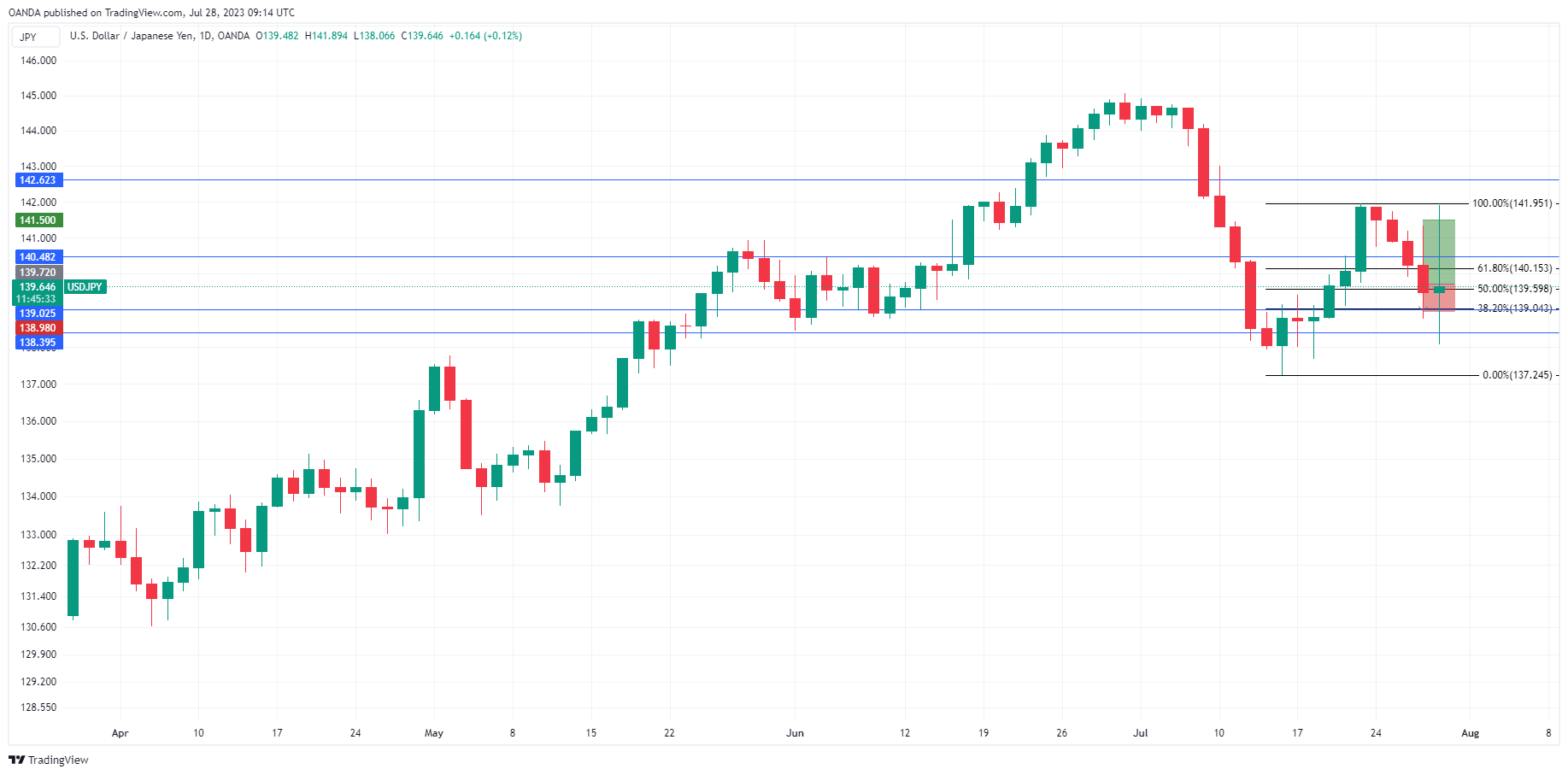
The Canadian dollar is almost unchanged on Friday, trading at 1.3223 in the European session. Things could get busier for the Canadian dollar in the North American session, as Canada releases GDP and the US publishes its preferred inflation indicator, the PCE index.
Canada’s GDP expected to improve in May
Canada’s economy stalled in April, as GDP came in at 0.0% m/m. The driver behind the weak reading was a strike by Canada’s largest government worker union in April, causing a drop in economic activity in the public sector. There are expectations for an improvement in May, with a consensus estimate of 0.3% m/m.
Despite the downswing in April, Canada’s economy has been in good shape, with a 3.2% gain in the first quarter. As is the case with the United States, Canada’s labour market has defied expectations and remained robust despite aggressive tightening by the central bank. This has complicated the Bank of Canada’s tough battle to push inflation back to the 2% target and means that additional rate hikes remain on the table.
The BoC released its Summary of Deliberations from the July meeting on Wednesday. At the meeting, the BoC raised rates by 0.25%, bringing the cash rate to 5.0%. The Bank’s Governing Council noted that inflation remained persistent due to the tight labour market and higher-than-expected consumption.
The Federal Reserve didn’t surprise anyone when it raised rates by 0.25% on Wednesday, bringing the benchmark rate to a range of 5.25%-5.50%. Fed Chair Powell reiterated that “policy has not been restrictive enough for long enough”, adding that the Fed could continue tightening. Still, the money markets are betting that the Fed is done with hiking, and have priced in an 80% likelihood of a pause in September.
USD/CAD Technical
- There is resistance at 1.3272 and 1.3319
- 1.3195 and 1.3148 are providing support
Yen Goes on a Wild Ride after BoJ Shocker
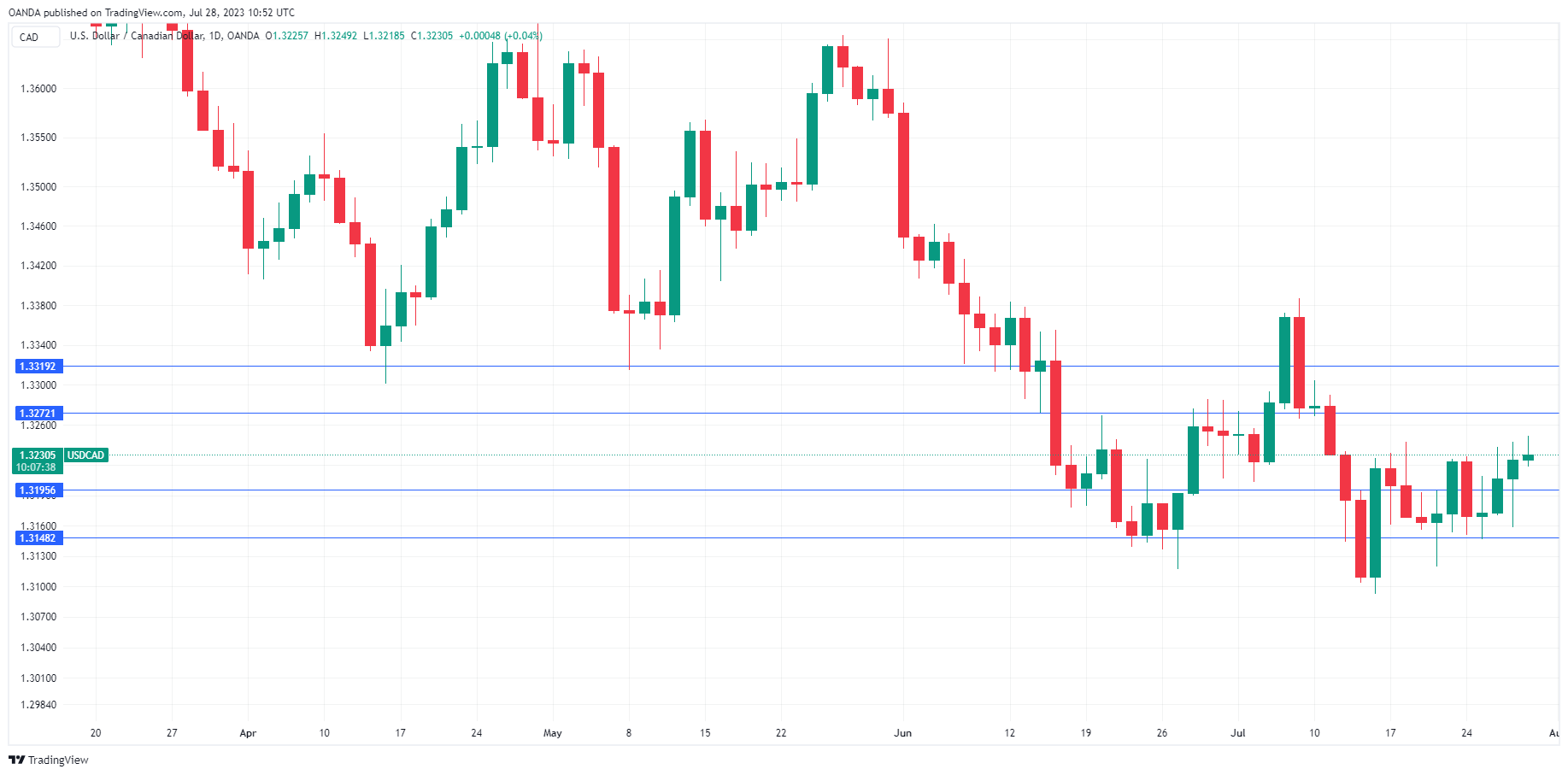
The Japanese yen took investors on a wild ride on Friday but has settled down. In the European session, USD/JPY is trading at 139.54, up 0.05%.
Yen swings wildly after BoJ tweaks yield curve control
The Bank of Japan appears to relish catching the markets with its pants down, and I’ll be the first to admit that I was shocked to read that the BoJ had made a shift in policy at today’s policy meeting. Clearly, I wasn’t alone, as the yen has fluctuated almost 400 points since the BoJ shocked the markets and announced it would loosen its yield curve control. The policy statement noted that the BoJ will “conduct yield curve control with greater flexibility, regarding the upper and lower bounds of the range as references, not as rigid limits, in its market operations”.
BoJ Governor Ueda had signalled that he would maintain policy settings, and he reiterated this stance just a few days ago. Instead, Ueda went ahead with his first major policy shift since taking over as head of the BoJ in April, which triggered sharp volatility from the yen.
In September, the BoJ widened the target band on 10-year Japanese government bonds (JGBs) from 0.25% to 0.50%, sending the yen sharply higher. The BoJ said in today’s policy statement that the target band will remain in the range of -0.50% to +0.50%, but it will offer to purchase JGBs at 1%. Effectively, this widens the band by a further 50 basis points.
The BoJ maintained interest rates at -0.1% and raised its inflation forecast for fiscal 2023 from 1.8% to 2.5%. Inflation has persistently hovered above the 2% target and has put pressure on the BoJ to normalize its monetary policy. Interestingly, Governor Ueda insisted at a follow-up press conference that today’s tweak was not intended as a step towards policy normalization, dampening any expectations that the BoJ will abandon its yield curve control.
USD/JPY Technical
- USD/JPY has pushed above resistance at 1.4049. Above, there is resistance at 142.62
- There is support at 139.03 and 1.3840
USDCAD Hopes for a New Bullish Correction
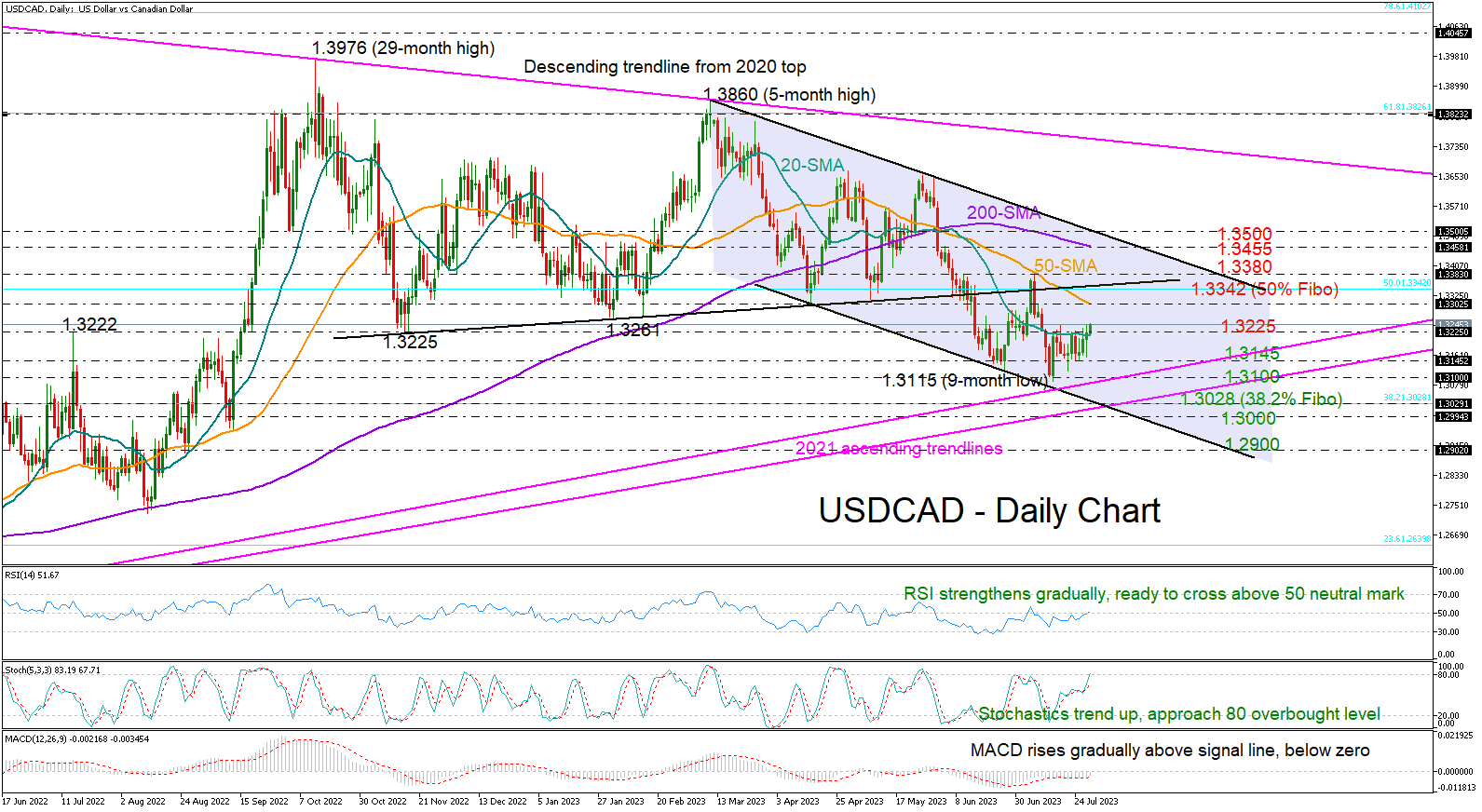
USDCAD has been in a range for the second consecutive week, unable to extend its rebound off a nine-month low of 1.3115 above the nearby resistance of 1.3225.
The odds for a bullish extension are increasing, given the positive slope in the momentum indicators. But with the RSI fluctuating below 50 and the MACD remaining within the negative zone, any improvement may be brief.
If the price sustains today’s bullish move above the 20-day SMA and 1.3225, the falling 50-day simple moving average (SMA) could first halt upside pressures at around 1.3300. Then, the 1.3040-1.3080 constraining zone, which encapsulates the former support trendline, the 50% Fibonacci retracement level of the 2020-2021 downtrend, and July’s high, could delay an extension towards the 200-day SMA at 1.3455. Yet only a sustainable close above the broad bearish channel and beyond 1.3500 would brighten the short-term outlook.
Alternatively, a pullback could re-examine the strong 1.3100-1.3145 support area, where the ascending trendline from May 2021 is positioned. If they break that base, the bears could immediately target the channel’s lower boundary, which coincides with the 38.2% Fibonacci mark and the flatter tentative ascending trendline from May 2021 at 1.3028. Should downside forces strengthen below the 1.3000 psychological level, the price might seek shelter at around 1.2900.
To sum up, USDCAD has been stubbornly pushing for a close above 1.3225 despite its unsuccessful attempts. If it breaches that bar this time, the pair could enjoy some recovery, though it will need stronger buying confidence to cross above the tough 1.3300-1.3380 resistance area.
No Major Risk-off after BoJ’s Creative YCC Flexibility Tweak
- Bank of Japan maintained its ultra-loose monetary policy but issued a lukewarm hawkish statement to introduce a “flexible” Yield Curve Control programme on the 10-year JGB yield.
- JPY strengthen but did not lead to a sell-off in other Asian benchmark stock indices.
- Nikkei 225 has managed to trim its intraday loss of -2.60% and ended with a smaller magnitude of -0.4%.
- Japanese banks outperformed; the TOPIX-17 Banks ETF rallied by +4.70%.
- The new YCC with “greater flexibility” may reduce speculative activities in the JGB futures market.
Bank of Japan (BoJ) has once again maintained its ultra-loose monetary policy outright in today’s conclusion of its July MPM; kept the short-term interest rate target unchanged at -0.1% and maintained the 10-year Japanese Bond Government Bond yield at around 0% with upper and lower limits cap at 0.5% on each side.
Also, BoJ has upgraded its median consumer inflation (CPI) forecast for FY 2023 on its latest quarterly outlook report; core CPI is expected to increase to 2.5% year-on-year (y/y) from the prior forecast of 1.8% y/y, and core-core CPI (excluding fresh food & energy) has also been raised to 3.2% y/y from prior forecast of 2.5% y/y.
No change in the median CPI forecasts for FY 2024 and FY 2025. For FY2024, forecasted core CPI (1.9% y/y), and core-core CPI (1.7% y/y), as for FY 2025, forecasted core CPI (1.6% y/y), and core-core CPI (1.8% y/y).
Meanwhile, the median forecast for FY 2023 real GDP is being downgraded slightly to 1.3% y/y from the previous forecast of 1.4% y/y. BoJ has maintained its real GDP median forecast for FY 2024 and FY 2025 at 1.2% y/y and 1% y/y respectively.
Based on its latest inflation and growth forecasts, BoJ seems to have a view that inflation growth is likely to slow down after FY 2023 in conjunction with a mild reduction in economic growth which suggests the 2% inflation target in terms of sustainability has not been obtained, and such forecasts support BoJ’s current modus operandi of maintain its ultra-easy monetary policy, in contrast with the rest of other developed nations.
Interestingly, BoJ is well-known for being a forerunner in enacting “creative monetary policies”, and issued a rather lukewarm hawkish monetary policy statement that starkly stated two key points.
Firstly, it will operate the Yield Curve Control (YCC) programme of the 10-year JGB yield with more flexibility to respond nimbly to upside and downside risks which implies that it is pointing to a potential abolishment of the current fixed upper and lower limits of 0.5% on either side (see chart below for more details on the new flexible YCC).
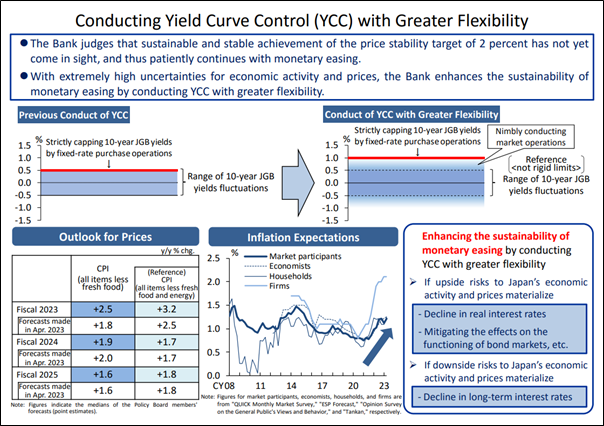
Fig 1: Bank of Japan’s new YCC with greater flexibility framework (Source: BoJ website, click to enlarge chart)
Secondly, BoJ will offer to purchase 10-year JGBs at 1% yield every business day through fixed-rate purchase operations which suggests subtly that the “new invisible” limit is now set at 1% on the YCC programme.
Overall, it seems that the new YCC with “greater flexibility” by not committing to any hard upper and lower limits is to reduce undesirable speculative activities in the financial markets, especially the JGB futures that are likely to trigger adverse reflexive loops into other asset classes and the real economy.
No major risk-off in the Asian session despite the continuation of JPY strength
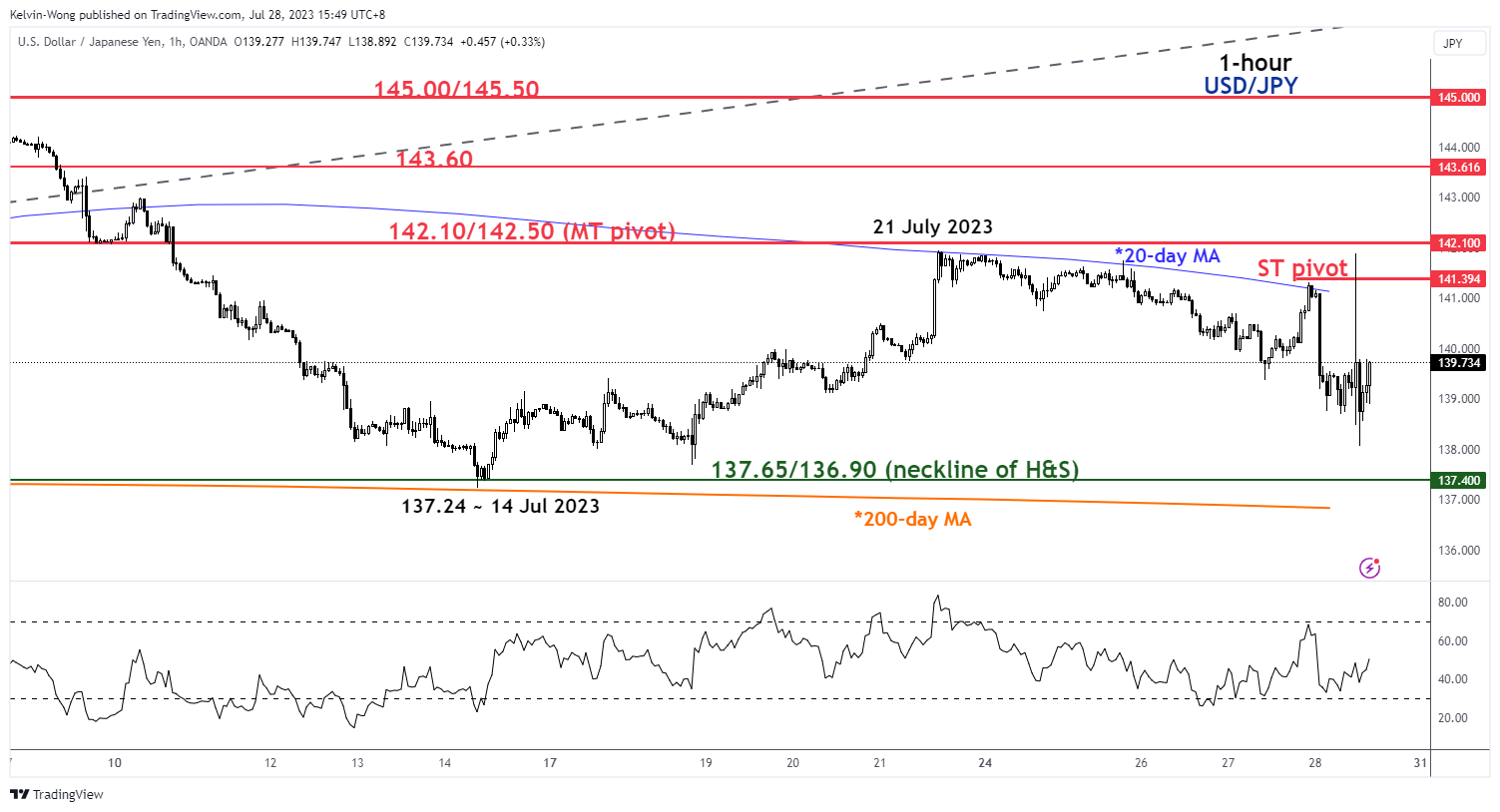
Fig 2: USD/JPY minor short-term trend as of 28 Jul 2023 (Source: TradingView, click to enlarge chart)
Even though the USD/JPY has continued to weaken (JPY strengthening) ex-post BoJ meeting where it slipped below yesterday, 27 July US session low of 138.76 to print an intraday lower low of 138.06 after a retest of the 20-day moving average that is acting a key short-term resistance at around 141.30 during today, 28 July Asian session at this time of the writing.
In the past, a significant further JPY strengthening due to a slight hint of hawkish monetary policy from the BoJ tends to trigger a risk-off behaviour where Asian stock indices sold off. In today’s “subtle tweak” to the YCC, the worst performer in the Asian region today is the Nikkei 225 which ended with a daily loss of -0.40% (trimmed away a much larger intraday magnitude of -2.60%) while other Asian benchmark stock indices have traded mostly with gains throughout today’s session; Hang Seng Index (+1.45%), Hang Seng TECH Index (+3.00), China’s CSI 300 (+2.3%), and Singapore’s Straits Times Index, (+1%) at this time of the writing.
Japanese banks outperformed
Also, within the Nikkei 225, the share prices of Japanese banks stood out significantly today where the TOPIX-17 Banks exchange-traded fund was the top performer among the 17 TOPIX sectors with a daily gain of +4.70% which suggests that market participants are anticipating an improvement of net interest margins for Japanese banks in a new “flexible” YCC environment.
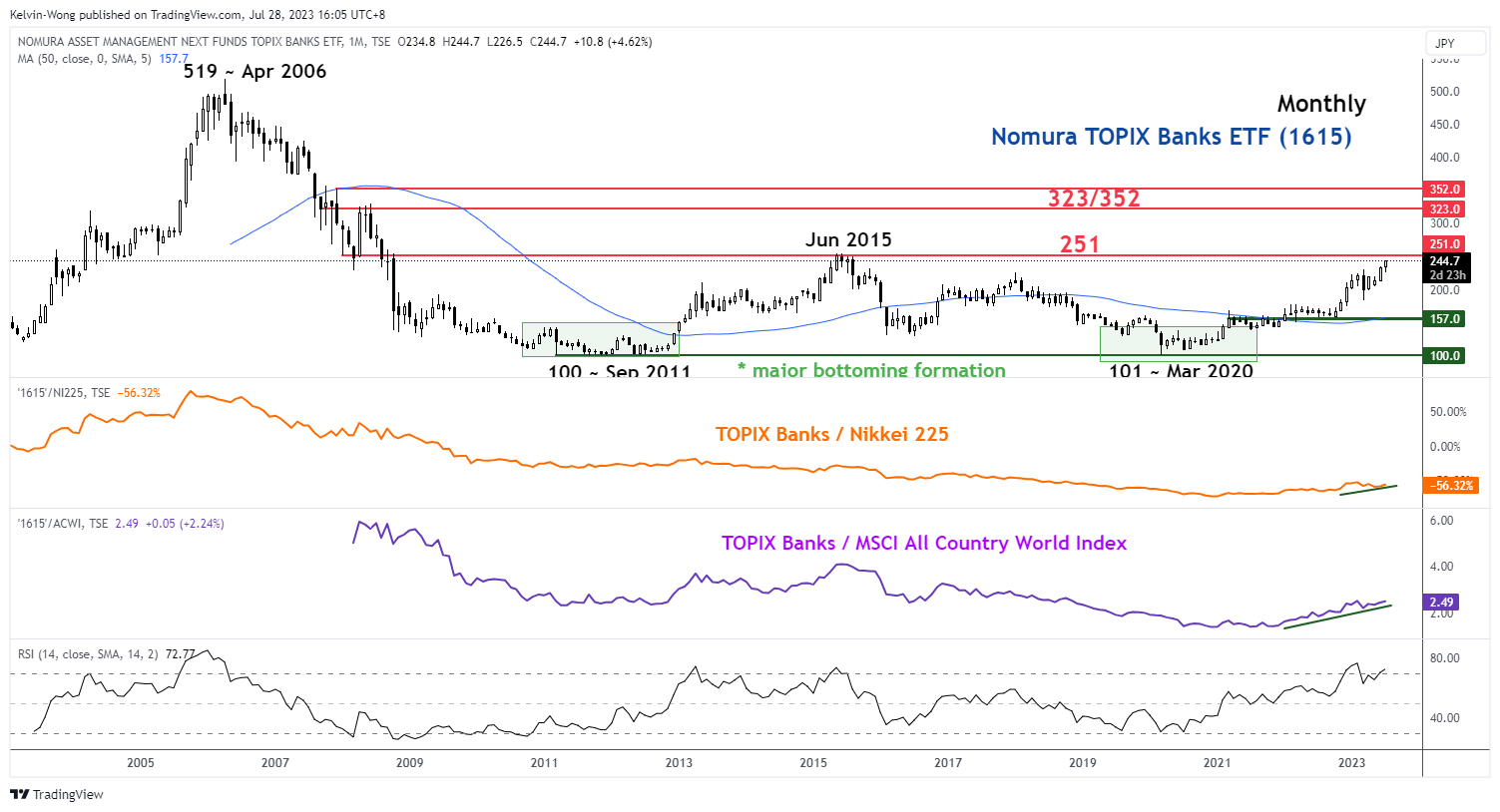
Fig 3: TOPIX-17 Banks ETF major term trend as of 28 Jul 2023 (Source: TradingView, click to enlarge chart)
From a technical analysis standpoint, the TOPIX-17 Banks’ ETF has traced a major bottoming formation in place since September 2011 which suggests that perhaps taking baby steps in normalization of Japan’s ultra-loose monetary policy may not lead to an adverse risk-off effect in the Japanese stock market and even globally by considering the current price actions movement seen in the major cross asset classes.
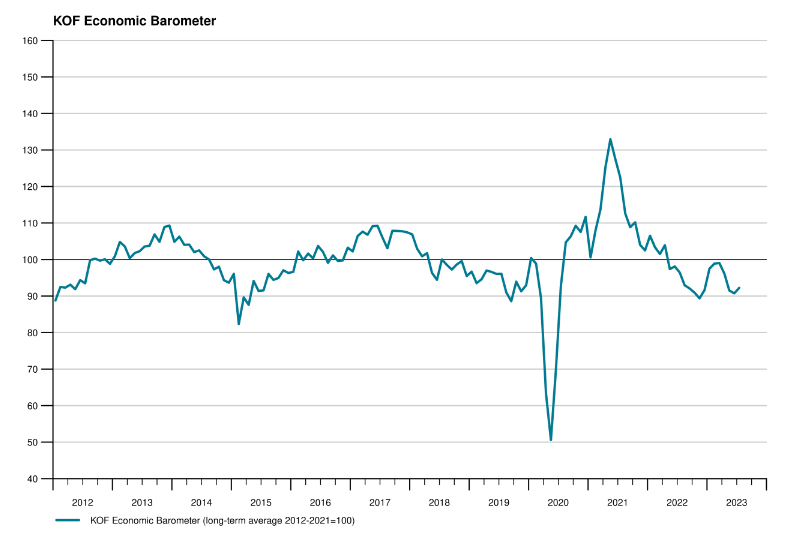
Swiss KOF rose slightly to 92.2, economic environment remains difficult
Swiss KOF Economic Barometer rose from 90.7 to 92.2 in July, above expectation of 90.0. KOF said: "The economic environment remains difficult for the Swiss economy."
It added: "All indicator bundles except those for consumption continue to point to a rather below-average development, but they moved in different directions in July.
"The outlook for services, financial and insurance services as well as for foreign demand and domestic consumption has brightened somewhat. On the other hand, the outlook for construction activity and for manufacturing, whose outlook is particularly gloomy, have clouded over."
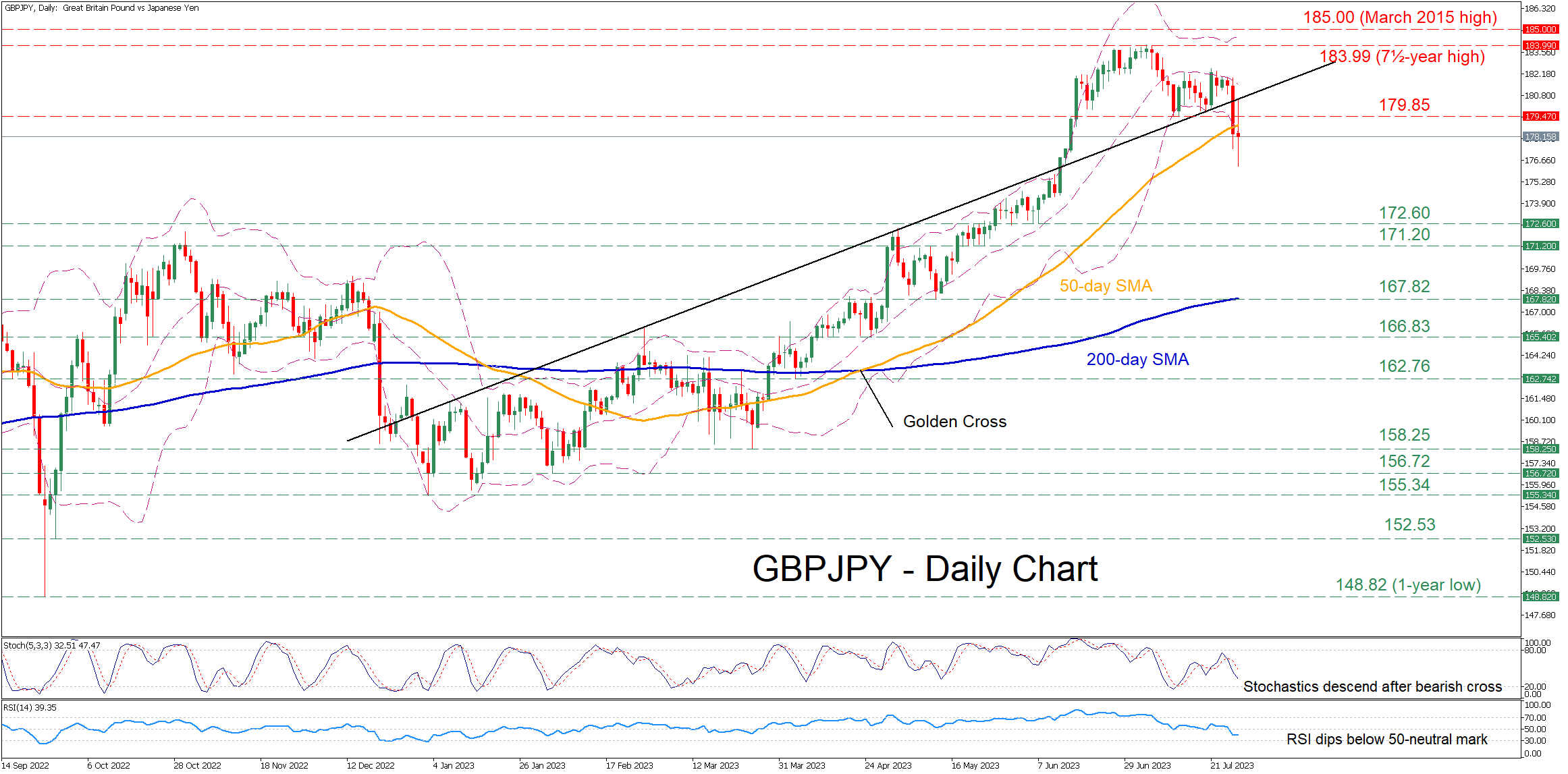
GBPJPY Battles With 50-SMA after Violating Crucial Trendline
GBPJPY had been stuck in a prolonged uptrend since the beginning of the year, generating a structure of consecutive multi-year highs. However, the pair has been experiencing a downside correction in the short term after posting a fresh 7½-year peak of 183.99, with the price breaching a crucial ascending trendline.
The momentum indicators currently suggest that bearish forces are intensifying. Specifically, the stochastic oscillator is descending after posting a bearish cross, while the RSI dipped below its 50-neutral mark.
If selling interest persists and the pair drops beneath its 50-day simple moving average (SMA), the June low of 172.60 could provide initial downside protection. Breaking below that zone, the price might face the May support of 171.20 before 167.82 gets tested. A violation of the latter could open the door for 166.83, which acted as both resistance and support during 2023.
Alternatively, should the price reverse back higher, the bulls could attack the recent support zone of 179.85, which could serve as resistance in the future. Piercing through that wall, the pair could attempt to jump above the upward sloping trendline that connects its higher highs since January before the 7½-year high of 183.99 comes under examination. Even higher, the March 2015 peak of 185.00 may curb further advances.
In brief, GBPJPY has been undergoing a strong pullback, which intensified after the pair dipped below the ascending trendline. Hence, a clear close beneath the 50-day SMA could ignite more selling interest.
BoJ Ueda: We will not tolerate 10-year JGB yield above 1%
At the post-meeting press conference, BoJ Governor Kazuo Ueda explained the details of the changes on monetary policy announced today. That includes explaining the decision to buy 10-year JGB yields at 1% in fixed-rate operations, an increase from the previous rate of 0.5%.
"We will not tolerate an increase in the 10-year bond yield above 1% and will step in if it does," Ueda emphasized. While yield moves between 0.5% and 1%, BoJ will monitor the yield level, pace of change, and speed, and conduct various market operations to counter any excessive upward pressure on long-term interest rates.
He added, "We don't expect the yield to move up to 1%, but have set this cap as a pre-emptive measure."
Turning to inflation, Ueda confessed to underestimating the upward pressure on prices, leading to a significant upward revision of the inflation forecast for the current fiscal year. He noted that many board members perceive risks as skewed to the upside amid high uncertainty over the outlook.
Speaking on the Yield Curve Control (YCC), Ueda warned,"It would be pretty tough to deal with upside (inflation) risks once they materialise". Given the current stability in the bond market and high uncertainty over the outlook, he termed this as a fitting moment to adjust the policy framework.
But Ueda also reiterated the bank's unchanged view on the significant distance to achieving their price target as a trend and the appropriateness of maintaining an easy monetary policy. "As for what we will do ahead, if inflation overshoots, we will respond appropriately," he assured.
Bank of Japan Unexpectedly Made an Admittedly Little Tweak to Yield Curve Control
Markets
After a benign market reaction on Fed decision day, markets yesterday showed quite some volatile swings. This was both due to ECB communication but also result of the market interpreting strong US data in the light the Fed’s data dependency. Data dependency also became the ECB’s new mantra. The bank as expected raised its policy rates by 25 bps, bringing the depo rate to 3.75%. The ECB still sees inflation as remaining too high for too long. However, improvement is visible. The bank repeated it will set interest rates at a sufficiently restrictive level for as long as necessary. However, whether this will result in additional rate hikes (in September or later) will be fully depended on the incoming data. The shift to an open minded approach initially triggered a sharp decline in EMU yields, but most of this move was reversed later, partially due to global/US market moves. German yields closed between 3.8 bps lower for the 2-y yield while the 30-y added 1.5 bps. In the US, the post-Fed calm was abruptly overthrown by a set of strong US data (Q2 GDP growth at 2.4% Q/Qa, better than expected jobless claims and solid durable goods orders). US yields started a protracted uptrend, which was reinforced by a mediocre 7-y Treasury auction and a Nikkei report that the BoJ could tweak its yield curve control. US yields added between 7.7 bps (2-y) and 12.1 bps (10-y). The latter briefly surpassed the 4.0% barrier. Equities initially gained on the combination of a perceived soft data dependency from the Fed and the ECB combined with resilient US data. However, sentiment changed after the Nikkei report on a potential change in the BoJ’s YCC policy. The Eurostoxx 50 still closed at a new cycle top (+2.33%) but US indices more than reversed initial gains (S&P 500 -0.64%). Interest rate divergence triggered a sharp USD rally especially against the likes of the euro. EUR/USD tumbled from an intraday peak near 1.1150 to close at 1.0979. DXY jumped from the 100.60 to near 101.8. USD/JPY initially surpassed the 141 big figure post the US data but the yen jumped sharply on the aforementioned report (USD/JPY close 139.48).
Dubbed governor “Ueda’s first surprise”, the Bank of Japan this morning unexpectedly made an admittedly little tweak to its Yield Curve Control programme. The central bank loosens its grip on bond yields a bit by allowing the 10-y yield to move more flexibly around the unchanged 0% +/- 50 bps cap. In the recent past, the central bank intervened as soon as the 10y bond yield moved above the 0.50% topside. That happened on multiple occasions amid a global core bond yield surge and rising domestic inflation. Tokyo inflation in July this morning for example came in at 3.2% with core measures above the 2% target as well. Prices ex. food rose 3%. Leaving out energy as well, inflation even accelerated to 4%. The BOJ raised the rate to 1% for its fixed-rate bond buying operations, suggesting it is willing to accept 10-year rates to move to that level. In practice this comes down to the yield cap being raised from 50 bps to 100 bps. The reason the central bank did not just do that is that it probably didn’t want to send a too hawkish signal. The new forecasts underpin this. Inflation for this FY was dramatically revised up from 1.8% to 2.5%. For next year, however, a tiny 0.1 ppt downgrade to 1.9% means inflation in theory will not reach the 2% target. The FY+2 forecast was left unchanged at 1.6%. Growth for this year was marginally revised lower to 1.3% with the projections for FY+1 and +2 left stable at 1.2% and 1%. News of the possible YCC tweak was reported yesterday evening in US dealings already, triggering a yen surge already then. The Japanese currency continues to appreciate this morning, with USD/JPY in volatile trading currently hovering near 139. Additional euro weakness pushed EUR/JPY towards the lowest level since mid-June at 151.50 area. Japanese 10-y yields sear almost 10 bps.
The ‘tweak’ In the BOJ YCC of course is the dominant feature for trading in Asia this morning. However, the eco calendar in the US and Europe later today also has plenty of market moving potential. In the US, June spending and income data are expected to show decent growth (0.5% and 0.4%), but the focus will be on the Q2 employment cost index (expected at 1.1%). Fed chair Powell at the press conference on Wednesday mentioned this series as an important input in the Fed’s data dependent analysis. EMU member states including France, Spain, Belgium and Germany will report July CPI figures. German Y/Y HICP inflation is expected to slow to 6.6% from 6.8%, but the monthly dynamic is still seen at a strong 0.6% M/M. The move in the US market yesterday illustrated that after a soft market assessment of CB’s data dependent approach, markets are sensitive to upside surprises in data. On FX markets, a EUR/USD close below 1.1021/1.10 would deteriorate the ST technical picture.
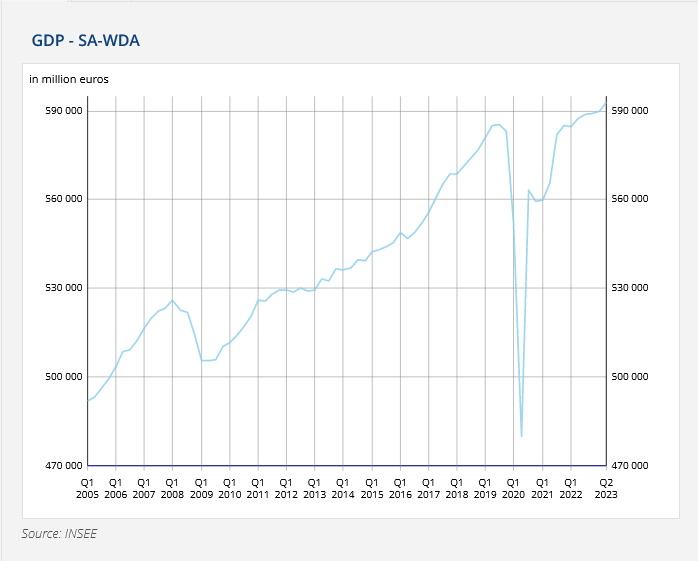
French GDP grew strongly by 0.5% qoq, bolstered by foreign trade
France's GDP surpassed expectations in Q2, growing by 0.5% qoq, significantly better than anticipated 0.1% qoq growth. French economy managed to outperform due to robust rebound in foreign trade activities.
According to the data, the main driver of this better-than-expected performance was the positive contribution from foreign trade, which added 0.7 points to GDP growth. Exports in particular saw a rebound this quarter, rising 2.6% after -0.8% contraction in the previous period. Meanwhile, imports also saw an increase, though less pronounced, rising by 0.4% after falling -2.0% in the prior period.
On the other hand, final domestic demand, excluding inventories, weighed on GDP growth once again, contributing a negative -0.1%, consistent with the previous quarter. This is largely attributed to a decrease in household consumption, which dropped by -0.4%. However, Gross Fixed Capital Formation (GFCF) noted a slight increase of 0.1%.
Contribution of inventory changes to GDP growth was minimally negative in Q2, at -0.1%.