

Sample Category Title
RBA Board to Raise Cash Rate by 25 Basis Points at August Meeting, Maintain Tightening Bias
The Reserve Bank Board meets next week on August 1.
Westpac has consistently argued that a further increase in the cash rate should be the appropriate policy response at the August meeting and we confirm that view.
We also believe that the Board should maintain its tightening bias, repeating the sentence: "Some further tightening of monetary policy may be required to ensure that inflation returns to target in a reasonable timeframe."
Previously we had a firm view that a follow-up increase in September would be required. We are now comfortable that maintenance of the tightening bias beyond August should be sufficient.
Markets and most commentators have concluded that the better print on headline inflation for the June quarter will be sufficient for the Board to extend the pause that it began in July for another month.
That is a quite reasonable position to take given the policy approach taken by the Board at the June and July meetings. For both meetings the key factor behind the decision to hike in June and pause in July centred around the monthly headline inflation reports.
In June the annual headline from the monthly indicator lifted from 6.3% to 6.8%, prompting an increase of 0.25%; whereas in July the monthly indicator slowed from 6.8% to 5.6% prompting the decision to pause.
In both months other developments, particularly around the labour market and services inflation, were arguably consistent with a different decision (the most notable exception being the minimum wage decision delivered just prior to the June Board meeting).
So, how can we possibly not go with the market for August when the quarterly headline Inflation report was softer than expected and the monthly indicator showed a further modest reduction from 5.6% to 5.4%?
Headline inflation printed 6.0% for the year to June compared to the RBA's forecast of 6.3% when it released its forecasts in the May Statement on Monetary Policy, and down from 7.0% in the year to March.
The RBA Board will undoubtedly look more deeply into the June quarterly report for inflation than is possible with the monthly indicator.
It will find that the 5.9% print for core inflation (trimmed mean) compared to the RBA's forecast of 6.0% a much closer result. That print was down from 6.6% in the year to March.
Annual goods inflation fell from 7.6% to 5.8%. On the other hand, annual services inflation lifted from 6.1% to 6.3%.
The ABS calculated that quarterly services inflation slowed from 1.7% in March to 0.8% in June. June is a low seasonal quarter for services June 2023 was in fact higher than the gain in June 2022 (0.6%).
A more reliable measure of services inflation is "market services ex volatile items". This measure excludes the government administered prices therefore capturing the economic cycle. The quarterly increase in this measure lifted from 0.9% to 1.2%, while annual growth held steady at 6.8%.
The detail around services inflation and core inflation is less encouraging than the headline result.
Central banks favour the core number because it is a more reliable indicator of ongoing inflation momentum.
While the decision at the last two meetings was reliant on the monthly Indicator the decision at the August meeting can draw on the much more reliable and detailed information from the quarterly report.
We had a similar situation at the May Board meeting.
Following a material fall in annual headline inflation in the March inflation report, markets dismissed the possibility of a rate increase in May. After all, headline inflation had fallen from 7.8% to 7.0% in a single quarter.
But the Board surprised with a hike, having the benefit of the more detailed quarterly report, which showed a further lift in services inflation (5.5% to 6.1%).
The theme behind much of the Board's concern around its inflation challenge, at the May meeting and continuing, has been that "inflation was not expected to reach the top of the target band until mid-2025 … although this was consistent with the Bank's mandate and objectives, it left little room for upside surprises to inflation given that inflation would have been above target for around four years by that time." (May minutes).
This explanation was given as a central reason for the surprise rate hike in May.
Notably also, despite the March result, the staff did not lower its forecast track for inflation with underlying inflation still projected to reach 2.9% by June 2025.
The key to the August policy decision is whether the Board and staff feel comfortable enough to lower their inflation forecasts following the June inflation result.
The Bank' refreshed forecasts in August to be published in Fridays' Statement on Monetary Policy will be extended out to December 2025. It would be very difficult for the Board if the forecasts still did not have inflation reaching the 2.5% mid-point of the target by end 2025.
During my recent trip to the East Coast of the US; Europe; and London I noted consistent criticism of the Board's approach of being comfortable to reach the top of the target band after being outside the band for so long.
The current forecasts only have the core inflation rate falling from 3.1% to 2.9% ( 0.2ppts) over the first six months of 2025. Arguing for a much faster fall in the second half of 2025 is not credible given that growth is forecast to be picking up in 2025. So, to justify an earlier achievement of the target, the progress will need to be in 2023 H2 and 2024.
Following the analysis of the June quarter report, particularly taking account of the stickiness of services inflation, we see some moderation in the pace of inflation in the second half of 2023 as goods inflation unwinds at a faster pace but the services story still holds inflation at an elevated pace in 2024 our forecasts for both headline and trimmed mean inflation in that year remain unchanged at 3.2%yr and 3.3% respectively.
Other factors create inertia for inflation in 2023H2 and 2024.
This inertia in inflation, particularly in 2024, is due to the range of other factors that have become more apparent in recent months and the market appears to be overlooking. These include:
- The continued strength of labour markets we have recently upgraded our forecasts for employment growth and lowered our unemployment rate forecasts, to reflect the consistent upside surprises on jobs and the persistence of 50-year lows in the unemployment rate. The strength reflects the extraordinary backlog of unfilled jobs with job vacancies remaining at extreme highs. This is another direct legacy from the pandemic and an issue being faced by many developed economies coming out of COVID. This resilience in labour market outcomes boosts incomes and demand adding to pressure on wages growth.
- Slow productivity growth the 'productivity challenge' has been at the top of the Board's considerations consistently in the meeting minutes. This was most clearly identified in the minutes to the meeting in May, which noted: "Members observed that the forecast for inflation to return to the top of the target band by mid-2025 was predicated on productivity growth returning to around the modest pace recorded prior to the pandemic. If this did not occur, growth in unit labour costs would be uncomfortably fast." The latest update on unit labour costs wages adjusted for productivity saw annual growth lift 7.0%yr to a very strong 7.9%yr in the March quarter.
- A resurgent housing market nationally house prices have lifted by around 5% since February, and the Westpac MI House Price Expectations Index showing consumers expect gains to continue over the next year, which will anchor and support current momentum. Activity, inflation and wealth effects resulting from the improving housing market will tend to make it more difficult for the RBA to achieve its inflation target. The May Board meeting minutes picked up on some of these concerns: "Members also reviewed recent developments in asset markets in particular, they noted the depreciation of the exchange rate and the increase in house prices … the decision to hold rates steady in April was likely to have contributed".
- Emerging risks around commodities oil prices are lifting and electricity costs already look like being a persistent source of high inflation; global food prices are being impacted by Russia's blockade of Ukraine's agricultural exports and are at risk of more weather-related impacts as an El Nino forms.
The RBA's forecasts of reaching the top of the band by mid- 2025 already envisage a very significant fall in inflation through the remainder of 2023. Underlying inflation is forecast to fall from 6% in June to 4% in December. That entails a slowdown in semi-annual inflation from 2.2% in 2023 H1 to 1.8% in 2023 H2 we think that is achievable but expect progress in 2024 to be much slower as goods disinflation runs its course, and the emphasis moves to more persistent services inflation.
Conclusion
Markets are convinced that the slowdown in inflation apparent in the June quarter inflation report will see an extension of the Board's July pause.
The headline inflation picture has been the key driver of recent decisions in both June and July. But that was not the case in May when the detailed quarterly report allowed for deeper and more reliable insights that were more concerning.
This time around, the June quarter report highlights the stickiness of services inflation while other information around the labour market and productivity pose questions about whether the staff can credibly lower the inflation profile to allow for an earlier achievement of the inflation target. Most importantly it needs to reach the mid-point of the target range by the extended forecast end-point of December 2025.
If, as we consider likely, the RBA's revised forecasts show little progress in this regard then the Board should take out more 'insurance' with an additional 25bp rate hike at its August meeting.
A combination of one last hike in August complemented with the ongoing 'soft' tightening bias seems to be the best approach to a difficult challenge.
CADCHF Wave Analysis
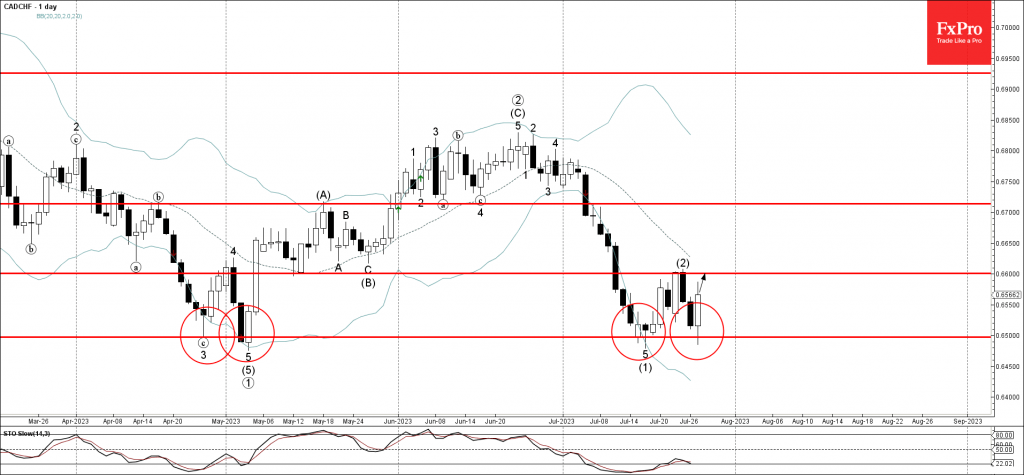
- CADCHF reversed from support level 0.6500
- Likely to rise to resistance level 0.6600
CADCHF recently reversed up from the powerful support level 0.6500 (which has reversed the previous impulse waves 3, (5) and (1)).
The upward reversal from the support level 0.6500 runs counter to the active intermediate impulse wave (3).
Given the strength of the support level 0.6500 , CADCHF can be expected to rise further toward the next resistance level 0.6600 (top of the previous wave (2)).
USDCHF Wave Analysis
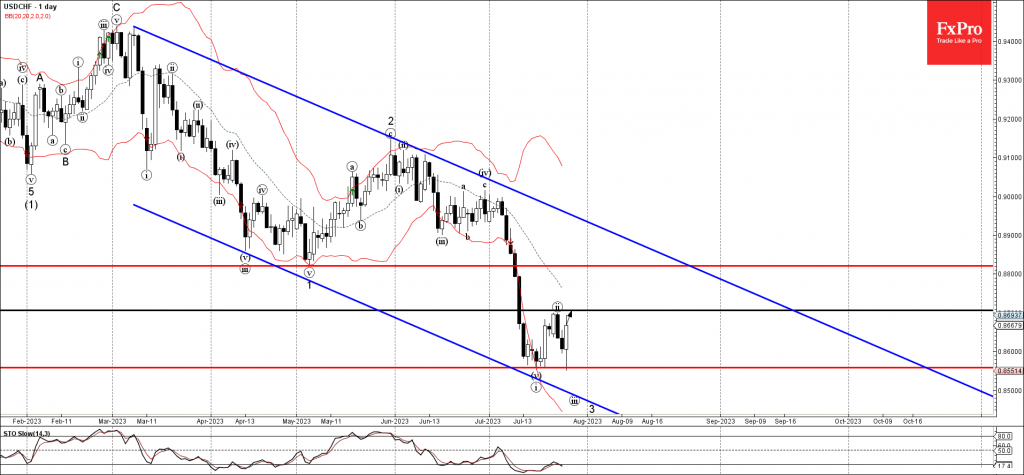
- USDCHF reversed from support level 0.8560
- Likely to rise to resistance level 0.8700
USDCHF recently reversed up from the key support level 0.8560 (which stopped the previous impulse wave i in the middle of July).
The upward reversal from this support level is currently forming the daily reversal pattern Bullish Engulfing.
USDCHF can be expected to rise further toward the next round resistance level 0.8700 (top of the previous correction ii).
Bank of England Preview – Topside Risk to EUR/GBP With a Return to 25bp Steps
- We expect the Bank of England (BoE) to hike the Bank Rate by 25bp on 3 August.
- We expect a peak in the Bank Rate of 5.50% with risks tilted to the upside. We see current market pricing of a peak in policy rates of 5.90% as too aggressive.
- EUR/GBP is set to move modestly higher on announcement. We do not expect the press conference to offer much further guidance than the written material.
BoE call. We expect the Bank of England (BoE) to hike the Bank Rate (key policy rate) by 25bp on 3 August, bringing it to 5.25%. Markets are currently pricing around 33bp for the meeting next week. While the latest UK economic data releases, in our view, support a return to a smaller increment hike pace of 25bp on Thursday, we acknowledge that the probability of a larger 50bp hike remains considerable given the evidence of (still) strong underlying inflationary pressures in the service sector and wage growth developments.
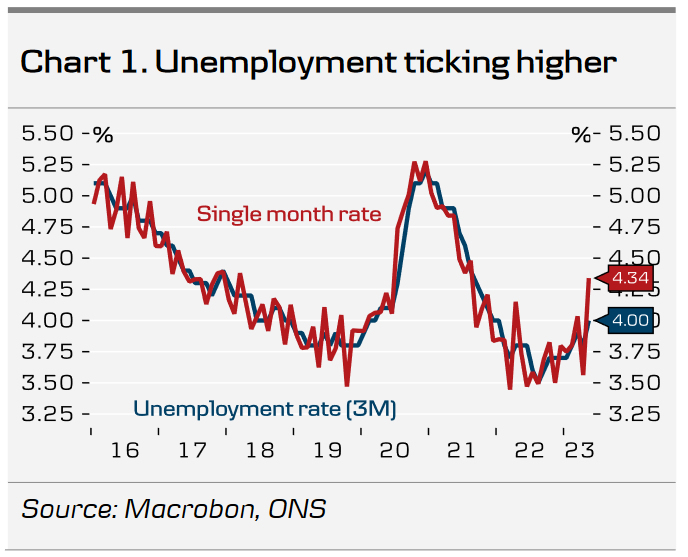
Since the last monetary policy decision in June, there have been limited new UK economic data releases. Likewise we have received little guidance from the MPC with speakers rigorously repeating official guidance from the latest meeting. The latest labour market report delivered a mixed bag of news. Single month unemployment increased to 4.3%, inactivity decreased and unfilled vacancies continued to decline indicating some rising slack in the labour market. However, wage growth remains elevated with wage growth excl. bonuses showing no clear signs of slowing. Large public sector wage agreements announced by the government at the beginning of July of pay rises between 5-7% also pose as further upward pressure on wage growth and hence possible second round effects.
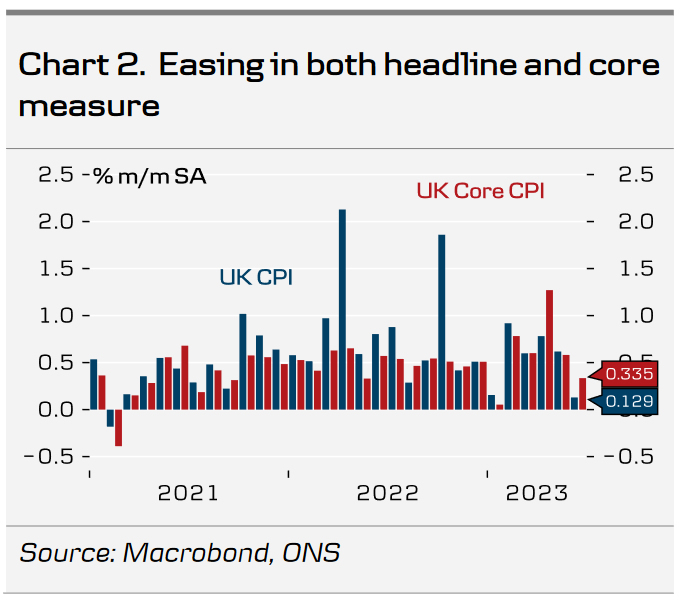
On the other hand, CPI for June came in lower than expected for the first time since January with a broad easing in both the core and headline measure. While the BoE in the minutes of the June meeting projected service inflation to remain "broadly unchanged in the near-term", service inflation declined to 7.2% y/y (down from 7.4% in June). Likewise, PMIs for July surprised to the downside and pointed to growth weakening further in the months ahead. The composite index remained in slightly expansionary territory at 50.7, whereas manufacturing continued to weaken further at 45.0. Momentum in the service sector continues to fade in line with the past two months releases with July at 51.5.
We maintain our call for a 25bp hike in September and see the Bank Rate peaking at 5.50%. This is less than market pricing, which remains above our call despite having decreased the past month to a peak rate of 5.90% in February 2024. Based on MPC member Ramsdens recent comments, an increase in the size of the gilt reduction program is likely from the current GBP 80bn the past 12 months. We expect no rate cuts until 2024.
FX. In our base case of a 25bp hike, we expect EUR/GBP to move slightly higher and volatility to be high. We anticipate Governor Bailey to reiterate the BoE's data dependent approach at the press conference, essentially kicking the can down the road. Overall, we expect the BoE to highlight the continued tight labour market and keep the door open for further tightening. On balance, we continue to see relative rates as a positive for EUR/GBP, which is one of several reasons behind our fundamental predisposition of buying EUR/GBP dips.
Silver Making Intraday Pullback Within Uptrend
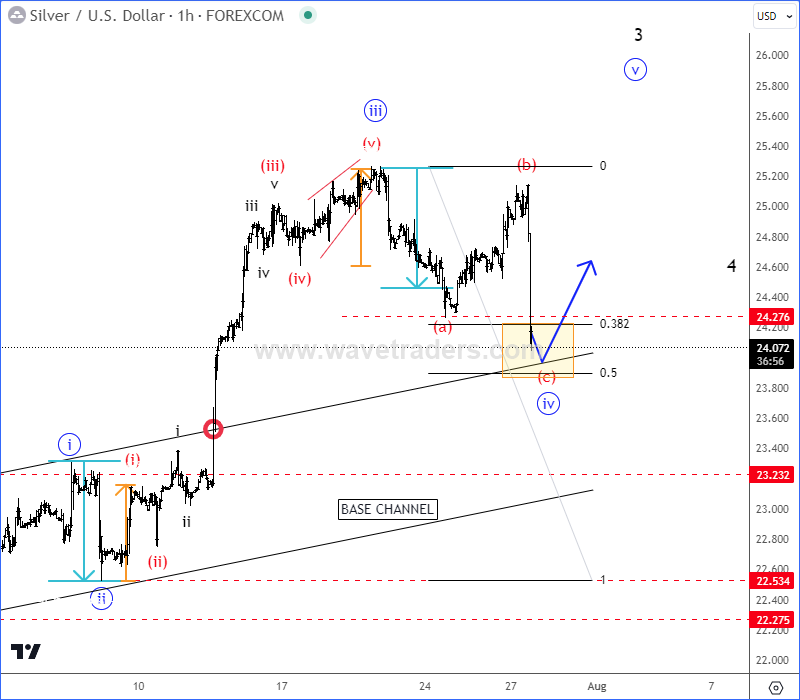
Silver is in an impulsive recovery away from 22.05 lows and there’s room for more upside as it can be unfolding a five-wave bullish cycle from Elliott wave perspective. It’s actually moving nicely as expected for now and we still see it trading in an (a)-(b)-(c) correction within wave »iv« with ideal support here around base channel resistance line and 24.00 level before the uptrend for wave »v« of 3 resumes.
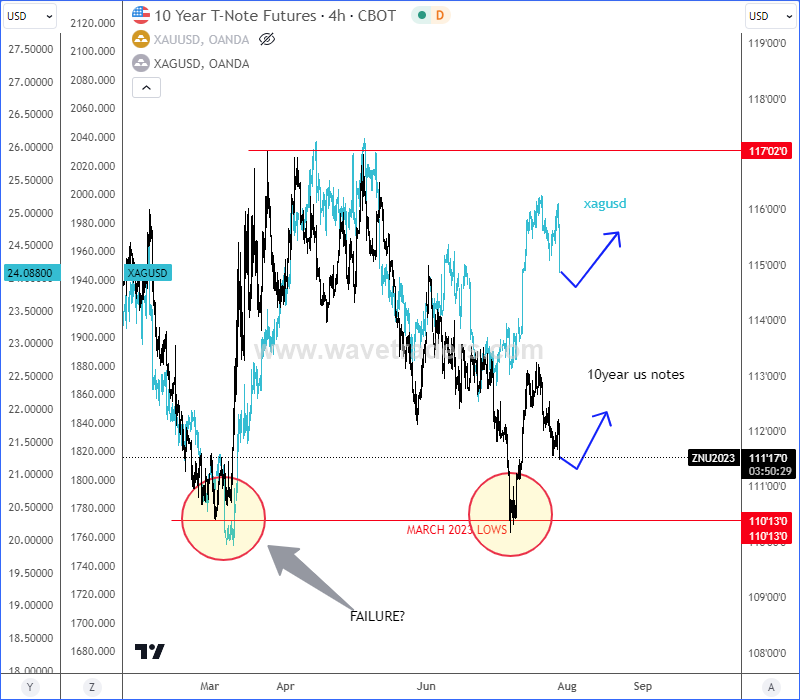
The main reason why we remain bullish on silver is 10Y US Notes chart, which is in tight positive correlation with metals. As you can see, after a failure break of March 2023 lows, we have seen strong recovery on both assets. They are probably just making a corrective pullback before a continuation higher.
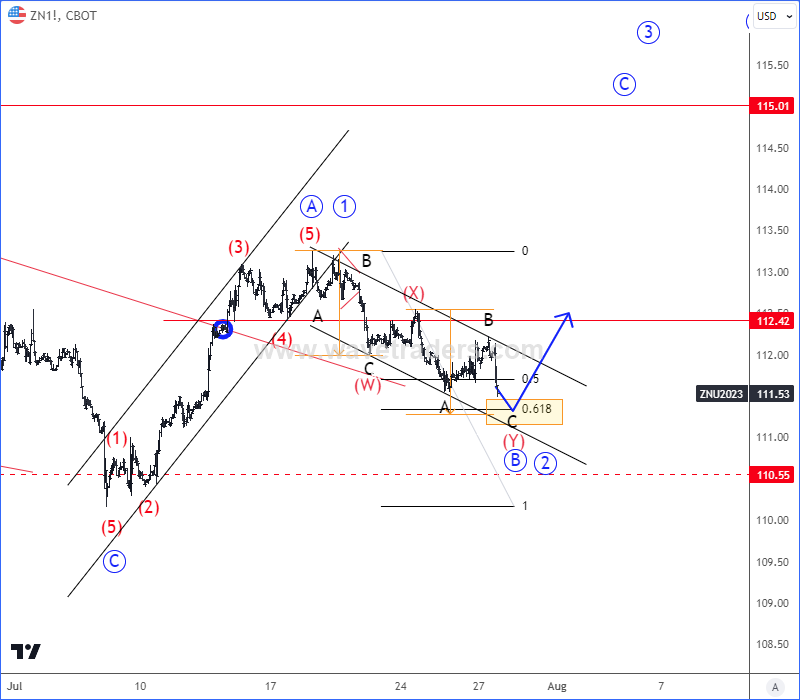
From Elliott wave perspective, 10Y US Notes is finishing a complex (W)-(X)-(Y) corrective setback in B/2 with ideal support here around 111 level. So, if we are on the right path and if 10Y US notes will continue higher into wave C or 3, then silver could easily stay in the bullish trend.
ECB Review: A Decisive Maybe
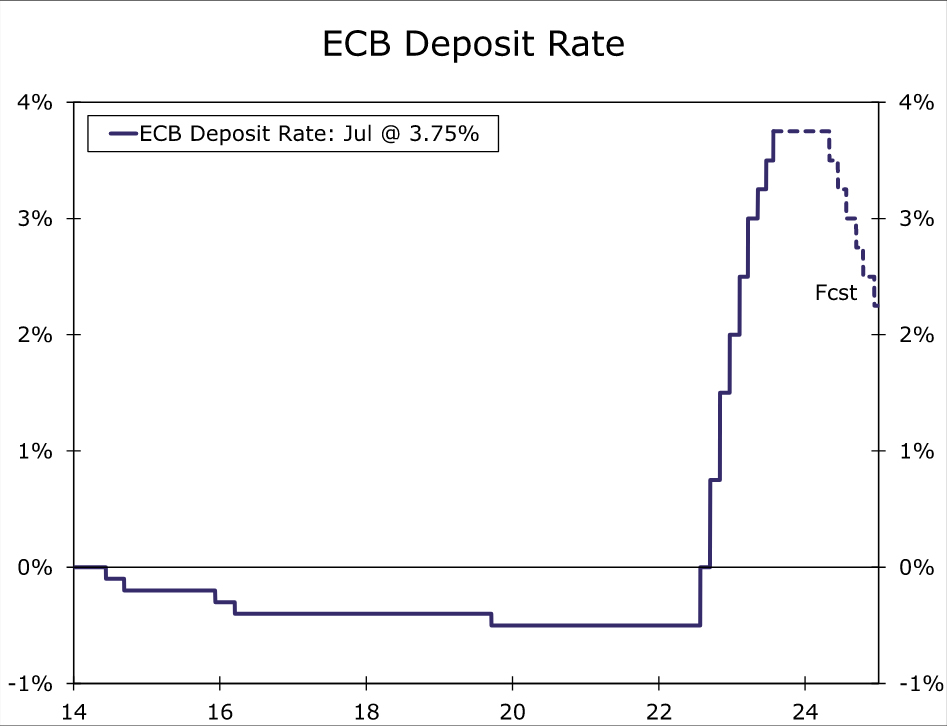
- Today, ECB decided to hike its three policy rates by 25bp. The deposit rate is now 3.75% which was widely anticipated. ECB left no clear guidance on a potential rate hike in September, as they will assess the strength of the incoming data.
- The balanced communication, weighting the lagged effect of monetary policy measures already taken and the strength of the incoming data, left no clear clues for a potential hike in September as Lagarde was very explicit about the not making any commitments, but truly staying data dependent on a meeting by meeting basis. Therefore a rate hike in September will depend on the incoming data and the staff projections in September. The weak PMI and gloomy bank lending survey released earlier this week is somewhat challenging our September rate hike call, in absence of an August rebound. However, the inflation releases (Monday next week) and end of August is essential for a firm conclusion of a September hike.
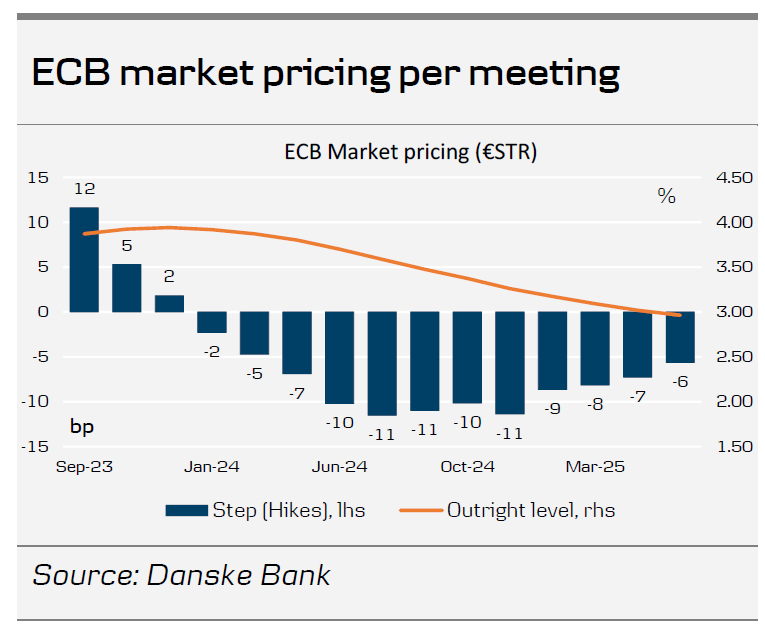
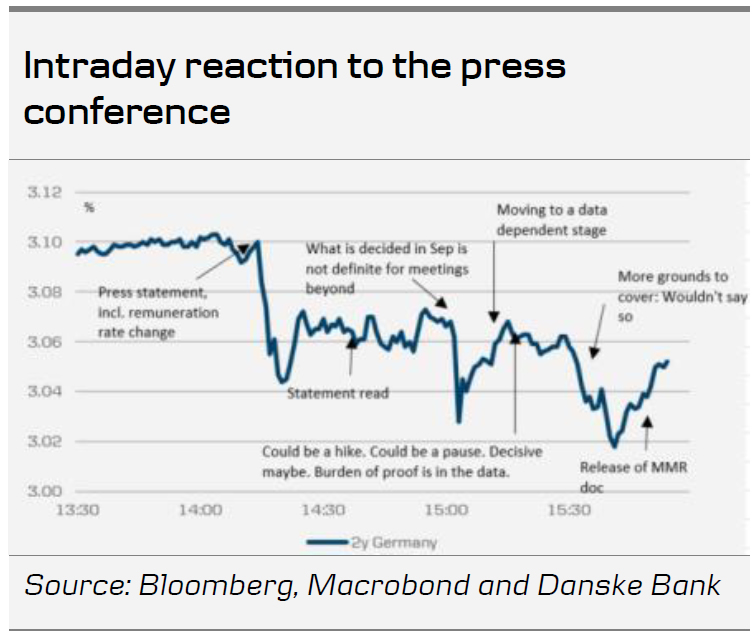
- Markets didn't react much to today's meeting and continues to have another 19bp to a 3.94% peak in the deposit rate. We find that pricing fair.
Inflation still too high
Overall, ECB acknowledge that inflation has continued to decline yet it is still 'expected to remain too high for too long'. In particular, President Lagarde highlighted that the drivers of inflation are changing as while the external price drivers are easing, it is now the domestic price drivers that are increasingly important with notably rising wages and profit margins becoming an increasingly important source of underlying inflation. In sum, the underlying inflation remains high overall. ECB highlighted that the near term economic activity have deteriorated mainly due to domestic demand as well as due to high inflation and tightening financing conditions. The economy is expected to remain weak in the near term.
Softer language on additional tightening. Door wide open for hike or pause
While the economic outlook and inflation assessment was overall in line with expectations, we take note a minor but important change to the guidance which allows that ECB have come with their final rate hike today. ECB changed the words 'brought to' to 'set' for their rate guidance to be 'sufficiently restrictive levels' to bring inflation in line with the target. That subtle change was clearly emphasised by Lagarde during the press conference where she made clear that no decision or guidance are given for the September meeting and even if they decide not to hike, this may not constitute the end of the hiking cycle, but may be a pause. She emphasised that a September decision will not say anything about the October decision. Lagarde said on a potential September hike that it is a 'definite maybe'.
Changes to reserve remuneration
ECB also announced a technical change to their operation framework. From 20 September the minimum reserve requirements (totalling around EUR160bn) will be remunerated at 0%. ECB has made this change to ensure the monetary policy transmission and the 'overall amount of interest that needs to be paid on reserves in order to implement the appropriate stance.' This change will save ECB around EUR6bn/year assuming current depo rate level.
Sharp decline in EUR/USD and broad EUR depreciation
EUR/USD moved sharply lower towards 1.10 on the dovish market interpretation of the ECB meeting and a batch of robust US data releases (strong US Advance Q2 GDP figures and lower-than-expected US jobless claims). The EUR broadly weakened in the G10 space, especially against the Dollar bloc. As we recently have highlighted, we think the general USD weakness this month has been more driven by positioning and sentiment rather than fundamentals. July has generally been characterised by disinflation signs and increasing soft landing optimism benefitting cyclical currencies and sending EUR/USD to new highs for the year. Increased risk appetite, moves in relative rates and particularly the soft June US CPI print have broadly led to a USD sell-off in July, although momentum has been reversing during the past week.
We still think the lagging effect of the restrictive monetary policy is yet to filter through to the euro area economy. In contrast to the relatively robust US economy, we think the euro area economy looks fragile and it has already been showing weakening signs, especially in the manufacturing sector. We expect that to be a headwind for the EUR in the coming months. It is also worth noting that trade weighted EUR is around all-time highs in nominal terms, which we find difficult to explain from a fundamental perspective.
Overall, we maintain our strategic case for a lower EUR/USD based on relative terms of trade, real rates and relative unit labour costs. We expect the relative strength of the US economy to weigh on the EUR/USD in the coming months, and we continue to forecast the cross at 1.06/1.03 in 6/12M. In the near-term, continued data dependence from both the Fed and the ECB will likely keep EUR/USD jumpy around US and euro area data releases in the next couple of months.
European Central Bank: Dovish and Data Dependent
Summary
- The European Central Bank (ECB) raised its Deposit Rate 25 bps to 3.75% at today's monetary policy announcement, matching widespread expectations. More significantly, the ECB sounded more downbeat on the economy and, in contrast to recent meetings, was cautious in offering any guidance about policy beyond this July meeting.
- Ahead of today's announcement, we believed that a policy rate of 3.75% could mark the peak for this cycle. That view is unchanged, with sentiment and survey data likely to remain subdued for the time being, and so long as inflation continues to trend in a more favorable direction in the months ahead. We do not expect the ECB to begin cutting interest rates until well into 2024, once more convincing progress in reducing underlying inflation closer to the central bank's target is evident.
European Central Bank Hikes Rates, But Cautious in Offering Policy Guidance
The European Central Bank (ECB) raised its Deposit Rate 25 bps to 3.75% at today's monetary policy announcement, matching widespread expectations. More significantly, the ECB sounded more downbeat on the economy and, in contrast to recent meetings, was cautious in offering guidance about policy beyond this July meeting. Ahead of today's announcement, we believed that a policy rate of 3.75% could mark the peak for this cycle. That view is unchanged, with sentiment and survey data likely to remain subdued for the time being, and so long as inflation continues to trend in a more favorable direction in the months ahead.
Overall, there were several comments in the ECB's accompanying statement, and from ECB President Lagarde's press conference, that pointed to a shift toward a less hawkish (or more dovish) approach than previously:
- The ECB said future decisions will ensure that key interest rates will be set at sufficiently restrictive levels. That is a change from previous terminology that interest rates would be brought to sufficiently restrictive levels.
- The ECB said past rate increases continue to be transmitted forcefully, and that financing conditions have tightened again and are increasingly dampening demand. ECB President Lagarde reinforced this, saying the central bank is definitely seeing policy being transmitted “strongly.”
- The ECB also decided to set the remuneration of minimum reserves at 0%.
- ECB President Lagarde said the near-term outlook has deteriorated, with manufacturing output held down by weak external demand while services activity was more resilient. The economy is expected to remain weak in the short run.
- Importantly, ECB President Lagarde said policymakers have an open mind on decisions in September and beyond, and that the ECB may vary from one meeting to another. Specifically with respect to September, Lagarde said “we are not going to cut”, and that September could be a hike or could be a pause. This is a significant contrast to recent meetings, where the ECB has explicitly signaled or promised a rate hike at the following meeting.
While outweighed by dovish comments, there were still one or two hawkish elements, most notably the ECB repeating that while inflation continues to decline, it “is still expected to remain too high for too long.”
Overall, while today's announcement leaves the door slightly ajar for a September rate hike, we think that door may be closed by the time of that meeting. So long as activity data and confidence surveys remain soft (which we think is likely) and inflation trends, both headline and underlying, continue to improve (which we think is more likely than not), we believe the European Central Bank will hold its policy rate steady at 3.75%. Indeed, at this time we believe that 3.75% will be the peak policy rate for the current cycle, and that rates will be held at that level for an extended period. We do not expect the ECB to begin cutting interest rates until Q2-2024, once more convincing progress in reducing underlying inflation closer to the central bank's target is evident.
Sunset Market Commentary
Markets
Powell’s ‘Big Mute’ on the future trajectory of tightening yesterday but at the same time expressing hope the Fed might be able to engineer a soft landing this morning supported a outright risk-on sentiment. The EuroStoxx 50 easily gained 1%+. The dollar was on the backfoot with EUR/USD extending gains beyond 1.11. For afternoon trading, key question was which out of two would have most market impact: A series of US data including US Q1 GDP growth (annex PCE deflator), durable goods orders and jobless claims, concretizing the Fed’s data dependent approach, or the ECB decision annex guidance (if any) at the post-meeting press conference.
As was the case for the Fed yesterday, the ECB as expected raised its policy rate by 25 bps, bringing the depo rate to 3.75%. The decision was unanimous, Lagarde said at the press conference. Contrary to the Fed, the ECB slightly amended/softened its inflation assessment in the policy statement. ‘Inflation continues to decline but is still expected to remain too high for too long. The Governing Council is determined to ensure that inflation returns to its 2% medium-term target in a timely manner’. At the same time communiqué reads that ‘The developments since the last meeting support the expectation that inflation will drop further over the remainder of the year but will stay above target for an extended period. While some measures show signs of easing, underlying inflation remains high overall’. In this respect, interest rates will be set at a sufficiently restrictive level for as long as necessary. The appropriate level and the duration of restriction also will be determined by a data-depended approach. At the press conference, as did the Fed yesterday, Lagarde clarified that the ECB turned to a completely open and data dependent approach with respect to the future decisions (September and beyond). European yields already declined immediately after the press release of the decision and this trend was accelerated after Lagarde during the press conferences stressed the ‘complete open bias’. The ECB still repeated that the focus gradually turns to domestic drivers of inflation including wages and profit margins, but that didn’t change investors’ view. At the time of writing, the German yield curve shows a bullish steepening with yields declining between 11 bps (2-y) and 5.0 bps (30-y).
Global bond markets initially softened after the publication of the ECB decision, but US data were strong/stronger than expected across the board. US Q2 growth accelerated from 2.0% Q/Qa to 2.4% (1.8% expected) mainly due to resilient consumption (1.6% Q/Qa) and a rebound in investment (5.9%). The core PCE deflator softened slightly more than expected (3.8% from 4.9%). Headline durable goods orders also beat expectations (4.7% M/M). Shipments were more moderate. US jobless claims declined further from 228k tot 221k. All combined, today’s releases in a data-depended approach support the case for further tightening. After some softening before the data releases, US yields current trade about 3.0 bps higher across the US Treasury curve.
On other markets, equities remain well bid, with Europe this time outperforming (EuroStoxx 50 +2.25%). The US S&P 500 opens about 0.8% higher. On FX markets, interest rate divergence post the US data and the ECB decision caused a sharp reversal of initial USD softness. EUR/USD dropped from intraday top near 1.1150 to currently test the 1.10 area. USD/JPY also jumped from an intraday low of 139.38 this morning to currently trade near 140.75.News & Views
Today was another important day for the Turkish central bank to reestablish credibility among investors. Governor Hafize Gaye Erkan for the first time since her appointment last month published Turkish inflation forecasts. These projections in the past often raised eyebrows, appearing to be very unrealistic. This time around, the central bank estimates year-end price pressures to be a whopping 58%, more than double the 22.3% under her predecessor. By end 2024, inflation would still amount to 33% vs a previous estimate of 8.8%. It’s not expected to hit the 5% target over a three-year horizon either. The governor said the groundwork for the start of a sustainable disinflation in 2024 is being laid. Even if the recent policy tightening under Erkan was less than markets hoped for (900 bps to 17.5%), the new forecasts in any case suggest the central bank is far from done. For the Turkish lira, the proof of the pudding is in the eating. USD/TRY stabilizes around record highs just south of the 27 big figure.
US: Real GDP Expanded Solidly in Q2, Beating Expectations
Real GDP expanded by a solid 2.4% quarter-over-quarter (q/q, annualized) in the second quarter of 2023. The reading came in notably above the consensus forecast, which called for a modest gain of 1.8% q/q.
Consumer spending grew by 1.6% – decelerating from 4.2% recorded in Q1. Spending on services (+2.1%) accounted for most of the gains, while durable (+0.4%) and non-durable (+0.9%) expenditures also ticked up.
Business investment jumped 7.7% q/q, as capital outlays on equipment (+10.8%) and intellectual property products (+3.9%) both rebounded. In addition, investments in structures continued to see robust strength (+9.7%).
Residential investment (-4.1%) continued to decline in Q2, despite a modest turnaround in residential construction, as sales of new and existing homes continued to struggle under higher mortgage rates.
Government spending increased 2.6% q/q, as spending at both the federal (+0.9%) and state & local (+3.6%) level moved higher. Federal expenditure growth moderated as nondefense spending declined, while defense spending continued to grow.
Exports fell by 10.8% in the second quarter, while imports recorded a more modest decline of 7.8%. This left the trade deficit roughly unchanged from Q1.
Inventory investment ticked up slightly in the second quarter – adding 0.1 percentage points to headline growth.
The core PCE deflator rose 3.8% on a q/q (annualized) basis – decelerating from 4.9% in Q1.
Key Implications
The U.S. economy expanded for a fourth consecutive quarter in 2023Q2, marking a full year of growth since the brief slowdown at the start of 2022. The resilience in consumer spending – which makes up roughly two thirds of GDP – has kept the economy growing solidly during the first half of the year. With the labor market remaining strong, consumers have been able to weather the headwinds of higher prices and higher interest rates so far.
This was shown in domestic demand in the second quarter, with steady consumer spending on services being joined by modest growth in durable and non-durable expenditures. Business investment also jumped up in the second quarter as equipment purchases rose notably and investment in structures remained elevated. Measures of consumer and business sentiment have stabilized in recent months as near-term growth prospects have improved, although future expectations remain relatively pessimistic.
With the Federal Reserve's most recent hike yesterday, the policy rate now sits at its highest level in 22 years. Progress has been made on the inflation front, however the Federal Reserve will need more time to decide whether the trajectory is pointing to a sustainable return to its 2% target. The cumulative effects of the 525bps in rate hikes have not yet fully filtered through the economy and are expected to continue to weigh on economic growth through the second half of this year.