Sample Category Title
Dollar Drift With Yield Shock, Yen Breaks Tradition
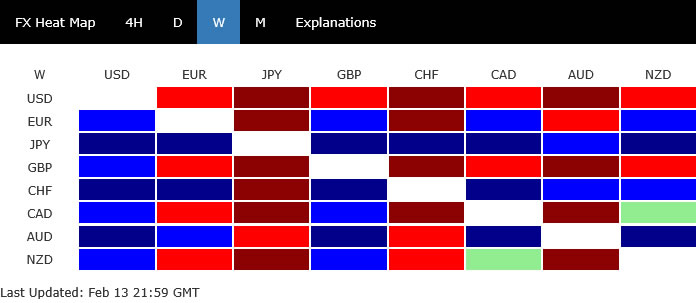
There was no single, dominant theme in currency markets last week. Instead, price action reflected a mix of cross-asset divergences. Dollar ended as the worst performer, despite the fact that Fed expectations barely shifted following high-profile releases of non-farm payrolls and CPI. Meanwhile, US Equities experienced volatility, particularly around renewed AI disruption fears, yet there was no decisive breakout in either direction.
The most consequential development was the sharp dive in US yields. The 10-year yield’s slide appeared disproportionate to changes in Fed pricing, hinting that capital flows and positioning dynamics may be playing a larger role than policy expectations. That yield compression likely weighed on the Dollar, even though the selloff has been restrained rather than disorderly. Dollar Index was under pressure but has not yet entered an accelerated downtrend.
In contrast, Yen emerged as the standout performer. Notably, its rally occurred alongside continued strength in Japanese equities, breaking from the traditional inverse correlation between the currency and risk sentiment. Yet momentum in Yen has already begun to stall near key resistance levels. Also the durability of its decoupling from risk appetite is uncertain.
Elsewhere, Sterling ranked as the second weakest currency, pressured by renewed political instability within the Labour government and soft GDP data. Swiss Franc, by contrast, was the second strongest, reinforcing the impression of underlying caution even if global equities did not fully reflect risk aversion.
Aussie also posted solid gains, supported by hawkish RBA commentary that kept the door open for further tightening. However, momentum there is fading as broader risk appetite softens. Euro, Loonie and Kiwi drifted in the middle, lacking clear directional conviction — like passersby in a market still searching for its next unifying theme.
Data Fails to Inspire; NASDAQ's Rejection Raises Caution
US equities experienced elevated volatility last week but ultimately failed to establish a decisive direction. Stronger-than-expected non-farm payrolls and a slightly softer CPI print provided headline movement, yet neither report altered the broader narrative in a meaningful way.
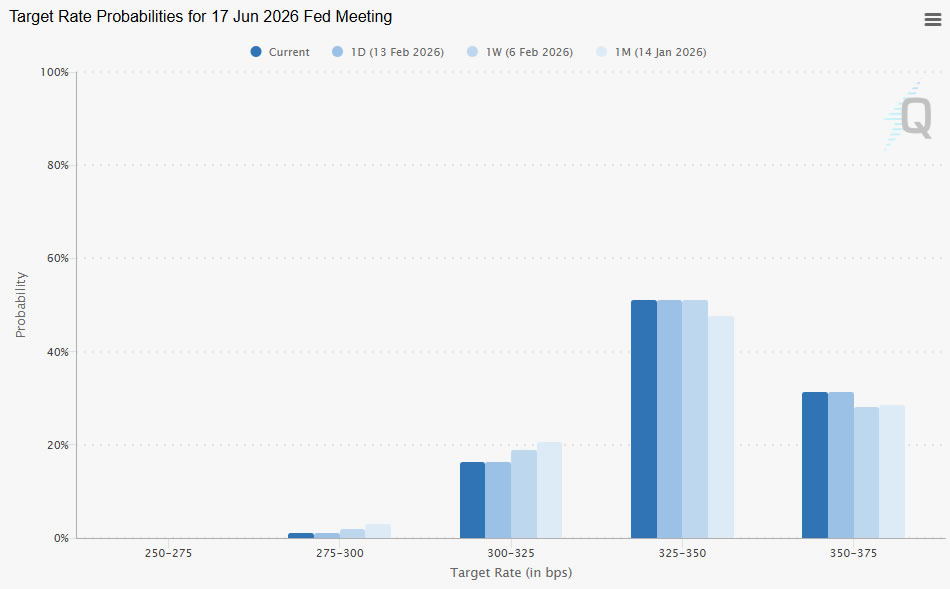
Markets quickly recognized that the data did little to shift Federal Reserve expectations. Pricing for a March hold moved from around 80% to roughly 90%. June cut odds dipped marginally from 72% to 69%. Those are incremental adjustments rather than regime changes.
With policy expectations stable, investor focus drifted back toward structural concerns — particularly renewed fears around AI-driven disruption. Technology and software shares remained sensitive, though selling pressure has so far lacked the intensity of a full risk-off unwind.
Importantly, the broader indexes are still holding within familiar ranges. The S&P 500 and NASDAQ remain contained inside consolidation structures, while DOW even managed to print a fresh record before paring gains.
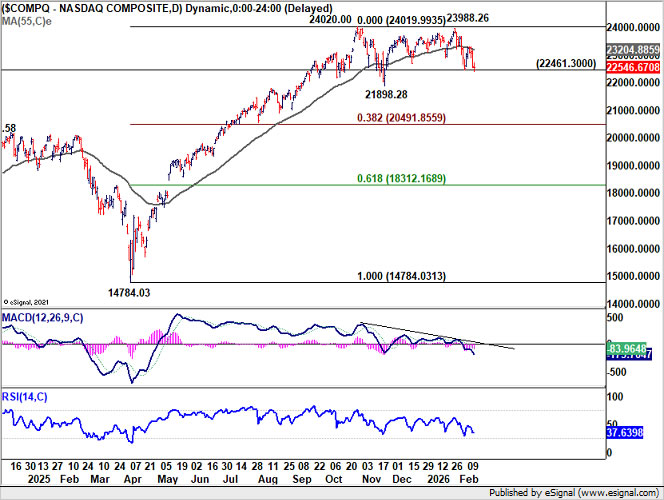
Technically, however, risk is tilting to the downside for NASDAQ. The index was rejected at its 55 D EMA (now at 23,204), a development that often signals near-term vulnerability. NASDAQ should have already entered the third leg of the corrective pattern from 24,020.00 high. Deeper decline toward 21,898 support, and possibly below, is likely in the near term.
But for now, it's seen as in correction to the up trend from 147,84.03 only, not a larger scale one. Hence, downside should be contained by 38.2% retracement of 14,784.03 to 24,020.00 at 20,491.85 to bring rebound.
10-Year Yield Collapse, Dollar Index Softens
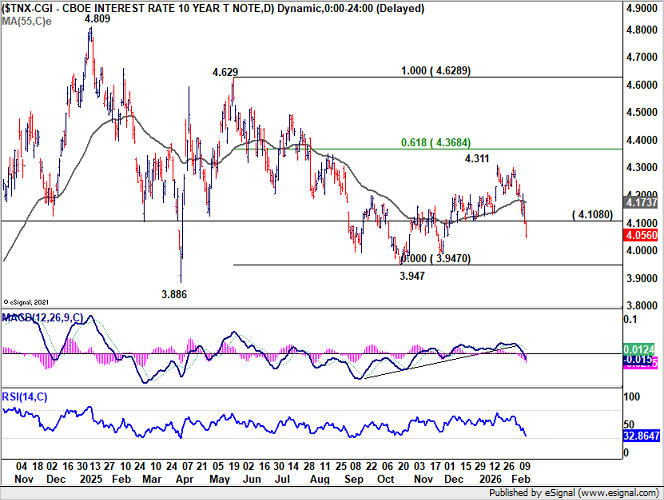
If there was one development that truly defined the week, it was the sharp decline in US Treasury yields. 10-year yield plunged to close near 4.056, a dramatic reversal from its January high at 4.311.
At first glance, some attributed the fall to expectations of faster Fed easing. However, interest rate pricing tells a different story. March remains firmly priced as a hold, while June cut probabilities have only shifted marginally. The yield move appears disproportionate to changes in Fed expectations.
A more plausible explanation lies in shifting asset allocation. With precious metals suffering steep declines in late January — Gold dropping more than 20% and Silver nearly 50% at one point — capital may have rotated back into Treasuries. Bitcoin’s sharp drawdown reinforces the broader de-risking narrative.
Safe-haven demand for US government bonds appears to have quietly re-emerged. The nomination of Kevin Warsh as the next Fed Chair may also have restored some institutional confidence in policy continuity, reducing fears of structural instability.
Technically, the break below 4.108 support in 10-year yield confirmed that the rebound from 3.947 was merely corrective, and topped at 4.311. The move decisively shifted near-term risk back to the downside. As long as 55 D EMA (now at 4.173) caps upside attempts, the path of least resistance remains lower. The next obvious target is a retest of 3.947.
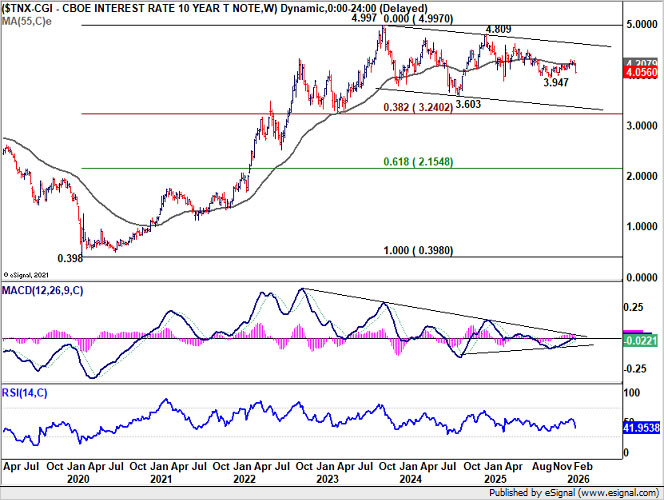
For now, sustained break below 3.947 is not the base case. But if equity markets deepen their correction, that level could give way, potentially resuming the broader downtrend visible on the weekly chart. Indeed, rejection by 55 W EMA (now at 4.207) carries medium term bearish implications.
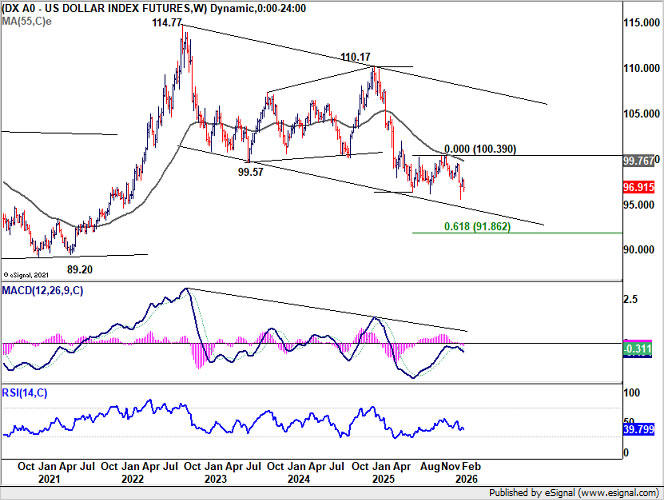
Meanwhile, Dollar Index's dip last week suggests that recovery from 95.55 has failed 55 D EMA (now at 98.04) on first attempt. There is prospect of a strong rebound in Dollar Index if stock market correction intensify. But upside should be capped below 100.39 resistance.
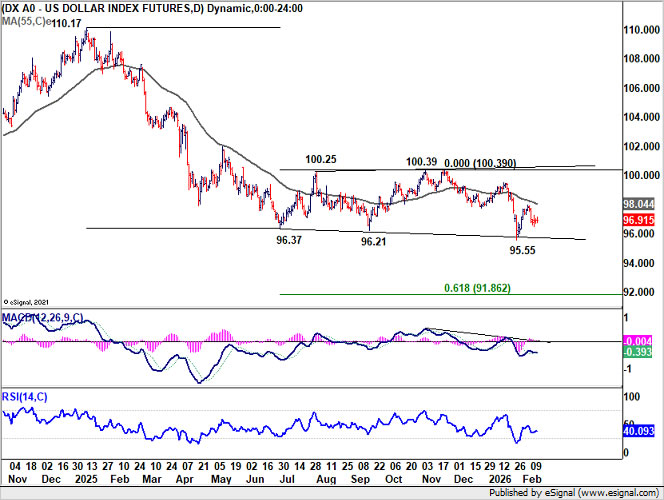
Medium term outlook remains bearish for now. Firm break of 95.55 will resume the down trend from 110.17 (2025 high) to 61.8% projection of 110.17 to 96.37 from 100.39 at 91.86.
Japan Breaks the Mold as Yen Decouples From Equities
Japan delivered the clearest directional story of the week. Nikkei surged to fresh record highs while Yen rallied alongside equities — a rare decoupling from its traditional inverse correlation with risk assets.
The catalyst was political. Prime Minister Sanae Takaichi’s landslide snap election victory provided markets with clarity and a strong mandate. Investors interpreted the LDP supermajority as enabling more coherent fiscal execution without heavy concessions to coalition partners. Equity markets embraced the prospect of targeted stimulus, tax adjustments and structural reform. The rally was not merely momentum-driven; it was narrative-driven. Political certainty replaced fragmentation.
What made the move more unusual was Yen’s strength. Historically, a surging Nikkei tends to coincide with Yen weakness. This time, however, currency markets priced in a different dynamic. Markets appear to believe that a stronger mandate could lead to more disciplined fiscal management rather than unchecked stimulus. That interpretation has lent support to Yen, at least temporarily.
Still, Yen momentum began to stall toward the end of the week as the rally ran into key resistance levels, suggesting election optimism may now be largely priced in. The relations between Yen and stocks could revert back to normal ahead.
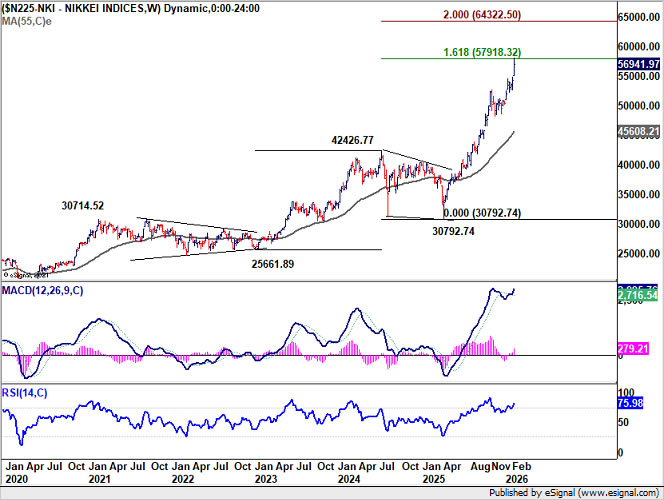
Technically, Nikkei is approaching a critical long-term Fibonacci resistance at 161.8% projection of 25,661.89 to 42,426.77 from 30,792.74 at 57,918.32. Overbought conditions raise the risk of consolidation.
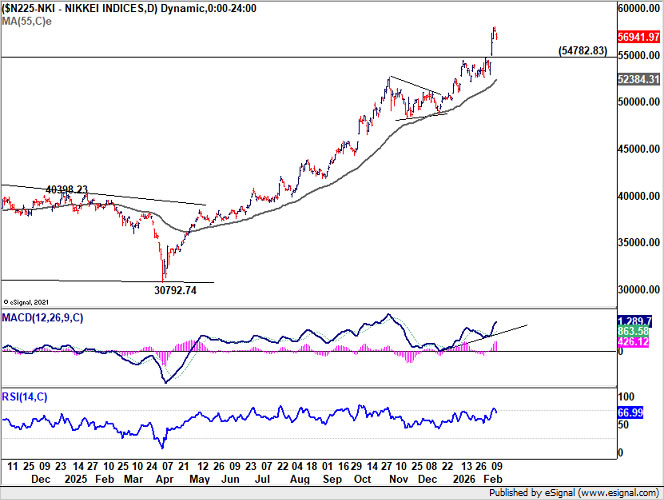
A break below 54,782 would signal that Nikkei has entered a corrective phase with risk of deeper pullback. Such a move could revive Yen strength and push USD/JPY through 150 toward 145.
Conversely, decisive clearance above 57,918 would open the door to 60,000 and potentially 200% projection near 64,322.50. That scenario would likely reintroduce downward pressure on Yen. Sustained Nikkei strength could push the USD/JPY back toward 160.
As for Yen's next move, CHF/JPY is worth some monitoring. Both are safe have currencies and thus the cross is a good candidate to indicate the underlying direction of Yen.
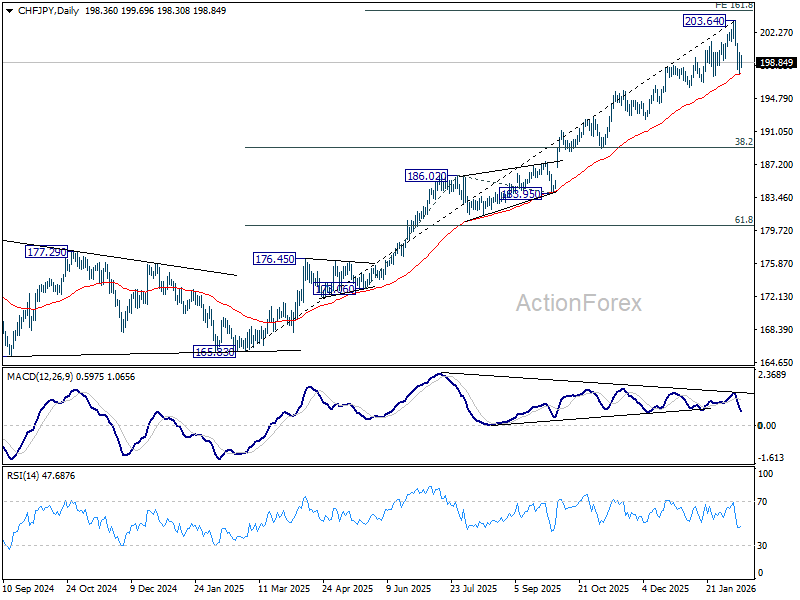
Risk of a deep medium term correction in CHF/JPY is building even though confirmation is still needed. Bearish divergence condition in D MACD suggests that momentum has been persistently diminishing since last June. Also, it's medium term target of 161.8% projection of 173.06 to 186.02 from 183.95 at 204.92 was nearly met.
Sustained break of 55 D EMA (now at 197.53) will indicate that a medium term top should be formed at 203.64 already. CHF/JPY should then correct the whole five-wave up trend from 165.83 (2025 low), and target 38.2% retracement of 165.83 to 203.64 at 189.19.
AUD/USD Weekly Report
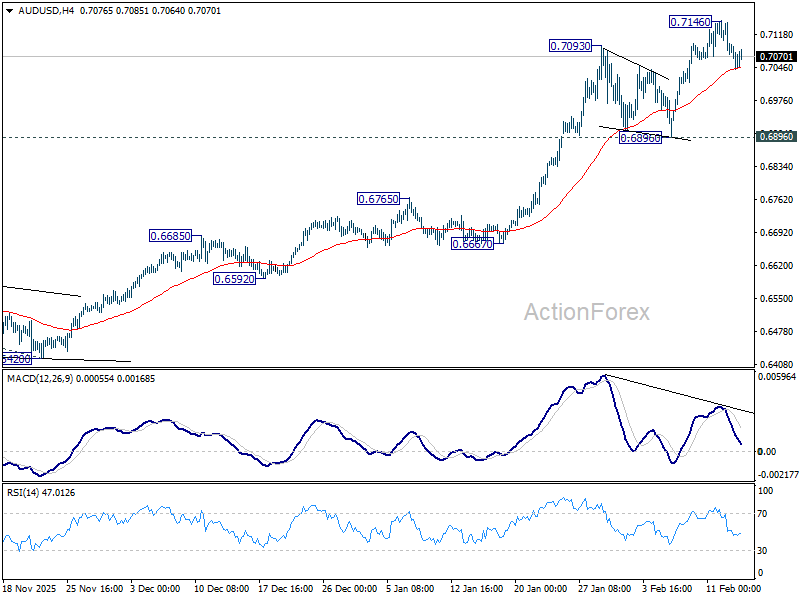
AUD/USD edged higher to 0.7146 last week, but subsequent retreat indicates short term topping, on bearish divergence condition in 4H MACD. Initial bias remains neutral this week for consolidations, and deeper retreat might be seen. But downside should be contained above 0.6896 support to bring another rally. On the upside, above 0.7146 will resume larger up trend to 100% projection of 0.5913 to 0.6706 from 0.6420 at 0.7213.
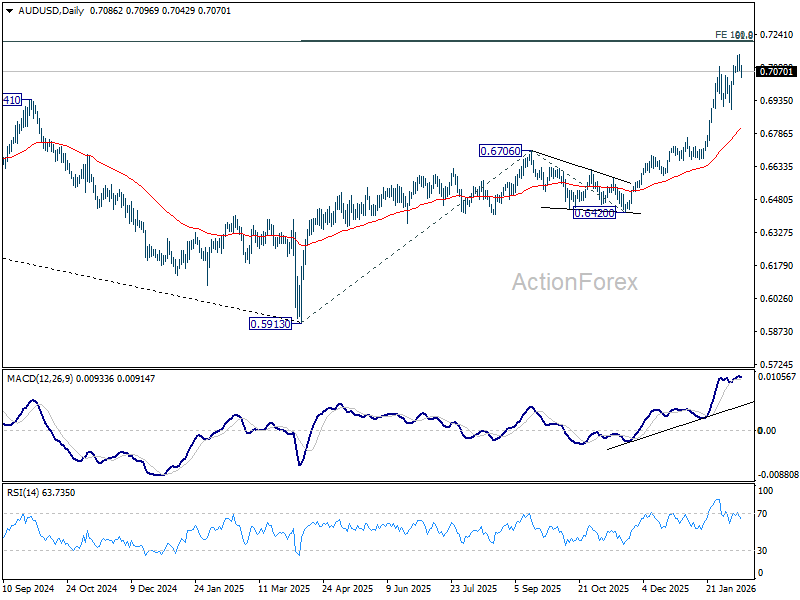
In the bigger picture, current development argues that rise from 0.5913 (2024 low) is reversing whole down trend from 0.8006 (2021 high). Further rally should be seen to 61.8% retracement of 0.8006 to 0.5913 at 0.7206. This will remain the favored case as long as 0.6706 resistance turned support holds, even in case of deep pullback.
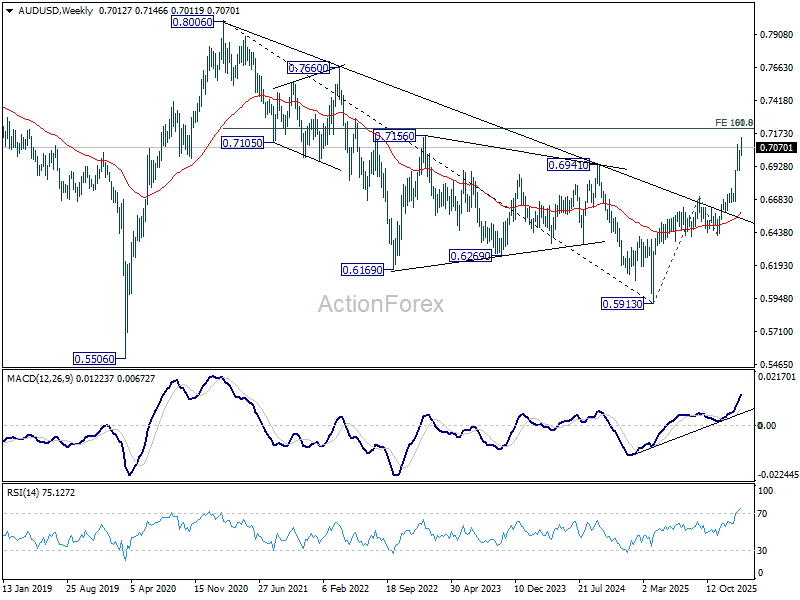
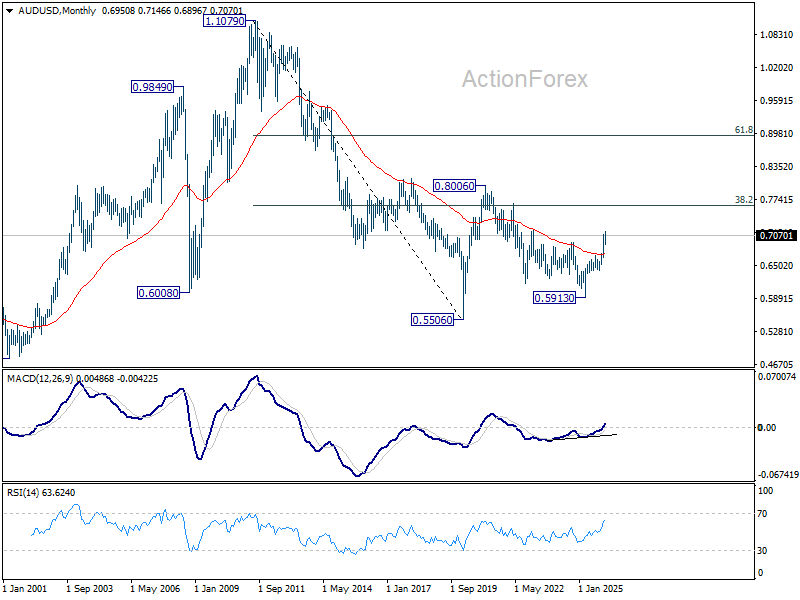
In the long term picture, rise from 0.5913 is seen as the third leg of the whole pattern from 0.5506 (2020 low). It's still early to judge if this is an impulsive or corrective pattern. But in either case, further rise should be seen back to 0.8006 and possibly above.
EUR/USD Weekly Outlook
EUR/USD's rebound stalled after hitting 1.1928 last week and retreated. Initial bias stays neutral this week first. On the upside, above 1.1928 will target a retest on 1.2081 high. Decisive break there and sustained trading above 1.2 psychological level will carry larger bullish implications. On the downside, however, sustained trading below 55 D EMA (now at 1.1756) will raise the chance of reversal on rejection by 1.2, and target 1.1576 support for confirmation.
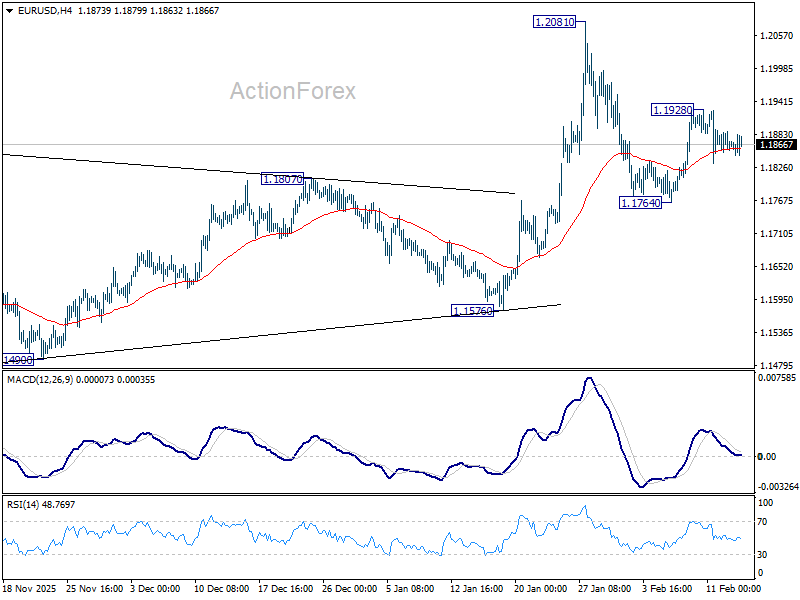
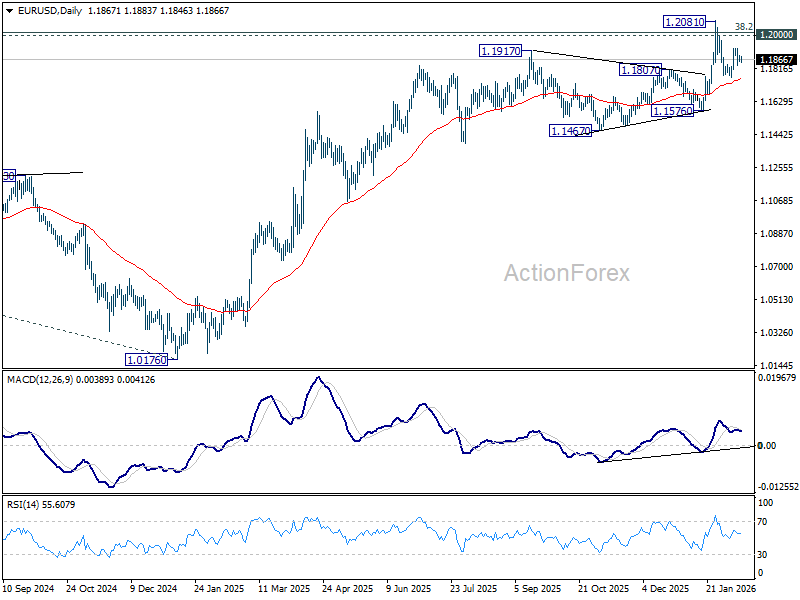
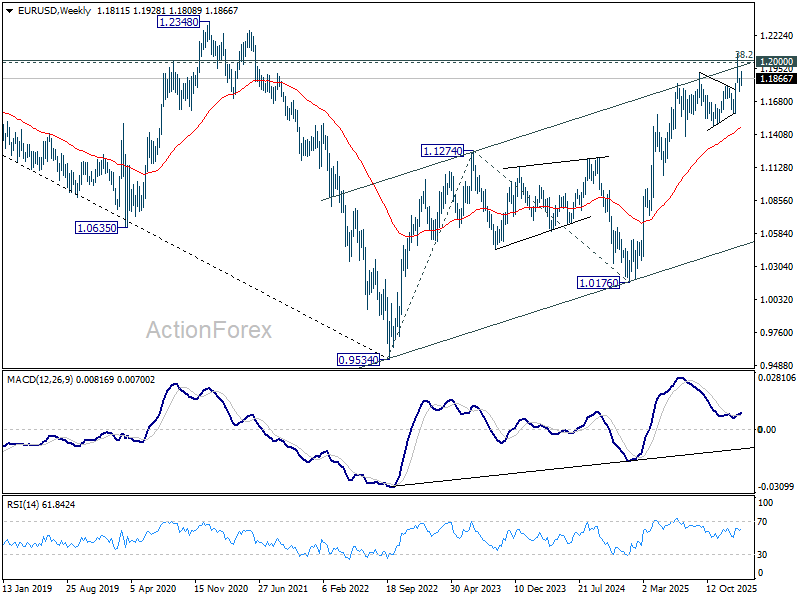
In the bigger picture, as long as 55 W EMA (now at 1.1471) holds, up trend from 0.9534 (2022 low) is still in favor to continue. Decisive break of 1.2 key psychological level will add to the case of long term bullish trend reversal. Next medium term target will be 138.2% projection of 0.9534 to 1.1274 from 1.0176 at 1.2581. However, sustained trading below 55 W EMA will argue that rise from 0.9534 has completed as a three wave corrective bounce, and keep long term outlook bearish.
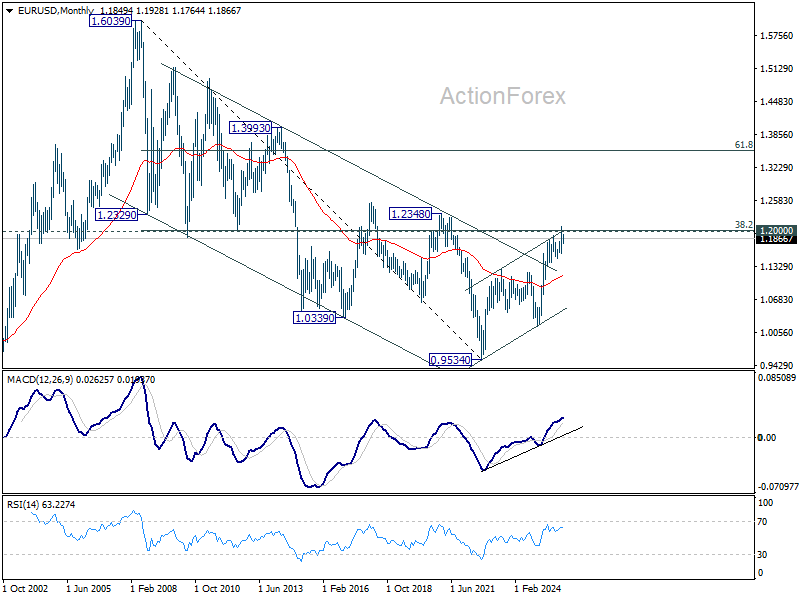
In the long term picture, 38.2% retracement of 1.6039 to 0.9534 at 1.2019, which is close to 1.2000 psychological level is the key for the outlook. Rejection by this level will keep the multi decade down trend from 1.6039 (2008 high) intact, and keep outlook neutral at best. However, decisive break of 1.2000/19, will suggest long term bullish trend reversal, and target 61.8% retracement at 1.3554.
USD/JPY Weekly Outlook
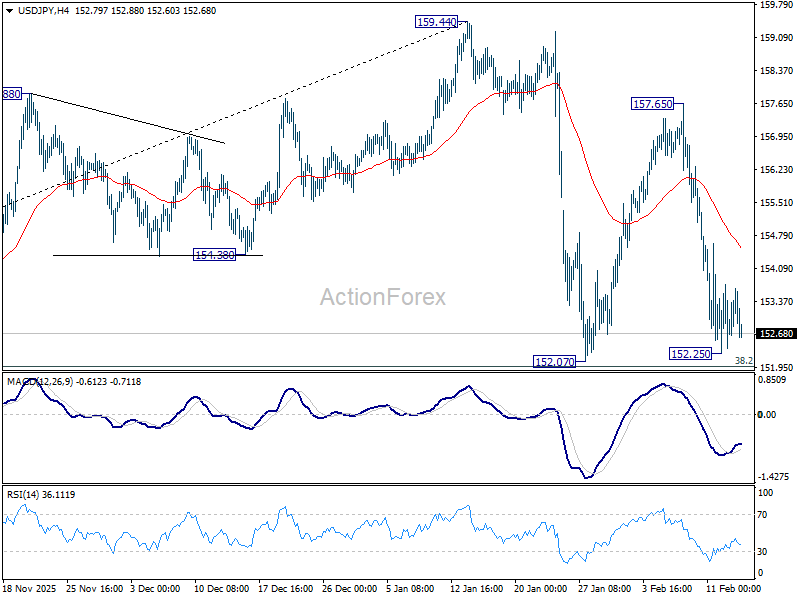
USD/JPY fell sharply last week but the decline lost momentum ahead of 152.07 support. Intial bias stays neutral this week first. With 38.2% retracement of 139.87 to 159.44 at 151.96 intact, price actions from 159.44 are seen as a consolidations pattern only. On the upside, sustained break of 55 4H EMA (now at 154.51) will bring stronger rebound towards 157.65. However, decisive break of 151.96 will argue that it's reversing the rise from 139.87 already. In this case, deeper fall should then be seen to 61.8% retracement at 147.34, and possibly below.
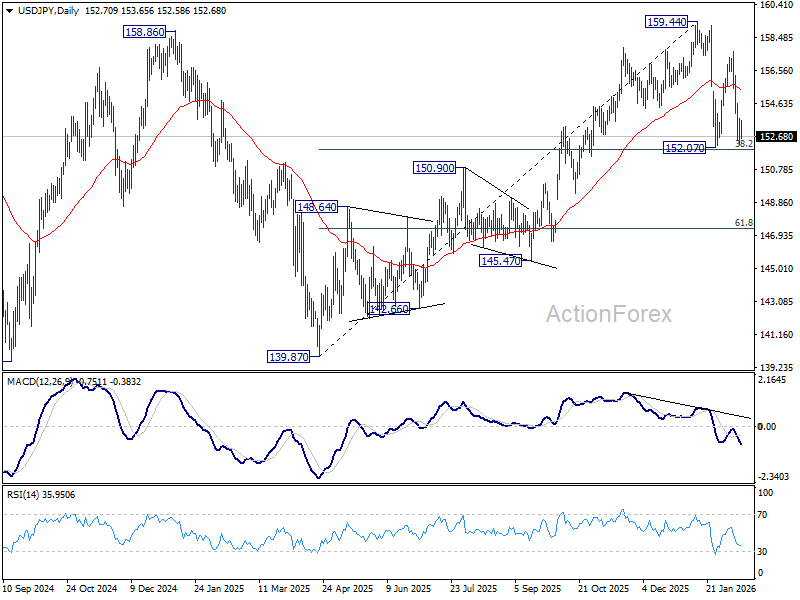
In the bigger picture, outlook is unchanged that corrective pattern from 161.94 (2024 high) should have completed with three waves at 139.87. Larger up trend from 102.58 (2021 low) could be ready to resume through 161.94. This will remain the favored case as long as 55 W EMA (now at 151.71) holds. However, sustained break of 55 W EMA will argue that the pattern from 161.94 is extending with another falling leg.
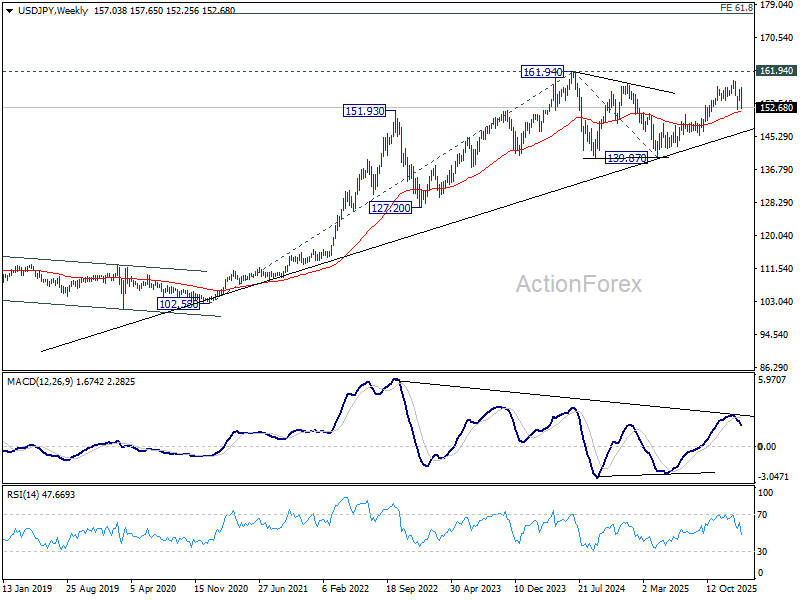
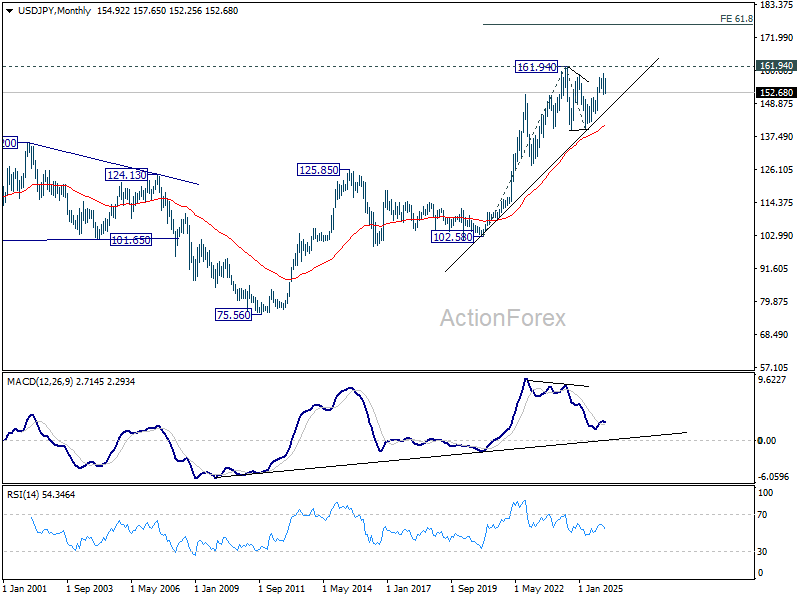
In the long term picture, up trend from 75.56 (2011 low) is still in progress and might be ready to resumption. Firm break of 161.94 will target 61.8% projection of 102.58 (2020 low) to 161.94 (2024 high) from 139.87 at 176.55 in the medium term. Long term outlook will stay bullish as long as 139.87 support holds, even in case of deep pullback.
GBP/USD Weekly Outlook
GBP/USD stayed in range above 1.3507 last week and outlook is unchanged. Initial bias stays neutral this week first. On the upside, firm break of 1.3732 will suggest that pullback from 1.3867 has completed as a correction at 1.3507. Retest of 1.3867 should be seen first. Firm break there will resume larger up trend towards 1.4284 key resistance. On the downside, however, sustained trading below 55 D EMA (now at 1.3509) will raise the chance of larger scale correction, and target 1.3342 support for confirmation.

In the bigger picture, rise from 1.0351 (2022 low) still in progress and should target 1.4284 key resistance (2021 high). Decisive break there will add to the case of long term bullish trend reversal. For now, outlook will stay bullish as long as 1.3008 support holds, even in case of deep pullback.

In the long term picture, as long as 1.4248/4480 resistance zone holds (38.2% retracement of 2.1161 to 1.0351 at 1.4480), the long term outlook will remain bearish. That is, price actions from 1.3051 are seen as a corrective pattern to down trend from 2.1161 (2007 high) only. Nevertheless, decisive break of 1.4248/4480 will be a strong sign of long term bullish reversal.


USD/CHF Weekly Outlook
USD/CHF stayed in consolidations from 0.7603 last week. Initial bias stays neutral this week first. Stronger rebound cannot be ruled out but upside should be limited by 55 D EMA (now at 0.7861) to complete the pattern. On the downside, break of 0.7603 will resume larger down trend, and target 0.7382 projection level next.

In the bigger picture, down trend from 1.0342 (2017 high) is still in progress. Next target is 100% projection of 1.0146 (2022 high) to 0.8332 from 0.9200 at 0.7382. In any case, outlook will stay bearish as long as 0.8123 resistance holds.

In the long term picture, price action from 0.7065 (2011 low) are seen as a corrective pattern to the multi-decade down trend from 1.8305 (2000 high). It's uncertain if the fall from 1.0342 is the second leg of the pattern, or resumption of the downtrend. But in either case, outlook will stay bearish as long as 0.8756 support turned resistance holds (2021 low). Retest of 0.7065 should be seen next.


AUD/USD Weekly Report
AUD/USD edged higher to 0.7146 last week, but subsequent retreat indicates short term topping, on bearish divergence condition in 4H MACD. Initial bias remains neutral this week for consolidations, and deeper retreat might be seen. But downside should be contained above 0.6896 support to bring another rally. On the upside, above 0.7146 will resume larger up trend to 100% projection of 0.5913 to 0.6706 from 0.6420 at 0.7213.
In the bigger picture, current development argues that rise from 0.5913 (2024 low) is reversing whole down trend from 0.8006 (2021 high). Further rally should be seen to 61.8% retracement of 0.8006 to 0.5913 at 0.7206. This will remain the favored case as long as 0.6706 resistance turned support holds, even in case of deep pullback.
In the long term picture, rise from 0.5913 is seen as the third leg of the whole pattern from 0.5506 (2020 low). It's still early to judge if this is an impulsive or corrective pattern. But in either case, further rise should be seen back to 0.8006 and possibly above.
USD/CAD Weekly Outlook
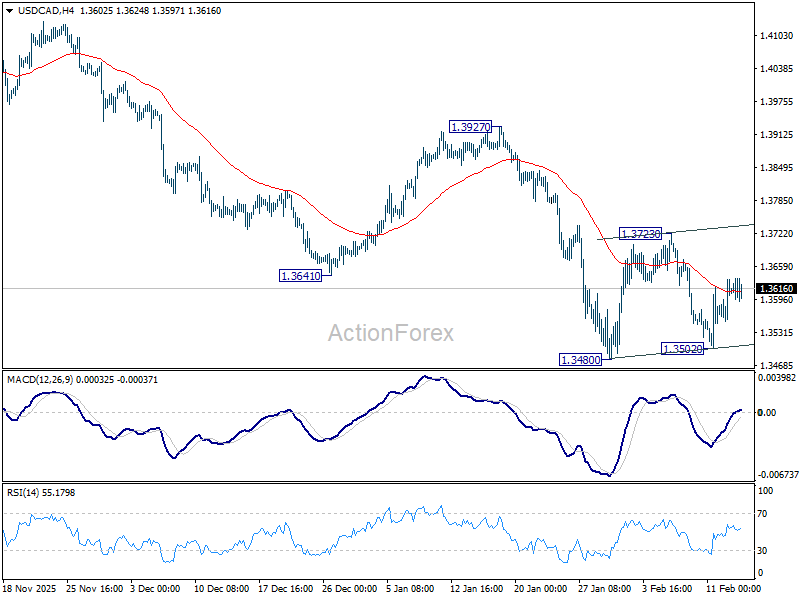
USD/CAD extended the consolidation pattern from 1.3480 last week. Initial bias stays neutral this week first. While stronger rebound cannot be ruled out, upside should be limited by 55 D EMA (now at 1.3752) to complete the pattern. On the downside, firm break of 1.3480 will resume larger down trend from 1.4791 to 61.8% projection of 1.4791 to 1.3538 from 1.4139 at 1.3365.
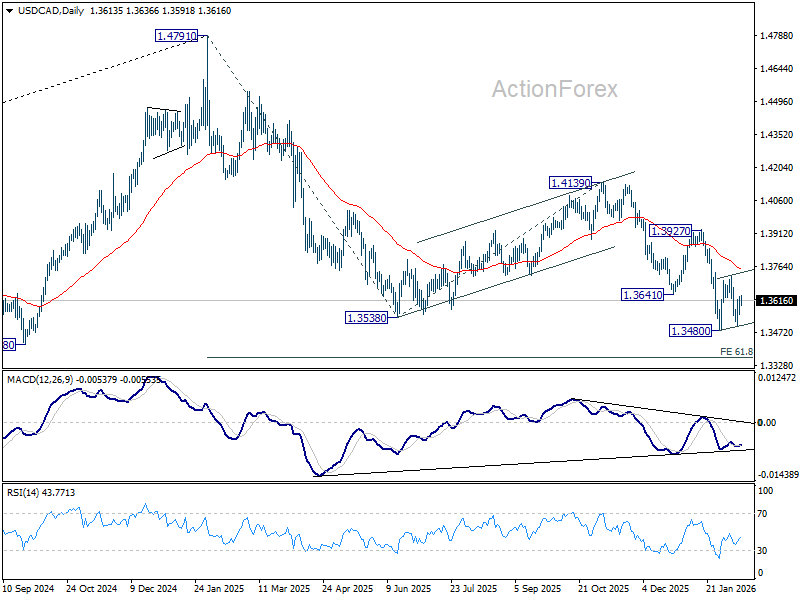
In the bigger picture, price actions from 1.4791 are seen as a corrective pattern to the whole up trend from 1.2005 (2021 low). Deeper fall could be seen as the pattern extends, to 61.8% retracement of 1.2005 to 1.4791 at 1.3069. For now, medium term outlook will be neutral at best, until there are signs that the correction has completed, or that a bearish trend reversal is confirmed.
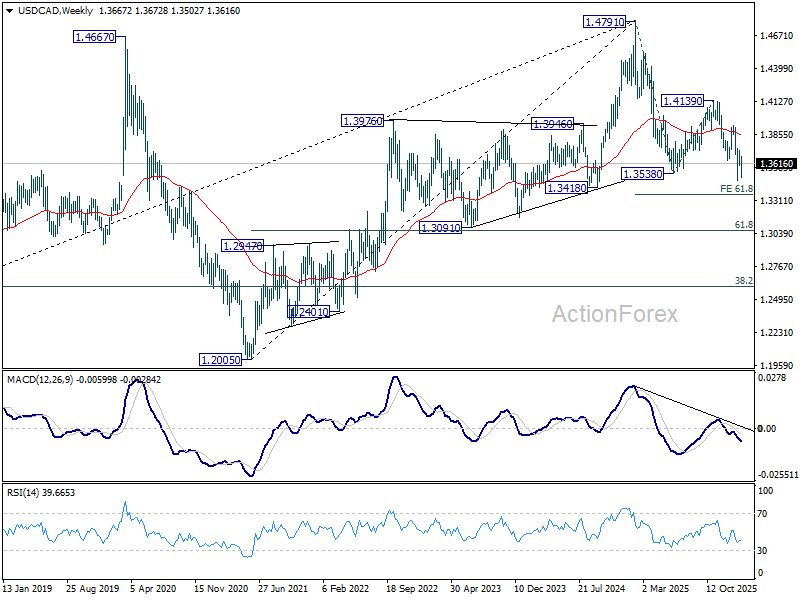
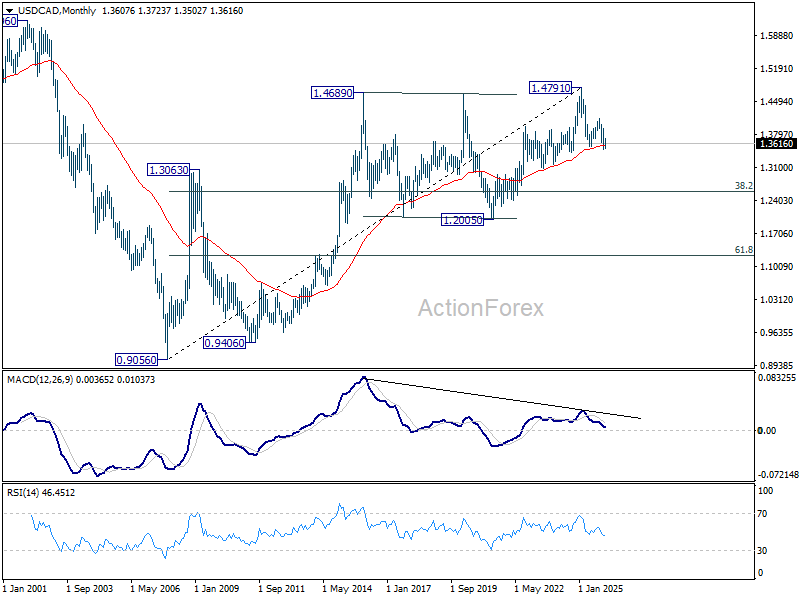
In the long term picture, rising 55 M EMA (now at 1.3569) remains intact. Thus, up trend from 0.9056 (2007 low) should still be in progress. However, considering bearish divergence condition M MACD, sustained trading below 55 M EMA will argue that the up trend has completed with five waves up to 1.4791, and turn medium term outlook bearish for correction to 38.2% retracement of 0.9056 to 1.4791 at 1.2600.
GBP/JPY Weekly Outlook
GBP/JPY's fell sharply last week but the decline halted after hitting 38.2% retracement of 197.47 to 214.98 at 208.29. Initial bias is neutral this week first. On the downside, sustained break of 208.29 will suggest that larger scale correction is already underway and target 203.27 fibonacci level. Nevertheless, strong rebound from current level, followed by break of 210.47 minor resistance will retain near term bullishness, and bring retest of 214.83/98 resistance zone.
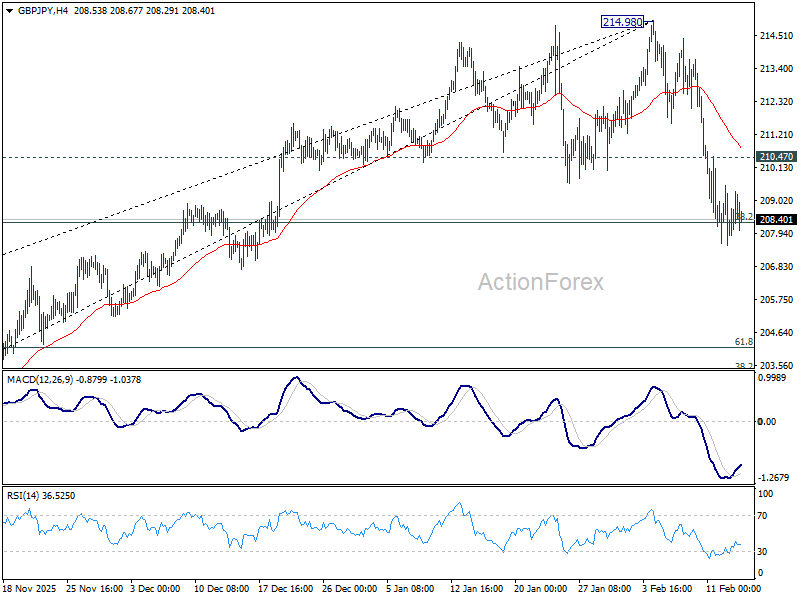
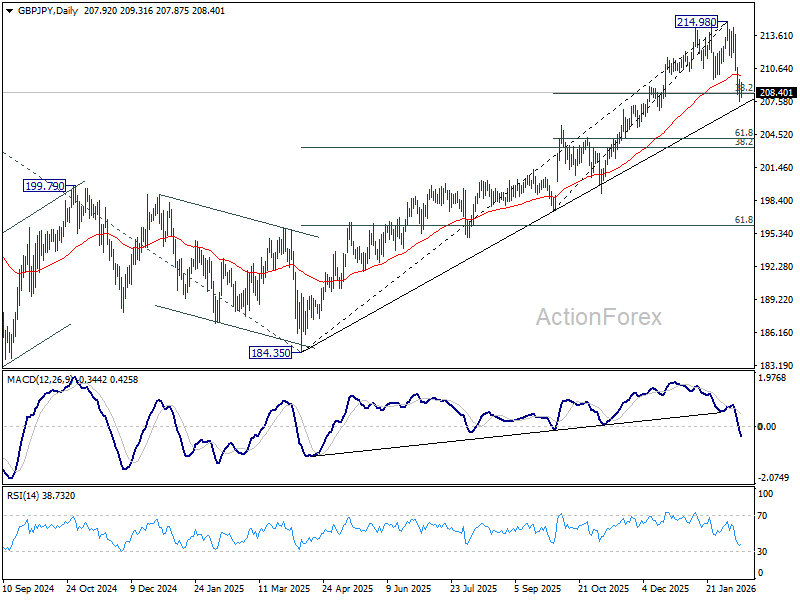
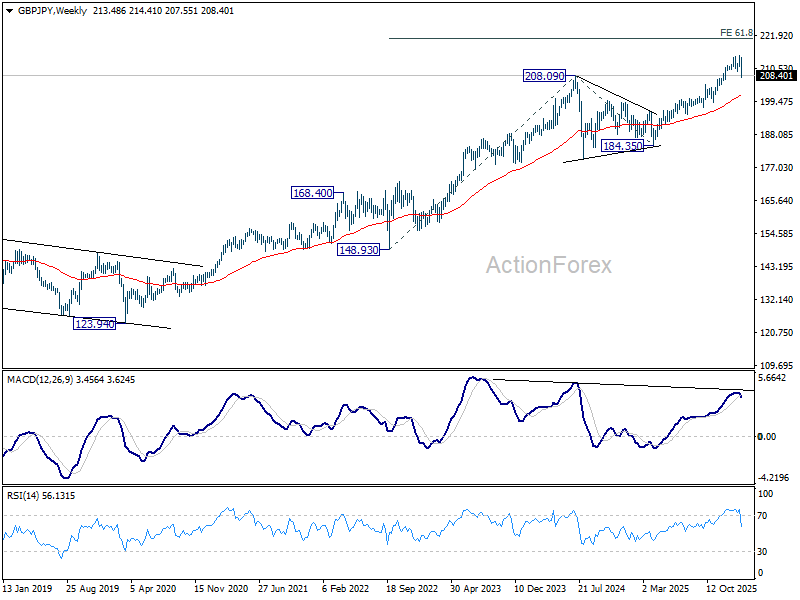
In the bigger picture, considering the break of 55 D EMA (now at 209.96), a medium term top could be formed at 214.98. Deeper correction would be seen, but downside should be contained by 38.2% retracement of 184.35 to 214.98 at 203.27. On the upside, break of 214.98 will resume larger up trend from from 123.94 (2020 low), and target 61.8% projection of 148.93 (2022 low) to 208.09 (2024 high) from 184.35 at 220.90.
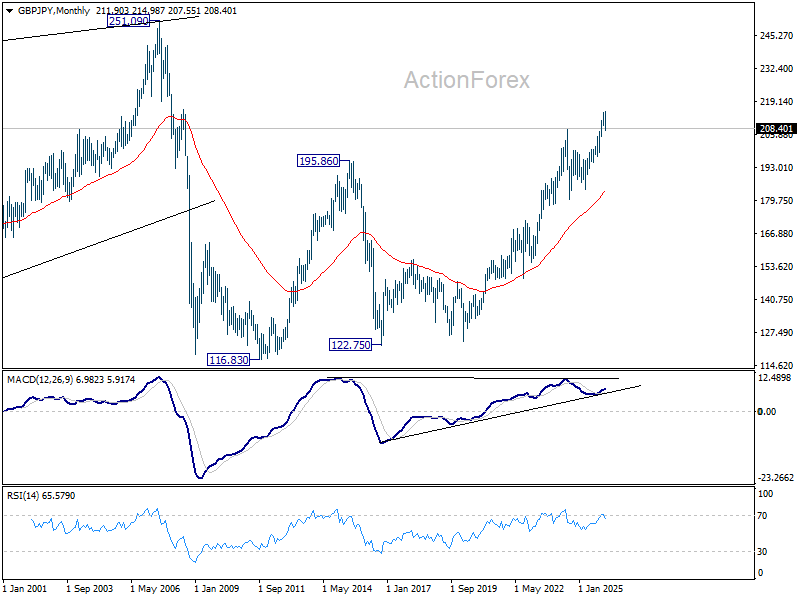
In the long term picture, up trend from 116.83 (2011 low) is in progress. Next target is 251.09 (2007 high). This will remain the favored case as long as 55 M EMA (now at 184.02) holds.
EUR/JPY Weekly Outlook
EUR/JPY fell sharply last week but the declined stalled after hitting 38.2% retracement of 172.24 to 186.86 at 181.27. Initial bias is neutral this week first. On the downside, sustained break of 181.27 will argue that fall from 186.86 is correcting whole up trend from 154.77. Next near term target will be 161.8% projection of 186.86 to 181.76 from 186.22 at 177.96. Nevertheless, strong rebound from current level, followed by break of 182.99 minor resistance will retain near term bullishness, and bring retest of 186.86 high first.
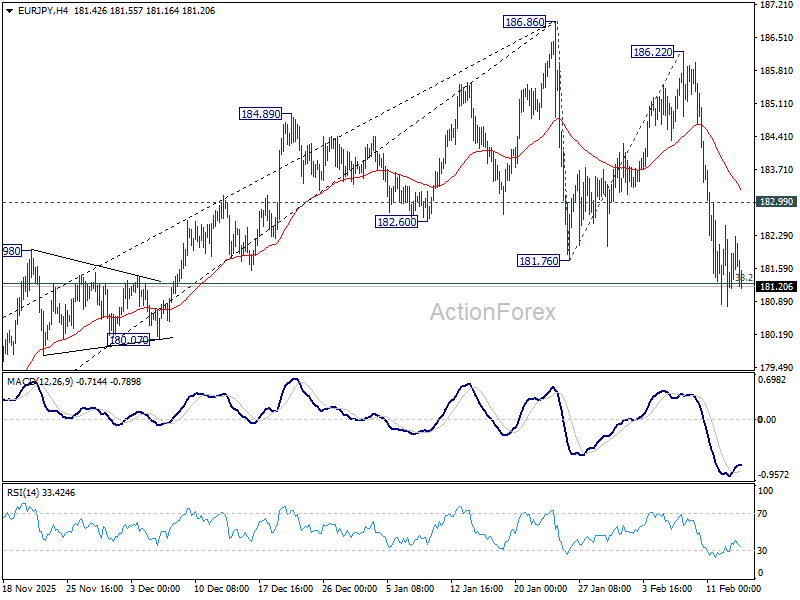
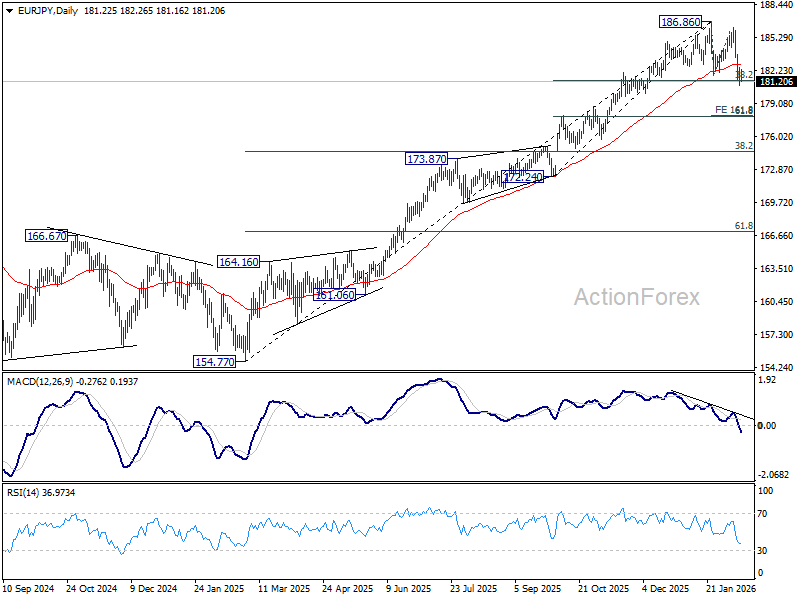
In the bigger picture, considering bearish divergence condition in D MACD and break of 55 D EMA (now at 182.67), a medium term top could be formed at 186.86 already. Deeper correction would be seen but downside should be contained by 38.2% retracement of 154.77 to 186.86 at 174.60 to bring rebound. Meanwhile, firm break of 186.86 will resume larger up trend to 78.6% projection of 124.37 to 175.41 from 154.77 at 194.88 next.
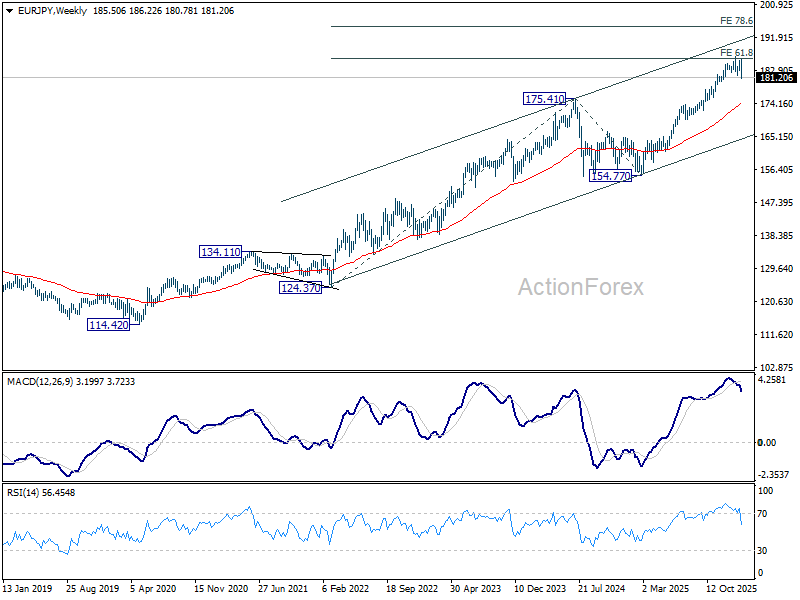
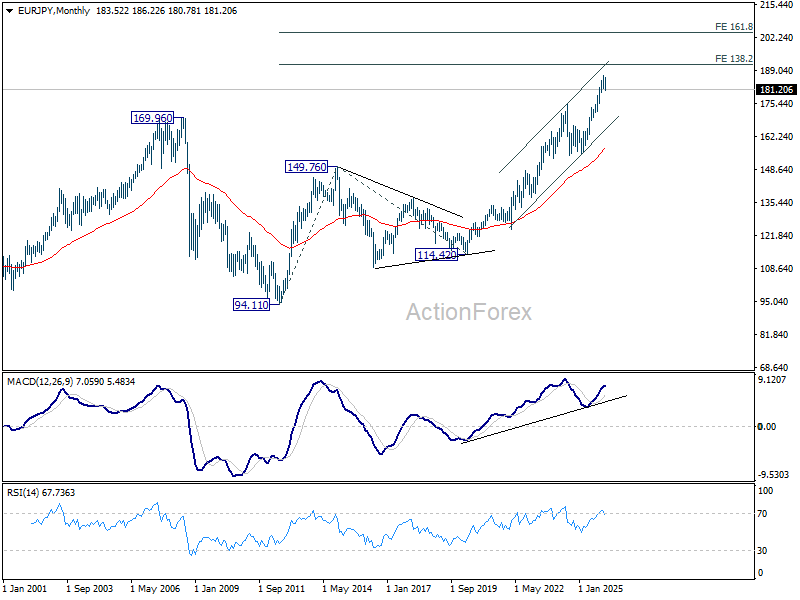
In the long term picture, up trend from 94.11 (2021 low) is in progress. Next target is 138.2% projection of 94.11 to 149.76 (2014 high) from 114.42 (2020 low) at 191.32. This will remain the favored case as long as 154.77 support holds.
EUR/GBP Weekly Outlook
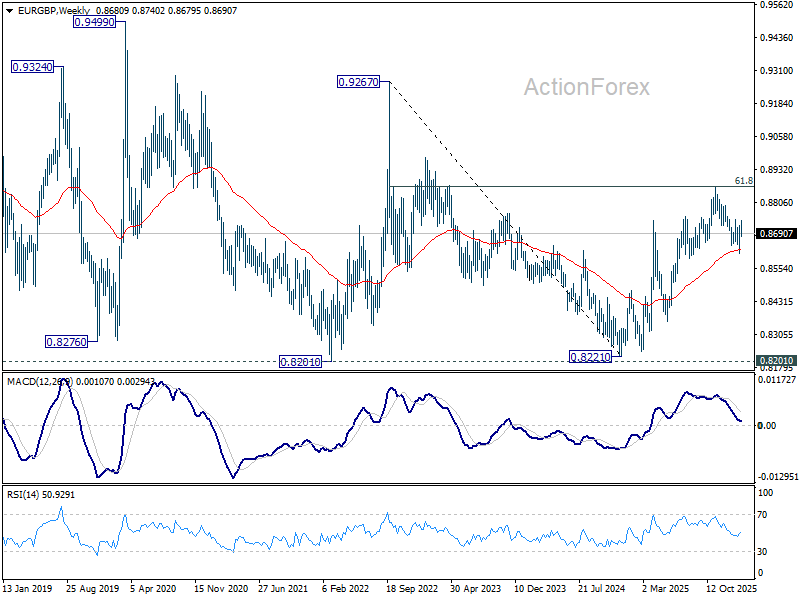
EUR/GBP edged higher last week but failed to break through 0.8744 resistance. Initial bias remains neutral this week first. Firm break of 0.8744 will indicate that fall from 0.8863 has completed as a correction. Further rally should then be seen back to retest 0.8863 high. On the downside, sustained break of 38.2% retracement of 0.8221 to 0.8663 at 0.8618 will carry larger bearish implications and turn outlook bearish.
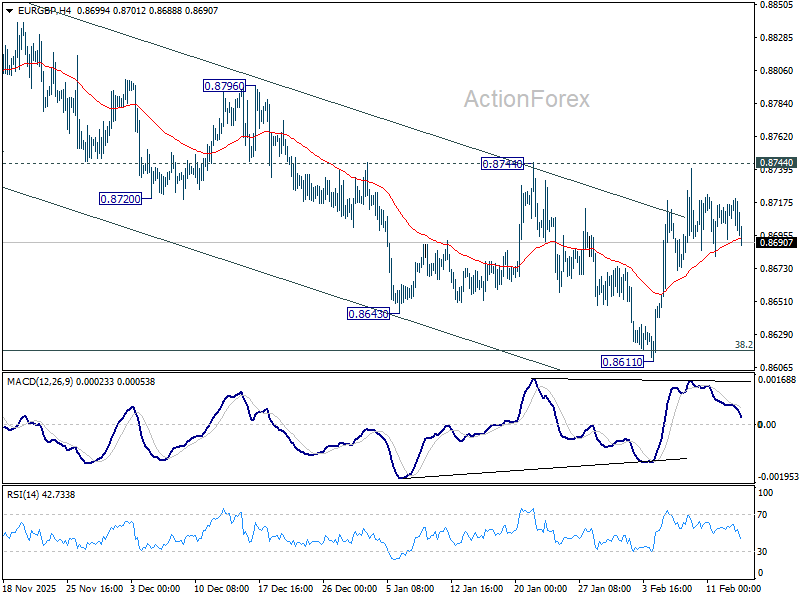
In the bigger picture, rise from 0.8221 medium term bottom (2024 low) is seen as a corrective move. Upside should be limited by 61.8% retracement of 0.9267 to 0.8221 at 0.8867. Sustained trading below 55 W EMA (now at 0.8629) should confirm that this corrective bounce has completed. In this case, deeper fall would be seen back to 0.8201/21 key support zone. However, decisive break of 0.8867 will suggest that EUR/GBP is already reversing whole decline from 0.9267 (2022 high). That should pave the way back to 0.9267.
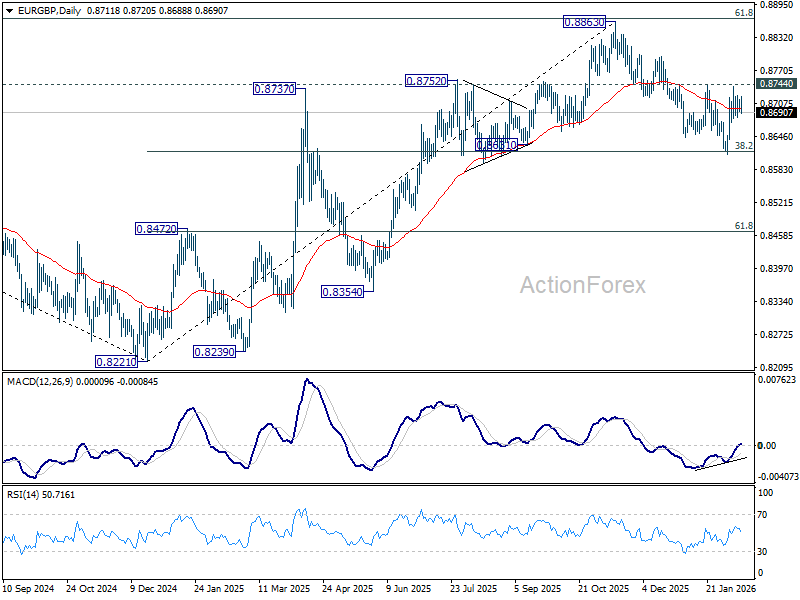
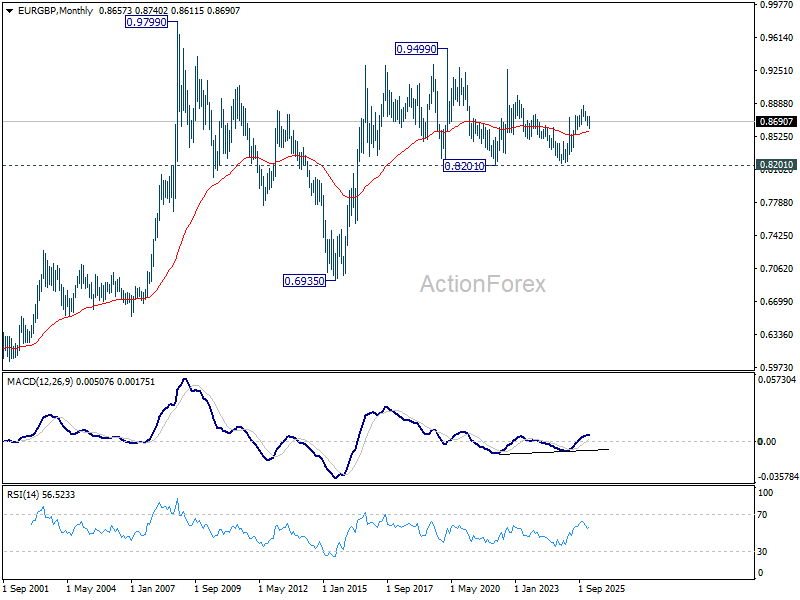
In the long term picture, price action from 0.9499 (2020 high) is seen as part of the long term range pattern from 0.9799 (2008 high). Range trading should continue between 0.8201 and 0.9499, until there is clear signal of imminent breakout.