

Sample Category Title
EUR/USD Mid-Day Outlook
Daily Pivots: (S1) 1.0948; (P) 1.0977; (R1) 1.1013; More...
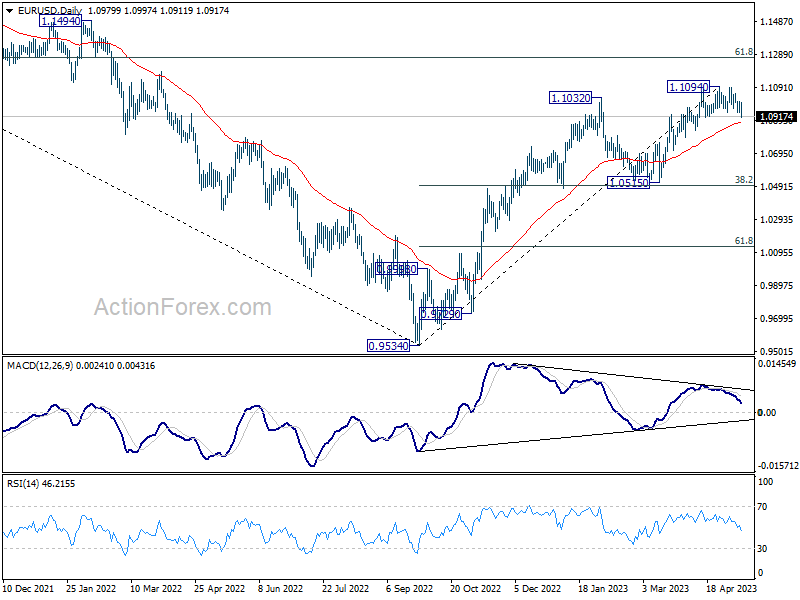
Intraday bias remains neutral for the moment. On the upside, firm break of 1.1094 will resume larger up trend to 1.1273 fibonacci level. However, considering bearish divergence condition in 4H MACD, break of 1.0908 support will indicate short term topping and turn bias back to the downside. Further break of 1.0830 will target 1.0515 key support level.
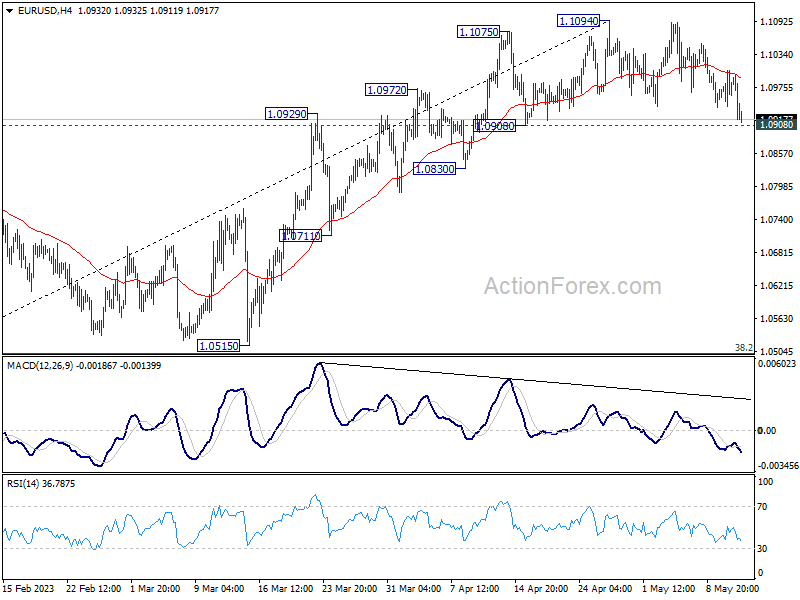
In the bigger picture, rise from 0.9534 (2022 low) is in progress for 61.8% retracement of 1.2348 (2021 high) to 0.9534 at 1.1273. Sustained break there will solidify the case of bullish trend reversal and target 1.2348 resistance next (2021 high). This will now remain the favored case as long as 1.0515 support holds, even in case of deeper pull back.
GBP/USD Mid-Day Outlook
Daily Pivots: (S1) 1.2592; (P) 1.2636; (R1) 1.2669; More...
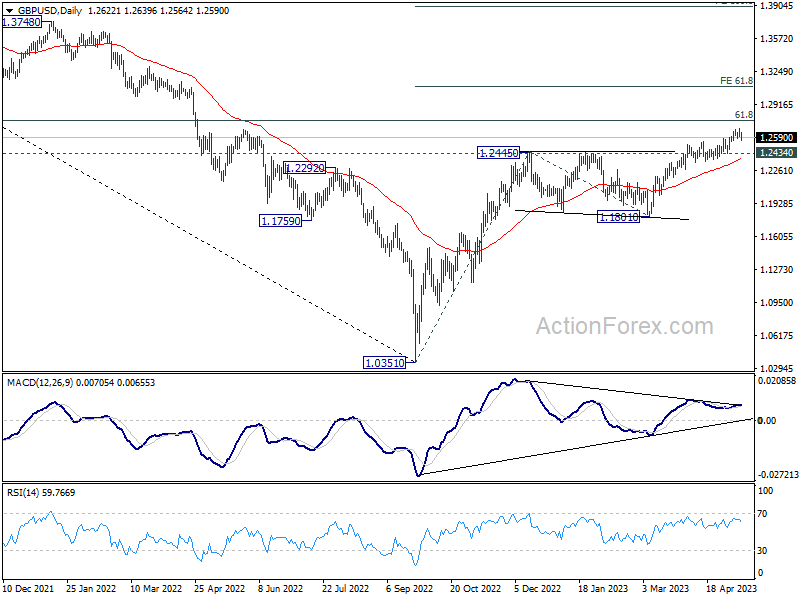
GBP/USD is staying in consolidation below 1.2678 and intraday bias remains neutral for the moment. Further rally is expected as long as 1.2434 support holds. Break of 1.2678 will resume larger up trend to 1.2759 fibonacci level first. Firm break there will target 61.8% projection of 1.0351 to 1.2445 from 1.1801 at 1.3095. However, decisive break of 1.2434 will confirm short term topping, and turn bias back to the downside for deeper fall.
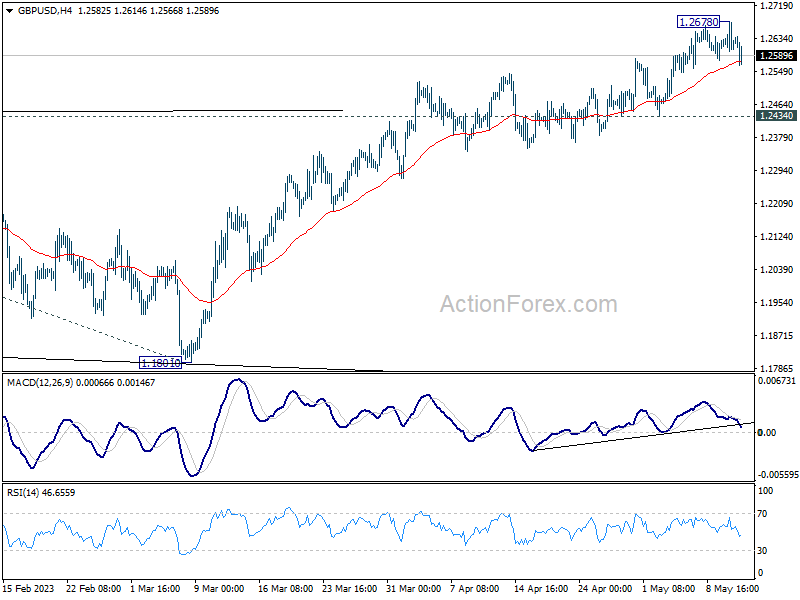
In the bigger picture, the rise from 1.0351 medium term term bottom (2022 low) is in progress for 61.8% retracement of 1.4248 (2021 high) to 1.0351 at 1.2759. Sustained break there will add to the case of long term bullish trend reversal. Further break of 61.8% projection of 1.0351 to 1.2445 from 1.1801 at 1.3095 could prompt upside acceleration to 100% projection at 1.3895. For now, this will remain the favored case as long as 1.1801 support holds, even in case of deep pull back.
Sterling Mixed Reaction to BoE Rate Hike; Yen Climbs With Dollar
Sterling's response to BoE rate hike has been somewhat ambivalent. Despite BoE's openness to further tightening and a rosier economic outlook, forecast for inflation indicates a marked downturn, with a "material" undershooting expected in the forecast horizon. The voting pattern held no surprises, leaving the Pound now turning its attention to tomorrow's GDP data for potential directional cues.
In the broader currency market, Japanese Yen is seeing notable gains in early US session, buoyed by continued decline in US and European treasury yields. Dollar, meanwhile, is capitalizing on risk-off sentiment, as US futures hint at a slightly lower opening. Australian dollar is trailing for the day, with Canadian Dollar and Euro not far behind. However, the final standing will depend on how risk sentiment evolves throughout the remainder of the session.
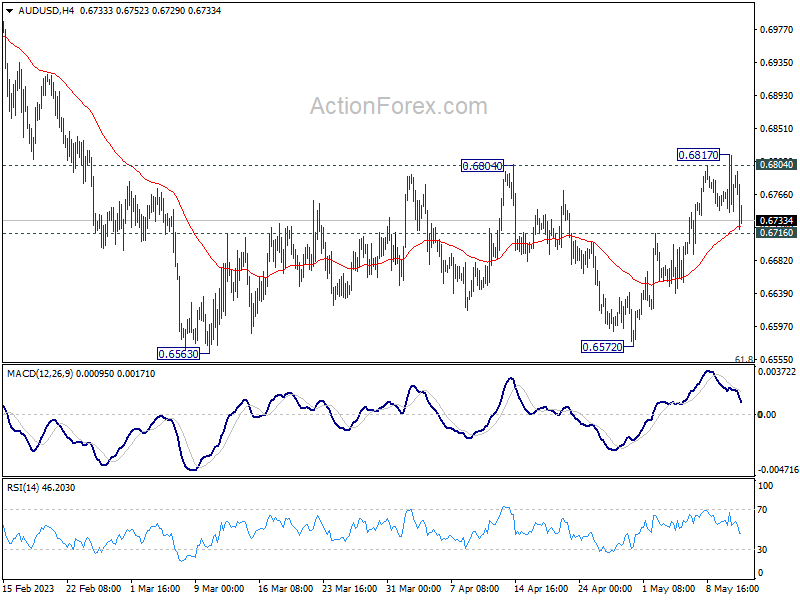
From a technical standpoint, the spotlight now shifts to whether AUD/USD will break 0.6716 support level, indicating rejection by 0.6804 resistance level. If this occurs, it suggests that the consolidation pattern from 0.6563 may have peaked at 0.6817, paving the way for a resumption of larger decline from 0.7156. If this turns out to be the case, it could signal a reversal in commodity currencies as well as risk sentiment.
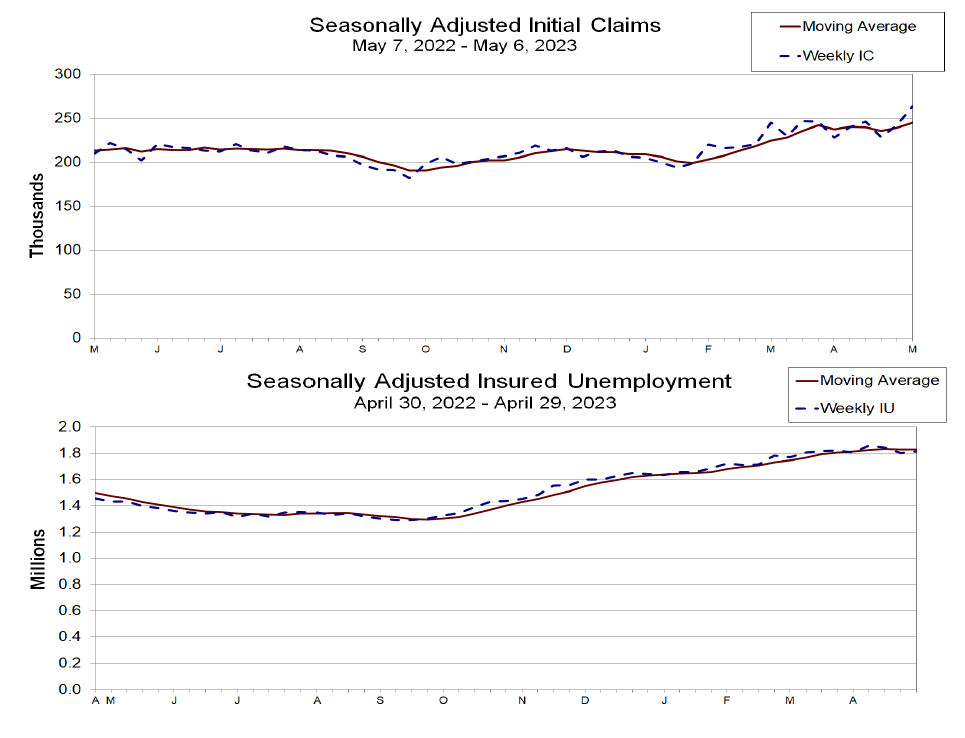
US initial jobless claims rose to 264k, highest since Oct 30, 2021
US initial jobless claims rose 22k to 264k in the week ending May 6, above expectation of 245k. That's the highest level since October 30, 2021. Four-week moving average of initial claims rose 6k to 245k, highest since November 20, 2021.
Continuing claims rose 12k to 1813k in the week ending April 29. Four-week moving average of continuing claims rose 2k to 1830k.
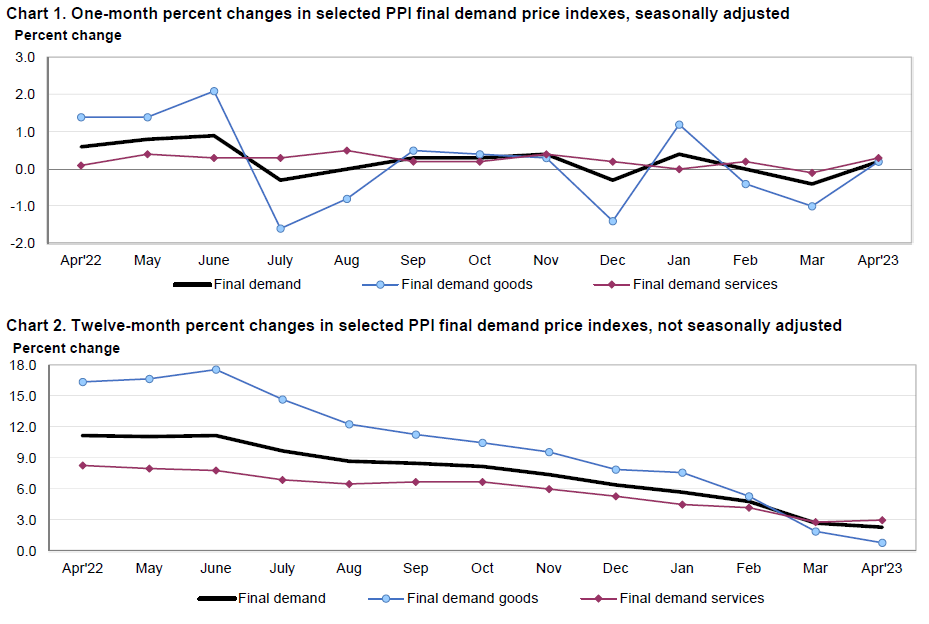
US PPI up 0.2% mom, 2.3% yoy in Apr
US PPI for final demand rose 0.2% mom in April, below expectation of 0.3% mom. 80% of the rise in PPI attributable to a 0.3% mom increase in prices for services. The index for goods advanced 0.2% mom. Prices for final demand less foods, energy, and trade services rose 0.2% mom.
For the 12 months ended in April, PPI slowed from 2.7% yoy to 2.3% yoy, above expectation of 1.4% yoy. PPI less foods, energy, and trade services slowed from 3.4% yoy to 3.2% yoy, above expectation of 2.7% yoy.
BoE hikes 25bps, leaves door open for more
BoE raises Bank Range by 25bps to 4.50% as widely expected. The decision was made by 7-2 vote with known doves Silvana Tenreyro and Swati Dhingra voted for no change.
In the accompanying statement, BoE left open the door for further rate hike, noting that "if there were to be evidence of more persistent (inflation) pressures, then further tightening in monetary policy would be required."
BoE expects inflation to "fall sharply from April" and decline to "a little above 1% at the two and three-year horizons". That would be "materially below the 2% target then. "This reflects the emergence of an increasing degree of economic slack and declining external pressures that are expected to reduce CPI inflation," it added.
Regarding the economy, GDP is expected to be "flat over the first half" of 2023. Economic activity has been "less weak than expected in February", with the path of demand "materially stronger than expected. Labor market remains tighter than February report.
BoE Bailey: CPI on course to halve by end of year
BoE Governor Andrew Bailey said in the post meeting press conference, "we have to stay the course to make sure inflation falls all the way back to the 2% target."
Nevertheless he expected the rise in bank rates since December to "weigh more on the economy in the coming quarters".
Inflation is "expected to fall sharply over the coming months, starting in April." He added, "consumer price inflation is on course to halve by the end of this year."
As for the economy, he said, "today we are forecasting modest but positive growth and a much smaller increase in unemployment."
BoJ opinions: Current monetary easing should continue
In the Summary of Opinions at BoJ's monetary policy meeting on April 27/28, new governor Kazuo Ueda's debut, revealed the need to continue with current monetary easing despite improved view on inflation outlook.
One member said "attention is warranted for the time being on the possibility of continued high inflation" while another said "achievement of the price stability target of 2 percent is coming into sight". Meanwhile, "price projections have been raised somewhat".
Yet, it's generally agreed that the central bank "should continue with the current monetary easing," given that inflation is likely to decline ahead, in the background of heightened uncertainties in overseas economies.
Also it's reiterated that to achieve the inflation target in "sustainable manner", it needs to be "accompanied by wage increases". And it's "necessary" to continue to "firmly support the momentum for wage hikes through monetary easing ".
There was also cautions that "the risk of missing a chance to achieve the 2 percent target due to a hasty revision to monetary easing is much more significant than the risk of the inflation rate continuing to exceed 2 percent."
One member noted that there is no need to revise the conduct of yield curve control as "distortions on the yield curve are currently dissipating".
China's CPI at 0.1% yoy in Apr, lowest since Feb 2021
China CPI slowed from 0.7% yoy to 0.1% yoy in April, below expectation of 0.3% yoy. That's the lowest level since February 2021. Core CPI, excluding food and energy, was unchanged a 0.7% yoy.
Within the CPI, food prices in China rose by 0.4 per cent from a year earlier in April, compared with a rise of 2.4 per cent in March, while non-food prices rose by 0.1 per cent last month, year on year, down from an increase of 0.3 per cent in March.
"In April, the market supply was generally adequate, and consumer demand gradually recovered, with the CPI falling by 0.1 per cent from a month earlier and rising by 0.1 per cent, year on year," said senior NBS statistician Dong Lijuan."Core CPI, excluding food and energy prices, rose by 0.1 per cent from a month earlier to 0.7 per cent, year on year, up at the same rate as in the previous month."
PPI dropped from -2.5% yoy to -3.6% yoy, below expectation of -3.2% yoy. PPI fell at the fastest rate since May 2020 and was down for a seventh consecutive month
"In April, PPI fell by 0.5 per cent from a month earlier and by 3.6 per cent, year on year, due to fluctuations in international commodity prices; the overall weakness of the domestic and international market demand; and the higher base of comparison from the same period last year," Dong added.
GBP/USD Mid-Day Outlook
Daily Pivots: (S1) 1.2592; (P) 1.2636; (R1) 1.2669; More...
GBP/USD is staying in consolidation below 1.2678 and intraday bias remains neutral for the moment. Further rally is expected as long as 1.2434 support holds. Break of 1.2678 will resume larger up trend to 1.2759 fibonacci level first. Firm break there will target 61.8% projection of 1.0351 to 1.2445 from 1.1801 at 1.3095. However, decisive break of 1.2434 will confirm short term topping, and turn bias back to the downside for deeper fall.
In the bigger picture, the rise from 1.0351 medium term term bottom (2022 low) is in progress for 61.8% retracement of 1.4248 (2021 high) to 1.0351 at 1.2759. Sustained break there will add to the case of long term bullish trend reversal. Further break of 61.8% projection of 1.0351 to 1.2445 from 1.1801 at 1.3095 could prompt upside acceleration to 100% projection at 1.3895. For now, this will remain the favored case as long as 1.1801 support holds, even in case of deep pull back.
Economic Indicators Update
| GMT | Ccy | Events | Actual | Forecast | Previous | Revised |
|---|---|---|---|---|---|---|
| 23:01 | GBP | RICS Housing Price Balance Apr | -39% | -38% | -43% | |
| 23:50 | JPY | BoJ Summary of Opinions | ||||
| 23:50 | JPY | Bank Lending Y/Y Apr | 3.20% | 2.90% | 3.00% | |
| 23:50 | JPY | Current Account (JPY) Mar | 1.01T | 1.32T | 1.09T | 1.23T |
| 01:00 | AUD | Consumer Inflation Expectations May | 5.00% | 4.60% | ||
| 01:30 | CNY | CPI Y/Y Apr | 0.10% | 0.30% | 0.70% | |
| 01:30 | CNY | PPI Y/Y Apr | -3.60% | -3.20% | -2.50% | |
| 05:00 | JPY | Eco Watchers Survey: Current Apr | 54.6 | 54.1 | 53.3 | |
| 11:00 | GBP | BoE Interest Rate Decision | 4.50% | 4.50% | 4.25% | |
| 11:00 | GBP | MPC Official Bank Rate Votes | 7--0--2 | 7--0--2 | 7--0--2 | |
| 12:30 | USD | PPI M/M Apr | 0.20% | 0.30% | -0.50% | -0.40% |
| 12:30 | USD | PPI Y/Y Apr | 2.30% | 1.40% | 2.70% | |
| 12:30 | USD | PPI Core M/M Apr | 0.20% | 0.30% | -0.10% | 0.00% |
| 12:30 | USD | PPI Core Y/Y Apr | 3.20% | 2.70% | 3.40% | |
| 12:30 | USD | Initial Jobless Claims (May 5) | 264K | 245K | 242K | |
| 14:30 | USD | Natural Gas Storage | 78B | 54B |
US PPI up 0.2% mom, 2.3% yoy in Apr
US PPI for final demand rose 0.2% mom in April, below expectation of 0.3% mom. 80% of the rise in PPI attributable to a 0.3% mom increase in prices for services. The index for goods advanced 0.2% mom. Prices for final demand less foods, energy, and trade services rose 0.2% mom.
For the 12 months ended in April, PPI slowed from 2.7% yoy to 2.3% yoy, above expectation of 1.4% yoy. PPI less foods, energy, and trade services slowed from 3.4% yoy to 3.2% yoy, above expectation of 2.7% yoy.
US initial jobless claims rose to 264k, highest since Oct 30, 2021
US initial jobless claims rose 22k to 264k in the week ending May 6, above expectation of 245k. That's the highest level since October 30, 2021. Four-week moving average of initial claims rose 6k to 245k, highest since November 20, 2021.
Continuing claims rose 12k to 1813k in the week ending April 29. Four-week moving average of continuing claims rose 2k to 1830k.
NZD/USD Lower Ahead of Inflation Expectations
- New Zealand releases inflation expectations
- Markets react positively to US inflation report
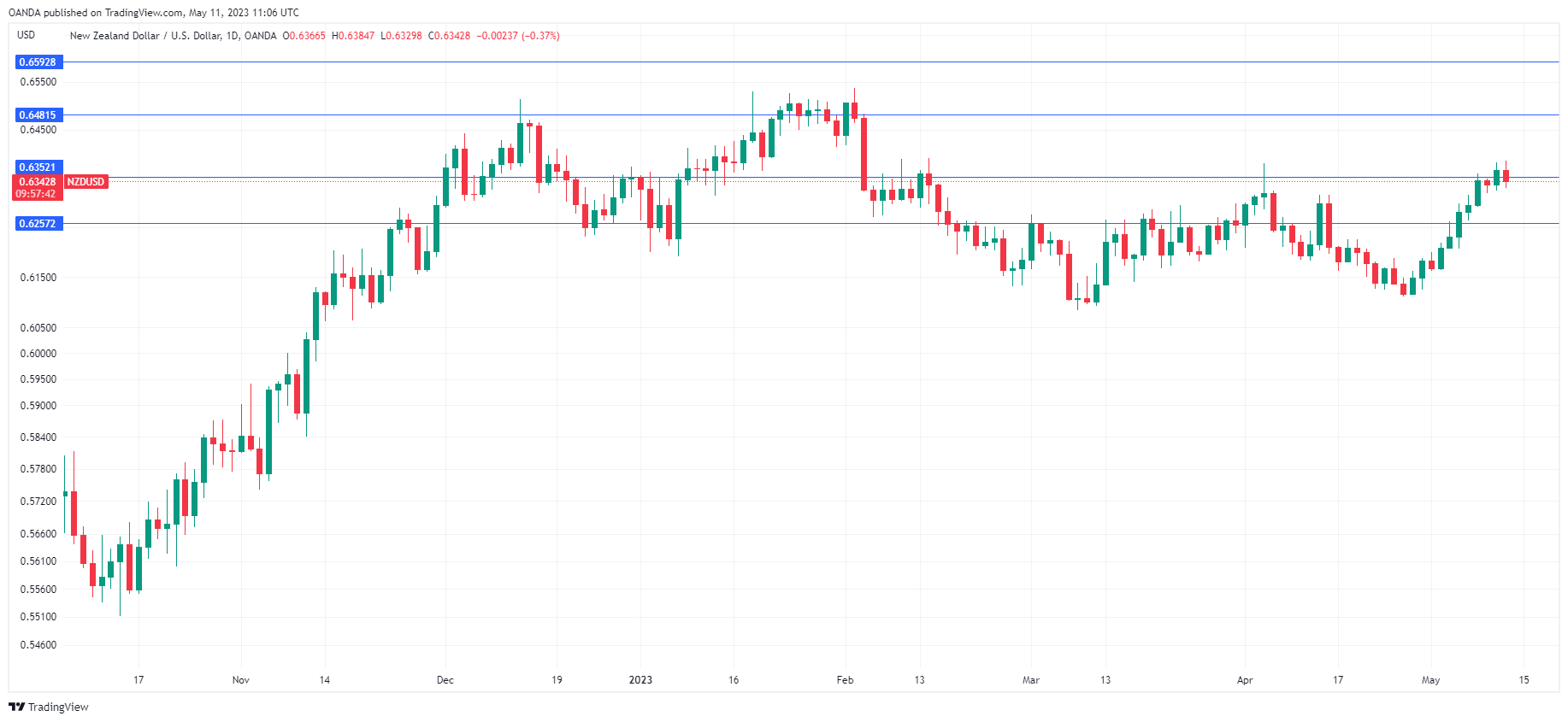
NZD/USD is trading at 0.6342, down 0.38% on the day.
New Zealand Inflation Expectations
The Reserve Bank of New Zealand will be keeping a close eye on inflation expectations release early on Friday. Inflation expectations eased to 3.3% in Q1, down from 3.62% and the central bank will be hoping that the downswing continues. The RBNZ hiked by 50-basis points in April to 5.25% and meets next on May 24th. The inflation expectations report will be the final inflation release prior to the meeting and could move the dial of the New Zealand dollar. A hot report will increase the chances of a rate hike at the next meeting, while a weak report will point to inflation falling and ease pressure on the RBNZ to raise rates.
US inflation report unlikely to sway Fed
US inflation in April dropped a notch, but the disinflation process appears to have stalled. Headline inflation ticked down to 4.9%, down from 5.0% in March. It was the same story with the core rate, which dropped from 5.6% to 5.5%. NZD/USD rose 0.40% and hit a 3-month high after the release, as investors focussed on a decline in CPI Core Services Ex-Housing.
I don’t expect this inflation release to sway the Fed’s rate policy, which is to keep rates elevated until inflation falls closer to the 2% target. Fed Chair Powell has hinted at a rate pause in June, and this has been widely priced in by the markets. The big question is what happens later in the year. Powell has insisted that rate cuts are not on the table, but the markets disagree and have priced in a 70% chance of a rate cut in September, according to the CME Group. A lot can happen before September, and if inflation falls more rapidly in the coming months, we may see the Fed rethink trimming rates, which would provide much-needed relief to consumers and businesses.
NZD/USD Technical
- NZD/USD is testing support at 0.6352. The next support level is 0.6257
- There is resistance at 0.6482 and 0.6592
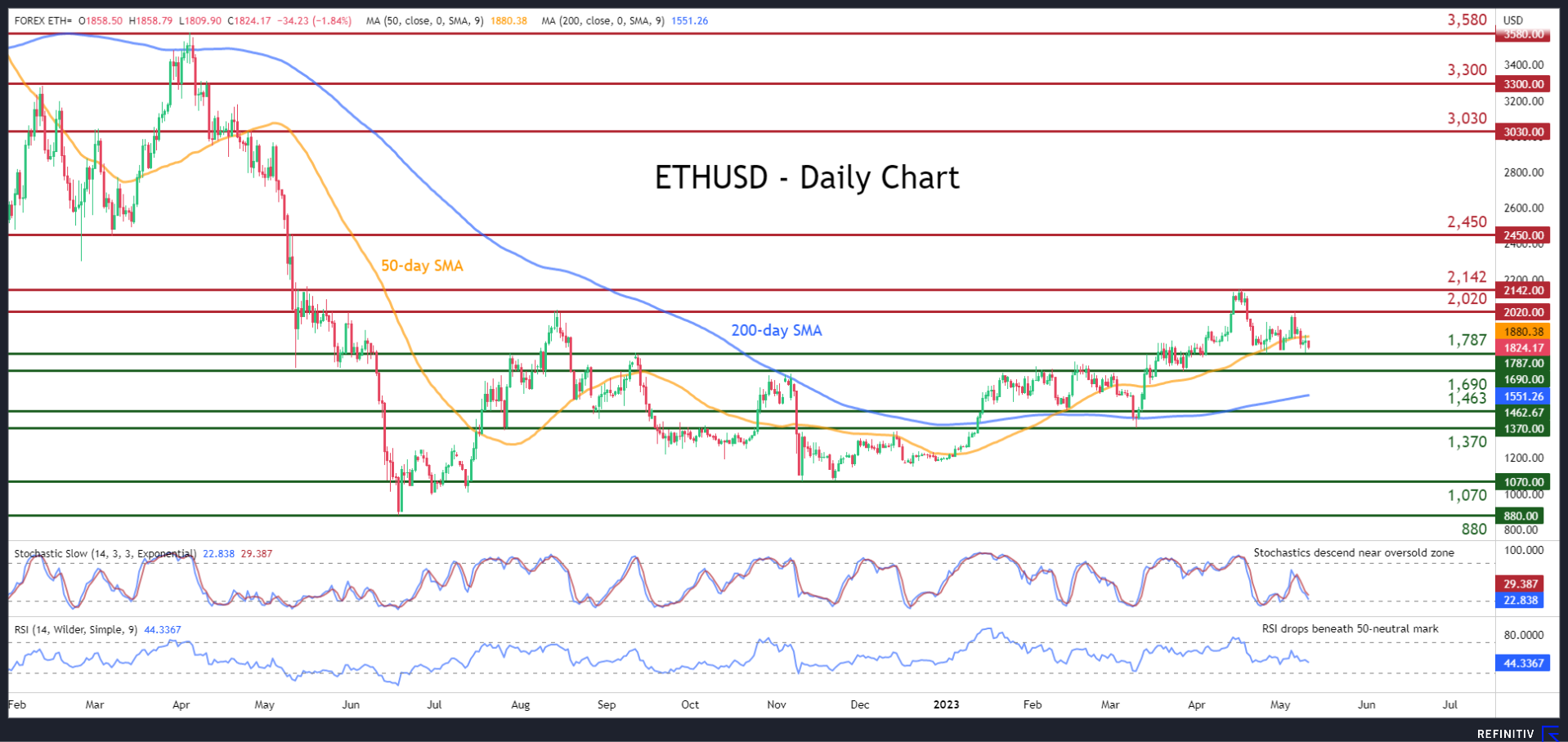
ETHUSD Retreats Below 50-day SMA But Sideways Pattern Holds
ETHUSD (Ethereum) had been trending higher since the beginning of the year, peaking at a fresh 11-month high of 2,142 before experiencing a significant downside correction. Since then, the digital coin has been rangebound, but the short-term picture deteriorated after the price dived beneath its 50-day simple moving average (SMA).
The momentum indicators currently suggest that near-term risks are tilted to the downside. Specifically, the stochastic oscillator is descending near its 20-oversold zone, while the RSI dipped below its 50-neutral mark.
Should sellers try to push the price lower, the recent support of 1,787 could act as the first line of defense. Sliding beneath that floor, the price might decline towards 1,690 before the February support of 1,463 comes under examination. A violation of the latter could pave the way for the March bottom of 1,370.
On the flipside, bullish actions could propel the price towards the recent resistance region of 2,020. Conquering this barricade, the bulls might then target the 11-month high of 2,142. Breaking above that zone, the price will ascend towards levels not seen in the past year, where the 2,450 hurdle could cap Ethereum’s upside.
Overall, ETHUSD seems to be in a consolidation phase, but its short-term technical picture deteriorated after the 50-day SMA got violated to the downside. Therefore, a test of the tight range’s lower end could be the next action that determines whether the latest pullback will extend.
BoE Bailey: CPI on course to halve by end of year
BoE Governor Andrew Bailey said in the post meeting press conference, "we have to stay the course to make sure inflation falls all the way back to the 2% target."
Nevertheless he expected the rise in bank rates since December to "weigh more on the economy in the coming quarters".
Inflation is "expected to fall sharply over the coming months, starting in April." He added, "consumer price inflation is on course to halve by the end of this year."
As for the economy, he said, "today we are forecasting modest but positive growth and a much smaller increase in unemployment."
BoE hikes 25bps, leaves door open for more
BoE raises Bank Rate by 25bps to 4.50% as widely expected. The decision was made by 7-2 vote with known doves Silvana Tenreyro and Swati Dhingra voted for no change.
In the accompanying statement, BoE left open the door for further rate hike, noting that "if there were to be evidence of more persistent (inflation) pressures, then further tightening in monetary policy would be required."
BoE expects inflation to "fall sharply from April" and decline to "a little above 1% at the two and three-year horizons". That would be "materially below the 2% target then. "This reflects the emergence of an increasing degree of economic slack and declining external pressures that are expected to reduce CPI inflation," it added.
Regarding the economy, GDP is expected to be "flat over the first half" of 2023. Economic activity has been "less weak than expected in February", with the path of demand "materially stronger than expected. Labor market remains tighter than February report.
(BOE) Bank Rate increased to 4.5%
Monetary Policy Summary, May 2023
The Bank of England's Monetary Policy Committee (MPC) sets monetary policy to meet the 2% inflation target, and in a way that helps to sustain growth and employment. At its meeting ending on 10 May 2023, the MPC voted by a majority of 7–2 to increase Bank Rate by 0.25 percentage points, to 4.5%. Two members preferred to maintain Bank Rate at 4.25%.
The Committee's updated projections for activity and inflation are set out in the accompanying May Monetary Policy Report. They are conditioned on a market-implied path for Bank Rate that peaks at around 4¾% in 2023 Q4 before ending the forecast period at just over 3½%.
There has been upside news to the near-term outlook for global activity, with UK-weighted world GDP now expected to grow at a moderate pace throughout the forecast period. Risks remain but, absent a further shock, there is likely to be only a small impact on GDP from the tightening of credit conditions related to recent global banking sector developments. Headline inflation has been falling in the United States and euro area, although core inflation measures remain elevated.
UK GDP is expected to be flat over the first half of this year, although underlying output, excluding the estimated impact of strikes and an extra bank holiday, is projected to grow modestly. Economic activity has been less weak than expected in February, and the Committee now judges that the path of demand is likely to be materially stronger than expected in the February Report, albeit still subdued by historical standards. The improved outlook reflects stronger global growth, lower energy prices, the fiscal support in the Spring Budget, and the possibility that a tight labour market leads to lower precautionary saving by households.
Although there are indications that the labour market has started to loosen, it is expected to remain tighter than in the February Report in the near term. The unemployment rate is now projected to remain below 4% until the end of 2024, before rising over the second half of the forecast period to around 4½%.
CPI inflation was 10.2% in 2023 Q1, higher than expected at the time of the February and March MPC meetings, with the upside surprise concentrated in core goods and food prices. Although still elevated, nominal private sector wage growth and services CPI inflation have been close to expectations.
CPI inflation is expected to fall sharply from April, in part as large rises in the price level one year ago drop out of the annual comparison. In addition, the extension in the Spring Budget of the Energy Price Guarantee and declines in wholesale energy prices will both lower the contribution from household energy bills to CPI inflation. However, food price inflation is likely to fall back more slowly than previously expected. Alongside news in other goods prices, this explains why the Committee's modal expectation for CPI inflation now falls back more slowly than in the February Report.
In the MPC's latest modal projection conditioned on market interest rates, CPI inflation declines to a little above 1% at the two and three-year horizons, materially below the 2% target. This reflects the emergence of an increasing degree of economic slack and declining external pressures that are expected to reduce CPI inflation. However, there remain considerable uncertainties around the pace at which CPI inflation will return sustainably to the 2% target. The Committee continues to judge that the risks around the inflation forecast are skewed significantly to the upside, reflecting the possibility that the second-round effects of external cost shocks on inflation in wages and domestic prices may take longer to unwind than they did to emerge. The mean CPI inflation profile, which incorporates this risk, is at or just below the 2% target in the medium term.
The MPC's remit is clear that the inflation target applies at all times, reflecting the primacy of price stability in the UK monetary policy framework. The framework recognises that there will be occasions when inflation will depart from the target as a result of shocks and disturbances. The economy has been subject to a sequence of very large and overlapping shocks. Monetary policy will ensure that, as the adjustment to these shocks continues, CPI inflation will return to the 2% target sustainably in the medium term. Monetary policy is also acting to ensure that longer-term inflation expectations are anchored at the 2% target.
The Committee has voted to increase Bank Rate by 0.25 percentage points, to 4.5%, at this meeting. In doing so the MPC is continuing to address the risk of more persistent strength in domestic price and wage setting, as represented by the upward skew in the projected distribution for CPI inflation.
The pace at which domestic inflationary pressures ease will depend on the evolution of the economy, including the impact of the significant increases in Bank Rate so far. Uncertainties around the global financial and economic outlook remain elevated.
The MPC will continue to monitor closely indications of persistent inflationary pressures, including the tightness of labour market conditions and the behaviour of wage growth and services price inflation. If there were to be evidence of more persistent pressures, then further tightening in monetary policy would be required.
The MPC will adjust Bank Rate as necessary to return inflation to the 2% target sustainably in the medium term, in line with its remit.
Minutes of the Monetary Policy Committee meeting ending on 10 May 2023
1: Before turning to its immediate policy decision, the Committee discussed: the international economy; monetary and financial conditions; demand and output; and supply, costs and prices. The latest data on these topics were set out in the accompanying May 2023 Monetary Policy Report, available at https://www.bankofengland.co.uk/monetary-policy-report/2023/may-2023.
2: The latest international economic data suggested GDP growth had been stronger than the February 2023 Monetary Policy Report forecast across the United Kingdom's main trading partners. The Committee noted that this had reflected different factors across regions. For instance, activity in China, particularly in the service sector, had surprised to the upside following the end of its zero-Covid policy. The euro-area economy had been more resilient than expected to the previous sharp rise in energy prices, while exports had been supported by stronger growth in China. In the United States, a robust labour market and higher post-tax income, following an increase in income tax thresholds that had come into effect from January, had been reflected in stronger-than-expected household consumption. In absolute terms, global output growth was nevertheless expected to remain somewhat weaker than its pre-pandemic average. The Committee also noted that headline inflation, while remaining elevated, had been falling in the United States and euro area, but core inflation measures had been flatter at high rates.
3: In addition to the latest developments in monetary and financial conditions, the Committee discussed the divergence in movements in UK and US market interest rates since the failure of Silicon Valley Bank (SVB). While short-term interest rates in the United Kingdom had risen back to similar levels to those seen before the failure of SVB, those in the United States had remained at around the lower levels reached at the time of SVB's failure. Market contacts had noted that this could, in part, be attributed to both UK-specific factors, such as CPI inflation having been higher than expected, and US-specific factors, where US credit conditions were expected to be somewhat tighter given stresses experienced by medium-sized US banks.
4: Following further signs of improvement in official estimates of UK activity and business surveys, Bank staff had increased their estimate of underlying quarterly GDP growth to around 0.2% during the first half of the year. The Committee discussed the potential factors behind the recent upside news in demand. While high energy and other tradable goods prices had depressed activity, these external shocks were beginning to abate and to a greater degree than assumed in previous forecasts that had been conditioned on higher prevailing commodities futures prices. Businesses and households also appeared to have been more resilient to the shocks that had crystallised, supported by fiscal policy. For households, spending had been further supported by the strength of the labour market and continuing employment growth, which had boosted incomes and may have reduced the extent of precautionary saving.
5: The Committee discussed how domestic inflationary pressures were evolving. Indicators of tightness, such as the vacancies-to-unemployment ratio and reported recruitment difficulties, continued to point to a loosening in the labour market, albeit they remained high by historical standards. Annual private sector regular pay growth had been close to expectations in recent months, consistent with an easing in higher-frequency pay growth data. But there continued to be a risk that pay growth could plateau at rates above those consistent with meeting the 2% inflation target sustainably in the medium term, if the labour market were to remain tight while households' real incomes were still weak and short-term inflation expectations were elevated. Similarly, businesses might rebuild, and perhaps expand, their margins if demand were to remain firm.
6: Twelve-month CPI inflation had remained just above 10% in March, higher than expected in preceding forecasts. Although services CPI inflation had been in line with expectations, there had been material upside news within food and core goods prices. Food price inflation had reached a new historical high of close to 20%, and this component of the CPI basket was particularly salient for households and hence potentially for their inflation expectations more broadly. Contacts of the Bank's Agents were expecting an easing in cost pressures associated with lower commodity prices and broader improvements in supply conditions to be passed on to consumer goods prices, but this would take some time to work through supply chains. The Committee judged that that process would be slower for food prices than had previously been anticipated.
The immediate policy decision
7: The MPC sets monetary policy to meet the 2% inflation target, and in a way that helps to sustain growth and employment.
8: Recent UK and global economic developments reinforced the MPC's view at the time of its March meeting that economic activity had been more resilient than expected at the time of the February Report. Bank staff now expected underlying UK GDP to grow by around 0.2% in both 2023 Q1 and Q2, compared to expectations in the February Report of negative growth. There were indications that the labour market had started to loosen. The vacancies-to-unemployment ratio had continued to fall, contacts of the Bank's Agents had reported that recruitment difficulties had eased and staff availability had increased in the latest KPMG/REC UK Report on Jobs. Nonetheless, the labour market was tighter than had been expected in February. Employment growth had been 0.5% in the three months to February, and was expected to be around 0.2% in 2023 Q2, both stronger than projected in the February Report. The unemployment rate was projected to be flat at 3.8% in Q2, compared to a projection of 4.1% in February.
9: Twelve-month CPI inflation had been higher than expected in 2023 Q1, at 10.2%, reflecting upside news in food and other goods price inflation, while services CPI inflation had been in line with expectations. Annual private sector regular pay growth had been 6.9% in the three months to February, close to the February Report forecast. The KPMG/REC permanent staff salaries index, which had tended to lead the ONS measure of private sector pay growth, had flattened in recent months, following a marked fall since last summer. Indicators of household and business UK inflation expectations had fallen back slightly, but most were still at elevated levels.
10: As set out in the accompanying May Monetary Policy Report, the MPC's updated projections showed that CPI inflation was expected to fall sharply from April, in part as large price rises one year ago dropped out of the annual comparison. In addition, the extension in the Spring Budget of the Energy Price Guarantee and declines in wholesale energy prices would both lower the contribution from household energy bills to CPI inflation. However, updated staff analysis and reports from the Agents' contacts suggested that food price inflation was likely to fall back more slowly than previously expected. Alongside news in other goods prices, this explained why the Committee's modal expectation for CPI inflation now fell back more slowly than in the February Report.
11: Economic activity had been less weak than expected in February, and the Committee now judged that the path of demand was likely to be materially stronger than in the February Report, albeit still subdued by historical standards. The improved outlook reflected stronger global growth, lower energy prices, the fiscal support in the Spring Budget, and the possibility that a tight labour market would lead to lower precautionary saving by households. Given the lags in monetary policy transmission, the increases in Bank Rate since December 2021 were expected to have an increasing impact on the economy in the coming quarters. The unemployment rate was now projected to remain below 4% until the end of 2024, before rising over the second half of the forecast period to around 4½%.
12: In the MPC's latest modal projection conditioned on market interest rates, CPI inflation declined to a little above 1% at the two and three-year horizons, materially below the 2% target. This reflected the emergence of an increasing degree of economic slack and declining external pressures that were expected to reduce CPI inflation.
13: However, there were considerable uncertainties around the pace at which CPI inflation would return sustainably to the 2% target. The Committee continued to judge that the risks to the inflation forecast were skewed significantly to the upside. Staff analysis had explored a range of channels that could be associated with more persistence in wage or price setting in the current environment. The Committee discussed the possibility that the second-round effects of external cost shocks on inflation in wages and domestic prices could take longer to unwind than they had to emerge. These risks were inherently difficult to quantify precisely, which had motivated the Committee's choice to include them in the skew rather than the modal projection. The mean CPI inflation profile, which incorporated this risk, was at or just below the 2% target in the medium term.
14: The Bank of England's Financial Policy Committee (FPC) had continued to brief the MPC about recent banking sector developments. The FPC continued to judge that the UK banking system was resilient, maintaining robust capital and strong liquidity positions. It was resilient to the current economic outlook, and had the capacity to support the economy in a period of higher interest rates even if economic conditions were worse than forecast. The FPC was monitoring developments in other jurisdictions closely in light of the risk that indirect spillovers from overseas banks impacted the wider UK financial system.
15: The impact of recent global banking sector developments on domestic credit conditions and hence UK GDP was expected to be small. The MPC would continue to monitor closely any effects on the credit conditions faced by households and businesses.
16: The MPC's remit was clear that the inflation target applied at all times, reflecting the primacy of price stability in the UK monetary policy framework. The framework recognised that there would be occasions when inflation would depart from the target as a result of shocks and disturbances. The economy had been subject to a sequence of very large and overlapping shocks. Monetary policy would ensure that, as the adjustment to these shocks continued, CPI inflation returned to the 2% target sustainably in the medium term. Monetary policy was also acting to ensure that longer-term inflation expectations were anchored at the 2% target.
17: Seven members judged that a 0.25 percentage point increase in Bank Rate, to 4.5%, was warranted at this meeting. It was important to continue to address the risk of more persistent strength in domestic price and wage setting, as represented by the upward skew in the projected distribution for CPI inflation. CPI inflation had been stronger than expected, owing to higher food and other goods prices, although services CPI inflation and wage growth, while still elevated, had been close to expectations. There were indications that the labour market had begun to loosen, but the path of unemployment was projected to be lower than in February. GDP growth had also been stronger than expected, and was expected to be higher over much of the forecast period than in February. For these members, there had been repeated surprises about the resilience of demand, while the labour market had remained tight. These were circumstances in which domestic price pressures risked becoming more persistent. In the May Report projections, CPI inflation was projected to take longer to return to the 2% target, conditioned on a higher path for Bank Rate. There remained a risk that the second-round effects of external cost shocks on inflation in wages and domestic prices could take longer to unwind than they had to emerge. A 0.25 percentage point increase in Bank Rate would better manage the upside risks to the inflation outlook, in the context of a more prolonged return of inflation to target and materially stronger projected demand.
18: Two members preferred to leave Bank Rate unchanged at 4.25% at this meeting. As the effects of the energy price shock and other cost-push shocks unwound, headline CPI inflation should fall sharply over 2023, which would also reduce associated persistence in domestic price setting. At the same time, the lags in the effects of monetary policy meant that sizeable impacts from past rate increases were still to come through. That implied the current setting of Bank Rate would be likely to reduce inflation to well below target in the medium term. As the policy setting had become increasingly restrictive, this would bring forward the point at which recent rate increases would need to be reversed.
19: The pace at which domestic inflationary pressures eased would depend on the evolution of the economy, including the impact of the significant increases in Bank Rate so far. Uncertainties around the global financial and economic outlook remained elevated.
20: The MPC would continue to monitor closely indications of persistent inflationary pressures, including the tightness of labour market conditions and the behaviour of wage growth and services price inflation. If there were to be evidence of more persistent pressures, then further tightening in monetary policy would be required.
21: The MPC would adjust Bank Rate as necessary to return inflation to the 2% target sustainably in the medium term, in line with its remit.
22: The Chair invited the Committee to vote on the proposition that:
- Bank Rate should be increased by 0.25 percentage points, to 4.5%.
23: Seven members (Andrew Bailey, Ben Broadbent, Jon Cunliffe, Jonathan Haskel, Catherine L Mann, Huw Pill and Dave Ramsden) voted in favour of the proposition. Two members (Swati Dhingra and Silvana Tenreyro) voted against the proposition, preferring to maintain Bank Rate at 4.25%.
Operational considerations
24: On 10 May 2023, the total stock of assets held for monetary policy purposes was £816 billion, comprising £813 billion of UK government bond purchases and £2.7 billion of sterling non‐financial investment‐grade corporate bond purchases.
25: In February 2022, the MPC had voted to unwind fully the stock of sterling non-financial investment-grade corporate bond purchases no earlier than towards the end of 2023. In December 2022, the Committee had noted that it was content with the initial rate of reduction in the stock which, if sustained, would permit an earlier unwind of the portfolio than originally anticipated.
26: Consistent with those indications, corporate bond sales had continued to progress and had been absorbed smoothly by the market. The sales programme was expected to conclude in coming weeks after which a small number of very short maturity bonds would continue to be held, as announced by the Bank at the outset of the sales programme, maturing fully by 5 April 2024.
27: The following members of the Committee were present:
- Andrew Bailey, Chair
- Ben Broadbent
- Jon Cunliffe
- Swati Dhingra
- Jonathan Haskel
- Catherine L Mann
- Huw Pill
- Dave Ramsden
- Silvana Tenreyro
James Bowler was present as the Treasury representative.
28: As permitted under the Bank of England Act 1998, as amended by the Bank of England and Financial Services Act 2016, David Roberts was also present on 2 and 4 May, as an observer for the purpose of exercising oversight functions in his role as a member of the Bank's Court of Directors.