

Sample Category Title
WTI Oil Futures Need to Breach $83 to Brighten Outlook
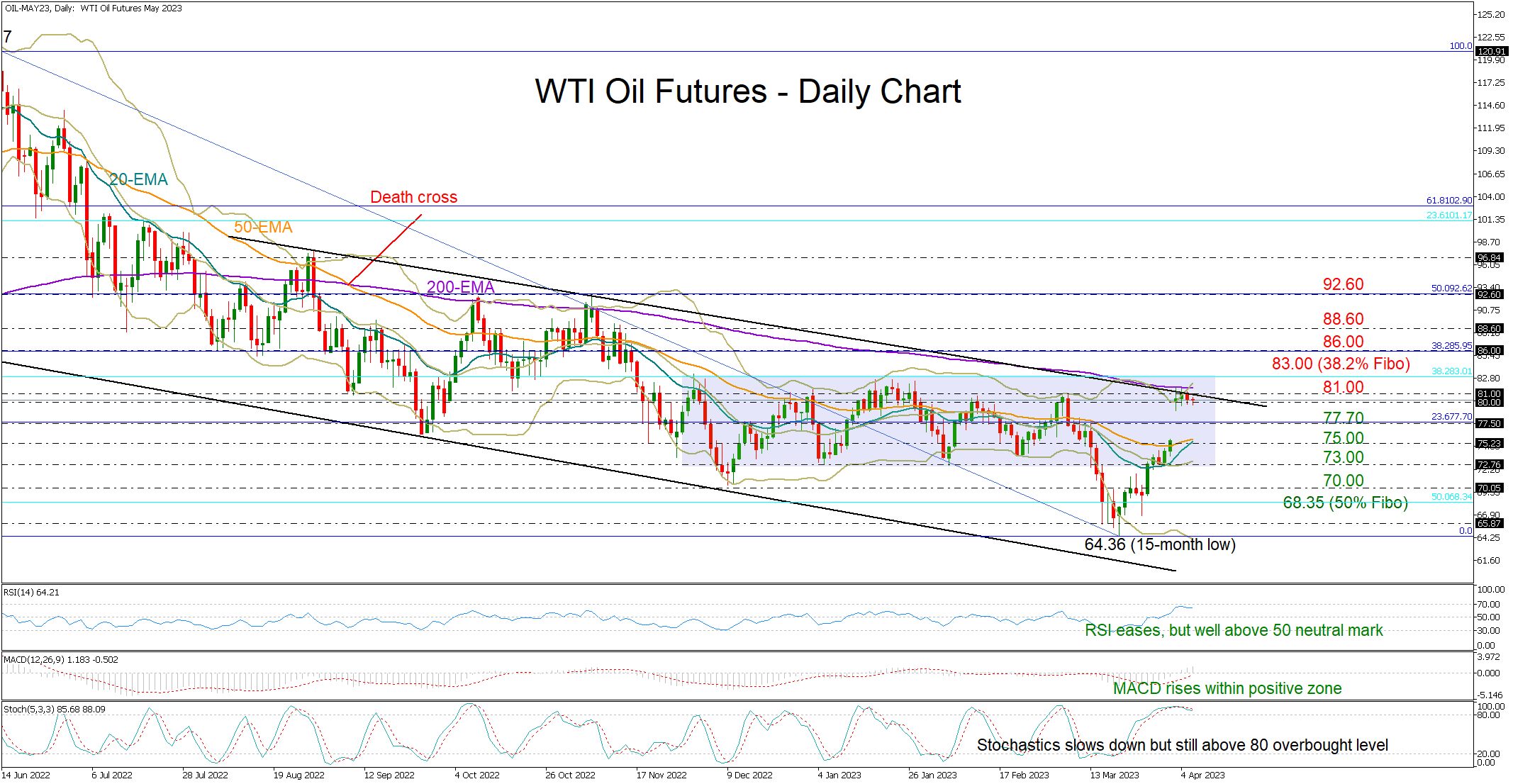
WTI oil futures have been tiptoeing sideways along the upper boundary of the seven-month-old bearish channel and within a tight range of $79.00-$81.00 so far this week.
The trend signals are still discouraging as the price has been struggling to post new higher highs above the $81.00-$83.00 ceiling since the start of the year, while the exponential moving averages (EMAs) have yet to print bullish crosses yet, endorsing the broad negative trajectory in the market.
On the other hand, the momentum indicators are in favor of the bulls. The slowdown in the stochastic oscillator is mirroring some weakness in buying appetite as the price is trading near the upper Bollinger band. Yet, the indicator has not slipped below its 80 overbought level yet, while the RSI and the MACD remain elevated within the bullish region, keeping the short-term bias on the positive side.
Should the bulls claim the $81.00-$83.00 zone, which encapsulates the 38.2% Fibonacci retracement of the 2020-2022 uptrend, the price could crawl up to the $86.00 barrier. An extension higher could find resistance near the $88.60 handle, while a steeper increase could head for the October-November bar of $92.60.
In the event sellers push below $80.00, support could initially develop around the former resistance zone of $77.70. Beyond that, the 20- and 50-day EMAs may attract some attention within the $75.00 territory before the focus turns again to the range’s bottom seen around 73.00.
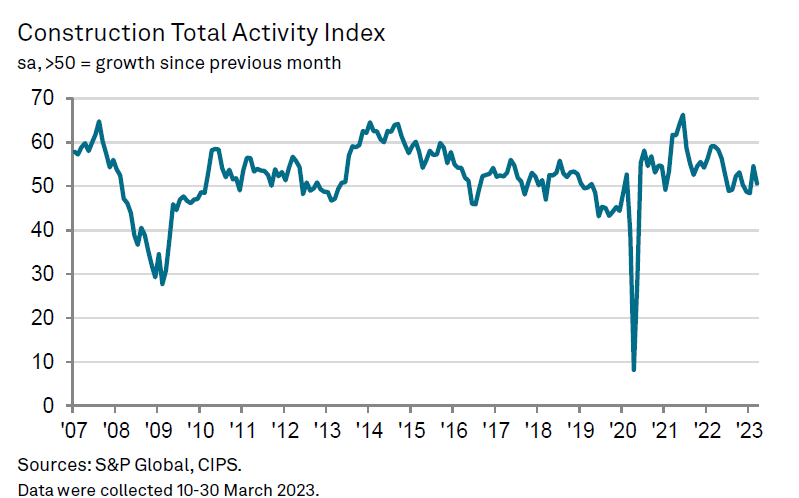
UK PMI construction dropped to 50.7, mixed fortunes in the sector
UK PMI Construction dropped from 54.6 to 50.7 in March, below expectation of 53.6, indicating a mixed picture for the industry.
Tim Moore, Economics Director at S&P Global Market Intelligence, explained that civil engineering and commercial projects saw a sustained rebound in output levels and improved tender opportunities, leading to the strongest rate of job creation in five months.
However, a sharp decline in house building raised concerns, as subdued demand and rising interest rates contributed to the steepest fall in housing activity in almost three years.
Despite these challenges, overall expectations for construction output in the coming year remain positive, with survey respondents citing improved availability of construction inputs and expectations for moderating purchasing price inflation.
USD/CAD Daily Outlook
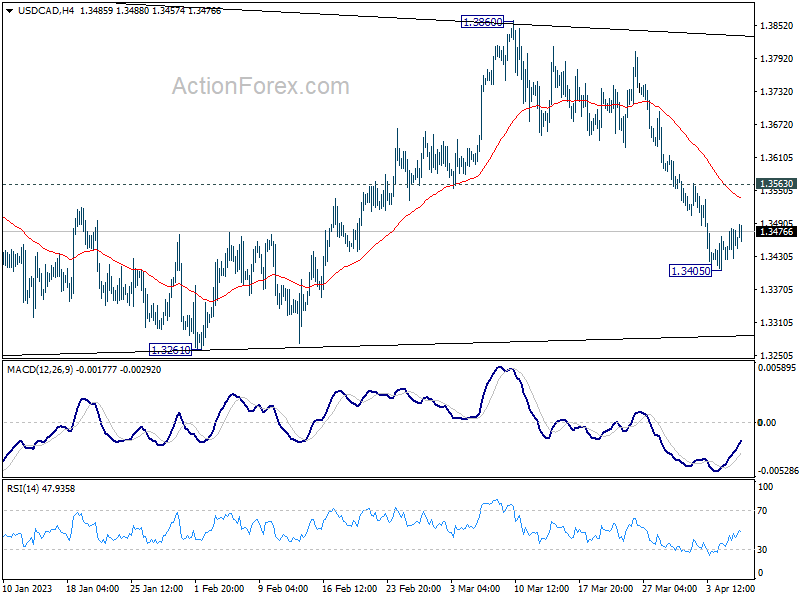
Daily Pivots: (S1) 1.3428; (P) 1.3455; (R1) 1.3485; More....
Intraday bias in USD/CAD remains neutral for consolidation above 1.3405 temporary low. Upside of recovery should be limited by 1.3563 resistance to bring another fall. Break of 1.3405 will resume the decline from 1.3860, as the third leg of the corrective pattern from 1.3976, to 1.3224/61 support zone. Strong support should be seen around there to bring rebound.
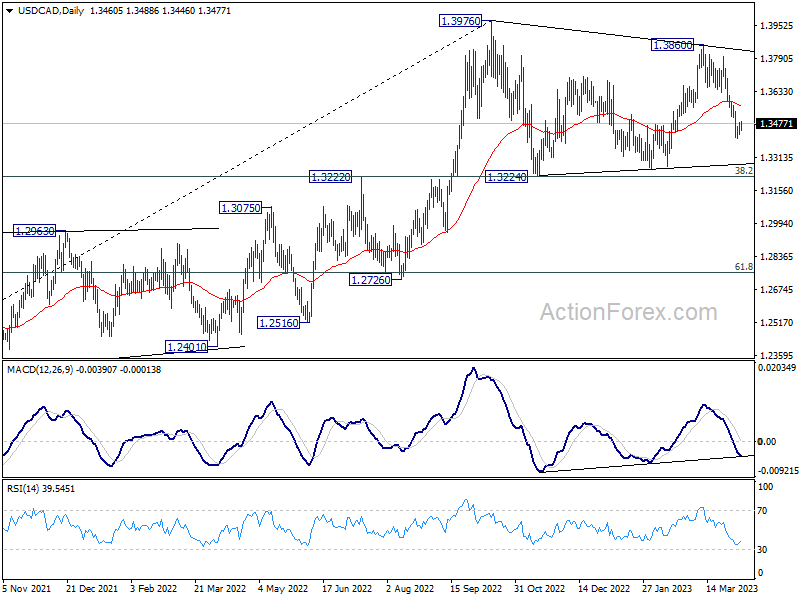
In the bigger picture, the up trend from 1.2005 (2021 low) is still in progress. Break of 1.3976 will confirm resumption and target 61.8% projection of 1.2401 to 1.3976 from 1.3261 at 1.4234. Firm break there will pave the way to long term resistance zone at 1.4667/89 (2016, 2020 highs). On the downside, sustained break of 55 week EMA (now at 1.3282) is needed to confirm medium term topping. Otherwise, outlook will remain bullish even in case of deep pull back.
AUD/USD Daily Report
Daily Pivots: (S1) 0.6674; (P) 0.6724; (R1) 0.6771; More...
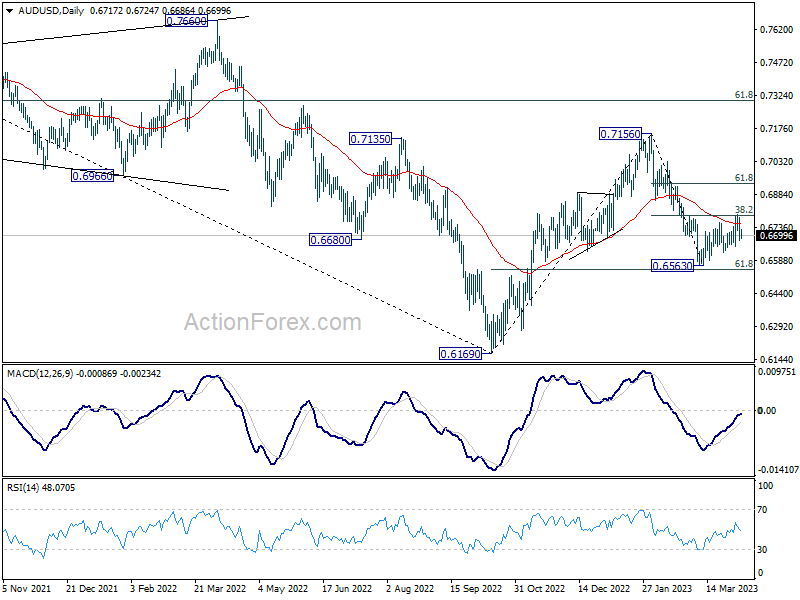
Intraday bias in AUD/USD remains neutral for the moment. On the upside, sustained break of 38.2% retracement of 0.7156 to 0.6563 at 0.6790 will pave the way to 61.8% retracement at 0.6929. However, break of 0.6650 support will turn bias back to the downside for 0.6563 low again.
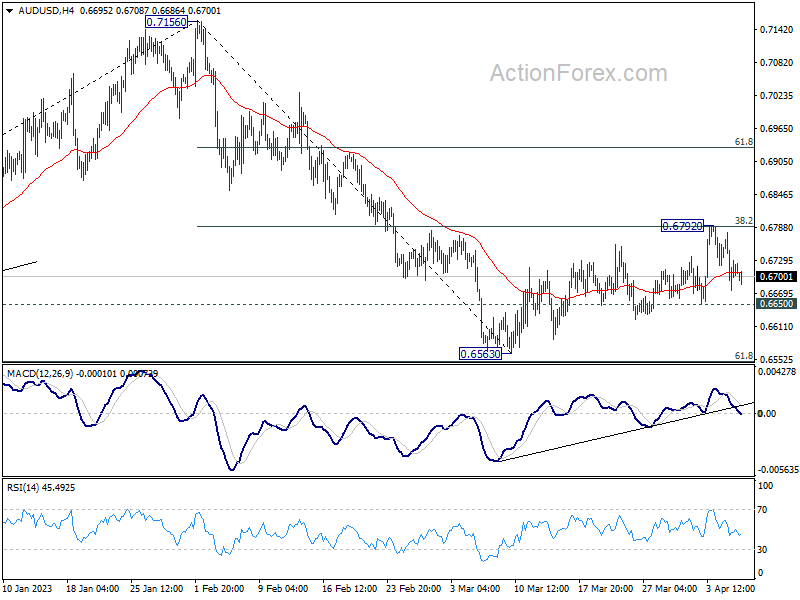
In the bigger picture, as long as 61.8% retracement of 0.6169 to 0.7156 at 0.6546 holds, the decline from 0.7156 is seen as a correction to rally from 0.6169 (2022 low) only. Another rise should still be seen through 0.7156 at a later stage. However, sustained break of 0.6546 will raise the chance of long term down trend resumption through 0.6169 low.
EUR/USD Daily Outlook
Daily Pivots: (S1) 1.0875; (P) 1.0923; (R1) 1.0954; More...
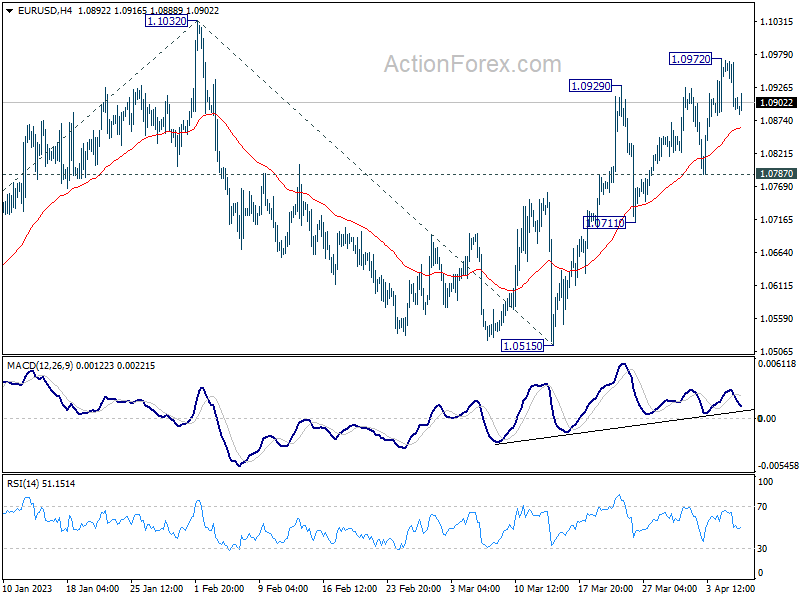
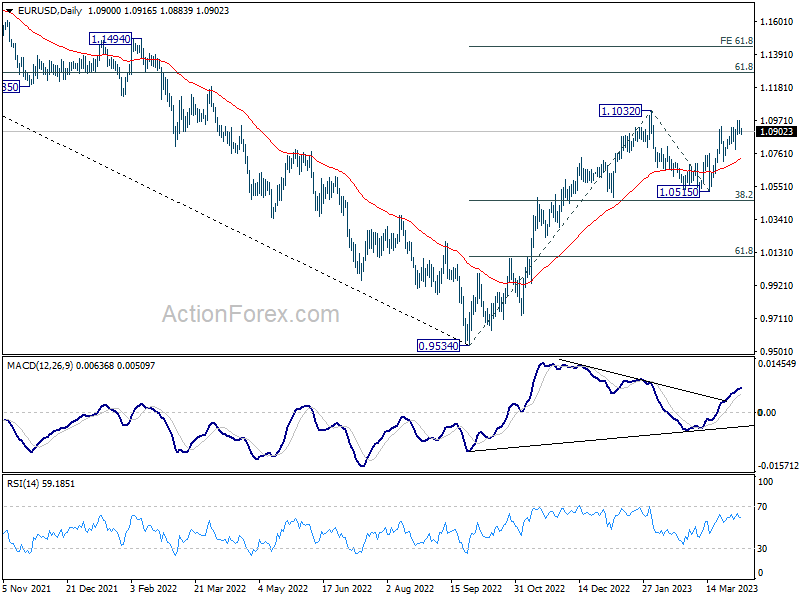
A temporary top was formed at 1.0972 and intraday bias in EUR/USD is turned neutral first. Further rise is expected as long as 1.0787 support holds. Above 1.0972 will resume the rally from 1.0515 to retest 01.1032 high. Firm break there will resume larger up trend from 0.9534. However, break of 1.0787 will turn bias back to the downside for 1.0711 support instead.
In the bigger picture, rise from 0.9534 (2022 low) is in progress with 38.2% retracement of 0.9534 to 1.1032 at 1.0460 intact. The strong support from 55 week EMA (now at 1.0625) was also a medium term bullish sign. Next target is 61.8% retracement of 1.2348 (2021 high) to 0.9534 at 1.1273. Sustained break there will solidify the case of bullish trend reversal and target 1.2348 resistance next (2021 high).
GBP/USD Daily Outlook
Daily Pivots: (S1) 1.2425; (P) 1.2469; (R1) 1.2506; More...
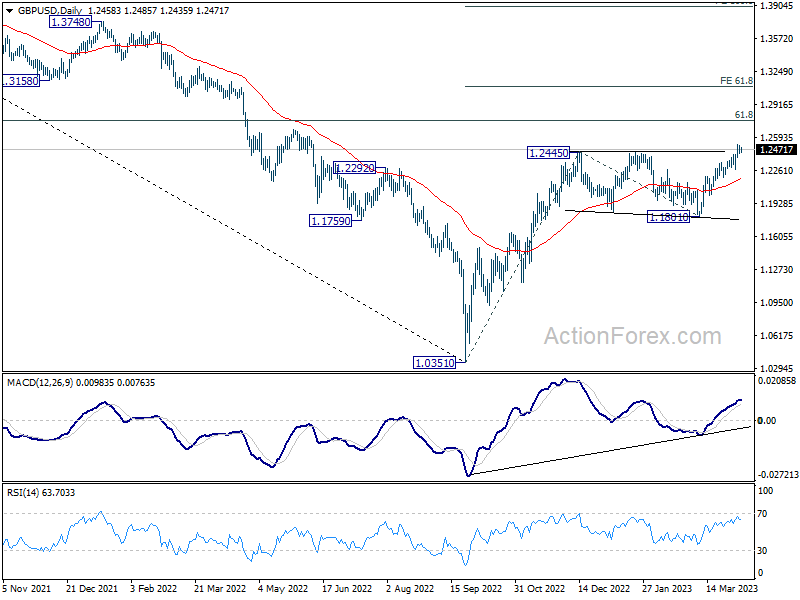
A temporary top is formed at 1.2524 and intraday bias in GBP/USD is turned neutral first. Some consolidations would be seen but downside of retreat should be contained above 1.2203 resistance turned support to bring another rally. Break of 1.2524 will target 1.2759 fibonacci level first. Firm break there will target 61.8% projection of 1.0351 to 1.2445 from 1.1801 at 1.3095.
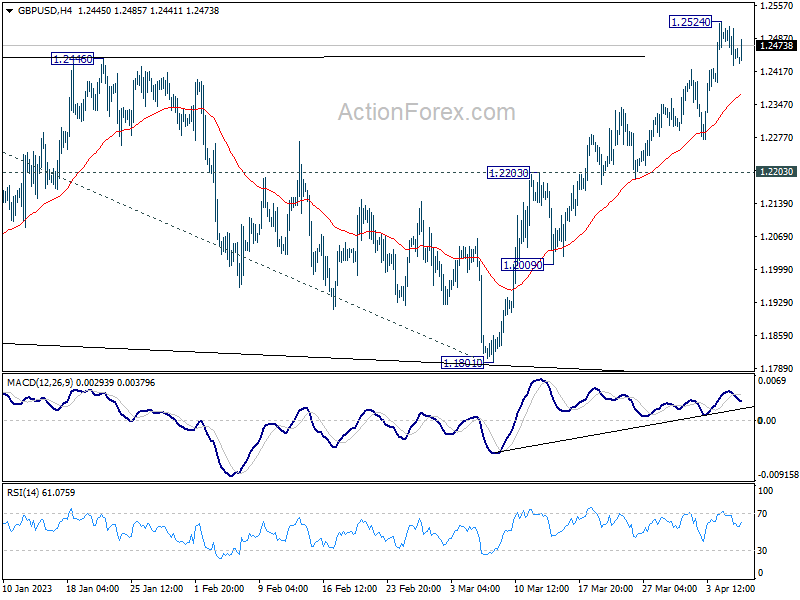
In the bigger picture, the rise from 1.0351 medium term term bottom (2022 low) is in progress for 61.8% retracement of 1.4248 (2021 high) to 1.0351 at 1.2759. Sustained break there will add to the case of long term bullish trend reversal. Further break of 61.8% projection of 1.0351 to 1.2445 from 1.1801 at 1.3095 could prompt upside acceleration to 100% projection at 1.3895. For now, this will remain the favored case as long as 1.1801 support holds, even in case of deep pull back.
USD/CHF Daily Outlook
Daily Pivots: (S1) 0.9029; (P) 0.9053; (R1) 0.9090; More...
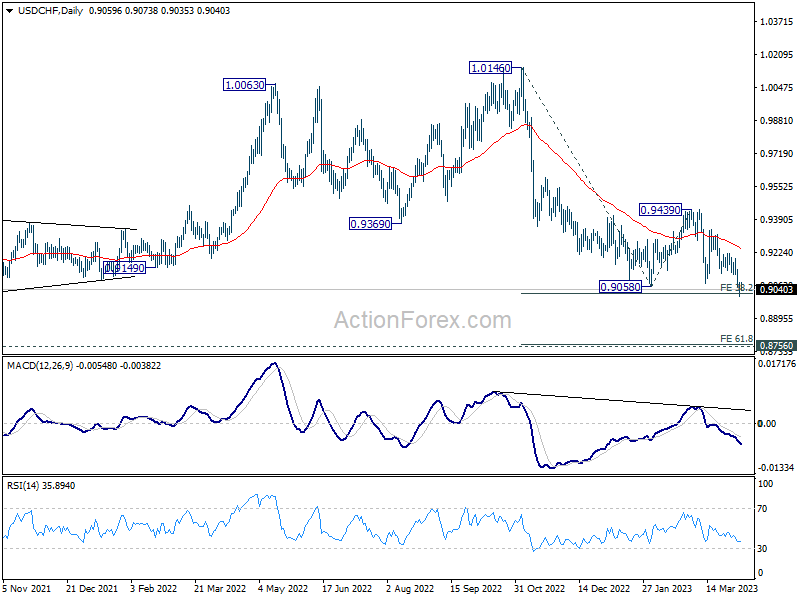
Intraday bias in USD/CHF remains on the downside for the moment. Sustained trading below 38.2% projection of 1.0146 to 0.9058 from 0.9439 at 0.9023 will extend the down trend from 1.0146 to 61.8% projection at 0.8767. On the upside, above 0.9099 minor resistance will turn intraday bias neutral and bring consolidations first, before staging another decline.
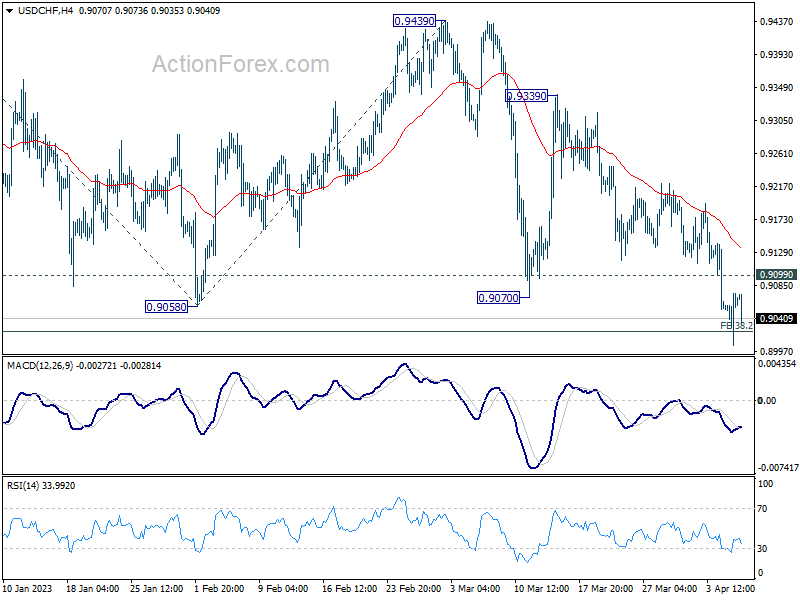
In the bigger picture, outlook will stay bearish as long as 0.9439 resistance holds, and fall from 1.1046 (2022 high) is still in progress. Prior rejection by 55 week EMA was a medium term bearish sign. Sustained of 0.9058 will resume such decline towards 0.8756 support (2021 low). But overall, this fall is still as a leg in the long term range pattern from 1.0342 (2016 high). So, downside should be contained by 0.8756 to bring reversal.
GBP/USD: Limited Dips Keep Larger Bulls Intact
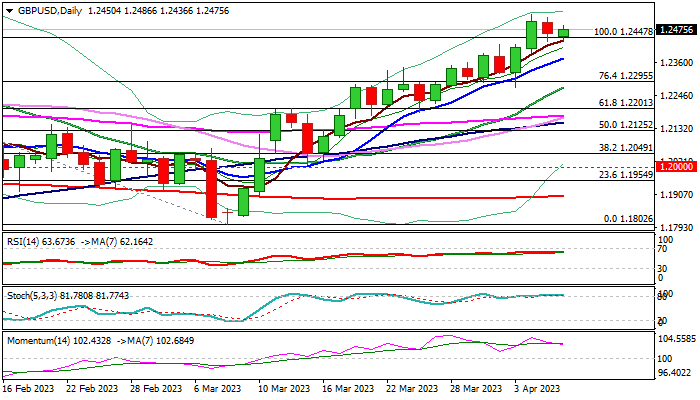
Cable regained traction in early Thursday’s trading, underpinned by better than expected UK housing data, reducing immediate risk of deeper pullback after Wednesday’s close in red.
The pair hit new multi-week high (1.2525) following break of key resistance at 1.2447 (Dec 14 / Jan 23) on Tuesday, but overbought conditions temporarily slowed bulls.
Broken 1.2447 barrier reverted to solid support which is so far holding and keeping larger bulls intact, despite initial signals of correction (overbought stochastic / fading bullish momentum on daily chart).
Sterling enjoys strong support from weakening dollar, hit by much weaker than expected data from the US labor and services sectors, which further soured sentiment and added to expectations that the Fed would slow the pace of policy tightening.
Markets eye US weekly jobless claims (today) and non-farm payrolls (Friday) for more direction signals, with lower volumes on Good Friday holiday, likely to increase market volatility.
Bulls look for weekly close above 1.2447 pivot to confirm signal of bullish continuation, which would expose targets at 1.2659/66 (May 2022 double-top) and 1.2759 (Fibo 61.8% of 1.4249/1.0348 fall) in extension.
Caution on firm break of 1.2447 support which would signal pullback and sideline immediate bulls.
Res: 1.2525; 1.2535; 1.2600; 1.2694
Sup: 1.2447; 1.2394; 1.2373; 1.2354
Gold Continues Higher
NZD/USD seeks support
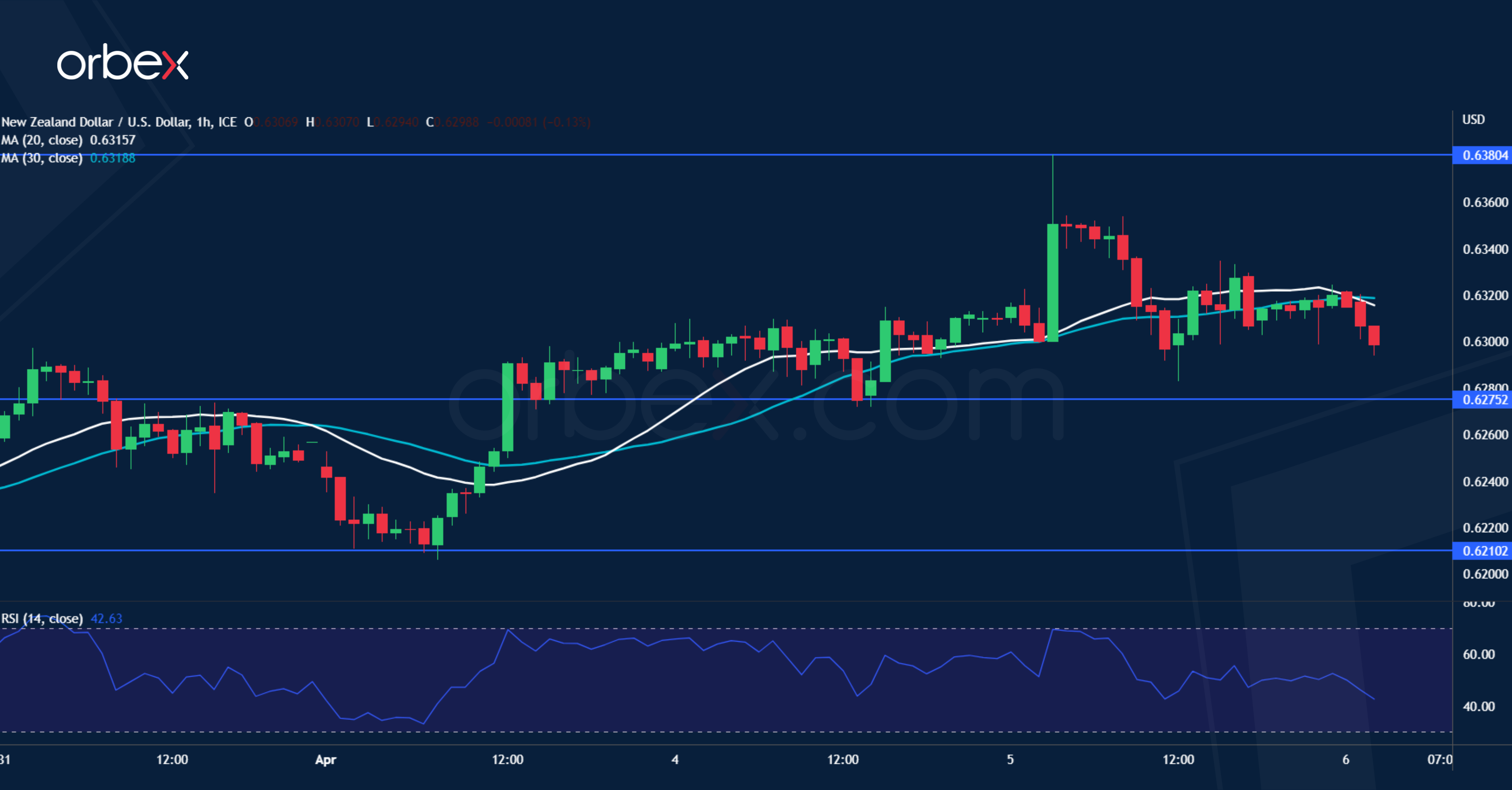
The New Zealand dollar jumped after an unexpected 50-basis point rate hike from the RBNZ. The latest surge came to a halt in the demand-turned-supply zone 0.6380-0.6390, suggesting that there is still strong enough selling pressure in spite of a choppy rally. Short-term buyers’ profit-taking has pulled the kiwi to 0.6275, a key support to keep the momentum going. Its breach would cause a revisit of 0.6210 on the 20- day SMA where a breakout could open the door to a bearish continuation in the medium-term.
XAU/USD aims at 13-month high
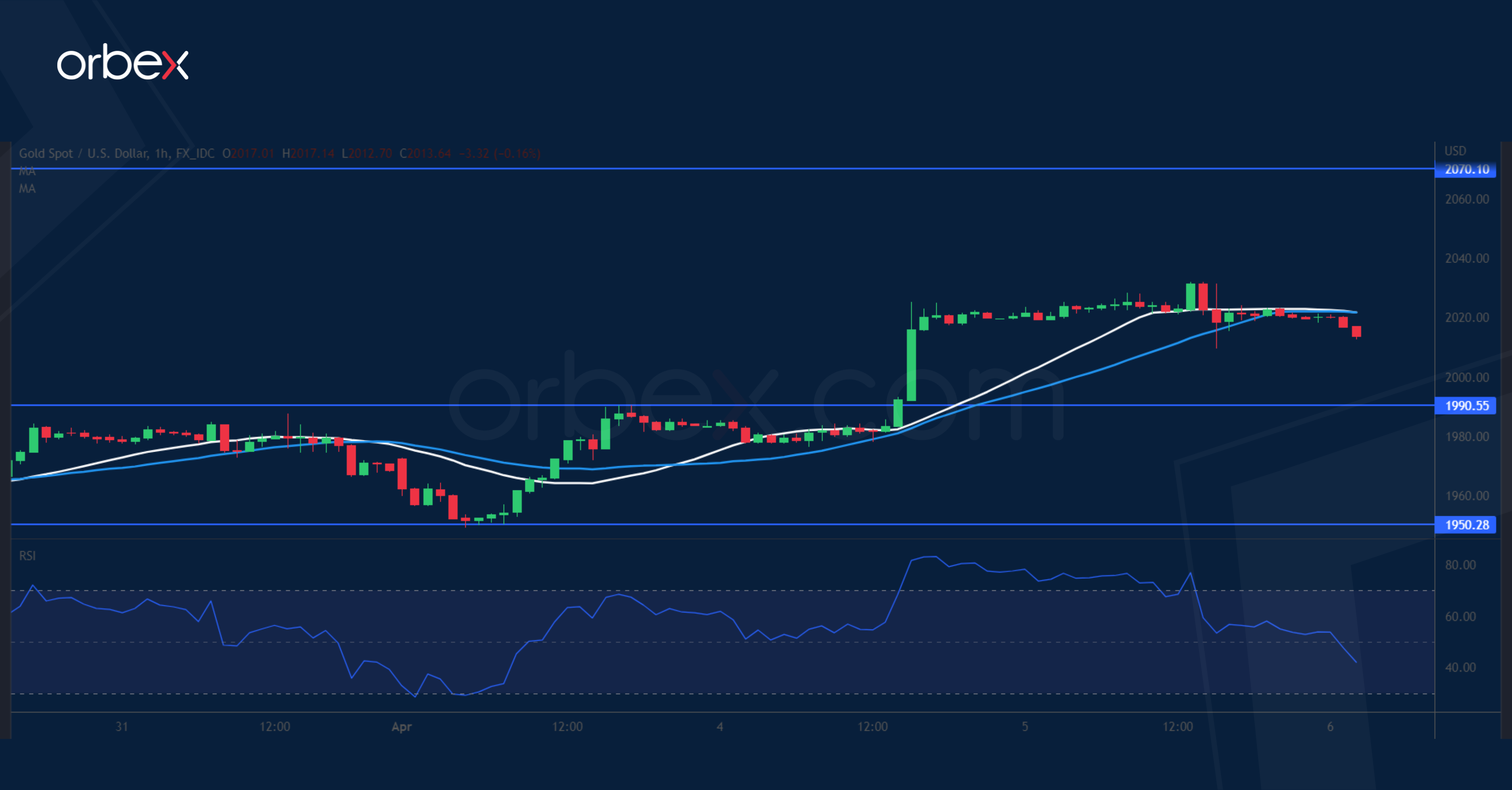
Safe haven gold rises on worries of an economic slowdown. Following a brief consolidation, a pop above the psychological level of 2000 started a new round of rally. As sentiment remains overwhelmingly bullish, the March 2022 high of 2070 would be the next target. The RSI’s overbought situation may temporarily drag the price down but more buyers could be looking to stake in near the previous supply zone around 1990-2000. 1950 on the 20-day SMA would be the bulls’ second line of defence in case of a deeper pullback.
UK 100 consolidates gains
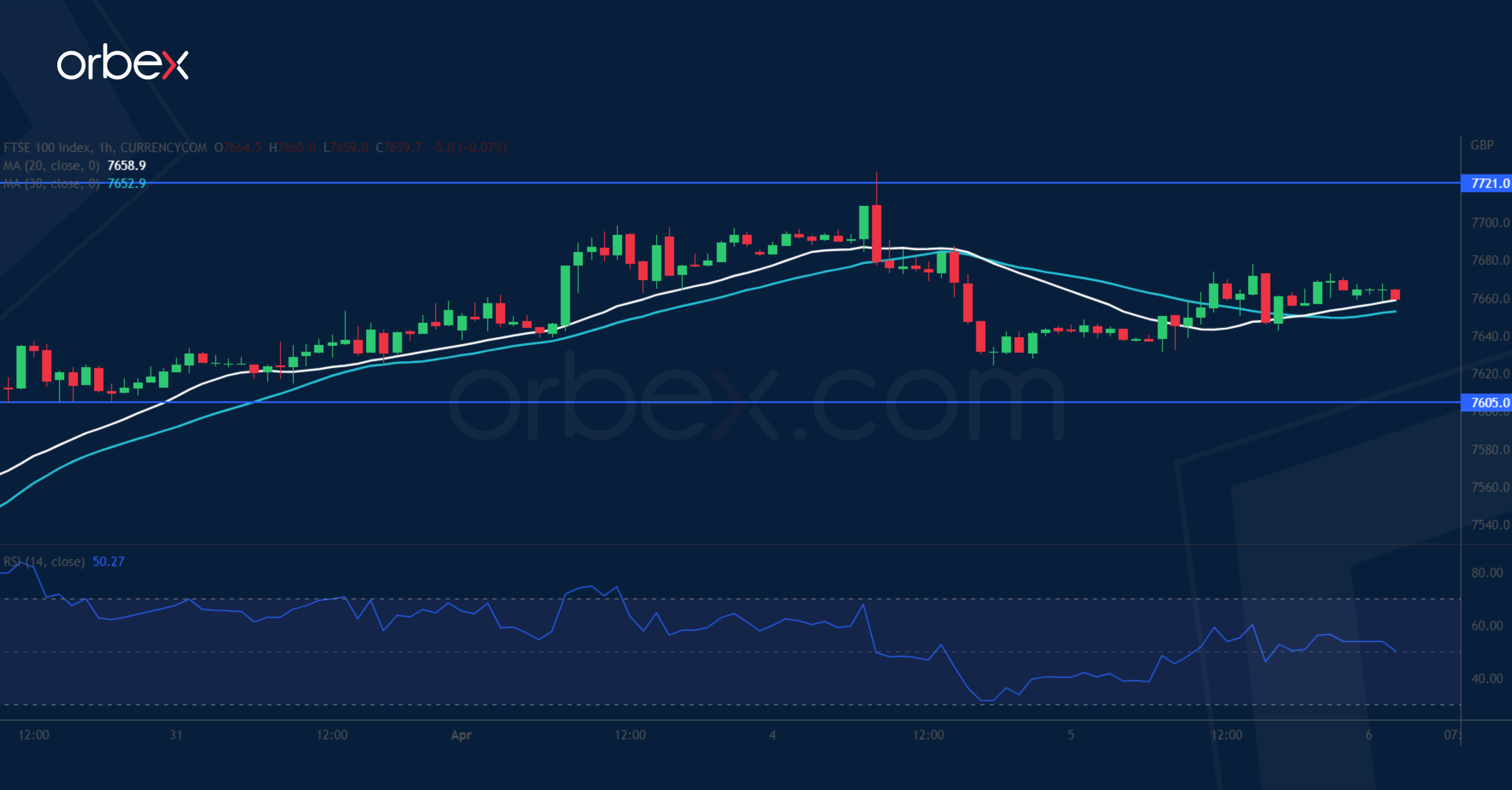
The FTSE 100 finds support from upbeat services PMI in March. As the index makes its way back to the previous daily support of 7770, growing resistance could be felt with a combination of profit-taking and renewed selling. 7720 is the immediate hurdle as the price turns south. 7605 is the closest level to see if the bulls will step in. Failing that, 7500 at the base of the breakout rally would be a major floor to test their commitment. On the upside, a close back above 7720 may resume the recovery above 7800.
Markets Aren’t Too Worried About Future Inflation Risks
Markets
Three in a row. Yesterday’s scenario on core bond markets was another repeat from Monday and Tuesday: consolidation during European dealings, before taking a step higher after early US eco releases. ADP employment increased by 145k in March following an upwardly revised 261k in February, but fell short of expectations (210k). After the ADP report, markets also had to stomach a disappointing services ISM (51.2 from 55.1 vs 54.4 expected). Details showed a broad-based setback. Business activity fell slightly from 56.3 to 55.4, but big declines in new orders (52.2 from 62.6) and new export orders (43.7 from 61.7) don’t bode well for coming months. The backlog of orders fell below the 50 boom/bust mark for the first time since end 2020 (48.5 from 52.8). Employment growth slowed from 54 to 51.3. Supplier deliveries (45.8 from 47.6) fell to the lowest level since 2009 in a sign that supply chain bottlenecks are something from the past. Moderating demand and smoother supply chains pull prices paid from 65.6 to 59.5, the slowest pace of price increases since July 2020. The loss of momentum added to market pressure that the Fed is probably done with tightening. A full percentage point of rate cuts is discounted by January 2024, reflecting markets’ bearish outlook on the US economy with financial stability risks adding to uncertainty. We stick to the view that the Fed will very unlikely follow such path given the inflation outlook. Giving in to such easing pressure now risks becoming the bigger policy mistake, allowing inflation to claw back in the second half of the year. Markets aren’t too worried about future inflation risks and bank on short term economic support from the Fed, something they got used to over the past decade. US Treasury yields ended 4.5 bps (2-yr) to 1.8 bps (5-yr) lower. Intraday swings had been larger, but for the first time this week yields managed to close some bps above intraday lows. This might point to some fatigue with technical support levels at play as well. The US 2-yr yield tested the March lows between 3.55% and 3.71% but avoided a new closing low (close at 3.78%). The US 5-yr yield tested the 3.3%/3.23% support zone before closing at 3.37%. The US 10-yr yield tested 3.29%/3.28% support and closed at 3.31%. If anything, it shows that volatility remains very high. It also means that above-mentioned support zones are still at risk of giving away with jobless claims (today), payrolls (tomorrow) and US CPI inflation (Wednesday) lining up. Erring on the dovish side of expectations going into the Easter weekend might be another motive. The jury is still out with Fed members at the moment not providing sufficient counterweight. We don’t expect them to call for many more rate hikes, but at least to put the notion of rate cuts to bed. Recall that the March dot plot (Mar 22; after SVB turmoil) showed unanimity on keeping rates stable and even above 5% (17 out of 18) for the remainder of the year. US stock markets for the first time this week lost ground despite lower yields with doom and gloom scenario’s at play. Bearish engulfing patterns suggest more downside. The dollar profited in the same vein with EUR/USD back below 1.09 from an open around 1.0950.
News and views
The National Bank of Poland kept its policy rate unchanged yesterday at 6.75%. The NBP sees weakening of activity around the world and in Poland even as unemployment remains low. Polish inflation remained elevated in March but decreased to 16.2% Y/Y (from 18.4%). Lower commodity prices, a slowdown in PPI, weakening economic activity and the effects of earlier strong monetary tightening suggest a further decline in inflation in coming months. The NBP repeats its previous assessment that the decrease in inflation would be faster if it were to be supported by an appreciation of the zloty consistent with the fundamentals of the Polish economy. It may intervene in the FX market to limit fluctuations of the zloty that are inconsistent with the direction of monetary policy. NBP governor Glapinski gives a press conference this afternoon. PLN underperformed HUF and CZK, closing near EUR/PLN 4.687
The Reserve Bank of India this morning surprisingly left its policy rate unchanged at 6.5% instead of hiking by 25 bps. The RBI is ready to take further action against inflation if needed. Its policy stance is still labelled as ‘withdrawal of accommodation’. The central bank raised its policy rate by 250 bps this cycle and wants to evaluate the impact. Inflation is judged to moderate from 6.44% in February to 5.2% in the FY starting in April (inflation target 2%-6%). The RBI slightly raised its growth forecast to 6.5% from 6.4%, but risks have increased after recent events. The Indian rupee initially weakened slightly, but currently trades little changed near USD/INR 81.9.