

Sample Category Title
RBA holds cash rate steady, maintains tightening bias
RBA has decided to keep the cash rate target unchanged at 3.60% amid ongoing uncertainty, but maintained its tightening bias. The central bank stated that some further tightening might be necessary, depending on developments in the global economy, household spending, inflation, and the labor market outlook.
In the official statement, RBA noted, "The Board expects that some further tightening of monetary policy may well be needed to ensure that inflation returns to target."
RBA's central forecast anticipates inflation to decline over the next couple of years, reaching around 3% by mid-2025. The statement highlighted that "medium-term inflation expectations remain well anchored, and it is important that this remains the case."
Despite the slowing growth in the Australian economy, labor market remains very tight. However, as economic growth slows, RBA expects unemployment to increase. The Board remains alert to the risk of a "price-wages spiral", given the limited spare capacity in the economy and the historically low rate of unemployment.
(RBA) Statement by Philip Lowe, Governor: Monetary Policy Decision
At its meeting today, the Board decided to leave the cash rate target unchanged at 3.60 per cent and the interest rate on Exchange Settlement balances unchanged at 3.50 per cent.
This decision follows a cumulative increase in interest rates of 3½ percentage points since May last year. The Board recognises that monetary policy operates with a lag and that the full effect of this substantial increase in interest rates is yet to be felt. The Board took the decision to hold interest rates steady this month to provide additional time to assess the impact of the increase in interest rates to date and the economic outlook.
Global inflation remains very high. In headline terms it is moderating, although services price inflation remains high in many economies. The outlook for the global economy remains subdued, with below-average growth expected this year and next. The recent banking system problems in the United States and Switzerland have resulted in volatility in financial markets and a reassessment of the outlook for global interest rates. These problems are also expected to lead to tighter financial conditions, which would be an additional headwind for the global economy.
The Australian banking system is strong, well capitalised and highly liquid. It is well placed to provide the credit that the economy needs.
A range of information, including the monthly CPI indicator, suggests that inflation has peaked in Australia. Goods price inflation is expected to moderate over the months ahead due to global developments and softer demand in Australia. Meanwhile, rents are increasing at the fastest rate in some years, with vacancy rates low in many parts of the country. The prices of utilities are also rising quickly. The central forecast is for inflation to decline this year and next, to around 3 per cent in mid-2025. Medium-term inflation expectations remain well anchored, and it is important that this remains the case.
Growth in the Australian economy has slowed, with growth over the next couple of years expected to be below trend. There is further evidence that the combination of higher interest rates, cost-of-living pressures and a decline in housing prices is leading to a substantial slowing in household spending. While some households have substantial savings buffers, others are experiencing a painful squeeze on their finances.
The labour market remains very tight. The unemployment rate is at a near 50-year low and underemployment is also low. Many firms continue to experience difficulty hiring workers, although some report an easing in labour shortages and the number of vacancies has declined a little. As economic growth slows, unemployment is expected to increase.
Wages growth is continuing to increase in response to the tight labour market and higher inflation. At the aggregate level, wages growth is still consistent with the inflation target, provided that productivity growth picks up. The Board remains alert to the risk of a prices-wages spiral, given the limited spare capacity in the economy and the historically low rate of unemployment. Accordingly, it will continue to pay close attention to both the evolution of labour costs and the price-setting behaviour of firms.
The Board's priority is to return inflation to target. High inflation makes life difficult for people and damages the functioning of the economy. And if high inflation were to become entrenched in people's expectations, it would be very costly to reduce later, involving even higher interest rates and a larger rise in unemployment. The Board is seeking to return inflation to the 2–3 per cent target range while keeping the economy on an even keel, but the path to achieving a soft landing remains a narrow one.
The Board expects that some further tightening of monetary policy may well be needed to ensure that inflation returns to target. The decision to hold interest rates steady this month provides the Board with more time to assess the state of the economy and the outlook, in an environment of considerable uncertainty. In assessing when and how much further interest rates need to increase, the Board will be paying close attention to developments in the global economy, trends in household spending and the outlook for inflation and the labour market. The Board remains resolute in its determination to return inflation to target and will do what is necessary to achieve that.
SNB Schlegel reiterates commitment to price stability and willingness to intervene
SNB Vice Chairman Martin Schlegel emphasized the central bank's commitment to price stability in an interview with Swiss broadcaster SRF yesterday. He stated, "Our mandate is crystal clear, and that is price stability," adding that SNB will do everything possible to bring inflation back to the target range of 0 to 2%.
Although Schlegel refrained from making any forecasts, he noted that SNB's inflation forecasts are higher now than they were in December, adding that the central bank is prepared to "continue to raise interest rates" if necessary.
Schlegel also addressed SNB's willingness to sell foreign currencies in order to strengthen Swiss franc. He said, "We said quite clearly at the last assessment that we are also prepared to sell foreign currencies, to actually strengthen the franc."
He revealed that SNB had already sold CHF 27B worth of foreign currencies in the last quarter, asserting that the bank will continue to monitor the exchange rate and intervene if necessary.
Fed Cook weighs economic momentum against headwinds
In a speech yesterday, Fed Governor Lisa Cook discussed her considerations for the future path of monetary policy, weighing the implications of stronger economic momentum against potential headwinds from recent banking developments.
Cook explained, "On the one hand, if tighter financing conditions restrain the economy, the appropriate path of the federal funds rate may be lower than it would be in their absence. On the other hand, if data show continued strength in the economy and slower disinflation, we may have more work to do."
Regarding Fed's strategy on rate hikes, Cook mentioned that FOMC has been raising rates in smaller increments, aiming for a sufficiently restrictive monetary policy to return inflation to 2% over time. She emphasized the benefit of taking smaller steps, as it allows Fed to observe economic and financial conditions and evaluate the cumulative effects of their policy actions.
Cook also touched on FOMC's recent adjustments to its forward guidance on the path of the policy rate in its March statement. The committee shifted from anticipating "ongoing increases" to stating that "some additional policy firming may be appropriate." Cook believes this communication is suitable as Fed seeks to calibrate monetary policy amid uncertainty about the economic outlook.
GBP/USD Climbs Higher As Bulls Take Control
Key Highlights
- GBP/USD started a steady increase above the 1.2300 resistance.
- A key rising channel is forming with support near 1.2300 on the 4-hours chart.
- EUR/USD also climbed higher above the 1.0850 resistance zone.
- Crude oil price remained strong above the $79.20 support zone.
GBP/USD Technical Analysis
The British Pound started a major increase above the 1.2200 resistance zone against the US Dollar. GBP/USD climbed higher above the 1.2300 resistance zone to move into a positive zone.
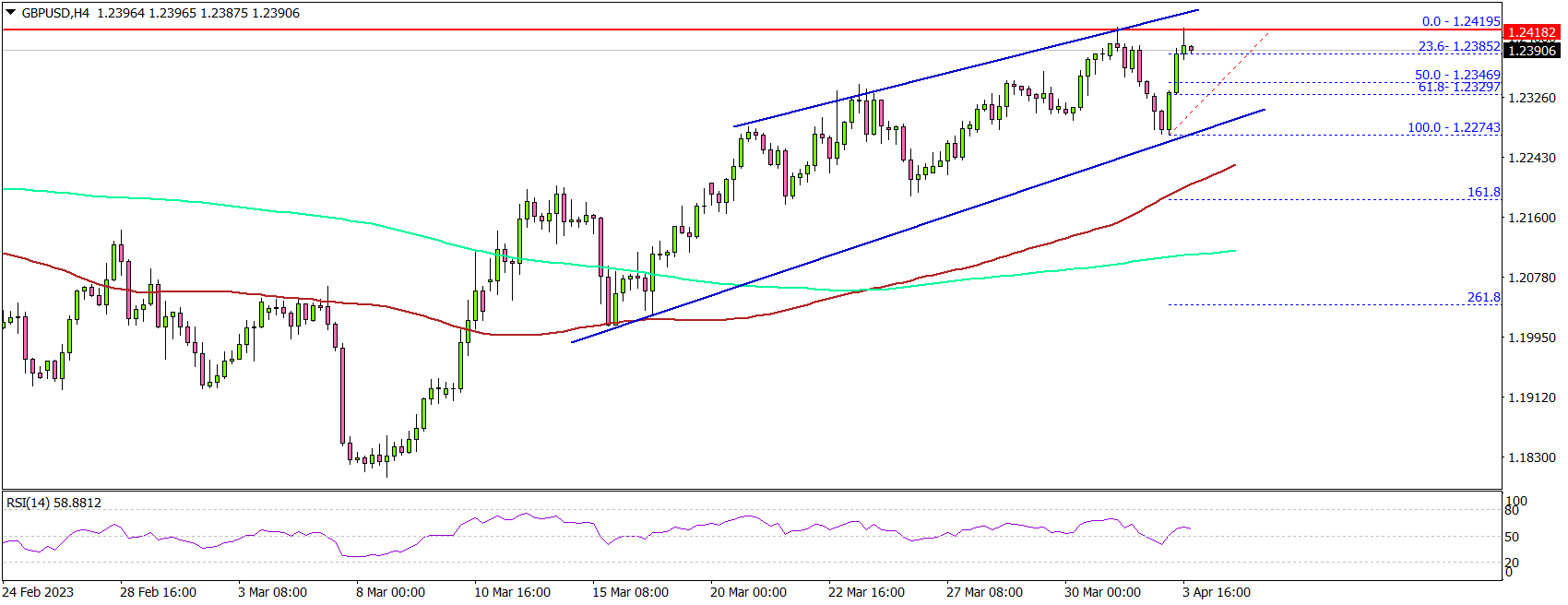
Looking at the 4-hours chart, the pair settled well above the 1.2300 level, the 100 simple moving average (red, 4-hours), and the 200 simple moving average (green, 4-hours).
The pair even spiked above the 1.2400 level. It seems like the pair is well supported for more gains above the 1.2400 level. The next key resistance is near the 1.2500 zone.
A clear move above the 1.2500 resistance might send the pair towards the 1.2620 zone. Any more gains might send the pair towards 1.2700.
On the downside, an immediate support is near the 1.2350. The next major support is near the 1.2320 level and the channel zone, below which the pair might test the 100 simple moving average (red, 4-hours).
Looking at oil price, the price gained pace above the $80 level and there are chances of more upsides in the near term.
Economic Releases
- US Factory Orders for Feb 2023 (MoM) - Forecast -0.5%, versus -1.6% previous.
USDCAD Wave Analysis
- USDCAD under the bearish pressure
- Likely to fall to support level 1.3300
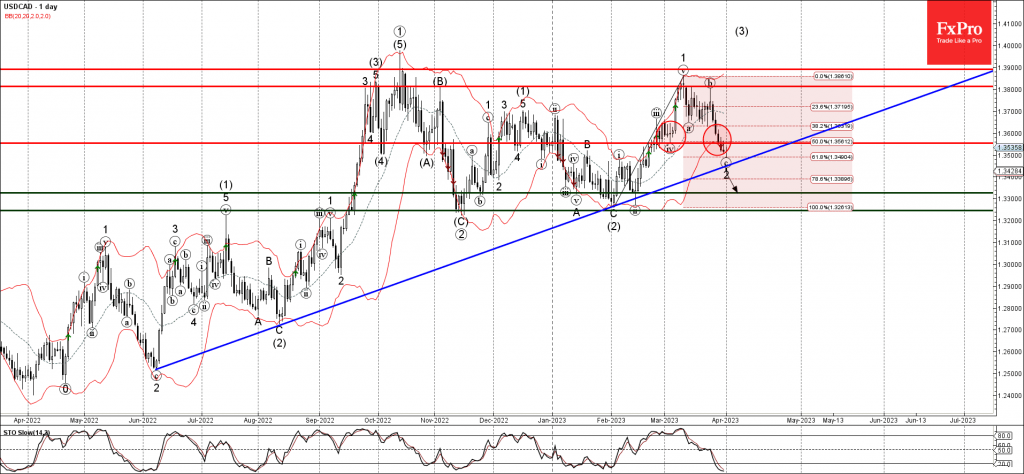
USDCAD under the bearish pressure after the price broke the key support level 1.3555 (which has been reversing the price from the middle of 2021, as can be seen below), intersecting with the 50% Fibonacci correction of the upward impulse from the start of February.
The price then broke the long-term support trendline from June – which accelerated the active ABC correction 2.
USDCAD can then be expected to fall further toward the next support level 1.3300 (base of the Morning Star from the middle of February).
EURAUD Wave Analysis
- EURAUD reversed from resistance level 1.6235
- Likely to fall to support level 1.5880
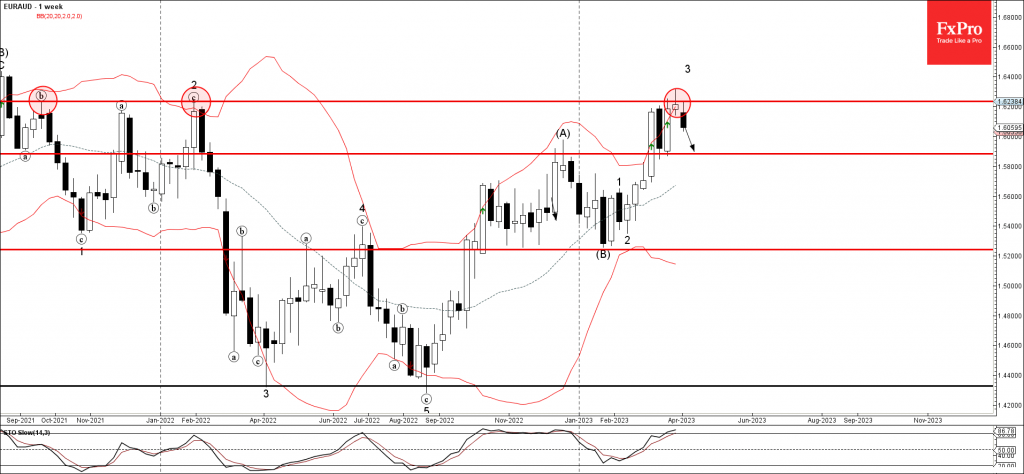
EURAUD recently reversed down from the major resistance level 1.6235 (which has been reversing the price from the middle of 2021, as can be seen below)
The resistance level 1.6235 was strengthened by the upper weekly and the daily Bollinger Band.
Given the overbought weekly Stochastic indicator, EURAUD can then be expected to fall toward the next support level 1.5880 (former resistance from the end of 2022).
China’s Rebound and Energy Prices
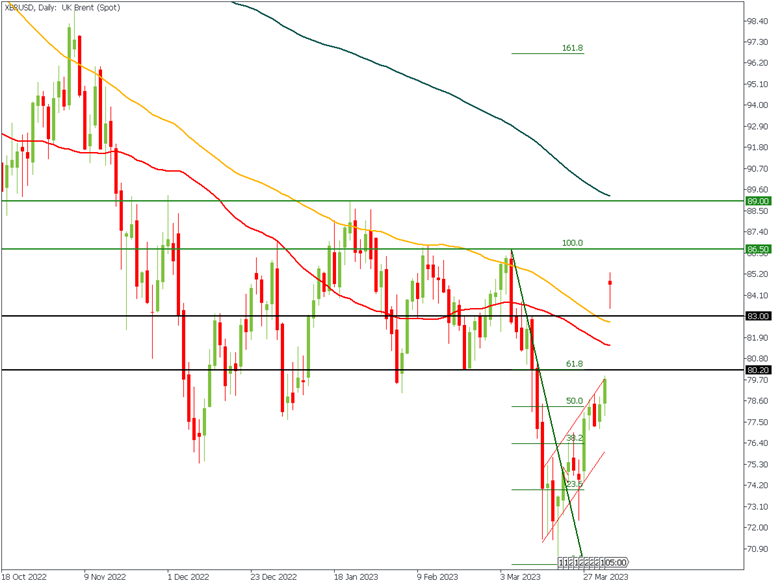
In March Brent crude oil has once again nosedived below $80, levelling all the systematic price growth from December 2022 to March 2023 in one fell swoop.
There are no fundamental reasons severe enough for such a substantial drop in prices. However, fears of a possible recession in the financial sector, which could spill over to other economic sectors and lead to a global slowdown, push energy prices down.
Where is the promised expansion of China’s economy? This article attempts to answer the question.
What happened with oil supply and demand?
According to the latest IEA report, oil supply has increased only slightly. OPEC+ added about 170,000 bpd.
As a result oil supply has jumped to 830,000 bpd, mainly thanks to the US and Canada. IEA expectations for oil production this year remain optimistic at +1.6M bpd.
US commercial crude oil inventories have risen to 480.1 mb. The Strategic Petroleum Reserve hasn't changed and remains at 371.6 mb.
The US has been draining its storage facilities for 1.5 years - from June 2020, till December 2022. With the cold winter, energy shortages, and the acute period of overcoming dependence on Russian oil and gas over, the realization that the US will not be left with no oil at all has ushered the market into a new phase.
Unexpected OPEC+ decision
At the beginning of April, some OPEC+ countries decided to cut oil production by approximately 1.5M bpd. Russia and Saudi Arabia accounted for the most significant reductions by 500K bpd each.
The OPEC was in no hurry to enter a market with supply restrictions. Now mostly, Saudi Arabia gave a signal to the future interference. For OPEC, the most comfortable price is around $90-$100. So, in the worst-case scenario, if prices do not stabilize, OPEC will enter the arena once more.
In reaction to the OPEC+ decision, the price instantly jumped to $85 and broke several resistance levels, including the cluster between $80 and $80.50 and then $83.
For a short-term trader, it’s clear that the price may soon close this gap, but from the fundamental point of view, we may face a bullish reversal.
The consequences of oil price growth
Everything has its price. The growth in oil prices may lead to the following consequences:
- Inflation growth. It means that the Fed won’t have room for further rate hikes.
- EURUSD decreasing
- American stock markets decline. Here it’s better to pay attention to energy companies because high oil prices may positively impact their financial results.
How much will China take?
Judging by the external macroeconomic backdrop, China's economy is starting to pick up gradually:
- The February PMI showed a substantial gain of 52.6 points, and the PMI for the services sector went above the 56-point level.
- Industrial production also started rising in February (+2.4% VS +1.3% in January).
- After several months of decline, retail sales showed strong growth of 3.5% for the first time.
The Energy Information Administration expects China's oil demand to grow by 730,000 b/d this year.
However, concerns have been raised that China continues to actively build up its oil reserves, importing mostly Russian grades at a reasonably high discount - imports from Russia to China amount to about 1.94M bpd.
Consequently, most analysts still prefer to lower the average oil price in 2023.
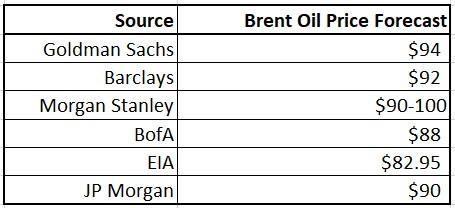 Oil market summary
The price value in March should be considered only a market reaction to an unexpectedly surfaced black swan in the form of a bank collapse - a sort of energy market RISK-OFF.
The probability of growth resumption and price stabilization at $80-90 is relatively high. But, given the fullness of Chinese storage facilities, the prospect of reaching $100 per barrel remains murky.
ISM Manufacturing Index Shows Sector Continues to Contract
The March ISM Manufacturing Index registered 46.3, well short of expectations calling for a 48.0 print. The index fell 1.4 percentage points (pp) from February's reading of 47.7.
New orders and new export orders fell 2.7 pp and 2.4 pp, respectively, to 44.3 and 47.6.
The backlog of orders sub-index fell to 43.9, down 1.2 pp from February's 45.1 print.
The production index rose 0.5 pp to 47.8, while the employment index edged down another 2.2 pp to 46.9.
The supplier deliveries sub-index fell to 44.8 from 45.2 in February – the lowest reading since March 2009. Amid cooling demand and falling raw material prices, the prices index pulled back 2.1 pp to 49.2 in March – indicating falling raw materials prices.
Six of 18 manufacturing industries reported growth in March. The industries reporting growth are Printing & Related Support Activities; Miscellaneous Manufacturing; Fabricated Metals Products; Petroleum & Coal Products; Primary Metals; and Machinery.
Key Implications
Another tough month for the manufacturing sector – albeit one that was expected. As the Fed keeps borrowing costs high to fight inflation, interest rate sensitive goods are bearing the brunt of the demand reduction. Moreover, as the hangover from the pandemic goods buying binge slowly wears off, shifting consumer preferences continue to weigh on goods demand.
Unfortunately for the manufacturing sector, the outlook for the rest of the year doesn't look much better. Recession jitters came out in force early in March as turmoil in the banking sector rattled markets. Looking forward, we expect consumer demand for durable goods to begin to fall, weighing on the sector overall. The one silver lining is the ongoing improvement on supply chains may help relieve the pent-up demand in the automotive sector over the coming year.