Sample Category Title
USD/CHF Mid-Day Outlook
Daily Pivots: (S1) 0.9129; (P) 0.9156; (R1) 0.9192; More...
Intraday bias in USD/CHF is turned neutral again with breach of 0.9205 minor resistance. Overall outlook is unchanged that consolidation pattern from 0.9058 could extend further. But outlook remains bearish as long as 0.9474 fibonacci level holds. Break of 0.9058 to resume the larger down trend from 1.1046 is expected at a later stage.
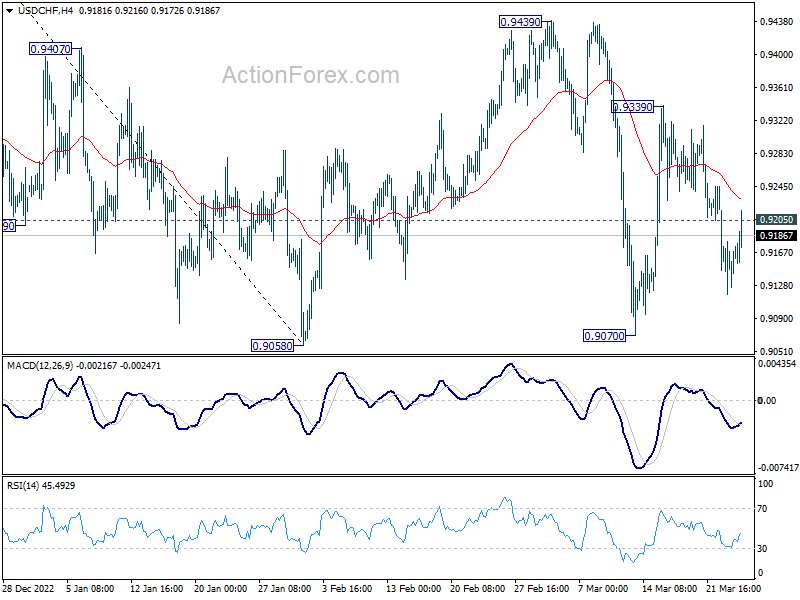
In the bigger picture, fall from 1.1046 (2022 high) should still be in progress with 38.2% retracement of 1.0146 to 0.9058 at 0.9474 intact. Prior rejection by 55 week EMA was a medium term bearish sign. Break of 0.9058 will resume such decline towards 0.8756 support (2021 low). But overall, such fall is still as a leg in the long term range pattern from 1.0342 (2016 high). So, downside should be contained by 0.8756 to bring reversal.
USD/JPY Mid-Day Outlook
Daily Pivots: (S1) 130.23; (P) 130.94; (R1) 131.57; More...
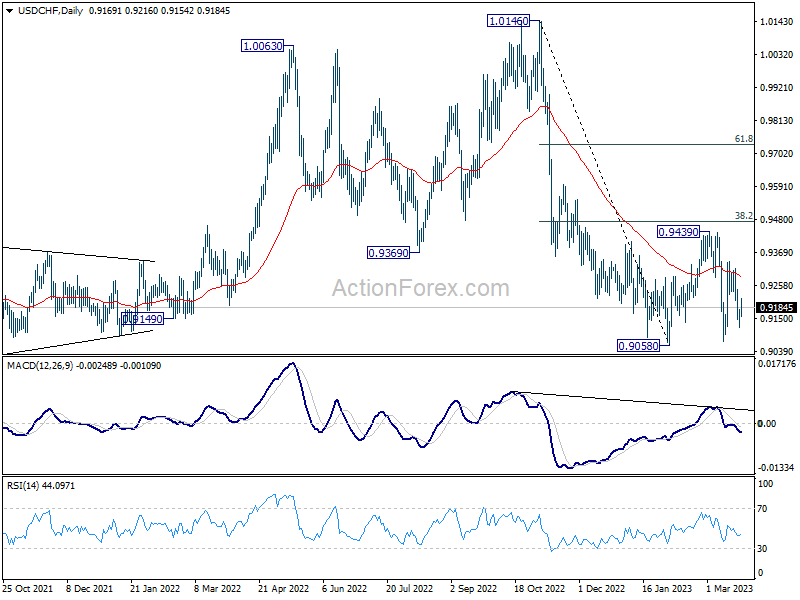
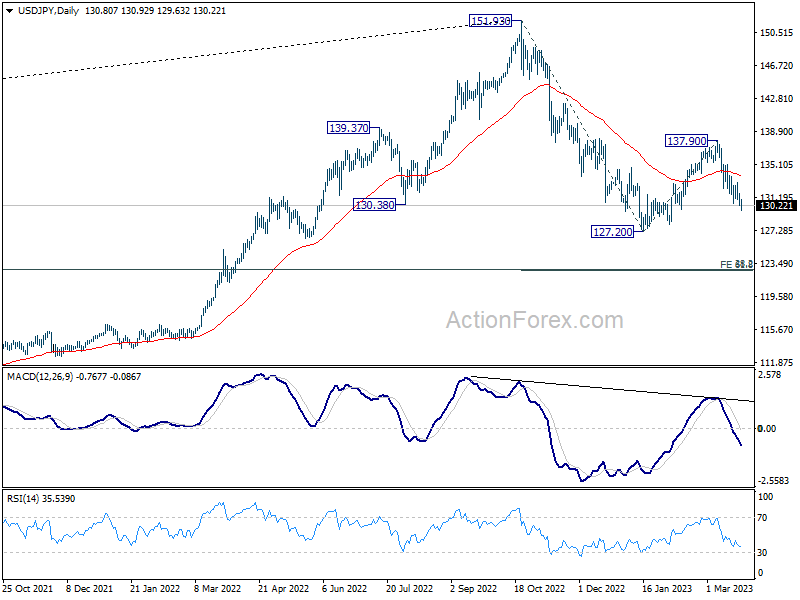
Intraday bias in USD/JPY stays on the downside at this point. Fall from 137.90 is in progress for retesting 127.20 low. Decisive break there will resume larger down trend from 151.93 to 122.61 fibonacci projection level. On the upside, break of 132.99 resistance is needed to indicate short term bottoming. Otherwise, outlook will remain bearish in case of recovery.
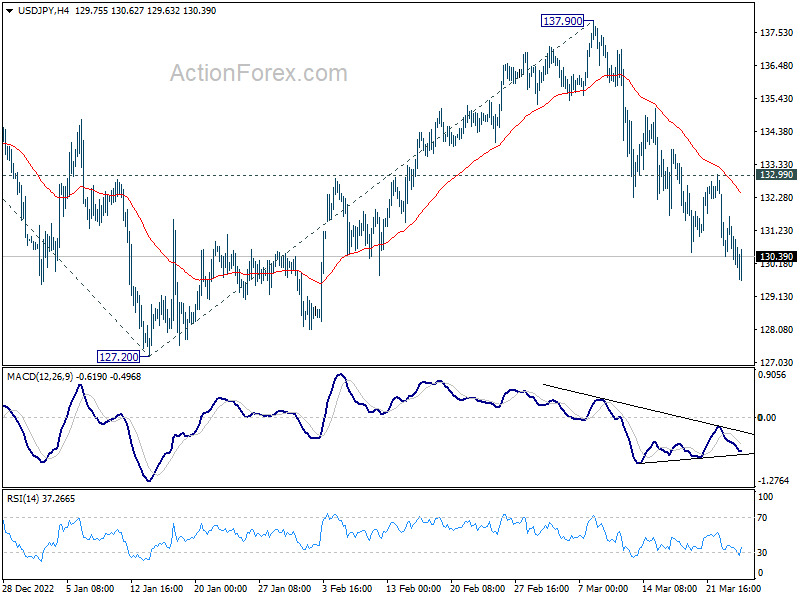
In the bigger picture, rebound from 127.20 should have completed at 137.90 as a corrective move. The down trend from 151.93 (2022 high) is still in progress. Break of 127.20 will resume this down trend and target 61.8% projection of 151.93 to 127.20 from 137.90 at 122.61. This will now be the favored case as long as 137.90 resistance holds.
USD/JPY – Surging Yen Breaks Below 130 as Rally Continues
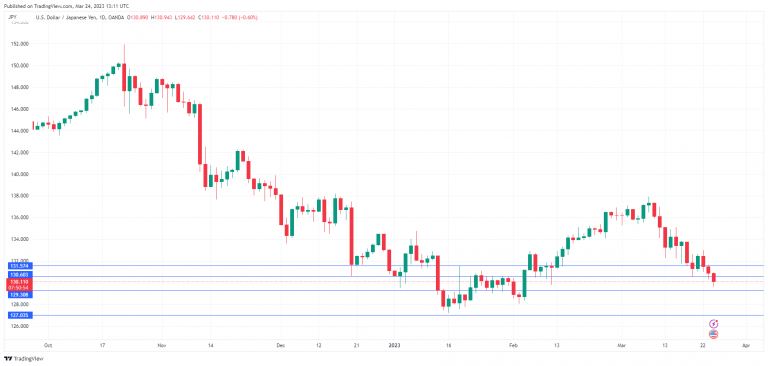
The Japanese yen broke below the symbolic 130 line earlier in the day, for the first time since February 3rd. In the North American session, USD/JPY is trading at 130.17, down 0.55% on the day. The yen is enjoying a splendid month of March, climbing 4.6% against the US dollar.
The yen has padded its gains this month courtesy of the banking crisis which triggered panic in the global financial markets. With the crisis centered on US and Swiss banks, jittery investors turned their backs on the US dollar and Swiss francs, traditionally safe-haven assets. This boosted the Japanese yen, another safe-haven currency. USD/JPY fell 2.4% last week, when the banking crisis was at its peak.
Banking crisis or not, the primary focus of central banks, including the Bank of Japan remains the battle to contain inflation. Japan’s inflation level is much lower than in Europe or the US, but it is well above the BoJ’s 2% target. Core CPI in February eased to 3.1%, matching the estimate and sharply lower than the January read of 4.2%, a 41-year high. The deceleration was due in large part to government subsidies for utility bills, and if the subsidies are lifted, inflation will likely jump higher.
The BoJ has insisted that high inflation is transient and will fall to 2% later this year as the effect of high commodity prices eases. However, in annual labour negotiations earlier this month, employees at major companies demanded and received substantial wage hikes, which could boost inflation and convince the BoJ that inflation is sustainable. Until the BoJ is convinced of that, it will not even consider tightening policy. The BoJ is going through a changing of the guard, with new Governor Ueda taking over the reins on April 9. Ueda will chair his first policy meeting on April 28, and the markets will be watching closely.
USD/JPY Technical
- There is resistance at 130.60 and 131.57
- 129.30 and 127.05 are providing support
AUD/USD Mid-Day Report
Daily Pivots: (S1) 0.6652; (P) 0.6704; (R1) 0.6737; More...
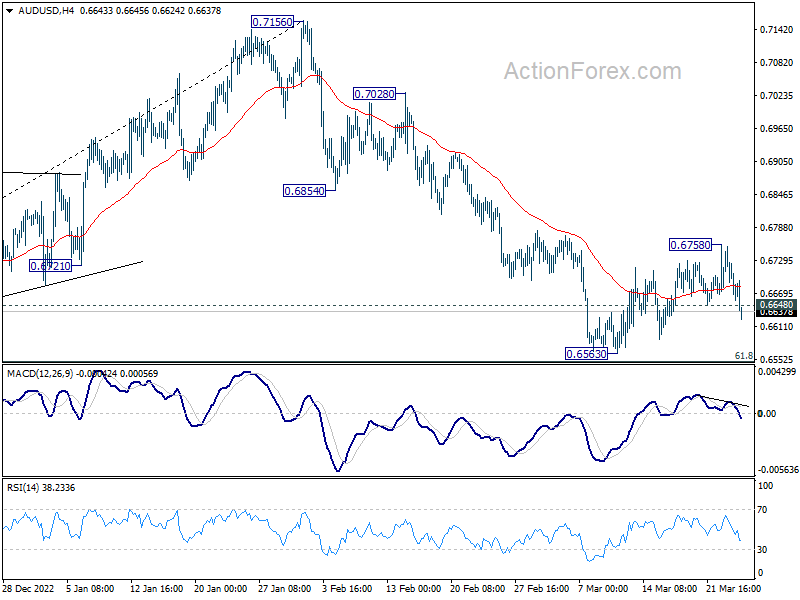
Break of 0.6648 minor support argues that AUD/USD's recovery from 0.6563 has completed at 0.6758, ahead of 55 day EMA. Intraday bias is back on the downside for 0.6563 low and 0.6546 fibonacci level. Decisive break there will resume whole fall from 0.7156 and carries larger bearish implications.
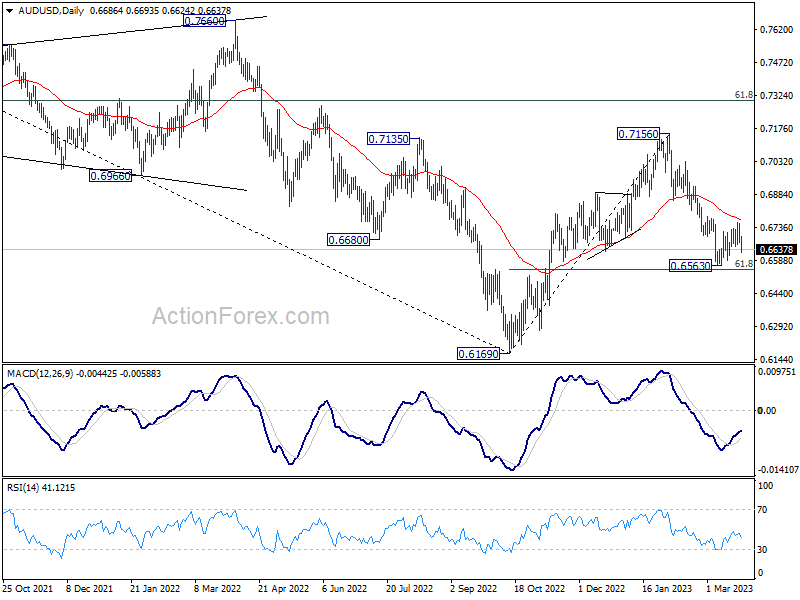
In the bigger picture, as long as 61.8% retracement of 0.6169 to 0.7156 at 0.6546 holds, the decline from 0.7156 is seen as a correction to rally from 0.6169 (2022 low) only. Another rise should still be seen through 0.7156 at a later stage. However, sustained break of 0.6546 will raise the chance of long term down trend resumption through 0.6169 low.
Market Turbulence Returns as Deutsche Bank Shares Plummet, Shaking Currency Markets
The European session has been marked by a resurgence of market turbulence as Deutsche Bank shares nosedive, fueled by a surge in its credit default swaps. This development has had a domino effect on major European indexes and US futures, both experiencing significant drops. Investors are seeking refuge in bonds, driving the US 10-year yield towards 3.3% and Germany's 10-year yield notably below 2.1%.
In the realm of currency, Yen is enjoying a broad rally, keeping company with Dollar and Swiss Franc. On the other hand, the Euro is taking a plunge, erasing most of its week's gains. Australian and New Zealand Dollars find themselves in an even more precarious situation, with Sterling and Canadian Dollar showing mixed performance. Market responses to today's economic data have been rather tepid.
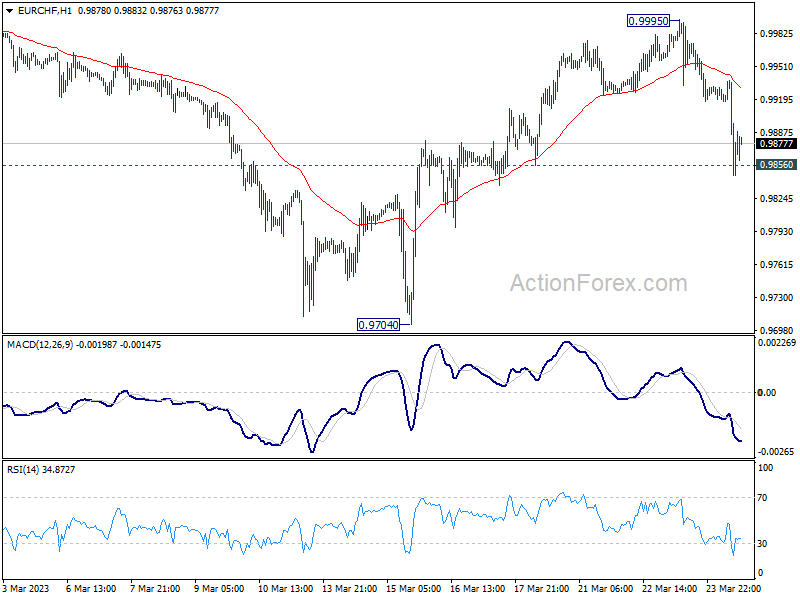
From a technical perspective, the sharp descent of EUR/CHF implies that the rebound from 0.9704 might have already reached its zenith at 0.9995. As Credit Suisse encountered challenges last week, funds seemed to flow from Swiss Franc to Euro. However, with Deutsche Bank now in hot water, funds are making their way back to the Franc. The critical question is whether the 0.9856 minor support can hold its ground before the weekly close.
In Europe, at the time of writing, FTSE is down -1.67%. DAX is down -2.28%. CAC is down -2.23%. Germany 10-year yield is down -0.1312 at 2.062. Earlier in Asia, Nikkei dropped -0.13%. Hong Kong HSI dropped -0.67%. China Shanghai SSE dropped -0.64%. Singapore Strait Times dropped -0.20%. Japan 10-year JGB yield dropped -0.035 to 0.276.
US durable goods orders down -1.0% mom in Feb, led by transport equipment
US durable goods orders dropped -1.0% mom to USD 268.5B in February, much worse than expectation of 0.4% mom rise. Ex-transport orders was flat 0.0% mom at USD 179.0B, below expectation of 0.2% mom. Ex-defense orders dropped -0.5% mom to USD 251.5B. Transportation equipment dropped -2.8% mom to USD 89.4B.
Canada retail sales up 1.4% mom in Jan, beat expectations
Canada retail sales value rose 1.4% mom to CAD 66.4B in January, above expectation of 0.7% mom. Sales increased in seven of nine subsectors, led by sales at motor vehicle and parts dealers (+3.0%) and gasoline stations and fuel vendors (+2.9%).
Core retail sales—which exclude gasoline stations and fuel vendors and motor vehicle and parts dealers—increased 0.5% in January.
Advance estimates indicates that sales deceased -0.6% mom in February.
BoE Bailey: Interest rates will go up further if inflation got embedded
In a interview with BBC, BoE Governor Andrew Bailey emphasized that the central bank expects inflation to decline sharply this year as the impact of last year's steep energy price increases drops from year-on-year price comparisons. He expressed relief that inflation had stabilized and noted some "encouraging signs" of progress. However, he urged continued vigilance, stating, "we have to be extremely vigilant on that front."
Bailey also issued a warning to businesses setting prices, cautioning that "if we get inflation embedded, interest rates will have to go up further." While acknowledging that companies must set prices according to the costs they face, he urged them to remember the anticipated decrease in inflation this year when setting prices: "we do expect inflation to come down sharply this year and I would just say please bear that in mind."
UK PMIs: Economic returns to modest growth in Q1
UK PMI Manufacturing dropped from 49.3 to 48.0 in March. PMI Services dropped from 53.5 to 52.8. PMI Composite dropped from 53.1 to 52.2. All three were two-month lows.
Chris Williamson, Chief Business Economist at S&P Global Market Intelligence, indicated that the UK economy has shown signs of growth in the first quarter, with the flash PMI surveys indicating a second consecutive month of rising output in March. The data suggests a modest quarterly GDP growth rate of 0.2%, which is a welcome change from the stagnation seen in the second half of the previous year.
Despite concerns over the banking sector, businesses remain optimistic about growth possibilities, and the improvement in order book growth suggests that a near-term recession has been averted. The upturn in companies' expectations for the year ahead indicates that firms are more focused on growth opportunities rather than banking sector challenges.
UK retail sales volume up 1.2% mom in Feb, sales value rose 1.6% mom
UK retail sales volume rose 1.2% mom in February, well above expectation of 0.2% mom. Ex-fuel sales volume rose 1.5% mom, above expectation of 0.1% mom. Nevertheless, in the three months to February, comparing to the prior three month, sales volume declined -0.3%, while ex-fuel sales volume dropped -0.4.
In value term, total sales rose 1.6% mom while ex-fuel sale rose 2.2% mom. In the three months to February, comparing to the prior three months, total sales value rose 0.7% while ex-fuel sales value rose 1.0%.
Eurozone PMI composite rose to 10-month high on strong services
Eurozone PMI Manufacturing dropped from 48.5 to 47.1 in March, hitting a 4-month low. However, PMI Services rose sharply from 52.7 to 55.6. PMI Composite rose from 52.0 to 54.1. Both PMI Services and Composite were the highest levels in 10 months.
According to Chris Williamson, Chris Williamson, Chief Business Economist at S&P Global Market Intelligence, the eurozone economy is experiencing a resurgence, with business activity in March growing at the fastest rate in ten months. The data indicates a 0.3% GDP growth in Q1, accelerating to a 0.5% rate in March. This growth is attributed to fading recession fears, easing inflation pressures, and significant improvements in supplier delivery times.
Despite these positive signs, inflationary pressures continue to be a concern, particularly in the service sector and rising wage costs. The growth remains unbalanced, with the service sector driving growth while manufacturing struggles to maintain production amid falling demand.
Also released, Germany PMI Manufacturing dropped further from 46.3 to 44.3 March, a 34-month low. But PMI Services rose from 50.9 to 53.9, a 10-month high. PMI Composite rose from 50.7 to 52.6, also a 10-month high.
France PMI Manufacturing ticked up from 47.4 to 47.7 in March. PMI Services rose from 53.1 to 55.5, a 10-month high. PMI Composite rose from 51.7 to 54.0, also a 10-month high.
Japan CPI core down sharply to 3.1%, but core-core rose to 40-yr high
Japan's headline CPI in February experienced a sharp slowdown from 4.3% yoy to 3.3% yoy, falling below the expected 4.1% yoy. CPI core (all items excluding food) dropped from 4.2% yoy to 3.1% yoy, meeting expectations. Meanwhile, CPI core-core (all items excluding food and energy) rose from 3.2% yoy to 3.5% yoy, surpassing the anticipated 3.4% yoy.
Despite the steep decline in CPI core from a 41-year high of 4.2% to 3.1%, the figure remains well above the Bank of Japan's (BoJ) 2% target. The core-core reading, closely monitored by the BoJ as an indicator of domestic demand, reached its highest rate since January 1982.
The data suggests that incoming BoJ Governor Kazuo Ueda may need to address a shift from cost-push inflation to demand-driven inflation, which could prove more sustainable.
Japan PMIs: Growth continues with strong services but struggling manufacturing
Japan PMI Manufacturing rose from 47.7 to 48.6 in March, slightly above expectation of 48.2. PMI Manufacturing Output rose from 45.3 to 47.4. PMI Services ticked up from 54.0 to 54.2, the best reading since October 2013. MI Composite improved from 51.1 to 51.9.
Japanese private sector firms experienced growth for the third consecutive month, with the services sector witnessing a notable improvement. Demand conditions strengthened, as government support and the lifting of COVID-19 restrictions in mainland China led to increased activity and new orders.
However, the manufacturing sector continued to face challenges, with output and new orders still contracting, albeit at a slower rate than February. Manufacturers reported ongoing supply chain normalization, as supplier delivery times lengthened at the slowest pace since October 2020.
Australia PMI composite dropped to 48.1, renewed contraction
Australia PMI Manufacturing dropped from 50.5 to 48.7 in March, a 34-month low. PMI Services dropped from 50.7 to 48.2, a 3-month low. PMI Composite dropped from 50.6 to 48.1, a 3-month low. All readings indicated renewed contraction in the private sector following improvements in February.
Looking at some details, the results indicate a continued economic slowdown, with composite output and new orders indexes at their lowest since the 2021 Delta lockdowns. Despite easing labor demand, employment indexes suggest businesses are still looking to expand their workforce in 2023. Price indicators have eased but remain elevated, with Australian inflation peaking in late 2022. Service industry input prices are still high, suggesting potential inflationary pressures in 2023 due to labor costs and energy prices.
As RBA prepares for its April meeting, it faces a tough decision on whether to pause its tightening cycle amid global financial uncertainty, strong employment numbers, and concerns about inflation levels. Some argue that the RBA should raise the cash rate closer to 4% before pausing to observe the economy's performance over the next few months.
Warren Hogan, Chief Economic Advisor at Judo Bank noted: "There is no point pausing for a month before hiking again. The RBA Board need to get the cash rate to a level that they think will buy them the time to observe how the economy unfolds for at least three months, if not longer."
AUD/USD Mid-Day Report
Daily Pivots: (S1) 0.6652; (P) 0.6704; (R1) 0.6737; More...
Break of 0.6648 minor support argues that AUD/USD's recovery from 0.6563 has completed at 0.6758, ahead of 55 day EMA. Intraday bias is back on the downside for 0.6563 low and 0.6546 fibonacci level. Decisive break there will resume whole fall from 0.7156 and carries larger bearish implications.
In the bigger picture, as long as 61.8% retracement of 0.6169 to 0.7156 at 0.6546 holds, the decline from 0.7156 is seen as a correction to rally from 0.6169 (2022 low) only. Another rise should still be seen through 0.7156 at a later stage. However, sustained break of 0.6546 will raise the chance of long term down trend resumption through 0.6169 low.
Economic Indicators Update
| GMT | Ccy | Events | Actual | Forecast | Previous | Revised |
|---|---|---|---|---|---|---|
| 22:00 | AUD | Manufacturing PMI Mar P | 48.7 | 50.5 | ||
| 22:00 | AUD | Services PMI Mar P | 48.2 | 50.7 | ||
| 23:30 | JPY | CPI Y/Y Feb | 3.30% | 4.10% | 4.30% | |
| 23:30 | JPY | CPI ex-Fresh Food Y/Y Feb | 3.10% | 3.10% | 4.20% | |
| 23:30 | JPY | CPI ex Food & Energy Y/Y Feb | 3.50% | 3.40% | 3.20% | |
| 00:01 | GBP | GfK Consumer Confidence Mar | -36 | -35 | -38 | |
| 00:30 | JPY | Manufacturing PMI Mar P | 48.6 | 48.2 | 47.7 | |
| 07:00 | GBP | Retail Sales M/M Feb | 1.20% | 0.20% | 0.50% | 0.90% |
| 07:00 | GBP | Retail Sales Y/Y Feb | -3.50% | -4.70% | -5.10% | -5.20% |
| 07:00 | GBP | Retail Sales ex-Fuel M/M Feb | 1.50% | 0.10% | 0.40% | 0.90% |
| 07:00 | GBP | Retail Sales ex-Fuel Y/Y Feb | -3.30% | -4.70% | -5.30% | -5.40% |
| 08:15 | EUR | France Manufacturing PMI Mar P | 47.7 | 48.2 | 47.4 | |
| 08:15 | EUR | France Services PMI Mar P | 55.5 | 53 | 53.1 | |
| 08:30 | EUR | Germany Manufacturing PMI Mar P | 44.4 | 47.1 | 46.3 | |
| 08:30 | EUR | Germany Services PMI Mar P | 53.9 | 51.1 | 50.9 | |
| 09:00 | EUR | Eurozone Manufacturing PMI Mar P | 47.1 | 48.9 | 48.5 | |
| 09:00 | EUR | Eurozone Services PMI Mar P | 55.6 | 52.9 | 52.7 | |
| 09:30 | GBP | Manufacturing PMI Mar P | 48 | 50 | 49.3 | |
| 09:30 | GBP | Services PMI Mar P | 52.8 | 53.1 | 53.5 | |
| 12:30 | CAD | Retail Sales M/M Jan | 1.40% | 0.70% | 0.50% | |
| 12:30 | CAD | Retail Sales ex Autos M/M Jan | 0.90% | 0.60% | -0.60% | |
| 12:30 | USD | Durable Goods Orders Feb | -1.00% | 0.40% | -4.50% | |
| 12:30 | USD | Durable Goods Orders ex Transportation Feb | 0.00% | 0.20% | 0.70% | |
| 13:45 | USD | Manufacturing PMI Mar P | 47.3 | |||
| 13:45 | USD | Services PMI Mar P | 50.6 |
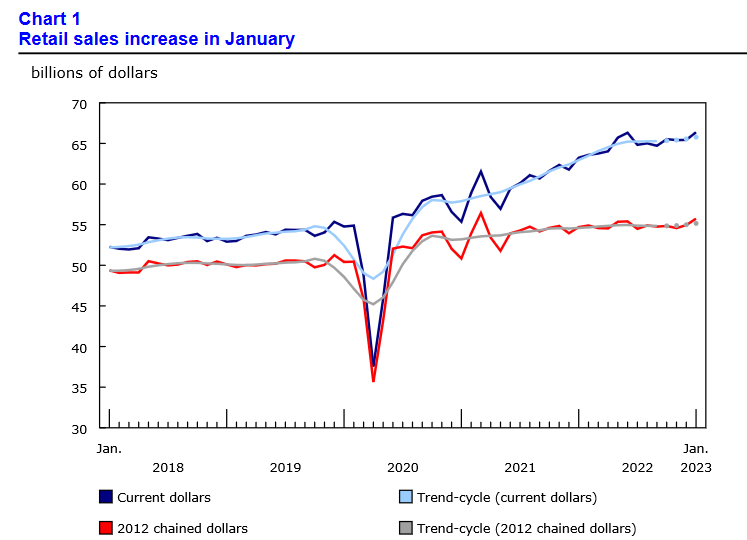
Canada retail sales up 1.4% mom in Jan, beat expectations
Canada retail sales value rose 1.4% mom to CAD 66.4B in January, above expectation of 0.7% mom. Sales increased in seven of nine-subsecotrs, led by sales at motor vehicle and parts dealers (+3.0%) and gasoline stations and fuel vendors (+2.9%).
Core retail sales—which exclude gasoline stations and fuel vendors and motor vehicle and parts dealers—increased 0.5% in January.
Advance estimates indicates that sales deceased -0.6% mom in February.
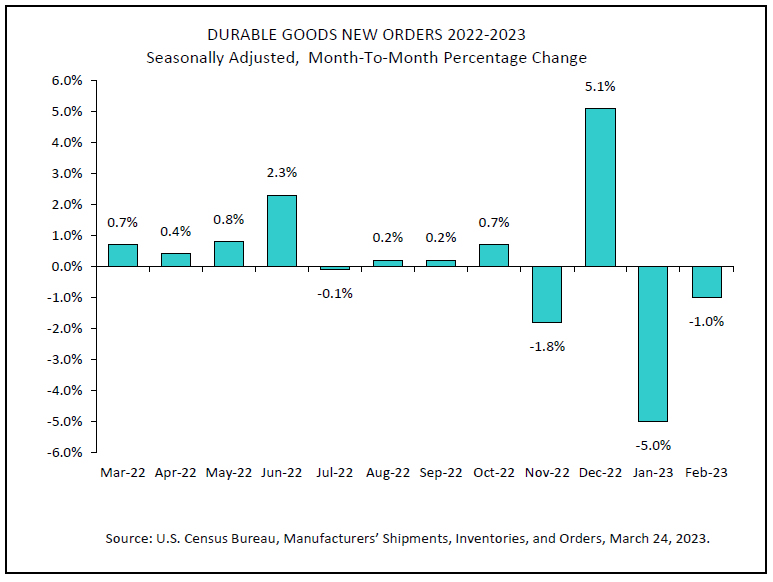
US durable goods orders down -1.0% mom in Feb, led by transport equipment
US durable goods orders dropped -1.0% mom to USD 268.5B in February, much worse than expectation of 0.4% mom rise. Ex-transport orders was flat 0.0% mom at USD 179.0B, below expectation of 0.2% mom. Ex-defense orders dropped -0.5% mom to USD 251.5B. Transportation equipment dropped -2.8% mom to USD 89.4B.
USD/JPY: Yen Advances Further on Increased Safe-haven Demand
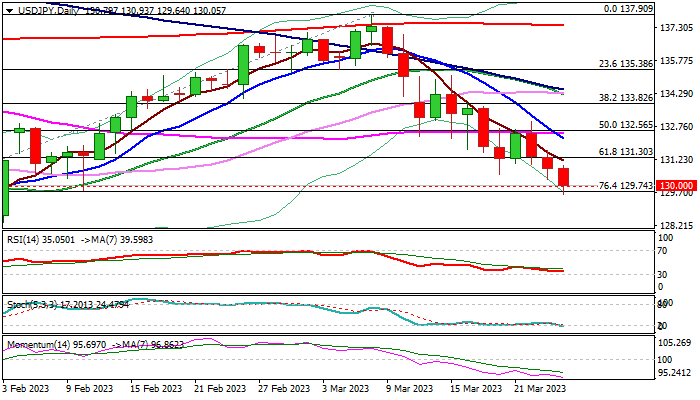
The USDJPY broke below psychological 130.00 support on Friday, hitting the levels last traded on Feb 10.
The pair is holding firmly in red, on track for the fourth consecutive weekly loss, fueled by increased safe-haven demand.
Growing uncertainty over the simmering crisis in banking sector sparked fresh sales of European banking shares on Friday, sending a shockwave through the markets and prompting traders to accelerate migration into safer assets.
Demand for safe-haven yen was additionally boosted by a record purchase of Japanese government bonds after the Bank of Japan kept its ultra-loose policy unchanged
Bears look for close below cracked supports at 130.00/129.74 (psychological / Fibo 76.4% of 127.22/137.90 rally) to confirm fresh negative signals and extend towards 128.08 (Feb 2 higher low) and key supports at 127.26/22 (50% retracement of larger 102.59/151.94 uptrend / 2023 low, posted on Jan 16).
Daily studies are in full bearish mode but overextended, suggesting that bears may pause for consolidation, before stronger push through 130.00 support.
Broken former strong support at 131.30 (Fibo 61.8% of 127.22/137.90) which recently kept bears limited for three straight days, reverted to significant resistance and expected to ideally keep the upside limited.
Res: 130.53; 130.93; 131.30; 132.21.
Sup: 129.74; 129.02; 128.08; 127.22.
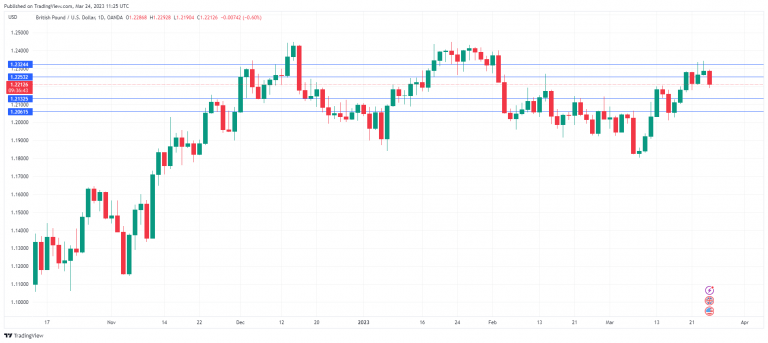
GBP/USD – Pound Slips as PMIs Dip, BoE Hikes Again
The British pound is down considerably on Friday after mostly soft numbers out of the UK. In the European session, GBP/USD is trading at 122.13, down 0.60%.
PMIs down, retail sales jump
UK releases are a mixed bag on Friday. Business activity and manufacturing weakened in March. The Services PMI eased to 52.8, down from 53.5 in February and shy of the estimate of 53.0 points. Manufacturing fell to 48.0, versus 49.3 in February and an estimate of 52.8 points. Manufacturing has declined for eight straight months, with readings below the 50.0 level which separates contraction from expansion. Business activity continues to show modest expansion and is the driver behind economic growth in the UK.
Given the weak economic landscape, it’s no surprise that consumer confidence remains mired in negative territory. Double-digit inflation and high interest rates have sapped consumer optimism. In March, GfK Consumer Confidence came in at -36, as expected and a bit higher than the previous reading of -38 points. With consumers may in a sour mood, a strong retail sales report for February was that much more surprising, with a gain of 1.2%. This beat the upwardly revised January gain of 0.9% and crushed the estimate of 0.2%. Core retail sales jumped 1.5%, versus 0.9% in January, which was upwardly revised, and beat the estimate of 0.1%.
BoE raises rates by 25 bp
As expected the Bank of England raised rates by 25 basis points on Thursday. This marked an 11th straight hike, although the 25-bp move was the smallest increase since June. Is the BoE done with tightening? This week’s disappointing acceleration in inflation has increased the odds of at least one more hike, although BoE Governor Bailey was non-committal when asked about future hikes. Like the ECB, the BoE didn’t flinch from delivering an expected rate hike despite the banking crisis and I wouldn’t be surprised if more hikes are in store unless inflation shows clear signs of easing.
GBP/USD Technical
- There is resistance at 1.2324, followed by 1.2445
- GBP/USD has support at 1.2253 and 1.2132
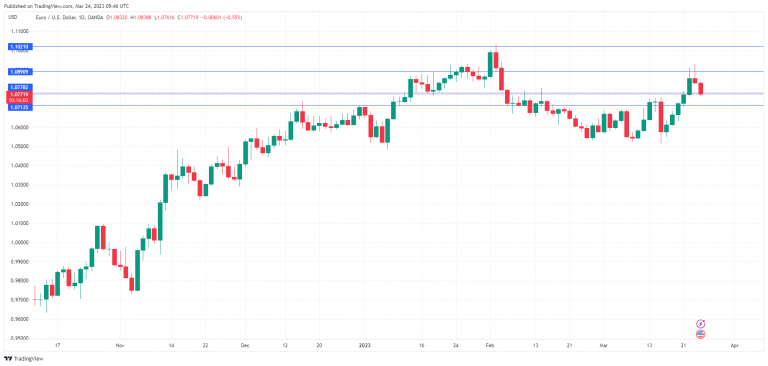
EUR/USD – Euro Slides On Soft German Manufacturing PMIs
After an impressive rally, the euro is falling for a second straight day. In the European session, EUR/USD is trading at 1.0739, down 0.86%.
German manufacturing falls, services rise
German PMIs were a mix in March. Let’s start with the good news. Business activity climbed to a 10-month high, as Services PMI rose to 53.9, versus 50.9 in February and 51.0 anticipated. Manufacturing was a different story, as the PMI slipped to 44.4, versus 46.3 in February and 47.0 anticipated. This was the lowest reading since May 2020. Manufacturing activity continues to decline, as companies remain cautious in the uncertain economic environment. The eurozone PMIs mirrored the German readings, indicating that business activity is driving economic growth as manufacturing continues to sputter.
The ECB took the plunge last week, delivering a 50 basis point hike despite the market turmoil due to the banking crisis. ECB President Lagarde had basically declared to the markets over the past few weeks that the ECB intended to raise rates by 50 bp, and had the ECB not carried through, it would have risked its credibility. The move also made sense as eurozone inflation came in at 8.5% in February, barely unchanged from the 8.6% gain a month earlier.
Lagarde seems intent on not getting trapped again with specific rate hike announcements and said this week that “with high uncertainty, it is even more important that the rate path is data-dependent”. She also noted that inflation is still high, which required a “robust strategy going forward”. Was that a hint at further rate hikes? The markets certainly thought so, as the euro jumped to a 5-week high after her comments. Earlier this week, Lagarde suggested that the recent market turmoil could actually help the ECB by lowering demand and thus reducing inflation.
EUR/USD Technical
- EUR/USD 1.0778. Next is 1.0890
- There is support at 1.0647 and 1.0535