

Sample Category Title
USD/CAD Weekly Outlook
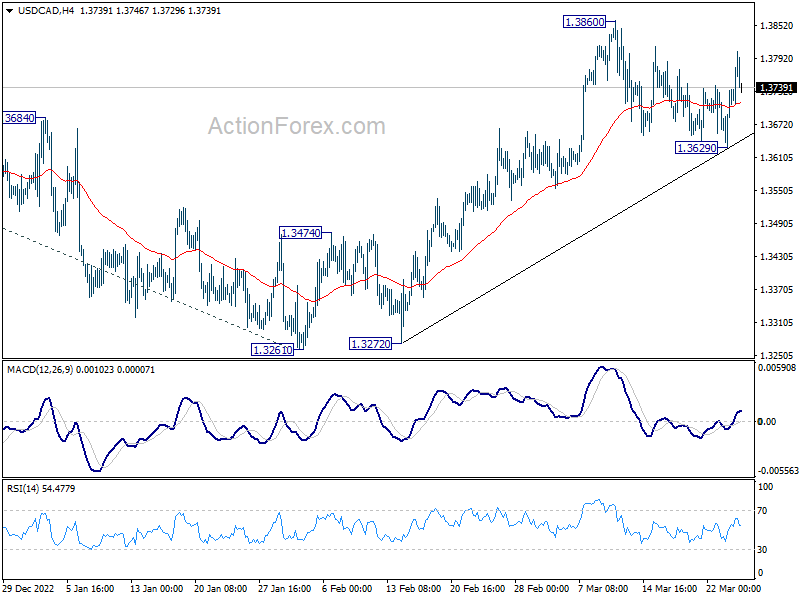
USD/CAD extend the consolidation from 1.3860 last week. Initial bias remains neutral first. Further rally is expected as long as 1.3629 support holds. Firm break of 1.3860 will target 1.3976 high. However, break of 1.3629 will mix up the near term outlook and bring deeper pullback to 55 day EMA (now at 1.3578).
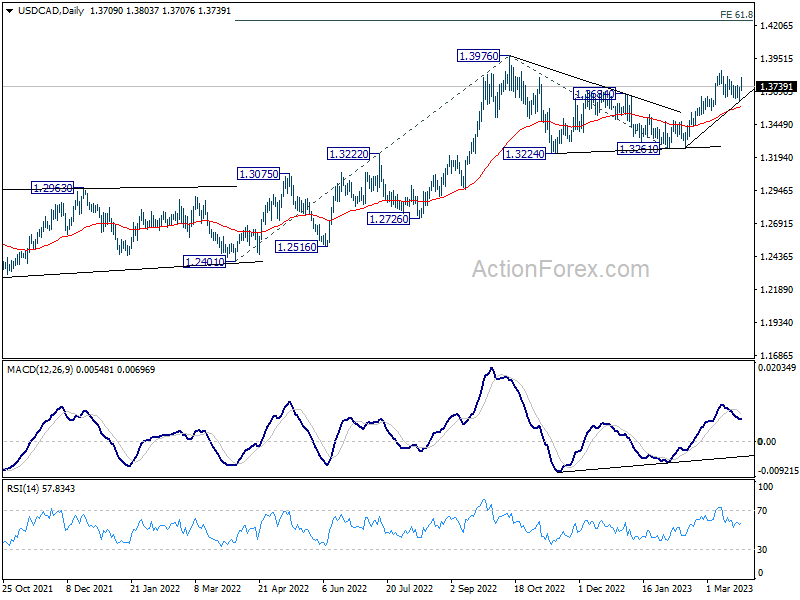
In the bigger picture, the up trend from 1.2005 (2021 low) is still in progress. Break of 1.3976 will confirm resumption and target 61.8% projection of 1.2401 to 1.3976 from 1.3261 at 1.4234. Firm break there will pave the way to long term resistance zone at 1.4667/89 (2016, 2020 highs). On the downside, break of 1.3261 support is needed to confirm medium term topping. Otherwise, outlook will remain bullish even in case of deep pull back.
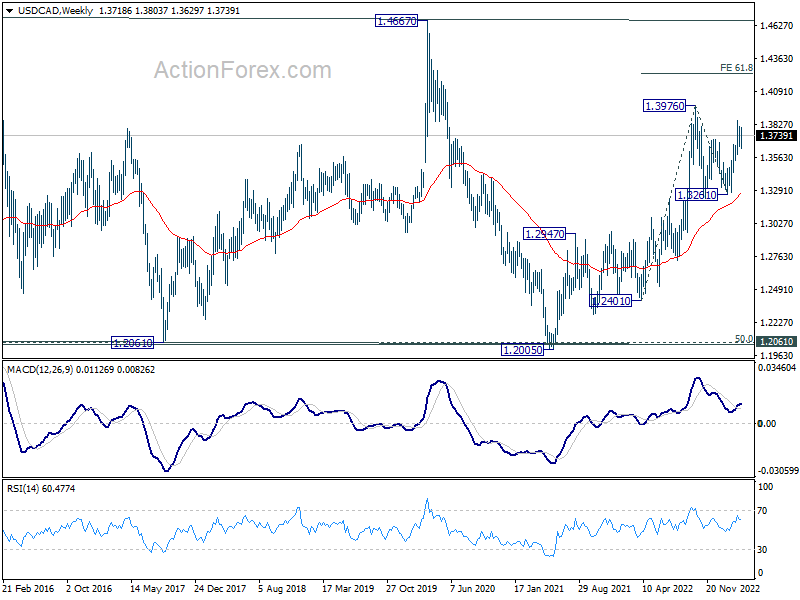
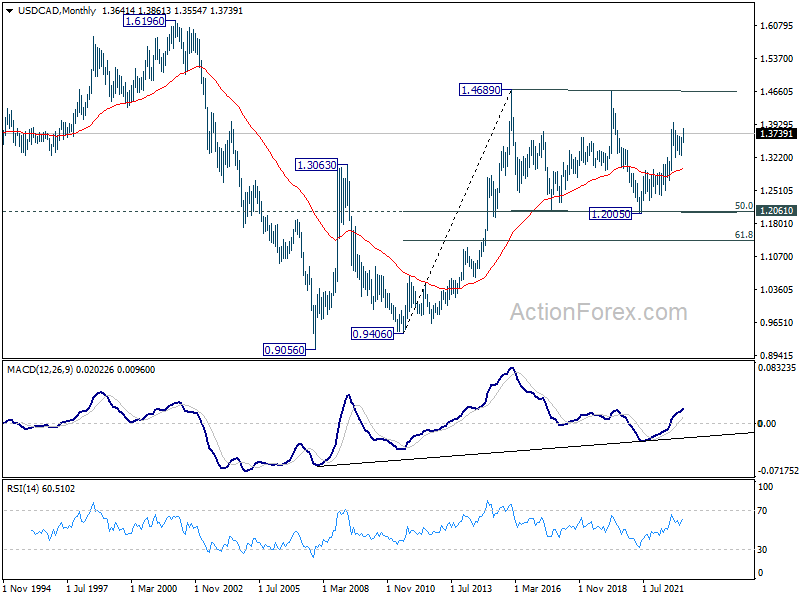
In the longer term picture, price actions from 1.4689 (2016 high) are seen as a consolidation pattern only, which might have completed at 1.2005. That is, up trend from 0.9506 (2007 low) is expected to resume at a later stage. This will remain the favored case as 55 month EMA (now at 1.3003) holds.
GBP/JPY Weekly Outlook
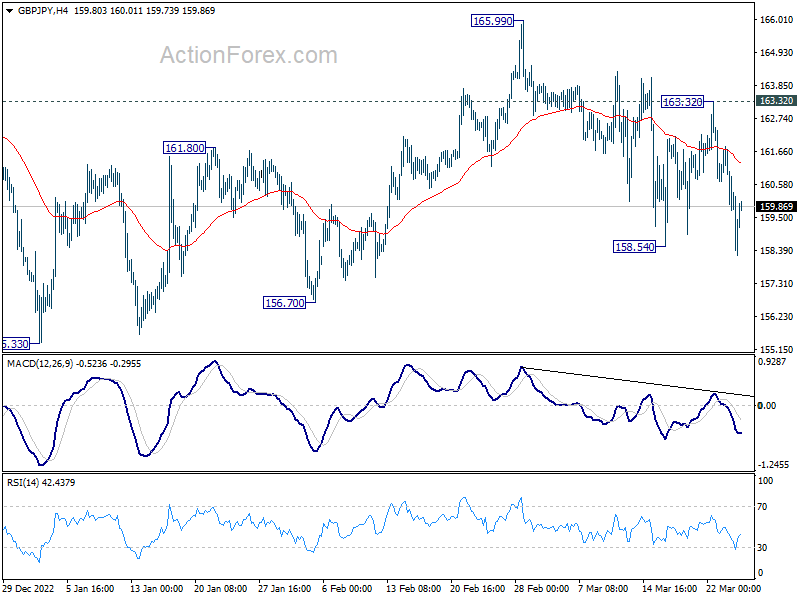
GBP/JPY's late breach of 158.53 support indicate that fall from 165.99 is resuming. This decline is seen as part of the whole fall from 172.11. Initial bias is now on the downside for retesting 155.33 low next. For now, risk will stay on the downside as long as 163.32 resistance holds, in case of recovery.
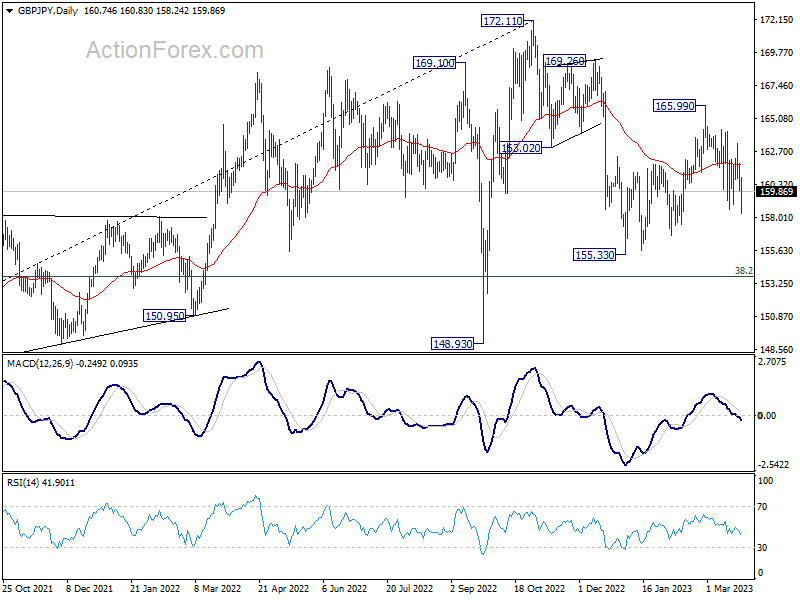
In the bigger picture, as long as 38.2% retracement of 123.94 (2020 low) to 172.11 (2022 high) at 153.70 holds, medium term bullishness is retained. That is, larger up trend from 123.94 (2020 low) is still in progress. Break of 172.11 high to resume such up trend is expected at a later stage.
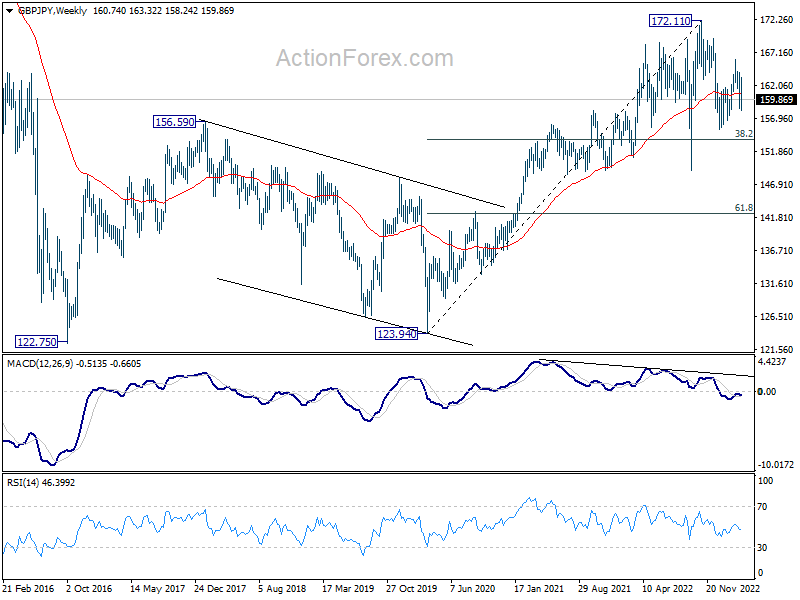
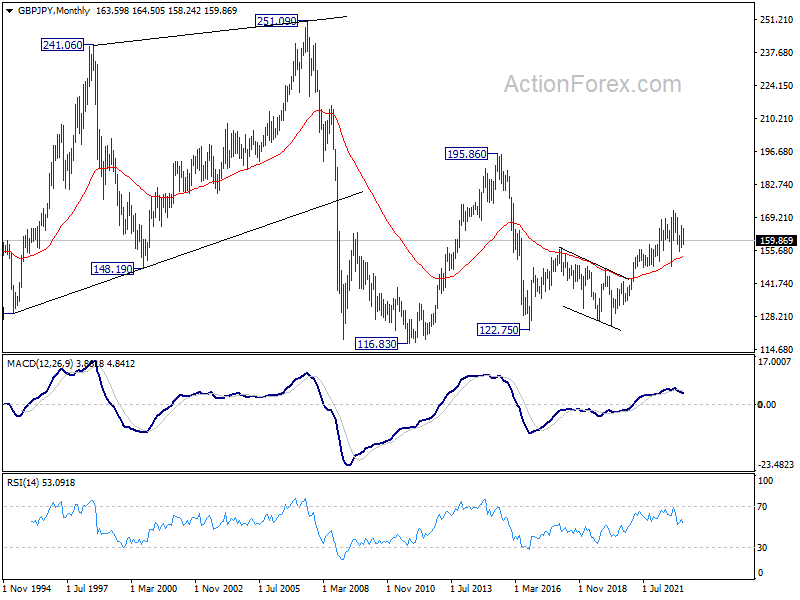
In the longer term picture, as long as 55 month EMA (now at 153.06) holds, rise from 122.75 (2016 low) could still extend higher at a later stage to 195.86 (2015 high).
EUR/JPY Weekly Outlook
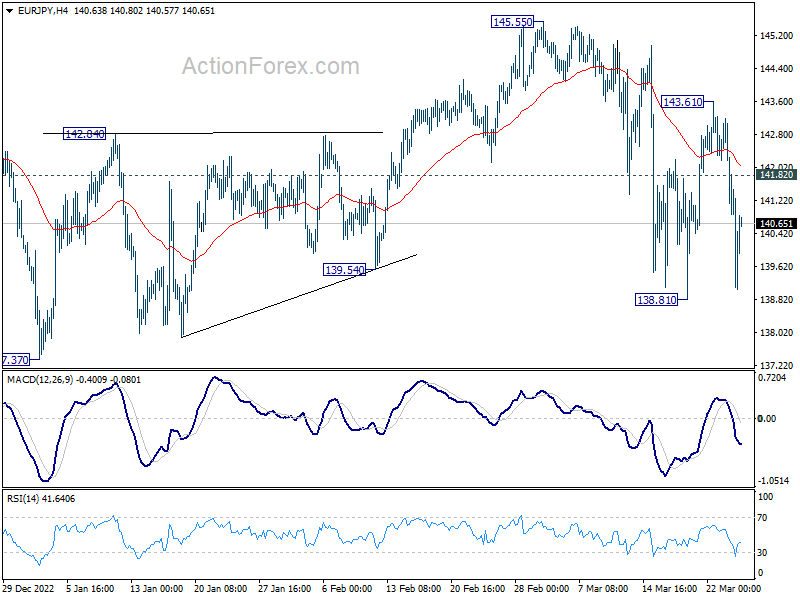
EUR/JPY's rebound from 138.81 was stronger than expected. But subsequent steep decline from 143.61 affirmed the bearish case. That is, fall from 145.55 is a leg inside the whole corrective decline from 148.38. Risk will now remain on the downside as long as 143.61 resistance holds. Below 138.81 will target 137.37 low, and then 135.40 fibonacci level.
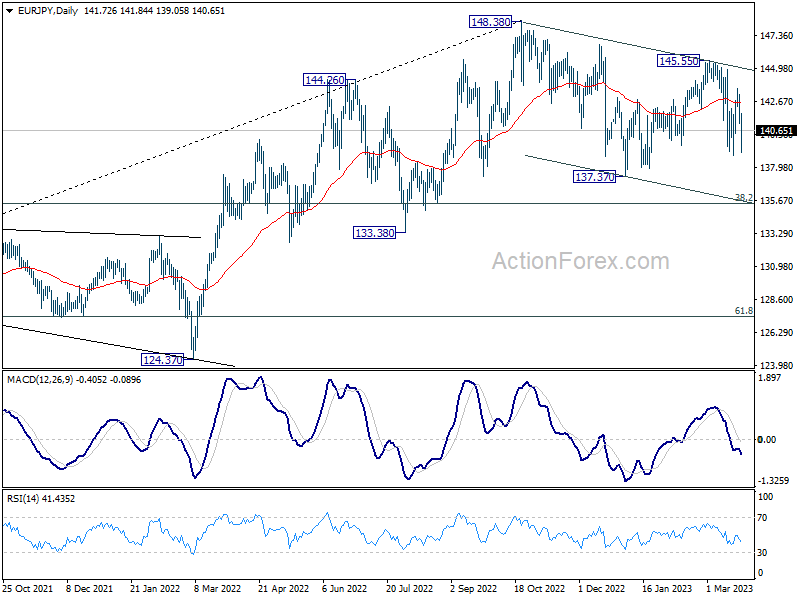
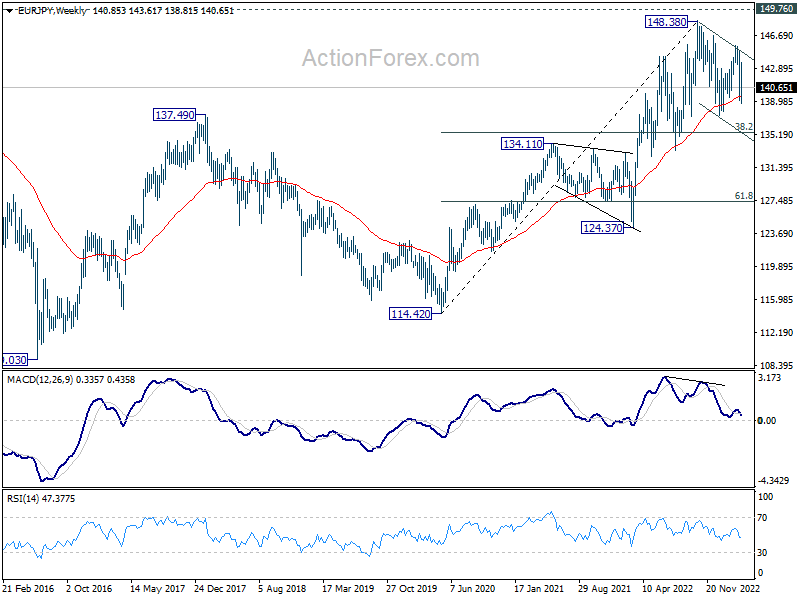
In the bigger picture, as long as 55 week EMA (now at 139.58) holds, larger up trend from 114.42 (2020 low) is still in progress for 149.76 long term resistance. However, sustained break of 55 week EMA will bring deeper fall to 38.2% retracement of 114.42 to 148.38 at 135.40. Decisive break there will raise the chance of trend reversal, and target 61.8% retracement at 127.39.
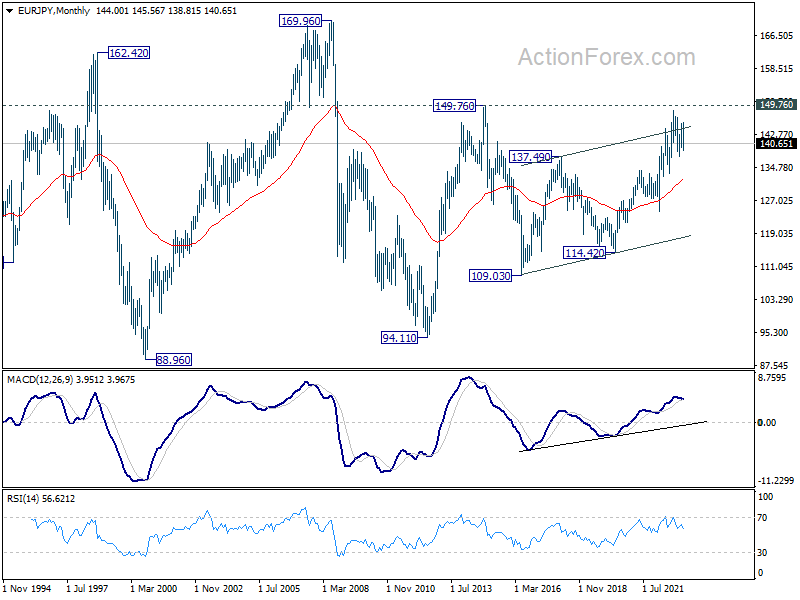
In the long term picture, outlook will stay bullish as long as 134.11 resistance turned support holds (2021 high). Sustained break of 149.76 (2014 high) will open up further rally, as resumption of the rise from 94.11 (2012 low), towards 169.96 (2008 high).
EUR/GBP Weekly Outlook
EUR/GBP edged higher to 0.8864 but retreated sharply since then. The development mixed up the near term outlook and intraday bias stays neutral this week first. On the upside, break of 0.8864 will target 0.8924 resistance first. Firm break there should resume larger rise from 0.8545 through 0.8977 high. However, decisive break of 0.8717 support will resume the decline from 0.8977 instead.
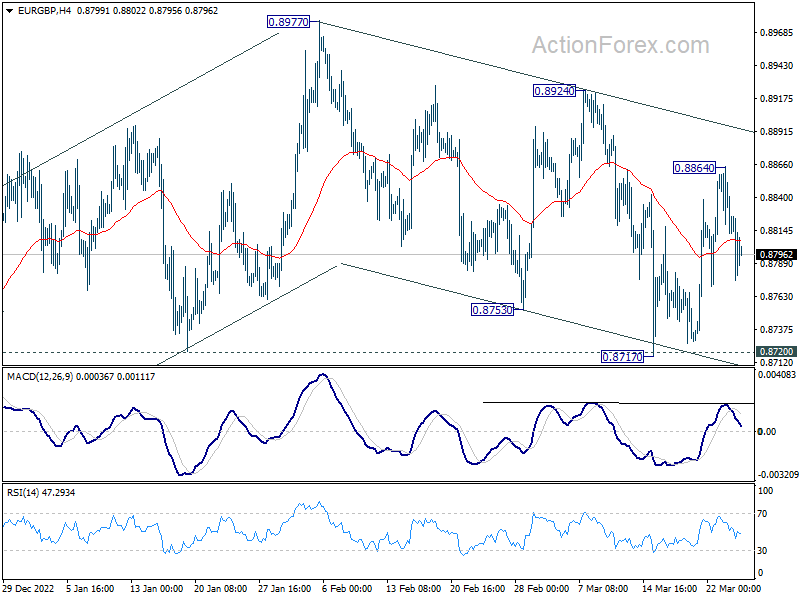
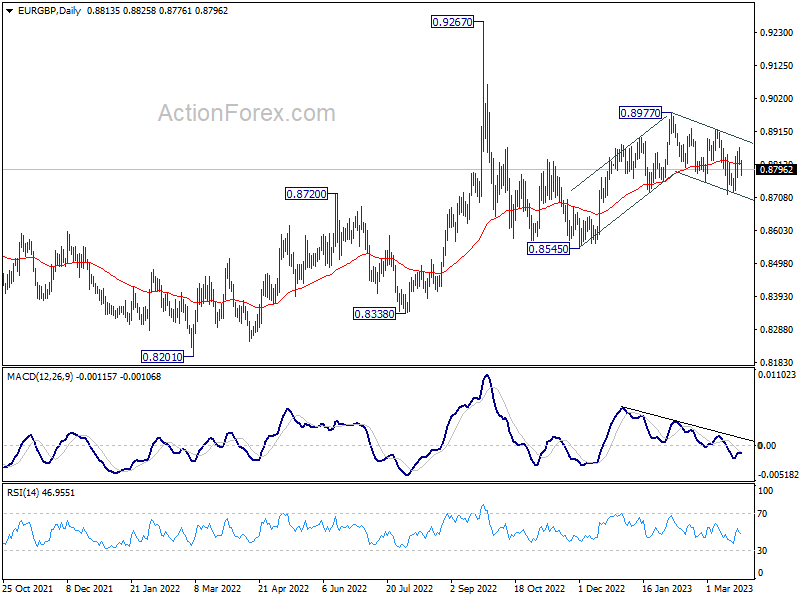
In the bigger picture, outlook remains rather mixed for now, except that price actions from 0.9267 (2022 high) are part of the long term range pattern from 0.9499 (2020 high). With 0.8720 support intact, rise from 0.8545 is in favor to continue through 0.8977. However, firm break of 0.8720 will argue that such rebound has completed, and open up deeper fall through this support level.
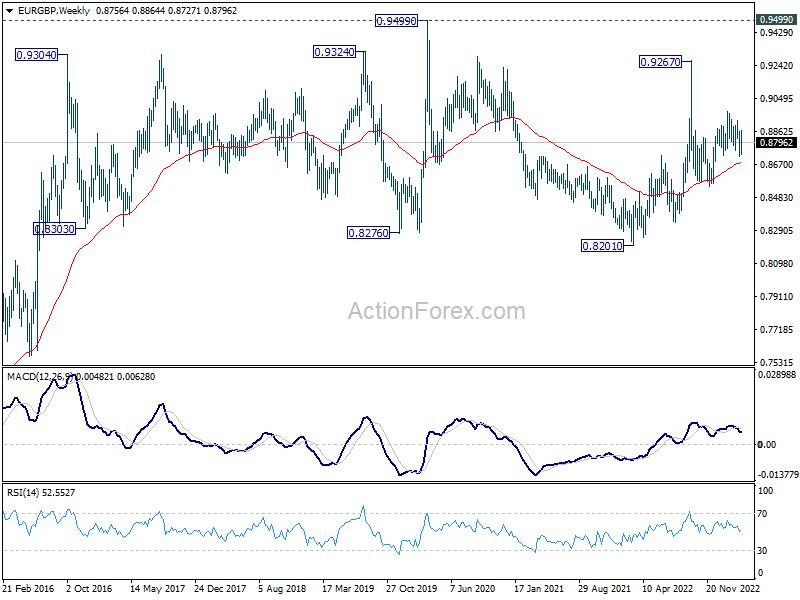
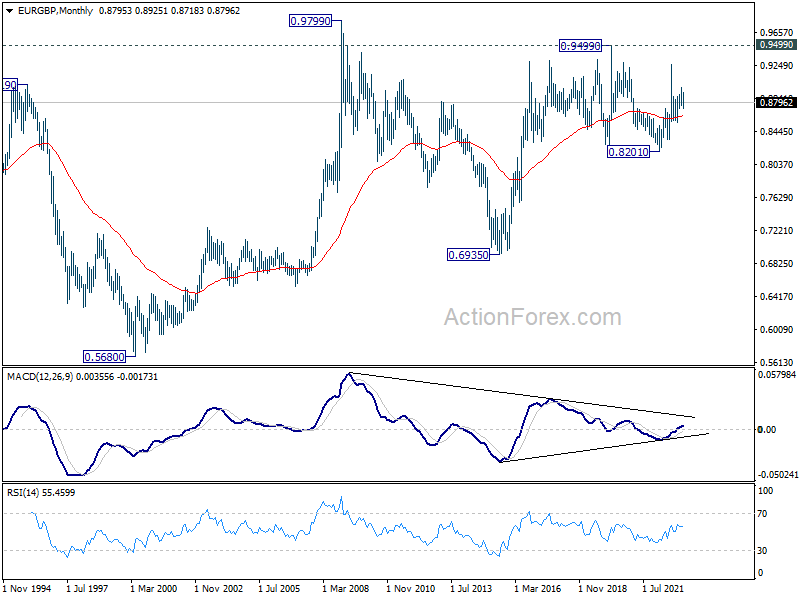
In the long term picture, long term range pattern is extending. But rise from 0.6935 (2015 low) is expected to extend at a later stage, to 0.9799 (2009 high).
EUR/AUD Weekly Outlook
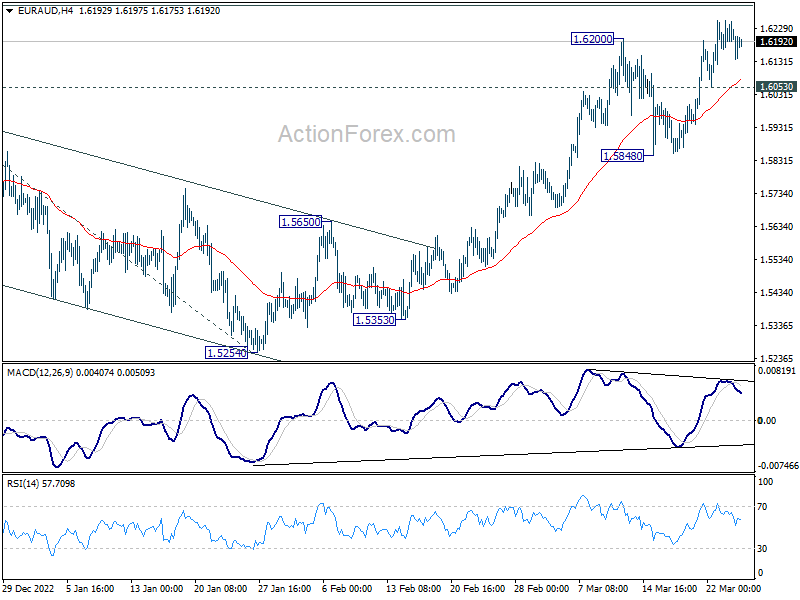
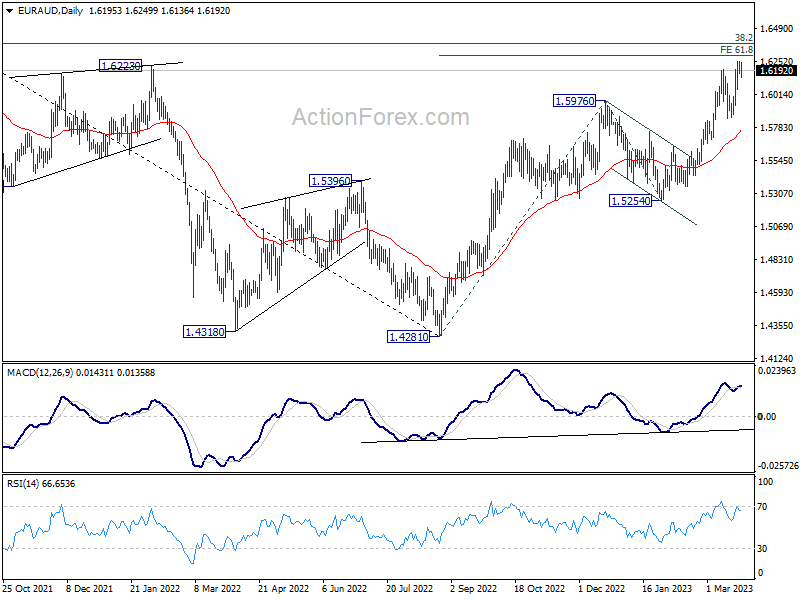
EUR/AUD's rally resumed last week but lost momentum ahead of 61.8% projection of 1.4281 to 1.5976 from 1.5254 at 1.6302 and retreat. Initial bias stays neutral this week first. Further rally is expected as long as 1.6053 support holds. Decisive break there of 1.6302 will resume larger rally from 1.4281 to 1.6389 fibonacci level and then 1.6434 resistance. However, firm break of 1.6053 will indicate rejection by 1.6302 and turn bias back to the downside for 1.5848 support.
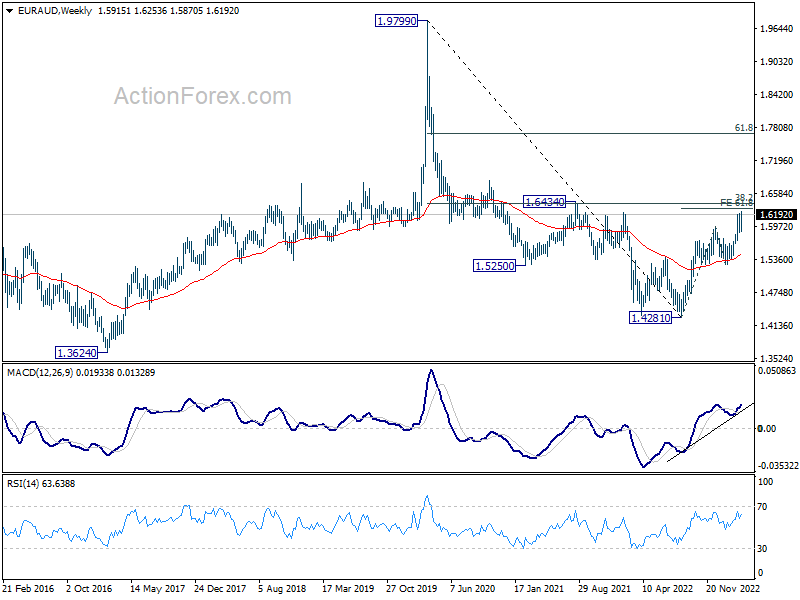
In the bigger picture, the strong support from 55 week EMA (now at 1.5404) is raising the chance of bullish trend reversal. Focus is now on 1.6434 cluster resistance (38.2% retracement of 1.9799 to 1.4281 at 1.6389). Sustained break there should confirm that whole down trend from 1.9799 (2020 high) has completed. Further rally should then be seen to 61.8% retracement at 1.7691. However, rejection by this cluster resistance will make medium term outlook neutral at best.
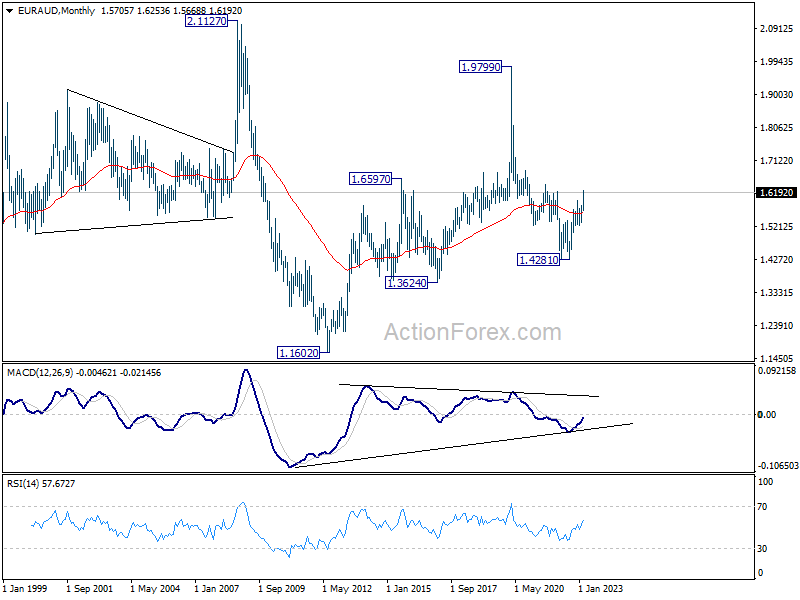
In the longer term picture, the strong break above 55 month EMA (now at 1.5616) raised the chance of bullish trend reversal. Firm break of 1.6434 resistance should confirm that the down trend from 1.9799 has completed. It's still early to decide if the up trend from 1.1602 (2012 low) is resuming. An assessment will be made after rise from 1.4281 reveals more of its structure.
EUR/CHF Weekly Outlook
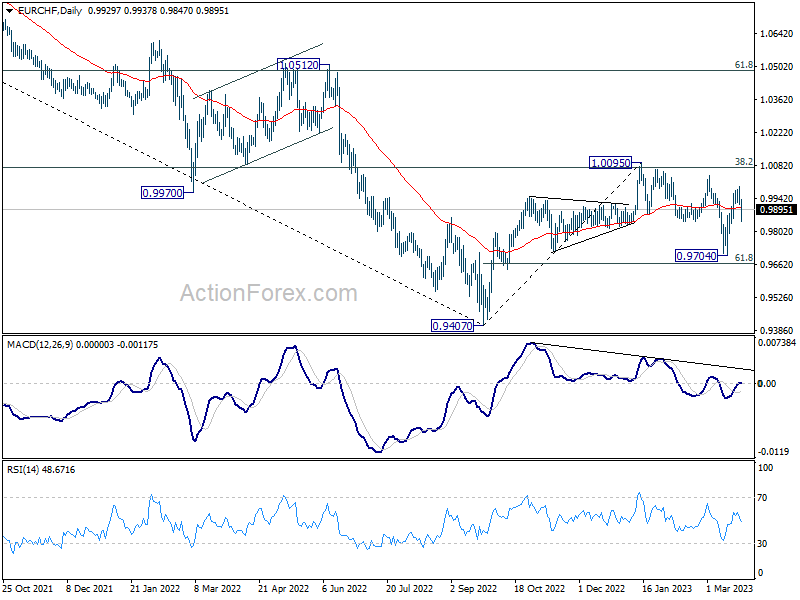
EUR/CHF's rise from 0.9704 extended higher to 0.9995 last week but retreated sharply since then. Initial bias remains neutral this week first. Another rise will remain mildly in favor as long as 0.9837 minor support holds. Break of 0.9995 will affirm the case that correction from 1.0095 has completed at 0.9704. Further rally should be seen through 1.0040 to retest 1.0095 high. However, firm break of 0.9837 will dampen this bullish view and turn bias back to the downside for 0.9704 support instead.
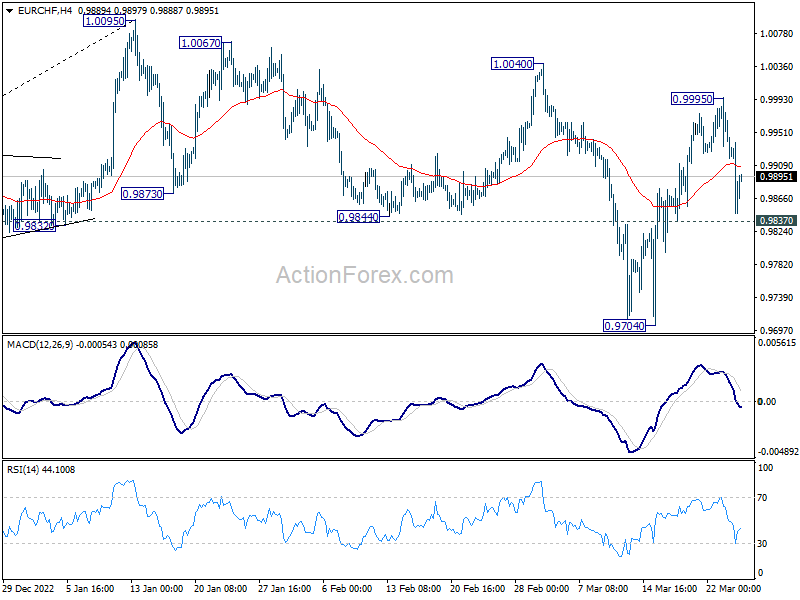
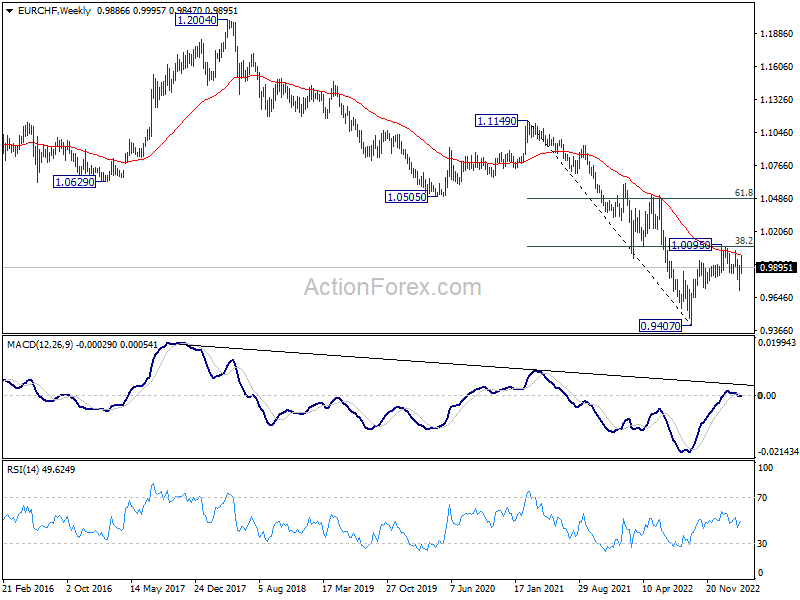
In the bigger picture, prior rejection by 55 week EMA (now at 1.1002) and 38.2% retracement of 1.1149 to 0.9407 at 1.0072 suggests that medium term outlook is staying bearish. That is, down trend from 1.2004 is not completed yet and is in favor to resume through 0.9407 at a later stage. However, decisive break of 1.0095 resistance will raise the chance of bullish trend reversal. Rise from 0.9407 should then target 1.0505 cluster resistance (2020 low at 1.0505, 61.8% retracement of 1.1149 to 0.9407 at 1.1484).
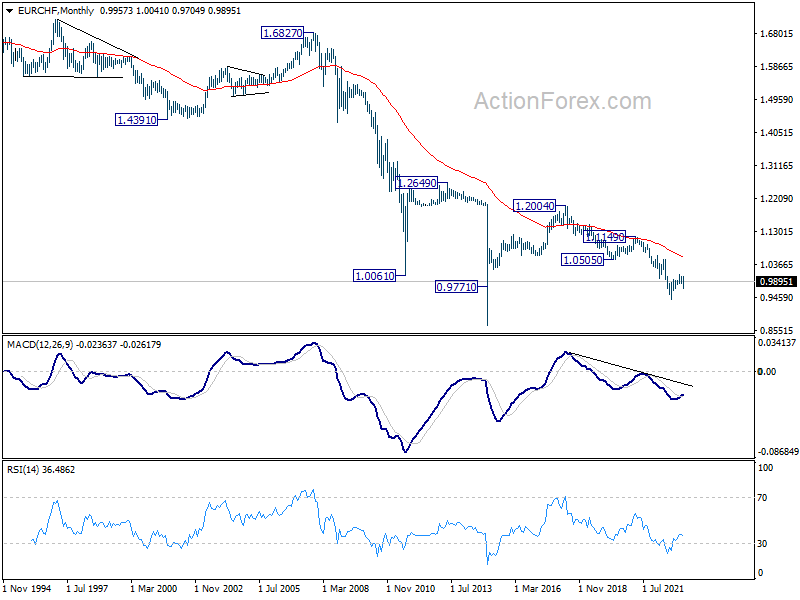
In the long term picture, it's still way too early too call for bullish trend reversal with upside capped well below 55 month EMA and 1.0505 support turned resistance (2020 low). The multi-decade down trend could still continue.
Market Confusion Reigns While Yen Continued Domination
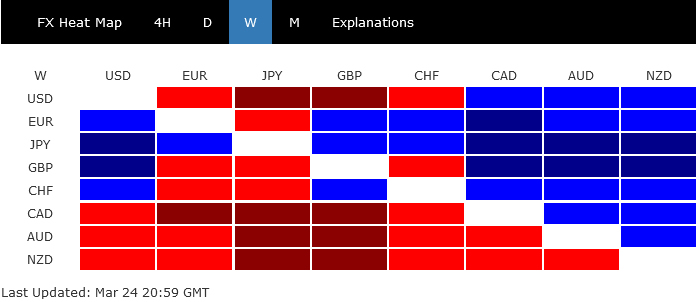
Last week's financial landscape was far from clear-cut. While it wasn't a definitive risk-on market, investors seemed reluctant to abandon US shares completely. The markets found themselves mired in confusion, struggling to make sense of the relentless barrage of headlines detailing bank crises that began with Silicon Valley Bank, then spread to First Republic, Credit Suisse, and eventually Deutsche Bank. Amid the banking turmoil, rate hikes by Fed, BoE, and SNB added another layer of complexity, prompting reinterpretations of rate outlooks and their influence on financial markets.
Despite the chaos, Yen emerged as the strongest performer for yet another week. Euro and Swiss Franc trailed behind, both making a notable recovery from the previous week's losses. Were it not for Deutsche Bank's woes, Euro might have claimed the top spot. Commodity currencies bore the brunt of the market turbulence, while Dollar and Sterling delivered mixed results.
As uncertainties continue to mount, including potentially more bank troubles, rate outlooks, and recession risks, the fluctuations between Dollar and European majors may persist until clarity is restored. For the time being, however, Yen appears to be in prime position to extend its gains against commodity currencies.
Fed rate at 4.75%-5.00% already the peak?
Last week, Fed raised interest rates by 25bp to 4.75-5.00% amidst flip-flopping speculations. Despite the less hawkish tone, the meeting wasn't entirely dovish. Median projections still indicate an interest rate peak at 5.1% this year, with another 25bps hike possible. The median projection for 2024 interest rate increased from 4.1% to 4.3%, signaling a slower path of rate cuts. Chair Jerome Powell also indicated in the post-meeting press conference that a rate cut this year was "not our baseline expectation."
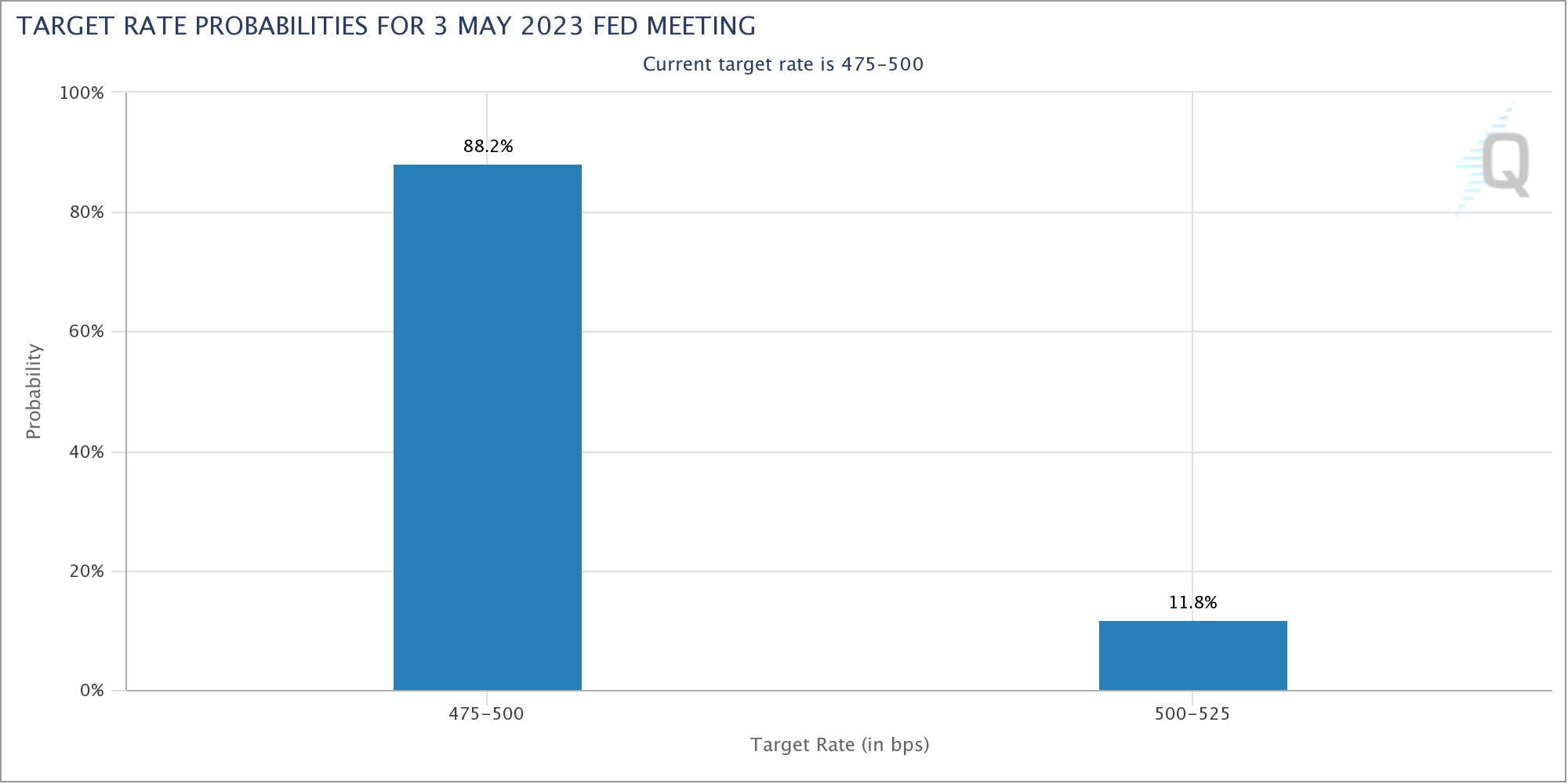
However, as the banking crisis appeared to be dragging on, investors are clearly having different views to FOMC members. As of end of Friday, fed fund futures are pricing in 88.2% chance of Fed being on hold in May, with just 11.8% chance of a 25bps hike.
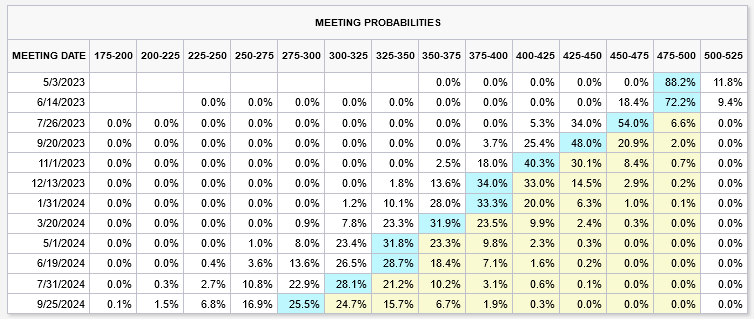
Indeed, the current 4.75-5.00% is seen as the peak already with over 90% chance of it staying there after June meeting. There's now over 90% chance of starting a rate cut cycle in July, with near 50% chance of having interest rate back to 3.75-4.00%, a 100bps below the current level, by the end of the year.
Happened last week too, BoE delivered a 25bps to 4.25% as widely expected, and then signalled that "if there were to be evidence of more persistent (inflation) pressures, then further tightening in monetary policy would be required." Or in other words, if inflation pressure doesn't persist, it's also open to a pause. The outlook, however, was complicated by February CPI, which reaccelerated to 10.4% yoy. Baseline expectations are now for BoE to hike another 25bps in May then pause.
SNB hiked by 50bps to 1.50% as widely expected and said ""it cannot be ruled out that additional rises in the SNB policy rate will be necessary". With assumption of 1.5% interest rate over the forecast horizon, inflation projections for both 2023 and 2024 were raised. Markets are expecting another 25bps hike in June to bring the tightening cycle to conclusion.
Minutes of RBA's meeting this month indicated that members agreed to "reconsider the case for a pause at the following meeting, recognizing that pausing would allow additional time to reassess the outlook for the economy." There case is there now for RBA to pause in April, before determining whether to hike again in May based on the new economic projections then.
US stocks resilient with NASDAQ leading
In the US stock markets, much resilience was shown despite all the headlines about banking turmoils. Sentiment seemed to be firmly supported by expectations of a lower terminal rate of Fed and an early start of rate cut cycle.
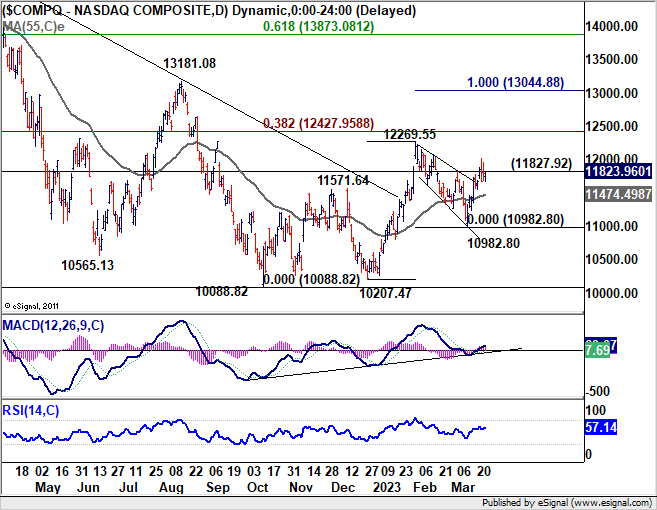
NASDAQ flared pretty well with break of 11827.91 resistance, even though it couldn't close the week above there. The development is inline with the view that corrective pullback from 12269.55 has completed at 10987.80 already. Further rally is in favor as long as 55 day EMA (now at 11474.49) holds, for 12269.55 and above in the near term.
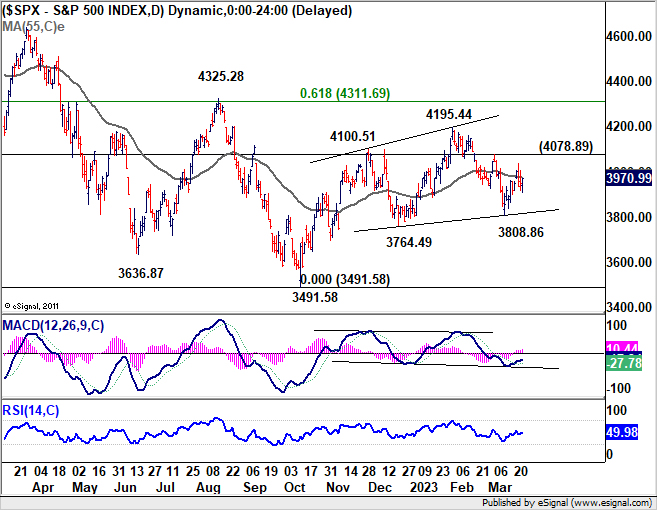
Underlying bullish momentum in US stocks would be further confirmed if S&P 500 could take out corresponding resistance level at 4078.89. That would indicate completion of the corrective pull back form 4195.44 at 3808.86. Rise from 3491.58 should then be ready to resume through 4195.44.
10-year yield trying to draw support from 3.21/22
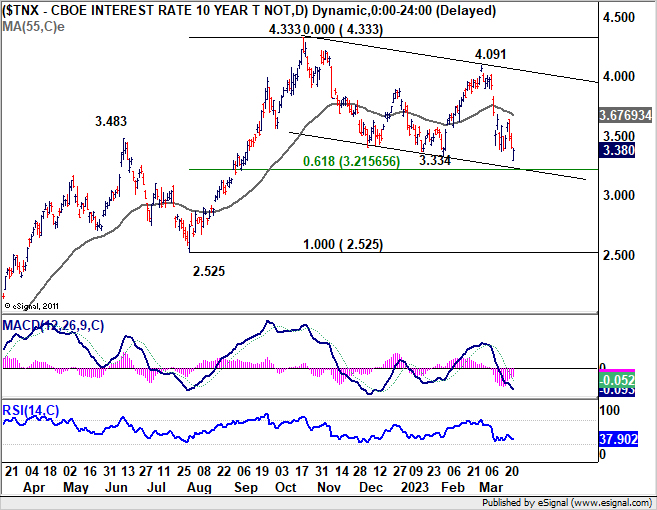
US 10-year yield dived to as low as 3.295 on Friday on developments around Deutsche Bank. But it recovered notably to close at 3.380, showing that sentiments were still relatively calm. Technically, TNX is extending the corrective pattern from 4.333, with 4.091 as the third leg.
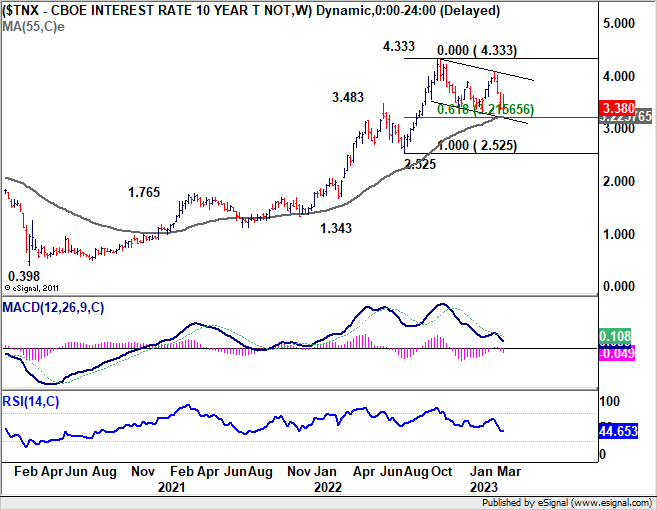
While another fall cannot be ruled out, we'd still expect strong support from 61.8% retracement level of 2.525 to 4.333 at 3.215, which is in close proximity to 55 week EMA (now at 3.220). This zone should provide enough support to complete the corrective pattern to bring rebound. However, sustained break of 3.2 handle would signal even larger troubles on the horizon.
Dollar index recovered ahead of 101.91 low, but stays bearish
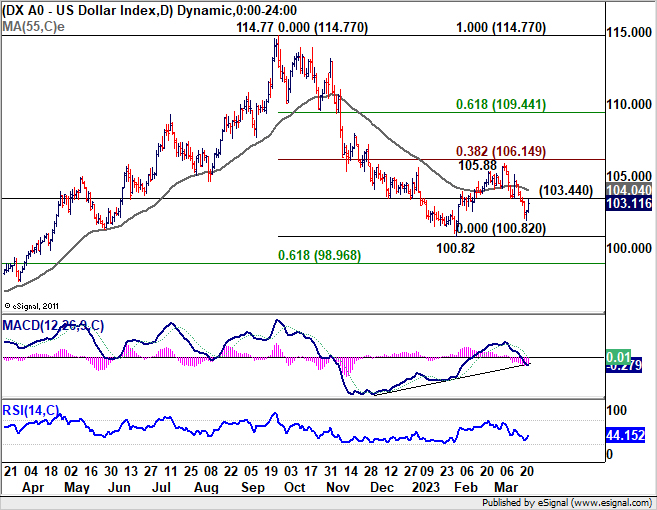
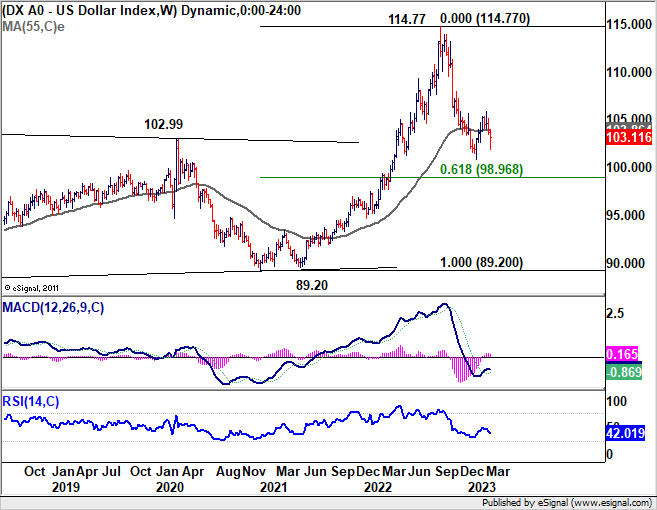
Dollar index's decline from 105.88 extended further to low as 101.91 but recovered to close at 103.11. Medium term outlook remains bearish with 38.2% retracement of 114.77 to 100.82 at 106.14 intact. That is, eventual break of 100.82 support is expected.
However, the question is whether price actions from 100.82 would develop into a three wave corrective pattern. Break of 103.44 support turned resistance would suggest that it is. Stronger rise would then be seen back to 105.88 or further to 106.14 in the near term, before breaking through 100.82 in the medium term.
NZD/JPY, AUD/JPY an CAD/JPY downside breakout as medium term decline resumed
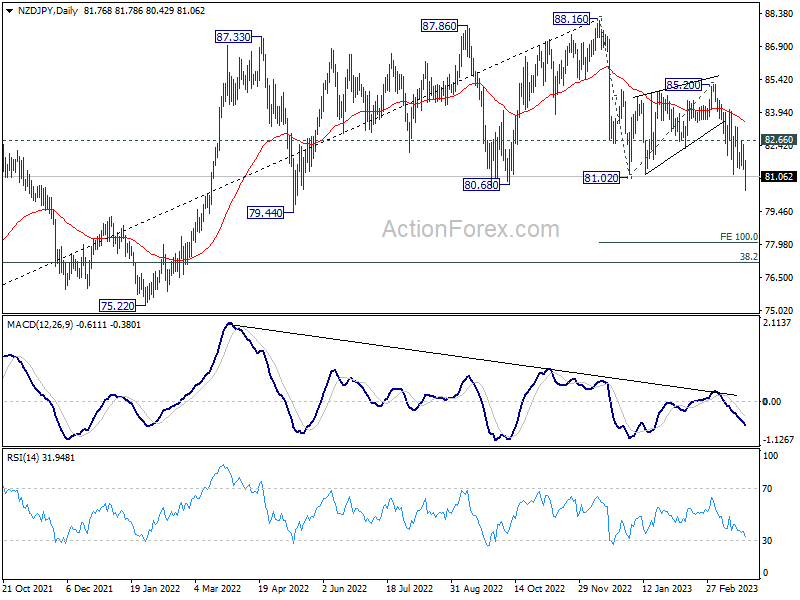
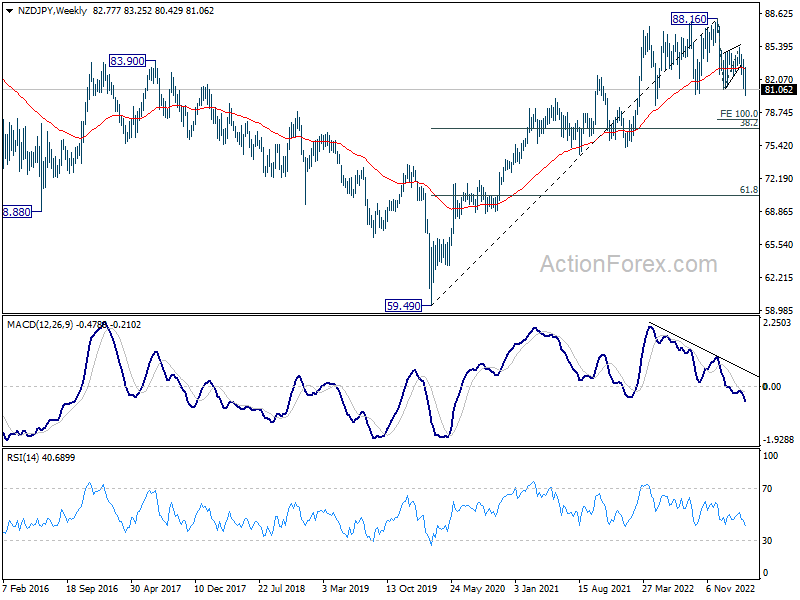
Yen broke out to the upside against all three commodity currencies last week. NZD/JPY was among the better performer recently. But even so, it should now be in a medium term decline, as a correction to the up trend from 59.49 (2020 low). Near term outlook will stay bearish as long as 82.66 resistance holds. Fall from 88.16 medium term top should target 100% projection of 88.16 to 81.02 from 85.20 at 78.06. Strong support could be seen around 38.2% retracement of 59.49 to 88.16 at 77.20 to conclude the correction to bring reversal.
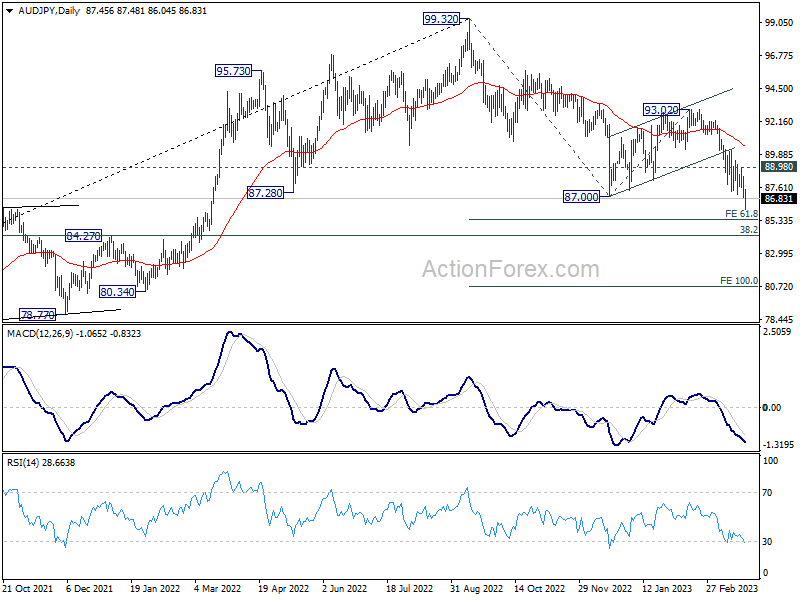
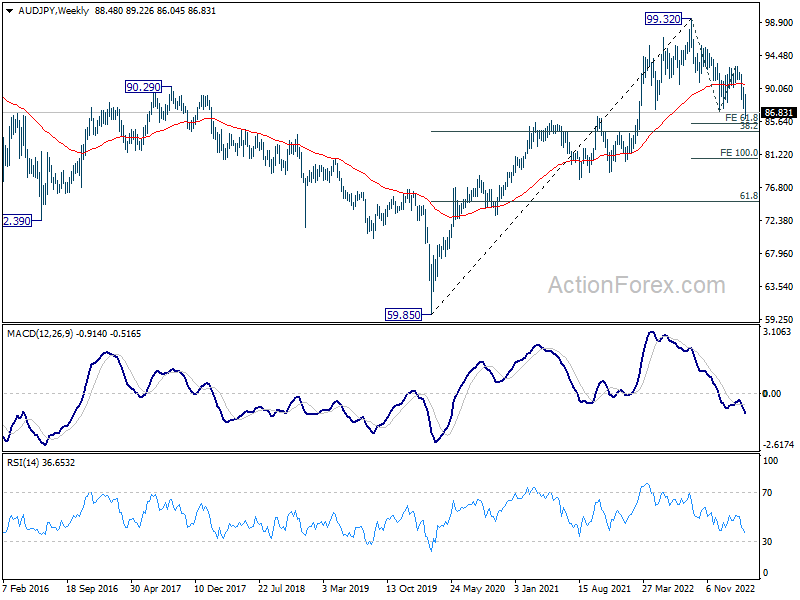
AUD/JPY is also in correction to the up trend from 59.85 (2020 low). Near term outlook will stay bearish as long as 88.98 resistance holds. Next target is 61.8% projection of 99.32 to 87.00 from 93.02 at 85.40. There might be some support from 38.2% retracement of 59.85 to 99.32 at 84.24 to complete the correction. If not, AUD/JPY's decline from 99.32 would extend further to 100% projection at 80.70 before conclusion.
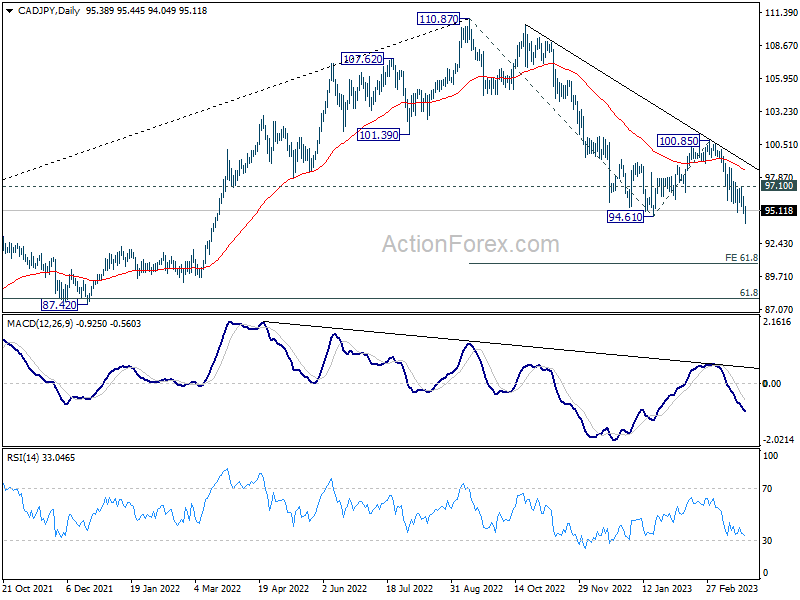
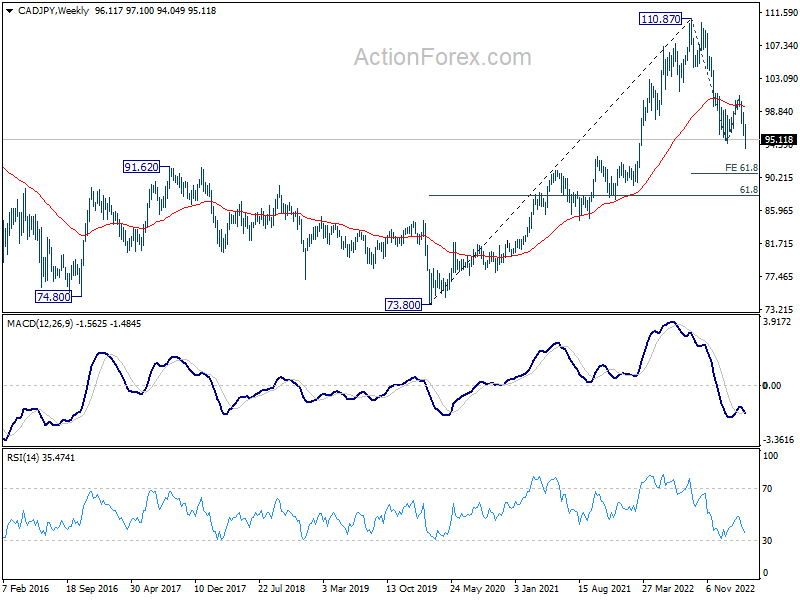
Similarly, CAD/JPY is also now in correction to the up trend from 73.80 (2020 low), steeper than NZD/JPY and AUD/JPY. Near term outlook will stay bearish as long as 97.10 resistance holds. Next target is 61.8% projection of 110.87 to 94.61 from 100.85 at 90.80. While CAD/JPY might fall through this projection level, strong support should be seen from 61.8% retracement of 73.80 to 110.87 at 87.96 to complete the correction.
EUR/CHF Weekly Outlook
EUR/CHF's rise from 0.9704 extended higher to 0.9995 last week but retreated sharply since then. Initial bias remains neutral this week first. Another rise will remain mildly in favor as long as 0.9837 minor support holds. Break of 0.9995 will affirm the case that correction from 1.0095 has completed at 0.9704. Further rally should be seen through 1.0040 to retest 1.0095 high. However, firm break of 0.9837 will dampen this bullish view and turn bias back to the downside for 0.9704 support instead.
In the bigger picture, prior rejection by 55 week EMA (now at 1.1002) and 38.2% retracement of 1.1149 to 0.9407 at 1.0072 suggests that medium term outlook is staying bearish. That is, down trend from 1.2004 is not completed yet and is in favor to resume through 0.9407 at a later stage. However, decisive break of 1.0095 resistance will raise the chance of bullish trend reversal. Rise from 0.9407 should then target 1.0505 cluster resistance (2020 low at 1.0505, 61.8% retracement of 1.1149 to 0.9407 at 1.1484).
In the long term picture, it's still way too early too call for bullish trend reversal with upside capped well below 55 month EMA and 1.0505 support turned resistance (2020 low). The multi-decade down trend could still continue.
Summary 3/27 – 3/31
Monday, Mar 27, 2023
| GMT | Ccy | Events | Consensus | Previous |
|---|---|---|---|---|
| 23:50 | JPY | Corporate Service Price Index Y/Y Feb | 1.80% | 1.60% |
| 08:00 | EUR | Germany IFO Business Climate Mar | 92 | 91.1 |
| 08:00 | EUR | Germany IFO Current Assessment Mar | 94 | 93.9 |
| 08:00 | EUR | Germany IFO Expectations Mar | 87.4 | 88.5 |
| 08:00 | EUR | Eurozone M3 Money Supply Y/Y Feb | 3.30% | 3.50% |
| GMT | Ccy | Events | |
|---|---|---|---|
| 23:50 | JPY | Corporate Service Price Index Y/Y Feb | |
| Forecast: 1.80% | Previous: 1.60% | ||
| 08:00 | EUR | Germany IFO Business Climate Mar | |
| Forecast: 92 | Previous: 91.1 | ||
| 08:00 | EUR | Germany IFO Current Assessment Mar | |
| Forecast: 94 | Previous: 93.9 | ||
| 08:00 | EUR | Germany IFO Expectations Mar | |
| Forecast: 87.4 | Previous: 88.5 | ||
| 08:00 | EUR | Eurozone M3 Money Supply Y/Y Feb | |
| Forecast: 3.30% | Previous: 3.50% | ||
Tuesday, Mar 28, 2023
| GMT | Ccy | Events | Consensus | Previous |
|---|---|---|---|---|
| 00:30 | AUD | Retail Sales M/M Feb | 0.40% | 1.90% |
| 11:00 | GBP | BoE Quarterly Bulletin | ||
| 12:30 | USD | Goods Trade Balance (USD) Feb P | -89.9B | -91.5B |
| 12:30 | USD | Wholesale Inventories Feb P | 0.20% | -0.40% |
| 13:00 | USD | Housing Price Index M/M Jan | -0.20% | -0.10% |
| 13:00 | USD | S&P/CS Composite-20 HPI Y/Y Jan | 4.50% | 4.60% |
| 14:00 | USD | Consumer Confidence Mar | 101.7 | 102.9 |
| GMT | Ccy | Events | |
|---|---|---|---|
| 00:30 | AUD | Retail Sales M/M Feb | |
| Forecast: 0.40% | Previous: 1.90% | ||
| 11:00 | GBP | BoE Quarterly Bulletin | |
| Forecast: | Previous: | ||
| 12:30 | USD | Goods Trade Balance (USD) Feb P | |
| Forecast: -89.9B | Previous: -91.5B | ||
| 12:30 | USD | Wholesale Inventories Feb P | |
| Forecast: 0.20% | Previous: -0.40% | ||
| 13:00 | USD | Housing Price Index M/M Jan | |
| Forecast: -0.20% | Previous: -0.10% | ||
| 13:00 | USD | S&P/CS Composite-20 HPI Y/Y Jan | |
| Forecast: 4.50% | Previous: 4.60% | ||
| 14:00 | USD | Consumer Confidence Mar | |
| Forecast: 101.7 | Previous: 102.9 | ||
Wednesday, Mar 29, 2023
| GMT | Ccy | Events | Consensus | Previous |
|---|---|---|---|---|
| 00:30 | AUD | Monthly CPI Y/Y Feb | 7.40% | |
| 06:00 | EUR | Germany Gfk Consumer Confidence Apr | -29 | -30.5 |
| 08:00 | CHF | Credit Suisse Economic Expectations Mar | -12.3 | |
| 08:30 | GBP | Mortgage Approvals Feb | 42K | 40K |
| 08:30 | GBP | M4 Money Supply M/M Feb | 0.90% | 1.30% |
| 13:00 | CHF | SNB Quarterly Bulletin | ||
| 14:00 | USD | Pending Home Sales M/M Feb | -2.20% | 8.10% |
| 14:30 | USD | Crude Oil Inventories | 1.1M | |
| 21:45 | NZD | Building Permits M/M Feb | -1.50% |
| GMT | Ccy | Events | |
|---|---|---|---|
| 00:30 | AUD | Monthly CPI Y/Y Feb | |
| Forecast: | Previous: 7.40% | ||
| 06:00 | EUR | Germany Gfk Consumer Confidence Apr | |
| Forecast: -29 | Previous: -30.5 | ||
| 08:00 | CHF | Credit Suisse Economic Expectations Mar | |
| Forecast: | Previous: -12.3 | ||
| 08:30 | GBP | Mortgage Approvals Feb | |
| Forecast: 42K | Previous: 40K | ||
| 08:30 | GBP | M4 Money Supply M/M Feb | |
| Forecast: 0.90% | Previous: 1.30% | ||
| 13:00 | CHF | SNB Quarterly Bulletin | |
| Forecast: | Previous: | ||
| 14:00 | USD | Pending Home Sales M/M Feb | |
| Forecast: -2.20% | Previous: 8.10% | ||
| 14:30 | USD | Crude Oil Inventories | |
| Forecast: | Previous: 1.1M | ||
| 21:45 | NZD | Building Permits M/M Feb | |
| Forecast: | Previous: -1.50% | ||
Thursday, Mar 30, 2023
| GMT | Ccy | Events | Consensus | Previous |
|---|---|---|---|---|
| 00:00 | NZD | ANZ Business Confidence Mar | -43.3 | |
| 08:00 | EUR | Italy Unemployment Feb | 8.00% | 7.90% |
| 08:00 | EUR | ECB Economic Bulletin | ||
| 09:00 | EUR | Eurozone Economic Sentiment Mar | 99.7 | 99.7 |
| 09:00 | EUR | Eurozone Industrial Confidence Mar | 0.9 | 0.5 |
| 09:00 | EUR | Eurozone Services Sentiment Mar | 10.1 | 9.5 |
| 09:00 | EUR | Eurozone Consumer Confidence Mar F | -19.2 | |
| 12:00 | EUR | Germany CPI M/M Mar P | 0.40% | 0.80% |
| 12:00 | EUR | Germany CPI Y/Y Mar P | 8.90% | 8.70% |
| 12:30 | USD | Initial Jobless Claims (Mar 24) | 195K | 191K |
| 12:30 | USD | GDP Price Index Q4 F | 3.90% | 3.90% |
| 12:30 | USD | GDP Annualized Q4 F | 2.70% | 2.70% |
| 14:30 | USD | Natural Gas Storage | -72B | |
| 23:30 | JPY | Tokyo CPI Core Y/Y Mar | 3.20% | 3.30% |
| 23:30 | JPY | Unemployment Rate Feb | 2.40% | 2.40% |
| 23:50 | JPY | Industrial Production M/M Feb P | 2.80% | -5.30% |
| 23:50 | JPY | Retail Trade Y/Y Feb | 5.90% | 6.30% |
| GMT | Ccy | Events | |
|---|---|---|---|
| 00:00 | NZD | ANZ Business Confidence Mar | |
| Forecast: | Previous: -43.3 | ||
| 08:00 | EUR | Italy Unemployment Feb | |
| Forecast: 8.00% | Previous: 7.90% | ||
| 08:00 | EUR | ECB Economic Bulletin | |
| Forecast: | Previous: | ||
| 09:00 | EUR | Eurozone Economic Sentiment Mar | |
| Forecast: 99.7 | Previous: 99.7 | ||
| 09:00 | EUR | Eurozone Industrial Confidence Mar | |
| Forecast: 0.9 | Previous: 0.5 | ||
| 09:00 | EUR | Eurozone Services Sentiment Mar | |
| Forecast: 10.1 | Previous: 9.5 | ||
| 09:00 | EUR | Eurozone Consumer Confidence Mar F | |
| Forecast: | Previous: -19.2 | ||
| 12:00 | EUR | Germany CPI M/M Mar P | |
| Forecast: 0.40% | Previous: 0.80% | ||
| 12:00 | EUR | Germany CPI Y/Y Mar P | |
| Forecast: 8.90% | Previous: 8.70% | ||
| 12:30 | USD | Initial Jobless Claims (Mar 24) | |
| Forecast: 195K | Previous: 191K | ||
| 12:30 | USD | GDP Price Index Q4 F | |
| Forecast: 3.90% | Previous: 3.90% | ||
| 12:30 | USD | GDP Annualized Q4 F | |
| Forecast: 2.70% | Previous: 2.70% | ||
| 14:30 | USD | Natural Gas Storage | |
| Forecast: | Previous: -72B | ||
| 23:30 | JPY | Tokyo CPI Core Y/Y Mar | |
| Forecast: 3.20% | Previous: 3.30% | ||
| 23:30 | JPY | Unemployment Rate Feb | |
| Forecast: 2.40% | Previous: 2.40% | ||
| 23:50 | JPY | Industrial Production M/M Feb P | |
| Forecast: 2.80% | Previous: -5.30% | ||
| 23:50 | JPY | Retail Trade Y/Y Feb | |
| Forecast: 5.90% | Previous: 6.30% | ||
Friday, Mar 31, 2023
| GMT | Ccy | Events | Consensus | Previous |
|---|---|---|---|---|
| 00:30 | AUD | Private Sector Credit M/M Feb | 0.30% | 0.40% |
| 01:00 | CNY | NBS Manufacturing PMI Mar | 51.9 | 52.6 |
| 01:00 | CNY | Non-Manufacturing PMI Mar | 54.3 | 56.3 |
| 05:00 | JPY | Housing Starts Y/Y Feb | -0.50% | 6.60% |
| 06:00 | GBP | GDP Q/Q Q4 F | 0.00% | 0.00% |
| 06:00 | GBP | Current Account (GBP) Q4 | -17.5B | -19.4B |
| 06:00 | EUR | Germany Import Price Index M/M Feb | -0.80% | -1.20% |
| 06:00 | EUR | Germany Retail Sales M/M Feb | 0.50% | -0.30% |
| 06:30 | CHF | Real Retail Sales Y/Y Feb | -1.00% | -2.20% |
| 06:45 | EUR | France Consumer Spending M/M Feb | 0.20% | 1.50% |
| 07:00 | CHF | KOF Leading Indicator Mar | 101.9 | 100 |
| 07:55 | EUR | Germany Unemployment Change Feb | 2K | 2K |
| 07:55 | EUR | Germany Unemployment Rate Feb | 5.50% | |
| 09:00 | EUR | Eurozone Unemployment Rate Feb | 6.70% | 6.70% |
| 09:00 | EUR | Eurozone CPI Y/Y Mar P | 7.20% | 8.50% |
| 09:00 | EUR | Eurozone Core CPI Y/Y Mar P | 5.70% | 5.60% |
| 12:30 | CAD | GDP M/M Jan | 0.00% | -0.10% |
| 12:30 | USD | Personal Income M/M Feb | 0.30% | 0.60% |
| 12:30 | USD | Personal Spending Feb | 0.30% | 1.80% |
| 12:30 | USD | PCE Price Index M/M Feb | 0.20% | 0.60% |
| 12:30 | USD | PCE Price Index Y/Y Feb | 5.30% | 5.40% |
| 12:30 | USD | Core PCE Price Index M/M Feb | 0.40% | 0.60% |
| 12:30 | USD | Core PCE Price Index Y/Y Feb | 4.40% | 4.70% |
| 13:45 | USD | Chicago PMI Mar | 43.6 | 43.6 |
| 14:00 | USD | Michigan Consumer Sentiment Mar F | 63.4 | 63.4 |
| GMT | Ccy | Events | |
|---|---|---|---|
| 00:30 | AUD | Private Sector Credit M/M Feb | |
| Forecast: 0.30% | Previous: 0.40% | ||
| 01:00 | CNY | NBS Manufacturing PMI Mar | |
| Forecast: 51.9 | Previous: 52.6 | ||
| 01:00 | CNY | Non-Manufacturing PMI Mar | |
| Forecast: 54.3 | Previous: 56.3 | ||
| 05:00 | JPY | Housing Starts Y/Y Feb | |
| Forecast: -0.50% | Previous: 6.60% | ||
| 06:00 | GBP | GDP Q/Q Q4 F | |
| Forecast: 0.00% | Previous: 0.00% | ||
| 06:00 | GBP | Current Account (GBP) Q4 | |
| Forecast: -17.5B | Previous: -19.4B | ||
| 06:00 | EUR | Germany Import Price Index M/M Feb | |
| Forecast: -0.80% | Previous: -1.20% | ||
| 06:00 | EUR | Germany Retail Sales M/M Feb | |
| Forecast: 0.50% | Previous: -0.30% | ||
| 06:30 | CHF | Real Retail Sales Y/Y Feb | |
| Forecast: -1.00% | Previous: -2.20% | ||
| 06:45 | EUR | France Consumer Spending M/M Feb | |
| Forecast: 0.20% | Previous: 1.50% | ||
| 07:00 | CHF | KOF Leading Indicator Mar | |
| Forecast: 101.9 | Previous: 100 | ||
| 07:55 | EUR | Germany Unemployment Change Feb | |
| Forecast: 2K | Previous: 2K | ||
| 07:55 | EUR | Germany Unemployment Rate Feb | |
| Forecast: | Previous: 5.50% | ||
| 09:00 | EUR | Eurozone Unemployment Rate Feb | |
| Forecast: 6.70% | Previous: 6.70% | ||
| 09:00 | EUR | Eurozone CPI Y/Y Mar P | |
| Forecast: 7.20% | Previous: 8.50% | ||
| 09:00 | EUR | Eurozone Core CPI Y/Y Mar P | |
| Forecast: 5.70% | Previous: 5.60% | ||
| 12:30 | CAD | GDP M/M Jan | |
| Forecast: 0.00% | Previous: -0.10% | ||
| 12:30 | USD | Personal Income M/M Feb | |
| Forecast: 0.30% | Previous: 0.60% | ||
| 12:30 | USD | Personal Spending Feb | |
| Forecast: 0.30% | Previous: 1.80% | ||
| 12:30 | USD | PCE Price Index M/M Feb | |
| Forecast: 0.20% | Previous: 0.60% | ||
| 12:30 | USD | PCE Price Index Y/Y Feb | |
| Forecast: 5.30% | Previous: 5.40% | ||
| 12:30 | USD | Core PCE Price Index M/M Feb | |
| Forecast: 0.40% | Previous: 0.60% | ||
| 12:30 | USD | Core PCE Price Index Y/Y Feb | |
| Forecast: 4.40% | Previous: 4.70% | ||
| 13:45 | USD | Chicago PMI Mar | |
| Forecast: 43.6 | Previous: 43.6 | ||
| 14:00 | USD | Michigan Consumer Sentiment Mar F | |
| Forecast: 63.4 | Previous: 63.4 | ||
Canada’s Federal Budget Will Be Unveiled Amid Rising Economic Uncertainty
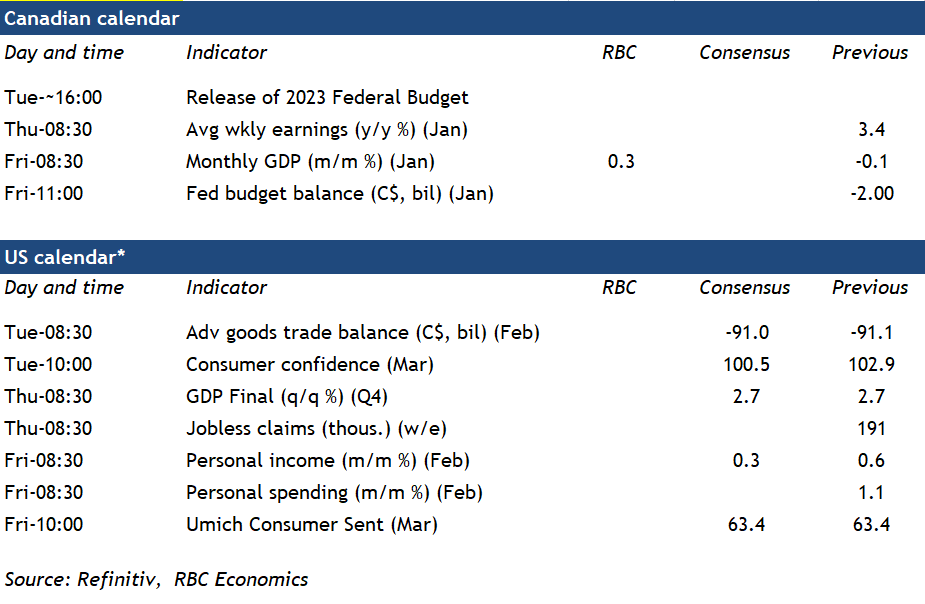
The Canadian economy has shown resilience so far this year. But there remain pockets of weakness, and headwinds from aggressive interest rate increases continue to build. It’s against this mixed economic backdrop that Finance Minister Chrystia Freeland will release the federal budget Tuesday.
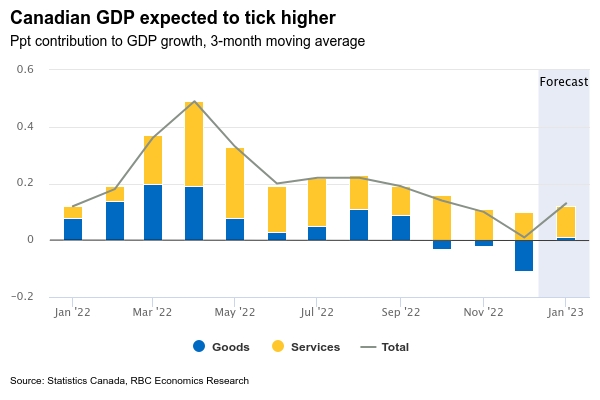
First the strengths: Statistics Canada’s advance estimate for January GDP was up 0.3% from December. And a strong February labour market report suggests output probably continued to rise in that month too. Though oil production likely edged lower again in January as the sector continued to deal with a range of (mostly) transitory disruptions, the manufacturing sector has been a bright spot, with January sales surging higher. Retail sales also rose 1.4% (1.5% excluding price impacts) in January although the early estimate for February was for a 0.6% decline.
Now the weaknesses: The housing market continues to soften. Though home resales are showing signs of stabilization, new construction has declined in eight of the last nine months. And home prices continue to edge lower. The impacts of interest rates have substantially lagged the Bank of Canada’s hikes. But they are increasingly weighing on household purchasing power as loans are gradually renewed at higher rates. This will cut into household purchasing power and spending in the months ahead.
Climate policy, and more specifically, Canada’s response to the massive U.S. Inflation Reduction Act, will headline the March 28 budget. Though an overheating economy has pushed inflation higher, it has also boosted government revenues. Still, plans to return the budget to balance remain at best aspirational. Fiscal tracking suggests scope for a smaller budget deficit for fiscal 2022/23 than the $36 billion shortfall expected in the Fall Economic Statement. And the FES also assumed a $31 billion deficit for fiscal 2023/24 with no return to balance until 2027/28. Some targeted relief to help more vulnerable groups cope with higher living costs is expected next week. But Freeland has already acknowledged that turning on the fiscal spending taps too much would just add “fuel on the fire of inflation.”
Week ahead data watch
Canada’s SEPH employment report should show continued job gains in January given the 150,000 surge earlier reported in the more recent LFS employment data. But job vacancies data will be closely monitored for signs of further softening in hiring demand, even if that weakness has yet to flow through to employment counts.
The Weekly Bottom Line: Canada Inflation Moving in the Right Direction
U.S. Highlights
- The Federal Reserve delivered a modest 25-basis point hike this week amid banking stress, lifting the policy rate to a range of 4.75-5.00% – a level that’s just a hair below its previous peak back in 2007.
- Fed projections show the policy rate peaking at 5.1% in 2023, implying one more hike for the year, while next year a series of cuts are forecast to bring the rate down to 4.3%. Market expectations, however, are titled toward a lower rate environment in both years.
- Existing home sales rose 14.5% in February, recording the first increase after twelve consecutive months of declines.
Canadian Highlights
- Canadian Consumer Price Inflation was the main event this week. It showed a steady deceleration in price pressures, with total inflation falling to 5.2% year-on-year (y/y), from 5.9% y/y in January.
- The driver of easing inflation has been the steady decline in the price of goods, with gasoline prices leading the way, down 4.7% y/y .
- The services side of the economy has not budged. It is still hovering around its 30-year high, at 5.3% y/y. This kept Core CPI excluding food and energy steady at 4.9% y/y.
U.S. - Fed Delivers Small Hike Amid Banking Stress
Stuck between a rock and a hard place, the Fed appears to have taken a middle-of-the-road approach in setting monetary policy this week. Inflation, which remains well above target and has shown moderate signs of acceleration recently coupled with strong job growth, meant that the Fed could have opted for a more hawkish stance at Wednesday’s FOMC meeting. Fed Chair Powell nodded to this possibility in his testimony to Congress two weeks ago. However, the ongoing banking turmoil has upended this narrative. Instead of leaving the rate unchanged, – an option that was closely considered – Fed officials ultimately went with a 25-basis point hike, lifting the policy rate to 4.75-to-5.00%.
In taking this decision, the Fed acknowledged the risks from the banking turmoil, including the potential negative impact on the real economy from tighter credit conditions for households and businesses. Tighter credit conditions could do some of the Fed’s work for it in reducing inflationary pressures, substituting for further hikes. However, as Chair Powell noted in the press conference, it’s not clear how significant and how sustained the credit tightening will be. The Fed is keeping the door open to some further monetary tightening for now, but changes in the language of the FOMC statement suggest that it is very close to wrapping up its hiking cycle.
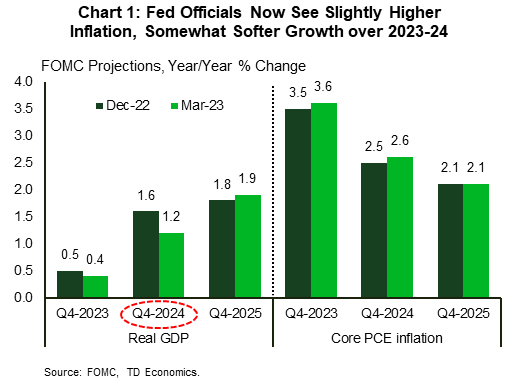
Along with the policy decision, the Fed also issued an update to its quarterly economic projections. Fed officials now expect inflation to remain slightly higher by the end of 2023 and 2024 compared to their view in December. Meanwhile, economic growth is expected to come in a bit softer over this same period, with a downgrade to the 2024 growth profile the most noticeable difference (Chart 1).
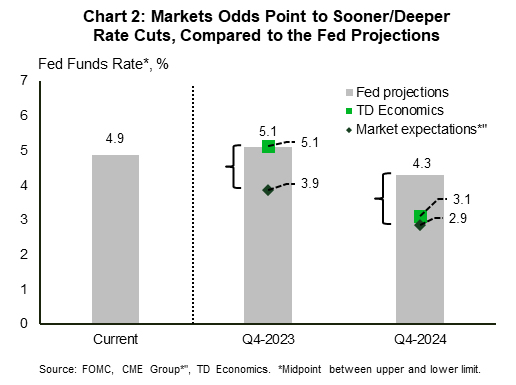
Policy rate expectations remained unchanged for 2023, with most Fed officials expecting the rate to peak to 5.1%, which implies one more hike this year. Market expectations, however, are not in tune with this view. The current pricing suggests that the Fed is done hiking rates, and that rate “cuts” will follow suit shortly this summer. Moving on to next year, while Fed officials have penciled in a series of rates cuts that will bring the policy rate down to 4.3%, market expectations remain more dovish, with the gap between the two forecasts widening (Chart 2). Our projection is aligned more closely with the Fed this year, but as growth slows into next year, we anticipate that in 2024 the Fed will loosen monetary policy more than it projects to steady the economic ship.
Reiterating Chair Powell’s view, the degree of credit tightening from the recent banking turmoil remains a major source of uncertainty for the outlook. On this front, it appears that authorities will need to stay alert in putting out more fires. Across the Atlantic, after finding a solution to the Credit Suisse troubles, the attention has now turned to another Global Systemically Important Bank (G-SIB), Deutsche Bank, after a surge this week in the cost of insuring the lender’s debt against default. With banking developments front and center, economic data played second fiddle, but a strong housing report did bring some cheer.
Canada – Inflation Moving in the Right Direction
The release of Canadian Consumer Price Inflation (CPI) was Canada's economic headliner this week. With total CPI decelerating to 5.2% year-on-year (y/y) in February (from 5.9% y/y in January), markets continued to price greater odds that the Bank of Canada will start to cut rates as early as July. This pushed government of Canada bond yields even lower - the Canada 2-year yield was down another 20 basis points (bps) this week, after falling 80 bps over the prior two weeks. Although this has been a significant move, the U.S. 2-year has fallen by even more (-135 bps), causing Canada/U.S. yield differentials to narrow. This has put a floor under the Canadian dollar at 72.5 U.S. cents, even as commodity prices have been falling.
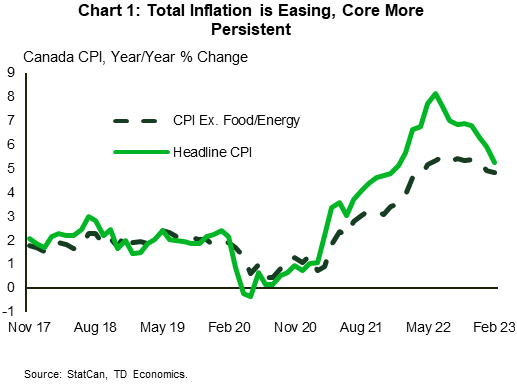
The easing in headline CPI was driven once again by a fall in energy prices (Chart 1 ). Total energy inflation has dropped in six of the last eight months, unwinding all the energy inflation witnessed after Russia invaded Ukraine. The drop in gasoline prices was the driver here, with prices at the pump down 4.7% compared to last year and down 27.9% since last spring. This has caused total goods inflation to go from its peak of 11.2% y/y in June 2022, to 5.27% y/y in February. Even more impressive is that on a three-month annualized basis, goods prices are in deflation at -0.9%, led by durable goods prices, which are falling by -4.8% (Chart 2).
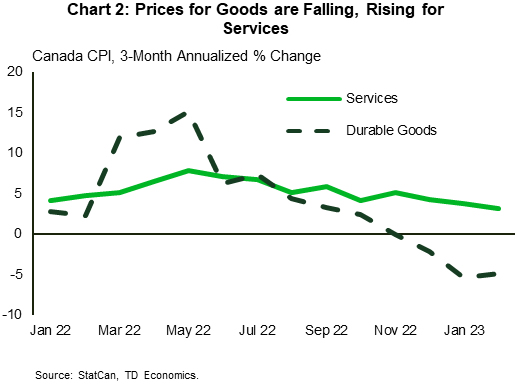
While the easing in goods inflation will act as a tailwind for the BoC in its efforts to bring price growth to the upper edge of its target band of 1% to 3% by the middle of 2023, core inflation metrics have been less agreeable. CPI excluding food and energy was unchanged in February at 4.9% y/y. This is due to the consistent pressure coming from the service side of the economy. Even though goods inflation is moving lower on falling commodity prices and the unwind of supply chain issues, services inflation is still hovering around 30-year highs, at 5.3% y/y. With wages as the main driver of services inflation, the recent upturn in average hourly earnings to 5.4% y/y in February (from 4.5% y/y in January) is a concern.
The increase in wages mirrors the recent revival in economic momentum. With the labour market averaging 67 thousand jobs gained per month since October (nearly 5x the trend rate of job growth), and the government supplementing peoples' incomes through a host of support programs, Canadians have seen incomes rise. Naturally, this has caused people to resume spending at a rapid clip. Retail sales released this morning confirmed this trend, rising 1.4% month-on-month in January. As we outlined in our recent paper on cyclical inflation in Canada (supercore), the current surge in spending risks pushing inflation higher over the coming months. For the BoC, which voiced its concern that "inflation could get stuck materially above the 2% target" in its policy meeting deliberations this week, the cyclical strength in recent data will further complicate matters.