Sample Category Title
UK PMIs: Economic returns to modest growth in Q1
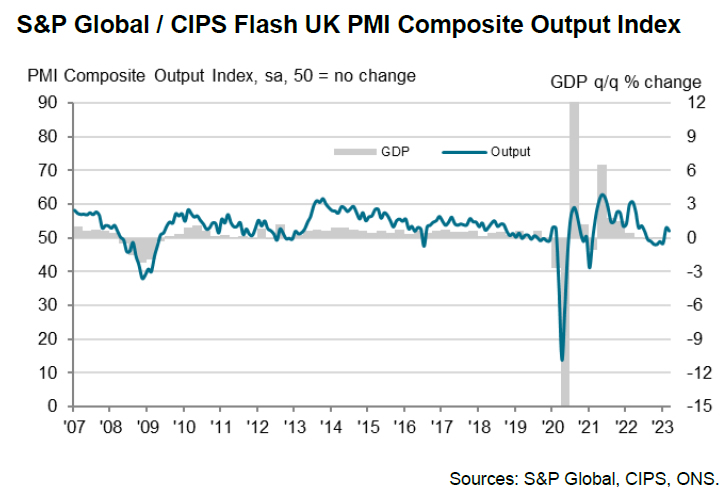
UK PMI Manufacturing dropped from 49.3 to 48.0 in March. PMI Services dropped from 53.5 to 52.8. PMI Composite dropped from 53.1 to 52.2. All three were two-month lows.
Chris Williamson, Chief Business Economist at S&P Global Market Intelligence, indicated that the UK economy has shown signs of growth in the first quarter, with the flash PMI surveys indicating a second consecutive month of rising output in March. The data suggests a modest quarterly GDP growth rate of 0.2%, which is a welcome change from the stagnation seen in the second half of the previous year.
Despite concerns over the banking sector, businesses remain optimistic about growth possibilities, and the improvement in order book growth suggests that a near-term recession has been averted. The upturn in companies' expectations for the year ahead indicates that firms are more focused on growth opportunities rather than banking sector challenges.
GBPJPY Slices Through 50-day SMA as Decline Resumes
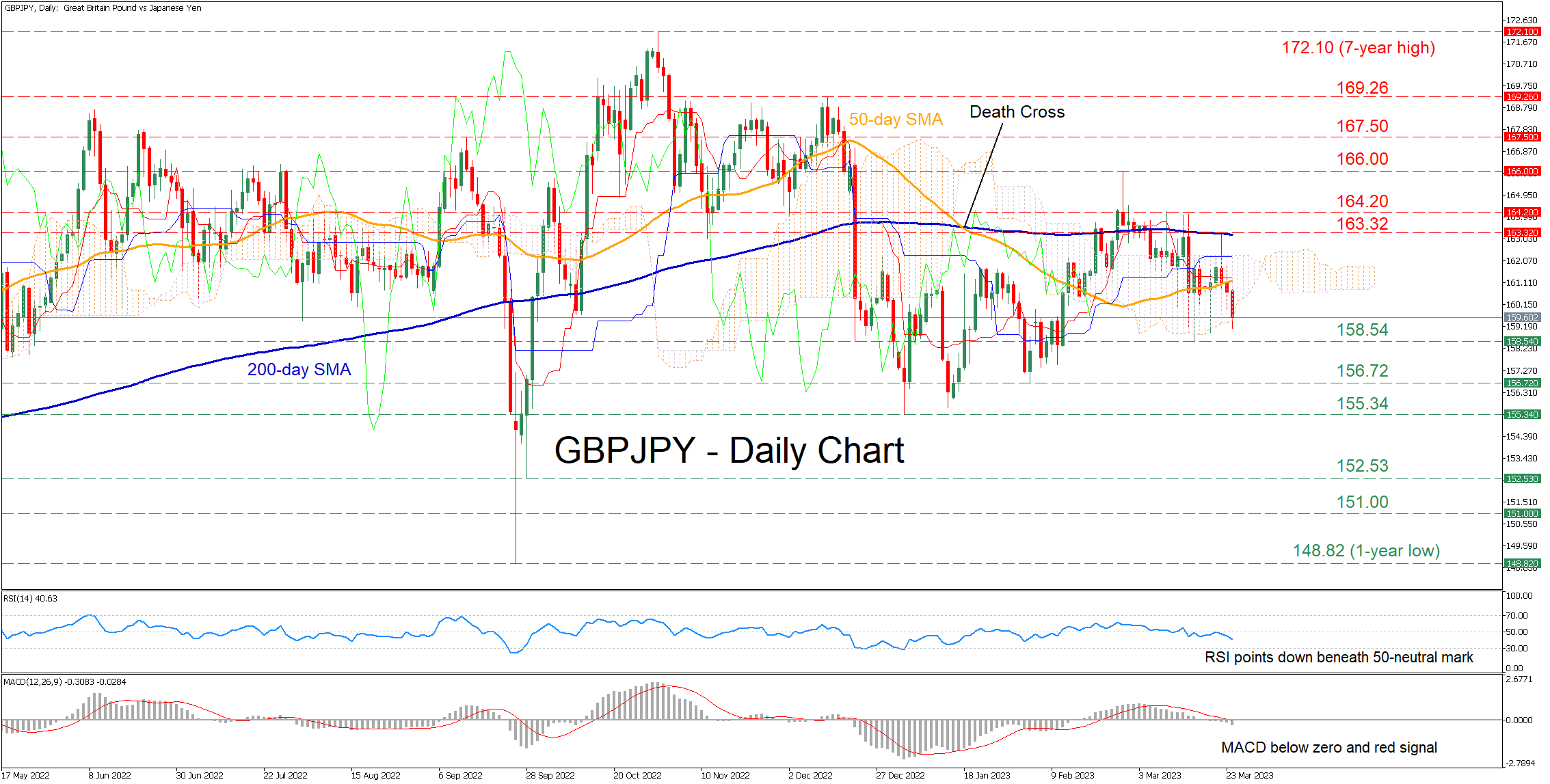
GBPJPY has been losing ground after its 2023 advance got rejected at the 166.00 region in early March. Even though the pair attempted to rebound after finding its feet near the 50-day simple moving average (SMA), the upper boundary of the Ichimoku cloud and the 200-day SMA curbed the upside.
The momentum indicators are endorsing this bearish near-term bias. Specifically, the RSI is sloping downwards below its 50-neutral mark, while the MACD histogram dropped below both zero and its red signal line.
Should selling pressures persist, the March low of 158.54 could act as the first line of defense. Sliding beneath that floor, the pair could decline towards 156.72, or lower to test the 2023 bottom of 155.34. Even lower, the 152.53 barrier might provide downside protection.
On the flipside, if the negative momentum fades and the price reverses upwards, the pair could challenge the recent resistance of 163.32, which overlaps with the 200-day SMA. Should that barricade fail, the bulls could aim for 164.20 before the 2023 peak of 166.00 appears on the radar. A break above the latter may pave the way for the September high of 167.50.
In brief, GBPJPY retraced lower and traded sideways between the 50- and 200-day SMAs after its recent advance got rejected. However, this rangebound pattern broke to the downside and a potential fresh lower low could lead to an acceleration of the retreat.
GBP/USD: Cable Loses Traction After Upside Rejection, Little Help from Upbeat UK Retail Sales
Cable is standing at the back foot in early Friday’s trading after hitting new highest since early February on Thursday but failing to sustain post-BOE gains.
The Bank of England raised its interest rates by 25 basis points, in line with expectations, after unexpected inflation rise in February shifted earlier 50/50 split on rate outlook, to decision for 0.25% hike.
However, BOE’s 7/2 vote split and subsequent comments, in which policymakers said that further hikes would directly depend on evidence of more persistent pressure, were mainly seen by markets as dovish.
This tempered immediate market reaction, however, supportive factor for pound could be diverging inflation values, as US inflation remains in a downward trajectory for now, while Britain’s inflation rose again after easing in past couple of months.
If the gap widens, this would prompt the BOE to remain on hiking track, and offer support to sterling, while the US central bank already signaled it is likely close to the end of its policy tightening campaign.
Today’s better than expected UK retail sales data, which showed monthly retail sales jumping well above forecast in February and returning to pre-pandemic levels, while annualized figure signaled much lower than expected drop, may offer temporary support.
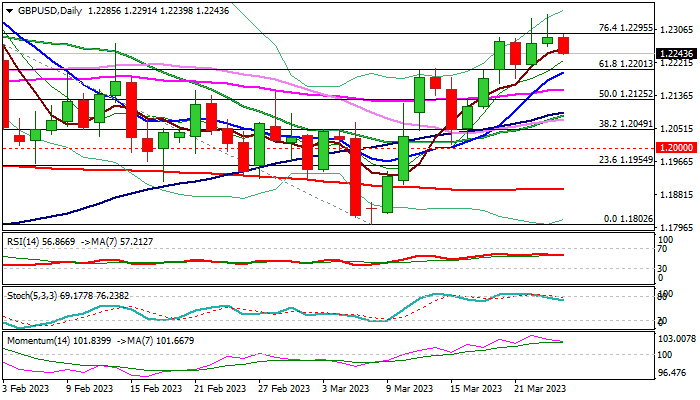
Technical view shows developing negative signals on daily chart, highlighted by long upper shadows on candles of past two days, which point to strong offers and warn of stall.
In addition, double failure to clearly break above Fibo barrier at 1.2295 (76.4% retracement of 1.2447/1.1802) is generating another negative signal – a bull-trap.
Contributing to negative near-term outlook is fading bullish momentum, as well as south-heading stochastic, which emerged from overbought territory, while today’s daily Ichimoku cloud twist, is also expected to be magnetic for fresh bears.
On the other hand, daily moving averages are still in full bullish setup and underpin the action for now.
The larger uptrend from 1.1802 (Mar 8 low) is intact, pointing to bullish scenario in which current pullback should be contained by strong supports at 1.2200 zone (broken Fibo 61.8% of 1.2447/1.1802, reinforced by rising 20-d moving average) to keep bulls in play and within already established consolidation range, ahead of fresh push higher.
Conversely, loss of 1.2200 handle would put bulls on hold and risk deeper pullback towards pivotal support at 1.2136 (Fibo 38.2% retracement of 1.1802/1.2343 rally).
Markets focus UK Mar PMI data, due today, which should provide fresh signals.
Res: 1.2295; 1.2343; 1.2402; 1.2447.
Sup: 1.2200; 1.2150; 1.2136; 1.2085.
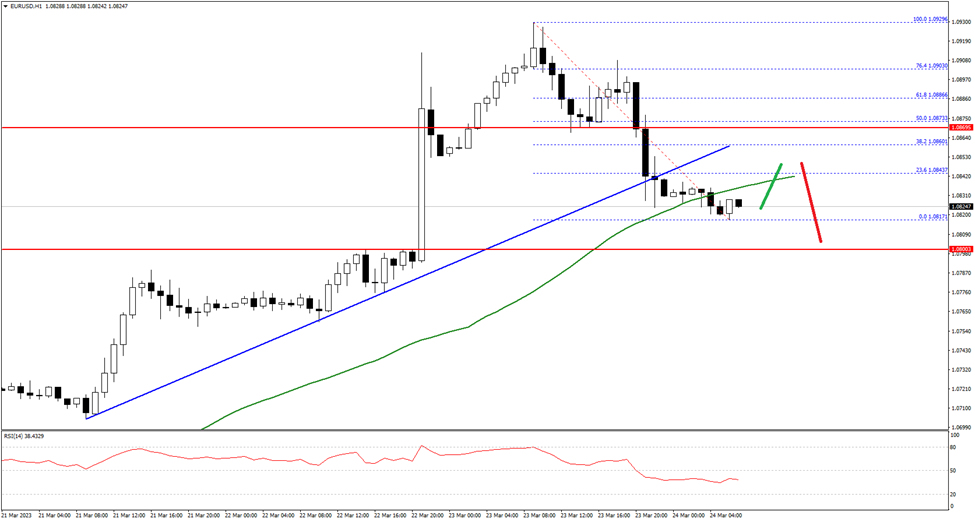
EUR/USD Pair Moved into a Short-Term Bearish Zone Below 1.0875
The Euro started a fresh decline after a major rally towards the 1.0920 against the US Dollar. The EUR/USD pair traded below the 1.0875 level to move into a short-term bearish zone.
There was a clear move below the 1.0850 support zone and the pair even settled below the 50 hourly simple moving average. It is now consolidating losses, with an immediate resistance near the 1.0840 level.
The next major resistance is near 1.0860 on FXOpen. A break above the 1.0860 resistance level could start another increase. In the stated case, it could rise towards the 1.0900 resistance.
Conversely, the pair might resume its decline below 1.0800. The next key support is near 1.0775, below the pair could drop towards the 1.0740 level. Any more losses might send the pair towards the 1.0710 level in the near term.
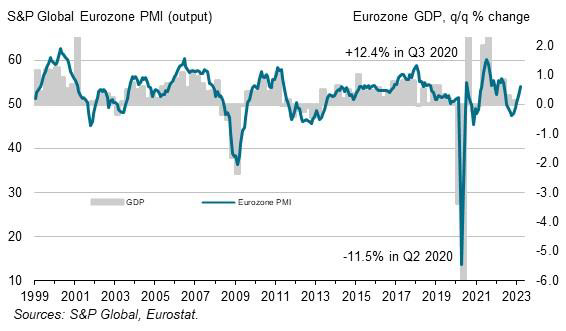
Eurozone PMI composite rose to 10-month high on strong services
Eurozone PMI Manufacturing dropped from 48.5 to 47.1 in March, hitting a 4-month low. However, PMI Services rose sharply from 52.7 to 55.6. PMI Composite rose from 52.0 to 54.1. Both PMI Services and Composite were the highest levels in 10 months.
According to Chris Williamson, Chris Williamson, Chief Business Economist at S&P Global Market Intelligence, the eurozone economy is experiencing a resurgence, with business activity in March growing at the fastest rate in ten months. The data indicates a 0.3% GDP growth in Q1, accelerating to a 0.5% rate in March. This growth is attributed to fading recession fears, easing inflation pressures, and significant improvements in supplier delivery times.
Despite these positive signs, inflationary pressures continue to be a concern, particularly in the service sector and rising wage costs. The growth remains unbalanced, with the service sector driving growth while manufacturing struggles to maintain production amid falling demand.
Full Eurozone PMI release here.
Also released, Germany PMI Manufacturing dropped further from 46.3 to 44.3 March, a 34-month low. But PMI Services rose from 50.9 to 53.9, a 10-month high. PMI Composite rose from 50.7 to 52.6, also a 10-month high.
France PMI Manufacturing ticked up from 47.4 to 47.7 in March. PMI Services rose from 53.1 to 55.5, a 10-month high. PMI Composite rose from 51.7 to 54.0, also a 10-month high.
BoE Bailey: Interest rates will go up further if inflation got embedded
In a interview with BBC, BoE Governor Andrew Bailey emphasized that the central bank expects inflation to decline sharply this year as the impact of last year's steep energy price increases drops from year-on-year price comparisons. He expressed relief that inflation had stabilized and noted some "encouraging signs" of progress. However, he urged continued vigilance, stating, "we have to be extremely vigilant on that front."
Bailey also issued a warning to businesses setting prices, cautioning that "if we get inflation embedded, interest rates will have to go up further." While acknowledging that companies must set prices according to the costs they face, he urged them to remember the anticipated decrease in inflation this year when setting prices: "we do expect inflation to come down sharply this year and I would just say please bear that in mind."
GBP/JPY Daily Outlook
Daily Pivots: (S1) 159.85; (P) 160.86; (R1) 161.77; More...
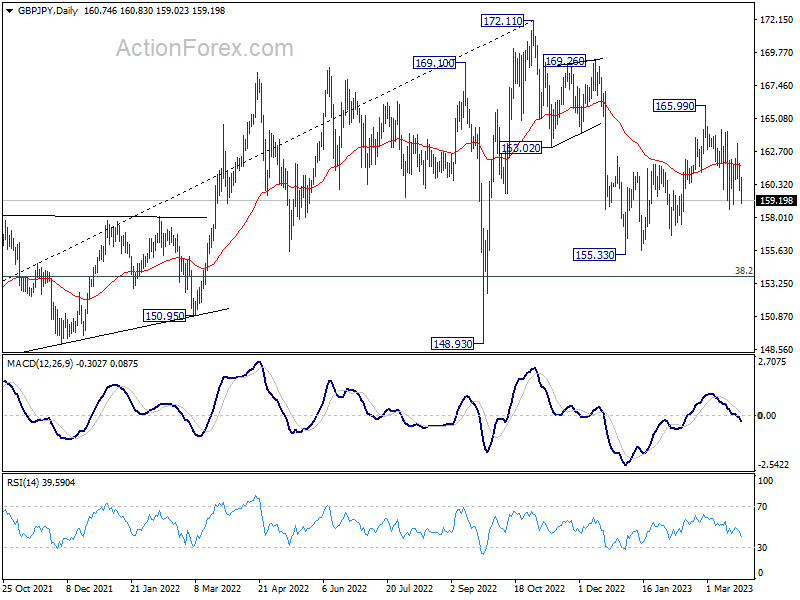
Immediate focus in now on 158.54 support in GBP/JPY with today's decline. Current development suggests that fall from 165.99 is a falling leg of the whole decline from 172.11. Deeper decline is expected as long as 164.12 resistance holds. Break of 158.54 will target a retest on 155.33 low. However, break of 164.12 resistance will bring stronger rise back to 165.99 resistance.
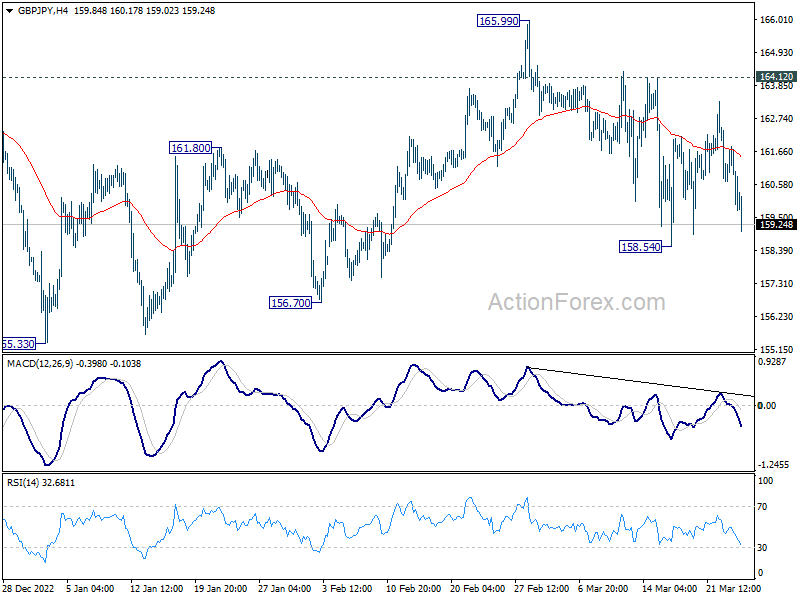
In the bigger picture, as long as 38.2% retracement of 123.94 (2020 low) to 172.11 (2022 high) at 153.70 holds, medium term bullishness is retained. That is, larger up trend from 123.94 (2020 low) is still in progress. Break of 172.11 high to resume such up trend is expected at a later stage.
EUR/JPY Daily Outlook
Daily Pivots: (S1) 140.87; (P) 142.04; (R1) 142.91; More....
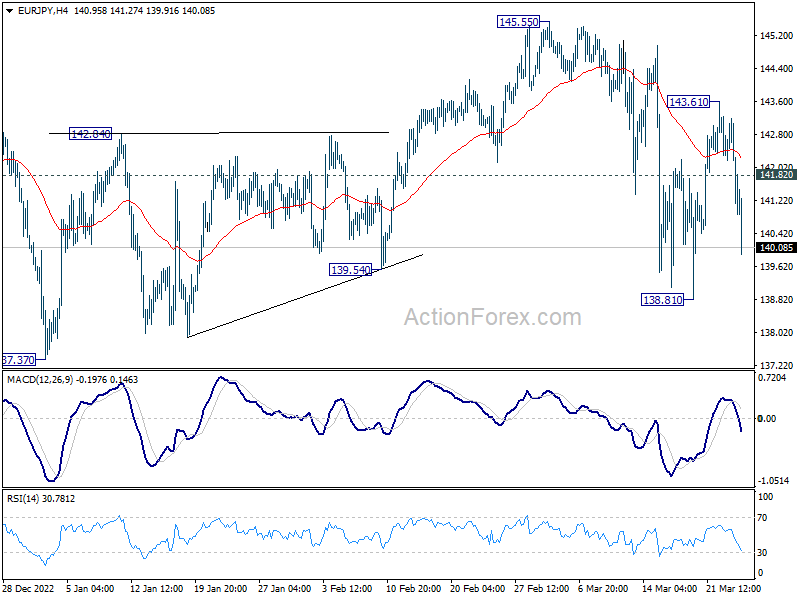
EUR/JPY's current downside acceleration argues that rebound from 138.81 has completed at 143.61 already. Intraday bias is back on the downside for 138.81 support first. Break there will suggest that whole corrective pattern from 148.38 is resuming for 137.37 support and below. On the upside, above 141.82 minor resistance will turn intraday bias again.
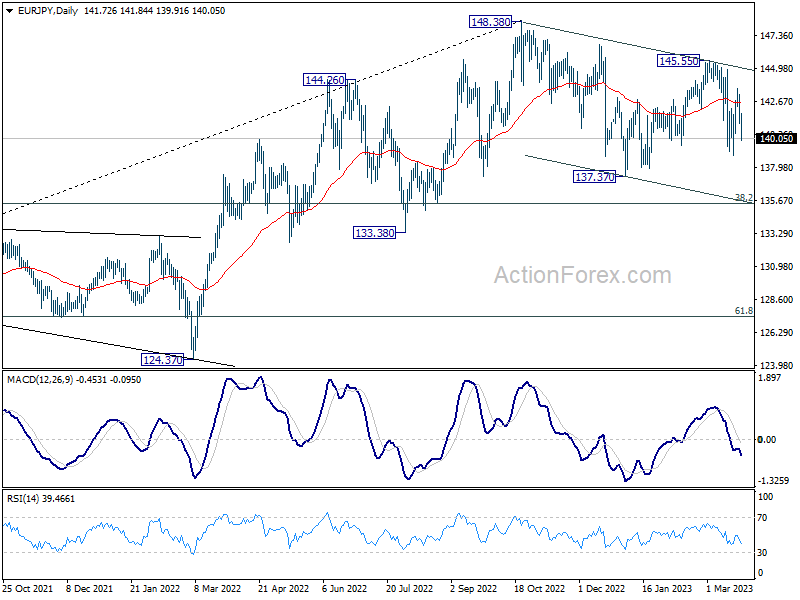
In the bigger picture, as long as 55 week EMA (now at 139.54) holds, larger up trend from 114.42 (2020 low) is still in progress for 149.76 long term resistance. However, firm break of 55 week EMA will bring deeper fall to 38.2% retracement of 114.42 to 148.38 at 135.40. Sustained break there will raise the chance of trend reversal, and target 61.8% retracement at 127.39.
EUR/GBP Daily Outlook
Daily Pivots: (S1) 0.8799; (P) 0.8832; (R1) 0.8850; More...
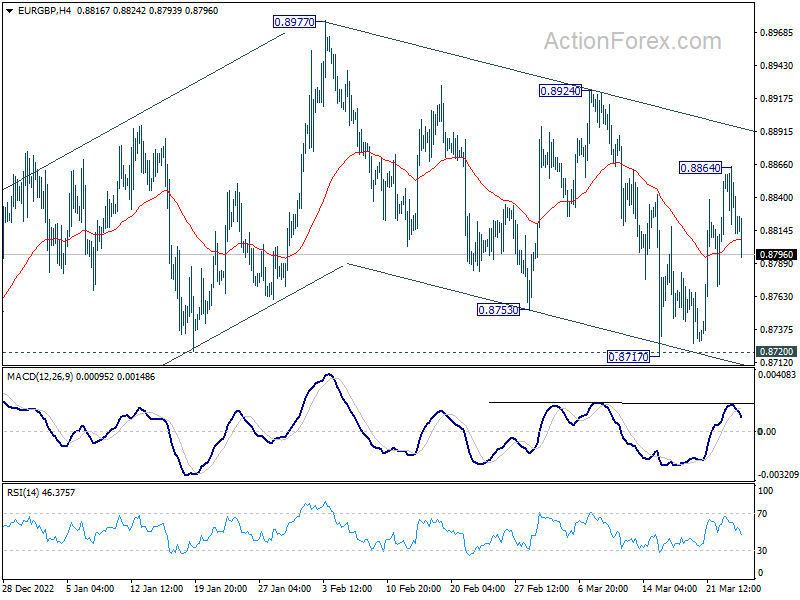
Intraday bias in EUR/GBP is turned neutral again as it retreated after hitting 0.8864. Overall outlook remains bullish as long as 0.8270 support holds. Above 0.8864 will target 0.8924 resistance first. Firm break there should resume larger rise from 0.8545 through 0.8977 high.
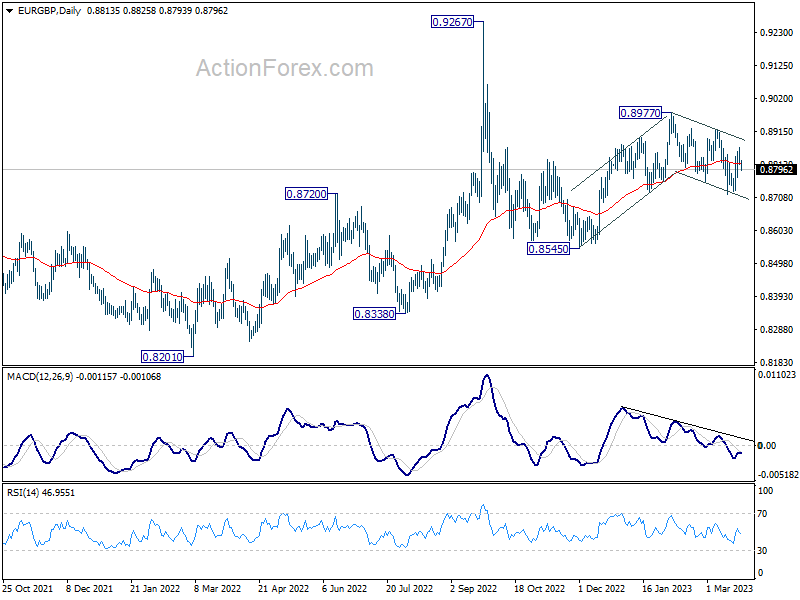
In the bigger picture, outlook is rather mixed for now, except that price actions from 0.9267 (2022 high) are part of the long term range pattern from 0.9499 (2020 high). With 0.8720 support intact, rise from 0.8545 is in favor to continue through 0.8977. However, firm break of 0.8720 will argue that such rebound has completed, and open up deeper fall through this support level.
EUR/AUD Daily Outlook
Daily Pivots: (S1) 1.6162; (P) 1.6209; (R1) 1.6249; More...
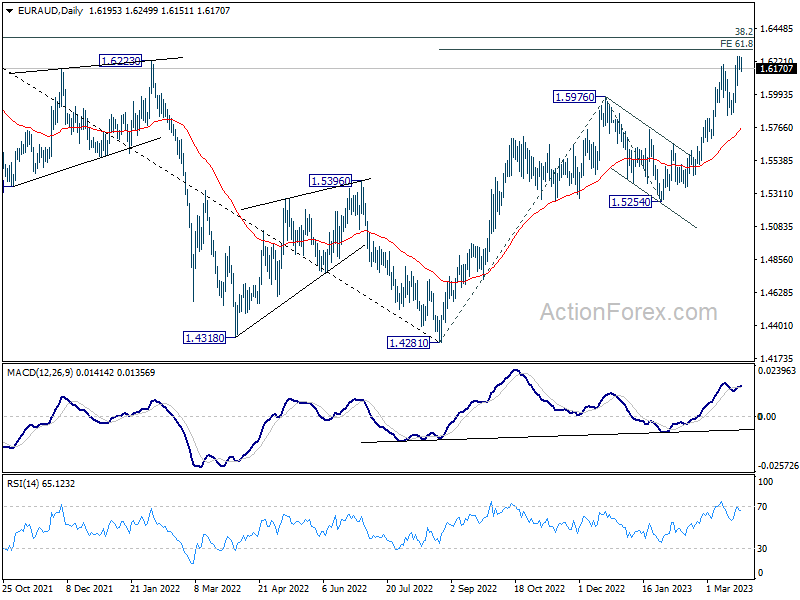
Intraday bias in EUR/AUD is turned neutral again with current retreat. Further rally is expected as long as 1.6053 support holds, for 61.8% projection of 1.4281 to 1.5976 from 1.5254 at 1.6302. Firm break there will resume larger rally from 1.4281 to 1.6389 fibonacci level. However, firm break of 1.6053 will indicate rejection by 1.6302 and turn bias back to the downside for 1.5848 support.
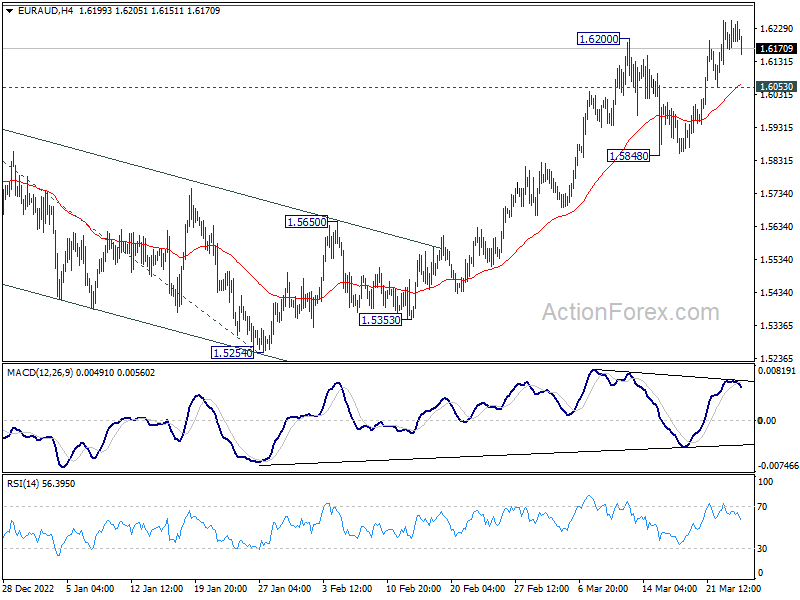
In the bigger picture, the strong support from 55 week EMA (now at 1.5404) is raising the chance of bullish trend reversal. Focus is now on 1.6434 cluster resistance (38.2% retracement of 1.9799 to 1.4281 at 1.6389). Sustained break there should confirm that whole down trend from 1.9799 (2020 high) has completed. Further rally should then be seen to 61.8% retracement at 1.7691. However, rejection by this cluster resistance will make medium term outlook neutral at best.