Sample Category Title
USD/JPY At Risk of Additional Decline, PMI’s Next
Key Highlights
- USD/JPY started a fresh decline below the 133.50 support zone.
- A major bearish trend line is forming with resistance at 131.80 on the 4-hours chart.
- EUR/USD and GBP/USD rallied above 1.0800 and 1.2220 respectively.
- The US Manufacturing PMI could decline from 47.3 to 47.0 in March 2023 (Preliminary).
USD/JPY Technical Analysis
The US dollar started a fresh decline from well above 134.00 against the Japanese Yen. USD/JPY traded below the 133.50 and 133.00 levels to enter a bearish zone.
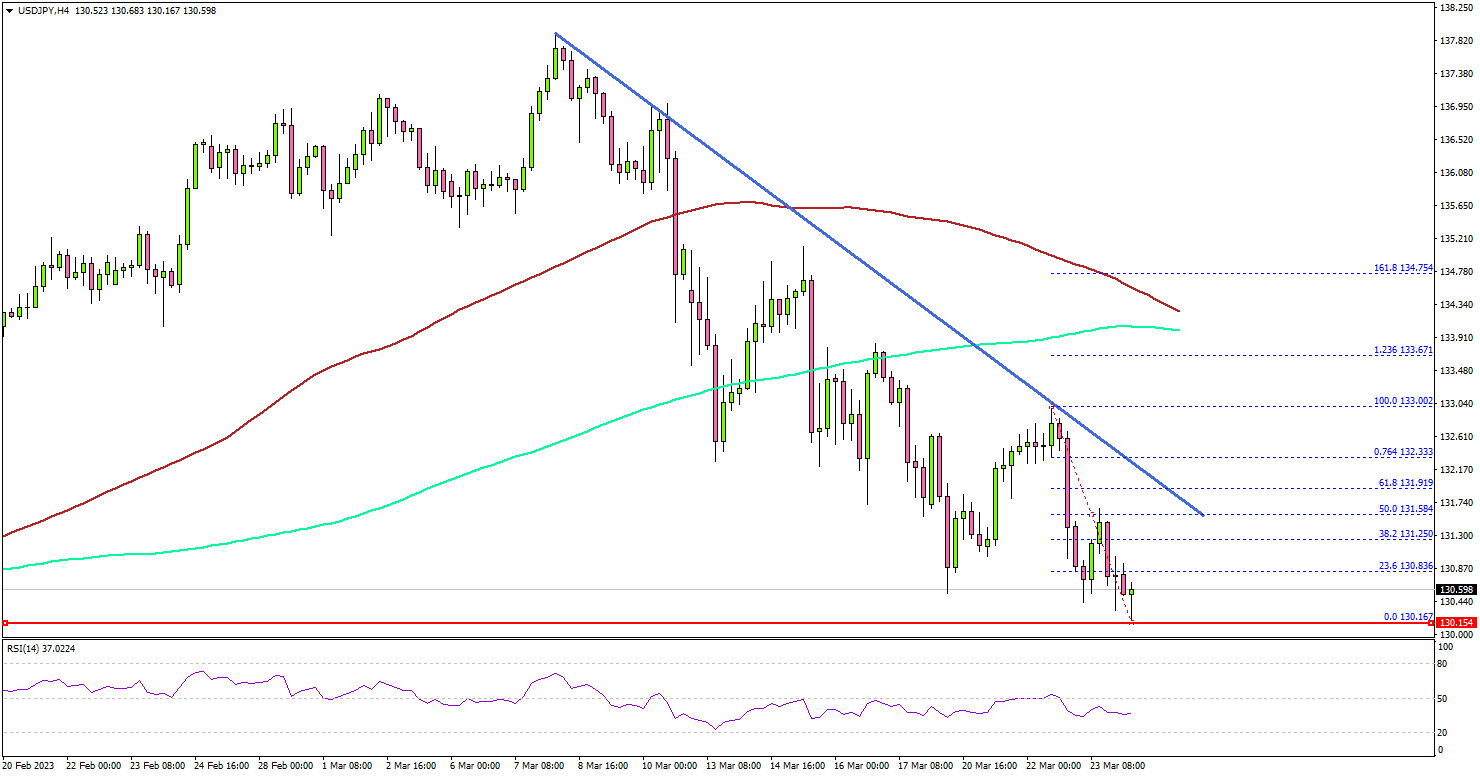
Looking at the 4-hours chart, the pair moved below the 132.50 support level, the 100 simple moving average (red, 4-hours), and the 200 simple moving average (green, 4-hours).
The pair even traded below the 131.20 support. A low is formed near 130.40 and the pair is now consolidating losses. An immediate resistance on the upside is near the 131.55 level.
The first major resistance is near the 131.80 level. There is also a major bearish trend line forming with resistance at 131.80 on the same chart. The next major resistance is near the 132.20. A clear move above the 132.20 resistance might send the pair towards the 133.00 zone.
Any more gains might send the pair towards 133.50 or even 134.00. On the downside, an immediate support is near the 130.50.
The next major support is near the 130.00 level, below which there is a risk of a move towards the 128.80 level or 127.50 in the coming days.
Looking at EUR/USD, the pair gained strength above the 1.0800 resistance zone and even spiked above the 1.0880 level.
Economic Releases
- Germany’s Manufacturing PMI for March 2023 (Preliminary) - Forecast 47.0, versus 46.3 previous.
- Germany’s Services PMI for March 2023 (Preliminary) - Forecast 51.0, versus 50.9 previous.
- Euro Zone Manufacturing PMI for March 2023 (Preliminary) – Forecast 49.0, versus 48.5 previous.
- Euro Zone Services PMI for March 2023 (Preliminary) – Forecast 52.5, versus 52.7 previous.
- US Manufacturing PMI for March 2023 (Preliminary) – Forecast 47.0, versus 47.3 previous.
- US Zone Services PMI for March 2023 (Preliminary) – Forecast 50.5, versus 50.6 previous
Elliott Wave Favors More Downside in GBPJPY
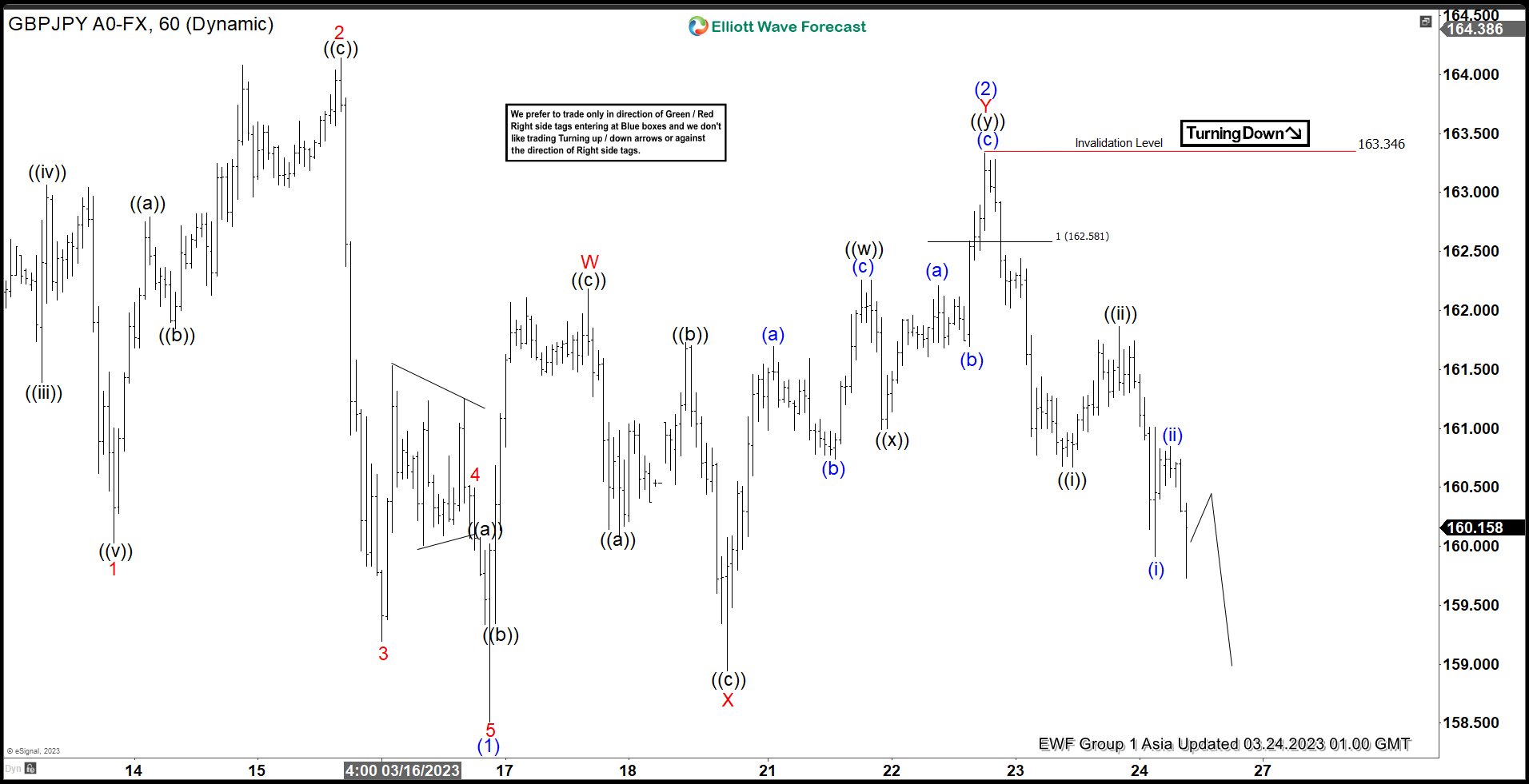
Decline from 2.28.2023 is in progress as a 5 waves impulse Elliott Wave structure. Down from 2.28 high, wave 1 ended at 160.02 and rally in wave 2 ended at 164.14. Pair resumes lower in wave 3 towards 159.19, and wave 4 ended at 160.49. Last leg lower wave 5 ended at 158.51 which completed wave (1). Wave (2) corrective rally ended at 163.34 as a double three Elliott Wave structure. Up from wave (1), wave W ended at 162.18, and pullback in wave X ended at 158.94. Wave Y higher ended at 163.34 which completed wave (2).
Pair resumes lower in wave (3) with internal subdivision as another 5 waves in lesser degree. Down from wave (2), wave ((i)) ended at 160.67 and rally in wave ((ii)) ended at 161.86. Pair has resumed lower in wave ((iii)) and broken below wave ((i)). Down from wave ((ii)), wave (i) ended at 159.91 and wave (ii) rally ended at 161.01. Expect pair to continue lower within wave (iii) of ((iii)). A break below wave (1) at 158.51 would confirm the bearish view and rule out a double correction. Near term, as far as pivot at 163.34 high stays intact, expect rally to fail in 3, 7, or 11 swing for further downside
GBPJPY 1 Hour Elliott Wave Chart
GBPJPY Elliott Wave Video
https://www.youtube.com/watch?v=Ue3pVdKIRDE
AUDNZD Wave Analysis
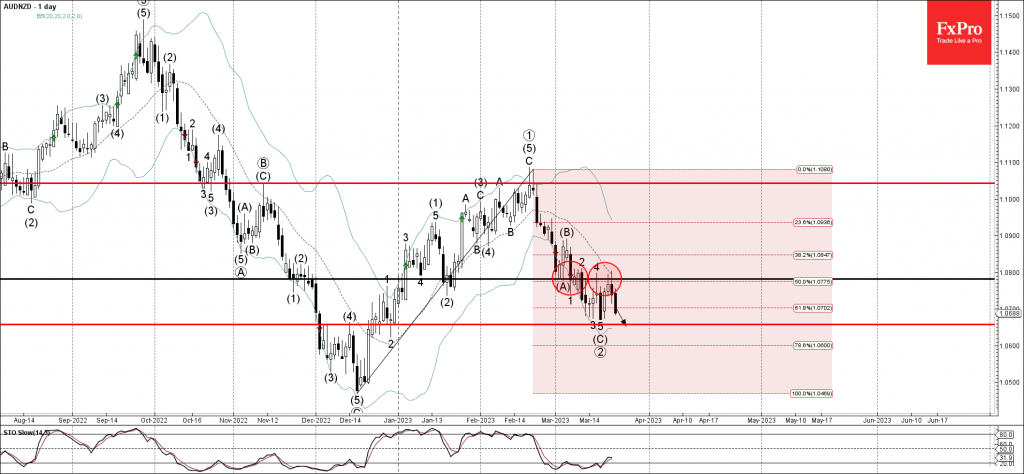
- AUDNZD reversed from resistance level 1.078
- Likely to fall to support level 1.0670
AUDNZD currency pair recently reversed down from the key resistance level 1.078 (former support from the start of March).
The resistance level 1.078 was strengthened by the intersecting 50% Fibonacci correction of the previous upward impulse from December (acting as the resistance after it was broken in March).
AUDNZD can then be expected to fall further toward the next support level 1.0670 (which stopped the previous correction (C)).
Silver Wave Analysis
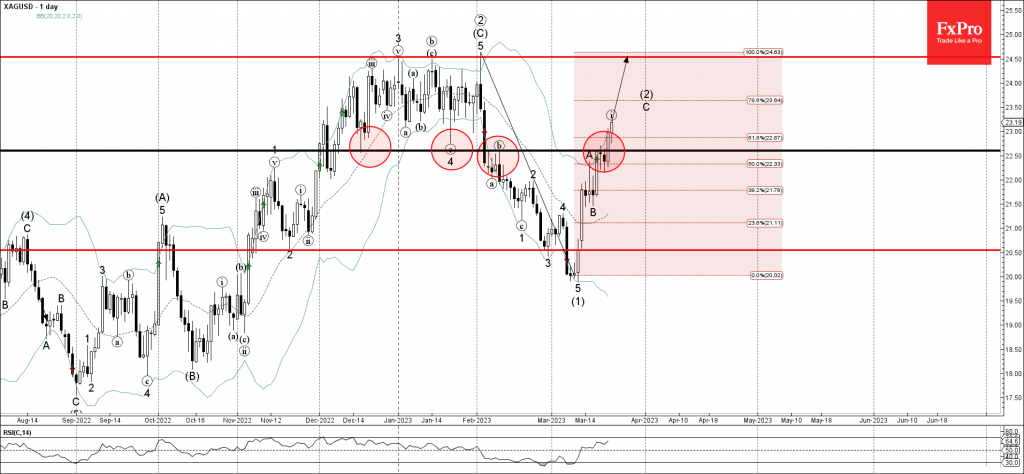
- Silver broke key resistance level 22.60
- Likely to rise to resistance level 24.50
Silver recently broke the key resistance level 22.60 (former support from December, which has been reversing the price from February).
The breakout of the resistance level 22.60 coincided with the breakout of the 50% Fibonacci correction of the previous downward impulse (1) from February (which accelerated the active impulse wave C).
Silver can then be expected to rise further toward the next resistance level 24.50 (previous Triple Top from December and January).
Bank of England Review – Set for Another 25bp Hike in May
- In line with our expectation, the BoE today hiked policy rates by 25bp, bringing the Bank Rate to 4.25%.
- With both growth and domestic inflation having surprised to the upside and given BoE's message today we pencil in an additional 25bp hike in May 2023.
- We thus expect the Bank Rate to peak at 4.50%. We still do not envision rate cuts from BoE before 2024.
In line with our expectation, the Bank of England (BoE) hiked the Bank (policy) Rate by 25bp to 4.25% with 7 members voting for a 25bp hike and two members voting for keeping the Bank Rate unchanged.
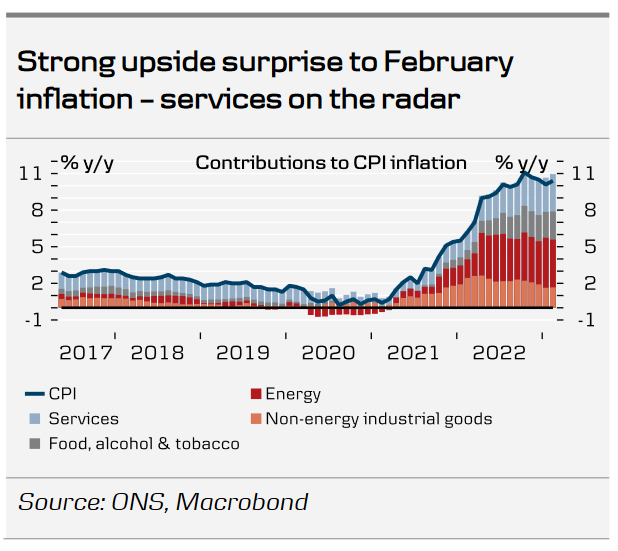
Overall, the forward guidance was limited with the BoE leaving the door open for another hike at the May meeting if persistent inflation pressures persist. With February headline inflation surprising sharply to the upside and the near-term path of GDP "likely to be somewhat stronger than previously expected" the majority of Monetary Policy Committee (MPC) voted for an increase of 25bp. Most notably, the most hawkish member Cathrine Mann voted for a 25bp instead of 50bp despite hawkish commentary between meetings. The key concern for the BoE remains developments in wage data as well as service inflation. With both growth and inflation having surprised to the upside, we do not believe that data will have weakened enough for the BoE to pause its hiking cycle at the May meeting. We thus revise our forecast to include a final 25bp hike in May, marking a peak in the Bank Rate at 4.50%.
We were left with little guidance in terms of potential cuts later in the year. The two MPC members in favour of keeping the Bank Rate unchanged suggested that policy was becoming "increasingly restrictive, this would bring forward the point at which recent rate increases would need to be reversed". We do not expect any cuts to materialize before 2024.
Rates. As the 25bp hike was fully priced in by markets, the market reaction upon announcement was limited. 10-30Y was close to unchanged while 2Y rates were a few basis points lower. The market pricing of the peak policy rate was pushed slightly lower to 4.5% in August (from 4.6%).
FX. EUR/GBP initially moved lower upon announcement but quickly retraced as little guidance was given in the statement. Further out, EUR/GBP is, in our view, stuck between opposing forces. On the one hand, we expect relative rates to act as a clear tailwind, while global growth slowdown and the relative appeal of UK assets acts as a headwind. We thus expect the cross to remain range bound around 0.87-0.88.
Our call. We revise our call to expect the BoE to deliver a final 25bp hike in May. Our expectations are in line with current market pricing (currently 30bp priced until August 2023) as we expect the rest of the BoE committee to increasingly turn less hawkish amid a weakening growth backdrop and easing labour market conditions. Markets are pricing in 30bp of cuts during H2. We still believe that the first rate cuts will not be delivered before the beginning of 2024.
Bank of England Raises Interest Rate and Optimism
The Bank of England raised its interest rate by 25 points to 4.25%, in line with market expectations. Two members voted to keep rates on hold for the third meeting, while seven others voted against it.
Commenting on the decision, the BoE noted the improved global growth outlook and now expects UK GDP to grow in the second quarter, up from a 0.4% contraction previously. Separately, the fall in gas and oil futures prices is noted.
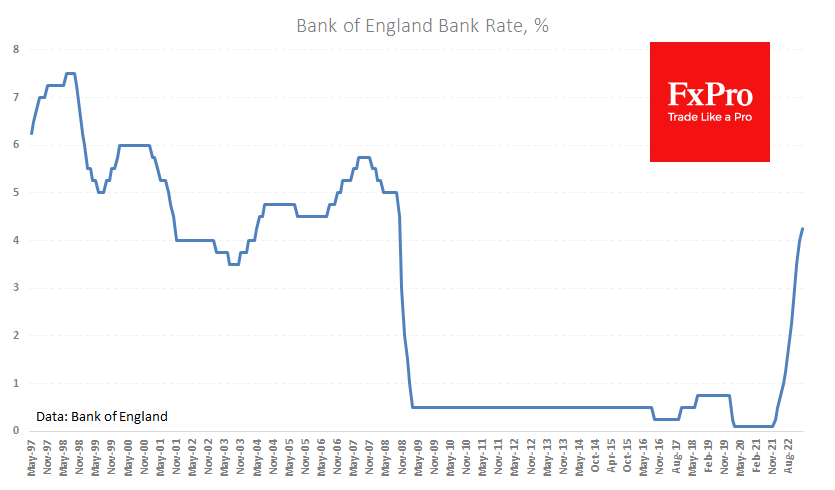
The Bank of England has described the recent unexpected rise in inflation as temporary and continues to see a significant slowdown over the year. This is in no small part due to the current budget changes.
The Bank of England said further policy tightening might be needed if there is evidence of additional inflationary pressures in wages and services costs. This sounds like relatively dovish commentary, expressing more hope than confidence in a sustained return of inflation to the 2% target and the financial sector’s resilience. Indirectly, the regulator’s rhetoric suggests that the baseline scenario remains for rates to stay on hold.
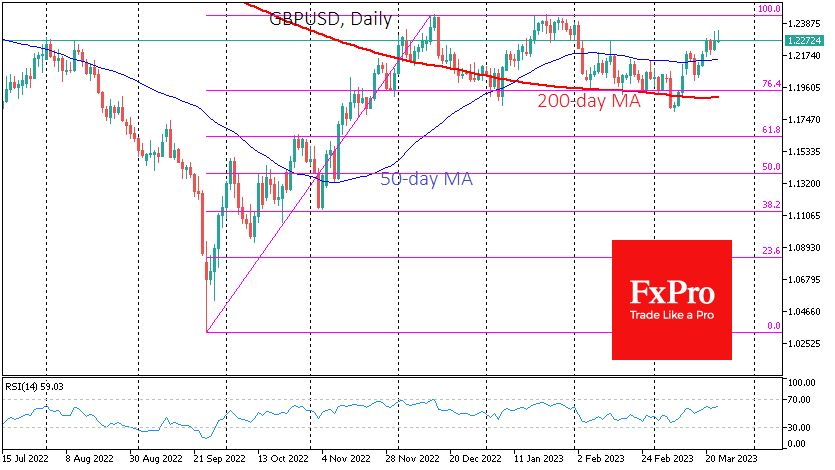
GBPUSD initially reacted positively to the rate decision, returning to the day’s high of 1.2340, but at the time of writing has pulled back below 1.2300. At the same time, the Pound’s momentum against the Dollar is primarily driven by the Dollar. In our view, the GBPUSD completed an almost three-month correction in early March, with the next target near the upper end of the trading range since December at 1.2430. Likely, the strengthening will not stop there, and the pair will have further strength to reach a new level, targeting 1.30.
ETHUSD Consolidates After Advance Pauses
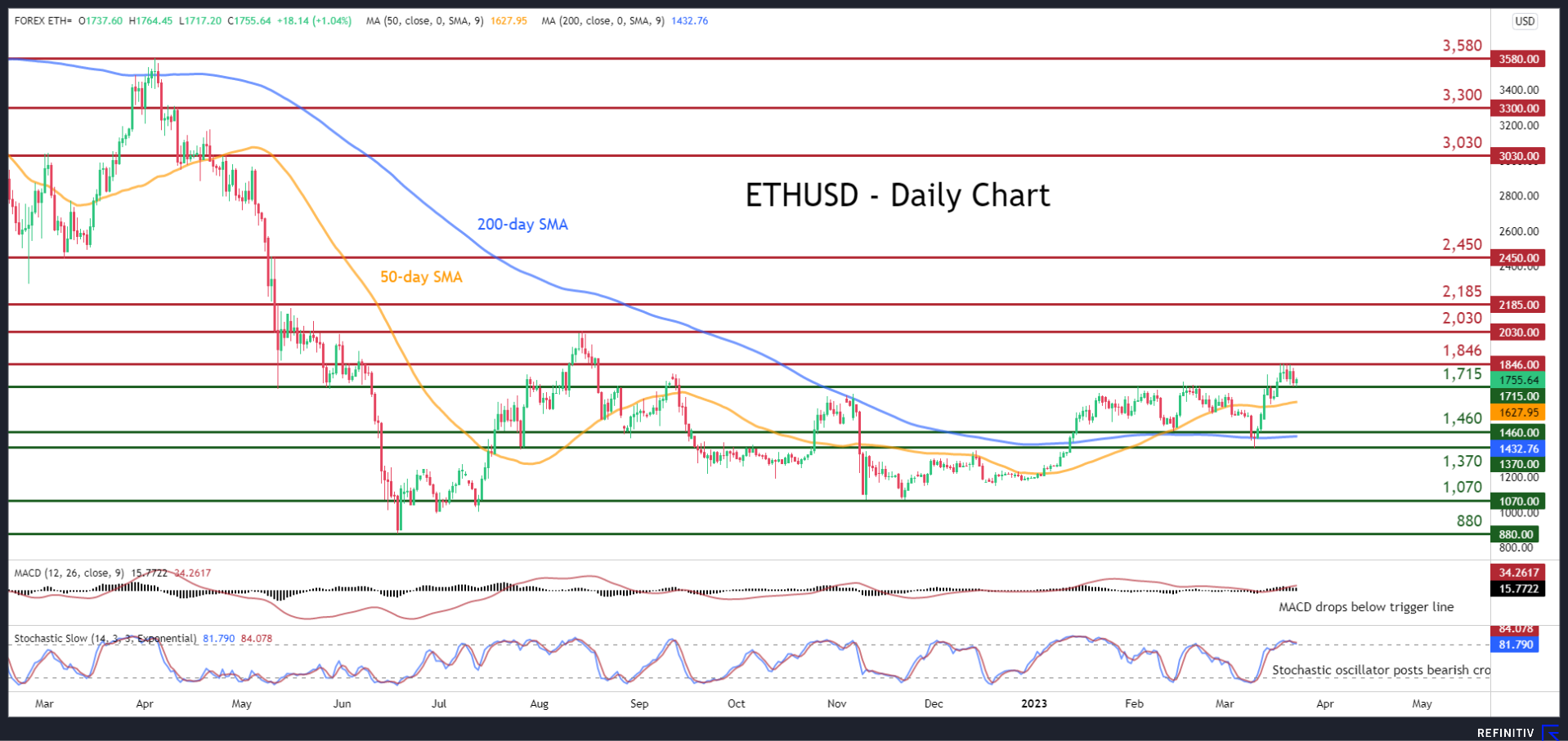
ETHUSD (Ethereum) has been in a steady uptrend since the beginning of the year, generating a fresh six-month high of 1,846 in mid-March. However, the digital asset experienced a minor pullback after reaching overbought conditions, with the price trading within a range for the past few daily sessions.
The momentum indicators currently suggest that the bullish forces are subsiding. Specifically, MACD histogram has crossed below its red signal line but remains in the positive region, while the stochastic oscillator posted a bearish cross within its 80-overbought zone.
Should selling pressures persist, initial resistance could be met at 1,715, which has acted both as support and resistance in 2023. Escaping the rangebound pattern, the price may descend towards the February low of 1,460 before the March bottom of 1,370 appears on the radar. Even lower, the November double-bottom region of 1,070 could provide downside protection.
On the flipside, if the positive momentum strengthens, Ethereum might test the recent rejection region of 1,846. A break above that zone could turn the spotlight to the August peak of 2,030. Violating this area, the bulls could aim for the 2,450 hurdle.
Overall, ETHUSD has been stuck in a range for the last few sessions, appearing unable to post a fresh higher high. Hence, a break beneath the lower boundary of its sideways move could lead to significant losses.
By Hiking and Retaining Conditionality, BoE Thus Bought Some Time
Markets
The Bank of England raised the policy rate by 25 bps to 4.25% in a 7 (rate hike) - 2 (unchanged) vote. The move was widely expected among analysts though markets required a little more conviction. That came from yesterday’s unexpected reacceleration in UK inflation to 10.4% headline and 6.2% core. The BoE in February tied further tightening to the condition of evidence of more persistent inflation. It kept that conditionality in today’s statement. Despite the recent uptick, which the BoE attributed to a single volatile component, inflation is still projected to slow down considerably in Q2 this year and to a lower rate than anticipated in February. This largely reflects the extension of the government’s energy price guarantee and the fall in wholesale energy prices. Services CPI, a closely watched gauge since it is related to wage pressures, was in line with expectations although wage growth is likely to fall back somewhat more quickly than projected in February. The BoE believes it was too pessimistic on growth. GDP should grow slightly in Q2 compared to a -0.4% feared one month ago. A stagnation rather than a significant drop in real household income, thanks to a tight labour market, helps a hand. The Financial Policy Committee briefed the BoE MPC about the recent banking turmoil and judged that the UK financial system is robust. Wholesale funding cost have risen nonetheless and the BoE said it’ll closely monitor its effects on credit conditions. The central bank said it’ll make a full assessment on the economic implications at the next meeting in May, when new forecasts are due. By hiking and retaining the conditionality, the BoE thus bought some time. According to current market pricing, the BoE is set for one more 25 bps hike in either May or June. UK gilt yields drop up to 16 bps at the front. More than half of the move happened before the meeting in a reaction the repositioning in the US late yesterday. Sterling strengthened marginally against the euro (EUR/GBP 0.883).
Other markets still digest yesterday’s Fed. Short term US yields barely recover from yesterday. Long tenors add up to 7.2 bps. German yields slip up to 15 bps at the front in a catch-up move with the US. Swap yields decline about half of that. The dollar stays in the defensive though clawed back a bit intraday. EUR/USD temporarily surpassed 1.09 but is currently changing hands around 1.087”, up from 1.0856. USD DXY tested the 102 support area to trade more or less unchanged at 102.43.
News & Views
The Swiss National Bank (SNB) raised its policy rate by 50 bps to 1.5% and doesn’t rule out additional rises if necessary. The SNB remains active in FX (selling FX reserves) to provide the appropriate monetary conditions and avoid a (too) weak CHF. The SNB argues that measures, including providing CHF and foreign liquidity assistance, have put a halt to events surrounding Credit Suisse. It puts the focus back on inflation which has risen to 3.4% Y/Y in February with price increases being broad-based. New CPI forecasts (suggesting 1.5% constant policy rate) are higher than in December (which used a 1% constant rate). The new forecast puts inflation at 2.6% for 2023, and 2% for 2024 and 2025. At the end of the forecast horizon, inflation stands at 2.1%. Despite the slight recent upturn in economic activity, growth is likely to remain modest for the rest of the year (around 1% from 2.1% for 2022). In the short term, the main risks are an economic downturn abroad and adverse effects of the turmoil in the global financial sector. The Swiss franc gains today. EUR/CHF falls short of hitting parity and drops back towards 0.996.
The Norges Bank raised its policy rate by 25 bps to 3%. If developments turn out as expected, the policy rate will be raised further in May. Upwardly revised policy rate forecasts indicate a peak rate of 3.5% compared to 3-3.25% in December and >3% policy rate levels over the 2023-2025 horizon. The Norwegian economy remains more resilient than feared and the labour market tighter. Inflation came out somewhat lower (6.5% Y/Y in February) because of decreasing energy prices, but higher wage growth (4.3% in 2022 and 5.1% projected for 2023) and a significantly weaker krone are expected to push up inflation ahead. Core inflation projections remain above 2% up until 2026 (5.6%-3.8%-2.9%-2.2%). If the krone proves weaker than projected, or pressures in the economy persist, a higher policy rate than currently projected may be needed to bring inflation down to target. If inflation falls faster or unemployment rises more than projected, the policy rate may be lower than projected. The Norwegian krone profited from the hawkish message with EUR/NOK sliding from 11.35 to 11.28.
Natural Gas Implodes, Erases War-Related Gains and More
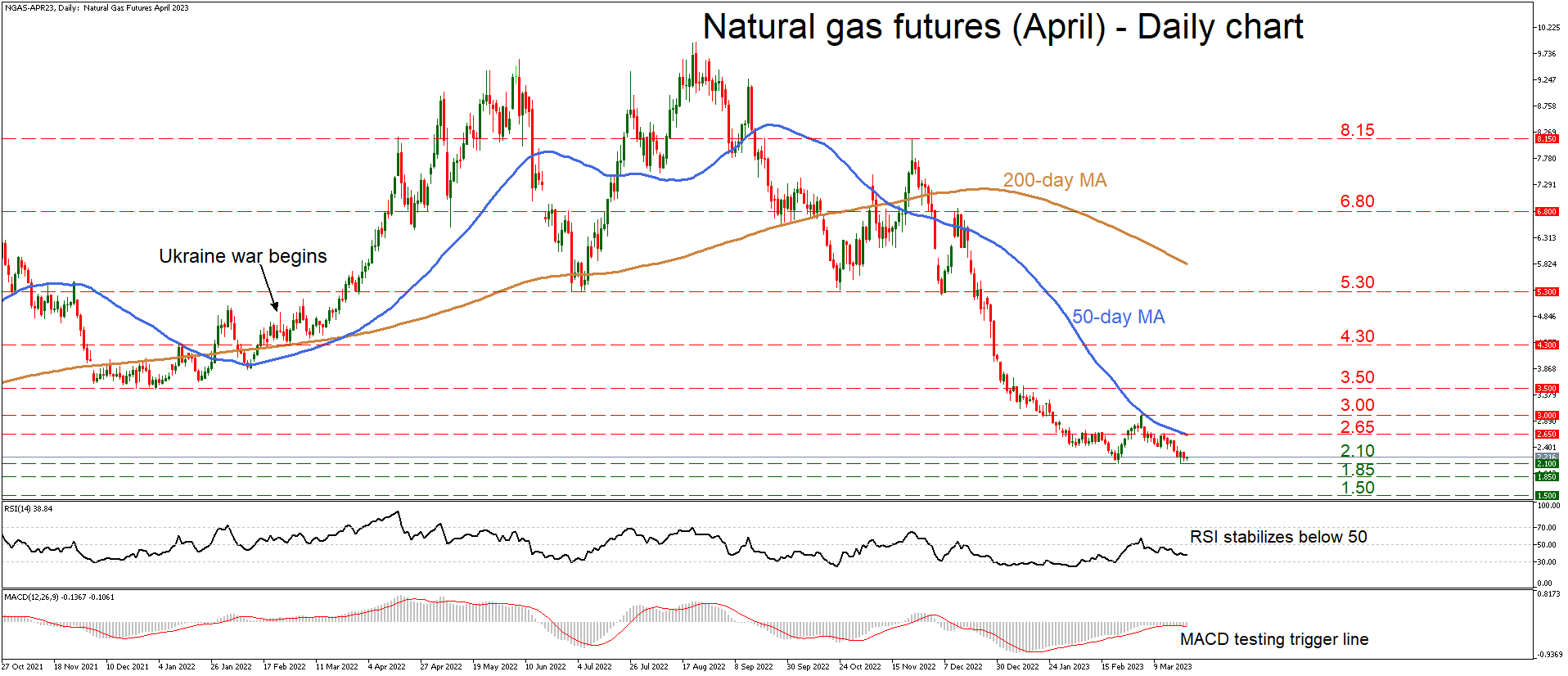
Natural gas futures (April delivery) went into freefall in recent months, erasing all the gains since the Ukraine war started and losing further ground beyond that. Sellers are currently knocking on the door of the 2.10 region, after a decline of 78% from the highs last year.
Momentum studies point to a minor stabilization in the market, although bearish forces are still in control overall. The RSI seems to be flattening but below its 50 line, while the MACD has just crossed back below its trigger line.
If sellers successfully slice below the 2.10 territory, that would signal a continuation of the intense downtrend. In this case, the next barrier to halt the decline might be 1.85, a region that served both as support and resistance back in 2020.
Should buyers manage to take the reins, the first obstacle to the upside might be the 2.65 level, which overlaps with the 50-day moving average. A successful violation would turn the focus to the recent high near 3.00. The bulls would need to clear that level to have any hopes of a trend reversal.
In summary, the outlook appears decisively negative and a successful break below 2.10 would reinforce that notion.