Sample Category Title
EUR/USD: Bulls Running Out of Steam after a Six-Day Rally
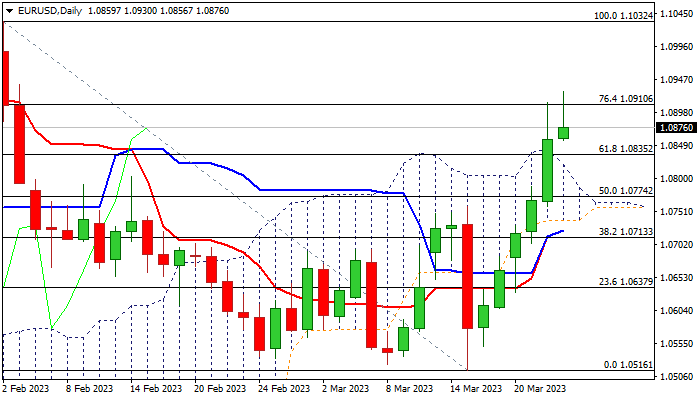
Steep ascend extends into sixth consecutive day, with strong acceleration seen in post-Fed period on Wednesday and extending to new seven-week high in late Asian / early European trading on Thursday.
However, long upper shadows on daily candles of Wednesday and Thursday, suggest that bulls are likely running out of steam and warn of rally’s stall.
In addition, bulls are facing increased headwinds, which may result in repeated failure to clearly break of Fibo barrier at 1.0910 (76.4% retracement of 1.1032/1.0516 fall) and leave a bull-trap, another negative signal.
Traders are cautious at these levels and started to take profits from the recent rally, as stochastic is overbought on daily chart and bullish momentum started to fade.
Also, the price surged above the top of daily Ichimoku cloud, with next week’s cloud twist remaining magnetic, but in opposite direction and this time attracting bears.
We look for fresh signal on today’s repeated close below 1.0910 Fibo resistance, which would increase pressure and open way for deeper correction, although this would signal a pause in larger bullish action and offer better levels to re-enter longs, as the pair is on track for strong weekly gains.
Extended dips should find firm ground above 1.0775/60 zone (broken 50% retracement / former top of Mar 15) to keep bulls in play.
Res: 1.0910; 1.0930; 1.1000; 1.1032.
Sup: 1.0856; 1.0835; 1.0760; 1.0731.
BoE hikes 25bps, door open for further tightening or pause
BoE raised its Bank Rate by 25 basis points to 4.25% as expected, with a 7-2 vote by the Monetary Policy Committee. MPC members Swati Dhingra and Silvana Tenreyro voted against the rate hike, opting for no change, while no member voted for a larger increase.
The central bank left the possibility of further rate hikes open, stating, "if there were to be evidence of more persistent pressures, then further tightening in monetary policy would be required." Simultaneously, it also means the door is open for a pause in the rate hike cycle too.
BoE acknowledged that CPI inflation "increased unexpectedly in the latest release" but maintained that it is "likely to fall sharply over the rest of the year." The central bank emphasized that the degree to which domestic inflationary pressures ease will depend on the economy's evolution, including the impact of the significant Bank Rate increases so far.
(BOE) Bank Rate increased to 4.25%
Monetary Policy Summary, March 2023
The Bank of England's Monetary Policy Committee (MPC) sets monetary policy to meet the 2% inflation target, and in a way that helps to sustain growth and employment. At its meeting ending on 22 March 2023, the MPC voted by a majority of 7–2 to increase Bank Rate by 0.25 percentage points, to 4.25%. Two members preferred to maintain Bank Rate at 4%.
Global growth is expected to be stronger than projected in the February Monetary Policy Report, and core consumer price inflation in advanced economies has remained elevated. Wholesale gas futures and oil prices have fallen materially.
There have been large and volatile moves in global financial markets, in particular since the failure of Silicon Valley Bank and in the run-up to UBS's purchase of Credit Suisse, and reflecting market concerns about the possible broader impact of these events. Overall, government bond yields are broadly unchanged and risky asset prices are somewhat lower than at the time of the Committee's previous meeting.
The Bank of England's Financial Policy Committee (FPC) has briefed the MPC about recent global banking sector developments. The FPC judges that the UK banking system maintains robust capital and strong liquidity positions, and is well placed to continue supporting the economy in a wide range of economic scenarios, including in a period of higher interest rates. The FPC's assessment is that the UK banking system remains resilient.
Reflecting these developments, bank wholesale funding costs have risen in the United Kingdom and other advanced economies. The MPC will continue to monitor closely any effects on the credit conditions faced by households and businesses, and hence the impact on the macroeconomic and inflation outlook.
Additional fiscal support was announced in the Spring Budget. Bank staff have provisionally estimated that this could, relative to the February Report, increase the level of GDP by around 0.3% over coming years. A full assessment, including the extent to which these measures could affect supply as well as demand in the medium term, will be conducted ahead of the May Monetary Policy Report.
GDP is still likely to have been broadly flat around the turn of the year, but is now expected to increase slightly in the second quarter, compared with the 0.4% decline anticipated in the February Report. As the Government's Energy Price Guarantee (EPG) will be maintained at £2,500 for three further months from April, real household disposable income could remain broadly flat in the near term, rather than falling significantly. The labour market has remained tight, while the news since the MPC's previous meeting points to stronger-than-expected employment growth in 2023 Q2 and a flat rather than rising unemployment rate.
Twelve-month CPI inflation fell from 10.5% in December to 10.1% in January but then rose to 10.4% in February, 0.6 percentage points higher than expected in the February Report. As a consequence, the exchange of open letters between the Governor and the Chancellor of the Exchequer is being published alongside this monetary policy announcement. Services CPI inflation was 6.6% in February, 0.1 percentage points weaker than expected at the time of the February Report, but food and core goods price inflation have been significantly stronger than projected. Most of the surprising strength in the core goods component was accounted for by higher clothing and footwear prices, which tend to be volatile and could therefore prove less persistent. Annual private sector regular earnings growth has eased, to 7% in the three months to January, 0.1 percentage points below the expectation in February.
CPI inflation is still expected to fall significantly in 2023 Q2, to a lower rate than anticipated in the February Report. This lower-than-expected rate is largely due to the near-term news in the Budget including on the EPG, alongside the falls in wholesale energy prices. Services CPI inflation is expected to remain broadly unchanged in the near term, but wage growth is likely to fall back somewhat more quickly than projected in the February Report.
The MPC's remit is clear that the inflation target applies at all times, reflecting the primacy of price stability in the UK monetary policy framework. The framework recognises that there will be occasions when inflation will depart from the target as a result of shocks and disturbances. The economy has been subject to a sequence of very large and overlapping shocks. Monetary policy will ensure that, as the adjustment to these shocks continues, CPI inflation will return to the 2% target sustainably in the medium term. Monetary policy is also acting to ensure that longer-term inflation expectations are anchored at the 2% target.
The Committee has voted to increase Bank Rate by 0.25 percentage points, to 4.25%, at this meeting. CPI inflation increased unexpectedly in the latest release, but it remains likely to fall sharply over the rest of the year. Services inflation has been broadly in line with expectations. The labour market has remained tight, and the near-term paths of GDP and employment are likely to be somewhat stronger than expected previously. Although nominal wage growth has been weaker than expected, cost and price pressures have remained elevated.
The extent to which domestic inflationary pressures ease will depend on the evolution of the economy, including the impact of the significant increases in Bank Rate so far. Uncertainties around the financial and economic outlook have risen.
The MPC will continue to monitor closely indications of persistent inflationary pressures, including the tightness of labour market conditions and the behaviour of wage growth and services inflation. If there were to be evidence of more persistent pressures, then further tightening in monetary policy would be required.
The MPC will make a full assessment of all of the news since the February Report, including the economic implications of recent financial market and banking sector developments, as part of its forthcoming May forecast round.
The MPC will adjust Bank Rate as necessary to return inflation to the 2% target sustainably in the medium term, in line with its remit.
Minutes of the Monetary Policy Committee meeting ending on 22 March 2023
1: Before turning to its immediate policy decision, the Committee discussed: the international economy; monetary and financial conditions; demand and output; and supply, costs and prices.
The international economy
2: UK-weighted world GDP had increased by 0.3% in 2022 Q4 and was expected to grow by 0.4% in 2023 Q1. That expectation for the first quarter was stronger than had been anticipated in the February Monetary Policy Report, accounted for by expectations of a sharper rebound in Chinese GDP following the end of its zero-Covid policy in December, as well as upside news to demand in the United States and in the euro area. Downside risks to the outlook nevertheless remained. In particular, it was unclear how credit conditions and economic activity might be affected by recent banking sector stress in a number of advanced economies.
3: In the euro area, GDP had been flat in 2022 Q4, in line with the projection in the February Report, and was expected to increase by 0.1% in 2023 Q1, stronger than had been incorporated into the February Report. The S&P Global euro-area composite output PMI had risen to its highest level in eight months in February, indicating expanding activity in both services and manufacturing.
4: In the United States, GDP had increased by 0.7% in 2022 Q4 and was expected to grow by 0.3% in 2023 Q1, both stronger than had been expected in the February Report. Retail sales and real consumption had grown strongly in January, and the ISM non-manufacturing PMIs suggested robust GDP growth in January and February, although the ISM manufacturing output PMI had remained below the 50 no-change mark. Around 810,000 jobs had been added to the US economy over January and February, and the unemployment rate had remained near record lows.
5: In China, economic activity had rebounded following the end of its zero-Covid policy in December. The economy was now expected to grow by 1.6% in 2023 Q1, materially stronger than the 1% contraction that had been incorporated into the February Report. The rebound was likely to have been concentrated in domestic demand, reflecting the lifting of Covid-related restrictions and less voluntary social distancing as the number of Covid cases had peaked earlier than had been expected previously. The NBS non-manufacturing and Caixin services PMIs in January and February had been strong, and stronger than their manufacturing counterparts. Retail sales had surged, and investment and industrial production growth had picked up relative to a year earlier. A measure of Chinese supply chain constraints had eased, and most indicators of global shipping costs had continued to decline. Overall, China's reopening was likely to be disinflationary for advanced economies, as the easing of supply chain disruption was expected to outweigh positive spillovers from stronger demand.
6: European natural gas prices had fallen materially since the MPC's February meeting. The Dutch Title Transfer Facility spot price, a measure of European wholesale gas prices, had declined to €42 per MWh, down 26% relative to February and below levels seen just before Russia's invasion of Ukraine in February 2022. The gas futures curve had also fallen further. These falls had been driven by milder weather, less energy use and fuel switching, implying that gas storage levels had continued to be high, although risks remained for the next winter. UK wholesale gas prices had fallen in line with their continental European counterparts. More recently, the possible macroeconomic implications of the financial market volatility that had followed the failure of Silicon Valley Bank had also contributed to falls in commodity prices. The Brent crude oil spot price had fallen by 12%, to $75 per barrel, since the MPC's previous meeting, and the prices of agricultural goods and metals had also declined.
7: Headline consumer price inflation had continued to decline in the euro area and the United States, but core CPI inflation had proved somewhat more persistent than had been expected. In the euro area, annual headline HICP inflation had been 8.5% in February, down from 8.6% in January, but annual core inflation had increased to 5.6%, from 5.3%. Both measures had been higher than expected by market participants, and the increase had largely been accounted for by services price inflation. Energy price inflation had continued to decline, and was expected to decline further on the back of lower wholesale gas prices, which would push down on headline relative to core measures in the near term. Wage growth in the euro area had continued to increase, albeit from a lower level than in other advanced economies.
8: In the United States, annual headline CPI inflation had decreased to 6.0% in February, from 6.4% in January, while core inflation had fallen marginally to 5.5% from 5.6%, in line with market expectations. However, annual headline and core PCE inflation had surprised to the upside in January. This strength had been accounted for by energy and housing cost inflation, which were expected to ease. Annual average hourly earnings growth had ticked up in the United States in February, following some moderation in previous months.
9: The MPC discussed the extent to which lower wholesale energy prices might already have boosted global activity in the first quarter, noting that most of the effect was still likely to come through as government price caps on households in Europe had cushioned the adverse effect on retail prices and activity while wholesale prices had been higher. The Committee also discussed what the net effect of upside news on economic activity and lower energy prices might be on global inflation. On the one hand, lower energy prices would push down on headline inflation, and also on core inflation via indirect and second-round effects. On the other hand, lower energy prices would push up demand, which, taken together with other factors pushing up GDP, and all else equal, would be likely to put upward pressure on global inflation.
Monetary and financial conditions
10: There had been large and volatile moves in financial markets since the MPC's previous meeting, in particular since the failure of Silicon Valley Bank (SVB) in early March and reflecting market concerns about the possible broader impact of these events. In the days leading up to the MPC's decision, UBS had agreed to buy Credit Suisse, and major advanced economy central banks had announced a coordinated action to enhance the provision of liquidity via the standing US dollar liquidity swap line arrangements. Overall, government bond yields were broadly unchanged and risky asset prices were somewhat lower than at the time of the Committee's previous meeting.
11: The change in aggregate indices of equity prices in major advanced economies had been modest by the end of the period relative to the time of the MPC's previous meeting. Bank equity prices had, however, been particularly affected as market sentiment had deteriorated following news about SVB, ending the period around 20% lower in the United States and around 5 to 10% down in the euro area and the United Kingdom. Measures of UK wholesale bank funding costs had risen, while remaining below the peaks seen in autumn 2022.
12: Prior to concerns emerging about SVB, market-implied monetary policy paths had picked up materially in advanced economies, reflecting positive global macroeconomic news, coupled with market interpretations of the tone of communications from the Federal Open Market Committee (FOMC), and the ECB Governing Council. These factors had also pushed up on market-implied policy paths in other countries, including in the United Kingdom.
13: After the issues at SVB had become public, however, risk sentiment had reversed and volatility had picked up, such that government bond yields globally had moved appreciably lower again. Risk sentiment had remained weak, given fragilities revealed at some other individual banks. Market contacts suggested that the fall in yields had largely reflected a flight to safety as market participants sought to wait out the volatility, while there was also some perception of an increase in downside risks to the outlook for growth and inflation.
14: Market expectations for the near-term path of policy rates in the euro area and the United States had ended the period largely unchanged and were expected to peak at a level similar to that at the time of the MPC's previous meeting, at around 3½% and around 5% respectively. At its meeting ending on 16 March, the ECB Governing Council had raised its key policy rates by 50 basis points, a little higher than had been implied by market pricing immediately before the announcement. At the FOMC's meeting ending on 22 March, market pricing was consistent with expectations of an increase in the federal funds rate of around 20 basis points. In the United Kingdom, the majority of market contacts expected Bank Rate to be increased by 25 basis points at this MPC meeting, and market pricing had risen consistent with these expectations following the release of February CPI data immediately prior to the MPC's decision. The market-implied path of Bank Rate rose to a peak of a little above 4½% in August 2023, somewhat higher than the peak at the time of the MPC's previous meeting.
15: Further out, market-implied paths remained consistent with expectations of a reduction in policy rates. In the United States, by mid-2026, the market-implied policy rate was just under 2 percentage points lower than the expected peak in rates, while the same rates were around 1½ percentage points lower than the peak in the United Kingdom and ¾ percentage points lower in the euro area.
16: The sterling effective exchange rate had ended the period around ½% higher compared to the time of the MPC's previous meeting.
17: Medium-term inflation compensation measures had increased a little in the United Kingdom, and had remained broadly unchanged in the United States and the euro area, since the MPC's previous meeting. Although interpreting the movements in UK medium-term inflation compensation measures continued to be challenging, it remained the case that there had been a material reduction in these measures since their peak in March 2022, while they had remained above their average levels of the previous decade.
18: There had been a further reduction in UK owner-occupied fixed-term mortgage rates since the MPC's previous meeting, although rates remained materially higher than in summer 2022. The average quoted rate on a two-year fixed-rate 75% loan-to-value mortgage had fallen by 35 basis points in February, to 4.8%. More generally, the pass-through of higher risk-free reference rates during the current monetary policy tightening cycle had occurred broadly in line with what had typically been the case in the past, excepting the temporary period of slightly faster-than-typical pass-through in 2022 Q4. There were no clear signs as yet that the recent increase in UK bank funding costs had affected mortgage rates.
19: Net secured lending to households had decreased somewhat further, to £2.5 billion in January from £3.1 billion in December. Mortgage approvals for house purchase, which had been falling since autumn 2022, had remained fairly stable in January, at historically low levels of just under 40,000.
20: There had continued to be weakness in other housing market indicators. The official UK House Price Index had fallen by 0.5% a month on average over December and January, and leading indicators such as the Halifax and Nationwide house price indices pointed to falls of around 3 to 4% compared to their peak in autumn 2022. Indicators of housing market activity from the RICS survey had increased a little in February but had remained weak.
21: Sight deposit rates had risen since the MPC's February meeting, though by less than the increase in Bank Rate. Relative to changes in the corresponding risk-free reference rates, the increase in sight deposit rates since the beginning of the current tightening cycle had been significantly less pronounced than it had been in past cycles, in contrast to time deposits, which had been broadly in line. There was some evidence that households might have rebalanced away from sight to time deposits in response.
Demand and output
22: According to the ONS's first quarterly estimate, real GDP had been flat in 2022 Q4, marginally weaker than had been expected in the February Monetary Policy Report. Household consumption had risen by 0.1%, while business investment had been estimated to have increased by almost 5%. Investment had also been revised up since the start of 2022, such that its level in 2022 Q3 was only 4½% below its pre-pandemic level, rather than 8% as in the previous estimate.
23: Monthly GDP had increased by 0.3% in January, following a 0.5% fall in December. This volatility in the monthly path had in large part been accounted for by a fall and subsequent partial rebound in health and education output around the turn of the year, reflecting the pattern of public-sector strike activity and sickness. Market sector output had risen by 0.1% in January, partially unwinding the 0.2% decline in December. Looking through the bank holiday-related volatility in GDP at various points last year, the level of market sector output had been broadly unchanged since the spring.
24: Bank staff continued to expect GDP to decline by 0.1% in 2023 Q1, as had been projected in the February Report. That was broadly consistent with the overall signal from business surveys of activity. In February, the S&P Global/CIPS UK composite output and new orders PMI indices had risen to levels close to their historical averages, whereas the CBI composite output balance had picked up but had remained contractionary.
25: Household consumption and business investment were also likely to be subdued in the first quarter. Retail sales volumes had risen by 0.5% in January, following a 1.2% decline in December. GfK consumer confidence had increased in February, to its highest level since April 2022, but had nevertheless remained well below its historical average. Most surveys of businesses' investment intentions had remained weak.
26: The Spring Budget had taken place on 15 March, accompanied by an Economic and fiscal outlook from the Office for Budget Responsibility. Additional fiscal support had been announced, including further energy support measures for households and businesses, temporary 100% capital allowances for qualifying business investment undertaken between 2023-24 and 2025-26, a package of measures aimed at increasing labour market participation, higher defence spending and a freeze in fuel duty. Bank staff had provisionally estimated that these additional policy measures could, relative to what had been assumed in the February Monetary Policy Report, increase the level of GDP by around 0.3% over coming years. A full assessment of this news, and the extent to which it could affect supply as well as demand in the medium term, would be conducted as part of the May Monetary Policy Report forecast round.
27: Bank staff now expected GDP to increase slightly in the second quarter, compared with the 0.4% decline incorporated in the February Report. The Bank's Agents had reported that, while subdued overall, activity was holding up better than contacts had previously expected, particularly in the consumer services sector. The composite future output PMI had risen further in February, with the associated report highlighting improved confidence regarding the near-term economic outlook. The news that the Government's Energy Price Guarantee (EPG) for a typical annual dual-fuel bill would be maintained at £2,500 in April rather than increased, suggested that real household disposable income could remain broadly flat in the near term, rather than falling significantly as had been expected previously.
28: The Committee discussed these developments in activity. Some of the prospective upside news in GDP was likely to reflect developments in energy prices, including recent declines in wholesale prices as well as the EPG adjustment, and hence a further unwind of the terms of trade shock that households and businesses had been experiencing. But some of the news could reflect other factors, including the continued momentum in employment growth. This channel was similar to the judgement that the MPC had made in the February Report that lower perceptions of the risk of job losses could result in lower precautionary saving by households than had previously been assumed. Activity could therefore be less weak than expected.
Supply, costs and prices
29: The labour market had remained tight, while the news since the MPC's previous meeting pointed to stronger-than-expected employment growth and participation. The Labour Force Survey (LFS) unemployment rate had remained at 3.7% in the three months to January, 0.1 percentage points below the expectation at the time of the February Monetary Policy Report. LFS employment had grown by 0.2% in the three months to January, slightly stronger than had been expected at the time of the February Report. This stronger-than-expected rise in employment had been the counterpart to a fall in the inactivity rate of the 16+ population. LFS data for 2022 Q4 suggested that the flow into inactivity from employment and unemployment had fallen to around pre-Covid levels, alongside a decline in the share of the inactive aged 50-64 who did not expect to work again.
30: Some other indicators of labour market quantities had strengthened in recent months, alongside a similar development in some output indicators. The composite employment index in the S&P Global/CIPS UK PMI and HMRC employee payrolls had both increased in February. The rate of decline in the stock of vacancies had continued to abate in the three months to February. There had been just over 1.1 million vacancies in the three months to February, around one third higher than prior to the pandemic. Contacts of the Bank's Agents had reported that the labour market remained tight, with little sign of loosening. Nevertheless, contacts had reported that churn in jobs had fallen back, and that recruitment difficulties had eased recently but remained elevated. Overall, Bank staff expected employment growth of 0.2% in 2023 Q2, in comparison to the 0.4% decline that had been anticipated in the February Report, and for the unemployment rate to remain around its current low level rather than starting to rise.
31: Annual private sector regular Average Weekly Earnings (AWE) growth had eased slightly to 7% in the three months to January, 0.1 percentage points below the expectation at the time of the February Report. Three month on three month private sector regular AWE growth had fallen significantly in recent months. Other pay growth indicators, such as the KPMG/REC survey measure of pay for new permanent hires, suggested that private sector regular pay growth could undershoot somewhat the near-term projections in the February Report. In that Report, earnings growth had been projected to soften in the second half of this year, as lower inflation expectations, which were anticipated to be quantitatively more important than changes in slack in the current environment, pulled down on pay growth.
32: Twelve-month CPI inflation had risen to 10.4% in February from 10.1% in January. This release had triggered the exchange of open letters between the Governor and the Chancellor of the Exchequer that was being published alongside these minutes. The February figure had been 0.6 percentage points higher than the expectation at the time of the February Report, with the upside news concentrated in clothing and footwear, and food and non-alcoholic beverages. Clothing and footwear prices had tended to be volatile and this news could therefore prove less persistent. Core CPI inflation, excluding energy, food, beverages and tobacco, had risen to 6.2% in February from 5.8% in January, and had been 0.3 percentage points higher than the expectation made at the time of the February Report.
33: Bank staff still expected CPI inflation to fall significantly in 2023 Q2, to a lower rate than had been anticipated in the February Report. This lower-than-expected rate was due largely to developments in administered energy prices. Retail gas and electricity prices were currently subject to the Government's Energy Price Guarantee (EPG). As part of the Spring Budget, the Government had announced that the EPG would now be maintained at £2,500, for a typical dual-fuel bill, for the three months from April. This change in the EPG represented downside news to the outlook for household energy prices, lowering directly the forecast for CPI inflation in 2023 Q2 by around 1 percentage point, all else equal. Other measures announced in the Budget, such as the freezing of fuel duty, had contributed around a further ⅓ percentage points of downside news to the inflation forecast, from April.
34: Staff expected CPI inflation to decline further beyond 2023 Q2, due largely to falls in wholesale gas futures prices. If that level of futures prices were to be sustained, it would mean that the EPG would not bind on household energy bills from July. Instead, Ofgem price caps would set the price of domestic energy bills, resetting every three months as per Ofgem's method. The latest Bank staff estimates suggested that the direct energy contribution to CPI inflation would turn negative by the end of this year.
35: Households' and businesses' short-term inflation expectations had continued to fall back. The quarterly Bank/Ipsos survey had reported a fall in year-ahead inflation expectations to around 4%. By contrast, the measure of one-year ahead inflation expectations in the Citi/YouGov survey of households had edged up in February, though had remained materially below its peak observed last August. The DMP survey had reported that businesses' expectations about their own prices a year ahead had fallen further in February, albeit they had remained at an elevated level. The Bank/Ipsos measures of households' two- and five-year ahead inflation expectations had been close to their historical averages.
36: The Committee discussed the persistence of inflation. Services CPI inflation had reached 6.6% in February and was expected to remain broadly unchanged in the near term, in part due to the continued pass-through of labour and other costs. Nevertheless, the easing in pay growth that had been expected in the February Report appeared more evident in the latest indicators. The labour market had remained tight, and the news since the previous MPC meeting pointed to stronger-than-expected employment growth in 2023 Q2 and a flat rather than rising unemployment rate.
The immediate policy decision
37: The MPC sets monetary policy to meet the 2% inflation target, and in a way that helps to sustain growth and employment.
38: In the MPC's February Monetary Policy Report projections, annual CPI inflation had been expected to fall back sharply towards the end of this year, alongside a much shallower projected decline in output than in the November Report forecast. Conditioned on the market-implied path for Bank Rate at that time, an increasing degree of economic slack, alongside falling external pressures, would lead CPI inflation to decline to below the 2% target in the medium term. There were considerable uncertainties around this medium-term outlook, and the Committee had judged that the risks to inflation were skewed significantly to the upside.
39: Since the previous MPC meeting, there had been considerable news in global and domestic economic data relative to the near-term projections in the February Report. Global growth was expected to be stronger than projected, with GDP no longer being expected to contract in either China or the euro area in 2023 Q1. Core consumer price inflation in advanced economies had remained elevated. Wholesale gas futures and oil prices had fallen materially.
40: UK GDP was now expected to increase slightly in the second quarter, compared with the 0.4% decline anticipated in the February Report. The labour market had remained tight, with an unemployment rate of 3.7% in the three months to January and a rise in employment as a counterpart to a fall in the inactivity rate. The news since the MPC's previous meeting pointed to stronger-than-expected employment growth in 2023 Q2 and a flat rather than rising unemployment rate.
41: Additional fiscal support had been announced in the Spring Budget. Bank staff had provisionally estimated that this could, relative to the February Report, increase the level of GDP by around 0.3% over coming years. A full assessment, including the extent to which these measures could affect supply as well as demand in the medium term, would be conducted ahead of the May Monetary Policy Report.
42: Twelve-month CPI inflation had fallen from 10.5% in December to 10.1% in January but had then risen to 10.4% in February, 0.6 percentage points higher than had been expected in the February Report. Services CPI inflation had been 6.6% in February, 0.1 percentage points weaker than had been expected at the time of the February Report, but food and core goods price inflation had been significantly stronger than projected. Most of the surprising strength in the core goods component was accounted for by higher clothing and footwear prices, which had tended to be volatile and could therefore prove less persistent. Annual private sector regular earnings growth had eased, to 7% in the three months to January, 0.1 percentage points below the expectation in February. Three month on three month growth in this measure of pay had fallen significantly in recent months.
43: CPI inflation was still expected to fall significantly in 2023 Q2, to a lower rate than had been anticipated in the February Report. This lower-than-expected rate was largely due to the near-term news in the Budget including on the Energy Price Guarantee, alongside the falls in wholesale energy prices since the previous MPC meeting. Services CPI inflation was expected to remain broadly unchanged in the near term, but wage growth was likely to fall back somewhat more quickly than had been projected in the February Report.
44: More generally, a lower path of energy prices would unwind further the terms of trade shock that households and businesses had been experiencing. The direct contribution of household energy prices to CPI inflation was now expected to turn negative by the end of this year, and this could also act to reduce inflation indirectly and via a dissipation of second-round effects. Lower energy prices would, however, boost activity, which, taken together with any other demand news pushing up GDP and employment, would, all else equal and over time, put upward pressure on inflation.
45: There had been large and volatile moves in global financial markets, in particular since the failure of Silicon Valley Bank and in the run-up to UBS's purchase of Credit Suisse, and reflecting market concerns about the possible broader impact of these events. Overall, government bond yields were broadly unchanged and risky asset prices were somewhat lower than at the time of the Committee's previous meeting.
46: The Bank of England's Financial Policy Committee (FPC) had briefed the MPC about recent global banking sector developments. The FPC judged that the UK banking system maintained robust capital and strong liquidity positions, and was well placed to continue supporting the economy in a wide range of economic scenarios, including in a period of higher interest rates. The FPC's assessment was that the UK banking system remained resilient.
47: Reflecting these developments, bank wholesale funding costs had risen in the United Kingdom and other advanced economies. The MPC would continue to monitor closely any effects on the credit conditions faced by households and businesses, and hence the impact on the macroeconomic and inflation outlook.
48: The MPC's remit was clear that the inflation target applied at all times, reflecting the primacy of price stability in the UK monetary policy framework. The framework recognised that there would be occasions when inflation would depart from the target as a result of shocks and disturbances. The economy had been subject to a sequence of very large and overlapping shocks. Monetary policy would ensure that, as the adjustment to these shocks continued, CPI inflation returned to the 2% target sustainably in the medium term. Monetary policy was also acting to ensure that longer-term inflation expectations were anchored at the 2% target.
49: Seven members judged that a 0.25 percentage point increase in Bank Rate, to 4.25%, was warranted at this meeting. The considerable news since the previous MPC meeting could be evaluated in the framework for monitoring the persistence of inflationary pressures set out in the February minutes. Although nominal wage growth had been weaker than expected, the labour market had remained tight and the unemployment rate was now expected to be flat in 2023 Q2 rather than rising. Services CPI inflation had been broadly in line with expectations. Alongside these developments, headline CPI inflation had surprised significantly on the upside and the near-term path of GDP was likely to be somewhat stronger than expected previously. These members put some weight on the possibility that the stronger domestic and global outlook for demand was also being driven by factors over and above the weaker path of energy prices, given that the strengthening had at least in part preceded the falls in prices. Renewed and sustained demand for labour could still reinforce the persistence of higher costs in consumer prices, even if second-round effects related to energy price inflation were to diminish.
50: Two members preferred to leave Bank Rate unchanged at 4% at this meeting. As the effects of the energy price shock and other cost-push shocks unwound, headline CPI inflation should fall sharply over 2023, which would also reduce associated persistence in domestic price setting. At the same time, the lags in the effects of monetary policy meant that sizeable impacts from past rate increases were still to come through. That implied the current setting of Bank Rate would be likely to reduce inflation to well below target in the medium term. As the policy setting had become increasingly restrictive, this would bring forward the point at which recent rate increases would need to be reversed.
51: The extent to which domestic inflationary pressures eased would depend on the evolution of the economy, including the impact of the significant increases in Bank Rate so far. Uncertainties around the financial and economic outlook had risen.
52: The MPC would continue to monitor closely indications of persistent inflationary pressures, including the tightness of labour market conditions and the behaviour of wage growth and services inflation. If there were to be evidence of more persistent pressures, then further tightening in monetary policy would be required.
53: The MPC would make a full assessment of all of the news since the February Report, including the economic implications of recent financial market and banking sector developments, as part of its forthcoming May forecast round.
54: The MPC would adjust Bank Rate as necessary to return inflation to the 2% target sustainably in the medium term, in line with its remit.
55: The Chair invited the Committee to vote on the proposition that:
- Bank Rate should be increased by 0.25 percentage points, to 4.25%.
56: Seven members (Andrew Bailey, Ben Broadbent, Jon Cunliffe, Jonathan Haskel, Catherine L Mann, Huw Pill and Dave Ramsden) voted in favour of the proposition. Two members (Swati Dhingra and Silvana Tenreyro) voted against the proposition, preferring to maintain Bank Rate at 4%.
Operational considerations
57: On 22 March 2023, the total stock of assets held for monetary policy purposes was £826 billion, comprising £818 billion of UK government bond purchases and £7.7 billion of sterling non‐financial investment‐grade corporate bond purchases.
58: The following members of the Committee were present:
- Andrew Bailey, Chair
- Ben Broadbent
- Jon Cunliffe
- Swati Dhingra
- Jonathan Haskel
- Catherine L Mann
- Huw Pill
- Dave Ramsden
- Silvana Tenreyro
- Clare Lombardelli was present as the Treasury representative.
59: On the occasion of her final meeting, the Chair expressed his appreciation on behalf of the Committee to Clare Lombardelli for her role as Treasury representative since 2017.
Switzerland Maintains Pace of Rate Hikes
The Swiss National Bank continued to tighten its monetary policy by raising its key interest rate by 50 points to 1.5% today. This decision is broadly in line with the market expectations of economists prior to the Credit Suisse story. The decision mainly shares the same logic with that of the Fed and the ECB: It is important to move within market expectations to avoid market chaos.
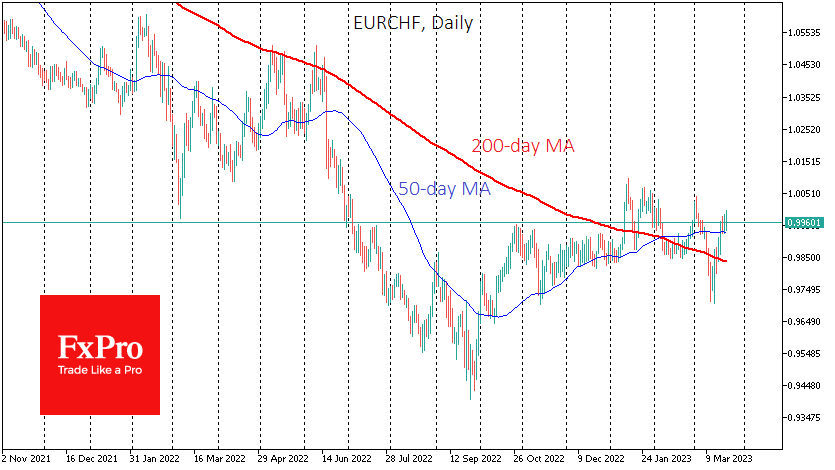
The SNB has raised rates by 225 bp over the recent tightening cycle, less than the Fed (475 bp) and the ECB (350 bp) did. However, this has not been a problem for the CHF, which is roughly at the same level as a year ago against the dollar and has strengthened against the euro for several reasons.
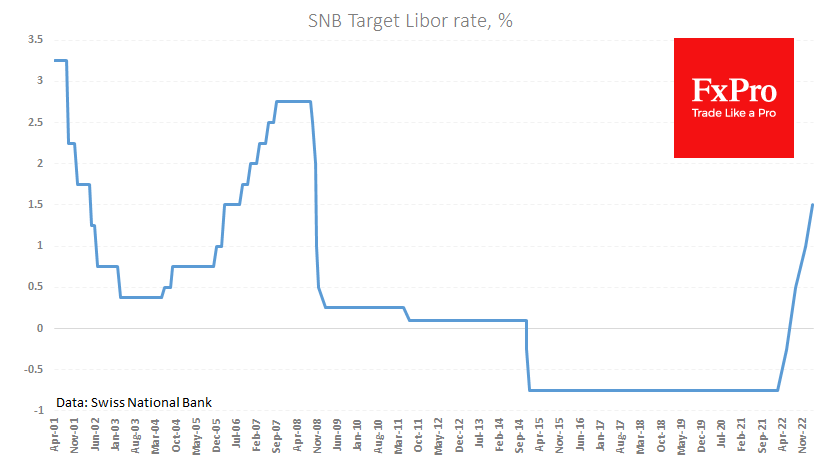
The Swiss central bank had more room to manoeuvre thanks to lower inflation. At 3.4%, it is still a concern but not as much of a problem as in the US (6%) or the eurozone (8.5%). Adjusted for inflation, real interest rates in Switzerland are not as deeply negative as in most other developed countries.
In addition, the SNB continues to signal its willingness to act in the foreign exchange market by selling some of its huge reserves. Such moves quickly strengthen the franc, contributing to pressure on import prices, but indirectly affecting general financial conditions.
At the same time, in its comments on the interest rate decision, the SNB indicated its willingness to raise rates further, citing strong second round effects and high inflationary pressures abroad.
In our view, the Credit Suisse case has increased the need for a rate hike to make Swiss franc deposits more attractive for foreigners. This is a U-turn of the policy of the past decade of capital inflows amid “global zero interest rates”. Now that interest rates are significantly higher in the US and Europe, and with UBS and the risk of “contagion” from Credit Suisse constantly in the news, Switzerland will have to actively compete for global deposits in order not to provoke unnecessary pressure on the franc.
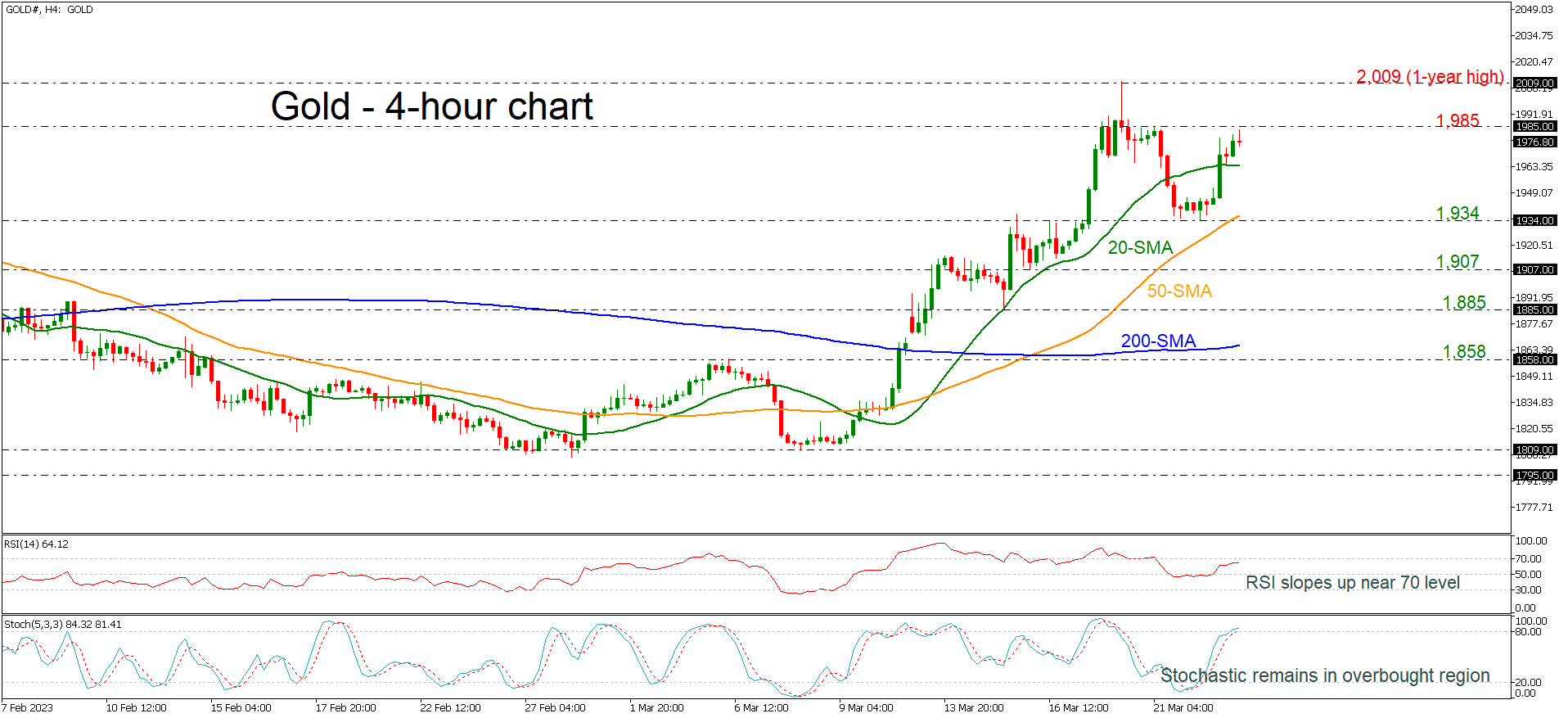
Gold Bulls Take a Breather After 1-year High Above 2,000
Gold struggled to jump above the immediate resistance of 1,985, keeping its footing above the short-term simple moving averages (SMAs) in the 4-hour chart.
Trend signals remain daunting as regards the market momentum. Some downside correction seems to be building as the RSI has paused its uptrend in the positive area and the stochastics are flattening in the overbought region.
Should the bulls dominate, driving the price above the 1,985 number, the spotlight will shift to the one-month high of 2,009 ahead of the 2,070 obstacle, taken from the peak in March 2022.
In the event the bears take control, the 20-period SMA at 1,964 will come first into view. A violation at this point may see another challenging battle around the 50-period SMA, which is currently near the 1,934 support. If sellers claim that zone this time, the 1,907 barrier could immediately add some downside pressure.
In brief, gold continues to send upward trend signals, the odds for an upturn seem to be growing, with the confirmation expected to come above 1,985.
Is the Banking Crisis Over, Or is the Worst Yet to Come?
When the Fed started signalling higher for longer last summer, everybody assumed that the first thing to break would be consumption, followed by big job losses. Few anticipated that the banking sector would get caught up in the crossfire of the Federal Reserve’s battle against high inflation. After all, banks traditionally perform better in higher interest rate environments as their profit margins improve. So why is it that we are now talking about bank runs, in an eerie reminder of the days of the 2008 Financial Crisis, and what are the risks of this panic escalating?
SVB: the first domino to fall
It all started with Silicon Valley Bank – a mid-sized Californian bank that mostly lent to venture-backed tech and life science companies. The bank was well capitalized to begin with but found itself unable to meet clients’ requests to withdraw deposits as tech startups began struggling for cash under the weight of rising borrowing costs. Subsequently, SVB resorted to selling its assets to raise funds, most of which were locked in 10-year Treasury notes.
However, the timing to sell bonds couldn’t have been worse for SVB as sovereign bond prices globally have been hammered over the past year as their yields have soared on rate hike expectations. This meant that in its bid to find more cash, the bank incurred heavy losses when it was forced to sell its bond holdings at a lower price than what it purchased them for.
It can be argued that this business model was unique to SVB and it’s unlikely that other regional banks would face similar risks. But the problem is, if liquidity has started to dry up for SVB’s customers, it’s likely that other small-to-medium-sized businesses across America are having to tap into their cash deposits to stay afloat.
Are authorities doing enough?
More importantly, once there is a loss of confidence in the banking sector, it is hard to stem the outflow of cash from worried depositors. That is why US banks are far from being out of the woods and is also the reason the government is bowing to pressure to provide additional safeguards. US Treasury Secretary Janet Yellen has signalled that the deposit guarantees agreed for SVB’s depositors were not a one-off and depositors of other banks would be protected too if there is further contagion.
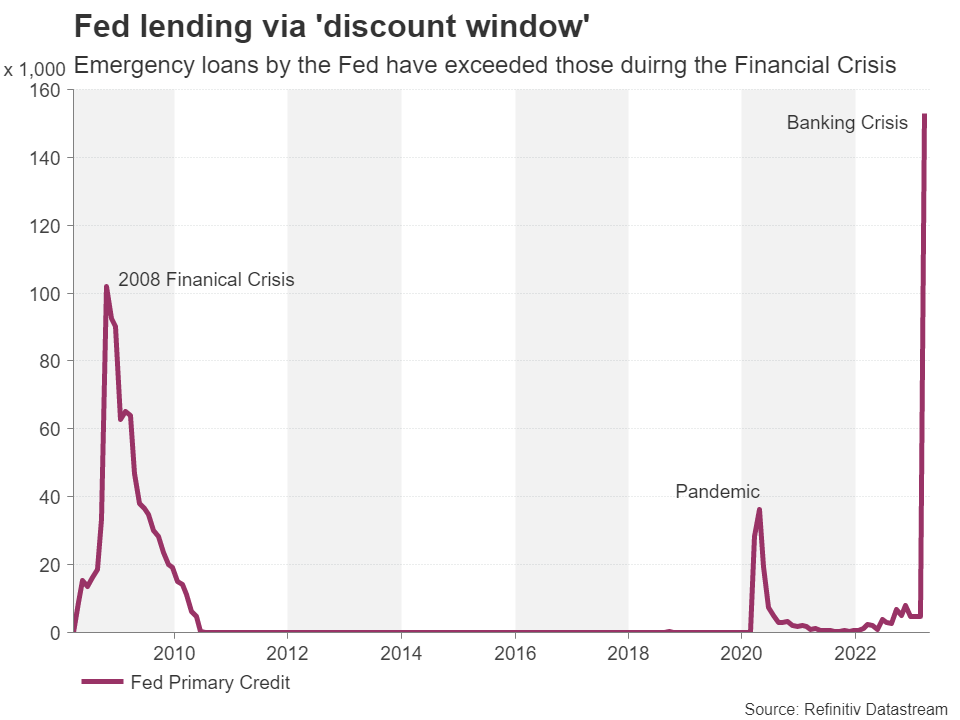
The Fed on its part launched a new emergency lending facility – the Bank Term Funding Program – and boosted dollar liquidity in the markets by increasing the frequency of its swap lines from weekly to daily operations.
Criticism about preferential treatment
Unfortunately, the combined responses came too late for Signature Bank, whose collapse was also sparked by a run on deposits, most of which were uninsured, just like SVB. Although, there have been suggestions that the decision to shut it down was political due to the bank’s connections to the crypto industry.
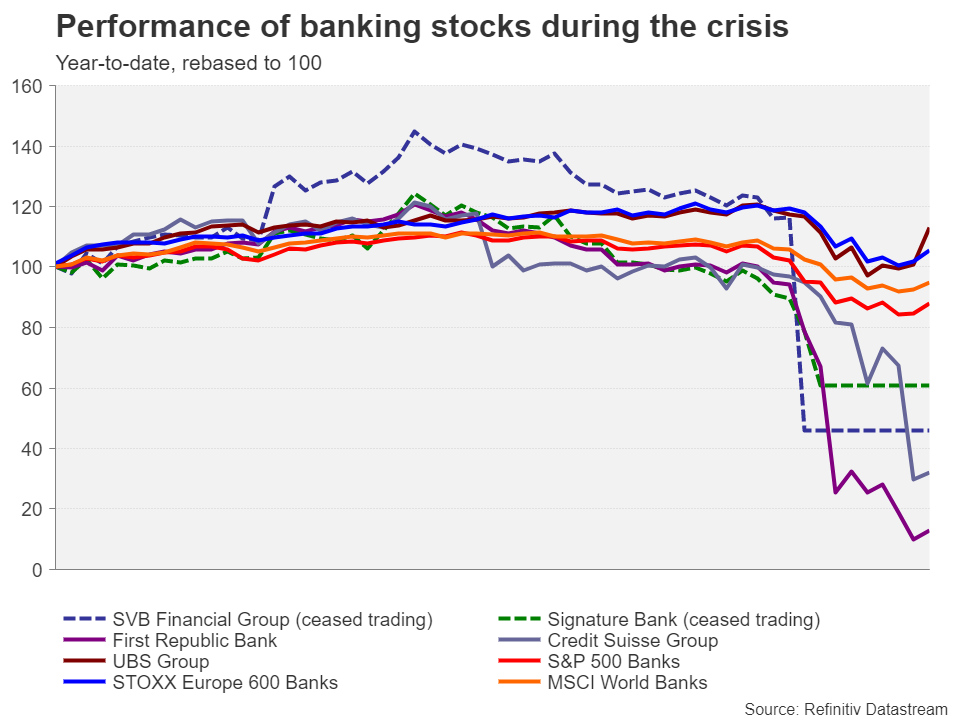
Then there is First Republic Bank – another one with high uninsured deposits that had to be rescued with a $30 billion injection by 11 big Wall Street banks. The fact that First Republic caters to a lot of wealthy clients might have played a role as to why there was so much interest to save the bank.
Other regional banks have suffered some degree of deposit runs too, but the outflow appears to be easing – something reflected in the rebound in their share prices. Even Swiss banking giant UBS’ stock is rebounding from the crash that followed after regulators and the Swiss government forced it to absorb its embattled smaller rival Credit Suisse.
Credit Suisse’s demise was a long time coming
It may be one of the oldest banks in the world, but Credit Suisse’s troubles predate this latest banking crisis. Its share price has in effect been in freefall over the past year, as the bank has been unable to draw a line over a series of scandals and mismanagement that have resulted in billions in fines from regulators around the world over the years.
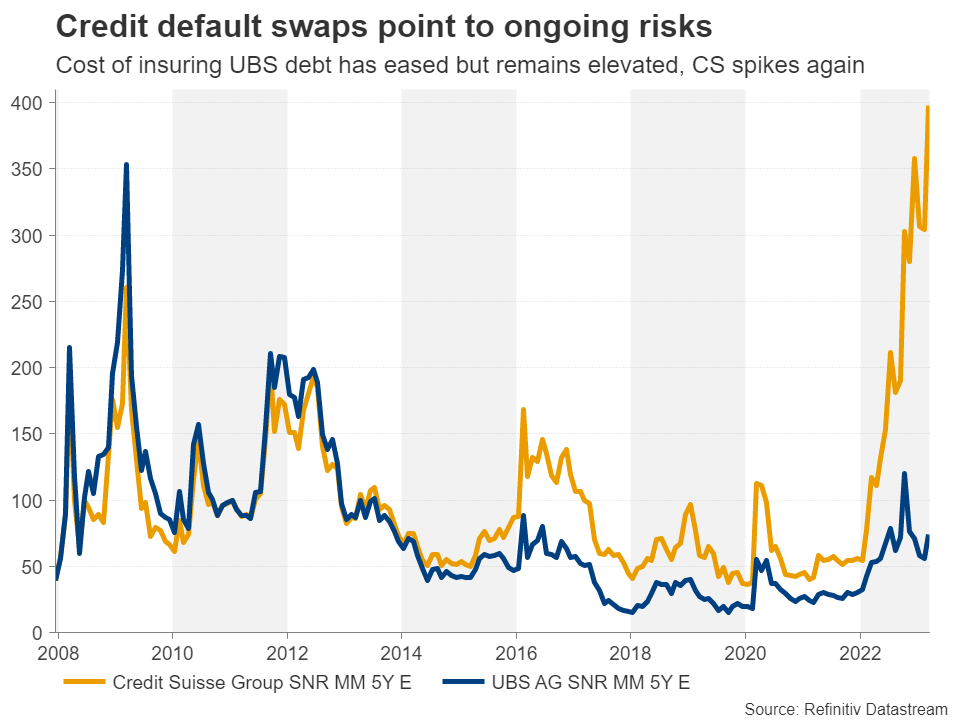
However, Swiss authorities are hoping that this ‘shotgun wedding’ between UBS and Credit Suisse will put an end to all the speculation, especially as the total size of the rescue deal is worth more than the value of Switzerland’s GDP in 2022.
Is the fallout contained or still contagious?
So does this mean that the crisis is fading, or are all the measures that regulators and policymakers have come up with so far merely sticking plasters? It may be too early to tell, but several financial stress indicators are pointing to an easing in investor panic.
For traders, the bigger question is how does this episode affect the outlook for interest rates and therefore the outlook for the major currencies and the various asset classes, in particular, commodities and equities.
Systemic risk is greater in the US
In the euro area, President Lagarde has made it clear the European Central Bank will focus on getting inflation down by raising interest rates and use other tools to help banks with liquidity should they need it. However, in the United States, the situation is quite different. Although the Fed is not about to relinquish its responsibilities on price stability, there is a real risk of the banking problems becoming systemic due to the nature of America’s regional banks.
But even if policymakers decide not to press on with further rate hikes and regulators take their time to bolster banking rules, there is a growing concern and an expectation that banks in the US will toughen their lending standards on their own accord and take less risk until this crisis has fully blown over. This would lead to a significant tightening of financial conditions, which would have a similar effect to rate increases by the Fed.
A recession has become more inevitable
More to the point, a US recession is now looking more likely than before this turmoil began and the Fed going on pause earlier than anticipated may not necessarily prevent one.
That cannot be good news for the US dollar, which has already taken a battering on dimming rate hike bets and worries about the economy. Fresh jitters about the US as well as the global economic outlook have also knocked demand-sensitive commodities such as crude oil. Gold on the other hand has received a major boost, both on safe-haven flows and on the back of the plunge in bond yields.
For Wall Street, however, there isn’t a straightforward relationship with falling Treasury yields and a shallower Fed rate path, as the benefits of lower short- and long-term borrowing costs would have to be weighed against the impact a potentially weaker economy would have on corporate earnings.
But perhaps the worst outcome for the markets is if this crisis of confidence in the banking system drags on for several months without completely evaporating, toppling more banks along the way, until decisive action is taken by politicians, regulators and central banks.
WTI Oil Futures Bounce Off 15-Month Low; Bearish Bias Intact
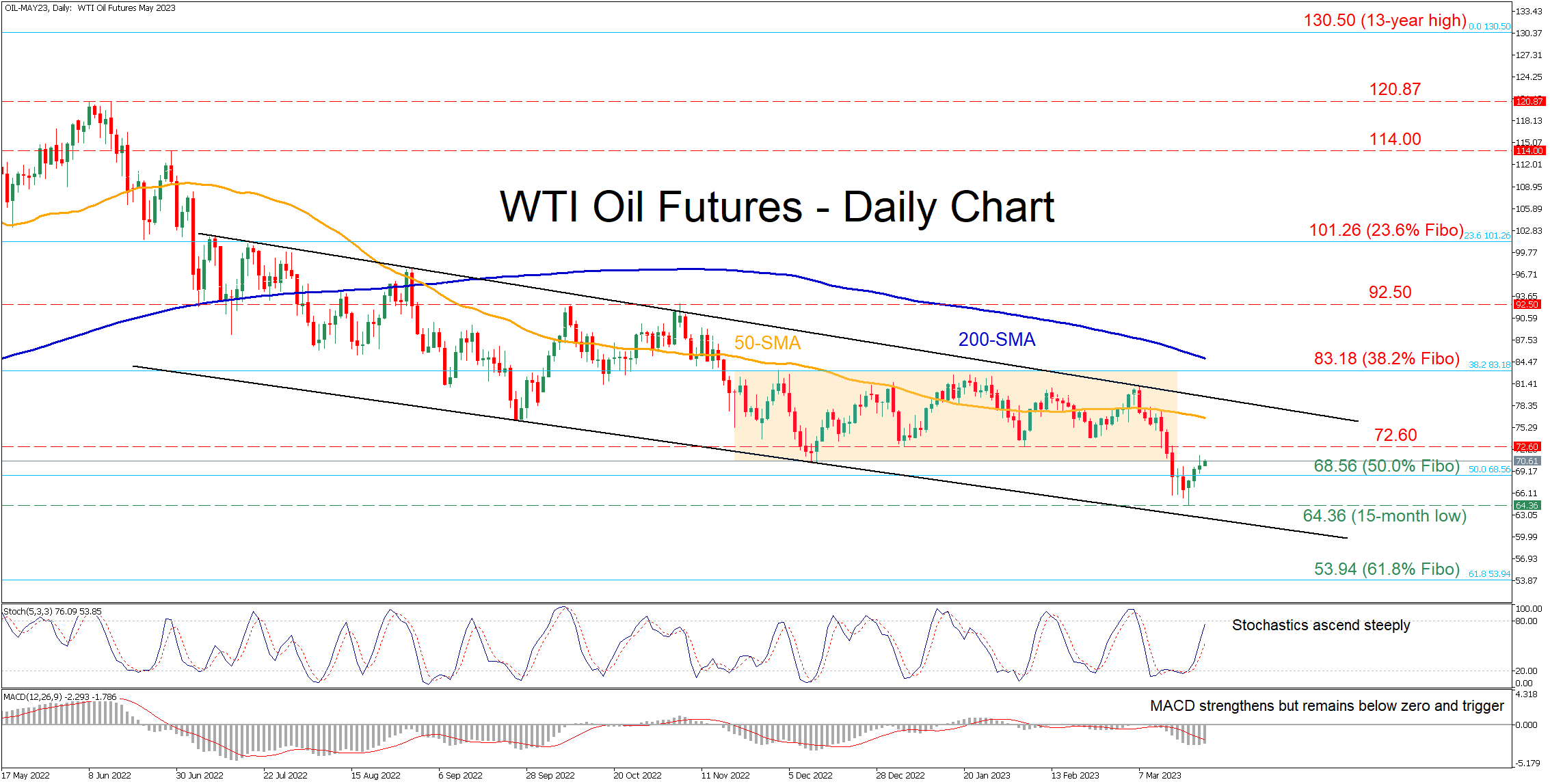
WTI oil futures (May delivery) broke below their rectangle pattern, which held strong since late November, posting a fresh 15-month low of 64.36. Even though the commodity managed to recoup some losses, its technical picture remains bearish.
The momentum indicators currently suggest that buying forces are strengthening but have not taken control yet. Specifically, the stochastic oscillator is ascending near its 80-overbought zone after escaping oversold conditions, while the MACD histogram is gaining ground but still below both zero and its red signal line.
If the recent rebound resumes, the price could initially challenge the recent support of 72.60, which could act as resistance in the future. Breaking above that zone, the commodity could ascend towards 83.18, which is the 38.2% Fibonacci retracement of the 6.62-130.5 uptrend that extended from the pandemic lows till the 13-year high in March 2022. Even higher, further upside moves could cease at the November high of 92.50.
On the flipside, should the negative momentum intensify and the price reverses lower again, the 50.0% Fibo of 68.56 could act as the first line of defense. A violation of that territory may open the door for the 15-month low of 64.36. Failing to halt there, the price could descend to test the 61.8% Fibo of 53.94.
In brief, WTI oil futures posted a minor rebound after plummeting to a fresh 15-month low and reaching oversold conditions. For the bearish outlook to reverse, the price needs to jump above the 83.18 ceiling.
GBPJPY Elliott Wave Forecasting The Path
Hello fellow traders. In this article we’re going to take a quick look at the Elliott Wave charts of GBPJPY forex pair published in members area of the website. As our members know, GBPJPY Is trading within the cycle from the February 28th peak. Recently we got 3 waves recovery against 165.98 high . The pair found sellers at the extreme zone and made the turn down as expected. In the further text we are going to explain the Elliott Wave Forecast.
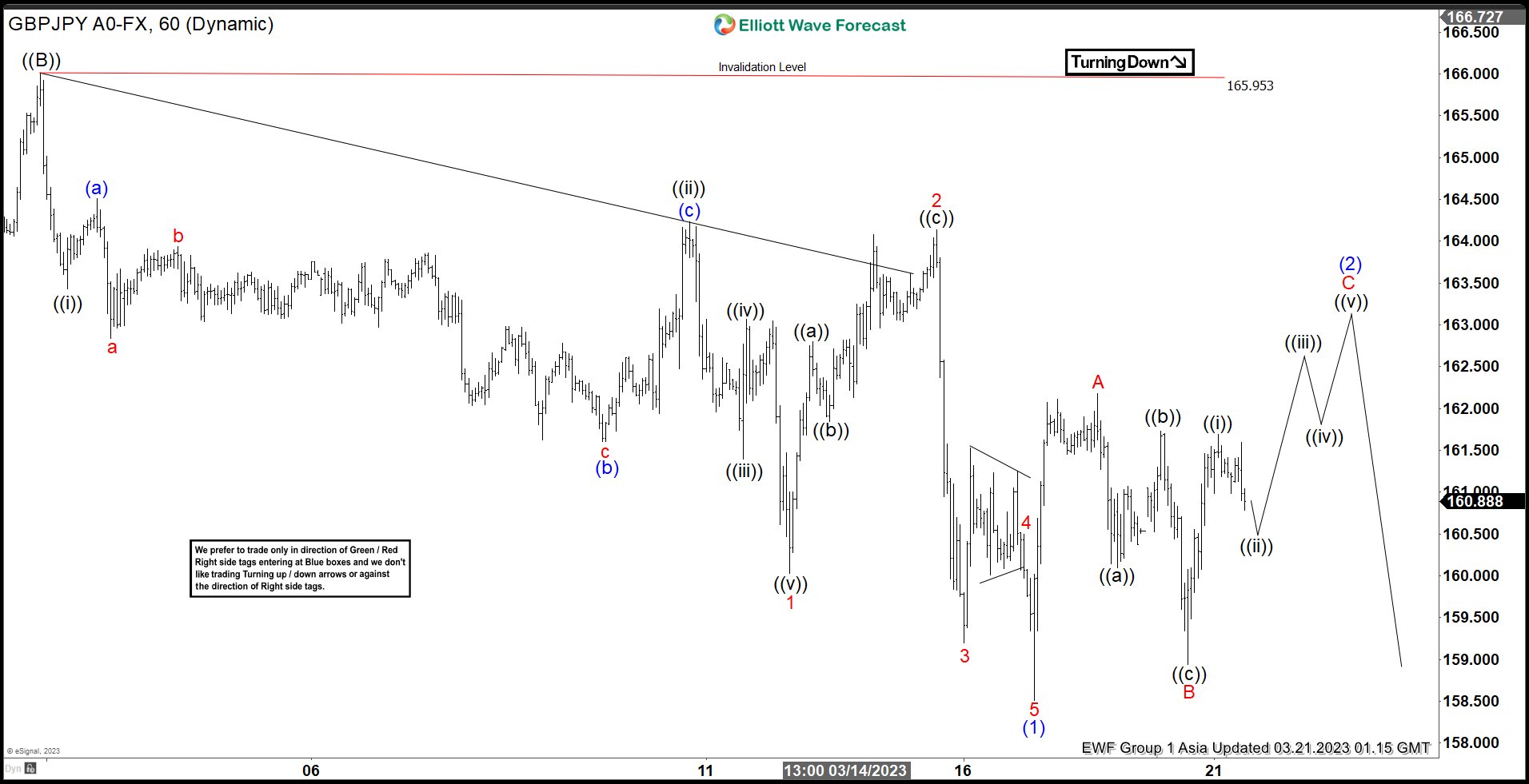
GBPJPY Elliott Wave 1 Hour Chart 02.10.2022
We are calling cycle from the 165.95 high completed as the 5 waves structure. Currently GBPJPY is doing correction against that high, which looks incomplete. We expect to see another leg up C red to complete wave (2) recovery.
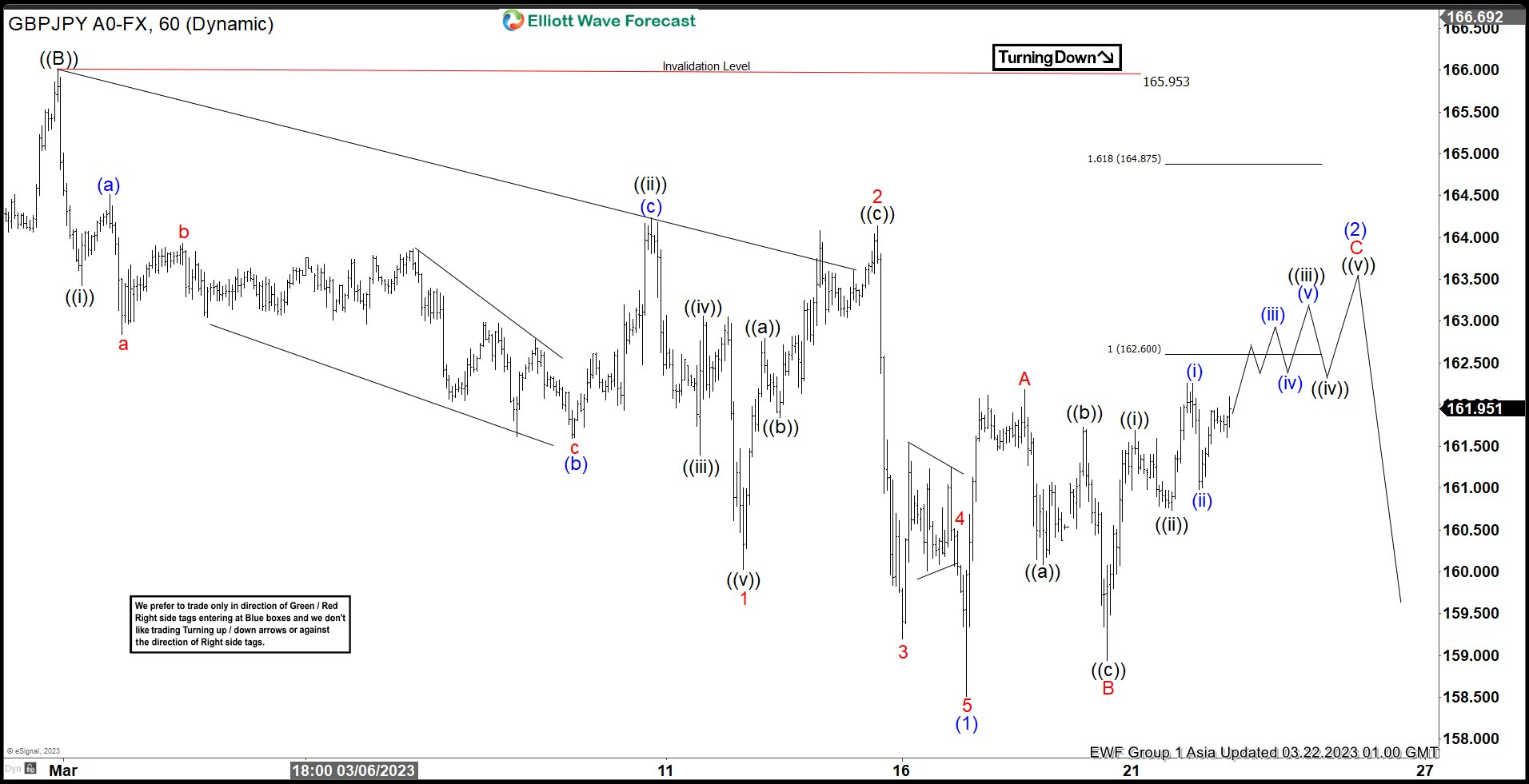
GBPJPY Elliott Wave 1 Hour Chart 03.22.2022
The pair has traded higher as we expected. It broke previous peak A red, confirming C red leg is in progress. More short term strength should ideally follow toward 162.6-164.87 area before turn lower takes place ideally.
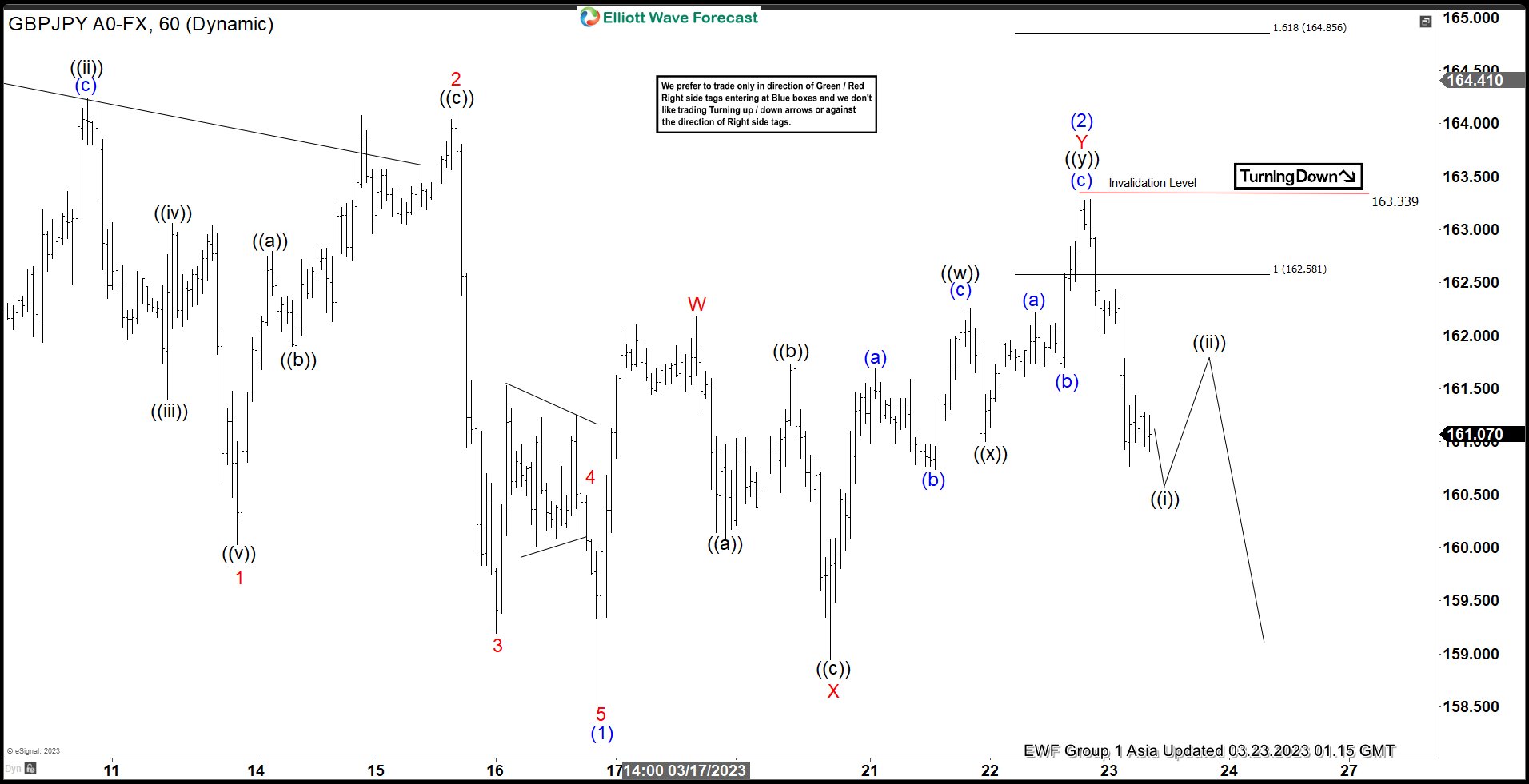
GBPJPY Elliott Wave 1 Hour Chart 03.23.2022
Eventually the pair made rally toward equal legs area 162.6-164.87 and found sellers as we expected. We already got decent pull back so we label wave (2) completed at the 163.33 high. As far as the price holds below that peak, chances are we are going to see further weakness. However , break of 03/16 low is needed to confirm next leg down is in progress.
GBP/JPY Daily Outlook
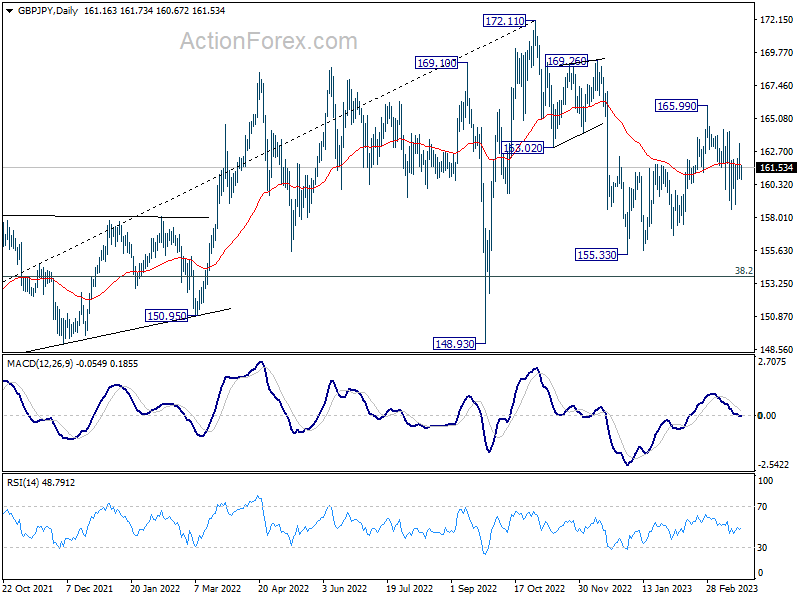
Daily Pivots: (S1) 160.30; (P) 161.82; (R1) 162.85; More...
Outlook in GBP/JPY remains unchanged and intraday bias stays neutral. Current development suggests that fall from 165.99 is a falling leg of the whole decline from 172.11. Deeper decline is expected as long as 164.12 resistance holds. Break of 158.54 will target a retest on 155.33 low. However, break of 164.12 resistance will bring stronger rise back to 165.99 resistance.
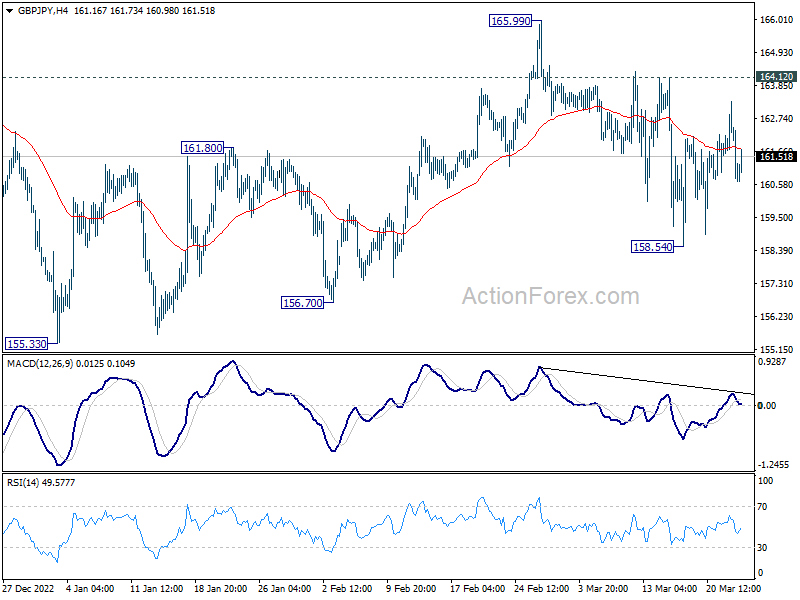
In the bigger picture, as long as 38.2% retracement of 123.94 (2020 low) to 172.11 (2022 high) at 153.70 holds, medium term bullishness is retained. That is, larger up trend from 123.94 (2020 low) is still in progress. Break of 172.11 high to resume such up trend is expected at a later stage.
EUR/JPY Daily Outlook
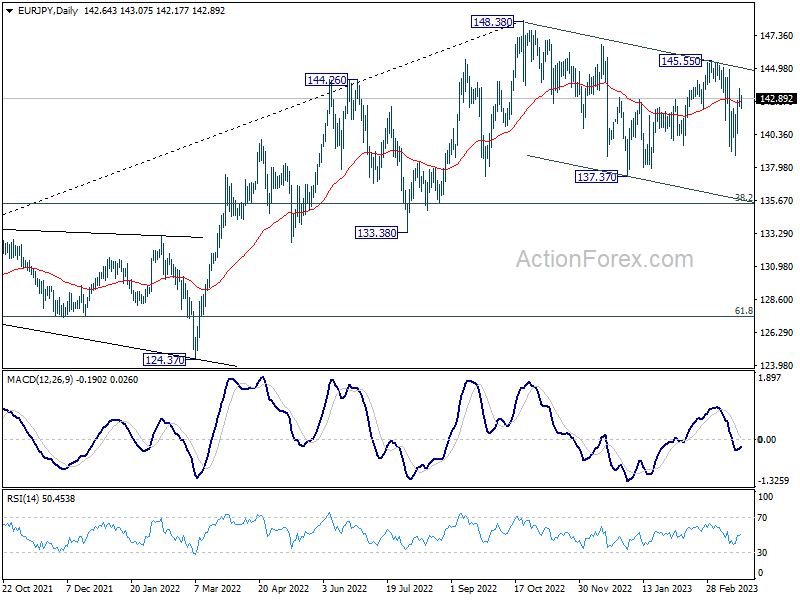
Daily Pivots: (S1) 142.18; (P) 142.90; (R1) 143.50; More....
Intraday bias in EUR/JPY stays neutral for the moment and near term outlook is mixed for now. On the downside, break of 138.81 will resume the fall from 145.55 to retest 137.37 low. However, break of 145.55 will resume the rebound from 137.37 low instead.
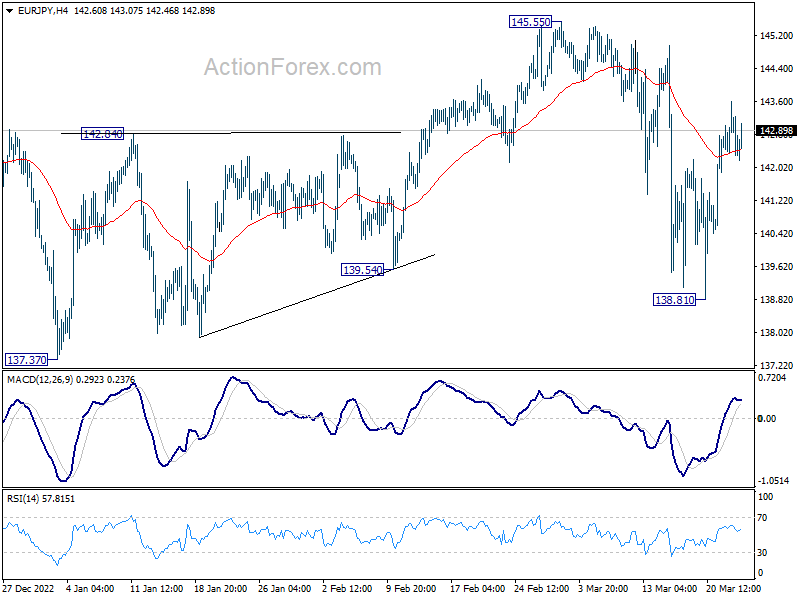
In the bigger picture, as long as 55 week EMA (now at 139.54) holds, larger up trend from 114.42 (2020 low) is still in progress for 149.76 long term resistance. However, firm break of 55 week EMA will bring deeper fall to 38.2% retracement of 114.42 to 148.38 at 135.40. Sustained break there will raise the chance of trend reversal, and target 61.8% retracement at 127.39.