Sample Category Title
AUD/USD Could Recover Higher, Fed Raised Rates Again
Key Highlights
- AUD/USD started an upside correction above the 0.6640 resistance.
- It broke a major bearish trend line with resistance at 0.6670 on the 4-hours chart.
- EUR/USD and GBP/USD extended gains above key hurdles.
- The fed increased interest rates from 4.75% to 5%.
AUD/USD Technical Analysis
The Aussie dollar tested the 0.6565 zone before it started an upside correction against the US dollar. AUD/USD cleared the 0.6620 resistance to move into a short-term positive zone.
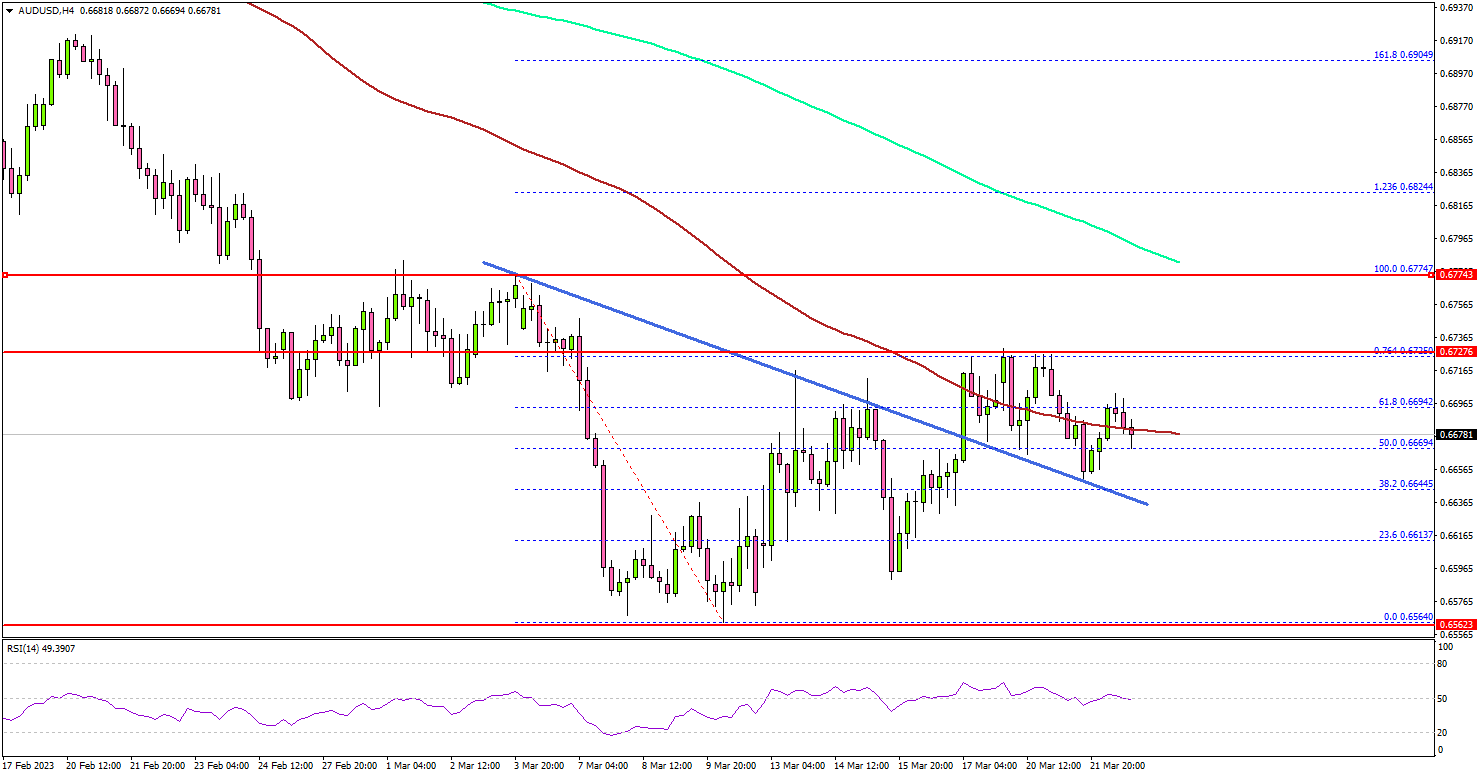
Looking at the 4-hours chart, the pair was able to clear the 0.6650 resistance zone. Besides, it broke a major bearish trend line with resistance at 0.6670.
The bulls were able to push the pair above the 50% Fib retracement level of the downward move from the 0.6774 swing high to 0.6564 low. However, the bears were active near the 0.6750 resistance zone.
It seems like AUD/USD struggled near the 76.4% Fib retracement level of the downward move from the 0.6774 swing high to 0.6564 low. The next major resistance is near the 0.6775. A clear move above the 0.6775 resistance might send the pair towards the 0.6820 zone.
Any more gains might send the pair towards 0.6850 or even 0.6880. On the downside, an immediate support is near the 0.6640.
The next major support is near the 0.66220 level, below which there is a risk of a move towards the 0.6565 level or the last swing low.
Looking at EUR/USD, the pair spiked above the key 1.0750 resistance zone and might attempt more gains in the near term.
Economic Releases
- BoE Interest Rate Decision - Forecast 4.25%, versus 4.0% previous.
- US Initial Jobless Claims - Forecast 201K, versus 192K previous.
Elliott Wave Suggests Ethereum (ETHUSD) at the Support Zone
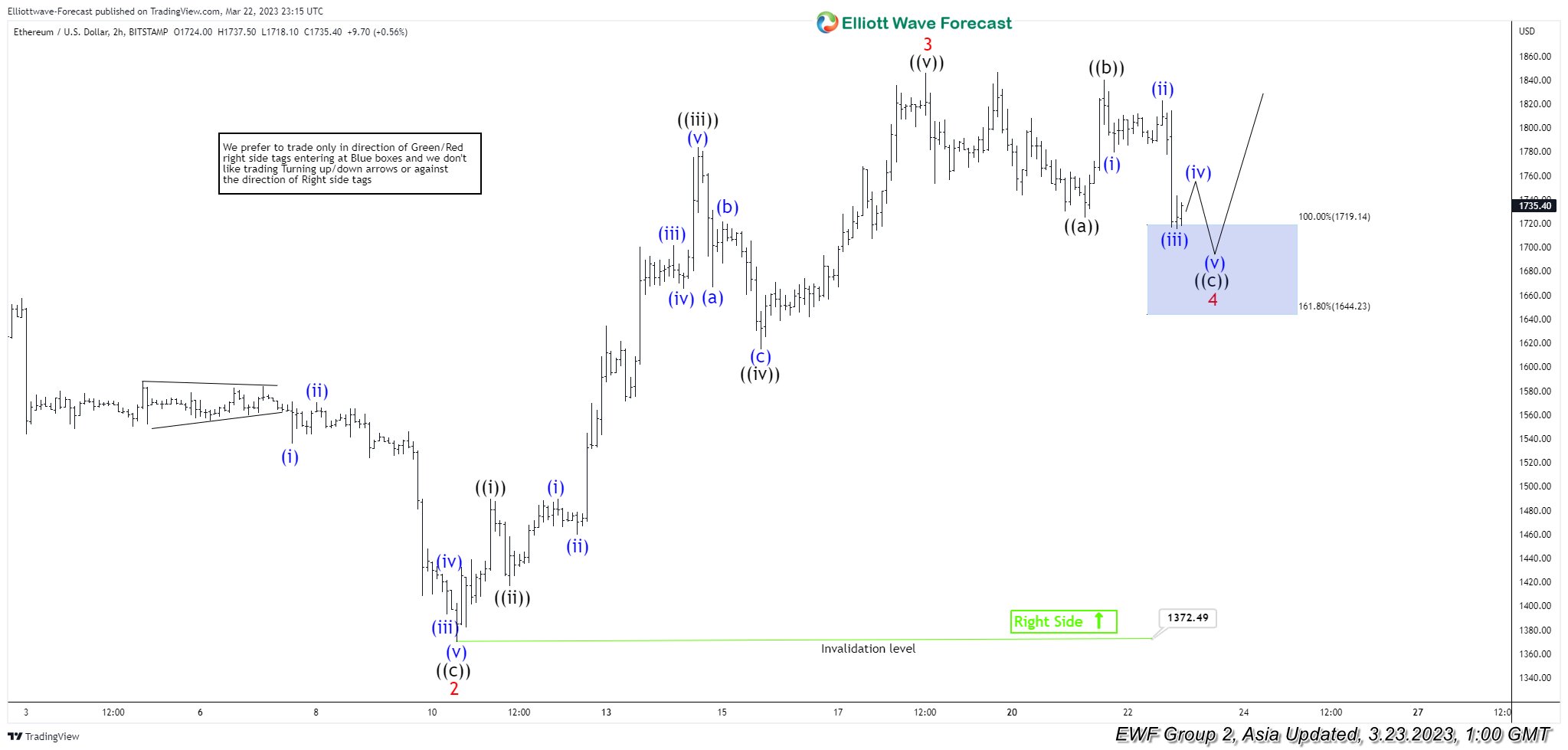
Cycle from November 9, 2022 low in Ethereum (ETHUSD) is in progress as a 5 waves impulse Elliott Wave structure. Up from Nov 9, 2022 low, wave 1 ended at 1742 and wave 2 pullback ended at 1372.49 as the chart below shows. Ethereum has extended higher in wave 3 with internal subdivision as an impulse in lesser degree. Up from wave 2, wave ((i)) ended at 1489.50 and dips in wave ((ii)) ended at 1416.80. The crypto currency extended higher in wave ((iii)) towards 1784.1 and pullback in wave ((iv)) ended at 1614.80. Final leg higher wave ((v)) ended at 1846 which completed wave 3.
Wave 4 pullback is now in progress to correct cycle from March 10, 2023 low before the rally resumes. Internal subdivision of wave 4 is taking the form of a zigzag Elliott Wave structure. Down from wave 3, wave ((a)) ended at 1725 and rally in wave ((b)) ended at 1839.90. Expect wave ((c)) to end soon and Ethereum to extend higher. Potential target for wave ((c)) is 100% – 161.8% Fibonacci extension of wave ((a)). This area comes at 1644.2 – 1719.1 as denoted with the blue box on the chart below. From this area, Ethereum should extend higher or rally in 3 waves at least.
ETHUSD 2 Hour Elliott Wave Chart
Ethereum (ETHUSD) Elliott Wave Video
https://www.youtube.com/watch?v=nR1ivXYdeqQ
FOMC’s Fight Against Inflation Finely Balanced
March’s 25bp hike is likely to be the last for this cycle as banking sector uncertainty tightens financial conditions and weighs on growth.
At their March meeting, the FOMC kept the immediate focus on the fight against inflation by hiking 25bps to a mid-point of 4.875% while also recognising the tightening of financial conditions to come as a result of this month’s Silicon Valley Bank and Signature Bank failures.
While uncertain in time and scale, the inclusion of “Recent developments are likely to result in tighter credit conditions for households and businesses and to weigh on economic activity, hiring, and inflation” makes clear the Committee’s expectation that the cost to the economy from this crisis of confidence in US regional banks will prove significant.
The FOMC go on in the statement to note that “some additional policy firming may be appropriate”, a much more dovish forward view on monetary policy than February’s “ongoing increases in the target range will be appropriate”. Further highlighting the significance of the change in circumstances, the press conference consequently made clear that these views are held by the FOMC despite Inflation being too high and recent data stronger than expected.
The immediate outlook for US monetary policy is therefore uncertain. The FOMC could certainly justify hiking once more in May to a peak of 5.125%. However, given the risks around financial conditions and confidence, holding off to assess would be the more prudent course, particularly given policy is already contractionary and forward indicators for inflation and the labour market were pointing down ahead of this shock, while the impact of these recent developments in the banking system is likely to be substantial for credit availability and economic activity.
Accordingly, we confirm our view that the federal funds rate has now peaked for this tightening cycle.
We also confirm our view that the federal funds rate is likely to remain on hold through the remainder of 2023. Apparent in the FOMC’s projections, and our own forecasts, is a need to keep policy on hold at a contractionary level for an extended period as inflation pressures abate and labour market slack increases. This is necessary to make sure the return to target inflation we forecast for late-2023 is sustainable. It is only once this goal is achieved that policy can be eased.
In contrast to current market pricing which sees 3-4 rate cuts by January 2024, Westpac anticipates rate cuts will not begin until March 2024. It appears that the Committee’s own expectation for policy is similarly timed to ours, with the median forecast of 5.1% at end-2023 followed by 80bps of cuts to end-2024 (surprisingly revised down from 100bps at the December meeting).
The cumulative scale of rate cuts from 2024 will clearly be dictated not only by the persistence of inflation, but also the cost to growth of contractionary monetary policy and banking sector uncertainty. We expect the loss of momentum to be more material in late-2023 than forecast by the FOMC (i.e. annual growth at December 2023 at or below zero versus the FOMC’s 0.4% median), and so anticipate a more aggressive pace of policy easing in 2024 than the Committee (200bps in 2024 from 4.875% versus 80bps from 5.1%).
This abrupt change in the stance of policy should create a robust turn in growth, allowing the FOMC to end the easing cycle in mid-2025 at a neutral level of 2.125%, well ahead of their timing (the FOMC’s end-2025 median forecast is 3.1%) but only marginally below the Committee’s longer-run estimate of 2.5%.
It is important to emphasise, as Chair Powell did in the press conference, that there are now multiple financial condition dynamics to assess in real time, each with their own timeline and risk profile. While term interest rates have fallen sharply, the 10-year yield from a recent peak of 4.06% to 3.50% currently, the economy is unlikely to receive benefit outside of a possible repricing of equities given the uncertainty surrounding the banking system, particularly the regional banks.
As the FOMC goes on hold, then begins to cut in 2024, term interest rates will fall further and general uncertainty over the health of the banking sector should subside; but a tighter regulatory focus on regional banks with less than $250bn in assets (which, until now, have had less onerous requirements) will likely continue to constrain lending and consequently investment and employment.
It is only after the regulatory regime is reset and confidence fully restored that easier policy will bring growth back above trend on a sustainable basis. This is unlikely before late-2024, at the earliest.
FOMC Hikes Rates, But End of Tightening Cycle Coming Into View
Summary
- The FOMC raised its target range for the federal funds rate by 25 bps at today's policy meeting. Fed policymakers have raised rates by 475 bps over the course of the past 12 months, the fastest pace of tightening since the early 1980s.
- The FOMC continues to have a relatively upbeat assessment of the current state of the economy. That said, it noted that "recent developments are likely to result in tighter credit conditions." This credit tightening likely will "weigh on economic activity," although "the extent of these effects is uncertain."
- Previously, the FOMC thought that "ongoing increases" in the fed funds rate would be needed to bring inflation back to the Committee's 2% target. Now the FOMC thinks that "some additional policy firming may be appropriate." In short, it appears that the end of the current tightening cycle is coming into view.
- The median 2023 dot in the "dot plot" lies between 5.00% and 5.25%, which is only 25 bps higher than the current target range for the federal funds rate. We look for the FOMC to hike rates by 25 bps at its May 3 before going on an extended pause in future meetings in 2023.
FOMC Hikes Rates By 25 bps Again
The Federal Open Market Committee (FOMC) voted unanimously today to hike rates by 25 bps, bringing the target range for the federal funds rate to 4.75%-5.00% (Figure 1). The Committee has now hiked rates by 475 bps over the course of the past 12 months, the fastest pace of tightening since the early 1980s. Furthermore, the FOMC decided to maintain the current pace of quantitative tightening, allowing up to $60 billion of Treasury securities and $35 billion of mortgage-backed securities to continue to roll off its balance sheet every month. The decision was more or less expected by financial markets.
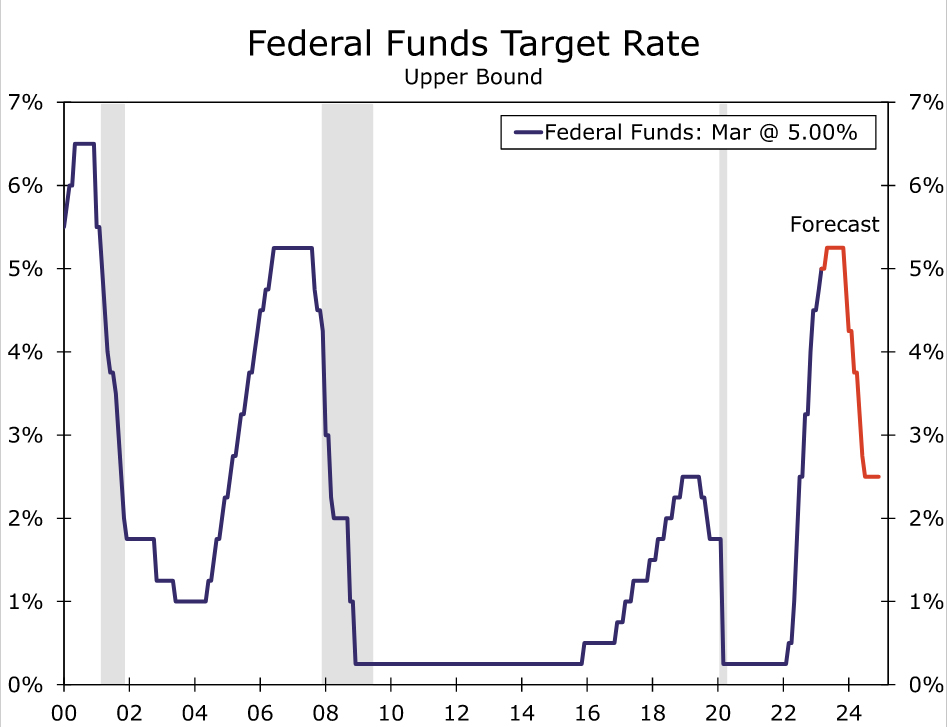
The FOMC continues to characterize the current state of the economy in favorable terms. The statement noted that "recent indicators point to modest growth in spending and production," and that job gains "are running at a robust pace." According to the FOMC, "inflation remains elevated." The Committee also noted the strains that have appeared in the banking system recently. In the FOMC's view, these strains "are likely to result in tighter credit conditions for households and businesses and to weigh on economic activity, hiring and inflation," although "the extent of these effects is uncertain."
Accordingly, the FOMC backed off somewhat on its forward guidance regarding further tightening. Previously, the statement said that "ongoing increases (emphasis ours) in the target range will be appropriate in order to attain a stance of monetary policy that is sufficiently restrictive to return inflation to 2 percent over time." The FOMC now judges that "some additional policy firming may be appropriate." In short, the uncertainty that the present banking system turmoil has engendered, along with the "tighter credit conditions" that likely will result, means that the end of the current tightening cycle is coming into view. In that regard, Chair Powell acknowledged in his post-meeting press conference that the FOMC considered a pause in its tightening cycle at this meeting.
The FOMC updated its Summary of Economic Projections (SEP), as it normally does once per quarter, in which it specifies its macroeconomic forecasts. The SEP contains the so-called "dot plot" that shows each individual FOMC member's assessment on the appropriate level of the fed funds rate over the next few years (Figure 2). The median dot for the end of this year lies in the middle of the 5.00%-5.25% range. Although this median dot is unchanged from the last dot plot in December, it likely would have been higher if banking system strains had never occurred. Relative to the projection that it released in December, the FOMC shaved 0.4 percentage points from its GDP growth forecast for 2024 and now looks for 1.2% GDP growth next year. This downward revision is consistent with the Committee's view that the current strains in the banking system will lead to "tighter credit conditions" that likely will have consequences for the real economy.
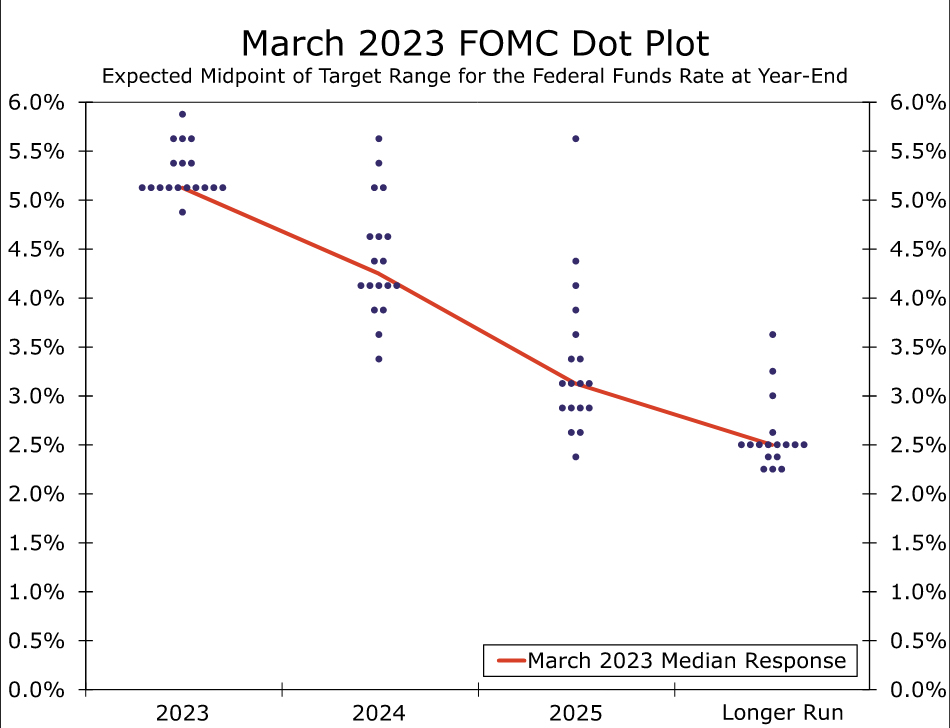
As we wrote in our recent U.S. Economic Outlook in which we updated our forecasts, we are explicitly assuming that authorities take the necessary steps in coming days and weeks to keep the current turmoil in the banking system more or less contained. If this assumption proves to be valid, then we anticipate that the Committee will increase the target range for the federal funds rate by another 25 bps at its next meeting on May 3, which we believe will be the last rate hike in this cycle. We think the FOMC will refrain from hiking the fed funds rate at the June 14 meeting in order to assess the effects that tighter monetary policy and credit conditions are having on the economy. That said, we would judge the risks to our fed funds forecast to be skewed to the upside. That is, we judge the probability of another 25 bps rate hike at the June 14 meeting to be higher than a pause at the May 3 meeting, assuming that authorities are successful in stabilizing the recent turmoil. We expect the Committee will remain on hold for most of the rest of 2023 as economic activity weakens and inflation recedes further. If our forecast of a modest recession beginning in the third quarter comes to pass, then we look for the FOMC to cut rates significantly next year.
FOMC Hikes Policy Rate by 25 Basis Points, Cautions on Bank Stress
The Federal Reserve Open Market Committee (FOMC) lifted the federal funds rate by a quarter point to the 4.75% to 5.0% range and announced a continuation of its balance sheet runoff.
The Fed adjusted to acknowledge the current banking stress stating, "the U.S. banking system is sound and resilient. Recent developments are likely to result in tighter credit conditions for households and businesses and to weigh on economic activity, hiring, and inflation. The extent of these effects is uncertain. The Committee remains highly attentive to inflation risks.".
It also shifted its language on the future path of policy in a more dovish direction, adding that "the Committee will closely monitor incoming information and assess the implications for monetary policy." Also shifting from "ongoing increases in the target range" in January, to "The Committee anticipates that some additional policy firming may be appropriate in order to attain a stance of monetary policy that is sufficiently restrictive".
The Fed's Summary of Economic Projections was updated from December, downgrading growth over the near term, but upgrading inflation as follows:
- The median projection for real GDP growth for 2023, 2024, 2025, and the longer run came in at 0.4%, 1.2%, 1.9% and 1.8% (from 0.5%, 1.6%, 1.8%, and 1.8%), respectively.
- The median unemployment rate forecast for 2023, 2024, 2025, and the longer run came in at 4.5%, 4.6%, 4.6% and 4.0% (from 4.6%, 4.6%, 4.5%, and 4.0%), respectively.
- On inflation, the median estimate for core PCE was assumed to be 3.6% in 2023, 2.6% in 2024, and 2.1% in 2025.
- The median projection for the fed funds rate was 5.1% in 2023, 4.3% in 2024, and 3.1% in 2025. The long-run neutral rate was assumed to be 2.5%.
All of the members of the FOMC voted in favor of the decision
Key Implications
This was one of the most contentious decisions the Fed has had to make. When inflation was its singular focus over the last year, raising rates was the only option. But now that the stability of the financial system has been brought to the forefront, the Fed is having to toe a fine line. By raising rates, while focusing the statement on the tail risks, it is acknowledging the flow through of financial market stress on the broader economy. The changes in the Fed's economic projections were for weaker growth over the next two years and higher inflation. In contrast to what was signaled a short time ago, the median "dot" for the end of this year was unchanged, suggesting that the downdraft from tighter credit conditions is expected to weigh on economic momentum enough to negate the need for the further rate hikes discussed only two short weeks ago.
Chair Powell is ready to speak, and we expect a flurry of questions, with investors eager to know how the Fed expects to manage its policy rate with so many crosscurrents challenging the outlook. Even though the Fed's projections point to another forthcoming rate hike, markets are getting ready for cuts to start by this summer. That would be an incredibly quick turnaround should the Fed hike again in May. This aggressive pricing has bond yields falling again. Let's see if Powell tries to lean against markets once more.
Fed hikes 25 bps, terminal rate forecast unchanged at 5.1%
Fed raise interest rate by 25bps to 4.75-5.00% as mostly expected, on unanimous vote. Tightening biased is maintained as "the Committee anticipates that some additional policy firming may be appropriate in order to attain a stance of monetary policy that is sufficiently restrictive to return inflation to 2 percent over time".
The terminal rate is still put at 5.00-5.25% this year. But a smaller rate cut is projected in 2024. Growth projections are lowered for 2023 and 2024. Core inflation forecasts were raised slightly for this year and next.
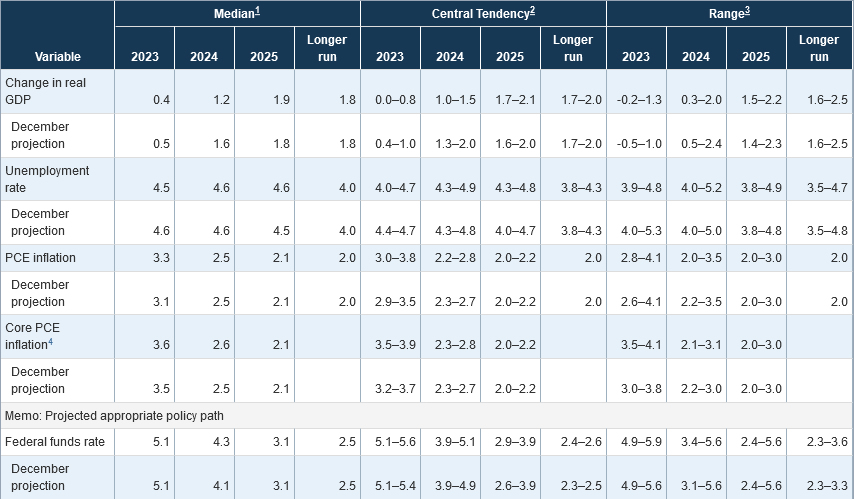
In the new economic projections (median):
- Federal funds rate for 2023 was unchanged at 5.1%.
- Federal funds rate for 2024 was raised from 4.1% to 4.3%.
- Federal funds rate for 2025 was unchanged at 3.1%.
- GDP growth in 2023 was lowered from 0.5% to 0.4%.
- GDP growth in 2024 was lowered from 1.6% to 1.8%.
- GDP growth in 2025 was raised from 1.8% to 1.9%.
- Unemployment rate in 2023 was lowered from 4.6% to 4.5%.
- Unemployment rate in 2024 was unchanged at 4.6%.
- Unemployment rate in 2025 was raised from 4.5% to 4.6%.
- Headline PCE inflation in 2023 was raised from 3.3% to 3.1%.
- Headline PCE inflation in 2024 was unchanged at 2.1%.
- Headline PCE inflation in 2025 was unchanged at 2.1%.
- Core PCE inflation in 2023 was raised from 3.5% to 3.6%.
- Core PCE inflation in 2024 was raised from 2.5% to 2.6%.
- Core PCE inflation in 2025 was unchanged at 2.1%.
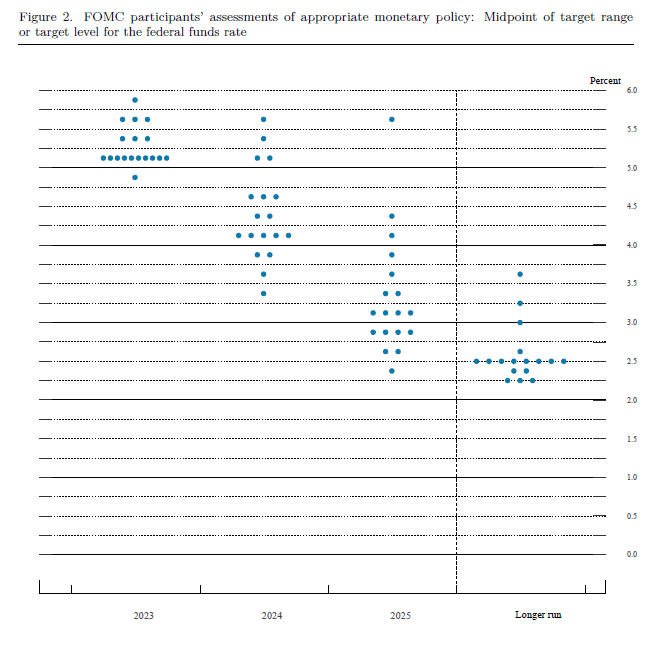
In the new dot plot:
- In 2023, the majority, 10 committee members, expect interest rate at 5.00-5.25% , with only one expecting lower rates.
- In 2024, 14 members at least at least two rate cut from 5.00-5.25% level. Majority of 10 members expect rates to be between 4.00-4.75% range.
(FED) Federal Reserve Issues FOMC Statement
Recent indicators point to modest growth in spending and production. Job gains have picked up in recent months and are running at a robust pace; the unemployment rate has remained low. Inflation remains elevated.
The U.S. banking system is sound and resilient. Recent developments are likely to result in tighter credit conditions for households and businesses and to weigh on economic activity, hiring, and inflation. The extent of these effects is uncertain. The Committee remains highly attentive to inflation risks.
The Committee seeks to achieve maximum employment and inflation at the rate of 2 percent over the longer run. In support of these goals, the Committee decided to raise the target range for the federal funds rate to 4-3/4 to 5 percent. The Committee will closely monitor incoming information and assess the implications for monetary policy. The Committee anticipates that some additional policy firming may be appropriate in order to attain a stance of monetary policy that is sufficiently restrictive to return inflation to 2 percent over time. In determining the extent of future increases in the target range, the Committee will take into account the cumulative tightening of monetary policy, the lags with which monetary policy affects economic activity and inflation, and economic and financial developments. In addition, the Committee will continue reducing its holdings of Treasury securities and agency debt and agency mortgage-backed securities, as described in its previously announced plans. The Committee is strongly committed to returning inflation to its 2 percent objective.
In assessing the appropriate stance of monetary policy, the Committee will continue to monitor the implications of incoming information for the economic outlook. The Committee would be prepared to adjust the stance of monetary policy as appropriate if risks emerge that could impede the attainment of the Committee's goals. The Committee's assessments will take into account a wide range of information, including readings on labor market conditions, inflation pressures and inflation expectations, and financial and international developments.
Voting for the monetary policy action were Jerome H. Powell, Chair; John C. Williams, Vice Chair; Michael S. Barr; Michelle W. Bowman; Lisa D. Cook; Austan D. Goolsbee; Patrick Harker; Philip N. Jefferson; Neel Kashkari; Lorie K. Logan; and Christopher J. Waller.
Bank of England & Swiss National Bank Both Set to Hike
Summary
- The Bank of England and Swiss National Bank both make monetary policy announcements tomorrow, March 23.
- Our base case is for the Bank of England to raise its policy rate 25 basis points to 4.25% this week, and then pause tightening. However, an unexpected quickening of inflation has added some uncertainty to that outlook. In the absence of a closer, or finely balanced, vote in favor of a rate hike, or a softening in the Bank of England's language, we will be inclined to adjust our outlook towards further tightening, an adjustment that could also be positive for the pound.
- In Switzerland, growth appears to be bottoming out and there has been an uptick in inflation. While Swiss markets have been dominated by banking sector strains over the past week, with some sense of relative calm restored and after the European Central Bank's rate hike last week, we still expect the Swiss National Bank to raise its policy rate by 50 basis points to 1.50% at this week's announcement.
Bank of England to Hike, But Will They Signal More To Come?
The Bank of England (BoE) announces its monetary policy decision on March 23, with market participants focused on both the size of any potential rate hike and any signals of potential future rate hikes. Our base case has been for the Bank of England to hike its policy rate by 25 basis points to 4.25% at this week, a view with which we are still comfortable. In recent days, as banking sector strains in the U.S. and Switzerland led to unsettled global markets, market discussion has centered on whether the Bank of England could even pause at this week's meeting. However, with those strains alleviated to a modest extent, further tightening now seems very likely at this week's meeting.
A more interesting question, in our view, is whether there will be any further tightening beyond this week's meeting. Our base case has been that this week's rate increase will be the last of the current cycle. The Bank of England's economic projections, which forecast a moderate U.K. recession and below-target inflation over the medium-term, are consistent with a pause from the Bank of England after this week. In our view, some key policymakers have also been quite balanced in their comments and are looking for opportunities to pivot towards a pause. For example, Governor Bailey recently said in early March, “I would caution against suggesting either that we are done with increasing Bank Rate, or that we will inevitably need to do more”.
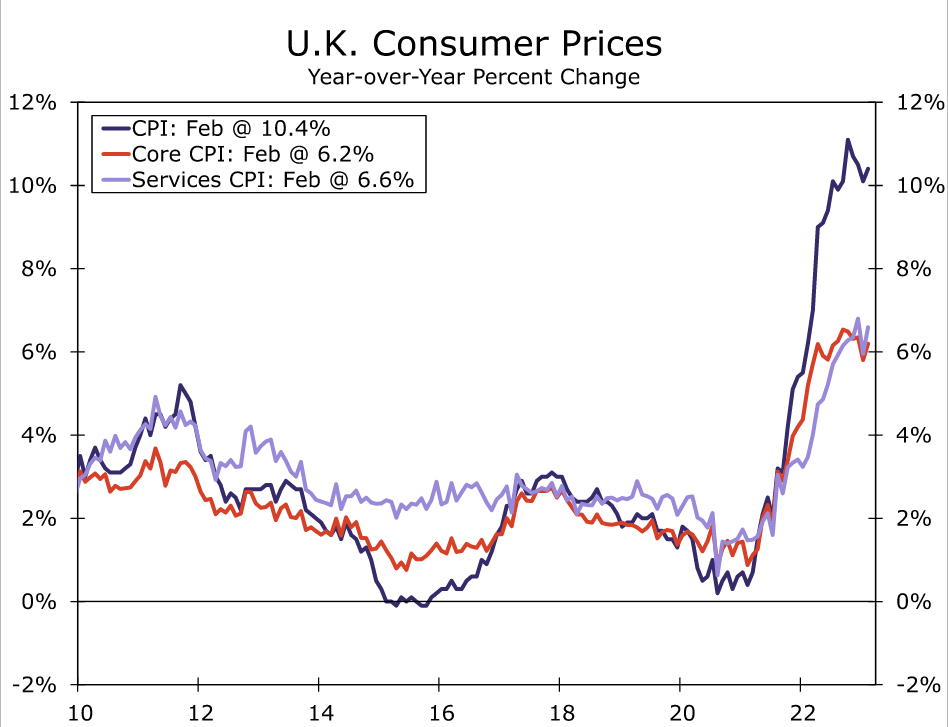
A moderate slowing in inflation over the last few months had opened the door slightly ajar, in our view, to a Bank of England pause. However, that pause has been thrown into doubt by the U.K. February CPI. U.K. inflation was an upside surprise, with the headline and core CPI unexpectedly quickening to 10.4% and 6.2% year-over-year, respectively. Today's Federal Reserve monetary policy decision may also be a factor—while it is not our base case, if the Fed does hike rates at its meeting, it could potentially make it easier for the Bank of England to deliver additional rate hikes after this week as well. Hence, while we are reasonably confident the BoE will hike rates 25 basis points this week, we will be scrutinizing the accompanying statement closely for signs of a pause (or not) going forward. In particular:
- The Bank of England voted 7-2 at its February meeting to hike rates, with the two dissents in favor of holding rates steady. We look for a closer vote split (6-3 or 5-4) as a hint that this week's hike could be the last. However, if the vote remains decisively in favor of a rate increase, more hikes could be forthcoming.
- The BoE also said it “will continue to monitor closely indications of persistent inflationary pressures, including the tightness of labor market conditions and the behavior of wage growth and services inflation. If there were to be evidence of more persistent pressures, then further tightening in monetary policy would be required.” (Note: Our bolding). Should the BoE once again highlight these persistent inflationary risks, that would be a signal of further tightening in our view.
To sum up, we will be looking for a closer vote split and a softening in the Bank of England's language to support the view of a potential pause. In the absence of those elements, we will be inclined to adjust our outlook towards further Bank of England tightening, and adjustment that could also be positive for the pound.
Swiss National Bank to Hike Despite Banking Sector Strains
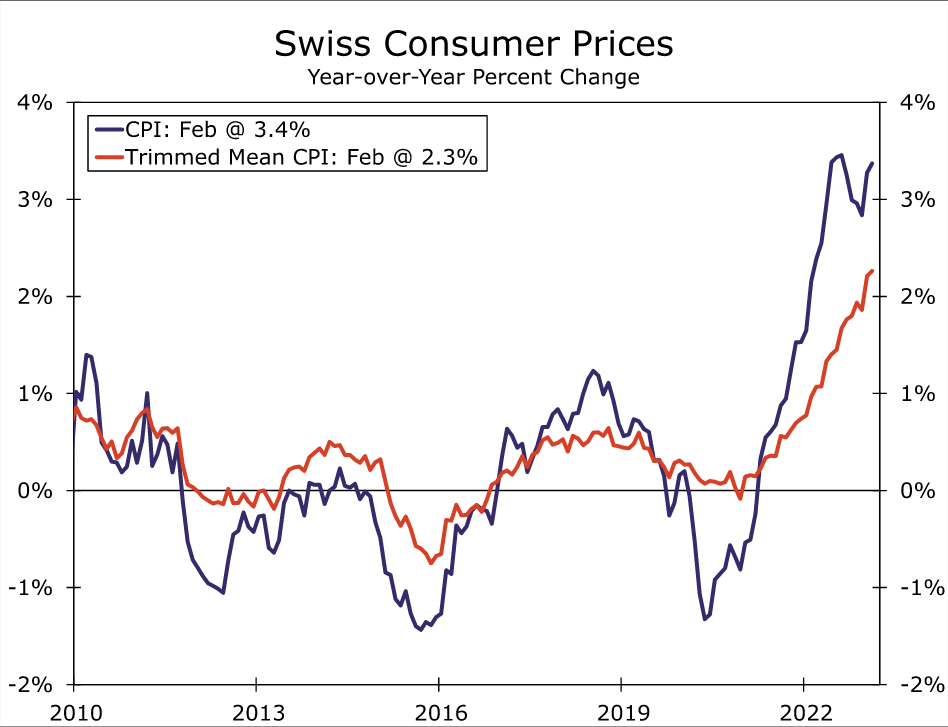
Early last week, we wrote on the Swiss economy, highlighting that growth appears to be bottoming out while CPI inflation has shown a renewed uptick, as the trimmed mean CPI rose 2.3% year-over-year in February. This led us to anticipate a 50 basis point hike from the Swiss National Bank (SNB) at its March 23 announcement. Since then, Swiss markets have been dominated by banking sector strains, which ultimately saw authorities engineer a takeover of Credit Suisse by rival firm UBS. The deal led the SNB to provide 100 billion francs of liquidity support for UBS, and the Swiss government to provide a guarantee of 9 billion francs against potential losses. With those developments having restored some relative calm to markets (the emphasis here is very much on the relative rather than the calm), and with the European Central Bank having raised its policy rate 50 basis points last week, we still expect the SNB to raise its policy rate by 50 basis points to 1.50% at this week's meeting. Moreover, while Swiss growth could be softer than previously expected, CPI inflation will likely remain mildly elevated above the central bank's 2% inflation target for the time being. If the SNB does raise rates 50 basis points this week, even in the context of recent market events, we believe it will also deliver a 25 basis point rate hike at its June meeting amid what we expect will be calmer markets conditions.