Sample Category Title
Will the SNB Roil Markets With a Hike Amid Credit Suisse Crisis?
The Swiss National Bank (SNB) will announce its quarterly monetary policy decision on Thursday (08:30 GMT), but the meeting has already been overshadowed by the Credit Suisse saga. The SNB is hoping that the emergency takeover of Credit Suisse by UBS will be enough to prevent a wider fallout, allowing it to go ahead with its planned rate increase. But there is uncertainty not only about the size of the expected hike but also about how much additional tightening policymakers will signal. As for the Swissie, its safe-haven status hasn’t been able to cushion it from domestic banking woes.
The fall of another giant
It was only a week ago that SNB Chairman Thomas Jordan was stressing the need to get inflation back into the “area of price stability”, describing it “too high”. Three days later, the share price of the country’s second largest banking group collapsed after its biggest shareholder refused to shore it up with more cash. The selloff came just as the panic over the health of US banks had started to recede, sending fresh shivers through the markets.
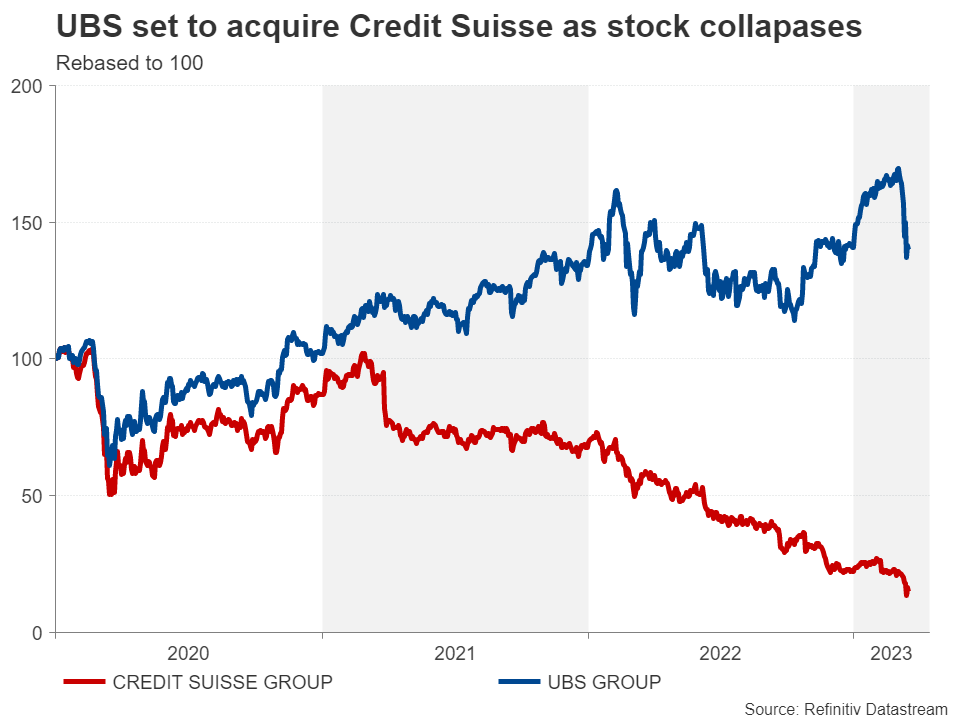
Although the troubles facing Credit Suisse are unrelated to those inflicting regional banks in the US, the market reaction highlights how quickly contagion can spread and that policymakers and regulators shouldn’t underestimate the risk posed by the further loss of confidence in financial institutions. It is hard to ignore that the confidence crisis hitting Credit Suisse is reminiscent of the days of the Eurozone debt crisis.
Mega deal fails to calm jitters
And just as they did back then, central banks and governments are riding to the rescue of these too large to fail banks. After the SNB’s decision to grant a CHF 50 billion lifeline to Credit Suisse only temporarily soothed nerves, the forced combination with its bigger rival UBS Group was thought to be the only viable option to save the bank.
The deal is backed by CHF 9 billion in guarantees from the Swiss government and a CHF 100 billion in liquidity by the SNB. Yet, doubts persist about the Swiss and global banking system, adding pressure on SNB policymakers to provide further assurances on Thursday that they stand ready to act should more banks or financial markets in general come under stress.
The stakes are high at upcoming meeting
One such reassurance could be to tone down the hawkish rhetoric, placing as much emphasis on the need for financial stability as on achieving low inflation. Prior to the turmoil, a 50-basis-point-rate hike was fully priced in for March, but investors now see a 25-bps increase as more likely. More importantly, even after the dramatic re-evaluation of rate hike expectations, almost two additional rate hikes of 25 bps are priced in for the SNB.
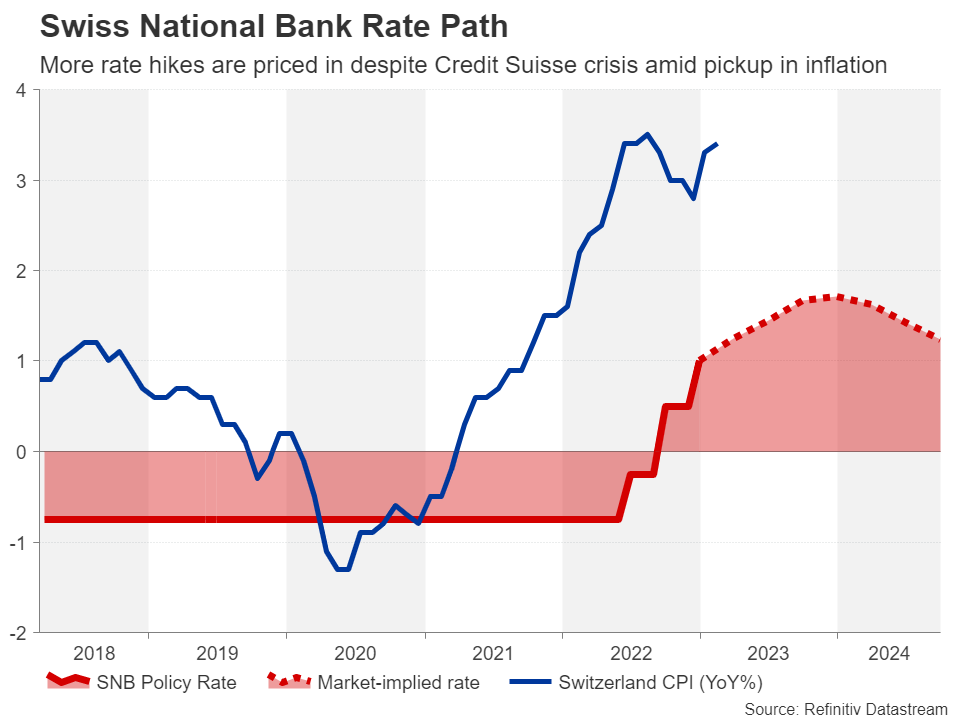
At 3.4% as per the February data, inflation in Switzerland remains comparatively low, hence, it can be argued that the SNB is in a more enviable position and can afford to ease up on its tightening plans. However, the consumer price index has been unexpectedly edging higher since January, rising well above the central bank’s target range of 0-2%, suggesting that it may not have quite peaked just yet.
Will the SNB maintain a hawkish bias?
It is worth pointing out the policy rate is not the only tool that the SNB has been using in its fight against inflation as it has also been selling its foreign currency reserve to purchase Swiss francs in an attempt to bring down import prices. This would have been unthinkable a year ago when policymakers considered the franc to be significantly overvalued and were still actively selling it.
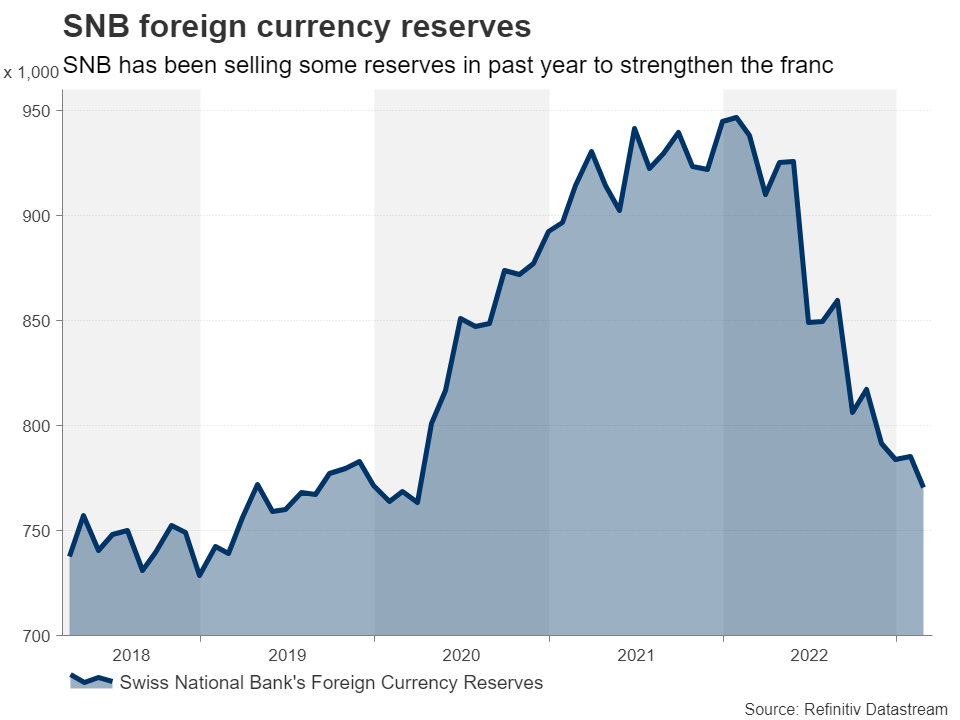
But the shift goes to show just how big the hawkish pivot has been in such a short period of time and so the SNB may not necessarily follow in the footsteps of the European Central Bank, which raised rates at its March meeting but indicated that future rate increases will be conditional on the incoming data.
Tougher times ahead for the franc?
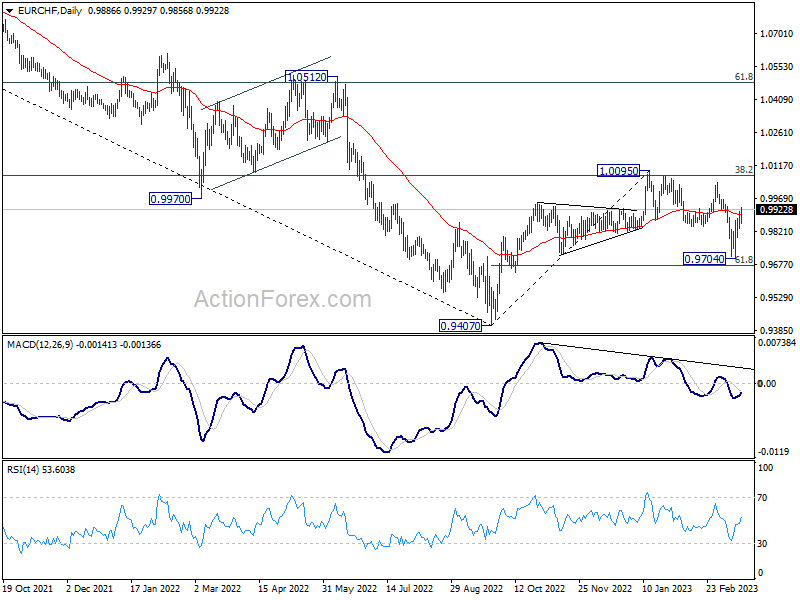
The Swiss franc could come under pressure from a dovish hike, pushing euro/franc above its 50-day moving average, which currently stands at 0.9930. Further gains would bring into scope the January high of 1.0097 that sits slightly above the 38.2% Fibonacci retracement of the March 2021-September 2022 downtrend.
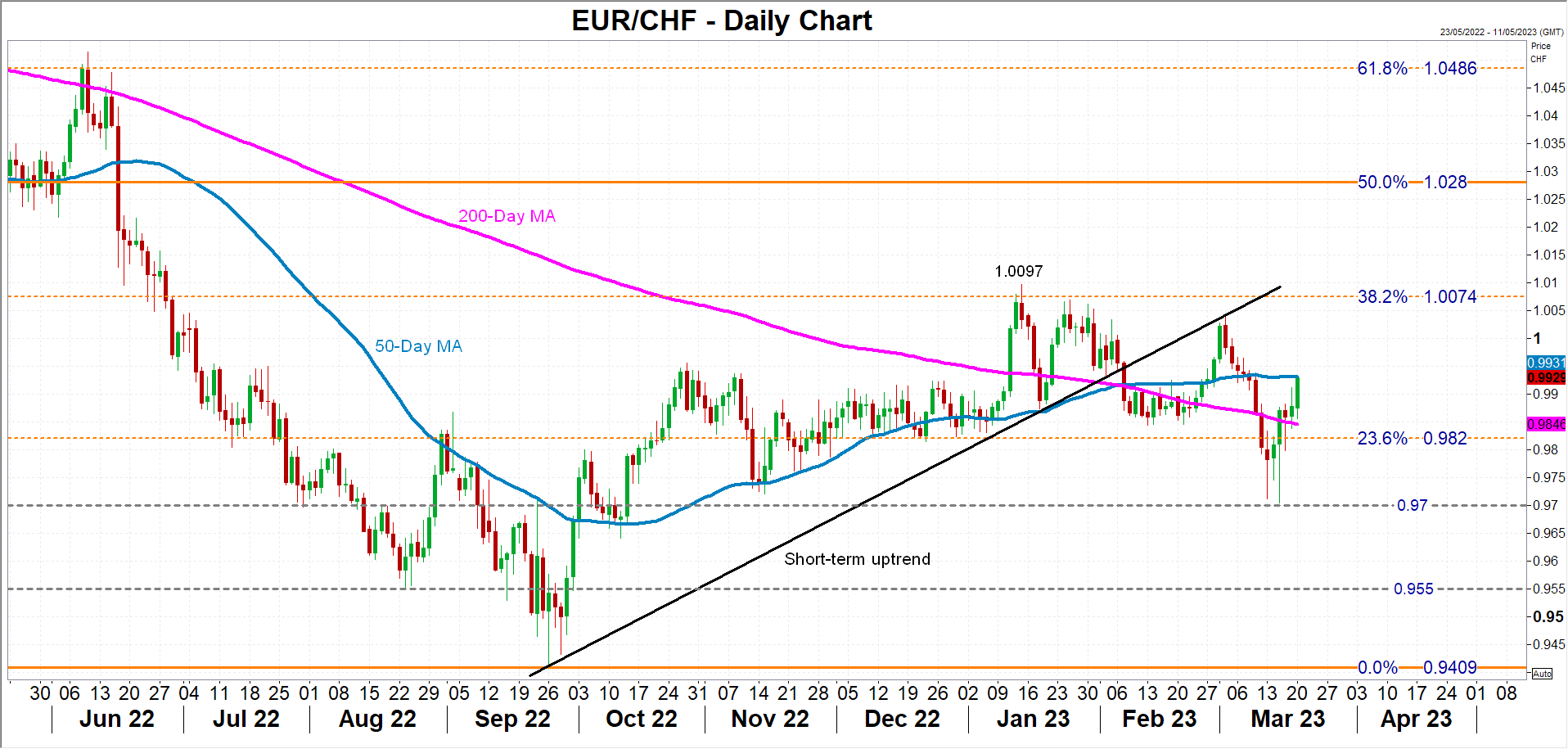
However, if the SNB maintains a hawkish bias, flagging further rate increases, euro/franc could head back towards the 0.97 level, which it came close to breaching last week. A drop below it could spur the franc to rally until the 0.9550 mark.
In the bigger picture, the franc has been mostly neutral against the euro this year. The question now is, would the SNB reinforcing its commitment to additional tightening while the ECB goes on pause work in the Swissie’s favour, or are there more losses to come amid concerns about the country’s banks?
Has the Long-Awaited Recession Arrived?
Stock markets are falling, oil dropped to prices not seen since 2021 and gold is trending higher. The general symptoms that would be expected as a recession developed. The collapse of three banks in the US, and Credit Suisse not only once again dropping to record lows, but having the largest drop in its stock price in history. It's not surprising at all that the market is having jitters. The question is whether this is a passing issue, or can we expect the situation to get worse.
The contagion issue
There has been a lot of talk in the media of "contagion". That implies that there is a problem in, say, SVB which passes on to other banks, causing them to have issues. And so on for a cascading effect. Regulators have come out to repeatedly assure the market that there isn't any "contagion" risk.
The problem with this is that it could lead people to think that a company which doesn't have investments in SVB (or any of the other banks in trouble), then it's safe. There is no contact through which there could be contagion. While that certainly is a concern, it's also possible for other bank or businesses to be in trouble without a direct link to one of the banks that recently went under.
The tip of the iceberg or just a mirage?
Take Credit Suisse, for example; it is experiencing difficulties and isn't related to SVB. However, it is operating in a similar environment. A prolonged period of low interest rates led banks to build up a large amount of low-interest reserves that is now causing them unrealized losses when interest rates go up.
The problem isn't necessarily "contagion", but that other banks could be in a similar position, and SVB was just the first. Sort of a canary in the coal mine scenario. Ultimately, the problem that the three banks that just went under had - and increasingly Credit Suisse has - is difficulty accessing liquidity. Tight liquidity means they are forced to sell assets at a discount, pushing down the value of those assets. If enough institutions find themselves in that position, then the whole market goes down in a crash.
It's now down to monetary policy
If other institutions don't end up having a liquidity problem, or their central bank provides liquidity, then SVB might just be a hiccup in an otherwise steady market. The focus, therefore, turns to what the central banks will do. Until now, they've been pushing rates higher to get inflation down. But the current crisis could lead to putting an end to that, which could allow inflation to start rising.
Until recently, the fear of inflation was that it would cause central banks to raise rates and slow the economy. But if central banks don't raise rates, inflation can still be a problem, since the erosion of purchasing power can lead to demand destruction. So far, central banks have been relieved that there has been no wage-price spiral, because wages have increased less than inflation has. That's fine if inflation is transitory. But central banks give up on fighting inflation, and wages don't keep up with prices, then there could be an extended economic slump instead of a crash.
GBP/USD Mid-Day Outlook
Daily Pivots: (S1) 1.2122; (P) 1.2162; (R1) 1.2221; More...
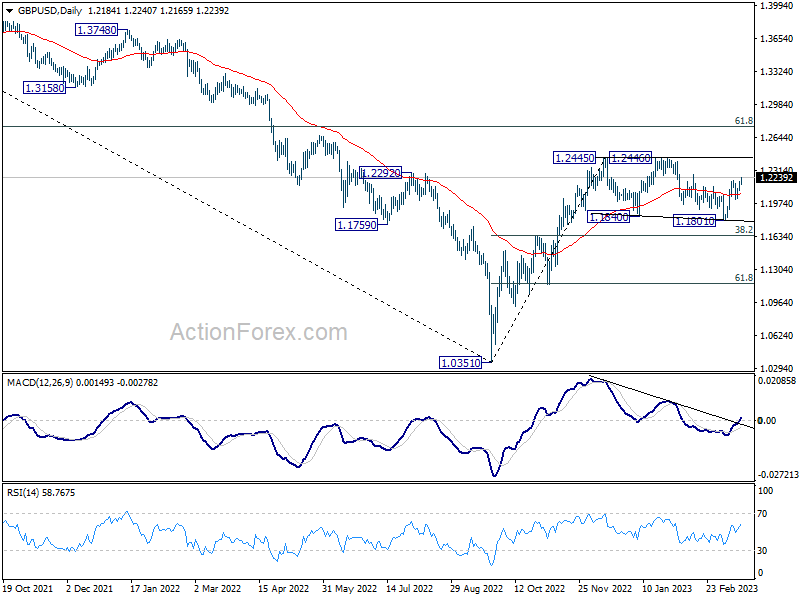
GBP/USD's rise from 1.1801 resumed today and intraday bias is back on the upside. Further rally should be seen to retest 1.2445/6 resistance zone. As noted before, corrective pattern from 1.2445 could have completed with three waves to 1.1801 already. Firm break of 1.2445/6 will resume larger rise from 1.0351, and target 1.2759 fibonacci level. For now, outlook will stay cautiously bullish as long as 1.2009 support holds, in case of retreat.
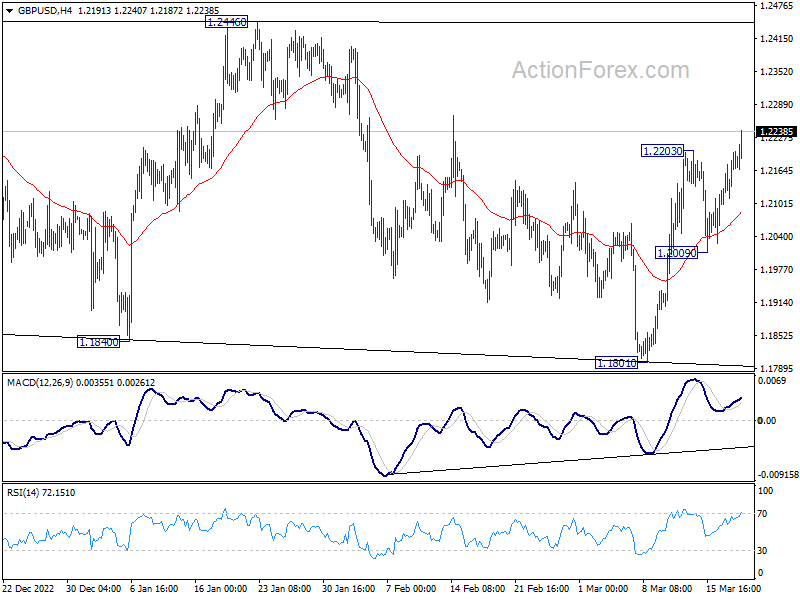
In the bigger picture, price action from 1.2445 are seen as a corrective pattern to rise from 1.0351 medium term bottom (2022 low). Resumption is expected as a later stage and firm break of 1.2446 will target 61.8% retracement of 1.4248 (2021 high) to 1.0351 at 1.2759. This will remain the favored case as long as 38.2% retracement of 1.0351 to 1.2445 at 1.1645 holds.
EUR/USD Mid-Day Outlook
Daily Pivots: (S1) 1.0619; (P) 1.0652; (R1) 1.0698; More...
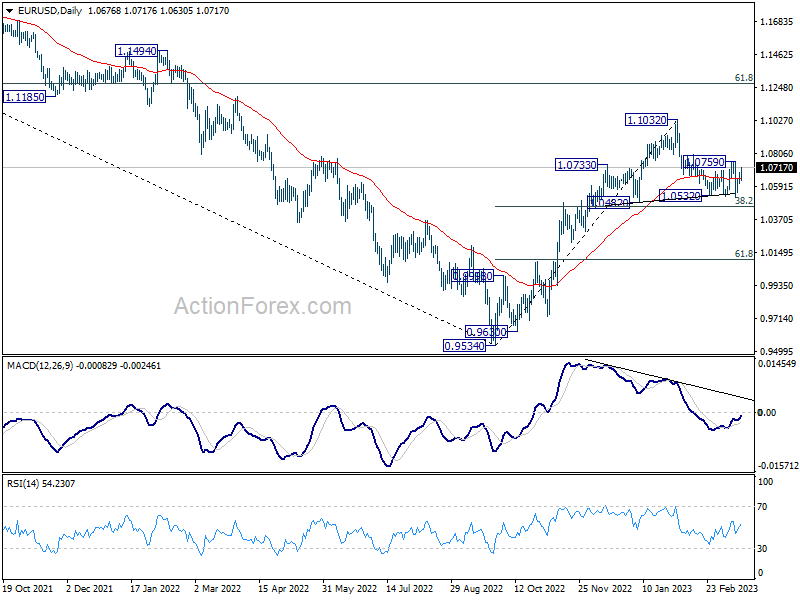
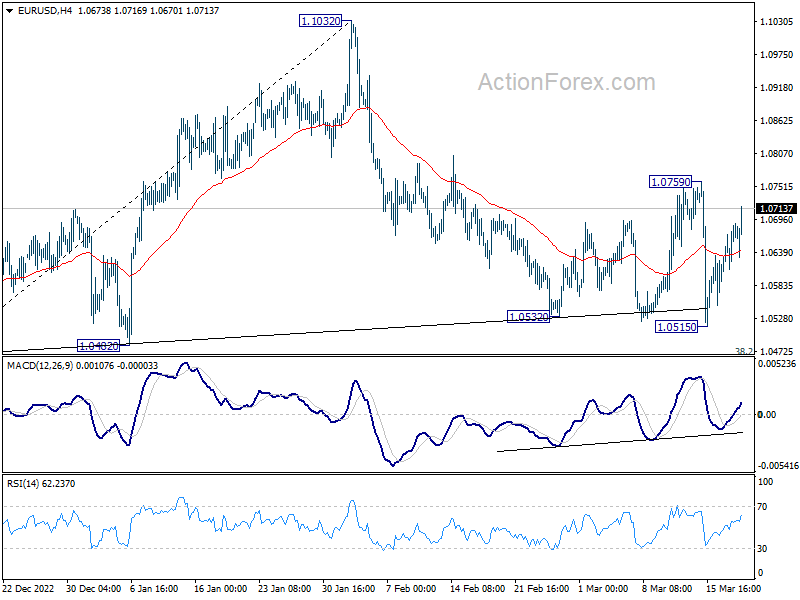
Intraday bias in EUR/USD stays neutral first with focus on 1.0759 resistance. Firm break there will argue that corrective fall from 1.1032 has completed at 1.0515, ahead of 38.2% retracement of 0.9534 to 1.1032 at 1.0258. Intraday bias will be turned back to the upside for retesting 1.1032 high. Nevertheless, sustained break of 1.0258 will complete a head and shoulder top (ls: 1.0733, h: 1.1032, rs: 1.0759). Outlook will be turned bearish for 61.8% retracement at 1.0106.
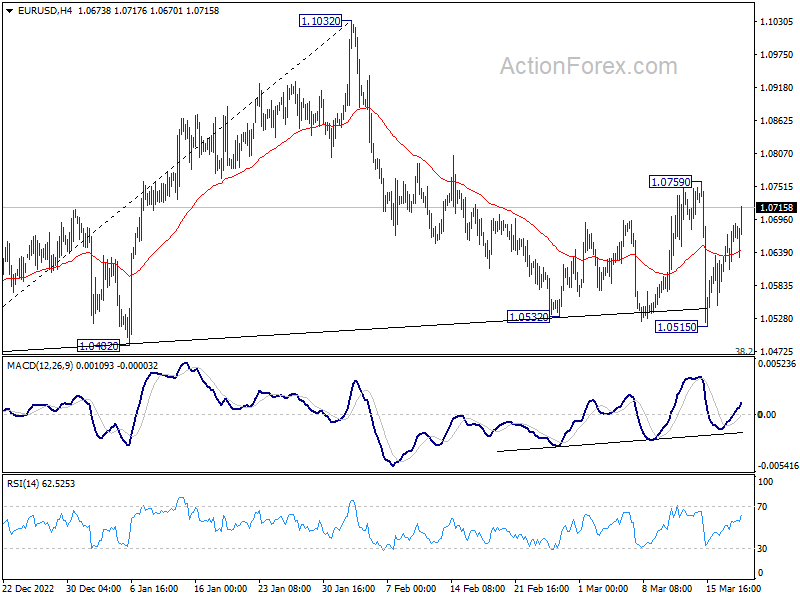
In the bigger picture, as long as 1.0482 support holds, rise from 0.9534 (2022 low) should continue to 61.8% retracement of 1.2348 (2021 high) to 0.9534 at 1.1273. However, sustained break of 1.0482 will bring deeper fall to 61.8% retracement of 0.9534 to 1.1032 at 1.0106, with risk of breaking through 0.9534 eventually.
USD/CHF Mid-Day Outlook
Daily Pivots: (S1) 0.9236; (P) 0.9269; (R1) 0.9298; More...
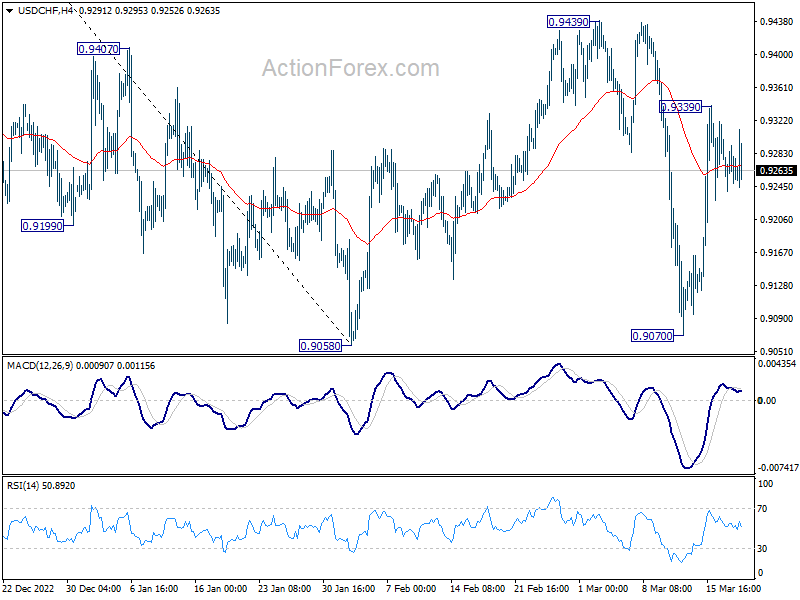
Intraday bias in USD/CHF remains neutral for the moment. Corrective pattern from 0.9058 low should still be in progress with rise from 0.9070 as the third leg. Above 0.9339 will target 0.9439 resistance and possibly above. But overall, outlook will stay bearish as long as 0.9474 fibonacci level holds, and another decline through 0.9058 is expected at a later stage.
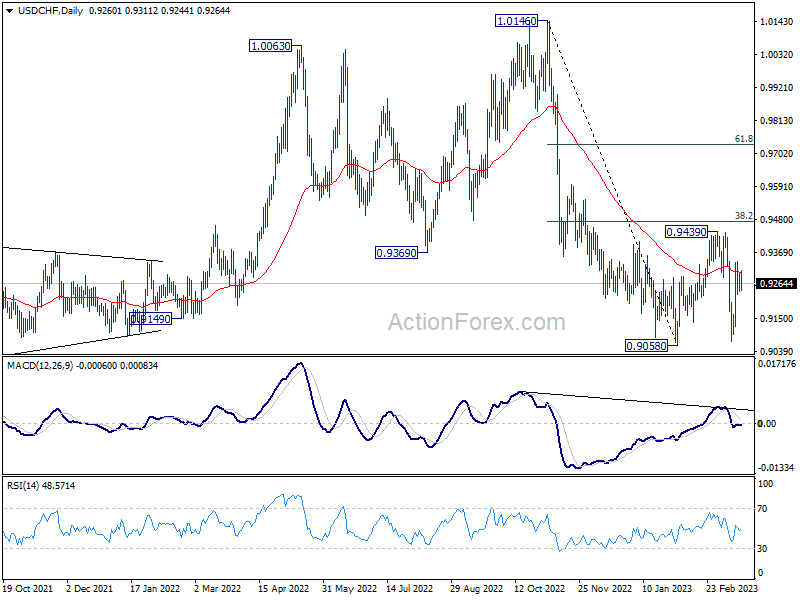
In the bigger picture, fall from 1.1046 (2022 high) should still be in progress with 38.2% retracement of 1.0146 to 0.9058 at 0.9474 intact. Rejection by 55 week EMA was a medium term bearish sign. Break of 0.9058 will resume such decline towards 0.8756 support (2021 low). But overall, such fall is still as a leg in the long term range pattern from 1.0342 (2016 high). So, downside should be contained by 0.8756 to bring reversal.
USD/JPY Mid-Day Outlook
Daily Pivots: (S1) 131.04; (P) 132.41; (R1) 133.26; More...
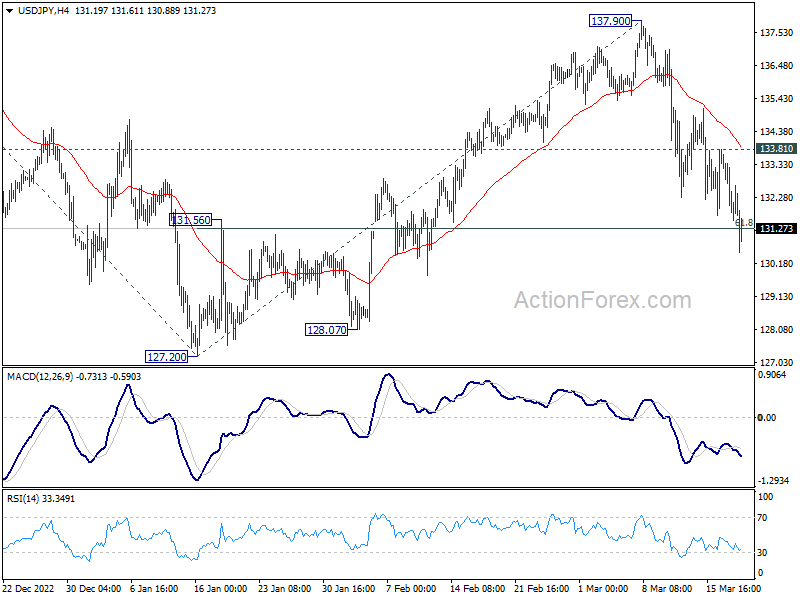
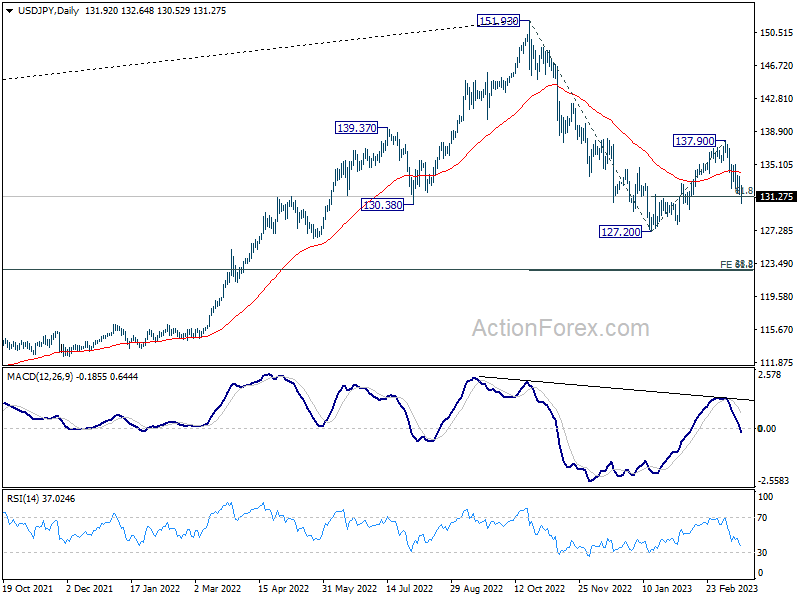
Intraday bias in USD/JPY remains on the downside at this point. Sustained trading below 61.8% retracement of 127.20 to 137.90 at 131.28 will pave the way to retest 127.20 low next. On the upside, above 133.81 minor resistance will turn intraday bias neutral and bring some consolidations first.
In the bigger picture, rebound from 127.20 should have completed at 137.90 as a corrective move, with strong break of 55 day EMA. The down trend from 151.93 (2022 high) is not over yet. Break of 127.20 will resume this down trend and target 61.8% projection of 151.93 to 127.20 from 137.90 at 122.61. This will now be the favored case as long as 137.90 resistance holds.
EUR/CHF Mid-Day Outlook
Daily Pivots: (S1) 0.9843; (P) 0.9877; (R1) 0.9915; More...
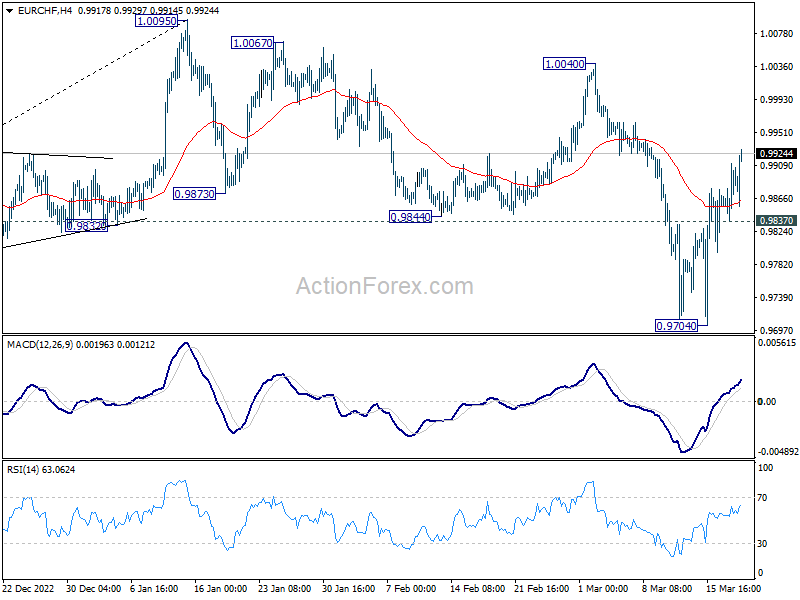
EUR/CHF's rise from 0.9704 accelerations higher today and the development argues that decline form 1.0095 has completed as a correction, with three waves down to 0.9704. Intraday bias is back on the upside for 1.0040 resistance first. Firm break there would argue that larger rise from 0.9407 is resuming through 1.0095. On the downside, though, break of 0.9837 minor support will turn intraday bias neutral first.
In the bigger picture, prior rejection by 55 week EMA (now at 1.0011) and 38.2% retracement of 1.1149 to 0.9407 at 1.0072 suggests that medium term outlook is staying bearish. That is, down trend from 1.2004 is not completed yet and is in favor to resume through 0.9407 at a later stage. However, decisive break of 1.0095 resistance will raise the chance of bullish trend reversal. Rise from 0.9407 should then target 1.0505 cluster resistance (2020 low at 1.0505, 61.8% retracement of 1.1149 to 0.9407 at 1.1484).
Swiss Franc Weakens While Euro and Sterling Firm, No More Safe Haven?
Market reactions to the ongoing banking crisis reveal a shift away from Swiss Franc, traditionally considered a safe-haven currency, as Credit Suisse shares lose over two-thirds of their value following the acquisition announcement by UBS. The broader markets in Europe are, however, relatively steady. Euro and Sterling are experiencing notable increases today, with the Yen emerging even stronger. Dollar faces pressure in general but fares slightly better than commodity currencies. Today's market response suggests that the banking crisis is far from over, and further volatility is expected in the days ahead.
Technically, 1.0759 resistance in EUR/USD is quickly within radar with today's rise. Firm break there will indicate completion of whole corrective fall from 1.1032, and bring stronger rally back to retest this high. At the same time, GBP/USD is already taking the lead by breaking through last week's high and it's on track to retest 1.2445/6 resistance zone.
In Europe, at the time of writing, FTSE is up 0.37%. DAX is up 0.50%. CAC is up 0.76%. Germany 10-year yield is down -0.011 at 2.099. Earlier in Asia, Nikkei dropped -1.42%. Hong Kong HSI dropped -2.65%. China Shanghai SSE dropped -0.48%. Singapore Strait Times dropped -1.37%. Japan 10-year JGB yield fell -0.0262 to 0.247.
Bundesbank: German economy faces slight Q1 decline, core inflation extraordinarily persistent
Bundesbank's latest monthly report suggests that Germany's economic activity is set to decline in the current quarter, though the contraction is anticipated to be smaller than the -0.4% qoq witnessed in Q4 2022.
Despite the downturn, employment leading indicators remained largely stable in positive territory in February, which bodes well for a continued positive development in employment over the coming months.
Inflation in Germany rose slightly to 9.3% in February 2023, up 0.1 percentage points from January. Meanwhile, the core inflation rate increased by 0.3 percentage points to 5.4%, matching the historical high set in December 2022.
Bundesbank predicts a significant drop in the headline inflation rate for March, primarily attributed to the base effect in energy prices. However, the report said, "the core rate is proving to be extraordinarily persistent".
Eurozone exports rose 11.0% yoy in Jan, imports rose 9.7% yoy
Eurozone exports of goods rose 11.0% yoy to EUR 222.9B in January. Imports rose 9.7% yoy to EUR 253.5B. Trade deficit came in at EUR -30.6B. Intra-eurozone trade rose 11.6% yoy to EUR 223.8B.
In seasonally adjusted term, exports fell -1.1% mom to EUR 241.5B. Imports declined -1.8% mom to EUR 252.9B. Trade deficit narrowed slightly from EUR -13.4B to EUR -11.3B, smaller than expectation of EUR -17.3B. Intra-eurozone trade dropped from 239.1B to EUR 229.2B.
BoJ members support persistent monetary easing, discussed side effects
In the Summary of Opinions from BoJ's March meeting, many members expressed support for continuing with the current monetary easing and yield curve control. However, there were also discussions on potential side effects and concerns related to the policy.
One member acknowledged the side effects of the current monetary easing, such as distortions in the yield curve. They stressed the need for BoJ to examine market functioning without preconceptions while assessing the balance between positive effects and side effects. Nonetheless, this member believed that the bank should "persistently continue with large-scale monetary easing" in the current phase.
Another member commented that it would take time to examine the effects of modifications in yield curve control on market functioning. They expect that when observed CPI inflation declines and market projections of interest rates calm down, "distortions on the yield curve are expected to be corrected".
A member warned against hasty policy changes, stating that the risk of missing the chance to achieve the price stability target should be considered more significant than the risk of delaying policy changes, given the current improvements in the price environment.
Another member emphasized the importance of BoJ maintaining its commitment to the 2% price stability target. They argued that starting a discussion on the target could lead to "unnecessary speculation" on monetary policy conduct, despite the growing possibility of achieving the target. Similarly, this member saw no need to revise the joint statement of the government and BoJ.
EUR/CHF Mid-Day Outlook
Daily Pivots: (S1) 0.9843; (P) 0.9877; (R1) 0.9915; More...
EUR/CHF's rise from 0.9704 accelerations higher today and the development argues that decline form 1.0095 has completed as a correction, with three waves down to 0.9704. Intraday bias is back on the upside for 1.0040 resistance first. Firm break there would argue that larger rise from 0.9407 is resuming through 1.0095. On the downside, though, break of 0.9837 minor support will turn intraday bias neutral first.
In the bigger picture, prior rejection by 55 week EMA (now at 1.0011) and 38.2% retracement of 1.1149 to 0.9407 at 1.0072 suggests that medium term outlook is staying bearish. That is, down trend from 1.2004 is not completed yet and is in favor to resume through 0.9407 at a later stage. However, decisive break of 1.0095 resistance will raise the chance of bullish trend reversal. Rise from 0.9407 should then target 1.0505 cluster resistance (2020 low at 1.0505, 61.8% retracement of 1.1149 to 0.9407 at 1.1484).
Economic Indicators Update
| GMT | Ccy | Events | Actual | Forecast | Previous | Revised |
|---|---|---|---|---|---|---|
| 23:50 | JPY | BoJ Summary of Opinions | ||||
| 00:01 | GBP | Rightmove House Price Index M/M Mar | 0.80% | 0.00% | ||
| 07:00 | EUR | Germany PPI M/M Feb | -0.30% | -1.20% | -1.00% | -1.20% |
| 07:00 | EUR | Germany PPI Y/Y Feb | 15.80% | 12.40% | 17.80% | 17.60% |
| 10:00 | EUR | Eurozone Trade Balance (EUR) Jan | -11.3B | -17.3B | -18.1B | -13.4B |
| 11:00 | EUR | German Buba Monthly Report |
Swiss Franc in Calm Waters, But Is There a Storm Ahead?
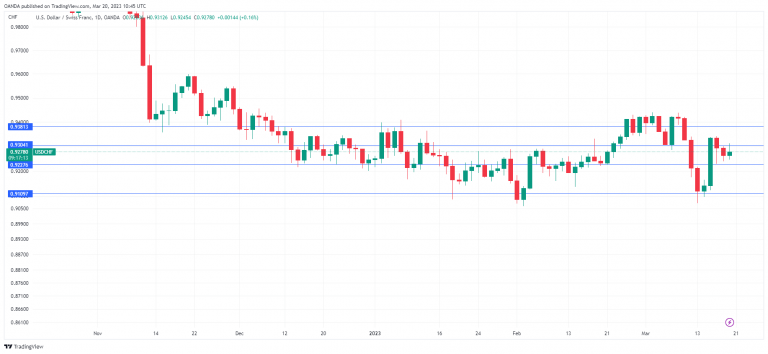
USD/CHF is trading quietly on Monday, after a tumultuous week. In the European session, USD/CHF is trading at 0.9276, up 0.15%.
Credit Suisse takeover, central banks take action
There was a flurry of activity on Sunday in response to the banking crisis which has shaved some $1 trillion from global financial shares this month. UBS has agreed to take over Credit Suisse, the second-largest bank in Switzerland. The move hasn’t stopped the bleeding at Credit Suisse, as its shares are down some 60% today. UBS shares are down 6% today and Deutschebank and other major European banks are also in the red.
As well, six central banks, including the Swiss National Bank (SNB) and the Federal Reserve announced they had coordinated action in order to boost liquidity. This move is aimed at restoring market confidence in the global banking system, which has been rocked by the failure of two US banks and the meltdown at Credit Suisse.
The Swiss franc was not immune to the market mayhem, as the sharp fall in Credit Suisse shares on Wednesday sent the Swissie tumbling by 2.1% and only settled down after intervention by the SNB. The Swiss franc, traditionally a safe-haven bastion, has seen its reputation tarnished as Swiss banks are in the middle of a banking crisis. Further developments in the Credit Suisse saga could lead to more volatility in the Swiss currency.
The market turmoil has seen market pricing for Wednesday’s Fed meeting shift from an increase of 50 basis points to 25, with an outside chance of a pause in hikes. The Fed has adopted a hawkish stance in its battle with inflation, but the latest crisis will make the Fed think twice about its pace of rate hikes. The markets have priced in a terminal rate in a range of 4.75% to 5.25%, and with the current rate at 4.50-4.75%, that means the markets are expecting the Fed to take a pause in the coming months.
USD/CHF Technical
- USD/CHF is testing resistance at 0.9304. Above, there is resistance at 0.9382
- 0.9226 and 0.9110 are providing support
USD/JPY: Japanese Yen Rises to a Multi-Week High vs Dollar on Growing Safe-Haven Demand
The USDJPY stays firmly in red and extends losses in early Monday, after falling 1.3% on Friday.
Rising risk aversion after UBS’ takeover of troubled Credit Suisse bank failed to calm tensions in the market, offered fresh support to safe-haven Japanese yen.
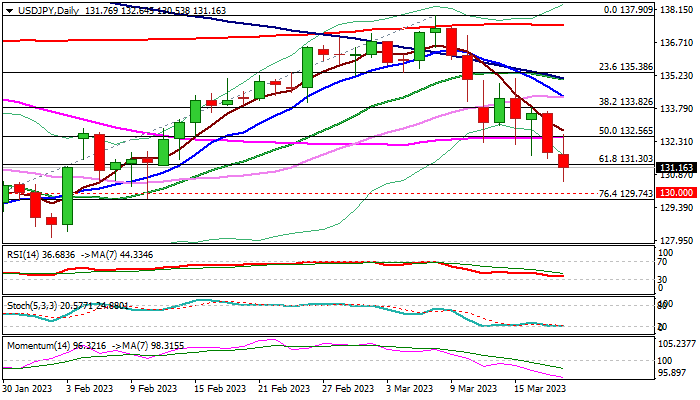
Fresh weakness broke below pivotal Fibo support at 131.30 (61.8% retracement of 127.22/137.90) and cracked the base of daily Ichimoku cloud (130.74), focusing on psychological 130.00 support and 129.74 (Fibo 76.4%).
Daily technical studies point to strong rise in negative momentum and moving averages in full bearish setup, warning of deeper fall.
Also, last Friday’s drop and close below pivotal Fibo support at 132.56 (50% retracement of 127.22/137.90, reinforced by 55DMA) neutralized positive signal of bull-trap, after last week’s action dented this support but repeatedly failed to register a close below.
Today’s close below 131.30 Fibo support is seen as a minimum requirement to keep bears intact, while sustained break below daily cloud would further weaken near-term structure and increase downside pressure.
Former pivotal support at 132.56 (broken Fibo 50%, reinforced by daily cloud top at 132.69) reverted to strong resistance, which marks the upper breakpoint.
Res: 131.55; 132.28; 132.69; 132.99.
Sup: 130.53; 130.00; 129.74; 128.32.