

Sample Category Title
SNB Schlegel: Still willing to intervene in the currency markets
Vice Chairman Martin Schlegel said yesterday that SNB is "still willing" to be active in currency intervention. "If the Swiss franc depreciates we are ready to sell foreign exchange, if the Swiss franc appreciates strongly we are willing to buy foreign exchange," he said.
He also noted that SNB had to "react forcefully" to fight inflation, which peaked at 3.5% last year. "The most important contribution we can do for society is to have stability-orientated policy and maintain price stability."
GBP/USD: Upsides Could Be Limited Above 1.2150
Key Highlights
- GBP/USD started an upside correction from the 1.1915 zone.
- It is facing resistance near 1.2100 and 1.2150 on the 4-hours chart.
- EUR/USD is also struggling to recover above the 1.0750 resistance zone.
- The US Manufacturing PMI could rise to 47.3 from 46.9 in Feb 2023 (Preliminary).
GBP/USD Technical Analysis
The British Pound extended its decline below the 1.2200 support against the US Dollar. GBP/USD declined below the 1.2100 support zone to enter a bearish zone.
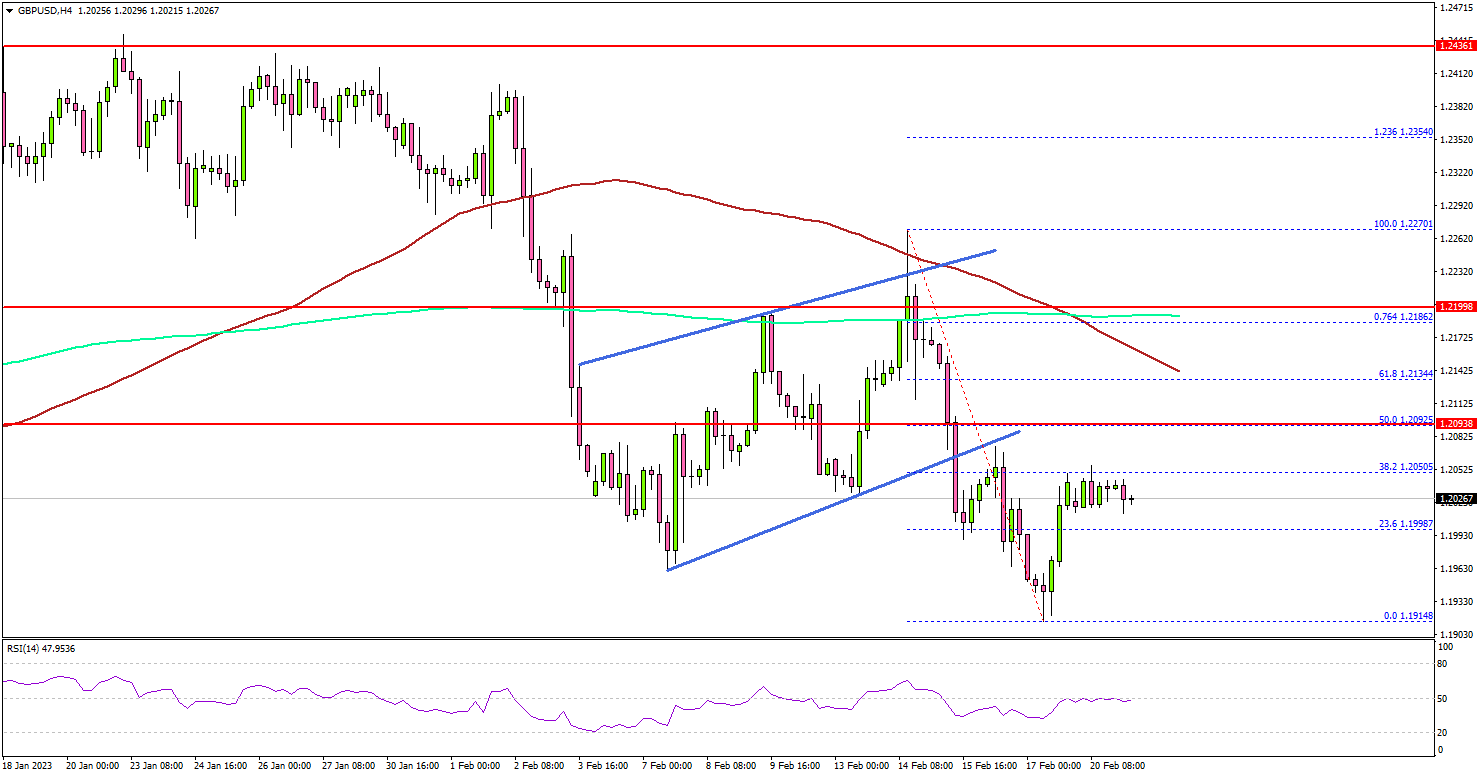
Looking at the 4-hours chart, the pair settled below the 1.2100 level, the 100 simple moving average (red, 4-hours), and the 200 simple moving average (green, 4-hours).
There was a clear move below the 1.2000 support zone. The pair traded as low as 1.1914 and is currently correcting losses. There was a minor increase above the 1.1950 and 1.2000 resistance levels.
However, the pair is now facing resistance near the 1.2100 level. It is close to the 50% Fib retracement level of the downward move from the 1.2270 swing high to 1.1914 low. The next major resistance is near the 1.2150 level and the 100 simple moving average (red, 4-hours).
A clear move above the 1.2150 resistance might start a steady increase towards the 1.2270 resistance zone. Any more gains could open the doors for a move towards the 1.2400 level.
On the downside, an immediate support is near the 1.1980 level. The next major support is near the 1.1920 level, below which there is a risk of a move towards the 1.1850.
Looking at EUR/USD, the pair is attempting a recovery wave, but it is likely to face resistance near 1.0750 and 1.0800.
Economic Releases
- Germany’s Manufacturing PMI for Feb 2023 (Preliminary) - Forecast 47.8, versus 47.3 previous.
- Germany’s Services PMI for Feb 2023 (Preliminary) - Forecast 51.0, versus 50.7 previous.
- Euro Zone Manufacturing PMI for Feb 2023 (Preliminary) – Forecast 49.3, versus 48.8 previous.
- Euro Zone Services PMI for Feb 2023 (Preliminary) – Forecast 51.0, versus 50.8 previous.
- US Manufacturing PMI for Feb 2023 (Preliminary) – Forecast 47.3, versus 46.9 previous.
- US Services PMI for Feb 2023 (Preliminary) – Forecast 47.2, versus 46.8 previous.
- Canadian Consumer Price Index for Jan 2023 (MoM) – Forecast +0.7%, versus -0.6% previous.
- Canadian Consumer Price Index for Jan 2023 (YoY) – Forecast +6.1%, versus +6.3% previous.
USDCHF Wave Analysis
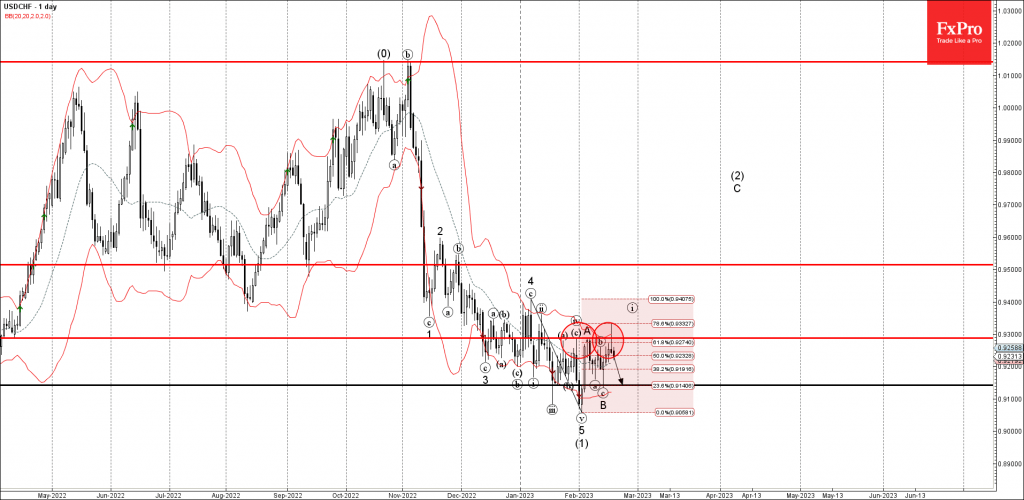
- USDCHF reversed from resistance level 0.9300
- Likely to fall to support level 0.9145
USDCHF currency pair recently reversed down from the resistance level 0.9300, intersecting with the upper daily Bollinger Band and the 61.8% Fibonacci correction of the downward impulse from January.
The downward reversal from the resistance level 0.9300 created the daily Japanese candlesticks reversal pattern Shooting Star.
Given the strong daily downtrend, USDCHF can be expected to fall further toward the next support level 0.9145 (low of the previous minor correction B).
NZDUSD Wave Analysis
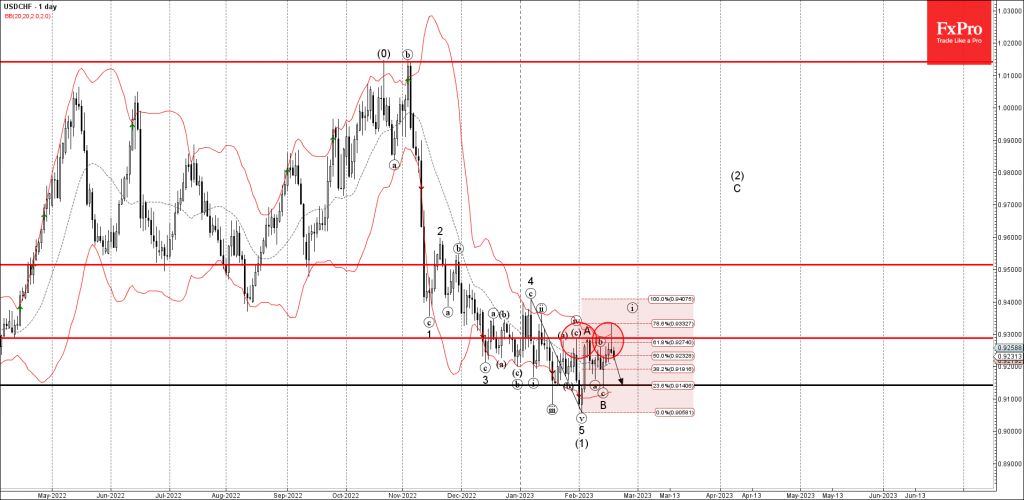
- NZDUSD reversed from key support level 0.6220
- Likely to rise to resistance level 0.6400
NZDUSD currency pair recently reversed up from the key support level 0.6220, intersecting with the lower daily Bollinger Band and the 38.2% Fibonacci correction of the upward impulse from November.
The upward reversal from the support level 0.6220 stopped the previous short-term ABC correction 2.
NZDUSD can be expected to rise further toward the next resistance level 0.6400 (top of the previous minor correction (b)).
Sunset Market Commentary
Markets
It’s a directionless, low-volume trading session in absence of US investors (President’s Day) and awaiting events later this week. For the record: German Bunds are broadly unchanged with UK Gilts outperforming (-4 bps for 10y). European stock markets trade near opening levels with both EUR/USD (1.0680) and EUR/GBP (0.8875) a tad softer. Later this week, we first of all look forward to global PMI’s. These could strengthen the picture that the global economy is actually showing much more resilient than feared. Second, to Wednesday’s FOMC Minutes. Last week’s “coming out” of Fed governors Mester and Bullard suggested that the early Fed decision to downshift the pace of rate hikes from 50 bps to 25 bps wasn’t so unanimous after all. Both argued in favour of sticking to 50 bps and will do so again in March. Minutes could show how big the hawkish minority within the Fed already was ahead of the January data releases (stellar payrolls, stubborn inflation and strong retail sales). The Fed’s preferred PCE deflators on Friday are this week’s final data point, though there direction is probably known given this month’s earlier CPI prints. The US Treasury’s end-of-month refinancing operation (2y-5y-7y) and central bank speeches serve as wildcards.
News & Views
Swedish headline inflation fell at the start of the year. January prices dropped by 1.1% m/m to be up 11.7% compared to the same month last year. CPIF, using a fixed interest rate, fell 1.3% m/m (9.3% y/y). Both measures printed below expectations. The Riksbank’s preferred gauge, however, did not. CPIF excluding energy unexpectedly rose 0.4% m/m (-0.2% expected) to be up 8.7%, quicker than in December (8.4%). Strong and stubborn (underlying) price dynamics are the reason the central bank delivered a 50 bps rate hike to 3% earlier this month with more hikes to come. The Riksbank penciled in a terminal rate of about 3.5% but that may not suffice according to swap markets. They expect the peak somewhere between 3.75-4%. Swap yields jump between 8.6-12.6bps across the curve. The Swedish krone strengthens from EUR/CZK 11.20 to 11.06 but remains weak historically. This is a (policy statement-official) source of concern for the Riksbank, since it fuels inflation further. This become obvious once more with the release of the meeting minutes today in which governor Thedeen stressed his desire for a stronger SEK, adding that it is important to also evaluate the actions of other central banks.
The Bundesbank in its monthly report said the economy shrink slightly in 2023 though added that it may fare a little better compared with the December forecast for a 0.5% contraction this year. The reasons for still anticipating a decline in GDP are subdued exports amid softer global demand, inflation weighing on consumption and construction sector momentum cooling. They offset the upside coming from an easing energy crunch and manufacturing bottlenecks dissolving. After a contraction in the first three months of 2023, bringing Germany in a technical recession, things will pick up slowly over the course of the year. The Bundesbank expects underlying inflation pressures to ease only slowly in coming months, warning that stronger wage deals will keep it elevated for some time through second-round effects.
Belgian consumer confidence continued its climb in February, rising from -12 to -8, the highest level since February of last year. In the space of four months, the confidence indicator has risen almost 20 points and is approaching its long-term average. Details showed broad-based strength except for a slight fall in savings intentions (1 from 3). Consumers expressed clearly more optimistic views on the trend in unemployment (16 from 27) and, to a lesser extent, the general economic situation (-13 from -18). Households also expect their financial situation to improve somewhat (-3 from -6). All sub-indicators express
US Dollar Has to Retreat
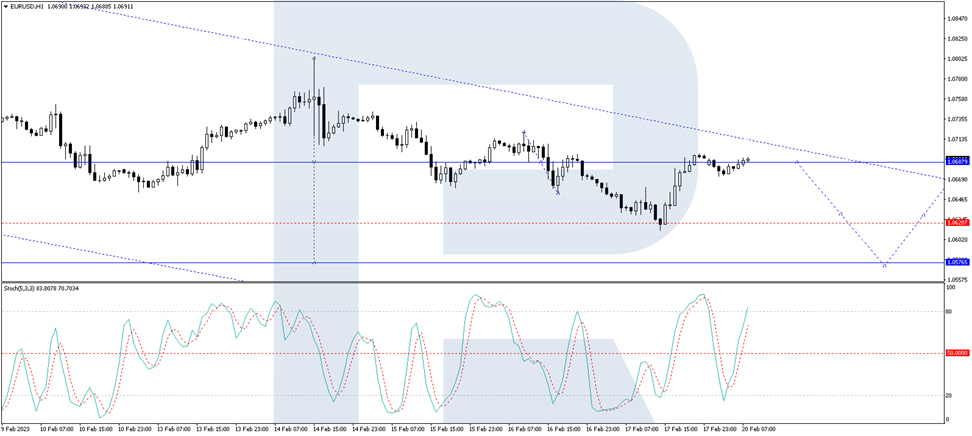
The market major starts this new week of February with an attempted correction. EUR/USD is balancing near 1.0690. After the lows of the previous week, this is good news though right now the bounce does not look really confident.
Investors are beginning to have more and more doubts that the Federal Reserve System will put aside its tightening monetary policy and include the expectations of further interest rate increases in the quotes. While previously traders used to expect a pause after two subsequent increases by 25 base points this year, now there are no such guarantees.
It is a day off in the US today, which means volatility will be smoothed out.
On the EUR/USD H4 chart, a consolidation range formed around 1.0720. The market extended it downwards to 1.0612. A link of correction to 1.0720 is not excluded (a test from below). Then a decline to 1.0577 should follow, from where the wave might extend to 1.0500. Technically, the scenario is confirmed by the MACD, whose signal line is under zero. Wait for the lows to be renewed.
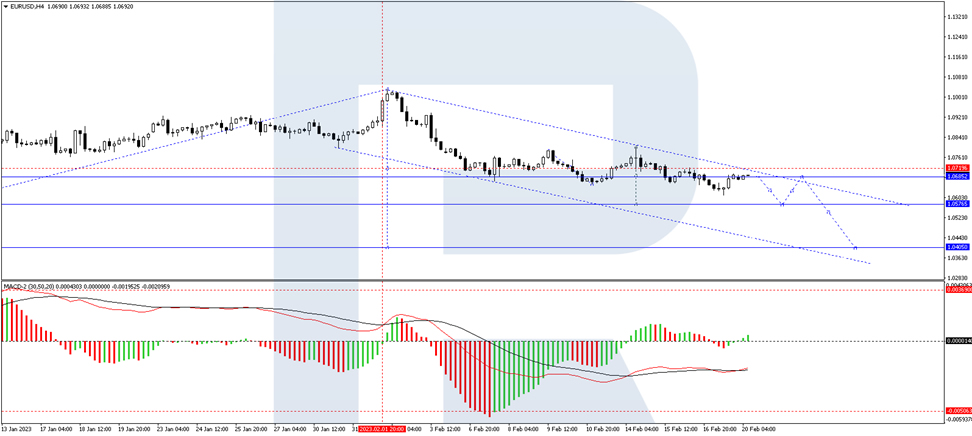
On H1, the currency pair has completed a wave of decline to 1.0612 and a correction to 1.0690. A consolidation range is expected to form around this level. With an escape downwards, a new wave of decline to 1.0577 should start. Technically, this scenario is confirmed by the Stochastic oscillator. Its signal line is above 50, and a decline to 20 is to follow.
EUR/GBP: Near-term Structure Weakens But Price Still Holding Above Initial Support
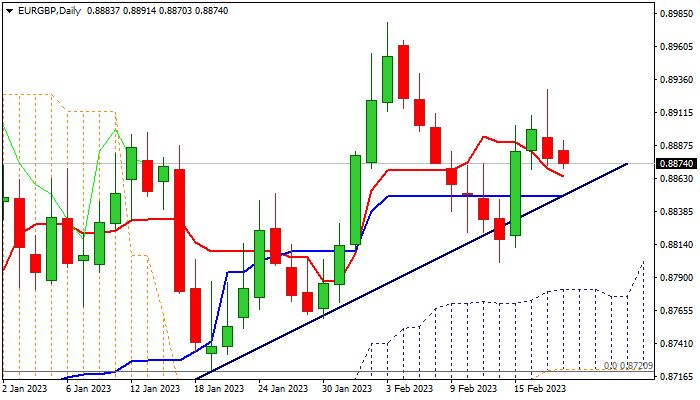
The cross remains at the back foot on the first day of the week, after strong upside rejection left bearish daily candle with long upper shadow, signaling recovery stall and increasing pressure.
Fresh bears pressure pivotal support at 0.8864 (daily Tenkan-sen/50% retracement of 0.8800/0.8928 upleg) with firm break here to confirm negative signal risk attack at next key support at 0.8850 (daily Kijun-sen/Fibo 61.8%/bull-trendline drawn off 0.8560 low).
Fading bullish momentum on daily chart and south-heading stochastic weigh on near-term action, though countered with daily Tenkan / Kijun-sen, still in bullish setup.
Ability to hold above daily Tenkan-sen will signal that bulls remain in play and look for fresh push higher after correction, while close below daily Kijun-sen would sideline bulls and open way for test of key near-term support at 0.8800 (Feb 14 low).
Res: 0.8898; 0.8928; 0.8940; 0.8978.
Sup: 0.8864; 0.8850; 0.8830; 0.8800.
Loonie Would Love a Stronger CPI, But Not the Bank of Canada
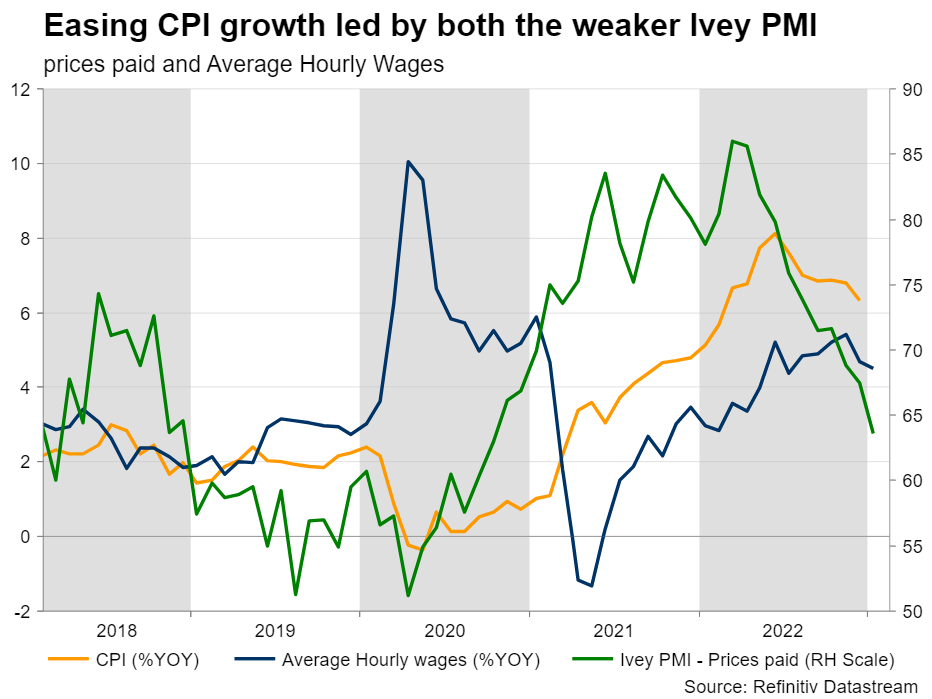
With the next BoC meeting scheduled in just two weeks, loonie followers will have the chance to evaluate the current economic state. The deceleration in inflation pressures has been the global theme in the past three months providing significant breathing space to both households and governments. Will this week’s data confirm this recent trend or could the BoC be forced to consider an even tighter monetary policy ahead?
A reevaluation of monetary policy stance on the cards?
At its first meeting for 2023 on January 25 the BoC signaled the intention to pause after 425 bps of rate hikes in just 10 months. This makes sense as a period of stable monetary policy would allow the economy to absorb the higher rates giving the chance to the central bank to evaluate the overall impact. This viewpoint potentially applies to other developed economies, but only the BoC appears determined to adopt this strategy. Other central banks will potentially soon follow the BoC’s example if inflation rates continue to surprise on the downside. Therefore, this week’s releases will be the first true test of the BoC’s commitment to its "pause" strategy.
Inflation to ease further?
The January headline CPI is seen rising by 6.1% on a year-on-year basis, down from the 6.3% increase seen in December. If confirmed, it will be the lowest print since March 2022 giving significant breathing space to Canadian households and potentially offering some early confirmation that the BoC strategy could be correct. However, when examining the January prints in other developed countries, there is a sizeable probability that the inflation figure could surprise on the upside. Should this be the case at Tuesday's release, we could see renewed expectations for a tighter monetary policy stance. The market is currently pricing in one 25 bps rate by the July meeting, compared to the almost three rate hikes seen by the US Fed during 2023.
Retail sales key going forward
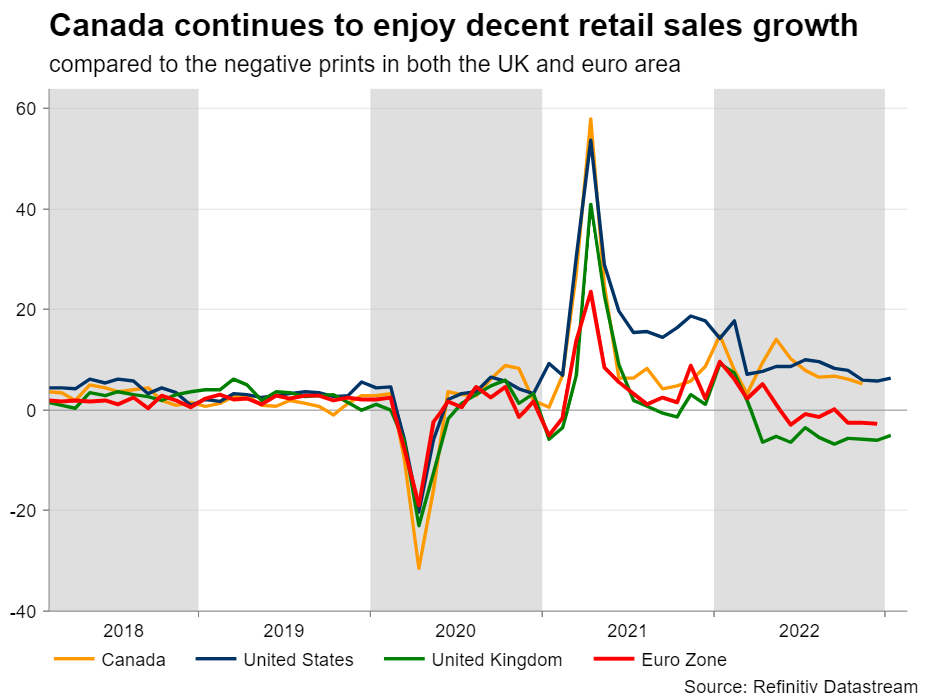
One of the indicators expected to come to prominence going forward is the retail sales. Unquestionably, this dataset has been followed by market participants and central bankers, particularly considering the rising cost of living globally over the past two years. But it is now expected to rise to the top of the food chain as consumers, on the back of lower utility bills and renewed confidence, are expected to gradually return to their previous spending behaviour. Not only retail firms will benefit, but also the government coffers should enjoy the increased revenues. Government finances have been greatly affected by the continued financial support offered especially in the euro area.
Could the loonie recover part of its losses since August 2022?
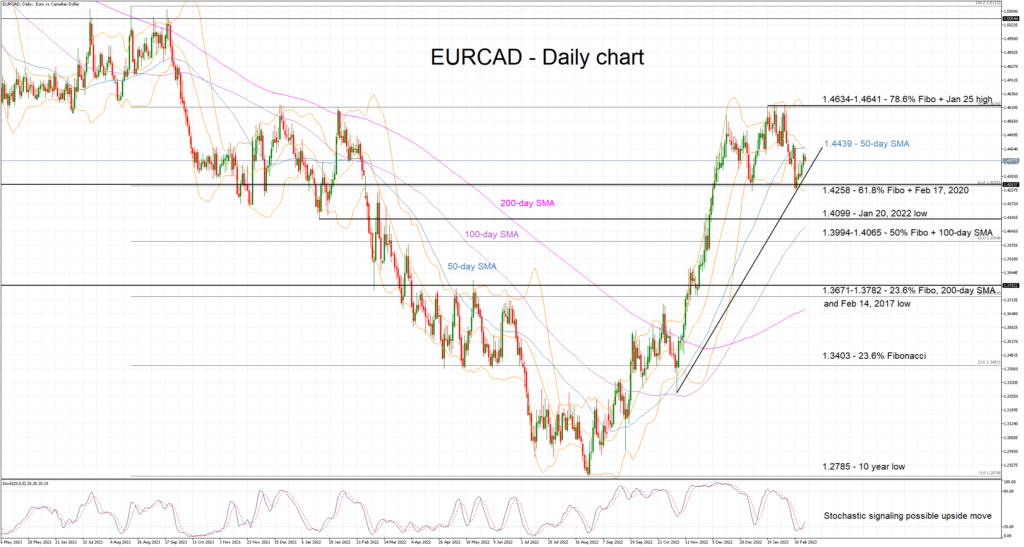
Amidst this volatile environment, the loonie has been under severe pressure against the euro since August 25. The 13.7% rally in the euro/loonie pair paused at 1.4641 with loonie bulls managing to stage a decent recovery towards the 1.4370 area. Since the start of 2023 this pair has been trading inside a wide 1.4235-1.4641 rectangle. A similar pattern formed in the October 2021 – February 2022 period when, following two failed breakouts, the pair finally broke downwards and opened the door for the 10-year low of 1.2785 seen on August 25. Loonie bulls would enjoy retesting the 1.4263 area and, if overcoming it successfully, make a move towards the 1.4099 level.
Treading Water
Stock markets in Europe are treading water in thin trade at the start of the week amid a light economic calendar and a US bank holiday.
It was always likely to be a slow day under the circumstances and that's exactly what it's turning out to be. Stock markets remain in a surprisingly strong position despite the uncertain outlook and rising interest rate expectations due to stubborn inflation.
While other areas of the market appear to have adopted a more defensive position, equity investors remain undeterred. It would appear it's going to take a lot more than a few nasty economic releases to put a dent in their optimism.
China optimism remains
The outlier is once again China, where stocks have enjoyed a very good start to the week. That came despite one and five-year loan prime rates remaining unchanged, as was widely expected following last week's MLF hold.
The bullish case for the Chinese economy remains solid and the likely release of stimulus over the next couple of months as it gathers pace could super-charge that. Domestic demand is going to be the cornerstone of the economic revival and policymakers appear poised to unleash that to its full potential. How they plan to do so should become clearer over the next month although we've already seen big steps in the right direction.
Choppy trade continues
Oil prices are bouncing back a little after slipping throughout the last week from their recent highs. The optimism around China today may be responsible for the gains we're seeing in crude which would make a lot of sense given it's the world's largest importer and expected to recover strongly from the Covid transition.
But as we've seen over the last few months, there's more to this story than just China and the decline over the last week was likely a reflection of more pessimistic global expectations against the backdrop of higher interest rate forecasts. Sentiment remains very fragile and the economic data is inconsistent. Until we see an improvement in the latter, the former will likely remain choppy, as will the price of oil.
Does the correction have further to run?
Gold traders do not share the eternal optimism that equity and crypto traders possess and recent weeks have highlighted that perfectly. The yellow metal fell into a corrective pattern and has struggled to get out since. It pared some losses on Friday to end the session higher around notable support in the $1,820 region. The long lower wick from the days' trade may be a bullish signal in the near term, although I'm not convinced the correction has run its course. Below here, the key zone falls around $1,780-$1,800.
Eternal optimism
Cryptos are seemingly existing in a world of their own with bitcoin rising 2% again on Monday and eyeing the highs of the last week once more. This could be a really pivotal level for bitcoin and a break of it could generate plenty more enthusiasm. And we've all seen what happens when enthusiasm and euphoria exist in cryptos. The price can take off regardless of fundamentals or broader sentiment. That isn't to say we'll necessarily see that on this occasion but the 50% recovery so far this year does suggest something may be happening.