

Sample Category Title
Plenty to Look Forward To
It hasn't been the most thrilling start to the week but the good news is that it should improve from here as the US rejoins and the economic calendar fills out.
We were basically treading water on Monday which is often the case on a US bank holiday. The fact that the calendar was as thin as it was elsewhere naturally doesn't help and it may be no bad thing either. We've become so accustomed to relentless action in the markets this past year in particular that a day of calm can be a good thing. But don't expect it to last.
This week may not be as all-action as others we've experienced this month but there is still plenty for investors to get their teeth stuck into. Today is littered with economic releases throughout, with the PMIs being a key feature of that. At a time of such uncertainty over inflation, interest rates, and the economy, these forward-looking business surveys carry extra weight. And what's more, they're expected to show businesses are becoming less pessimistic which would be a small win but a win nonetheless.
That said, the Japanese manufacturing PMI was expected to do just that and instead dipped much further into contraction territory. The decline was driven by lower output, new orders, and new export orders; once again indicating waning global demand and trade. The services survey was much better but that is being driven by improved tourism as restrictions were removed, and government support. All in all, there are more concerning signs than promising ones.
Unnerved
The RBA minutes from earlier this month highlighted how unnerved policymakers are by recent inflation developments, with a pause in tightening not even discussed despite that at one stage appearing to be where the central bank was heading. In fact, the debate centered around whether there was a need to accelerate the hiking cycle which may unsettle investors that have become more relaxed on the belief that the end is near.
The message, often not heard, from policymakers around the world has consistently been that there's more to do and that rates may need to stay higher for longer but investors have not always been receptive to that. That seems to be changing and a 50-basis point hike would have very much driven that home but the RBA instead opted for 25 this time, backed by the belief that monthly meetings allow for a more gradual exit.
Choppy trading continues
Oil remains choppy this week with Brent and WTI slipping around 1% in early trade on Tuesday, wiping out similar gains at the start of the week. There is undoubtedly more optimism around the Chinese economy which will stimulate more demand this year but at the same time, sentiment is cooling on the global economy as interest rates are projected to go a little higher than previously anticipated.
This was always likely to be a quarter of big swings in sentiment as it was too much to ask for the inflation data to simply retreat back without any setbacks along the way. That naturally has consequences for economic expectations and therefore oil demand which is why we could see the market remain choppy over the rest of this quarter and into next.
Correction losing momentum
Gold is edging lower once more today following some choppy trade at the start of the week. While bulls may be encouraged by Friday's rebound, others may take a little more convincing. That it came around notable support, in the $1,820 region, and on weaker momentum could be the biggest sign that the corrective move is seeing pushback.
That isn't to say it's fully run its course and we could see the yellow metal pare losses before the correction continues but near-term prospects are looking a little more promising. The first test in any recovery may come around $1,860, with $1,890-$1,900 then being a major test of resistance.
Can Bitcoin overcome major resistance?
There is no shortage of optimism in bitcoin this year and it's continuing to push higher again today. The cryptocurrency is trading close to $25,000, a huge test considering the scale of recovery we've seen in the last seven weeks. The region around $24,500-$25,500 was big on the way down so it will be a big psychological test this time around, too. But with bitcoin up around 50% already this year, you have to wonder how much further it can go.
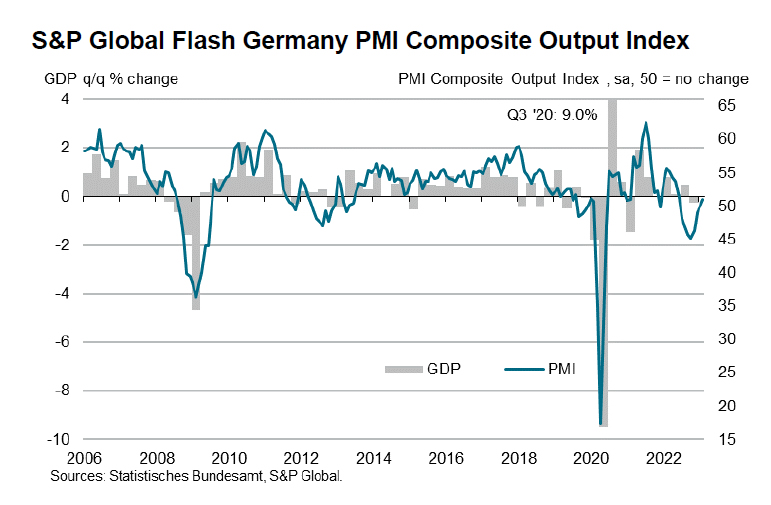
Germany PMI composite rose to 561.1, return to growth after eight months
Germany PMI Manufacturing dropped from 47.3 to 46.5 in February. PMI Services rose from 50.7 to 51.3, an 8-month high. PMI Composite rose from 49.9 to 51.1, also an 8-month high.
Phil Smith, Economics Associate Director at S&P Global Market Intelligence said:
"February's flash PMI survey showed the German private sector economy return to growth territory for the first time eight months, alongside continued resilience in the labour market and a further slight recovery in business confidence.
"Encouragingly, the increase in business activity was broad-based by sector. However, whereas the upturn in services activity was at least partly demand-related, higher manufacturing output owed almost exclusively to a substantial easing of supply-chain bottlenecks, which merely allowed goods producers to catch up on backlogs of work. With manufacturing new orders still in contraction territory, goods producers remain only cautiously optimistic about the year-ahead outlook, and they will likely need to see demand revive for that to change.
"The cooling of demand in the goods-producing sector and subsequent easing of supply-chain pressures has seen factory input costs start to fall. Still, like their service sector counterparts who once again highlighted particularly strong wage demands, manufacturers continued to raise their output prices at a robust rate during February, signalling that core inflationary pressures remain elevated. However, the rate of increase in average prices charged for goods and services continued to slow, down to its lowest since May 2021."
France PMI composite rose to 51.6, economy back in growth territory
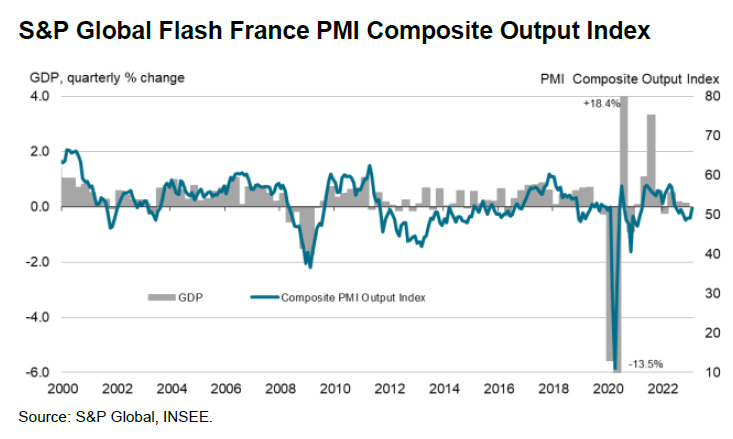
France PMI Manufacturing dropped notably from 50.5 to 47.9 in February. PMI Services, on the other hand, rose from 49.4 to 52.8. PMI Composite rose from 49.1 to 51.6, hitting a 7-month high.
Joe Hayes, Senior Economist at S&P Global Market Intelligence said:
"At face value, the February 'flash' PMI survey results for France are positive, showing the economy was in growth territory for the first time since October 2022. More encouragement could be taken from the underlying sector data, which showed the expansion was driven by services, a sector which has been under pressure due to the negative demand impact of eroding real incomes.
"However, it's difficult to say for certain if we're at an inflexion point and the French economy is now on its path to recovery. The manufacturing sector downturn intensified in February, and demand conditions within this sector are clearly still fragile. Factory export orders fell at the sharpest rate since May 2020, providing a downbeat assessment of broader global economic conditions.
"The likelihood of further increases in interest rates also remains, and this poses a risk to demand and activity. Inflation remained stubborn in the service sector, with rates of input cost and output price inflation holding close to their peaks. How much needs to be done by monetary policymakers to push this lower is uncertain, although sustained resilience in the labour market suggests more needs to be done to take heat out of the French economy."
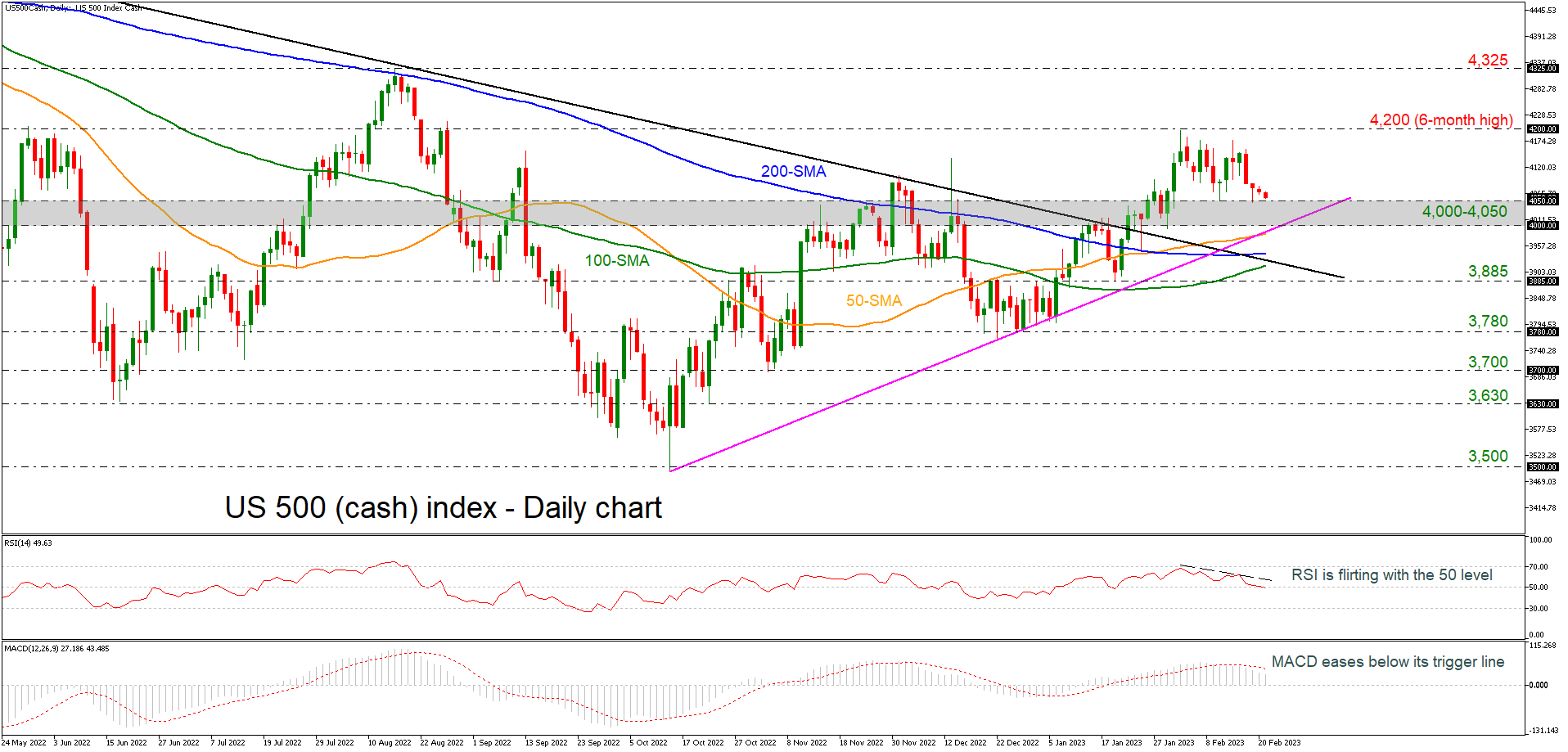
US 500 Index Seems to be Looking for Recovery after 6-month Peak
The US 500 (cash) index is losing some momentum around the 4,050 level but it remains above the medium-term uptrend line and also well above the long-term descending trend line. The index failed to surpass the 4,200 round number with the technical oscillators suggesting that more gains may be on the cards. The RSI is resting near the neutral threshold of 50 after the fall from 70 level, while the MACD is heading south below its trigger line in the positive territory.
The 4,200 number is the nearest resistance that could reject any attempt higher. If not and the price extends positive momentum, the 4,325 barrier, registered back in August 2022 could take over ahead of the 4,600 hurdle.
On the flip side, a downside reversal below the 4,000-4,050 support region and the ascending line could bring the 50- and the 200-day simple moving averages (SMAs) at 3,980 and 3,940 respectively. Should it fail to hold, the 100-day SMA at 3,910 would be the next target, while a steeper decline could also reach the 3,885 barrier, where any violation would raise fears over a down-trending market.
In the medium-term window, the sentiment is turning positive following the break above 4,000 and the key resistance trendline which re-activated the uptrend off the 3,500 low. A closing price above 4,200 would confirm the outlook reversal.
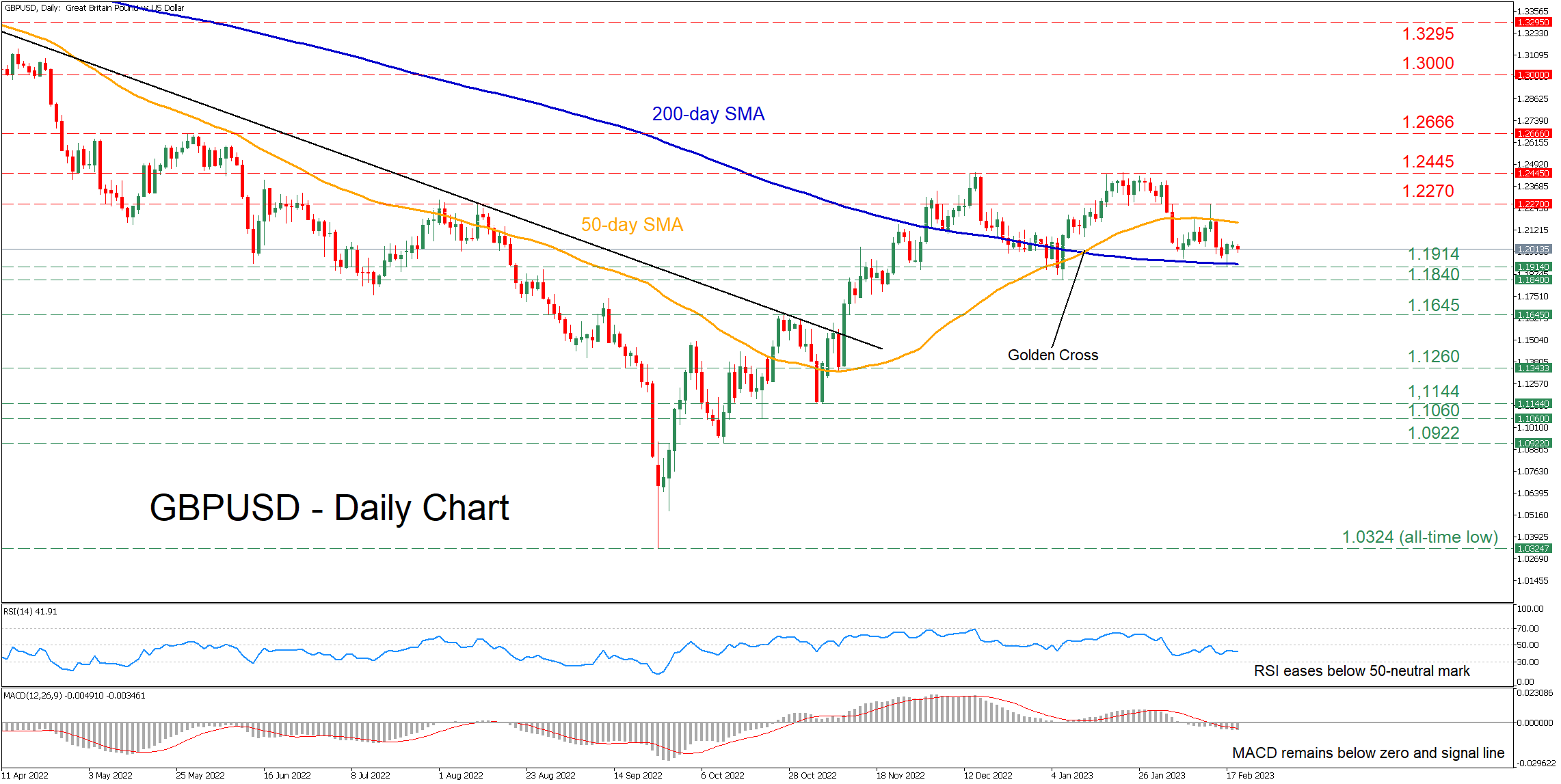
GBPUSD Muted Between SMAs as Rebound Falters
GBPUSD has been attempting a solid recovery since September when the pair fell to an all-time low of 1.0324. However, this latest advance appears to be fading after being rejected twice at the 1.2445 region, while the price has been trading sideways between the 50- and 200-day simple moving averages (SMAs) in the past three weeks.
Despite the latest consolidation, the momentum indicators currently suggest that bearish forces have taken control. Specifically, the RSI is pointing downwards below the 50-neutral mark and the MACD histogram is currently found below both zero and its red signal line.
To the downside, if the pair extends its recent downside correction, the congested region between the 200-day SMA and the recent low of 1.1914 could act as the first line of defence. Should that floor collapse, the January low of 1.1840 might come under examination. Even lower, the pair may face the October resistance of 1.1645, which could act as support in the future.
Alternatively, should buyers re-emerge and push the price above its 50-day SMA, initial resistance may be met at the recent peak of 1.2270. Breaking above that zone, the price could ascend to test the crucial 1.2445 territory, which rejected the pair’s rebound twice. Failing to halt there, further advances could come to a halt at the May high of 1.2666.
In brief, GBPUSD remains stuck in a rangebound pattern as its 50- and 200-day SMAs have repeatedly capped both its upside and downside. Therefore, a break above or below this tight range is likely to be followed by a significant move in the same direction.
Dow Jones 30 Hits Resistance
The Dow Jones 30 steadies as traders await Fed minutes. A long upper wick in the supply zone near 34400 suggests rejection after the index struggled to grind higher. A drop below the swing low of 33520 has put the bulls on the defensive. A rising trendline has been supporting the choppy rally in the past two months and is an important level to keep the trajectory up. Its breach at 33480 could trigger a broader liquidation towards the daily support at 33000. 34000 is the first hurdle before the price could make its way back.

USD/CHF Bounces Back
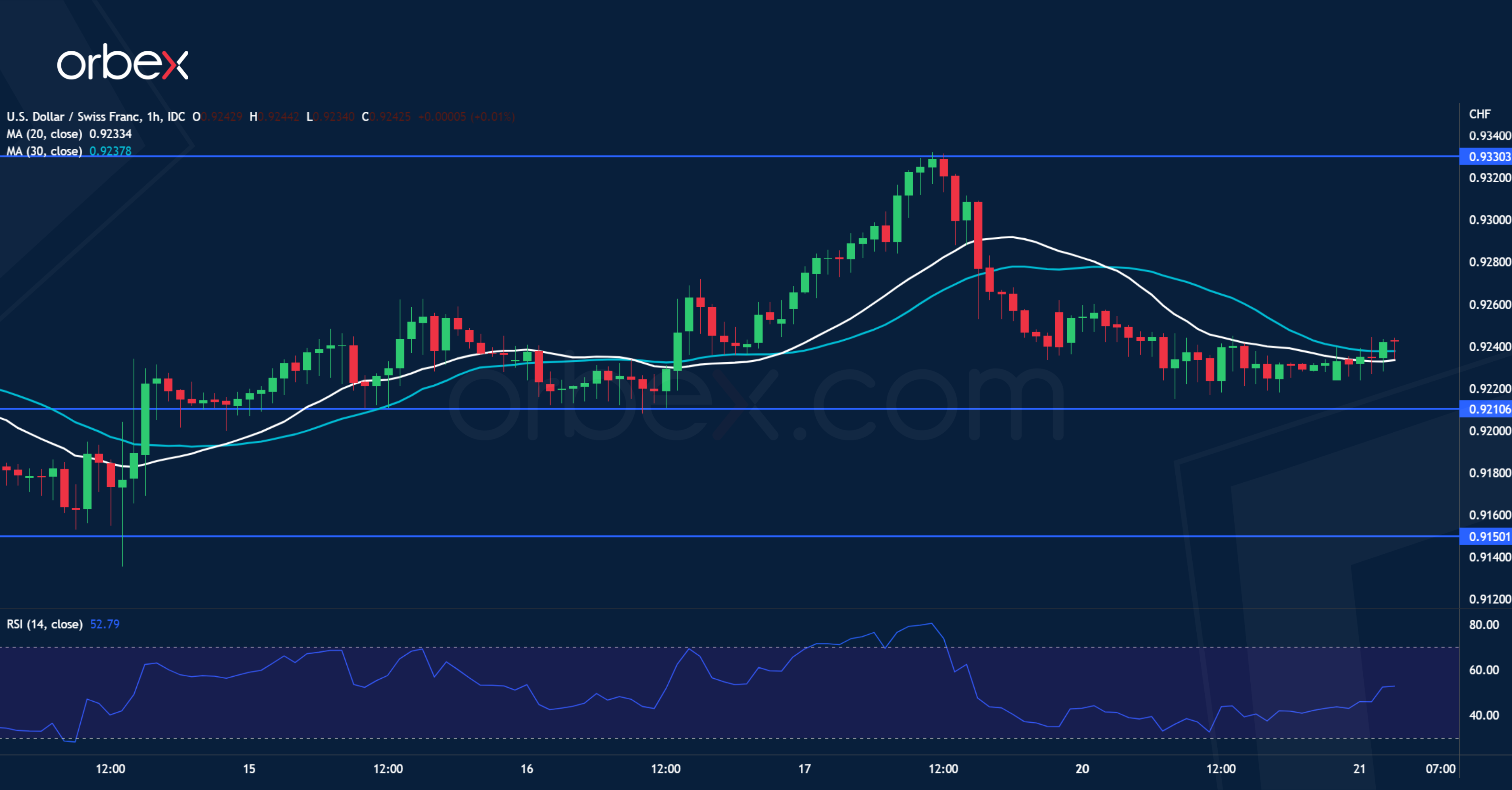
The US dollar consolidates its gains as money markets expect higher peak rates from the Fed. Following a bounce off 0.9150, a pop above this month’s high of 0.9290 has prompted the bears to trim their exposure. 0.9120 at the bottom of the latest rally is a key level to keep the momentum intact. A recovery above 0.9330 would send the greenback to the daily resistance at 0.9400, paving the way for a full-fledged rebound in the medium-term. Failing that, a bearish breakout would trigger a retest of 0.9150.
AUD/USD Tests Resistance
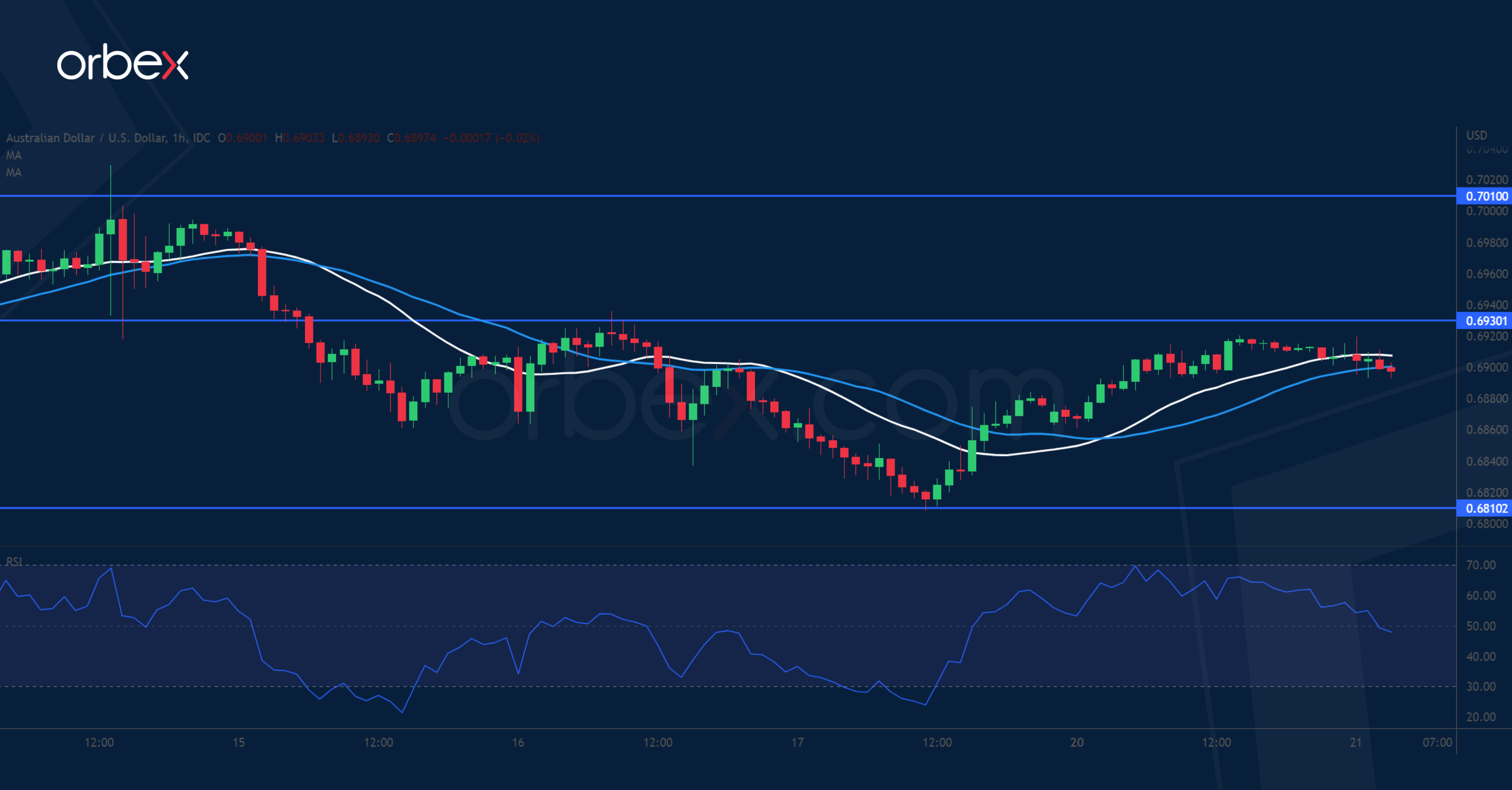
The Australian dollar struggles as the RBA’s hawkish meeting minutes put a cap on risk appetite. The price action has fallen back to the consolidation area around 0.6800 from late December. The RSI’s double dip in the oversold zone has attracted some buying interests. 0.6930 is the closest hurdle and the bulls will need to lift the top of a previously faded rebound at 0.7010 before they could turn short-term sentiment around. A drop below the fresh support of 0.6810 would extend the correction to the year’s low at 0.6700.
All Eyes Will on Flash PMIs from Europe and US
Market movers today
Today, all eyes will be on flash PMIs from Europe and the US. In the euro area, we look for potentially more evidence of rebounding activity amid easing inflation pressures. In the US, NY Fed's Empire and Philly Fed Manufacturing indices have sent mixed signals thus far for February but we still expect the PMIs to edge higher.
The German ZEW index will also be released today, and consensus expects a further improvement in both the forward-looking assessment as well as on the respondents' assessment on the current situation.
Overnight, the Reserve Bank of New Zealand will announce their rate decision. A 50bp hike is a clear base case.
The 60 second overview
Market sentiment: Stock market futures are in red and the euro is slightly down against the dollar this morning as markets tune in for PMI signals on economic growth. While global financial conditions eased substantially from November until January this year, February has marked a U-turn. The conflict between stronger growth and persistent price pressures still remains, and as the global economy has fared better than expected, also underlying price pressures persist. Higher short-term inflation expectations are reflected in steeper yield curve inversions and expectations of higher central bank rates for longer.
Chinese peace proposal: Several media outlets have reported that China is planning to present its own proposal for peace in Ukraine this week, as the first anniversary for Russia's invasion looms. Details have not been revealed but China has said their proposal would uphold the principles of territorial integrity while also respecting "Russia's legitimate security interests". For now, the West has shown a sceptical response to China's proposal as they are seen as an ally to Russia, and hence, hardly impartial. Western officials have also highlighted that the only way to a lasting peace is through Russia withdrawing its troops from Ukraine.
As the war drags on, rifts in the global community will most likely continue to grow. Many countries in the global south have opted to stay neutral, as for historical reasons they have little sympathy towards a US/European alliance. Many low income or lower middle income economies also see that the West could use its resources more wisely, not on warfare. Within Europe, cracks may also emerge as Eastern European countries continue to have a very hawkish stance on Russia while large Western European countries could be more attracted to peace proposals. Sentiment in the US, which is by far the greatest contributor to Ukraine's military, may also change as the 2024 election approaches.
FI: With US closed and little news on the wires, European rates traded mostly sideways. Only late in the afternoon, markets recorded a small sell-off which thereby left rates 1bp higher for most countries in core and semi-core and marginally more in the periphery. Most curves parallel shifted higher.
FX: Yesterday's session was all about the strengthening of the SEK and the spill-over effects to neighbouring NOK. EUR/SEK is now back below 11.10 while EUR/NOK has settled in the low 10.90s. EUR/USD did nothing on a day where US markets were out with EUR/USD still trading south of 1.07. EUR/GBP is back below 0.89 while the rally in USD/JPY has paused.
Credit: It was a busy day in corporate primary market yesterday as Swiss pharmaceutical company Roche, the UK-Dutch consumer goods group Unilever and French luxury firm Kering all printed EUR dual-tranche deals, while UK supermarket chain Tesco brought a GBP/EUR dual-tranche to the market. The EUR FIG segment saw only covered bonds placed while no unsecured issuance took place. Meanwhile, CDS indices were broadly unchanged with iTraxx Main holding steady at 78bp and Xover widening 4bp to 409bp in yesterday's trading.
Nordic macro
Both Martin Flodén and Henry Ohlsson from the Riksbank board will speak today at two different events. As minutes have been released, they are now free to comment on monetary policy and there may well be some comments on everything ranging from the weak Krona to yesterday's inflation surprise, which would not have been to the board's liking.
US PMIs Might Have the Biggest Market Moving Potential
Markets
Yesterday’s US President’s Day holiday narrowed down trading volumes to an absolute minimum, with European markets going nowhere in absence of any relevant eco data. This morning’s RBA minutes offer a glimpse of what to expect from tomorrow’s FOMC Minutes as well. The key question being how large the hawkish Fed minority was in favour of sticking to a 50 bps rate hike pace, as suggested by Fed Mester and Bullard last week around. To fill the void until these Minutes, S&P global will serve February PMI surveys today. European gauges are expected to show another modest improvement in both manufacturing (49.3 from 48.8) and services (50.7 from 50.3). Risks are probably tilted to the upside of expectations as the economy and labour market turn out to be more resilient than feared. Simultaneously, they could still see sticky price pressures in the details of the report. Such outcome could reinforce market trends in place since early February. From a market point of view, we think US PMI’s might have the biggest market moving potential. PMI’s over the past month deteriorated both faster and stronger than “comparable” ISM’s. Up until recently, the idea was that ISM’s would converge towards PMI’s. Following this year’s earlier economic releases, the balance started shifting with PMI’s likely painting a too pessimistic picture. The composite US PMI fell below the 50 boom/bust mark in July and remained “under water” ever since. Consensus today expects a marginal improvement from 46.8 to 47.5. Any (substantial?) upward surprises are expected to put new selling pressure on US Treasuries while the dollar’s faith will depend on the stock market reaction. We’ve been proven wrong earlier this year, but stick to the view that higher core bond yields (bond sell-off) will eventually hurt risk sentiment as well, that way supporting USD. The main mechanism through which this will work is when (money) markets start pricing a 50 bps rate hike in March. Key markets remain near important technical levels, suggesting that a break higher won’t be easy. Specifically, the US 10-yr yield tested 3.9% resistance last week, the German 10-yr yield 2.55% resistance and EUR/USD the 1.0650 support area.
News and views
The Bank of Israel raised its policy rate by a more-than-expected 50 bps to 4.25%. Yesterday’s move brought to policy rate to its highest level since 2008. The Bank of Israel started its hiking cycle in April last year at 0.1%. January inflation printed at 5.4% Y/Y, still holding well above the 1-3% target of the central bank. Deputy governor Andrew Abir stressed that the central bank was determined to bring inflation down. Yesterday’s 50 bps step was justified by ongoing strong growth, a tight labour market and an increase in the broader inflationary environment. The Bank of Israel also cited currency volatility as a factor. Even as it indicates that monetary tightening is working, some further adjustments remains possible depending on the data. The central bank holds its next policy meeting on April 3. The 50 bps rate hike met with critics from foreign minister Eli Cohen. The shekel over the previous month depreciated from USD/ILS 3.35 to currently USD/ILS 3.57. Part of the weakening might be due to uncertainty related to political reforms in the judicial system. A weaker currency might slow the disinflationary process.
Minutes of the 7 February policy meeting by the Reserve Bank of Australia showed that the RBA considered both the option to raise the policy rate by 25 bps and by 50 bps. The arguments for a 50 bps increase stemmed from the concern on incoming prices and wages data exceeding expectations, and a risk that high inflation would be persistent. If so, there would be significant costs, including higher interest rates and a larger increase in unemployment later on. Arguments for a 25 bps point increase also recognized the need to bring demand and supply into balance, but noted that inflation was expected to have peaked and that consumption might soften. Monthly meetings provided the Board with frequent opportunities to assess these uncertainties and to adjust policy if needed. In this respect, the MPC opted for a 25 bps hike to 3.35%. Members also agreed that further increases in the interest rate are needed over the months ahead. Contrary to December, the Board didn’t retain the option of keeping the cash rate unchanged. The 2-y Australia government bond yield gains 2 bps this morning. The Aussie dollar (AUD/USD 0.689) eases slightly on a mild broader bid for the USD.