Sample Category Title
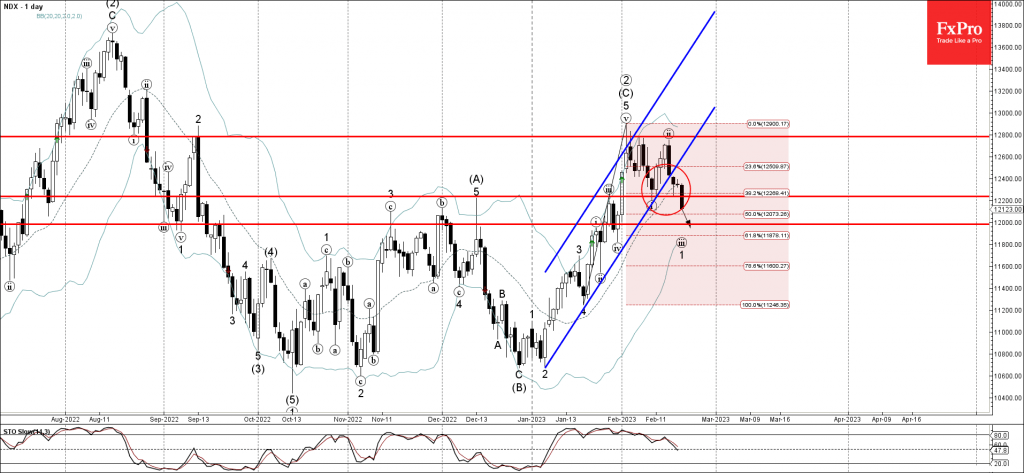
Nasdaq-100 Wave Analysis
- Nasdaq-100 broke pivotal support level 12235.00
- Likely to fall to support level 12000.00
Nasdaq-100 recently broke the pivotal support level 12235.00 (former strong resistance from December) intersecting with the 38.2% Fibonacci correction of the previous sharp upward impulse from January.
The breakout of the support level 12235.00 was preceded by the breakout of the sharp daily up channel from January – which accelerated the active impulse wave 1.
Nasdaq-100 can be expected to fall further toward the next round support level 12000.00 (target for the completion of the active impulse wave (iii)).
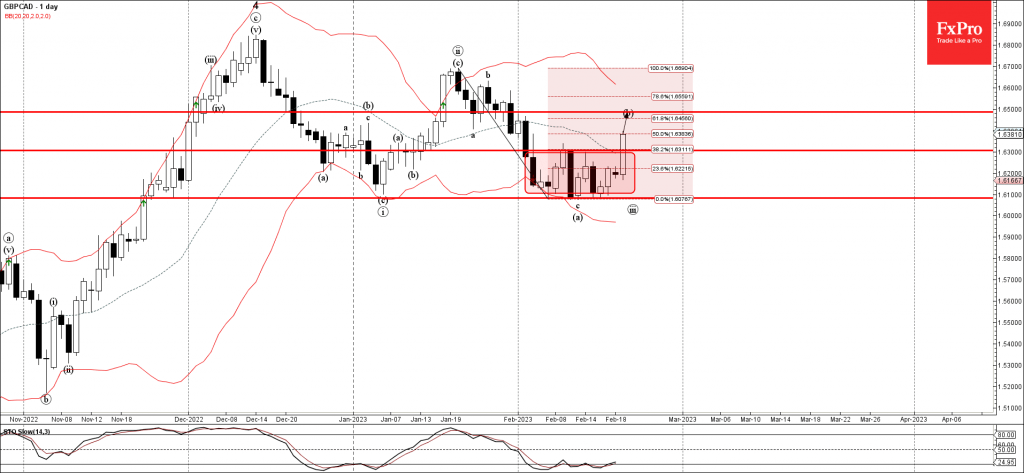
GBPCAD Wave Analysis
- GBPCAD broke key resistance level 1.6300
- Likely to rise to resistance level 1.6500
GBPCAD currency pair recently broke the key resistance level 1.6300, which is the top border of the narrow price range inside which the pair has been moving from the start of February.
The breakout of the resistance level 1.6300 coincided with the breakout of the 38.2% Fibonacci correction of the previous sharp downward impulse from January.
GBPCAD can be expected to rise further toward the next resistance level 1.6500 (target for the completion of the active minor correction (b)).
ECB Lagarde: What comes after March will be data dependent
ECB President Christine Lagarde reiterated the plan to hike by another 50bps at March meeting. She added, "What comes after that will be data dependent. We will look at all numbers — inflation, obviously, labor cost, projections and we will determine what our monetary-policy path will be after that."
"It is quite normal that we see at the moment inflation catchup as a key theme of negotiations between unions and employers associations," she said. "At this point in time, for the whole of the euro area, we don't see this spiraling of inflation-wages, inflation-wages."
Dollar Eyes Fed Minutes and PCE Inflation after Lacklustre Rebound
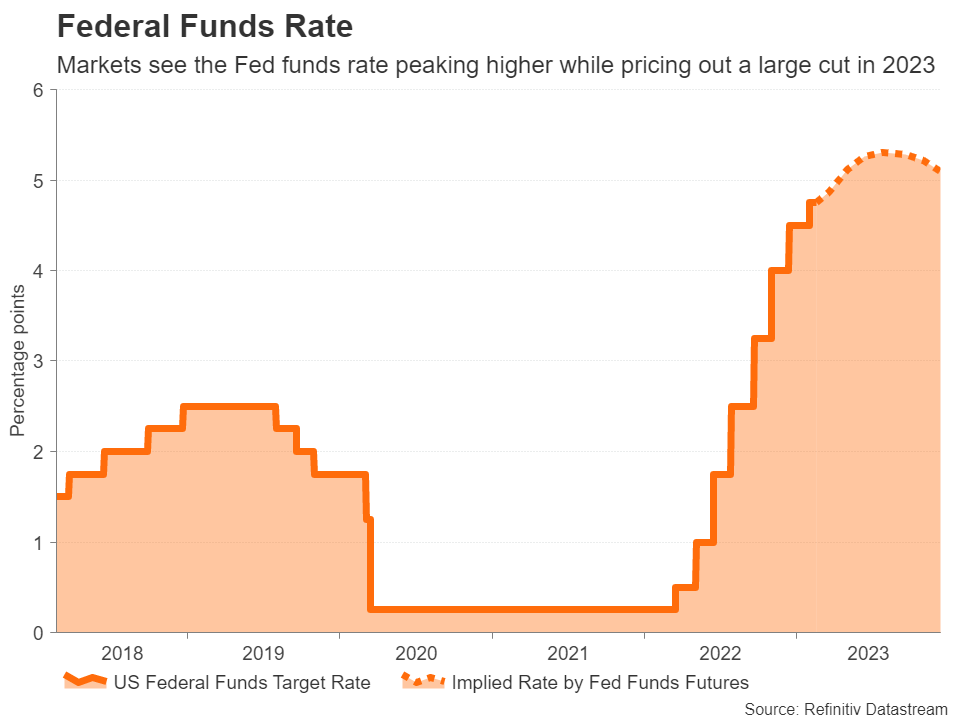
The US dollar has come off the back foot after a series of strong data and hawkish Fed talk, but is there scope for a more substantial recovery? The minutes of the Fed’s January 31-February 1 meeting out on Wednesday (19:00 GMT) will guide traders through to Friday when the all-important PCE inflation figures are due (13:30 GMT). Personal income and consumption readings for January will be vital too as the debate about whether the American economy can avoid a recession rages on.
What recession?
US economic indicators swung up in February, much to the relief of investors as not only does this ease concerns that the Fed’s aggressive rate hiking campaign is choking growth, but it also bodes well for the earnings outlook for corporate America as the worst case scenario is priced out of stocks. However, the strength of the latest batch of data has caught policymakers off guard too.
Some may be scratching their heads right now, wondering if the decision at the last meeting to shift to a slower gear was the right call. The half a million jump in January payrolls in particular must have come as quite a shock and caused angst. Add to that the smaller-than-expected drop in CPI inflation, and Fed officials are once again talking about the “significant road ahead” in their inflation battle.
Significant road ahead
Those were the words of Chair Jerome Powell, who spoke a few days after the jobs report. The minutes may therefore not reveal anything new as far as the Fed chief is concerned. But what will be interesting to see, even though the decision was unanimous, is whether there were any voting members who were hesitant about slowing down the pace of rate increases for the second straight meeting.
Two non-voting members – the Cleveland Fed’s Mester and St. Louis’ Bullard – have already expressed doubt about the need to downshift. Any hint in the discussions of that meeting that policymakers are more than ready to re-accelerate the pace of tightening should inflation prove stickier than anticipated, could put risk assets under renewed pressure.
Labour market is getting tighter
Yet, unless the tone of the minutes is vastly more hawkish than policymakers’ recent remarks, traders might be hesitant to react before they’ve had the chance to digest Friday’s slew of data. A day earlier, the second estimate of fourth quarter GDP will be released, though, no revision to the initial reading of 2.9% annualized growth is anticipated.
The weekly jobless claims on the other hand might be more crucial as they have been running below 200k for the last few weeks, pointing to ongoing tightness in the labour market. Another solid print in the jobless claims on Thursday could put investors on high alert ahead of Friday’s numbers.
US consumers are spending again
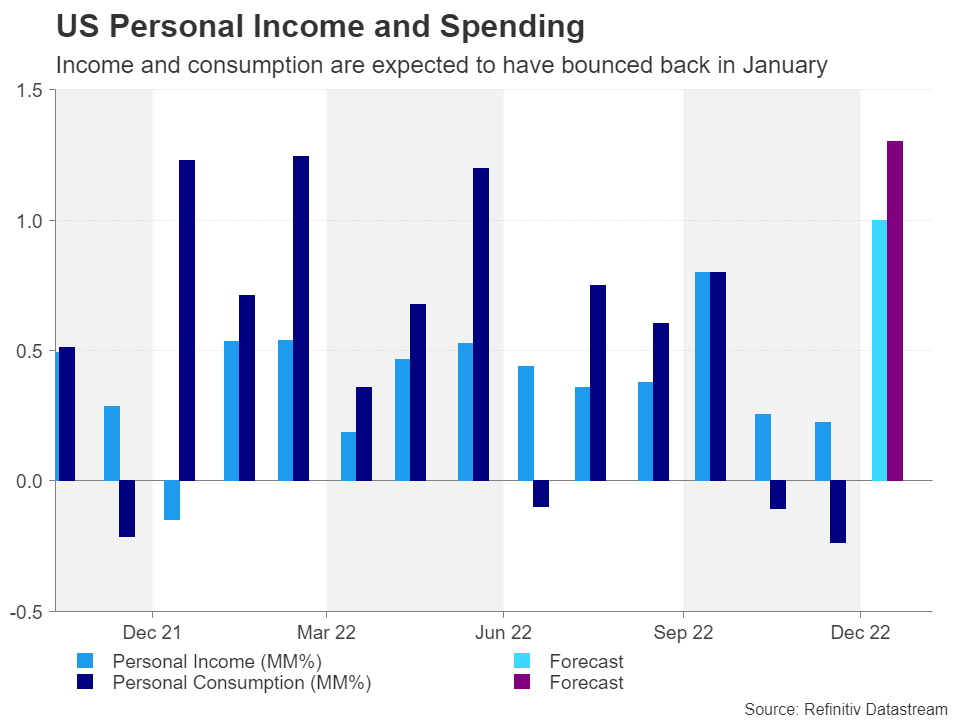
Both personal income and personal spending are expected to have bounced back strongly in January, rising by 1.0% and 1.3% month-on-month, respectively. Consumer spending sagged towards the end of 2022, but as indicated by the retail sales figures, milder weather likely spurred a rebound in January.
The highlight, however, on Friday will be the core PCE price index, which poses the biggest threat to risk appetite following the CPI surprise. The Fed’s favourite inflation gauge is forecast to have inched down 0.1 percentage point to 4.3% y/y in January, while the monthly measure is projected to have quickened slightly to 0.4%.
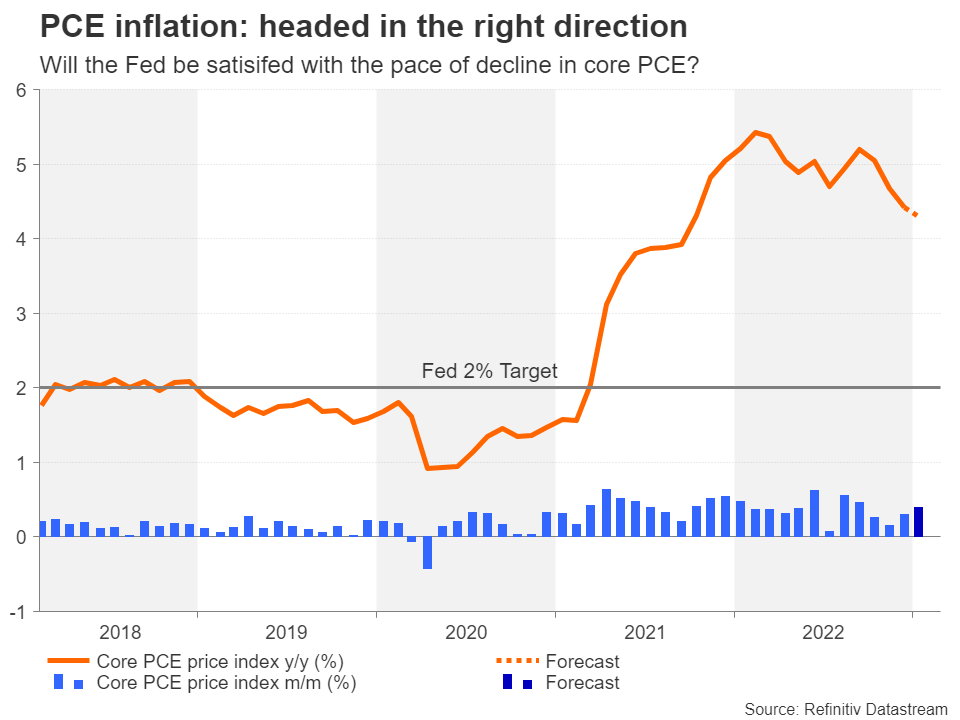
With investors already on edge, if the core PCE price index does not maintain a downward path then that would heighten fears of elevated inflation persisting for longer, and therefore, interest rates going higher and staying higher for longer.
Dollar’s revival not yet convincing
The question for the dollar, however, is would that be enough to rally the bulls? Although the Fed is unlikely to pause anytime soon, other central banks like the ECB are still hiking too, while the Bank of Japan may soon exit from all its stimulus policies. Still, if everything from the minutes to the data go in the dollar’s favour, there could be some healthy gains in store for the currency.
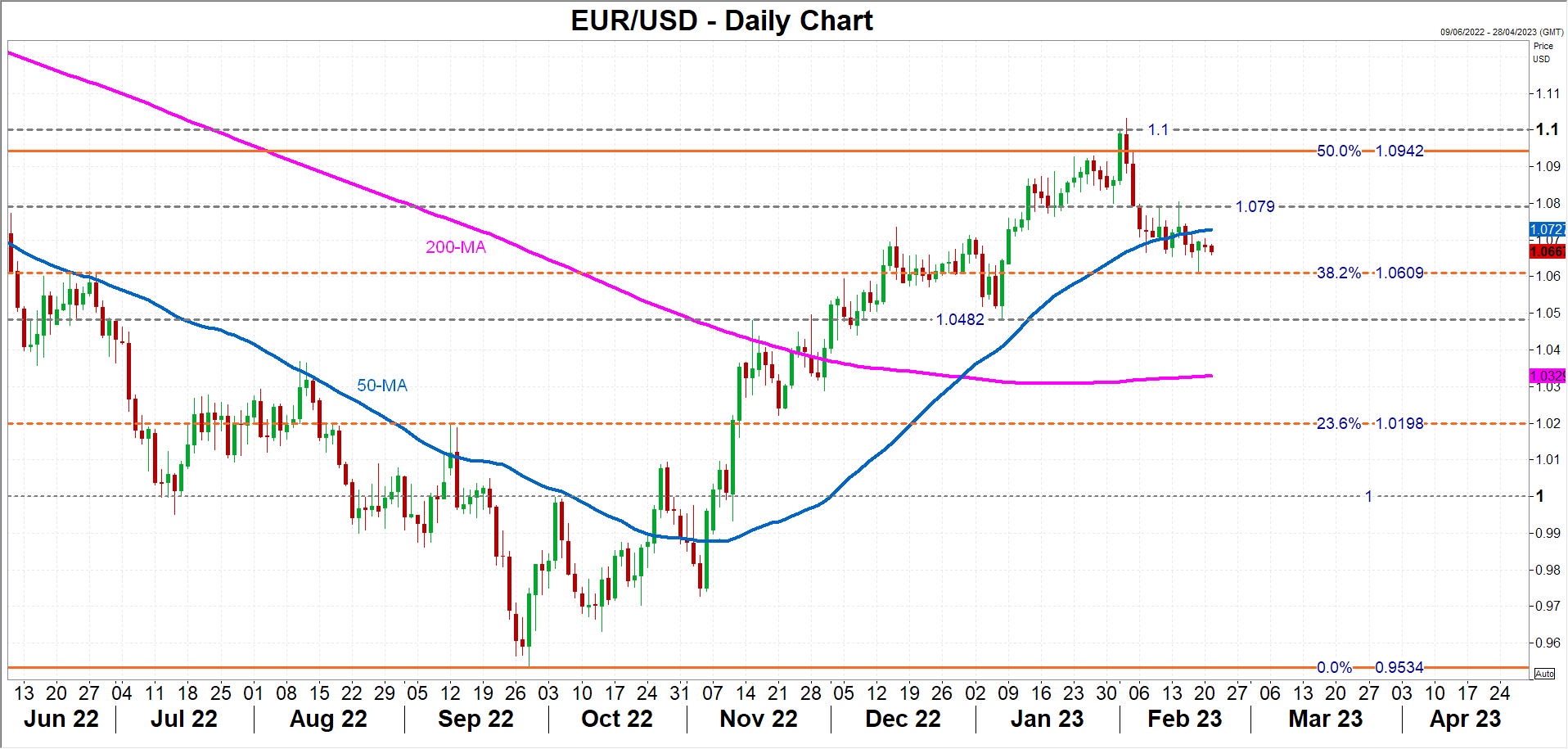
The euro, which has just slid below its 50-day moving average (MA), has found support in the $1.06 region where the 38.2% Fibonacci of the 2021-2022 downtrend runs across. Should this support crumble, the early January trough of $1.0482 would likely come into focus before attention turns to the 200-day MA near $1.0330.
In the event, though, that the minutes are no more hawkish than Fed official’s latest comments and there are no nasty surprises in the PCE inflation numbers, the euro might just be able to recapture the 50-day MA and have another attempt at the $1.10 handle where the uptrend stalled in January.
For the moment, the dollar’s recovery appears to be a short-term correction rather than a trend reversal so further positive momentum is required to push the greenback to at least the half-way point of the downward phase that began in late September to signify a sustainable rebound.
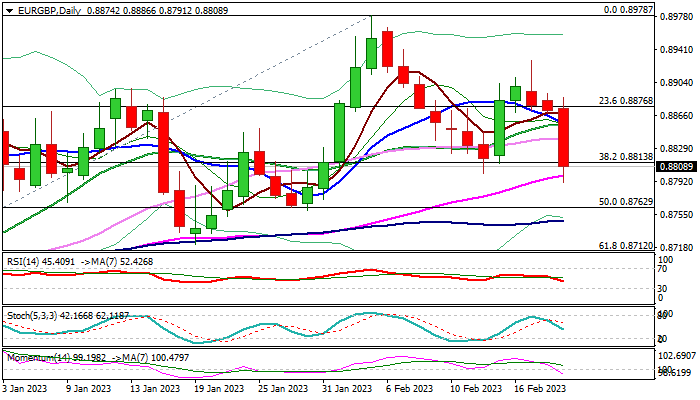
EUR/GBP: Falls Sharply after Upbeat UK Data
The cross accelerated sharply lower in European trading on Tuesday, falling 0.9% during the session.
Much stronger than expected UK services PMI data signaled significant improvement in the activity in UK economy’s dominant service sector which brightens the outlook and eases recession concerns.
Fresh weakness cracked key supports at 0.8813/0.8799 zone (Fibo 38.2% of 0.8547/0.8978 / Feb 14 former low / 55DMA) and looks for close below these levels to confirm bearish signal on completion of failure swing pattern on daily chart.
Daily studies weakened as MA’s (10/20/30) turned to bearish setup and south-heading momentum indicator broke into negative territory, but fresh bears may face strong headwinds from rising daily cloud (top of the cloud lays at 0.8780).
Res: 0.8839; 0.8857; 0.8876; 0.8891.
Sup: 0.8780; 0.8748; 0.8722; 0.8701.
Sunset Market Commentary
Markets
Today’s PMI’s should further shape markets’ and central bankers’ assessment on how much further policy tightening is needed to bring inflation back to target in a sustainable way. EMU February PMI’s at least suggest that tightening already put in place by the ECB (and other central banks) probably didn’t restore the demand supply balance in a way that guarantees a sustained return to the 2% target. The composite PMI rebounded decisively further into expansionary territory from 50.3 to 52.3 (vs 50.7 expected). The move was driven by the services sector (53 from 50.8 vs 51.0 expected). The headline figure for the manufacturing sector declined slightly from 48.8 to 48.5, but this was partially due to lower delivery times. Input prices cooled, especially in the manufacturing sector. However, regarding prices charged for goods and services, S&P said they are still increasing at a solid rate as firms sought to pass higher costs on to customers, including in many cases greater staff costs. Firms are further hiring, albeit at a slower pace than in January, but this is partially due to labour shortages. The main message from the PMI’s is that activity in the EMU economy is improving faster than expected with a better outlook. While many bottlenecks disappeared, especially selling prices remain elevated for an important part due to high wages. S&P global concludes that this ‘will naturally encourage a bias towards further policy tightening in the months ahead’. German/European yields continued recent protracted uptrend. German yields are rising between 5.5 bps (2-y) and 7.5 bps (10-y). The 2-y yield continues to set new cycle peak levels as money markets are considering the ECB raising its policy rate (well) beyond 3.50% by the summer. The German 10-y yield continues to attack the 2.50%/2.57% resistance. US bond markets clearly ‘feared’ strong US PMI’s with yields already gaining up to 9 bps points in the run-up to the release. The US February composite PMI (50.5 from 46.8 vs 47.5 expected) indeed improved much more than expected, narrowing the gap with much more optimistic signs from (especially) the services ISM. US yields currently are rising between 12.25 bps (5-y) and 9 bps (2& 30-y). The dollar recorded modest gains for most of the day, but is gaining some further traction post US PMI’s. EUR/USD trades in the 1.0650 rea. USD/JPY is attacking the 135 big figure. US equities opened with losses of 0.75% (Dow) to 1.15% (Nasdaq). The Euro Stoxx 50 again outperforms (-0.33%). Losses hardly grow post US PMI.
News & Views
The UK February composite PMI unexpectedly spiked from 48.5 to 53, an 8-month high. The services PMI showed a similar jump (53.3 from 48.7) with the manufacturing PMI still below the 50 boom/bust mark, but increasing from 47 to 49.2. Details showed a swift and significant jump in output. Supplier delivery times improved at the fastest rate since June 2009 for manufacturers. New work rose at the quickest pace since May 2022 for services. The easing of input prices (especially manufacturing) didn’t translate into improved costs for customers. The services sector referred to rising salary costs while skills shortages remain widespread. Following PMI’s, UK markets followed recent trends witnessed in the EMU and the US: discounting a more hawkish policy rate path for the central bank. UK Gilts underperform with yields rising between 11.5 (bps) and 19.5 bps (2-yr). Money markets start pondering the possibility that the BoE’s policy rate will end up above 4.5% this summer (4% now). Sterling enjoys the rate support with EUR/GBP tanking around 1 big figure to levels below 0.88.
Headline Canadian inflation rose slightly less than forecast in January, up 0.5% M/M vs 0.7% consensus. Higher gasoline prices contributed the most to M/M increase, followed by a rise in mortgage interest costs and meat prices. The Y/Y comparison slowed from 6.3% to 5.9%. Prices for cellular services and passenger vehicles contributed most to the deceleration. Underlying core CPI slowed less than the headline outcome with the median down from 5.2% Y/Y to 5% Y/Y and the trimmed mean measure decelerating from 5.3% Y/Y to 5.1% Y/Y. The loonie ticked lower on the data (USD/CAD 1.35) as they leave room for the flagged conditional pause in the policy rate cycle by the Bank of Canada in March. It remains a tight call though following blowout Canadian payrolls earlier this month.
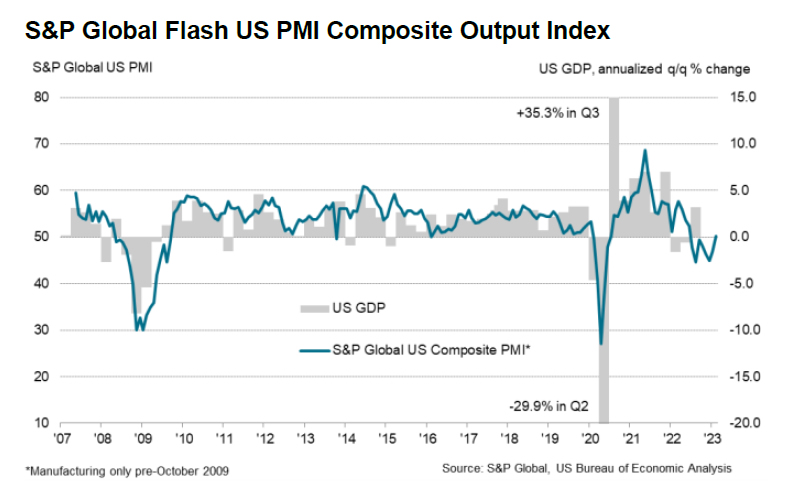
US PMI composite rose to 50.2, welcome steadying of business activity
US PMI Manufacturing rose from 46.9 to 47.8 in February. PMI Services rose from 46.8 to 50.5, an 8-month high. PMI Composite rose from 46.8 to 50.2, also an 8-month high.
Chris Williamson, Chief Business Economist at S&P Global Market Intelligence said:
"February is seeing a welcome steadying of business activity after seven months of decline. Despite headwinds from higher interest rates and the cost of living squeeze, the business mood has brightened amid signs that inflation has peaked and recession risks have faded. At the same time, supply constraints have alleviated to the extent that delivery times for inputs into factories are improving at a rate not seen since 2009.
"However, there are some caveats to the good news. The upturn is being driven by the services sector, which in part reflects unseasonably warm weather, and although the manufacturing survey data are showing signs of improvement, the factory sector remains in contraction and focused on inventory reduction.
"Furthermore, the improved supply situation has taken price pressures out of manufacturing supply chains, but the survey data underscore how the upward driving force on inflation has now shifted to wages amid the tight labor market. By potentially stoking concerns over a wage-price spiral, accelerating service sector price growth will add to calls for higher interest rates, which could in turn subdue the nascent expansion."
USD/JPY Mid-Day Outlook
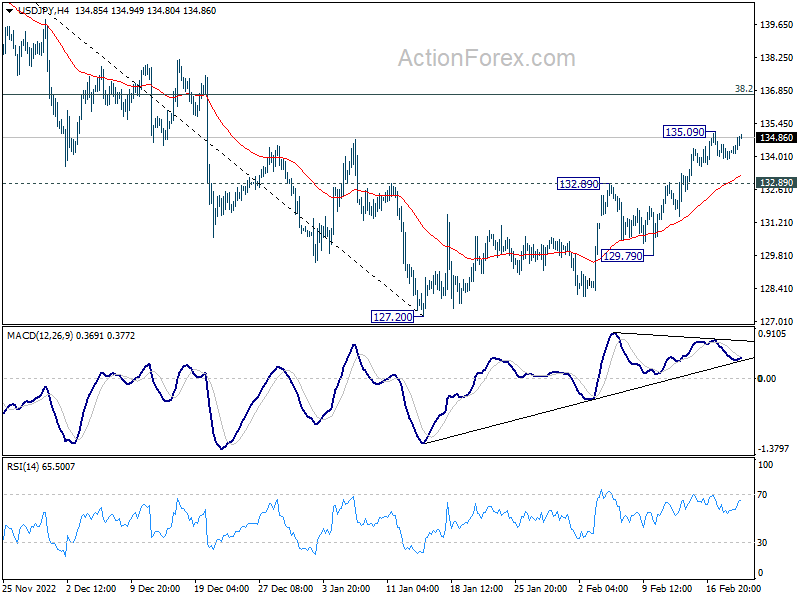
Daily Pivots: (S1) 133.97; (P) 134.25; (R1) 134.58; More...
Intraday bias in USD/JPY remains neutral at this point. On the upside, break of 135.09 will resume the rise from 127.20 to 38.2% retracement of 151.93 to 127.20 at 136.64. Strong resistance could be seen there to complete the corrective rebound. On the downside, break of 132.89 resistance turned support will bring deeper fall to 129.79 support.
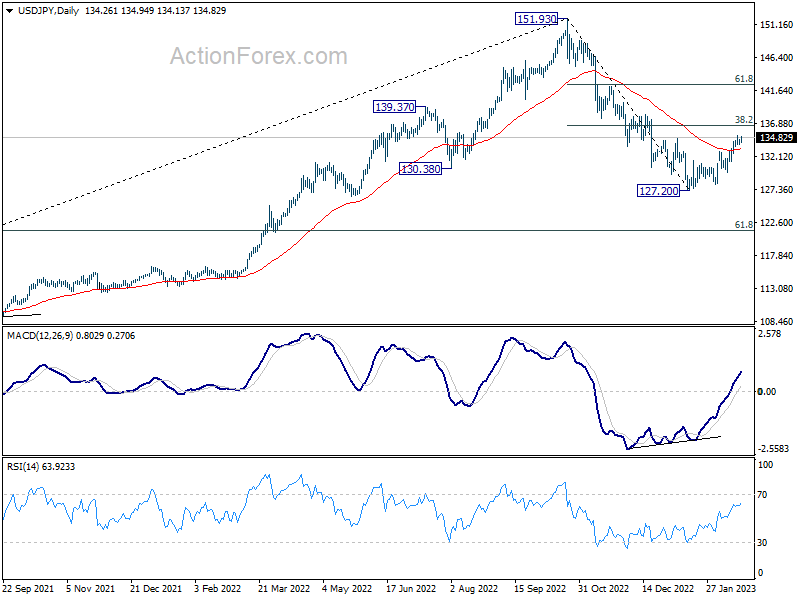
In the bigger picture, prior break of 55 week EMA (now at 131.47) raises the chance of medium term bearish reversal, but that's not confirmed yet. Strong rebound from current level, followed by sustained break of 38.2% retracement of 151.93 to 127.20 at 136.64 will argue that price actions from 151.93 is merely a corrective pattern. However, rejection by 136.64 will solidify medium term bearishness for 61.8% retracement of 102.58 to 151.93 at 121.43 and 38.2% retracement of 75.56 to 151.93 at 122.75.
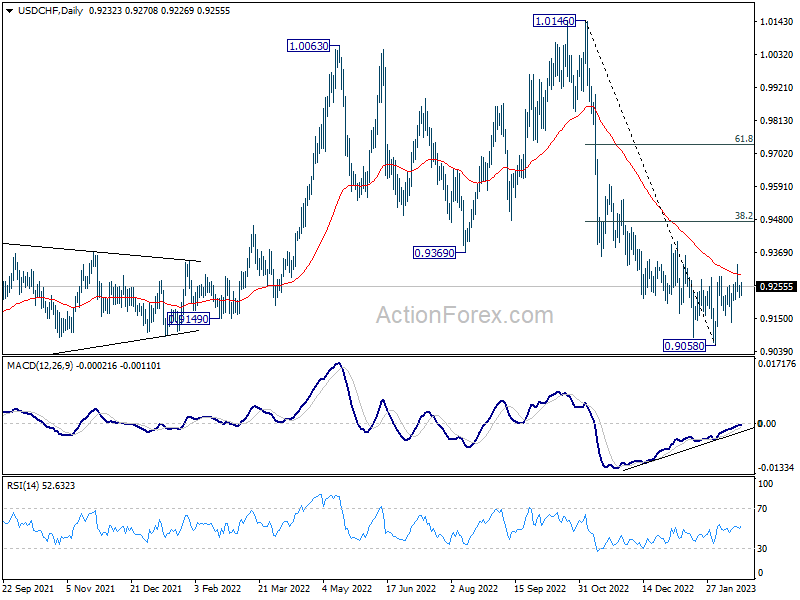
USD/CHF Mid-Day Outlook
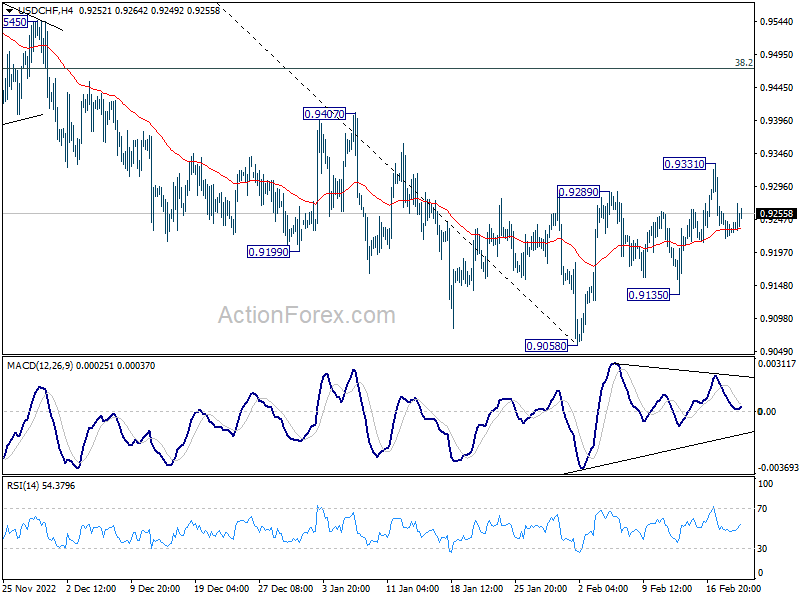
Daily Pivots: (S1) 0.9213; (P) 0.9238; (R1) 0.9255; More...
Intraday bias in USD/CHF remains neutral. On the upside, break of 0.9331 will resume the rebound from 0.9058 to 38.2% retracement of 1.0146 to 0.9058 at 0.9474. However, break of 0.9135 will indicate that the rebound has completed and bring retest of 0.9058 low.
In the bigger picture, decline from 1.0146 is seen as part of a long term sideway pattern. As long as 38.2% retracement of 1.0146 to 0.9058 at 0.9474 holds, another fall is in favor through 0.9058. However, sustained trading above 0.9474 will indicate that the medium term trend has reversed, and open up further rally to 1.0146 again.