

Sample Category Title
AUD/USD Daily Report
Daily Pivots: (S1) 0.6835; (P) 0.6868; (R1) 0.6887; More...
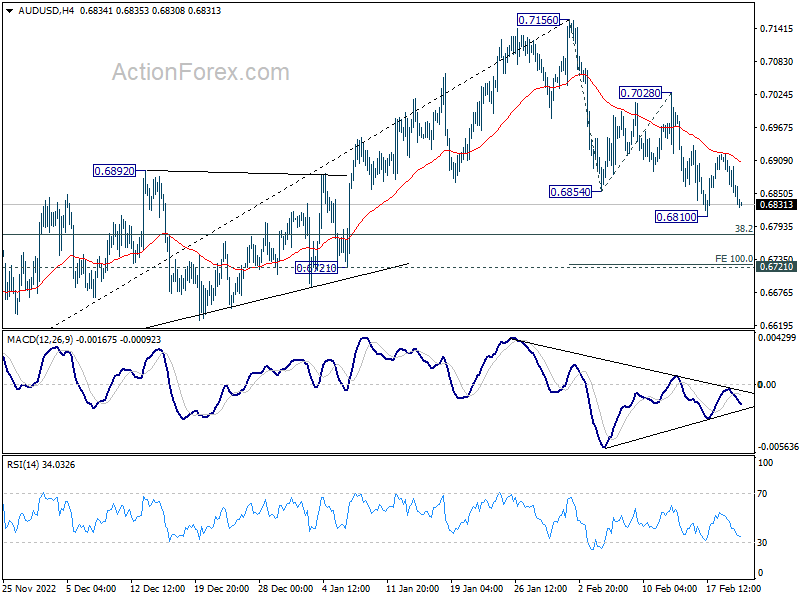
Intraday bias in AUD/USD remains neutral and risk stays mildly on the downside with 0.7028 resistance intact. On the downside, break of 0.6180 will resume the corrective fall from 0.7156, and target 100% projection of 0.6854 to 0.7028 from 0.6854 at 0.6736, which is close to 0.6721 key structural support. Strong support is expected there to bring rebound.
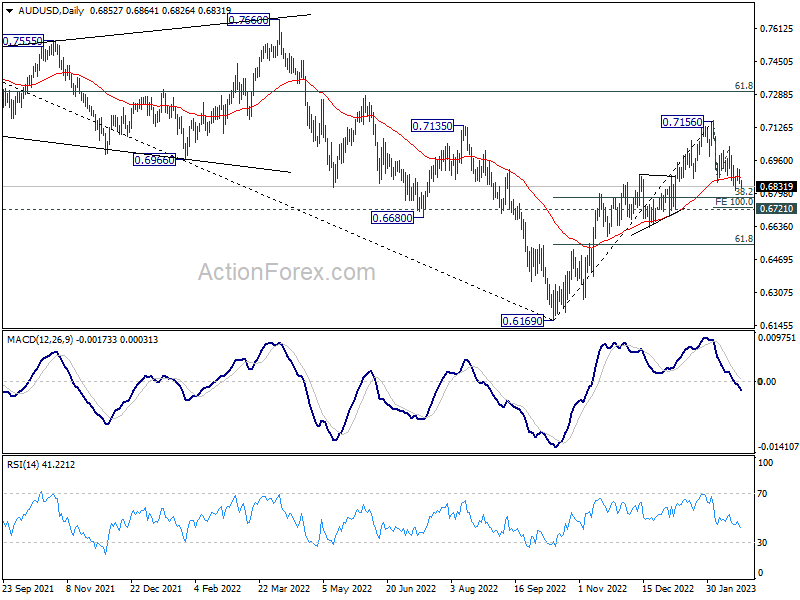
In the bigger picture, corrective decline from 0.8006 (2021 high) should have completed with three waves down to 0.6169 (2022 low). Further rally should be seen to 61.8% retracement of 0.8006 to 0.6169 at 0.7304. Sustained break there will pave the way to retest 0.8006. This will now remain the favored case as long as 0.6721 support holds.
Technical Outlook and Review
USD/JPY:
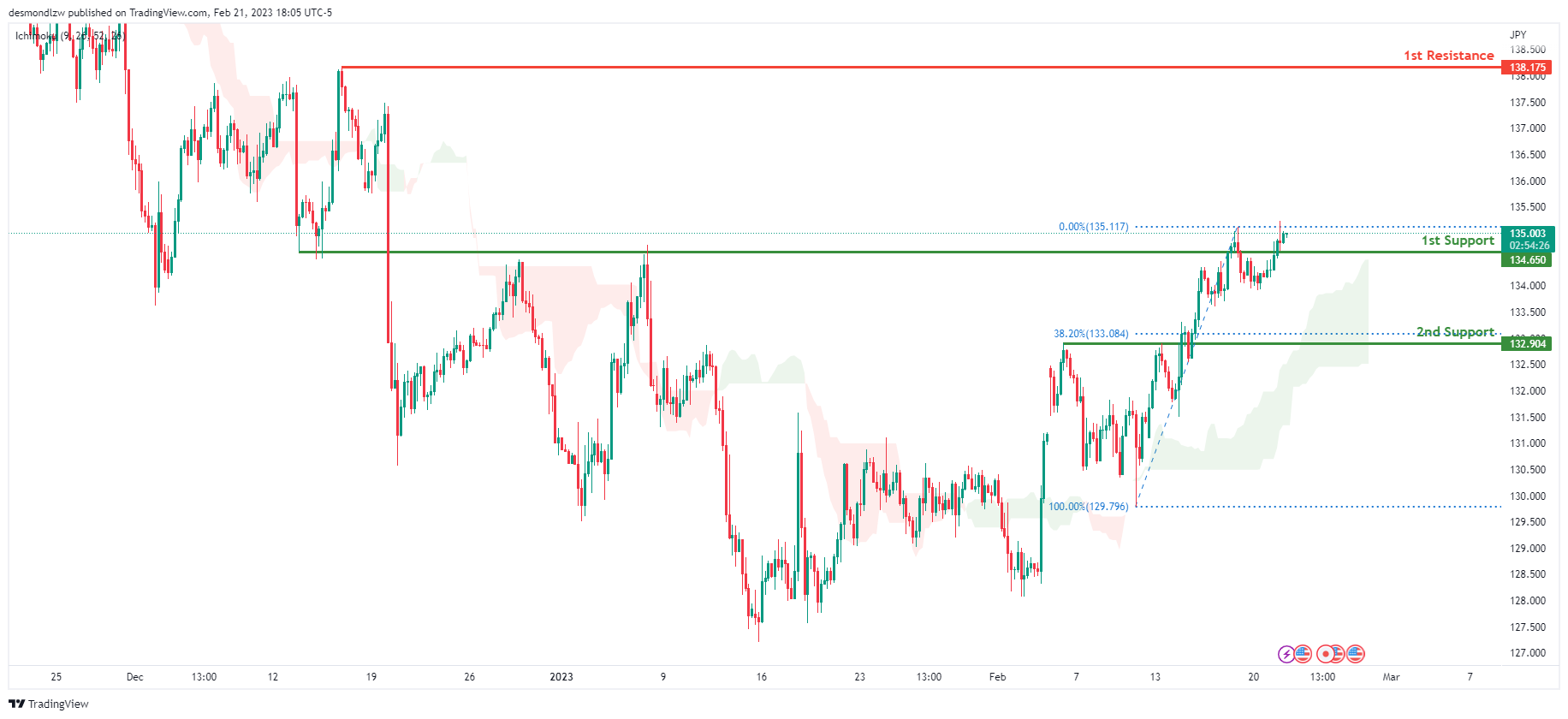
Looking at the H4 chart, my overall bias for USDJPY is bullish due to the current price being above the Ichimoku cloud, indicating a bullish market. If this bullish momentum continues, expect the price to continue heading towards the 1st resistance at 138.175, where the previous swing high is.
In an alternate scenario, price could possibly head back down to break the 1st support at 134.650, where the overlap support is before heading towards the 2nd support at 132.904, where the overlap support and 38.2% Fibonacci line is.
Areas of consideration:
- H4 time frame, 1st resistance at 138.175
- H4 time frame, 1st support at 134.650
- H4 time frame, 2nd support at 132.904
DXY:
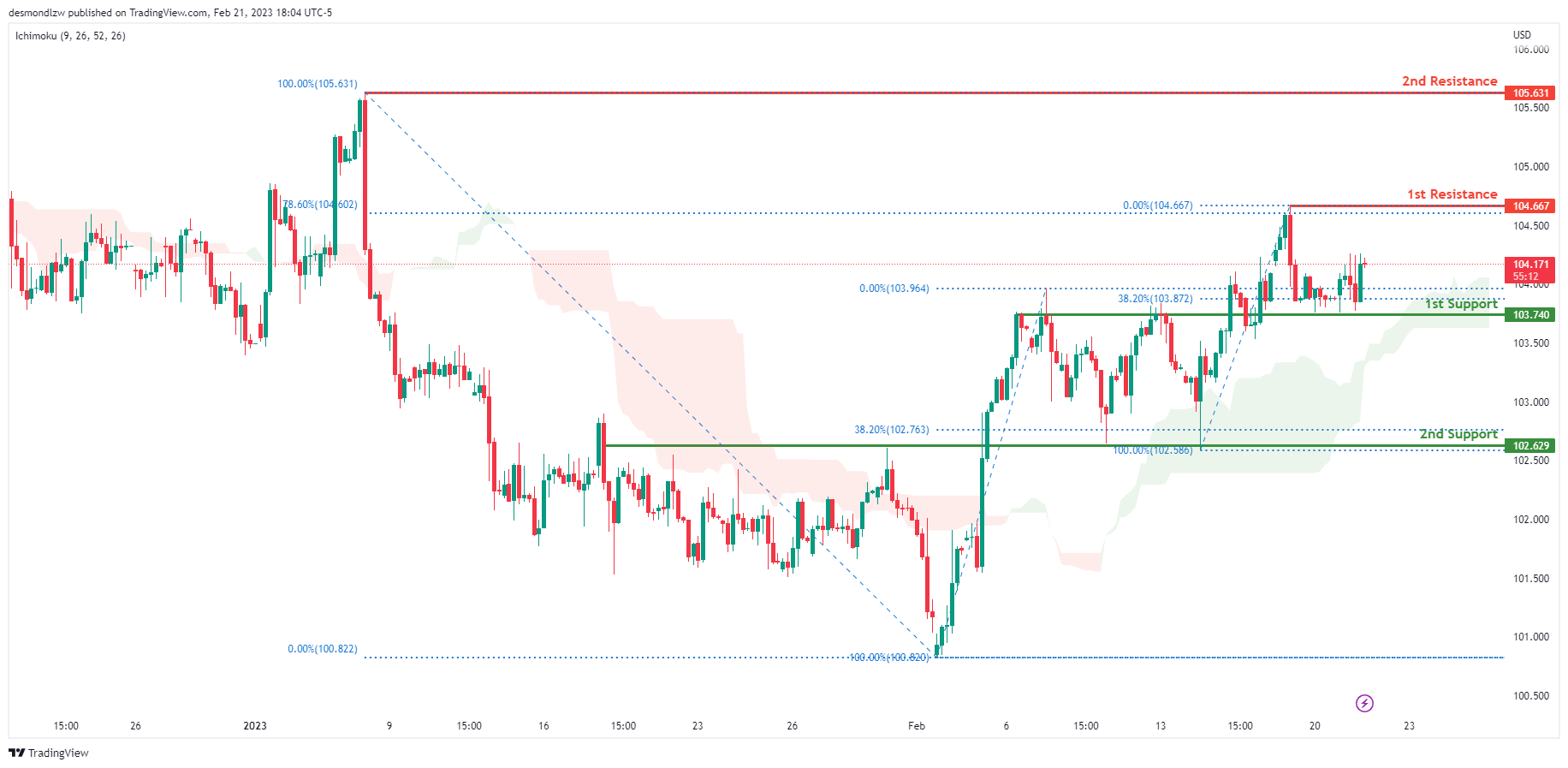
Looking at the H4 chart, my overall bias for DXY is bullish due to the current price crossing above the Ichimoku cloud, indicating a bullish market. If this bullish momentum continues, expect the price to possibly continue heading towards the 1st resistance at 104.667, where the recent high and 78.6% Fibonacci line is.
In an alternative scenario, price could head back down to retest the 1st support at 103.740, where the overlap support and 38.2% Fibonacci line is.
Areas of consideration:
- H4 time frame, 1st resistance at 104.667
- H4 time frame, 1st support at 103.740
EUR/USD:
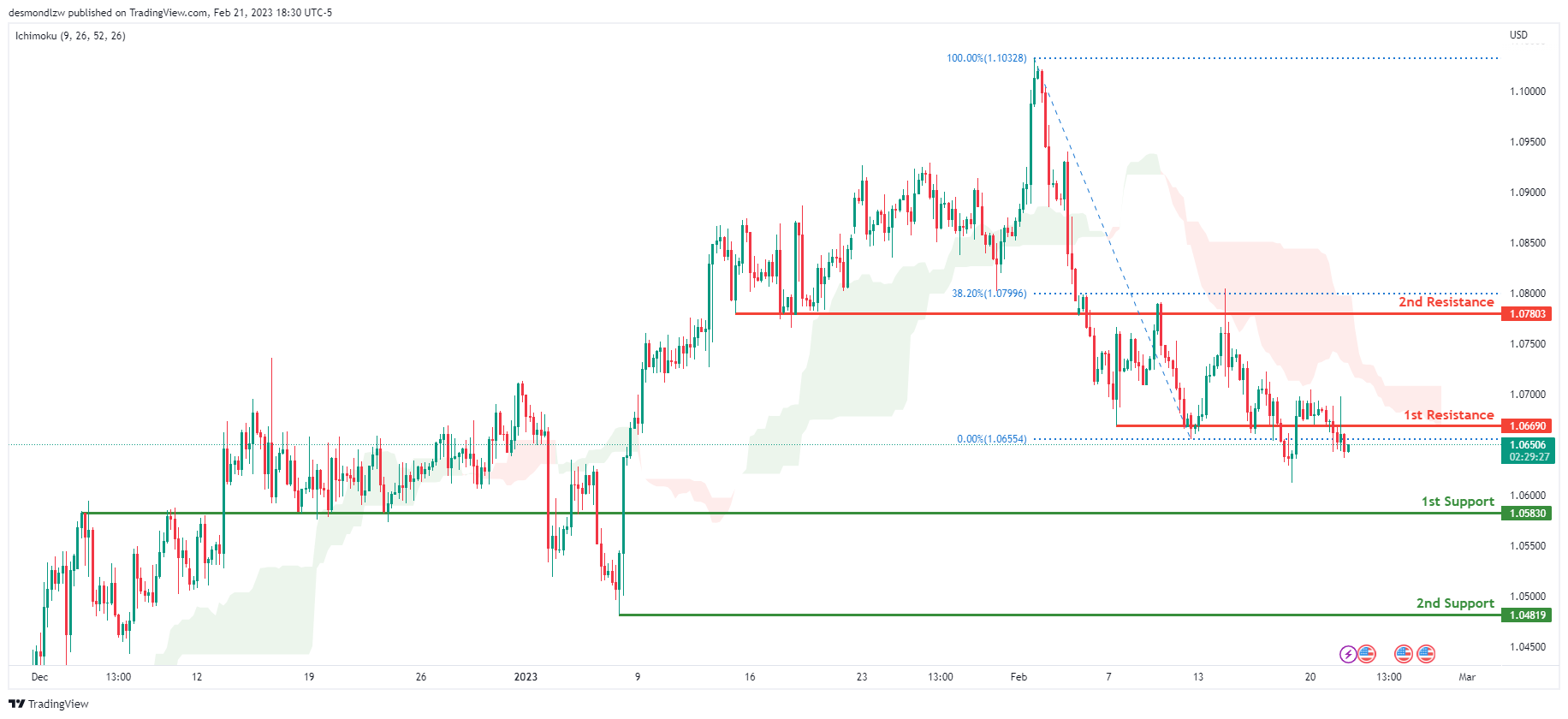
Looking at the H4 chart, my overall bias for EURUSD is bearish due to the current price crossing below the Ichimoku cloud, indicating a bearish market structure. If this bearish momentum continues, expect the price to head towards the 1st support at 1.05830 which is the overlap support.
In an alternate scenario, price could possibly head back up to retest the 1st resistance at 1.06690, where the overlap support is.
Areas of consideration :
- H4 1st resistance at 1.06690
- H4 1st support at 1.05830
GBP/USD:
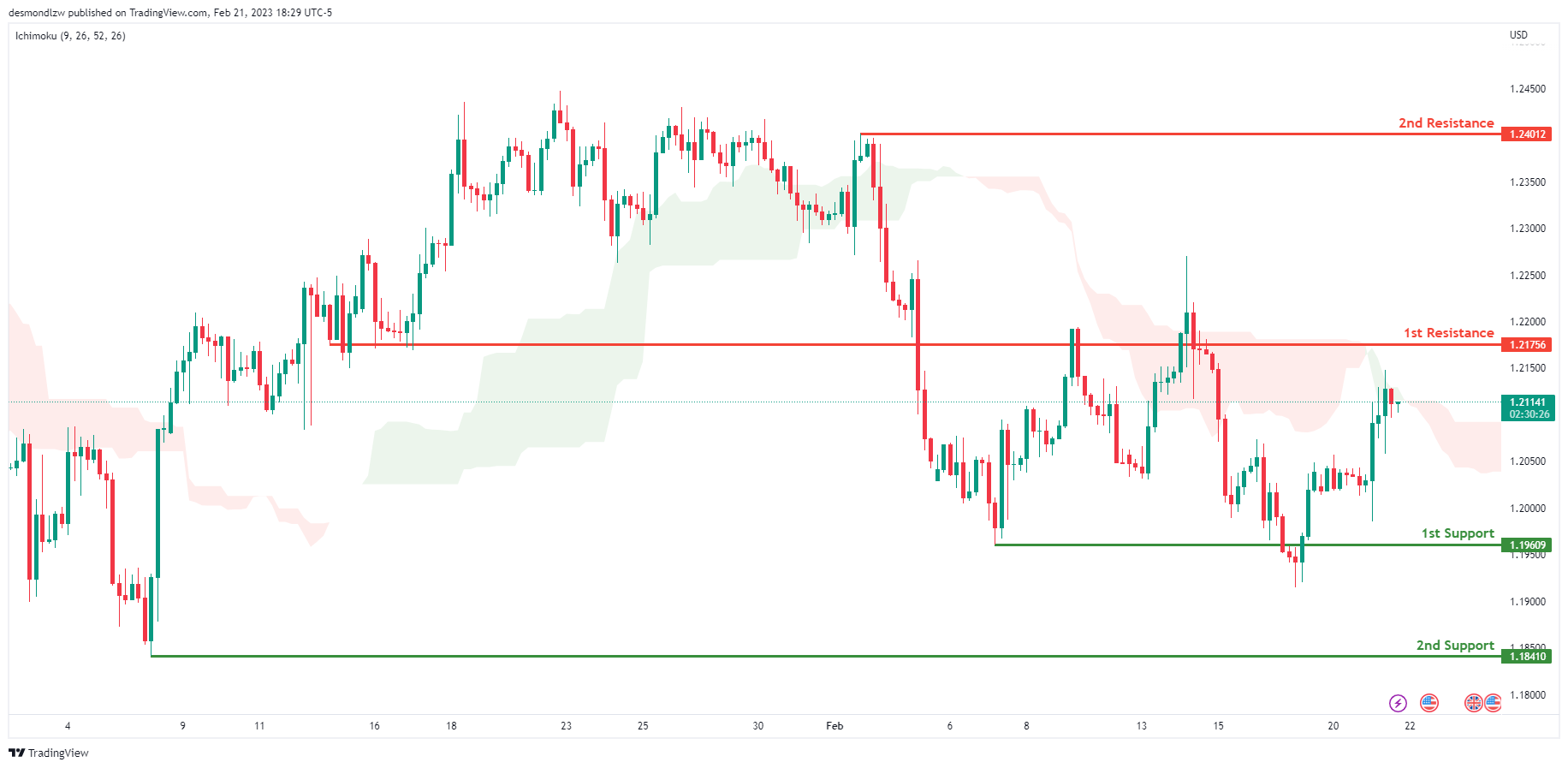
Looking at the H4 chart, my overall bias for GBPUSD is bearish due to the current price crossing below the Ichimoku cloud, indicating a bearish market. If this bearish momentum continues, expect the price to possibly break the 1st support at 1.19609, where the recent swing low is, before heading towards the 2nd support at 1.18410, where the previous swing low is.
In an alternate scenario, price could head back up to retest the 1st resistance line at 1.21756 where the overlap resistance is.
Areas of consideration:
- H4 1st resistance at 1.21756
- H4 1st support at 1.19609
- H4 2nd support at 1.18410
USD/CHF:
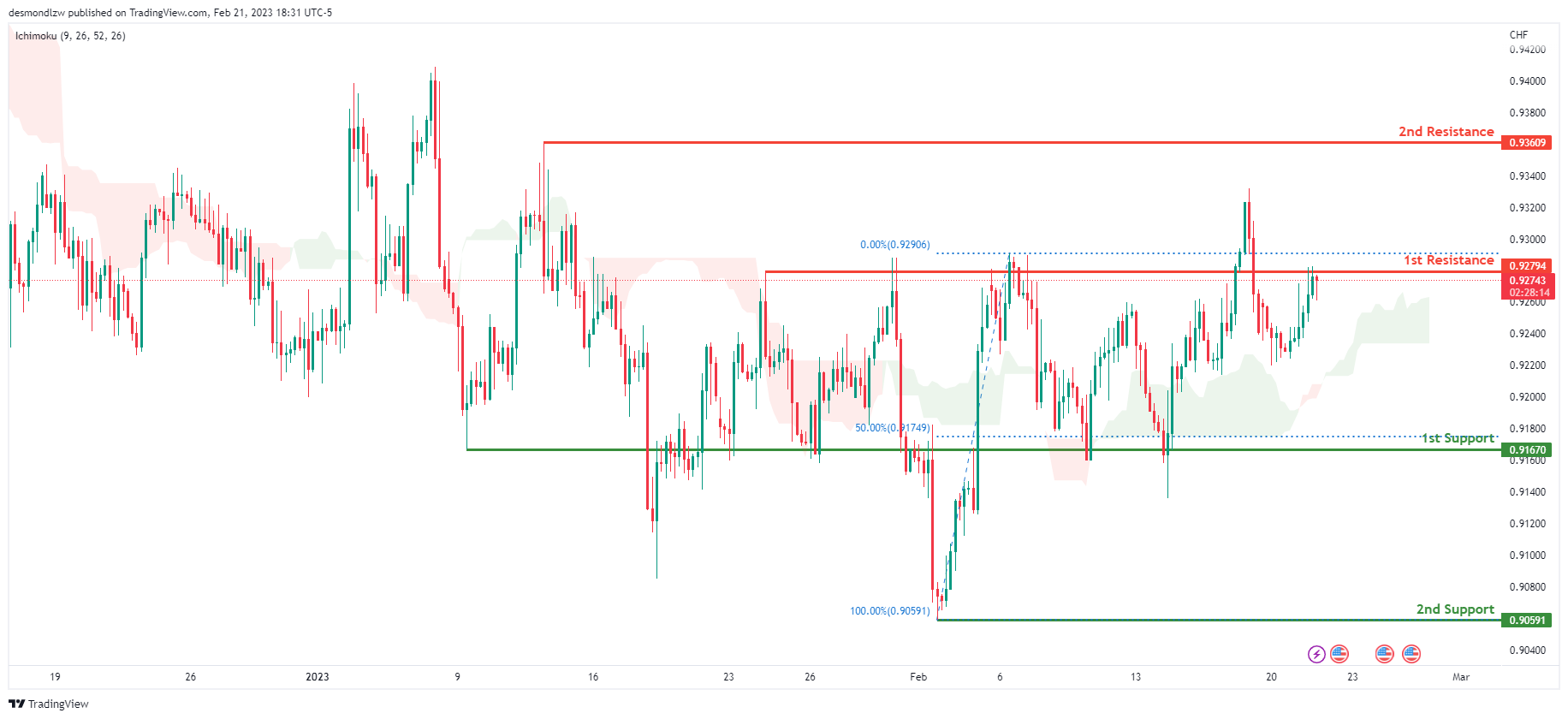
Looking at the H4 chart, my overall bias for USDCHF is bullish due to the current price being above the Ichimoku cloud, indicating a bullish market. If the current bullish trend continues, expect the price to possibly break the 1st resistance at 0.92794, where the previous swing high is, before heading towards the 2nd resistance at 0.93609 where the intermediate high is.
In an alternative scenario, price could possibly head back down to retest the 1st support at 0.91670, where the recent swing low and 50% Fibonacci line is.
Areas of consideration
- H4 1st support at 0.91670
- H4 1st resistance at 0.92794
- H4 2nd resistance at 0.93609
XAU/USD (GOLD):
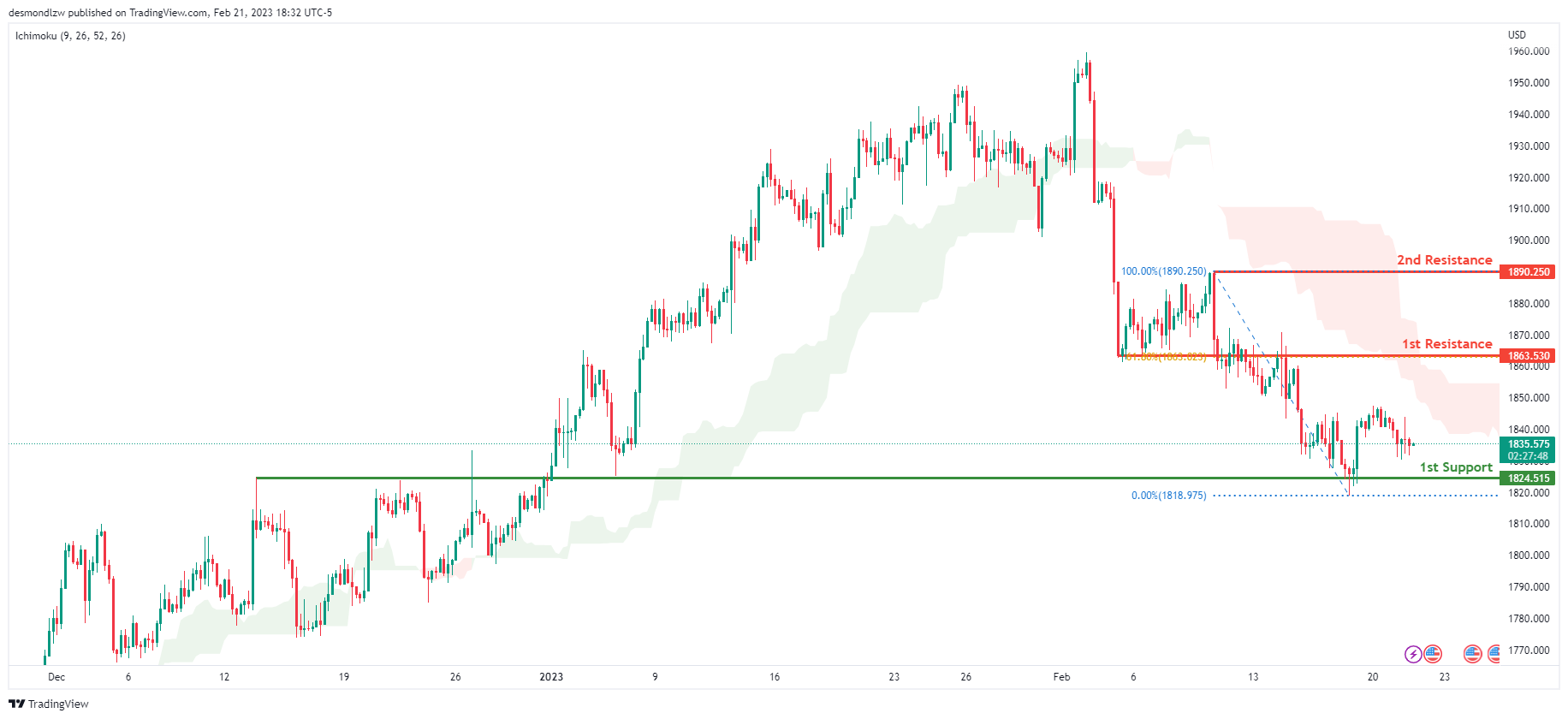
Looking at the H4 chart, my overall bias for XAUUSD is bearish due to the current price being below the Ichimoku cloud, indicating a bearish market. If this bearish momentum continues, expect the price to possibly continue heading towards the 1st support at 1824.515 where the overlap support is.
In an alternative scenario, price could possibly head back up to retest the 1st resistance at 1863.530, where the overlap resistance and 61.8% Fibonacci line is.
Areas of consideration:
- H4 time frame, 1st resistance at 1863.530
- H4 time frame, 1st support at 1824.515
AUD/USD:
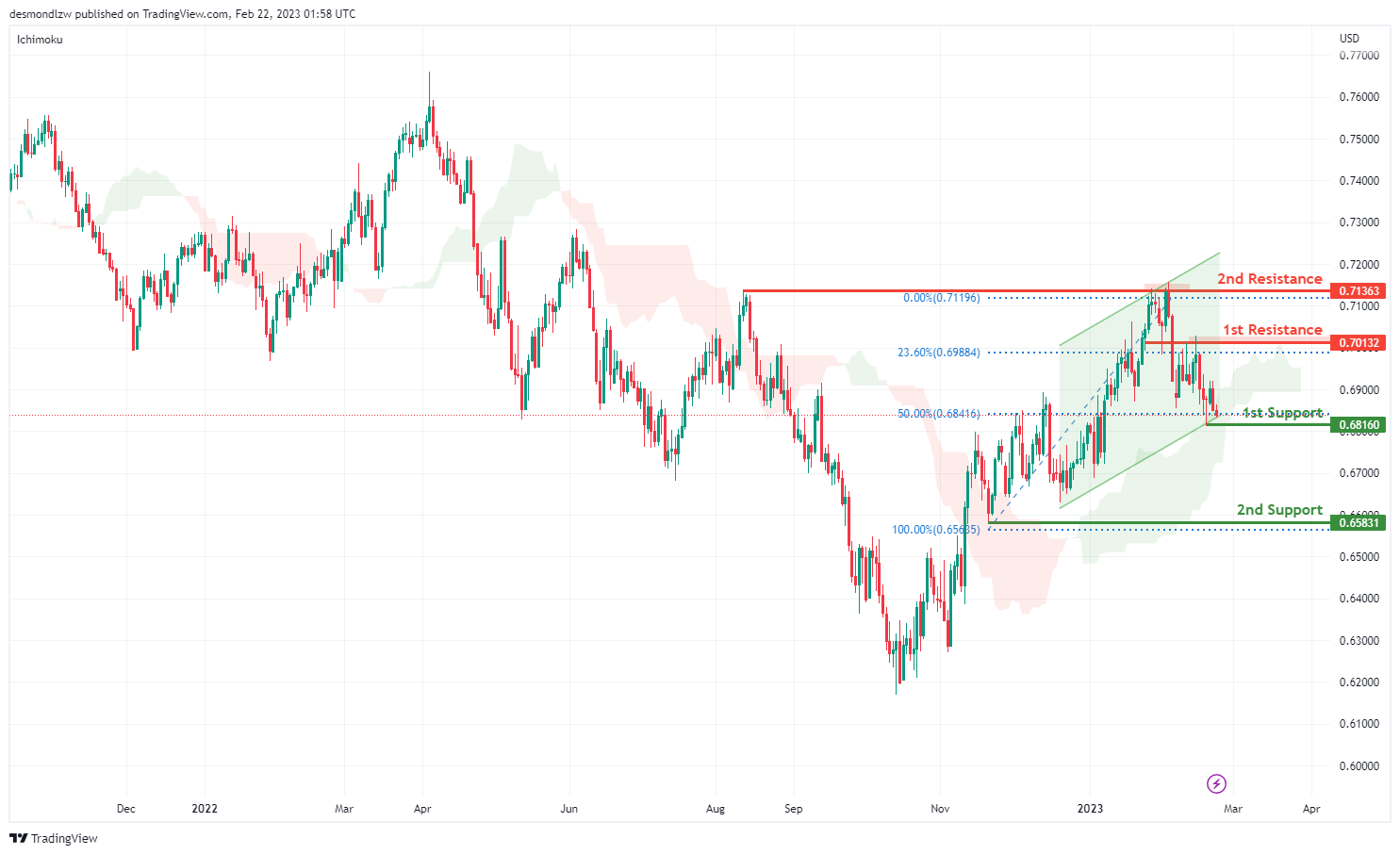
Looking at the H4 chart, my overall bias for AUDUSD is slightly bullish due to the current price being above the Ichimoku cloud, and there is an ascending channel, indicating a bullish market.
The price could possibly go up towards the 1st resistance level at 0.70132 which is the recent swing high and in line with the 23.6% Fibonacci retracement. There is 2nd resistance at 0.71363 which is the previous swing high.
In an alternate scenario, the price could possibly down towards the The 1st support is at 0.68160 which is the recent swing high and in line with the 50% Fibonacci retracement. The 2nd support is at 0.65831 which is the recent swing low.
Areas of consideration
- H4. 2nd resistance at 0.71363
- H4. 1st resistance at 0.70132
- H4, 1st support at 0.68160
- H4, 2nd support at 0.65831
NZD/USD:
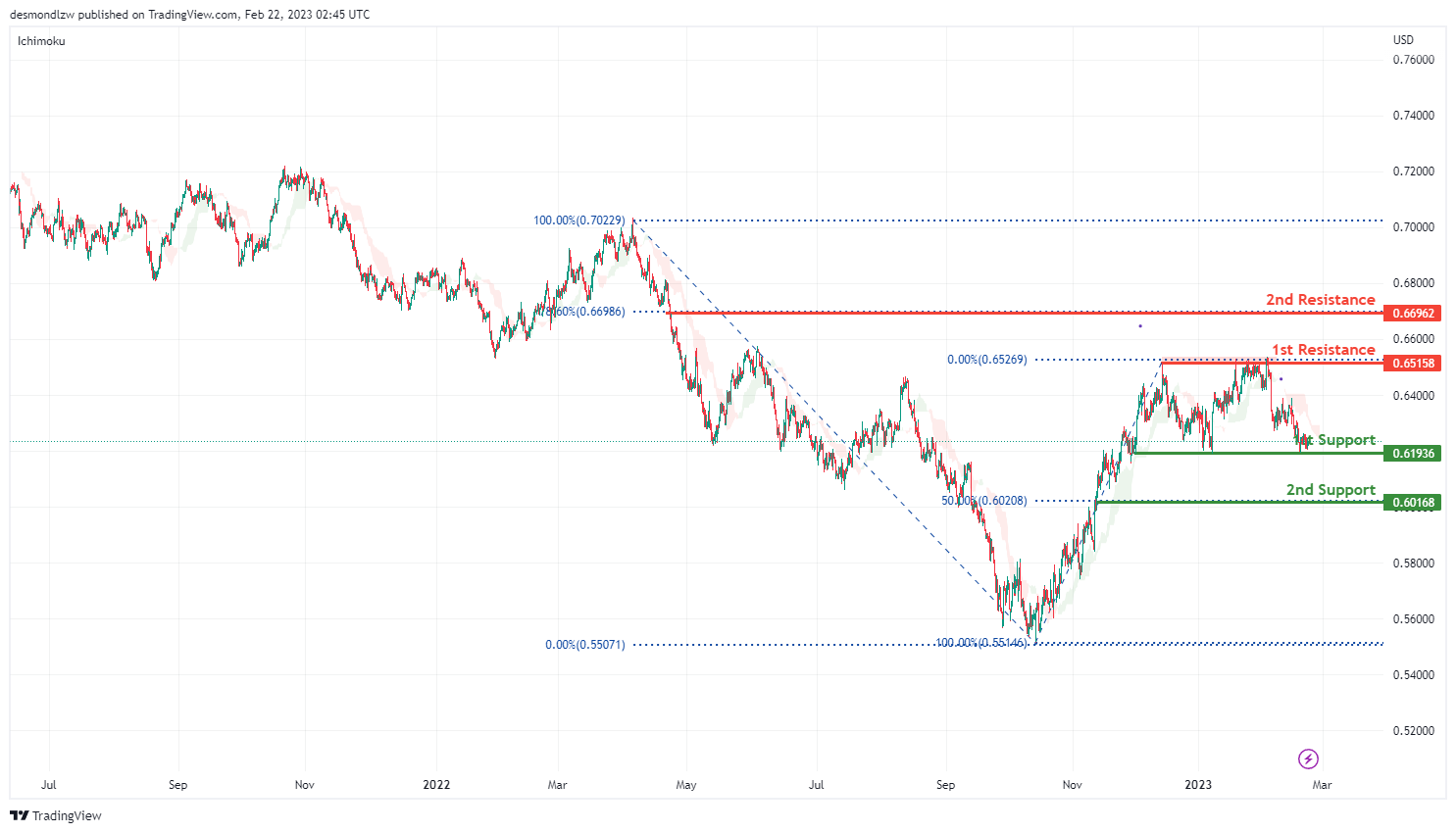
Looking at the H4 chart, my overall bias for NZDUSD is bearish, as the current price is below the Ichimoku Cloud. Expecting the price go down towards the 1st support at 0.61936 which is the overlap swing low. The 2nd support is at 0.60168 where the 50% Fibonacci line is.
In an alternate scenario, price could possibly go up towards the 1st resistance level at 0.65158 which is the recent overlap swing high and in line with 61,8% Fibonacci retracement. There is a 2nd resistance at 0.66962 where the 78.6% Fibonacci line is.
Areas of consideration:
- H4 time frame, 2nd resistance at 0.66962
- H4 time frame, 1st resistance at 0.65158
- H4 time frame, 1st support at 0.61936
- H4 time frame, 2nd support at 0.60168
USD/CAD:
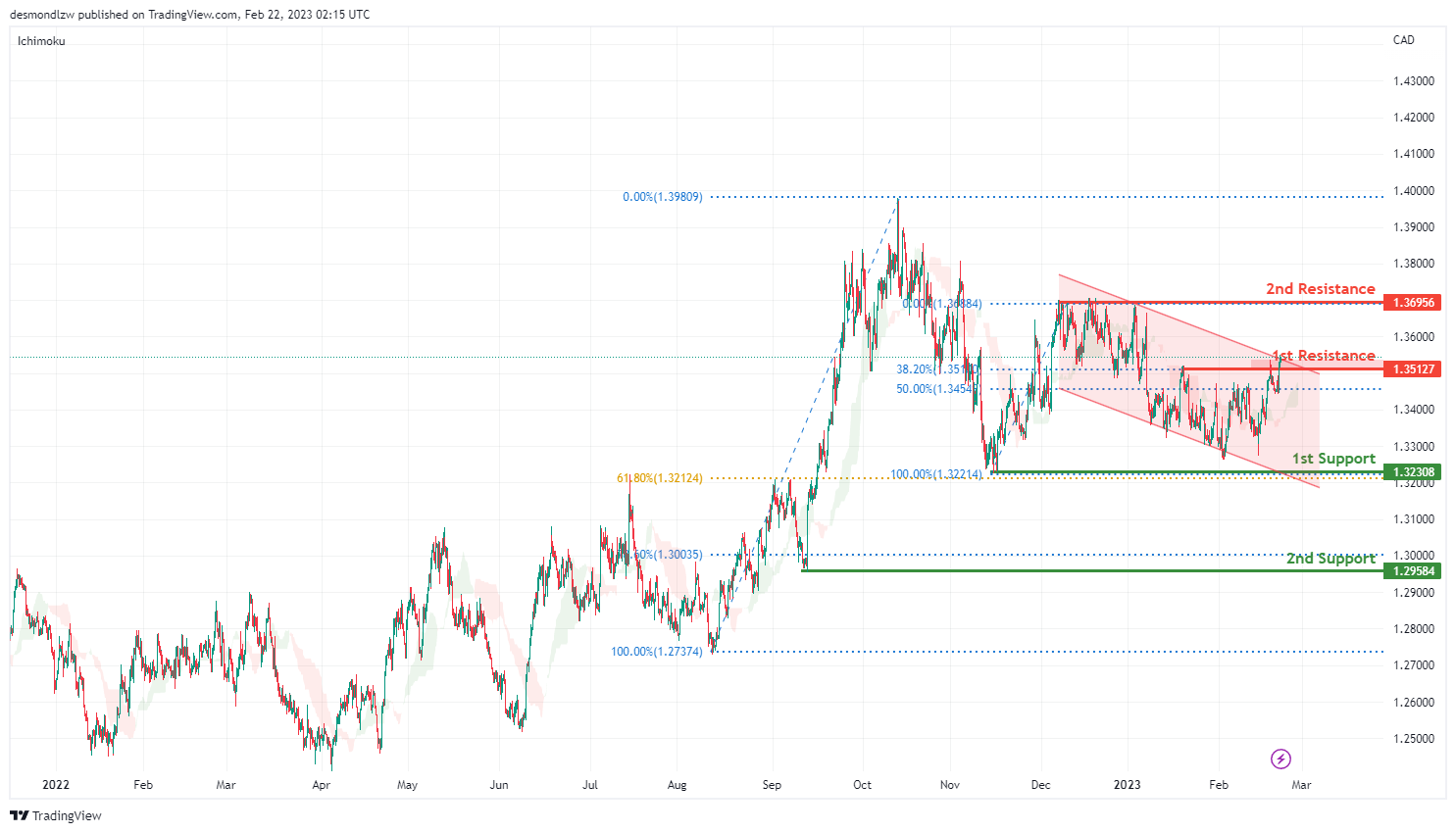
Looking at the H4 chart, my overall bias for USDCAD is bullish , as the current price is above the Ichimoku cloud and try to break the upper level of the descending channel. Expecting the current price to possibly break the 1st resistance at 1.35127 which is the recent swing high and in line with 38.2% Fibonacci retracement, before it heading to the 2nd resistance at 1.36956 which is the overlap previous swing high.
In an alternative scenario, the price could possibly drop to the 1st support at 1.32308 which is the previous swing low and also in line with the 61.8% Fibonacci retracement. The 2nd support is at 1.29584 where the 78.6% Fibonacci line is .
Areas of consideration:
- H4 time frame, 2nd resistance at 1.36956
- H4 time frame, 1st resistance at 1.35127
- H4 time frame, 1st support at 1.32308
- H4 time frame, 2nd support at 1.29584
OIL:
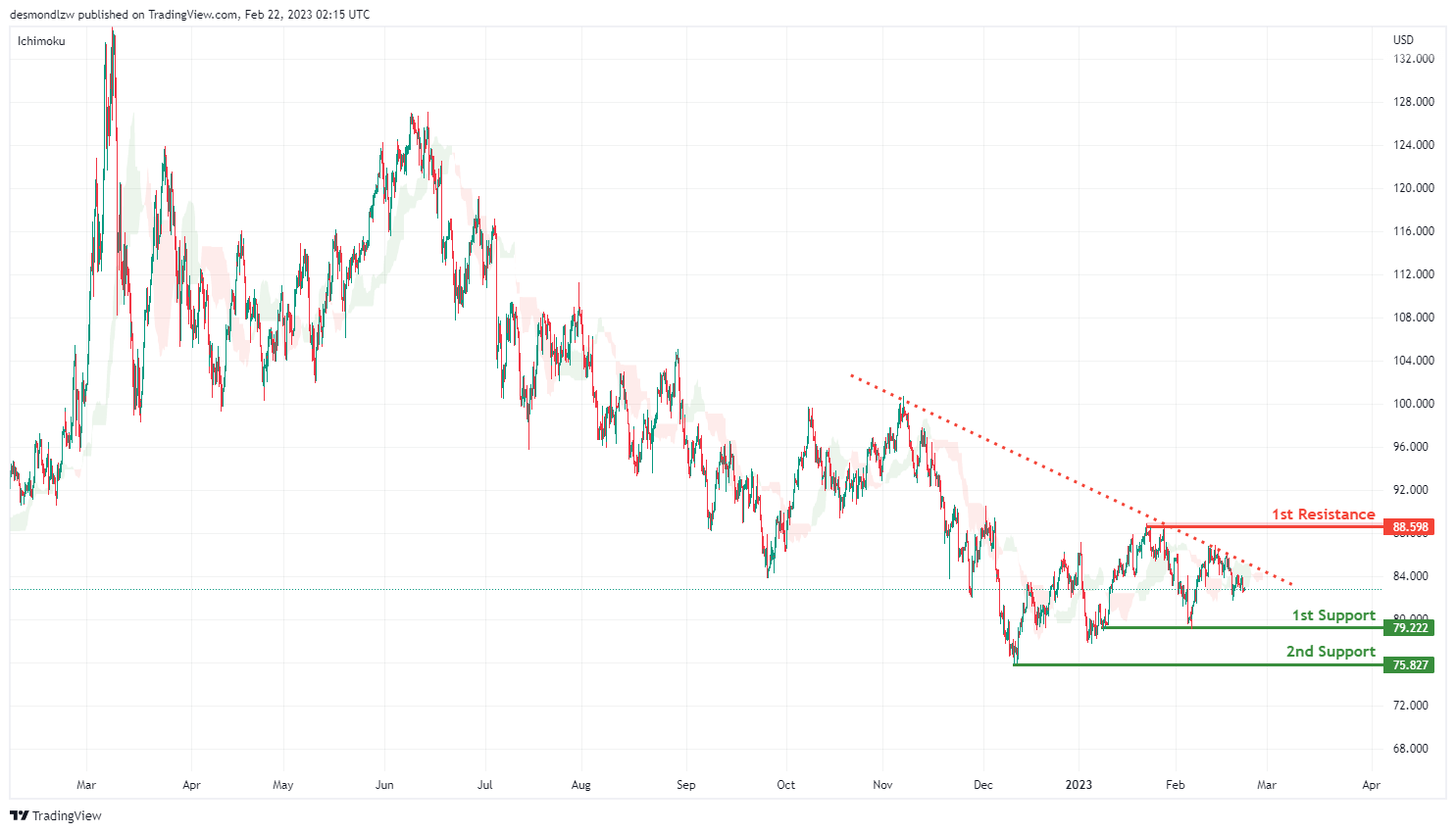
Looking at the H4 chart, my overall bias for BOC is bearish as the current price acrossing the Ichimoku cloud, and there is an descending trend line. Expecting the price to head down towards the 1st support level at 79.222 which is the recent overlap swing low, before the price drops to the 2nd support at 75.827.
In an alternate scenario, the price could possibly head up towards the 1st resistance level at 88.598 which is the recent swing high.
Areas of consideration:
- H4 time frame, 1st resistance at 88.598
- H4 time frame,1st support at 79.587
- H4 time frame, 2nd support at 75.827
Dow Jones Industrial Average:
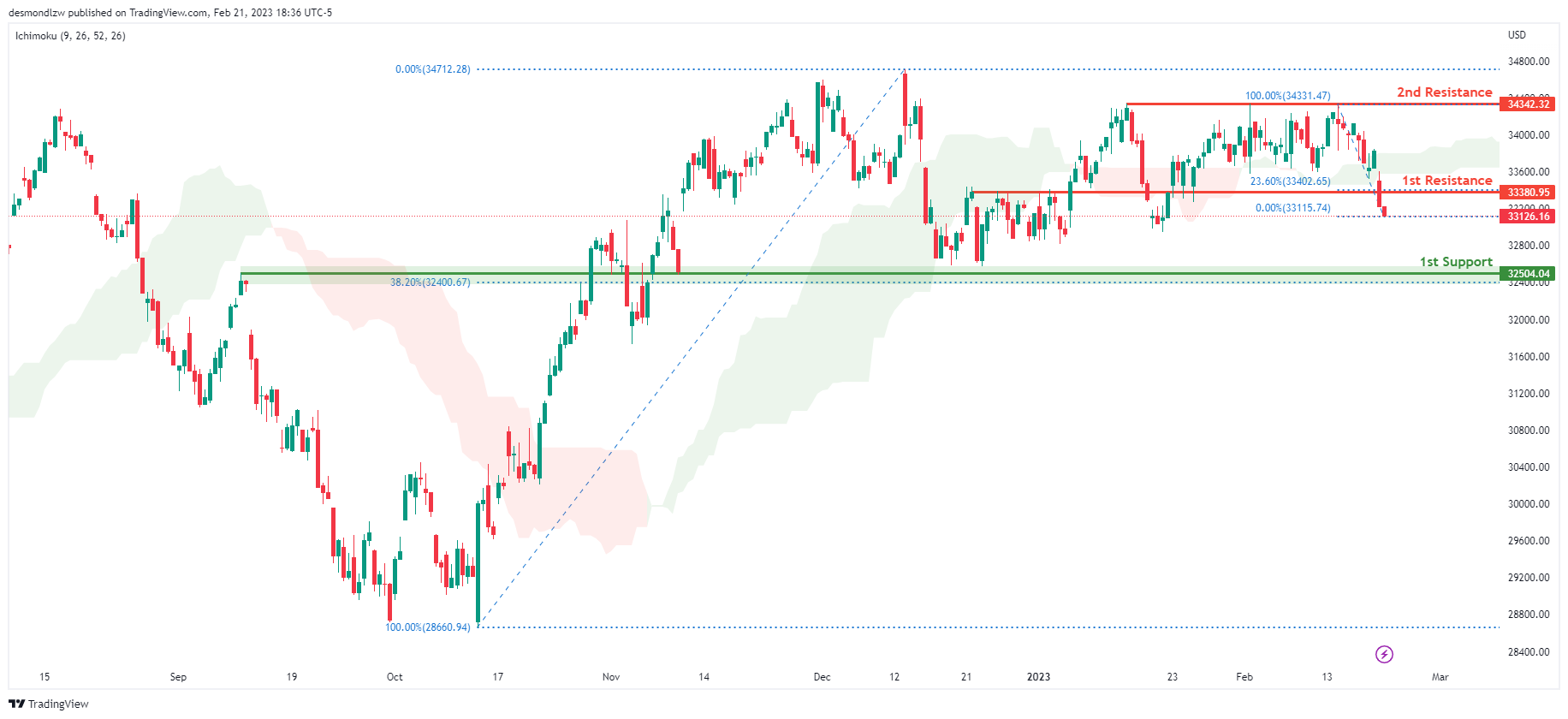
On the H4 chart, the overall bias for DJI is bearish. To add confluence to this, the price is crossing below the Ichimoku cloud which indicates a bearish market. If this bearish momentum continues, expect the price to possibly continue heading towards the 1st support at 32504.04, where the 38.2% Fibonacci line and overlap support is.
In an alternative scenario, price could possibly head back up towards the 1st resistance at 33380.95, where the 23.6% Fibonacci line is.
Areas of consideration:
- H4 time frame, 1st support at 32504.04
- H4 time frame, 1st Resistance at 33380.95
DAX:
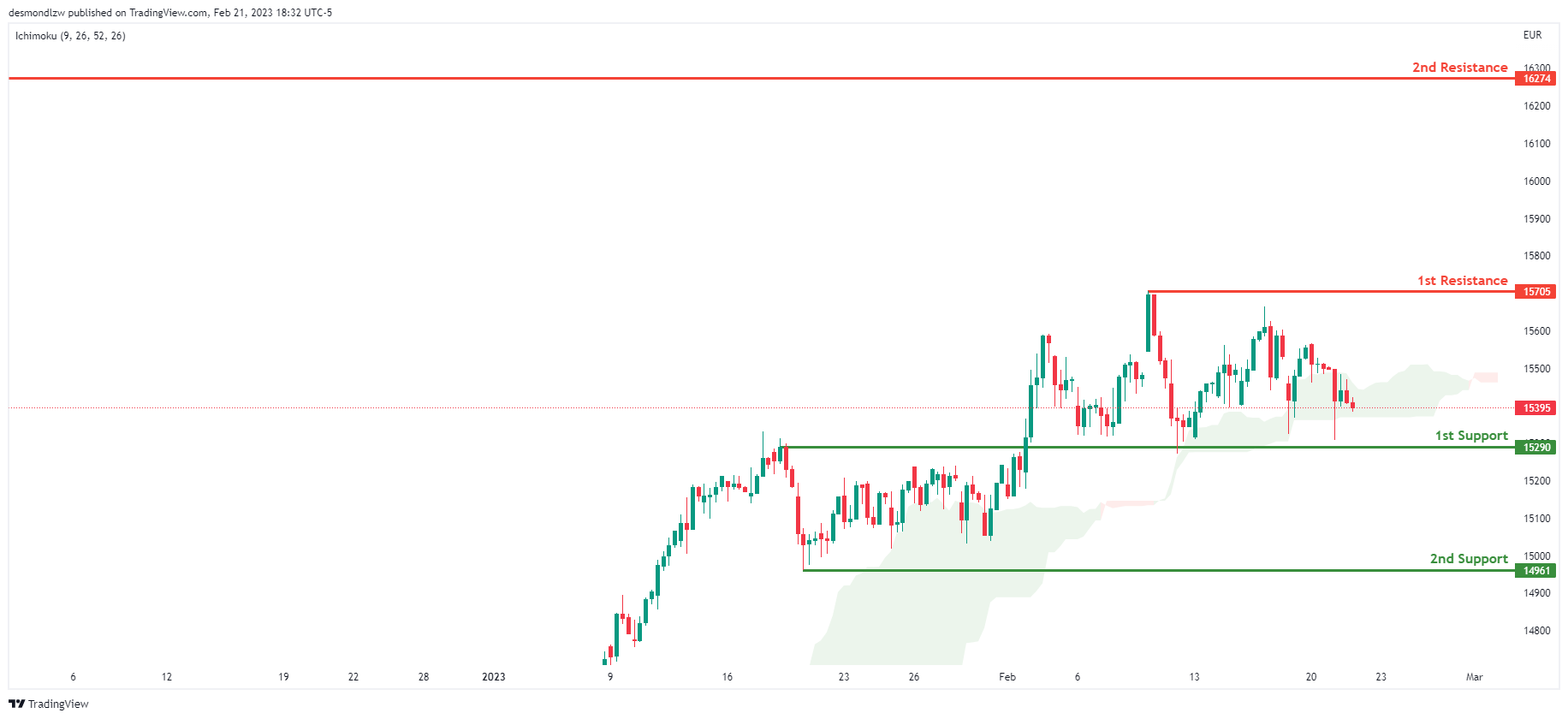
Looking at the H4 chart, my overall bias for DAX is bullish due to the current price crossing above the Ichimoku cloud, indicating a bullish market. If this bullish momentum continues, expect the price to possibly head towards the 1st resistance line at 15705, where the recent high is.
In an alternative scenario, price could possibly head down to retest the 1st support at 15290, where the overlap support is.
Areas of consideration:
- H4 time frame, 1st resistance is at 15705
- H4 time frame, 1st support is at 15290
ETHUSD:
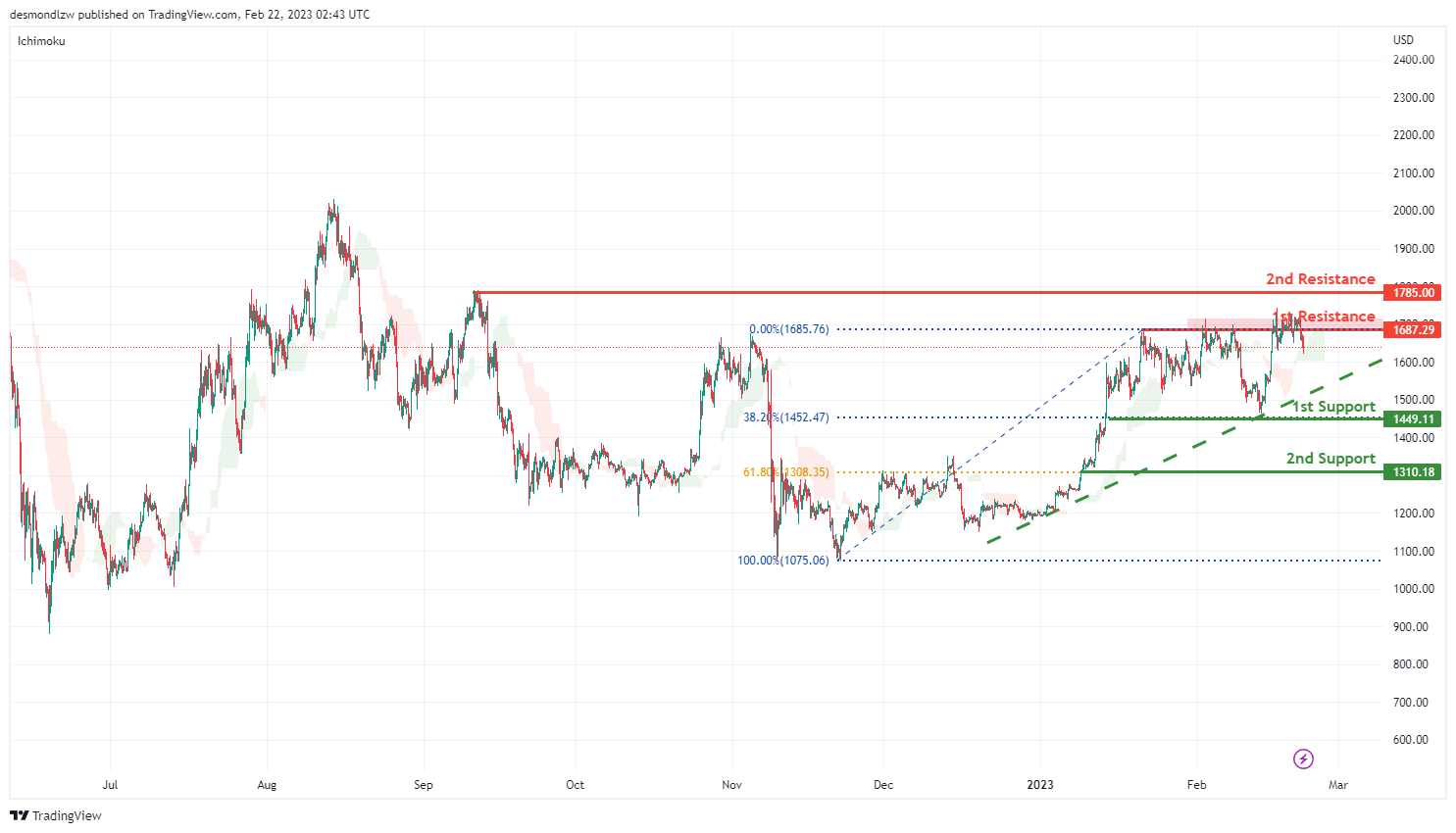
Looking at the H4 chart, my overall bias for ETHUSD is bullish, as there is a strong ascending trend line. The price may go up and break the 1st resistance line at 1685.76 before breaking the 2nd resistance line at 1785.00 which is the previous swing high.
In an alternate scenario, the price may retrace back to the 1st support line at 1449.11 which is in line with 38.2% Fibonacci retracement, before it heads towards the 2nd support at 1310.18 which is in line with 61.8% Fibonacci retracement.
Areas of consideration:
- H4 time frame, 2nd resistance of 1785.00
- H4 time frame, 1st resistance of 1685.76
- H4 time frame, 1st support at 1449.11
- H4 time frame, 2nd support at 1310.18
BTCUSD:
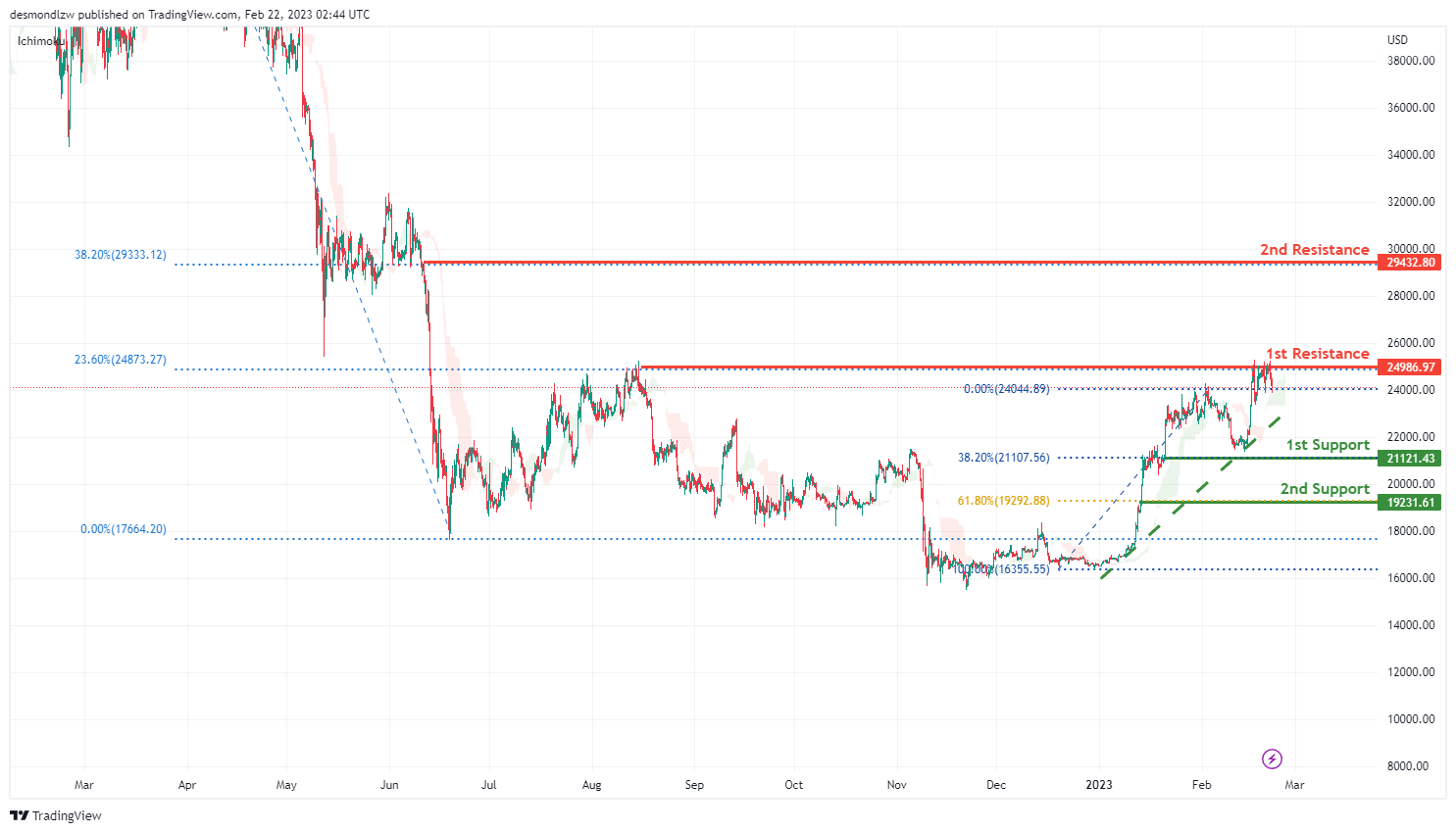
Looking at the H4 chart, my overall bias for BTCUSD is bulllish. As there is an ascending trend line, expect the price could possibly head up to the 1st resistance at 24986.97 which is the overlap recent swing high, before it head up to the 2nd resistance 29432.80 where the 38.2% Fibonacci retracement is.
In an alternate scenario, The price may go down towards the 1st support line at 21121.43 which is in line with 38.2% Fibonacci retracement, before heading down towards the 2nd support at 19231.61 which is in line with 61.8% Fibonacci retracement.
Areas of consideration:
- H4 time frame, 2nd resistance 29432.80
- H4 time frame, 1st resistance 24986.97
- H4 time frame, 1st support at 21121.43
- H4 time frame, 2nd support at 19231.61
S&P 500:
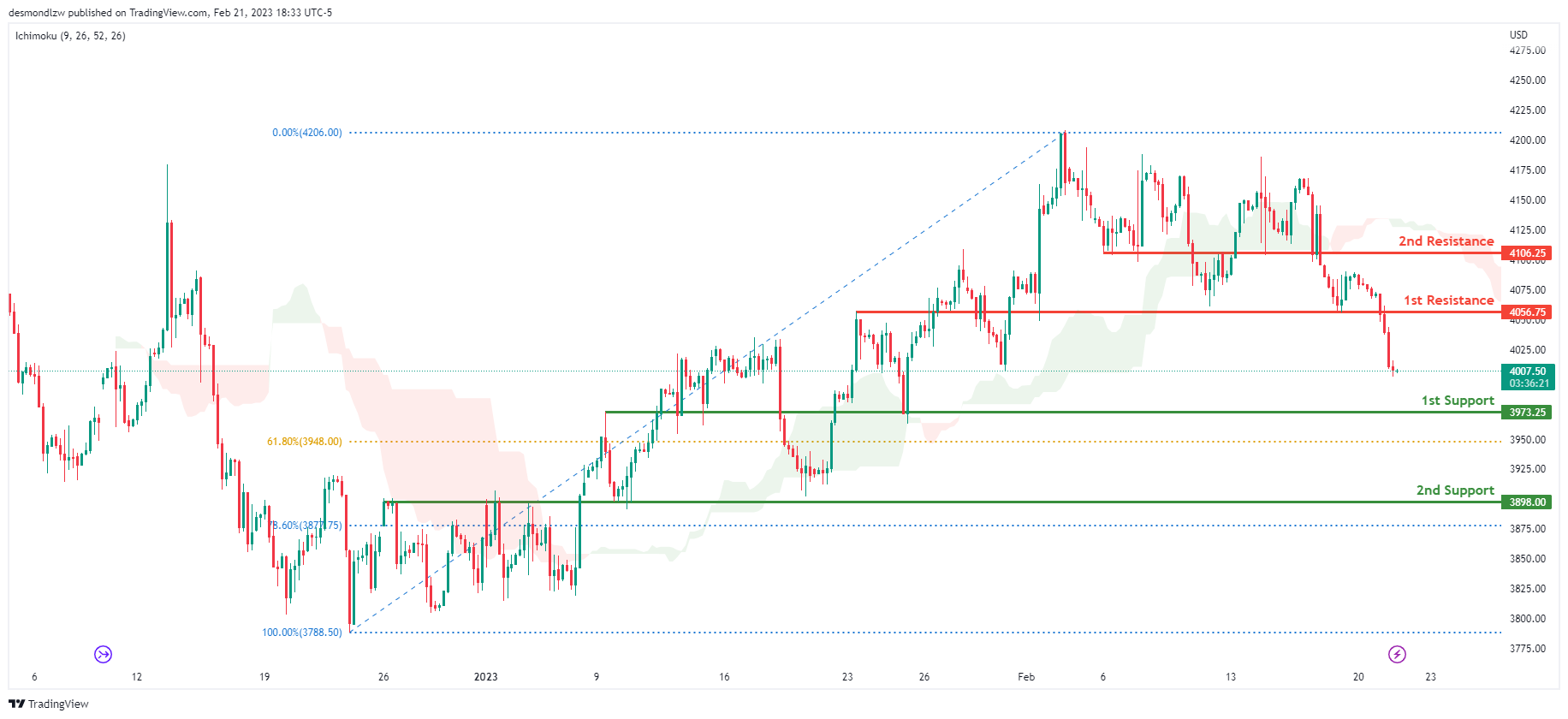
Looking at the H4 chart, my overall bias for S&P500 is bearish due to the current price being below the Ichimoku cloud, indicating a bearish market. If this bearish momentum continues, expect the price to continue heading towards the 1st support at 3973.25 which is the overlap support and slightly above where the 61.8% Fibonacci line is.
In an alternative scenario, price could possibly head back up to retest the 1st resistance at 4056.75, where the overlap resistance is.
Areas of consideration:
- H4 time frame, 1st support at 3973.25
- H4 time frame, 1st resistance at 4056.75
USD/CAD Daily Outlook
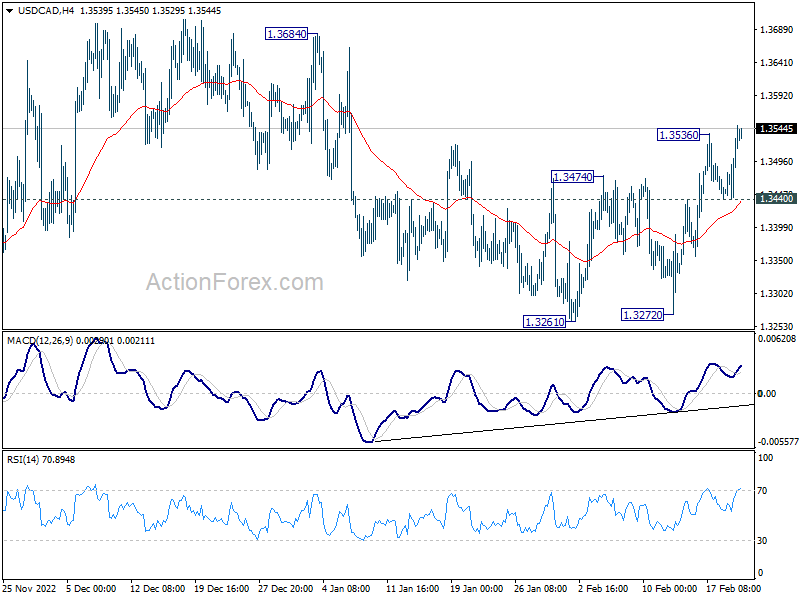
Daily Pivots: (S1) 1.3470; (P) 1.3509; (R1) 1.3577; More....
USD/CAD's rally resumed after brief retreat and intraday bias is back on the upside. Outlook is unchanged that corrective pattern from 1.3967 should have completed at 1.3261. Further rally should now be seen to 1.3684 resistance first. Break there will pave the way back to retest 1.3976 high. On the downside, however, break of 1.3440 support will dampen this bullish cas and turn intraday bias neutral first.
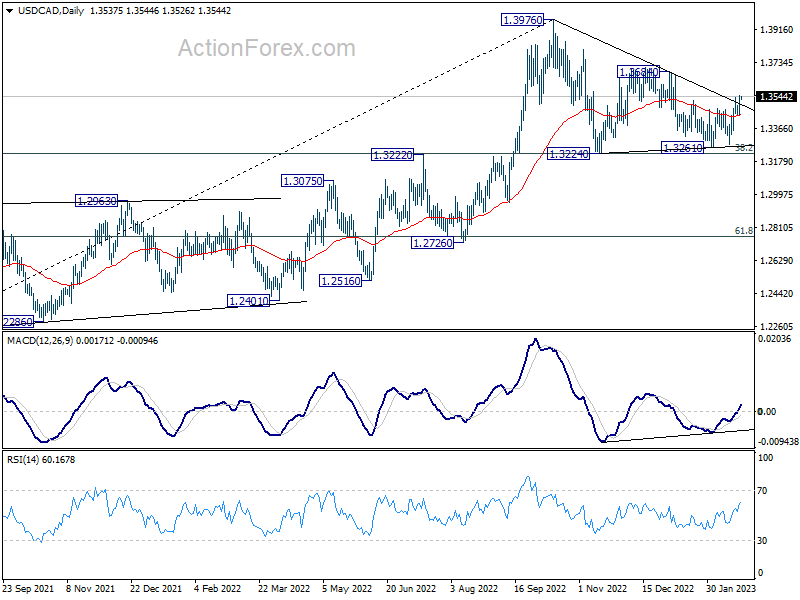
In the bigger picture, as long as 1.3222 cluster support (38.2% retracement of 1.2005 to 1.3976 at 1.3223) holds, larger up trend from 1.2005 (2021 low) is still expected to resume through 1.3976 high at a later stage. However, firm break of 1.3222/3 will indicate that the trend might have reversed. Deeper fall would be seen to next cluster support at 1.2726 (61.8% retracement at 1.2758).
NZD Higher after RBNZ Hike, Other Commodity Currencies Soft
New Zealand Dollar rises broadly today after hawkish RBNZ hike. But other commodity currencies are lagging behind on risk-off sentiment. As for the week so far, Sterling remains the strongest, as supported by optimism on avoiding recession. Dollar followed as second as supported by rising treasury yields, and then Swiss Franc. Aussie is the worst, followed by Yen and then Loonie.
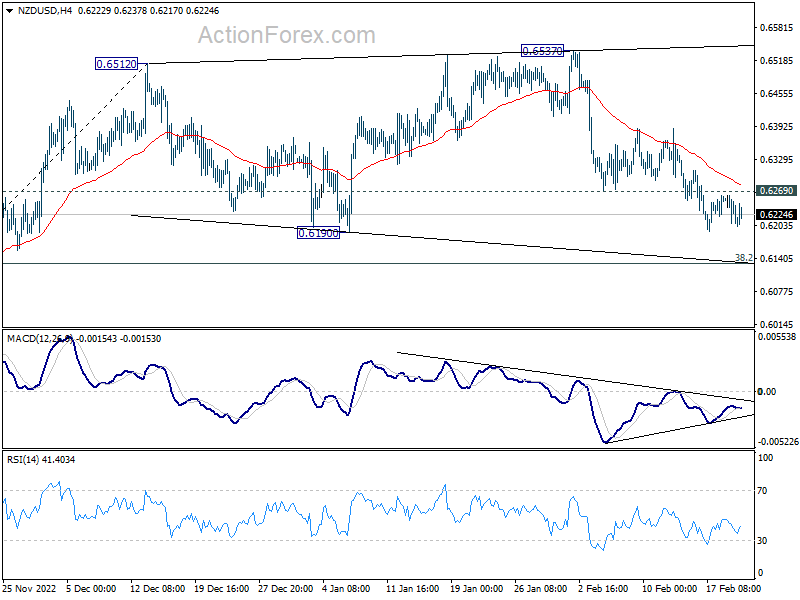
Technically, NZD/USD's recovery today is rather weak, and doesn't warrant a reversal. Fall from 0.6537 is still in favor to continue as long as 0.6269 support turned resistance holds. Yet, the three-wave consolidation from 0.6512 should be about to complete. Downside momentum should continue to slow while support will come in below 0.6190. Break of 0.6269 will suggest short term bottoming and bring stronger rebound.
In Asia, at the time of writing, Nikkei is down -1.30%. Hong Kong HSI is up 0.03%. China Shanghai SSE is down -0.25%. Singapore Strait Times is down -0.18%. Japan 10-year JGB yield is up 0.009 at 0.512. Overnight, DOW dropped -2.06%. S&P 500 dropped -2.00%. NASDAQ dropped -2.50%. 10-year yield rose 0.127 to 3.955.
RBNZ hikes 50bps, sees OCR peaking at 5.5%
RBNZ raises the Official Cash Rate by 50bps to 4.75% as widely expected. It also maintained hawkish bias and noted, "monetary conditions need to tighten further".
Regarding cyclone Gabrielle, it's "too early to accurately assess the monetary policy implications".. The committee will also "look through" the "short-term output variations and direct price effects" related to the weather event.
In the economic projections, RBNZ sees OCR peaking at 5.5% in Q4 2023, and stays above 5% until Q1 2025. GDP is projected to contract in Q2, Q3 and Q4 this year. Inflation is projected to drop gradually from 7.3% in Q1, but only falls back below 3% in Q3 2024.
In the post meeting press conference, RBNZ Governor Adrian Orr said that all options remain on the table today, "including 25, 50 and 75 bps hikes." There was "very little discussion of a 25bp rate hike", while "most focus was on 50bp".
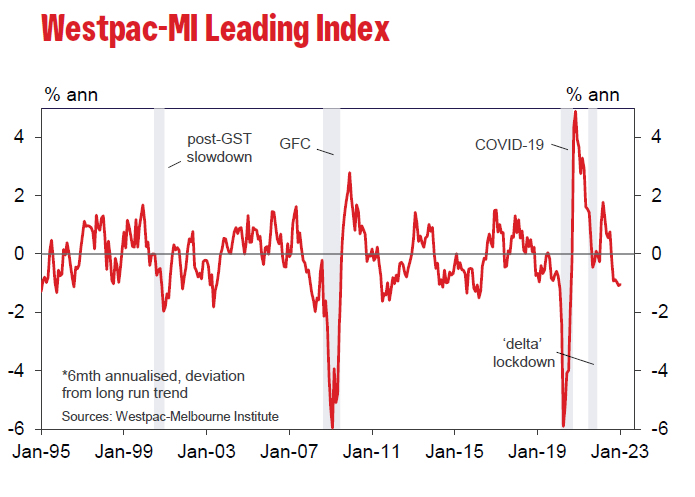
Australia Westpac leading index ticked up, growth below trend through most of 2023
Australia Westpac-MI leading index ticked up slightly in January. Growth in the three to nine months period is estimated to be -1.04% below trend, comparing to -1.09% in December.
Westpac added that growth would remain below trend through most of 2023, with global factors, monetary policy and, recently, hours worked have weighed heavily on the Index.
Regarding RBA policy, Westpac expects another 25bps hike at March meeting to 3.60%. The cash rate is expected to peak at 3.85%, but recent communications from RBA "imply upside risks to that forecast".
BoJ Tamura: Appropriate to maintain monetary easing for now
BoJ board member Naoki Tamura said, "we're now in a phase where we need to scrutinise whether Japan can achieve a positive wage-inflation cycle. As such, it's appropriate to maintain monetary easing for now."
Tamura also noted that December's decision to double to yield cap was aimed at making monetary easing more sustainable, not at tightening. "At this stage, it's important to follow carefully and humbly how markets would stabilise and to what extent market functions will improve," he said.
Looking ahead
Germany Ifo business climate is the main focus in European session while CPI final will also be released. Swiss will release ZEW expectations. Later in the day, FOMC minutes will take center stage. Canada new housing price index will also be featured.
USD/CAD Daily Outlook
Daily Pivots: (S1) 1.3470; (P) 1.3509; (R1) 1.3577; More....
USD/CAD's rally resumed after brief retreat and intraday bias is back on the upside. Outlook is unchanged that corrective pattern from 1.3967 should have completed at 1.3261. Further rally should now be seen to 1.3684 resistance first. Break there will pave the way back to retest 1.3976 high. On the downside, however, break of 1.3440 support will dampen this bullish cas and turn intraday bias neutral first.
In the bigger picture, as long as 1.3222 cluster support (38.2% retracement of 1.2005 to 1.3976 at 1.3223) holds, larger up trend from 1.2005 (2021 low) is still expected to resume through 1.3976 high at a later stage. However, firm break of 1.3222/3 will indicate that the trend might have reversed. Deeper fall would be seen to next cluster support at 1.2726 (61.8% retracement at 1.2758).
Economic Indicators Update
| GMT | Ccy | Events | Actual | Forecast | Previous | Revised |
|---|---|---|---|---|---|---|
| 21:45 | NZD | Trade Balance (NZD) Jan | -1954M | -475M | -636M | |
| 23:30 | AUD | Westpac Leading Index M/M Jan | -0.10% | -0.10% | -0.20% | |
| 23:50 | JPY | Corporate Service Price Index Y/Y Jan | 1.60% | 1.50% | 1.50% | |
| 00:30 | AUD | Wage Price Index Q/Q Q4 | 0.80% | 1.00% | 1.00% | 1.10% |
| 00:30 | AUD | Construction Work Done Q4 | -0.40% | 1.60% | 2.20% | |
| 01:00 | NZD | RBNZ Rate Decision | 4.75% | 4.75% | 4.25% | |
| 02:00 | NZD | RBNZ Press Conference | ||||
| 07:00 | EUR | Germany CPI M/M Jan F | 1.00% | 1.00% | ||
| 07:00 | EUR | Germany CPI Y/Y Jan F | 8.70% | 8.70% | ||
| 09:00 | CHF | ZEW Expectations Feb | -40 | |||
| 09:00 | EUR | Germany IFO Business Climate Feb | 91.1 | 90.2 | ||
| 09:00 | EUR | Germany IFO Current Assessment Feb | 94.3 | 94.1 | ||
| 09:00 | EUR | Germany IFO Expectations Feb | 84.7 | 86.4 | ||
| 13:30 | CAD | New Housing Price Index M/M Jan | 0.10% | 0.00% | ||
| 19:00 | USD | FOMC Minutes |
Australia Westpac leading index ticked up, growth below trend through most of 2023
Australia Westpac-MI leading index ticked up slightly in January. Growth in the three to nine months period is estimated to be -1.04% below trend, comparing to -1.09% in December.
Westpac added that growth would remain below trend through most of 2023, with global factors, monetary policy and, recently, hours worked have weighed heavily on the Index.
Regarding RBA policy, Westpac expects another 25bps hike at March meeting to 3.60%. The cash rate is expected to peak at 3.85%, but recent communications from RBA "imply upside risks to that forecast".
First Impressions: RBNZ Monetary Policy Statement February 2023
The Reserve Bank raised the Official Cash Rate by 50 basis points to 4.75%, and maintained its projection of a 5.5% peak in the coming months.
RBNZ Monetary Policy Statement, February 2023
The Reserve Bank increased the Official Cash Rate by 50 basis points to 4.75%, as was expected by most forecasters.
Surprisingly, there was almost no change to the projected OCR track compared to the November policy statement. The OCR is still expected to peak at 5.5% in the middle part of this year (albeit slightly later), and to fall only gradually from late next year.
We had expected a modest lowering of the OCR track, given that recent inflation outturns hadn’t quite lived up to the very strong assumptions that the RBNZ had made.
The options that the Monetary Policy Committee considered this time were between a 50bp and a 75bp increase. The Committee went for the smaller move, noting that the upside risks to inflation had lessened since the November review.
There was no consideration of delaying interest rate hikes in response to Cyclone Gabrielle’s impact, noting that fiscal policy could address this more effectively.
The Committee judged that the effects of the cyclone did not materially alter the outlook for monetary policy over the medium term. However, it is still early days in terms of assessing the scale of its impact, particularly in terms of the amount of rebuilding work it will generate.
The RBNZ is clearly grappling with an uncertain environment, even before the impact of Cyclone Gabrielle. It still sees upside risks to inflation in the near term. However, it also sees the risks being towards a shorter and sharper downturn in activity, and a more intense impact on household spending as homeowners roll on to higher mortgage rates.
Our current forecast is for the OCR to peak at 5.25%. In the coming months we expect to see more evidence that higher interest rates are having a restraining effect on demand, which would give the RBNZ some comfort that it has done enough to put inflation on a path back towards the 1-3% target range.
RBNZ media release
The Committee agreed that the OCR still needs to increase, as indicated in the November Statement, to ensure inflation returns to within its target range over the medium term. While there are early signs of price pressure easing, core consumer price inflation remains too high, employment is still beyond its maximum sustainable level, and near-term inflation expectations remain elevated.
Cyclone Gabrielle and other recent severe weather events have had a devastating effect on the lives of many New Zealanders. It is too early to accurately assess the monetary policy implications of these weather events, given that the scale of destruction and economic disruption are only now becoming evident. The timing, size, and the nature of funding the Government’s fiscal response are also yet to be determined.
The Committee’s current assessment is that over coming weeks, prices for some goods are likely to spike and activity will be weaker than previously expected. Export revenues will be negatively impacted. Monetary policy is set with a medium-term focus, and the Committee will look through these short-term output variations and direct price effects. In time, the infrastructure and community rebuild will add to activity and inflationary pressures, especially given existing capacity constraints in the economy.
Internationally, core inflation remains high and inflationary pressures remain broad based. However, the outlook for global economic activity in 2023 remains subdued, which is acting to lower global consumer pricing pressures, as well as demand for New Zealand’s key commodity exports. Continued growth in services exports will provide some export revenue offset.
Domestically, demand remained robust through 2022 underpinned by resilient household spending, construction activity, government spending, and a swift recovery in international tourism as the border reopened. Labour shortages remain a significant constraint on economic activity, contributing to heightened wage inflation. People are moving jobs at an elevated pace, consistent with labour shortages and strong demand.
While there are early signs of demand easing it continues to outpace supply, as reflected in strong domestic inflation. The Committee agreed that monetary conditions need to tighten further, as indicated in the November Statement, so as to be confident there is sufficient restraint on spending to bring inflation back within its 1 to 3% per annum target range. The Committee remains determined to achieve its Monetary Policy Remit.
BoJ Tamura: Appropriate to maintain monetary easing for now
BoJ board member Naoki Tamura said, "we're now in a phase where we need to scrutinise whether Japan can achieve a positive wage-inflation cycle. As such, it's appropriate to maintain monetary easing for now."
Tamura also noted that December's decision to double to yield cap was aimed at making monetary easing more sustainable, not at tightening. "At this stage, it's important to follow carefully and humbly how markets would stabilise and to what extent market functions will improve," he said.
RBNZ hikes 50bps, sees OCR peaking at 5.5%
RBNZ raises the Official Cash Rate by 50bps to 4.75% as widely expected. It also maintained hawkish bias and noted, "monetary conditions need to tighten further".
Regarding cyclone Gabrielle, it's "too early to accurately assess the monetary policy implications".. The committee will also "look through" the "short-term output variations and direct price effects" related to the weather event.
In the economic projections, RBNZ sees OCR peaking at 5.5% in Q4 2023, and stays above 5% until Q1 2025. GDP is projected to contract in Q2, Q3 and Q4 this year. Inflation is projected to drop gradually from 7.3% in Q1, but only falls back below 3% in Q3 2024.
In the post meeting press conference, RBNZ Governor Adrian Orr said that all options remain on the table today, "including 25, 50 and 75 bps hikes." There was "very little discussion of a 25bp rate hike", while "most focus was on 50bp".
(RBNZ) Reserve Bank increases the Official Cash Rate
The Monetary Policy Committee today increased the Official Cash Rate (OCR) from 4.25% to 4.75%.
The Committee agreed that the OCR still needs to increase, as indicated in the November Statement, to ensure inflation returns to within its target range over the medium term. While there are early signs of price pressure easing, core consumer price inflation remains too high, employment is still beyond its maximum sustainable level, and near-term inflation expectations remain elevated.
Cyclone Gabrielle and other recent severe weather events have had a devastating effect on the lives of many New Zealanders. It is too early to accurately assess the monetary policy implications of these weather events, given that the scale of destruction and economic disruption are only now becoming evident. The timing, size, and the nature of funding the Government's fiscal response are also yet to be determined.
The Committee's current assessment is that over coming weeks, prices for some goods are likely to spike and activity will be weaker than previously expected. Export revenues will be negatively impacted. Monetary policy is set with a medium-term focus, and the Committee will look through these short-term output variations and direct price effects. In time, the infrastructure and community rebuild will add to activity and inflationary pressures, especially given existing capacity constraints in the economy.
Internationally, core inflation remains high and inflationary pressures remain broad based. However, the outlook for global economic activity in 2023 remains subdued, which is acting to lower global consumer pricing pressures, as well as demand for New Zealand's key commodity exports. Continued growth in services exports will provide some export revenue offset.
Domestically, demand remained robust through 2022 underpinned by resilient household spending, construction activity, government spending, and a swift recovery in international tourism as the border reopened. Labour shortages remain a significant constraint on economic activity, contributing to heightened wage inflation. People are moving jobs at an elevated pace, consistent with labour shortages and strong demand.
While there are early signs of demand easing it continues to outpace supply, as reflected in strong domestic inflation. The Committee agreed that monetary conditions need to tighten further, as indicated in the November Statement, so as to be confident there is sufficient restraint on spending to bring inflation back within its 1 to 3% per annum target range. The Committee remains determined to achieve its Monetary Policy Remit.
Summary record of meeting
The Monetary Policy Committee discussed developments affecting the outlook for inflation and employment in New Zealand. Overall, the economy has developed broadly in line with expectations at the time of the November Statement. Inflation is currently too high and employment is beyond its maximum sustainable level. The Committee agreed it must continue to increase the Official Cash Rate (OCR) to return inflation to target and to fulfil its Remit.
The Committee discussed recent international economic developments and their implications for New Zealand. In many countries, core inflation remains high, reflecting significant broad-based inflationary pressures. The outlook for global economic activity in 2023 remains relatively subdued. A weakening global economy is contributing to weaker demand for New Zealand's key commodity exports, such as dairy and meat, leading to a lower outlook for New Zealand's terms of trade. Continued growth in New Zealand's service exports, in particular tourism, is assumed to provide some offset to this drop in export revenue in the near term. As is an easing of travel and activity restrictions in China over the medium term.
Committee members discussed the effects of Cyclone Gabrielle and other recent severe weather events. These events have had a devastating effect on the lives of many New Zealanders. Economically, they represent a disruption to employment, trade and production, and damage to property. The economic impacts discussed by the Committee included the immediate upward pressure on some prices, the effect that higher CPI inflation could have on longer-term inflation expectations, the ability to resource and supply any increase in demand and investment in affected regions, and the longer-term impact these severe weather events will have on the productive capacity of New Zealand.
While it is too early to estimate the full economic impacts, near-term rebuilding and restocking are likely to lift the level of economic activity, and consumer prices for some goods and services will come under upward pressure given supply chain disruption and product scarcity. Weaker export volumes will impact negatively on export earnings as a result of these extreme weather events. It remains unclear how significant the impact of these events will be on New Zealand's longer-term productive capacity.
Monetary policy is set with a medium-term focus. Given this, the Committee decided to look through the short-term direct price pressures stemming from these extreme weather events, and focus on the medium-term impacts on inflation and maximum sustainable employment.
At this stage, the Committee agreed that the medium-term impacts of the severe weather events do not materially alter the outlook for monetary policy. However, significant uncertainty remains, and more accurate information on the scale of the events is becoming available by the day. Inflation remains high, employment is above its maximum sustainable level, and ongoing restrictive monetary policy settings are necessary. However, the Committee acknowledged the significant regional impacts that the severe weather events will have across New Zealand, and agreed that the Government's fiscal policy response would be more effective at addressing these, rather than any monetary policy activity.
The Committee noted that demand in the New Zealand economy remained robust through 2022, despite significant global and domestic challenges. Economic growth has been underpinned by resilient household spending, construction activity, government spending, and a swift recovery in international tourism as the border reopened. High frequency surveys of economic activity suggest domestic demand may be starting to ease. This moderation is in line with expectations outlined at the November Statement. However, demand continues to outpace supply, and this continues to be reflected in high domestic inflation.
The Committee observed that consumer price inflation in New Zealand in the December quarter remained high. Encouragingly, there was a slightly larger-than-forecast slowing in non-tradable inflation. However, CPI inflation, at 7.2 percent in the year to the December 2022 quarter, remains well above the 1 to 3 percent target range set out in the Remit. Measures of persistent or 'core' inflation have remained very high, indicating that high inflation remains broad-based. Medium- and longer-term inflation expectations have stabilised recently, but remain elevated. The potential for a persistent continuation of global and domestic supply constraints, greater persistence in core inflation and elevated inflation expectations were seen as upside risks to the economic projections.
The Committee noted that a range of measures indicated that labour shortages continue to be a significant constraint on economic activity, contributing to strong wage inflation. Measures of labour force utilisation are near record levels and firms continue to report severe difficulties finding labour. Private sector employees are also transitioning between jobs at an elevated pace, consistent with significant labour shortages and strong demand in the economy.
The Committee discussed financial conditions noting that increases in both shorter term wholesale and mortgage rates have exceeded longer term maturities. It was also noted that deposit rate increases continue to lag the increases in wholesale and mortgage rates resulting in a further widening of bank margins between lending and deposit rates. The Committee expect deposit rates to increase over the coming year incentivising savings, further dampening inflation and supporting the maintenance of current mortgage rates for a longer period.
The Committee also discussed the functioning of the New Zealand Government bond market, in the context of sales of bonds in the Large Scale Asset Purchase Programme portfolio. Measures of secondary market liquidity were generally in line with historic norms and observed volatility was consistent with trends seen in international interest rate markets.
The Committee considered the economic projections. As in the November Statement, the central projections show a decline in GDP this year. Members noted that this reduction in aggregate demand was necessary to return inflation to target over the forecast period. Members agreed that the exact timing and extent of negative GDP growth was difficult to predict, but historical evidence suggests risks are skewed toward a more concentrated period of contraction. Members also agreed that the sooner supply and demand were better matched in the economy, the lower the overall cost of reducing inflation.
The Committee discussed the resilience of household balance sheets in the context of rising interest rates and the outlook for reduced labour demand. This was seen as a downside risk – with the potential for monetary policy to have larger effects on the economy in an environment of elevated debt levels. However, it was noted that while measures of financial stress have increased marginally, they remain low. The Committee agreed that as debt servicing costs rise, spending decisions for many households will become increasingly constrained. These constraints would be felt most by recent home buyers with a high debt servicing commitment relative to their income.
The Committee agreed that the impact of rising interest rates on households' spending and saving decisions is an important channel for monetary policy. The Committee also agreed that housing market related activity was a downside risk. Projections incorporate a substantial decline in construction. However, there are significant uncertainties. Feedback from the construction industry points to a significant lack of forward activity. In contrast, rebuilding in the wake of Cyclone Gabrielle will support construction activity.
The Committee agreed that fiscal policy can also act to reduce demand in the economy. The current projection assumes government consumption and investment will fall as a share of the economy in coming years. However, members viewed the risks to inflation pressure from fiscal policy as skewed to the upside, particularly given the ongoing demand for government services in an environment of rising costs of provision. In addition, the economic impact of the Government response to recent severe weather events will depend on the scale of damage, fiscal reprioritisation decisions, timing of activity and how the fiscal costs are funded.
The Committee discussed the extent of additional monetary tightening required to achieve its Remit. Members noted the rapid pace and extent of tightening to date implies monetary policy is now contractionary. The Committee noted the long lags of monetary transmission to the economy means the impact of this tightening is still to be fully seen. Committee members agreed that the OCR needed to reach a level where the Committee could be confident it would reduce actual inflation to within the target range over the forecast horizon. Members agreed that this level of the OCR was broadly consistent with expectations at the time of the November Statement.
The Committee discussed the size of the OCR increase to be delivered at this meeting. Increases of 50 and 75 basis points were considered. The Committee assessed that, while the balance of risks around inflation remain skewed to the upside, the extent of this risk had moderated somewhat since the November Statement. As a result, a 50 basis point move balanced the need to ensure core inflation and inflation expectations fall, against the early signs that demand was beginning to moderate towards the economy's productive capacity.
On Wednesday 22 February, the Committee reached a consensus to raise the OCR by 50 basis points from 4.25% to 4.75%.
Attendees:
Reserve Bank members of MPC: Adrian Orr, Karen Silk, Christian Hawkesby, Paul Conway
External MPC members: Bob Buckle, Peter Harris, Caroline Saunders
Treasury Observer: Dominick Stephens
MPC Secretary: Adam Richardson
Crude Oil Price At Risk of Additional Losses
Key Highlights
- Crude oil price is facing resistance near the $78.50 zone.
- A major bearish trend line is forming with resistance near $78.50 on the 4-hours chart.
- Gold price is struggling to clear the $1,850 resistance zone.
- EUR/USD might slide further below the 1.0600 support zone.
Crude Oil Price Technical Analysis
Crude oil price started a fresh decline from the $80.50 resistance against the US Dollar. The price declined below the $78.50 support to move into a bearish zone.
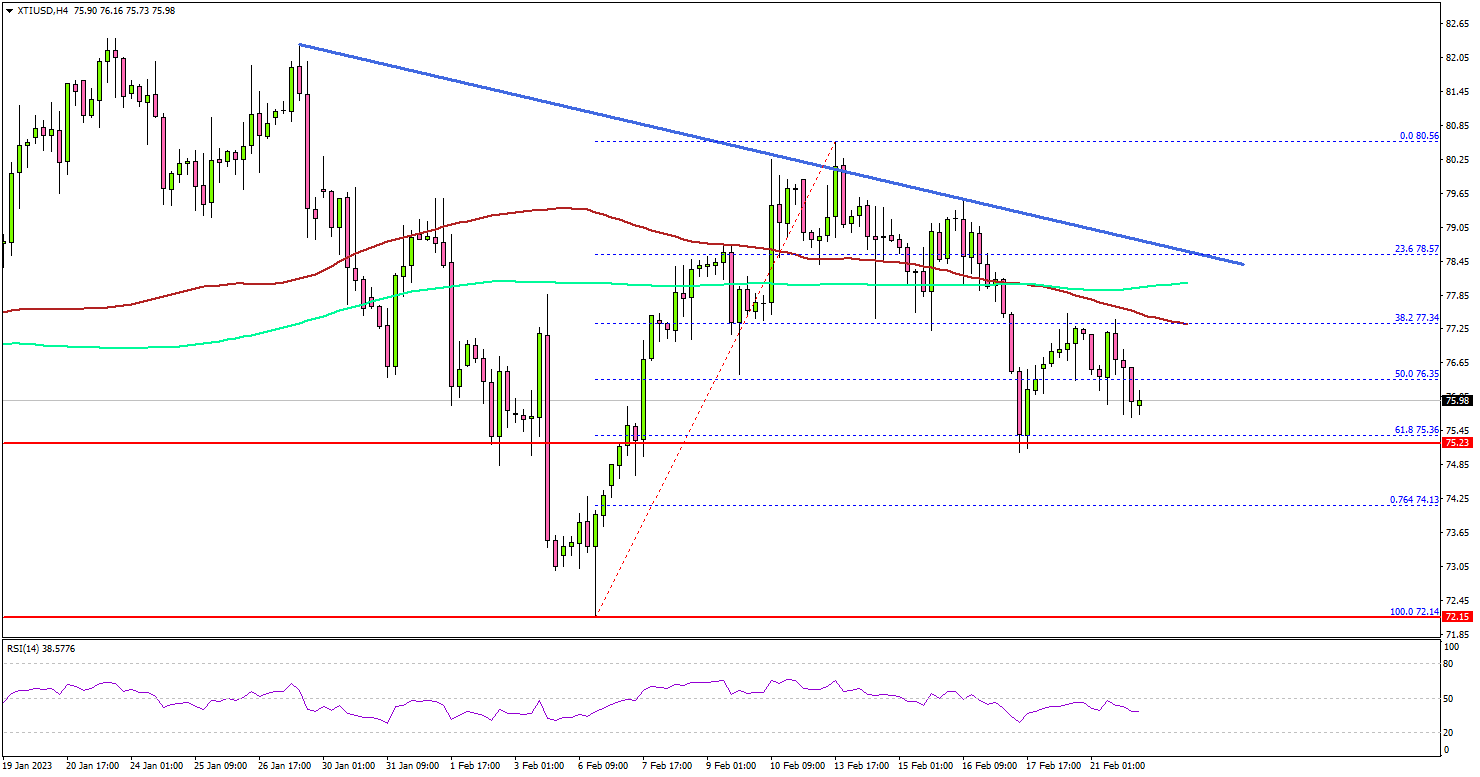
Looking at the 4-hours chart of XTI/USD, the price settled below the $78.00 support, the 100 simple moving average (red, 4-hours) and the 200 simple moving average (green, 4-hours).
There was a sharp move below the 50% Fib retracement level of the upward move from the $72.14 swing low to $80.56 high. An immediate support is now forming near the $75.40 zone.
The 61.8% Fib retracement level of the upward move from the $72.14 swing low to $80.56 high is also near the $75.40 level. The next major support sits near the $74.00 level. Any more losses might call for a test of the $72.20 support zone in the coming days.
On the upside, the price is facing resistance near the $78.00 zone. The next major resistance is near the $78.50 zone and a bearish trend line. A clear move above the $78.50 resistance could open the doors for another steady increase towards $82 or even $85.
Looking at gold price, the bears are still active below the $1,850 resistance zone and there is a risk of another bearish wave.
Economic Releases to Watch Today
- German Consumer Price Index for Jan 2023 (YoY) – Forecast +8.7%, versus +8.7% previous.
- German Consumer Price Index for Jan 2023 (MoM) – Forecast +1%, versus +1% previous.
- German IFO Business Climate Index for Feb 2023 – Forecast 91.4, versus 90.2 previous.