Sample Category Title
GBP/USD: Cable Surges after Upbeat UK PMI Data
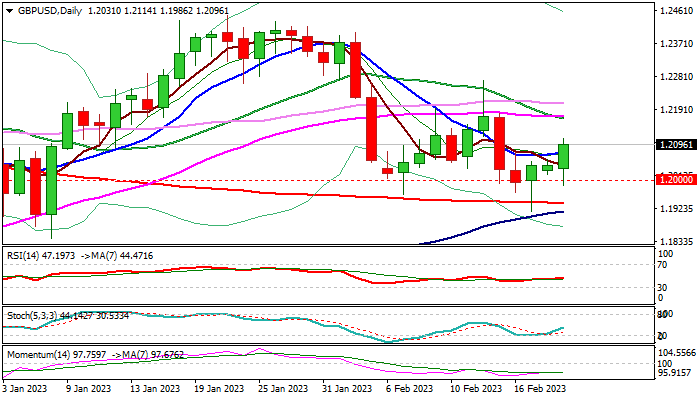
Cable jumped over one full figure and ticked above 1.21 mark on Tuesday, following upbeat Feb UK PMI data.
Report from UK economy’s dominant services sector showed PMI jumping to 53.3 in February (the highest since July) from 48.7 previous month and strongly beating 49.2 forecast.
Composite PMI which tracks the activity in both, services and manufacturing sectors and provides more details about the health of the economy, rose to 53.0 in February from 48.5 in January and well above 49.0 consensus. Both indicators establish above 50 threshold which divides growth from contraction, generating positive signals.
Manufacturing PMI also made a significant gains (Feb 49.2 vs Jan 47.0 and 47.5 f/c), although remains below 50 level.
Much better than expected PMI reports boost optimism about the economy’s performance in the first quarter and also contribute to Bank of England’s hawkish shift in interest rate expectations.
Technical picture on daily chart is improving after larger bears repeatedly failed to register clear break below psychological 1.20 support, as today’s bullish acceleration added to signal of bear-trap under 200DMA (1.1935).
Fresh rally probed above the top of daily Ichimoku cloud (1.2107), with close above the cloud (also near 50% retracement of 1.2269/1.1914 bear-leg) to firm near-term structure and add to reversal signals, opening way for further recovery.
Also, daily 100 and 200 moving averages are converging and on track to form a bull-cross, which would additionally support the action and contribute to positive signals from north-heading RSI and stochastic.
However, 14-d momentum indicator is still in negative territory that partially offsets bullish signals.
The near-term price action needs to hold above 1.2050, which is the minimum requirement to keep bullish bias, however, repeated failure to clear pivotal 1.2100 zone would signal weakening and keep the downside vulnerable.
Loss of 1.2050 support would risk renewed probe through 1.20 level and 200DMA.
Res: 1.2114; 1.2134; 1.2185; 1.2200.
Sup: 1.2075; 1.2050; 1.2000; 1.1935.
NZD/USD Eyes Central Bank Meeting
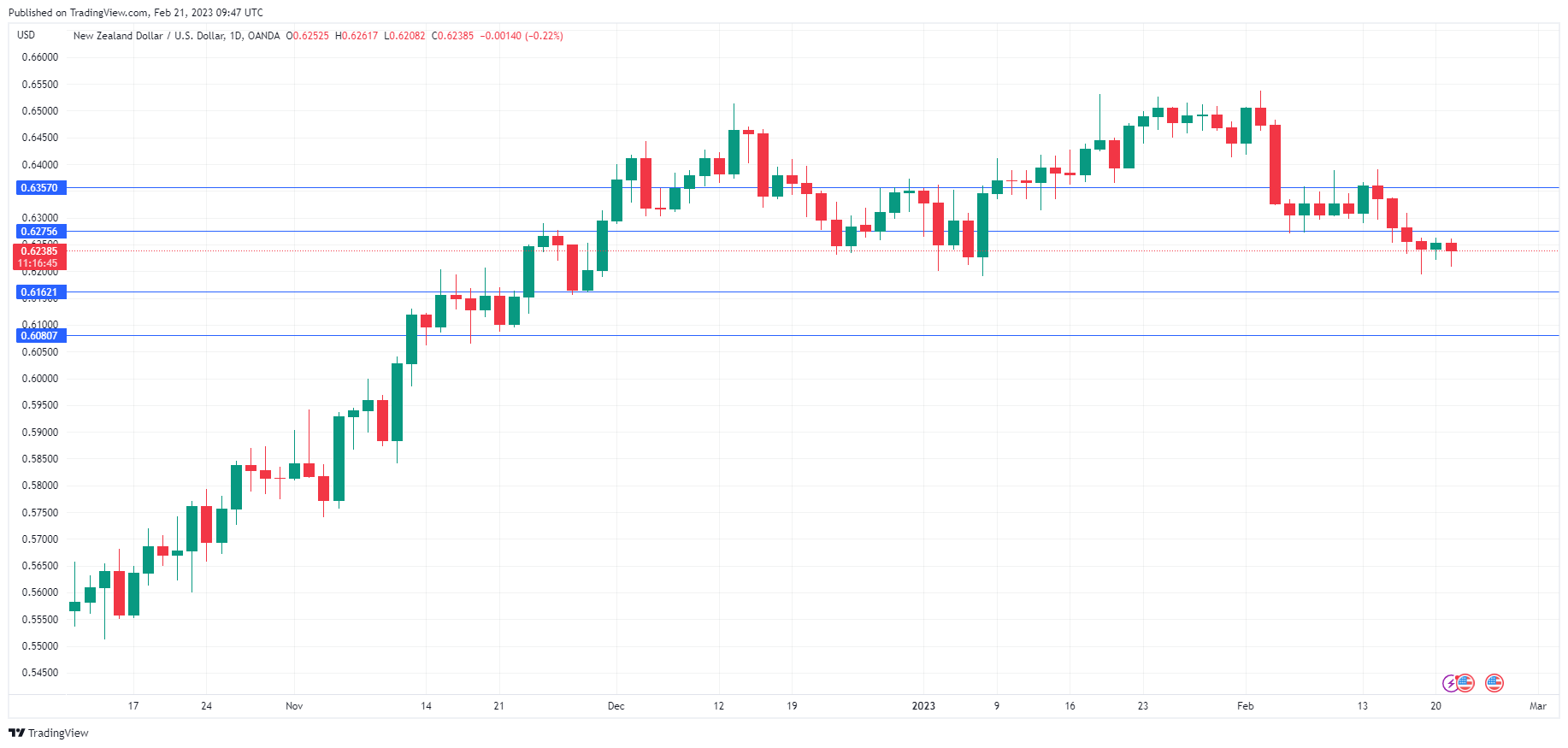
The New Zealand dollar is slightly lower on Tuesday. NZD/USD declined over 0.50% earlier but has pared most of these losses and is trading at 0.6240, down 0.20%.
RBNZ expected to hike by 50 bp
The Reserve Bank of New Zealand will meet on Wednesday, its first policy meeting this year. The Bank last met in November, at which time it hiked rates by a record 75 basis points, bringing the cash rate to 4.25%. There had been expectations of another 75-bp increase at tomorrow’s meeting, but Cyclone Gabrielle has thrown a monkey wrench into the decision. The cyclone, which caused damage in the billions of dollars, has raised concerns about the economy and the RBNZ is widely expected to lower gears and deliver a 50-bp increase. In the short term, the major disruptions from the cyclone are projected to raise inflation, which is already running at 7.2%, its highest level since 1990.
Aside from Gabrielle, there are signs that inflation may have peaked. Inflation Expectations eased in Q1 to 3.3%, down from 3.6% in Q4 2022. Inflation hit 7.2% in the final quarter of 2022, lower than the RBNZ’s forecast of 7.5%. The RBNZ still has its foot on the brake, but if inflation continues to head lower, we can expect the Bank to ease up on the pace of rates in the coming meetings.
In the US, we’ll get a look at the February PMI reports. Recent US numbers have beaten expectations, including employment growth, retail sales, and inflation. This is not a complete picture of the economy, as the services and manufacturing sectors have been in contraction territory for months, with readings below the 50.0 level. This negative trend is expected to continue, with Manufacturing PMI expected at 47.3 and Services PMI at 47.2 points.
NZD/USD Technical
- There is resistance at 0.6275 and 0.6357
- 0.6162 and 0.6080 are providing support
EURJPY May Close at Higher Levels; 144.00 in Focus
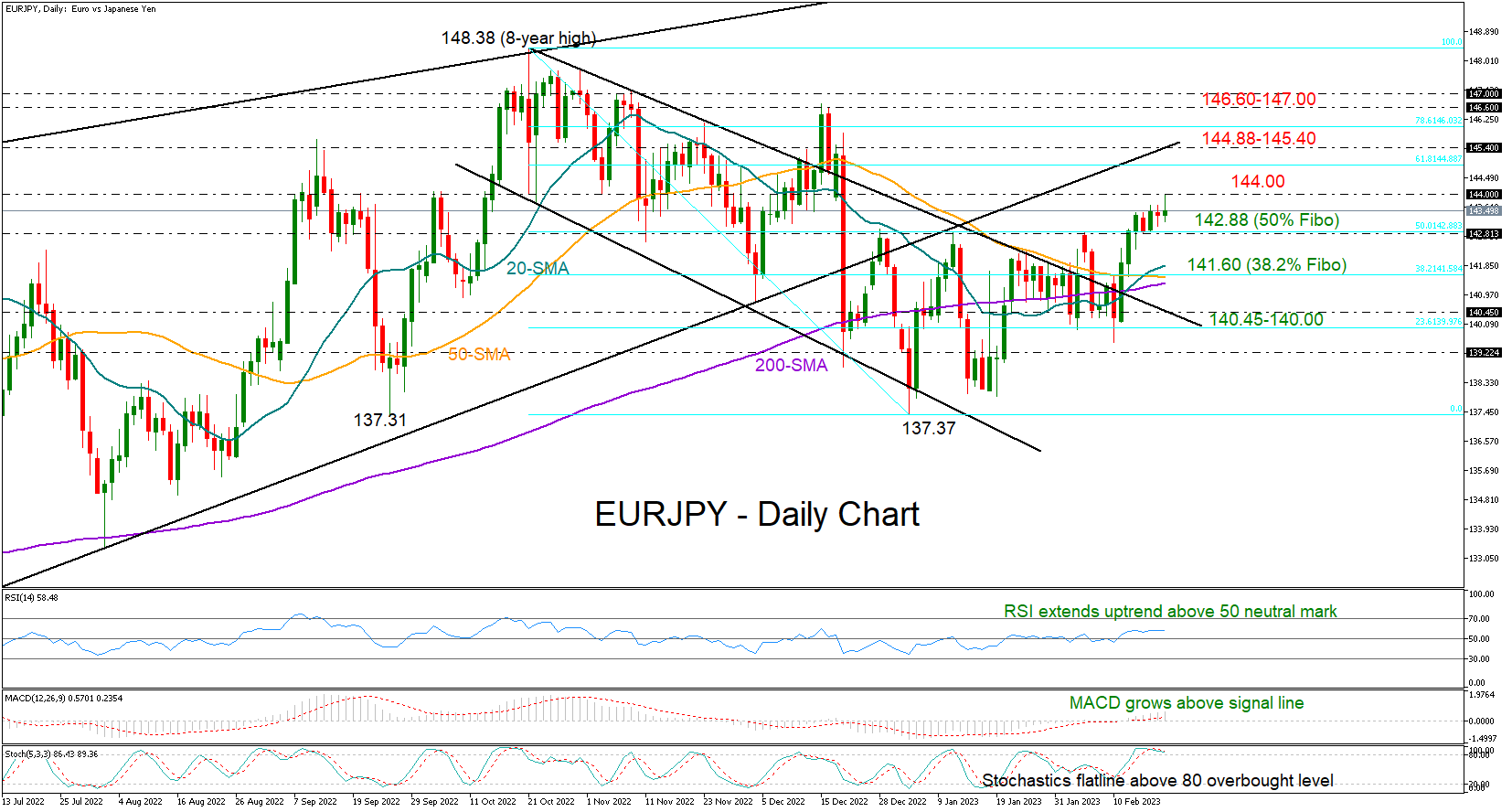
EURJPY gained new traction on Tuesday, breaking its short-term consolidation phase to print a new two-month high of 143.98.
There is more room for improvement according to the technical oscillators as the RSI is expanding above its 50 neutral mark and the MACD continues to strengthen above its red signal line. Meanwhile, the stochastic oscillator has already entered the overbought region above 80 but has yet to show any convincing signs of weakness, keeping the bias on the bullish side as well.
A decisive close above the 144.00 round-level is expected to bolster buying pressures towards the support-turned-resistance trendline from March 2022 seen around 145.40, while slightly lower the 61.8% Fibonacci retracement of the 148.38-137.37 downleg at 144.88 may attempt to pause the rally beforehand. Additional gains from here may then challenge the 146.60-147.00 ceiling ahead of the eight-year high of 148.38 registered last October.
On the downside, the pair seems to have established a floor around 142.88. If sellers press the price beneath that base, which coincides with the 50% Fibonacci level, the spotlight will fall on the 38.2% Fibonacci zone of 141.60. A steeper decline could squeeze the pair below its simple moving averages (SMAs) and towards the surface of the broken bearish channel seen around 140.45. The 23.6% Fibonacci area of 140.00 may be the last opportunity to change direction before a new bearish wave starts again within the channel.
Summing up, the recovery in EURJPY is expected to continue in the short term once the price peaks above 144.00. Alternatively, a step below 142.88 may shift attention back to the downside.
GBP/USD Muted Between SMAs as Rebound Falters
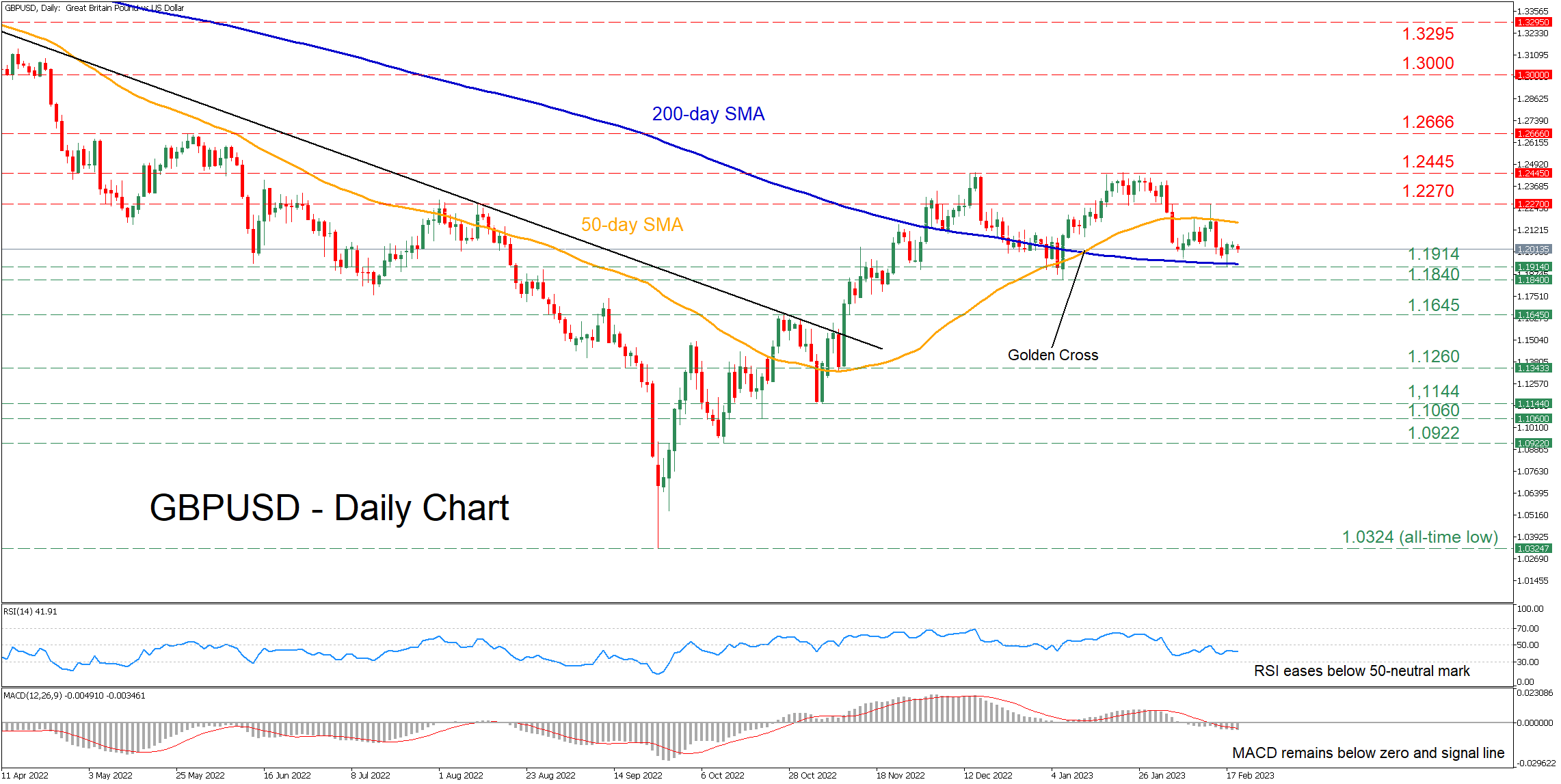
GBPUSD has been attempting a solid recovery since September when the pair fell to an all-time low of 1.0324. However, this latest advance appears to be fading after being rejected twice at the 1.2445 region, while the price has been trading sideways between the 50- and 200-day simple moving averages (SMAs) in the past three weeks.
Despite the latest consolidation, the momentum indicators currently suggest that bearish forces have taken control. Specifically, the RSI is pointing downwards below the 50-neutral mark and the MACD histogram is currently found below both zero and its red signal line.
To the downside, if the pair extends its recent downside correction, the congested region between the 200-day SMA and the recent low of 1.1914 could act as the first line of defence. Should that floor collapse, the January low of 1.1840 might come under examination. Even lower, the pair may face the October resistance of 1.1645, which could act as support in the future.
Alternatively, should buyers re-emerge and push the price above its 50-day SMA, initial resistance may be met at the recent peak of 1.2270. Breaking above that zone, the price could ascend to test the crucial 1.2445 territory, which rejected the pair’s rebound twice. Failing to halt there, further advances could come to a halt at the May high of 1.2666.
In brief, GBPUSD remains stuck in a rangebound pattern as its 50- and 200-day SMAs have repeatedly capped both its upside and downside. Therefore, a break above or below this tight range is likely to be followed by a significant move in the same direction.
Macros Continue to Weigh on Crude Oil
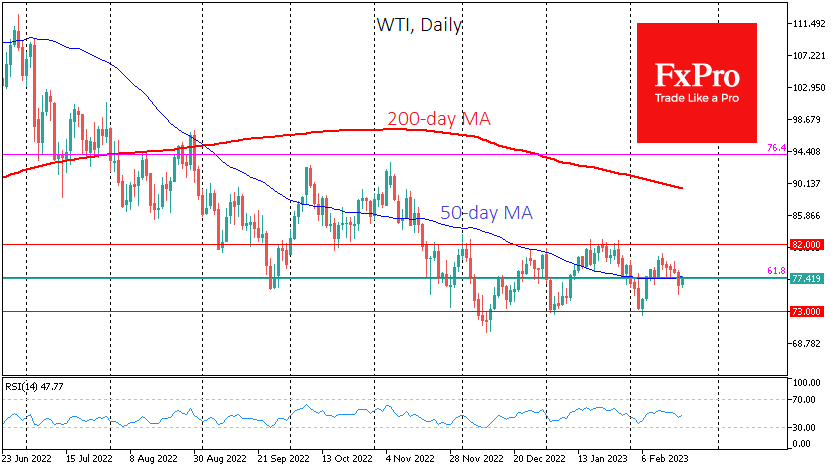
For the third month, oil has barely moved out of its wide range of $73-82 for WTI barrel and $78-88 for Brent. This is not a balance and equilibrium of supply and demand forces but a tug of war.
This does not often happen in large liquid markets, but the range movement has more to do with political actions and statements than the market’s technical picture. The recent reversal from the upper end of the range coincided with the US postponing the start of the renewal of the strategic reserve. A move closer to the lower boundary in early February coincided with comments from Russian officials that production would be cut by 500K barrels per day.
The sideways movement forms a stable reflex for traders, but it is important to understand that this trading mode only lasts for a while. This is a case when macroeconomics can determine the exit direction from the range. And the current data snapshot suggests an exit from this sideways range.
The strong US labour market has not led to a significant increase in oil demand, and commercial inventories have risen from 420M to 471M in recent weeks. This is 14.6% higher than in the same week a year ago. Inventory levels above 500m have coincided with periods of extreme market tightness (March 2016, February 2017 and April 2020) associated with price falls before or after. More recently, the idea that the US government is acting as a strong potential buyer has temporarily supported prices.
It is worth being prepared that the fight against inflation is still ongoing, so it would be wise to expect oil purchases for reserves to start any time soon, as this would send a counterproductive signal. Regardless, it is worth remembering that the recent robust labour market data and inflation surprises increase the chances that the Fed will go further in its rate hikes than previously hoped. The latter is bad news for oil, which is very sensitive to the dollar and interest rate movements.
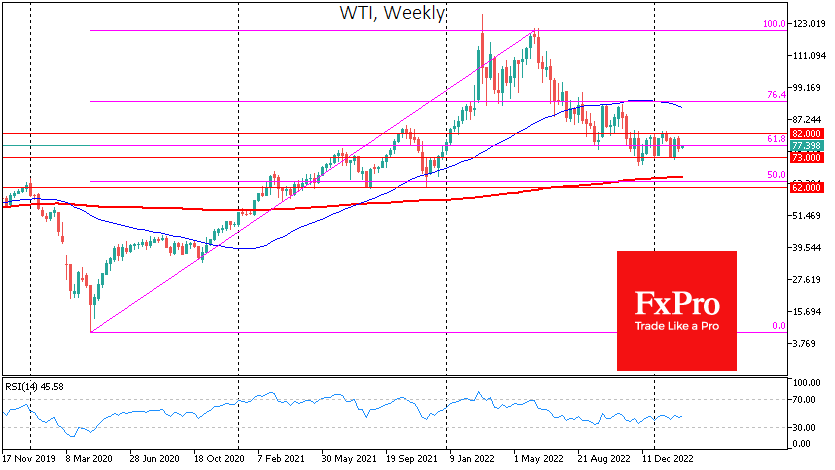
A hypothetical bearish scenario looks viable if prices fall below $72 in the coming weeks. A consolidation would open the way to $62, where oil bottomed out several times since April 2021.
Conversely, a move above $83 would signal that a correction from the global lows of April 2020 to the highs of June 2022 has occurred and that a new mega-wave of growth awaits oil. This scenario is hard to believe, given that prices have dragged global economic growth over the past year.
Bitcoin Set to Break Through
Market Picture
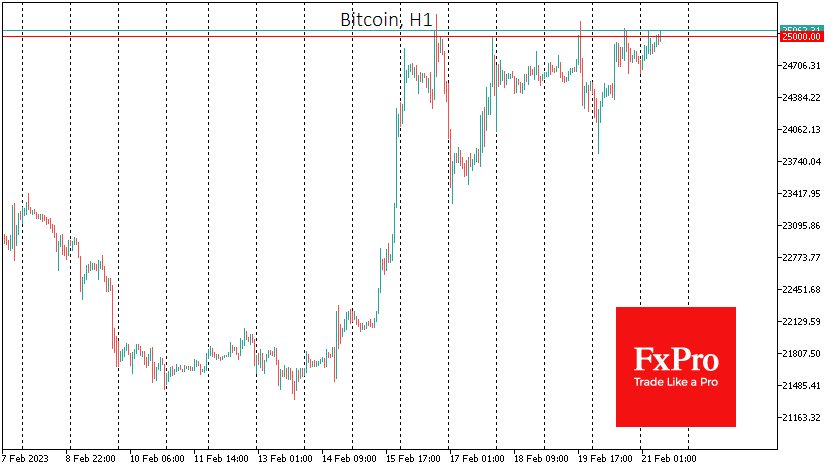
Bitcoin continues its attempts to break through resistance at $25K. Volatility was muted on Monday as the primary driver of it – US equity markets – was closed yesterday. Cryptocurrency market capitalisation rose 1.2%.
According to CoinShares, investments in cryptocurrencies fell by $32 million last week, the second consecutive week of declines and the highest in seven weeks. Investments in Bitcoin fell by $25 million and Ethereum by $7 million. Investment in funds that allow to short bitcoin increased by $4 million.
Despite bitcoin’s unsuccessful attempts to consolidate above $25K, intraday pullbacks from this resistance are becoming smaller, indicating a continued buying-the-dip pattern. A break above $25K is only a matter of time, potentially opening the door to $28K.
News Background
Galois Capital, one of the world’s largest cryptocurrency-focused hedge funds, announced its closure. The fund lost around half of its capital after the FTX collapse.
The next cryptocurrency bull market will start in the East. The US will only have two options: embrace cryptocurrencies or be left behind, said Gemini exchange co-founder Cameron Winklevoss. Such comments came amid moves by US regulators against cryptocurrency companies.
The G20’s Financial Stability Board (FSB) intends to draw up standards for cryptocurrency regulation by July.
Hong Kong will allow retail investors to trade cryptocurrencies on exchanges. Trading venues will be subject to mandatory licensing.
Meanwhile, Binance’s introduction of a zero fee for bitcoin trading and the collapse of the FTX exchange allowed it to capture 98% of the BTC spot trading market.
German ZEW rose to 28.1, but current situation still unfavorable
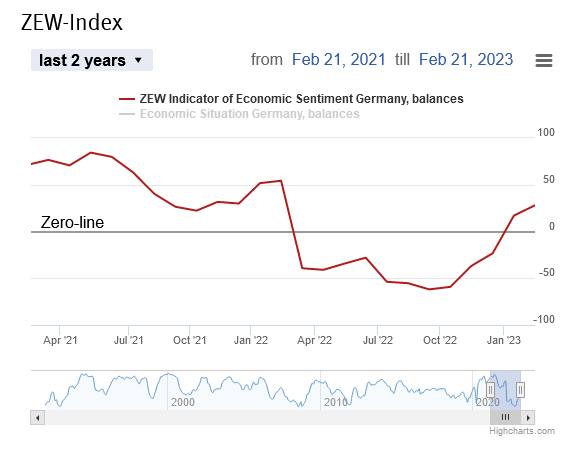
Germany ZEW Economic Sentiment rose form 16.9 to 28.1 in February, above expectation of 22.8. Current Situation index rose from -58.6 to -45.1, above expectation of -50.0.
Eurozone ZEW Economic sentiment rose form 16.7 to 29.7, above expectation of 22.3. Current Situation Index rose 13.2 pts to -41.6.
ZEW President Professor Achim Wambach said: "Meanwhile a large fraction of the survey participants expects the economic situation to improve in six months' time. However, the current situation is still assessed as relatively unfavourable.
"As in the previous month, the increase in expectations can be traced back to higher profit expectations in the energy- and export-oriented sectors as well as the consumer-related parts of the economy. Expectations for long-term interest rates are also rising and the banking sector indicator has reached its highest level since 2004."
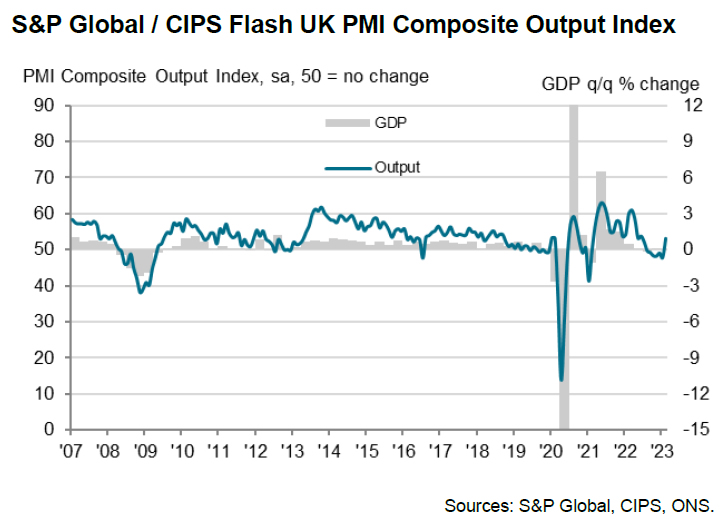
UK PMI composite jumped to 53, near-term recession odds fallen considerably
UK PMI Manufacturing rose from 47.0 to 49.2 in February, a 7-month high. PMI Services rose sharply from 48.7 to 53.3, an 8-month high. PMI Composite jumped from 48.5 to 53.0, an 8-month high.
Chris Williamson, Chief Business Economist at S&P Global Market Intelligence said: "Much better than anticipated PMI data for February indicate encouraging resilience of the economy in the face of headwinds which include rising interest rates, the ongoing cost of living crisis, labour shortages and strikes...
"However, while the data suggest that near-term recession odds have fallen considerably, elevated inflation pressures clearly remain a concern, especially in the service sector. As such, the resilience of the economy and the stickiness of the survey's inflation gauges add to the likelihood of the Bank of England tightening policy further, and potentially more aggressively, which may dampen future growth expectations and suggests that the possibility of recession later in the year should not be ruled out."
Sentiment Shaky Ahead of Fed Minutes and “Higher For Longer” Rates
Asian shares traded mostly lower on Tuesday along with US and European futures as investors adopted a cautious approach ahead of the reopening of the US markets after the President’s Day holiday.
Mounting diplomatic tensions between the United States and China, coupled with the prospects of the Fed maintaining its hawkish path have left market players on edge. This sense of unease and growing uncertainty may drag equity markets lower this week. In the currency space, dollar bulls were offered some support as Treasury yields climbed. Gold struggled for direction while oil prices slipped as expectations of more Fed rate hikes clashed with optimism over Chinese demand.
In other news, the minutes from the recent Reserve Bank of Australia meeting struck a hawkish tone with the central bank considering raising interest rates by 50bps. The bank eventually proceeded with a 25bp hike with policymakers agreeing that more interest rate increases were needed down the road to tame price pressures. Given how headline inflation jumped to 7.8% in the final quarter of 2022 from 7.3% in Q3, RBA hawks will remain in a position of power. Looking at the technical picture, AUDUSD remains trapped within a messy range on the daily charts. While a breakout could be on the horizon, a fundamental spark might be needed to get the gears turning.
Will the Fed Minutes Boost USD?
Market expectations around the Fed maintaining its hawkish bias have been boosted by robust US economic data since the start of February coupled with a sticky inflation report. This development has injected dollar bulls with renewed confidence, leaving G10 currencies sore and vulnerable. Despite the dollar's recent rebound, bulls could be rallying on shaky foundations. Markets expect the Fed to raise interest rates by 25bps in March with the Fed funds rate expected to peak around 5.3% by the summer. Given how the current inflation rate of 6.4% is the lowest since October 2021, further signs of cooling inflation may temper further rate hike bets.
All eyes will be on the FOMC meeting minutes on Wednesday which will be closely scrutinised for clues about the rate hike path. The key question is whether a 50bp rate hike could have been a possibility during its first meeting in 2023. Ultimately, the overall tone of the minutes and any fresh clues regarding rate hike timelines will most likely impact the dollar.
Currency spotlight – EURUSD
Over the past two weeks, it’s been the same old story with the EURUSD as prices remained trapped within a 150-pip range. While the euro has drawn support from ECB hike expectations and improving confidence towards the Eurozone economy, the dollar remains strengthened by speculation of more Fed rate hikes. This growing tension between the two currencies could result in a strong breakout in the major, with a fundamental spark needed to get things moving. It may be wise to keep an eye on the Eurozone February ZEW survey and PMIs out of Europe and the United States today.
Talking technicals, a strong daily close below 1.0650 in EURUSD could signal a decline towards 1.0500. Should 1.0650 prove to be reliable support, prices may retest 1.0800.
Commodity spotlight - Gold
Could we be experiencing the calm before the gold storm this week? The precious metal struggled for direction during early trade, lingering below $1840 as investors waited on the sidelines ahead of the Fed meeting minutes on Wednesday.
It has been a rough month for gold so far thanks to the strong jobs and hot inflation data from the United States pushing up Treasury yields. Hawkish comments from Fed officials rubbed salt into the wound with gold currently down 4.7% month-to-date. Given how the precious metal is enroute to experiencing its first monthly loss since October 2022, bulls need to get their mojo back. But a hawkish set of Fed minutes will most likely add insult to injury, potentially dragging prices toward $1800. Such a development may invite further downside in the short to medium term.
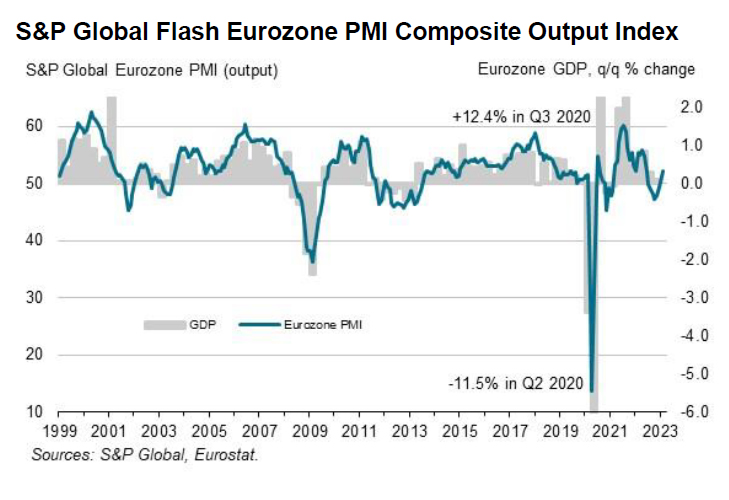
Eurozone PMI composite rose to 52.3, accelerating growth and stubbornly elevated price pressures
Eurozone PMI Manufacturing dropped from 48.5 to 48.8 in February. PMI Services rose from 50.8 to 53.0, an 8-month high. PMI Composite rose from 50.3 to 52.3, a 9-month high.
Chris Williamson, Chief Business Economist at S&P Global Market Intelligence said:
"Business activity across the eurozone grew much faster than expected in February, with growth hitting a nine-month high thanks to resurgent service sector activity and a recovering manufacturing economy. February's PMI is broadly consistent with GDP rising at a quarterly rate of just under 0.3%....
"However, although inflationary pressures have continued to moderate in February, the survey hints at persistent elevated price trends in the service sector, linked in part to higher wage growth, which will concern ECB policymakers....
"The combination of accelerating growth and stubbornly elevated price pressures will naturally encourage a bias towards further policy tightening in the months ahead."