Sample Category Title
EUR/USD Mid-Day Outlook
Daily Pivots: (S1) 1.0669; (P) 1.0687; (R1) 1.0703; More...
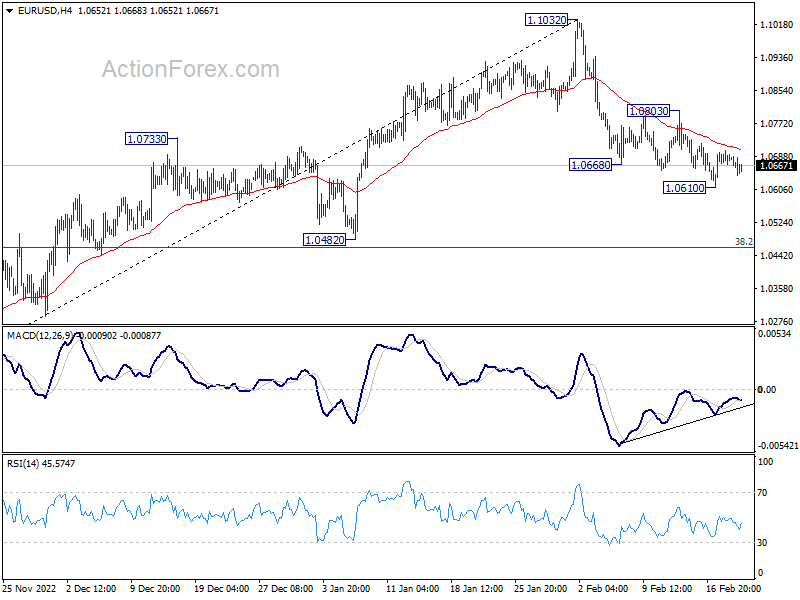
Intraday bias in EUR/USD remains neutral and risk stays on the downside with 1.0803 resistance intact. On the downside, break of 1.0610 will resume the corrective fall from 1.1032 and 38.2% retracement of 0.9534 to 1.1032 at 1.0463. Strong support should be seen around there to bring rebound, at least on first attempt.
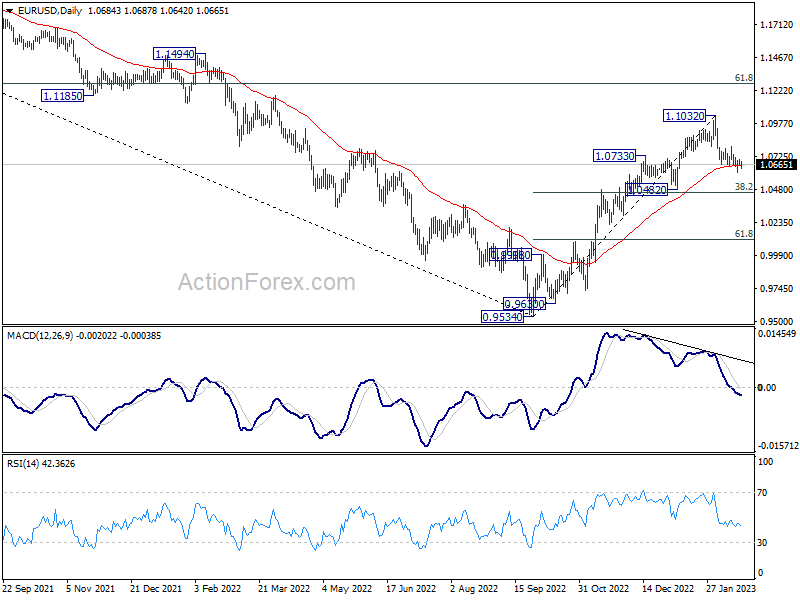
In the bigger picture, the rally from 0.9534 low (2022 low) is a medium term up trend rather than a correction. Further rise is in favor to 61.8% retracement of 1.2348 (2021 high) to 0.9534 at 1.1273 next. This will remain the favored case as long as 1.0482 support holds.
Canada: Inflation Continues to Cool in January
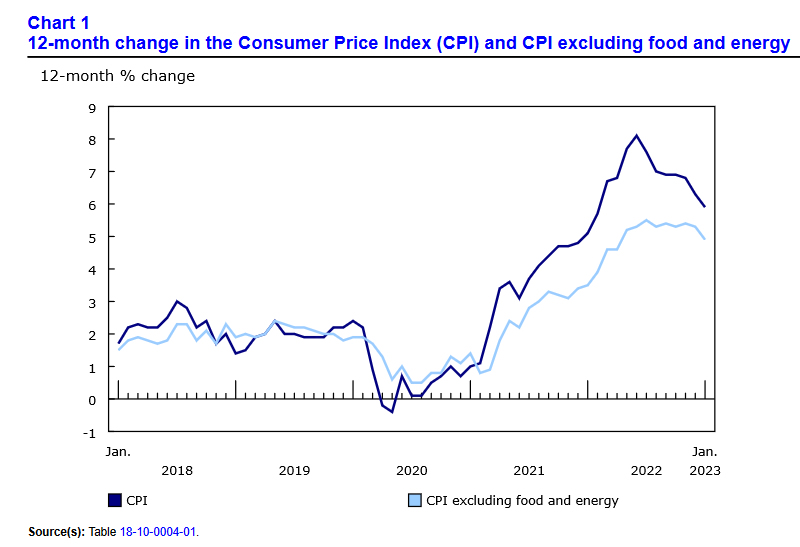
Consumer price inflation continued to decelerate in January, up 5.9% versus a year ago (y/y), from 6.3% in December.
Prices for cellular services and passenger vehicles contributed to the deceleration, as holiday discounting spilled in to January in the case of the former, and improved supply chains contributed to the decline for the latter.
Energy prices rose in January, as prices at the pump surged 4.7% month-on-month (m/m). However, gasoline prices are only 2.9% higher than a year ago.
Shelter prices continued to increase, as "the mortgage interest cost index continued to rise at a faster year-over-year pace amid the higher interest rate environment, rising 21.2% in January, the largest increase since September 1982."
Food inflation also rose in January, up 10.4% y/y, versus 10.1% in December. Food at grocery stores continues to see high inflation, while food at restaurants is picking up stream (+8.2% y/y from +7.7% in December).
Underlying inflation pressures eased, with CPI ex-food and energy up 4.9% y/y, down from 5.3% in December. The BoC's core inflation measures moved in a positive direction in January, with CPI-trim at 5.1% y/y (5.3% in Dec.) and CPI-median at 5.0% y/y (5.2% in Dec.).
Key Implications
January's CPI report showed that inflation continues to cool in Canada. Headline and core measures are falling on a year-on-year basis and should decline even further over the coming months as the base effect of last year's first half price surge washes out of the data.
For the Bank of Canada, it will need to see this trend continue for it to be comfortable remaining on the sidelines. As we highlighted in our Quarterly Economic Forecast, a slowing in economic momentum will be needed for inflation to decisively fall back towards the 1% to 3% target range. The recent uptick in employment and spending data complicate this. But given the improvement in inflation data today, the BoC will not feel rushed to jump back in with another rate hike just yet.
GBP/USD Mid-Day Outlook
Daily Pivots: (S1) 1.2018; (P) 1.2037; (R1) 1.2060; More...
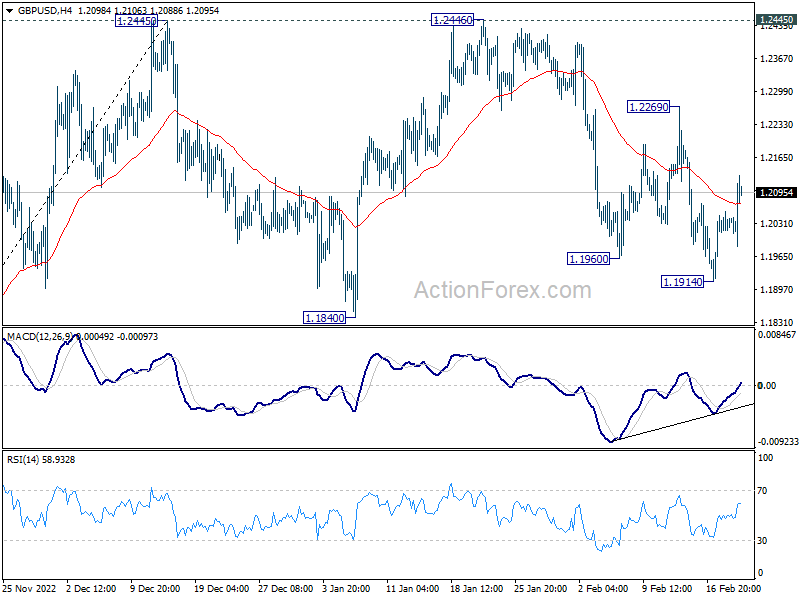
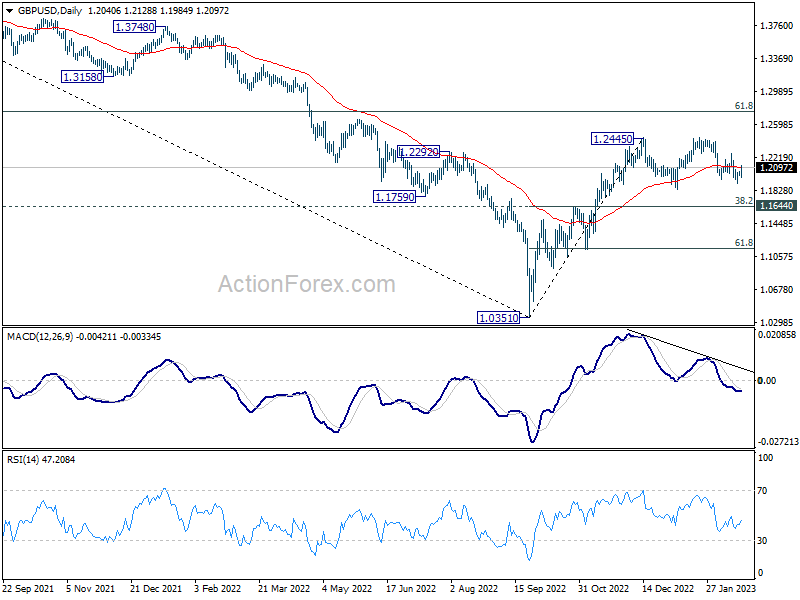
GBP/USD's rebound from 1.1914 extends higher today but stays well below 1.2269 resistance. Intraday bias remains neutral and another fall could still be seen. Below 1.1914 will resume the fall from 1.2446, as the third leg of the corrective pattern from 1.2445, to 1.1840 support and possibly below. Nevertheless, firm break of 1.2269 will bring retest of 1.2445/6 resistance.
In the bigger picture, rise from 1.0351 medium term bottom is at least correcting whole down trend from 1.4248 (2021 high). Further rise is expected as long as 1.1644 resistance turned support holds. Next target is 61.8% retracement of 1.4248 to 1.0351 at 1.2759. Sustained break there will pave the way back to 1.4248.
Sterling Surges on Strong PMIs, Dollar Following
Sterling rises broadly today as stronger than expected PMI data indicate that near-term recession odds have fallen considerably. European majors are also trading higher after positive Eurozone PMI and Germany ZEW. Nevertheless, Dollar is following the Pound as the second strongest, with some help from risk aversion. Australian Dollar is the worst performing one, followed by Yen, and then other commodity currencies.
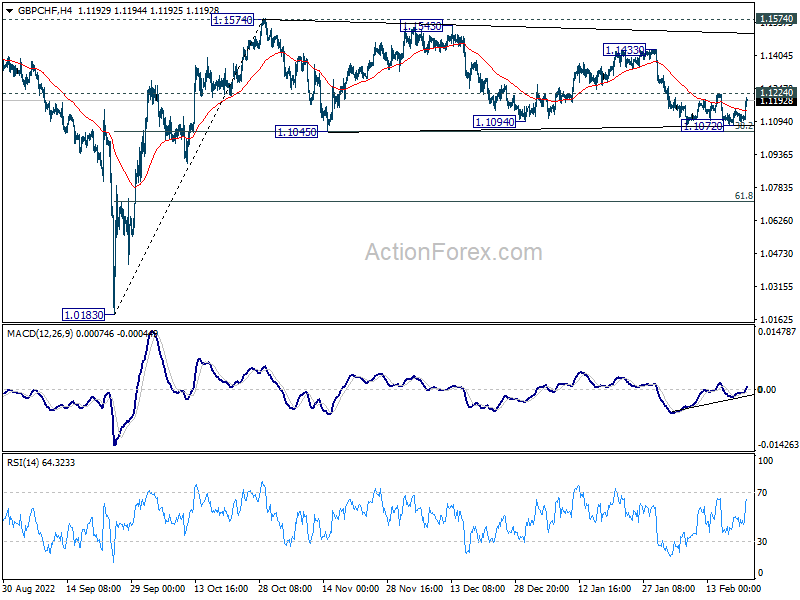
Technically, while the near term reversal is delayed, GBP/CHF's bounce today argue that fall from 1.1433 might have finally completed at 1.1072. Break of 1.1224 will also suggest that whole consolidation from 1.1574 has completed too, and rise from 1.0183 is ready to resume. Let's see Sterling could ride on the current momentum further.
In Europe, at the time of writing, FTSE is down -0.41%. DAX is down -0.47%. CAC is down -0.39%. Germany 10-year yield is up 0.0515 at 2.516. UK 10-year yield is up 0.127 at 3.600. Earlier in Asia, Nikkei dropped -0.21%. Hong Kong HSI dropped -1.71%. China Shanghai SSE rose 0.49%. Singapore Strait Times dropped -0.06%. Japan 10-year JGB yield dropped -0.0018 to 0.503.
Canada CPI slowed to 5.9% yoy in Jan, Ex food and energy down to 4.9% yoy
Canada CPI slowed from 6.3% yoy to 5.9% yoy in January. StatsCan noted that "Prices for cellular services and passenger vehicles contributed to the deceleration in the all-items CPI. However, mortgage interest cost and prices for food continue to rise." Excluding food and energy, CPI also slowed to 4.9% yoy while ex-mortgage CPI slowed to 5.4% yoy.
CPI median was unchanged at 5.0% yoy. CPI trimmed slowed form 5.3% yoy to 5.1% yoy. CPI common was unchanged at 6.6% yoy.
On a monthly basis, CPI rose 0.5% mom. Higher gasoline prices contributed the most to the month-over-month increase, followed by a rise in mortgage interest cost and meat prices.
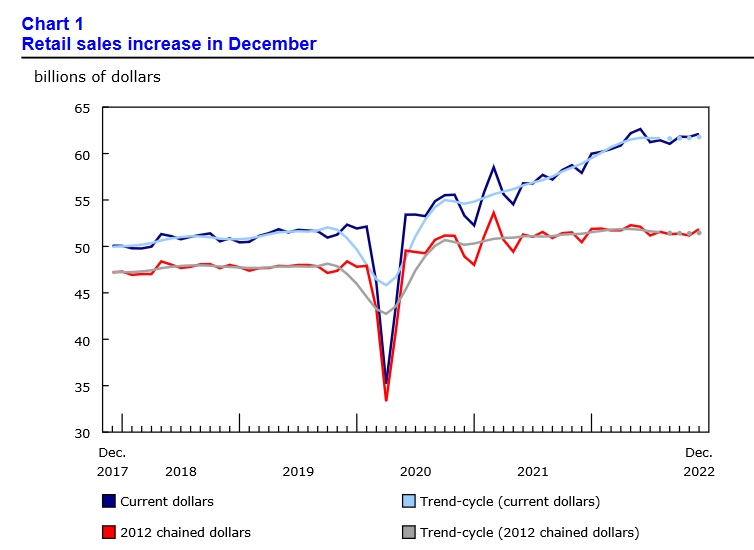
Canada retail sales rose 0.5% mom in Dec
Canada retail sales rose 0.5% mom to CAD 62.1B in December. Sales increased in 7 of 11 subsectors, representing 75.1% of retail trade. Higher sales at motor vehicle and parts dealers (+3.8%) and general merchandise stores (+1.7%) led the increase. Ex-gasoline and auto sales rose 0.4% mom. In volume term, retail sales increased 1.3% mom.
Advance estimate suggests that retail sales rose further by 0.7% mom in January.
UK PMI composite jumped to 53, near-term recession odds fallen considerably
UK PMI Manufacturing rose from 47.0 to 49.2 in February, a 7-month high. PMI Services rose sharply from 48.7 to 53.3, an 8-month high. PMI Composite jumped from 48.5 to 53.0, an 8-month high.
Chris Williamson, Chief Business Economist at S&P Global Market Intelligence said: "Much better than anticipated PMI data for February indicate encouraging resilience of the economy in the face of headwinds which include rising interest rates, the ongoing cost of living crisis, labour shortages and strikes...
"However, while the data suggest that near-term recession odds have fallen considerably, elevated inflation pressures clearly remain a concern, especially in the service sector. As such, the resilience of the economy and the stickiness of the survey's inflation gauges add to the likelihood of the Bank of England tightening policy further, and potentially more aggressively, which may dampen future growth expectations and suggests that the possibility of recession later in the year should not be ruled out."
Eurozone PMI composite rose to 52.3, accelerating growth and stubbornly elevated price pressures
Eurozone PMI Manufacturing dropped from 48.5 to 48.8 in February. PMI Services rose from 50.8 to 53.0, an 8-month high. PMI Composite rose from 50.3 to 52.3, a 9-month high.
Chris Williamson, Chief Business Economist at S&P Global Market Intelligence said:
"Business activity across the eurozone grew much faster than expected in February, with growth hitting a nine-month high thanks to resurgent service sector activity and a recovering manufacturing economy. February's PMI is broadly consistent with GDP rising at a quarterly rate of just under 0.3%....
"However, although inflationary pressures have continued to moderate in February, the survey hints at persistent elevated price trends in the service sector, linked in part to higher wage growth, which will concern ECB policymakers. The combination of accelerating growth and stubbornly elevated price pressures will naturally encourage a bias towards further policy tightening in the months ahead."
German ZEW rose to 28.1, but current situation still unfavorable
Germany ZEW Economic Sentiment rose form 16.9 to 28.1 in February, above expectation of 22.8. Current Situation index rose from -58.6 to -45.1, above expectation of -50.0.
Eurozone ZEW Economic sentiment rose form 16.7 to 29.7, above expectation of 22.3. Current Situation Index rose 13.2 pts to -41.6.
ZEW President Professor Achim Wambach said: "Meanwhile a large fraction of the survey participants expects the economic situation to improve in six months' time. However, the current situation is still assessed as relatively unfavourable.
"As in the previous month, the increase in expectations can be traced back to higher profit expectations in the energy- and export-oriented sectors as well as the consumer-related parts of the economy. Expectations for long-term interest rates are also rising and the banking sector indicator has reached its highest level since 2004."
RBA minutes: 25bps and 50bps hike considered at Feb meeting
Minutes of RBA's February 7 meeting revealed that both the options of 25bps and 50bps hike were considered. But the case for a 25bps hike was stronger, with "the monthly meetings provided the Board with frequent opportunities to assess how these uncertainties were being resolved and to adjust policy if needed".
The minutes also noted, "members agreed that further increases in interest rates are likely to be needed over the months ahead to ensure that inflation returns to target and that the current period of high inflation is only temporary."
Australia PMI composite rose to 49.2, on the narrow path to achieve soft landing
Australia PMI Manufacturing ticked up from 50.0 to 50.1 in February. PMI Services rose from 48.6 to 49.2. PMI Composite also rose from 48.5 to 49.2.
Warren Hogan, Chief Economic Advisor at Judo Bank said: "Australian business activity improved in February 2023 with a second consecutive small rise in the flash composite output index to 49.2. The economy has slowed from the strong rates of growth in 2022 to be on a more sustainable footing in early 2023. We still appear to be on the narrow path to achieve a soft landing for the economy in 2023...
"At this stage the Judo Bank PMIs are pointing to a welcome slowdown in the economy that may help take upward pressure off interest rates. While this will do little to alter the RBA's intentions to raise interest rates further over the months ahead, it does indicate that we may be close to the point where the RBA Board can pause the current tightening cycle."
Japan PMI manufacturing dropped to 47.4, services rose to 53.6
Japan PMI Manufacturing dropped from 48.9 to 47.4 in February, below expectation of 49.3. It's also the worst reading in over two-and-a-half years. Manufacturing Output dropped sharply from 47.2 to 44.9. PMI services, on the other hand, rose from 52.3 to 53.6. PMI Composite was unchanged at 50.7.
Andrew Harker, Economics Director at S&P Global Market Intelligence, said:
"The modest, stable growth signalled by the au Jibun Bank Flash Japan Composite PMI in February masked widely differing trends between the manufacturing and service sectors midway through the first quarter of the year.
"Service providers posted sharper rises in activity and new business as the latest wave of the COVID-19 pandemic faded, providing a boost to demand.
"The picture was much less positive in the manufacturing sector, however, where new orders and production dropped to the greatest extents in just over two-and-a-half years."
GBP/USD Mid-Day Outlook
Daily Pivots: (S1) 1.2018; (P) 1.2037; (R1) 1.2060; More...
GBP/USD's rebound from 1.1914 extends higher today but stays well below 1.2269 resistance. Intraday bias remains neutral and another fall could still be seen. Below 1.1914 will resume the fall from 1.2446, as the third leg of the corrective pattern from 1.2445, to 1.1840 support and possibly below. Nevertheless, firm break of 1.2269 will bring retest of 1.2445/6 resistance.
In the bigger picture, rise from 1.0351 medium term bottom is at least correcting whole down trend from 1.4248 (2021 high). Further rise is expected as long as 1.1644 resistance turned support holds. Next target is 61.8% retracement of 1.4248 to 1.0351 at 1.2759. Sustained break there will pave the way back to 1.4248.
Economic Indicators Update
| GMT | Ccy | Events | Actual | Forecast | Previous | Revised |
|---|---|---|---|---|---|---|
| 21:45 | NZD | PPI Input Q/Q Q4 | 0.50% | 0.50% | 0.80% | |
| 21:45 | NZD | PPI Output Q/Q Q4 | 0.90% | 0.40% | 1.60% | |
| 22:00 | AUD | Manufacturing PMI Feb P | 50.1 | 50 | ||
| 22:00 | AUD | Services PMI Feb P | 49.2 | 48.6 | ||
| 00:30 | AUD | RBA Meeting Minutes | ||||
| 00:30 | JPY | Manufacturing PMI Feb P | 47.4 | 49.3 | 48.9 | |
| 07:00 | CHF | Trade Balance (CHF) Jan | 5.08B | 3.75B | 2.83B | 2.77B |
| 07:00 | GBP | Public Sector Net Borrowing (GBP) Jan | -6.2B | 2.3B | 26.6B | 24.8B |
| 08:15 | EUR | France Manufacturing PMI Feb P | 47.9 | 50.7 | 50.5 | |
| 08:15 | EUR | France Services PMI Feb P | 52.8 | 50 | 49.4 | |
| 08:30 | EUR | Germany Manufacturing PMI Feb P | 46.5 | 48 | 47.3 | |
| 08:30 | EUR | Germany Services PMI Feb P | 51.3 | 51 | 50.7 | |
| 09:00 | EUR | Eurozone Manufacturing PMI Feb P | 48.5 | 49.4 | 48.8 | |
| 09:00 | EUR | Eurozone Services PMI Feb P | 53 | 51 | 50.8 | |
| 09:30 | GBP | Manufacturing PMI Feb P | 49.2 | 47.5 | 47 | |
| 09:30 | GBP | Services PMI Feb P | 53.3 | 49.4 | 48.7 | |
| 10:00 | EUR | Germany ZEW Economic Sentiment Feb | 28.1 | 22.8 | 16.9 | |
| 10:00 | EUR | Germany ZEW Current Situation Feb | -45.1 | -50 | -58.6 | |
| 10:00 | EUR | Eurozone ZEW Economic Sentiment Feb | 29.7 | 22.3 | 16.7 | |
| 13:30 | CAD | Retail Sales M/M Dec | 0.50% | 0.50% | -0.10% | 0% |
| 13:30 | CAD | Retail Sales ex Autos M/M Dec | -0.60% | -0.10% | -0.60% | -0.50% |
| 13:30 | CAD | CPI M/M Jan | 0.50% | 0.20% | -0.60% | |
| 13:30 | CAD | CPI Y/Y Jan | 5.90% | 5.70% | 6.30% | |
| 13:30 | CAD | CPI Core M/M Jan | 0.10% | 0.30% | ||
| 13:30 | CAD | CPI Median Y/Y Jan | 5.00% | 4.90% | 5.00% | |
| 13:30 | CAD | CPI Trimmed Y/Y Jan | 5.10% | 5.20% | 5.30% | |
| 13:30 | CAD | CPI Common Y/Y Jan | 6.60% | 6.50% | 6.60% | |
| 14:45 | USD | Manufacturing PMI Feb P | 47.4 | 46.9 | ||
| 14:45 | USD | Services PMI Feb P | 47.3 | 46.8 | ||
| 15:00 | USD | Existing Home Sales Jan | 4.06M | 4.02M |
Canada retail sales rose 0.5% mom in Dec
Canada retail sales rose 0.5% mom to CAD 62.1B in December. Sales increased in 7 of 11 subsectors, representing 75.1% of retail trade. Higher sales at motor vehicle and parts dealers (+3.8%) and general merchandise stores (+1.7%) led the increase. Ex-gasoline and auto sales rose 0.4% mom. In volume term, retail sales increased 1.3% mom.
Advance estimate suggests that retail sales rose further by 0.7% mom in January.
Canada CPI slowed to 5.9% yoy in Jan, Ex food and energy down to 4.9% yoy
Canada CPI slowed from 6.3% yoy to 5.9% yoy in Jan. StatsCan noted that "Prices for cellular services and passenger vehicles contributed to the deceleration in the all-items CPI. However, mortgage interest cost and prices for food continue to rise." Excluding food and energy, CPI also slowed to 4.9% yoy while ex-mortgage CPI slowed to 5.4% yoy.
CPI median was unchanged at 5.0% yoy. CPI trimmed slowed form 5.3% yoy to 5.1% yoy. CPI common was unchanged at 6.6% yoy.
On a monthly basis, CPI rose 0.5% mom. Higher gasoline prices contributed the most to the month-over-month increase, followed by a rise in mortgage interest cost and meat prices.
EUR/GBP Daily Outlook
Daily Pivots: (S1) 0.8867; (P) 0.8879; (R1) 0.8888; More...
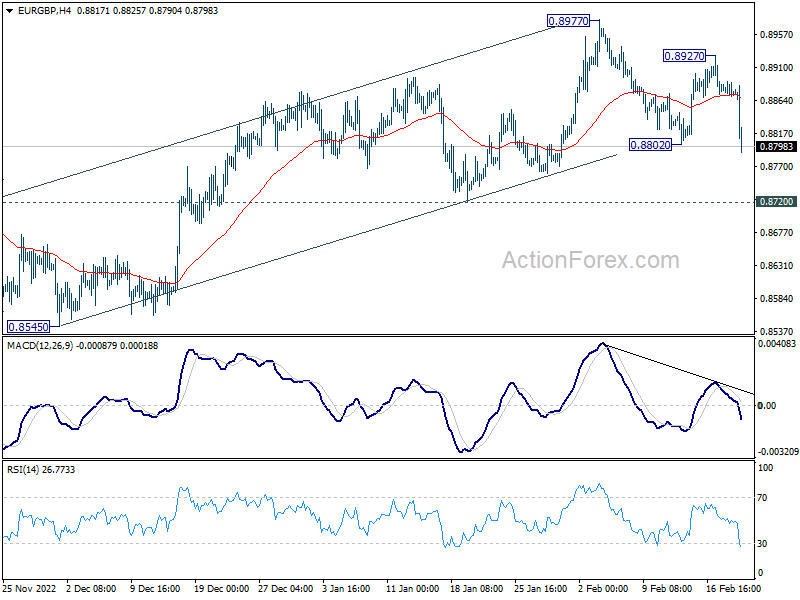
EUR/GBP's fall from 0.8977 resumed by breaking through 0.8802 today. The development now argues that whole rebound from 0.8545 has completed. Intraday bias is back on the downside for 0.8720 support first. Break there will bring deeper decline to retest 0.8545. For now, risk will stay on the downside as long as 0.8927 resistance holds, in case of recovery.
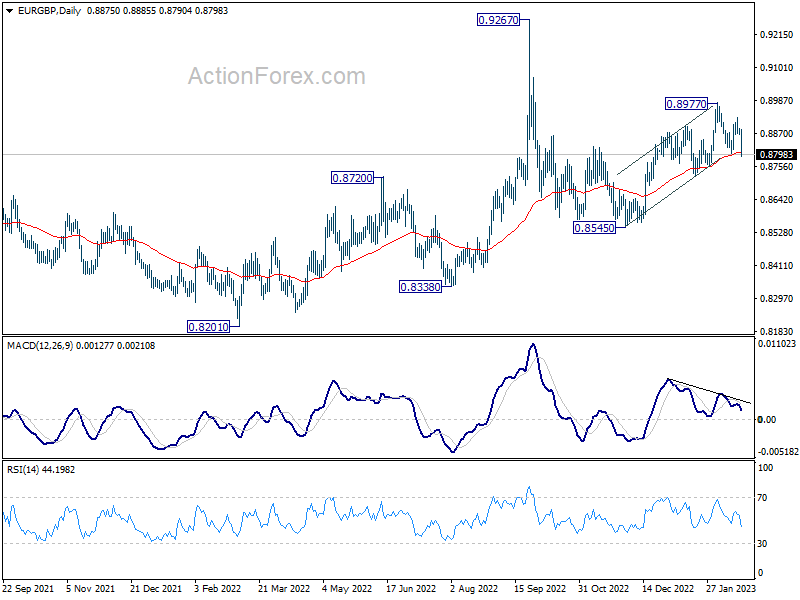
In the bigger picture, focus is back on 55 day EMA (now at 0.8804). Sustained trading below there will argue that fall from 0.9267 is in progress. Such decline is seen as a leg inside long term range pattern from 0.9499 (2020 high). Break of 0.8545 will pave the way back to 0.8201 (2022 low).
GBP/JPY Mid-Day Outlook
Daily Pivots: (S1) 161.32; (P) 161.53; (R1) 161.88; More...
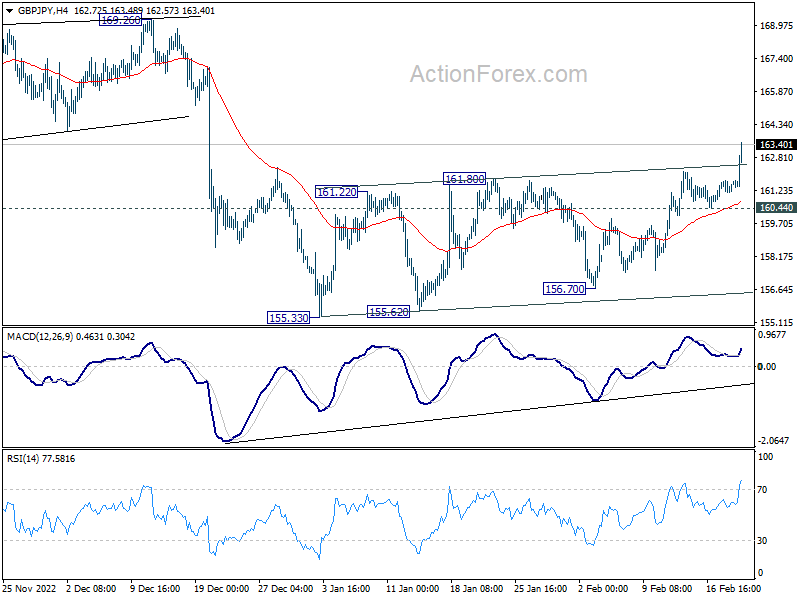
GBP/JPY's rebound from 155.33 finally accelerates higher and the development argues that whole correction from 172.11 has completed with three waves down to 155.33. 163.02 support turned resistance was taken out too. Intraday bias is back on the upside for 169.26/172.11 resistance zone. For now, further rally will remain in favor as long as 160.44 minor support holds, in case of retreat.
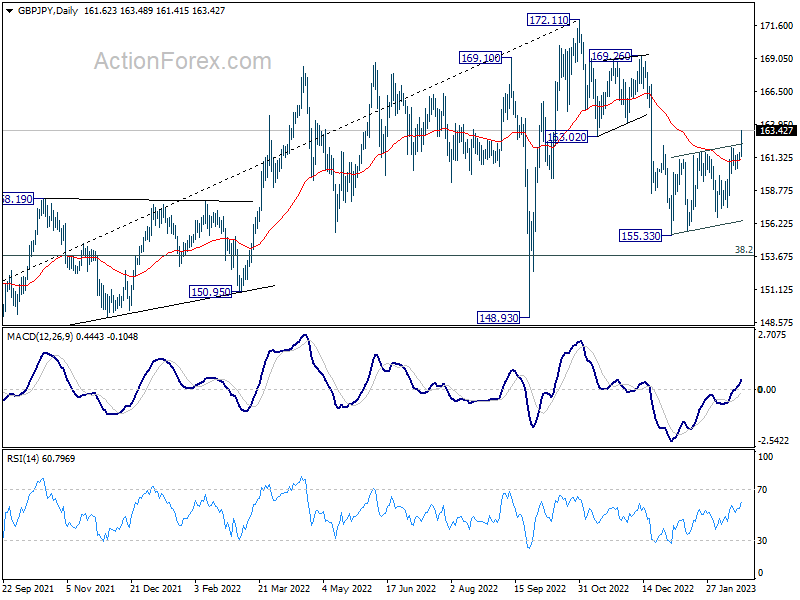
In the bigger picture, corrective decline from 172.11 medium term should have completed at 155.33. With 38.2% retracement of 123.94 to 172.11 at 153.70 intact, medium term bullishness is retained. That is, larger up trend from 123.94 (2020 low) is still in progress. Break of 172.11 high to resume such up trend is expected at a later stage.
Australian Dollar Dips after RBA Minutes
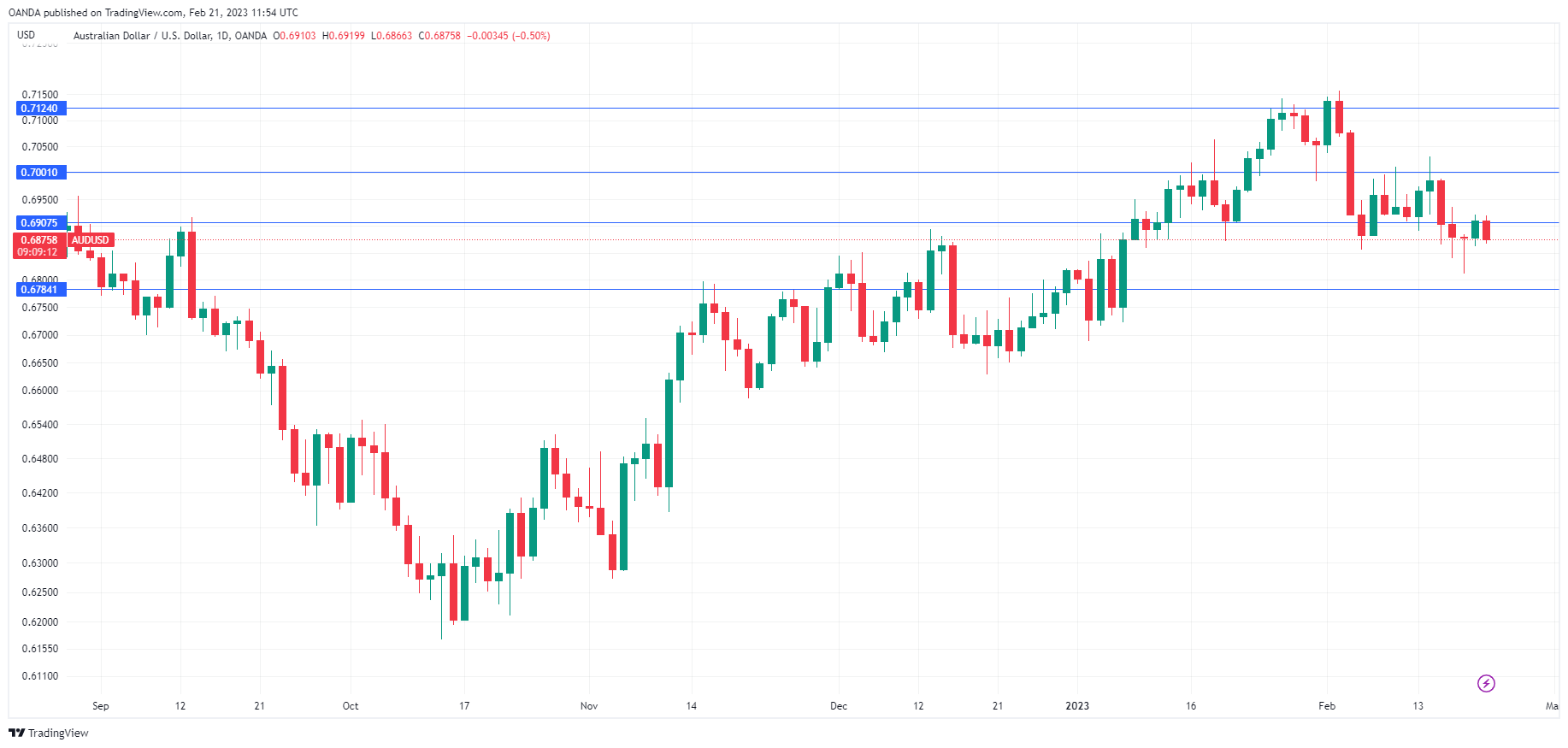
The Australian dollar is in negative territory on Tuesday. In European trade, AUD/USD is trading at 0.6876, down 0.50%.
RBA minutes indicate concern over inflation
The Reserve Bank of Australia keeps getting in the way of the Australian dollar. RBA Governor Lowe appeared before a parliamentary committee last Wednesday and confirmed that further rate hikes were on the way as inflation was still unacceptably high. The Aussie responded by dropping 1.1%. The RBA minutes were released today and members expressed concern at the upside risk to inflation, noting that there was “more breadth and persistence” in inflation. The hawkish tone of the minutes has boosted rate-hike bets but the Australian dollar remains under pressure over concerns that the RBA is having trouble getting a handle on inflation, despite its aggressive rate-tightening cycle. Again, the Aussie has responded with losses.
How much higher will interest rates go? That will depend to a large extent on upcoming data, starting with Wednesday’s Wage Price Index for Q4. Wages are expected to have climbed 3.5% y/y in Q4, up from 3.1% and the highest level since September 2012. Wages are an important driver of inflation and higher wages will make it more difficult for the Bank to curb inflation.
The RBA minutes also indicated that members debated whether to raise rates by 25 or 50 basis points. Ultimately, the RBA opted for a modest 25-bp increase, which brought the cash rate to 3.35%. The money markets are projecting a terminal cash rate of 4.25% by August, which means that the RBA will likely be busy in the coming months.
We’ll also hear from the Federal Reserve on Wednesday, with the release of the minutes from the February meeting. The Fed didn’t have any surprises and raised rates by 25 basis points. The markets will be looking to see how close the Fed was to hiking by 50 basis points. If the rate decision was a close call, the US dollar could continue to rally.
AUD/USD Technical
- AUD/USD is testing support at 0.6907. Below, there is support at 0.6784
- There is resistance at 0.7001 and 0.7124
Gold: End of correction or new downturn?
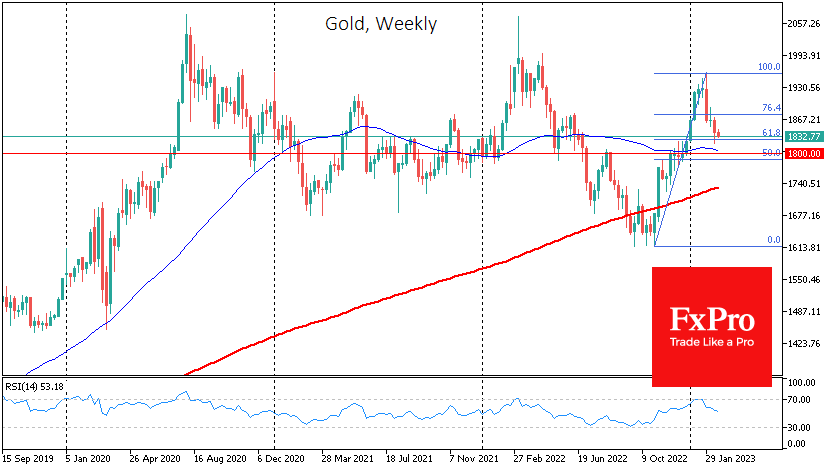
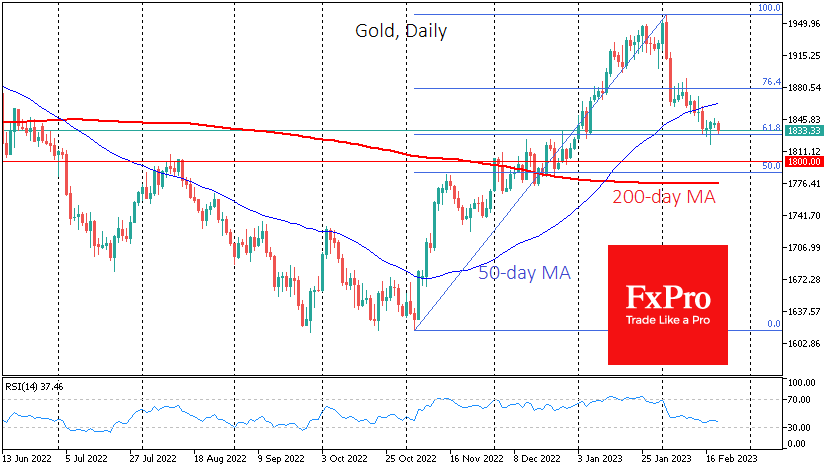
Gold has lost more than 6.5% from its early February highs, correcting the November-January rally. Now it’s time to decide on the next trend. The coming days should show whether we will see a new wave of growth in gold or whether the decline will continue.
From the beginning of November to the first days of February, gold gained more than 21%. The February declines stabilised the price at 61.8% of the initial rally, a classic retracement. This pattern suggests buyers are returning and opens the potential for a rally to $2170 (161.8% of the initial rally). A more conservative view suggests that the path to new highs will only open up after a sharp rise above previous highs at $1960.
Another indicator, the Relative Strength Index (RSI) on the daily timeframe, suggests that there is still room for a decline. According to this indicator, gold has been overbought for most of January and has yet to reach the oversold zone.
On the weekly timeframe, the reversal in February coincided with a touch of overbought conditions, and so far, the indicator remains above 50, indicating the potential for further declines.
In addition, we note that mid-month gold fell below the 50-day moving average, which has worked well as a short-term trend indicator over the past year. When gold breaks below this moving average without any resistance from buyers, it looks like a signal that bearish sentiment is prevailing.
It is worth being prepared for the fact that gold’s decline has paused but not ended. Up to the $1775-1800 area, we do not see any significant barriers to the fall. A break there would also allow the overbought RSI to correct fully. Gold has reversed several times near $1800, especially last year.