

Sample Category Title
Crypto Market Stalls after Pump
Market picture
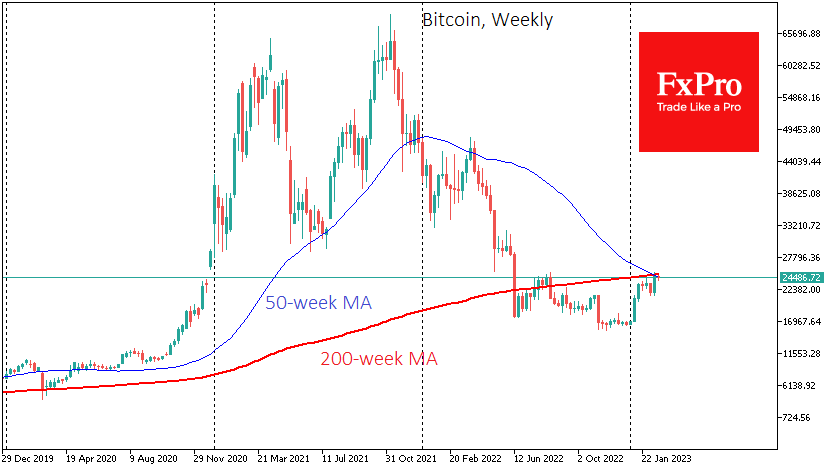
Bitcoin gained 11.5% last week to close at $24.5K. The price stabilised near this level at the start of the new week. The cryptocurrency’s market capitalisation rose 9.3% last week to $1.12 trillion. Almost all of the growth came in the first half of the week, with smaller gains in the final days.
Sunday saw a fresh attempt to push BTCUSD above $25K. However, the bulls failed to form a nice weekly candle to close above a significant level, leaving the rate below the 200-week average and touching the 50-week. Buyers may be more cautious in the coming days as a death cross formed on the weekly timeframes last week, although it should not be taken as a sell signal.
Ethereum grew 9.5% to $1680. Other leading altcoins in the top 10 gained between 1.2% (XRP) and 16.7% (Polygon). The exception was BNB (-2.3%).
News background
US authorities continue their “cryptocurrency crusade”. The US Securities and Exchange Commission (SEC) has charged Terraform Labs (TFL) and its CEO, Do Kwon, with running a multi-billion-dollar securities fraud scheme. The SEC charged TerraUSD (UST) and the LUNA token with algorithmic stablecoin.
US Senate Banking Committee Chairman Sherrod Brown called for a comprehensive regulatory framework for cryptocurrencies to protect investors from losing money. The congressman recalled that the digital asset market lost $1.46 trillion in capitalisation in 2022 and that cryptocurrencies have cut more than 1,600 jobs.
The Wall Street Journal wrote that banks are ending partnerships with crypto firms for fear of reprisals from regulators threatening to separate digital assets from the traditional financial system.
Platypus, a decentralised financial protocol based on the Avalanche blockchain, suffered an attack in which a hacker stole around $8.5 million in crypto assets. However, Chainalysis estimated that during 2022, the total amount of money raised by cryptocurrency fraudsters fell from $10.9 billion to $5.9 billion.
USD/JPY: Recovery Losing Traction But Bias Remains With Bulls Above 10DMA
The USDJPY is holding in sideways mode for the third consecutive day and looking for fresh direction signal.
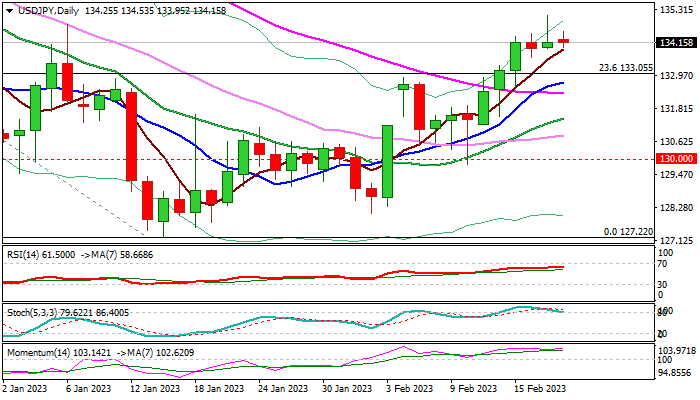
Recovery from 127.22 (2023 low of Jan 6) peaked at 135.11 on Friday (two-month high), but subsequent easing left a daily candle with long upper shadow, signaling that bulls might be running out of steam.
Daily studies remain in bullish setup, but stochastic is about to emerge from overbought territory and warning extended consolidation or correction.
Pivotal supports at 133.05/132.72 (broken Fibo 23.6% of 151.94/127.22 / 10DMA) are in focus and should contain dips to keep bulls in play for fresh push higher.
Conversely, clear break of these supports would weaken near-term structure and risk deeper pullback towards key supports at 132.08/131.84 (Fibo 38.2% of 127.22/135.11 recovery leg / daily cloud) loss of which would signal reversal.
Res: 135.11; 136.66; 136.94; 137.54.
Sup: 133.60; 133.05; 132.72; 132.08.
Gold Price Started a Recovery Wave from $1,830
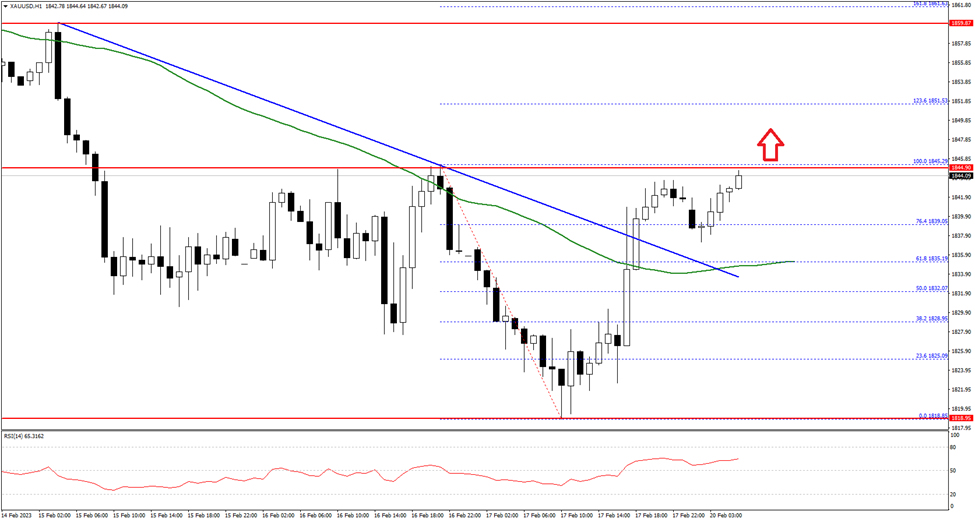
Gold price started a decent increase from the $1,820 zone against the US Dollar. The price moved above the $1,830 resistance zone to start a recovery wave.
The bulls even pushed the pair above the $1,835, a bearish trend line on the hourly chart, and the 50 hourly simple moving average. The price is now showing a few positive signs above the $1,840 level. An immediate resistance on the upside is near the $1,845 level.
The first major resistance is near $1,850 on FXOpen. The next main resistance could be near the $1,860 level, above which the price could start a steady increase towards the $1,880 level.
On the downside, an immediate support is near the $1,835 level. The next major support is near the $1,820 level, below which the price might decline towards the $1,800 support level in the near term.
AUD/USD: High Probability Price Will Fall Again to a Minimum of 0.617
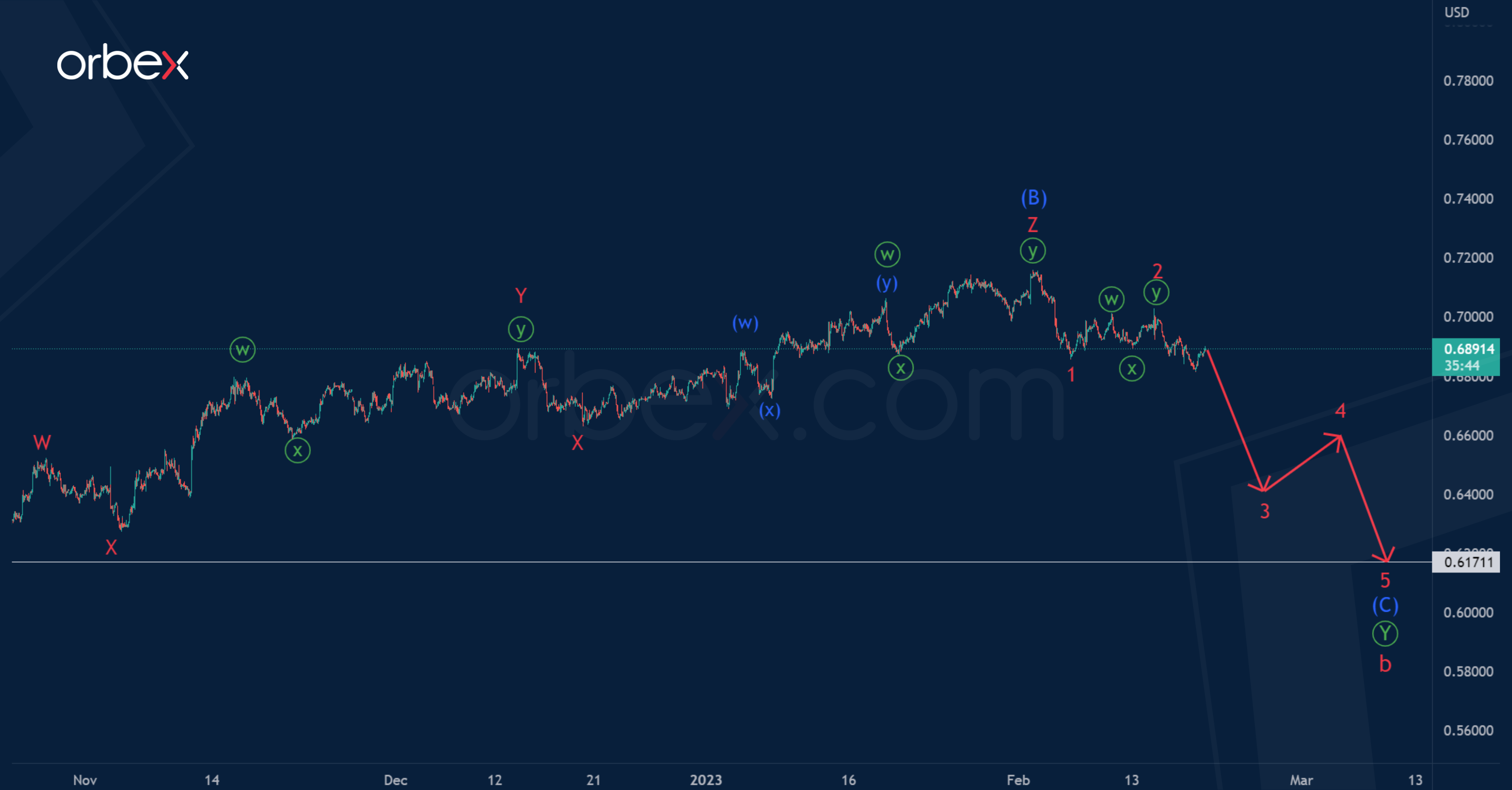
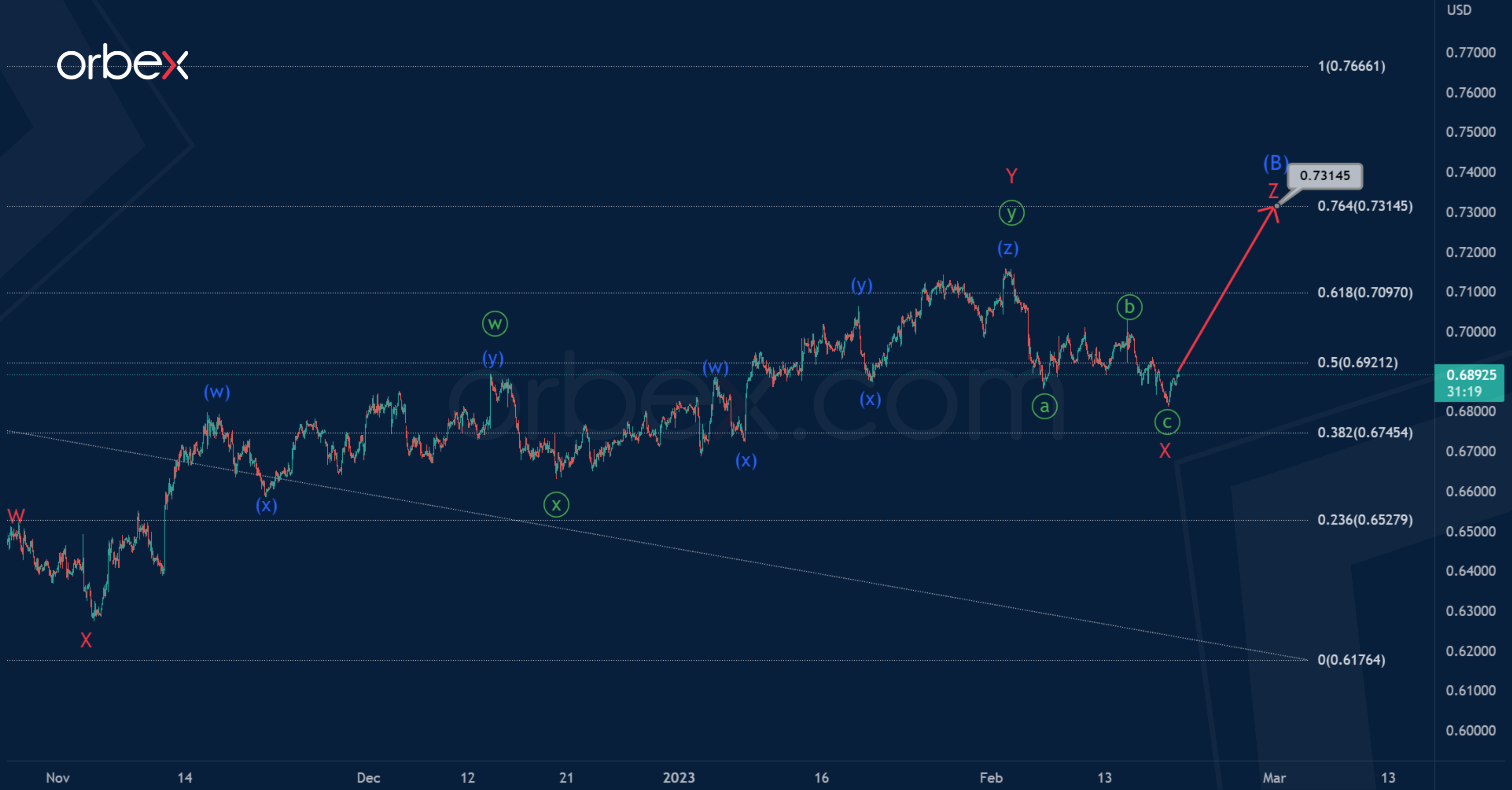
In the long run, AUDUSD seems to be forming a global correction b of the cycle degree, which may soon end in the form of a primary double zigzag Ⓦ-Ⓧ-Ⓨ.
In a zigzag actionary wave, two parts can be completed – an impulse (A) and an intermediate correction (B) in the form of a triple zigzag.
In the last section of the chart, the initial part of the final impulse (C) can develop, the structure of which is schematically shown by trend lines.
There is a high probability that impulse (C), like the previous impulse (A), will end at a minimum of 0.617.
An alternative scenario is indicative of the continuation of price growth in the intermediate correction (B).
Perhaps it will take the form of a triple zigzag W-X-Y-X-Z, as in the first scenario, however, its end is expected a little higher.
Most likely, after the end of the zigzag intervening wave X in the form of a minute zigzag, the price will continue to rise in the final minor wave Z to 0.731.
At that level, correction (B) will be at 76.4% of impulse (A).
Dax 40 Finds Support
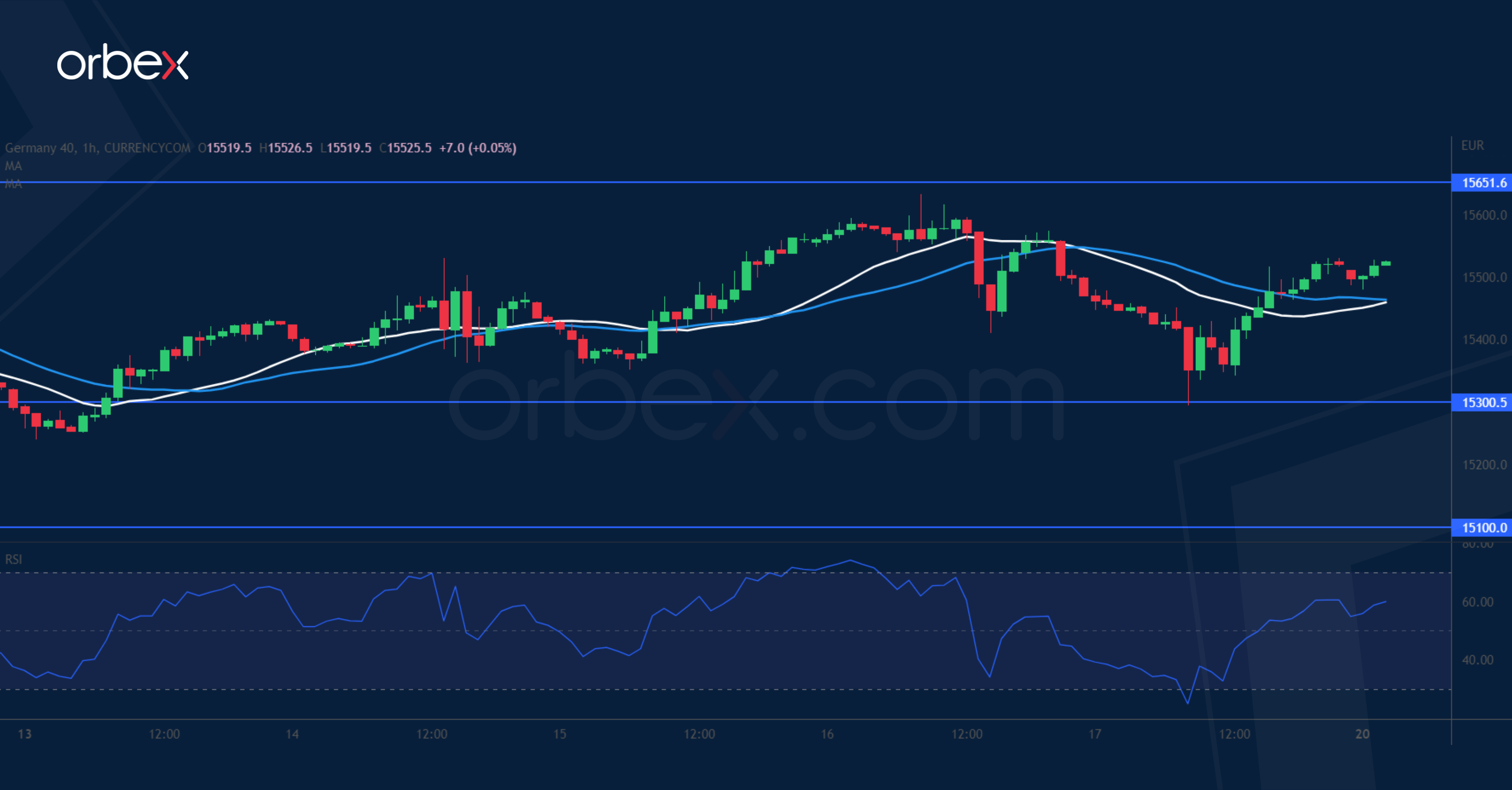
The Dax 40 whipsaws on concerns about more interest rate hikes. The price action previously failed to clear the high of 15650, forming a double top as it pulls below 15380. A bounce off 15300 right above the swing low of 15250 on the 30-day SMA, suggests a strong enough follow-through to keep the short-term bullish momentum intact. A close back above 15650 would nip the selling in the bud and resume the uptrend while a bearish breakout would cause a correction to the previous consolidation range above 15000.
XAG/USD Tests Major Support
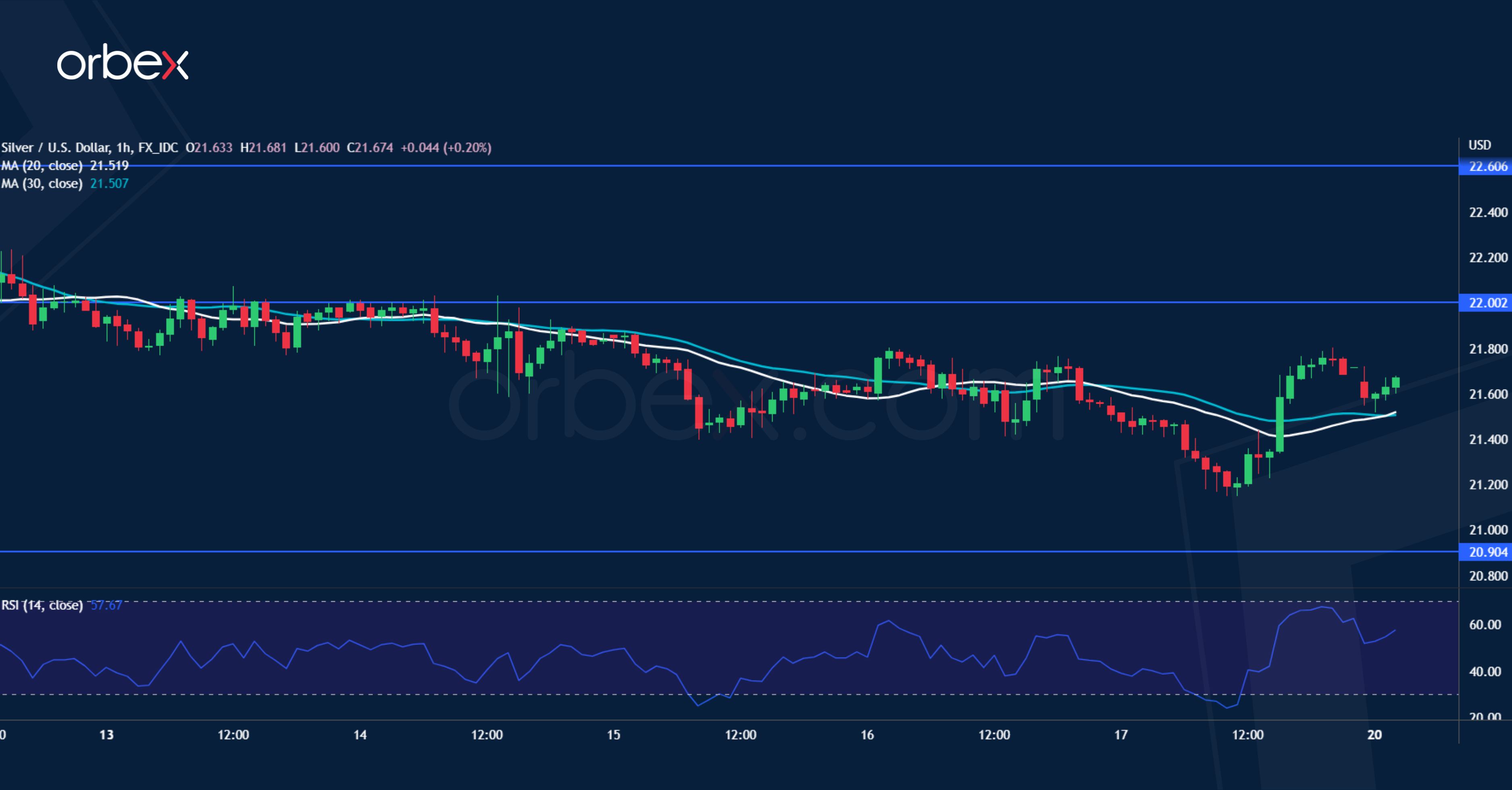
Silver struggles as the US dollar nears a six-week peak. The price is drifting to last November’s low of 20.90, a daily support at the origin of a bullish breakout. Buying interest or a lack of in this important zone would dictate the metal’s outlook in the weeks to come. Intraday-wise, the RSI’s oversold condition has triggered a ‘buy-the-dips’ behaviour. A combination of profit-taking and fresh buying may drive the short-term price up. 22.00 is the closest resistance and the bulls will need to lift 22.60 before a recovery could happen.
GBP/USD Bounces Back
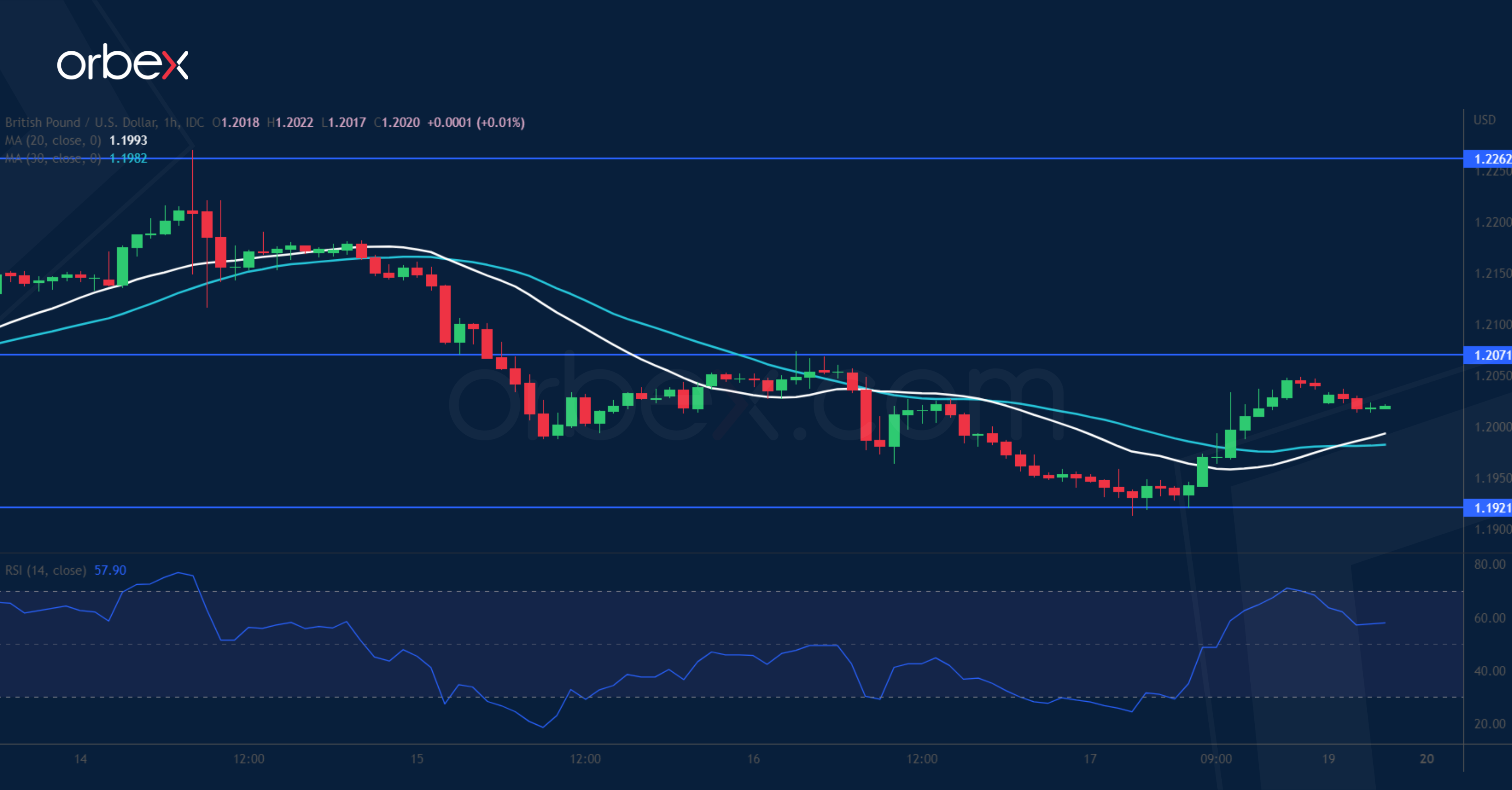
The pound clawed back some losses after January’s retail sales beat expectations. A fall below 1.1970 has invalidated the rebound and put buyers under renewed pressure. As the cable tests the demand zone above this year’s low of 1.1850, the RSI’s double dip into the oversold area attracted some bargain hunters near 1.1920. 1.2070 is the immediate resistance and stiff selling could be expected around 1.2200-1.2260 as sentiment remains downbeat. A return to the critical level of 1.1850 could trigger a deeper correction.
As US Yields Hit Resistance, Dollar Lost Momentum
Markets
Technical levels prevailed on Friday during US trading hours. A strong repositioning drive pulled core bonds lower since the release of January US payrolls. Markets are finally embracing the idea that policy rates will peak at higher levels and remain there for longer. ECB Villeroy for the first time implicitly put forward 4% as potential end zone (“peak by September”; “slowing down pace after March”). Both the German 10-yr and US 10-yr yield tested important resistance, respectively at 2.55% (2022 high & 62% retracement on 2008/2020 decline) and 3.9% (neckline double bottom formation). Ahead of the long US weekend (markets closed for President’s Day), markets lacked the drive to already force the break higher. US yield eventually declined by 4-5 bps across the curve with the front end underperforming (2y: -2.3 bps). German yields dropped between 0.4 bps (2-yr) and 4.3 bps (30-yr). Technical pictures now even suggest some short term trend reversal with a bearish engulfer on the German 10-yr chart and a (sort of) inverted hammer on the US 10-yr chart. From a data point of view, this week hasn’t that much to offer to nevertheless extend the upleg in yield, though we see some opportunities. First of all via tomorrow’s global PMI’s. Those could strengthen the picture that the global economy is actually showing much more resilience than feared. Second, via Wednesday’s FOMC Minutes. Last week’s “coming out” of Fed governors Mester and Bullard suggested that the early Fed decision to downshift the pace of rate hikes from 50 bps to 25 bps wasn’t so unanimous after all. Both argued in favour of sticking to 50 bps and will do so again in March. Minutes could show how big the hawkish minority within the Fed already was ahead of the January data releases (stellar payrolls, stubborn inflation and strong retail sales). The Fed’s preferred PCE deflators on Friday are this week’s final data point, though there direction is probably known given this month’s earlier CPI prints. The US Treasury’s end-of-month refinancing operation (2y-5y-7y) and central bank speeches serve as wildcards.
As US yields hit resistance, the dollar lost momentum on Friday as well. EUR/USD last week dropped out of the upward trend channel in place since November. The pair set a new short term low at 1.0613 before closing at 1.0695 with a technical hammer formation suggesting some short term improvement ahead. We think that the pair will rapidly run into resistance near 1.0750 though. EUR/GBP holds just narrowly below the 0.89 big figure, but the uptrend in the pair remains firmly in place.
News and views
Czech National Bank vice governor Jan Frait in an interview with daily DenikN indicated that no rate cuts will be discussed that the CNB policy meetings of March and May. If the economy actually develops in line with the CNB’s forecast, the central bank might consider whether it can cut rates in the third quarter of the year. However, Frait warned that this is already a far distant horizon which contains a high degree of uncertainty. Even in such a scenario, Frait assessed that interest rates will have to stay relatively high for a longer period of time. In assessing the options for monetary policy, the CNB will keep a close eye at the development in the real estate market. Higher core market rates last week’s caused the Czech krona to ease off a multi-year top against the euro. Even so, at EUR/CZK 23,7, the Czech currency continues holding strong.
Rating agency S&P affirmed the Polish A- long term credit rating (stable outlook). S&P assesses that the discontinuation of some energy-related tax cuts by the Polish government will probably result in a lower 2023 fiscal deficit than initially anticipated. The government might stabilize the general government debt to GDP ratio at around 45% in the coming years. S&P also mentions Poland’s competitive and diversified economy as well as strong external and public balance sheets to help mitigate the negative consequences of the war. S&P expects inflation to peak around 20% in February and average 12.9% this year and 6.2% in 2024, above the NBP’s 2.5% (+/- 1%) inflation target. The zloty over the previous weeks underperformed the forint and the Czech koruna, but last week resisted the impact of higher core yields rater well holding near EUR/PLN 4.76/4.77.
The Planet is Boiling
Tensions between US and China ramped up as Wang Yi said that Americans’ response to the spy balloon was ‘hysterical’.
Antony Blinken said that the object’s entry in the US airspace was ‘irresponsible’. He also said that they have information that China is considering a dangerous aid to Russia which could cause ‘a serios problem’.
As a response, China said they will hold naval exercises with Russian and South Africa.
North Korea fired an intercontinental ballistic missile which landed off Hokkaido.
US, South Korea and Japan held aerial drills to show off a force.
And Pentagon’s top China official went to Taiwan on Friday – it was the first known trip to the island since 2019.
Then, international atomic monitors detected that Iran has uranium enriched to the levels just below what’s needed for a nuclear weapon.
The only good news is that there could be finally a Brexit agreement on Northern Island. But I won’t clap before I see the concrete agreement.
Escalating geopolitical tensions combined with the hawkish Federal Reserve (Fed) bets boost demand in the US dollar, while gold sees demand below the $1840.
Note that an ounce of gold came as close as $4 to a critical support last Friday, which is the major 38.2% Fibonacci retracement, if cleared will mark the end of November to February bullish trend. Will the boiling tensions between US, China, Russia, and Koreas help keeping gold’s head above water is yet to be seen. Because the US yields are trending higher on an increasingly hawkish Fed talk, and that could well send the precious metal into the bearish consolidation zone, sooner rather than later.
ECB’s Schnabel sends ECB rate expectations rocketing
The European Central Bank’s (ECB) Isabel Schnabel warned last week that investors may be underestimating the persistence of inflation, and more importantly the response needed to tame it.
She said that the ECB may have to act more forcefully to bring inflation to the 2% target. Her words boosted the ECB rate bets, with money markets pushing the peak ECB’s deposit rate to 3.72%, from around 2.50% where it stands currently. The latter helped the EURUSD rebound from the 1.0612 dip on Friday, but the pair remains under pressure with decent resistance seen into the 50-DMA, which stands near the 1.0730 mark.
The European stock markets, however, continue performing well despite the hawkish ECB expectations and the few more 50bp hikes to come.
The rebound in the euro since the end of September has been a boon for European stocks, as the stronger euro made energy costs – that are negotiated in the USD terms - more affordable for European companies.
The mild winter in Europe also helped divert the risk of an energy shortage.
Even though the EURUSD started easing in February, the strength in European stocks continued on the back of softening energy prices. The DAX is now at one-year high levels, at levels before the start of the Ukrainian war, and the CAC40 hit an all-time high last week. It’s unbelievable.
The European nat gas futures continue trending lower, on the other hand, we are also at levels before the war in Ukraine started. The barrel of American crude fell to $75bp on Friday, and interestingly, the Chinese reopening, the fading global recession odds, strong economic data, or supply cuts from Russia… nothing has been appetizing enough to give the oil bulls the momentum they needed to clear the 100-DMA resistance.
That’s great news for the DAX, because the energy costs will be falling further even with a softer euro. And, on the other hand, the softer euro is a boon for French luxury brands, as they make more sales abroad.
What could go wrong? The ECB. Higher ECB rates, and a potential U-turn in energy prices are the main risks to the European stock rally right now.
The only place where the central bank will remain soft enough is China, to recover from a series of absurd Covid measures that pushed the economy into an unnecessary depressed zone. So People’s Bank of China kept its lending rates unchanged for the 6th straight month and urged banks to “front-load” credit extensions and help support the recovery. Is it enough to make people willing to buy Chinese stocks is yet to be seen. The geopolitical tensions aren’t going in the right direction for restoring confidence. Nasdaq’s Golden Dragon China index is down by more than 10% since the January peak. Alibaba is down by more than 17%. Alibaba and Baidu will announce their latest quarterly earnings this week, and may not come as a blessing. The revenue is seen 6% lower over the year. Even the Singles Day sales may not save the day.
US-China Relations Remain Tense
Market movers today
Today, focus will be on Sweden where we get January inflation data and Riksbank minutes. We expect both headline and core CPIF to print higher than Riksbank's forecasts: CPIF at 10.2% y/y and CPIF excl. Energy at 8.4 % y/y.
US markets are closed today for the Presidents Day.
Tomorrow, focus turns to preliminary February PMIs from the US and euro area. The German ZEW index is also out.
On the central bank front, FOMC minutes will be published on Wednesday but considering the strength in macro data and the hawkish tone by Fed speakers recently, the message might be outdated by now. We also have the Reserve Bank of New Zealand meeting on Wednesday and the central cank of Turkey meeting on Thursday.
The 60 second overview
Central banks: Central bankers had mixed views on the inflation outlook and the most recent upbeat data releases on Friday. ECB's Schnabel said markets might underestimate inflation risks, but later Villeroy appeared more dovish, noting that rates have 'clearly passed the neutral rate' and emphasizing that ECB is not on a pre-committed path.
In the US, Fed's Bowman (voter) noted that the recent data suggests Fed's actions 'have yet to be effective' and that more rate hikes will be needed. Barkin (non-voter) also said labour demand remains too high relative to supply. Barkin (non-voter) was less worried, and highlighted that the seasonal adjustment issues (potentially linked to the unusually warm weather) might have distorted the recent employment and retail sales figures. He favoured 25bp hikes also going forward.
Munich security conference: Relations between the US and China remain tense after US Secretary of State Blinken met with China's top diplomat Wang at the Munich security conference over the weekend. Blinken noted that there was 'no doubt' the balloon recently shot down by US military was used for surveillance purposes, while Wang called the US actions 'almost hysterical'. Blinken also warned China against providing military support for Russia, saying that US was concerned China was planning to send weapons over to be used in the war.
PBoC: The People's Bank of China left its Loan Prime Rates (LPR) unchanged overnight, which was widely expected after it did not make changes to its medium-term lending facility rate (MLF) last week.
FI: After an initial sell-off on hawkish comments from Schnabel on Friday saying risks are for markets underestimating inflation outcomes, European rates staged a strong rally of 11bp from the peak to the trough as Villeroy voiced more moderate tunes. Rates markets have repriced as the expectations for peak policy rates have seen a significant change since the US labour market and CPI reports earlier this month, talking peak deposit rate to almost 3.75% in ECB and slightly above 5.25% in the US. In particular the ECB seems divided about the future need of policy tightening. 2y UST yields are 50bp higher than the US labour market report now at 4.62%.
FX: Last week was characterised by JPY and NOK weakness amid the broader tightening of global financial conditions, lower oil and higher USD rates. EUR/USD temporarily moved below the 1.0650 level on Friday but rebounded during US hours. EUR/SEK has edged slightly higher again trading just south of 11.20.
Credit: The increased focus on rising rates and the potential ensuing damage to the economy and default rates once again drew attention to Friday's credit markets. This left credit indices weaker with iTraxx main wider by 2bp to 77.8bn and Xover wider by 12bp to 404.5bp.
Nordic macro
Sweden: Both January inflation (08.00 CET) and Riksbank minutes (09.30 CET) are out Monday morning. We expect both headline and core CPIF to print higher than Riksbank's forecasts respectively: CPIF at 10.2 % yoy vs 9.3 % yoy and CPIF excl. Energy at 8.4 % yoy vs 8.2 % yoy. Markets' call is closer to Riksbank's view than our own. That said, January inflation tends to be volatile and there is the usual uncertainty for the January print given updated basket weights. Hence, any outcome either higher or lower should not be over-interpreted, and we will get two more inflation prints before the next Riksbank meeting in April.
The Riksbank minutes will be scrutinized about how the four 'old' board members came to change their minds about active quantitative tightening. During the autumn meetings these members were content with reducing the bond portfolio by just letting bonds mature, to shift their stances to active QT with the two new board members (Thedéen and Bunge) at the February meeting. This time we would also not be surprised to see the krona being discussed by all board members and we are especially keen on any thoughts concerning potential policy action being linked to the SEK and how Board members view the SEK toolbox.