Sample Category Title
Fed Waller: I am prepared for a longer fight to get inflation down
Fed Christopher Waller said in a speech that while some believe that inflation will come down quite quickly this year, "I'm not seeing signals of this quick decline in the economic data".
"I am prepared for a longer fight to get inflation down to our target," he added.
"Though we have made progress reducing inflation, I want to be clear today that the job is not done," Waller said.
"It might be a long fight, with interest rates higher for longer than some are currently expecting. But I will not hesitate to do what is needed to get my job done."
Fed Kashkari: We need to do more to bring labor market into balance
Minneapolis Fed President Neel Kashkari said yesterday, "there's not yet much evidence, in my judgment, that the rate hikes that we've done so far are having much effect on the labor market."
"We need to bring the labor market into balance so that tells me we need to do more," he added.
He noted that Fed will likely need to raise interest rates to around 5.4% in order to bring inflation down to the 2% target.
ECB Knot: Highly unlikely that the March hike will be our endpoint
ECB Governing Council member Klaas Knot said, "I consider it highly unlikely that the March hike will be our endpoint."
"If underlying inflation pressures do not materially abate, maintaining the current pace of hikes into May could well remain warranted," he added.
He also noted that ECB's focus "has shifted from energy, headline inflation to breaking underlying inflation." It will take "some time before core inflation slows down."
"Once we see a clear and decisive turn in underlying inflation dynamics, I therefore expect us to move to smaller steps," he said. "But absent such a turn, the ECB will continue to stay the course on its steady pace upwards, in pursuit of price stability."
Is the Dollar Staging a Comeback?
Following last week’s robust US data, the dollar surged against all its major counterparts, gaining the most against the risk-linked currencies aussie and kiwi. Investors revised up their expectations with regards to the Fed’s future course of action, admitting for the first time that they were probably wrong in pricing in a lower peak in interest rates and around 50bps worth of rate cuts later this year. Does this mean that the US dollar is staging a solid comeback?
Dollar laggard among majors on Fed pivot view
Since September 28, when it hit a more-than-twenty year high, the greenback has been suffering against all the other major currencies. It still holds the last place, even following Friday’s surprisingly upbeat economic releases, losing the most ground against the pound, the euro and the aussie.
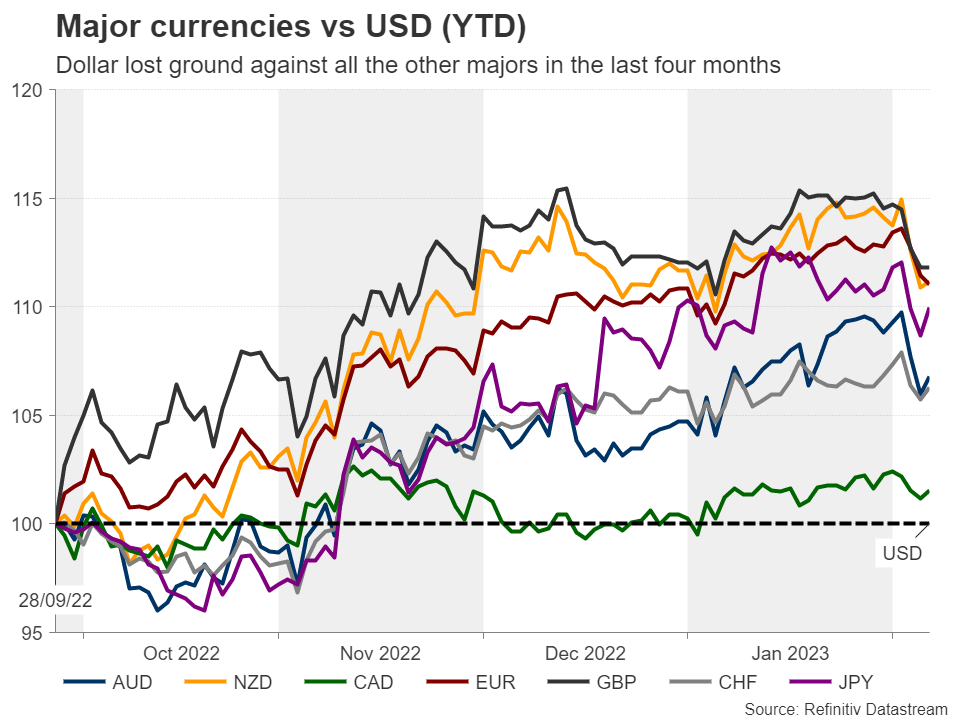
This was due to market participants adopting the view that, with inflation slowing down faster than estimated, the Fed may not raise rate as high as it has itself projected and that it may be forced to push the cut button later this year; and all this despite policymakers adamantly sticking to their guns that interest rates will rise to slightly above 5% and that no rate cuts are on their playbook for this year.
At the latest meeting, Fed Chair Powell reiterated that same view but added that the disinflationary process has started and that if inflation comes down faster, that will be incorporated into their policy. So, with inflation consistently missing estimates lately, market participants became more confident that the Fed may soon admit that rate reductions could be possible towards the end of the year, and thereby added to their dollar short positions.
Dollar shines on robust jobs and ISM data
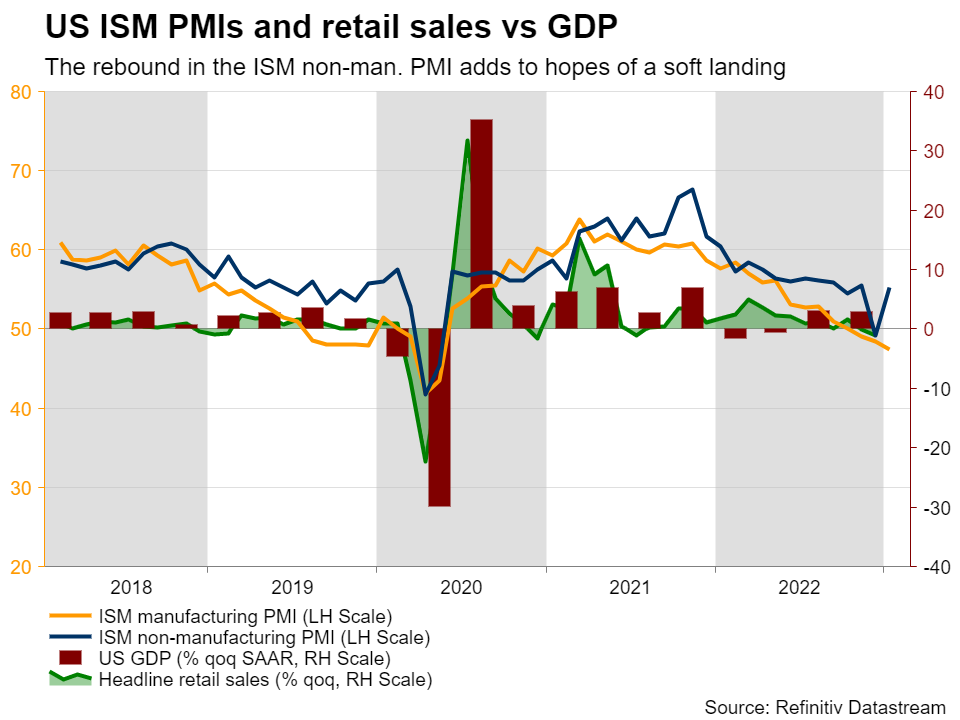
However, the dollar took a 180-degree spin on Friday and rebounded strongly against all its counterparts, after the US employment report showed that the economy added an astounding 517k jobs in January, with the unemployment rate hitting a more than a 53-1/2-year low of 3.4%. On top of that, just after the jobs data, the ISM non-manufacturing PMI rebounded strongly back into expansionary territory, adding to hopes that the US economy may eventually avert a recession.
The massive buying of the dollar following Friday’s numbers confirms the notion that the market pays more attention to data rather than to Fed communication. Even when the Fed was sounding ultra-hawkish, the market was not listening. But after the data, they were pricing in a terminal rate of around 5.12%, more or less in line with the Fed’s median projection of 5.15%, while they saw only one quarter point rate cut later this year.
Is the king back?
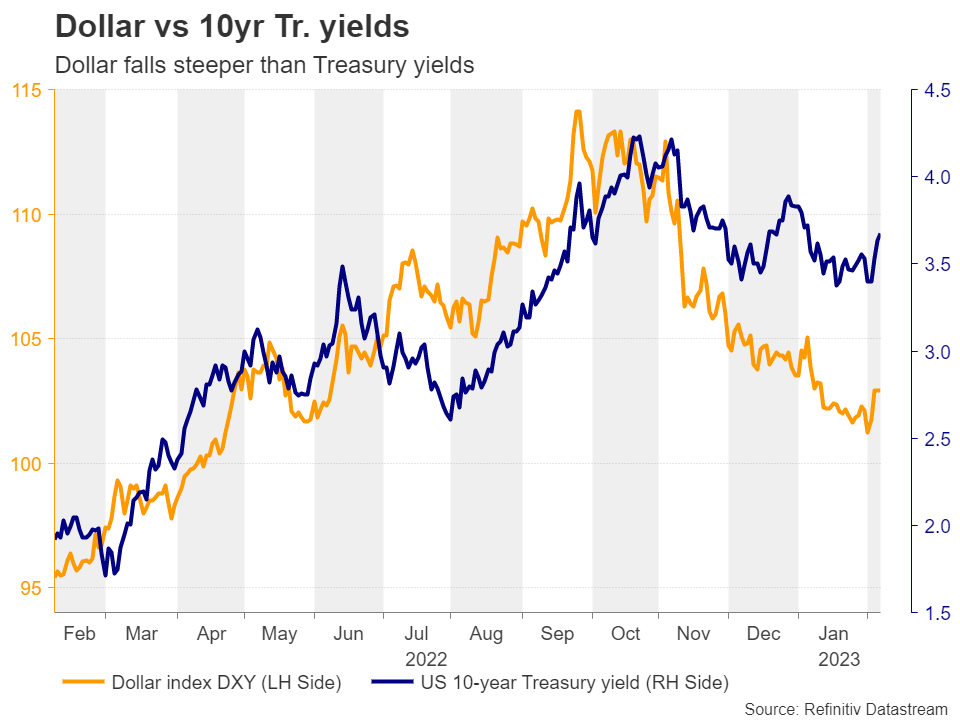
Does this mean that the dollar is back? That it reclaimed its throne as a king? What supports the case for some further recovery in the short run, may be that the dollar has fallen much steeper than the US Treasury yields due to Fed pivot bets, so when something points in the other direction, the currency may have some room to cover. Nonetheless, even if it strengthens a while longer, calling for a long-lasting recovery sounds premature at the moment. After all, just on Wednesday, Fed Chair Powell reiterated his disinflation remarks, prompting market participants to add back some rate-cut points.
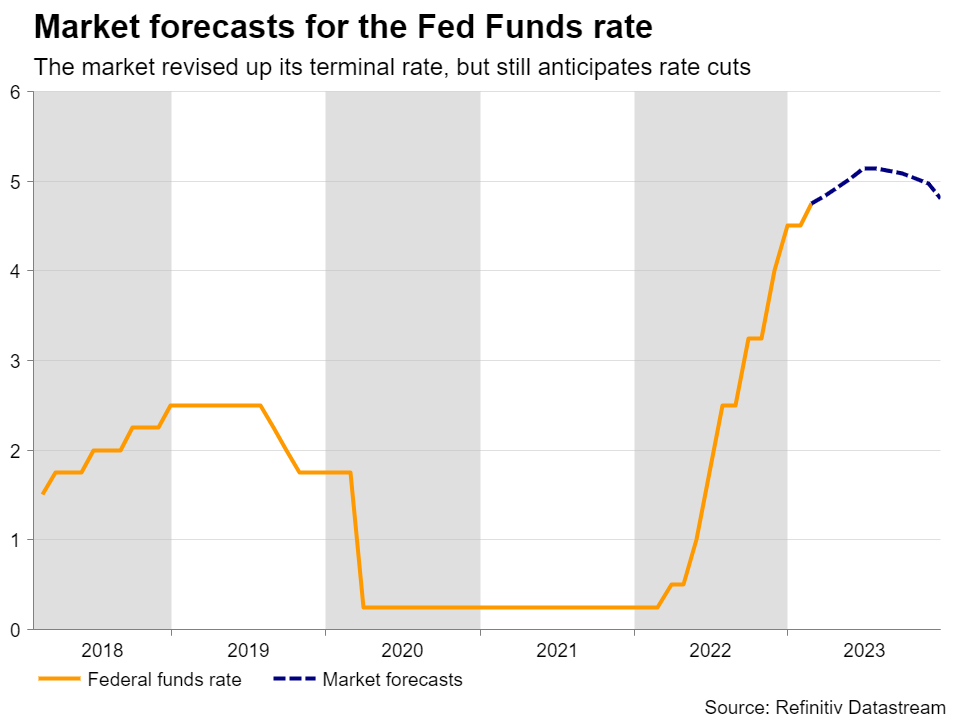
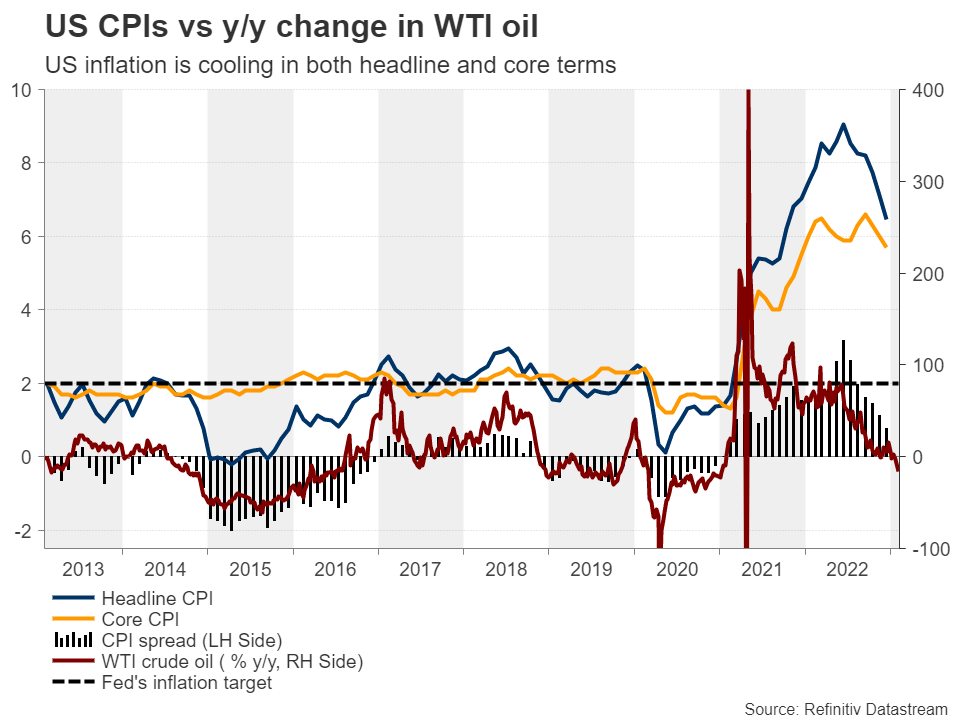
Also, with more crucial data coming out next week, any further recovery may be at risk. On Tuesday, the inflation data is expected to show that both the headline and core CPI rates continued to decline, and with the y/y change in oil prices dipping further in the negative territory, the headline CPI rate may fall more than the core. This could revive speculation about a lower peak in US interest rates as well as more rate cuts for later this year. US Treasury yields may come under renewed pressure and thereby the dollar could be sold again. The currencies that may take the most advantage of a potential downtrend continuation in the greenback are the euro, the aussie and the yen.
Getting the ball rolling with the common currency, the first reason is because the ECB is still expected to continue hiking more aggressively than the Fed, even after Friday’s stellar data, and the second is hopes that the Euro area is on track to avoid recession.
As for the aussie, the RBA turned hawkish again at its latest meeting, removing from its guidance the wording that they are not on a “pre-set course’ and instead emphasizing the need to continue with rate hikes moving forward. A potential increase in risk appetite due to investors’ potential repricing after the CPIs could also help the risk-linked currency, whose tanks are also receiving fuel from the reopening of the Chinese economy.
Last but not least, with wages in Japan accelerating strongly, speculation that the BoJ may eventually need to abandon its yield curve control may soon resurface, which will result in further narrowing between the Treasury and JGB yields and thereby translate into a lower dollar/yen.
More upside surprises may be needed
Now, in the case that the CPIs surprise to the upside and retail sales for January rebound (also scheduled to be released next week), investors may price out more basis points worth of rate reductions. The dollar may gain, and perhaps perform best against the Canadian dollar. Despite being a risk-linked currency, the Loonie gained the least against the greenback since its bearish reversal, perhaps due to the subdued oil prices. The BoC’s decision to signal that it may not hit the hike button again could also weigh on the Canadian currency should incoming data add credence to that view.
Dollar Index still in a downtrend
From a technical standpoint, the dollar index rallied after posting a false break out below the key support zone of 101.50. That said, it met resistance near the 50-day EMA on Tuesday, slightly above the key zone of 103.45, which provided support between December 14 and 30. This keeps the index in a downtrend.
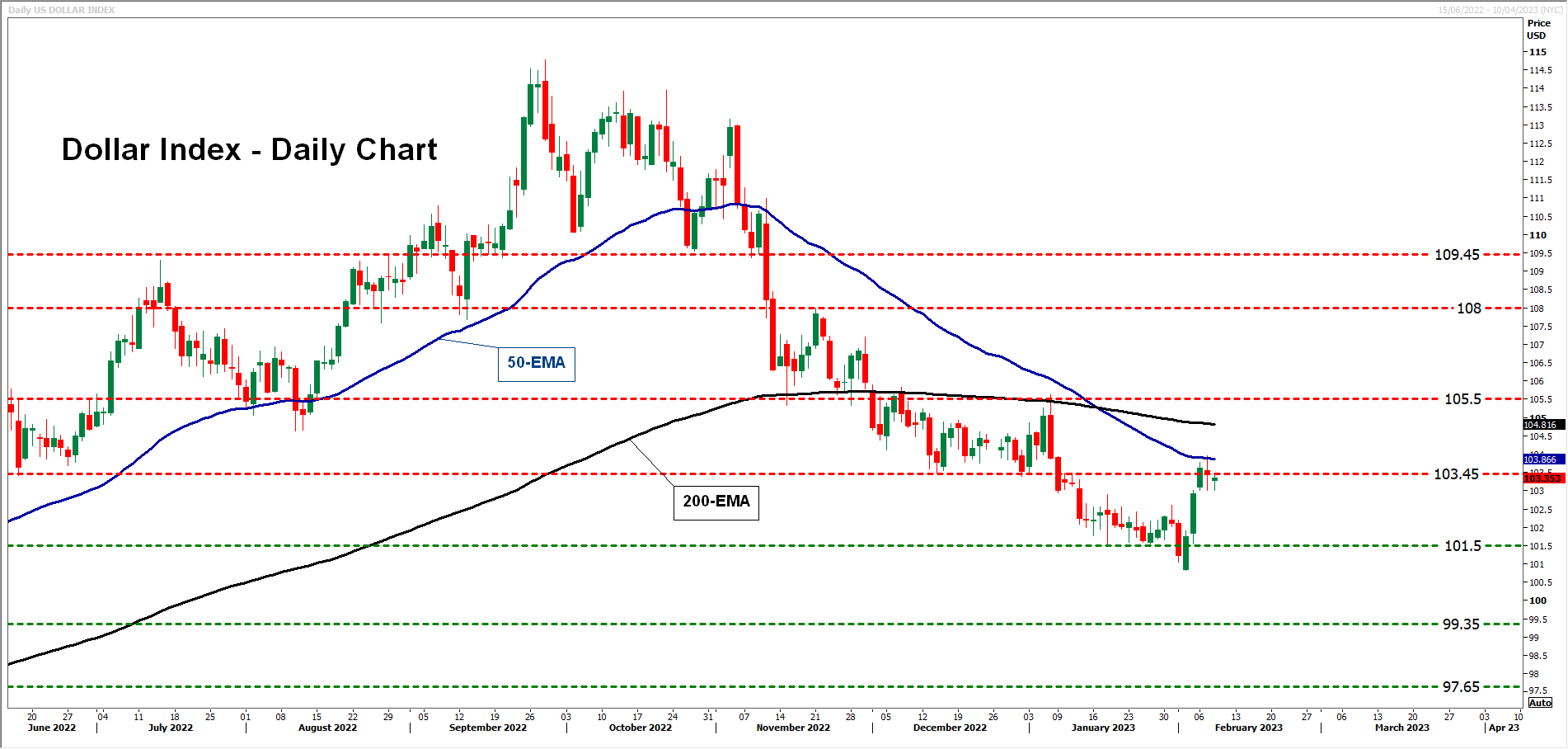
Even if the recovery continues for a while longer, the bears may jump back into the action from near the 200-day EMA or the 105.50 zone marked by the high of January 6. If they are strong enough to take the action back below the 101.50 zone, they may dive towards the 99.35 barrier, or towards the 97.65 zone, which provided strong support between March 10 and 30.
The move signaling that the bulls have stolen all the bears’ swords may be a recovery above 105.50. The index will be back above both the 50- and 200- EMAs, encouraging advances towards the 107.90 zone, marked by the high of November 21. Slightly higher lies the inside swing low of October 27 at 109.45, which could provide resistance should the 107.90 zone fail to.
Fed Cook: Appropriate to move in smaller steps while staying the course
Fed Governor Lisa Cook said, "data are telling a pretty clear story of a historically strong labor market, with still elevated inflation." But, Fed is "starting to seem some improvement in inflation data."
She expects that inflation will "continue falling this year and next, though progress may be uneven."
It's "appropriate now to move in smaller steps as Fed assesses cumulative impact of rate increases so far," She added. "Fed will stay the course until inflation is contained."
Overall, the path of policy rates "will depend on how quickly inflation moves towards the 2% goal."
Fed Williams: December rate projection still seems a very reasonable view
New York Fed President John William said, that the December interest rate projection "still seems a very reasonable view of what we'll need to do this year in order to get supply and demand in balance and bring inflation down." Median projection was a peak rate of 5.1% by the end of this year.
He added that further increase of 24bps "seems like the right size". But the pace would remain dependent on incoming data. "We still have our work cut out for us."
"The Fed will watch the data to determine the path of rate rises," Williams added. "Maybe services prices stay elevated, and if that happens we'll need higher rates."
Sunset Market Commentary
Markets
Yesterday’s interview of Fed Chair Powell at the Economic Club of Washington for sure wasn’t the game changer some had hoped for. He agreed that further rate hikes are likely (maybe even more than envisaged in the December dots), but the level and the timing of the Fed peak policy rate remains conditional to the data. US payrolls and ISM last Friday pointed to upside risks, but after recent repositioning, markets remain cautious to really prepare for a new hawkish Fed-tilt. US yield are taking a breather with changes less than 2 bps across the curve. According to the Manheim Used vehicle index, average price of US used cars rebounded 2.5% in January, potentially slowing the disinflationary dynamics. However, this (admittedly partial) evidence doesn’t move US yields. European yields also didn’t get any clear directional guidance. German yields are gaining between 1.0 bp (2-y) and 2.5 bps (10-y). The German 10-y yield is returning the upper part of the 2.0%/2.50% consolidation range that is guiding trading since the start of the year. Tomorrow’s delayed German CPI data are a next reference for European yields, even as technical issues might complicate the analysis. US and European equity indices show good resilience despite the hawkish repositioning on core interest rate markets since Friday. The peak policy rate is one factor potentially hurting risk assets. However, for equity investors it’s probably at least as important how long central banks will keep interest rates in restrictive territory. In this respect, markets still are fighting CB guidance on higher for longer. Whatever the reason, the EuroStoxx 50 gains 0.4%, and is still only about 3.0 % away from the cycle top reached end 2021. After yesterday’s somewhat remarkable post-Powell rebound, US indices open little changed. Later, plenty of Fed and ECB policymakers are still scheduled to speak. The US Treasury later today will sell $35 bln of 10-y Notes.
The pause in (US) yield markets and a still rather mild risk climate also blocked further USD gains. The DXY index eases to 103.3 (from 103.42). EUR/USD today held an extremely tight sideways pattern near the 1.0750 pivot. The yen maintains yesterday’s gain, with USD/JPY struggle not to fall below the 131 big figure. In a low volatility environment, sterling outperforms with EUR/GBP drifting back below the 0.89 handle (0.8885). The decline in the Norwegian krone (EUR/NOK 11.03) and the Swedish krone (EUR/SEK 11.36) also took a pause, but is too early to already call a bottom. The Riksbank will announce its policy decision tomorrow morning.
News & Views
The White House Council of Economic Advisors (CEA) created a new wage measure for core non-housing services (NHS). It’s part of core inflation (together with core goods and housing services) often referred to as “supercore”. NHS are more labor intensive than the other categories with the tight labour market expected to play a meaningful role in this part of inflation. In the post-pandemic expansion, NHS average hourly earnings grew very quickly, reaching a 7% and 8% annual rate in early 2022 for all private sector and PNS (production, non-supervisory) workers, respectively. Since then, however, these series have both eased substantially and both were rising at a yearly rate of between 4.5–5% in December. In other inflation news, the Manheim used car vehicle index unexpectedly rose by 2.5% M/M yesterday (fastest pace since Nov2021), suggesting upside risks to next week’s US core CPI reading.
The ECB published the results of Supervisory Review and Evaluation Process (SREP) for 2022. On average, banks maintained solid capital and liquidity positions, with the vast majority holding more capital than the levels dictated by capital requirements and guidance stemming from the previous SREP cycle. For the year ahead, the weighted average of Pillar 2 requirements (P2R) set by the ECB for total capital remained in line with the requirements set out in previous years, at 2% of risk-weighted assets (RWA) after 1.9% in 2022. The P2R for Common Equity Tier 1 also remained broadly unchanged for 2023, at 1.1%. The average amount of overall capital requirements and guidance in CET1 increased to around 10.7% of RWA for 2023, up from 10.4% in 2022. At the end of Q3 2022, the average amount of CET1 held by significant institutions totaled 14.7% of RWA.
EUR/USD Mid-Day Outlook
Daily Pivots: (S1) 1.0676; (P) 1.0721; (R1) 1.0773; More...
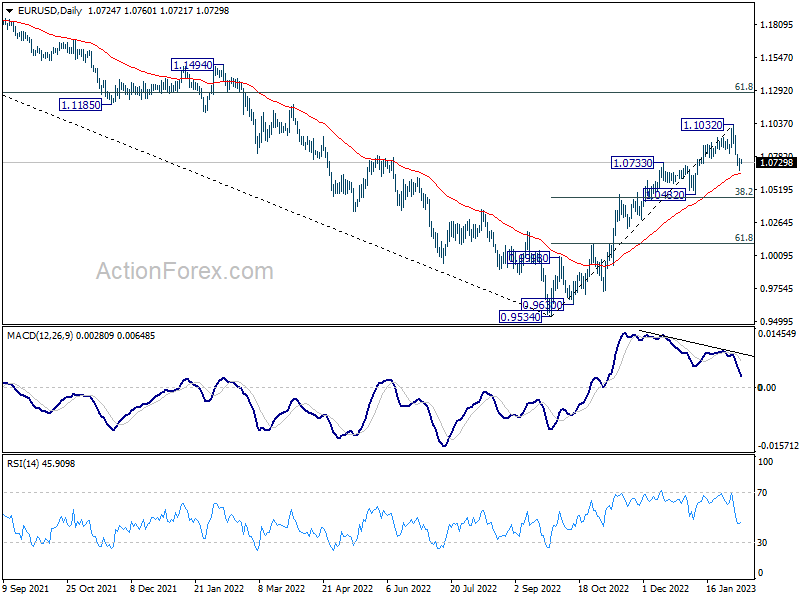
Intraday bias in EURUSD stays neutral for the moment. Correction from 1.1032 short term top could still extend lower. Break of 1.0668 will target 38.2% retracement of 0.9534 to 1.1032 at 1.0463. Nevertheless, firm break of 4 hour 55 EMA (now at 1.0822) will bring retest of 1.1032 high instead.
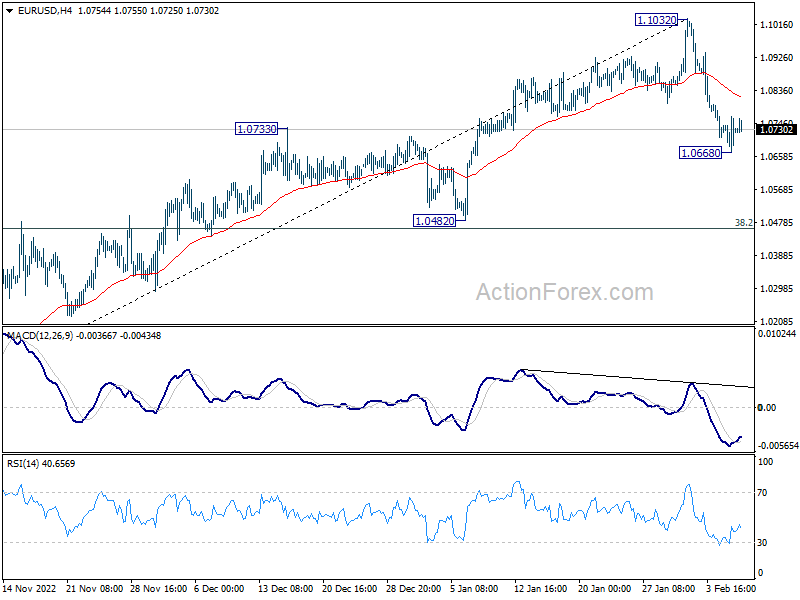
In the bigger picture, current development suggests that the rally from 0.9534 low (2022 low) is a medium term up trend rather than a correction. Further rise is in favor to 61.8% retracement of 1.2348 (2021 high) to 0.9534 at 1.1273 next. This will remain the favored case as long as 1.0482 support holds.
USD/CHF Mid-Day Outlook
Daily Pivots: (S1) 0.9178; (P) 0.9234; (R1) 0.9276; More...
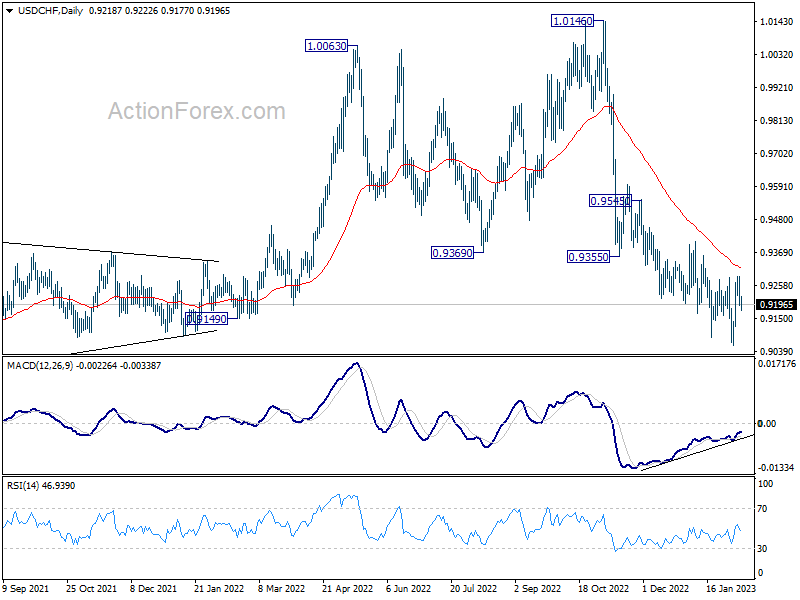
Outlook in USD/CHF is unchanged and intraday bias stays neutral. On the upside, firm break of 0.9287 resistance will confirm short term bottoming at 0.9058, and bring stronger rise to 0.9407 resistance. On the downside, however, sustained break of 0.9058 will resume larger decline from 1.0146 instead.
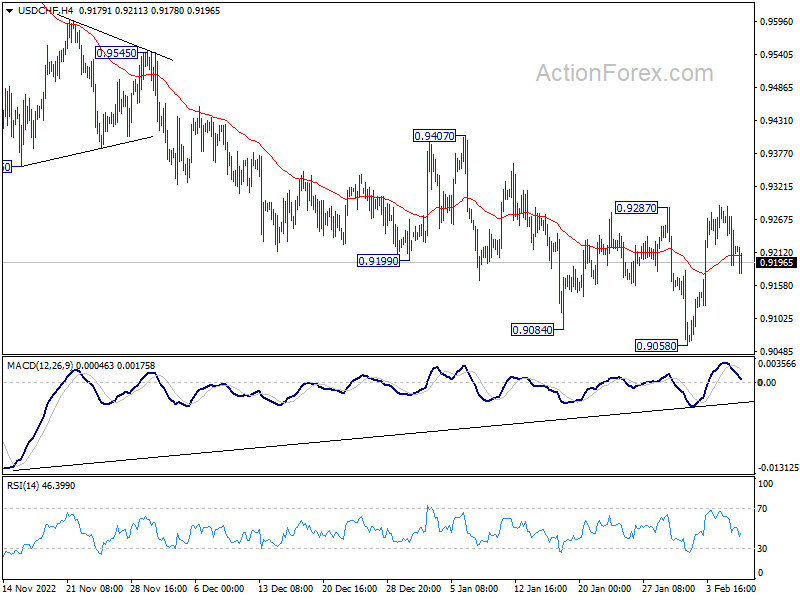
In the bigger picture, rise from 0.8756 (2021 low) has completed at 1.0146, well ahead of 1.0342 long term resistance (2016 high). Based on current downside momentum, fall from 1.0146 should be a medium term down trend itself. Next target is a test on 0.8756 low. Strong support should be seen there to bring rebound. Still, further decline will now be expected as long as 0.9407 resistance holds, in any case.