

Sample Category Title
USD/CAD Daily Outlook
Daily Pivots: (S1) 1.3409; (P) 1.3545; (R1) 1.3614; More....
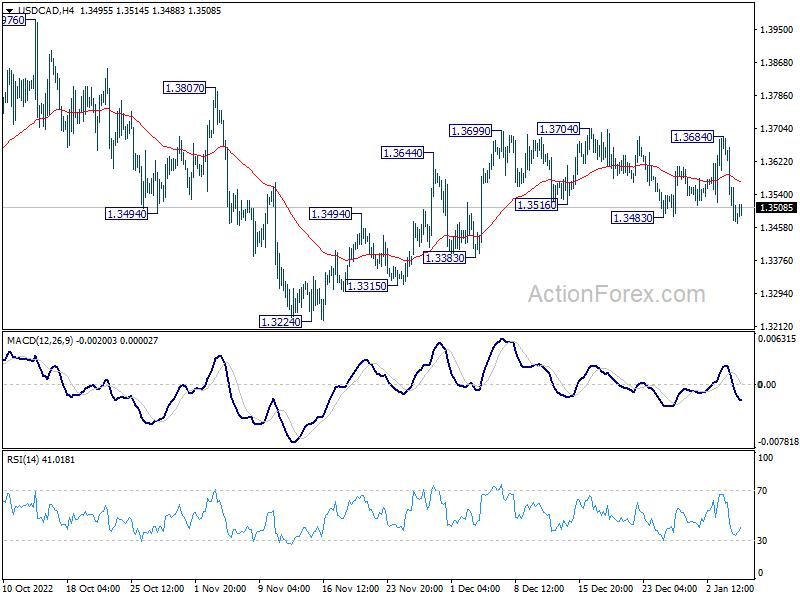
Intraday bias in USD/CAD is mildly on the downside with breach of 1.3483 support. Further decline would be seen back towards 1.3224 support zone. Nevertheless, on the upside, break of 1.3704 will resume the rebound from 1.3224 to retest 1.3976 high.
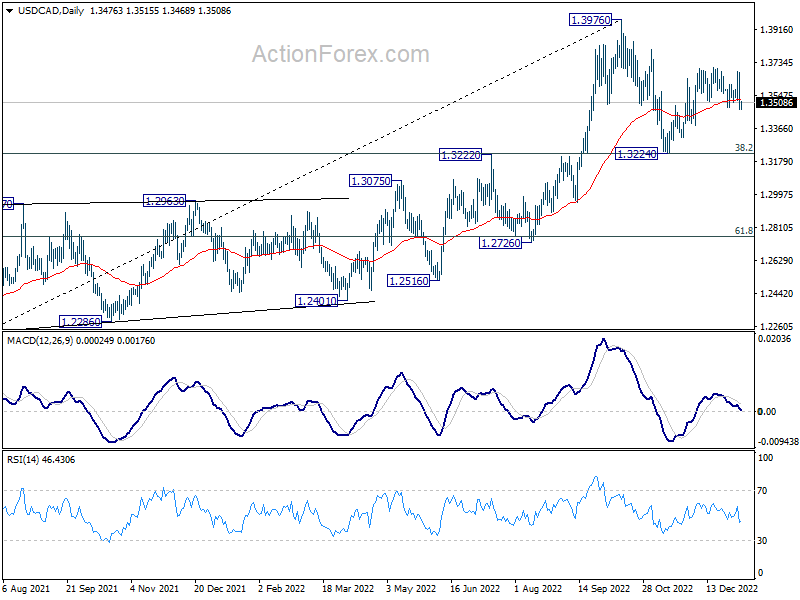
In the bigger picture, as long as 1.3222 cluster support (38.2% retracement of 1.2005 to 1.3976 at 1.3223) holds, larger up trend from 1.2005 (2021 low) is still expected to resume through 1.3976 high at a later stage. However, firm break of 1.3222/3 will indicate that the trend might have reversed. Deeper fall would be seen to next cluster support at 1.2726 (61.8% retracement at 1.2758).
Calendar Modestly Interesting With US ADP Labour Data
Markets
Yesterday, trading basically followed the pattern from earlier this week. Bonds rallied, with Europe outperforming as investors took further comfort from below consensus (headline) inflation data in most EMU member states. France joined this trend with CPI printing lower than expected at -0.1% M/M and 6.7% Y/Y (from 7.1%). US data brought a more diffuse message. The headline manufacturing ISM suggests a modest contraction in activity easing from 49.0 to 48.4. However, from a policy point of view, details were ambiguous. The prices paid subindex declined from 43.0 to 39.5, suggesting a further easing of inflationary pressures. At the same time, employment rebounded into expansionary territory, highlighting risks to wage growth, annex underlying inflation. JOLT job openings staying at 10458k also suggested a resilient US labour market. The Minutes of the December 13-14 policy meeting confirmed the Fed’s strong commitment to eradicate inflation. In this respect, the MPC clearly wasn’t happy with an easing of financial conditions and again strongly rejected markets discounting rate hikes for the second half of this year. In the end, it hardly changed the market dynamics. US yields declined between 1.7 bps (2-y) and 5.6 bps (10-y), again driven by a further decline in inflation expectations. Bunds still outperformed with yields ceding between 9.1 bps ( 2y) and 12.3 bps (5-y). Investors hope that the worst inflation might be over supported equities with Europe (EuroStoxx50 + 2.36%) again outperforming the US (S&P +0.75%). The dollar (DXY close 104.25) returned part of Tuesday’s gain. EUR/USD rebounded from 1.0541 to close at 1.0604. USD/JPY was the exception to the rule, as the BOJ-driven rally of the Japanese currency ran into resistance. USD/JPY rebounded off the 130 support area to close at 132.63. UK PM Sunak setting out the governments objectives, including halving inflation, reducing debt and restoring growth, didn’t really inspiring sterling. EUR/GBP held a tight range near to 0.88 big figure (close 0.8796).
This morning, sentiment in Asia remains mostly risk-on with China outperforming as investors ponder the potential positive impact of the reopening. The yuan extends its recent upleg (USD/CNY 6.874). The yen trades little changed after yesterday’s correction (USD/JPY 132.5). US yields are inching slightly higher.
Later today, the calendar is modestly interesting with the US ADP labour data, jobless claims and trade balance. Fed speakers (Harker, Bullard) probably will confirm the Fed anti-inflationary commitment. In case of constructive activity data, recent bond rally might gradually slow, with tomorrow’s payrolls potentially holding the key for the next directional move. On FX markets, the dollar shows tentative signs of bottoming, but without a clear technical signal yet. EUR/USD is locked in a ST range between 1.0520 and 1.0713/35.
News Headlines
The National bank of Poland left its policy rate unchanged at 6.75% yesterday. Inflation decreased in November to 17.5% y/y due to lower energy and fuel prices. However, given companies’ ability to pass through higher (operating) costs due to relatively strong demand, core inflation is still trending higher (11.4%). The NBP expects the weakening of global economic conditions to weigh on Polish growth. In those circumstances, it considers the currently delivered tightening sufficient to support a decline in inflation towards the NBP inflation target beyond the short term. This process would go quicker if the zloty trade more consistent with the economic fundamentals. In this respect, the central bank remains prepared to intervene in the FX market. The zloty yesterday appreciated from EUR/PLN 4.676 to 4.667 but that move was inspired by a constructive mood on broader markets supporting CE FX in general.
Egypt’s pound crashed to a record low against the US dollar yesterday. USD/EGP officially closed at 26.275, a 6.3% surge in what is seen as the third devaluation in less than a year. The two previous ones date back to March and October 2022, after the Egypt government pledged to adopt a flexible exchange-rate policy that allowed it to secure a $3bn loan from the IMF. At the start of 2022, USD/EGP traded around 15.7. Following the conflict between Russia and Ukraine, Egypt is struggling with sharp FX outflows as investors shunned it for being so reliant on the countries at war for its wheat imports. This causes huge dollar shortages and external imbalances that could ease thanks to a weaker pound. Soaring inflation amidst rising raw material prices added to the sense of urgency at the government. It also prompted the central bank in December to jack up interest rates by a whopping 300 bps to 16.25%.
Fed Pricing Remains Too Soft
Released yesterday, the FOMC minutes were hawkish enough to get the S&P500 erase early gains, but not hawkish enough to get the index to close in the red. The index closed the session 0.75% higher. Nasdaq gained 0.50%.
The Federal Reserve (Fed) repeated its determination to keep fighting inflation with further rate hikes, and warned that this determination should not be underestimated by investors.
No one talked about a rate cut in the foreseeable future, even though pricing in the market still shows that investors continue to bet that the Fed will start cutting rates before the end of this year.
Yes, there are some data pointing at slowing economic activity in the US, but the jobs market – which is closely watched by the Fed - remains surprisingly tight – while the Fed keeps saying that bringing inflation back to the 2% target requires some ‘softening’ in the jobs market.
Helas, a softening that has not showed up its nose, so far. Released yesterday, the US jobs opening data was again stronger than expected. The JOLTS data showed that there were still around 10.5 million job openings in November – little changed from last month, and a bit less than half a million less than the market expectation.
Today, we will see what the ADP report tells about new hirings in December. Analysts believe that the US economy may have added around 150’000 new private jobs last month.
Note that the latter is not a good indication regarding what’s to come on Friday. Last month, the ADP printed a weak 127’000 figure, while the NFP came in at 263’000. Therefore, even the avalanche of layoff news from big companies, and a soft ADP print may not be enough convince that the US jobs market is cooling.
On the rates front, there will likely be at least another 50bp hike this quarter, and perhaps one or two more 25bp hikes. Right now, activity on Fed funds futures gives a higher chance for a 25bp hike in the next Fed meeting.
To me, that means that there is room for a hawkish readjustment in expectations through January.
Oil tanks
Weaker nat gas prices, combined to the past few days’ recession fears, and news that OPEC output increased in December thanks to the recovery in Nigerian supply from outages – despite the OPEC+ will to cut output to keep prices sustained - pulled the price of American crude 5% lower yesterday. The $75/76 support has been broken; I revise my short-term view from bullish to neutral, and expect the new support, around $70/72 range, to hold on tight supply, and the Chinese reopening story.
In the FX
The Australian dollar is surfing on the positive Chinese vibes. The Aussie-dollar shortly traded above the 200-DMA, near 0.6850, yesterday, but gains remained capped into the major 38.2% Fibonacci resistance on 2021-2022 selloff, if cleared, should hint at a bullish reversal in Aussie-dollar’s medium term trend. And I think that a bullish reversal in AUDUSD is a matter of time, as the rally in iron ore prices triggered by the Chinese reopening should continue giving support to the Aussie in the coming weeks.
Elsewhere, the US dollar index couldn’t extent the early week gains, and we are about to see a death cross formation on the daily chart, where the 50-DMA will cross below the 200-DMA very shortly.
A death cross formation is closely watched by investors and is seen as a bearish sign. Although it is a lagging indicator, it is in line with our 2023 outlook of softening US dollar against many currencies, and gold.
The EURUSD is bid around 1.0550, as Cable sees buying interest below 1.20 despite its worse economic fundamentals compared to other G7 economies.
One of the most popular trades of the moment is long the Japanese yen against EUR, USD and pound, as the BoJ’s latest decision to double its cap on JGB yields spurred hawkish Bank of Japan (BoJ) expectations. Even though the BoJ warned that this doesn’t mean that a rate hike is imminent, the BoJ won’t be able to maintain rates below zero while rates are soaring elsewhere. Sooner or later, the BoJ will hike, and that’s enough for traders to pile into the yen, which has been the worst performing major currency last year.
The Fed Keeps a Close Eye on the Labour Market
Market movers today
Today's data calendar is thin. After yesterday's bunch of data releases and Fed minutes, markets will probably listen closely to Fed's Bostic in the afternoon.
While waiting for Friday's US payrolls, we get a few US tier-2 employment indicators with the release of ADP employment, initial jobless claims and Challenger job cuts.
The 60 second overview
Nordic Outlook: This morning we published our Nordic Outlook - Time to get inflation down with new economic forecasts for the Nordic countries. We have downgraded the growth outlook for 2023, as higher inflation means both reduced spending power and higher interest rates than in our October outlook. We expect inflation to come down more quickly in the Nordics than in the wider euro area, and growth to return to more normal levels during 2024. Nordic housing markets, especially in Sweden, are under pressure from the sharp rise in interest rates, and we expect prices to decline further. The Swedish Riksbank is expected to hike rates further as the weak SEK causes inflation concerns, while we expect Norges Bank to be done hiking for now.
FOMC minutes: The minutes of the December FOMC meeting provided little new information for the markets yesterday. The Fed continues to focus on labour markets and price developments in the most wage-sensitive sectors to gauge the underlying inflation pressures. On a more hawkish note, some members suggested that 'unwarranted easing in financial conditions' driven by premature speculation of future rate cuts could push Fed towards taking a more hawkish stance.
Good news is bad news: Yesterday, we highlighted how the recent uptick in some US leading indicators points towards a turnaround in macro momentum amid easing financial conditions, which is tricky for Fed as they are still far away from reaching their price stability objective. Read more in Research US - Good news is bad news for the Fed, 4 January
Hawkish Fed member: Speaking of hawkish stance, President of Minneapolis Fed Neel Kashkari (voter, hawk) yesterday said, that he favoured raising rates to 5.4%, much higher than where the market currently prices the peak just below 5%. He added that "any sign of slow progress that keeps inflation elevated for longer will warrant, in my view, taking the policy rate potentially much higher".
Mixed US data: Yesterday's US macro data was a mixed bag, with ISM manufacturing continuing its decline, but JOLTs Job Openings surprising to the upside. Notably, also the ISM employment index and JOLTs voluntary quits rose, further supporting the view of a resilient labour market. Current level of job openings is consistent with employment costs rising some 4-5% annually, clearly too fast to be consistent with Fed's inflation target.
Oil prices lower: Oil prices plunged yesterday below USD80 per barrel - unexpectedly and at odds with the faster reopening of Chinese economy that should support global oil demand. We think it is too early to disregard a positive effect on oil prices from China ending hard lockdown measures, but it may not come before after it has passed the current big wave of infections.
Equities: US and European stocks were higher yesterday, partly supported by the China reopening, which continues to fuel a strong rally in Chinese stocks, where offshore stocks this morning reached the highest level since July. They are still 30% below pre-pandemic levels, though, leaving potential for more upside as the economy recovers, see China Outlook: Earlier reopening to driver faster rebound, 3 January.
Credit: The flow of new deals continued yesterday also in the EUR corporate segment with French utility Engie bringing a landmark EUR2.75bn triple-tranche deal to the market. Within the FIG segment, issuance of senior debt slowed a bit with EUR4bn printed, yet there were some signs of lower investor demand following the heavy issuance on Tuesday. Nonetheless, the two AT1 capital trades executed saw solid demand. Also, CDS indices performed with iTraxx Main tighter by 5bp to 85bp, while Xover tightened 22bp to 440bp.
FI: Global yields continue to decline and take out the rate increase seen before New Year. This is driven by the lower than expected French headline inflation data. However, the core-inflation remains sticky and thus we could a rebound in the headline inflation later on.
FX: The NOK continues to underperform amid downward pressure on oil. EUR/NOK trades just above 10.70 this morning and is vulnerable for further upside. Meanwhile, EUR/SEK briefly tested 11.20, possibly due to NOK contagion, but is back in the range, currently at 11.15. In majors, there were big moves in JPY crosses yesterday. USD/JPY and EUR/JPY alike gained two figures. EUR/USD relative stable around 1.06.
Nordics
There are no market movers in Nordics today.
EUR/GBP Daily Outlook
Daily Pivots: (S1) 0.8779; (P) 0.8800; (R1) 0.8816; More...
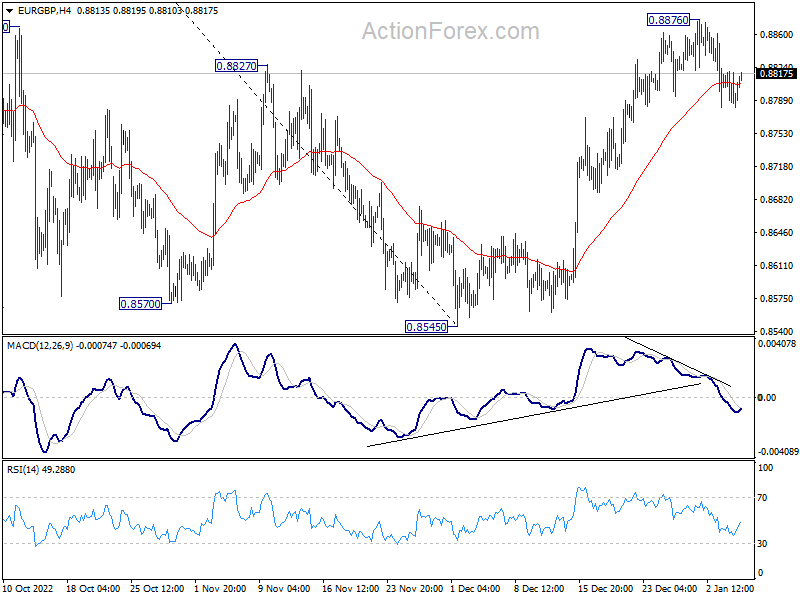
Intraday bias in EUR/GBP is turned neutral first. As long as 55 day EMA (now at 0.8714) holds, rise from 0.8545 is still in favor to continue. Above 0.8876 will resume the rally and target 61.8% retracement of 0.9276 to 0.8545 at 0.8997 and possibly above.
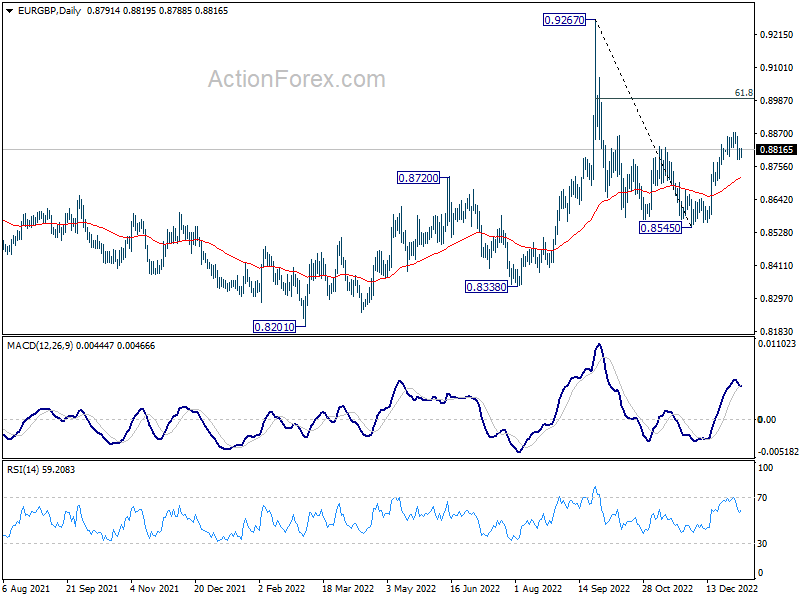
In the bigger picture, fall from 0.9267 is seen as a down leg inside long term range pattern. Deeper fall could be seen towards 0.8201/8338 support zone. But strong support should be seen there to bring reversal. Nevertheless, firm break of 0.8827 resistance will turn favor to the case that such decline is merely a correction in the up trend from 0.8201. That is, further rally would be seen at a later stage through 0.9267.
EUR/AUD Daily Outlook
Daily Pivots: (S1) 1.5385; (P) 1.5542; (R1) 1.5666; More...
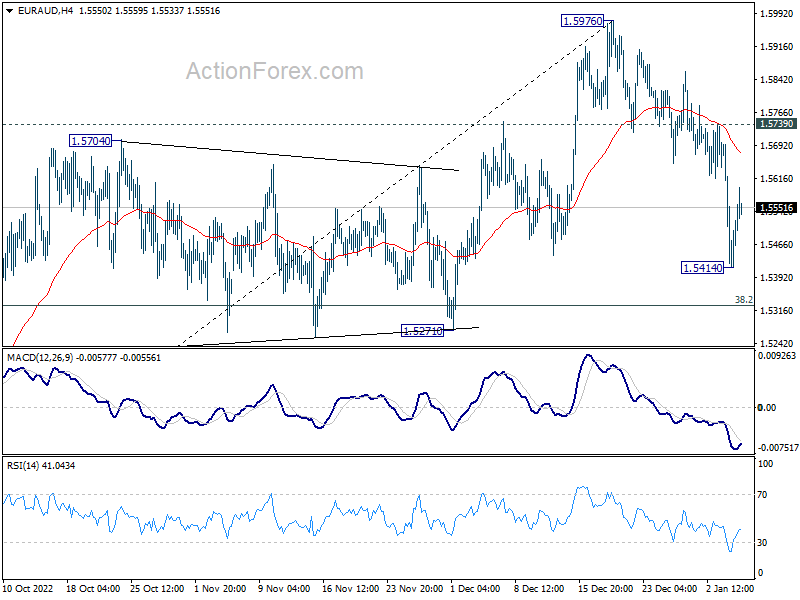
Intraday bias in EUR/AUD is turned neutral first, as it recovered after dipping to 1.5414. On the downside, below 1.5414 will extend the fall form 1.5976 to 38.2% retracement of 1.4281 to 1.5976 at 1.5329. Nevertheless, on the upside, above 1.5739 minor resistance will suggest that the pull back has finished, and bring retest of 1.5976 high.
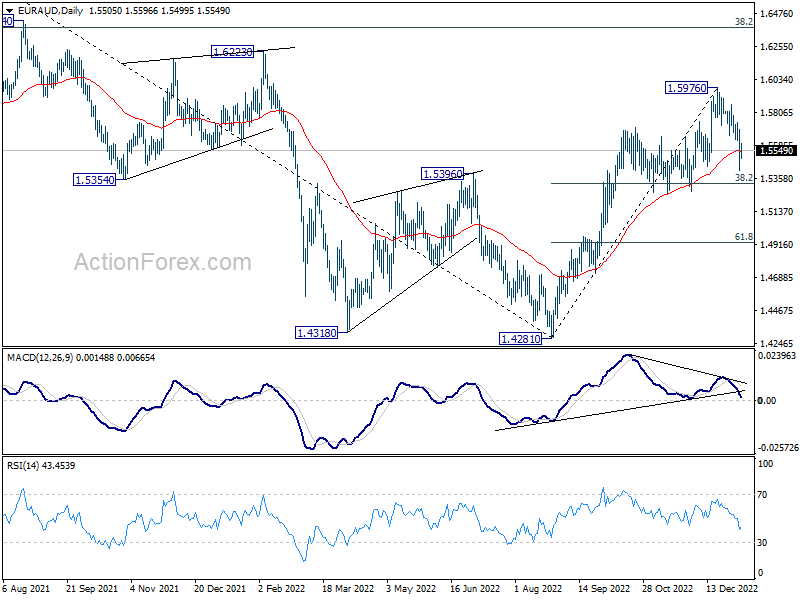
In the bigger picture, strong support from 55 week EMA affirms underlying bullishness. As long as 1.5271 support holds, rise from 1.4281 medium term bottom is expected to continue to 1.6434 key resistance next. Decisive break there should confirm medium term bullish trend reversal.
EUR/CHF Daily Outlook
Daily Pivots: (S1) 0.9841; (P) 0.9873; (R1) 0.9905; More....
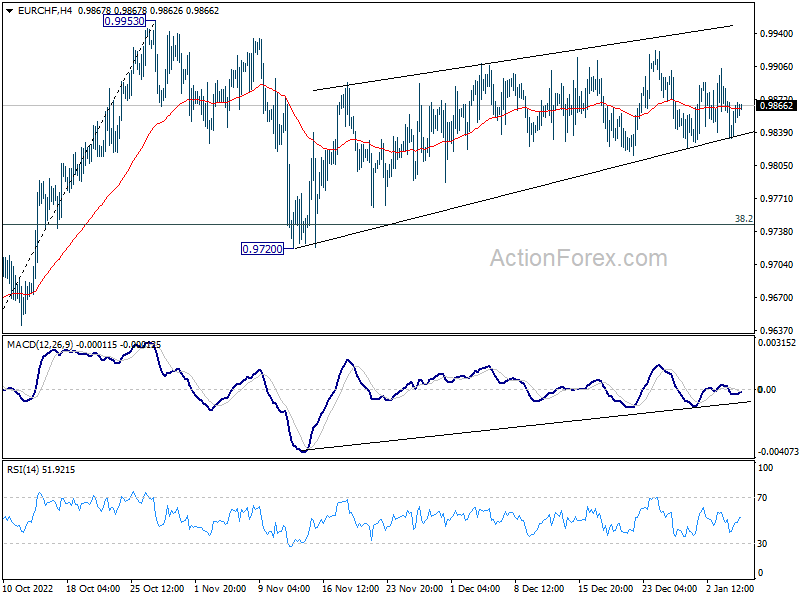
EUR/CHF is still extending the consolidation pattern from 0.9953 and intraday bias remains neutral. On the upside, firm break of 0.9953 resistance will resume larger rally from 0.9407 to 1.0072 fibonacci level. However, break of 0.9720 will extend the decline from 0.9953 to 61.8% retracement of 0.8407 to 0.9953 at 0.9616.
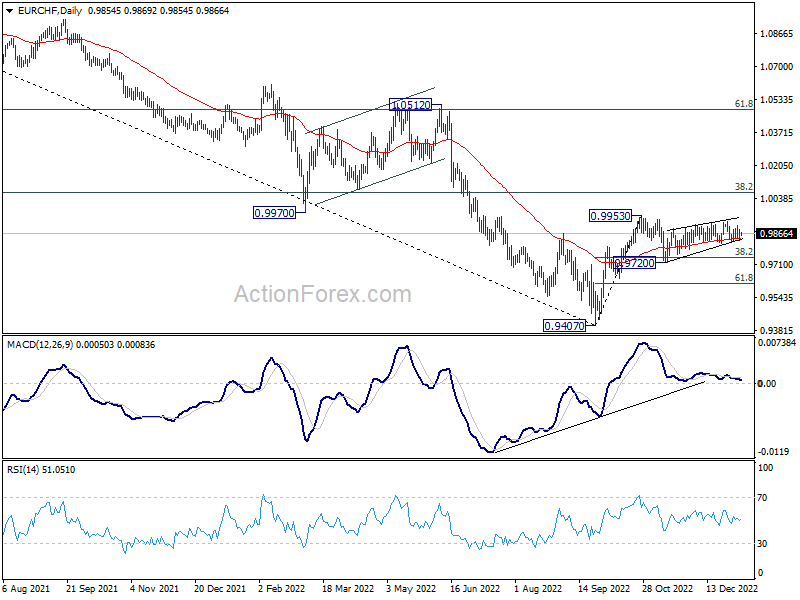
In the bigger picture, as long as 38.2% retracement of 1.1149 to 0.9407 at 1.0072 holds, price actions from 0.9407 medium term bottom will be treated as a corrective pattern. That is, long term down trend would resume through this low at a later stage. Nevertheless, firm break of 1.0072 will also have 55 week EMA (now at 1.0053) taken out. That would be an initial sign of long term bullish reversal.
EUR/JPY Daily Outlook
Daily Pivots: (S1) 138.80; (P) 139.78; (R1) 141.68; More....
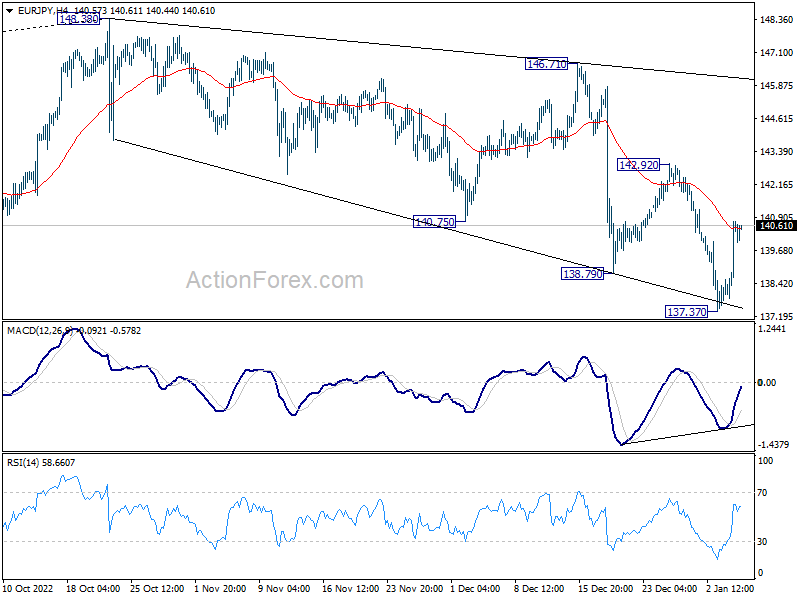
Intraday bias in EUR/JPY is turned neutral first with current recovery. Outlook stays bearish as long as 142.92 resistance holds. Break of 137.37 will resume the decline from 148.38 to 135.40 fibonacci level. However, considering bullish convergence condition in 4 hour MACD, break of 142.92 will argue that the correction from 148.38 might have completed. Intraday bias will be turned back to the upside for 146.71 resistance.
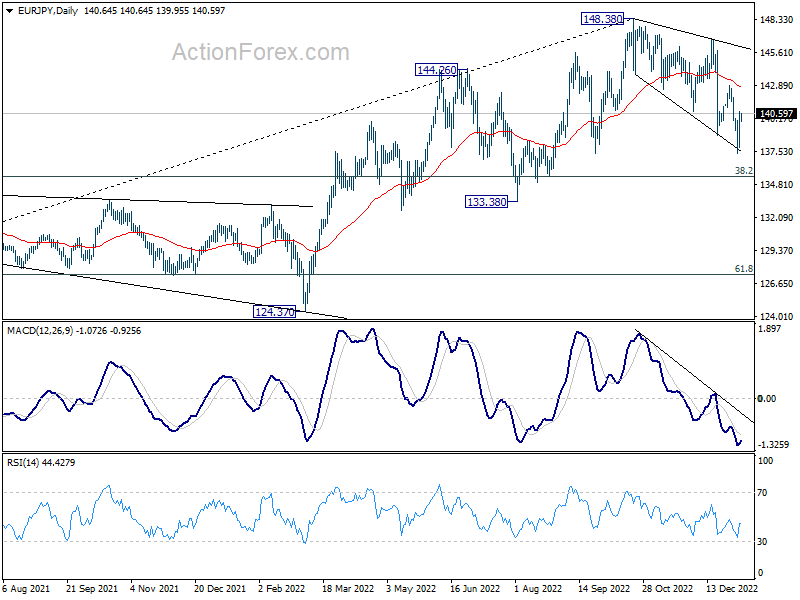
In the bigger picture, as long as 55 week EMA (now at 138.54) holds, larger up trend from 114.42 (2020 low) is still in progress for 149.76 long term resistance. However, firm break of 55 week EMA will bring deeper fall to 38.2% retracement of 114.42 to 148.38 at 135.40. Sustained break there will raise the chance of trend reversal, and target 61.8% retracement at 127.39.
GBP/JPY Daily Outlook
Daily Pivots: (S1) 157.61; (P) 158.89; (R1) 161.28; More...
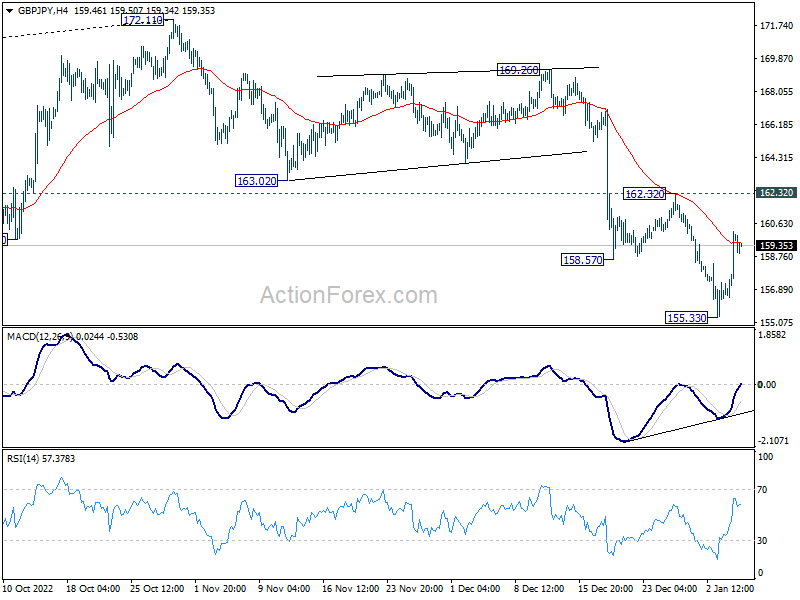
Intraday bias in GBP/JPY is turned neutral first with current recovery. Further decline is still expected as long as 162.32 resistance holds. Break of 155.33 will resume the fall from 172.11 to 153.70 fibonacci level. Nevertheless, considering bullish convergence condition in 4 hour MACD, firm break of 162.32 will argue that such decline has completed, and turn bias back to the upside for 55 day EMA (now at 163.71) and above.
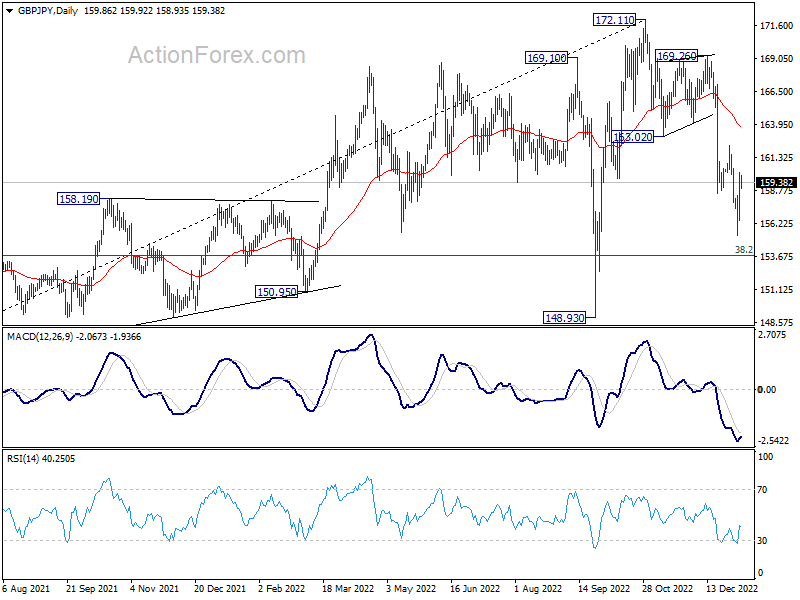
In the bigger picture, a medium term top was in place at 172.11 on on bearish divergence condition in weekly MACD. Decline from there should target 38.2% retracement of 123.94 to 172.11 at 153.70. Sustained break there will raise the change of trend reversal and target 61.8% retracement at 142.34. Nevertheless, break of 153.02 support turned resistance will argue that the decline has completed, and retain medium term bullishness.
Dollar Shrugs FOMC Minutes, Yen Continues to Reverse
Overall, the movements in the markets remain indecisive. Yen is staying soft after reversing all of earlier gains in the week, but holds above near term support levels. Dollar is stuck in familiar range against European majors and commodity currencies. The hawkish FOMC minutes provided no inspiration to the greenback. While Aussie surged yesterday, there is no follow through buying so far. Traders are generally on the sideline awaiting tomorrow's non-farm payroll data from the US.
Technically, as Yen crosses are rebounding, attention will be on some near term resistance levels, including 134.49 resistance in USD/JPY, 142.92 resistance in EUR/JPY and 162.32 resistance in GBP/JPY. As long as these levels hold, more downside is still expected in these crosses ahead. However, firm break of these levels together will argue that Yen is under some persistent selling pressure.
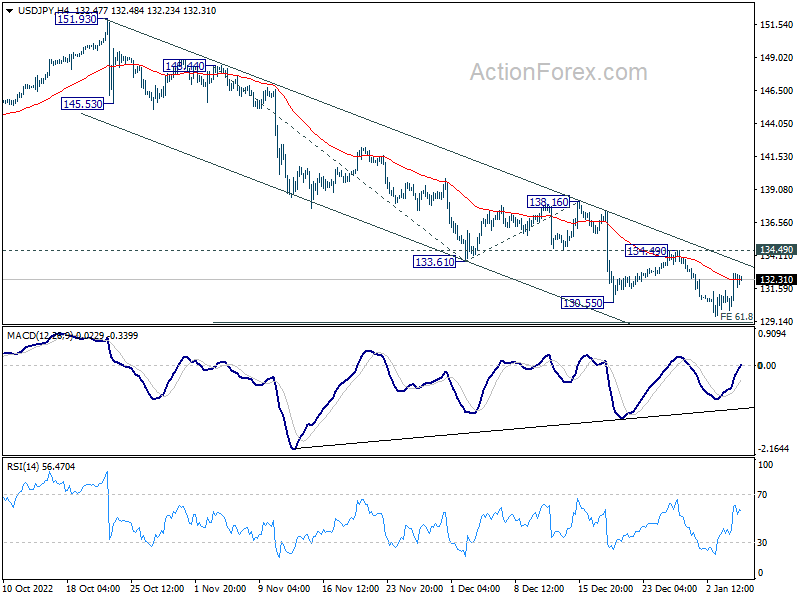
In Asia, at the time of writing, Nikkei is up 0.38%. Hong Kong HSI is up 1.38%. China Shanghai SSE is up 1.06%. Singapore Strait Times is up 1.54%. Japan 10-year JGB yield is down -0.0313 at 0.433. Overnight, DOW rose 0.40%. S&P 500 rose 0.75%. NASDAQ rose 0.69%. 10-year yield dropped -0.084 to 3.709.
FOMC Minutes: Anticipate ongoing rate hikes appropriate
In the minutes of the December FOMC meeting, the participants agreed that inflation was "unacceptably high". They "concurred" that inflation data showed "welcome reductions in the monthly pace of price increases", but "stressed that it would take substantially more evidence of progress to be confident that inflation was on a sustained downward path."
Also, participants noted that risk to inflation outlook remained "tilted to the upside", with possibility of "more persistent than anticipate" price pressures. Meanwhile, risks to economic activity outlook were "weighted to the downside".
Participants continued to anticipate that "ongoing increases in the target range for the federal funds rate would be appropriate". "No participant" anticipated that it's appropriate to start lowering rates in 2023. They generally observed that a "restrictive policy stance would need to be maintained" for some time. Also, "several participants commented that historical experience cautioned against prematurely loosening monetary policy."
China Caixin PMI composite improved to 48.3, continuing contraction
China Caixin PMI Services rose from 46.7 to 48.0 in December, above expectation of 47.5. PMI Composite rose from 47.0 to 48.3, pointing to contraction in business activity for the fourth straight month.
Wang Zhe, Senior Economist at Caixin Insight Group said: "Both manufacturing and services sectors' supply and demand contracted due to the pandemic, with manufacturing demand taking a harder hit than in November. Overseas demand was weak, employment remained sluggish, but inflationary pressure was modest, and optimism among businesses significantly improved.
"Covid outbreaks rapidly spread across China in November, causing a number of macroeconomic indicators to fall sharply. On Dec. 7, China announced 10 new measures to further optimize Covid containment. In the short term, infections are expected to explode, which will disrupt production and everyday life. How to effectively coordinate Covid controls with economic and social development has once again become a crucial question."
Looking ahead
Germany trade balance, Eurozone PPI, UK PMI Services final will be released in European session. Later in the day, Canada will release trade balance. US will release ADP employment, jobless claims, trade balance and PMI services final.
GBP/JPY Daily Outlook
Daily Pivots: (S1) 157.61; (P) 158.89; (R1) 161.28; More...
Intraday bias in GBP/JPY is turned neutral first with current recovery. Further decline is still expected as long as 162.32 resistance holds. Break of 155.33 will resume the fall from 172.11 to 153.70 fibonacci level. Nevertheless, considering bullish convergence condition in 4 hour MACD, firm break of 162.32 will argue that such decline has completed, and turn bias back to the upside for 55 day EMA (now at 163.71) and above.
In the bigger picture, a medium term top was in place at 172.11 on on bearish divergence condition in weekly MACD. Decline from there should target 38.2% retracement of 123.94 to 172.11 at 153.70. Sustained break there will raise the change of trend reversal and target 61.8% retracement at 142.34. Nevertheless, break of 153.02 support turned resistance will argue that the decline has completed, and retain medium term bullishness.
Economic Indicators Update
| GMT | Ccy | Events | Actual | Forecast | Previous | Revised |
|---|---|---|---|---|---|---|
| 23:50 | JPY | Monetary Base Y/Y Dec | -6.10% | -3.20% | -6.40% | |
| 01:45 | CNY | Caixin Services PMI Dec | 48 | 47.5 | 46.7 | |
| 05:00 | JPY | Consumer Confidence Index Dec | 30.3 | 29.1 | 28.6 | |
| 07:00 | EUR | Germany Trade Balance (EUR) Nov | 7.5B | 6.9B | ||
| 09:30 | GBP | Services PMI Dec F | 50 | 50 | ||
| 10:00 | EUR | Eurozone PPI M/M Nov | -0.80% | -2.90% | ||
| 10:00 | EUR | Eurozone PPI Y/Y Nov | 28.20% | 30.80% | ||
| 12:30 | USD | Challenger Job Cuts Y/Y Dec | 416.50% | |||
| 13:15 | USD | ADP Employment Change Dec | 145K | 127K | ||
| 13:30 | USD | Initial Jobless Claims (Dec 30) | 230K | 225K | ||
| 13:30 | USD | Trade Balance (USD) Nov | -74.6B | -78.2B | ||
| 13:30 | CAD | Trade Balance (CAD) Nov | 1.2B | 1.2B | ||
| 14:45 | USD | Services PMI Dec F | 44.4 | 44.4 | ||
| 15:30 | USD | Natural Gas Storage | -230B | -213B | ||
| 16:00 | USD | Crude Oil Inventories | 1.5M | 0.7M |